International Journal of Electronics and Communication Engineering & Technology (IJECET), ISSN 0976 –
6464(Print), ISSN 0976 – 6472(Online), Volume 5, Issue 2, February (2014), pp. 98-102 © IAEME
98
TWO ELEMENT U - SLOT LOADED CIRCULAR MICROSTRIP ARRAY
ANTENNA FOR WLAN APPLICATIONS
Dr. Nagraj K. Kulkarni
Government College, Gulbarga-585105, Karkataka, India
ABSTRACT
This paper presents the two element U- slot loaded circular microstrip array antenna for dual
band operation. The antenna operates between 2.6 to 7.00 GHz. The antenna has been fabricated
with a volume of 9 X 5 X 0.16 cm3
. The maximum bandwidth of 44.90% is achieved. With a peak
gain of 5.24 dB is obtained in primary band. The antenna exhibits a broadside and linear radiation
characteristics. The results are presented and discussed. This antenna may find its applications in
WLAN communication system.
Keywords: Two Element, Circular, Microstrip Antenna, Size Reduction.
1. INTRODUCTION
In today’s era microstrip antennas (MSAs) have become the attractive candidate for the
antenna designers because of their inherent features such as light weight, low profile, compatibility
with MMICs [1] etc. The patch antennas are receiving increasing interest in modern communication
systems such as WLAN, WiMAX, HIPERLAN/2 etc, because of their many advantages over
traditional microwave antennas in terms of achieving dual, triple and multiple bands which are
realized by using different techniques such as, cutting slots of different geometries like rectangular,
L- shape, E-shape, circular shape, square shape [2-7] etc. In many applications, the wide bandwidth
and gain are the essential needs to use the antenna for specific applications. During past years, many
efforts have been put forth to realize bandwidth widening techniques of microstrip antennas, which
include the use of impedance matching, multiple resonators and a thick substrate [8, 9] etc. But, the
two element array antenna having a U shaped slots on the circular radiating patch and plus shaped
slots on the ground plane is used for enhancing the bandwidth and gain. This kind of study is found
to be rare in the literature. The slot loading technique provides the freedom to design the required
slot irrespective of their size or shape and can be suitably loaded at the desired place on the geometry
of the antenna for broadening the bandwidth of the antenna [9]. Also, the array technique, gives the
INTERNATIONAL JOURNAL OF ELECTRONICS AND
COMMUNICATION ENGINEERING & TECHNOLOGY (IJECET)
ISSN 0976 – 6464(Print)
ISSN 0976 – 6472(Online)
Volume 5, Issue 2, February (2014), pp. 98-102
© IAEME: www.iaeme.com/ijecet.asp
Journal Impact Factor (2014): 7.2836 (Calculated by GISI)
www.jifactor.com
IJECET
© I A E M E
International Journal of Electronics and Communication Engineering & Technology (IJECET), ISSN 0976 –
6464(Print), ISSN 0976 – 6472(Online), Volume 5, Issue 2, February (2014), pp. 98-102 © IAEME
99
flexibility to design the required feed line between the array elements to energize, which helps in
enhancing the gain of the antenna [10].
2. DESIGN AND EXPERIMENTAL RESULTS
The antenna is fabricated using low-cost glass epoxy substrate material of thickness h = 1.6
mm and dielectric constant εr = 4.2. Artwork of the antenna is sketched using computer software
Auto-CAD 2006 to achieve better accuracy. The antenna is etched using photolithography process.
Fig. 1: Top view Geometry of TUCMAA
Figure 1 shows the top view geometry of the two element, U-slot loaded circular microstrip
array antenna(TUCMAA). The antenna has two circular patches of radius R are designed for the
resonant frequency of 3.5 GHz, using the basic equations available in the literature. The U shaped
slot of horizontal and vertical arm lengths h and v are placed on the two circular patches.
Fig. 2: Bottom view Geometry of TUCMAA
Fig. 2 shows the bottom view geometry of TUCMAA. The two plus shaped slots which are D
mm apart and each having a width 2 mm are incorporated on the ground plane such that the mid-
point of these slots lie exactly below the center of the each radiating patch. The L and H are the
horizontal and vertical arm lengths of the plus shaped slots. The dimensions D, R h, v, L and H are
taken in terms of λ0, where λ0 is the free space wavelength in millimeter corresponding to the
designed frequency of 3.5 GHz. The parallel feed arrangement is used in the present study, because
it has the advantage over series fed arrangement, that is, its wideband performance. The feed
arrangement shown in this figure is a contact feed and has the advantage that it can be etched
simultaneously along with the antenna elements. The microstripline feed arrangement is designed
using the relations available in the literature [12]. A 50 feed line of length L50 and width W50 is
connected to 100 line of length L100 and width W100 to form a two way power divider. A quarter
wave transformer of length Ltr and width Wtr is connected between 100 feed line and midpoint of
the radiating elements to establish perfect impedance matching. A 50 semi miniature–A connector
International Journal of Electronics and Communication Engineering & Technology (IJECET), ISSN 0976 –
6464(Print), ISSN 0976 – 6472(Online), Volume 5, Issue 2, February (2014), pp. 98-102 © IAEME
100
is used at the tip of the 50 feed line. The various parameters of the proposed antenna are enlisted
in Table 1.
Table 1: Various parameters of TUCMAA
Antenna
Parameters
Dimensions
in (mm)
Antenna
Parameters
Dimensions
in (mm)
R 26.6 v λ0/10
L50 21.84 WTr 0.15
W50 3.2 D λ0/1.96
L100 21.88 ASub 90
W100 0.74 BSub 50
LTr 10.92 H λ0/9.96
h λ0/10 L λ0/8.32
The Vector Network Analyzer (Germany make, Rohde and Schwarz, ZVK model 1127.8651)
is used to measure experimental return loss of TUCMAA. The experimental impedance bandwidth
over return loss less than -10 dB is calculated using the formula,
2 1
Bandwidth (%) =
C
f f
f
−
× 100 %
where, f2 and f1 are the upper and lower cut off frequencies of the resonating bands
when their return loss reaches -10 dB and fC is a centre frequency of f2 and f1.
Fig. 3: Variation of return loss versus frequency of TUCMAA
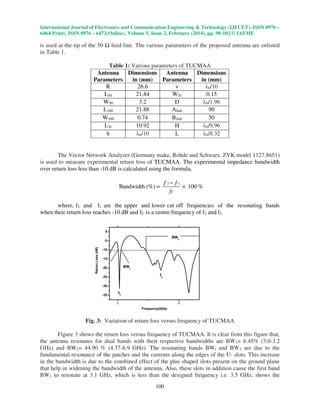
Figure 3 shows the return loss versus frequency of TUCMAA. It is clear from this figure that,
the antenna resonates for dual bands with their respective bandwidths are BW1= 6.45% (3.0-3.2
GHz) and BW2= 44.90 % (4.37-6.9 GHz). The resonating bands BW1 and BW2 are due to the
fundamental resonance of the patches and the currents along the edges of the U- slots. This increase
in the bandwidth is due to the combined effect of the plus shaped slots present on the ground plane
that help in widening the bandwidth of the antenna. Also, these slots in addition cause the first band
BW1 to resonate at 3.1 GHz, which is less than the designed frequency i.e. 3.5 GHz, shows the
International Journal of Electronics and Communication Engineering & Technology (IJECET), ISSN 0976 –
6464(Print), ISSN 0976 – 6472(Online), Volume 5, Issue 2, February (2014), pp. 98-102 © IAEME
101
virtual size reduction of about 6.01 %. Furthermore, the bandwidth of the second band BW2 is
enhanced to a maximum of 44.90%.
Fig. 4: Radiation pattern of TUCMAA
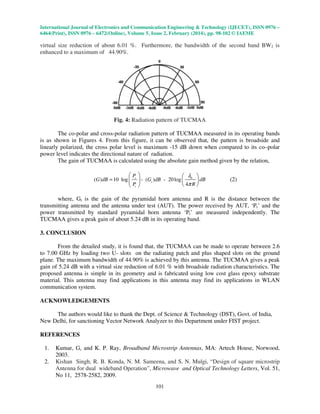
The co-polar and cross-polar radiation pattern of TUCMAA measured in its operating bands
is as shown in Figures 4. From this figure, it can be observed that, the pattern is broadside and
linearly polarized, the cross polar level is maximum -15 dB down when compared to its co–polar
power level indicates the directional nature of radiation.
The gain of TUCMAA is calculated using the absolute gain method given by the relation,
0
( ) 10 log - ( ) - 20log
4
r
t
t
P
G dB G dB dB
P R
λ
π
=
   
  
  
(2)
where, Gt is the gain of the pyramidal horn antenna and R is the distance between the
transmitting antenna and the antenna under test (AUT). The power received by AUT, ‘Pr’ and the
power transmitted by standard pyramidal horn antenna ‘Pt’ are measured independently. The
TUCMAA gives a peak gain of about 5.24 dB in its operating band.
3. CONCLUSION
From the detailed study, it is found that, the TUCMAA can be made to operate between 2.6
to 7.00 GHz by loading two U- slots on the radiating patch and plus shaped slots on the ground
plane. The maximum bandwidth of 44.90% is achieved by this antenna. The TUCMAA gives a peak
gain of 5.24 dB with a virtual size reduction of 6.01 % with broadside radiation characteristics. The
proposed antenna is simple in its geometry and is fabricated using low cost glass epoxy substrate
material. This antenna may find applications in this antenna may find its applications in WLAN
communication system.
ACKNOWLEDGEMENTS
The authors would like to thank the Dept. of Science & Technology (DST), Govt. of India,
New Delhi, for sanctioning Vector Network Analyzer to this Department under FIST project.
REFERENCES
1. Kumar, G, and K. P. Ray, Broadband Microstrip Antennas, MA: Artech House, Norwood,
2003.
2. Kishan Singh, R. B. Konda, N. M. Sameena, and S. N. Mulgi, “Design of square microstrip
Antenna for dual wideband Operation”, Microwave and Optical Technology Letters, Vol. 51,
No 11, 2578-2582, 2009.
International Journal of Electronics and Communication Engineering & Technology (IJECET),
6464(Print), ISSN 0976 – 6472(Online), Volume 5, Issue 2, February (2014), pp.
3. Ge,Y., K.P.Esselle, and T.S.Bird
compatible feed,” Microwave and Optical Technology Letters
4. Kuo, J.S, and K.L. Wong, “A compact
plane,” Microwave and Optical Technology Letters
5. Ray, K.P., S. Ghosh, and K.Nirmala, “Multi layer multi
for broad band and dual band operations,”
47, 489-494, 2005.
6. Behera,. S, and Vinoy, K.J, “Microstrip square ring antenna for dual band operation,”
Progress In Electromagnetics Research, PIER 93,
7. Sadat,S., Fardis, M., Geran, F, and Dadashzadeh, G, “A compact microstrip square
antenna for UWB applications,”
2007.
8. Roy .J.S., Chattoraj, and N. Swain, “
communications,” Microwave and Optical Technology Letters
9. Rafi, Gh. Z, and Shafai, L, “Wide
Electronics Letters, Vol. 40, No. 19, 1166
10. N. M. Sameena, R. B. Konda, and S. N. Mulgi
symmetry Microstrip array antenna,”
No. 10, 2256-2258, 2010.
11. Bahl, I. J, and P. Bhartia, Microstrip Antennas, Artech house, New Delhi, 1980.
12. Anurag Sharma, Ramesh Bharti
Microstrip Patch Antenna”,
Engineering & Technology (IJECET)
0976- 6464, ISSN Online: 0976
13. Nagraj Kulkarni and S. N. Mulgi, “Corner Truncated Inverted U
Rectangular Microstrip Antenna for Wlan Applications”
and Communication Engineering & Technology (IJECET)
ISSN Print: 0976- 6464, ISSN Online: 0976
14. M. Veereshappa and Dr.S.N Mulgi, “Corner Truncated Rectangular Slot Loaded Monopole
Microstrip Antennas for Quad
and Communication Engineering & Technology (IJECET)
pp. 165 - 171, ISSN Print: 0976
BIO-DATA
Dr. Nagraj K. Kulkarni
Electronics from Gulbarga University Gulbarga in the year 1995, 1996 and 2014
respectively. He is working as an Assis
Electronics Government Deg
field of Microwave Electronics.
International Journal of Electronics and Communication Engineering & Technology (IJECET),
6472(Online), Volume 5, Issue 2, February (2014), pp. 98-102 © IAEME
102
Ge,Y., K.P.Esselle, and T.S.Bird, “ A broadband E-shaped patch antenna with microstrip
Microwave and Optical Technology Letters, Vol .42, No.2,
Kuo, J.S, and K.L. Wong, “A compact microstrip antenna with meandered slots
d Optical Technology Letters, Vol. 29, 95-97, 2001.
Ray, K.P., S. Ghosh, and K.Nirmala, “Multi layer multi-resonator circular microstrip antenna
for broad band and dual band operations,” Microwave and Optical Technology Letters
Behera,. S, and Vinoy, K.J, “Microstrip square ring antenna for dual band operation,”
Progress In Electromagnetics Research, PIER 93, 41–56, 2009.
Sadat,S., Fardis, M., Geran, F, and Dadashzadeh, G, “A compact microstrip square
applications,” Progress In Electromagnetic Research PIER
Roy .J.S., Chattoraj, and N. Swain, “short circuited microstrip antenna for multi
Microwave and Optical Technology Letters, Vol .48, 2372
Rafi, Gh. Z, and Shafai, L, “Wideband V-slotted diamond-shaped microstrip
40, No. 19, 1166-1167, 2004.
N. M. Sameena, R. B. Konda, and S. N. Mulgi, “Broadband, high-gain Complementary
symmetry Microstrip array antenna,” Microwave and Optical Technology Letters
Bahl, I. J, and P. Bhartia, Microstrip Antennas, Artech house, New Delhi, 1980.
Anurag Sharma, Ramesh Bharti and Archanaagarwal, “Enhanced Bandwidth Slotted
”, International Journal of Electronics and Communication
Engineering & Technology (IJECET), Volume 4, Issue 2, 2013, pp. 41 -
6464, ISSN Online: 0976 –6472.
Kulkarni and S. N. Mulgi, “Corner Truncated Inverted U - Slot Triple Band Tunable
Rectangular Microstrip Antenna for Wlan Applications” International Journal of Electronics
and Communication Engineering & Technology (IJECET), Volume 3, Issue 1, 2012, pp.
6464, ISSN Online: 0976 –6472.
M. Veereshappa and Dr.S.N Mulgi, “Corner Truncated Rectangular Slot Loaded Monopole
Microstrip Antennas for Quad-Band Operation”, International Journal of Electronics
and Communication Engineering & Technology (IJECET), Volume 4, Issue 2, 2013,
171, ISSN Print: 0976- 6464, ISSN Online: 0976 –6472.
K. Kulkarni received his M.Sc, M.Phil and Ph. D degree in Applied
Electronics from Gulbarga University Gulbarga in the year 1995, 1996 and 2014
respectively. He is working as an Assistant professor and Head, in the
Electronics Government Degree College Gulbarga. He is an active researcher in the
field of Microwave Electronics.
International Journal of Electronics and Communication Engineering & Technology (IJECET), ISSN 0976 –
© IAEME
shaped patch antenna with microstrip
, Vol .42, No.2, 2004.
slots in the ground
resonator circular microstrip antenna
Microwave and Optical Technology Letters, Vol.
Behera,. S, and Vinoy, K.J, “Microstrip square ring antenna for dual band operation,”
Sadat,S., Fardis, M., Geran, F, and Dadashzadeh, G, “A compact microstrip square-ring slot
Research PIER 67, 173-179,
short circuited microstrip antenna for multi-band wireless
.48, 2372-2375, 2006.
microstrip patch antenna,”
gain Complementary-
Microwave and Optical Technology Letters, Vol. 52,
Bahl, I. J, and P. Bhartia, Microstrip Antennas, Artech house, New Delhi, 1980.
Enhanced Bandwidth Slotted
International Journal of Electronics and Communication
- 47, ISSN Print:
Slot Triple Band Tunable
International Journal of Electronics
, Volume 3, Issue 1, 2012, pp. 1 - 9,
M. Veereshappa and Dr.S.N Mulgi, “Corner Truncated Rectangular Slot Loaded Monopole
International Journal of Electronics
, Volume 4, Issue 2, 2013,
his M.Sc, M.Phil and Ph. D degree in Applied
Electronics from Gulbarga University Gulbarga in the year 1995, 1996 and 2014
tant professor and Head, in the Department of
ree College Gulbarga. He is an active researcher in the

40120140502013

  • 1.
    International Journal ofElectronics and Communication Engineering & Technology (IJECET), ISSN 0976 – 6464(Print), ISSN 0976 – 6472(Online), Volume 5, Issue 2, February (2014), pp. 98-102 © IAEME 98 TWO ELEMENT U - SLOT LOADED CIRCULAR MICROSTRIP ARRAY ANTENNA FOR WLAN APPLICATIONS Dr. Nagraj K. Kulkarni Government College, Gulbarga-585105, Karkataka, India ABSTRACT This paper presents the two element U- slot loaded circular microstrip array antenna for dual band operation. The antenna operates between 2.6 to 7.00 GHz. The antenna has been fabricated with a volume of 9 X 5 X 0.16 cm3 . The maximum bandwidth of 44.90% is achieved. With a peak gain of 5.24 dB is obtained in primary band. The antenna exhibits a broadside and linear radiation characteristics. The results are presented and discussed. This antenna may find its applications in WLAN communication system. Keywords: Two Element, Circular, Microstrip Antenna, Size Reduction. 1. INTRODUCTION In today’s era microstrip antennas (MSAs) have become the attractive candidate for the antenna designers because of their inherent features such as light weight, low profile, compatibility with MMICs [1] etc. The patch antennas are receiving increasing interest in modern communication systems such as WLAN, WiMAX, HIPERLAN/2 etc, because of their many advantages over traditional microwave antennas in terms of achieving dual, triple and multiple bands which are realized by using different techniques such as, cutting slots of different geometries like rectangular, L- shape, E-shape, circular shape, square shape [2-7] etc. In many applications, the wide bandwidth and gain are the essential needs to use the antenna for specific applications. During past years, many efforts have been put forth to realize bandwidth widening techniques of microstrip antennas, which include the use of impedance matching, multiple resonators and a thick substrate [8, 9] etc. But, the two element array antenna having a U shaped slots on the circular radiating patch and plus shaped slots on the ground plane is used for enhancing the bandwidth and gain. This kind of study is found to be rare in the literature. The slot loading technique provides the freedom to design the required slot irrespective of their size or shape and can be suitably loaded at the desired place on the geometry of the antenna for broadening the bandwidth of the antenna [9]. Also, the array technique, gives the INTERNATIONAL JOURNAL OF ELECTRONICS AND COMMUNICATION ENGINEERING & TECHNOLOGY (IJECET) ISSN 0976 – 6464(Print) ISSN 0976 – 6472(Online) Volume 5, Issue 2, February (2014), pp. 98-102 © IAEME: www.iaeme.com/ijecet.asp Journal Impact Factor (2014): 7.2836 (Calculated by GISI) www.jifactor.com IJECET © I A E M E
  • 2.
    International Journal ofElectronics and Communication Engineering & Technology (IJECET), ISSN 0976 – 6464(Print), ISSN 0976 – 6472(Online), Volume 5, Issue 2, February (2014), pp. 98-102 © IAEME 99 flexibility to design the required feed line between the array elements to energize, which helps in enhancing the gain of the antenna [10]. 2. DESIGN AND EXPERIMENTAL RESULTS The antenna is fabricated using low-cost glass epoxy substrate material of thickness h = 1.6 mm and dielectric constant εr = 4.2. Artwork of the antenna is sketched using computer software Auto-CAD 2006 to achieve better accuracy. The antenna is etched using photolithography process. Fig. 1: Top view Geometry of TUCMAA Figure 1 shows the top view geometry of the two element, U-slot loaded circular microstrip array antenna(TUCMAA). The antenna has two circular patches of radius R are designed for the resonant frequency of 3.5 GHz, using the basic equations available in the literature. The U shaped slot of horizontal and vertical arm lengths h and v are placed on the two circular patches. Fig. 2: Bottom view Geometry of TUCMAA Fig. 2 shows the bottom view geometry of TUCMAA. The two plus shaped slots which are D mm apart and each having a width 2 mm are incorporated on the ground plane such that the mid- point of these slots lie exactly below the center of the each radiating patch. The L and H are the horizontal and vertical arm lengths of the plus shaped slots. The dimensions D, R h, v, L and H are taken in terms of λ0, where λ0 is the free space wavelength in millimeter corresponding to the designed frequency of 3.5 GHz. The parallel feed arrangement is used in the present study, because it has the advantage over series fed arrangement, that is, its wideband performance. The feed arrangement shown in this figure is a contact feed and has the advantage that it can be etched simultaneously along with the antenna elements. The microstripline feed arrangement is designed using the relations available in the literature [12]. A 50 feed line of length L50 and width W50 is connected to 100 line of length L100 and width W100 to form a two way power divider. A quarter wave transformer of length Ltr and width Wtr is connected between 100 feed line and midpoint of the radiating elements to establish perfect impedance matching. A 50 semi miniature–A connector
  • 3.
    International Journal ofElectronics and Communication Engineering & Technology (IJECET), ISSN 0976 – 6464(Print), ISSN 0976 – 6472(Online), Volume 5, Issue 2, February (2014), pp. 98-102 © IAEME 100 is used at the tip of the 50 feed line. The various parameters of the proposed antenna are enlisted in Table 1. Table 1: Various parameters of TUCMAA Antenna Parameters Dimensions in (mm) Antenna Parameters Dimensions in (mm) R 26.6 v λ0/10 L50 21.84 WTr 0.15 W50 3.2 D λ0/1.96 L100 21.88 ASub 90 W100 0.74 BSub 50 LTr 10.92 H λ0/9.96 h λ0/10 L λ0/8.32 The Vector Network Analyzer (Germany make, Rohde and Schwarz, ZVK model 1127.8651) is used to measure experimental return loss of TUCMAA. The experimental impedance bandwidth over return loss less than -10 dB is calculated using the formula, 2 1 Bandwidth (%) = C f f f − × 100 % where, f2 and f1 are the upper and lower cut off frequencies of the resonating bands when their return loss reaches -10 dB and fC is a centre frequency of f2 and f1. Fig. 3: Variation of return loss versus frequency of TUCMAA Figure 3 shows the return loss versus frequency of TUCMAA. It is clear from this figure that, the antenna resonates for dual bands with their respective bandwidths are BW1= 6.45% (3.0-3.2 GHz) and BW2= 44.90 % (4.37-6.9 GHz). The resonating bands BW1 and BW2 are due to the fundamental resonance of the patches and the currents along the edges of the U- slots. This increase in the bandwidth is due to the combined effect of the plus shaped slots present on the ground plane that help in widening the bandwidth of the antenna. Also, these slots in addition cause the first band BW1 to resonate at 3.1 GHz, which is less than the designed frequency i.e. 3.5 GHz, shows the
  • 4.
    International Journal ofElectronics and Communication Engineering & Technology (IJECET), ISSN 0976 – 6464(Print), ISSN 0976 – 6472(Online), Volume 5, Issue 2, February (2014), pp. 98-102 © IAEME 101 virtual size reduction of about 6.01 %. Furthermore, the bandwidth of the second band BW2 is enhanced to a maximum of 44.90%. Fig. 4: Radiation pattern of TUCMAA The co-polar and cross-polar radiation pattern of TUCMAA measured in its operating bands is as shown in Figures 4. From this figure, it can be observed that, the pattern is broadside and linearly polarized, the cross polar level is maximum -15 dB down when compared to its co–polar power level indicates the directional nature of radiation. The gain of TUCMAA is calculated using the absolute gain method given by the relation, 0 ( ) 10 log - ( ) - 20log 4 r t t P G dB G dB dB P R λ π =           (2) where, Gt is the gain of the pyramidal horn antenna and R is the distance between the transmitting antenna and the antenna under test (AUT). The power received by AUT, ‘Pr’ and the power transmitted by standard pyramidal horn antenna ‘Pt’ are measured independently. The TUCMAA gives a peak gain of about 5.24 dB in its operating band. 3. CONCLUSION From the detailed study, it is found that, the TUCMAA can be made to operate between 2.6 to 7.00 GHz by loading two U- slots on the radiating patch and plus shaped slots on the ground plane. The maximum bandwidth of 44.90% is achieved by this antenna. The TUCMAA gives a peak gain of 5.24 dB with a virtual size reduction of 6.01 % with broadside radiation characteristics. The proposed antenna is simple in its geometry and is fabricated using low cost glass epoxy substrate material. This antenna may find applications in this antenna may find its applications in WLAN communication system. ACKNOWLEDGEMENTS The authors would like to thank the Dept. of Science & Technology (DST), Govt. of India, New Delhi, for sanctioning Vector Network Analyzer to this Department under FIST project. REFERENCES 1. Kumar, G, and K. P. Ray, Broadband Microstrip Antennas, MA: Artech House, Norwood, 2003. 2. Kishan Singh, R. B. Konda, N. M. Sameena, and S. N. Mulgi, “Design of square microstrip Antenna for dual wideband Operation”, Microwave and Optical Technology Letters, Vol. 51, No 11, 2578-2582, 2009.
  • 5.
    International Journal ofElectronics and Communication Engineering & Technology (IJECET), 6464(Print), ISSN 0976 – 6472(Online), Volume 5, Issue 2, February (2014), pp. 3. Ge,Y., K.P.Esselle, and T.S.Bird compatible feed,” Microwave and Optical Technology Letters 4. Kuo, J.S, and K.L. Wong, “A compact plane,” Microwave and Optical Technology Letters 5. Ray, K.P., S. Ghosh, and K.Nirmala, “Multi layer multi for broad band and dual band operations,” 47, 489-494, 2005. 6. Behera,. S, and Vinoy, K.J, “Microstrip square ring antenna for dual band operation,” Progress In Electromagnetics Research, PIER 93, 7. Sadat,S., Fardis, M., Geran, F, and Dadashzadeh, G, “A compact microstrip square antenna for UWB applications,” 2007. 8. Roy .J.S., Chattoraj, and N. Swain, “ communications,” Microwave and Optical Technology Letters 9. Rafi, Gh. Z, and Shafai, L, “Wide Electronics Letters, Vol. 40, No. 19, 1166 10. N. M. Sameena, R. B. Konda, and S. N. Mulgi symmetry Microstrip array antenna,” No. 10, 2256-2258, 2010. 11. Bahl, I. J, and P. Bhartia, Microstrip Antennas, Artech house, New Delhi, 1980. 12. Anurag Sharma, Ramesh Bharti Microstrip Patch Antenna”, Engineering & Technology (IJECET) 0976- 6464, ISSN Online: 0976 13. Nagraj Kulkarni and S. N. Mulgi, “Corner Truncated Inverted U Rectangular Microstrip Antenna for Wlan Applications” and Communication Engineering & Technology (IJECET) ISSN Print: 0976- 6464, ISSN Online: 0976 14. M. Veereshappa and Dr.S.N Mulgi, “Corner Truncated Rectangular Slot Loaded Monopole Microstrip Antennas for Quad and Communication Engineering & Technology (IJECET) pp. 165 - 171, ISSN Print: 0976 BIO-DATA Dr. Nagraj K. Kulkarni Electronics from Gulbarga University Gulbarga in the year 1995, 1996 and 2014 respectively. He is working as an Assis Electronics Government Deg field of Microwave Electronics. International Journal of Electronics and Communication Engineering & Technology (IJECET), 6472(Online), Volume 5, Issue 2, February (2014), pp. 98-102 © IAEME 102 Ge,Y., K.P.Esselle, and T.S.Bird, “ A broadband E-shaped patch antenna with microstrip Microwave and Optical Technology Letters, Vol .42, No.2, Kuo, J.S, and K.L. Wong, “A compact microstrip antenna with meandered slots d Optical Technology Letters, Vol. 29, 95-97, 2001. Ray, K.P., S. Ghosh, and K.Nirmala, “Multi layer multi-resonator circular microstrip antenna for broad band and dual band operations,” Microwave and Optical Technology Letters Behera,. S, and Vinoy, K.J, “Microstrip square ring antenna for dual band operation,” Progress In Electromagnetics Research, PIER 93, 41–56, 2009. Sadat,S., Fardis, M., Geran, F, and Dadashzadeh, G, “A compact microstrip square applications,” Progress In Electromagnetic Research PIER Roy .J.S., Chattoraj, and N. Swain, “short circuited microstrip antenna for multi Microwave and Optical Technology Letters, Vol .48, 2372 Rafi, Gh. Z, and Shafai, L, “Wideband V-slotted diamond-shaped microstrip 40, No. 19, 1166-1167, 2004. N. M. Sameena, R. B. Konda, and S. N. Mulgi, “Broadband, high-gain Complementary symmetry Microstrip array antenna,” Microwave and Optical Technology Letters Bahl, I. J, and P. Bhartia, Microstrip Antennas, Artech house, New Delhi, 1980. Anurag Sharma, Ramesh Bharti and Archanaagarwal, “Enhanced Bandwidth Slotted ”, International Journal of Electronics and Communication Engineering & Technology (IJECET), Volume 4, Issue 2, 2013, pp. 41 - 6464, ISSN Online: 0976 –6472. Kulkarni and S. N. Mulgi, “Corner Truncated Inverted U - Slot Triple Band Tunable Rectangular Microstrip Antenna for Wlan Applications” International Journal of Electronics and Communication Engineering & Technology (IJECET), Volume 3, Issue 1, 2012, pp. 6464, ISSN Online: 0976 –6472. M. Veereshappa and Dr.S.N Mulgi, “Corner Truncated Rectangular Slot Loaded Monopole Microstrip Antennas for Quad-Band Operation”, International Journal of Electronics and Communication Engineering & Technology (IJECET), Volume 4, Issue 2, 2013, 171, ISSN Print: 0976- 6464, ISSN Online: 0976 –6472. K. Kulkarni received his M.Sc, M.Phil and Ph. D degree in Applied Electronics from Gulbarga University Gulbarga in the year 1995, 1996 and 2014 respectively. He is working as an Assistant professor and Head, in the Electronics Government Degree College Gulbarga. He is an active researcher in the field of Microwave Electronics. International Journal of Electronics and Communication Engineering & Technology (IJECET), ISSN 0976 – © IAEME shaped patch antenna with microstrip , Vol .42, No.2, 2004. slots in the ground resonator circular microstrip antenna Microwave and Optical Technology Letters, Vol. Behera,. S, and Vinoy, K.J, “Microstrip square ring antenna for dual band operation,” Sadat,S., Fardis, M., Geran, F, and Dadashzadeh, G, “A compact microstrip square-ring slot Research PIER 67, 173-179, short circuited microstrip antenna for multi-band wireless .48, 2372-2375, 2006. microstrip patch antenna,” gain Complementary- Microwave and Optical Technology Letters, Vol. 52, Bahl, I. J, and P. Bhartia, Microstrip Antennas, Artech house, New Delhi, 1980. Enhanced Bandwidth Slotted International Journal of Electronics and Communication - 47, ISSN Print: Slot Triple Band Tunable International Journal of Electronics , Volume 3, Issue 1, 2012, pp. 1 - 9, M. Veereshappa and Dr.S.N Mulgi, “Corner Truncated Rectangular Slot Loaded Monopole International Journal of Electronics , Volume 4, Issue 2, 2013, his M.Sc, M.Phil and Ph. D degree in Applied Electronics from Gulbarga University Gulbarga in the year 1995, 1996 and 2014 tant professor and Head, in the Department of ree College Gulbarga. He is an active researcher in the