SUN PATH
DIAGRAM
SUN PATH
DIAGRAM
ppt by: Kiara Alejandrino
WHAT IS THE
SUN?
WHAT IS THE
SUN?
WHAT IS THE
SUN?
WHAT IS THE
SUN?
Brightest star in the Earth’s solar system.
WHAT IS THE
SUN?
WHAT IS THE
SUN?
Brightest star in the Earth’s solar system.
Sun give us light and also serves as a valuable
source of heat energy.
Brightest star in the Earth’s solar system.
Sun give us light and also serves as a valuable
source of heat energy.
WHAT IS THE
SUN?
WHAT IS THE
SUN?
Brightest star in the Earth’s solar system.
Sun give us light and also serves as a valuable
source of heat energy.
‘Life giver’ of all living things on Earth
Brightest star in the Earth’s solar system.
Sun give us light and also serves as a valuable
source of heat energy.
‘Life giver’ of all living things on Earth
WHAT IS THE
SUN?
WHAT IS THE
SUN?
Brightest star in the Earth’s solar system.
Sun give us light and also serves as a valuable
source of heat energy.
‘Life giver’ of all living things on Earth
However, the sun also creates some
problems::
Brightest star in the Earth’s solar system.
Sun give us light and also serves as a valuable
source of heat energy.
‘Life giver’ of all living things on Earth
However, the sun also creates some
problems::
WHAT IS THE
SUN?
WHAT IS THE
SUN?
Brightest star in the Earth’s solar system.
Sun give us light and also serves as a valuable
source of heat energy.
‘Life giver’ of all living things on Earth
However, the sun also creates some
problems::
For example, extreme heat is
undesirable as it may cause a sudden
increase in bodily temperature.
Brightest star in the Earth’s solar system.
Sun give us light and also serves as a valuable
source of heat energy.
‘Life giver’ of all living things on Earth
However, the sun also creates some
problems::
For example, extreme heat is
undesirable as it may cause a sudden
increase in bodily temperature.
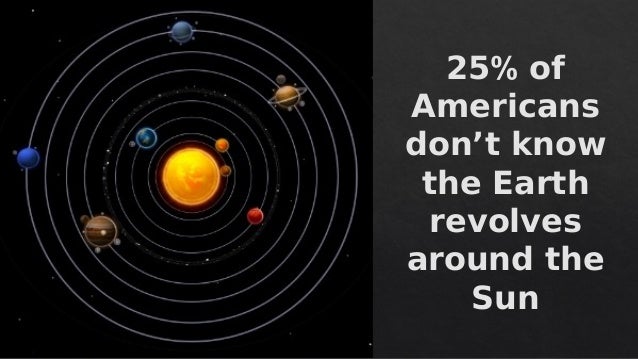
25% of
Americans
don’t know
the Earth
revolves
around the
Sun
25% of
Americans
don’t know
the Earth
revolves
around the
Sun
What is the sun’s apparent
motion?
What is the sun’s apparent
motion?
What is the sun’s apparent
motion?
What is the sun’s apparent
motion?
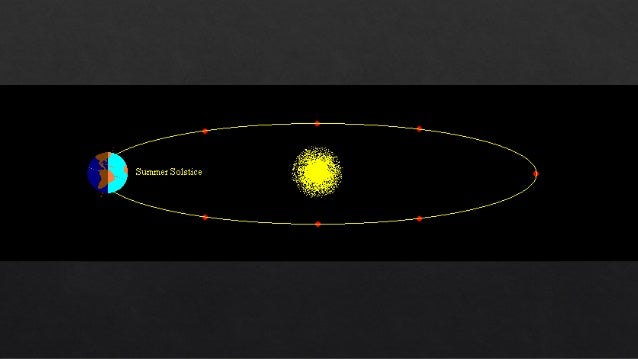
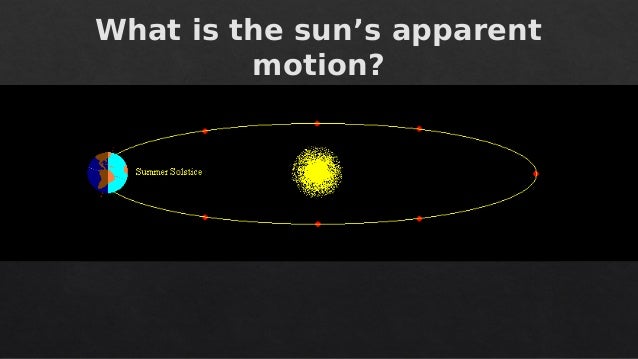
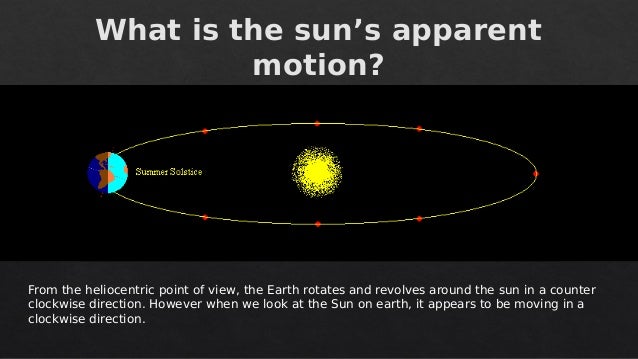
From the heliocentric point of view, the Earth rotates and revolves around the sun in a counter
clockwise direction. However when we look at the Sun on earth, it appears to be moving in a
clockwise direction.
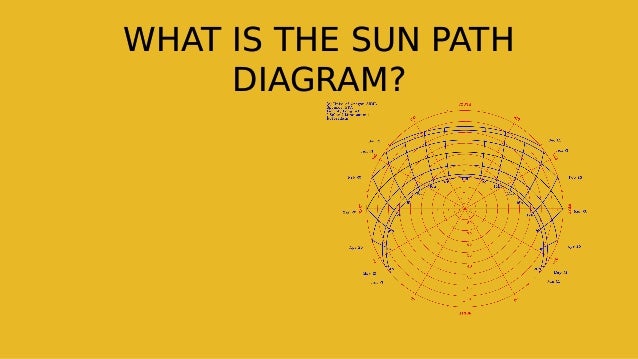
WHAT IS THE SUN PATH
DIAGRAM?
WHAT IS THE SUN PATH
DIAGRAM?
WHAT IS THE SUN PATH
DIAGRAM?
WHAT IS THE SUN PATH
DIAGRAM?
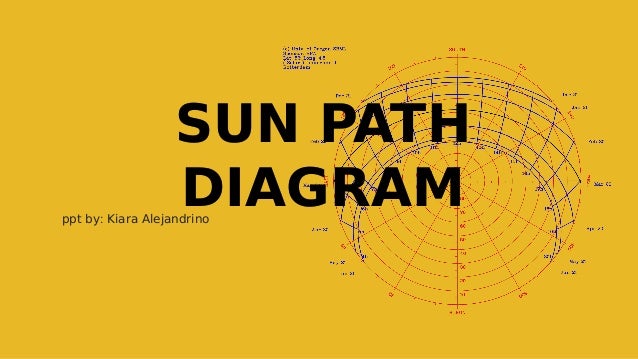
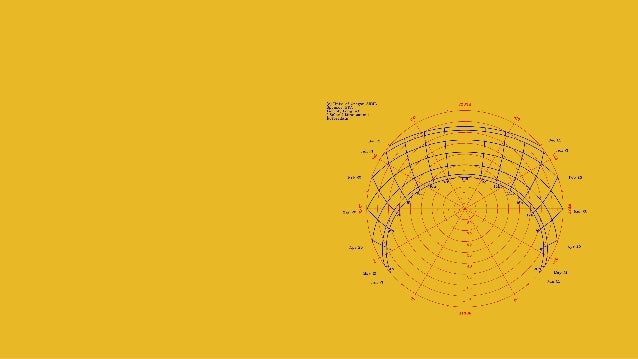
 Sun path diagrams are
representations on a flat surface of
the sun's path across the sky.
 Sun path diagrams are
representations on a flat surface of
the sun's path across the sky.
WHAT IS THE SUN PATH
DIAGRAM?
WHAT IS THE SUN PATH
DIAGRAM?
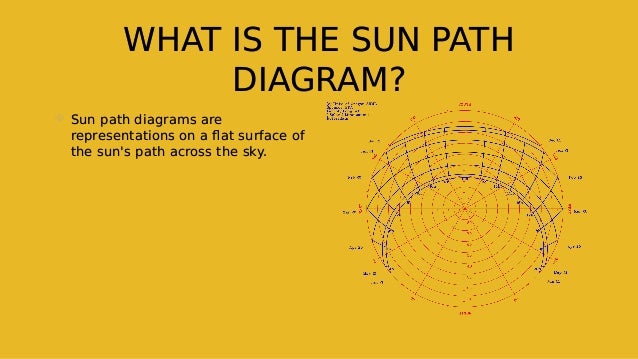
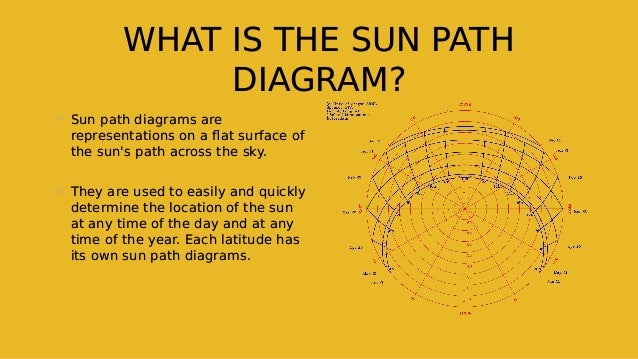
 Sun path diagrams are
representations on a flat surface of
the sun's path across the sky.
 They are used to easily and quickly
determine the location of the sun
at any time of the day and at any
time of the year. Each latitude has
its own sun path diagrams.
 Sun path diagrams are
representations on a flat surface of
the sun's path across the sky.
 They are used to easily and quickly
determine the location of the sun
at any time of the day and at any
time of the year. Each latitude has
its own sun path diagrams.
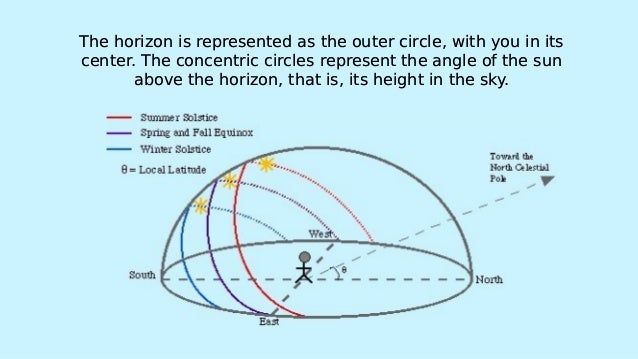
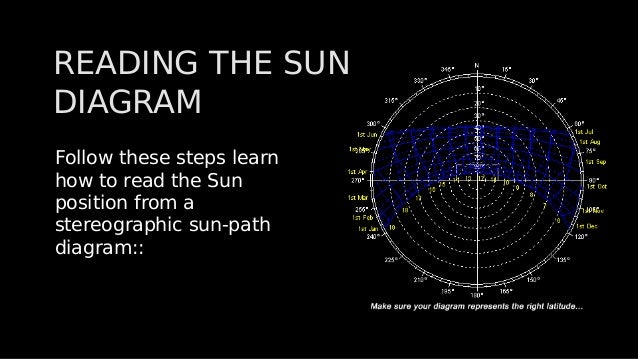
The horizon is represented as the outer circle, with you in its
center. The concentric circles represent the angle of the sun
above the horizon, that is, its height in the sky.
The horizon is represented as the outer circle, with you in its
center. The concentric circles represent the angle of the sun
above the horizon, that is, its height in the sky.
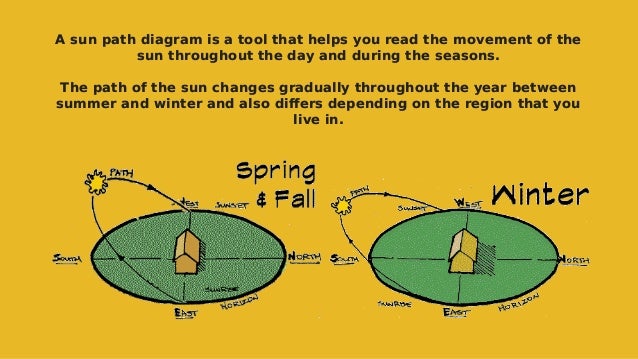
A sun path diagram is a tool that helps you read the movement of the
sun throughout the day and during the seasons.
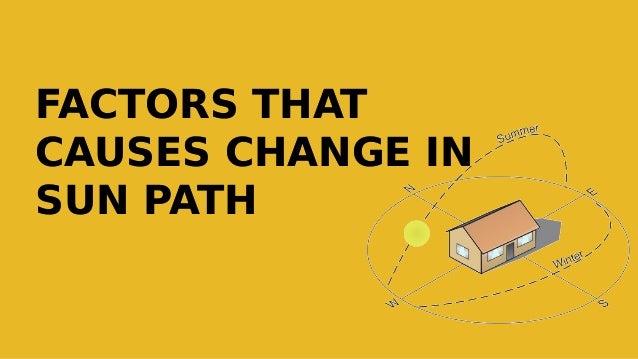
The path of the sun changes gradually throughout the year between
summer and winter and also differs depending on the region that you
live in.
A sun path diagram is a tool that helps you read the movement of the
sun throughout the day and during the seasons.
The path of the sun changes gradually throughout the year between
summer and winter and also differs depending on the region that you
live in.
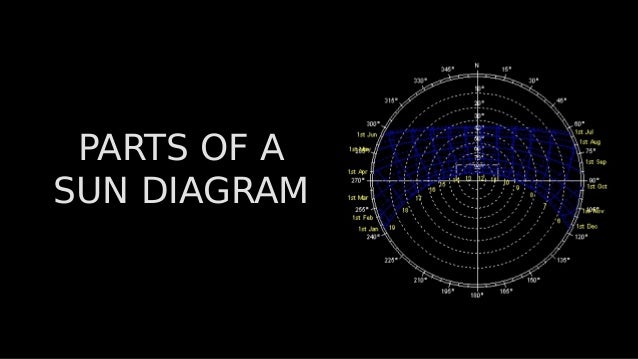
PARTS OF A
SUN DIAGRAM
PARTS OF A
SUN DIAGRAM
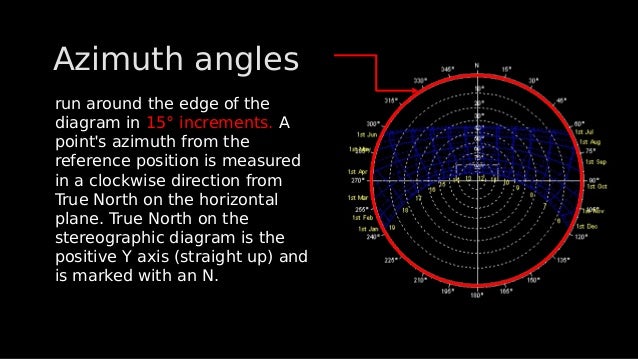
Azimuth angles
Azimuth angles
run around the edge of the
diagram in 15° increments. A
point's azimuth from the
reference position is measured
in a clockwise direction from
True North on the horizontal
plane. True North on the
stereographic diagram is the
positive Y axis (straight up) and
is marked with an N.
run around the edge of the
diagram in 15° increments. A
point's azimuth from the
reference position is measured
in a clockwise direction from
True North on the horizontal
plane. True North on the
stereographic diagram is the
positive Y axis (straight up) and
is marked with an N.
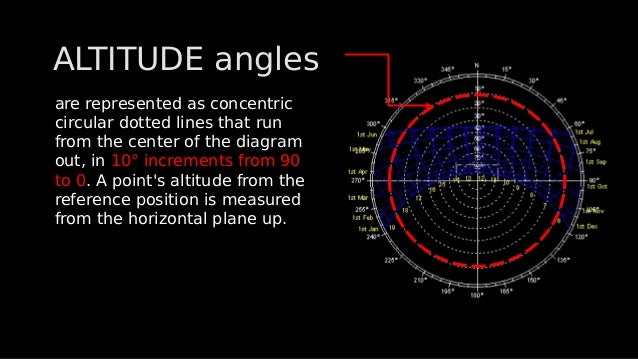
ALTITUDE angles
ALTITUDE angles
are represented as concentric
circular dotted lines that run
from the center of the diagram
out, in 10° increments from 90
to 0. A point's altitude from the
reference position is measured
from the horizontal plane up.
are represented as concentric
circular dotted lines that run
from the center of the diagram
out, in 10° increments from 90
to 0. A point's altitude from the
reference position is measured
from the horizontal plane up.
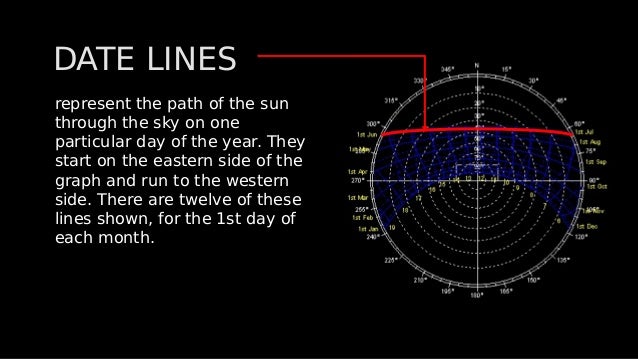
represent the path of the sun
through the sky on one
particular day of the year. They
start on the eastern side of the
graph and run to the western
side. There are twelve of these
lines shown, for the 1st day of
each month.
represent the path of the sun
through the sky on one
particular day of the year. They
start on the eastern side of the
graph and run to the western
side. There are twelve of these
lines shown, for the 1st day of
each month.
DATE LINES
DATE LINES
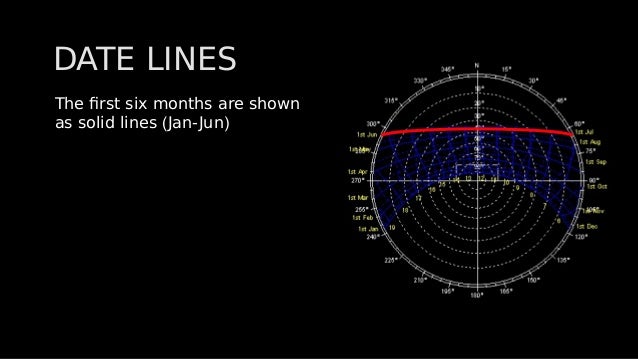
The first six months are shown
as solid lines (Jan-Jun)
The first six months are shown
as solid lines (Jan-Jun)
DATE LINES
DATE LINES
The first six months are shown
as solid lines (Jan-Jun)
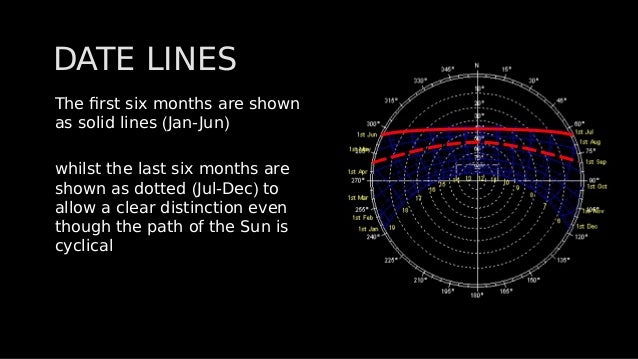
whilst the last six months are
shown as dotted (Jul-Dec) to
allow a clear distinction even
though the path of the Sun is
cyclical
The first six months are shown
as solid lines (Jan-Jun)
whilst the last six months are
shown as dotted (Jul-Dec) to
allow a clear distinction even
though the path of the Sun is
cyclical
DATE LINES
DATE LINES
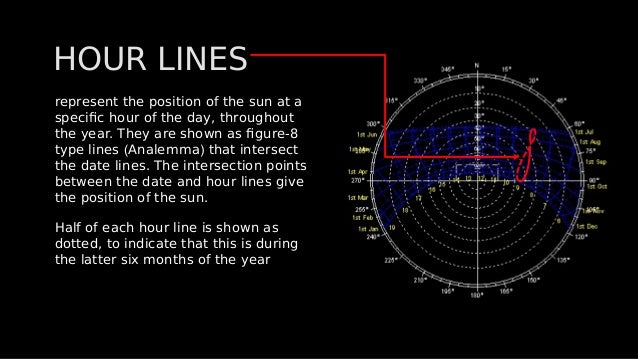
represent the position of the sun at a
specific hour of the day, throughout
the year. They are shown as figure-8
type lines (Analemma) that intersect
the date lines. The intersection points
between the date and hour lines give
the position of the sun.
Half of each hour line is shown as
dotted, to indicate that this is during
the latter six months of the year
represent the position of the sun at a
specific hour of the day, throughout
the year. They are shown as figure-8
type lines (Analemma) that intersect
the date lines. The intersection points
between the date and hour lines give
the position of the sun.
Half of each hour line is shown as
dotted, to indicate that this is during
the latter six months of the year
HOUR LINES
HOUR LINES
Follow these steps learn
how to read the Sun
position from a
stereographic sun-path
diagram::
Follow these steps learn
how to read the Sun
position from a
stereographic sun-path
diagram::
READING THE SUN
DIAGRAM
READING THE SUN
DIAGRAM
FACTORS THAT
CAUSES CHANGE IN
SUN PATH
FACTORS THAT
CAUSES CHANGE IN
SUN PATH
Location (local latitude)
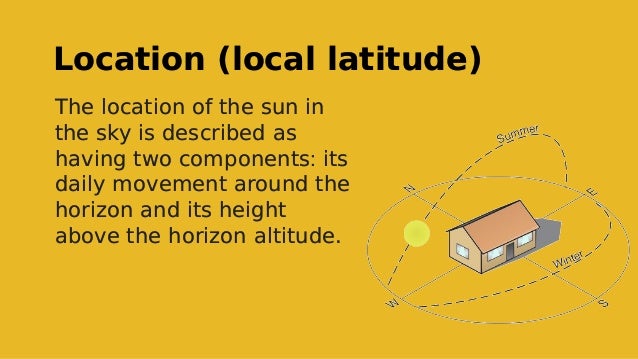
The location of the sun in
the sky is described as
having two components: its
daily movement around the
horizon and its height
above the horizon altitude.
The location of the sun in
the sky is described as
having two components: its
daily movement around the
horizon and its height
above the horizon altitude.
Rising and setting position
(based on the time of
the year)
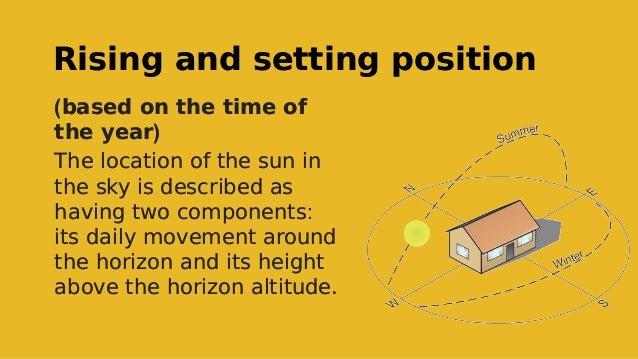
The location of the sun in
the sky is described as
having two components:
its daily movement around
the horizon and its height
above the horizon altitude.
(based on the time of
the year)
The location of the sun in
the sky is described as
having two components:
its daily movement around
the horizon and its height
above the horizon altitude.
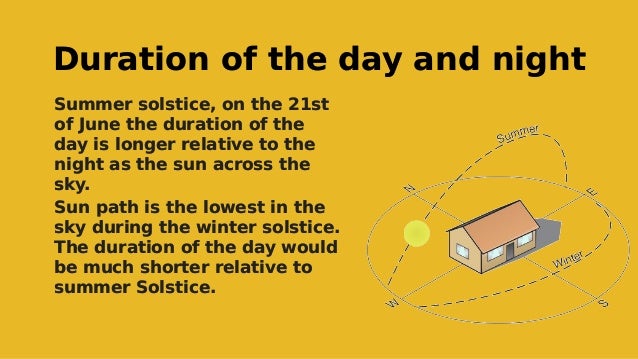
Duration of the day and night
Summer solstice, on the 21st
of June the duration of the
day is longer relative to the
night as the sun across the
sky.
Sun path is the lowest in the
sky during the winter solstice.
The duration of the day would
be much shorter relative to
summer Solstice.
Summer solstice, on the 21st
of June the duration of the
day is longer relative to the
night as the sun across the
sky.
Sun path is the lowest in the
sky during the winter solstice.
The duration of the day would
be much shorter relative to
summer Solstice.
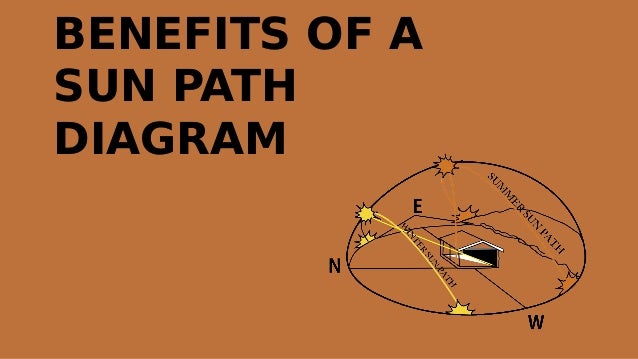
BENEFITS OF A
SUN PATH
DIAGRAM
BENEFITS OF A
SUN PATH
DIAGRAM
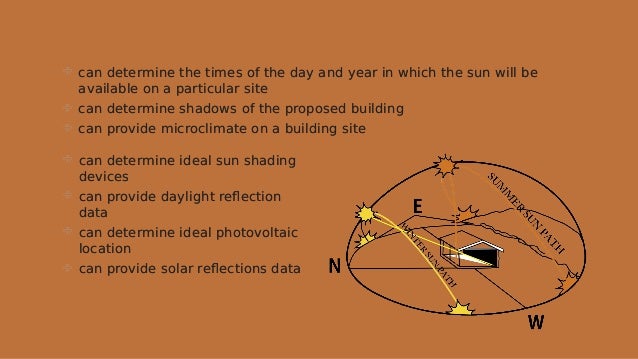
 can determine ideal sun shading
devices
 can provide daylight reflection
data
 can determine ideal photovoltaic
location
 can provide solar reflections data
 can determine ideal sun shading
devices
 can provide daylight reflection
data
 can determine ideal photovoltaic
location
 can provide solar reflections data
 can determine the times of the day and year in which the sun will be
available on a particular site
 can determine shadows of the proposed building
 can provide microclimate on a building site
 can determine the times of the day and year in which the sun will be
available on a particular site
 can determine shadows of the proposed building
 can provide microclimate on a building site
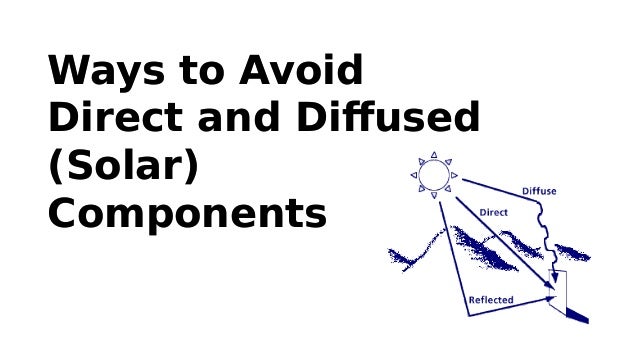
Ways to Avoid
Direct and Diffused
(Solar)
Components
Ways to Avoid
Direct and Diffused
(Solar)
Components
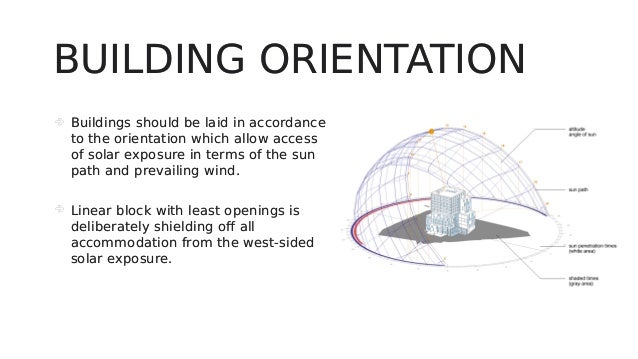
BUILDING ORIENTATION
 Buildings should be laid in accordance
to the orientation which allow access
of solar exposure in terms of the sun
path and prevailing wind.
 Linear block with least openings is
deliberately shielding off all
accommodation from the west-sided
solar exposure.
 Buildings should be laid in accordance
to the orientation which allow access
of solar exposure in terms of the sun
path and prevailing wind.
 Linear block with least openings is
deliberately shielding off all
accommodation from the west-sided
solar exposure.
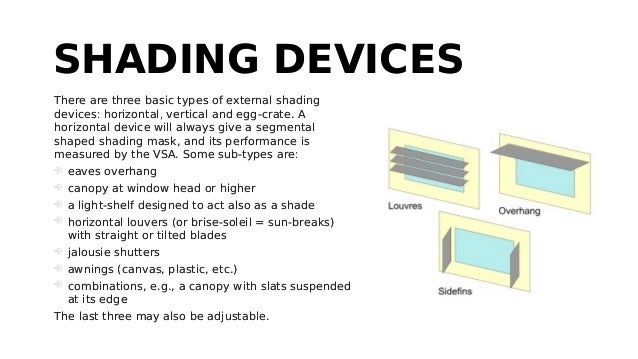
SHADING DEVICES
SHADING DEVICES
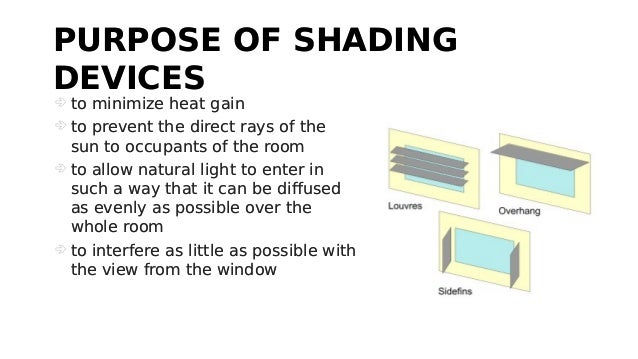
There are three basic types of external shading
devices: horizontal, vertical and egg-crate. A
horizontal device will always give a segmental
shaped shading mask, and its performance is
measured by the VSA. Some sub-types are:
 eaves overhang
 canopy at window head or higher
 a light-shelf designed to act also as a shade
 horizontal louvers (or brise-soleil = sun-breaks)
with straight or tilted blades
 jalousie shutters
 awnings (canvas, plastic, etc.)
 combinations, e.g., a canopy with slats suspended
at its edge
The last three may also be adjustable.
There are three basic types of external shading
devices: horizontal, vertical and egg-crate. A
horizontal device will always give a segmental
shaped shading mask, and its performance is
measured by the VSA. Some sub-types are:
 eaves overhang
 canopy at window head or higher
 a light-shelf designed to act also as a shade
 horizontal louvers (or brise-soleil = sun-breaks)
with straight or tilted blades
 jalousie shutters
 awnings (canvas, plastic, etc.)
 combinations, e.g., a canopy with slats suspended
at its edge
The last three may also be adjustable.
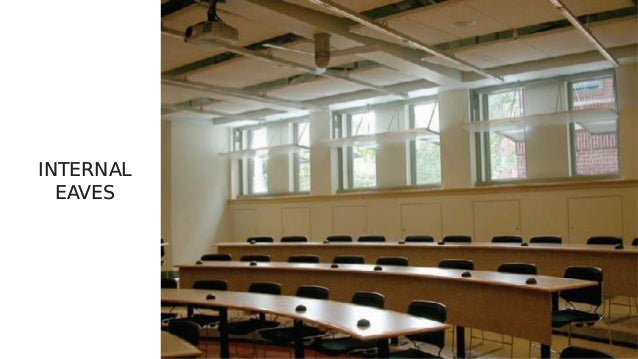
INTERNAL
EAVES
INTERNAL
EAVES
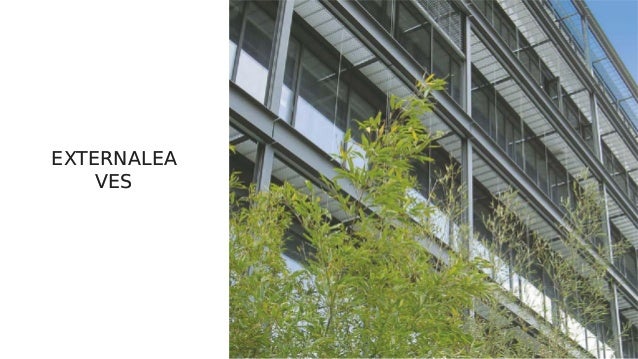
EXTERNALEA
VES
EXTERNALEA
VES
ADJUSTABLE
SHUTTERS
ADJUSTABLE
SHUTTERS
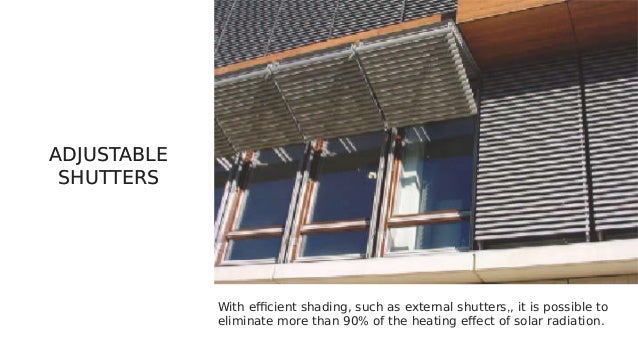
With efficient shading, such as external shutters,, it is possible to
eliminate more than 90% of the heating effect of solar radiation.
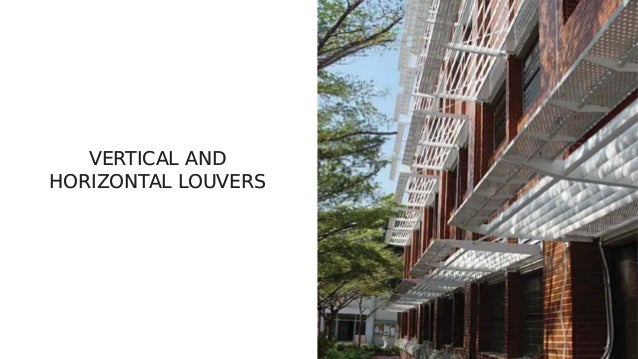
VERTICAL AND
HORIZONTAL LOUVERS
VERTICAL AND
HORIZONTAL LOUVERS
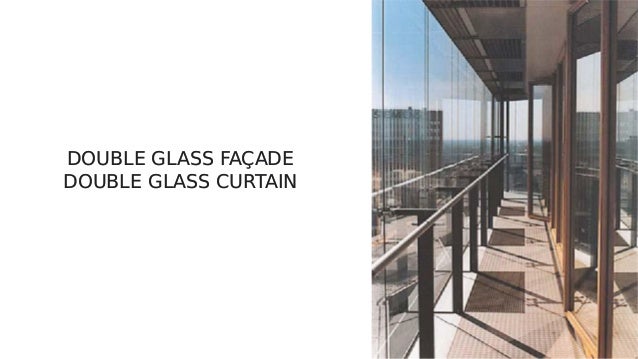
DOUBLE GLASS FAÇADE
DOUBLE GLASS CURTAIN
DOUBLE GLASS FAÇADE
DOUBLE GLASS CURTAIN
PURPOSE OF SHADING
DEVICES
PURPOSE OF SHADING
DEVICES
 to minimize heat gain
 to prevent the direct rays of the
sun to occupants of the room
 to allow natural light to enter in
such a way that it can be diffused
as evenly as possible over the
whole room
 to interfere as little as possible with
the view from the window
 to minimize heat gain
 to prevent the direct rays of the
sun to occupants of the room
 to allow natural light to enter in
such a way that it can be diffused
as evenly as possible over the
whole room
 to interfere as little as possible with
the view from the window
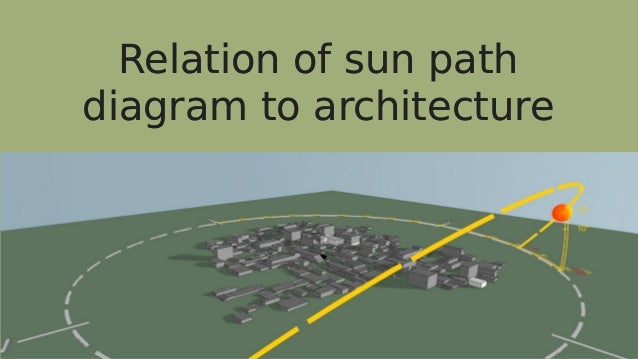
Relation of sun path
diagram to architecture
Relation of sun path
diagram to architecture
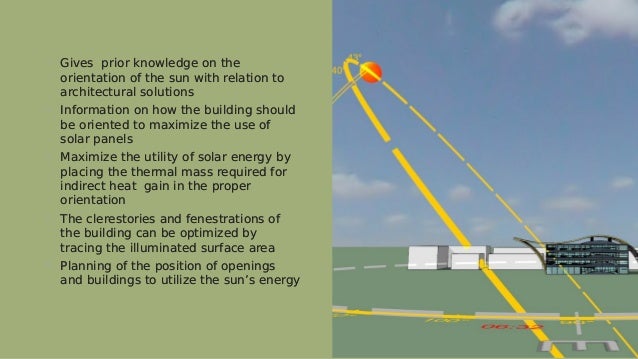
 Gives prior knowledge on the
orientation of the sun with relation to
architectural solutions
 Information on how the building should
be oriented to maximize the use of
solar panels
 Maximize the utility of solar energy by
placing the thermal mass required for
indirect heat gain in the proper
orientation
 The clerestories and fenestrations of
the building can be optimized by
tracing the illuminated surface area
 Planning of the position of openings
and buildings to utilize the sun’s energy
 Gives prior knowledge on the
orientation of the sun with relation to
architectural solutions
 Information on how the building should
be oriented to maximize the use of
solar panels
 Maximize the utility of solar energy by
placing the thermal mass required for
indirect heat gain in the proper
orientation
 The clerestories and fenestrations of
the building can be optimized by
tracing the illuminated surface area
 Planning of the position of openings
and buildings to utilize the sun’s energy
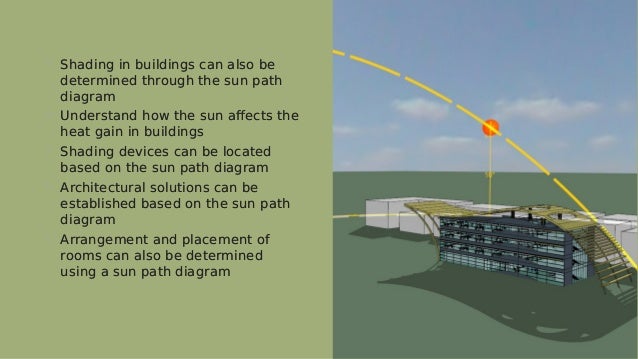
 Shading in buildings can also be
determined through the sun path
diagram
 Understand how the sun affects the
heat gain in buildings
 Shading devices can be located
based on the sun path diagram
 Architectural solutions can be
established based on the sun path
diagram
 Arrangement and placement of
rooms can also be determined
using a sun path diagram
 Shading in buildings can also be
determined through the sun path
diagram
 Understand how the sun affects the
heat gain in buildings
 Shading devices can be located
based on the sun path diagram
 Architectural solutions can be
established based on the sun path
diagram
 Arrangement and placement of
rooms can also be determined
using a sun path diagram
Relation of sun path to
tropical countries
Relation of sun path to
tropical countries
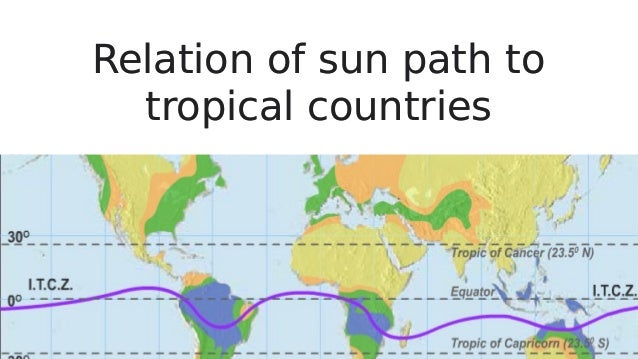
 The main factor that the sun path has
that affects tropical regions is its angle.
 The amount of heat energy received at
any location on the globe is a direct
effect of sun angle on climate, as the
angle at which sunlight strikes the
Earth varies by location, time of day,
and season.
 When sunlight shines at a lower angle,
the energy is spread at a larger area,
and is therefore weaker than an
overhead sunlight spread on a
concentrated area.
 The main factor that the sun path has
that affects tropical regions is its angle.
 The amount of heat energy received at
any location on the globe is a direct
effect of sun angle on climate, as the
angle at which sunlight strikes the
Earth varies by location, time of day,
and season.
 When sunlight shines at a lower angle,
the energy is spread at a larger area,
and is therefore weaker than an
overhead sunlight spread on a
concentrated area.
VISUALIZATION OF
THE SUN PATH IN
THE TROPICS
REGION
VISUALIZATION OF
THE SUN PATH IN
THE TROPICS
REGION
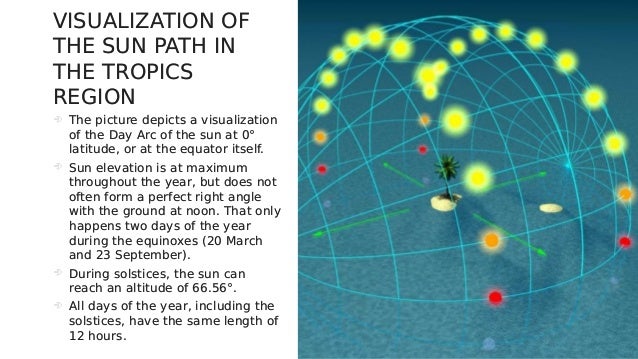
 The picture depicts a visualization
of the Day Arc of the sun at 0°
latitude, or at the equator itself.
 Sun elevation is at maximum
throughout the year, but does not
often form a perfect right angle
with the ground at noon. That only
happens two days of the year
during the equinoxes (20 March
and 23 September).
 During solstices, the sun can
reach an altitude of 66.56°.
 All days of the year, including the
solstices, have the same length of
12 hours.
 The picture depicts a visualization
of the Day Arc of the sun at 0°
latitude, or at the equator itself.
 Sun elevation is at maximum
throughout the year, but does not
often form a perfect right angle
with the ground at noon. That only
happens two days of the year
during the equinoxes (20 March
and 23 September).
 During solstices, the sun can
reach an altitude of 66.56°.
 All days of the year, including the
solstices, have the same length of
12 hours.
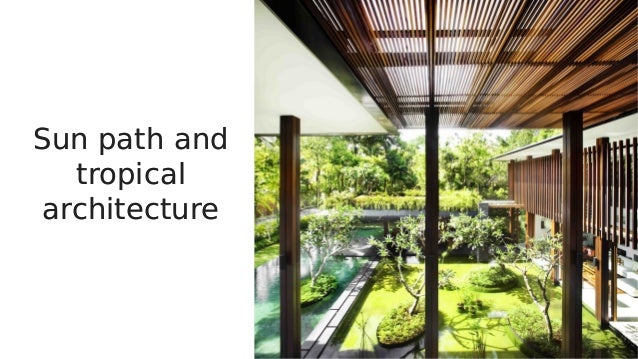
Sun path and
tropical
architecture
Sun path and
tropical
architecture
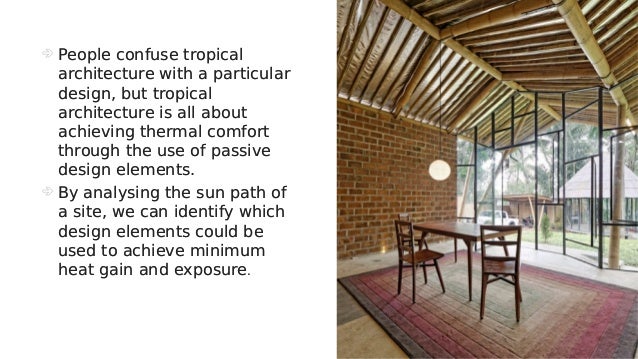
 People confuse tropical
architecture with a particular
design, but tropical
architecture is all about
achieving thermal comfort
through the use of passive
design elements.
 By analysing the sun path of
a site, we can identify which
design elements could be
used to achieve minimum
heat gain and exposure.
 People confuse tropical
architecture with a particular
design, but tropical
architecture is all about
achieving thermal comfort
through the use of passive
design elements.
 By analysing the sun path of
a site, we can identify which
design elements could be
used to achieve minimum
heat gain and exposure.
REFERENCES
REFERENCES
 https://en.wikipedia.org/wiki/Effect_of_Sun_angle_on_climate
 https://en.wikipedia.org/wiki/Sun_path
 https://en.wikipedia.org/wiki/Tropics
 https://sites.google.com/site/khavrus/public-activities/SolarEng/solenghunt
 http://
www.slideshare.net/BryllEdisonPar/case-study-of-tropical-design-of-an-architect
 https://www.educate-sustainability.eu/kb/content/sunpath-diagrams
 http://www.math.nus.edu.sg/aslaksen/gem-projects/hm/0304-1-66-
sun_and_architecture.pdf
 http://www.new-
learn.info/packages/clear/thermal/climate/sun/sunpath_diagrams.html
 http://sustainabilityworkshop.autodesk.com/buildings/reading-sun-path-diagrams
 https://en.wikipedia.org/wiki/Effect_of_Sun_angle_on_climate
 https://en.wikipedia.org/wiki/Sun_path
 https://en.wikipedia.org/wiki/Tropics
 https://sites.google.com/site/khavrus/public-activities/SolarEng/solenghunt
 http://
www.slideshare.net/BryllEdisonPar/case-study-of-tropical-design-of-an-architect
 https://www.educate-sustainability.eu/kb/content/sunpath-diagrams
 http://www.math.nus.edu.sg/aslaksen/gem-projects/hm/0304-1-66-
sun_and_architecture.pdf
 http://www.new-
learn.info/packages/clear/thermal/climate/sun/sunpath_diagrams.html
 http://sustainabilityworkshop.autodesk.com/buildings/reading-sun-path-diagrams
THANK YOU!

THANK YOU!


333530255-Sun-Path-Diagram.pdf

  • 1.
  • 3.
  • 4.
    WHAT IS THE SUN? WHATIS THE SUN? Brightest star in the Earth’s solar system. Brightest star in the Earth’s solar system.
  • 5.
    WHAT IS THE SUN? WHATIS THE SUN? Brightest star in the Earth’s solar system. Sun give us light and also serves as a valuable source of heat energy. Brightest star in the Earth’s solar system. Sun give us light and also serves as a valuable source of heat energy.
  • 6.
    WHAT IS THE SUN? WHATIS THE SUN? Brightest star in the Earth’s solar system. Sun give us light and also serves as a valuable source of heat energy. ‘Life giver’ of all living things on Earth Brightest star in the Earth’s solar system. Sun give us light and also serves as a valuable source of heat energy. ‘Life giver’ of all living things on Earth
  • 7.
    WHAT IS THE SUN? WHATIS THE SUN? Brightest star in the Earth’s solar system. Sun give us light and also serves as a valuable source of heat energy. ‘Life giver’ of all living things on Earth However, the sun also creates some problems:: Brightest star in the Earth’s solar system. Sun give us light and also serves as a valuable source of heat energy. ‘Life giver’ of all living things on Earth However, the sun also creates some problems::
  • 8.
    WHAT IS THE SUN? WHATIS THE SUN? Brightest star in the Earth’s solar system. Sun give us light and also serves as a valuable source of heat energy. ‘Life giver’ of all living things on Earth However, the sun also creates some problems:: For example, extreme heat is undesirable as it may cause a sudden increase in bodily temperature. Brightest star in the Earth’s solar system. Sun give us light and also serves as a valuable source of heat energy. ‘Life giver’ of all living things on Earth However, the sun also creates some problems:: For example, extreme heat is undesirable as it may cause a sudden increase in bodily temperature.
  • 9.
    25% of Americans don’t know theEarth revolves around the Sun 25% of Americans don’t know the Earth revolves around the Sun
  • 11.
    What is thesun’s apparent motion? What is the sun’s apparent motion?
  • 12.
    What is thesun’s apparent motion? What is the sun’s apparent motion? From the heliocentric point of view, the Earth rotates and revolves around the sun in a counter clockwise direction. However when we look at the Sun on earth, it appears to be moving in a clockwise direction.
  • 14.
    WHAT IS THESUN PATH DIAGRAM? WHAT IS THE SUN PATH DIAGRAM?
  • 15.
    WHAT IS THESUN PATH DIAGRAM? WHAT IS THE SUN PATH DIAGRAM?  Sun path diagrams are representations on a flat surface of the sun's path across the sky.  Sun path diagrams are representations on a flat surface of the sun's path across the sky.
  • 16.
    WHAT IS THESUN PATH DIAGRAM? WHAT IS THE SUN PATH DIAGRAM?  Sun path diagrams are representations on a flat surface of the sun's path across the sky.  They are used to easily and quickly determine the location of the sun at any time of the day and at any time of the year. Each latitude has its own sun path diagrams.  Sun path diagrams are representations on a flat surface of the sun's path across the sky.  They are used to easily and quickly determine the location of the sun at any time of the day and at any time of the year. Each latitude has its own sun path diagrams.
  • 17.
    The horizon isrepresented as the outer circle, with you in its center. The concentric circles represent the angle of the sun above the horizon, that is, its height in the sky. The horizon is represented as the outer circle, with you in its center. The concentric circles represent the angle of the sun above the horizon, that is, its height in the sky.
  • 18.
    A sun pathdiagram is a tool that helps you read the movement of the sun throughout the day and during the seasons. The path of the sun changes gradually throughout the year between summer and winter and also differs depending on the region that you live in. A sun path diagram is a tool that helps you read the movement of the sun throughout the day and during the seasons. The path of the sun changes gradually throughout the year between summer and winter and also differs depending on the region that you live in.
  • 19.
    PARTS OF A SUNDIAGRAM PARTS OF A SUN DIAGRAM
  • 20.
    Azimuth angles Azimuth angles runaround the edge of the diagram in 15° increments. A point's azimuth from the reference position is measured in a clockwise direction from True North on the horizontal plane. True North on the stereographic diagram is the positive Y axis (straight up) and is marked with an N. run around the edge of the diagram in 15° increments. A point's azimuth from the reference position is measured in a clockwise direction from True North on the horizontal plane. True North on the stereographic diagram is the positive Y axis (straight up) and is marked with an N.
  • 21.
    ALTITUDE angles ALTITUDE angles arerepresented as concentric circular dotted lines that run from the center of the diagram out, in 10° increments from 90 to 0. A point's altitude from the reference position is measured from the horizontal plane up. are represented as concentric circular dotted lines that run from the center of the diagram out, in 10° increments from 90 to 0. A point's altitude from the reference position is measured from the horizontal plane up.
  • 22.
    represent the pathof the sun through the sky on one particular day of the year. They start on the eastern side of the graph and run to the western side. There are twelve of these lines shown, for the 1st day of each month. represent the path of the sun through the sky on one particular day of the year. They start on the eastern side of the graph and run to the western side. There are twelve of these lines shown, for the 1st day of each month. DATE LINES DATE LINES
  • 23.
    The first sixmonths are shown as solid lines (Jan-Jun) The first six months are shown as solid lines (Jan-Jun) DATE LINES DATE LINES
  • 24.
    The first sixmonths are shown as solid lines (Jan-Jun) whilst the last six months are shown as dotted (Jul-Dec) to allow a clear distinction even though the path of the Sun is cyclical The first six months are shown as solid lines (Jan-Jun) whilst the last six months are shown as dotted (Jul-Dec) to allow a clear distinction even though the path of the Sun is cyclical DATE LINES DATE LINES
  • 25.
    represent the positionof the sun at a specific hour of the day, throughout the year. They are shown as figure-8 type lines (Analemma) that intersect the date lines. The intersection points between the date and hour lines give the position of the sun. Half of each hour line is shown as dotted, to indicate that this is during the latter six months of the year represent the position of the sun at a specific hour of the day, throughout the year. They are shown as figure-8 type lines (Analemma) that intersect the date lines. The intersection points between the date and hour lines give the position of the sun. Half of each hour line is shown as dotted, to indicate that this is during the latter six months of the year HOUR LINES HOUR LINES
  • 26.
    Follow these stepslearn how to read the Sun position from a stereographic sun-path diagram:: Follow these steps learn how to read the Sun position from a stereographic sun-path diagram:: READING THE SUN DIAGRAM READING THE SUN DIAGRAM
  • 27.
    FACTORS THAT CAUSES CHANGEIN SUN PATH FACTORS THAT CAUSES CHANGE IN SUN PATH
  • 28.
    Location (local latitude) Location(local latitude) The location of the sun in the sky is described as having two components: its daily movement around the horizon and its height above the horizon altitude. The location of the sun in the sky is described as having two components: its daily movement around the horizon and its height above the horizon altitude.
  • 29.
    Rising and settingposition Rising and setting position (based on the time of the year) The location of the sun in the sky is described as having two components: its daily movement around the horizon and its height above the horizon altitude. (based on the time of the year) The location of the sun in the sky is described as having two components: its daily movement around the horizon and its height above the horizon altitude.
  • 30.
    Duration of theday and night Duration of the day and night Summer solstice, on the 21st of June the duration of the day is longer relative to the night as the sun across the sky. Sun path is the lowest in the sky during the winter solstice. The duration of the day would be much shorter relative to summer Solstice. Summer solstice, on the 21st of June the duration of the day is longer relative to the night as the sun across the sky. Sun path is the lowest in the sky during the winter solstice. The duration of the day would be much shorter relative to summer Solstice.
  • 31.
    BENEFITS OF A SUNPATH DIAGRAM BENEFITS OF A SUN PATH DIAGRAM
  • 32.
     can determineideal sun shading devices  can provide daylight reflection data  can determine ideal photovoltaic location  can provide solar reflections data  can determine ideal sun shading devices  can provide daylight reflection data  can determine ideal photovoltaic location  can provide solar reflections data  can determine the times of the day and year in which the sun will be available on a particular site  can determine shadows of the proposed building  can provide microclimate on a building site  can determine the times of the day and year in which the sun will be available on a particular site  can determine shadows of the proposed building  can provide microclimate on a building site
  • 33.
    Ways to Avoid Directand Diffused (Solar) Components Ways to Avoid Direct and Diffused (Solar) Components
  • 35.
    BUILDING ORIENTATION BUILDING ORIENTATION Buildings should be laid in accordance to the orientation which allow access of solar exposure in terms of the sun path and prevailing wind.  Linear block with least openings is deliberately shielding off all accommodation from the west-sided solar exposure.  Buildings should be laid in accordance to the orientation which allow access of solar exposure in terms of the sun path and prevailing wind.  Linear block with least openings is deliberately shielding off all accommodation from the west-sided solar exposure.
  • 36.
    SHADING DEVICES SHADING DEVICES Thereare three basic types of external shading devices: horizontal, vertical and egg-crate. A horizontal device will always give a segmental shaped shading mask, and its performance is measured by the VSA. Some sub-types are:  eaves overhang  canopy at window head or higher  a light-shelf designed to act also as a shade  horizontal louvers (or brise-soleil = sun-breaks) with straight or tilted blades  jalousie shutters  awnings (canvas, plastic, etc.)  combinations, e.g., a canopy with slats suspended at its edge The last three may also be adjustable. There are three basic types of external shading devices: horizontal, vertical and egg-crate. A horizontal device will always give a segmental shaped shading mask, and its performance is measured by the VSA. Some sub-types are:  eaves overhang  canopy at window head or higher  a light-shelf designed to act also as a shade  horizontal louvers (or brise-soleil = sun-breaks) with straight or tilted blades  jalousie shutters  awnings (canvas, plastic, etc.)  combinations, e.g., a canopy with slats suspended at its edge The last three may also be adjustable.
  • 37.
  • 38.
  • 39.
    ADJUSTABLE SHUTTERS ADJUSTABLE SHUTTERS With efficient shading,such as external shutters,, it is possible to eliminate more than 90% of the heating effect of solar radiation.
  • 40.
  • 41.
    DOUBLE GLASS FAÇADE DOUBLEGLASS CURTAIN DOUBLE GLASS FAÇADE DOUBLE GLASS CURTAIN
  • 42.
    PURPOSE OF SHADING DEVICES PURPOSEOF SHADING DEVICES  to minimize heat gain  to prevent the direct rays of the sun to occupants of the room  to allow natural light to enter in such a way that it can be diffused as evenly as possible over the whole room  to interfere as little as possible with the view from the window  to minimize heat gain  to prevent the direct rays of the sun to occupants of the room  to allow natural light to enter in such a way that it can be diffused as evenly as possible over the whole room  to interfere as little as possible with the view from the window
  • 43.
    Relation of sunpath diagram to architecture Relation of sun path diagram to architecture
  • 44.
     Gives priorknowledge on the orientation of the sun with relation to architectural solutions  Information on how the building should be oriented to maximize the use of solar panels  Maximize the utility of solar energy by placing the thermal mass required for indirect heat gain in the proper orientation  The clerestories and fenestrations of the building can be optimized by tracing the illuminated surface area  Planning of the position of openings and buildings to utilize the sun’s energy  Gives prior knowledge on the orientation of the sun with relation to architectural solutions  Information on how the building should be oriented to maximize the use of solar panels  Maximize the utility of solar energy by placing the thermal mass required for indirect heat gain in the proper orientation  The clerestories and fenestrations of the building can be optimized by tracing the illuminated surface area  Planning of the position of openings and buildings to utilize the sun’s energy
  • 45.
     Shading inbuildings can also be determined through the sun path diagram  Understand how the sun affects the heat gain in buildings  Shading devices can be located based on the sun path diagram  Architectural solutions can be established based on the sun path diagram  Arrangement and placement of rooms can also be determined using a sun path diagram  Shading in buildings can also be determined through the sun path diagram  Understand how the sun affects the heat gain in buildings  Shading devices can be located based on the sun path diagram  Architectural solutions can be established based on the sun path diagram  Arrangement and placement of rooms can also be determined using a sun path diagram
  • 46.
    Relation of sunpath to tropical countries Relation of sun path to tropical countries
  • 47.
     The mainfactor that the sun path has that affects tropical regions is its angle.  The amount of heat energy received at any location on the globe is a direct effect of sun angle on climate, as the angle at which sunlight strikes the Earth varies by location, time of day, and season.  When sunlight shines at a lower angle, the energy is spread at a larger area, and is therefore weaker than an overhead sunlight spread on a concentrated area.  The main factor that the sun path has that affects tropical regions is its angle.  The amount of heat energy received at any location on the globe is a direct effect of sun angle on climate, as the angle at which sunlight strikes the Earth varies by location, time of day, and season.  When sunlight shines at a lower angle, the energy is spread at a larger area, and is therefore weaker than an overhead sunlight spread on a concentrated area.
  • 48.
    VISUALIZATION OF THE SUNPATH IN THE TROPICS REGION VISUALIZATION OF THE SUN PATH IN THE TROPICS REGION  The picture depicts a visualization of the Day Arc of the sun at 0° latitude, or at the equator itself.  Sun elevation is at maximum throughout the year, but does not often form a perfect right angle with the ground at noon. That only happens two days of the year during the equinoxes (20 March and 23 September).  During solstices, the sun can reach an altitude of 66.56°.  All days of the year, including the solstices, have the same length of 12 hours.  The picture depicts a visualization of the Day Arc of the sun at 0° latitude, or at the equator itself.  Sun elevation is at maximum throughout the year, but does not often form a perfect right angle with the ground at noon. That only happens two days of the year during the equinoxes (20 March and 23 September).  During solstices, the sun can reach an altitude of 66.56°.  All days of the year, including the solstices, have the same length of 12 hours.
  • 49.
    Sun path and tropical architecture Sunpath and tropical architecture
  • 50.
     People confusetropical architecture with a particular design, but tropical architecture is all about achieving thermal comfort through the use of passive design elements.  By analysing the sun path of a site, we can identify which design elements could be used to achieve minimum heat gain and exposure.  People confuse tropical architecture with a particular design, but tropical architecture is all about achieving thermal comfort through the use of passive design elements.  By analysing the sun path of a site, we can identify which design elements could be used to achieve minimum heat gain and exposure.
  • 51.
    REFERENCES REFERENCES  https://en.wikipedia.org/wiki/Effect_of_Sun_angle_on_climate  https://en.wikipedia.org/wiki/Sun_path https://en.wikipedia.org/wiki/Tropics  https://sites.google.com/site/khavrus/public-activities/SolarEng/solenghunt  http:// www.slideshare.net/BryllEdisonPar/case-study-of-tropical-design-of-an-architect  https://www.educate-sustainability.eu/kb/content/sunpath-diagrams  http://www.math.nus.edu.sg/aslaksen/gem-projects/hm/0304-1-66- sun_and_architecture.pdf  http://www.new- learn.info/packages/clear/thermal/climate/sun/sunpath_diagrams.html  http://sustainabilityworkshop.autodesk.com/buildings/reading-sun-path-diagrams  https://en.wikipedia.org/wiki/Effect_of_Sun_angle_on_climate  https://en.wikipedia.org/wiki/Sun_path  https://en.wikipedia.org/wiki/Tropics  https://sites.google.com/site/khavrus/public-activities/SolarEng/solenghunt  http:// www.slideshare.net/BryllEdisonPar/case-study-of-tropical-design-of-an-architect  https://www.educate-sustainability.eu/kb/content/sunpath-diagrams  http://www.math.nus.edu.sg/aslaksen/gem-projects/hm/0304-1-66- sun_and_architecture.pdf  http://www.new- learn.info/packages/clear/thermal/climate/sun/sunpath_diagrams.html  http://sustainabilityworkshop.autodesk.com/buildings/reading-sun-path-diagrams
  • 52.