Scaling MongoDB
Sharding into, and beyond the Multi-Terabyte Range
MongoNYC 2013
Kenny Gorman
Founder, ObjectRocket
@objectrocket @kennygorman
Philosophy
Design
@scale
Philosophy
scalability is the ability of a system, network, or
process to handle a growing amount of work in a
capable manner or its ability to be enlarged to
accommodate that growth.
- André B. Bondi, 'Characteristics of scalability and their impact on
performance', Proceedings of the 2nd international workshop on Software and
performance
Philosophy
● Benefits of scaling horizontally
○ Adding compute in linear relation to storage
○ Use many smaller systems
○ Cost benefits
○ Start small, grow over time
○ Incremental approach
Philosophy
● Do I need to scale?
yes...
and...
no...
Philosophy
● Scale vertically works only for a while
○ Ratio's get whack
○ You are going to wish you did something else for a
living
● Split workloads
○ Figure out what needs to be colocated with what.
● Then scale horizontally
○ Shard!
Design
● Scaling vertically vs horizontally
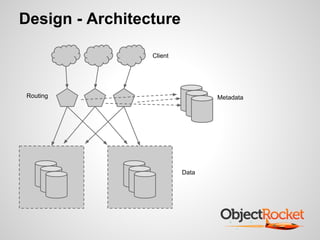
● MongoDB horizontal scalability; sharding
○ Sharding architecture
○ Sharding keys and collections
● Achieving your scaling goals
○ Tuning for writes
○ Tuning for reads
○ Lock scopes
Design - Architecture
Client
Routing Metadata
Data
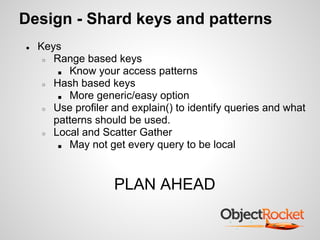
Design - Shard keys and patterns
● Keys
○ Range based keys
■ Know your access patterns
○ Hash based keys
■ More generic/easy option
○ Use profiler and explain() to identify queries and what
patterns should be used.
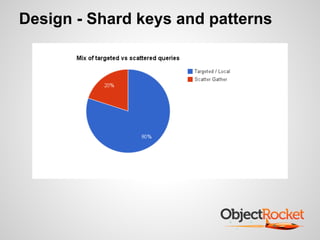
○ Local and Scatter Gather
■ May not get every query to be local
PLAN AHEAD
Design - Shard keys and patterns
Design - Sharding Collections
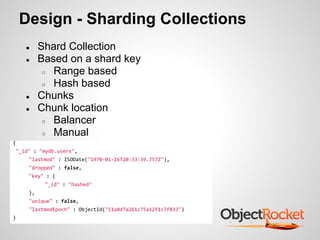
● Shard Collection
● Based on a shard key
○ Range based
○ Hash based
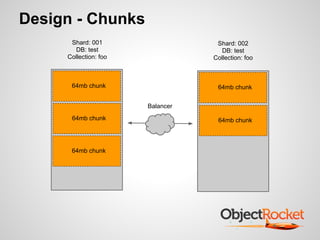
● Chunks
● Chunk location
○ Balancer
○ Manual
{
"_id" : "mydb.users",
"lastmod" : ISODate("1970-01-16T20:33:39.757Z"),
"dropped" : false,
"key" : {
"_id" : "hashed"
},
"unique" : false,
"lastmodEpoch" : ObjectId("51a8d7a261c75a12f1c7f833")
}
Design - Chunks
64mb chunk
64mb chunk
64mb chunk
64mb chunk
64mb chunk
Shard: 001
DB: test
Collection: foo
Shard: 002
DB: test
Collection: foo
Balancer
Design - Chunks
{
"_id" : "mydb.users-_id_-2315986245884394206",
"lastmod" : { "t" : 89, "i" : 0 },
"lastmodEpoch" : ObjectId("51a8d7a261c75a12f1c7f833"),
"ns" : "mydb.users",
"min" : { "_id" : NumberLong("-2315986245884394206") },
"max" : { "_id" : NumberLong("-2237069208547820477") },
"shard" : "d3b07384d113edec49eaa6238ad5ff00"}
{
"_id" : "mydb.users-_id_-2395340237016371204",
"lastmod" : { "t" : 88, "i" : 0 },
"lastmodEpoch" : ObjectId("51a8d7a261c75a12f1c7f833"),
"ns" : "mydb.users",
"min" : { "_id" : NumberLong("-2395340237016371204")},
"max" : { "_id" : NumberLong("-2315986245884394206")},
"shard" : "15e894ac57eddb32713e7eae90d13e41"
}
Design - take aways
● Getting the proper shard key is critical. Once defined it's
a pain in the a^$ to change.
● Creating a shard key that achieves your goals can
sometimes be tricky. Take time to test this portion in
dev/sandbox environments.
● Use profiler and explain() to figure out if you are using
proper keys
● Understanding the Balancer's effect on your workload is
critical. You probably need more I/O capacity than you
think.
@scale - balancing
● Balancing is hard
○ Visibility
○ Balancer process
@scale - balancing
var balance_check = function(n) {
if ( n ) {
var output = db.chunks.aggregate([
{ $group : { _id : { "_id":"$ns", "shard":"$shard" },
chunks : { $sum : 1 } }},
{ $match : { "_id._id" : n } },
{ $sort : { "chunks" : 1 } }
]);
} else {
var output = db.chunks.aggregate([
{ $group : { _id : { "_id":"$ns", "shard":"$shard" },
chunks : { $sum : 1 } }},
{ $sort : { "chunks" : 1 } }
]);
}
printjson(output);
};
https://gist.github.com/kgorman/5775530
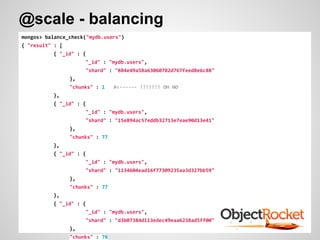
mongos> balance_check("mydb.users")
{ "result" : [
{ "_id" : {
"_id" : "mydb.users",
"shard" : "884e49a58a63060782d767feed8e6c88"
},
"chunks" : 1 #<------ !!!!!!! OH NO
},
{ "_id" : {
"_id" : "mydb.users",
"shard" : "15e894ac57eddb32713e7eae90d13e41"
},
"chunks" : 77
},
{ "_id" : {
"_id" : "mydb.users",
"shard" : "1134604ead16f77309235aa3d327bb59"
},
"chunks" : 77
},
{ "_id" : {
"_id" : "mydb.users",
"shard" : "d3b07384d113edec49eaa6238ad5ff00"
},
"chunks" : 78
@scale - balancing
@scale - balancing
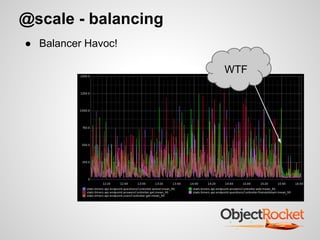
WTF
● Balancer Havoc!
@scale - balancing
● Balancer 'Fixes'
○ Pre-splitting
○ Windows
○ Micro-windows
○ Custom scripts
○ Don't use it
@scale - Monitoring
● Monitor everything. But some key items:
○ Shard size
○ Balancer on/off
○ Response time
○ Balance of OPS across shards
○ Failed migration of chunks
○ Locks
○ I/O
● Get histograms!
○ Graphite
@scale - Capacity
● Don't fail to plan
● Disk space/size is critical
○ maxSize()
○ extending disk space
○ adding cpu or memory capacity
○ Slave 'tricks'
■ Shell game
● Compute resources
● You need disk I/O no matter what anyone says.
○ Size for balancer workloads too
http://blog.foursquare.com/2010/10/05/so-that-was-a-bummer/
1. We’re making changes to our operational procedures to prevent overloading, and to ensure that
future occurrences have safeguards so foursquare stays up.
@scale
● Things to watch for
○ Out of disk space or other resources
■ Don't wait!
○ Balancer havoc
○ No more I/O left
○ Shard Asymmetry
○ Scatter gather's
● Things to ensure you do
○ Use maxSize, leave yourself a bit of wiggle room
○ Leave profiler on!
○ Explain and profile your queries
Contact
@kennygorman
@objectrocket
kgorman@objectrocket.com
https://www.objectrocket.com
WE ARE HIRING!
https://www.objectrocket.com/careers/

Scaling MongoDB; Sharding Into and Beyond the Multi-Terabyte Range

  • 1.
    Scaling MongoDB Sharding into,and beyond the Multi-Terabyte Range MongoNYC 2013 Kenny Gorman Founder, ObjectRocket @objectrocket @kennygorman
  • 2.
  • 3.
    Philosophy scalability is theability of a system, network, or process to handle a growing amount of work in a capable manner or its ability to be enlarged to accommodate that growth. - André B. Bondi, 'Characteristics of scalability and their impact on performance', Proceedings of the 2nd international workshop on Software and performance
  • 4.
    Philosophy ● Benefits ofscaling horizontally ○ Adding compute in linear relation to storage ○ Use many smaller systems ○ Cost benefits ○ Start small, grow over time ○ Incremental approach
  • 5.
    Philosophy ● Do Ineed to scale? yes... and... no...
  • 6.
    Philosophy ● Scale verticallyworks only for a while ○ Ratio's get whack ○ You are going to wish you did something else for a living ● Split workloads ○ Figure out what needs to be colocated with what. ● Then scale horizontally ○ Shard!
  • 7.
    Design ● Scaling verticallyvs horizontally ● MongoDB horizontal scalability; sharding ○ Sharding architecture ○ Sharding keys and collections ● Achieving your scaling goals ○ Tuning for writes ○ Tuning for reads ○ Lock scopes
  • 8.
  • 9.
    Design - Shardkeys and patterns ● Keys ○ Range based keys ■ Know your access patterns ○ Hash based keys ■ More generic/easy option ○ Use profiler and explain() to identify queries and what patterns should be used. ○ Local and Scatter Gather ■ May not get every query to be local PLAN AHEAD
  • 10.
    Design - Shardkeys and patterns
  • 11.
    Design - ShardingCollections ● Shard Collection ● Based on a shard key ○ Range based ○ Hash based ● Chunks ● Chunk location ○ Balancer ○ Manual { "_id" : "mydb.users", "lastmod" : ISODate("1970-01-16T20:33:39.757Z"), "dropped" : false, "key" : { "_id" : "hashed" }, "unique" : false, "lastmodEpoch" : ObjectId("51a8d7a261c75a12f1c7f833") }
  • 12.
    Design - Chunks 64mbchunk 64mb chunk 64mb chunk 64mb chunk 64mb chunk Shard: 001 DB: test Collection: foo Shard: 002 DB: test Collection: foo Balancer
  • 13.
    Design - Chunks { "_id": "mydb.users-_id_-2315986245884394206", "lastmod" : { "t" : 89, "i" : 0 }, "lastmodEpoch" : ObjectId("51a8d7a261c75a12f1c7f833"), "ns" : "mydb.users", "min" : { "_id" : NumberLong("-2315986245884394206") }, "max" : { "_id" : NumberLong("-2237069208547820477") }, "shard" : "d3b07384d113edec49eaa6238ad5ff00"} { "_id" : "mydb.users-_id_-2395340237016371204", "lastmod" : { "t" : 88, "i" : 0 }, "lastmodEpoch" : ObjectId("51a8d7a261c75a12f1c7f833"), "ns" : "mydb.users", "min" : { "_id" : NumberLong("-2395340237016371204")}, "max" : { "_id" : NumberLong("-2315986245884394206")}, "shard" : "15e894ac57eddb32713e7eae90d13e41" }
  • 14.
    Design - takeaways ● Getting the proper shard key is critical. Once defined it's a pain in the a^$ to change. ● Creating a shard key that achieves your goals can sometimes be tricky. Take time to test this portion in dev/sandbox environments. ● Use profiler and explain() to figure out if you are using proper keys ● Understanding the Balancer's effect on your workload is critical. You probably need more I/O capacity than you think.
  • 15.
    @scale - balancing ●Balancing is hard ○ Visibility ○ Balancer process
  • 16.
    @scale - balancing varbalance_check = function(n) { if ( n ) { var output = db.chunks.aggregate([ { $group : { _id : { "_id":"$ns", "shard":"$shard" }, chunks : { $sum : 1 } }}, { $match : { "_id._id" : n } }, { $sort : { "chunks" : 1 } } ]); } else { var output = db.chunks.aggregate([ { $group : { _id : { "_id":"$ns", "shard":"$shard" }, chunks : { $sum : 1 } }}, { $sort : { "chunks" : 1 } } ]); } printjson(output); }; https://gist.github.com/kgorman/5775530
  • 17.
    mongos> balance_check("mydb.users") { "result": [ { "_id" : { "_id" : "mydb.users", "shard" : "884e49a58a63060782d767feed8e6c88" }, "chunks" : 1 #<------ !!!!!!! OH NO }, { "_id" : { "_id" : "mydb.users", "shard" : "15e894ac57eddb32713e7eae90d13e41" }, "chunks" : 77 }, { "_id" : { "_id" : "mydb.users", "shard" : "1134604ead16f77309235aa3d327bb59" }, "chunks" : 77 }, { "_id" : { "_id" : "mydb.users", "shard" : "d3b07384d113edec49eaa6238ad5ff00" }, "chunks" : 78 @scale - balancing
  • 18.
  • 19.
    @scale - balancing ●Balancer 'Fixes' ○ Pre-splitting ○ Windows ○ Micro-windows ○ Custom scripts ○ Don't use it
  • 20.
    @scale - Monitoring ●Monitor everything. But some key items: ○ Shard size ○ Balancer on/off ○ Response time ○ Balance of OPS across shards ○ Failed migration of chunks ○ Locks ○ I/O ● Get histograms! ○ Graphite
  • 21.
    @scale - Capacity ●Don't fail to plan ● Disk space/size is critical ○ maxSize() ○ extending disk space ○ adding cpu or memory capacity ○ Slave 'tricks' ■ Shell game ● Compute resources ● You need disk I/O no matter what anyone says. ○ Size for balancer workloads too http://blog.foursquare.com/2010/10/05/so-that-was-a-bummer/ 1. We’re making changes to our operational procedures to prevent overloading, and to ensure that future occurrences have safeguards so foursquare stays up.
  • 22.
    @scale ● Things towatch for ○ Out of disk space or other resources ■ Don't wait! ○ Balancer havoc ○ No more I/O left ○ Shard Asymmetry ○ Scatter gather's ● Things to ensure you do ○ Use maxSize, leave yourself a bit of wiggle room ○ Leave profiler on! ○ Explain and profile your queries
  • 23.