Dr.T.V.Rao MD
HEPATITIS B INFECTION
DIAGNOSIS AND INTERPRETATION
DR.T.V.RAO MD 1
HEPATITIS B IN THE WORLD
• 2 billion people have been infected (1 out of
3 people).
• 400 million people are chronically infected.
• 10-30 million will become infected each year.
• An estimated 1 million people die each year
from hepatitis B and its complications.
• Approximately 2 people die each minute from
hepatitis B.
DR.T.V.RAO MD 2
PREVALENCE OF HEPATITIS B CARRIERS
. Worldwide prevalence of hepatitis B carriers and primary hepatocellular carcinoma. (Courtesy Centers for
Disease Control and Prevention, Atlanta.)
From Murray et. al., Medical Microbiology 5th edition, 2005, Chapter
66, published by Mosby Philadelphia,,
1、PROPERTIES OF HBV
• A member of the hepadnavirus group
• Circular partially double-stranded DNA viruses
• Replication involves a reverse transcriptase.
• Endemic in the human population and hyper endemic
in many parts of the world.
A number of variants
• It has not yet been possible to propagate the virus in
cell culture
DR.T.V.RAO MD 4
HEPATITIS B
Diagrammatic
representation of the
hepatitis B virion and
the surface antigen
components
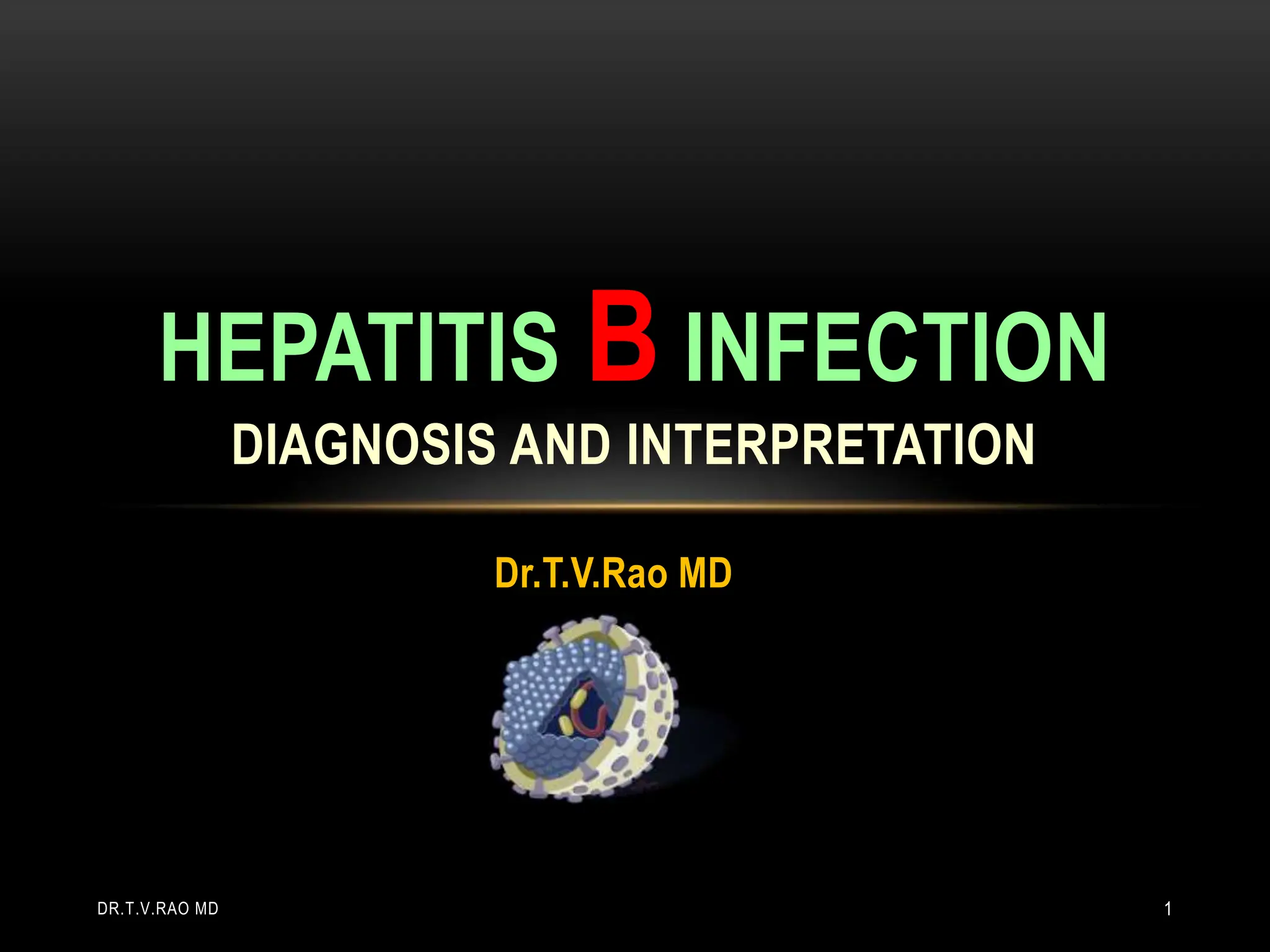
EM of Hepatitis
B viron
– Hepadnaviridae family
– DNA virus
– Double-shelled particles
– Outer lipoprotein
envelope (surface Ag)
– Inner viral nucleocapsid
(core)
– seven genotypes
– four major subtypes.
– All HBV subtypes share one
common antigenic
determinant - "a.“
– Thus, antibodies to the "a"
determinant confer protection
to all HBV subtypes
HEPATITIS B VIRUS A MAJOR CAUSE OF
HEPATITIS
DR.T.V.RAO MD 6
DNA virus – hepadnavirus
3200 bp
Compact - uses overlapping
genes
Complicated replication –
has a ssDNA
component to RNA to DNA
Difficult to grow
Liver damage may be due
to host immunity
HEPATITIS B
DR.T.V.RAO MD 7
STRUCTURE OF HEPATITIS B VIRUS
DR.T.V.RAO MD 8
HBV STRUCTURE & ANTIGENS
Dane particle
HBsAg = surface (coat) protein ( 4 phenotypes : adw, adr, ayw and ayr)
HBcAg = inner core protein (a single serotype)
HBeAg = secreted protein; function unknown
DR.T.V.RAO MD 9
SURFACE PARTICLES
• HBsAg-containing particles
are released into the serum
of infected people and
outnumber the actual
virions.
• Spherical or filamentous
• They are immunogenic and
were processed into the first
commercial vaccine against
HBV.
DR.T.V.RAO MD 10
HEPATITIS B
Structure and major antigens:
22 nm – most abundant – extra viral envelope protein
- spheres and tubes
42 nm double-shelled – intact virus
Both covered by HBsAg – see in blood
Disrupt 42 nm with mild detergent – get 27nm core
particle – covered by HBcAg – never see in blood
HBeAg – soluble – binds to the smooth ER and gets
exported into the circulation – see in blood
DR.T.V.RAO MD 11
There are 4 open reading frames derived from the same strand (the
incomplete + strand)
• S - the 3 polypeptides of the surface antigen (preS1, preS2 and
S - produced from alternative translation start sites.
• C - the core protein
• P - the polymerase
• X - a transactivator of viral transcription (and cellular genes?).
HBx is conserved in all mammalian (but not avian) hepadnavirus.
Though not essential in transfected cells, it is required for
infection in vivo.
Open Reading Frames
DR.T.V.RAO MD 12
• Acute infection
• HBsAg positive and anti-HBcAg
IGM
• Rarely, IgM anti-HBc only marker
• Usually seen in acute fulminate
Hep B
• Chronic infection
• HBsAg positive and anti-HBcAg
• Previous Infection
• HBsAg negative
• anti-HBs positive
• IgG anti-HBc positive
HBV – SEROLOGY INTERPRETATION
ETIOLOGY
• HBcAg—anti-HBc system
 HBcAg can be found in the nuclei of liver cells, no free
HBcAg in serum
 HBcAg is the marker of replication of HBV
 The stage called window phase
 Anti-HBc IgM is a marker of acute infection and acute
attack of chronic infection of HBV. Anti-HBc IgG is the
marker of past infection, high titer means low level
replication of HBV
DR.T.V.RAO MD 14
• Secretory protein that is processed from the precore
protein
• Elevated early in infection and usually coverts to antibody
early on.
• Traditionally used as a marker for viral load as viral load
was undetectable with early assays when Ag was absent.
• However, certain variants of the Hep B virus do not create the
HBeAg as it has no known function.
• When present, it does correlate with elevated viral load
and seroconversion the antibody usually correlates with a
decrease in viral load by a magnitude of 4-5.
HEPATITIS B VIRUS – E ANTIGEN
THREE ANTIGEN-ANTIBODY SYSTEM
Include HBsAg, anti-HBs, pre-s1,s2 antigen and
anti-pres1, s2
HBsAg appears 1-2 weeks (late to 11-12 weeks)
after exposure, persists for 1-6 weeks( even 5
months) in acute hepatitis B.
In chronic patients or carrier, HBsAg persist
many years
HBsAg antigencity but no infectivity
DR.T.V.RAO MD 16
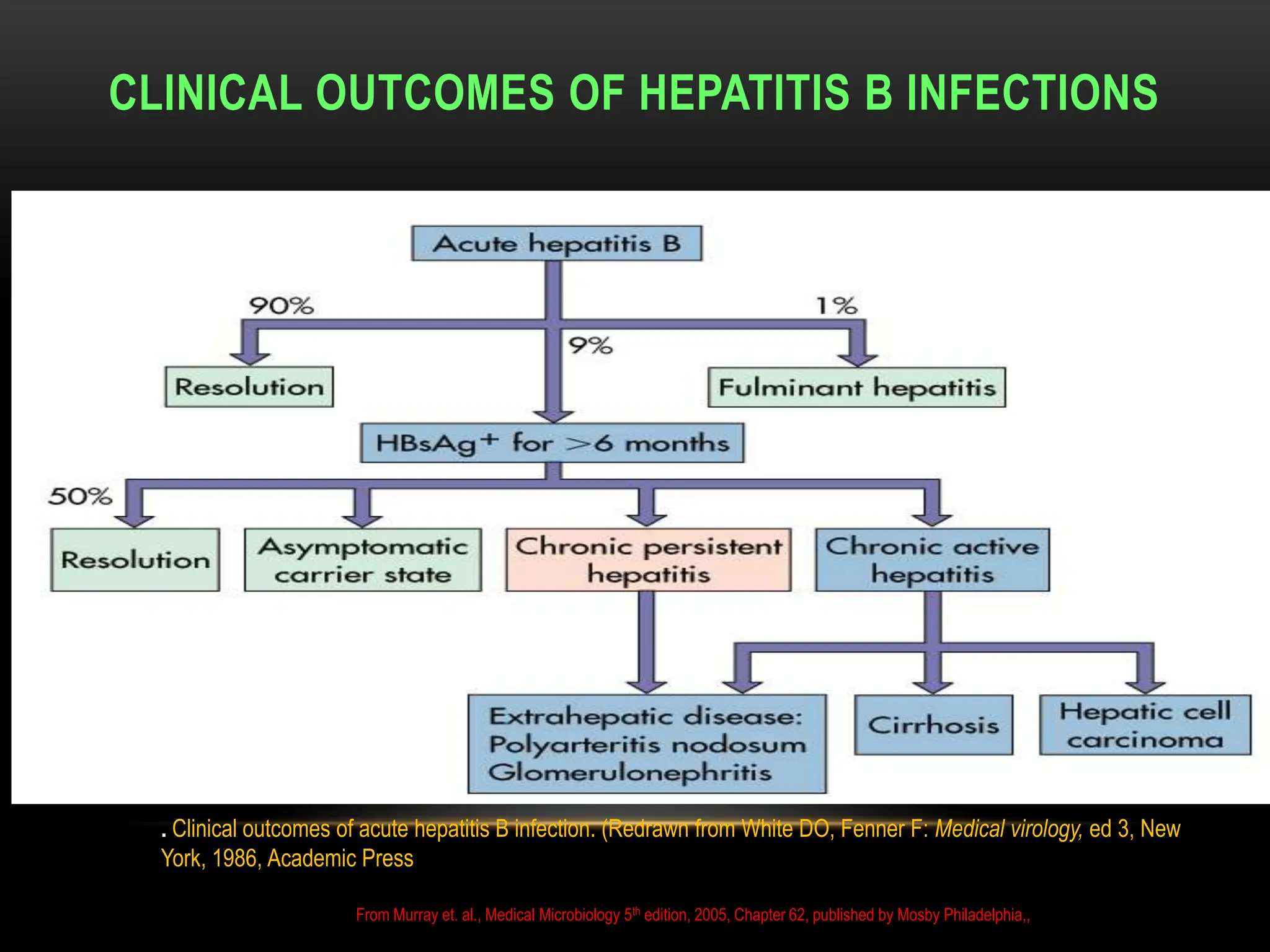
. Clinical outcomes of acute hepatitis B infection. (Redrawn from White DO, Fenner F: Medical virology, ed 3, New
York, 1986, Academic Press
CLINICAL OUTCOMES OF HEPATITIS B INFECTIONS
From Murray et. al., Medical Microbiology 5th edition, 2005, Chapter 62, published by Mosby Philadelphia,,
DETERMINANTS OR ACUTE AND CHRONIC
HBV INFECTION
From Murray et. al., Medical Microbiology
5th edition, 2005, Chapter 66, published by
Mosby Philadelphia,,
Figure 66-7
SCREENING – WHO?
• Who should be screened
• Persons born in hyper endemic areas
• Men who have sex with men
• Injection drug users
• Patients on dialysis
• HIV infected patients
• Pregnant women
• Family and household contacts and sexual contacts of
HBV-infected persons.
• Testing should be performed by obtaining an HBsAg and anti-
HBs.
SEROLOGICAL MARKERS
DR.T.V.RAO MD 20
HEPATITIS B MARKERS:
• HBsAg:Present in acute or chronic infection.
• HBsAb:Present in recovery or immunization.
• Anti -HB Core: May be “Total” (IgG&IgM) or IgM.
Lifelong marker of past and active infection in either
acute or chronic.
• HBeAg:Acute infection, and extremely infectious.
• Anti-Hbe: Usually prognostic for resolution.
DR.T.V.RAO MD 21
ETIOLOGY
• HBcAg—anti-HBc system
 HBcAg can be found in the nuclei of liver cells, no free
HBcAg in serum
 HBcAg is the marker of replication of HBV
 The stage called window phase
 Anti-HBc IgM is a marker of acute infection and acute
attack of chronic infection of HBV. Anti-HBc IgG is the
marker of past infection, high titer means low level
replication of HBV
DR.T.V.RAO MD 22
Symptoms
HBeAg anti-HBe
Total anti-HBc
IgM anti-HBc anti-HBs
HBsAg
0 4 8 12 16 20 24 28 32 36 52 100
Acute Hepatitis B Virus Infection with Recovery
Typical Serologic Course
Weeks after Exposure
Titre
DR.T.V.RAO MD 23
IgM anti-HBc
Total anti-HBc
HBsAg
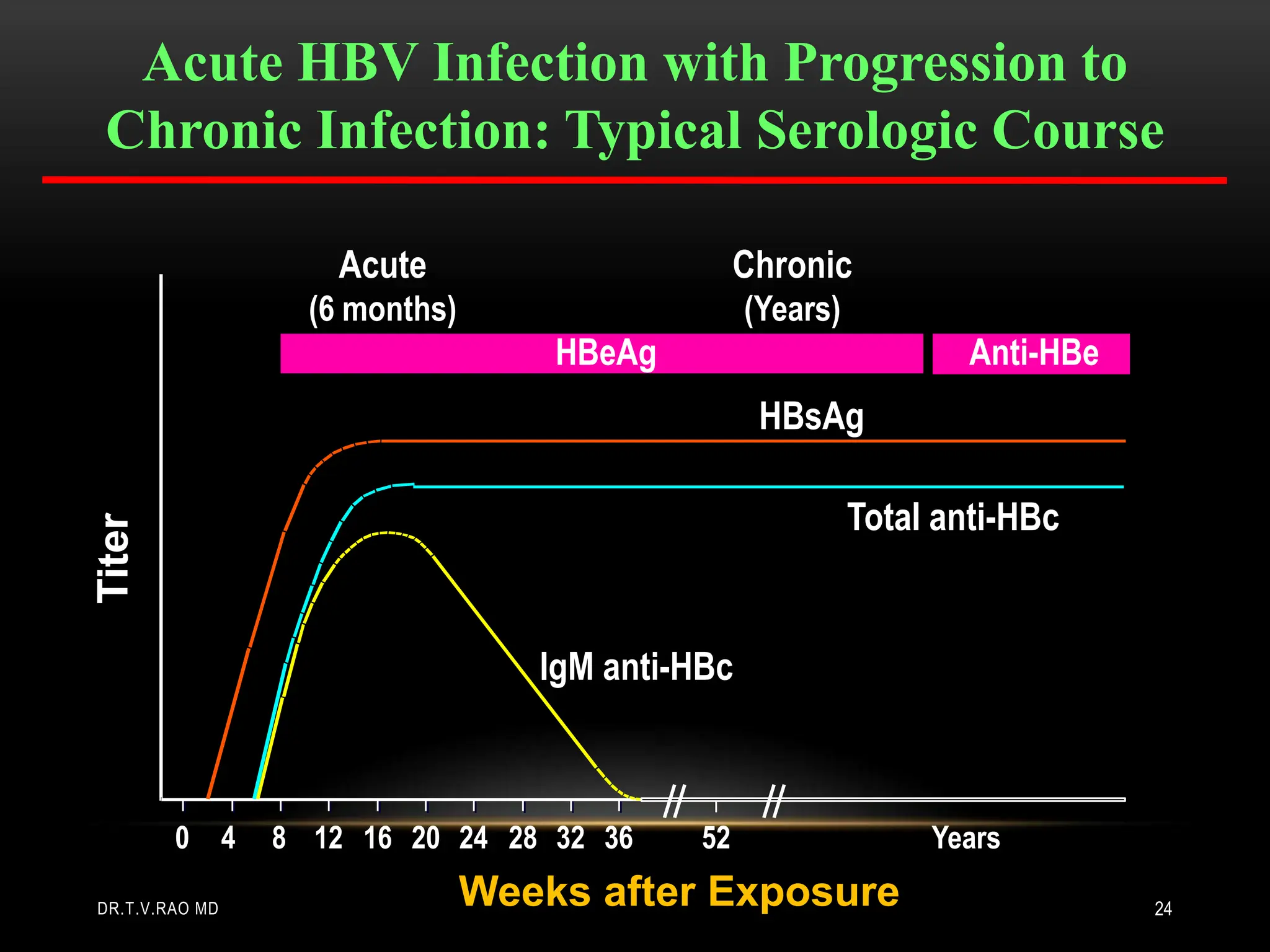
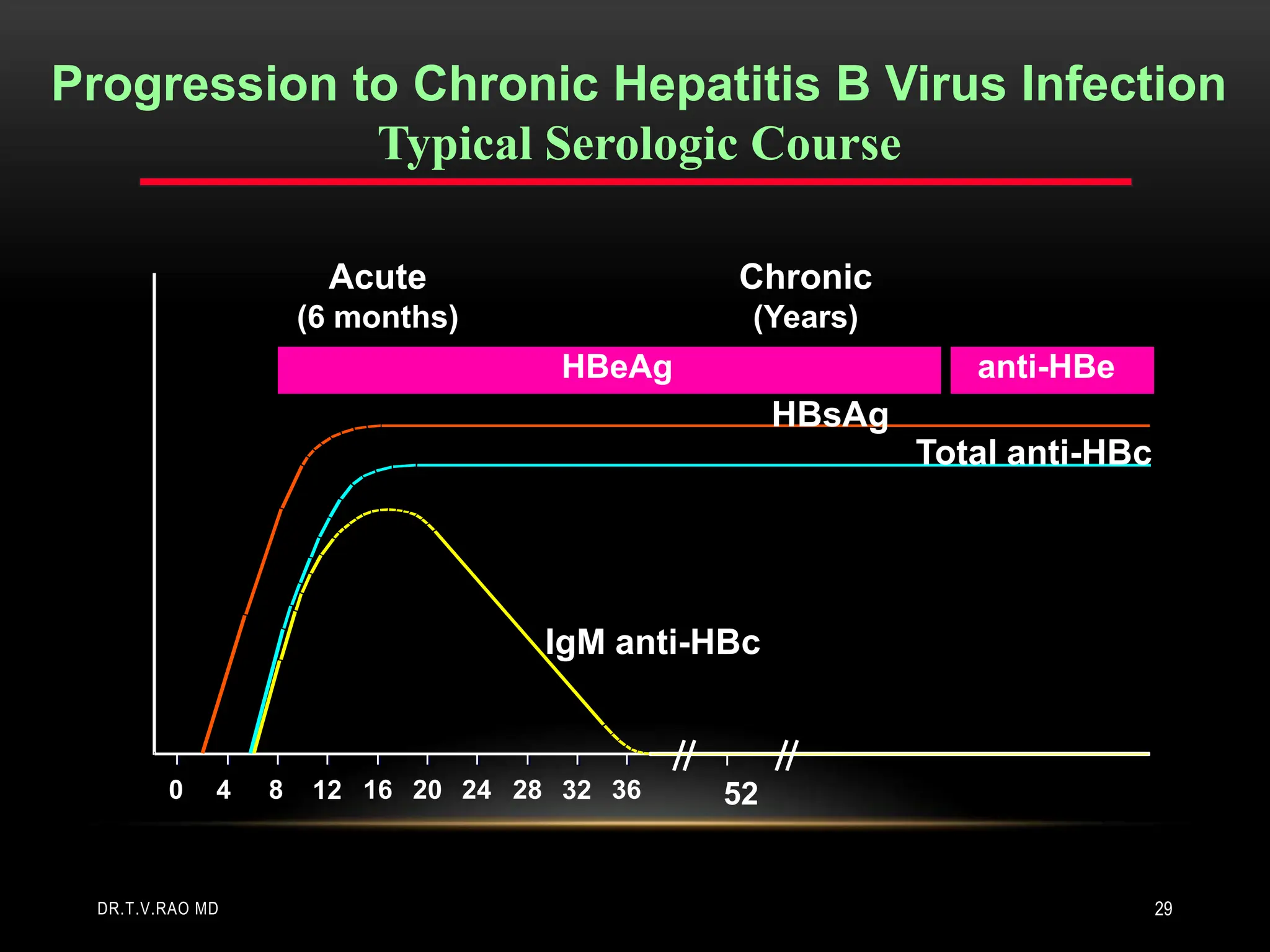
Acute
(6 months)
HBeAg
Chronic
(Years)
Anti-HBe
0 4 8 12 16 20 24 28 32 36 52 Years
Weeks after Exposure
Acute HBV Infection with Progression to
Chronic Infection: Typical Serologic Course
DR.T.V.RAO MD 24
0
10
20
30
40
50
60
1 2 3 4 5 6 7 8 9 10
Months after exposure
Titer
Anti-HBsAb
Anti-HBeAb
Anti-HBcAb
HBeAg
HBsAg
Elevated ALT
Jaundice
Incubation Recovery IMMUNE
―Window‖
HEPATITIS B
Serologic Markers During Acute HBV Hepatitis and Recovery
DR.T.V.RAO MD 25
ETIOLOGY
• HBcAg—anti-HBc system
 HBcAg can be found in the nuclei of liver cells, no
free HBcAg in serum
 HBcAg is the marker of replication of HBV
 The stage called window phase
 Anti-HBc IgM is a marker of acute infection and acute
attack of chronic infection of HBV. Anti-HBc IgG is the
marker of past infection, high titer means low level
replication of HBV
DR.T.V.RAO MD 26
HEPATITIS B
Serology: - acute:
HBsAg+ (HBsAb-) = acute infection or chronic
carrier
HBeAg+ = highly infectious
HBsAb = immune – naturally or vaccine
Window = HBsAg- and HBsAb-
will be HBcAb+ (IgM – acute)
DR.T.V.RAO MD 27
ETIOLOGY
• HBeAg—anti-HBe system
 HBeAg is a soluble antigen
 HBeAg is a reliable indicator of active replication of
HBV
 Anti-HBe is a marker of reduced infectivity. If exist
long may be a marker of integration of HBV into liver
cell
DR.T.V.RAO MD 28
IgM anti-HBc
Total anti-HBc
HBsAg
Acute
(6 months)
HBeAg
Chronic
(Years)
anti-HBe
0 4 8 12 16 20 24 28 32 36 52
Weeks after Exposure
Progression to Chronic Hepatitis B Virus Infection
Typical Serologic Course
DR.T.V.RAO MD 29
ETIOLOGY
• The marker of molecular biology of HBV
• HBV-DNA
The direct indicator of HBV infection
Can integrate into the genome of hepatocytes
• HBV DNA polymerase
Possesses the ability of reverse transcriptase
and the indicator of the ability of replication of
HBV
DR.T.V.RAO MD 30
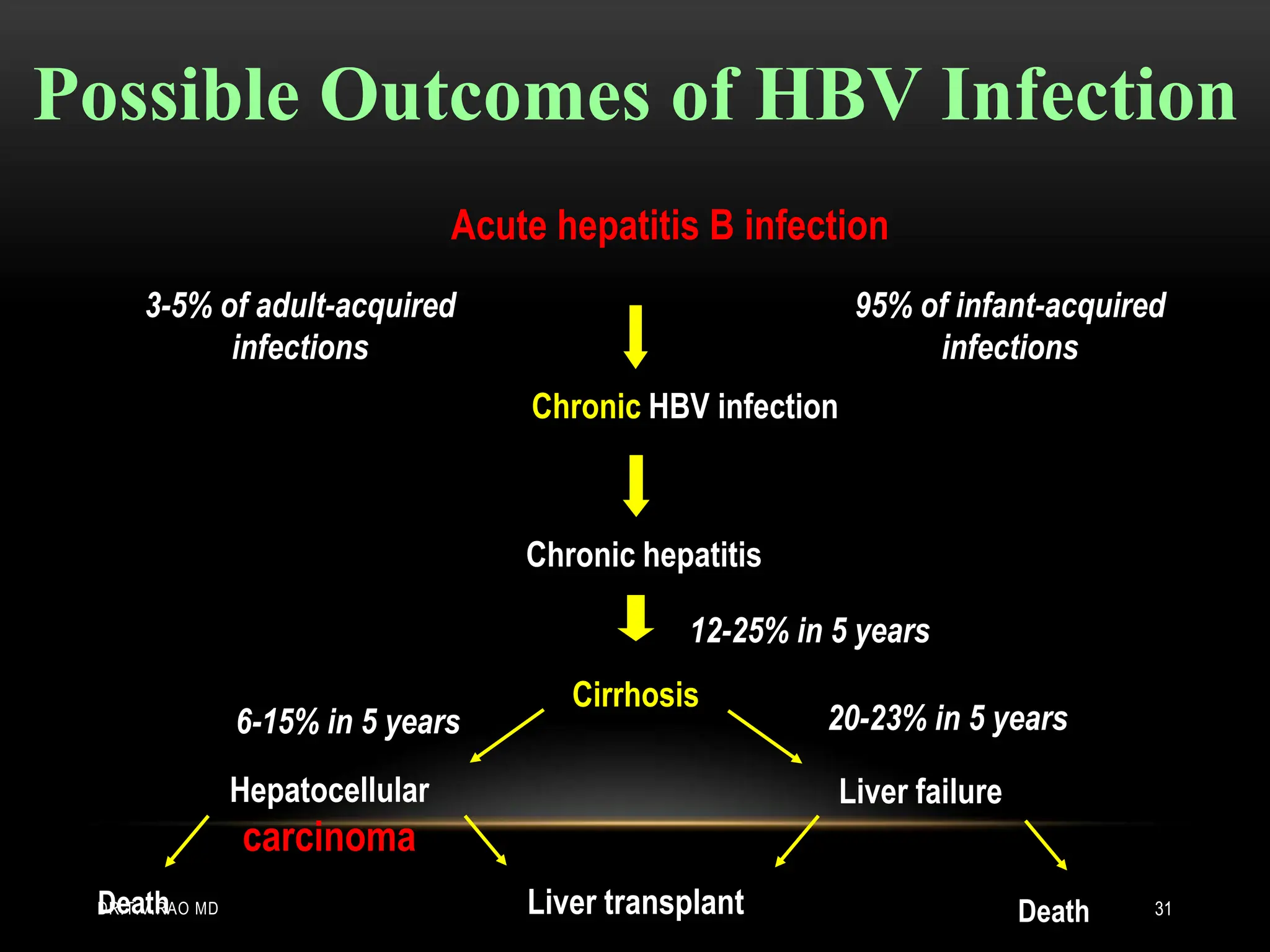
Possible Outcomes of HBV Infection
Acute hepatitis B infection
Chronic HBV infection
3-5% of adult-acquired
infections
95% of infant-acquired
infections
Cirrhosis
Chronic hepatitis
12-25% in 5 years
Liver failure
Hepatocellular
carcinoma
Liver transplant
6-15% in 5 years 20-23% in 5 years
Death
Death
DR.T.V.RAO MD 31
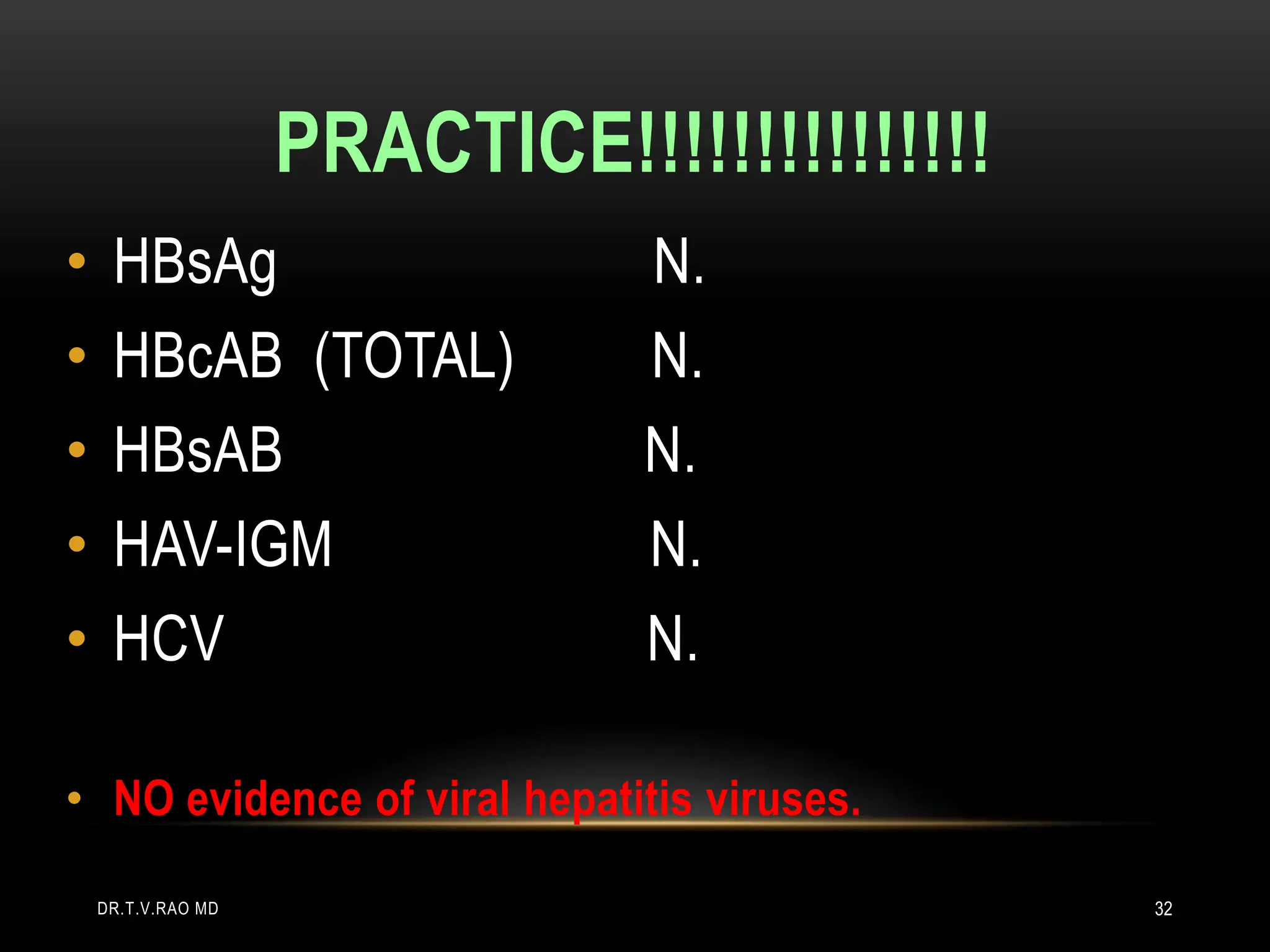
PRACTICE!!!!!!!!!!!!!!!
• HBsAg N.
• HBcAB (TOTAL) N.
• HBsAB N.
• HAV-IGM N.
• HCV N.
• NO evidence of viral hepatitis viruses.
DR.T.V.RAO MD 32
SOLVING THE PROBLEMS
• HBsAG N.
• HBcAB (TOTAL) P.
• HBsAB P.
• HAV-IGM N.
• HCV N.
• PAST INFECTION.
DR.T.V.RAO MD 33
IMMUNIZED FOR HBV INFECTION
• HBsAg N.
• HBcAB (total) N.
• HBsAB P.
• HAV-IGM N.
• HCV N.
DR.T.V.RAO MD 34
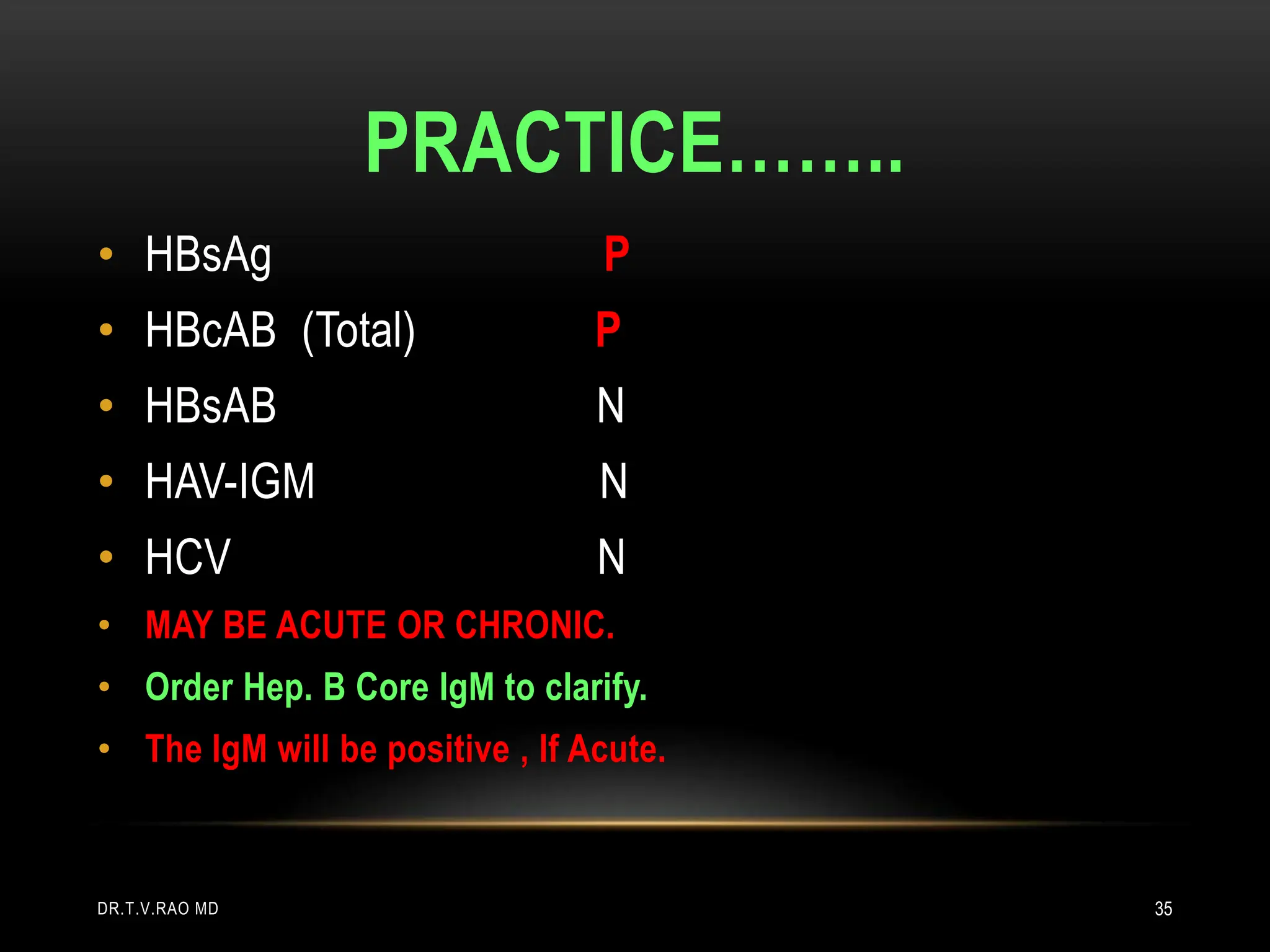
PRACTICE……..
DR.T.V.RAO MD 35
• HBsAg P
• HBcAB (Total) P
• HBsAB N
• HAV-IGM N
• HCV N
• MAY BE ACUTE OR CHRONIC.
• Order Hep. B Core IgM to clarify.
• The IgM will be positive , If Acute.
CO INFECTION WITH HBV, HAV, AND HCV
• HBsAg P
• HBcAB (TOTAL) P
• HBsAB N
• HAV-IGM P
HCV P
DR.T.V.RAO MD 36
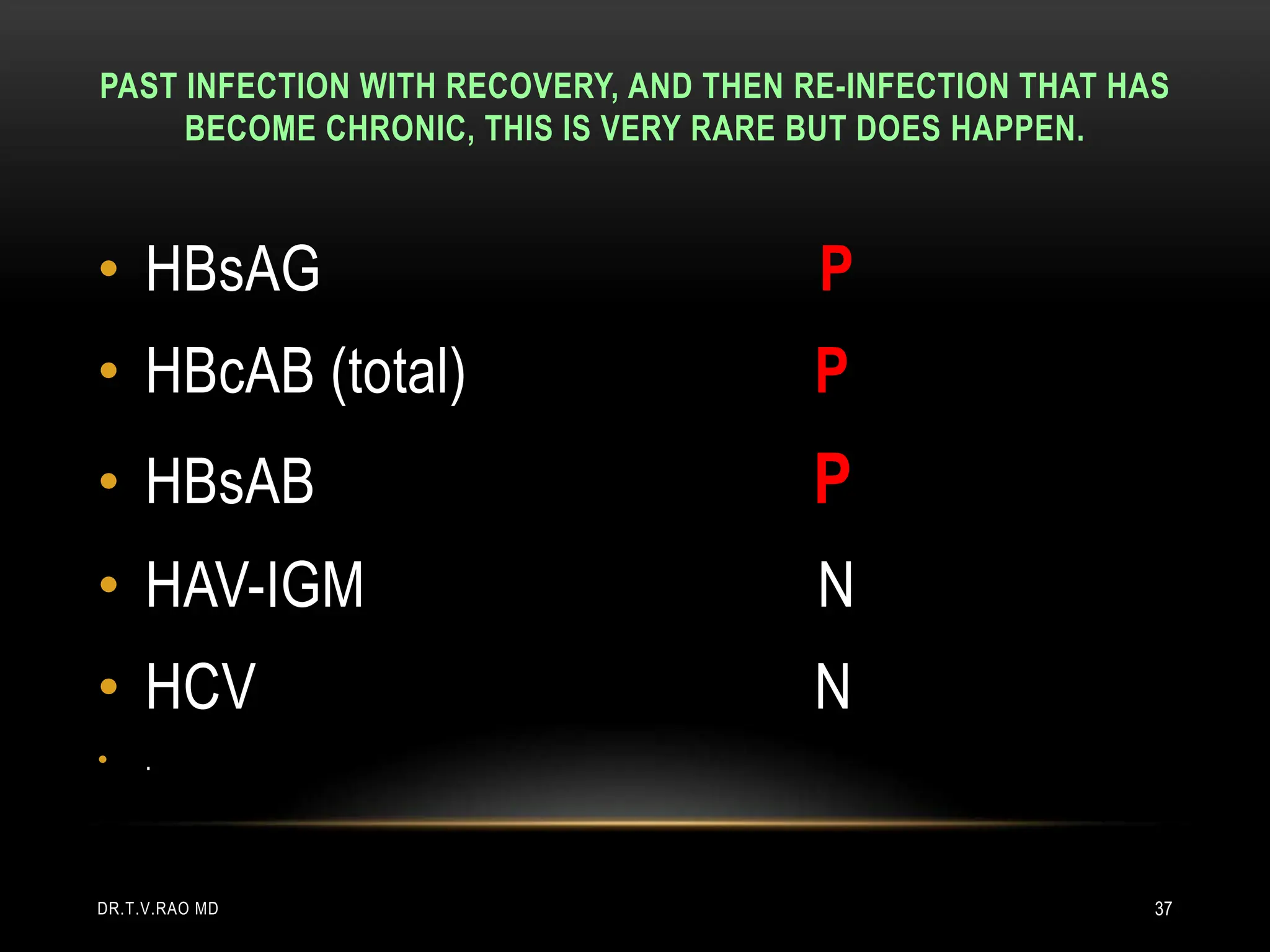
PAST INFECTION WITH RECOVERY, AND THEN RE-INFECTION THAT HAS
BECOME CHRONIC, THIS IS VERY RARE BUT DOES HAPPEN.
• HBsAG P
• HBcAB (total) P
• HBsAB P
• HAV-IGM N
• HCV N
• .
DR.T.V.RAO MD 37
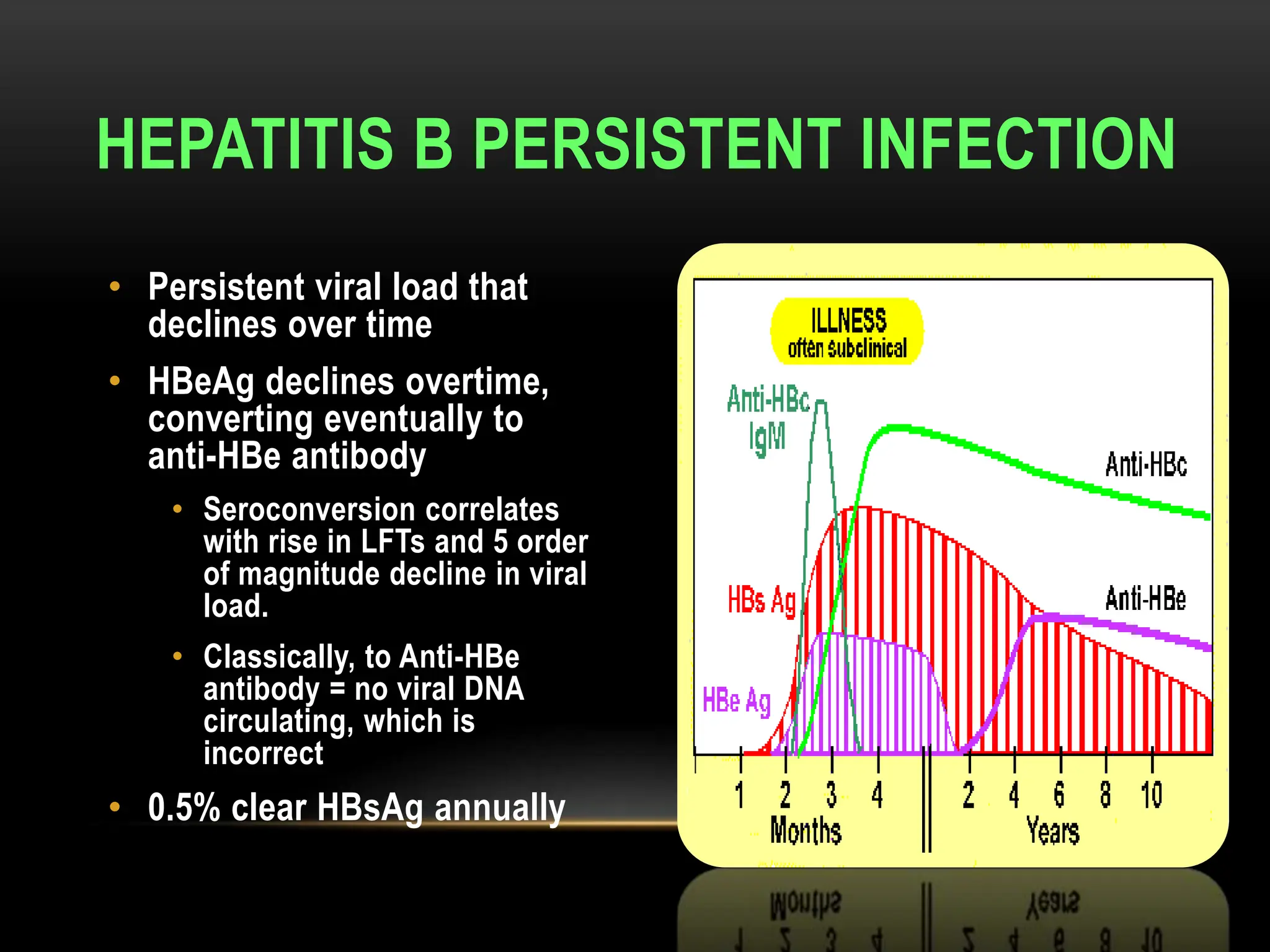
HEPATITIS B PERSISTENT INFECTION
• Persistent viral load that
declines over time
• HBeAg declines overtime,
converting eventually to
anti-HBe antibody
• Seroconversion correlates
with rise in LFTs and 5 order
of magnitude decline in viral
load.
• Classically, to Anti-HBe
antibody = no viral DNA
circulating, which is
incorrect
• 0.5% clear HBsAg annually
• Recent diagnostic
developments
including HBV
genotyping and
precore/core
promoter assays that
could well play
important future
roles in HBV patient
management
MOLECULAR ADVANCES IN DIAGNOSIS OF
HBV INFECTION
39
EMERGING TOOLS IN DIAGNOSIS OF HBV
INFECTION
DR.T.V.RAO MD 40
• Current HBV DNA assays make use of differing
technologies and can generally be divided into (i) signal
amplification assays (liquid phase
hybridization, antibody capture approach, branched
DNA) and (ii) DNA amplification tests based on the
polymerase chain reaction (PCR) . Signal amplification
assays have sensitivities approaching 1 pg of DNA
(105-106 genome copies) or even to 103 genome
copies. Alternatively, HBV DNA detection based on a
nested PCR approach can detect as few as 102-103
genome copies.
• Programme created by Dr.T.V.Rao MD
for Health care workers in the
Developing world
• Email
• doctortvrao@gmail.com
DR.T.V.RAO MD 41

Hepatitis B Infection; Diagnosis and Interpretation.pdf

  • 1.
    Dr.T.V.Rao MD HEPATITIS BINFECTION DIAGNOSIS AND INTERPRETATION DR.T.V.RAO MD 1
  • 2.
    HEPATITIS B INTHE WORLD • 2 billion people have been infected (1 out of 3 people). • 400 million people are chronically infected. • 10-30 million will become infected each year. • An estimated 1 million people die each year from hepatitis B and its complications. • Approximately 2 people die each minute from hepatitis B. DR.T.V.RAO MD 2
  • 3.
    PREVALENCE OF HEPATITISB CARRIERS . Worldwide prevalence of hepatitis B carriers and primary hepatocellular carcinoma. (Courtesy Centers for Disease Control and Prevention, Atlanta.) From Murray et. al., Medical Microbiology 5th edition, 2005, Chapter 66, published by Mosby Philadelphia,,
  • 4.
    1、PROPERTIES OF HBV •A member of the hepadnavirus group • Circular partially double-stranded DNA viruses • Replication involves a reverse transcriptase. • Endemic in the human population and hyper endemic in many parts of the world. A number of variants • It has not yet been possible to propagate the virus in cell culture DR.T.V.RAO MD 4
  • 5.
    HEPATITIS B Diagrammatic representation ofthe hepatitis B virion and the surface antigen components EM of Hepatitis B viron – Hepadnaviridae family – DNA virus – Double-shelled particles – Outer lipoprotein envelope (surface Ag) – Inner viral nucleocapsid (core) – seven genotypes – four major subtypes. – All HBV subtypes share one common antigenic determinant - "a.“ – Thus, antibodies to the "a" determinant confer protection to all HBV subtypes
  • 6.
    HEPATITIS B VIRUSA MAJOR CAUSE OF HEPATITIS DR.T.V.RAO MD 6
  • 7.
    DNA virus –hepadnavirus 3200 bp Compact - uses overlapping genes Complicated replication – has a ssDNA component to RNA to DNA Difficult to grow Liver damage may be due to host immunity HEPATITIS B DR.T.V.RAO MD 7
  • 8.
    STRUCTURE OF HEPATITISB VIRUS DR.T.V.RAO MD 8
  • 9.
    HBV STRUCTURE &ANTIGENS Dane particle HBsAg = surface (coat) protein ( 4 phenotypes : adw, adr, ayw and ayr) HBcAg = inner core protein (a single serotype) HBeAg = secreted protein; function unknown DR.T.V.RAO MD 9
  • 10.
    SURFACE PARTICLES • HBsAg-containingparticles are released into the serum of infected people and outnumber the actual virions. • Spherical or filamentous • They are immunogenic and were processed into the first commercial vaccine against HBV. DR.T.V.RAO MD 10
  • 11.
    HEPATITIS B Structure andmajor antigens: 22 nm – most abundant – extra viral envelope protein - spheres and tubes 42 nm double-shelled – intact virus Both covered by HBsAg – see in blood Disrupt 42 nm with mild detergent – get 27nm core particle – covered by HBcAg – never see in blood HBeAg – soluble – binds to the smooth ER and gets exported into the circulation – see in blood DR.T.V.RAO MD 11
  • 12.
    There are 4open reading frames derived from the same strand (the incomplete + strand) • S - the 3 polypeptides of the surface antigen (preS1, preS2 and S - produced from alternative translation start sites. • C - the core protein • P - the polymerase • X - a transactivator of viral transcription (and cellular genes?). HBx is conserved in all mammalian (but not avian) hepadnavirus. Though not essential in transfected cells, it is required for infection in vivo. Open Reading Frames DR.T.V.RAO MD 12
  • 13.
    • Acute infection •HBsAg positive and anti-HBcAg IGM • Rarely, IgM anti-HBc only marker • Usually seen in acute fulminate Hep B • Chronic infection • HBsAg positive and anti-HBcAg • Previous Infection • HBsAg negative • anti-HBs positive • IgG anti-HBc positive HBV – SEROLOGY INTERPRETATION
  • 14.
    ETIOLOGY • HBcAg—anti-HBc system HBcAg can be found in the nuclei of liver cells, no free HBcAg in serum  HBcAg is the marker of replication of HBV  The stage called window phase  Anti-HBc IgM is a marker of acute infection and acute attack of chronic infection of HBV. Anti-HBc IgG is the marker of past infection, high titer means low level replication of HBV DR.T.V.RAO MD 14
  • 15.
    • Secretory proteinthat is processed from the precore protein • Elevated early in infection and usually coverts to antibody early on. • Traditionally used as a marker for viral load as viral load was undetectable with early assays when Ag was absent. • However, certain variants of the Hep B virus do not create the HBeAg as it has no known function. • When present, it does correlate with elevated viral load and seroconversion the antibody usually correlates with a decrease in viral load by a magnitude of 4-5. HEPATITIS B VIRUS – E ANTIGEN
  • 16.
    THREE ANTIGEN-ANTIBODY SYSTEM IncludeHBsAg, anti-HBs, pre-s1,s2 antigen and anti-pres1, s2 HBsAg appears 1-2 weeks (late to 11-12 weeks) after exposure, persists for 1-6 weeks( even 5 months) in acute hepatitis B. In chronic patients or carrier, HBsAg persist many years HBsAg antigencity but no infectivity DR.T.V.RAO MD 16
  • 17.
    . Clinical outcomesof acute hepatitis B infection. (Redrawn from White DO, Fenner F: Medical virology, ed 3, New York, 1986, Academic Press CLINICAL OUTCOMES OF HEPATITIS B INFECTIONS From Murray et. al., Medical Microbiology 5th edition, 2005, Chapter 62, published by Mosby Philadelphia,,
  • 18.
    DETERMINANTS OR ACUTEAND CHRONIC HBV INFECTION From Murray et. al., Medical Microbiology 5th edition, 2005, Chapter 66, published by Mosby Philadelphia,, Figure 66-7
  • 19.
    SCREENING – WHO? •Who should be screened • Persons born in hyper endemic areas • Men who have sex with men • Injection drug users • Patients on dialysis • HIV infected patients • Pregnant women • Family and household contacts and sexual contacts of HBV-infected persons. • Testing should be performed by obtaining an HBsAg and anti- HBs.
  • 20.
  • 21.
    HEPATITIS B MARKERS: •HBsAg:Present in acute or chronic infection. • HBsAb:Present in recovery or immunization. • Anti -HB Core: May be “Total” (IgG&IgM) or IgM. Lifelong marker of past and active infection in either acute or chronic. • HBeAg:Acute infection, and extremely infectious. • Anti-Hbe: Usually prognostic for resolution. DR.T.V.RAO MD 21
  • 22.
    ETIOLOGY • HBcAg—anti-HBc system HBcAg can be found in the nuclei of liver cells, no free HBcAg in serum  HBcAg is the marker of replication of HBV  The stage called window phase  Anti-HBc IgM is a marker of acute infection and acute attack of chronic infection of HBV. Anti-HBc IgG is the marker of past infection, high titer means low level replication of HBV DR.T.V.RAO MD 22
  • 23.
    Symptoms HBeAg anti-HBe Total anti-HBc IgManti-HBc anti-HBs HBsAg 0 4 8 12 16 20 24 28 32 36 52 100 Acute Hepatitis B Virus Infection with Recovery Typical Serologic Course Weeks after Exposure Titre DR.T.V.RAO MD 23
  • 24.
    IgM anti-HBc Total anti-HBc HBsAg Acute (6months) HBeAg Chronic (Years) Anti-HBe 0 4 8 12 16 20 24 28 32 36 52 Years Weeks after Exposure Acute HBV Infection with Progression to Chronic Infection: Typical Serologic Course DR.T.V.RAO MD 24
  • 25.
    0 10 20 30 40 50 60 1 2 34 5 6 7 8 9 10 Months after exposure Titer Anti-HBsAb Anti-HBeAb Anti-HBcAb HBeAg HBsAg Elevated ALT Jaundice Incubation Recovery IMMUNE ―Window‖ HEPATITIS B Serologic Markers During Acute HBV Hepatitis and Recovery DR.T.V.RAO MD 25
  • 26.
    ETIOLOGY • HBcAg—anti-HBc system HBcAg can be found in the nuclei of liver cells, no free HBcAg in serum  HBcAg is the marker of replication of HBV  The stage called window phase  Anti-HBc IgM is a marker of acute infection and acute attack of chronic infection of HBV. Anti-HBc IgG is the marker of past infection, high titer means low level replication of HBV DR.T.V.RAO MD 26
  • 27.
    HEPATITIS B Serology: -acute: HBsAg+ (HBsAb-) = acute infection or chronic carrier HBeAg+ = highly infectious HBsAb = immune – naturally or vaccine Window = HBsAg- and HBsAb- will be HBcAb+ (IgM – acute) DR.T.V.RAO MD 27
  • 28.
    ETIOLOGY • HBeAg—anti-HBe system HBeAg is a soluble antigen  HBeAg is a reliable indicator of active replication of HBV  Anti-HBe is a marker of reduced infectivity. If exist long may be a marker of integration of HBV into liver cell DR.T.V.RAO MD 28
  • 29.
    IgM anti-HBc Total anti-HBc HBsAg Acute (6months) HBeAg Chronic (Years) anti-HBe 0 4 8 12 16 20 24 28 32 36 52 Weeks after Exposure Progression to Chronic Hepatitis B Virus Infection Typical Serologic Course DR.T.V.RAO MD 29
  • 30.
    ETIOLOGY • The markerof molecular biology of HBV • HBV-DNA The direct indicator of HBV infection Can integrate into the genome of hepatocytes • HBV DNA polymerase Possesses the ability of reverse transcriptase and the indicator of the ability of replication of HBV DR.T.V.RAO MD 30
  • 31.
    Possible Outcomes ofHBV Infection Acute hepatitis B infection Chronic HBV infection 3-5% of adult-acquired infections 95% of infant-acquired infections Cirrhosis Chronic hepatitis 12-25% in 5 years Liver failure Hepatocellular carcinoma Liver transplant 6-15% in 5 years 20-23% in 5 years Death Death DR.T.V.RAO MD 31
  • 32.
    PRACTICE!!!!!!!!!!!!!!! • HBsAg N. •HBcAB (TOTAL) N. • HBsAB N. • HAV-IGM N. • HCV N. • NO evidence of viral hepatitis viruses. DR.T.V.RAO MD 32
  • 33.
    SOLVING THE PROBLEMS •HBsAG N. • HBcAB (TOTAL) P. • HBsAB P. • HAV-IGM N. • HCV N. • PAST INFECTION. DR.T.V.RAO MD 33
  • 34.
    IMMUNIZED FOR HBVINFECTION • HBsAg N. • HBcAB (total) N. • HBsAB P. • HAV-IGM N. • HCV N. DR.T.V.RAO MD 34
  • 35.
    PRACTICE…….. DR.T.V.RAO MD 35 •HBsAg P • HBcAB (Total) P • HBsAB N • HAV-IGM N • HCV N • MAY BE ACUTE OR CHRONIC. • Order Hep. B Core IgM to clarify. • The IgM will be positive , If Acute.
  • 36.
    CO INFECTION WITHHBV, HAV, AND HCV • HBsAg P • HBcAB (TOTAL) P • HBsAB N • HAV-IGM P HCV P DR.T.V.RAO MD 36
  • 37.
    PAST INFECTION WITHRECOVERY, AND THEN RE-INFECTION THAT HAS BECOME CHRONIC, THIS IS VERY RARE BUT DOES HAPPEN. • HBsAG P • HBcAB (total) P • HBsAB P • HAV-IGM N • HCV N • . DR.T.V.RAO MD 37
  • 38.
    HEPATITIS B PERSISTENTINFECTION • Persistent viral load that declines over time • HBeAg declines overtime, converting eventually to anti-HBe antibody • Seroconversion correlates with rise in LFTs and 5 order of magnitude decline in viral load. • Classically, to Anti-HBe antibody = no viral DNA circulating, which is incorrect • 0.5% clear HBsAg annually
  • 39.
    • Recent diagnostic developments includingHBV genotyping and precore/core promoter assays that could well play important future roles in HBV patient management MOLECULAR ADVANCES IN DIAGNOSIS OF HBV INFECTION 39
  • 40.
    EMERGING TOOLS INDIAGNOSIS OF HBV INFECTION DR.T.V.RAO MD 40 • Current HBV DNA assays make use of differing technologies and can generally be divided into (i) signal amplification assays (liquid phase hybridization, antibody capture approach, branched DNA) and (ii) DNA amplification tests based on the polymerase chain reaction (PCR) . Signal amplification assays have sensitivities approaching 1 pg of DNA (105-106 genome copies) or even to 103 genome copies. Alternatively, HBV DNA detection based on a nested PCR approach can detect as few as 102-103 genome copies.
  • 41.
    • Programme createdby Dr.T.V.Rao MD for Health care workers in the Developing world • Email • doctortvrao@gmail.com DR.T.V.RAO MD 41