Positive Psychology @ SchoolDr Suzy GreenCo-Founder, Positive Psychology InstituteAdjunct Lecturer, Coaching Psychology Unit, University of Sydneywww.positivepsychologyinstitute.cominfo@positivepsychologyinstitute.com
Overall AimsThis workshop will allow you to learn and apply the principles of Appreciative Inquiry (AI) to assist you in considering the application of Positive Psychology/Positive Education for the optimal functioning of yourself, your students and your school.
AimsTime-out:  professional & personal reflection
Building on WWW
Creating an inspirational vision for the future….
Inspire enthusiasm for action!Overview of WorkshopIntroduction to Appreciative Inquiry (AI)
Identification of the WIFM (relevance to you!)
Review of Pos Psych & EB Coaching
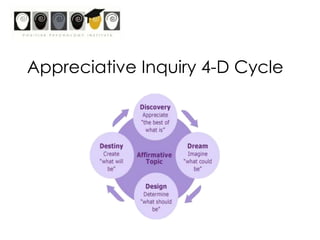
Introduction to (and experience of) the AI 4D Model (Discover, Dream, Design & Deliver)
 This workshop will run as a mini AI Summit!You are about to enter…
The Appreciable World	“Imagine what would happen if you had the ability to see consistently, and connect with, every strength – every one of the capacities – inherent in the world around you; or to see every positive potential in your son or daughter; or like Michelangelo, the intellectual ability to “sense” the towering, historic figure of David “already existing” in the huge slab of marble – even before the reality”Professor David Cooperrider
A Positive Revolution
Welcome…Take a turn to…Introduce yourself to your group ie name, where you work and why you’re at this workshop?Identify something that is going well for you?Say why you care about the future of your role as a School Psychologist…
What is Appreciative Inquiry?“The co-operative search for the best in people, their organisations, and the world around them”
“The systematic discovery of what gives a system life”
“Involves the art and practice of asking questions that strengthen a system’s capacity to heighten positive potential”AppreciateValuing; the act of recognising the best in people or the world around us; affirming past and present strengths, successes and potentials; to perceive those things that give life (health, vitality, excellence) to living systems.To increase in value eg the economy has appreciated in value. Synonyms; value, prize, esteem and honour
InquireThe act of exploration and discovery.To ask questions; to be open to seeing new potentials and possibilities. Synonyms: discover, search, systematically explore and study.

Appreciative InquiryEvolved in the 1980s (Cooperrider & Srivastva)
A revolutionary & positive philosophy towards organisational change
Process that focused on an organisation’s core strengths rather than seeking to overcome its weaknessesAppreciative InquiryRealisation that the traditional organisational development (OD) approach of problem diagnosis and feedback was sucking the energy for change right out of the system
Realisation that as more problems were discovered, the more discouraged people became, and the more they blamed each other for the problems.Appreciative InquiryAI was a radical reversal of the traditional problem-solving approach
Instead of detailing root causes of failure, they focused on the root causes of success
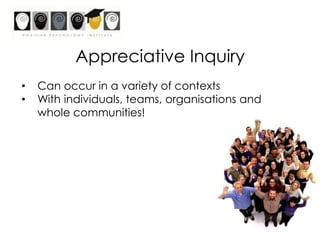
AI began as a theory-building process, however also called a philosophy, a revolutionary force, a transformational change process, a life-giving theory and practice and even a new world-view!Appreciative InquiryCan occur in a variety of contexts
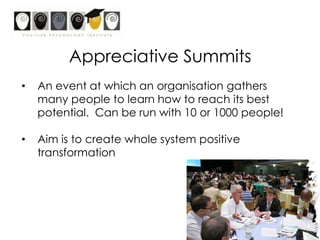
With individuals, teams, organisations and whole communities!Appreciative SummitsAn event at which an organisation gathers many people to learn how to reach its best potential.  Can be run with 10 or 1000 people!
Aim is to create whole system positive transformationAppreciative InquiryFor today’s purposes…
AI is regarded as a positive, strength-based operational approach to change, learning and development(Gordon 2008)
Today it is applied to you in your role as a School Psychologist …
To assist you consider the application of Positive Psychology/Positive Education in your role as SP at your SchoolBut first… why bother?	What is the relevance of Positive Psychology/Positive Education to…You as a School Psychologist?
The schools you work with?
School Psychology generally?Discuss in small groups…
Take a moment….Take a moment to ask yourself these questions?What do I want to take away from today’s workshop that will help me in my work and personal life? How could I use PP/PE as a tool for my professional development?How might I use PP/PE as an approach in my role as a School Psychologist?
Review  of Positive PsychologyThe study of the conditions and processes that contribute to the flourishing or optimal functioning of people, groups and institutions. (Gable & Haidt, 2005)
Positive PsychologyA strengths-based psychology“I do not believe that you should devote overly much effort to correcting your weaknesses.  Rather, I believe that the highest success in living and the deepest emotional satisfaction comes from building and using your signature strengths”				Professor Martin Seligman
Strengths AssessmentWithin positive psychology, strengths assessment is a key area of research.Since the publication of the VIA (Values in Action) in 2004, further research conducted.See www.viacharacter.org or www.authentichappiness.orgAlso Realise2 (www.cappeu.org) for assessment of staff strengths
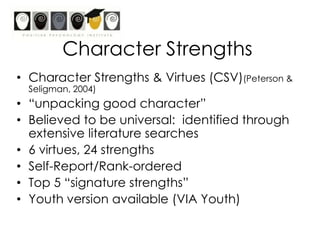
Character StrengthsCharacter Strengths & Virtues (CSV)(Peterson & Seligman, 2004)“unpacking good character”Believed to be universal:  identified through extensive literature searches6 virtues, 24 strengthsSelf-Report/Rank-orderedTop 5 “signature strengths”Youth version available (VIA Youth)
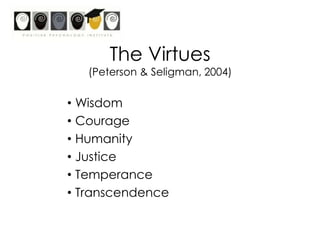
The Virtues(Peterson & Seligman, 2004)WisdomCourageHumanityJusticeTemperanceTranscendence
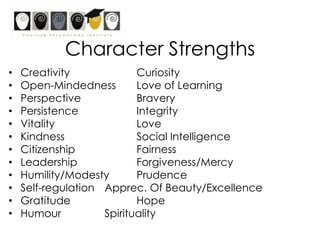
Character StrengthsCreativity					CuriosityOpen-Mindedness		Love of LearningPerspective				BraveryPersistence 				IntegrityVitality						LoveKindness					Social IntelligenceCitizenship				FairnessLeadership				Forgiveness/MercyHumility/Modesty		PrudenceSelf-regulation	Apprec. Of Beauty/ExcellenceGratitude					HopeHumour			Spirituality
Criteria for signature strengths:A sense of ownership & authenticity;A feeling of excitement while using it;A rapid learning curve as the strength is applied.Continuous learning of new ways to utilise the strength.A yearning or sense of inevitability to use it - intrinsic motivation.Feeling of vitality when using it.
Strengths ResearchGrowing research and evidence of working with strengths.Using top strength in a new way for one week (Park & Peterson, 2006)Those that did were happier, less depressed and more engaged in their lives.Effects sustained at 6 month follow-up.
Strengths ResearchHope, Love, Zest, Gratitude & Curiosity associated with higher levels of well-being (Peterson, Park & Seligman, 2004).Academic achievement among school children is predicted by temperance strengths and by perseveranceTeaching effectiveness is predicted by teacher zest, humour and social intelligence
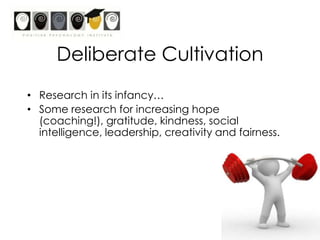
Deliberate CultivationResearch in its infancy…Some research for increasing hope (coaching!), gratitude, kindness, social intelligence, leadership, creativity and fairness.
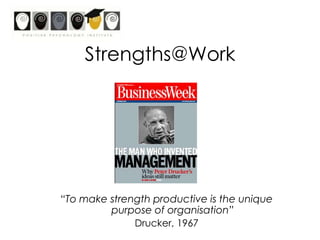
Strengths@Work“To make strength productive is the unique purpose of organisation”Drucker, 1967
Strengths@Work	“A strength is a pre-existing capacity for a particular way of behaving, thinking, or feeling that is authentic and energizing to the user, and enables optimal functioning, development and performance.”						Linley, 2008
Strengths@Work	“Personal strengths are the characteristics of a person that allow them to perform well or at their personal best.”						Wood et al, 2011
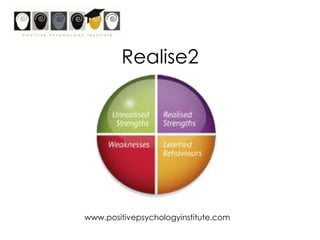
Strengths@WorkRealise2www.cappeu.orgwww.positivepsychologyinstitute.com60 StrengthsRealised Strengths, Unrealised Strengths, Learned Behaviours & WeaknessStrengths Tips each week!
Realise2www.positivepsychologyinstitute.com
Interesting….Studies show that only about one-third of people can identify their own strengths (Hill, 2001); andOnly 17% of people say they use their strengths ‘most of the time’ each day (Buckingham, 2007)
More evidence…A 2011 scientific study showed that people who reported greater use of their strengths developed greater levels of well-being over time.Specifically at both 3 & 6 month follow up, greater strength use was related to greater self-esteem, vitality, positive affect and lowered perceived stress!
Strengthspotting Exercise!
Strengths Based ApproachesDiscuss in small groups:Do you know what your strengths are?
Do you know the strength/s needed in your role as a School Psychologist?
Are you using strengths in your School for yourself, your studentsand your staff?Review of Evidence-Based Coaching?
Review of Evidence-Based Coaching?In general, coaching can be defined as a goal-oriented, solution-focused collaborative relationship between coach and coachee that utilises a systematic process to improve an individual’s performance and well-being(Grant & Greene, 2001).
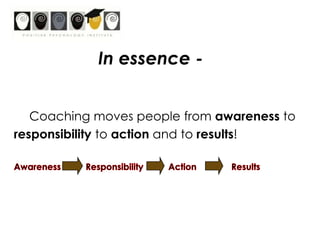
In essence -	 Coaching moves people from awareness toresponsibility to action and to results!Awareness          Responsibility          Action              Results
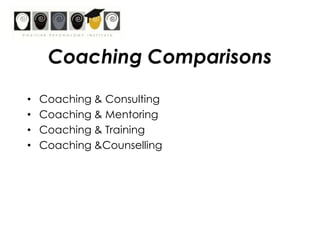
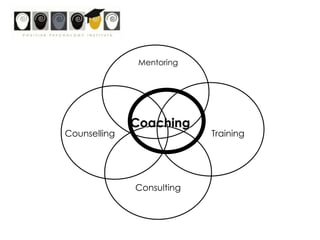
Coaching ComparisonsCoaching & ConsultingCoaching & MentoringCoaching & TrainingCoaching &Counselling
MentoringCoachingCounsellingTrainingConsulting
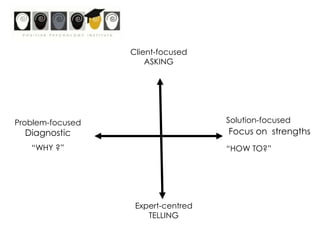
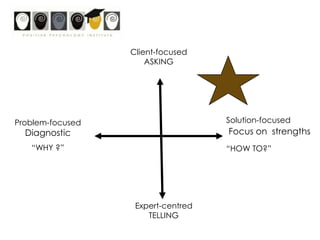
Client-focusedASKINGSolution-focused  Focus on  strengths“HOW TO?”Problem-focusedDiagnostic “WHY ?”Expert-centredTELLING
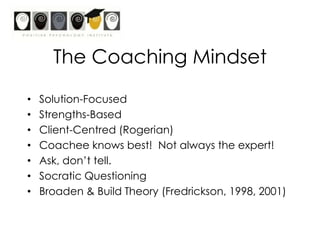
The Coaching MindsetSolution-FocusedStrengths-Based Client-Centred (Rogerian)Coachee knows best!  Not always the expert!Ask, don’t tell.Socratic QuestioningBroaden & Build Theory (Fredrickson, 1998, 2001)
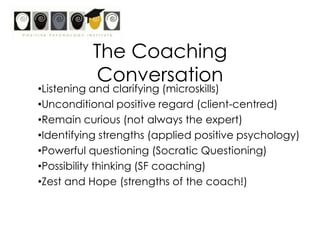
The Coaching ConversationListening and clarifying (microskills)
Unconditional positive regard (client-centred)
Remain curious (not always the expert)
Identifying strengths (applied positive psychology)
Powerful questioning (Socratic Questioning)
Possibility thinking (SF coaching)
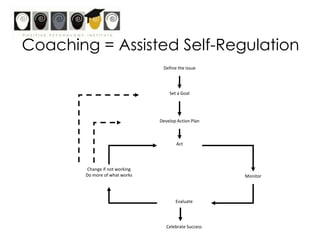
Zest and Hope (strengths of the coach!)Define the IssueSet a GoalDevelop Action PlanActChange if not workingDo more of what worksMonitorEvaluateCelebrate SuccessCoaching = Assisted Self-Regulation
Take a moment…What am I doingalready in regard to PP/PE that is successful?
What am I not doing that I want to start doing?Back to AIRemember for today’s purposes:A positive, strengths-based operational approach to change, learning and development…
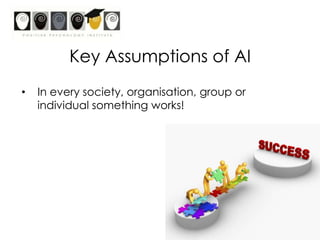
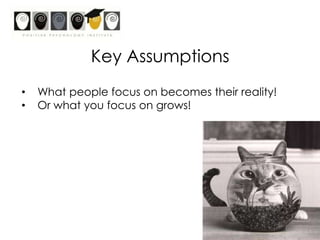
Can be used to create change in your organisation, your personal life, your professional life.Key Assumptions of AIIn every society, organisation, group or individual something works!Key AssumptionsWhat people focus on becomes their reality!
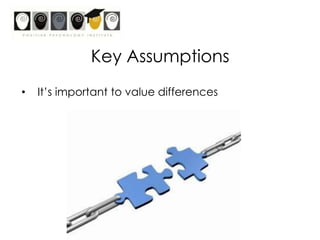
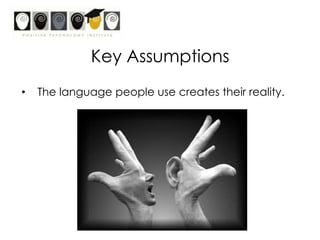
Or what you focus on grows!Key AssumptionsThe act of asking questions of an organisation, group, or individual influences the group or individual in some way.Key AssumptionsPeople are more confident and comfortable in their journey to the future (the unknown) when they carry forward parts of the past (the known).Key AssumptionsIf people carry parts of the past forward, those parts should be what is best about the pastKey AssumptionsIt’s important to value differencesKey AssumptionsThe language people use creates their reality.Appreciative Inquiry 4-D Cycle
AI Kick-Start Exercises

Positive psychology appreciative inquiry workshop

  • 1.
    Positive Psychology @SchoolDr Suzy GreenCo-Founder, Positive Psychology InstituteAdjunct Lecturer, Coaching Psychology Unit, University of Sydneywww.positivepsychologyinstitute.cominfo@positivepsychologyinstitute.com
  • 2.
    Overall AimsThis workshopwill allow you to learn and apply the principles of Appreciative Inquiry (AI) to assist you in considering the application of Positive Psychology/Positive Education for the optimal functioning of yourself, your students and your school.
  • 3.
    AimsTime-out: professional& personal reflection
  • 4.
  • 5.
    Creating an inspirationalvision for the future….
  • 6.
    Inspire enthusiasm foraction!Overview of WorkshopIntroduction to Appreciative Inquiry (AI)
  • 7.
    Identification of theWIFM (relevance to you!)
  • 8.
    Review of PosPsych & EB Coaching
  • 9.
    Introduction to (andexperience of) the AI 4D Model (Discover, Dream, Design & Deliver)
  • 10.
    This workshopwill run as a mini AI Summit!You are about to enter…
  • 11.
    The Appreciable World “Imaginewhat would happen if you had the ability to see consistently, and connect with, every strength – every one of the capacities – inherent in the world around you; or to see every positive potential in your son or daughter; or like Michelangelo, the intellectual ability to “sense” the towering, historic figure of David “already existing” in the huge slab of marble – even before the reality”Professor David Cooperrider
  • 12.
  • 13.
    Welcome…Take a turnto…Introduce yourself to your group ie name, where you work and why you’re at this workshop?Identify something that is going well for you?Say why you care about the future of your role as a School Psychologist…
  • 14.
    What is AppreciativeInquiry?“The co-operative search for the best in people, their organisations, and the world around them”
  • 15.
    “The systematic discoveryof what gives a system life”
  • 16.
    “Involves the artand practice of asking questions that strengthen a system’s capacity to heighten positive potential”AppreciateValuing; the act of recognising the best in people or the world around us; affirming past and present strengths, successes and potentials; to perceive those things that give life (health, vitality, excellence) to living systems.To increase in value eg the economy has appreciated in value. Synonyms; value, prize, esteem and honour
  • 17.
    InquireThe act ofexploration and discovery.To ask questions; to be open to seeing new potentials and possibilities. Synonyms: discover, search, systematically explore and study.
  • 18.
    Appreciative InquiryEvolved inthe 1980s (Cooperrider & Srivastva)
  • 19.
    A revolutionary &positive philosophy towards organisational change
  • 20.
    Process that focusedon an organisation’s core strengths rather than seeking to overcome its weaknessesAppreciative InquiryRealisation that the traditional organisational development (OD) approach of problem diagnosis and feedback was sucking the energy for change right out of the system
  • 21.
    Realisation that asmore problems were discovered, the more discouraged people became, and the more they blamed each other for the problems.Appreciative InquiryAI was a radical reversal of the traditional problem-solving approach
  • 22.
    Instead of detailingroot causes of failure, they focused on the root causes of success
  • 23.
    AI began asa theory-building process, however also called a philosophy, a revolutionary force, a transformational change process, a life-giving theory and practice and even a new world-view!Appreciative InquiryCan occur in a variety of contexts
  • 24.
    With individuals, teams,organisations and whole communities!Appreciative SummitsAn event at which an organisation gathers many people to learn how to reach its best potential. Can be run with 10 or 1000 people!
  • 25.
    Aim is tocreate whole system positive transformationAppreciative InquiryFor today’s purposes…
  • 26.
    AI is regardedas a positive, strength-based operational approach to change, learning and development(Gordon 2008)
  • 27.
    Today it isapplied to you in your role as a School Psychologist …
  • 28.
    To assist youconsider the application of Positive Psychology/Positive Education in your role as SP at your SchoolBut first… why bother? What is the relevance of Positive Psychology/Positive Education to…You as a School Psychologist?
  • 29.
    The schools youwork with?
  • 30.
  • 31.
    Take a moment….Takea moment to ask yourself these questions?What do I want to take away from today’s workshop that will help me in my work and personal life? How could I use PP/PE as a tool for my professional development?How might I use PP/PE as an approach in my role as a School Psychologist?
  • 32.
    Review ofPositive PsychologyThe study of the conditions and processes that contribute to the flourishing or optimal functioning of people, groups and institutions. (Gable & Haidt, 2005)
  • 33.
    Positive PsychologyA strengths-basedpsychology“I do not believe that you should devote overly much effort to correcting your weaknesses. Rather, I believe that the highest success in living and the deepest emotional satisfaction comes from building and using your signature strengths” Professor Martin Seligman
  • 34.
    Strengths AssessmentWithin positivepsychology, strengths assessment is a key area of research.Since the publication of the VIA (Values in Action) in 2004, further research conducted.See www.viacharacter.org or www.authentichappiness.orgAlso Realise2 (www.cappeu.org) for assessment of staff strengths
  • 35.
    Character StrengthsCharacter Strengths& Virtues (CSV)(Peterson & Seligman, 2004)“unpacking good character”Believed to be universal: identified through extensive literature searches6 virtues, 24 strengthsSelf-Report/Rank-orderedTop 5 “signature strengths”Youth version available (VIA Youth)
  • 36.
    The Virtues(Peterson &Seligman, 2004)WisdomCourageHumanityJusticeTemperanceTranscendence
  • 37.
    Character StrengthsCreativity CuriosityOpen-Mindedness Love ofLearningPerspective BraveryPersistence IntegrityVitality LoveKindness Social IntelligenceCitizenship FairnessLeadership Forgiveness/MercyHumility/Modesty PrudenceSelf-regulation Apprec. Of Beauty/ExcellenceGratitude HopeHumour Spirituality
  • 38.
    Criteria for signaturestrengths:A sense of ownership & authenticity;A feeling of excitement while using it;A rapid learning curve as the strength is applied.Continuous learning of new ways to utilise the strength.A yearning or sense of inevitability to use it - intrinsic motivation.Feeling of vitality when using it.
  • 39.
    Strengths ResearchGrowing researchand evidence of working with strengths.Using top strength in a new way for one week (Park & Peterson, 2006)Those that did were happier, less depressed and more engaged in their lives.Effects sustained at 6 month follow-up.
  • 40.
    Strengths ResearchHope, Love,Zest, Gratitude & Curiosity associated with higher levels of well-being (Peterson, Park & Seligman, 2004).Academic achievement among school children is predicted by temperance strengths and by perseveranceTeaching effectiveness is predicted by teacher zest, humour and social intelligence
  • 41.
    Deliberate CultivationResearch inits infancy…Some research for increasing hope (coaching!), gratitude, kindness, social intelligence, leadership, creativity and fairness.
  • 43.
    Strengths@Work“To make strengthproductive is the unique purpose of organisation”Drucker, 1967
  • 44.
    Strengths@Work “A strength isa pre-existing capacity for a particular way of behaving, thinking, or feeling that is authentic and energizing to the user, and enables optimal functioning, development and performance.” Linley, 2008
  • 45.
    Strengths@Work “Personal strengths arethe characteristics of a person that allow them to perform well or at their personal best.” Wood et al, 2011
  • 46.
    Strengths@WorkRealise2www.cappeu.orgwww.positivepsychologyinstitute.com60 StrengthsRealised Strengths,Unrealised Strengths, Learned Behaviours & WeaknessStrengths Tips each week!
  • 47.
  • 48.
    Interesting….Studies show thatonly about one-third of people can identify their own strengths (Hill, 2001); andOnly 17% of people say they use their strengths ‘most of the time’ each day (Buckingham, 2007)
  • 49.
    More evidence…A 2011scientific study showed that people who reported greater use of their strengths developed greater levels of well-being over time.Specifically at both 3 & 6 month follow up, greater strength use was related to greater self-esteem, vitality, positive affect and lowered perceived stress!
  • 50.
  • 51.
    Strengths Based ApproachesDiscussin small groups:Do you know what your strengths are?
  • 52.
    Do you knowthe strength/s needed in your role as a School Psychologist?
  • 53.
    Are you usingstrengths in your School for yourself, your studentsand your staff?Review of Evidence-Based Coaching?
  • 54.
    Review of Evidence-BasedCoaching?In general, coaching can be defined as a goal-oriented, solution-focused collaborative relationship between coach and coachee that utilises a systematic process to improve an individual’s performance and well-being(Grant & Greene, 2001).
  • 55.
    In essence - Coaching moves people from awareness toresponsibility to action and to results!Awareness Responsibility Action Results
  • 56.
    Coaching ComparisonsCoaching &ConsultingCoaching & MentoringCoaching & TrainingCoaching &Counselling
  • 57.
  • 58.
    Client-focusedASKINGSolution-focused Focuson strengths“HOW TO?”Problem-focusedDiagnostic “WHY ?”Expert-centredTELLING
  • 59.
    Client-focusedASKINGSolution-focused Focuson strengths“HOW TO?”Problem-focusedDiagnostic “WHY ?”Expert-centredTELLING
  • 60.
    The Coaching MindsetSolution-FocusedStrengths-BasedClient-Centred (Rogerian)Coachee knows best! Not always the expert!Ask, don’t tell.Socratic QuestioningBroaden & Build Theory (Fredrickson, 1998, 2001)
  • 61.
    The Coaching ConversationListeningand clarifying (microskills)
  • 62.
  • 63.
    Remain curious (notalways the expert)
  • 64.
    Identifying strengths (appliedpositive psychology)
  • 65.
  • 66.
  • 67.
    Zest and Hope(strengths of the coach!)Define the IssueSet a GoalDevelop Action PlanActChange if not workingDo more of what worksMonitorEvaluateCelebrate SuccessCoaching = Assisted Self-Regulation
  • 68.
    Take a moment…Whatam I doingalready in regard to PP/PE that is successful?
  • 69.
    What am Inot doing that I want to start doing?Back to AIRemember for today’s purposes:A positive, strengths-based operational approach to change, learning and development…
  • 70.
    Can be usedto create change in your organisation, your personal life, your professional life.Key Assumptions of AIIn every society, organisation, group or individual something works!Key AssumptionsWhat people focus on becomes their reality!
  • 71.
    Or what youfocus on grows!Key AssumptionsThe act of asking questions of an organisation, group, or individual influences the group or individual in some way.Key AssumptionsPeople are more confident and comfortable in their journey to the future (the unknown) when they carry forward parts of the past (the known).Key AssumptionsIf people carry parts of the past forward, those parts should be what is best about the pastKey AssumptionsIt’s important to value differencesKey AssumptionsThe language people use creates their reality.Appreciative Inquiry 4-D Cycle
  • 72.