MATHEMATICS - 9
QUARTERLY EXAM
S.Y. 2023-2024
CONTINUE
Directions: Read and analyze
each item carefully. Choose the
correct answer. Write it on the
blank provided for before each
number.
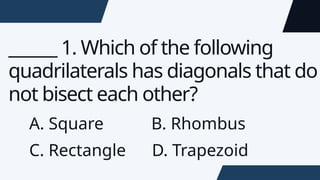
______ 1. Which of the following
quadrilaterals has diagonals that do
not bisect each other?
A. Square B. Rhombus
C. Rectangle D. Trapezoid
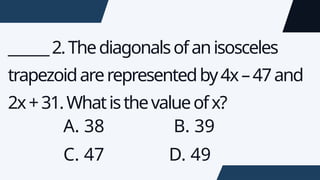
______2.Thediagonalsofanisosceles
trapezoidarerepresentedby4x–47and
2x+31.Whatisthevalueofx?
A. 38 B. 39
C. 47 D. 49
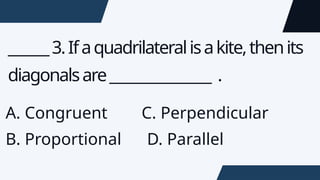
______3.Ifaquadrilateralisakite,thenits
diagonalsare_______________ .
A. Congruent C. Perpendicular
B. Proportional D. Parallel
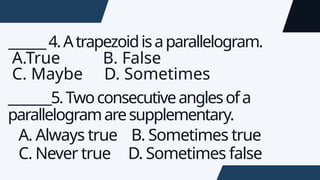
______4.Atrapezoidisaparallelogram.
A.True B. False
C. Maybe D. Sometimes
_______5.Twoconsecutiveanglesofa
parallelogramaresupplementary.
A. Always true B. Sometimes true
C. Never true D. Sometimes false
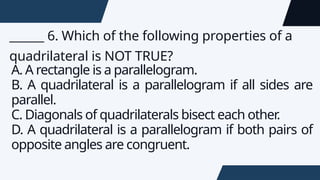
______ 6. Which of the following properties of a
quadrilateral is NOT TRUE?
A. A rectangle is a parallelogram.
B. A quadrilateral is a parallelogram if all sides are
parallel.
C. Diagonals of quadrilaterals bisect each other
.
D. A quadrilateral is a parallelogram if both pairs of
opposite angles are congruent.
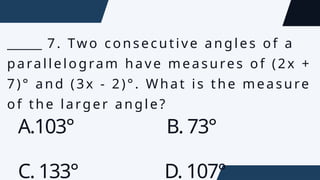
______ 7. Two consecutive angles of a
parallelogram have measures of (2x +
7)° and (3x - 2)°. What is the measure
of the larger angle?
A.103° B. 73°
C. 133° D. 107°
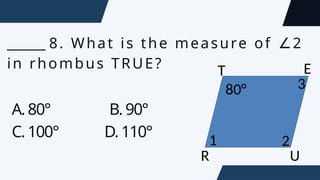
______ 8. What is the measure of 2
∠
in rhombus TRUE?
A.80° B.90°
C.100° D.110°
80°
1 2
3
R U
T E
______ 9. What is the perimeter of a kite if the sides
are 15 centimeters and 16 centimeters?
A. 60 cm B. 61 cm
C. 62 cm D. 63 cm
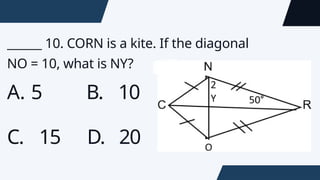
______ 10. CORN is a kite. If the diagonal
NO = 10, what is NY?
A. 5 B. 10
C. 15 D. 20
______ 11. Which of the following statements is
TRUE?
A. Akitehastwoparallelsides.
B. Akitehasfourcongruentangles
C. Thediagonalsofakiteareperpendicular
.
D. Thediagonalsofakitearecongruent.
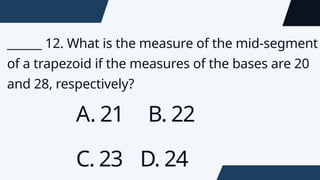
______ 12. What is the measure of the mid-segment
of a trapezoid if the measures of the bases are 20
and 28, respectively?
A. 21 B. 22
C. 23 D. 24
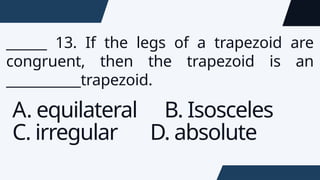
______ 13. If the legs of a trapezoid are
congruent, then the trapezoid is an
___________trapezoid.
A. equilateral B. Isosceles
C. irregular D. absolute
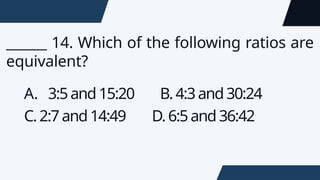
______ 14. Which of the following ratios are
equivalent?
A. 3:5and15:20 B.4:3and30:24
C.2:7and14:49 D.6:5and36:42
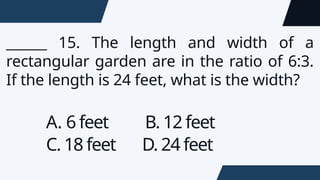
______ 15. The length and width of a
rectangular garden are in the ratio of 6:3.
If the length is 24 feet, what is the width?
A. 6 feet B. 12 feet
C. 18 feet D. 24 feet
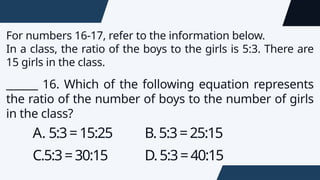
For numbers 16-17, refer to the information below.
In a class, the ratio of the boys to the girls is 5:3. There are
15 girls in the class.
A. 5:3=15:25 B.5:3=25:15
C.5:3=30:15 D.5:3=40:15
______ 16. Which of the following equation represents
the ratio of the number of boys to the number of girls
in the class?
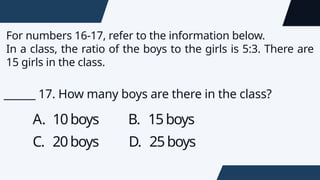
For numbers 16-17, refer to the information below.
In a class, the ratio of the boys to the girls is 5:3. There are
15 girls in the class.
A. 10boys B. 15boys
C. 20boys D. 25boys
______ 17. How many boys are there in the class?
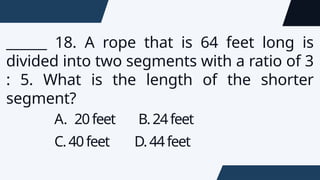
______ 18. A rope that is 64 feet long is
divided into two segments with a ratio of 3
: 5. What is the length of the shorter
segment?
A. 20feet B.24feet
C.40feet D.44feet
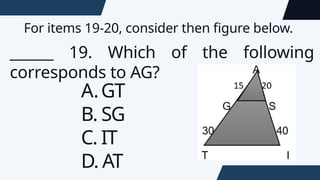
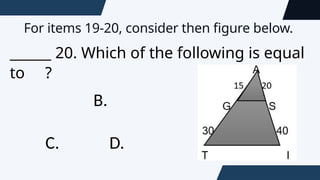
For items 19-20, consider then figure below.
______ 19. Which of the following
corresponds to AG?
A.GT
B. SG
C. IT
D. AT
For items 19-20, consider then figure below.
______ 20. Which of the following is equal
to ?
B.
C. D.
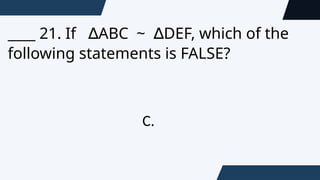
____ 21. If ABC ~ DEF, which of the
∆ ∆
following statements is FALSE?
C.
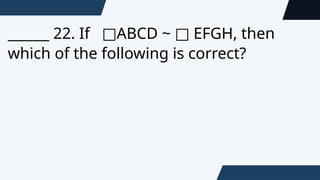
______ 22. If ABCD ~ EFGH, then
□ □
which of the following is correct?
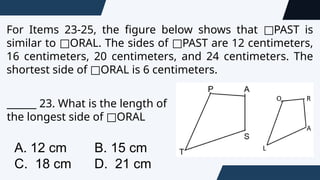
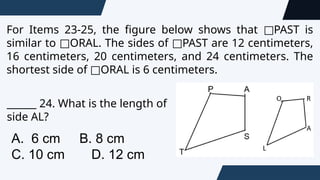
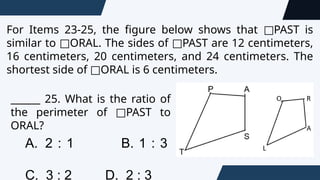
For Items 23-25, the figure below shows that PAST is
□
similar to ORAL. The sides of PAST are 12 centimeters,
□ □
16 centimeters, 20 centimeters, and 24 centimeters. The
shortest side of ORAL is 6 centimeters.
□
______ 23. What is the length of
the longest side of ORAL
□
A. 12 cm B. 15 cm
C. 18 cm D. 21 cm
For Items 23-25, the figure below shows that PAST is
□
similar to ORAL. The sides of PAST are 12 centimeters,
□ □
16 centimeters, 20 centimeters, and 24 centimeters. The
shortest side of ORAL is 6 centimeters.
□
______ 24. What is the length of
side AL?
A. 6 cm B. 8 cm
C. 10 cm D. 12 cm
For Items 23-25, the figure below shows that PAST is
□
similar to ORAL. The sides of PAST are 12 centimeters,
□ □
16 centimeters, 20 centimeters, and 24 centimeters. The
shortest side of ORAL is 6 centimeters.
□
______ 25. What is the ratio of
the perimeter of PAST to
□
ORAL?
A. 2 : 1 B. 1 : 3
C. 3 : 2 D. 2 : 3
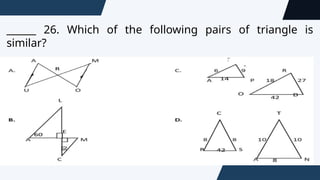
______ 26. Which of the following pairs of triangle is
similar?
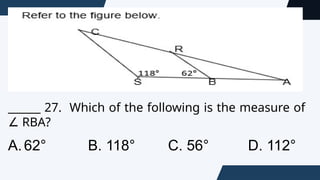
______ 27. Which of the following is the measure of
RBA?
∠
A.62° B. 118° C. 56° D. 112°
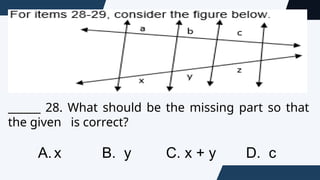
______ 28. What should be the missing part so that
the given is correct?
A.x B. y C. x + y D. c
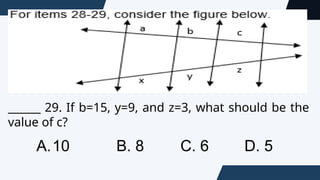
______ 29. If b=15, y=9, and z=3, what should be the
value of c?
A.10 B. 8 C. 6 D. 5
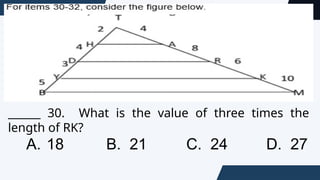
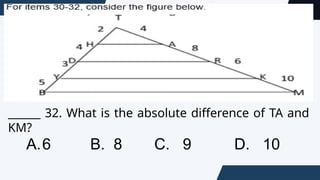
______ 30. What is the value of three times the
length of RK?
A. 18 B. 21 C. 24 D. 27
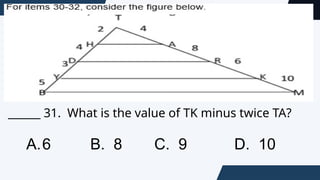
______ 31. What is the value of TK minus twice TA?
A.6 B. 8 C. 9 D. 10
______ 32. What is the absolute difference of TA and
KM?
A.6 B. 8 C. 9 D. 10
______ 33. Which of the following group of
quadrilaterals have diagonal that are
perpendicular?
A. Rectangle, square
B. Rhombus, rectangle
C. Rhombus, square
D. Rectangle, rhombus, and square
______ 34. What is the perimeter of a
kite if the sides are 13 centimeters
and 17 centimeters?
A.60 cm B. 50 cm
C. 40 cm D. 30 cm
______ 35. The bases of a trapezoid
are the __________ sides.
A. parallel B. nonparallel
sides
C. equal D. perpendicular
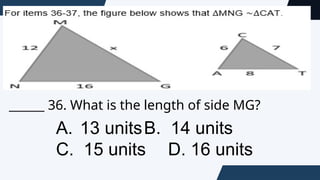
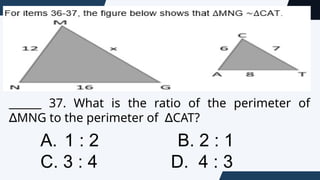
______ 36. What is the length of side MG?
A. 13 unitsB. 14 units
C. 15 units D. 16 units
______ 37. What is the ratio of the perimeter of
MNG to the perimeter of CAT?
∆ ∆
A. 1 : 2 B. 2 : 1
C. 3 : 4 D. 4 : 3
______ 38. In a parallelogram RSTW, diagonals
RT and SW are perpendicular bisectors of each
other. Parallelogram RSTW must be a:
I. Rectangle II. Rhombus III. Square
A.I B. II C. II and III D. I, II, and III
______ 39. What condition will make
parallelogram WXYZ a rectangle?
A.WX YZ
≅
B.∠X is a right angle
C. WX YZ
∥
D. WX and YZ bisect each other
______ 40. In NEAT, the diagonal ET
□
forms NET and ATE. What kind of
∆ ∆
triangles are formed?
A. Isosceles triangles
B.Equilateral triangles
C.scalene triangles
D. equiangular triangles
Don’t be afraid to make mistakes;
they are just the stepping-stones to success.
– Louis Zamperini ©
THE END

MATH9-3rd-Quarterly-Exam grade 9 learners.pptx

  • 1.
    MATHEMATICS - 9 QUARTERLYEXAM S.Y. 2023-2024
  • 2.
    CONTINUE Directions: Read andanalyze each item carefully. Choose the correct answer. Write it on the blank provided for before each number.
  • 3.
    ______ 1. Whichof the following quadrilaterals has diagonals that do not bisect each other? A. Square B. Rhombus C. Rectangle D. Trapezoid
  • 4.
  • 5.
  • 6.
    ______4.Atrapezoidisaparallelogram. A.True B. False C.Maybe D. Sometimes _______5.Twoconsecutiveanglesofa parallelogramaresupplementary. A. Always true B. Sometimes true C. Never true D. Sometimes false
  • 7.
    ______ 6. Whichof the following properties of a quadrilateral is NOT TRUE? A. A rectangle is a parallelogram. B. A quadrilateral is a parallelogram if all sides are parallel. C. Diagonals of quadrilaterals bisect each other . D. A quadrilateral is a parallelogram if both pairs of opposite angles are congruent.
  • 8.
    ______ 7. Twoconsecutive angles of a parallelogram have measures of (2x + 7)° and (3x - 2)°. What is the measure of the larger angle? A.103° B. 73° C. 133° D. 107°
  • 9.
    ______ 8. Whatis the measure of 2 ∠ in rhombus TRUE? A.80° B.90° C.100° D.110° 80° 1 2 3 R U T E
  • 10.
    ______ 9. Whatis the perimeter of a kite if the sides are 15 centimeters and 16 centimeters? A. 60 cm B. 61 cm C. 62 cm D. 63 cm
  • 11.
    ______ 10. CORNis a kite. If the diagonal NO = 10, what is NY? A. 5 B. 10 C. 15 D. 20
  • 12.
    ______ 11. Whichof the following statements is TRUE? A. Akitehastwoparallelsides. B. Akitehasfourcongruentangles C. Thediagonalsofakiteareperpendicular . D. Thediagonalsofakitearecongruent.
  • 13.
    ______ 12. Whatis the measure of the mid-segment of a trapezoid if the measures of the bases are 20 and 28, respectively? A. 21 B. 22 C. 23 D. 24
  • 14.
    ______ 13. Ifthe legs of a trapezoid are congruent, then the trapezoid is an ___________trapezoid. A. equilateral B. Isosceles C. irregular D. absolute
  • 15.
    ______ 14. Whichof the following ratios are equivalent? A. 3:5and15:20 B.4:3and30:24 C.2:7and14:49 D.6:5and36:42
  • 16.
    ______ 15. Thelength and width of a rectangular garden are in the ratio of 6:3. If the length is 24 feet, what is the width? A. 6 feet B. 12 feet C. 18 feet D. 24 feet
  • 17.
    For numbers 16-17,refer to the information below. In a class, the ratio of the boys to the girls is 5:3. There are 15 girls in the class. A. 5:3=15:25 B.5:3=25:15 C.5:3=30:15 D.5:3=40:15 ______ 16. Which of the following equation represents the ratio of the number of boys to the number of girls in the class?
  • 18.
    For numbers 16-17,refer to the information below. In a class, the ratio of the boys to the girls is 5:3. There are 15 girls in the class. A. 10boys B. 15boys C. 20boys D. 25boys ______ 17. How many boys are there in the class?
  • 19.
    ______ 18. Arope that is 64 feet long is divided into two segments with a ratio of 3 : 5. What is the length of the shorter segment? A. 20feet B.24feet C.40feet D.44feet
  • 20.
    For items 19-20,consider then figure below. ______ 19. Which of the following corresponds to AG? A.GT B. SG C. IT D. AT
  • 21.
    For items 19-20,consider then figure below. ______ 20. Which of the following is equal to ? B. C. D.
  • 22.
    ____ 21. IfABC ~ DEF, which of the ∆ ∆ following statements is FALSE? C.
  • 23.
    ______ 22. IfABCD ~ EFGH, then □ □ which of the following is correct?
  • 24.
    For Items 23-25,the figure below shows that PAST is □ similar to ORAL. The sides of PAST are 12 centimeters, □ □ 16 centimeters, 20 centimeters, and 24 centimeters. The shortest side of ORAL is 6 centimeters. □ ______ 23. What is the length of the longest side of ORAL □ A. 12 cm B. 15 cm C. 18 cm D. 21 cm
  • 25.
    For Items 23-25,the figure below shows that PAST is □ similar to ORAL. The sides of PAST are 12 centimeters, □ □ 16 centimeters, 20 centimeters, and 24 centimeters. The shortest side of ORAL is 6 centimeters. □ ______ 24. What is the length of side AL? A. 6 cm B. 8 cm C. 10 cm D. 12 cm
  • 26.
    For Items 23-25,the figure below shows that PAST is □ similar to ORAL. The sides of PAST are 12 centimeters, □ □ 16 centimeters, 20 centimeters, and 24 centimeters. The shortest side of ORAL is 6 centimeters. □ ______ 25. What is the ratio of the perimeter of PAST to □ ORAL? A. 2 : 1 B. 1 : 3 C. 3 : 2 D. 2 : 3
  • 27.
    ______ 26. Whichof the following pairs of triangle is similar?
  • 28.
    ______ 27. Whichof the following is the measure of RBA? ∠ A.62° B. 118° C. 56° D. 112°
  • 29.
    ______ 28. Whatshould be the missing part so that the given is correct? A.x B. y C. x + y D. c
  • 30.
    ______ 29. Ifb=15, y=9, and z=3, what should be the value of c? A.10 B. 8 C. 6 D. 5
  • 31.
    ______ 30. Whatis the value of three times the length of RK? A. 18 B. 21 C. 24 D. 27
  • 32.
    ______ 31. Whatis the value of TK minus twice TA? A.6 B. 8 C. 9 D. 10
  • 33.
    ______ 32. Whatis the absolute difference of TA and KM? A.6 B. 8 C. 9 D. 10
  • 34.
    ______ 33. Whichof the following group of quadrilaterals have diagonal that are perpendicular? A. Rectangle, square B. Rhombus, rectangle C. Rhombus, square D. Rectangle, rhombus, and square
  • 35.
    ______ 34. Whatis the perimeter of a kite if the sides are 13 centimeters and 17 centimeters? A.60 cm B. 50 cm C. 40 cm D. 30 cm
  • 36.
    ______ 35. Thebases of a trapezoid are the __________ sides. A. parallel B. nonparallel sides C. equal D. perpendicular
  • 37.
    ______ 36. Whatis the length of side MG? A. 13 unitsB. 14 units C. 15 units D. 16 units
  • 38.
    ______ 37. Whatis the ratio of the perimeter of MNG to the perimeter of CAT? ∆ ∆ A. 1 : 2 B. 2 : 1 C. 3 : 4 D. 4 : 3
  • 39.
    ______ 38. Ina parallelogram RSTW, diagonals RT and SW are perpendicular bisectors of each other. Parallelogram RSTW must be a: I. Rectangle II. Rhombus III. Square A.I B. II C. II and III D. I, II, and III
  • 40.
    ______ 39. Whatcondition will make parallelogram WXYZ a rectangle? A.WX YZ ≅ B.∠X is a right angle C. WX YZ ∥ D. WX and YZ bisect each other
  • 41.
    ______ 40. InNEAT, the diagonal ET □ forms NET and ATE. What kind of ∆ ∆ triangles are formed? A. Isosceles triangles B.Equilateral triangles C.scalene triangles D. equiangular triangles
  • 42.
    Don’t be afraidto make mistakes; they are just the stepping-stones to success. – Louis Zamperini © THE END