DESIRE
Newsletter
w w w .desir e.gju.edu.jo
desir e@ gju.edu.jo
Development of Higher Education Teaching Modules on the
Socio-economic Impacts of the Renewable Energy Implementation
ISSUE , Vol. 1
03
september, 2017
-561638EPP-1-2015-1-JO-EPPKA-2CBHE-JP
"This project has been funded with support from
the European Commission.
This publication [communication] reflects the
views only of the author, and the Commission
cannot be held responsible for any use which
maybe made of the information contained therein"
4TH
DESIRE PROJECT STEERING COMMITTEE MEETING
1
Dresden Germany, 31th
of July 2017
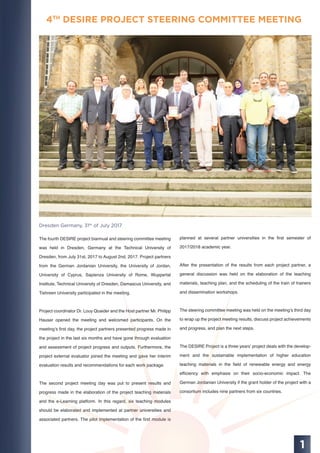
The fourth DESIRE project biannual and steering committee meeting
was held in Dresden, Germany at the Technical University of
Dresden, from July 31st, 2017 to August 2nd, 2017. Project partners
from the German Jordanian University, the University of Jordan,
University of Cyprus, Sapienza University of Rome, Wuppertal
Institute, Technical University of Dresden, Damascus University, and
Tishreen University participated in the meeting.
Project coordinator Dr. Louy Qoaider and the Host partner Mr. Philipp
Hauser opened the meeting and welcomed participants. On the
meeting’s first day, the project partners presented progress made in
the project in the last six months and have gone through evaluation
and assessment of project progress and outputs. Furthermore, the
project external evaluator joined the meeting and gave her interim
evaluation results and recommendations for each work package.
The second project meeting day was put to present results and
progress made in the elaboration of the project teaching materials
and the e-Learning platform. In this regard, six teaching modules
should be elaborated and implemented at partner universities and
associated partners. The pilot implementation of the first module is
planned at several partner universities in the first semester of
2017/2018 academic year.
After the presentation of the results from each project partner, a
general discussion was held on the elaboration of the teaching
materials, teaching plan, and the scheduling of the train of trainers
and dissemination workshops.
The steering committee meeting was held on the meeting’s third day
to wrap up the project meeting results, discuss project achievements
and progress, and plan the next steps.
The DESIRE Project is a three years’ project deals with the develop-
ment and the sustainable implementation of higher education
teaching materials in the field of renewable energy and energy
efficiency with emphasis on their socio-economic impact. The
German Jordanian University if the grant holder of the project with a
consortium includes nine partners from six countries.
GJU ORGANIZES A WORKSHOP ON SOCIO-ECONOMIC IMPACTS
OF RENEWABLE ENERGY AND ENERGY EFFICIENCY IN JORDAN
2
2017 May 16 -Amman
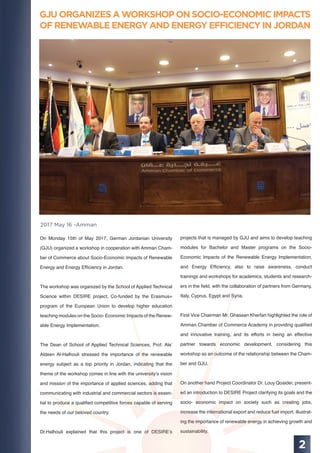
On Monday 15th of May 2017, German Jordanian University
(GJU) organized a workshop in cooperation with Amman Cham-
ber of Commerce about Socio-Economic Impacts of Renewable
Energy and Energy Efficiency in Jordan.
The workshop was organized by the School of Applied Technical
Science within DESIRE project, Co-funded by the Erasmus+
program of the European Union to develop higher education
teaching modules on the Socio- Economic Impacts of the Renew-
able Energy Implementation.
The Dean of School of Applied Technical Sciences, Prof. Ala’
Aldeen Al-Halhouli stressed the importance of the renewable
energy subject as a top priority in Jordan, indicating that the
theme of the workshop comes in line with the university’s vision
and mission of the importance of applied sciences, adding that
communicating with industrial and commercial sectors is essen-
tial to produce a qualified competitive forces capable of serving
the needs of our beloved country.
Dr.Halhouli explained that this project is one of DESIRE’s
projects that is managed by GJU and aims to develop teaching
modules for Bachelor and Master programs on the Socio-
Economic Impacts of the Renewable Energy Implementation,
and Energy Efficiency, also to raise awareness, conduct
trainings and workshops for academics, students and research-
ers in the field, with the collaboration of partners from Germany,
Italy, Cyprus, Egypt and Syria.
First Vice Chairman Mr. Ghassan Kherfan highlighted the role of
Amman Chamber of Commerce Academy in providing qualified
and innovative training, and its efforts in being an effective
partner towards economic development, considering this
workshop as an outcome of the relationship between the Cham-
ber and GJU.
On another hand Project Coordinator Dr. Louy Qoaider, present-
ed an introduction to DESIRE Project clarifying its goals and the
socio- economic impact on society such as creating jobs,
increase the international export and reduce fuel import, illustrat-
ing the importance of renewable energy in achieving growth and
sustainability.
3
DESIRE TRAINING COURSES
Europe (Wupperal, rome, dresden), 30th
of July 2017
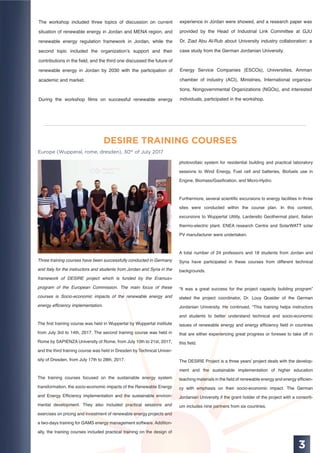
Three training courses have been successfully conducted in Germany
and Italy for the instructors and students from Jordan and Syria in the
framework of DESIRE project which is funded by the Eramus+
program of the European Commission. The main focus of these
courses is Socio-economic impacts of the renewable energy and
energy efficiency implementation.
The first training course was held in Wuppertal by Wuppertal institute
from July 3rd to 14th, 2017, The second training course was held in
Rome by SAPIENZA University of Rome, from July 10th to 21st, 2017,
and the third training course was held in Dresden by Technical Univer-
sity of Dresden, from July 17th to 28th, 2017.
The training courses focused on the sustainable energy system
transformation, the socio-economic impacts of the Renewable Energy
and Energy Efficiency implementation and the sustainable environ-
mental development. They also included practical sessions and
exercises on pricing and investment of renewable energy projects and
a two-days training for GAMS energy management software. Addition-
ally, the training courses included practical training on the design of
The workshop included three topics of discussion on current
situation of renewable energy in Jordan and MENA region, and
renewable energy regulation framework in Jordan, while the
second topic included the organization’s support and their
contributions in the field, and the third one discussed the future of
renewable energy in Jordan by 2030 with the participation of
academic and market.
During the workshop films on successful renewable energy
experience in Jordan were showed, and a research paper was
provided by the Head of Industrial Link Committee at GJU
Dr. Ziad Abu Al-Rub about University industry collaboration: a
case study from the German Jordanian University.
Energy Service Companies (ESCOs), Universities, Amman
chamber of industry (ACI), Ministries, International organiza-
tions, Nongovernmental Organizations (NGOs), and interested
individuals, participated in the workshop.
photovoltaic system for residential building and practical laboratory
sessions to Wind Energy, Fuel cell and batteries, Biofuels use in
Engine, Biomass/Gasification, and Micro-Hydro.
Furthermore, several scientific excursions to energy facilities in three
sites were conducted within the course plan. In this context,
excursions to Wuppertal Utility, Larderello Geothermal plant, Italian
thermo-electric plant, ENEA research Centre and SolarWATT solar
PV manufacturer were undertaken.
A total number of 24 professors and 18 students from Jordan and
Syria have participated in these courses from different technical
backgrounds.
“It was a great success for the project capacity building program”
stated the project coordinator, Dr. Louy Qoaider of the German
Jordanian University. He continued, “This training helps instructors
and students to better understand technical and socio-economic
issues of renewable energy and energy efficiency field in countries
that are either experiencing great progress or foresee to take off in
this field.
The DESIRE Project is a three years’ project deals with the develop-
ment and the sustainable implementation of higher education
teaching materials in the field of renewable energy and energy efficien-
cy with emphasis on their socio-economic impact. The German
Jordanian University if the grant holder of the project with a consorti-
um includes nine partners from six countries.
Development of Higher Education Teaching Modules on the
Socio-economic Impacts of the Renewable Energy Implementation
PARTNERS
DesireGJU DesireGJU DesireGJUDESIRE Project GroupDESIRE Project
Upcoming Events and Conferences:
- ENERDAY 2018 in Dresden, 27th of April
https://tu-dresden.de/bu/wirtschaft/ee2/tagungen/enerday
- GCREEDER 2018, Amman, 3rd of April
http://conferences.ju.edu.jo/en/gcreeder2018/Home.aspx

3rd Desire Newsletter

  • 1.
    DESIRE Newsletter w w w.desir e.gju.edu.jo desir e@ gju.edu.jo Development of Higher Education Teaching Modules on the Socio-economic Impacts of the Renewable Energy Implementation ISSUE , Vol. 1 03 september, 2017 -561638EPP-1-2015-1-JO-EPPKA-2CBHE-JP "This project has been funded with support from the European Commission. This publication [communication] reflects the views only of the author, and the Commission cannot be held responsible for any use which maybe made of the information contained therein"
  • 2.
    4TH DESIRE PROJECT STEERINGCOMMITTEE MEETING 1 Dresden Germany, 31th of July 2017 The fourth DESIRE project biannual and steering committee meeting was held in Dresden, Germany at the Technical University of Dresden, from July 31st, 2017 to August 2nd, 2017. Project partners from the German Jordanian University, the University of Jordan, University of Cyprus, Sapienza University of Rome, Wuppertal Institute, Technical University of Dresden, Damascus University, and Tishreen University participated in the meeting. Project coordinator Dr. Louy Qoaider and the Host partner Mr. Philipp Hauser opened the meeting and welcomed participants. On the meeting’s first day, the project partners presented progress made in the project in the last six months and have gone through evaluation and assessment of project progress and outputs. Furthermore, the project external evaluator joined the meeting and gave her interim evaluation results and recommendations for each work package. The second project meeting day was put to present results and progress made in the elaboration of the project teaching materials and the e-Learning platform. In this regard, six teaching modules should be elaborated and implemented at partner universities and associated partners. The pilot implementation of the first module is planned at several partner universities in the first semester of 2017/2018 academic year. After the presentation of the results from each project partner, a general discussion was held on the elaboration of the teaching materials, teaching plan, and the scheduling of the train of trainers and dissemination workshops. The steering committee meeting was held on the meeting’s third day to wrap up the project meeting results, discuss project achievements and progress, and plan the next steps. The DESIRE Project is a three years’ project deals with the develop- ment and the sustainable implementation of higher education teaching materials in the field of renewable energy and energy efficiency with emphasis on their socio-economic impact. The German Jordanian University if the grant holder of the project with a consortium includes nine partners from six countries.
  • 3.
    GJU ORGANIZES AWORKSHOP ON SOCIO-ECONOMIC IMPACTS OF RENEWABLE ENERGY AND ENERGY EFFICIENCY IN JORDAN 2 2017 May 16 -Amman On Monday 15th of May 2017, German Jordanian University (GJU) organized a workshop in cooperation with Amman Cham- ber of Commerce about Socio-Economic Impacts of Renewable Energy and Energy Efficiency in Jordan. The workshop was organized by the School of Applied Technical Science within DESIRE project, Co-funded by the Erasmus+ program of the European Union to develop higher education teaching modules on the Socio- Economic Impacts of the Renew- able Energy Implementation. The Dean of School of Applied Technical Sciences, Prof. Ala’ Aldeen Al-Halhouli stressed the importance of the renewable energy subject as a top priority in Jordan, indicating that the theme of the workshop comes in line with the university’s vision and mission of the importance of applied sciences, adding that communicating with industrial and commercial sectors is essen- tial to produce a qualified competitive forces capable of serving the needs of our beloved country. Dr.Halhouli explained that this project is one of DESIRE’s projects that is managed by GJU and aims to develop teaching modules for Bachelor and Master programs on the Socio- Economic Impacts of the Renewable Energy Implementation, and Energy Efficiency, also to raise awareness, conduct trainings and workshops for academics, students and research- ers in the field, with the collaboration of partners from Germany, Italy, Cyprus, Egypt and Syria. First Vice Chairman Mr. Ghassan Kherfan highlighted the role of Amman Chamber of Commerce Academy in providing qualified and innovative training, and its efforts in being an effective partner towards economic development, considering this workshop as an outcome of the relationship between the Cham- ber and GJU. On another hand Project Coordinator Dr. Louy Qoaider, present- ed an introduction to DESIRE Project clarifying its goals and the socio- economic impact on society such as creating jobs, increase the international export and reduce fuel import, illustrat- ing the importance of renewable energy in achieving growth and sustainability.
  • 4.
    3 DESIRE TRAINING COURSES Europe(Wupperal, rome, dresden), 30th of July 2017 Three training courses have been successfully conducted in Germany and Italy for the instructors and students from Jordan and Syria in the framework of DESIRE project which is funded by the Eramus+ program of the European Commission. The main focus of these courses is Socio-economic impacts of the renewable energy and energy efficiency implementation. The first training course was held in Wuppertal by Wuppertal institute from July 3rd to 14th, 2017, The second training course was held in Rome by SAPIENZA University of Rome, from July 10th to 21st, 2017, and the third training course was held in Dresden by Technical Univer- sity of Dresden, from July 17th to 28th, 2017. The training courses focused on the sustainable energy system transformation, the socio-economic impacts of the Renewable Energy and Energy Efficiency implementation and the sustainable environ- mental development. They also included practical sessions and exercises on pricing and investment of renewable energy projects and a two-days training for GAMS energy management software. Addition- ally, the training courses included practical training on the design of The workshop included three topics of discussion on current situation of renewable energy in Jordan and MENA region, and renewable energy regulation framework in Jordan, while the second topic included the organization’s support and their contributions in the field, and the third one discussed the future of renewable energy in Jordan by 2030 with the participation of academic and market. During the workshop films on successful renewable energy experience in Jordan were showed, and a research paper was provided by the Head of Industrial Link Committee at GJU Dr. Ziad Abu Al-Rub about University industry collaboration: a case study from the German Jordanian University. Energy Service Companies (ESCOs), Universities, Amman chamber of industry (ACI), Ministries, International organiza- tions, Nongovernmental Organizations (NGOs), and interested individuals, participated in the workshop. photovoltaic system for residential building and practical laboratory sessions to Wind Energy, Fuel cell and batteries, Biofuels use in Engine, Biomass/Gasification, and Micro-Hydro. Furthermore, several scientific excursions to energy facilities in three sites were conducted within the course plan. In this context, excursions to Wuppertal Utility, Larderello Geothermal plant, Italian thermo-electric plant, ENEA research Centre and SolarWATT solar PV manufacturer were undertaken. A total number of 24 professors and 18 students from Jordan and Syria have participated in these courses from different technical backgrounds. “It was a great success for the project capacity building program” stated the project coordinator, Dr. Louy Qoaider of the German Jordanian University. He continued, “This training helps instructors and students to better understand technical and socio-economic issues of renewable energy and energy efficiency field in countries that are either experiencing great progress or foresee to take off in this field. The DESIRE Project is a three years’ project deals with the develop- ment and the sustainable implementation of higher education teaching materials in the field of renewable energy and energy efficien- cy with emphasis on their socio-economic impact. The German Jordanian University if the grant holder of the project with a consorti- um includes nine partners from six countries.
  • 5.
    Development of HigherEducation Teaching Modules on the Socio-economic Impacts of the Renewable Energy Implementation PARTNERS DesireGJU DesireGJU DesireGJUDESIRE Project GroupDESIRE Project Upcoming Events and Conferences: - ENERDAY 2018 in Dresden, 27th of April https://tu-dresden.de/bu/wirtschaft/ee2/tagungen/enerday - GCREEDER 2018, Amman, 3rd of April http://conferences.ju.edu.jo/en/gcreeder2018/Home.aspx