WHAT IS 3D PRINTING 
1.) 3D printing refers to any of the various methods used for 
printing a three dimensional object. 
2.) Primarily additive processes are used where successive layers 
of material are laid down with the help of computer. 
3.) Objects of almost any kind or shape may be printed by this 
method. 
4.) It is a kind of INDUSTRIAL ROBOT.
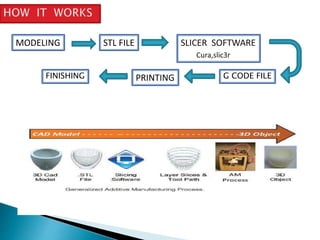
MODELING STL FILE SLICER SOFTWARE 
Cura,slic3r 
FINISHING PRINTING G CODE FILE
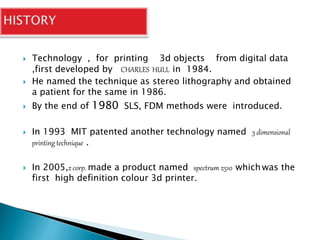
 Technology , for printing 3d objects from digital data 
,first developed by CHARLES HULL in 1984. 
 He named the technique as stereo lithography and obtained 
a patient for the same in 1986. 
 By the end of 1980 SLS, FDM methods were introduced. 
 In 1993 MIT patented another technology named 3 dimensional 
printing technique . 
 In 2005,z corp. made a product named spectrum z510 which was the 
first high definition colour 3d printer.
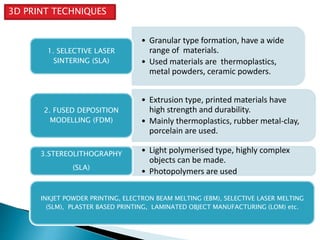
• Granular type formation, have a wide 
range of materials. 
• Used materials are thermoplastics, 
metal powders, ceramic powders. 
3D PRINT TECHNIQUES 
1. SELECTIVE LASER 
SINTERING (SLA) 
• Extrusion type, printed materials have 
high strength and durability. 
• Mainly thermoplastics, rubber metal-clay, 
porcelain are used. 
2. FUSED DEPOSITION 
MODELLING (FDM) 
• Light polymerised type, highly complex 
objects can be made. 
• Photopolymers are used 
3.STEREOLITHOGRAPHY 
(SLA) 
INKJET POWDER PRINTING, ELECTRON BEAM MELTING (EBM), SELECTIVE LASER MELTING 
(SLM), PLASTER BASED PRINTING, LAMINATED OBJECT MANUFACTURING (LOM) etc.
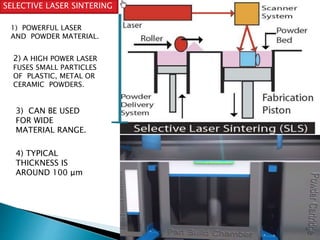
SELECTIVE LASER SINTERING 
1) POWERFUL LASER 
AND POWDER MATERIAL. 
2) A HIGH POWER LASER 
FUSES SMALL PARTICLES 
OF PLASTIC, METAL OR 
CERAMIC POWDERS. 
3) CAN BE USED 
FOR WIDE 
MATERIAL RANGE. 
4) TYPICAL 
THICKNESS IS 
AROUND 100 μm
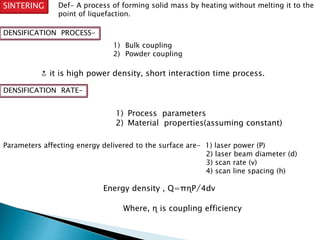
SINTERING Def- A process of forming solid mass by heating without melting it to the 
point of liquefaction. 
DENSIFICATION PROCESS- 
1) Bulk coupling 
2) Powder coupling 
≛ it is high power density, short interaction time process. 
DENSIFICATION RATE- 
1) Process parameters 
2) Material properties(assuming constant) 
Parameters affecting energy delivered to the surface are- 1) laser power (P) 
2) laser beam diameter (d) 
3) scan rate (v) 
4) scan line spacing (h) 
Energy density , Q=πɳP̸4dv 
Where, ɳ is coupling efficiency
1.) Sintering temperature, T(s)= T(0) +1/C [ πɳ/4ρ (P/hvw) - ΔH ] 
it is a empirical relation. 
where, w is layer density , C is specific heat, T(s) is sintering temp , 
T(0) is initial temp, ρ is density and ΔH is latent heat. 
2.) The rate of change in void fraction of powder bed is , 
d€/dt = -k€, €(i) ≤ € ≤ €(s) 
where k is sintering rate and € is void fraction. 
3.) empirically , k ⋉ P/wh 
4.) Full densification can not be obtained
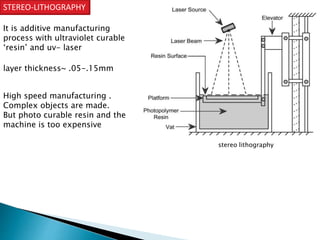
STEREO-LITHOGRAPHY 
stereo lithography 
It is additive manufacturing 
process with ultraviolet curable 
‘resin’ and uv- laser 
layer thickness~ .05-.15mm 
High speed manufacturing . 
Complex objects are made. 
But photo curable resin and the 
machine is too expensive
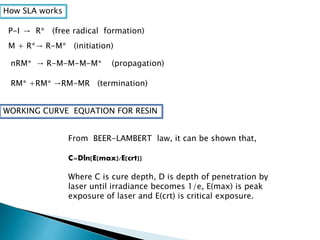
How SLA works 
P-I → 
R* (free radical formation) 
M + R* → 
R-M* (initiation) 
nRM* → R-M-M-M-M* (propagation) 
RM* +RM* →RM-MR (termination) 
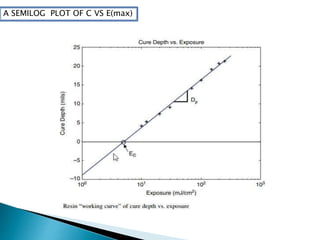
WORKING CURVE EQUATION FOR RESIN 
From BEER-LAMBERT law, it can be shown that, 
C=Dln[E(max)/E(crt)) 
Where C is cure depth, D is depth of penetration by 
laser until irradiance becomes 1/e, E(max) is peak 
exposure of laser and E(crt) is critical exposure.
A SEMILOG PLOT OF C VS E(max)
WHY 3D PRINTING 
1.) Increase innovation 
2.) Reduce development costs 
3.) Improve communications-(like, recently a 3D printer 
has been sent to space (by NASA’s MARSHALL SPACE FLIGHT 
CENTER in Huntsville, Ala) to help astronauts building 
replacement parts or any other important tools ) 
4.) Win business. 
APPLICATIONS 
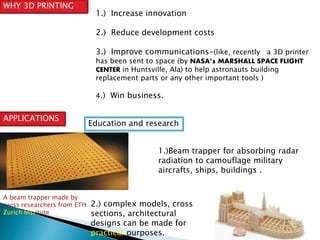
Education and research 
1.)Beam trapper for absorbing radar 
radiation to camouflage military 
aircrafts, ships, buildings . 
2.) complex models, cross 
sections, architectural 
designs can be made for 
practical purposes. 
A beam trapper made by 
swiss researchers from ETH 
Zurich Institute
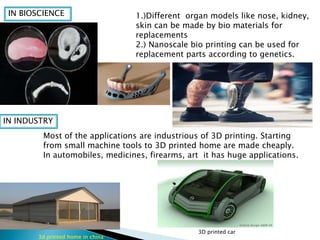
IN BIOSCIENCE 1.)Different organ models like nose, kidney, 
skin can be made by bio materials for 
replacements 
2.) Nanoscale bio printing can be used for 
replacement parts according to genetics. 
IN INDUSTRY 
Most of the applications are industrious of 3D printing. Starting 
from small machine tools to 3D printed home are made cheaply. 
In automobiles, medicines, firearms, art it has huge applications. 
3d printed home in china 
3D printed car
REFERENCES and SOURCES 
1.)www.elsevier.com/locate/msea; A. Simchi / Materials Science and 
Engineering A 428 (2006) 148–158 
2. Jacobs PF (1992) Rapid prototyping & manufacturing, fundamentals of stereo 
lithography. Society of Manufacturing Engineers, New York, NY 
3. http://www.space.com/23532-3d-printer-space-station-video.html 
4. "How Stereo lithography Works". THRE3D.com. Retrieved 4 February 2014
3d printing....science....

3d printing....science....

  • 2.
    WHAT IS 3DPRINTING 1.) 3D printing refers to any of the various methods used for printing a three dimensional object. 2.) Primarily additive processes are used where successive layers of material are laid down with the help of computer. 3.) Objects of almost any kind or shape may be printed by this method. 4.) It is a kind of INDUSTRIAL ROBOT.
  • 3.
    MODELING STL FILESLICER SOFTWARE Cura,slic3r FINISHING PRINTING G CODE FILE
  • 4.
     Technology ,for printing 3d objects from digital data ,first developed by CHARLES HULL in 1984.  He named the technique as stereo lithography and obtained a patient for the same in 1986.  By the end of 1980 SLS, FDM methods were introduced.  In 1993 MIT patented another technology named 3 dimensional printing technique .  In 2005,z corp. made a product named spectrum z510 which was the first high definition colour 3d printer.
  • 5.
    • Granular typeformation, have a wide range of materials. • Used materials are thermoplastics, metal powders, ceramic powders. 3D PRINT TECHNIQUES 1. SELECTIVE LASER SINTERING (SLA) • Extrusion type, printed materials have high strength and durability. • Mainly thermoplastics, rubber metal-clay, porcelain are used. 2. FUSED DEPOSITION MODELLING (FDM) • Light polymerised type, highly complex objects can be made. • Photopolymers are used 3.STEREOLITHOGRAPHY (SLA) INKJET POWDER PRINTING, ELECTRON BEAM MELTING (EBM), SELECTIVE LASER MELTING (SLM), PLASTER BASED PRINTING, LAMINATED OBJECT MANUFACTURING (LOM) etc.
  • 6.
    SELECTIVE LASER SINTERING 1) POWERFUL LASER AND POWDER MATERIAL. 2) A HIGH POWER LASER FUSES SMALL PARTICLES OF PLASTIC, METAL OR CERAMIC POWDERS. 3) CAN BE USED FOR WIDE MATERIAL RANGE. 4) TYPICAL THICKNESS IS AROUND 100 μm
  • 7.
    SINTERING Def- Aprocess of forming solid mass by heating without melting it to the point of liquefaction. DENSIFICATION PROCESS- 1) Bulk coupling 2) Powder coupling ≛ it is high power density, short interaction time process. DENSIFICATION RATE- 1) Process parameters 2) Material properties(assuming constant) Parameters affecting energy delivered to the surface are- 1) laser power (P) 2) laser beam diameter (d) 3) scan rate (v) 4) scan line spacing (h) Energy density , Q=πɳP̸4dv Where, ɳ is coupling efficiency
  • 8.
    1.) Sintering temperature,T(s)= T(0) +1/C [ πɳ/4ρ (P/hvw) - ΔH ] it is a empirical relation. where, w is layer density , C is specific heat, T(s) is sintering temp , T(0) is initial temp, ρ is density and ΔH is latent heat. 2.) The rate of change in void fraction of powder bed is , d€/dt = -k€, €(i) ≤ € ≤ €(s) where k is sintering rate and € is void fraction. 3.) empirically , k ⋉ P/wh 4.) Full densification can not be obtained
  • 9.
    STEREO-LITHOGRAPHY stereo lithography It is additive manufacturing process with ultraviolet curable ‘resin’ and uv- laser layer thickness~ .05-.15mm High speed manufacturing . Complex objects are made. But photo curable resin and the machine is too expensive
  • 10.
    How SLA works P-I → R* (free radical formation) M + R* → R-M* (initiation) nRM* → R-M-M-M-M* (propagation) RM* +RM* →RM-MR (termination) WORKING CURVE EQUATION FOR RESIN From BEER-LAMBERT law, it can be shown that, C=Dln[E(max)/E(crt)) Where C is cure depth, D is depth of penetration by laser until irradiance becomes 1/e, E(max) is peak exposure of laser and E(crt) is critical exposure.
  • 11.
    A SEMILOG PLOTOF C VS E(max)
  • 12.
    WHY 3D PRINTING 1.) Increase innovation 2.) Reduce development costs 3.) Improve communications-(like, recently a 3D printer has been sent to space (by NASA’s MARSHALL SPACE FLIGHT CENTER in Huntsville, Ala) to help astronauts building replacement parts or any other important tools ) 4.) Win business. APPLICATIONS Education and research 1.)Beam trapper for absorbing radar radiation to camouflage military aircrafts, ships, buildings . 2.) complex models, cross sections, architectural designs can be made for practical purposes. A beam trapper made by swiss researchers from ETH Zurich Institute
  • 13.
    IN BIOSCIENCE 1.)Differentorgan models like nose, kidney, skin can be made by bio materials for replacements 2.) Nanoscale bio printing can be used for replacement parts according to genetics. IN INDUSTRY Most of the applications are industrious of 3D printing. Starting from small machine tools to 3D printed home are made cheaply. In automobiles, medicines, firearms, art it has huge applications. 3d printed home in china 3D printed car
  • 14.
    REFERENCES and SOURCES 1.)www.elsevier.com/locate/msea; A. Simchi / Materials Science and Engineering A 428 (2006) 148–158 2. Jacobs PF (1992) Rapid prototyping & manufacturing, fundamentals of stereo lithography. Society of Manufacturing Engineers, New York, NY 3. http://www.space.com/23532-3d-printer-space-station-video.html 4. "How Stereo lithography Works". THRE3D.com. Retrieved 4 February 2014