SMT. KAMALAAND SRI VENKAPPA M. AGADI
COLLEGE OF ENGINEERING AND TECHNOLOGY
LAKSHMESHWAR – 582116
DEPARTMENT OF INFORMATION SCIENCE AND ENGINEERING
FINAL YEAR TECHNICAL SEMINAR PRESENTATION ON THE TOPIC ENTITLED
“HOLOGRAPHIC PROJECTION TECHNOLOGY”
Under the guidance of:
Mr.Ramesh N Koppar
Presented By:
Shrinidhi S Kulkarni
2KA19IS036
Dept of ISE, SKSVMACET
Contents
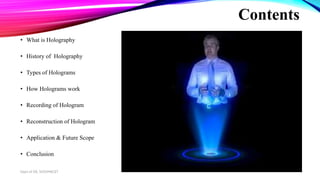
• What is Holography
• History of Holography
• Types of Holograms
• How Holograms work
• Recording of Hologram
• Reconstruction of Hologram
• Application & Future Scope
• Conclusion
Dept of ISE, SKSVMACET
HOLOGRAPHY
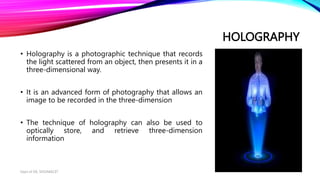
• Holography is a photographic technique that records
the light scattered from an object, then presents it in a
three-dimensional way.
• It is an advanced form of photography that allows an
image to be recorded in the three-dimension
• The technique of holography can also be used to
optically store, and retrieve three-dimension
information
Dept of ISE, SKSVMACET
THREE-DIMENSIONAL HOLOGRAPHIC
PROJECTION TECHNOLOGY
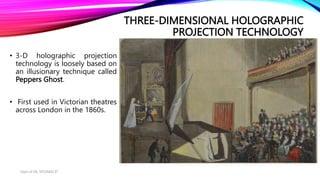
• 3-D holographic projection
technology is loosely based on
an illusionary technique called
Peppers Ghost.
• First used in Victorian theatres
across London in the 1860s.
Dept of ISE, SKSVMACET
HOLOGRAM - HISTORY
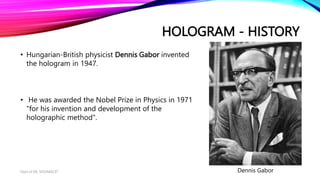
• Hungarian-British physicist Dennis Gabor invented
the hologram in 1947.
• He was awarded the Nobel Prize in Physics in 1971
"for his invention and development of the
holographic method".
Dennis Gabor
Dept of ISE, SKSVMACET
TYPES OF HOLOGRAPHY
• Reflection Hologram: Created by reflecting laser light off an object and viewed by
shining a laser beam on it from the same angle as the original beam.
• Transmission Hologram: Created by passing laser light through an object onto a
photographic plate, viewed by shining a laser beam through it from the same angle
as the original beam.
• Computer-Generated Hologram (CGH): Created using digital devices to simulate an
object's interference pattern, the resulting hologram can be printed or displayed on
a screen, used in applications such as 3D displays.
Dept of ISE, SKSVMACET
WORKING OF HOLOGRAM
The time-varying light field of a scene with all its physical properties is to be recorded
and then regenerated. Hence the working of holography is divided into two phases:
• Recording of a hologram.
• Reconstruction of a hologram.
Dept of ISE, SKSVMACET
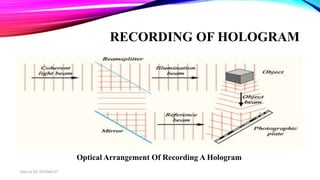
RECORDING OF HOLOGRAM
Optical Arrangement Of Recording A Hologram
Dept of ISE, SKSVMACET
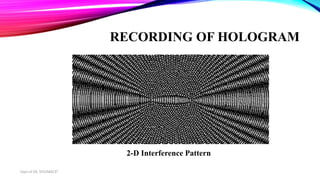
RECORDING OF HOLOGRAM
2-D Interference Pattern
Dept of ISE, SKSVMACET
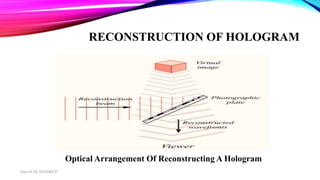
RECONSTRUCTION OF HOLOGRAM
Optical Arrangement Of Reconstructing A Hologram
Dept of ISE, SKSVMACET
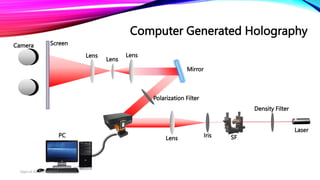
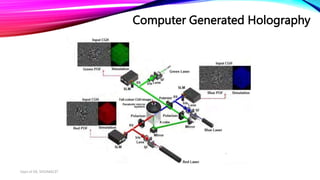
Computer Generated Holography
Camera
SF
Laser
Density Filter
Polarization Filter
Iris
Lens
PC
Lens
Lens
Lens
Mirror
Screen
Dept of ISE, SKSVMACET
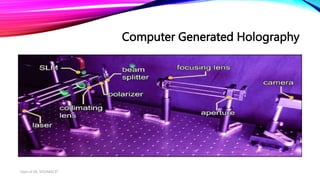
Computer Generated Holography
Dept of ISE, SKSVMACET
A DOUBLE PARABOLIC MIRROR PROJECTION SYSTEM
• The double parabolic projection system is composed of double parabolic mirrors.
• The full-color computer-generated hologram is a real image, which could be remade
a virtual image through the double parabolic projection system.
• The image magnification appears to be 1.2 times the original.
• The horizontal viewing angle appears 360° and the vertical viewing angle 15-75°.
Dept of ISE, SKSVMACET
Computer Generated Holography
Dept of ISE, SKSVMACET
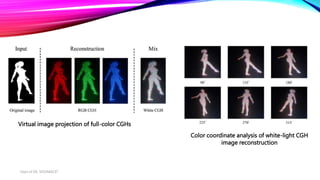
Virtual image projection of full-color CGHs
Color coordinate analysis of white-light CGH
image reconstruction
Dept of ISE, SKSVMACET
APPLICATIONS OF HOLOGRAPHIC
PROJECTION TECHNOLOGY
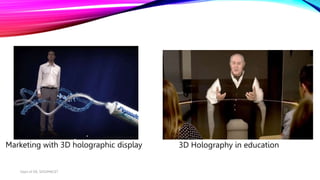
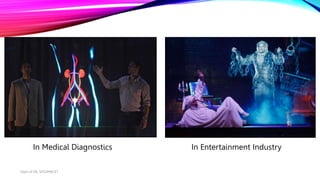
Marketing with 3D holographic display 3D Holography in education
Dept of ISE, SKSVMACET
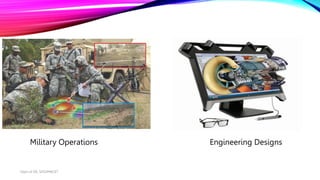
In Medical Diagnostics In Entertainment Industry
Dept of ISE, SKSVMACET
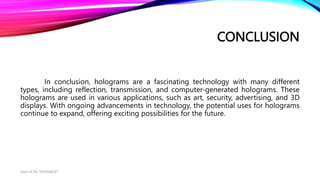
Military Operations Engineering Designs
Dept of ISE, SKSVMACET
CONCLUSION
In conclusion, holograms are a fascinating technology with many different
types, including reflection, transmission, and computer-generated holograms. These
holograms are used in various applications, such as art, security, advertising, and 3D
displays. With ongoing advancements in technology, the potential uses for holograms
continue to expand, offering exciting possibilities for the future.
Dept of ISE, SKSVMACET
REFERENCES
• Yu, D. and Yao, W., 2023, February. Research on holographic display and technology
application of art museums based on immersive design. In Journal of Physics:
Conference Series (Vol. 2425, No. 1, p. 012048). IOP Publishing.
• J. Matišák, K. Žáková and M. Rábek, "Hologram in Control Applications," 2022
Cybernetics & Informatics (K&I), Visegrád, Hungary, 2022, pp. 1-6,
doi:10.1109/KI55792.2022.9925927.
Dept of ISE, SKSVMACET

3D Holographic Projection Technology-1.pptx

  • 1.
    SMT. KAMALAAND SRIVENKAPPA M. AGADI COLLEGE OF ENGINEERING AND TECHNOLOGY LAKSHMESHWAR – 582116 DEPARTMENT OF INFORMATION SCIENCE AND ENGINEERING FINAL YEAR TECHNICAL SEMINAR PRESENTATION ON THE TOPIC ENTITLED “HOLOGRAPHIC PROJECTION TECHNOLOGY” Under the guidance of: Mr.Ramesh N Koppar Presented By: Shrinidhi S Kulkarni 2KA19IS036 Dept of ISE, SKSVMACET
  • 2.
    Contents • What isHolography • History of Holography • Types of Holograms • How Holograms work • Recording of Hologram • Reconstruction of Hologram • Application & Future Scope • Conclusion Dept of ISE, SKSVMACET
  • 3.
    HOLOGRAPHY • Holography isa photographic technique that records the light scattered from an object, then presents it in a three-dimensional way. • It is an advanced form of photography that allows an image to be recorded in the three-dimension • The technique of holography can also be used to optically store, and retrieve three-dimension information Dept of ISE, SKSVMACET
  • 4.
    THREE-DIMENSIONAL HOLOGRAPHIC PROJECTION TECHNOLOGY •3-D holographic projection technology is loosely based on an illusionary technique called Peppers Ghost. • First used in Victorian theatres across London in the 1860s. Dept of ISE, SKSVMACET
  • 5.
    HOLOGRAM - HISTORY •Hungarian-British physicist Dennis Gabor invented the hologram in 1947. • He was awarded the Nobel Prize in Physics in 1971 "for his invention and development of the holographic method". Dennis Gabor Dept of ISE, SKSVMACET
  • 6.
    TYPES OF HOLOGRAPHY •Reflection Hologram: Created by reflecting laser light off an object and viewed by shining a laser beam on it from the same angle as the original beam. • Transmission Hologram: Created by passing laser light through an object onto a photographic plate, viewed by shining a laser beam through it from the same angle as the original beam. • Computer-Generated Hologram (CGH): Created using digital devices to simulate an object's interference pattern, the resulting hologram can be printed or displayed on a screen, used in applications such as 3D displays. Dept of ISE, SKSVMACET
  • 7.
    WORKING OF HOLOGRAM Thetime-varying light field of a scene with all its physical properties is to be recorded and then regenerated. Hence the working of holography is divided into two phases: • Recording of a hologram. • Reconstruction of a hologram. Dept of ISE, SKSVMACET
  • 8.
    RECORDING OF HOLOGRAM OpticalArrangement Of Recording A Hologram Dept of ISE, SKSVMACET
  • 9.
    RECORDING OF HOLOGRAM 2-DInterference Pattern Dept of ISE, SKSVMACET
  • 10.
    RECONSTRUCTION OF HOLOGRAM OpticalArrangement Of Reconstructing A Hologram Dept of ISE, SKSVMACET
  • 11.
    Computer Generated Holography Camera SF Laser DensityFilter Polarization Filter Iris Lens PC Lens Lens Lens Mirror Screen Dept of ISE, SKSVMACET
  • 12.
  • 13.
    A DOUBLE PARABOLICMIRROR PROJECTION SYSTEM • The double parabolic projection system is composed of double parabolic mirrors. • The full-color computer-generated hologram is a real image, which could be remade a virtual image through the double parabolic projection system. • The image magnification appears to be 1.2 times the original. • The horizontal viewing angle appears 360° and the vertical viewing angle 15-75°. Dept of ISE, SKSVMACET
  • 14.
  • 15.
    Virtual image projectionof full-color CGHs Color coordinate analysis of white-light CGH image reconstruction Dept of ISE, SKSVMACET
  • 16.
  • 17.
    Marketing with 3Dholographic display 3D Holography in education Dept of ISE, SKSVMACET
  • 18.
    In Medical DiagnosticsIn Entertainment Industry Dept of ISE, SKSVMACET
  • 19.
    Military Operations EngineeringDesigns Dept of ISE, SKSVMACET
  • 20.
    CONCLUSION In conclusion, hologramsare a fascinating technology with many different types, including reflection, transmission, and computer-generated holograms. These holograms are used in various applications, such as art, security, advertising, and 3D displays. With ongoing advancements in technology, the potential uses for holograms continue to expand, offering exciting possibilities for the future. Dept of ISE, SKSVMACET
  • 21.
    REFERENCES • Yu, D.and Yao, W., 2023, February. Research on holographic display and technology application of art museums based on immersive design. In Journal of Physics: Conference Series (Vol. 2425, No. 1, p. 012048). IOP Publishing. • J. Matišák, K. Žáková and M. Rábek, "Hologram in Control Applications," 2022 Cybernetics & Informatics (K&I), Visegrád, Hungary, 2022, pp. 1-6, doi:10.1109/KI55792.2022.9925927. Dept of ISE, SKSVMACET