MINISTRY OF PRIMARYAND
SECONDARY EDUCATION
COMPETENCE BASED CURRICULUM
ASSESSMENT FRAMEWORK
THE ASSESSMENT FRAMEWORK
2.
Preamble
The Curriculum Framework2015-2022 emphasizes the assessment of
knowledge, skills, abilities, values and traits to ascertain the achievement of
desired learner exit profiles. This is underpinned by the philosophy of
Ubuntu/Unhu/Vumunhu
The new curriculum framework prescribes a new model of assessment which is
a hybrid of assessment for learning and assessment as learning [assessment is
learning] and assessment of learning.
Inclusive learning, which accommodates learner diversity, is key in the
framework. The assessment framework accommodates diverse needs such as
different aptitudes, talents, gender, disabilities, socio-economic status and
vulnerabilities.
The weighted contributions of these assessment approaches are specified in
the syllabus and are in line with the Curriculum Framework. The model embraces
holistic approaches to assessment which entail assessing learner competencies
on a continuum that includes knowledge, skills, abilities, values and traits
3.
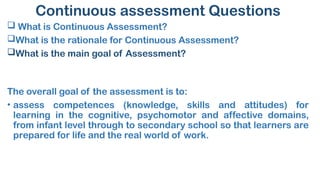
Continuous assessment Questions
What is Continuous Assessment?
What is the rationale for Continuous Assessment?
What is the main goal of Assessment?
The overall goal of the assessment is to:
• assess competences (knowledge, skills and attitudes) for
learning in the cognitive, psychomotor and affective domains,
from infant level through to secondary school so that learners are
prepared for life and the real world of work.
4.
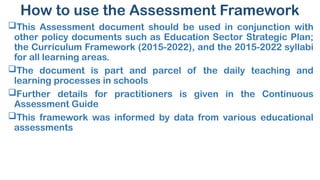
How to usethe Assessment Framework
This Assessment document should be used in conjunction with
other policy documents such as Education Sector Strategic Plan;
the Curriculum Framework (2015-2022), and the 2015-2022 syllabi
for all learning areas.
The document is part and parcel of the daily teaching and
learning processes in schools
Further details for practitioners is given in the Continuous
Assessment Guide
This framework was informed by data from various educational
assessments
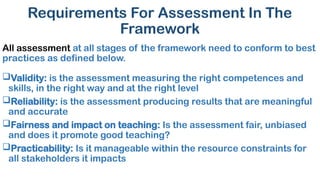
Requirements For AssessmentIn The
Framework
All assessment at all stages of the framework need to conform to best
practices as defined below.
Validity: is the assessment measuring the right competences and
skills, in the right way and at the right level
Reliability: is the assessment producing results that are meaningful
and accurate
Fairness and impact on teaching: Is the assessment fair, unbiased
and does it promote good teaching?
Practicability: Is it manageable within the resource constraints for
all stakeholders it impacts
7.
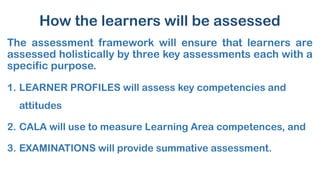
How the learnerswill be assessed
The assessment framework will ensure that learners are
assessed holistically by three key assessments each with a
specific purpose.
1. LEARNER PROFILES will assess key competencies and
attitudes
2. CALA will use to measure Learning Area competences, and
3. EXAMINATIONS will provide summative assessment.
8.
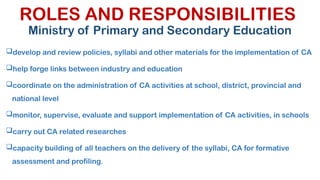
ROLES AND RESPONSIBILITIES
Ministryof Primary and Secondary Education
develop and review policies, syllabi and other materials for the implementation of CA
help forge links between industry and education
coordinate on the administration of CA activities at school, district, provincial and
national level
monitor, supervise, evaluate and support implementation of CA activities, in schools
carry out CA related researches
capacity building of all teachers on the delivery of the syllabi, CA for formative
assessment and profiling.
9.
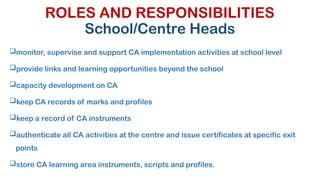
ROLES AND RESPONSIBILITIES
School/CentreHeads
monitor, supervise and support CA implementation activities at school level
provide links and learning opportunities beyond the school
capacity development on CA
keep CA records of marks and profiles
keep a record of CA instruments
authenticate all CA activities at the centre and issue certificates at specific exit
points
store CA learning area instruments, scripts and profiles.
10.
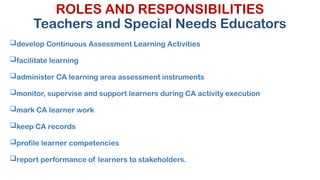
ROLES AND RESPONSIBILITIES
Teachersand Special Needs Educators
develop Continuous Assessment Learning Activities
facilitate learning
administer CA learning area assessment instruments
monitor, supervise and support learners during CA activity execution
mark CA learner work
keep CA records
profile learner competencies
report performance of learners to stakeholders.
11.
ROLES AND RESPONSIBILITIES
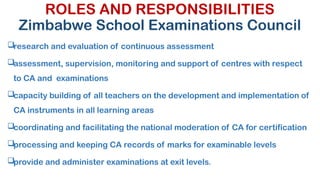
ZimbabweSchool Examinations Council
research and evaluation of continuous assessment
assessment, supervision, monitoring and support of centres with respect
to CA and examinations
capacity building of all teachers on the development and implementation of
CA instruments in all learning areas
coordinating and facilitating the national moderation of CA for certification
processing and keeping CA records of marks for examinable levels
provide and administer examinations at exit levels.
12.
ROLES AND RESPONSIBILITIES
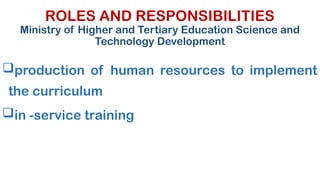
Ministryof Higher and Tertiary Education Science and
Technology Development
production of human resources to implement
the curriculum
in -service training
13.
ROLES AND RESPONSIBILITIES
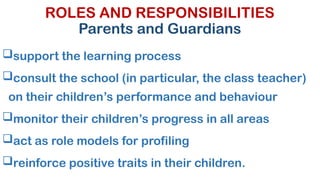
Parentsand Guardians
support the learning process
consult the school (in particular, the class teacher)
on their children’s performance and behaviour
monitor their children’s progress in all areas
act as role models for profiling
reinforce positive traits in their children.
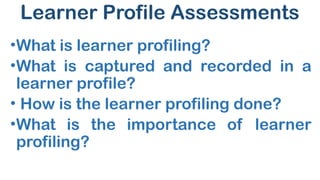
Learner Profile Assessments
•Whatis learner profiling?
•What is captured and recorded in a
learner profile?
• How is the learner profiling done?
•What is the importance of learner
profiling?
16.
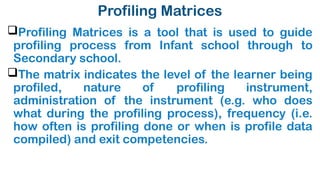
Profiling Matrices
Profiling Matricesis a tool that is used to guide
profiling process from Infant school through to
Secondary school.
The matrix indicates the level of the learner being
profiled, nature of profiling instrument,
administration of the instrument (e.g. who does
what during the profiling process), frequency (i.e.
how often is profiling done or when is profile data
compiled) and exit competencies.
17.
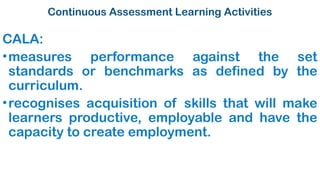
Continuous Assessment LearningActivities
CALA:
•measures performance against the set
standards or benchmarks as defined by the
curriculum.
•recognises acquisition of skills that will make
learners productive, employable and have the
capacity to create employment.
18.
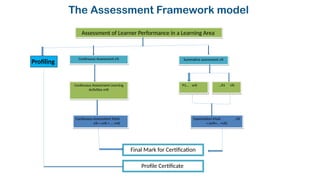
The Assessment Frameworkmodel
Assessment of Learner Performance in a Learning Area
Continuous Assessment x%
Continuous Assessment Learning
Activities m%
Continuous Assessment Mark
x% = m% + … +n%
Summative assessment y%
P1… w% …P2 v%
Examination Mark y%
= (w%+… +v%)
Final Mark for Certification
Profile Certificate
Profiling
19.
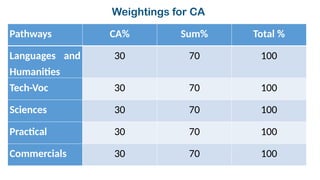
Weightings for CA
PathwaysCA% Sum% Total %
Languages and
Humanities
30 70 100
Tech-Voc 30 70 100
Sciences 30 70 100
Practical 30 70 100
Commercials 30 70 100
20.
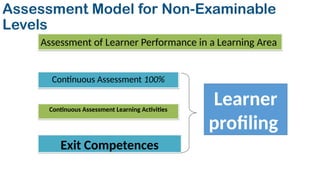
Assessment Model forNon-Examinable
Levels
Assessment of Learner Performance in a Learning Area
Continuous Assessment 100%
Continuous Assessment Learning Activities
Exit Competences
Learner
profiling
21.
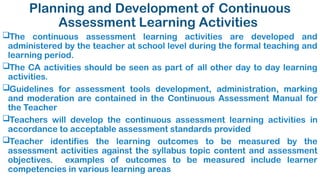
Planning and Developmentof Continuous
Assessment Learning Activities
The continuous assessment learning activities are developed and
administered by the teacher at school level during the formal teaching and
learning period.
The CA activities should be seen as part of all other day to day learning
activities.
Guidelines for assessment tools development, administration, marking
and moderation are contained in the Continuous Assessment Manual for
the Teacher
Teachers will develop the continuous assessment learning activities in
accordance to acceptable assessment standards provided
Teacher identifies the learning outcomes to be measured by the
assessment activities against the syllabus topic content and assessment
objectives. examples of outcomes to be measured include learner
competencies in various learning areas
22.
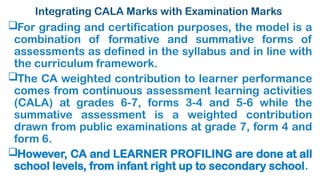
Integrating CALA Markswith Examination Marks
For grading and certification purposes, the model is a
combination of formative and summative forms of
assessments as defined in the syllabus and in line with
the curriculum framework.
The CA weighted contribution to learner performance
comes from continuous assessment learning activities
(CALA) at grades 6-7, forms 3-4 and 5-6 while the
summative assessment is a weighted contribution
drawn from public examinations at grade 7, form 4 and
form 6.
However, CA and LEARNER PROFILING are done at all
school levels, from infant right up to secondary school.
23.
Continuous Assessment Activities
performanceactivities implementation by centres according to
given guidelines.
continuous scoring of performance activities by centres
according to developed specifications and guidelines.
uploading of marks by centres into the ZIMSEC database according
to given timelines and specifications for examinable levels.
moderation of CA work by schools and ZIMSEC.
monitoring, supervision and support of ca implementation
activities by MoPSE and ZIMSEC.
24.
Assessment for non-formal/Privatelearner
• The assessment of non-formal learners for certification follows all
requirements of the mainstream classes
• Non-formal learners should be registered at MoPSE and ZIMSEC
accredited centres.
• All non-formal candidates’ arrangements and considerations
enshrined in the ZIMSEC examinations handbook for centres and
examinations circulars shall apply, with respect of public
examinations.
25.
Non-formal and modalitieson CA
The continuous assessment mark will have a three-year shelf life, which will provide the
candidate four chances of sitting for an examination.
A learner has an option to repeat CA if they so wish
In the event of the candidate failing to pass after the two-year shelf life of the CA mark,
then the candidate will have to take the non-formal education route.
Every school is a non-formal centre and therefore resources, including human resources
should be availed for the teaching and learning process.
The non-formal route remains open for anyone who would want to pursue education in the
primary and secondary school levels.
26.
Learner Transfer underCA
Learners who transfer from one centre to another will:
• maintain their identification (candidate number) and
• carry with them the CA mark profile.
It is the responsibility of the releasing head to
authenticate the CA documents.
27.
Learners with SpecialNeeds
Assessment of learners with special needs shall follow that of the
mainstream classes, but with special arrangements and special
considerations appropriate to each and every assessment activity.
Special considerations and arrangements shall be made for all
deserving learners as a matter of right not charity.
Notifications for special arrangements, special considerations
and the justification for these shall be made to MoPSE and
ZIMSEC in case of public examinations.
Teachers shall be responsible for developing assessment
activities, providing alternative part questions of the activities and
suggesting exemptions where necessary
Teachers with special needs and teachers of learners with special
need to be involved at every stage of the assessment processes.
28.
Quality Control
Quality controlof CALA is done at school, cluster,
district, provincial and national levels.
Administrative structures that are currently prevailing
at school, cluster, district, provincial and national levels
will support, supervise, monitor and evaluate the
development, administration, marking and moderation
of CALA.
29.
Certification
Profile reports andprofile certificates can be issued at any learner exit point.
At the end of each term and year, a summary profile report will be compiled by
the teacher. These reports may be issued to a learner who has exited the school
system not through transfer or moving to the next school level. The teacher or
H.O.D must authenticate the report. A copy of the report should however be
retained by the teacher or the H.O.D.
At the end of each school level, a school profile certificate is compiled by the
school profile committee. In the event of the learner exiting the school at the end
of a school level, then the learner will be issued with an end of school level profile
certificate at that level by the Ministry
At the point of readiness learners should be assessed and accredited by
certified boards recognized by the Ministry.
At the main exit points such as end of junior school level, ordinary level and
advanced level, national profile certificate will be compiled by MoPSE and issued
to the learner together with the ZIMSEC certificate. This is a consolidated
summary of CA and Profile record of the learner based on the end of school level
profile reports.
![Preamble
The Curriculum Framework 2015-2022 emphasizes the assessment of
knowledge, skills, abilities, values and traits to ascertain the achievement of
desired learner exit profiles. This is underpinned by the philosophy of
Ubuntu/Unhu/Vumunhu
The new curriculum framework prescribes a new model of assessment which is
a hybrid of assessment for learning and assessment as learning [assessment is
learning] and assessment of learning.
Inclusive learning, which accommodates learner diversity, is key in the
framework. The assessment framework accommodates diverse needs such as
different aptitudes, talents, gender, disabilities, socio-economic status and
vulnerabilities.
The weighted contributions of these assessment approaches are specified in
the syllabus and are in line with the Curriculum Framework. The model embraces
holistic approaches to assessment which entail assessing learner competencies
on a continuum that includes knowledge, skills, abilities, values and traits](https://image.slidesharecdn.com/3caframework-250305130128-902493d8/85/3_C_A_Framework-that-will-help-with-cala-pptx-2-320.jpg)