Organization and Implementationof a National Regulatory
Program for the Control of Radiation Sources
Module 1.2
2
Objective
• To understand the role of regulatory program in
providing adequate safety in the use of radiation
sources in various practices (e.g. medical, industrial,
agriculture, research etc).
3.
Organization and Implementationof a National Regulatory
Program for the Control of Radiation Sources
Module 1.2
3
Contents
• Beneficial uses of ionizing radiation.
• Harmful effects due to the lack of and / or effectiveness
of an adequate and appropriate radiation safety
Program.
• Consequences of radiological accidents and lessons
learned.
4.
Organization and Implementationof a National Regulatory
Program for the Control of Radiation Sources
Module 1.2
4
• science;
Uses of Radiation
Radiation sources have been used to benefit society in:
• research;
• industry;
• medicine;
• environmental protection; and
• a number of academic and commercial fields.
5.
Organization and Implementationof a National Regulatory
Program for the Control of Radiation Sources
Module 1.2
5
• Regardless of the beneficial uses, many people are
afraid of radiation and the potentially harmful effects.
• The public is concerned about accidents that could
affect their health and everyday lives.
Uses of Radiation (cont)
6.
Organization and Implementationof a National Regulatory
Program for the Control of Radiation Sources
Module 1.2
6
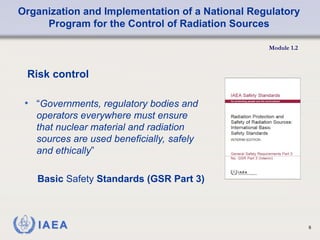
• “Governments, regulatory bodies and
operators everywhere must ensure
that nuclear material and radiation
sources are used beneficially, safely
and ethically”
Basic Safety Standards (GSR Part 3)
Risk control
7.
Organization and Implementationof a National Regulatory
Program for the Control of Radiation Sources
Module 1.2
7
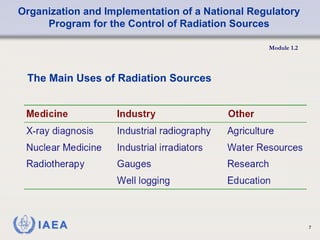
The Main Uses of Radiation Sources
8.
Organization and Implementationof a National Regulatory
Program for the Control of Radiation Sources
Module 1.2
8
The primary purpose of a regulatory program is to provide
an appropriate standard of protection and safety for
humans without unduly limiting the benefits of the practice
giving rise to the exposure.
Purpose of a Regulatory System
9.
Organization and Implementationof a National Regulatory
Program for the Control of Radiation Sources
Module 1.2
9
• prevent the occurrence of deterministic effects in
individuals by ensuring doses are kept below the
relevant threshold;
Purpose of a Regulatory System (cont)
Effective defences against radiological hazards from
sources should be established and maintained to:
• ensure that all reasonable steps are taken to minimize
the occurrence of stochastic effects in the population.
10.
Organization and Implementationof a National Regulatory
Program for the Control of Radiation Sources
Module 1.2
10
Deterministic effects
• There is a threshold dose below which no short term
effect is observed.
• Above this threshold the severity of the effect
increases with dose e.g. burns, nausea.
Deterministic and Stochastic Effects
Stochastic effects
• There is no established threshold dose.
• The probability of a long term effect increases with dose
e.g. the induction of cancer.
11.
Organization and Implementationof a National Regulatory
Program for the Control of Radiation Sources
Module 1.2
11
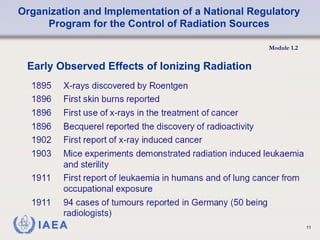
Early Observed Effects of Ionizing Radiation
12.
Organization and Implementationof a National Regulatory
Program for the Control of Radiation Sources
Module 1.2
12
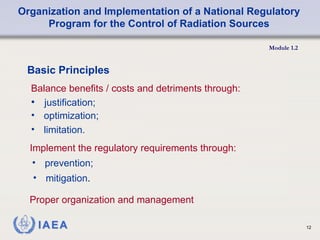
Balance benefits / costs and detriments through:
• justification;
Basic Principles
Implement the regulatory requirements through:
• optimization;
• limitation.
• prevention;
Proper organization and management
• mitigation.
13.
Organization and Implementationof a National Regulatory
Program for the Control of Radiation Sources
Module 1.2
13
• The justification of a practice implies doing more good
than harm.
Basic Principles (cont)
• The optimization of protection implies maximizing the
margin of good over harm (ALARA).
• The use of recognized dose limits implies an adequate
standard of protection even for the most highly
exposed individuals.
14.
Organization and Implementationof a National Regulatory
Program for the Control of Radiation Sources
Module 1.2
14
The Standards are intended:
• to place requirements on persons or organizations
authorized to conduct practices causing radiation
exposure, and
• to provide for intervention in order to reduce existing
exposures.
Restriction of Risks
The risks associated with radiation exposure must be
minimized and workers and the public protected by
applying basic radiation safety standards.
15.
Organization and Implementationof a National Regulatory
Program for the Control of Radiation Sources
Module 1.2
15
• The implementation of the Standards requires that a
Regulatory Body be established by the Government to
regulate the introduction and conduct of any practice
involving sources of radiation.
Implementation of the Standards
• The Regulatory Body should implement a national
regulatory program for the control of radiation sources.
16.
Organization and Implementationof a National Regulatory
Program for the Control of Radiation Sources
Module 1.2
16
• in industrial irradiators;
Lessons to be Learned
Accidents resulting in fatalities and injuries have been
reported:
• industrial radiography;
• radiotherapy; and
• as the result of lost or abandoned sources, etc.
17.
Organization and Implementationof a National Regulatory
Program for the Control of Radiation Sources
Module 1.2
17
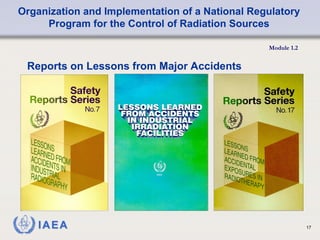
Reports on Lessons from Major Accidents
18.
Organization and Implementationof a National Regulatory
Program for the Control of Radiation Sources
Module 1.2
18
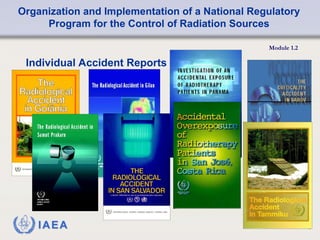
Individual Accident Reports
19.
Organization and Implementationof a National Regulatory
Program for the Control of Radiation Sources
Module 1.2
19
An inadequate regulatory framework in respect of:
• authorizations;
• inspections;
• enforcement.
Causes of Accidents
Poor user safety culture in areas such as:
• management;
• quality control;
• training and qualifications of personnel.
20.
Organization and Implementationof a National Regulatory
Program for the Control of Radiation Sources
Module 1.2
20
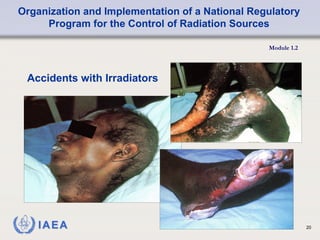
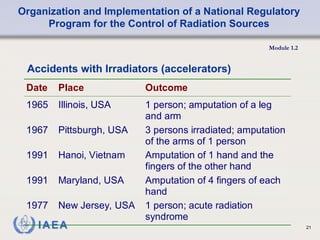
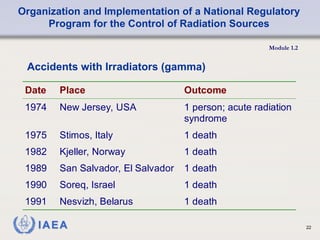
Accidents with Irradiators
21.
Organization and Implementationof a National Regulatory
Program for the Control of Radiation Sources
Module 1.2
21
Accidents with Irradiators (accelerators)
Date Place Outcome
1965 Illinois, USA 1 person; amputation of a leg
and arm
1967 Pittsburgh, USA 3 persons irradiated; amputation
of the arms of 1 person
1991 Hanoi, Vietnam Amputation of 1 hand and the
fingers of the other hand
1991 Maryland, USA Amputation of 4 fingers of each
hand
1977 New Jersey, USA 1 person; acute radiation
syndrome
22.
Organization and Implementationof a National Regulatory
Program for the Control of Radiation Sources
Module 1.2
22
Accidents with Irradiators (gamma)
Date Place Outcome
1974 New Jersey, USA 1 person; acute radiation
syndrome
1975 Stimos, Italy 1 death
1982 Kjeller, Norway 1 death
1989 San Salvador, El Salvador 1 death
1990 Soreq, Israel 1 death
1991 Nesvizh, Belarus 1 death
23.
Organization and Implementationof a National Regulatory
Program for the Control of Radiation Sources
Module 1.2
23
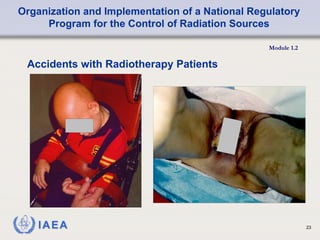
Accidents with Radiotherapy Patients
24.
Organization and Implementationof a National Regulatory
Program for the Control of Radiation Sources
Module 1.2
24
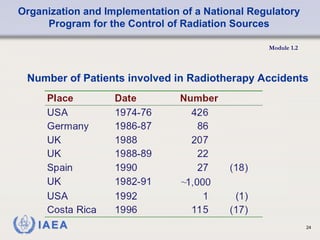
Number of Patients involved in Radiotherapy Accidents
25.
Organization and Implementationof a National Regulatory
Program for the Control of Radiation Sources
Module 1.2
25
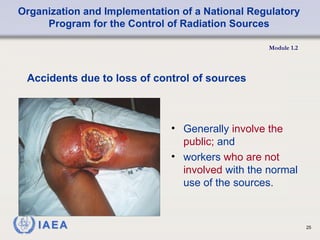
• Generally involve the
public; and
• workers who are not
involved with the normal
use of the sources.
Accidents due to loss of control of sources
26.
Organization and Implementationof a National Regulatory
Program for the Control of Radiation Sources
Module 1.2
26
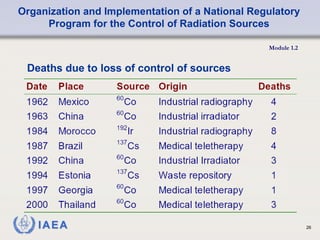
Deaths due to loss of control of sources
27.
Organization and Implementationof a National Regulatory
Program for the Control of Radiation Sources
Module 1.2
27
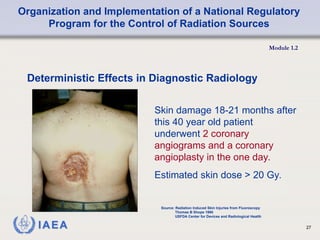
Deterministic Effects in Diagnostic Radiology
Skin damage 18-21 months after
this 40 year old patient
underwent 2 coronary
angiograms and a coronary
angioplasty in the one day.
Estimated skin dose > 20 Gy.
Source: Radiation Induced Skin Injuries from Fluoroscopy
Thomas B Shope 1995
USFDA Center for Devices and Radiological Health
28.
Organization and Implementationof a National Regulatory
Program for the Control of Radiation Sources
Module 1.2
28
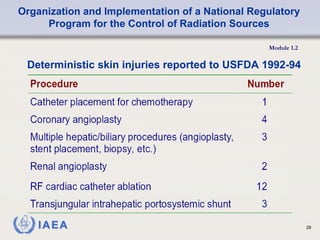
Deterministic skin injuries reported to USFDA 1992-94
29.
Organization and Implementationof a National Regulatory
Program for the Control of Radiation Sources
Module 1.2
29
• There was an excessive and / or inappropriate use of
the high dose rate mode.
• The filtration of the x-ray beam was inadequate.
• A fixed beam geometry was used (radiation entering
through the same skin surface all the time).
• There was an undetected malfunction of the automatic
exposure control system.
Diagnostic Radiology Incidents - Summary of Lessons
• The x-ray tube was too close to the patient.
30.
Organization and Implementationof a National Regulatory
Program for the Control of Radiation Sources
Module 1.2
30
• Severe deterministic effects e.g.
death, loss of limbs, erythema, acute radiation syndrome.
General Consequences of Accidents
• Contamination of the environment.
• Social impact.
• Economic impact.
31.
Organization and Implementationof a National Regulatory
Program for the Control of Radiation Sources
Module 1.2
31
• maintenance;
• control.
Safe operation requires:
• training;
Safe use of Radiation Sources
Radiation Sources:
• are widely used;
SAFETY CULTURE
}
• provide substantial benefits; but
• can cause harmful effects (injury or death).
32.
Organization and Implementationof a National Regulatory
Program for the Control of Radiation Sources
Module 1.2
32
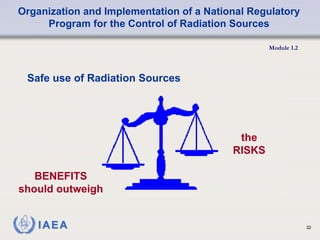
the
RISKS
BENEFITS
should outweigh
Safe use of Radiation Sources
33.
Organization and Implementationof a National Regulatory
Program for the Control of Radiation Sources
Module 1.2
33
• Radiation Protection and Safety of Radiation Sources: International Basic
Safety Standards. Generic Safety Requirements. GSR Part 3 (Interim) Vienna
(2011).
• Handbook on Nuclear Law: Volume 1 & 2 (2010).
• Model Regulations for the use of radiation sources and for the management of
the associated radioactive waste. Draft: 2012-04-04.
• Regulatory Control of Radioactive Sources, Safety Standards Series No. GS-G-
1.5, IAEA, Vienna (2004).
• Notification and Authorization for the Use of Radiation Sources
(Supplement to IAEA Safety Standards Series No. GS-G-1.5) IAEA TECDOC
1525, Vienna (2007).
• Inspection of Radiation Sources and Regulatory Enforcement (Supplement to
IAEA Safety Standards Series No. GS-G-1.5) IAEA TECDOC 1526.
• Lessons Learned from Accidents in Radiotherapy, Industrial Irradiation
Facilities and Industrial Radiography, (reports in) IAEA Safety Reports Series.
• Safety of Radiation Generators and Sealed Radioactive Sources, Safety
Standard Series No. RS-G-1.10, IAEA, Vienna (2006). IAEA, Accident reports
(various).
References
Editor's Notes
#5 The public is not only afraid of radiation they often confuse ionizing and non-ionizing radiation and the potential hazards and have limited understanding of risk. Fear is also frequently driven by the media and the misinterpretation of scientific articles.
The public also may be sceptical of health and safety advice given by public authorities but its perception may be improved by the Regulatory Body reiterating its independence.
#27 Although this injury is the result of radiation exposure during the use of diagnostic radiology equipment, the medical procedures undertaken were not for diagnostic purposes. The patient underwent a series of procedures including coronary angiography (for diagnosis) and angioplasty (a medical interventional procedure). Repeating these lengthy procedures resulted in an estimated skin dose of 20Gy.
#28 Although using diagnostic x-rays to guide catheters and the locations of shunts, etc., all of these procedures are “medically therapeutic”. ie diagnostic x-rays (fluoroscopy) are used to treat particular medical problems. Depending on the patient’s condition, such invasive procedures can be involved and prolonged.
Fluoroscopy alone may deliver dose rates to the patient’s skin of tens of milligray per minute (the recording of dynamic images can involve dose rates exceeding 200 mGy/min).
Medical practitioners performing such procedures require specific training in radiation safety so that despite the complexities of the medical procedure, they minimise fluoroscopic and other imaging exposure times, use last image hold where practicable, avoid unnecessary use of high dose rate fluoroscopy and digital subtraction angiography (DSA); the latter also should not be used as substitute for fluoroscopy in difficult cases. The operation and settings of the x-ray equipment also should be controlled by and be under the immediate supervision of an appropriately qualified person eg a qualified radiographer (medical imaging technologist).
The fluoroscopic exposure factors should be continually monitored and critically evaluated so that the highest practicable tube voltage (kVp) is used together with the lowest tube current (mA). Additionally, it may be possible to increase the filtration of the x-ray beam to significantly reduce the patient entrance surface dose rate without compromising image quality.
#29 X-ray tube too close
Although possible, this is an unlikely cause of excessive doses. Unless the tube focal spot is very small, the use of short distances (eg 20 cm) is likely to significantly degrade image quality.
Filtration inadequate
The filtration of the x-ray beam (inherent and added) should comply with the minimum requirements laid down in Standards or regulations. However, filtration can be inadvertently reduced during maintenance, markedly increasing the dose rate. Conversely, the patient entrance surface dose rate will be reduced if filtration levels are increased. This can often be achieved without compromising image quality. (eg by the use of copper, hafnium, etc)
High dose rate mode
This may be a significant factor, particularly where the users have not been properly trained in its use and effects. The x-ray equipment should provide a clear ongoing warning to users that the high dose rate mode has been selected and is being used.
Fixed Beam Geometry
Geometry is dictated by the procedure undertaken. Significant variation in beam direction might not be practicable.
Undetected malfunction of the automatic dose rate control
Points to the need for close observation of the equipment’s performance by an appropriately trained person. Some users assume that “automatic” equipment can be used without human supervision or intervention.