Objectives: At the
end of this lesson,
you should be able
to:
• identify aspects
of culture and
society,
• prove that culture
is dynamic,
flexible and
adaptive,
• prove that culture
is shared and
contested, and
• raise questions
toward a holistic
appreciation of
cultures and
societies.
Questions:
• Is there something
unique that only
your family does?
• Do you practice a
certain custom or
celebrate a special
feast in your
province?
ASPECTS OF CULTURE
AND SOCIETY I
(DYNAMIC, FLEXIBLE,
& ADAPTIVE; AND
SHARED &
CONTESTED)
 Culture and society are two different concepts. Each
has its own meaning and function.
 Culture
 According to Edward B. Tylor, culture is "that complex
whole which encompasses beliefs, practices, values,
attitudes, laws, norms, artifacts, symbols, knowledge,
and everything that a person learns and shares as a
member of society."
 Culture also encompasses social institutions like the
family, church, school, and government.
 Our culture defines who we are.
 Whatever it is that we do is part of our culture.
CULTURE AND SOCIETY
Culture and society are two different
concepts. Each has its own meaning and
function.
Society
Society can be defined as the interaction among
people where a common culture can be shared.
Society can also refer to people from a particular
place that shares the same culture.
A common location may not just develop a common
culture. It can also be formed by gender, shared
beliefs, values, norms, or activities.
CULTURE AND SOCIETY
For example, people from
Bicol love spicy food while
people from Iloilo are known
to be sweet and caring.
Can you identify a common
cultural practice in your
society?
CULTURE AND SOCIETY
 Culture and society are two closely related concepts.
For culture to exist and to be developed, it needs
human interaction. It needs people to interact with
one another, and it needs people to practice it
continuously. Without a society practicing their
common culture, the culture may cease to exist.
 Culture is also essential to society because, without
culture, society will be dull and will not continue to
thrive. A society without culture is like a body
without a soul and vice versa. Culture and society
need each other so they can both develop and
prosper.
THE RELATIONSHIP OF
CULTURE AND SOCIETY
There are different aspects of culture like art,
music, language, food, daily life, clothing, and
religion to name a few. These aspects of
culture show us that culture
is dynamic, flexible, and adaptive.
Culture constantly changes and adapts to the
current state of society. It continuously
restores itself whenever customs do not fit in
the current situation anymore. It does not
remain stagnant.
ASPECTS OF CULTURE: DYNAMIC,
FLEXIBLE, AND ADAPTIVE
 Examples:
 In the aspect of music, we can see that music may change
from time to time. The traditional music during the 1920s
was mostly jazz, ragtime, and broadway music while the
popular music during the 1970s was disco music.
 Because we are now more inclined to use computers and
tablets especially when playing games, some children are
not able to play street games anymore. This pushed some
game developers to introduce Filipino street games as video
games.
 When it comes to language, we can also see how culture
adapts to changing times. We have already developed new
words related to the internet like memes, netizens, vines,
and others.
ASPECTS OF CULTURE: DYNAMIC,
FLEXIBLE, AND ADAPTIVE
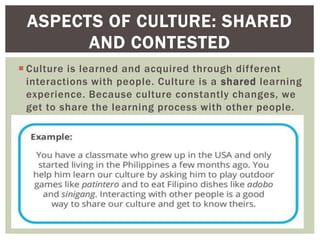
 Culture is learned and acquired through different
interactions with people. Culture is a shared learning
experience. Because culture constantly changes, we
get to share the learning process with other people.
ASPECTS OF CULTURE: SHARED
AND CONTESTED
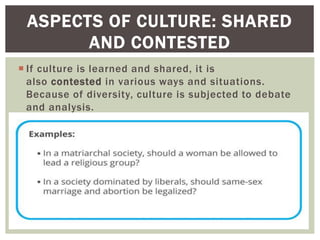
 If culture is learned and shared, it is
also contested in various ways and situations.
Because of diversity, culture is subjected to debate
and analysis.
ASPECTS OF CULTURE: SHARED
AND CONTESTED
Observe your interaction
with your classmates. Try to
identify what common
culture you and your
classmates share that made
you become friends.
EXPLORE!
Try to ask your parents about
popular songs and dances
during their teenage years.
Find out how different they are
from yours and how much they
have changed.
TRY IT!
What do you think the
Philippine culture will
be twenty years from
now?
WHAT DO YOU THINK?
 Our society needs to preserve and promulgate our
indigenous culture so that we can maintain our identity
as a nation.
 Culture changes and adapts to current society, but that
does not mean that our traditional culture should be
forgotten.
 Different cultures exist in the world, but there is no
culture greater than another. We should learn to accept
our differences, help other cultures learn ours, and
learn other cultures as well.
 We should not judge the customs, norms, and beliefs
of others because those are part of their unique
culture.
TIPS
Culture is a set of behaviors that we have
absorbed. It is a set of characteristics that
help us relate and bond with other people.
Society is a group of individuals coming from
the same place and shares the same culture.
It is crucial to preserve and promulgate our
culture and traditions if we want to keep them
alive. We are facing lots of changes,
developments, and technological advances
today that we tend to forget to look back on
our old culture and traditions.
KEYPOINTS
Culture is dynamic, flexible, and adaptive. It
changes based on the current situation of
society. Culture continuously restores itself so it
will remain relevant.
Culture is best learned when it is shared. There
are a lot of cultures that exists in our world. We
need to share our unique culture with others to
get to know theirs and also spread ours.
While it is learned and shared, culture is
also contested. Because of diversity, culture is
subject to debate and analysis.
KEYPOINTS

388437625-Aspects-of-Culture-and-Society-I-Dynamic-Flexible-Adaptable-Shared-and-Contested-pptx.pptx

  • 1.
    Objectives: At the endof this lesson, you should be able to: • identify aspects of culture and society, • prove that culture is dynamic, flexible and adaptive, • prove that culture is shared and contested, and • raise questions toward a holistic appreciation of cultures and societies. Questions: • Is there something unique that only your family does? • Do you practice a certain custom or celebrate a special feast in your province? ASPECTS OF CULTURE AND SOCIETY I (DYNAMIC, FLEXIBLE, & ADAPTIVE; AND SHARED & CONTESTED)
  • 2.
     Culture andsociety are two different concepts. Each has its own meaning and function.  Culture  According to Edward B. Tylor, culture is "that complex whole which encompasses beliefs, practices, values, attitudes, laws, norms, artifacts, symbols, knowledge, and everything that a person learns and shares as a member of society."  Culture also encompasses social institutions like the family, church, school, and government.  Our culture defines who we are.  Whatever it is that we do is part of our culture. CULTURE AND SOCIETY
  • 3.
    Culture and societyare two different concepts. Each has its own meaning and function. Society Society can be defined as the interaction among people where a common culture can be shared. Society can also refer to people from a particular place that shares the same culture. A common location may not just develop a common culture. It can also be formed by gender, shared beliefs, values, norms, or activities. CULTURE AND SOCIETY
  • 4.
    For example, peoplefrom Bicol love spicy food while people from Iloilo are known to be sweet and caring. Can you identify a common cultural practice in your society? CULTURE AND SOCIETY
  • 5.
     Culture andsociety are two closely related concepts. For culture to exist and to be developed, it needs human interaction. It needs people to interact with one another, and it needs people to practice it continuously. Without a society practicing their common culture, the culture may cease to exist.  Culture is also essential to society because, without culture, society will be dull and will not continue to thrive. A society without culture is like a body without a soul and vice versa. Culture and society need each other so they can both develop and prosper. THE RELATIONSHIP OF CULTURE AND SOCIETY
  • 6.
    There are differentaspects of culture like art, music, language, food, daily life, clothing, and religion to name a few. These aspects of culture show us that culture is dynamic, flexible, and adaptive. Culture constantly changes and adapts to the current state of society. It continuously restores itself whenever customs do not fit in the current situation anymore. It does not remain stagnant. ASPECTS OF CULTURE: DYNAMIC, FLEXIBLE, AND ADAPTIVE
  • 7.
     Examples:  Inthe aspect of music, we can see that music may change from time to time. The traditional music during the 1920s was mostly jazz, ragtime, and broadway music while the popular music during the 1970s was disco music.  Because we are now more inclined to use computers and tablets especially when playing games, some children are not able to play street games anymore. This pushed some game developers to introduce Filipino street games as video games.  When it comes to language, we can also see how culture adapts to changing times. We have already developed new words related to the internet like memes, netizens, vines, and others. ASPECTS OF CULTURE: DYNAMIC, FLEXIBLE, AND ADAPTIVE
  • 8.
     Culture islearned and acquired through different interactions with people. Culture is a shared learning experience. Because culture constantly changes, we get to share the learning process with other people. ASPECTS OF CULTURE: SHARED AND CONTESTED
  • 9.
     If cultureis learned and shared, it is also contested in various ways and situations. Because of diversity, culture is subjected to debate and analysis. ASPECTS OF CULTURE: SHARED AND CONTESTED
  • 10.
    Observe your interaction withyour classmates. Try to identify what common culture you and your classmates share that made you become friends. EXPLORE!
  • 11.
    Try to askyour parents about popular songs and dances during their teenage years. Find out how different they are from yours and how much they have changed. TRY IT!
  • 12.
    What do youthink the Philippine culture will be twenty years from now? WHAT DO YOU THINK?
  • 13.
     Our societyneeds to preserve and promulgate our indigenous culture so that we can maintain our identity as a nation.  Culture changes and adapts to current society, but that does not mean that our traditional culture should be forgotten.  Different cultures exist in the world, but there is no culture greater than another. We should learn to accept our differences, help other cultures learn ours, and learn other cultures as well.  We should not judge the customs, norms, and beliefs of others because those are part of their unique culture. TIPS
  • 14.
    Culture is aset of behaviors that we have absorbed. It is a set of characteristics that help us relate and bond with other people. Society is a group of individuals coming from the same place and shares the same culture. It is crucial to preserve and promulgate our culture and traditions if we want to keep them alive. We are facing lots of changes, developments, and technological advances today that we tend to forget to look back on our old culture and traditions. KEYPOINTS
  • 15.
    Culture is dynamic,flexible, and adaptive. It changes based on the current situation of society. Culture continuously restores itself so it will remain relevant. Culture is best learned when it is shared. There are a lot of cultures that exists in our world. We need to share our unique culture with others to get to know theirs and also spread ours. While it is learned and shared, culture is also contested. Because of diversity, culture is subject to debate and analysis. KEYPOINTS