

schema.fiware.org
José Manuel Cantera Fonseca
Technological Expert. FIWARE Data Models Technical Lead.
josemanuel.canterafonseca@telefonica.com
Background
Introduction to schema.org
2
Introduction
• What is schema.org? http://schema.org
o A collaborative, vendor-neutral, community-based initiative targeted to provide a
shared set of harmonized, cross-domain vocabularies for publishing and consuming
structured data on the web
o Enables structured data exchange in an interoperable fashion
o In widespread use today (>12 million sites using it and growing everyday)
• Why schema.org?
o search engines can understand “the meaning” of web content
o richer and more interactive user experiences when searching for information
o interoperability between the Web and/or other applications
calendars, email clients, personal assistants, …
● Who is behind schema.org?
○ Major search engine providers (Google, Yahoo!, Microsoft, Yandex, …) which act
as project sponsors
○ A community of developers / domain experts making contributions
○ W3C Community Group https://www.w3.org/community/schemaorg/
■ A CG is not governed by the official W3C Process
Introduction (II)
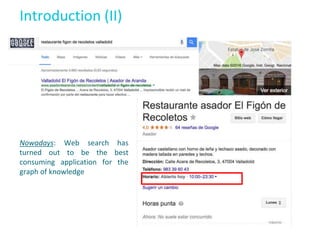
Nowadays: Web search has
turned out to be the best
consuming application for the
graph of knowledge
Introduction (III)
• In order to provide any kind of structured data, it is needed:
o Data Model (structural organization of data):
Graph vs DLG vs Tree vs Entity-Attribute vs vertical-specific ...
o Syntax (underlying format used to represent such data structure):
JSON vs XML vs RDF vs HTML5 vs JSON-LD vs RDFa vs Turtle …
o Vocabulary (dictionary):
Terms → Entities (types, classes), relations (attributes, properties) and
enumerations (tabulated values)
o Identifiers for instances (entity ids)
● Many years of formal standards work, battles, bells & whistles …
○ The stick
schema.org - Facts
• Work started in August 2010
o Sponsored Microsoft, Google, Yahoo!, Yandex
• Goals:
o Make it very easy for the webmaster
write once for all search engines using one vocabulary (single schema)
o Make it possible to use it in combination with other vocabularies
o Wide range of cross-domain topics (297 classes, 187 relations, initially)
people, places, events, products, offers, recipes, businesses, opening hours ...
• Successful initiative, de facto standard, thanks to:
o Being the substrate behind contemporary web search engine experiences
o Supported by popular CMS tools and multiple verticals
Drupal, Wordpress, Blogger, Youtube
Ticketmaster, ebay, alibaba, BBC, European Broadcasting Union, etc.
o Flexibility, pragmatism, agility, maintainability,
schema.org - Structure and core data model
• schema.org core data model is a graph, roughly, similar to RDF
• schema.org defines the following term categories:
o Data types (Number, DateTime, Text, URL, etc.)
o Entity types (Event, Restaurant, Person, Offer, Place, etc.)
Arranged in a multiple inheritance hierarchy
Currently 583 (core vocabulary)
o Relations (properties)
multiple domain and range
Currently 846 (core vocabulary)
o Enumerations
wherever there are a limited number of typical values for a property, there is a
corresponding enumeration specified in schema.org
Ex. http://schema.org/ItemAvailability
Currently 114 (core vocabulary)
• schema.org is not intended to be a universal ontology.
o it should be used in combination with other vocabularies
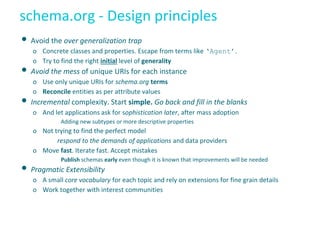
schema.org - Design principles
• Avoid the over generalization trap
o Concrete classes and properties. Escape from terms like ‘Agent’.
o Try to find the right initial level of generality
• Avoid the mess of unique URIs for each instance
o Use only unique URIs for schema.org terms
o Reconcile entities as per attribute values
• Incremental complexity. Start simple. Go back and fill in the blanks
o And let applications ask for sophistication later, after mass adoption
Adding new subtypes or more descriptive properties
o Not trying to find the perfect model
respond to the demands of applications and data providers
o Move fast. Iterate fast. Accept mistakes
Publish schemas early even though it is known that improvements will be needed
• Pragmatic Extensibility
o A small core vocabulary for each topic and rely on extensions for fine grain details
o Work together with interest communities
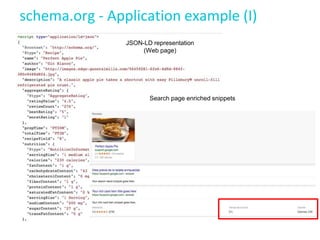
schema.org - Application example (I)
JSON-LD representation
(Web page)
Search page enriched snippets
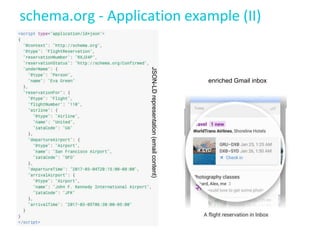
schema.org - Application example (II)
enriched Gmail inbox
JSON-LDrepresentation(emailcontent)
FIWARE + schema.org
11
FIWARE + schema.org - Introduction (I)
• Idea :
o apply all the successful design principles and workflows of schema.org to
produce harmonized schemas in the "Internet of Things" (IoT) area
enabling semantic interoperability that bridges IoT and non-IoT applications
real scope is “real world things” rather than Internet of Things.
• In cooperation with GSMA and mobile operators
o http://www.gsma.com/connectedliving/wp-content/uploads/2016/12/CLP.26-v1.0.pdf
• IoT + schema.org complementary initiative introduced by Dan Brickley
(schema.org chairman) through the following position paper:
o https://docs.google.com/document/d/1mE2hN83lXzqXA-
RQYMURJxIlEktcZkFB252BQCCnkKk/edit#
FIWARE + schema.org - introduction (II)
• Does this really make sense?:
o (IoT) data provider role, publishing data using iot.schema.org, will be similar
than the role played by a Webmaster
o Application / (IoT) data consumer, role, will be similar than the search engine,
email client,etc. roles.
Dashboards, smart (interoperable) applications, etc.
• We can bring all the schema.org benefits from the Web to the IoT-Big
Data domain
o avoiding silos, fragmentation, etc.
o Give carrots to data / IoT providers instead of sticks (ex. lengthy ontologies)
o “We give value to your data if it is harmonized”
o IoT and non-IoT entities can be easily “linked” following schema.org principle
of “local view” but a “single”, coherent vocabulary.
14
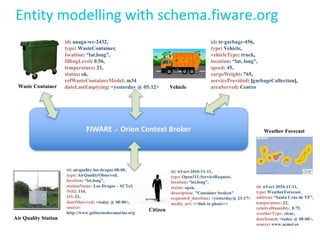
Entity modelling with schema.fiware.org
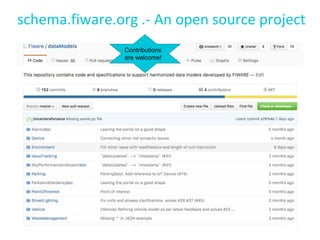
schema.fiware.org .- An open source project
Contributions
are welcome!
Questions
17
References
• http://schema.org/docs/documents.html
• https://www.w3.org/community/schemaorg/how-we-work/work-in-progress-mechanisms-
webschemas-and-the-pending-area/
• https://www.w3.org/community/schemaorg/how-we-work/issue-management-on-github/
• http://events.linkeddata.org/ldow2014/slides/ldow2014_keynote_guha_schema_org.pdf
• http://queue.acm.org/detail.cfm?id=2857276
• https://search.google.com/structured-data/testing-tool
• https://developers.google.com/gmail/markup/reference/
• https://msdn.microsoft.com/en-us/library/dn632191.aspx
• https://developers.google.com/search/docs/guides/enhance-site
• http://schema.fiware.org
• http://webschemas.org/docs/cg/sdo-wot-tpac-2016-09.pdf
• https://docs.google.com/document/d/1mE2hN83lXzqXA-
RQYMURJxIlEktcZkFB252BQCCnkKk/edit#
• https://developers.google.com/knowledge-graph/
Thank you!
http://fiware.org
Follow @FIWARE on Twitter

Schema.fiware.org: FIWARE Harmonized Data Models

  • 1.
    schema.fiware.org José Manuel CanteraFonseca Technological Expert. FIWARE Data Models Technical Lead. josemanuel.canterafonseca@telefonica.com
  • 2.
  • 3.
    Introduction • What isschema.org? http://schema.org o A collaborative, vendor-neutral, community-based initiative targeted to provide a shared set of harmonized, cross-domain vocabularies for publishing and consuming structured data on the web o Enables structured data exchange in an interoperable fashion o In widespread use today (>12 million sites using it and growing everyday) • Why schema.org? o search engines can understand “the meaning” of web content o richer and more interactive user experiences when searching for information o interoperability between the Web and/or other applications calendars, email clients, personal assistants, … ● Who is behind schema.org? ○ Major search engine providers (Google, Yahoo!, Microsoft, Yandex, …) which act as project sponsors ○ A community of developers / domain experts making contributions ○ W3C Community Group https://www.w3.org/community/schemaorg/ ■ A CG is not governed by the official W3C Process
  • 4.
    Introduction (II) Nowadays: Websearch has turned out to be the best consuming application for the graph of knowledge
  • 5.
    Introduction (III) • Inorder to provide any kind of structured data, it is needed: o Data Model (structural organization of data): Graph vs DLG vs Tree vs Entity-Attribute vs vertical-specific ... o Syntax (underlying format used to represent such data structure): JSON vs XML vs RDF vs HTML5 vs JSON-LD vs RDFa vs Turtle … o Vocabulary (dictionary): Terms → Entities (types, classes), relations (attributes, properties) and enumerations (tabulated values) o Identifiers for instances (entity ids) ● Many years of formal standards work, battles, bells & whistles … ○ The stick
  • 6.
    schema.org - Facts •Work started in August 2010 o Sponsored Microsoft, Google, Yahoo!, Yandex • Goals: o Make it very easy for the webmaster write once for all search engines using one vocabulary (single schema) o Make it possible to use it in combination with other vocabularies o Wide range of cross-domain topics (297 classes, 187 relations, initially) people, places, events, products, offers, recipes, businesses, opening hours ... • Successful initiative, de facto standard, thanks to: o Being the substrate behind contemporary web search engine experiences o Supported by popular CMS tools and multiple verticals Drupal, Wordpress, Blogger, Youtube Ticketmaster, ebay, alibaba, BBC, European Broadcasting Union, etc. o Flexibility, pragmatism, agility, maintainability,
  • 7.
    schema.org - Structureand core data model • schema.org core data model is a graph, roughly, similar to RDF • schema.org defines the following term categories: o Data types (Number, DateTime, Text, URL, etc.) o Entity types (Event, Restaurant, Person, Offer, Place, etc.) Arranged in a multiple inheritance hierarchy Currently 583 (core vocabulary) o Relations (properties) multiple domain and range Currently 846 (core vocabulary) o Enumerations wherever there are a limited number of typical values for a property, there is a corresponding enumeration specified in schema.org Ex. http://schema.org/ItemAvailability Currently 114 (core vocabulary) • schema.org is not intended to be a universal ontology. o it should be used in combination with other vocabularies
  • 8.
    schema.org - Designprinciples • Avoid the over generalization trap o Concrete classes and properties. Escape from terms like ‘Agent’. o Try to find the right initial level of generality • Avoid the mess of unique URIs for each instance o Use only unique URIs for schema.org terms o Reconcile entities as per attribute values • Incremental complexity. Start simple. Go back and fill in the blanks o And let applications ask for sophistication later, after mass adoption Adding new subtypes or more descriptive properties o Not trying to find the perfect model respond to the demands of applications and data providers o Move fast. Iterate fast. Accept mistakes Publish schemas early even though it is known that improvements will be needed • Pragmatic Extensibility o A small core vocabulary for each topic and rely on extensions for fine grain details o Work together with interest communities
  • 9.
    schema.org - Applicationexample (I) JSON-LD representation (Web page) Search page enriched snippets
  • 10.
    schema.org - Applicationexample (II) enriched Gmail inbox JSON-LDrepresentation(emailcontent)
  • 11.
  • 12.
    FIWARE + schema.org- Introduction (I) • Idea : o apply all the successful design principles and workflows of schema.org to produce harmonized schemas in the "Internet of Things" (IoT) area enabling semantic interoperability that bridges IoT and non-IoT applications real scope is “real world things” rather than Internet of Things. • In cooperation with GSMA and mobile operators o http://www.gsma.com/connectedliving/wp-content/uploads/2016/12/CLP.26-v1.0.pdf • IoT + schema.org complementary initiative introduced by Dan Brickley (schema.org chairman) through the following position paper: o https://docs.google.com/document/d/1mE2hN83lXzqXA- RQYMURJxIlEktcZkFB252BQCCnkKk/edit#
  • 13.
    FIWARE + schema.org- introduction (II) • Does this really make sense?: o (IoT) data provider role, publishing data using iot.schema.org, will be similar than the role played by a Webmaster o Application / (IoT) data consumer, role, will be similar than the search engine, email client,etc. roles. Dashboards, smart (interoperable) applications, etc. • We can bring all the schema.org benefits from the Web to the IoT-Big Data domain o avoiding silos, fragmentation, etc. o Give carrots to data / IoT providers instead of sticks (ex. lengthy ontologies) o “We give value to your data if it is harmonized” o IoT and non-IoT entities can be easily “linked” following schema.org principle of “local view” but a “single”, coherent vocabulary.
  • 14.
  • 15.
    Entity modelling withschema.fiware.org
  • 16.
    schema.fiware.org .- Anopen source project Contributions are welcome!
  • 17.
  • 18.
    References • http://schema.org/docs/documents.html • https://www.w3.org/community/schemaorg/how-we-work/work-in-progress-mechanisms- webschemas-and-the-pending-area/ •https://www.w3.org/community/schemaorg/how-we-work/issue-management-on-github/ • http://events.linkeddata.org/ldow2014/slides/ldow2014_keynote_guha_schema_org.pdf • http://queue.acm.org/detail.cfm?id=2857276 • https://search.google.com/structured-data/testing-tool • https://developers.google.com/gmail/markup/reference/ • https://msdn.microsoft.com/en-us/library/dn632191.aspx • https://developers.google.com/search/docs/guides/enhance-site • http://schema.fiware.org • http://webschemas.org/docs/cg/sdo-wot-tpac-2016-09.pdf • https://docs.google.com/document/d/1mE2hN83lXzqXA- RQYMURJxIlEktcZkFB252BQCCnkKk/edit# • https://developers.google.com/knowledge-graph/
  • 19.