3.6 Prove theorems about perpendicular lines                             10­13­10


                                    Bellwork
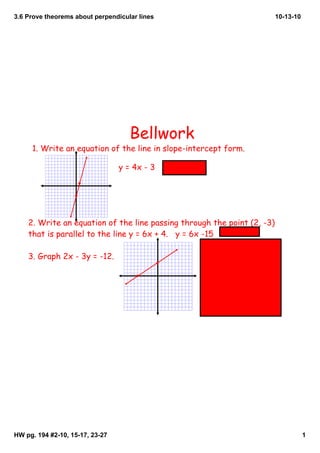
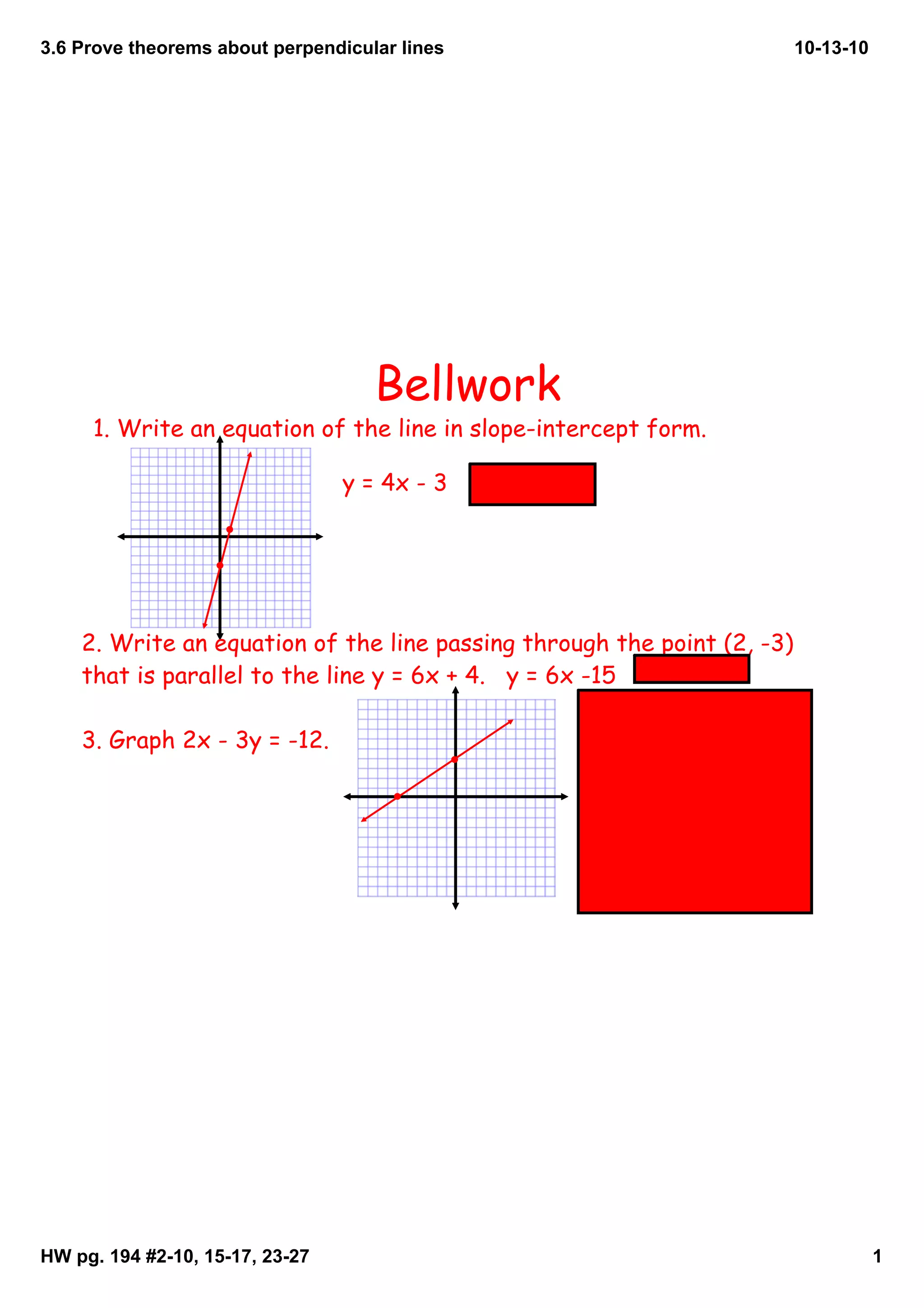
     1. Write an equation of the line in slope-intercept form.

                                 y = 4x - 3


    2. Write an equation of the line passing through the point (2, -3)
    that is parallel to the line y = 6x + 4. y = 6x -15

    3. Graph 2x - 3y = -12.


HW pg. 194 #2­10, 15­17, 23­27                                                      1
3.6 Prove theorems about perpendicular lines                                        10­13­10


     3.6 Prove Theorems about Perpendicular Lines
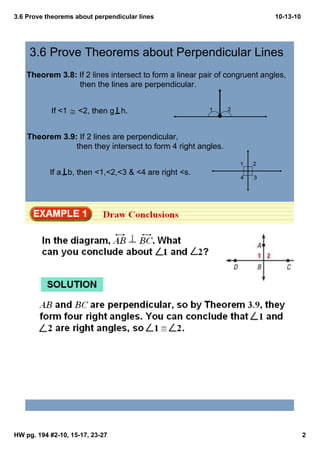
    Theorem 3.8: If 2 lines intersect to form a linear pair of congruent angles,    
                 then the lines are perpendicular.


            If <1 ≅ <2, then g   h.                             1       2


    Theorem 3.9: If 2 lines are perpendicular, 
                          then they intersect to form 4 right angles.

                                                                            1   2
           If a   b, then <1,<2,<3 & <4 are right <s.
                                                                            4   3


HW pg. 194 #2­10, 15­17, 23­27                                                                 2
3.6 Prove theorems about perpendicular lines                            10­13­10


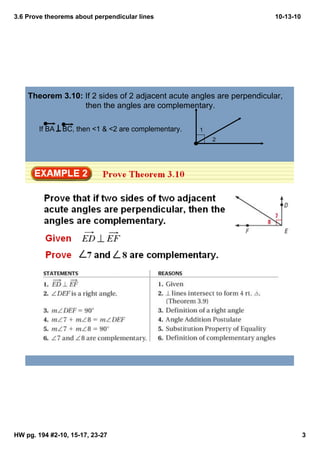
    Theorem 3.10: If 2 sides of 2 adjacent acute angles are perpendicular, 
                   then the angles are complementary.

        If BA    BC, then <1 & <2 are complementary.   1
                                                           2


HW pg. 194 #2­10, 15­17, 23­27                                                     3
3.6 Prove theorems about perpendicular lines                                           10­13­10


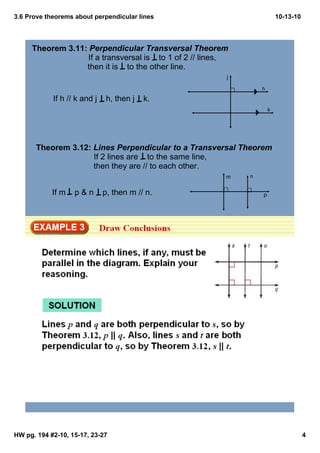
     Theorem 3.11: Perpendicular Transversal Theorem
                              If a transversal is    to 1 of 2 // lines,
                              then it is    to the other line.
                                                                       j

                                                                               h

            If h // k and j    h, then j    k. 
                                                                                   k


       Theorem 3.12: Lines Perpendicular to a Transversal Theorem
                      If 2 lines are    to the same line, 
                      then they are // to each other.
                                                                       m   n


            If m    p & n    p, then m // n.                                   p


HW pg. 194 #2­10, 15­17, 23­27                                                                    4
3.6 Prove theorems about perpendicular lines              10­13­10


                                                         HW 

                                                     pg. 194 

                                               #2­10 & 15­17


HW pg. 194 #2­10, 15­17, 23­27                                       5
3.6 Prove theorems about perpendicular lines                                                         10­13­10

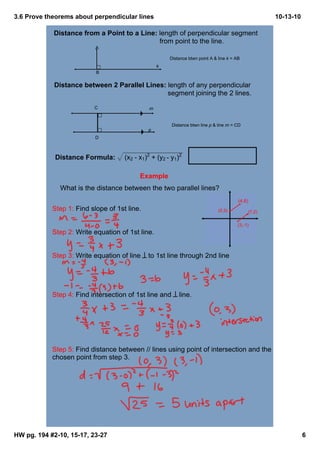
            Distance from a Point to a Line: length of perpendicular segment 
                                               from point to the line.
                           A

                                                      Distance btwn point A & line k = AB
                                                  k
                           B


            Distance between 2 Parallel Lines: length of any perpendicular 
                                               segment joining the 2 lines.

                           C                  m


                                                      Distance btwn line p & line m = CD
                                              p
                           D


             Distance Formula: √ 2 ­ x1)2 + (y2 ­ y1)2 
                                   (x

                                           Example
              What is the distance between the two parallel lines?
                                                                                        (4,6)
            Step 1: Find slope of 1st line.                                   (0,3)          (7,2)

                                                                                        (3,­1)
            Step 2: Write equation of 1st line.


            Step 3: Write equation of line    to 1st line through 2nd line


            Step 4: Find intersection of 1st line and    line.


            Step 5: Find distance between // lines using point of intersection and the 
            chosen point from step 3.


HW pg. 194 #2­10, 15­17, 23­27                                                                                  6
3.6 Prove theorems about perpendicular lines   10­13­10


HW pg. 194 #2­10, 15­17, 23­27                            7
3.6 Prove theorems about perpendicular lines   10­13­10


     Class Assignment

     pg. 195 

     #23­27


HW pg. 194 #2­10, 15­17, 23­27                            8

3.6 notes

  • 1.
    3.6 Prove theorems about perpendicular lines 10­13­10 Bellwork 1. Write an equation of the line in slope-intercept form. y = 4x - 3 2. Write an equation of the line passing through the point (2, -3) that is parallel to the line y = 6x + 4. y = 6x -15 3. Graph 2x - 3y = -12. HW pg. 194 #2­10, 15­17, 23­27 1
  • 2.
    3.6 Prove theorems about perpendicular lines 10­13­10 3.6 Prove Theorems about Perpendicular Lines Theorem 3.8: If 2 lines intersect to form a linear pair of congruent angles,       then the lines are perpendicular. If <1 ≅ <2, then g   h.  1 2 Theorem 3.9: If 2 lines are perpendicular,                        then they intersect to form 4 right angles. 1 2 If a   b, then <1,<2,<3 & <4 are right <s. 4 3 HW pg. 194 #2­10, 15­17, 23­27 2
  • 3.
    3.6 Prove theorems about perpendicular lines 10­13­10 Theorem 3.10: If 2 sides of 2 adjacent acute angles are perpendicular,      then the angles are complementary. If BA    BC, then <1 & <2 are complementary. 1 2 HW pg. 194 #2­10, 15­17, 23­27 3
  • 4.
    3.6 Prove theorems about perpendicular lines 10­13­10 Theorem 3.11: Perpendicular Transversal Theorem                          If a transversal is    to 1 of 2 // lines,    then it is    to the other line. j h If h // k and j    h, then j    k.  k Theorem 3.12: Lines Perpendicular to a Transversal Theorem     If 2 lines are    to the same line,      then they are // to each other. m n If m    p & n    p, then m // n.  p HW pg. 194 #2­10, 15­17, 23­27 4
  • 5.
    3.6 Prove theorems about perpendicular lines 10­13­10 HW  pg. 194  #2­10 & 15­17 HW pg. 194 #2­10, 15­17, 23­27 5
  • 6.
    3.6 Prove theorems about perpendicular lines 10­13­10 Distance from a Point to a Line: length of perpendicular segment       from point to the line. A Distance btwn point A & line k = AB k B Distance between 2 Parallel Lines: length of any perpendicular    segment joining the 2 lines. C m Distance btwn line p & line m = CD p D Distance Formula: √ 2 ­ x1)2 + (y2 ­ y1)2      (x Example What is the distance between the two parallel lines? (4,6) Step 1: Find slope of 1st line. (0,3) (7,2) (3,­1) Step 2: Write equation of 1st line. Step 3: Write equation of line    to 1st line through 2nd line Step 4: Find intersection of 1st line and    line. Step 5: Find distance between // lines using point of intersection and the  chosen point from step 3. HW pg. 194 #2­10, 15­17, 23­27 6
  • 7.
    3.6 Prove theorems about perpendicular lines 10­13­10 HW pg. 194 #2­10, 15­17, 23­27 7
  • 8.
    3.6 Prove theorems about perpendicular lines 10­13­10 Class Assignment pg. 195  #23­27 HW pg. 194 #2­10, 15­17, 23­27 8