English 3.6: Create a
fluent and coherent
visual text which
develops, sustains,
and structures ideas
using verbal and
visual language

Resource title: Visual Essay
Credits: 3
Christine Wells
Introduction

   This assessment activity requires you to
    develop and craft a visual essay that
    develops, sustains, and structures key ideas
    from a text you have studied. You can work
    individually or in a group.
   If you are working in groups, you will each
    need to fill out a log of your progress.
   You will be assessed on how effectively your
    visual essay communicates your ideas.
   Deadlines and checkpoints for each part of
    the visual essay will be given.
Thinking
                                                        Relating to
                                                           others
                                                         Using text,
                                                          symbols

         Task: Develop a focus                        Managing self
                                                     Participating and
                                                       contributing


   Determine a source text that could be used
    as the basis for developing a visual essay.
    Discuss with another student what you know
    about the source text.
   Brainstorm everything you know about the
    text and then create categories for the
    different items from your brainstorm. If your
    source text has been part of work you have
    covered in class, refer to your notes.
   The focus for our visual essays will be theme.

Gathering
Processing
What is a visual essay?

   A visual essay consists of images and text with a
    voice-over and music and/or sound effects.
   A quality visual essay uses visual and verbal
    language techniques that are clearly linked to ideas
    from a source text to command the attention of an
    audience. It introduces core ideas and then
    progressively adds detail and analysis so the
    audience understands important ideas from the
    source text.
   There are a number of visual texts on the Internet;
    some of these have the depth required to be
    considered visual essays, while others are more
    tribute texts designed to engage and entertain
    rather than communicate ideas.
Choose a voice-over

    List the characters from the source text with
     links to your focus. If you are focusing on a
     particular character, consider ways that other
     characters provide insight into their
     character. If you are focusing on a theme or
     central idea, consider which character(s)
     give the best insights into this.
    Decide what form your voice-over will take
     (narrative, reflective, commentary, interview)
     and how you will link it to the visual
     component of the essay.                       Thinking
                                                   Relating to others
                                                   Using text, symbols
                                                     Managing self
Gathering                                          Participating and
Processing                                             contributing
Thinking
Using text, symbols
  Managing self
Participating and
    contributing
                      Recreate the mood

          Look back at your focus and consider which scenes
           from the source text relate most clearly to it. Re-
           watch or reread these scenes from the source text.
          Write a phrase describing your interpretation of the
           mood of the text.
          Using the expertise and resources available, decide
           how you could utilise colour (colour filters as well as
           colour in images), music, sound effects, font and text,
           and images to recreate your interpretation of the
           mood of the source text. Note down some
           possibilities for using these.
          Recreate mood and further develop your ideas.
           Refer to Resource B for more information on how to
           recreate mood.

        Gathering
        Processing
Resource B: Interpreting the mood
   When interpreting the mood of the source text, consider
    the key scenes you have identified.
   List as many words as you can to describe the mood of
    these scenes. Convert these into a phrase that captures
    the entire mood of the text. Combinations of things and
    phrases can be more specific than single words. For
    instance, grim with a hint of hope is more evocative than
    negative.
   When you have decided which language techniques you
    are going to use, consider how you will use these
    throughout your text. Using techniques in a similar and
    consistent manner throughout your text can create
    different effects but can also give it a recognisable theme
    that creates mood and ties the ideas together across your
    whole text.
Develop a storyboard

Draw up a storyboard that:
 outlines the order of the visual elements
  (images and text)
 details the visual language techniques that
  you will use with the images
 outlines the important ideas to include in the
  voice-over script and how they link to the
  visual elements.

   For more guidance on developing a
    storyboard, refer to Resource C.                Thinking
                                              Relating to others
                                              Using text, symbols
Gathering                                       Managing self
                                              Participating and
Processing                                        contributing
 Applying
Resource C: Planning the visual essay
   As you create your visual essay, think about the order of
    your ideas, images, and scenes. Ordering these elements in
    a particular way can effectively develop your ideas as the
    text progresses.
   Introduce the focus of your text. Divide up the different
    ideas that make up the main focus of your text and add
    these as the text progresses. Plan for a progression of
    images and a voice-over that tell a story of your own and
    communicate literal and deeper meanings clearly and
    effectively to your audience.
   A well-constructed storyboard can serve as a plan for your
    final essay and can be used to develop a list of things you
    need to do. A storyboard is a simple layout drawing (with
    labelled individual elements) of each scene/image from
    your visual essay. This should be developed at the same
    time as the script for your voice-over so you can ensure
    they are linked and will have maximum potential for
    commanding attention and achieving coherent and
    effective communication.
Resource C: Planning the visual essay
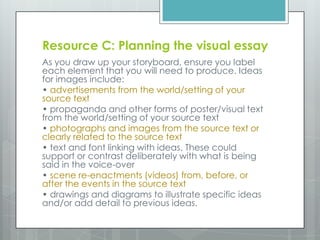
As you draw up your storyboard, ensure you label
each element that you will need to produce. Ideas
for images include:
• advertisements from the world/setting of your
source text
• propaganda and other forms of poster/visual text
from the world/setting of your source text
• photographs and images from the source text or
clearly related to the source text
• text and font linking with ideas. These could
support or contrast deliberately with what is being
said in the voice-over
• scene re-enactments (videos) from, before, or
after the events in the source text
• drawings and diagrams to illustrate specific ideas
and/or add detail to previous ideas.
Resource C: Planning the visual essay


As you write the script for your voice-over, ensure that you
annotate it with places where you can use some of the
following techniques, and note what effects you aim to
create with them. Examples include but are not limited to:
• emphasising your character's voice to indicate some kind of
emotion
• pausing or breaking off to suggest something, for example,
uncertainty
• changing volume and tone to indicate emotion, for
example, anger or frustration
• changing the pace to suggest emotion, for example,
excitement or boredom
• contrasting the voice-over and music and visual elements to
communicate ideas.
Decide on tools and create


     Review your storyboard and the visual and verbal elements
      you plan to include in the visual essay. For each element
      consider the tools you have available and the expertise of
      your group members. Plan how you will finish each part of
      your text with the resources you have available and the
      time you have remaining.
     Aim to communicate all the important ideas that make up
      your focus as effectively as possible. For a list of reflective
      questions to help you develop your visual essay, refer to
      Resource D.
     Your teacher will direct you to a number of electronic and
      hard resources you can use for creating your visual essay.
      (See Resource E for some software tools.) You could also
      negotiate the use of your own resources with your teacher.

                                                                      Thinking
                                                                Relating to others
                                                                Using text, symbols
                                                                  Managing self
Processing                                                      Participating and
                                                                    contributing
Resource D: Creating your visual essay


Revisit the following list of questions as you develop your visual
essay and work to refine your text.
• Does my text progressively add detail to the ideas I am
trying to communicate? How can I ensure that it does this?
• Am I structuring (ordering and grouping) my ideas in a way
that communicates them effectively?
• Have I chosen language techniques to create specific
effects, and do these support the core ideas from the source
text that I am focusing on?
• Am I revisiting and critiquing my use of language and
checking that it commands the attention of my
readers/audience? Am I seeking advice from my teacher as I
do this?
• Do the ideas I am communicating link clearly and closely
with the source text?
Resource E: Useful software
There are a number of different pieces of software (many of which are
open source) you can use to assist with the creation of your text.
 GIMP – an open-source graphics tool. Similar to commercial software for
   editing photos but aimed more at general graphics manipulation than
   at photos. Lots of plug-ins available. Excellent for combining with hard
   materials. For example, scanned hard media and images can have
   background colours easily added or changed.
 Audacity – an open-source sound editing, mixing, and recording tool.
 Inkscape – an open-source vector graphics tool. Vector graphics can
   be scaled/resized without losing quality. Powerful for creating and
   manipulating shapes and building up images from scratch.
 VoiceThread – an online, Flash-based tool. Students can string images
   and videos together and annotate them with sound and text. Easy to
   use.
 Prezi – an online, Flash-based presentation tool. Non-linear animations
   and potential for showing relationships.
 Wikimedia Commons – a repository of public domain images, pictures,
   and sounds.
 Windows Movie Maker – an easy-to-use entry-level video editing tool.
   Movie Maker comes free with some distributions of Windows and can
   also be downloaded and installed.
 Blender – a powerful, open-source 3-D graphics tool.
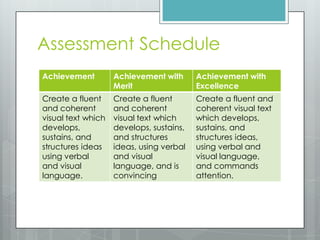
Assessment Schedule
Achievement         Achievement with      Achievement with
                    Merit                 Excellence

Create a fluent     Create a fluent       Create a fluent and
 coherent
and                 and coherent          coherent visual text
visual text which   visual text which     which develops,
develops,           develops, sustains,   sustains, and
sustains, and       and structures        structures ideas,
structures ideas    ideas, using verbal   using verbal and
using verbal        and visual            visual language,
and visual          language, and is      and commands
language.           convincing            attention.
Achieved
  The student creates a fluent and coherent visual essay
   which develops, sustains, and structures ideas using
   visual and verbal language.
 This involves demonstrating an understanding of
   purpose and audience by:
• developing ideas and making links between them.
Ideas may include the use of information, opinions,
experiences or events, observations, arguments,
interpretations, narrative, thoughts, or feelings
• selecting and using language features appropriate to
a visual essay to create consistency in meaning and
effect and to sustain interest. This includes both visual (for
example, images, sequences, camera shots) and verbal
language techniques (for example, sound, dialogue)
• selecting effective structure(s) for the visual essay. This
may include poetic, formal, and narrative forms or a
combination of these.
Merit
   The student creates a fluent and coherent visual essay which
    develops, sustains, and structures ideas, using visual and
    verbal language, and is convincing.
   This involves demonstrating a discerning understanding of
    purpose and audience through the discriminating selection,
    development, and integration of ideas, language features,
    and structures appropriate to a visual essay to create
    consistency in meaning and effect and to sustain interest.
   Ideas may include the use of information, opinions,
    experiences or events, observations, arguments,
    interpretations, narrative, thoughts, or feelings.
   Language features include both visual (for example, images,
    sequences, camera shots) and verbal language techniques
    (for example, sound, dialogue).
   Structures may include poetic, formal, and narrative forms or
    a combination of these.
Excellence
    The student creates a fluent and coherent visual essay
     which develops, sustains, and structures ideas, using visual
     and verbal language, and commands attention.
    This involves demonstrating a sophisticated understanding
     of purpose and audience through the insightful selection,
     development, and integration of ideas, language features,
     and structures appropriate to a visual essay to create
     consistency in meaning and effect, sustain interest, and
     create a striking whole.
    Ideas may include the use of information, opinions,
     experiences or events, observations, arguments,
     interpretations, narrative, thoughts, or feelings.
    Language features include both visual (for example,
     images, sequences, camera shots) and verbal language
     techniques (for example, sound, dialogue).
    Structures may include poetic, formal, and narrative forms
     or a combination of these.
Bibliography
 Draftinternal assessment NZQA resource
 English 3.6A

3.6 Create a Visual Presentation

  • 1.
    English 3.6: Createa fluent and coherent visual text which develops, sustains, and structures ideas using verbal and visual language Resource title: Visual Essay Credits: 3 Christine Wells
  • 2.
    Introduction  This assessment activity requires you to develop and craft a visual essay that develops, sustains, and structures key ideas from a text you have studied. You can work individually or in a group.  If you are working in groups, you will each need to fill out a log of your progress.  You will be assessed on how effectively your visual essay communicates your ideas.  Deadlines and checkpoints for each part of the visual essay will be given.
  • 3.
    Thinking Relating to others Using text, symbols Task: Develop a focus Managing self Participating and contributing  Determine a source text that could be used as the basis for developing a visual essay. Discuss with another student what you know about the source text.  Brainstorm everything you know about the text and then create categories for the different items from your brainstorm. If your source text has been part of work you have covered in class, refer to your notes.  The focus for our visual essays will be theme. Gathering Processing
  • 4.
    What is avisual essay?  A visual essay consists of images and text with a voice-over and music and/or sound effects.  A quality visual essay uses visual and verbal language techniques that are clearly linked to ideas from a source text to command the attention of an audience. It introduces core ideas and then progressively adds detail and analysis so the audience understands important ideas from the source text.  There are a number of visual texts on the Internet; some of these have the depth required to be considered visual essays, while others are more tribute texts designed to engage and entertain rather than communicate ideas.
  • 5.
    Choose a voice-over  List the characters from the source text with links to your focus. If you are focusing on a particular character, consider ways that other characters provide insight into their character. If you are focusing on a theme or central idea, consider which character(s) give the best insights into this.  Decide what form your voice-over will take (narrative, reflective, commentary, interview) and how you will link it to the visual component of the essay. Thinking Relating to others Using text, symbols Managing self Gathering Participating and Processing contributing
  • 6.
    Thinking Using text, symbols Managing self Participating and contributing Recreate the mood  Look back at your focus and consider which scenes from the source text relate most clearly to it. Re- watch or reread these scenes from the source text.  Write a phrase describing your interpretation of the mood of the text.  Using the expertise and resources available, decide how you could utilise colour (colour filters as well as colour in images), music, sound effects, font and text, and images to recreate your interpretation of the mood of the source text. Note down some possibilities for using these.  Recreate mood and further develop your ideas. Refer to Resource B for more information on how to recreate mood. Gathering Processing
  • 7.
    Resource B: Interpretingthe mood  When interpreting the mood of the source text, consider the key scenes you have identified.  List as many words as you can to describe the mood of these scenes. Convert these into a phrase that captures the entire mood of the text. Combinations of things and phrases can be more specific than single words. For instance, grim with a hint of hope is more evocative than negative.  When you have decided which language techniques you are going to use, consider how you will use these throughout your text. Using techniques in a similar and consistent manner throughout your text can create different effects but can also give it a recognisable theme that creates mood and ties the ideas together across your whole text.
  • 8.
    Develop a storyboard Drawup a storyboard that:  outlines the order of the visual elements (images and text)  details the visual language techniques that you will use with the images  outlines the important ideas to include in the voice-over script and how they link to the visual elements.  For more guidance on developing a storyboard, refer to Resource C. Thinking Relating to others Using text, symbols Gathering Managing self Participating and Processing contributing Applying
  • 9.
    Resource C: Planningthe visual essay  As you create your visual essay, think about the order of your ideas, images, and scenes. Ordering these elements in a particular way can effectively develop your ideas as the text progresses.  Introduce the focus of your text. Divide up the different ideas that make up the main focus of your text and add these as the text progresses. Plan for a progression of images and a voice-over that tell a story of your own and communicate literal and deeper meanings clearly and effectively to your audience.  A well-constructed storyboard can serve as a plan for your final essay and can be used to develop a list of things you need to do. A storyboard is a simple layout drawing (with labelled individual elements) of each scene/image from your visual essay. This should be developed at the same time as the script for your voice-over so you can ensure they are linked and will have maximum potential for commanding attention and achieving coherent and effective communication.
  • 10.
    Resource C: Planningthe visual essay As you draw up your storyboard, ensure you label each element that you will need to produce. Ideas for images include: • advertisements from the world/setting of your source text • propaganda and other forms of poster/visual text from the world/setting of your source text • photographs and images from the source text or clearly related to the source text • text and font linking with ideas. These could support or contrast deliberately with what is being said in the voice-over • scene re-enactments (videos) from, before, or after the events in the source text • drawings and diagrams to illustrate specific ideas and/or add detail to previous ideas.
  • 11.
    Resource C: Planningthe visual essay As you write the script for your voice-over, ensure that you annotate it with places where you can use some of the following techniques, and note what effects you aim to create with them. Examples include but are not limited to: • emphasising your character's voice to indicate some kind of emotion • pausing or breaking off to suggest something, for example, uncertainty • changing volume and tone to indicate emotion, for example, anger or frustration • changing the pace to suggest emotion, for example, excitement or boredom • contrasting the voice-over and music and visual elements to communicate ideas.
  • 12.
    Decide on toolsand create  Review your storyboard and the visual and verbal elements you plan to include in the visual essay. For each element consider the tools you have available and the expertise of your group members. Plan how you will finish each part of your text with the resources you have available and the time you have remaining.  Aim to communicate all the important ideas that make up your focus as effectively as possible. For a list of reflective questions to help you develop your visual essay, refer to Resource D.  Your teacher will direct you to a number of electronic and hard resources you can use for creating your visual essay. (See Resource E for some software tools.) You could also negotiate the use of your own resources with your teacher. Thinking Relating to others Using text, symbols Managing self Processing Participating and contributing
  • 13.
    Resource D: Creatingyour visual essay Revisit the following list of questions as you develop your visual essay and work to refine your text. • Does my text progressively add detail to the ideas I am trying to communicate? How can I ensure that it does this? • Am I structuring (ordering and grouping) my ideas in a way that communicates them effectively? • Have I chosen language techniques to create specific effects, and do these support the core ideas from the source text that I am focusing on? • Am I revisiting and critiquing my use of language and checking that it commands the attention of my readers/audience? Am I seeking advice from my teacher as I do this? • Do the ideas I am communicating link clearly and closely with the source text?
  • 14.
    Resource E: Usefulsoftware There are a number of different pieces of software (many of which are open source) you can use to assist with the creation of your text.  GIMP – an open-source graphics tool. Similar to commercial software for editing photos but aimed more at general graphics manipulation than at photos. Lots of plug-ins available. Excellent for combining with hard materials. For example, scanned hard media and images can have background colours easily added or changed.  Audacity – an open-source sound editing, mixing, and recording tool.  Inkscape – an open-source vector graphics tool. Vector graphics can be scaled/resized without losing quality. Powerful for creating and manipulating shapes and building up images from scratch.  VoiceThread – an online, Flash-based tool. Students can string images and videos together and annotate them with sound and text. Easy to use.  Prezi – an online, Flash-based presentation tool. Non-linear animations and potential for showing relationships.  Wikimedia Commons – a repository of public domain images, pictures, and sounds.  Windows Movie Maker – an easy-to-use entry-level video editing tool. Movie Maker comes free with some distributions of Windows and can also be downloaded and installed.  Blender – a powerful, open-source 3-D graphics tool.
  • 15.
    Assessment Schedule Achievement Achievement with Achievement with Merit Excellence  Create a fluent Create a fluent Create a fluent and  coherent and and coherent coherent visual text visual text which visual text which which develops, develops, develops, sustains, sustains, and sustains, and and structures structures ideas, structures ideas ideas, using verbal using verbal and using verbal and visual visual language, and visual language, and is and commands language. convincing attention.
  • 16.
    Achieved  Thestudent creates a fluent and coherent visual essay which develops, sustains, and structures ideas using visual and verbal language.  This involves demonstrating an understanding of purpose and audience by: • developing ideas and making links between them. Ideas may include the use of information, opinions, experiences or events, observations, arguments, interpretations, narrative, thoughts, or feelings • selecting and using language features appropriate to a visual essay to create consistency in meaning and effect and to sustain interest. This includes both visual (for example, images, sequences, camera shots) and verbal language techniques (for example, sound, dialogue) • selecting effective structure(s) for the visual essay. This may include poetic, formal, and narrative forms or a combination of these.
  • 17.
    Merit  The student creates a fluent and coherent visual essay which develops, sustains, and structures ideas, using visual and verbal language, and is convincing.  This involves demonstrating a discerning understanding of purpose and audience through the discriminating selection, development, and integration of ideas, language features, and structures appropriate to a visual essay to create consistency in meaning and effect and to sustain interest.  Ideas may include the use of information, opinions, experiences or events, observations, arguments, interpretations, narrative, thoughts, or feelings.  Language features include both visual (for example, images, sequences, camera shots) and verbal language techniques (for example, sound, dialogue).  Structures may include poetic, formal, and narrative forms or a combination of these.
  • 18.
    Excellence  The student creates a fluent and coherent visual essay which develops, sustains, and structures ideas, using visual and verbal language, and commands attention.  This involves demonstrating a sophisticated understanding of purpose and audience through the insightful selection, development, and integration of ideas, language features, and structures appropriate to a visual essay to create consistency in meaning and effect, sustain interest, and create a striking whole.  Ideas may include the use of information, opinions, experiences or events, observations, arguments, interpretations, narrative, thoughts, or feelings.  Language features include both visual (for example, images, sequences, camera shots) and verbal language techniques (for example, sound, dialogue).  Structures may include poetic, formal, and narrative forms or a combination of these.
  • 19.