Using Whole NumbersBy: Tara SpradleyIndicator Project
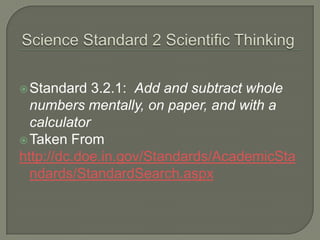
Science Standard 2 Scientific ThinkingStandard 3.2.1:  Add and subtract whole numbers mentally, on paper, and with a calculatorTaken Fromhttp://dc.doe.in.gov/Standards/AcademicStandards/StandardSearch.aspx
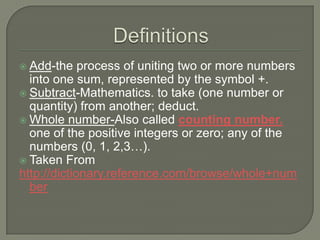
DefinitionsAdd-the process of uniting two or more numbers into one sum, represented by the symbol +.Subtract-Mathematics. to take (one number or quantity) from another; deduct.Whole number-Also called counting number. one of the positive integers or zero; any of the numbers (0, 1, 2,3…).Taken From http://dictionary.reference.com/browse/whole+number
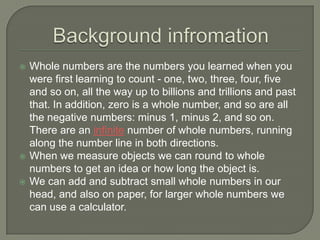
Background infromationWhole numbers are the numbers you learned when you were first learning to count - one, two, three, four, five and so on, all the way up to billions and trillions and past that. In addition, zero is a whole number, and so are all the negative numbers: minus 1, minus 2, and so on. There are an infinite number of whole numbers, running along the number line in both directions.When we measure objects we can round to whole numbers to get an idea or how long the object is.We can add and subtract small whole numbers in our head, and also on paper, for larger whole numbers we can use a calculator.
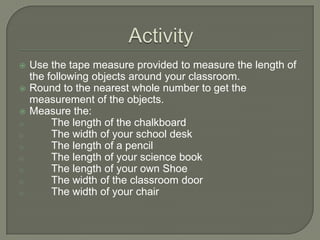
ActivityUse the tape measure provided to measure the length of the following objects around your classroom.Round to the nearest whole number to get the measurement of the objects.Measure the:	The length of the chalkboard
	The width of your school desk
	The length of a pencil
	The length of your science book
	The length of your own Shoe
	The width of the classroom door
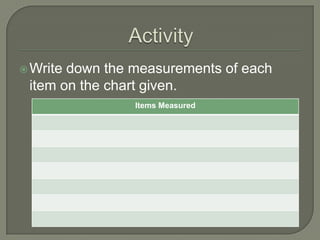
	The width of your chairActivityWrite down the measurements of each item on the chart given.
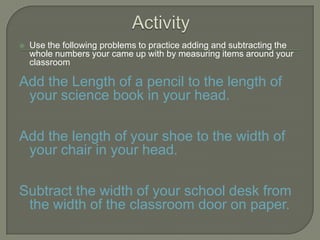
ActivityUse the following problems to practice adding and subtracting the whole numbers your came up with by measuring items around your classroomAdd the Length of a pencil to the length of your science book in your head.Add the length of your shoe to the width of your chair in your head.Subtract the width of your school desk from the width of the classroom door on paper.Subtract the width of the classroom door from the length of the chalkboard on paper.
ActivityAdd the length of the chalkboard to the length of a pencil on paper.Subtract the length of a pencil from the width of your school desk on paper.Add the length of the chalkboard, the length of a pencil and the width of your chair using a calculator.
ActivityAdd the width of your science book, the width of your school desk and the width of the classroom door using a calculator. Add the width of your chair to the width of your school desk using a calculator.

356indicatorpowerpoint

  • 1.
    Using Whole NumbersBy:Tara SpradleyIndicator Project
  • 2.
    Science Standard 2Scientific ThinkingStandard 3.2.1: Add and subtract whole numbers mentally, on paper, and with a calculatorTaken Fromhttp://dc.doe.in.gov/Standards/AcademicStandards/StandardSearch.aspx
  • 3.
    DefinitionsAdd-the process ofuniting two or more numbers into one sum, represented by the symbol +.Subtract-Mathematics. to take (one number or quantity) from another; deduct.Whole number-Also called counting number. one of the positive integers or zero; any of the numbers (0, 1, 2,3…).Taken From http://dictionary.reference.com/browse/whole+number
  • 4.
    Background infromationWhole numbersare the numbers you learned when you were first learning to count - one, two, three, four, five and so on, all the way up to billions and trillions and past that. In addition, zero is a whole number, and so are all the negative numbers: minus 1, minus 2, and so on. There are an infinite number of whole numbers, running along the number line in both directions.When we measure objects we can round to whole numbers to get an idea or how long the object is.We can add and subtract small whole numbers in our head, and also on paper, for larger whole numbers we can use a calculator.
  • 5.
    ActivityUse the tapemeasure provided to measure the length of the following objects around your classroom.Round to the nearest whole number to get the measurement of the objects.Measure the: The length of the chalkboard
  • 6.
    The width ofyour school desk
  • 7.
  • 8.
    The length ofyour science book
  • 9.
    The length ofyour own Shoe
  • 10.
    The width ofthe classroom door
  • 11.
    The width ofyour chairActivityWrite down the measurements of each item on the chart given.
  • 12.
    ActivityUse the followingproblems to practice adding and subtracting the whole numbers your came up with by measuring items around your classroomAdd the Length of a pencil to the length of your science book in your head.Add the length of your shoe to the width of your chair in your head.Subtract the width of your school desk from the width of the classroom door on paper.Subtract the width of the classroom door from the length of the chalkboard on paper.
  • 13.
    ActivityAdd the lengthof the chalkboard to the length of a pencil on paper.Subtract the length of a pencil from the width of your school desk on paper.Add the length of the chalkboard, the length of a pencil and the width of your chair using a calculator.
  • 14.
    ActivityAdd the widthof your science book, the width of your school desk and the width of the classroom door using a calculator. Add the width of your chair to the width of your school desk using a calculator.