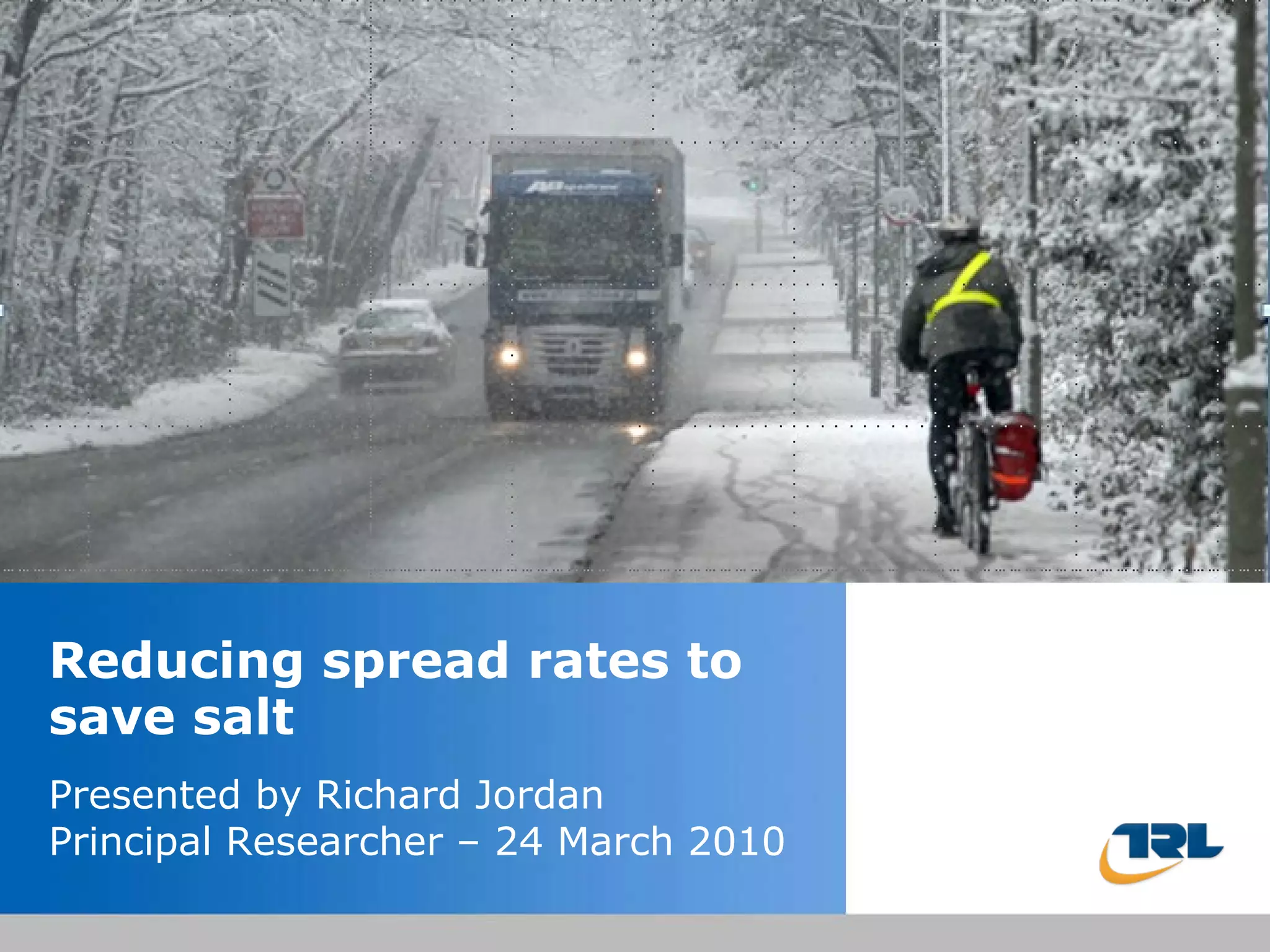
Insert the title of your  presentation here Presented by Name Here Job Title - Date Reducing spread rates to save salt Presented by Richard Jordan Principal Researcher – 24 March 2010
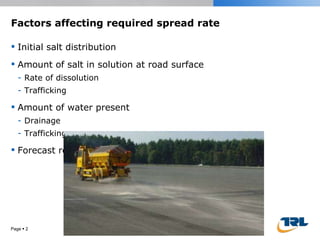
Factors affecting required spread rate Initial salt distribution Amount of salt in solution at road surface Rate of dissolution Trafficking  Amount of water present Drainage Trafficking Forecast road surface temperature Page  
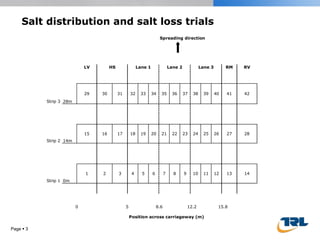
Salt distribution and salt loss trials Page  
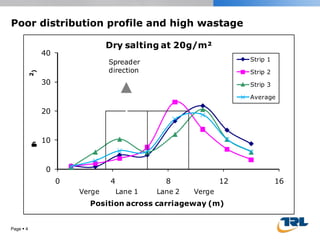
Poor distribution profile and high wastage Page  
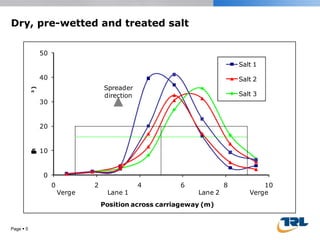
Dry, pre-wetted and treated salt Page  
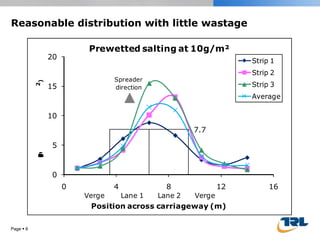
Reasonable distribution with little wastage Page  
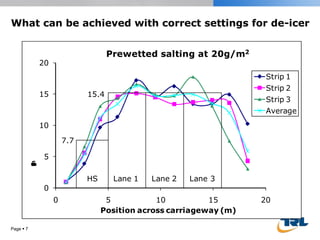
What can be achieved with correct settings for de-icer Page  
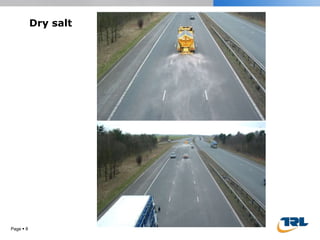
Dry salt Page  
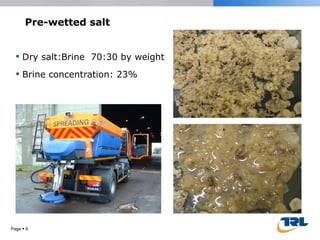
Pre-wetted salt Dry salt:Brine  70:30 by weight Brine concentration: 23% Page  
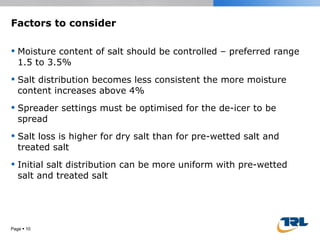
Factors to consider Moisture content of salt should be controlled – preferred range 1.5 to 3.5% Salt distribution becomes less consistent the more moisture content increases above 4% Spreader settings must be optimised for the de-icer to be spread Salt loss is higher for dry salt than for pre-wetted salt and treated salt  Initial salt distribution can be more uniform with pre-wetted salt and treated salt Page  
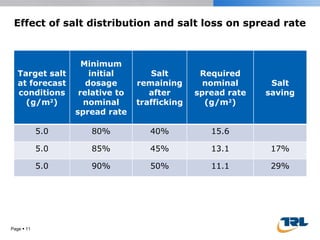
Effect of salt distribution and salt loss on spread rate Page     Target salt at forecast conditions (g/m 2 ) Minimum initial dosage relative to nominal spread rate Salt remaining after trafficking Required nominal spread rate (g/m 2 ) Salt saving 5.0 80% 40% 15.6 5.0 85% 45% 13.1 17% 5.0 90% 50% 11.1 29%
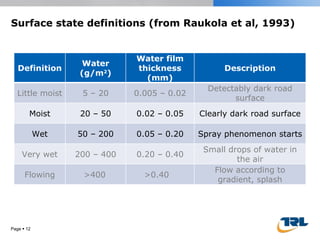
Surface state definitions (from Raukola et al, 1993) Page     Definition Water (g/m 2 ) Water film thickness (mm) Description Little moist 5 – 20 0.005 – 0.02 Detectably dark road surface Moist 20 – 50 0.02 – 0.05 Clearly dark road surface Wet 50 – 200 0.05 – 0.20 Spray phenomenon starts Very wet 200 – 400 0.20 – 0.40 Small drops of water in the air Flowing >400 >0.40 Flow according to gradient, splash
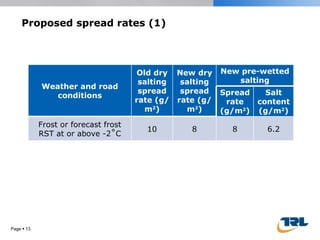
Proposed spread rates (1) Page     Weather and road conditions Old dry salting spread rate (g/m 2 ) New dry salting spread rate (g/m 2 ) New pre-wetted salting Spread rate (g/m 2 ) Salt content (g/m 2 ) Frost or forecast frost RST at or above -2˚C 10 8 8 6.2
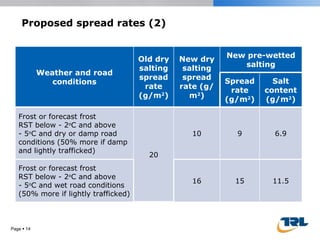
Proposed spread rates (2) Page     Weather and road conditions Old dry salting spread rate (g/m 2 ) New dry salting spread rate (g/m 2 ) New pre-wetted salting Spread rate (g/m 2 ) Salt content (g/m 2 ) Frost or forecast frost  RST below - 2 o C and above  - 5 o C and dry or damp road conditions (50% more if damp and lightly trafficked) 20 10 9 6.9 Frost or forecast frost  RST below - 2 o C and above  - 5 o C and wet road conditions (50% more if lightly trafficked) 16 15 11.5
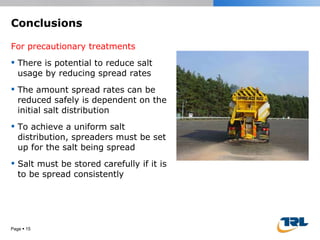
Conclusions For precautionary treatments There is potential to reduce salt usage by reducing spread rates The amount spread rates can be reduced safely is dependent on the initial salt distribution To achieve a uniform salt distribution, spreaders must be set up for the salt being spread Salt must be stored carefully if it is to be spread consistently Page  
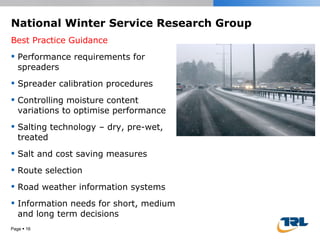
National Winter Service Research Group Best Practice Guidance Performance requirements for spreaders Spreader calibration procedures Controlling moisture content variations to optimise performance Salting technology – dry, pre-wet, treated Salt and cost saving measures Route selection Road weather information systems Information needs for short, medium and long term decisions Page  
Page     Thank you Reducing spread rates to save salt Snow Summit 2010 Presented by Richard Jordan Principal Researcher – 24 March 2010 Tel: 01344 770828 Email: rjordan@trl.co.uk

Richard Jordan

  • 1.
    Insert the titleof your presentation here Presented by Name Here Job Title - Date Reducing spread rates to save salt Presented by Richard Jordan Principal Researcher – 24 March 2010
  • 2.
    Factors affecting requiredspread rate Initial salt distribution Amount of salt in solution at road surface Rate of dissolution Trafficking Amount of water present Drainage Trafficking Forecast road surface temperature Page 
  • 3.
    Salt distribution andsalt loss trials Page 
  • 4.
    Poor distribution profileand high wastage Page 
  • 5.
    Dry, pre-wetted andtreated salt Page 
  • 6.
    Reasonable distribution withlittle wastage Page 
  • 7.
    What can beachieved with correct settings for de-icer Page 
  • 8.
  • 9.
    Pre-wetted salt Drysalt:Brine 70:30 by weight Brine concentration: 23% Page 
  • 10.
    Factors to considerMoisture content of salt should be controlled – preferred range 1.5 to 3.5% Salt distribution becomes less consistent the more moisture content increases above 4% Spreader settings must be optimised for the de-icer to be spread Salt loss is higher for dry salt than for pre-wetted salt and treated salt Initial salt distribution can be more uniform with pre-wetted salt and treated salt Page 
  • 11.
    Effect of saltdistribution and salt loss on spread rate Page  Target salt at forecast conditions (g/m 2 ) Minimum initial dosage relative to nominal spread rate Salt remaining after trafficking Required nominal spread rate (g/m 2 ) Salt saving 5.0 80% 40% 15.6 5.0 85% 45% 13.1 17% 5.0 90% 50% 11.1 29%
  • 12.
    Surface state definitions(from Raukola et al, 1993) Page  Definition Water (g/m 2 ) Water film thickness (mm) Description Little moist 5 – 20 0.005 – 0.02 Detectably dark road surface Moist 20 – 50 0.02 – 0.05 Clearly dark road surface Wet 50 – 200 0.05 – 0.20 Spray phenomenon starts Very wet 200 – 400 0.20 – 0.40 Small drops of water in the air Flowing >400 >0.40 Flow according to gradient, splash
  • 13.
    Proposed spread rates(1) Page  Weather and road conditions Old dry salting spread rate (g/m 2 ) New dry salting spread rate (g/m 2 ) New pre-wetted salting Spread rate (g/m 2 ) Salt content (g/m 2 ) Frost or forecast frost RST at or above -2˚C 10 8 8 6.2
  • 14.
    Proposed spread rates(2) Page  Weather and road conditions Old dry salting spread rate (g/m 2 ) New dry salting spread rate (g/m 2 ) New pre-wetted salting Spread rate (g/m 2 ) Salt content (g/m 2 ) Frost or forecast frost RST below - 2 o C and above - 5 o C and dry or damp road conditions (50% more if damp and lightly trafficked) 20 10 9 6.9 Frost or forecast frost RST below - 2 o C and above - 5 o C and wet road conditions (50% more if lightly trafficked) 16 15 11.5
  • 15.
    Conclusions For precautionarytreatments There is potential to reduce salt usage by reducing spread rates The amount spread rates can be reduced safely is dependent on the initial salt distribution To achieve a uniform salt distribution, spreaders must be set up for the salt being spread Salt must be stored carefully if it is to be spread consistently Page 
  • 16.
    National Winter ServiceResearch Group Best Practice Guidance Performance requirements for spreaders Spreader calibration procedures Controlling moisture content variations to optimise performance Salting technology – dry, pre-wet, treated Salt and cost saving measures Route selection Road weather information systems Information needs for short, medium and long term decisions Page 
  • 17.
    Page  Thank you Reducing spread rates to save salt Snow Summit 2010 Presented by Richard Jordan Principal Researcher – 24 March 2010 Tel: 01344 770828 Email: rjordan@trl.co.uk