Addition and Subtraction
of Whole Numbers
Addition and Subtraction of Whole
Numbers
• 1.
3
• 1.
4
• 1.
5
Addition of Whole Numbers
Subtraction of Whole
Numbers Properties of
Addition
Addition of Whole Numbers
• Objectives:
• understand the addition process
• be able to add whole numbers
• be able to use the calculator to add one whole number
to another
Addition of Whole Numbers
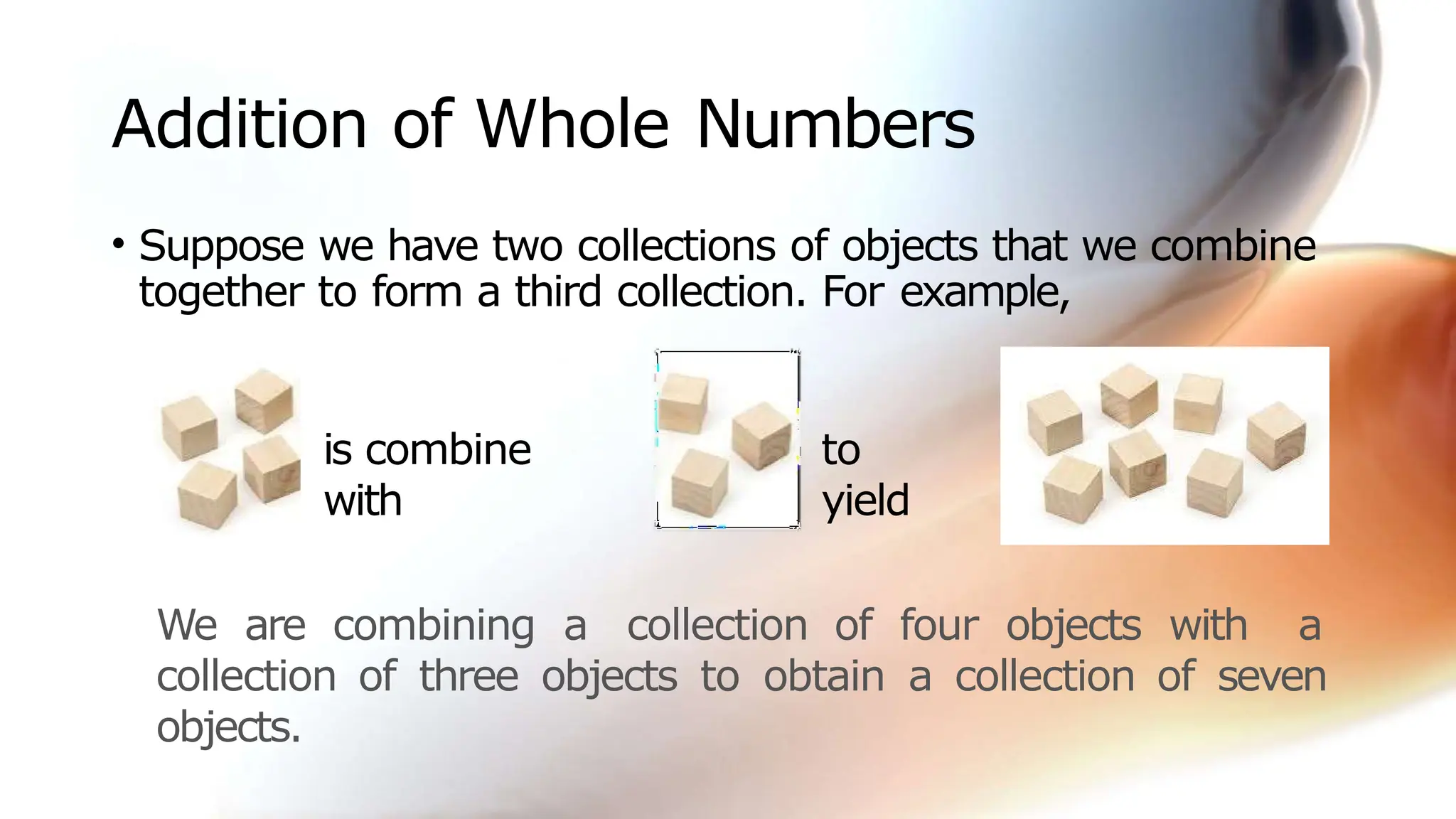
• Suppose we have two collections of objects that we combine
together to form a third collection. For example,
is combine
with
to
yield
We are combining a collection of four objects with a
collection of three objects to obtain a collection of seven
objects.
Addition of Whole Numbers
• Addition
The process of combining two or more objects (real or intuitive)
to form a third, the total, is called addition.
In addition, the numbers being added are called addends or
terms, and the total is called the sum. The plus symbol (+) is
used to indicate addition, and the equal symbol (=) is used to
represent the word "equal." For example, 4
+ 3 = 7 means "four added to three equals seven."
Addition Visualized on the Number Line
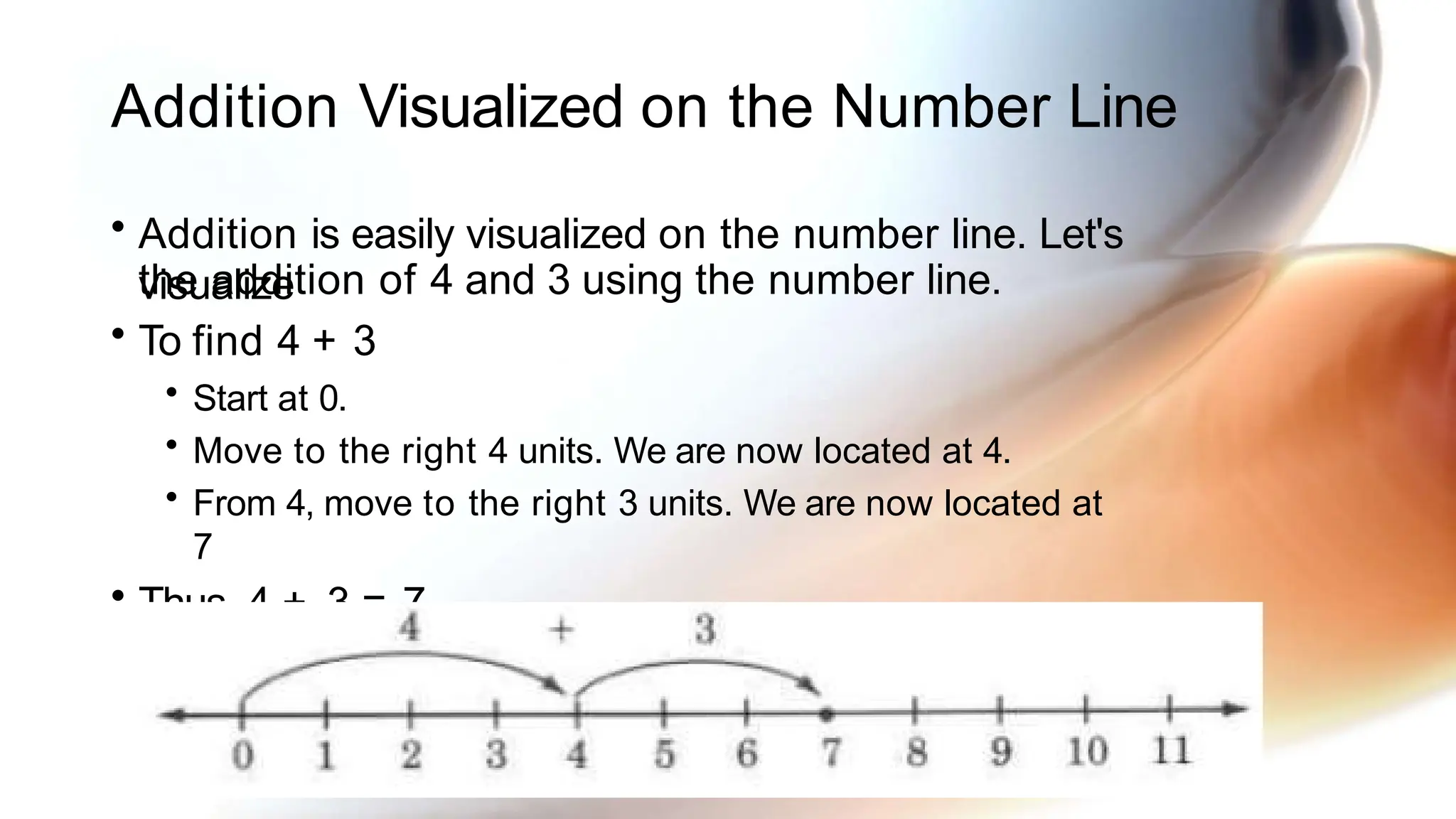
• Addition is easily visualized on the number line. Let's
visualize
the addition of 4 and 3 using the number line.
• To find 4 + 3
• Start at 0.
• Move to the right 4 units. We are now located at 4.
• From 4, move to the right 3 units. We are now located at
7
• Thus, 4 + 3 = 7
The Addition
Process
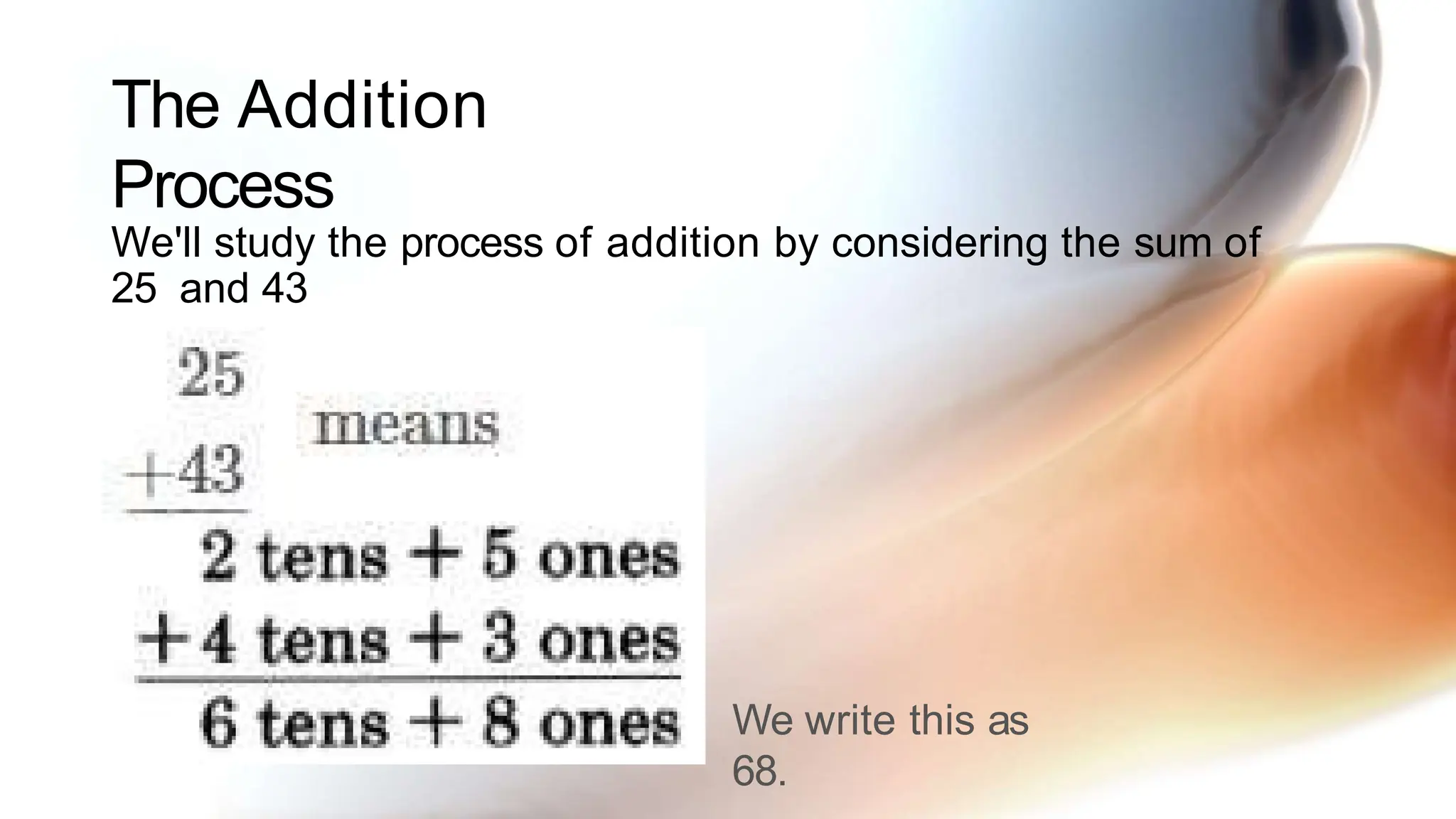
We'll study the process of addition by considering the sum of
25 and 43
We write this as
68.
The Process of Adding Whole
Numbers
T
o add whole numbers,
The process:
1) Write the numbers vertically, placing corresponding
positions in the same column.
2) Add the digits in each column. Start at the right (in the
ones position) and move to the left, placing the sum at
the bottom.
Addition Involving
Carrying
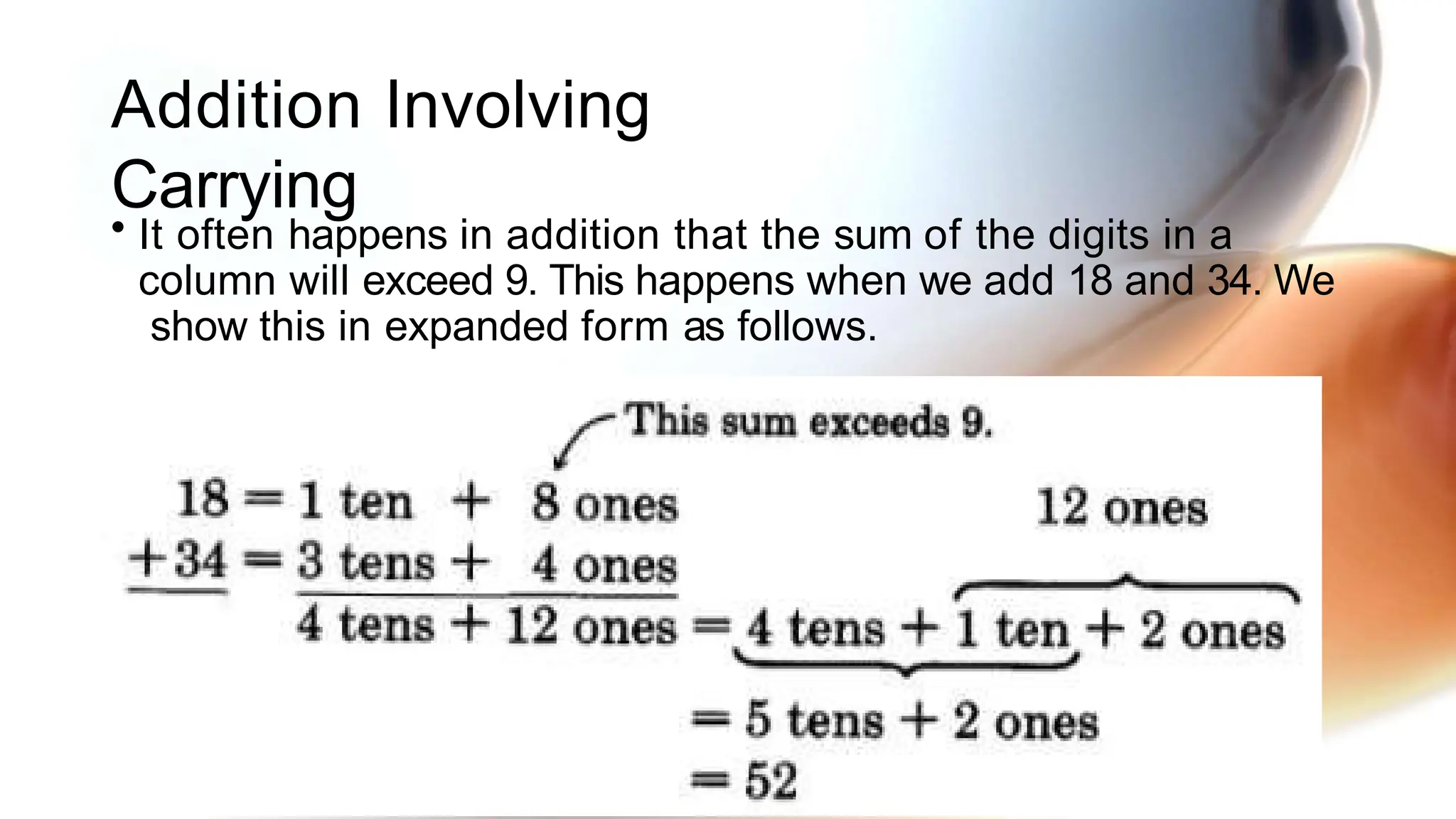
• It often happens in addition that the sum of the digits in a
column will exceed 9. This happens when we add 18 and 34. We
show this in expanded form as follows.
Addition Involving
Carrying
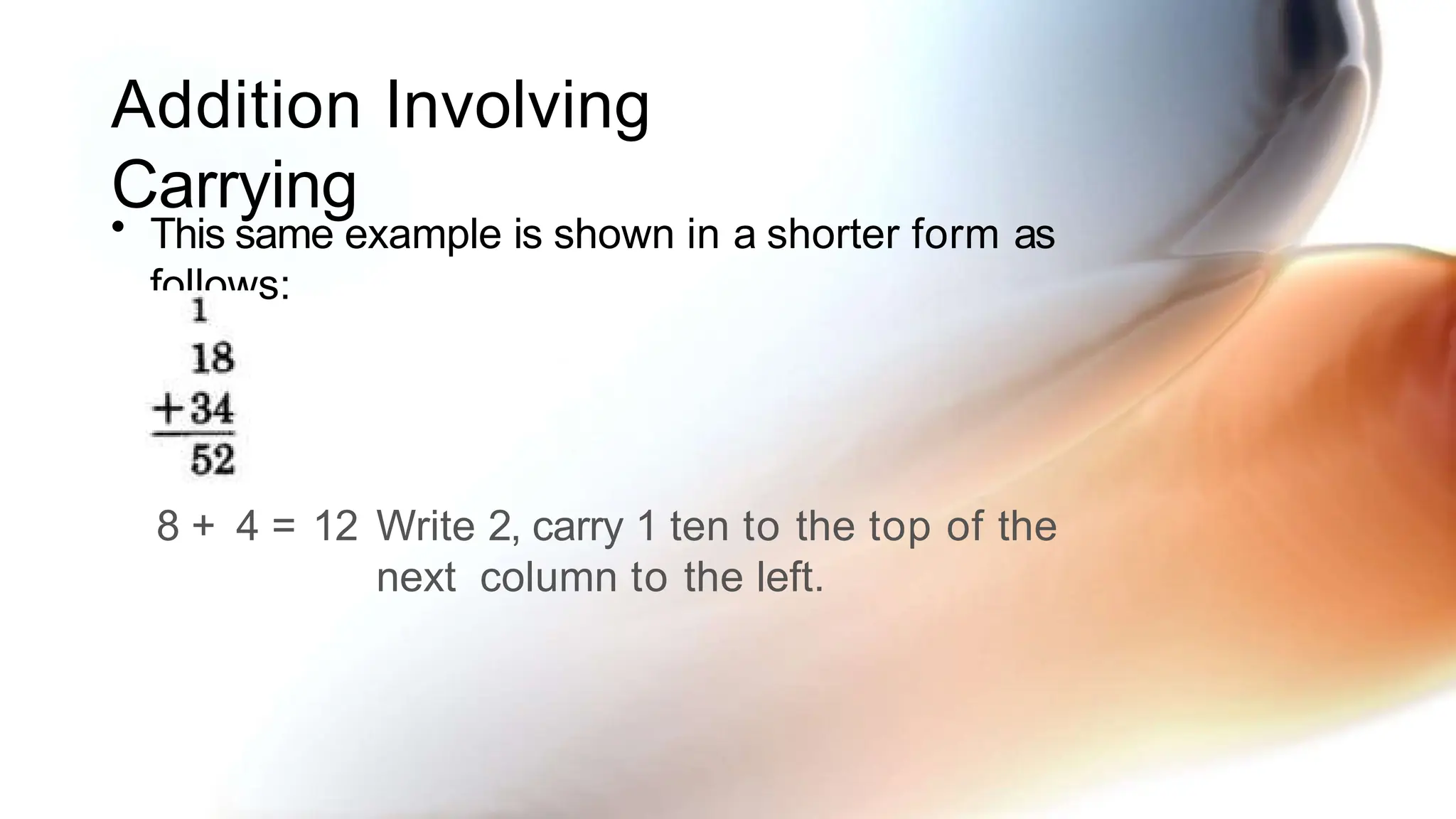
• This same example is shown in a shorter form as
follows:
8 + 4 = 12 Write 2, carry 1 ten to the top of the
next column to the left.
Addition Involving
Carrying
• Sample Set B
• Perform the following additions. Use the process of
carrying when needed.
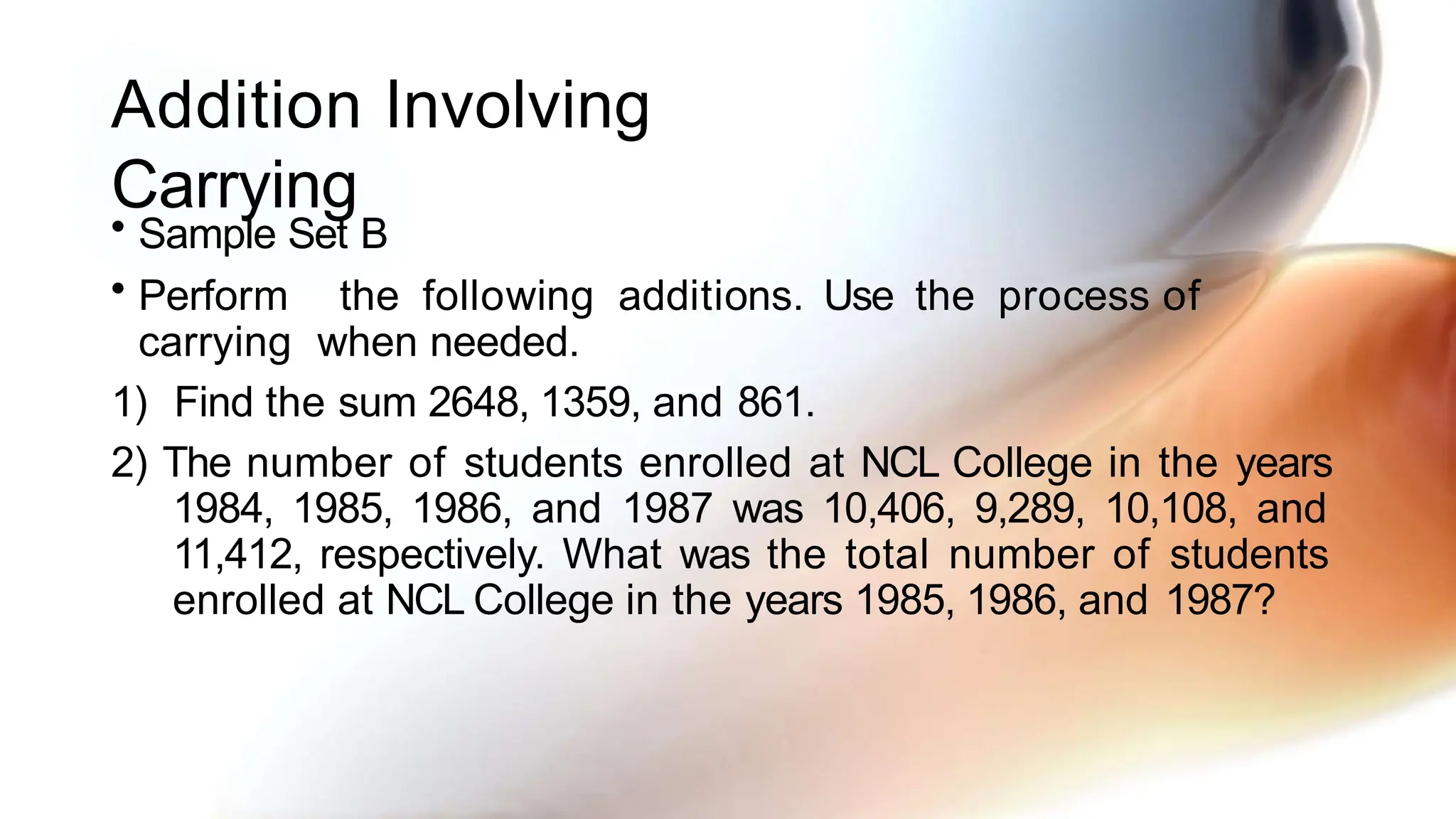
1) Find the sum 2648, 1359, and 861.
2) The number of students enrolled at NCL College in the years
1984, 1985, 1986, and 1987 was 10,406, 9,289, 10,108, and
11,412, respectively. What was the total number of students
enrolled at NCL College in the years 1985, 1986, and 1987?
Calculators
Calculators provide a very simple and quick way to find sums
of whole numbers.
Sample Set C
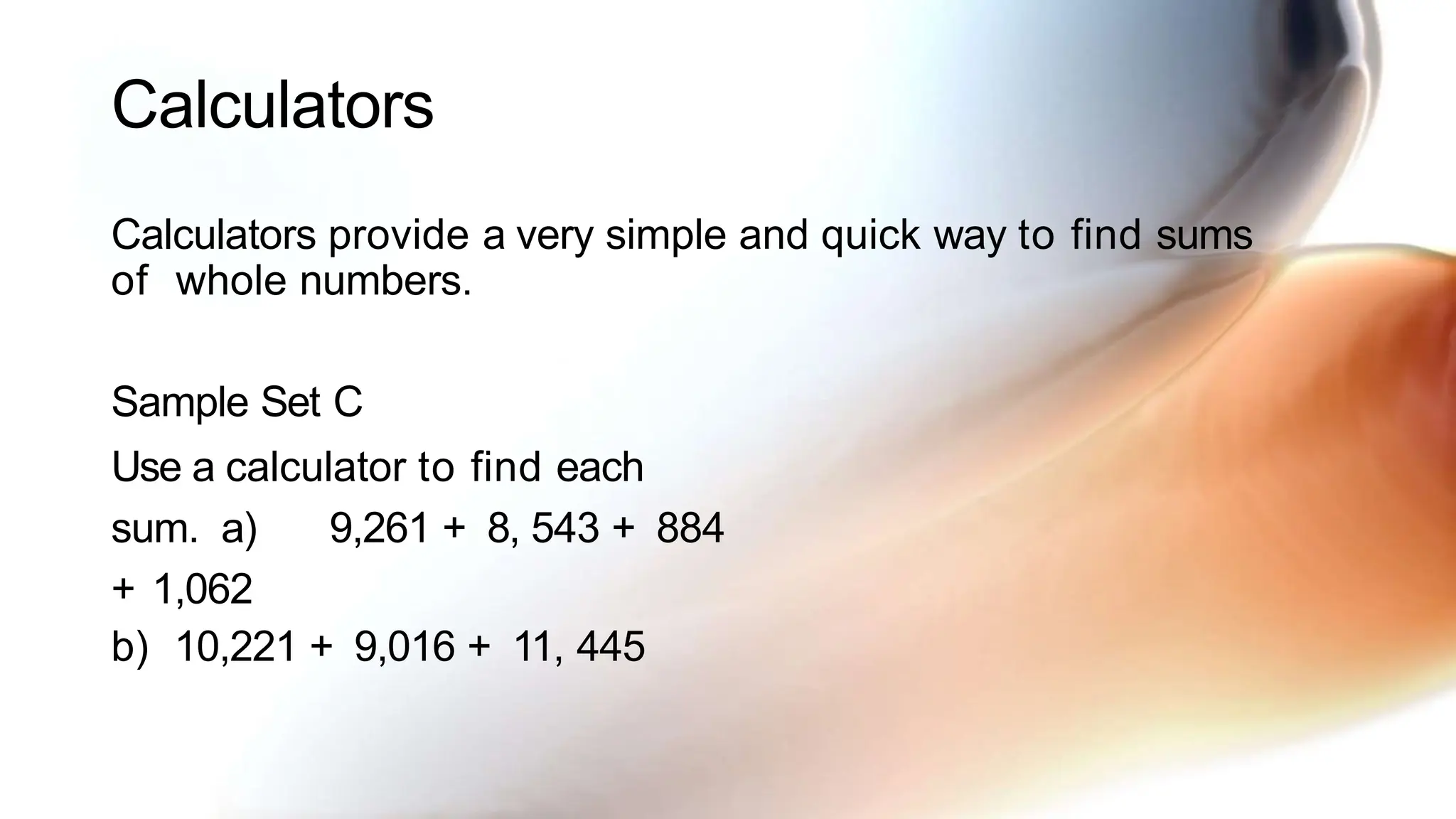
Use a calculator to find each
sum. a) 9,261 + 8, 543 + 884
+ 1,062
b) 10,221 + 9,016 + 11, 445
Exercise
s
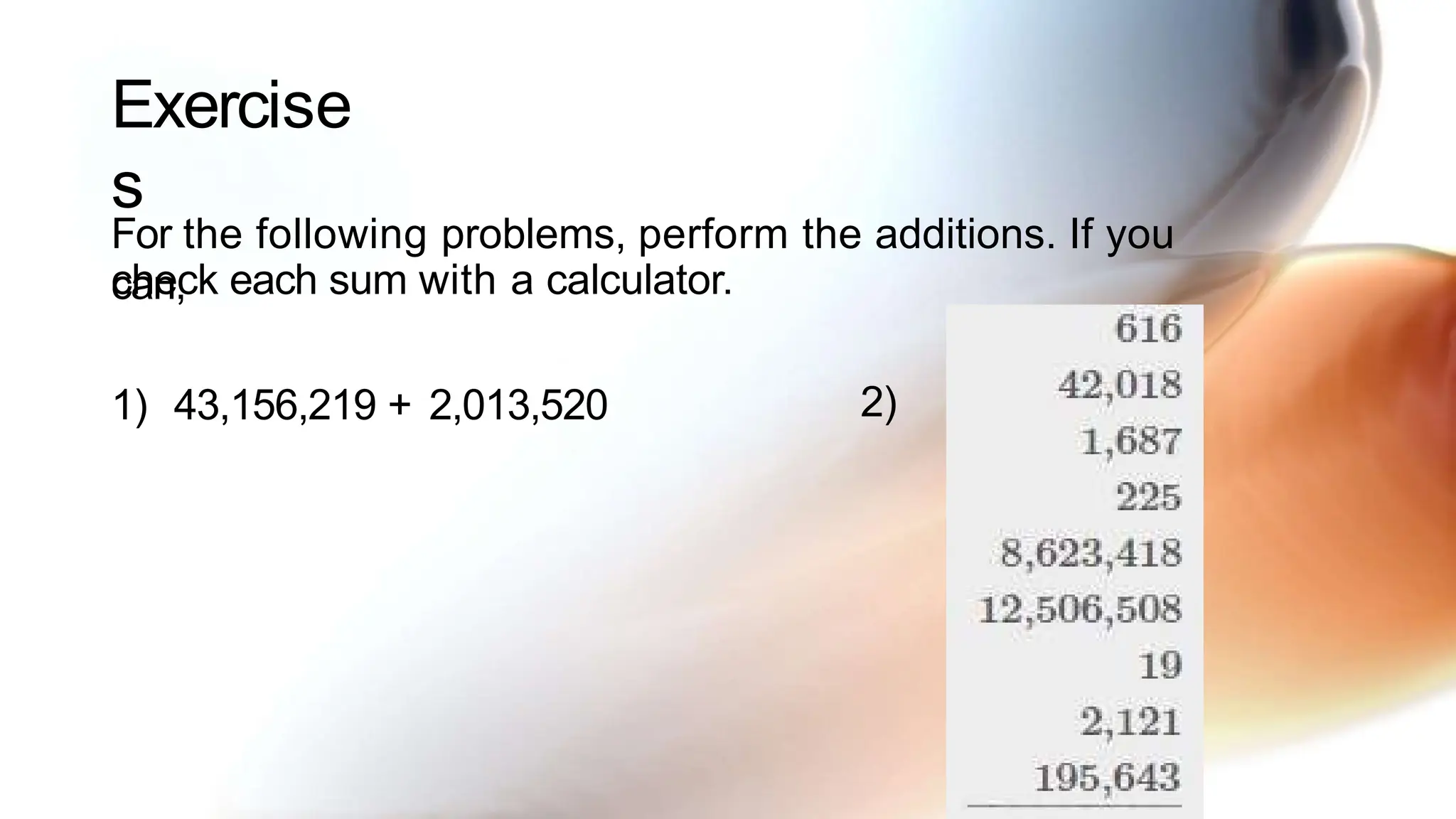
For the following problems, perform the additions. If you
can,
check each sum with a calculator.
1) 43,156,219 + 2,013,520 2)
Exercise
s
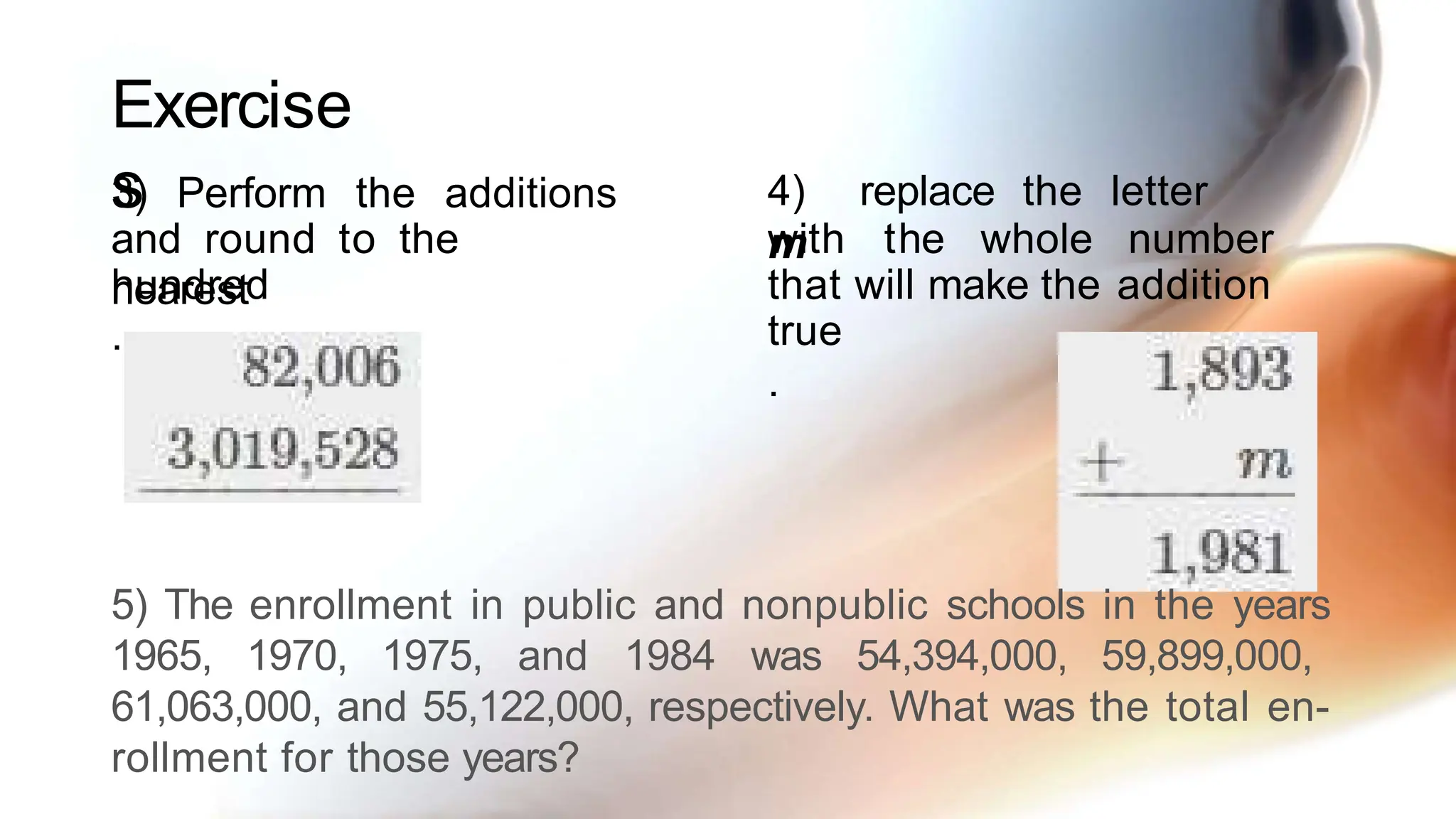
3) Perform the additions
and round to the
nearest
hundred
.
4) replace the letter
m
with the whole number
that will make the addition
true
.
5) The enrollment in public and nonpublic schools in the years
1965, 1970, 1975, and 1984 was 54,394,000, 59,899,000,
61,063,000, and 55,122,000, respectively. What was the total en-
rollment for those years?
Exercise
s
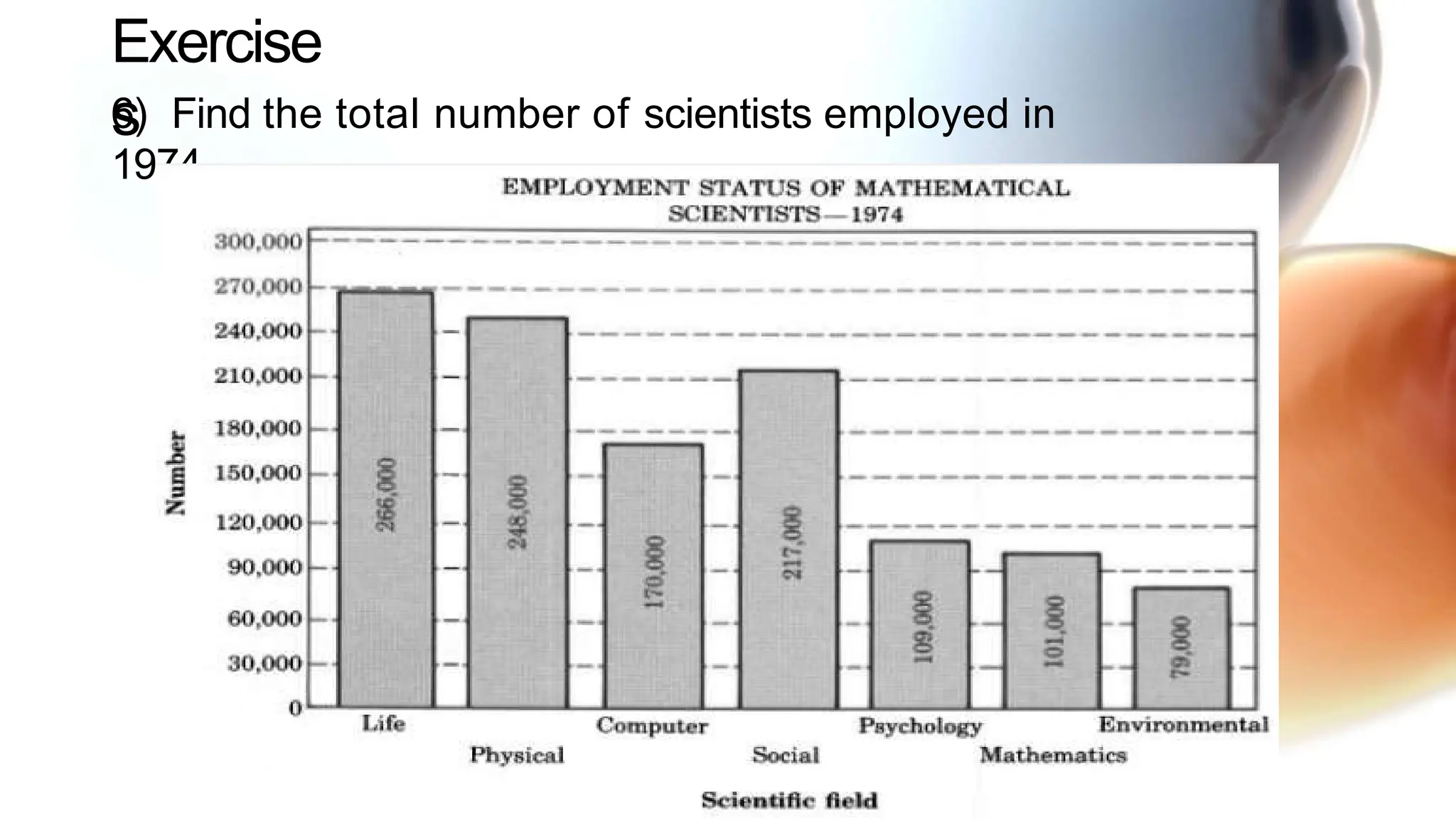
6) Find the total number of scientists employed in
1974.
Subtraction of Whole Numbers
• Objectives
• understand the subtraction process
• be able to subtract whole numbers
• be able to use a calculator to subtract one whole number
from another whole number
Subtraction of Whole Numbers
• Subtraction is the process of determining the remainder when
part of the total is removed.
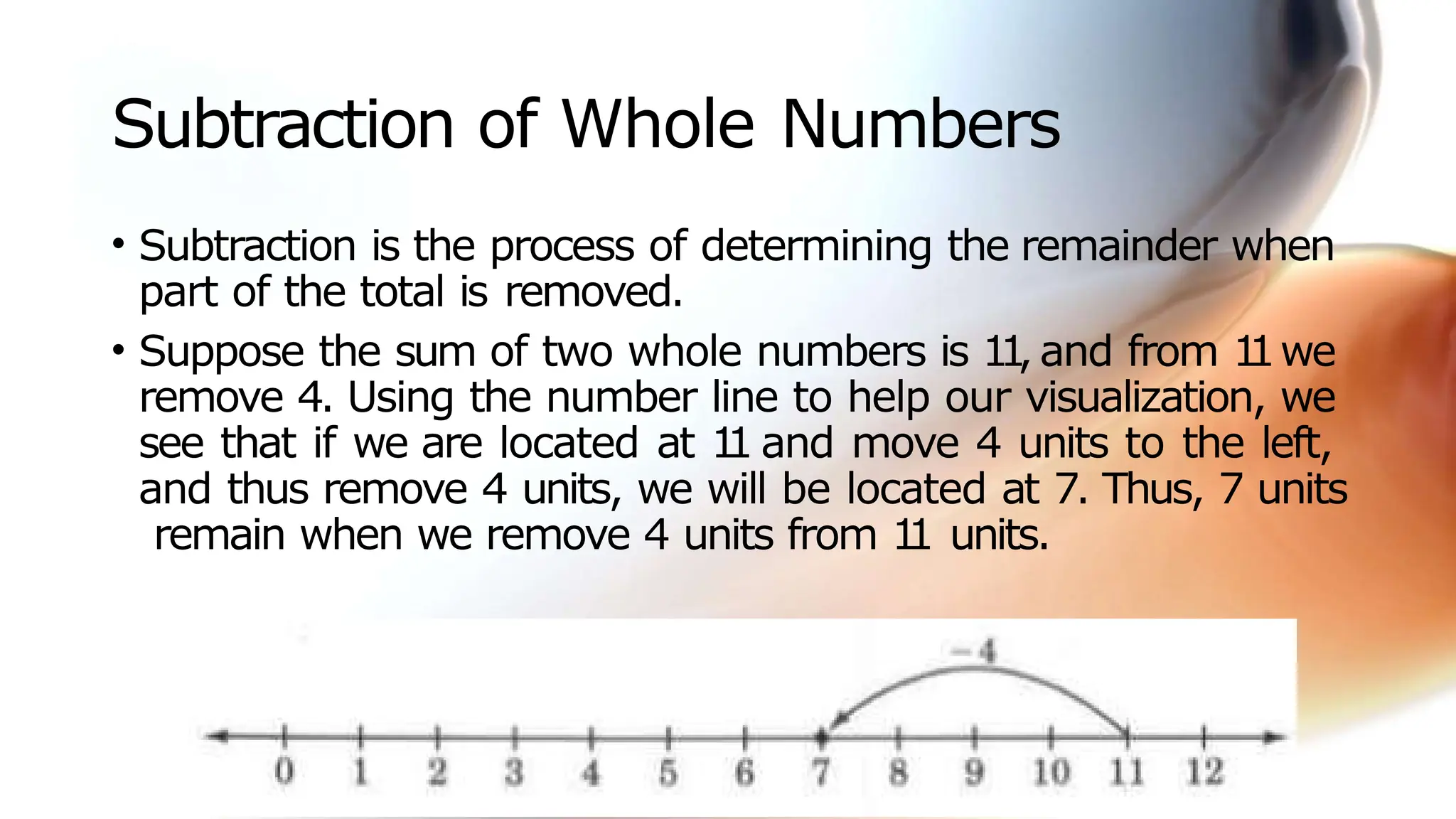
• Suppose the sum of two whole numbers is 1
1
, and from 1
1we
remove 4. Using the number line to help our visualization, we
see that if we are located at 1
1 and move 4 units to the left,
and thus remove 4 units, we will be located at 7. Thus, 7 units
remain when we remove 4 units from 1
1 units.
Subtraction of Whole Numbers
• The Minus Symbol
The minus symbol (-) is used to indicate subtraction. For
example, 1
1 – 4 indicates that 4 is to be subtracted from 1
1
.
• Minuend
The number immediately in front of or the minus symbol is called the
minuend,
and it represents the original number of
units.
• Subtrahend
The number immediately following or below the minus
symbol
is
called
the subtrahend, and it represents the number of units to be
removed.
• Difference
The result of the subtraction is called the differenceof the two numbers. For
example, in 1
1 - 4 = 7, 1
1 is the minuend, 4
is the subtrahend, and 7 is the
differenc
e.
Subtraction as the Opposite of Addition
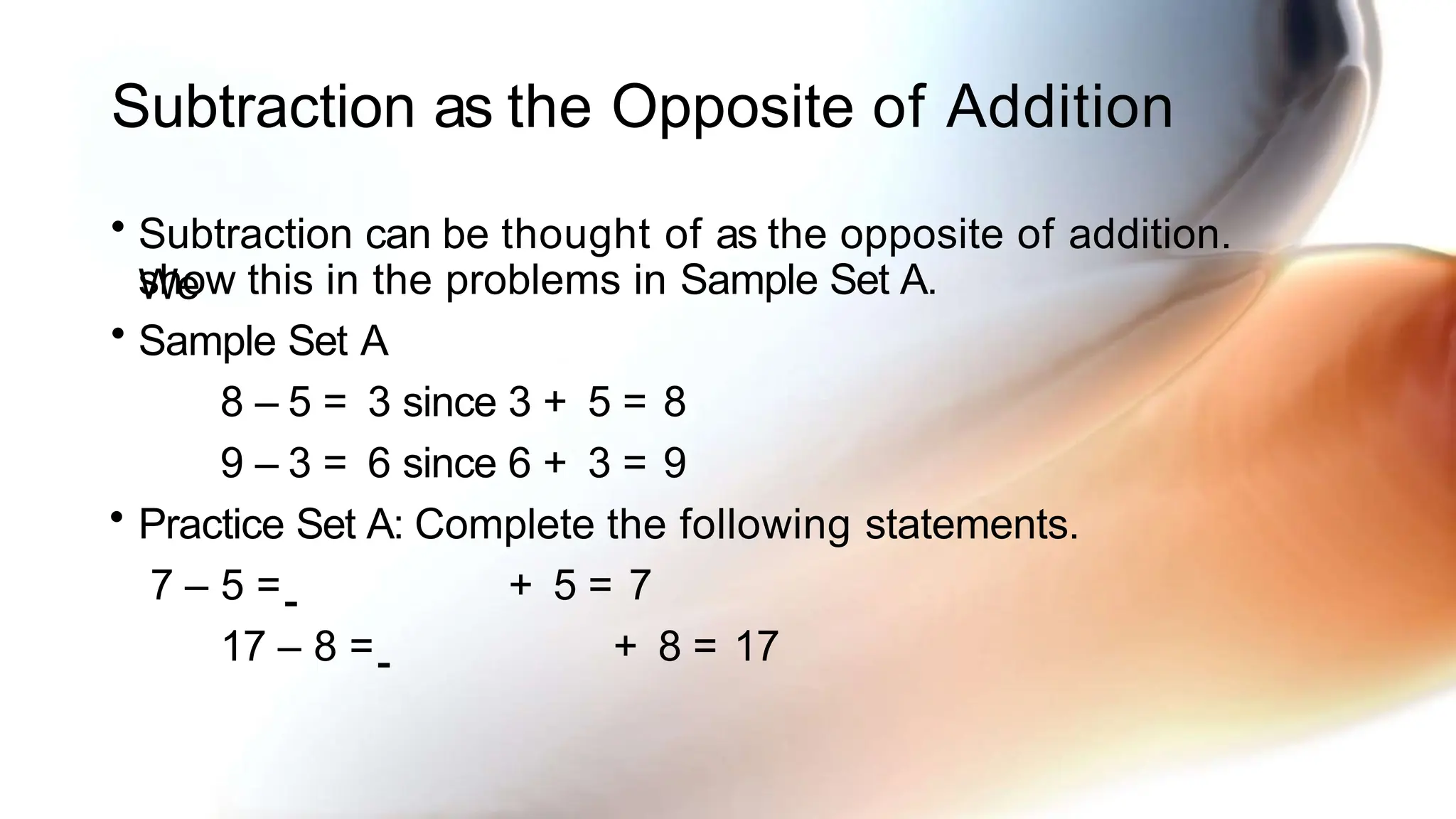
• Subtraction can be thought of as the opposite of addition.
We
show this in the problems in Sample Set A.
• Sample Set A
8 – 5 = 3 since 3 + 5 = 8
9 – 3 = 6 since 6 + 3 = 9
• Practice Set A: Complete the following statements.
7 – 5 = + 5 = 7
17 – 8 = + 8 = 17
The Subtraction
Process
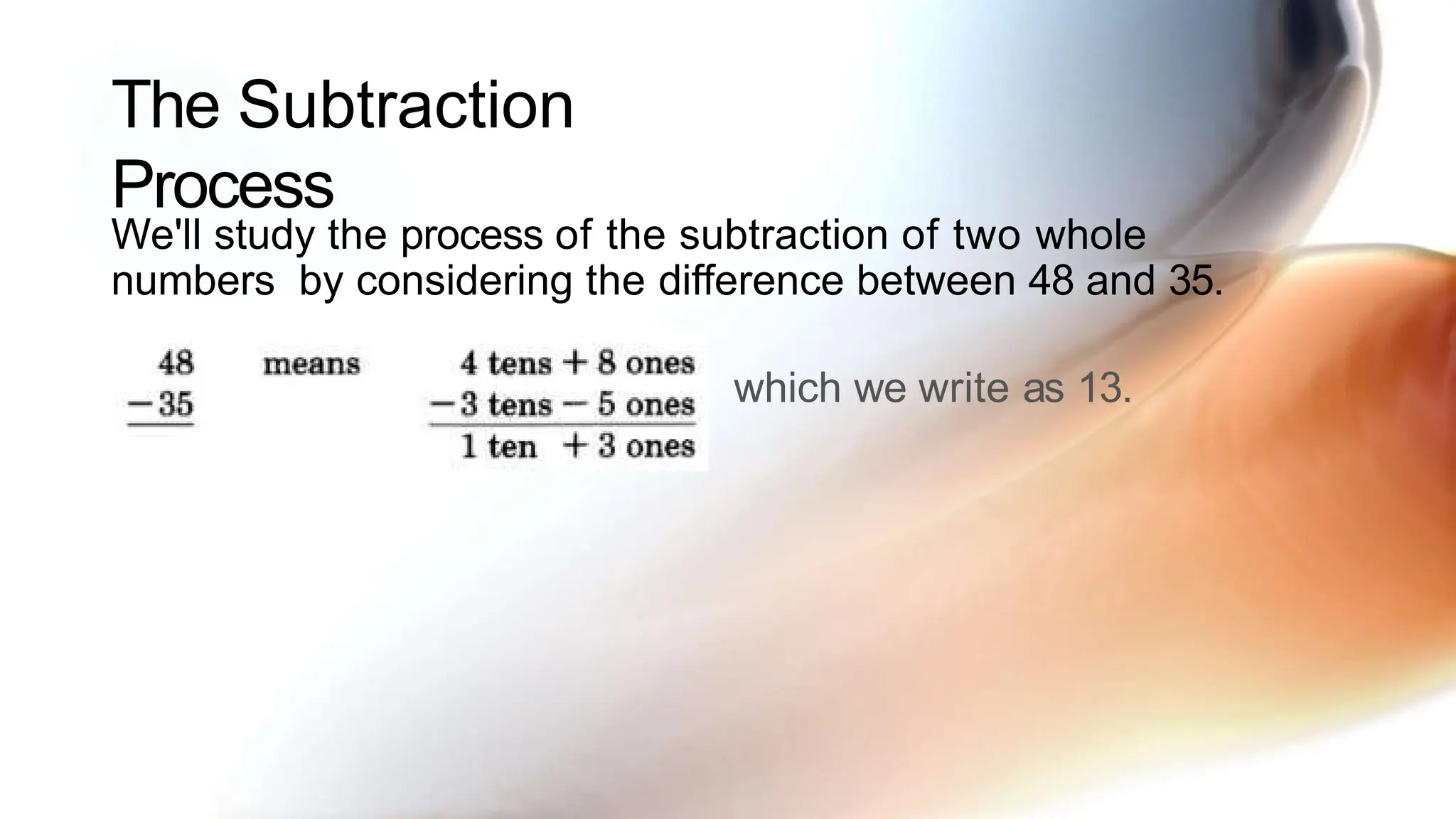
We'll study the process of the subtraction of two whole
numbers by considering the difference between 48 and 35.
which we write as 13.
The Process of Subtracting Whole
Numbers
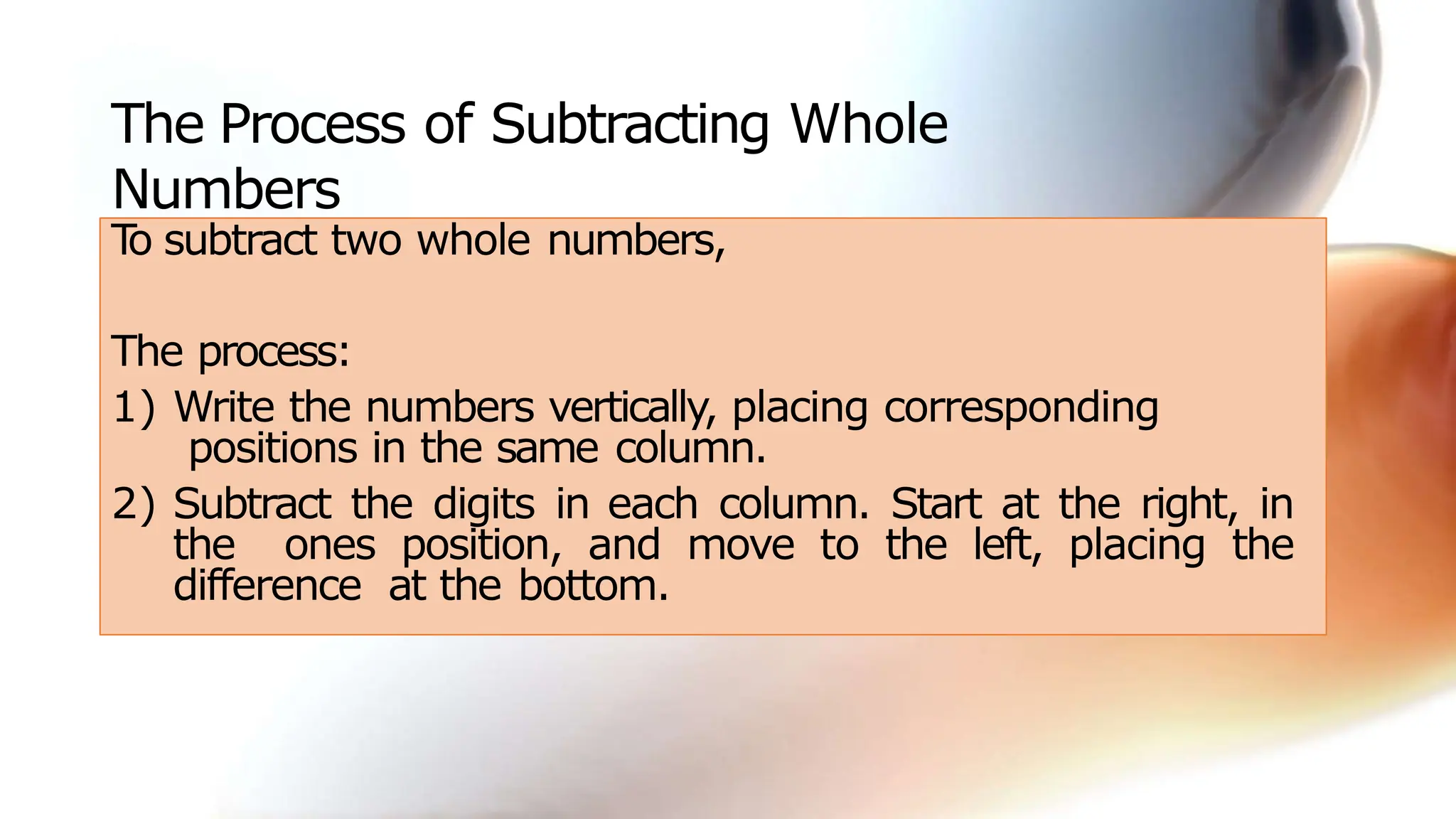
T
o subtract two whole numbers,
The process:
1) Write the numbers vertically, placing corresponding
positions in the same column.
2) Subtract the digits in each column. Start at the right, in
the ones position, and move to the left, placing the
difference at the bottom.
Subtraction of Whole Numbers
Sample Set B
Perform the following subtractions.
1
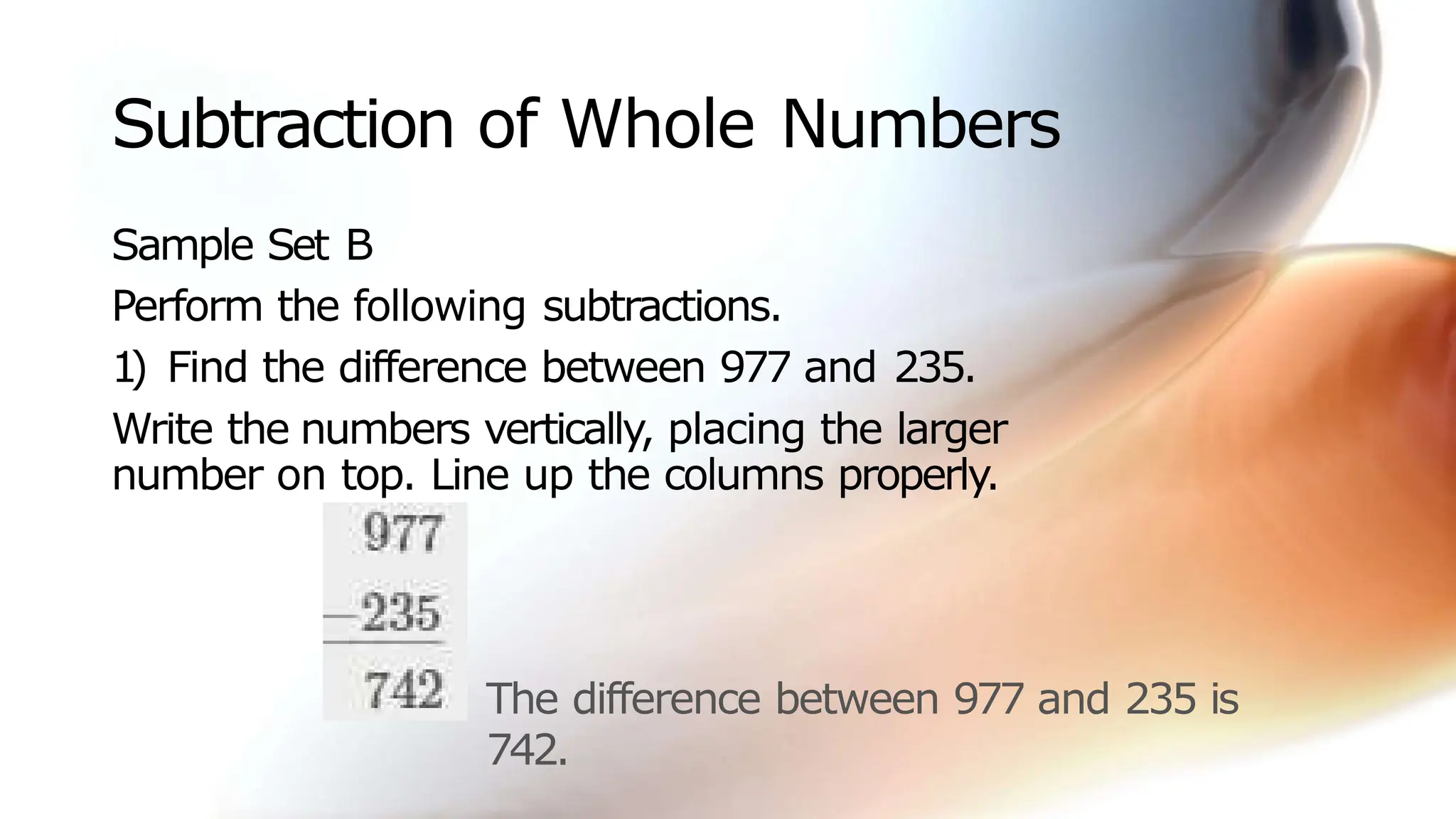
) Find the difference between 977 and 235.
Write the numbers vertically, placing the larger
number on top. Line up the columns properly.
The difference between 977 and 235 is
742.
Subtraction of Whole Numbers
2) In Keys County in 1987, there were 809 cable television
installations. In Flags County in 1987, there were 1,159 cable
television installations. How many more cable television
installations were there in Flags County than in Keys County in
1987?
Subtraction Involving Borrowing
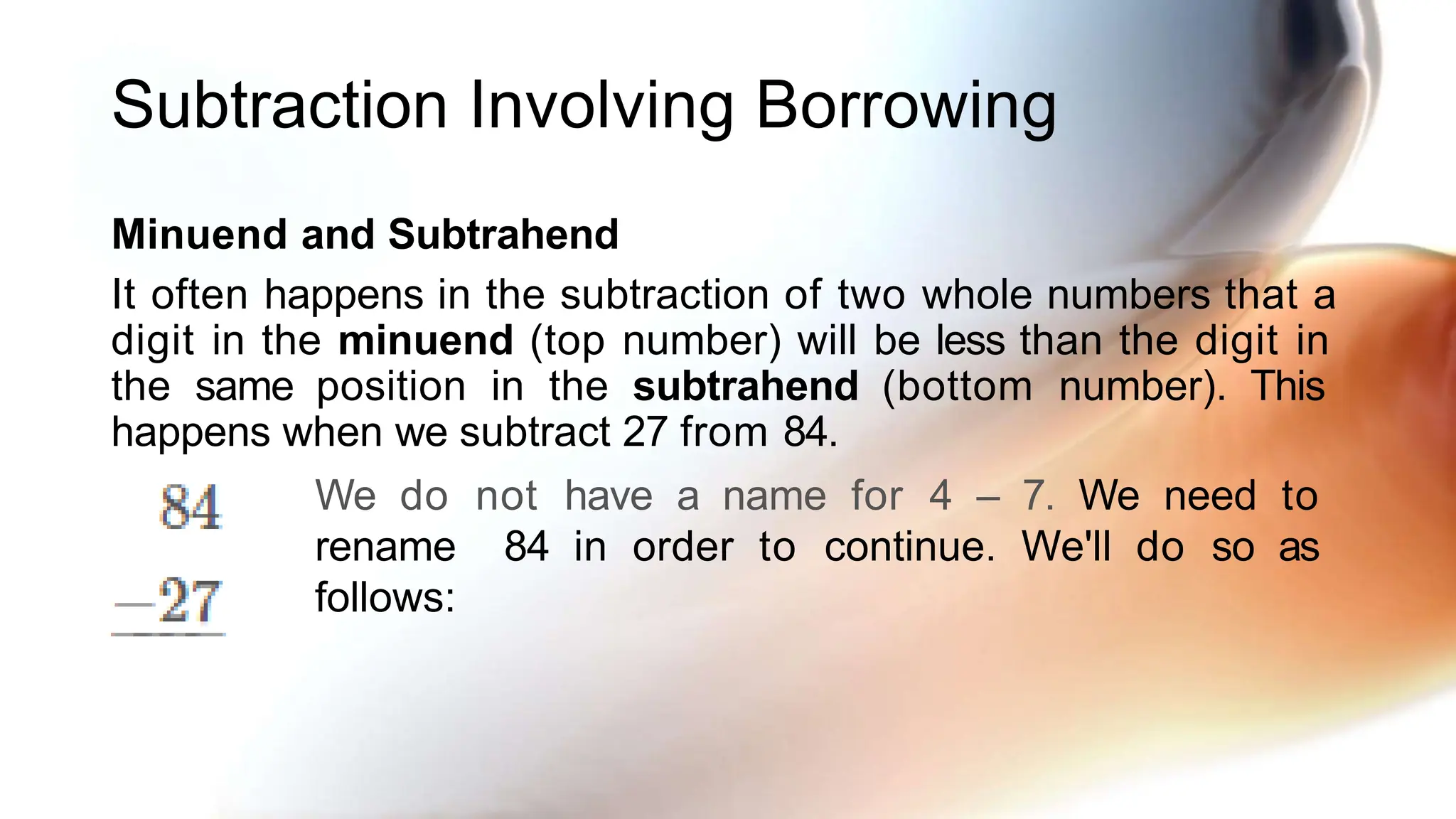
Minuend and Subtrahend
It often happens in the subtraction of two whole numbers that a
digit in the minuend (top number) will be less than the digit in
the same position in the subtrahend (bottom number). This
happens when we subtract 27 from 84.
We do not have a name for 4 – 7. We need to
rename 84 in order to continue. We'll do so as
follows:
Subtraction Involving Borrowing
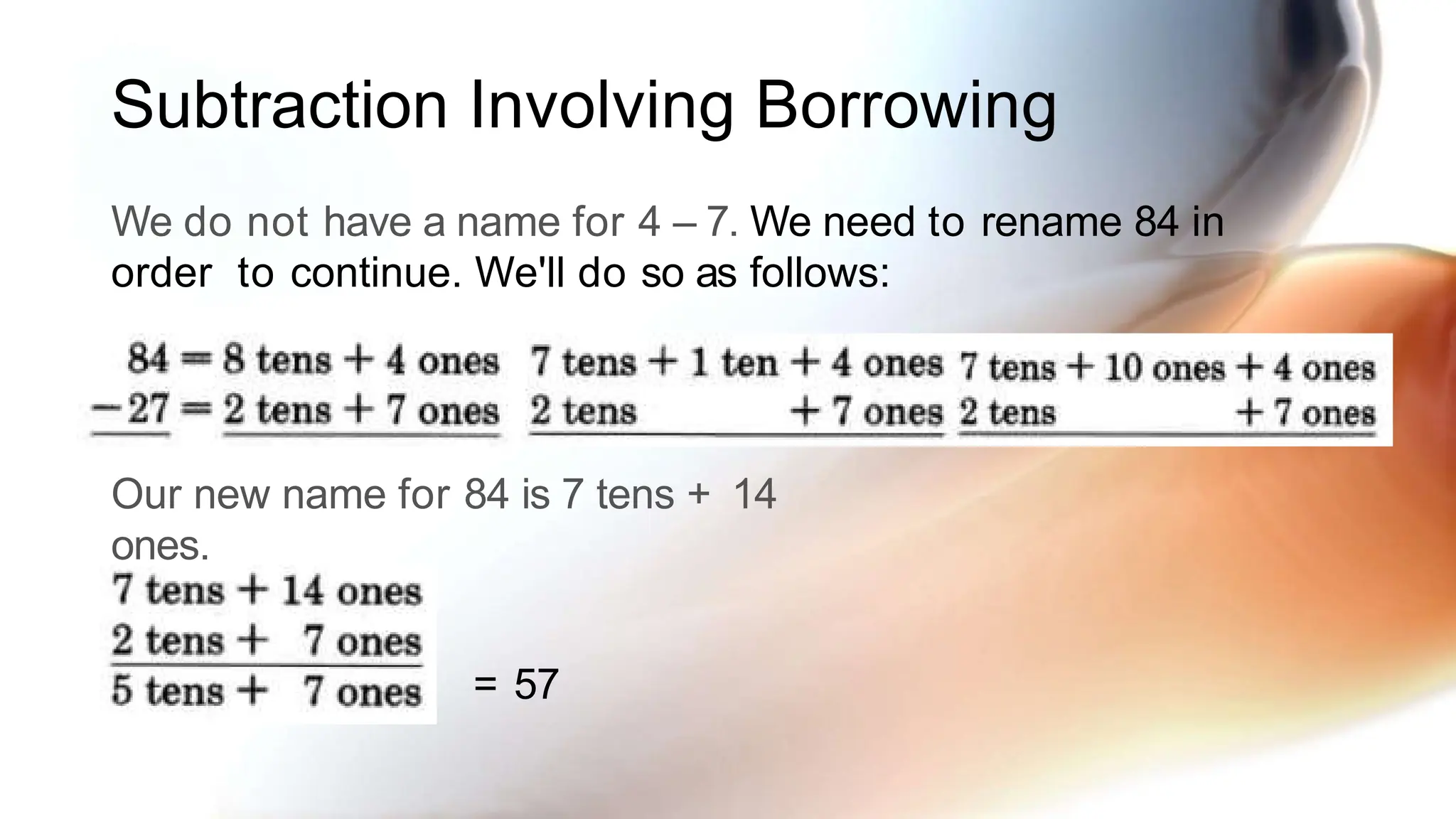
We do not have a name for 4 – 7. We need to rename 84 in
order to continue. We'll do so as follows:
Our new name for 84 is 7 tens + 14
ones.
= 57
Subtraction Involving Borrowing
Borrowin
g
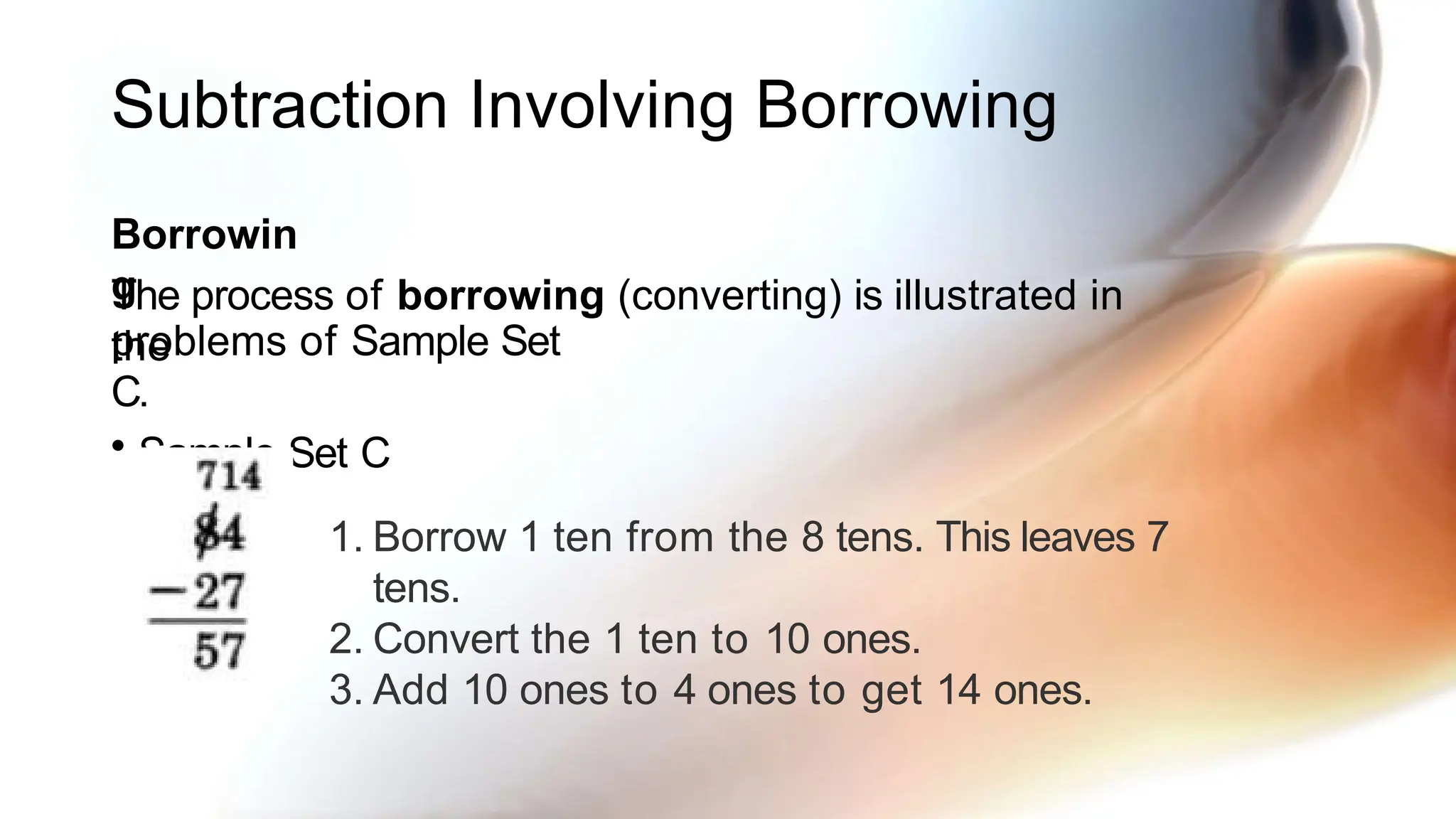
The process of borrowing (converting) is illustrated in
the
problems of Sample Set
C.
• Sample Set C
1. Borrow 1 ten from the 8 tens. This leaves 7
tens.
2. Convert the 1 ten to 10 ones.
3. Add 10 ones to 4 ones to get 14 ones.
Borrowing from
Zero
Borrowing from a Single Zero
To borrow from a single zero,
• Decrease the digit to the immediate left of zero by
one.
• Draw a line through the zero and make it a 10.
• Proceed to subtract as usual.
Borrowing from
Zero
Consider the problem
here are no tens to borrow, we
mu
503
-37
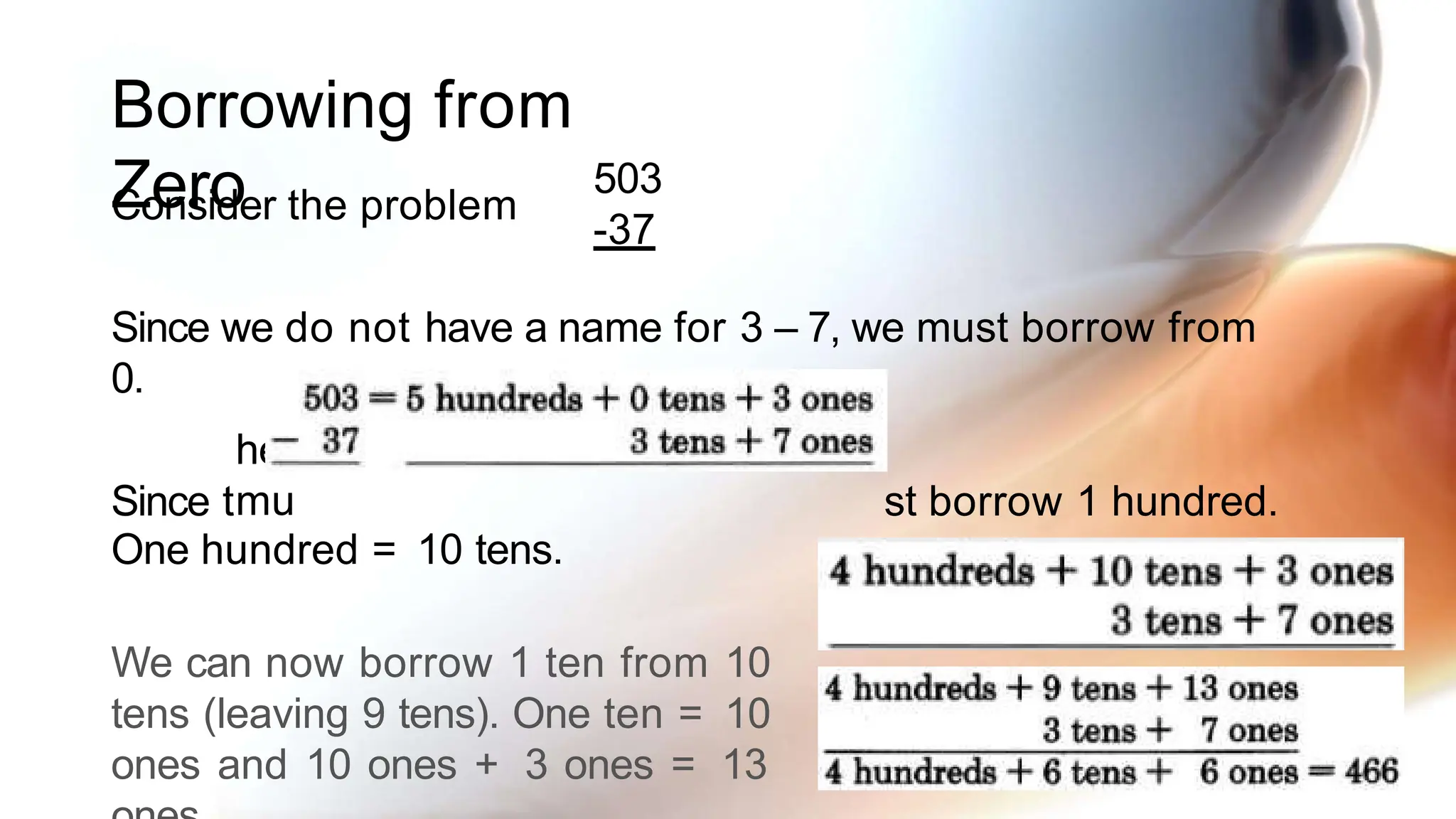
Since we do not have a name for 3 – 7, we must borrow from
0.
Since t st borrow 1 hundred.
One hundred = 10 tens.
We can now borrow 1 ten from 10
tens (leaving 9 tens). One ten = 10
ones and 10 ones + 3 ones = 13
Borrowing from a group of
zeros
To borrow from a group of zeros,
• Decrease the digit to the immediate left of the group of zeros by one.
• Draw a line through each zero in the group and make it a 9, except the
rightmost zero, make it 10.
• Proceed to subtract as usual.
Borrowing from a group of
zeros
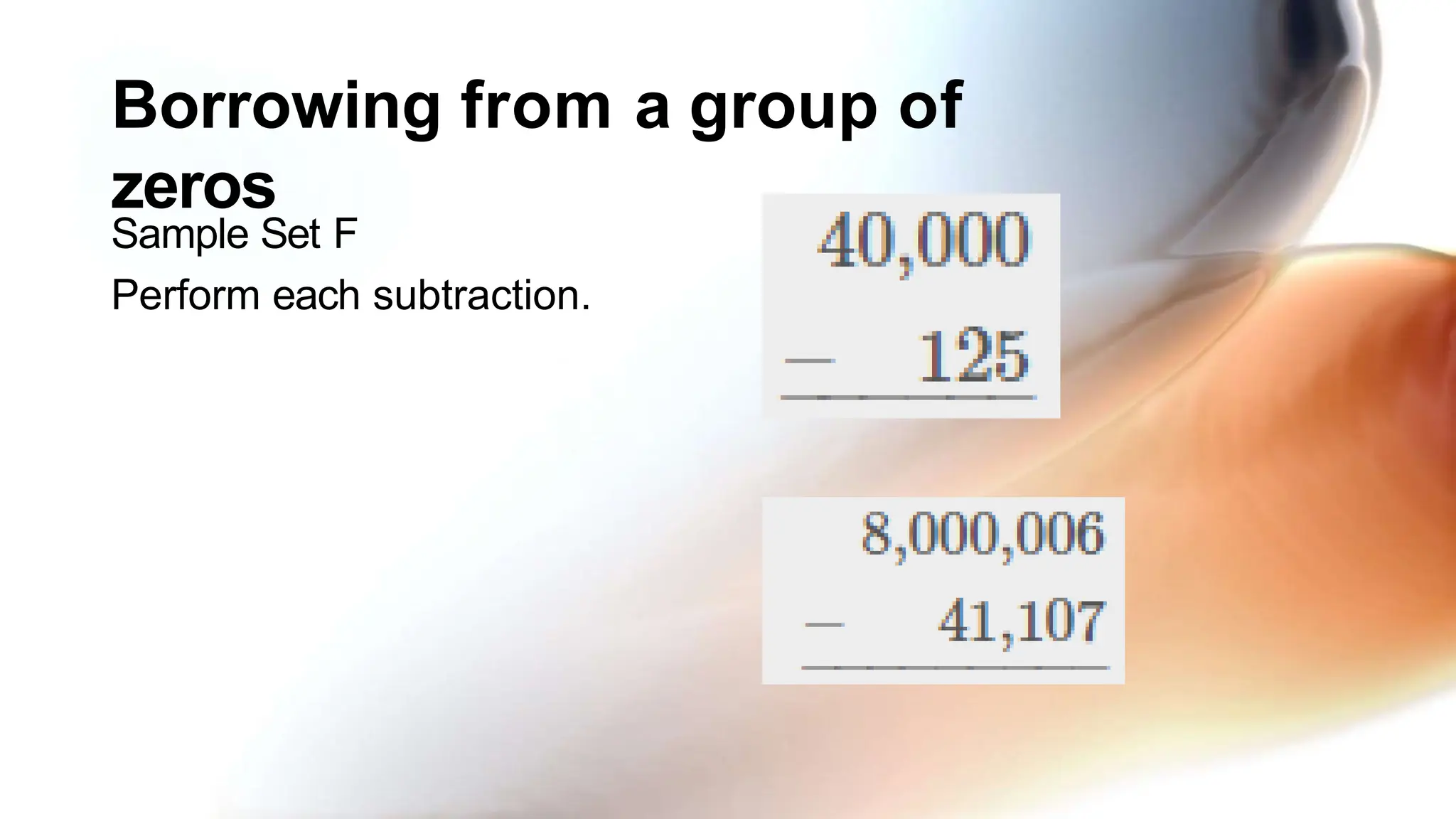
Sample Set F
Perform each subtraction.
Calculators
In practice, calculators are used to find the difference
between two whole numbers.
Practice Set G
1) Use a calculator to find the difference between 7338 and
2809.
2) Use a calculator to find the difference between 31,060,001
and 8,591,774.
Exercise
s
For the following problems, perform each subtraction.
1) Subtract 26,082 from 35,040.
2) How much bigger is 3,080,020 than 1,814,161?
3) The 1980 population of Singapore was 2,414,000 and the
1980 population of Sri Lanka was 14,850,000. How many
more people lived in Sri Lanka than in Singapore in 1980?
4) Add the difference between 815 and 298 to the
difference between 2,204 and 1,016.
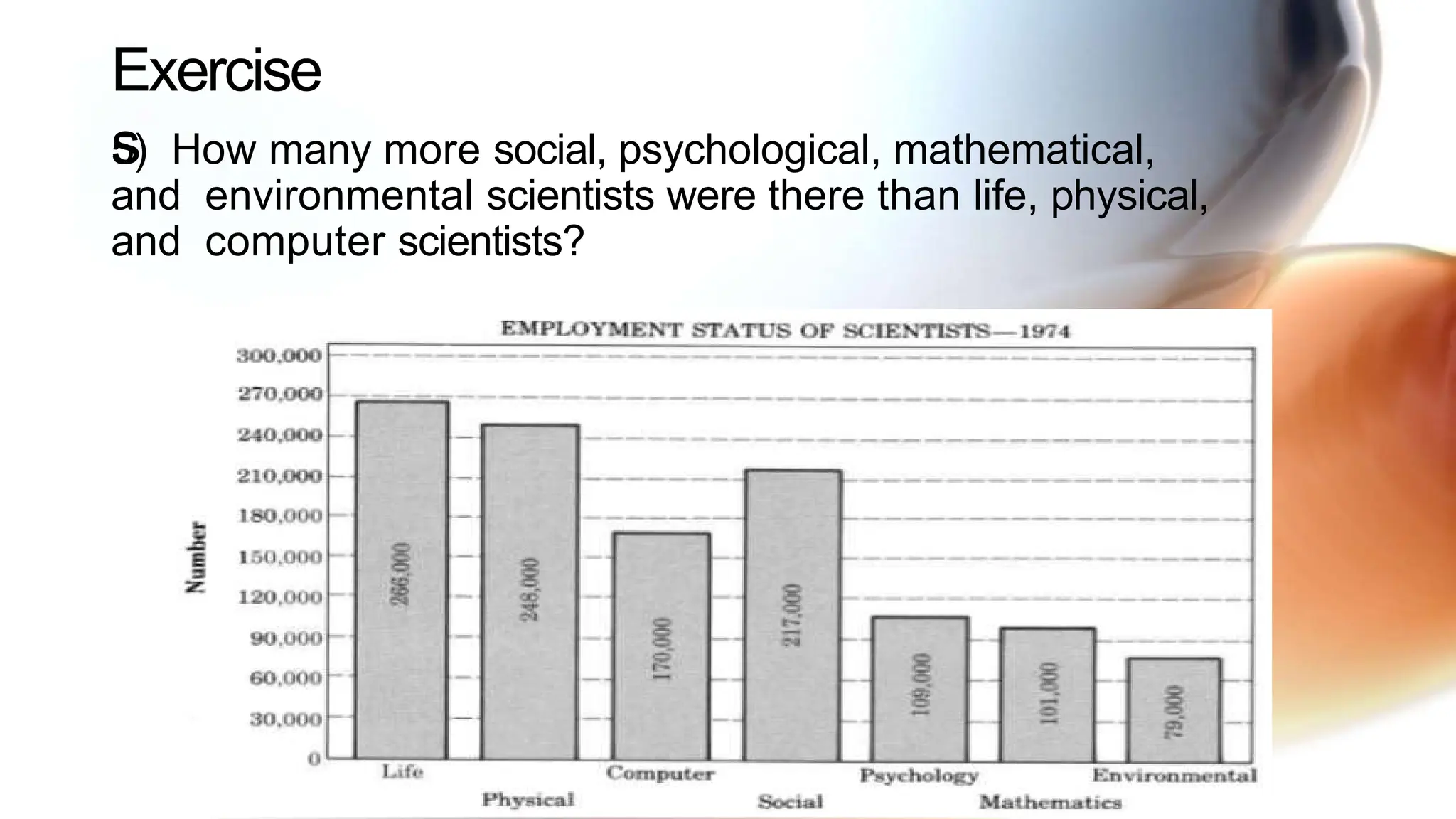
Exercise
s
5) How many more social, psychological, mathematical,
and environmental scientists were there than life, physical,
and computer scientists?
Properties of Addition
• Objectives
• understand the commutative and associative properties
of addition
• understand why 0 is the additive identity
The Commutative Property of Addition
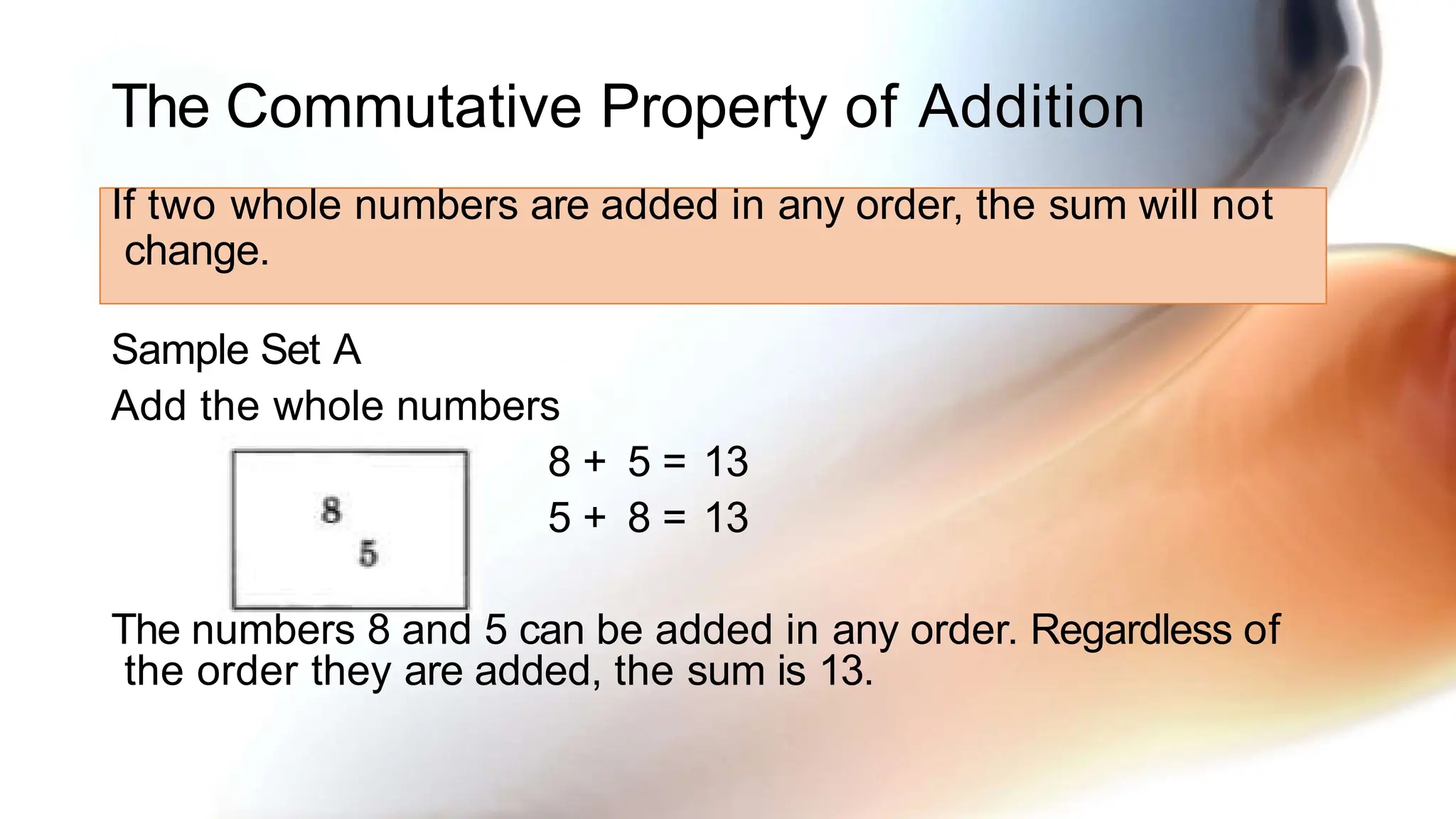
If two whole numbers are added in any order, the sum will not
change.
Sample Set A
Add the whole numbers
8 + 5 = 13
5 + 8 = 13
The numbers 8 and 5 can be added in any order. Regardless of
the order they are added, the sum is 13.
The Commutative Property of Addition
Practice Set A
1) Use the commutative property of addition to find the sum
of 837 and 1,958 in two different ways.
2) Use the commutative property of addition to find the sum
of 265,094 and 32,508 in two different ways.
The Associative Property of Addition
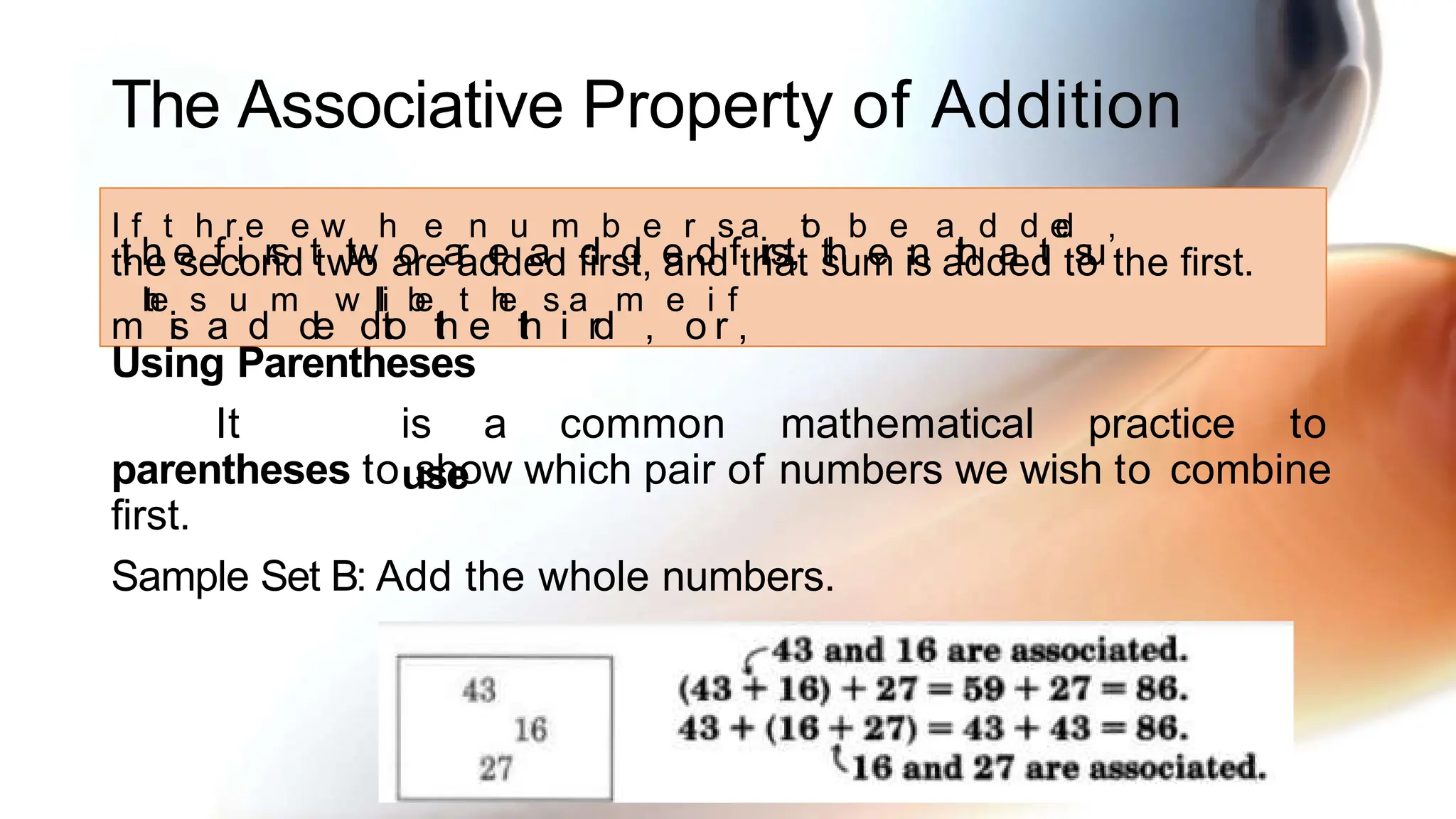
parentheses to show which pair of numbers we wish to combine
first.
Sample Set B: Add the whole numbers.
I
t
f
h
t
e
h
f
r
i
e
rs
e
t
w
tw
h
o
e
a
r
n
e
u
a
m
d
b
d
e
e
r
d
s
f
a
irst,
t
o
th
b
e
e
n
a
t
h
d
a
d
t
e
d
s
u
,
m
t
h
e
is
s
a
u
d
m
de
w
d
i
l
l
to
b
e
th
t
e
h
e
th
s
i
a
rd
m
,
e
o
i
r
f
,
the second two are added first, and that sum is added to the first.
Using Parentheses
It is a common mathematical practice to
use
The Associative Property of Addition
Practice Set
B
Use the associative property of addition to add the following
whole numbers two different ways.
1) 17, 32 and 25.
2) 1,629; 806 and 429.
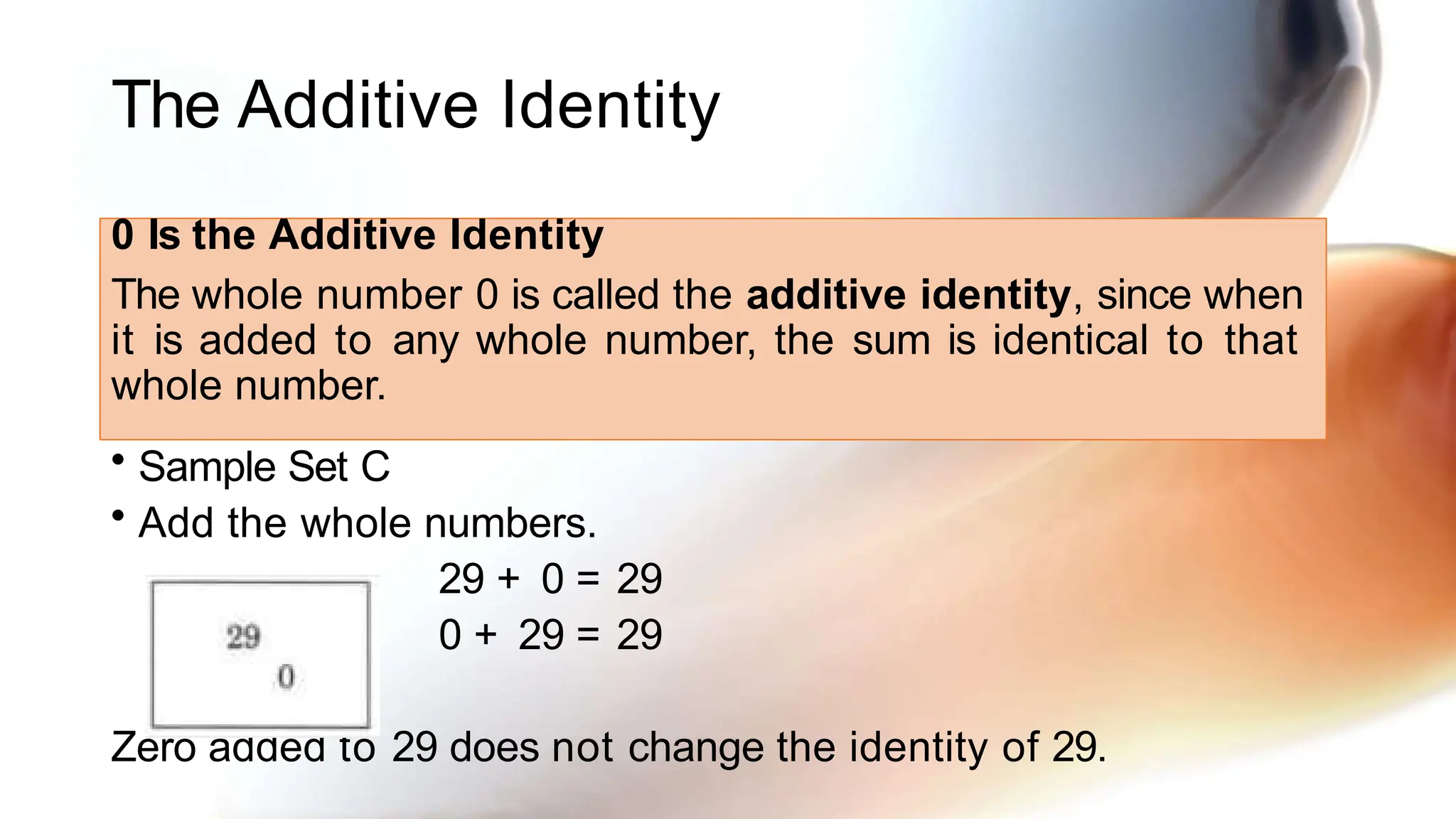
The Additive Identity
0 Is the Additive Identity
The whole number 0 is called the additive identity, since when
it is added to any whole number, the sum is identical to that
whole number.
• Sample Set C
• Add the whole numbers.
29 + 0 = 29
0 + 29 = 29
Zero added to 29 does not change the identity of 29.
Exercise
s
1) The fact that (a first number + a second number) + third
number = a first number + (a second number + a third
number) is an example of the property of addition.
2) The fact that 0 + any number = that particular number is an
example of the property of addition.
3) The fact that a first number + a second number = a second
number + a first number is an example of the property of
addition.
4) Use the numbers 15 and 8 to illustrate the commutative
property of addition.
5) Use the numbers 6, 5, and 11 to illustrate the associative
property of addition.

2 Whole Numbers introduction, addition, subtraction2.pptx

  • 1.
  • 2.
    Addition and Subtractionof Whole Numbers • 1. 3 • 1. 4 • 1. 5 Addition of Whole Numbers Subtraction of Whole Numbers Properties of Addition
  • 3.
    Addition of WholeNumbers • Objectives: • understand the addition process • be able to add whole numbers • be able to use the calculator to add one whole number to another
  • 4.
    Addition of WholeNumbers • Suppose we have two collections of objects that we combine together to form a third collection. For example, is combine with to yield We are combining a collection of four objects with a collection of three objects to obtain a collection of seven objects.
  • 5.
    Addition of WholeNumbers • Addition The process of combining two or more objects (real or intuitive) to form a third, the total, is called addition. In addition, the numbers being added are called addends or terms, and the total is called the sum. The plus symbol (+) is used to indicate addition, and the equal symbol (=) is used to represent the word "equal." For example, 4 + 3 = 7 means "four added to three equals seven."
  • 6.
    Addition Visualized onthe Number Line • Addition is easily visualized on the number line. Let's visualize the addition of 4 and 3 using the number line. • To find 4 + 3 • Start at 0. • Move to the right 4 units. We are now located at 4. • From 4, move to the right 3 units. We are now located at 7 • Thus, 4 + 3 = 7
  • 7.
    The Addition Process We'll studythe process of addition by considering the sum of 25 and 43 We write this as 68.
  • 8.
    The Process ofAdding Whole Numbers T o add whole numbers, The process: 1) Write the numbers vertically, placing corresponding positions in the same column. 2) Add the digits in each column. Start at the right (in the ones position) and move to the left, placing the sum at the bottom.
  • 9.
    Addition Involving Carrying • Itoften happens in addition that the sum of the digits in a column will exceed 9. This happens when we add 18 and 34. We show this in expanded form as follows.
  • 10.
    Addition Involving Carrying • Thissame example is shown in a shorter form as follows: 8 + 4 = 12 Write 2, carry 1 ten to the top of the next column to the left.
  • 11.
    Addition Involving Carrying • SampleSet B • Perform the following additions. Use the process of carrying when needed. 1) Find the sum 2648, 1359, and 861. 2) The number of students enrolled at NCL College in the years 1984, 1985, 1986, and 1987 was 10,406, 9,289, 10,108, and 11,412, respectively. What was the total number of students enrolled at NCL College in the years 1985, 1986, and 1987?
  • 12.
    Calculators Calculators provide avery simple and quick way to find sums of whole numbers. Sample Set C Use a calculator to find each sum. a) 9,261 + 8, 543 + 884 + 1,062 b) 10,221 + 9,016 + 11, 445
  • 13.
    Exercise s For the followingproblems, perform the additions. If you can, check each sum with a calculator. 1) 43,156,219 + 2,013,520 2)
  • 14.
    Exercise s 3) Perform theadditions and round to the nearest hundred . 4) replace the letter m with the whole number that will make the addition true . 5) The enrollment in public and nonpublic schools in the years 1965, 1970, 1975, and 1984 was 54,394,000, 59,899,000, 61,063,000, and 55,122,000, respectively. What was the total en- rollment for those years?
  • 15.
    Exercise s 6) Find thetotal number of scientists employed in 1974.
  • 16.
    Subtraction of WholeNumbers • Objectives • understand the subtraction process • be able to subtract whole numbers • be able to use a calculator to subtract one whole number from another whole number
  • 17.
    Subtraction of WholeNumbers • Subtraction is the process of determining the remainder when part of the total is removed. • Suppose the sum of two whole numbers is 1 1 , and from 1 1we remove 4. Using the number line to help our visualization, we see that if we are located at 1 1 and move 4 units to the left, and thus remove 4 units, we will be located at 7. Thus, 7 units remain when we remove 4 units from 1 1 units.
  • 18.
    Subtraction of WholeNumbers • The Minus Symbol The minus symbol (-) is used to indicate subtraction. For example, 1 1 – 4 indicates that 4 is to be subtracted from 1 1 . • Minuend The number immediately in front of or the minus symbol is called the minuend, and it represents the original number of units. • Subtrahend The number immediately following or below the minus symbol is called the subtrahend, and it represents the number of units to be removed. • Difference The result of the subtraction is called the differenceof the two numbers. For example, in 1 1 - 4 = 7, 1 1 is the minuend, 4 is the subtrahend, and 7 is the differenc e.
  • 19.
    Subtraction as theOpposite of Addition • Subtraction can be thought of as the opposite of addition. We show this in the problems in Sample Set A. • Sample Set A 8 – 5 = 3 since 3 + 5 = 8 9 – 3 = 6 since 6 + 3 = 9 • Practice Set A: Complete the following statements. 7 – 5 = + 5 = 7 17 – 8 = + 8 = 17
  • 20.
    The Subtraction Process We'll studythe process of the subtraction of two whole numbers by considering the difference between 48 and 35. which we write as 13.
  • 21.
    The Process ofSubtracting Whole Numbers T o subtract two whole numbers, The process: 1) Write the numbers vertically, placing corresponding positions in the same column. 2) Subtract the digits in each column. Start at the right, in the ones position, and move to the left, placing the difference at the bottom.
  • 22.
    Subtraction of WholeNumbers Sample Set B Perform the following subtractions. 1 ) Find the difference between 977 and 235. Write the numbers vertically, placing the larger number on top. Line up the columns properly. The difference between 977 and 235 is 742.
  • 23.
    Subtraction of WholeNumbers 2) In Keys County in 1987, there were 809 cable television installations. In Flags County in 1987, there were 1,159 cable television installations. How many more cable television installations were there in Flags County than in Keys County in 1987?
  • 24.
    Subtraction Involving Borrowing Minuendand Subtrahend It often happens in the subtraction of two whole numbers that a digit in the minuend (top number) will be less than the digit in the same position in the subtrahend (bottom number). This happens when we subtract 27 from 84. We do not have a name for 4 – 7. We need to rename 84 in order to continue. We'll do so as follows:
  • 25.
    Subtraction Involving Borrowing Wedo not have a name for 4 – 7. We need to rename 84 in order to continue. We'll do so as follows: Our new name for 84 is 7 tens + 14 ones. = 57
  • 26.
    Subtraction Involving Borrowing Borrowin g Theprocess of borrowing (converting) is illustrated in the problems of Sample Set C. • Sample Set C 1. Borrow 1 ten from the 8 tens. This leaves 7 tens. 2. Convert the 1 ten to 10 ones. 3. Add 10 ones to 4 ones to get 14 ones.
  • 27.
    Borrowing from Zero Borrowing froma Single Zero To borrow from a single zero, • Decrease the digit to the immediate left of zero by one. • Draw a line through the zero and make it a 10. • Proceed to subtract as usual.
  • 28.
    Borrowing from Zero Consider theproblem here are no tens to borrow, we mu 503 -37 Since we do not have a name for 3 – 7, we must borrow from 0. Since t st borrow 1 hundred. One hundred = 10 tens. We can now borrow 1 ten from 10 tens (leaving 9 tens). One ten = 10 ones and 10 ones + 3 ones = 13
  • 29.
    Borrowing from agroup of zeros To borrow from a group of zeros, • Decrease the digit to the immediate left of the group of zeros by one. • Draw a line through each zero in the group and make it a 9, except the rightmost zero, make it 10. • Proceed to subtract as usual.
  • 30.
    Borrowing from agroup of zeros Sample Set F Perform each subtraction.
  • 31.
    Calculators In practice, calculatorsare used to find the difference between two whole numbers. Practice Set G 1) Use a calculator to find the difference between 7338 and 2809. 2) Use a calculator to find the difference between 31,060,001 and 8,591,774.
  • 32.
    Exercise s For the followingproblems, perform each subtraction. 1) Subtract 26,082 from 35,040. 2) How much bigger is 3,080,020 than 1,814,161? 3) The 1980 population of Singapore was 2,414,000 and the 1980 population of Sri Lanka was 14,850,000. How many more people lived in Sri Lanka than in Singapore in 1980? 4) Add the difference between 815 and 298 to the difference between 2,204 and 1,016.
  • 33.
    Exercise s 5) How manymore social, psychological, mathematical, and environmental scientists were there than life, physical, and computer scientists?
  • 34.
    Properties of Addition •Objectives • understand the commutative and associative properties of addition • understand why 0 is the additive identity
  • 35.
    The Commutative Propertyof Addition If two whole numbers are added in any order, the sum will not change. Sample Set A Add the whole numbers 8 + 5 = 13 5 + 8 = 13 The numbers 8 and 5 can be added in any order. Regardless of the order they are added, the sum is 13.
  • 36.
    The Commutative Propertyof Addition Practice Set A 1) Use the commutative property of addition to find the sum of 837 and 1,958 in two different ways. 2) Use the commutative property of addition to find the sum of 265,094 and 32,508 in two different ways.
  • 37.
    The Associative Propertyof Addition parentheses to show which pair of numbers we wish to combine first. Sample Set B: Add the whole numbers. I t f h t e h f r i e rs e t w tw h o e a r n e u a m d b d e e r d s f a irst, t o th b e e n a t h d a d t e d s u , m t h e is s a u d m de w d i l l to b e th t e h e th s i a rd m , e o i r f , the second two are added first, and that sum is added to the first. Using Parentheses It is a common mathematical practice to use
  • 38.
    The Associative Propertyof Addition Practice Set B Use the associative property of addition to add the following whole numbers two different ways. 1) 17, 32 and 25. 2) 1,629; 806 and 429.
  • 39.
    The Additive Identity 0Is the Additive Identity The whole number 0 is called the additive identity, since when it is added to any whole number, the sum is identical to that whole number. • Sample Set C • Add the whole numbers. 29 + 0 = 29 0 + 29 = 29 Zero added to 29 does not change the identity of 29.
  • 40.
    Exercise s 1) The factthat (a first number + a second number) + third number = a first number + (a second number + a third number) is an example of the property of addition. 2) The fact that 0 + any number = that particular number is an example of the property of addition. 3) The fact that a first number + a second number = a second number + a first number is an example of the property of addition. 4) Use the numbers 15 and 8 to illustrate the commutative property of addition. 5) Use the numbers 6, 5, and 11 to illustrate the associative property of addition.