VA Support for Homeless Services John Kuhn, LCSW, MPH National Director, Homeless Evaluation and Supportive Services for Veteran Families (SSVF) http://www.va.gov/HOMELESS
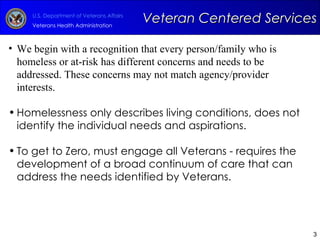
Federal Strategic Plan VA Five-Year Plan Built upon 6 strategic pillars:  Outreach/Education Treatment  Prevention Housing/Supportive Services Income/ Employment/ Benefits  Community Partnerships Ending  Veteran Homelessness
We begin with a recognition that every person/family who is homeless or at-risk has different concerns and needs to be addressed. These concerns may not match agency/provider interests. Homelessness only describes living conditions, does not identify the individual needs and aspirations. To get to Zero, must engage all Veterans - requires the development of a broad continuum of care that can address the needs identified by Veterans. Veteran Centered Services
A Continuum of Care VA’s Alphabet Soup Outreach (CRRC, HCHV) National Call Center (NCCHV) Prevention (HCRV, VJO, SSVF, VHPD) Transitional Housing (GPD, CWT/TR, HCHV Contract Housing) Residential Rehab (RRTP) Voc Rehab (CWT) Permanent Housing (HUD-VASH) Services must address needs identified by those we serve. Program info:  www.va.gov/homeless
Many homeless people are unable to work due to a disability. Veterans are more likely to be older and disabled than the general homeless population.  Both VBA (service connected and pension payments) and mainstream resources (Social Security, TANF, SNAPs) can offer critical assistance. Veterans Benefits Administration (VBA) provides services for homeless Veterans at all 56 regional offices. The number of homeless Veterans claims’ received during FY 2009  (6,285) increased by 9.06% from FY 2008 (5,715).  Assistance is also provided to Veteran homeowners who may be in foreclosure. Benefits
Non-profit organizations may be eligible to purchase Department of Veterans’ Affairs (VA) acquired properties at a discount.  VA markets these properties at fair market. Non-profits may purchase these properties at discounts after the properties have been listed for sale. Percentage of discount vary based on length of property listing.  Listings – Bank of America's at  http://va.reotrans.com   Email:   [email_address] Telephone : (972)918-8024 VA   POC: Valerie McDougle  Telephone: (571)272-0039 Email:  [email_address] Foreclosed VBA Properties
Identify vacant or underutilized buildings within the VA inventory with 10,000 square feet or more of space to use for housing or other potential reuses  Prevent homelessness: provide housing for Veterans and their families at risk for homelessness Reduce current homelessness: provide permanent housing and/or transitional housing depending upon local need. Current sites for potential development found at: http://www.va.gov/ASSETMANAGEMENT/MissionHomeless/ index.asp   DRAFT Building Utilization Review and Reuse (BURR)
Grant  and Per Diem Program (GPD) Capital Grants  May pay up to 65% of construction, renovation, or acquisition costs (requires a 35% match). Eligible activities are: Acquisition, Rehabilitation or New Construction of Transitional Housing (up to 24 months stay) Acquisition, Rehabilitation or New Construction Procurement of a vans to provide transportation & outreach for the purposes of providing supportive services. Expansion of existing transitional housing or service centers. Capital grant may be awards for construction, expansion or renovation of buildings on VA-owned property.
Grant  and Per Diem Program (GPD ) Per Diem Transitional housing (up to 2 years) with supportive services designed to help homeless Veterans address rehabilitative needs, increase their skill levels and/or income, preparing them for community housing.  Veterans are eligible for GPD housing if they are homeless or at-risk of homelessness and need rehabilitative services to find and maintain themselves in independent housing. Per diem payments currently up to $38.90 day and based on current state home rate Veterans may pay fee up to 30% of their monthly adjusted income. http://www.va.gov/HOMELESS/GPD.asp
HUD-VASH Largest permanent, supportive housing initiative for homeless Veterans. Veterans who meet VA health care eligibility  requirements and who meet HUD’s definition of homeless”,  with their families , are eligible to apply for housing choice voucher assistance Provides housing (HUD) with case management (VA) and supportive services (VA) 30,000 Housing Choice vouchers offered through 301 participating PHAs Almost 1,000 case managers provide case management and supportive services designed to promote housing stability and recovery.
On September 28, 2010, HUD announced the availability of a set-aside of approximately 500 project--based vouchers (PBV) through HUD-Veterans Affairs Supportive Housing (VASH) through a notice of competitive funding.  Only those PHAs that currently administer VASH vouchers are eligible to respond to this Notice of Competitive Funding. Application deadline February 28, 2011. www.hud.gov/offices/pih/programs/hcv/vash DRAFT HUD-VASH
INCOME/EMPLOYMENT This strategy includes a multi-pronged effort aimed at improving financial opportunities for Veterans, including, at minimum, vocational training and enhanced access to benefits.  VA’s Work programs provide paid work experience and vocational assistance services to approximately 50,000 Veterans each year, including 6,000 OEF/OIF Veterans. These services are integrated into the Veteran’s overall mental health treatment plan. Veterans in VA’s work programs earned in excess of $50 million during their participation.
Homeless Veterans’ Reintegration Program (HVRP) and Veterans’ Workforce Investment Program (VWIP) HVRP targets homeless veterans VWIP targets the following veterans groups: Those with service-connected disabilities Those who have significant barriers to employment Those who served during a campaign Those who are recently separated from active duty (within 48 months) DOL/VETS VWIP :  http://www.dol.gov/vets/programs/vwip/main.htm DOL/VETS HVRP :  http://www.dol.gov/vets/grants/main.htm   DOL/VETS Programs
Challenge is to effective target these services to engage those most at-risk. 1 in 10 impoverished Veterans become homeless at some point during the year (HUD, 2009). 1.3 million Veteran households have very low income, less than 50% of the area median income (GAO, 2007). Homeless Veterans may be more isolated from family and other social supports compared to the general homeless population. Veterans over the age of 51 over-represented among the homeless. Need for Targeted Prevention and Diversion Services
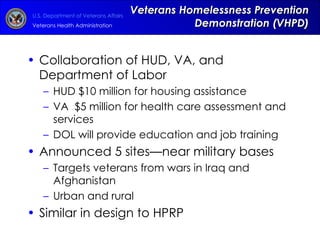
Veterans Homelessness Prevention Demonstration (VHPD) Collaboration of HUD, VA, and Department of Labor HUD $10 million for housing assistance VA  $5 million for health care assessment and services DOL will provide education and job training Announced 5 sites—near military bases Targets veterans from wars in Iraq and Afghanistan  Urban and rural Similar in design to HPRP
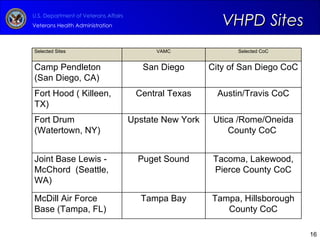
VHPD Sites Selected Sites VAMC Selected CoC Camp Pendleton (San Diego, CA) San Diego City of San Diego CoC Fort Hood ( Killeen, TX) Central Texas Austin/Travis CoC Fort Drum  (Watertown, NY) Upstate New York Utica  /Rome/Oneida County CoC   Joint Base Lewis - McChord  (Seattle, WA) Puget Sound Tacoma, Lakewood, Pierce County CoC McDill Air Force Base (Tampa, FL) Tampa Bay Tampa, Hillsborough County CoC
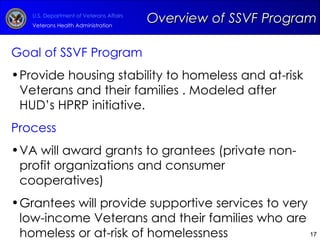
Overview of SSVF Program Goal of SSVF Program  Provide housing stability to homeless and at-risk Veterans and their families . Modeled after HUD’s HPRP initiative. Process  VA will award grants to grantees (private non-profit organizations and consumer cooperatives)  Grantees will provide supportive services to very low-income Veterans and their families who are homeless or at-risk of homelessness
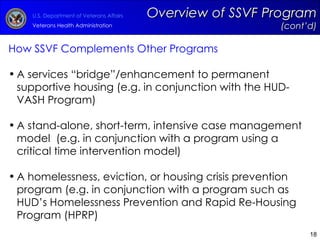
How SSVF Complements Other Programs A services “bridge”/enhancement to permanent supportive housing (e.g. in conjunction with the HUD-VASH Program) A stand-alone, short-term, intensive case management model  (e.g. in conjunction with a program using a critical time intervention model) A homelessness, eviction, or housing crisis prevention program (e.g. in conjunction with a program such as HUD’s Homelessness Prevention and Rapid Re-Housing Program (HPRP) Overview of SSVF Program  (cont’d)
How SSVF Differs from Other VA Programs Grantees will be community-based organizations Grantees will serve Veterans  and their families Homelessness prevention and rapid re-housing focus Temporary financial assistance payments may be provided to third parties on behalf of participants Overview of SSVF Program  (cont’d)
Goals and Objectives for Awards under NOFA (NOFA Section J) Enhance the housing stability and independent living skills of very low-income Veteran families occupying permanent housing across geographic regions Rapidly re-house or prevent homelessness among the following target populations who also meet all requirements for being part of a very low-income Veteran family occupying permanent housing: Veteran families earning less than 30% of area median income (AMI) as most recently published by HUD ( http://www.huduser.org )  Veterans with at least one dependent family member  Chronically homeless Veteran families  Formerly chronically homeless Veteran families VA’s Goals & Objectives
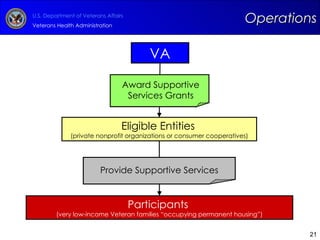
VA Eligible Entities   (private nonprofit organizations or consumer cooperatives) Participants  (very low-income Veteran families “occupying permanent housing”) Provide Supportive Services Award Supportive Services Grants Operations
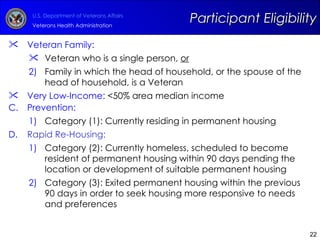
Veteran Family:   Veteran who is a single person,  or Family in which the head of household, or the spouse of the head of household, is a Veteran  Very Low-Income:  <50% area median income  Prevention: Category (1): Currently residing in permanent housing Rapid Re-Housing: Category (2): Currently homeless, scheduled to become resident of permanent housing within 90 days pending the location or development of suitable permanent housing Category (3): Exited permanent housing within the previous 90 days in order to seek housing more responsive to needs and preferences Participant Eligibility
Required Supportive Services: Outreach services Case management services Assist participants to obtain VA benefits  Assist participants to obtain and coordinate the provision of other public benefits provided by Federal, State, or local agencies, or any eligible entity in the area or community served by the grantee (provided directly or through referral to partner agencies)  Supportive Services Housing counseling services Health care services Personal financial planning services Transportation services  Income support services  Fiduciary and representative payee services Legal services Child care Daily living services
Optional Supportive Services: Temporary financial assistance payments  Payments must help participants remain in or obtain permanent housing and can be for the following purposes Payments are subject to the restrictions including the development of sustainability plan and payments can only be made to third parties Supportive Services  (cont’d) Rent, penalties, or fees Utility fees  Security or utility deposits Moving costs Purchase of emergency supplies Transportation Child care
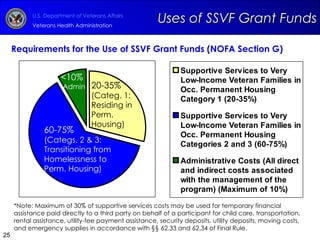
Requirements for the Use of SSVF Grant Funds (NOFA Section G) Uses of SSVF Grant Funds *Note: Maximum of 30% of supportive services costs may be used for temporary financial assistance paid directly to a third party on behalf of a participant for child care, transportation, rental assistance, utility-fee  payment assistance, security deposits, utility deposits, moving costs, and emergency supplies in accordance with §§ 62.33 and 62.34 of Final Rule.  60-75% <10% Admin 20-35% (Categ. 1: Residing in Perm. Housing) 60-75% (Categs. 2 & 3:  Transitioning from Homelessness to  Perm. Housing) <10%  Admin
Application Application package is posted on the SSVF website ( http://www.va.gov/homeless/SSVF.asp ) – includes PDF file and  Excel file (Attachment B)  Corporation for Supportive Housing is providing technical assistance For Technical Assistance Questions regarding the application may be directed to the Corporation for Supportive Housing (CSH) at 1-312-332-6690 ext. 17 (this is not a toll free number) / Email:  [email_address]   Application Deadline Five copies of application (prepared in accordance with NOFA requirements) are due by 4:00 p.m. Eastern on  Friday, March 11, 2011 May submit one application per state Application Process & Scoring
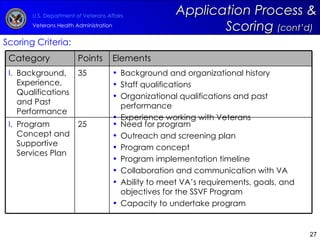
Scoring Criteria: Application Process & Scoring  (cont’d)   Category Points Elements Background, Experience, Qualifications and Past Performance 35 Background and organizational history Staff qualifications Organizational qualifications and past performance Experience working with Veterans  Program Concept and Supportive Services Plan  25 Need for program Outreach and screening plan Program concept Program implementation timeline Collaboration and communication with VA Ability to meet VA’s requirements, goals, and objectives for the SSVF Program Capacity to undertake program
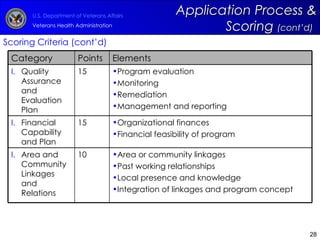
Scoring Criteria (cont’d) Application Process & Scoring  (cont’d)   Category Points Elements Quality Assurance and Evaluation Plan  15 Program evaluation Monitoring Remediation Management and reporting  Financial Capability and Plan  15 Organizational finances Financial feasibility of program Area and Community Linkages and Relations  10 Area or community linkages Past working relationships  Local presence and knowledge Integration of linkages and program concept
For More Information For more information about the SSVF Program, please visit: http://www.va.gov/homeless/SSVF.asp   Email:  [email_address]  or  Call (toll-free) 1-877-737–0111
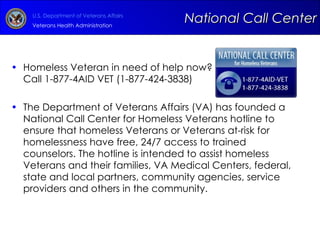
Homeless Veteran in need of help now?  Call 1-877-4AID VET (1-877-424-3838) The Department of Veterans Affairs (VA) has founded a National Call Center for Homeless Veterans hotline to ensure that homeless Veterans or Veterans at-risk for homelessness have free, 24/7 access to trained counselors. The hotline is intended to assist homeless Veterans and their families, VA Medical Centers, federal, state and local partners, community agencies, service providers and others in the community.   National Call Center

3.4 Ending Homelessness for Veterans and their Families

  • 1.
    VA Support forHomeless Services John Kuhn, LCSW, MPH National Director, Homeless Evaluation and Supportive Services for Veteran Families (SSVF) http://www.va.gov/HOMELESS
  • 2.
    Federal Strategic PlanVA Five-Year Plan Built upon 6 strategic pillars: Outreach/Education Treatment Prevention Housing/Supportive Services Income/ Employment/ Benefits Community Partnerships Ending Veteran Homelessness
  • 3.
    We begin witha recognition that every person/family who is homeless or at-risk has different concerns and needs to be addressed. These concerns may not match agency/provider interests. Homelessness only describes living conditions, does not identify the individual needs and aspirations. To get to Zero, must engage all Veterans - requires the development of a broad continuum of care that can address the needs identified by Veterans. Veteran Centered Services
  • 4.
    A Continuum ofCare VA’s Alphabet Soup Outreach (CRRC, HCHV) National Call Center (NCCHV) Prevention (HCRV, VJO, SSVF, VHPD) Transitional Housing (GPD, CWT/TR, HCHV Contract Housing) Residential Rehab (RRTP) Voc Rehab (CWT) Permanent Housing (HUD-VASH) Services must address needs identified by those we serve. Program info: www.va.gov/homeless
  • 5.
    Many homeless peopleare unable to work due to a disability. Veterans are more likely to be older and disabled than the general homeless population. Both VBA (service connected and pension payments) and mainstream resources (Social Security, TANF, SNAPs) can offer critical assistance. Veterans Benefits Administration (VBA) provides services for homeless Veterans at all 56 regional offices. The number of homeless Veterans claims’ received during FY 2009 (6,285) increased by 9.06% from FY 2008 (5,715). Assistance is also provided to Veteran homeowners who may be in foreclosure. Benefits
  • 6.
    Non-profit organizations maybe eligible to purchase Department of Veterans’ Affairs (VA) acquired properties at a discount. VA markets these properties at fair market. Non-profits may purchase these properties at discounts after the properties have been listed for sale. Percentage of discount vary based on length of property listing. Listings – Bank of America's at http://va.reotrans.com Email: [email_address] Telephone : (972)918-8024 VA POC: Valerie McDougle Telephone: (571)272-0039 Email: [email_address] Foreclosed VBA Properties
  • 7.
    Identify vacant orunderutilized buildings within the VA inventory with 10,000 square feet or more of space to use for housing or other potential reuses Prevent homelessness: provide housing for Veterans and their families at risk for homelessness Reduce current homelessness: provide permanent housing and/or transitional housing depending upon local need. Current sites for potential development found at: http://www.va.gov/ASSETMANAGEMENT/MissionHomeless/ index.asp DRAFT Building Utilization Review and Reuse (BURR)
  • 8.
    Grant andPer Diem Program (GPD) Capital Grants May pay up to 65% of construction, renovation, or acquisition costs (requires a 35% match). Eligible activities are: Acquisition, Rehabilitation or New Construction of Transitional Housing (up to 24 months stay) Acquisition, Rehabilitation or New Construction Procurement of a vans to provide transportation & outreach for the purposes of providing supportive services. Expansion of existing transitional housing or service centers. Capital grant may be awards for construction, expansion or renovation of buildings on VA-owned property.
  • 9.
    Grant andPer Diem Program (GPD ) Per Diem Transitional housing (up to 2 years) with supportive services designed to help homeless Veterans address rehabilitative needs, increase their skill levels and/or income, preparing them for community housing. Veterans are eligible for GPD housing if they are homeless or at-risk of homelessness and need rehabilitative services to find and maintain themselves in independent housing. Per diem payments currently up to $38.90 day and based on current state home rate Veterans may pay fee up to 30% of their monthly adjusted income. http://www.va.gov/HOMELESS/GPD.asp
  • 10.
    HUD-VASH Largest permanent,supportive housing initiative for homeless Veterans. Veterans who meet VA health care eligibility requirements and who meet HUD’s definition of homeless”, with their families , are eligible to apply for housing choice voucher assistance Provides housing (HUD) with case management (VA) and supportive services (VA) 30,000 Housing Choice vouchers offered through 301 participating PHAs Almost 1,000 case managers provide case management and supportive services designed to promote housing stability and recovery.
  • 11.
    On September 28,2010, HUD announced the availability of a set-aside of approximately 500 project--based vouchers (PBV) through HUD-Veterans Affairs Supportive Housing (VASH) through a notice of competitive funding. Only those PHAs that currently administer VASH vouchers are eligible to respond to this Notice of Competitive Funding. Application deadline February 28, 2011. www.hud.gov/offices/pih/programs/hcv/vash DRAFT HUD-VASH
  • 12.
    INCOME/EMPLOYMENT This strategyincludes a multi-pronged effort aimed at improving financial opportunities for Veterans, including, at minimum, vocational training and enhanced access to benefits. VA’s Work programs provide paid work experience and vocational assistance services to approximately 50,000 Veterans each year, including 6,000 OEF/OIF Veterans. These services are integrated into the Veteran’s overall mental health treatment plan. Veterans in VA’s work programs earned in excess of $50 million during their participation.
  • 13.
    Homeless Veterans’ ReintegrationProgram (HVRP) and Veterans’ Workforce Investment Program (VWIP) HVRP targets homeless veterans VWIP targets the following veterans groups: Those with service-connected disabilities Those who have significant barriers to employment Those who served during a campaign Those who are recently separated from active duty (within 48 months) DOL/VETS VWIP : http://www.dol.gov/vets/programs/vwip/main.htm DOL/VETS HVRP : http://www.dol.gov/vets/grants/main.htm DOL/VETS Programs
  • 14.
    Challenge is toeffective target these services to engage those most at-risk. 1 in 10 impoverished Veterans become homeless at some point during the year (HUD, 2009). 1.3 million Veteran households have very low income, less than 50% of the area median income (GAO, 2007). Homeless Veterans may be more isolated from family and other social supports compared to the general homeless population. Veterans over the age of 51 over-represented among the homeless. Need for Targeted Prevention and Diversion Services
  • 15.
    Veterans Homelessness PreventionDemonstration (VHPD) Collaboration of HUD, VA, and Department of Labor HUD $10 million for housing assistance VA $5 million for health care assessment and services DOL will provide education and job training Announced 5 sites—near military bases Targets veterans from wars in Iraq and Afghanistan Urban and rural Similar in design to HPRP
  • 16.
    VHPD Sites SelectedSites VAMC Selected CoC Camp Pendleton (San Diego, CA) San Diego City of San Diego CoC Fort Hood ( Killeen, TX) Central Texas Austin/Travis CoC Fort Drum  (Watertown, NY) Upstate New York Utica /Rome/Oneida County CoC Joint Base Lewis - McChord  (Seattle, WA) Puget Sound Tacoma, Lakewood, Pierce County CoC McDill Air Force Base (Tampa, FL) Tampa Bay Tampa, Hillsborough County CoC
  • 17.
    Overview of SSVFProgram Goal of SSVF Program Provide housing stability to homeless and at-risk Veterans and their families . Modeled after HUD’s HPRP initiative. Process VA will award grants to grantees (private non-profit organizations and consumer cooperatives) Grantees will provide supportive services to very low-income Veterans and their families who are homeless or at-risk of homelessness
  • 18.
    How SSVF ComplementsOther Programs A services “bridge”/enhancement to permanent supportive housing (e.g. in conjunction with the HUD-VASH Program) A stand-alone, short-term, intensive case management model (e.g. in conjunction with a program using a critical time intervention model) A homelessness, eviction, or housing crisis prevention program (e.g. in conjunction with a program such as HUD’s Homelessness Prevention and Rapid Re-Housing Program (HPRP) Overview of SSVF Program (cont’d)
  • 19.
    How SSVF Differsfrom Other VA Programs Grantees will be community-based organizations Grantees will serve Veterans and their families Homelessness prevention and rapid re-housing focus Temporary financial assistance payments may be provided to third parties on behalf of participants Overview of SSVF Program (cont’d)
  • 20.
    Goals and Objectivesfor Awards under NOFA (NOFA Section J) Enhance the housing stability and independent living skills of very low-income Veteran families occupying permanent housing across geographic regions Rapidly re-house or prevent homelessness among the following target populations who also meet all requirements for being part of a very low-income Veteran family occupying permanent housing: Veteran families earning less than 30% of area median income (AMI) as most recently published by HUD ( http://www.huduser.org ) Veterans with at least one dependent family member Chronically homeless Veteran families Formerly chronically homeless Veteran families VA’s Goals & Objectives
  • 21.
    VA Eligible Entities (private nonprofit organizations or consumer cooperatives) Participants (very low-income Veteran families “occupying permanent housing”) Provide Supportive Services Award Supportive Services Grants Operations
  • 22.
    Veteran Family: Veteran who is a single person, or Family in which the head of household, or the spouse of the head of household, is a Veteran Very Low-Income: <50% area median income Prevention: Category (1): Currently residing in permanent housing Rapid Re-Housing: Category (2): Currently homeless, scheduled to become resident of permanent housing within 90 days pending the location or development of suitable permanent housing Category (3): Exited permanent housing within the previous 90 days in order to seek housing more responsive to needs and preferences Participant Eligibility
  • 23.
    Required Supportive Services:Outreach services Case management services Assist participants to obtain VA benefits Assist participants to obtain and coordinate the provision of other public benefits provided by Federal, State, or local agencies, or any eligible entity in the area or community served by the grantee (provided directly or through referral to partner agencies) Supportive Services Housing counseling services Health care services Personal financial planning services Transportation services Income support services Fiduciary and representative payee services Legal services Child care Daily living services
  • 24.
    Optional Supportive Services:Temporary financial assistance payments Payments must help participants remain in or obtain permanent housing and can be for the following purposes Payments are subject to the restrictions including the development of sustainability plan and payments can only be made to third parties Supportive Services (cont’d) Rent, penalties, or fees Utility fees Security or utility deposits Moving costs Purchase of emergency supplies Transportation Child care
  • 25.
    Requirements for theUse of SSVF Grant Funds (NOFA Section G) Uses of SSVF Grant Funds *Note: Maximum of 30% of supportive services costs may be used for temporary financial assistance paid directly to a third party on behalf of a participant for child care, transportation, rental assistance, utility-fee payment assistance, security deposits, utility deposits, moving costs, and emergency supplies in accordance with §§ 62.33 and 62.34 of Final Rule. 60-75% <10% Admin 20-35% (Categ. 1: Residing in Perm. Housing) 60-75% (Categs. 2 & 3: Transitioning from Homelessness to Perm. Housing) <10% Admin
  • 26.
    Application Application packageis posted on the SSVF website ( http://www.va.gov/homeless/SSVF.asp ) – includes PDF file and Excel file (Attachment B) Corporation for Supportive Housing is providing technical assistance For Technical Assistance Questions regarding the application may be directed to the Corporation for Supportive Housing (CSH) at 1-312-332-6690 ext. 17 (this is not a toll free number) / Email: [email_address] Application Deadline Five copies of application (prepared in accordance with NOFA requirements) are due by 4:00 p.m. Eastern on Friday, March 11, 2011 May submit one application per state Application Process & Scoring
  • 27.
    Scoring Criteria: ApplicationProcess & Scoring (cont’d) Category Points Elements Background, Experience, Qualifications and Past Performance 35 Background and organizational history Staff qualifications Organizational qualifications and past performance Experience working with Veterans Program Concept and Supportive Services Plan 25 Need for program Outreach and screening plan Program concept Program implementation timeline Collaboration and communication with VA Ability to meet VA’s requirements, goals, and objectives for the SSVF Program Capacity to undertake program
  • 28.
    Scoring Criteria (cont’d)Application Process & Scoring (cont’d) Category Points Elements Quality Assurance and Evaluation Plan 15 Program evaluation Monitoring Remediation Management and reporting Financial Capability and Plan 15 Organizational finances Financial feasibility of program Area and Community Linkages and Relations 10 Area or community linkages Past working relationships Local presence and knowledge Integration of linkages and program concept
  • 29.
    For More InformationFor more information about the SSVF Program, please visit: http://www.va.gov/homeless/SSVF.asp Email: [email_address] or Call (toll-free) 1-877-737–0111
  • 30.
    Homeless Veteran inneed of help now?  Call 1-877-4AID VET (1-877-424-3838) The Department of Veterans Affairs (VA) has founded a National Call Center for Homeless Veterans hotline to ensure that homeless Veterans or Veterans at-risk for homelessness have free, 24/7 access to trained counselors. The hotline is intended to assist homeless Veterans and their families, VA Medical Centers, federal, state and local partners, community agencies, service providers and others in the community.   National Call Center

Editor's Notes

  • #9 Primarily focused on transitional housing programs for a variety of homeless veteran sub-populations Such as female veterans, families, returning veterans and incarcerated veterans The VA has not funded Service Centers since 2001. Purchase of vans is for transporting veterans to services and conducting outreach
  • #14 VETS programs are all “employment focused” i.e., aimed at increasing employability of veterans through training and education and linking them to available jobs. Both the HVRP and the VWIP are small grant programs (only $36.33 million and $10 million respectively for FY2010). The Department of Labor seeks to maximize those resources by partnering with the VA and with HUD to promote multi-agency funded programs that integrate the various services and housing needed by homeless veterans. The two programs are similar in many respects, but differ most significantly in terms of whether or not they are specifically targeted to homeless veterans. The HVRP program is targeted to homeless veterans while the VWIP program is not necessarily targeted to homeless veterans but can also be used to serve this population. The VWIP program is targeted to several other special veterans populations and homeless veterans may also qualify as a member of one of those target populations.
  • #16 On July 22, 2010, HUD, in collaboration with the Departments of Veterans Affairs and Labor, announced a three-year $15 million initiative to address the prevention of homelessness among our nation’s veterans. Existing HUD grantees or ‘Continuums of Care’ located near the following military installations will each receive $2 million: MacDill Air Force Base in Tampa, Florida ; Camp Pendleton in San Diego, California ; Fort Hood in Killeen, Texas ; Fort Drum in Watertown, New York ; and Joint Base Lewis-McChord near Tacoma, Washington . In addition, VA medical centers in the following areas will each receive $1 million: Tampa, San Diego, Dallas, Syracuse, New York; and American Lake in Washington. Similar in design to HPRP and is intended to address the financial and supportive services needs of veterans and their families who may be at-risk of homelessness, or experiencing short-term homelessness. Targeted at veterans from the wars in Iraq and/or Afghanistan, and veterans serving in the National Guard and Reserve. DOL programs: Homeless Veterans’ Reintegration Program (HVRP), Jobs for Veterans State Grant Program, Disabled Veterans Outreach Specialists (DVOP) and Local Veterans Employment Representative (LVER) assistance, One Stop Career Centers and Transition Assistance Program (TAP) Employment Workshops, and assistance under the Uniformed Services Employment and Reemployment Rights Act.
  • #19 HUD VASH Replicate, partner with and learn from successful local scattered site supportive housing programs Shelter + Care Community Mental Health Replicate what has worked with experienced PSH for homeless Veterans across the country Use VASH vouchers to set aside units in new &amp; existing supportive housing projects Projects in development may need operating subsidies for units to serve homeless Veterans Local funding partnerships integrate capital, operating and services resources to produce supportive housing Partner with affordable housing providers who offer resident services to build healthy communities Integrated housing opportunities for families and people with disabilities Deliver effective supportive housing opportunities for homeless Veterans – invest in quality! CTI - This is a time limited case management model to ensure housing stability through transitional services tiered to be reduced over time as individuals exit from institutional systems of care. - The premise is to strengthen an individual’s long-term ties to services, family, friends and other support networks to assist in reducing the possibility of an individual or family cycling out in to homelessness. -CTI ideally lasts no more than 9 months and is broken down in to 3 phases that each last approximately 3 months. - Consists of 3 phases Transition to Community Try-Out Transfer of Care
  • #22 Flow chart illustrating how VA will award supportive services grants to eligible entities (who are private nonprofit organization or consumer cooperatives). These eligible entities awarded grants will then provide supportive services to participants (who are very low-income Veteran families “occupying permanent housing”).