What makes entrepreneurs rich?
An institutional explanation of entrepreneurial success in Confucian Asia
Matthew Seely – 338555
MScBA Strategic Management
Coach: Dr. Patrick Reinmoeller
Co-reader: Dr. Orietta Marsili
September 12, 2011
2
3
Preface
This thesis is submitted in partial fulfilment of the degree of MScBA in Strategic Management at
RSM. The copyright of this Master thesis rests with the author. The author is responsible for its
contents. RSM is only responsible for the educational coaching and cannot be held liable for the
content.
Since I began the initial work on my thesis in late November 2010, it has been a large part of my
life. It has been a challenging experience at times, but I have learned from my experiences and
genuinely enjoyed the process.
Studying billionaires has been particularly interesting. Our society is obsessed with the super-
rich. While working on my thesis I could not help but notice the abundance of news articles in
the popular media about billionaires and other highly successful entrepreneurs; it is rare for me
to go more than a day or two without stumbling on such an article. While people are curious
about these highly successful entrepreneurs, little research has been done to understand the
causes of their success. It has been my pleasure to provide some insight that may satisfy this
curiosity.
I would like to thank my thesis coach Dr. Patrick Reinmoeller for his guidance from the start of
this undertaking and my co-reader Dr. Orietta Marsili for her feedback. They have both provided
valuable critiques that have helped me to strengthen this work.
4
5
Executive summary
This thesis proposes to answer a simple question: what makes entrepreneurs rich? Not all
entrepreneurs do get rich, of course, which makes it all the more interesting to question why this
is the case. While this is a simple question, the answer is complex and can be answered in
different ways. Past research has focussed on how individual characteristics, for example
individualism (Busenitz, Gomez, and Spencer 2000) and age (Evans and Leighton 1989a;
Reynolds, 1997; Peters, Cressy, and Storey, 1999; Delmar and Davidson, 2000), affect
entrepreneurship. This study takes a different approach, however, focussing on factors outside of
the individual. Grant (1991) suggests that certain factors provide countries with a national
advantage, a view widely held in the field of strategic management and stemming from Michael
E. Porter‟s seminal work, The Competitive Advantage of Nations (1990). This thesis argues that
institutions are at the heart of the advantage described by Porter and that these advantages can
benefit entrepreneurs.
Institutional literature is rooted in sociology. Paul J. DiMaggio and Walter W. Powell (1983)
explain that businesses adopt practices due to pressures from external organizations and cultural
expectations. Over the past three decades, researchers have attempted to identify the specific
institutions that affect businesses. In his 1980 work, Culture’s Consequences, Geert Hofstede
identified four cultural values that predicted economic growth: power distance, uncertainty
avoidance, individualism, and masculinity. This list of factors grew to five, with the inclusion of
long-term orientation added by Hofstede and Bond (1988). These factors have been a starting
point for institutional literature, with several others being identified by scholars in the three
decades following Hofstede‟s original contribution. Scholars such as Kostova (1999), Ghemawat
(2001), and Berry, Guillen, and Zhou (2010) have attempted to integrate these findings into
comprehensive frameworks.
This study selects relevant institutional factors based on the framework of Berry et al. (2010).
Their framework identifies nine institutional dimensions based on a survey of previous
theoretical publications and empirical research. These dimensions are economic, financial,
political, administrative, cultural, demographic, knowledge, global connectedness, and
geographic. Their framework deals specifically with institutional distances however, not the
absolute value of institutions; that is to say that they look at the difference between the
6
institutions in different countries, rather than the institutions themselves. This study, in contrast,
looks at the absolute value of institutions and focuses on the following seven institutional factors:
economic, financial, political, cultural, demographic, knowledge, and global connectedness.
Based on these seven institutional factors and a survey of relevant literature, this thesis proposes
that increases in the following institutional variables are positively related to entrepreneurial
success: economic development, financial development, taxes and government spending,
property rights, immigration, individualism, long-term orientation, population, population
density, the percentage of the people aged 15 to 64, innovation, and global connectedness.
Research has suggested that entrepreneurship is most prevalent in highly developed and under-
developed nations (Wennekers et al., 2005). This is consistent with other researchers (Gilad and
Levine, 1986) who have proposed that entrepreneurs are either “pushed” into entrepreneurship
by circumstances or “pulled” in by opportunities. Research has shown that the prevalence of
“push” entrepreneurs is associated with a strong economy, while no such relationship exists for
“pull” entrepreneurs (Acs, 2006). This suggests that a developed economy will offer greater
opportunities for entrepreneurial success. To test this, this thesis proposes: H1 – Increased
economic development is positively related to entrepreneurial success.
Scholars (Schumpeter 1934; King and Levine, 1993; Greenwood and Smith, 1997) have argued
that strong financial institutions generate more successful entrepreneurs. Countries that are better
developed financially offer the funds to back entrepreneurs, but financial institutions also take on
an important role, which is screening entrepreneurs and selecting those with the greatest promise.
To test this, this thesis proposes: H2 – Increased financial development is positively related to
entrepreneurial success.
Siu and Martin (1992) suggest that Hong Kongers are more likely to become entrepreneurs due
to their low levels of taxation. Empirical research suggests, however, that high tax rates actually
encourage entrepreneurship (Aronson, 1991; Blau, 1987; Carson, 1984; Evans and Leighton,
1989b; Long, 1982). Research into the Forbes list of billionaires has shown that taxes and
government spending do not adversely affect the accumulation of extreme wealth (Neumayer,
2004). The following is proposed: H3a – Increased taxes and government spending positively
relate to entrepreneurial success.
7
Research has shown a positive relationship between property rights and economic growth (Hall
and Jones, 1999; Keefer and Knack, 1997; Knack and Keefer, 1995) and large wealth
accumulation by individuals (Neumayer, 2004). Therefore, this thesis proposes: H3b – The
protection of property is positively related to entrepreneurial success.
Research has shown that immigrants are more likely to become entrepreneurs than non-
immigrants in the United States (Borjas, 1986; Collins and Moore, 1970). Chinese immigrants in
particular, have been found to have greater entrepreneurial success than people born domestically
(Redding, 1995). The following is therefore tested: H4a – High immigration levels are positively
related to entrepreneurial success.
Several studies (McGrath, MacMillan, and Scheinberg, 1992; Shane, 1992; Shane 1993; Tiessen,
1997) have emphasized the importance of individualism in entrepreneurship. Hofstede and Bond
(1988) suggest that long-term orientation – a characteristic of socially supportive cultures – is
related to entrepreneurial success. To test these seemingly opposed views, the following are
proposed: H4b – Increased levels of long-term orientation are positively related to
entrepreneurial success and H4c – Increased levels of individualism are positively related to
entrepreneurial success.
Research shows that population growth and density contribute positively to the number of
entrepreneurial start-ups in a country (Armington and Acs, 2002) but it is unclear if this will
affect success. The following hypotheses are proposed to test this: H5a – Increased population
levels are positively related to entrepreneurial success and H5b – High population density is
positively related to entrepreneurial success.
Economists (Erb, Harvey, and Viskanta, 1997; Huyn, Mallik, and Hettihewa, 2006) have linked
firm performance to the working-age population, while entrepreneurship researchers (Evans and
Leighton, 1989a; Reynolds, 1997; Peters et al. 1999; Delmar et al., 2000) found mixed results
for the influence of age on entrepreneurial tendencies. The following is therefore proposed: H5c
– An increase in the percentage of the population aged 15 to 64 is positively related to
entrepreneurial success.
Nations vary according to their ability to produce and commercialize new technologies (Furman,
Porter, and Stern, 2002). It has been suggested that national innovation systems have allowed
8
certain Asian countries to thrive economically (Hou and Gee , 1993; Kim, 1993; Nelson and
Rosenberg, 1993). To test the effect on entrepreneurship, the following is proposed: H6 – High
levels of innovation are positively related to entrepreneurial success.
According to Berry et al. (2010) global connectedness – the ability to interact with other parts of
the world – is as an important institutional dimension in international business. Research has not
shown how this may affect entrepreneurial success, however. To test this, the following is
proposed: H7 – Increased global connectedness is positively related to entrepreneurial success.
To test these hypotheses, this study performed a series of regression analyses using
entrepreneurial success as a dependent variable, and several institutional measures as
independent variables. To measure entrepreneurial success, this study used the annual Forbes list
of billionaires from 1996 to 2011. Specifically, it calculated the total wealth, the average wealth,
and the total number of billionaires per country and used these three metrics as measures of
entrepreneurial success. In doing so, this study takes a broad view of what it is to be an
entrepreneur. The independent variables used come from the World Bank‟s World Development
Indicators (WDI), the Heritage Foundation and Wall Street Journal‟s Index of Economic
Freedom, the CIA World Factbook, and World Values Survey from a variety of years.
Because many studies have focussed on cultural institutions, this thesis takes a different
approach and controls for culture, in order to focus on other institutional factors. To do this, it
has focussed on China, Hong Kong, Japan, South Korea, and Singapore – countries1
that belong
to an area that the Global Leadership and Organizational Behaviour Effectiveness Research
Project (GLOBE) refers to as Confucian Asia2
.
This research found mixed support for H1. The evidence suggests that a strong economy relates
positively to entrepreneurial success, but that countries that rely heavily on exports to support
their economy will produce less successful entrepreneurs. Mixed support was also found for H2;
it appears that financial development is positively related to entrepreneurial success, but that the
number of domestic companies is associated with a decrease in average billionaire wealth. Partial
1
Although Hong Kong is part of China, this paper uses the term “country” loosely, applying it to self-governing
regions such including Hong Kong.
2
Confucian Asia also includes Taiwan; however, Taiwan is excluded from this study due to a lack of available data,
from sources such as the World Bank, which do not distinguish between Taiwan and China in all of their data.
9
support was found for H3a, with gross national expenditure contributing to the total number of
billionaires, but with no evidence suggesting that taxation increases entrepreneurial success.
Mixed support was found for H3b, with some evidence suggesting that property protection
contributes to entrepreneurial success, but with other evidence finding them opposed. Mixed
support was found for H4a, with evidence suggesting that the percentage of international migrant
stock is associated with an increase in entrepreneurial success, but with evidence that net
migration and Ethnic Chinese population decrease entrepreneurial success. No support was
found for H4b or H4c, though this is not surprising as this study controlled for cultural factors.
The models were significant however, indicating that culture is a predictor of entrepreneurial
success. Mixed support was found for H5a, with birth rate negatively contributing to the number
and overall value of billionaires and population growth contributing negatively to average
billionaire wealth. Population growth, however, contributed to average wealth. H5b yielded
mixed support; population density contributed significantly to entrepreneurial success, however
urban population contributed negatively to entrepreneurial success. Support was found for H5c,
with the percentage of the population aged 15 to 64 contributing positively to the model; the
percentage aged 65 and older also contributed significantly. Mixed support was found for H6,
with some variables indicating that knowledge increases entrepreneurial success and others
indicating the opposite effect. Mixed support was also found for H7, indicating that some forms
of global connectedness contribute to entrepreneurial success, while others have a negative
impact.
Overall, this study finds that institutional factors influence entrepreneurial success. Given the
fact that many of the results are contradictory, it suggests that the individual variables should be
investigated. That is to say, that rather than looking at a broad term like global connectedness;
future research should focus on specific factors such as Internet users or international tourism
expenditures. Alternatively, this research provides variables, which may be aggregated to create
new predictors of entrepreneurial success, which can be included together in a regression
analysis. Finally, this thesis offers some guidance for practitioners, suggesting that entrepreneurs
should seek out markets with supportive institutions and that governments cannot create
successful entrepreneurs merely through low taxes and spending, but must invest in building
institutions to support entrepreneurs.
10
11
Contents
Preface............................................................................................................................................. 3
Executive summary......................................................................................................................... 5
Chapter 1 – Introduction ............................................................................................................... 13
Introduction............................................................................................................................... 13
Introduction to the problem definition...................................................................................... 14
Chapter 2 – Theory ....................................................................................................................... 19
Problem definition and research questions ............................................................................... 19
Economic factors .................................................................................................................. 19
Financial factors.................................................................................................................... 20
Political factors ..................................................................................................................... 20
Cultural factors...................................................................................................................... 22
Demographic factors............................................................................................................. 24
Knowledge factors ................................................................................................................ 25
Global connectedness factors................................................................................................ 26
Chapter 3 – Methodology ............................................................................................................. 29
Research objectives................................................................................................................... 29
Research design ........................................................................................................................ 29
Chapter 4 – Results....................................................................................................................... 35
Economic factors ...................................................................................................................... 35
Financial factors........................................................................................................................ 36
Political factors ......................................................................................................................... 38
Cultural factors.......................................................................................................................... 40
Demographic factors................................................................................................................. 41
Knowledge factors .................................................................................................................... 44
Global connectedness factors.................................................................................................... 45
Chapter 5 – Conclusion................................................................................................................. 47
Discussion................................................................................................................................. 47
Limitations................................................................................................................................ 55
Implications for research........................................................................................................... 56
Implications for practitioners.................................................................................................... 58
Works Cited................................................................................................................................... 61
Appendix....................................................................................................................................... 65
12
13
Chapter 1 – Introduction
Introduction
When considering entrepreneurial success in Asia it is difficult to ignore the growth of highly
successful Chinese individuals, as is reflected in the 64 Chinese billionaires that were identified
by a recent Forbes list (Forbes, 2010). In absolute numbers, this sounds impressive; China is the
country with the second greatest number of billionaires (a distant second to the United States
with over 400). When the size of China's population is taken into account, it is considerably less
impressive. In China there is approximately one billionaire for every 20 million people (or 0.05
billionaires per million people; see appendix, Figure 1). This is one third of the global statistic of
0.15 billionaires for every million people and nowhere near the United stated with 1.29
billionaires for every million Americans. Closer (geographically and culturally) to China,
Singapore and Japan have 0.87 and 0.17 billionaires per million people, respectively. The biggest
contrast however, is with Hong Kong, a Special Administration Region of the People's Republic
of China3
, which boasts a whopping 3.58 billionaires for every million people – a greater number
per capita than any other country in the world excepting Monaco.4
The difference in success rates in these countries begs the question: what factors have created
this variance? Economists have long pointed to external factors that have allowed certain nations
to gain an advantage over others (Grant, 1991). In the field of strategic management Michael E.
Porter (1990) offers a framework that explains national advantage according to external factors.
Porter (1990) claims national advantage depends on entrepreneurs, but it also reasons that
entrepreneurs benefit from national advantage; a country with a national advantage should
produce entrepreneurs who are more successful than countries without an advantage. While
Porter (1990) does not specifically address institutions, they are at the root of the four factors he
describes. A growing field of literature does however, deal explicitly with the institutional causes
of business success (Berry et al., 2010).
Institutional literature is rooted in sociology. Paul J. DiMaggio and Walter W. Powell (1983),
drawing on the work of Max Weber, attempt to explain the homogeneity of organizations; they
3
Although Hong Kong is part of China, this paper uses the term “country” loosely, applying it to self-governing
regions such including Hong Kong.
4
Monaco has an astronomical 30.3 billionaires per million people; however, this figure is merely the result of
having a single billionaire among its miniscule population of 33,000 people.
14
argue that businesses adopt practices not because they are beneficial (though they may be), but
due to what they call “institutional isomorphism”. Organizations, according to this theory, do not
tend to diversify in their forms, but rather they tend to become more and more alike. DiMaggio
and Powell (1983) note, for instance, how American college textbook publishing evolved from
an industry with several business models, to a two-model industry. Institutions are what cause
this tendency toward homogeneity, as firms give in to formal and informal pressures by other
institutions and to cultural expectations (DiMaggio and Powell, 1983).
Institutional literature has attempted to identify the specific cultural variables that affect business,
the economy, and entrepreneurship. Much of the existing literature on the institutional causes of
entrepreneurship has focussed narrowly on cultural institutions, stemming from the cultural
dimensions identified by Geert Hofstede (1980). Over the past three decades institutional
literature has grown to include several other institutional dimensions (Berry et al., 2010), but no
study has empirically tested a comprehensive variety of institutional factors to determine their
effects on entrepreneurship.
This study will fill this gap in the literature, testing the effects of a variety of institutional factors
outlined by Berry et al. (2010) on entrepreneurial success. In order to focus on the variety of
institutional factors, and not just cultural factors, this study will specifically focus on the cultural
cluster identified by the Global Leadership and Organizational Behaviour Effectiveness Research
Project (GLOBE) as Confucian Asia. Confucian Asia includes China, Hong Kong, Japan, South
Korea, Singapore, and Taiwan (House et al., 2004). This study examines entrepreneurship in five
of these six countries: China, Hong Kong, Japan, South Korea, and Singapore (Taiwan is
excluded due to a lack of available data). As a measure of entrepreneurial success, this study will
use the personal wealth of billionaires in five of these countries over a 16-year period (1996-
2011). It will use regression analyses to assess the relationship between a variety of institutional
variables and entrepreneurial success.
Introduction to the problem definition
The concept of national advantage is nothing new. As Robert M. Grant (1991) points out,
national advantages are central to Adam Smith‟s 1776 work, The Wealth of Nations, which
introduces the concept of competitive advantage. Expanding on this in 1821, David Ricardo
developed the theory of comparative advantage of nations which asserts that a country gains an
15
advantage in an industry due to “its situation, its climate, and its other natural or artificial
advantages” (Ricardo, 1821). Eli Heckscher and Bertil Ohlin5
pick up this line of thinking in the
20th
century, arguing that nations gain a comparative advantage over others due to “factors of
production” such as land, labour and capital (Ohlin, 1933). Michael Porter (1990) argues that
“comparative advantage based on factors of production is not sufficient to explain patterns of
trade.” Factor conditions still maintain an important role within Porter‟s framework, albeit in
conjunction with three other determinants of national advantage (firm strategy, structure, and
rivalry; demand conditions; and related and supporting industries).
This paper does not disagree with Porter‟s view that a variety of determinants interacts to create
a national advantage, but it focuses on one important cause: institutional differences. This does
not contradict Porter; in fact, it is compatible with his arguments. Porter (1990) does not deal
with institutional factors in any great depth, but he does say that the “institutional structure
surrounding companies” stimulates them to gain competitive advantage. Each of the
determinants described by Porter (1990) is influenced by institutions. Factor conditions include
natural resources, but according to Porter (1990), “a nation does not inherit but instead creates
the most important factors of production – such as human resources or a scientific base.” For
example, educational institutions influence skilled labour (a factor condition). Demand
conditions are affected by a variety of institutions, including social, government and economic
institutions influencing the habits of consumers. Related and supporting industries are most
obviously affected by institutions established by the government. For example, the United States‟
large military investments create a supporting industry for the country‟s weapons manufacturers.
Rivalry is largely influenced by government institutions. Countries like China limit foreign
competition by placing limitations on foreign direct investment. Even democratic, capitalist
countries impose trade tariffs and some limit domestic rivalry with control boards. Cultural
institutions also play a role; Porter (1990) notes that values and the perceived prestige of certain
industries in a given country drive investment and labour into the sector, creating greater rivalry.
Cultural institutions have received a great deal of attention in management scholarship.
Management scholars have embraced the four cultural dimensions identified by Geert Hofstede
(Berry et al., 2010). Hofstede (1980) conducted a survey of IBM employees in 40 countries
5
Although Bertil Ohlin is the sole author of Interregional and International Trade, he gives shared credit to Eli
Heckscher for the Heckscher-Ohlin model described in it.
16
between 1967 and 1973. He identified power distance, uncertainty avoidance, individualism, and
masculinity as the four factors distinguishing one culture from another. Hofstede and Bond
(1988) later expanded these four factors to include Confucian dynamism – also called long-term
orientation. Of the cultural factors identified by Hofstede, entrepreneurial studies have focussed
on individualism in particular (Busenitz et al., 2000). Although Hofstede‟s measures have been
embraced by management scholars, they have not gained popularity in the social sciences and
they have been criticized in other business fields such as international business, marketing, and
accounting (Berry et al., 2010). Berry et al. (2010) identify four specific problems with
Hofstede‟s measures. First, they criticize Hofstede‟s focus on culture, ignoring other
distinguishing dimensions of countries. Ghemawat (2001), in contrast, identifies culture as one
of four dimensions, or distances, that distinguish countries; the others are administrative,
geographic, and economic. Secondly, they criticize Hofstede‟s assumption that culture is static.
Tang and Koveos (2008) share this criticism, arguing that if cultural values correlate with
national wealth, then they cannot be static (as national wealth changes over time). This is
supported by Inglehart and Baker (2000) who found evidence of “massive cultural change” in
their study of 65 societies comprising 75% of the world‟s population. Thirdly, they claim that
researchers studying individual managers make an “ecological fallacy” by assuming that the
results of Hofstede‟s general study can be applied to individual members of the group. Finally,
they criticize Hofstede‟s assumption that a survey of employees with a single company can be
generalized to the entire population.
Given the problems with Hofstede‟s cultural measures, it should come as no surprise that studies
relying on them have provided mixed and contradictory results (Berry et al., 2010). Studies have
shown cultural distance increases full ownership as a foreign entry strategy, that it encourages
joint ownership as a foreign entry strategy, and that it has no effect on ownership as a foreign
entry strategy (Berry et al., 2010). Some studies have found a correlation between lower foreign
subsidiary dissolution rates and greater cultural distances; others have found no relationship
(Berry et al., 2010). These mixed results suggest that although culture may influence businesses,
it alone is insufficient to explain the differences between countries.
Scholars have expanded on Hofstede‟s dimensions. In the field of psychology, Schwartz and
Bilsky (1990) identify seven cultural dimensions in their study of data from Australia, Finland,
17
Hong Kong, Spain, and the United States. These values, which exist in varying degrees in each
of the countries studied, are achievement, enjoyment, maturity, prosocial, restrictive conformity,
security, and self-direction. The GLOBE project was initiated in 1991 by Robert J. House
(Hofstede, 2006). Despite some differences, Hofstede maintains that the GLOBE project “was
designed as a replication and elaboration” of his original 1980 study (Hofstede, 2006). The
GLOBE project identifies nine cultural dimensions: uncertainty avoidance, power distance,
societal collectivism, in-group collectivism, egalitarianism, assertiveness, future orientation,
performance orientation, and humane orientation (House, Javidan, Hanges, and Dorfman, 2002).
Although these studies have expanded on Hofstede‟s cultural dimensions, they still do not fully
explain the differences between countries. Other researchers have expanded their research
beyond cultural factors to consider broader institutional factors.
Tatiana Kostova (1999) presents the country institutional profile (CIP) as an alternative to
cultural measures. The CIP consists of three components: regulatory, cognitive, and normative
(Kostova, 1999). The regulatory component deals with a country‟s “laws and rules” (Kostova,
1999). The cognitive component relates to the “schemas, frames, inferential sets, and
representations [that] affect the way people notice, categorize, and interpret stimuli from the
environment” (Kostova, 1999). The normative component is concerned with a nation‟s values
and norms (Kostova, 1999), such as those represented in Hofstede‟s cultural dimensions.
The problem with Kostova‟s framework is that the operational definitions are somewhat
ambiguous and open to interpretation. Ghemawat (2001) offers a more concrete framework for
institutional distances. According to his CAGE framework, the distinguishing institutional
distances between countries are cultural, administrative, geographic, and economic (Ghemawat,
2001). Cultural distance encompasses linguistic, ethnic, religious and normative differences;
administrative distance includes political ties, government policies and institutional weaknesses;
geographic distance includes not only the distance between two points, but physical remoteness,
shared borders, access to waters, country size, transportation/communication links, and
differences in climate; and economic distance includes the difference between consumer incomes
as well as the differences in the cost and quality of several resources (Ghemawat, 2001).
Interestingly, Ghemawat (2001) asserts that different distances affect particular industries to
varying degrees; for instance, the food industry is strongly affected by cultural distance, while
18
the electrical power industry is much more strongly affected by geographic distance.
Recent work by Berry et al. (2010) offers a more in-depth framework for measuring institutional
distances. Through a review of the existing literature, they identify nine institutional distances. In
addition to Ghemawat‟s cultural, administrative, geographic and economic distances, they also
identify financial, political, demographic, knowledge, and global connectedness as distinguishing
cross-national distances (Berry et al., 2010). Each of the identified distances is supported both by
theoretical literature and empirical studies (Berry et al., 2010).
Previous institutional literature has focussed on institutional distances, specifically on the effect
that distance has when entering foreign countries. This paper differs from this approach. Rather
than looking at the effect of institutional distances, this paper looks at the effect of the
institutions per se. Rather than looking, for instance, at how the distance between China and
Hong Kong affects the entry of a business from one locale to the other, this paper seeks to
understand which institutional factors lead to entrepreneurial success in China and Hong Kong
individually (and each of the other countries studied). To do this, this study focuses on the
absolute value of the institutional factors. This is a return to the tradition of early modern
economists like Adam Smith and David Ricardo, and embodied by Michael Porter‟s diamond
framework, of trying to understand what factors lead to a national advantage. This paper goes
further, however, incorporating the institutional theories that have developed over the past three
decades.
19
Chapter 2 – Theory
Problem definition and research questions
This paper aims to show the influence of institutional factors on entrepreneurial success in the
Confucian Asian cultural cluster. In their review of institutional literature Berry et al. (2010)
identify eight distinct institutional dimensions affecting business: economic distance, financial
distance, political distance, administrative distance, cultural distance, demographic distance,
knowledge distance, and global connectedness distance. Additionally, they identify geographic
distance as an important non-institutional dimension. Berry et al. (2010) measure the institutional
distance between countries, however this study treats the dimensions as absolute values. The goal
of this research is not to find out if the institutional proximity of countries is beneficial, but rather
if the institutional factors in each country lead to a national advantage. This study uses seven of
the dimensions identified by Berry et al. (2010). It omits geographic distance, as it is a non-
institutional dimension, because it cannot be measured as an absolute value, and because this
study opts to focus on a group of geographically close countries; while geographic distance may
be important to entrepreneurship, its impact is neutralized by the focus of this study. It also omits
the administrative dimension. Administrative distance deals with shared colonizer-colony links,
language, religion, and legal systems. This dimension is omitted because while it may be relevant
to the institutional distance between countries, the literature does not indicate that these
dimensions have an impact on the competitive advantage of the nation. This paper will attempt to
show the relationship between seven institutional dimensions (economic, financial, political,
cultural, demographic, knowledge, and global connectedness respectively) and entrepreneurial
success.
Economic factors
Wennekers, Van Stel, Thurik and Reynolds (2005) demonstrate that there is a U-shaped
relationship between nascent entrepreneurship and economic development, meaning that nascent
entrepreneurship is most common in the most developed and least developed nations; nascent
entrepreneurship is least common in moderately developed nations. This suggests that people are
likely to become entrepreneurs because either they have nothing to lose or they have enough that
they can afford to lose some. This is consistent with Gilad and Levine (1986) who suggest there
are two types of entrepreneurship: “push” entrepreneurship and “pull” entrepreneurship.
20
Entrepreneurs are either “pushed” into entrepreneurship due to adverse economic and social
conditions or they are “pulled” in by opportunities in the market (Gilad et al., 1986). It is unclear
from previous research, however, whether the level of success is the same for entrepreneurs in
underdeveloped and highly developed nations or if there is a relationship between economic
development and entrepreneurial success. Research has shown however, that while “push”
entrepreneurs have no significant impact on the economy, “pull” entrepreneurs strongly and
positively impact the economy (Acs, 2006). This suggests that entrepreneurs who find
opportunities presented by a strong economy will be more successful than those who are forced
into entrepreneurship due to lack of other options; this paper therefore proposes the following:
H1: Increased economic development is positively related to entrepreneurial success.
Financial factors
Joseph Schumpeter (1934) argues that banks play an important role in developing entrepreneurs
by selecting and investing the ones that are most promising. King and Levine (1993) continue
with this line of thinking, asserting that “financial institutions play an active role in evaluating,
managing, and funding the entrepreneurial activity that leads to productivity growth.”
Greenwood and Smith (1997) share this view. Additionally, Greenwood and Smith (1997) claim
that financial markets give entrepreneurs access to capital which allows them to specialize,
undertake professional development , and invest in technology. In turn, these lead to a higher rate
of growth in the economy (Greenwood et al., 1997). This literature suggests that strong financial
institutions should lead to greater entrepreneurial success, both because they serve as gatekeepers
– investing only in high-potential entrepreneurs – and by giving entrepreneurs the resources they
need to grow. The following is therefore proposed:
H2: Increased financial development is positively related to entrepreneurial success.
Political factors
Siu and Martin (1992) suggest that free market economic policies and low taxation encourage
Hong Kong citizens to become entrepreneurs because they are able to keep more of their money.
If this is true then differences in taxation may explain the differences in entrepreneurial success
in Confucian Asia. Siu and Martin‟s (1992) assertion is not empirically demonstrated however,
and a paper published by the International Monetary Fund suggests that high personal taxes can
21
actually encourage entrepreneurship (Gordon, 1998); empirical studies on the effects of taxation
on entrepreneurship support this view (Aronson, 1991; Blau, 1987; Carson, 1984; Evans et al.,
1989b; Long, 1982). Djankov, La Porta, Lopez-De-Silanes, and Shleifer (2002) conclude that
highly regulated environments discourage entrepreneurship, however Baumol (1990, 1993)
argues that entrepreneurship levels are the same regardless of government regulation, but that
increased regulation encourages entrepreneurs to operate outside of the government regulation
(i.e. unlicensed or illegally). Capelleras, Mole, Greene, and Storey (2008) support Baumol (1990,
1993), showing that new firm size and growth differs between highly regulated and lightly
regulated countries (in this case Spain and the United Kingdom respectively) only when
unregistered businesses are excluded from consideration. None of these aforementioned studies
deals explicitly with extremely successful entrepreneurs (i.e. multi-millionaires or billionaires),
but a previous study of the Forbes list of billionaires concluded that “[n]either a higher fiscal
burden, nor a greater extent of government intervention, nor a greater extent of governmental
interference with prices and wages, has a negative effect on the incidence of great wealth”
(Neumayer, 2004). This same study also concluded that government spending on social welfare
does not have a negative impact on large wealth accumulation. Together, these studies suggest
that tax rates and government spending will not adversely affect the success of entrepreneurs. It
is unclear whether taxation and government spending will affect entrepreneurial success. To test
this, the following hypothesis is proposed:
H3a: Increased taxes and government spending positively relate to entrepreneurial success.
Research shows private property rights are linked to increased economic growth (Hall et al.,
1999; Keefer et al., 1997; Knack et al., 1995). Neumayer‟s (2004) study supports this,
concluding that private property rights positively affect large wealth accumulation while
socialist/communist dictatorships negatively affect large wealth accumulation. China appears to
offer a counter-example to the idea that private property rights are linked to economic growth as
it has experienced large economic growth despite its poor protection of private property but this
economic growth has not been the result of the private sector (Che and Qian, 1998). Nee (1992)
argues that private entrepreneurs in China are unwilling to reinvest their profits in their
businesses due to the lack of private property rights protecting them. This suggests that
entrepreneurs are less likely to be successful in countries with poor private property rights. From
22
this, it is proposed:
H3b: The protection of property is positively related to entrepreneurial success.
Cultural factors
As noted above, much of the research into the institutional factors affecting national advantage
and entrepreneurial success have focussed on culture. The countries studied in this research –
Confucian Asia – are strongly influenced by Chinese culture. Siu and Martin (1992) suggest that
the success of entrepreneurs in Hong Kong may be attributed to the presence of Chinese
immigrants. This is supported by the fact that Chinese immigrants have had disproportionate
success in entrepreneurship relative to natives in several East Asian countries (Redding, 1995)
and it is consistent with empirical studies in the United States (Borjas, 1986; Collins et al., 1970)
that have shown immigrants are more likely to become entrepreneurs. Additionally, research in
Australia has shown that a large proportion of its wealthiest people are immigrants (Gilding,
1999). Not all immigrant communities are equally successful, however. Tarun Khanna (2007)
compares the success of overseas Chinese to overseas Indians, and finds that the Chinese expat
community is much more successful because while the Chinese diaspora (the community of
ethnically Chinese people living outside of China) is embraced by the Chinese government, the
Indian government has – historically – shunned the Indian diaspora. This suggests that Chinese
immigrants may be more inclined toward entrepreneurial success than immigrants may in
general. The success of Chinese immigrants may stem from characteristics inherent to all
immigrants, Chinese culture, or – as Redding (1995) suggests – from a combination of the two. It
reasons to hypothesize that countries with high levels of immigration (and in particular high
levels of Chinese immigration) will have a greater incidence of entrepreneurial success. The
following hypothesis is proposed:
H4a: High immigration levels are positively related to entrepreneurial success.
Academic literature has given considerable attention to the role that individualism plays in
entrepreneurship; individualism has been shown to be positively related to entrepreneurial output
as measured by the number of patents (Shane, 1992, 1993) and entrepreneurs typically are more
individualist than collectivist in nature (McGrath et al., 1992). Not surprisingly, individualist
23
cultures are more entrepreneurial than collectivist cultures (Tiessen, 1997). The verdict is not
entirely clear in the academic community, however. Some studies have concluded that power
distance and individualism are the driving factors in entrepreneurial orientation, but others have
concluded that lower uncertainty avoidance is the key factor (Berry et al., 2010). Importantly,
while many studies have focussed on individualism as a driver of entrepreneurship, other
research has shown a lack of correlation between the two (Busenitz et al., 2000). Some literature
contradicts the notion that individualism drives entrepreneurship, showing that collectivist
nations actually spur entrepreneurial endeavours (Franke, Hofstede, and Bond, 1991; Hofstede et
al., 1988). Stephan and Uhlaner (2010) studied entrepreneurship in socially supportive cultures
compared to performance-based cultures finding that Confucian countries (which scored high in
the measures of socially supported cultures) were found to have higher rates of entrepreneurship.
This suggests that Confucian cultures may be more inclined to entrepreneurial success. Hofstede
and Bond (1988) argue that “Confucian dynamism” contributes to economic growth and
entrepreneurship. Hofstede and Bond‟s concept of Confucian dynamism distinguishes two
different types of Confucian values, those that are oriented to the future and those that are
oriented to the present and past. Countries with high levels of Confucian dynamism are said to
emphasize future oriented Confucian values but to place less emphasis on Confucian values
oriented to the present and past. While entrepreneurship literature has focused on opportunity
recognition and short-term orientation (Shane and Venkataraman, 2000) this suggests that long-
term orientation may actually be related to entrepreneurial success.
There is a tension between Siu and Martin‟s (1992) assertion that Hong Kong entrepreneurs are
successful because they do not have a Confucian outlook, and that of Hofstede and Bond (1988)
who argue that Confucian dynamism (or long-term orientation) encourages entrepreneurship. It
could well be that while long-term orientation and individualism are seemingly opposed, they are
not mutually exclusive and can both be beneficial to entrepreneurs in different ways, and cultures
that can draw on both traditions will produce more successful entrepreneurs. Two hypotheses are
proposed to test this:
H4b: Increased levels of long-term orientation are positively related to entrepreneurial success.
H4c: Increased levels of individualism are positively related to entrepreneurial success.
24
Demographic factors
Demographic factors affect the attractiveness of markets and their potential for growth (Berry et
al., 2010). Research suggests that population growth is positively related to the number of
entrepreneurial start-ups in a country (Armington et al., 2002). A growing population can
encourage “pull” entrepreneurs by providing growing consumer markets and it can create “push”
entrepreneurs as it creates more competition for employment – particularly when population
growth is driven by immigration (Wennekers et al., 2005). The following hypothesis is proposed:
H5a: Increased population levels are positively related to entrepreneurial success.
Research has also shown that population density is positively related to the number of start-ups
in a country (Armington et al., 2002). This is consistent with Porter‟s (1990) view that
competitive advantage arises from particular clusters, such as the electronics cluster in Silicon
valley or the automotive cluster in Detroit. The following is therefore proposed:
H5b: High population density is positively related to entrepreneurial success.
In the field of economics, researchers have focussed on the effect of age on firm performance.
Erb, Harvey, and Viskanta (1997) found a correlation between the population aged 25 and 45 and
stock returns in the United States. In the United States, shares were rapidly driven up during the
1990s by “baby boomers” as they entered their “prime earning years and began saving for
retirement” (Poterba, 2001). Huyn et al. (2006) found a positive relationship between the size of
the population aged 40 to 65 and the superannuation fund.6
The relationship between age and
stock prices suggests that entrepreneurs may benefit from investments in the market depending
on the age demographics of the population. It is unclear, however, if these studies – based in
western, English-speaking countries – translate to Asia.
A variety of studies has yielded different results with respect to the relationship between age and
a propensity toward entrepreneurship. Peters et al. (1999) found that younger individuals are less
likely to be or become self-employed and Evans and Leighton (1989a) found the average
entrepreneur to be over 40-years-old. Research into nascent entrepreneurs contradicts this;
American research has found a concentration of nascent entrepreneurs in the 25- to 34-year-old
6
The superannuation is an Australian pension fund with a mandatory component paid by employers.
25
demographic; 9.7% of individuals in this demographic are categorized as nascent entrepreneurs –
twice the overall American average – and people in this demographic are responsible for 71% of
all start-ups (Reynolds, 1997). A replication of the study in Sweden demonstrated different
results, with only 3% of Swedes in the 25- to 34-year-old demographic being classified as
nascent entrepreneurs (Delmar et al., 2000). The authors attribute this difference to two factors.
Firstly, they explain that Swedes in that demographic are more indebted than their American
counterparts – leaving them less able to bare the risks of entrepreneurship (Delmar et al., 2000).
Secondly, they speculate that because there are more women in the workforce there are more
families with two working parents during the age when children are raised, leaving little room
for the efforts needed to set up a business (Delmar et al., 2000). This suggests that while age may
affect entrepreneurial propensities, cultural and other institutional factors are also at play.
Furthermore it is unclear whether the variation of entrepreneurial rate by age is a reflection of
age per se or generational differences (Verheul, Wennekers, Audretsch, and Thurik, 2002).
Research clearly shows that the age demographics of a population are important factors for
entrepreneurship and that they are related to stock market growth, but research has yet to explore
their effect on entrepreneurial success. Furthermore, these studies have focussed on Western
nations so the relationship between age demographics and entrepreneurial success in Confucian
Asia may or may not hold. The following is therefore proposed:
H5c: An increase in the percentage of the population aged 15 to 64 is positively related to
entrepreneurial success.
Knowledge factors
Furman, Porter, and Stern (2002) suggest that nations vary according to their “national
innovative capacity,” or their ability to produce and commercialize new technologies. This
echoes the view of Nelson and Rosenberg (1993) who suggest the rise of Japan and newly
industrialized countries like South Korea and Taiwan – and the decline of the United States since
the 1970s – can be attributed to differences national innovation systems. Kim (1993) suggests
that the rise of South Korea in the 20th
century can be attributed to its national innovation system
while Hou and Gee (1993) offer a similar explanation for the rise of the Taiwanese economy.
While research shows a positive correlation between innovation and economic growth, the
26
relationship between innovation and entrepreneurship differs. Interestingly, research has shown
that the relationship between innovative capacity and nascent entrepreneurship is not linear, but
U-shaped, with the greatest incidence of nascent entrepreneurship being found in the countries
with the greatest and least innovative capacity (Wennekers, Van Stel, Thurik, and Reynolds
2005). The authors of the study note, however, that the U-shaped relationship is not as robust
when the United States is removed from the analysis (Wennekers et al., 2005). Also of interest is
that no Asian countries are shown to have high rates of nascent entrepreneurship and innovative
capacity in this study. Asian countries, in general, are shown to have high rates of nascent
entrepreneurship and low innovative capacity, while some (most notably Japan) have low levels
of nascent entrepreneurship and moderate innovative capacity (Wennekers et al., 2005). This is
consistent with Kim (1976), who suggests that innovation is not as important in newly
industrialized, non-western countries because the technological know-how already exists and
does not need to be innovated. Kim and Lau (1994) further support this, showing that economic
growth in Hong Kong, South Korea, Singapore and Taiwan can be attributed primarily to
tangible inputs – not to technology. This suggests that exploitation of existing knowledge may be
more important than exploration to create knowledge in Confucian Asia.
Studies have yet to show the relationship between innovative capacity and entrepreneurial
success in Confucian Asia. While previous work suggests there is a negative relationship
between innovative capacity and nascent entrepreneurship in Asia (Wennekers et al., 2005),
nascent entrepreneurs include “push” entrepreneurs. For reasons outlined above, it is unlikely
that “push” entrepreneurs will achieve the same level of success as “pull” entrepreneurs. Given
that “pull” entrepreneurs are more likely to be successful, the following is proposed:
H6: High levels of innovation are positively related to entrepreneurial success.
Global connectedness factors
Berry et al. (2010) identify global connectedness as an important institutional dimension in
international business. They define global connectedness as “the ability of resident individuals
and companies to interact with other parts of the world, obtain information, and diffuse their own
activities” (Berry et al., 2010). The importance of global connectedness is supported by Rugman
and Verbeke (2003) who emphasize the importance of transnational clusters, in response to
Porter‟s (1990) regional clusters. Global connectedness can be measured using tourism and
27
Internet use as measures (Berry et al., 2010). Much has been written about the factors affecting
rates of Internet adoption in different countries (Andrés, Cuberes, Diouf, and Serebrisky, 2010;
Guillén and Zhou, 2005; Oxley and Yeung, 2001; Wunnava and Leiter, 2009) but little attention
has been paid the effects of Internet use on the economy or entrepreneurship.
The Internet is an enabling technology (Porter, 2001). In economics it‟s been suggested that the
Internet has the potential to connect countries, which are isolated from economic hubs and trade
routes, to the global economy (Dunt and Harper, 2002). In the field of export marketing, Hamill
(1997) suggests that the Internet can help SMEs connect with international clients to export
products and overcome the barriers to internationalization, while empirical research by Lu and
Julian (2007) shows Internet use can increase export marketing performance.
Surprisingly little literature addresses the role of global connectedness on entrepreneurship. An
American study found that while there is a positive connection between owning a personal
computer and becoming an entrepreneur, the link between Internet access and entrepreneurship is
negative and statistically insignificant (Fairlie, 2006). The author of the study suggests that there
may be a relationship between Internet access and entrepreneurial performance; however, the
study did not test this hypothesis. Prahalad and Hammond (2002) suggest that the Internet and
other digital technologies can connect the poor in the so-called bottom-of-the-pyramid-nations,
increasing their entrepreneurial prospects. This can also benefit international firms who are able
to connect with these entrepreneurs. For example, one of DuPont‟s Latin American subsidiaries
used Internet kiosks to interact with customers and farmers in remote areas (Prahalad and
Hammond, 2002).
Asian countries have developed transnational economies and become experts in manufacturing,
but while they have developed sophisticated, computer-based manufacturing systems, knowledge
management is relatively underdeveloped (Ernst, 2001). Guillén and Suárez (2005) present the
world as digitally divided with high levels of Internet use in high-income OECD countries and
relatively low levels of Internet use in other countries. They project that this divide will only
increase with time. This divide has the potential to stifle developing nations in Asia, while giving
a strategic advantage to those nations that are better connected to the world.
Empirical research on the effects of global connectedness and entrepreneurship, specifically in
28
Confucian Asia, are lacking. This study will fill this gap by testing the following hypothesis:
H7: Increased global connectedness is positively related to entrepreneurial success.
29
Chapter 3 – Methodology
Research objectives
This paper aims to contribute to academic literature dealing with the success of entrepreneurs
across Confucian Asia. It also aims to contribute to institutional literature more broadly by
demonstrating that institutions have an effect on entrepreneurial success. No research has
attempted to explain the varying levels of entrepreneurial success in Confucian Asia and this
research will fill this void.
This research aims to provide practical insight for practitioners as well; by studying the
institutional factors that affect entrepreneurial success in the countries studied, it can allow
international entrepreneurs, investors, and expanding businesses to assess which countries are
more conducive to the success of entrepreneurial ventures. While this does not help countries in
their home markets, it can provide insight into selecting new countries for international
expansion.
Perhaps most importantly, this research will benefit policy makers in the countries covered by
this study. Porter (1990) asserts that governments play a role “in shaping the context and
institutional structure surrounding companies and in creating an environment that stimulates
companies to gain competitive advantage.” By understanding which institutions are most
important, governments can focus on creating the institutions that are conducive to
entrepreneurial success. Although not all institutions can be controlled or influenced by policy
makers, some can. This research will provide policy makers with insight into how government
institutions can encourage or stifle entrepreneurial success.
Research design
The above hypotheses were examined by way of a longitudinal study of billionaires from a
narrow cultural cluster of countries: China, Hong Kong, Singapore, South Korea, and Japan,
using publicly available secondary data. As has been noted above, many studies have focussed
on the cultural differences as a source of advantage. By focussing on a cultural cluster of
countries, it allows the other institutional factors to be examined more closely. A cultural cluster
is a group of countries distinguished by geographic proximity, mass migration and ethnic social
capital, and religious and linguistic similarities (Gupta, Hanges, and Dorfman 2002). The idea of
30
cultural clusters can be traced back to the mid-20th
century in the works of historian Arnold J.
Toynbee and psychologist Raymond Cattell (Gupta et al., 2002). The GLOBE project has been
the most in-depth attempt to group countries into cultural clusters. The project groups the 62
societies studied into 10 cultural clusters: Anglo cultures, Latin Europe, Nordic Europe,
Germanic Europe, Eastern Europe, Latin America, Sub-Sahara Africa, Arab cultures, Southern
Asia, and Confucian Asia (House et al., 2004). This paper focuses specifically on Confucian
Asia. These countries offer an interesting opportunity to investigate the role that institutions play
in creating a national advantage because they share strong similarities in many respects, yet there
are distinct differences and the success of entrepreneurs varies greatly across these countries.
This provides an opportunity to isolate the specific institutional factors that cause entrepreneurial
success.
Confucian Asia has a distinct worldview influenced by the teachings of Confucius and Buddha
(House et al., 2004). Some countries in Confucian Asia have sizeable ethnic Chinese
populations, including Hong Kong (95% of the population), and Singapore (77% of the
population); South Korea and Japan have smaller but significant Chinese populations (CIA,
2010). At the same time, there are sharp differences between countries in Confucian Asia. A
communist government has been in power in China since the 1949; the British returned Hong
Kong to the Chinese after 156 years of rule in 1997; Singapore was founded as a British colony;
Korea existed as part of Japan for much of the first half of the 20th
century and is now divided
into a capitalist South and communist North; and Japan was under American occupation
following the Second World War, emerging as an economic powerhouse (CIA, 2010). These
unique histories have caused profound institutional differences between Confucian Asian
countries. Whitley (1992) describes the East Asian countries (specifically Japan, South Korea,
Hong Kong, and Taiwan) as having unique business systems that have developed as a result of
their particular national histories. While Western countries share common norms, capital market-
based financial systems, and similar methods for skill development within organizations, the
differences between East Asian countries are profound (Whitley, 1992). The authority relations
and structures of firms within East Asia vary considerably between countries due to the different
pre-industrial histories in each country (Whitley, 1992). Siu and Martin (1992) suggest that Hong
Kong entrepreneurs are successful because of specific institutional difference, but no study has
empirically demonstrated that institutional differences can explain the differing levels of
31
entrepreneurial success in Confucian Asia. This study aims to fill this gap, showing how
institutional differences can explain the variance in entrepreneurial success between countries in
this cluster.
This study examined the personal wealth of billionaires across these regions as listed by Forbes’
annual list of billionaires from 1996 to 2011. Forbes lists the total estimated wealth of
billionaires at an individual level on an annual basis. This individual-level data was used to build
a country-level data set. The billionaires were organized by their country of citizenship – as
listed by Forbes – and then the values were added to give total billionaire wealth per country,
averaged to give the average billionaire wealth per country, and counted to give the number of
billionaires per country. The result was a country-level data set giving the total value, average
value, and total number of billionaires by country for the years 1996 to 2011. The wealth of these
billionaires was considered in relation to a variety of institutional factors over the course of
multiple years. The specific institutional measures are outlined in Table 2 of the appendix. These
measures come from a variety of sources including the World Bank‟s World Development
Indicators (WDI), the Heritage Foundation and Wall Street Journal‟s Index of Economic
Freedom, and the CIA World Factbook. For the cultural measures, Geert Hofstede‟s (1980) four
measures and Hofstede and Bond‟s (1988) additional measure of long-term orientation were
measured using corresponding questions from the World Values Survey; this is in keeping with
the methods used by Berry et al. (2010) and Hofstede and Minkov (2010).
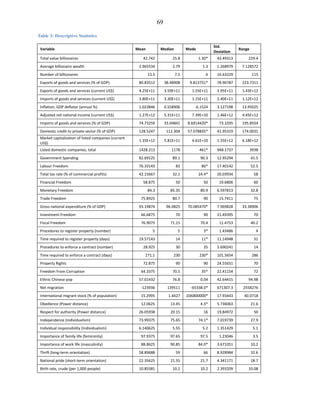
The sample for total billionaire had a mean of 42.742, a median of 25.8, a mode of 1.30, and a
standard deviation of 43.49313. The average billionaire wealth sample had a mean of 965534, a
median of 2.79, a mode of 1.3, and a standard deviation of 1.268979. The number of billionaires
had a mean of 13.5 with a median of 7.5, a mode of 4, and a standard deviation of 16.63229. The
descriptive statistics for all dependent and independent variables are included in Table 3 of the
appendix. The sample size varied by variable the maximum number of data points for any
variable was 80 (one data point per year for 16 years in 5 countries). The number of available
data points for each variable is listed in Table 2. Some of the data (demographic figures and
cultural values) were only available on a periodic basis. Missing data between available data
points was interpolated – in keeping with the methodology of Berry et al. (2010). Missing values
outside of the range of available data points were excluded from the analyses.
32
This study conducted three separate multiple regression analyses for each hypothesis using the
dependent variables of the number of billionaires per country, the total value of these billionaires,
and the average wealth of billionaires by country. The independent variables that were used for
each hypothesis are the institutional measures outlined in Table 2. This was done to ascertain
whether or not these institutional variables are, in fact, related to entrepreneurial success as
proposed in the hypotheses.
To test H1, this thesis used the following model:
ES = B0 + B1 * ANI + B2 * Inf + B3 * IGDP + B4 * IUSD + B5 * EGDP + B6 * EUSD + ε;
where ES is entrepreneurial success, ANI is adjusted net income, Inf is inflation, IGDP is imports
as a percentage of GDP, IUSD is imports in US dollars, EGDP is exports as a percentage of GDP,
and EUSD is exports in US dollars.
To test H2, the following model was used:
ES = B0 + B1 * LDC + B2 * MCap + B3 * DC + ε;
where ES is entrepreneurial success, LDC is the number of listed domestic companies, MCap is
the market capitalization of listed domestic companies, and DC is the domestic credit available
to the private sector.
To test H3a, this thesis used the following model:
ES = B0 + B1 * TTR + B2 * GNE + B3 * FiscF + B4 * TF + B5 * MF + B6 * IF + B7 * FinF + B8 *
LF + B9 * GS + ε;
where ES is entrepreneurial success, TTR is total tax rate, FiscF is fiscal freedom, TF is trade
freedom, MF is monetary freedom, IF is investment freedom, FinF is financial freedom, LF is
labour freedom, and GS is government spending.
The thesis tested H3b using the following model:
ES = B0 + B1 * PRP + B2 * PR + B3 * TRP + B4 * PEC + B5 * TEC + B6 * FFC + ε;
where ES is entrepreneurial success, PRP is the number of procedures to register a property, PR
is property rights, TRP is time to register property, PEC is procedures to enforce a contract, TEC
is time to enforce a contract, and FFC is freedom from corruption.
H4a was tested using the model:
ES = B0 + B1 * IMS + B2 * NM + B3 * EC + ε;
33
where ES is entrepreneurial success, IMS is international migrant stock, NM is net migration,
and EC is Ethnic Chinese population.
H4b and H4c were tested using the following model:
ES = B0 + B1 * AUTH + B2 * OBD + B3 * INDP + B4 * INDV + B5 * FAM + B6 * WRK + B7 *
THR + B8 * NP + ε;
where ES is entrepreneurial success, AUTH is respect for authority (power distance), OBD is
obedience (power distance), INDP is independence (individualism), INDV is individual
responsibility (individualism), FAM is importance of family life (femininity), WRK is
importance of work life (masculinity), THR is thrift (long-term orientation) and NP is national
pride (short-term orientation).
H5a was tested using the model:
ES = B0 + B1 * BR + B2 * POPT + B3 * POPG + ε;
where ES is entrepreneurial success, BR is the birth rate, POPT is the total population, and
POPG is population growth.
H5b was tested according to the model:
ES = B0 + B1 * POPD + B2 * UP + B3 * RD + ε;
where ES is entrepreneurial success, POPD is population density; UP is urban population, and
RD is road density.
H5c was tested with the model:
ES = B0 + B1 * LE + B2 * POPMid + B3 * POPEld + ε;
where ES is entrepreneurial success, LE is life expectancy, POPMid is the percentage of the
population aged 15 to 64, and POPEld is the population aged 65 and over.
H6 was tested using the model:
ES = B0 + B1 * RDE + B2 * JOURN + B3 * RSRCH + B4 * PTNT + ε;
where ES is entrepreneurial success, RDE is R&D expenditures, JOURN is the number of
scientific and technical journal publications, RSRCH is the number of researchers in R&D per
million people, and PTNT is the number of patents applied for.
H7 was tested using the model:
34
ES = B0 + B1 * MOB + B2 * MOBP + B3 * TRSM + B4 * INTR + B5 * INTRP + B6 * TEL + B8 *
TELP + ε;
where ES is entrepreneurial success, MOB is the number of mobile phone subscribers, MOBP is
the number of mobile phone subscribers per 100 people, TRSM is international tourism
expenditures, INTR is the number of Internet users, INTRP is the number of Internet users per
100 people, TEL is the number of telephone lines, and TELP is the number of telephone lines per
100 people.
The regression analyses were performed using the ordinary least squares method. Importantly,
the dependent variables (total billionaire wealth, average billionaire wealth, and total number of
billionaires) are continuous, and there is evidence that that are related to the predictor variables
used in the analyses. The relationship between predictors and dependent variables is linear and
the error is normally distributed and uncorrelated with the predictors. There are, however,
problems with multicollinearity. The implications of multicollinearity are discussed in the
limitations section of the conclusion.
35
Chapter 4 – Results
Economic factors
This study analyzed the correlation between the total worth of billionaires per country, the
average worth of billionaires per country, and the total number of billionaires per country with
the following economic measurements: export of goods and services in US dollars, the export of
goods and services as a percentage of GDP, inflation, national income, imports of goods and
services in US dollars, and imports of goods and services as a percentage of GDP. A summary of
the expected and resultant coefficient directions is found in Table 4 of the appendix. Details of
the regressions are found in Table 5.
A regression analysis was performed using the total worth of billionaires per country as a
dependent variable, and export of goods and services in US dollars, the export of goods and
services as a percentage of GDP, inflation, national income, imports of goods and services in US
dollars, and imports of goods and services as a percentage of GDP as independent variables.
Adjusted net national income, and imports of goods and services (percentage of GDP)
contributed significantly (p < .001) and positively to the model – supporting H1. Every dollar
that adjusted net national income increases, the total value of billionaires in a country increases
by $0.02818. For every percentage point that imports of goods and services increases, total
billionaire wealth increases by $818 million. The exports of goods and services (percentage of
GDP) contributed significantly (p < .001) and negatively to the model, contradicting H1. For
every percentage point that exports of goods and services increases, total billionaire value
decreases by $3.498 billion. Overall, the model yielded an adjusted R squared value of .636 was
found to be statistically significant (p < .001). This indicates that 63.6% of variation in total
billionaire wealth can be predicted based on these economic variables.
A multiple regression analysis of average billionaire wealth per country (the dependent variable)
and export of goods and services in US dollars, the export of goods and services as a percentage
of GDP, inflation, national income, imports of goods and services in US dollars, and imports of
goods and services as a percentage of GDP (the independent variables) was performed. Adjusted
net national income contributed significantly (p < .01) and positively to the model with every
dollar increase to net national income predicting a $0.0006568 increase in average billionaire
wealth, supporting H1. Inflation contributed significantly (p < .05) and positively with every
36
percentage increase in inflation, increasing average wealth by $114 million, supporting H1.
Imports of goods and services (percentage of GDP) contributed significantly (p < .001) and
positively, supporting H1; every percentage increase equalled an increase of $117 million in
average wealth. Exports of goods and services (percentage of GDP) also contributed
significantly (p < .001) but negatively, with every percentage point of increase in exports
amounting to a decrease of $149 million in average wealth; this contradicts H1. Overall, the
regression analysis yielded a statistically significant (p < .001) model with an adjusted R square
value of 0.552, indicating that 55.2% of the variation in average billionaire wealth can be
predicted with these economic variables.
A regression analysis using the number of billionaires as the dependent variable and export of
goods and services in US dollars, the export of goods and services as a percentage of GDP,
inflation, national income, imports of goods and services in US dollars, and imports of goods and
services as a percentage of GDP as the independent variables was performed. In this model,
adjusted national income contributed positively and significantly (p < .001) with every dollar
increase in adjusted national income equalling an increase of 8.757E-12 billionaires per country,
offering support for H1. Imports of goods and services (percentage of GDP) contributed
positively and significantly (p < .001) with each percentage point increase equalling an increase
of 0.922 billionaires, also supporting H1. Imports of goods and services (current US$)
contributed negatively and significantly (p < .05) with every dollar increase in imports equalling
a decrease of 6.182E-11 billionaires, contradicting H1. Exports of goods and services (percent of
GDP) contributed negatively and significantly (p < .001) to the model; for every percentage
point of increase in exports there was a decrease in the number of billionaires by 0.761,
contradicting H1. Exports of goods and services in US dollars also contributed significantly (p <
.05) to the model. Every dollar of increased exports amounts to an increase of 4.926E-11
billionaires, supporting H1. The model as a whole was significant (p < .001) with an adjusted R
square value of 0.721, indicating that 72.1% of variation in the number of billionaires can be
predicted based on these economic factors.
Financial factors
A regression analysis was conducted using the total value of billionaires per country as a
dependent variable and listed domestic companies, market capitalization, and domestic credit as
37
the independent variables. Market capitalization and domestic credit contributed positively and
significantly (p < .001) to the model, supporting H2. Every percentage point that market
capitalization increased, was equal to $75 million of increased total billionaire value. Every
percentage point that domestic credit increases, is equal to $427 million in total billionaire value.
The overall model showed an adjusted R square of 0.630 and was statistically significant (p <
.001), indicating that 63% of the variation in national worth of billionaires can be predicted with
these financial development indicators.
A regression analysis using the average billionaire wealth as the dependent variable and listed
domestic companies, market capitalization, and domestic credit as the independent variables was
performed. Domestic credit was found to contribute positively and significantly (p < .01), to the
model, supporting H2. Market capitalization also contributed positively and significantly (p <
.05), supporting H2. The number of listed domestic companies contributed significantly (p < .01)
but negatively, contradicting H2. For each additional listed company, average billionaire wealth
decreased by $1 million. For every percentage point that the market capitalization increased,
average billionaire wealth increased by $2 million. For every percentage point that domestic
credit increased, average billionaire wealth increased by $14 million. The overall model is
statistically significant (p < .001) and has an adjusted R square of 0.291, meaning that 29.1% of
the variation in average billionaire wealth can be predicted using these financial development
indicators.
A regression analysis was performed using the number of billionaires as a dependent variable,
and listed domestic companies, market capitalization, and domestic credit as the independent
variables. The number of domestic companies contributed positively and significantly (p < .001)
to the model, supporting H2; an increase of 1 domestic company is equivalent to an increase of
0.005 billionaires in the country. The market capitalization of companies was also found to
contribute positively and significantly (p < .01) with each percentage point of increase in market
capitalization equalling an increase of 0.015 billionaires, providing support to H2. Domestic
credit contributed positively and significantly (p < .001) with each percentage point of increase
being equal to an increase of 0.109 billionaires – once again supporting H2. The model as a
whole was found to be statistically significant (p < .001) and it provided an adjusted R square of
0.710, indicating that 71% of the variation in the number of billionaires in a country can be
predicted by these three financial development indicators.
38
Political factors
A regression analysis was performed, treating the total national worth of billionaires as the
dependent variable and total tax rate, government spending, labour freedom, financial freedom,
monetary freedom, trade freedom, investment freedom, fiscal freedom and gross national
expenditures as the independent variables. Individually, none of the variables contributes
significantly to the model; therefore, no support is found for H3a with respect to total billionaire
value. The overall model is, however, statistically significant (p < .01) and yields an adjusted R
square of 0.606, indicating that these variables predict 60.6% of the variation in the national
worth of billionaires.
A regression analysis was performed using average wealth as a dependent variable, and total tax
rate, government spending, labour freedom, financial freedom, monetary freedom, trade
freedom, investment freedom, fiscal freedom and gross national expenditures as the independent
variables. None of the independent variables contributed significantly to the model on their own,
therefore no support was found for H3a, with respect to average billionaire wealth. However, the
overall model is statistically significant (p < .01) with an adjusted R square of 0.623. This means
that 62.3% of the variance in average billionaire wealth can be predicted with these variables.
A regression analysis between the number of billionaires (the dependent variable) and total tax
rate, government spending, labour freedom, financial freedom, monetary freedom, trade
freedom, investment freedom, fiscal freedom and gross national expenditures (the independent
variables) was performed. Only gross national expenditure was found to significantly (p < .05)
contribute to the model, which it did positively, contradicting H3a. For each dollar increase in
gross national expenditure, the number of billionaires increased by 7.968E-12. The model as a
whole is statistically significant (p < .01) with an adjusted R square of 0.658, meaning that these
variables explain 65.8% of the variance in the number of billionaires in a country.
A regression analysis analyzed the dependent variable of the total value of billionaires per
country, with the number of procedures to register a property, the time required to register a
property, the number of procedures to enforce a contract, the time to enforce a contract, property
rights, and freedom from corruption as independent variables. Property rights contributed
significantly (p < .01) and negatively to the model, contradicting H3b; for each unit increase in
property rights, the total value of billionaires decreases by $3.815 billion. The number of
39
procedures to enforce a contract contributed negatively and significantly (p < .01) to the model –
contradicting H3b – with each additional procedure amounting to a decrease of $21.130 billion
in total billionaire wealth. The number of procedures to register a property contributed positively
and significantly (p < .01) to the model, supporting H3b; for each additional procedure there is
an increase in total billionaire wealth of $56.920 billion. The model as a whole is statistically
significant (p < .001) and has an adjusted R square of 0.698, indicating that 69.8% of the
variation in the total wealth of billionaires in a country can be predicted by these property-related
variables.
A regression analysis was performed using the average worth of billionaires as the dependent
variable, and the number of procedures to register a property, the time required to register a
property, the number of procedures to enforce a contract, the time to enforce a contract, property
rights, and freedom from corruption as predictors. Both the number of procedures to enforce a
contract and the number of procedures to register a property contributed positively and
significantly (p < .05) to the model, supporting H3b. For each additional procedure to enforce a
contract there was a decrease in average billionaire wealth of $440 million. For each additional
procedure to register property there was an increase in average billionaire wealth of $791
million. The model as a whole is statistically significant (p < .01) and has an adjusted R square of
0.712, meaning that these predictors predict 71.2% of the variance in average billionaire wealth.
A regression analysis used the number of billionaires as a dependent variable and took the
number of procedures to register a property, the time required to register a property, the number
of procedures to enforce a contract, the time to enforce a contract, property rights, and freedom
from corruption as independent variables. Property rights contributed negatively and
significantly (p < .001) to the model with each unit increase amounting to a decrease of 2.010
billionaires, contradicting H3b. The number of procedures to enforce a contract contributed
significantly (p < .01) with each increase in the number of procedures equalling a decrease of
9.365 billionaires. The number of procedures to register a property contributed significantly (p <
.001) and positively to the model, supporting H3b. For each additional procedure, there was an
increase of 24.460 billionaires. The model as a whole is statistically significant (p < .001) and
has an adjusted R square of 0.693, indicating that 69.3% of the variance in the number of
billionaires in a country can be predicted with these property-related variables.
40
Cultural factors
A regression analysis between the total value of billionaires and the immigration measures was
performed. International migrant stock was found to contribute positively and significantly (p <
.01) to the model, supporting H4a; for every percentage increase in migrant stock, the total value
of billionaires increased by $2.890 billion. Net migration also contributed significantly (p < .01)
but negatively – contradicting H4a – with total billionaire wealth decreasing by $57,600 for each
unit increase to net migration. Ethnic Chinese population contributed significantly (p < .05) and
negatively to the model, contradicting H4a. For each increase in the percentage of the population
that is ethnically Chinese, there was a decrease in total billionaire wealth of $909 million. The
model as a whole was statistically significant (p < .05) with an adjusted R square of 0.120,
indicating that 12% of the variance in the total value of billionaires in countries can be predicted
based on net migration, international migrant stock, and ethnic Chinese population.
A regression analysis used these migration variables as predictors and average billionaire wealth
as the dependent variable. Only international migrant stock contributed significantly (p < .01) to
the model, and it contributed positively – supporting H4a. For every percentage increase in
migrant stock, the average billionaire wealth increased by $91 million. The model as a whole is
statistically significant (p < .001) with an adjusted R square of 0.418, meaning that 41.8% of the
variance in average billionaire wealth can be predicted by migration measures.
A regression analysis performed using the number of billionaires a dependent variable and using
net migration, international migrant stock, and Ethnic Chinese population as predictors found
international migrant stock, net migration, and ethnic Chinese population all contributed
significantly (p < .001) to the model. Ethnic Chinese population and net migration contributed
negatively – contradicting H4a – while international migrant stock contributed positively –
supporting H4a. For every percentage point that international migrant stock increased, there was
an increase of 1.008 billionaires. For each unit increase in net migration there was a decrease in
the number of billionaires by 2.445E-5. For each percentage point that the ethnically Chinese
population increased, the number of billionaires decreased by 0.379. The model as a whole is
statistically significant (p < .01) and has an adjusted R square of 0.189, meaning that 18.9% of
the variation in the number of billionaires in a country can be predicted based on these variables.
A regression analysis analyzed the total worth of billionaires (as a dependent variable) and the
41
following independent variables: obedience, respect for authority, independence, individual
responsibility (a measure of individualism), importance of family life (a measure of femininity),
importance of work, thrift, and national pride. Trust (a measure of uncertainty avoidance), was
excluded from the regression analysis due to its collinearity with other predictors. None of the
individual cultural values measures contributed significantly to the model; therefore, no support
was found for H4b or H4c; however, the model as a whole is statistically significant (p < .001).
The model has an adjusted R square of 0.750, meaning that these variables predict 75% of the
variance in total billionaire wealth in a country.
A regression analysis took average billionaire wealth as the dependent variable and used
obedience, respect for authority, independence, individual responsibility, importance of family
life, importance of work, thrift, and national pride as predictors; trust was again excluded due to
its collinearity. Once again, none of the individual variables contributed significantly to the
model, meaning that there is no support for H4b or H4c. The overall model is, however,
statistically significant (p < .01). This analysis indicated an adjusted R square value of 0.556,
meaning that these variables predict 55.6% of the variance in average billionaire wealth.
A regression analysis was performed using the number of billionaires as a dependent variable,
and the independent variables of obedience, respect for authority, independence, individual
responsibility, importance of family life, importance of work, thrift, and national pride. Trust was
excluded due to its high multicollinearity. None of the individual variables contributed
significantly to the model, therefore H4b and H4c are not supported, but the overall model is
statistically significant (p < .001). This analysis yielded an adjusted R square of 0.763 meaning
that 76.3% of the variance in the number of billionaires is predicted by these cultural variables.
Demographic factors
A regression analysis between the total worth of billionaires per country (the dependent variable)
and the total population, population growth rate, and birth rate (the independent variables) found
that only birth rate contributed significantly to the model (p < .01) and it did so negatively,
contradicting H5a. For every unit increase in births per 1,000 people, the total value of
billionaires decreased by $6.013 billion. The model as a whole is statistically significant (p < .01)
and has an adjusted R square of 0.176, indicating that 17.6% of total billionaire wealth by
country can be predicted by these population variables.
42
A regression analysis was performed between the dependent variable of average billionaire
wealth and the independent variables of total population, population growth rate, and birth rate.
The total population contributed significantly (p < .01) and negatively, contradicting H5a.
Population growth contributed significantly (p < .05) and positively, supporting H5a. For every
increase in population of 1 person, the average wealth of billionaires decreased by $1.14. For
every percentage point that the population growth rate increased, the average wealth of
billionaires increased by $261 million. The overall model is statistically significant (p < .001)
with an adjusted R square of 0.289, meaning that 28.9% of the variance in average billionaire
wealth can be predicted with these population variables.
A regression analysis was performed using total population, the population growth rate, and
birth rate as predictors of the number of billionaires in a country. The birth rate contributed
significantly (p < .01) and negatively to the model – contradicting H5a – with every unit increase
in the number of births per 1,000 people equalling a decrease of 2.016 billionaires per country.
The model is statistically significant (p < .001) and has an R square of 0.220, meaning that 22%
of the variance in the number of billionaires in a country can be predicted by these population
variables.
Regression analyses using the independent variables of population density, urban population, and
road density failed to yield statistically significant predictors for either total billionaire wealth or
the number of billionaires per country, meaning that neither provides support for hypothesis 5b.
An analysis using average billionaire wealth did, however, yield a statistically significant (p <
.001) regression. Population density contributed positively and significantly (p < .01) to the
model, providing support for H5b (but the B value was found to be 0.000 meaning that the
contribution is too small to measure). Urban population contributed negatively and significantly
(p < .01) with every increase of 1 person in the urban population amounting to a decrease of
$2.768 in average billionaire wealth. The model has an adjusted R square of 0.505 indicating that
these measures of population density predict 50.5% of the variation in average billionaire wealth.
A regression analysis was conducted using the national worth of billionaires as the dependent
variable. Life expectancy, the percentage of the population aged 15 to 64, and the percentage of
the population aged 65 and over were used as independent variables. Due to its collinearity with
the other variables, population aged 0 to 14 was excluded from the analysis. The percentage of
43
the population aged 15 to 64 contributed positively and significantly (p < .001) to the model,
with every percentage point increase equalling an increase in total billionaire wealth of $10.351
billion; this supports H5c. The percentage of the population aged 65 and up contributed
significantly (p < .001) and positively to the model. For every percentage point increase, the
wealth of billionaires increased by $10.728 billion. Life expectancy at birth contributed
significantly (p < .05) and negatively to the model; every year of increased life expectancy is
associated with a decrease of total billionaire wealth per country of $4.399 billion. This analysis
produced a statistically significant (p < .001) model with an adjusted R square of 0.570, meaning
that these demographic variables predict 57% of the variance in the total value of billionaires per
country.
A regression analysis assessed the average billionaire wealth against life expectancy, the
percentage of the population aged 15 to 64, and the percentage of the population aged 65 and
over respectively; again, the percentage of the population aged 0 to 14 was excluded due to
collinearity. This regression analysis yielded a statistically significant (p < .001) model. No
support was found for H5c, as the percentage of the population aged 15 to 64 did not contribute
significantly to the model. Life expectancy contributed significantly (p < .01) to the model.
Every year of increase in life expectancy amounts to an increase in average billionaire wealth of
$297 billion. The adjusted R square for this model is 0.314, meaning that these demographic
variables predict 31.4% of the variation in the average billionaire wealth.
A regression analysis was performed using the number of billionaires as the dependent variable
and life expectancy, the percentage of the population aged 15 to 64, and the percentage of the
population aged 65 and over as the independent variables; the population aged 0 to 14 was again
excluded due to its collinearity with other variables. The resultant model is statistically
significant (p < .001) and all three independent variables contributed significantly (p < .001) to
the model; life expectancy contributed negatively while the percentage of the population 15 to 64
and the percentage of the population 65 and older contributed positively. The positive
contribution of the percentage of the population aged 15 to 65 supports H5c. Every year of
increased life expectancy amounts to a decrease of 2.260 billionaires. Every percentage increase
to the population aged 15 to 64 results in an increase of 3.105 billionaires. Every increase in the
population aged 65 and up results in an increase of 3.902 billionaires. The analysis resulted in an
adjusted R square of 0.606, indicating that 60.6% of variation in the number of billionaires can
44
be predicted using these variables.
Knowledge factors
A regression analysis was performed using the dependent variable of total billionaire wealth and
the independent variables of scientific and technical journal publications, researchers in R&D,
R&D expenditure, and resident patent applications. The number of patents significantly (p <
.001) and positively contributed to the model – supporting H6 – however the beta is equal to
0.000, making it impossible to estimate a unit-level contribution. The number of researchers in
R&D contributed significantly (p < .01) and positively to the model with an increase of total
billionaire value of $7 million for every unit increase of R&D researchers per million people,
supporting H6. R&D expenditures also contributed significantly (p < .01) and negatively to the
model, with every percentage point increase of R&D expenditure predicting a decrease of
$21.661 in total billionaire value. The model as a whole is statistically significant (p < .001) with
an adjusted R square value of 0.803, indicating that 80.3% of the variance in the total wealth of
billionaires can be predicted with these innovation variables.
The regression analysis examined the relationship between average billionaire wealth (the
dependent variable) and scientific and technical journal publications, researchers in R&D, R&D
expenditure, and resident patent applications as independent variables. The number of patent
applications contributed significantly (p < .05) and positively to the model, supporting H6. For
every patent application, the average billionaire wealth increases by $8,507. Scientific and
technical journal articles also contributed negatively and significantly (p < .05) to the model,
contradicting H6, with average billionaire wealth decreasing by $54,457 for every journal
publication. The model is statistically significant as a whole (p < .01) with an adjusted R square
of 0.268, meaning that 26.8% of the variance in average billionaire wealth can be predicted with
these variables.
The regression analysis between the dependent variable of the number of billionaires in a
country, and the independent variables of and technical journal publications, researchers in R&D,
R&D expenditure, and resident patent applications produced a statistically significant (p < .01)
model. The number of patent applications contributed positively and significantly to the model (p
< .01), supporting H6. For every increase in patents, there is an increase in the number of
billionaires of 7.072E-5. The number of researchers in R&D per million people also contributed
45
positively and significantly (p < .01) to the model, supporting H6. For every unit increase in
R&D researchers per million people, there was an increase of 0.002 billionaires. The overall
model has an adjusted R square of 0.794, meaning that 79.4% of the variance in the number of
billionaires can be predicted with these variables.
Global connectedness factors
A regression analysis used international tourism expenditures, the number of Internet users,
Internet users per 100 people, telephone lines, mobile phone subscriptions, and mobile phone
subscriptions per 100 people as predictors of total billionaire wealth. All of the independent
variables contributed significantly to the model. International tourism expenditures contributed
positively and significantly (p < .05) with every percentage increase amounting to an increase of
$3.701 billion in total billionaire wealth; this supports H7. The number of Internet users
contributed significantly (p < .001) and positively to the model – supporting H7 – for every
additional Internet user, there was an additional $1,742 in increased billionaire wealth. The
number of Internet users per 100 people contributed significantly (p < .001) but negatively to the
model – contradicting H7 – with each increase of 1 person per 100 equalling a decrease in total
billionaire wealth of $1.645 billion. The number of telephone lines contributed significantly (p <
.001) and positively to the model, supporting H7; for each additional phone line, there was an
increase of $685.30 in total billionaire value. Telephone lines per 100 people contributed
positively and significantly (p < .01) to the model, with each increase in the number of lines per
100 people predicting an increase of $996 million in total billionaire wealth; this supports H7.
Mobile cellular subscriptions contributed significantly (p < .001) and negatively to the model,
contradicting H7; for each additional subscriber there was a reduction of $1,079 in billionaire
wealth. Mobile cellular subscriptions per 100 people contributed significantly to the model, with
an increase of $1.145 billion in total billionaire value for each additional subscriber per 100
people. The model as a whole is statistically significant (p < .001) with an adjusted R square of
.686, meaning that 68.6% of total billionaire wealth can be predicted from these variables.
A regression analysis used mobile cellular subscriptions per 100 people, Internet users,
international tourism, telephone lines per 100 people, Internet users per 100 people, telephone
lines, and mobile cellular subscriptions as predictors of average billionaire wealth. Internet users
per 100 people contributed negatively and significantly (p < .01) to the model, contradicting H7.
46
For each additional person per 100 people on the Internet, average billionaire wealth decreased
by $35 million. Mobile cellular subscriptions per 100 people contributed positively and
significantly (p < .01) to the model, supporting H7. For each additional mobile cellular
subscription per 100 people, average wealth increased by $20 million. The model as a whole is
statistically significant (p < .001) with an adjusted R square of .451, meaning that 45.1% of the
variance in average billionaire wealth can be predicted with these variables.
A regression analysis used international tourism expenditures, the number of Internet users,
Internet users per 100 people, telephone lines, mobile phone subscriptions, and mobile phone
subscriptions per 100 people as predictors for the number of billionaires per country. The number
of Internet users contributed significantly and positively (p < .001) to the model, supporting H7;
for each additional Internet user, there was an increase in the number of billionaires of 4.487E-7.
The number of Internet users per 100 people also contributed significantly (p < .001) but
negatively – contradicting H7 – with each additional Internet user per 100 people amounting to a
decrease of .362 billionaires. The number of mobile cellular subscribers per 100 people
contributed significantly (p < .001) and positively, offering support for H7; every unit increase in
subscribers per 100 people equalled an increase of .246 billionaires. International tourism
contributed significantly (p < .01) and positively to the model, supporting H7; for each
percentage increase, the number of billionaires increased by 1.926. Telephone lines per 100
people contributed positively and significantly (p < .01) to the model, supporting H7; for each
additional line per 100 people, there was an increase of .236 billionaires. Mobile cellular
subscriptions contributed significantly (p < .01) and negatively – contradicting H7 – with each
additional subscriber amounting to a reduction in the number of billionaires of 2.305E-7.
Telephone lines contributed significantly (p < .01) and positively – supporting H7 – with each
additional line equalling an increase in billionaires of 1.277E-7. The overall model is statistically
significant (p < .001), with an adjusted R square of .699, meaning that 69.9% of the variance in
the number of billionaires can be predicted with these variables.
47
Chapter 5 – Conclusion
Discussion
This thesis proposed that increased economic development (H1), increased financial
development (H2), higher taxes and government spending (H3a), better protection of property
(H3b), higher immigration levels (H4a), stronger levels of long-term orientation (H4b), greater
individualism (H4c), higher population levels (H5a), greater population density (H5b), an
increased percentage of the population aged 15 to 64 (H5c), greater innovation (H6), and greater
global connectedness (H7) are positively related to entrepreneurial success. Mixed support was
found for H1, H2, H3b, H4a, H5a, H5b, H6, and H7. Support was found for H5c, partial support
was found for H3a, and no support was found for either H4b or H4c.
The analysis of economic factors found that increases to net national income, imports
(percentage of GDP), exports (in US$), and inflation were positively related to entrepreneurial
success. This suggests that a strong economy is related to entrepreneurial success. Previous
research has indicated that the distance between the level of economic development in two
countries is an important factor for business success (Berry et al., 2010). This goes further, to
suggest that the absolute level of economic development in a country is a predictor for
entrepreneurial success. This makes sense because a country with a stronger economy provides a
better domestic market for entrepreneurs to sell their products and services; it also creates greater
wealth that can be invested in entrepreneurial endeavours. The exports of goods as a percentage
of the GDP was found to be negatively related to entrepreneurial success, however. This suggests
that overall, a strong economy relates positively to entrepreneurial success, but that countries
which rely heavily on exports to support their economy will produce less successful
entrepreneurs. This may be because countries that depend on exporting have weak domestic
markets. It seems then, that it is important for entrepreneurs to operate in countries that offer a
strong domestic market. This is consistent with Porter (1990), who emphasizes the importance of
a strong domestic market for national advantage. Countries with a strong domestic economy
provide a large market to sell products, but the sophistication of the market is perhaps even more
important than the size. In a developed economy, customers have more sophisticated demands;
this drives companies to be innovative and to develop more advanced products and services with
greater margins. As a result, entrepreneurs in developed economies are more likely to build
48
highly profitable businesses and to amass greater personal fortunes.
The models using total billionaire wealth and the total number of billionaires as the measures for
entrepreneurial success provide support for H2. This suggests that, as scholars (Schumpeter
1934; King and Levine, 1993; Greenwood et al., 1997) have noted, greater financial
development leads to entrepreneurial success. It reasons that this is because financial institutions
screen entrepreneurs and select those with the greatest potential. Average billionaire wealth,
when used as a performance measure, provides mixed support however, as the number of listed
companies is negatively related to this measure of entrepreneurial success. It contributes
positively to the other models (though significantly for the total number of billionaires only).
This suggests that increased financial development is positively related to entrepreneurial
success, with one key exception: an increase in the number of listed domestic companies is
associated with a decrease in average billionaire wealth. This is not surprising, however, as it
simply shows a key difference in the entrepreneurial success measures; the total value and
number of billionaires measures the success of the overall pool of billionaires, while average
wealth measures individual success. An increase in the number of firms should increase the
overall number of highly successful individuals, but because it creates competition, it should also
reduce the average wealth of these highly successful entrepreneurs. It should be noted that a
decrease in average billionaire wealth may not reflect a decrease in the wealth of any individual
billionaire, but may simply reflect the addition of more billionaires who just pass the $1 billion
threshold (this is discussed in the limitations section).
Partial support was found for H3a. An increase in gross national expenditure contributed
significantly and positively to the total number of billionaires. This suggests that government
spending can increase the number of highly successful entrepreneurs. This is consistent with
Neumayer (2004), who found that government spending did not adversely affect the
accumulation of extreme wealth (though his study did not go so far as to say it was a cause of
such wealth). It suggests that entrepreneurs may benefit from government investments. There are
a number of reasons why government spending would increase entrepreneurial success. It may
be that government spending creates opportunities for entrepreneurs who receive government
contracts. It may be that government spending creates jobs and stimulates the economy and – as
has been shown above – a stronger domestic economy leads to greater entrepreneurial success. It
49
may also be that government spending provides a national infrastructure – for example
tranportation systems that allow products to be distributed and educational institutions that
provide skilled workers – that benefit entrepreneurs. An increase in total tax rate contributed
positively to the number and total value of billionaires and negatively to the average value, but
none of the contributions were statistically significant. This indicates that there is no support for
the notion that taxes contribute positively or negatively to entrepreneurial success.
Mixed support was found for H3b. Greater property rights were found to negatively relate to
entrepreneurial success. While researchers (Hall et al., 1999; Keefer et al., 1997; Knack et al.,
1995) have shown that property rights contribute to economic development, this suggests that
with respect to entrepreneurial success, property rights are not beneficial. This contradicts
Neumayer‟s (2004) findings that property rights contribute to extreme wealth accumulation. It
also appears to contradict Nee‟s (1992) assertion that Chinese entrepreneurs are unwilling to
invest for fear of losing their property. This is counterintuitive, as it seems that the protection of
property ought to allow people to accumulate property. It may be that countries with poor
property rights also offer large opportunities, suggesting that high risks can yield large gains. It is
also possible that these entrepreneurs are able to take advantage of poor property rights and use
them to amass their own wealth. It may be the case that these measures of property protection
simply do not accurately measure property protection in Confucian Asia. In China, for instance,
guanxi – one‟s network of influence – has, for centuries, substituted for the rule of law. Wealthy
individuals may also be able to protect their property by moving it outside of the country where
it can be better protected, a luxury that may be unattainable to the less wealthy. While property
may not be protected by conventional means in these countries, it may be protected by social
connections or other unofficial institutions.
A greater number of procedures to register property was found to positively relate to
entrepreneurial success. The number of procedures to register a property is a measure of the
number of steps in the property registration process. This suggests that a higher burden for
registering property, results in greater entrepreneurial success. A more bureaucratic system is not
necessarily a better system, however (the number of procedures to register a property correlated
negatively with the protection of property, though it was not statistically significant). A
bureaucratic process may discourage smaller entrepreneurs from registering their property,
50
giving an advantage to wealthier entrepreneurs who have the resources to deal with the process
and allowing them to further accumulate their wealth.
A greater number of procedures to enforce a contract, in contrast, contributed negatively to
entrepreneurial success. This suggests that there is an important distinction between registering
property and contract enforcement. While a bureaucratic system for registering property relates
positively to entrepreneurial success, the effect is negative when it is bureaucratic to enforce a
contract. It may be that wealthier entrepreneurs can afford to deal with the bureaucracy of
registering their property, but it is difficult for any entrepreneur to do business when enforcing a
contract requires extra effort. This is because registering a property only affects the entrepreneur,
but enforcing a contract affects the entrepreneur and anyone doing business with the
entrepreneur. It may be that other businesses are less willing to do business with a company
when it is difficult to enforce a contract. In particular, it may discourage foreign firms from doing
business with companies in a country where it is difficult to enforce a contract.
Mixed support was found for H4a. International migrant stock (as a percentage of the
population) was found to positively contribute to entrepreneurial success. This is consistent with
the findings of studies suggesting that immigrants are more likely to be successful than non-
immigrants (Borjas, 1986; Collins et al., 1970; Gilding, 1999). It may be that people of
international origin contribute to the entrepreneurial culture of a country. It may also be the case
that foreign-born residents offer skills and perspectives that benefit entrepreneurs. It could also
be that foreign-born residents provide a market for new products and services that benefit
entrepreneurs. Paradoxically, an increase to net migration was found to be negatively related to
entrepreneurial success, as was an increase to the ethnic Chinese population. This means that
countries with a greater number of emigrants than immigrants should produce more successful
entrepreneurs. It is unclear why emigration would benefit entrepreneurial success. On the surface
at least, it would seem that emigration would reflect a poor domestic economy and should cause
a decline in entrepreneurial success. The reason that emigration may stimulate entrepreneurial
success could be because a high volume of emigrants can create a diaspora, an international
network of expatriates, that can benefit domestic entrepreneurs; Tarun Khanna (2007) notes that
China has benefited especially from such emigration.
It seems that the ideal country should have a negative net migration and a high percentage of
51
international migrants in the population. These findings are not necessarily contradictory, as net
migration and international migrant stock measure slightly different demographics. Net
migration only includes people who plan to settle in the country, while international migrant
stock includes all foreign-born residents – both permanent and temporary. This implies that while
immigration as a whole will contribute negatively to entrepreneurial success, the presence of
non-permanent residents may actually drive entrepreneurial success. This may indicate that
expatriate employees, international students, and other temporary residents play a vital role in
entrepreneurial success, by connecting a country to the world; in this sense, these findings may
actually be seen as support for the hypothesis H7, that greater global connectedness contributes
positively to entrepreneurial success.
No support was found for H4b, that increased long-term orientation contributes to
entrepreneurial success. Nor was any support found for H4c, that increased individualism
contributes to entrepreneurial success. Furthermore, none of the other cultural values contributed
significantly to the regression analysis. This study cannot confirm or reject the notion that any
specific cultural value contributes – postively or negatively – to entrepreneurial success. This is
not surprising, however, as this study controlled for cultural factors by selecting countries from
Confucian Asia.
Mixed support was found for H5a. The regression analyses found that an increase in the birth
rate negatively contributed to the number and overall value of billionaires; also, the population
growth contributed negatively to average billionaire wealth. These results contrast with the
findings of Armington et al. (2002) who found that population growth was related to the number
of start-ups in a country. This implies that there are significant differences between the variables
affecting entry into entrepreneurship, and entrepreneurial success; while population growth may
create entrepreneurs, it does not appear that it will drive entrepreneurial success. This may be
because population growth drives “push” entrepreneurship, as competiton for employment forces
individuals into self-employment. As a result, there will be more entrepreneurs but they will be
less successful. Furthermore, a low birth rate or population growth may simply be a reflection of
socio-economic factors, as more developed nations typically experience a slow-down in their
birth rate and population growth. This study did find that an increase in population growth
contributed positively and significantly to average wealth. On the surface this appears to contrast
52
the other findings however it is possible for average wealth to decline even while the wealth of
all billionaires increases (as is discussed in the limitations section); it should be noted that an
increase in population growth contributed positively (though not statistically significantly) to the
number and overall value of billionaires in the study.
The results of this study provided mixed support for H5b. Increased population density
contributed significantly to entrepreneurial success, in keeping with Armington et al.‟s (2002)
finding that population density increases the number of startups and with Porter‟s (1990) cluster
view of advantage. This suggests that entrepreneurs are more likely to succeed in heavily
populated areas where there is greater access to infrastructure. This is contradicted, however by
the finding that urban population contributes negatively to entrepreneurial success. These
findings are not contradictory, however. Population density can increase even while urban
population decreases, if the rural population increases without reaching the point of becoming
urban. These results suggest that entrepreneurs are most successful in countries where the overall
population is denser, but that entrepreneurship is negatively affected when population density is
driven by urban growth. This suggests that rural population growth is key to entrepreneurial
success. This may be because entrepreneurs profit from traditionally rural industries such as
agriculture and natural resources extraction. A decline in these industries may cause people to
migrate to urban centres, causing an increase in the urban population while having no effect on
overall population density. These results may also be explained by growth in suburban areas –
though this study did not consider suburban populations. Suburban growth may reflect a greater
infrastructure development than urban growth. Countries experiencing growth in suburban areas
have a more developed infrastructure connecting suburban inhabitants with the rest of the
country. Countries in which population density is driven by urban growth alone may simply lack
the infrastructure that would allow for suburban growth and that would benefit entrepreneurs.
Support was found for H5c, with the population aged 15 to 64 contributing to entrepreneurial
success. This suggests that entrepreneurs will be more successful in a country dominated by
working-age people. This may be because people in this age range contribute more actively to
the economy; in particular, it may be explained by the fact that people invest more heavily during
many of these years, as Poterba (2001) suggested when noting a link between the number of
people in their prime earning years (25 to 45 in his study) with increased returns on the stock
53
markets. It is also consistent with Huyn, Mallik, and Hettihewa‟s (2006) finding that the size of
the population aged 40 to 65 contributed positively to returns in Australia‟s superannuation fund.
The increase in entrepreneurial success may be due to an increase in investments by a public
with income to save. It would follow that increased investments would provide entrepreneurs
with greater access to capita, thereby allowing for greater entrepreneurial growth. It may also be
the result of an increase in the percentage of people with disposable income to spend, thus
stimulating the market and creating a strong domestic market for entrepreneurs. The increase
may also be due to entrepreneurial characteristics inherent in people within this age range.
Interestingly, the percentage of the population aged 65 and over also contributed positively to
entrepreneurial success. On the surface, this would seem to contradict the Poterba (2001) who
suggests that as people reach retirement age, they will withdraw their investments and have a
negative impact on the economy. This may not be the case however. This study deals with
personal wealth, which is not immediately responsive to investor‟s actions in the way that a
company‟s market capitalization is. This lag means that a positive relationship with the
population aged 65 and older may actualy be reflective of the fact that entrepreneurs made their
money while the population was dominated by people aged 15 to 64.
Mixed results were found for H6. The number of researchers in R&D and the number of patent
applications contributed positively, suggesting that an increased level of scientific and
technological knowledge will contribute to entrepreneurial success. This is consistent with
researchers (Kim, 1993; Hou and Gee, 1993; Nelson and Rosenberg, 1993) who suggest that
countries that are able to develop national innovation systems are more economically prosperous
than those that do not. This is logical, as it would seem likely that countries where there is a high
level of scientific and technical knowledge, would offer a greater number of opportunities for
commercial exploitation. For example, a greater number of researchers in R&D and a greater
number of patents should result in a greater number of innovations to be exploited. The number
of scientific and technical journal titles was found to relate negatively to entrepreneurial success.
This may be due to the fact that journal publications reflect a strong public research sector, but
this may not necessarily be good for entrepreneurs; public knowledge and research may
contribute to innovations overall, but doing so may create an equality of knowledge that
increases competition and reduces the opportunity to exploit rare knowledge. R&D expenditures
as a percentage of GDP were also found to contribute negatively to entrepreneurial success. This
54
may, however, be due to increases in the GDP; if the GDP increases at a higher rate than research
expenditures, then R&D expenditures may increase while actually getting smaller as a share of
the GDP. It could also be the result of increased government spending in R&D, as this figure
does not distinguish between private and public research spending. If the R&D spending is
predominantly government spending, this spending may serve to even the playing field,
increasing competition and making it difficult for entrepreneurs to gain an advantage sufficient
enough to amass a large personal wealth.
This study found mixed results for H7, with some results indicating that increased global
connectedness leads to increased entrepreneurial success and other results showing the opposite.
Increases in global tourism, telephone lines, and telephone lines per 100 people all contributed
positively to entrepreneurial success. This is consistent with Berry et al. (2010), who point to the
importance of global connectedness for businesses, and with Rugman and Verbeke (2003) who
argue that businesses benefit from transnational, rather than domestic clusters. It implies that
entrepreneurs in countries with a greater access to global markets, and with greater interactions
with the world at large, will be more successful than entrepreneurs in isolated countries. Given
the fact that increased property rights were found to negatively contribute to entrepreneurial
success, increased global connectedness may serve as an alternative to domestic property
protection – as increased global connectedness may allow entrepreneurs to secure their assets
abroad. Conflicting results were found for the relationship between entrepreneurial success and
both the number of Internet users and the number of mobile phone subscriptions. An increase in
the absolute number of mobile phones contributed negatively to entrepreneurial success, but the
number of mobile phone subscriptions per capita contributed positively. The opposite was found
with Internet users, as an increase in the absolute number contributed positively while an
increase to the per capita figure contributed negatively. It is therefore impossible to draw a
conclusion regarding the relationship between either the number of Internet users or the number
of mobile phone subscriptions, and entrepreneurial success.
This study revealed that not all institutions influence entrepreneurial success equally. The biggest
predictor of both the number and value of billionaires was innovation – suggesting that
innovation, in particular, is an area worthy of further study. Interestingly, innovation‟s prediction
of average billionaire wealth was considerably smaller (its level of prediction was the lowest for
55
that performance measure). In the case of average billionaire wealth, the biggest predictor was
property rights (which had similar prediction levels for the other success measures). With respect
to those variables that had the least influence, population density did not significantly predict the
size or value of billionaire wealth – though it did predict 50% of the variance in average wealth.
The lowest level of prediction that was significant for both the number and value of billionaires,
was population level (it was larger for average billionaire wealth, though still less than the
median). One of the more interesting results was for cultural values. Although no single cultural
value contributed to any of the three models, all three models provided high levels of prediction
(the second highest levels for total value and number of billionaires, and the third highest levels
for average wealth). This suggests that cultural values can be used to predict entrepreneurial
success, but that no individual cultural values can be used as reliable predictors.
Using multiple measures of entrepreneurial success showed that different measures are affected
differently by the same institutions. In some instances, such as the life expectancy or procedures
to enforce a contract, the relationship found with the total value and number of billionaires, was
the opposite of the one found with average billionaire wealth. This emphasizes the fact that what
is good for entrepreneurs as a whole is not necessarily good for entrepreneurs at an individual
level. Yet, in other situations, a consistent relationship can be identified across all three measures.
As noted above, the level of prediction also varies by performance measure, showing that the
importance of institutions varies by performance measure.
Limitations
The sample used in this study places immediate limitations on its findings. This study has
focussed on a specific (and elite) group of people within the same cultural cluster. Billionaires
are exceptional and likely do not represent entrepreneurs as a whole; using a sample that is
limited to billionaires introduces a success bias; it eliminates the entrepreneurs who do not
achieve an extremely high level of achievement. This limited selection does not allow the results
to be generalized. The narrow cultural focus of this study has two implications. Firstly, it controls
for the effects of culture and likely limits their significance. Secondly, it means that the findings
cannot be generalized beyond Confucian Asia.
There are limits inherent in the use of the Forbes list of billionaires. The Forbes list is merely an
estimate of personal wealth that takes into account cash, property, and other assets, it also
56
considers debt but, as Forbes admits, this is not always easily found. The accuracy of these
estimates is unknown, but it is reasonable to be sceptical of their completeness, particularly in
countries where there is less transparency in business. A difficulty of estimating personal wealth
is that it is not always easy to tell how wealth is split between family members. As such, some of
the Forbes entries represent individuals while others represent multiple people. Furthermore, the
Forbes list is not written for a scientific audience, but for the general public; the methodology for
generating the list has changed over the years meaning that there may be inconsistencies in the
data. The use of the $1 billion threshold is an arbitrary measure of success and it provides an
incomplete set of data because an individual‟s wealth is only measured once it hits this level. As
a result, the findings may give misleading results for average billionaire wealth. For example, if
several individuals meet the minimum $1 billion threshold, then it can cause average billionaire
wealth to decrease even if the wealth of all the billionaires actually increases.
The methodology used in this study places limitations on its findings. Because this study used
separate regression analyses for each hypothesis, it ignored the potential interplay between
several of the institutions that were not analyzed together. There are also limitations to the data
that has been used in this analysis. H5c and H6 both feature variance inflation factors (VIF)
exceeding the generally accepted cut-off value of 5 but not exceeding 10, which has also been
suggested as an acceptable cut-off (Obrien, 2007). H1, H3a, H3b, H4b, and H7 have variables
with a VIF exceeding 10. As such, the coefficient values may be affected, attributing inaccurate
levels of contribution to the predictors.
Implications for research
This study has shown the significance of institutional factors in predicting entrepreneurial
success based on a narrow sample. Further research should examine whether or not these
findings can be generalized. Researchers should examine the relationship between institutional
factors and entrepreneurial success in a sample that spans multiple cultural clusters – ideally with
representation from each cluster. Alternatively, researchers may replicate this study for other
cultural clusters to see if the results transcend cultural boundaries. Researchers should also
broaden this study to encompass a larger sample of entrepreneurs. Future studies might, for
instance, include millionaires. An ideal study would perform a longitudinal survey of
entrepreneurs of all levels of success, tracking their success from their beginning as
57
entrepreneurs. This would eliminate the success bias and make it possible to contrast
entrepreneurs who succeed against those who fail. It would also eliminate the problem with
average wealth (as mentioned in the limitations) as it would provide a complete data set that does
not drop off entrepreneurs below an arbitrary threshold.
In order to properly study the interactions between all of the variables, a regression analysis
should take all of the variables into account. In order to do this it would be necessary to create an
index out of all of the variables for each hypothesis. This would result in 11 independent
variables with which to perform the regression analysis. This model can be expressed as:
ES = B0 + B1 * EC + B2 * FN + B3 * TS + B4 * PP + B5 * IM + B6 * CV + B7 * PL + B8 * PDN +
B9* PDM + B10 * KNO + B11 * GC + ε;
where ES is entrepreneurial success, EC is an index of economic factors, FN is an index of
financial factors, TS is an index of tax and spending factors, PP is an index of property protection
factors, IM is an index of immigration factors, CV is an index of cultural value factors, PL is an
index of population level factors, PDN is an index of population density factors, PDM is an
index of population demographic factors, KNO is an index of knowledge factors, and GC is an
index of global connectedness factors. This would give a more accurate prediction of
entrepreneurial success, taking into account all of the variables while avoiding problems of
multicollinearity.
Alternatively, the issues of multicollinearity may be addressed within the individual analyses.
For H1 it may be possible to reduce the multicollinearity by combining exports and imports –
which are highly correlated (see Table 4) – and using the balance of trade instead. In H3a, the
multicollinearity may be reduced by eliminating financial freedom, which is highly correlated
with the total tax rate (see Table 6). For H4b none of the variables exceeds the correlation cut-off
value of 0.9 (see Table 9). It may be possible to reduce multicollinearity nonetheless by
combining the two measures of uncertainty avoidance to create one overall measure, by
combining the measures for long- and short-term orientation into a single measure, and by
combining the measures for masculinity and femininity into one overall measure. Finally, in H7
the number of mobile phone subscriptions is highly correlated with both the number of Internet
users and the number of telephone lines (see table 14). To deal with this, future researchers could
combine all three variables into one index of technological connectivity.
58
In addition to looking at all of the institutional factors together, there is potential for future
research into several specific hypotheses. This study found that entrepreneurial success is driven
by government spending, but further research is needed to explain why. Researchers should
examine different types of government spending (infrastructure, education, military, etc.) to see
which forms of spending contribute to entrepreneurial success. This will allow researchers to see
if any and all types of spending benefit entrepreneurs, or if specific types of spending provide
resources or other benefits to entrepreneurs. It was hypothesized that entrepreneurs may be able
to protect their property in countries with poor property rights by keeping their assets abroad; to
test this, future research should examine the freedom to move assets abroad to entrepreneurial
success. In explaining the results for H4a, this study hypothesized that the different types of
foreign nationals may impact entrepreneurial success in different ways. Research should explore
this idea further, examining how the levels of non-permanent residents impact entrepreneurial
success compared to the number of immigrants; specifically, researchers should examine how the
levels of refugees, expatriate workers, and foreign students affect entrepreneurial success. This
study also suggested that the size of the expatriate community can benefit a country‟s
entrepreneurs. To test this, future researchers should look at the relationship between the success
of entrepreneurs in a given country, with the size and spread of the expatriate community hailing
from the same country. In explaining the results of H5b, this study hypothesized that industries
specific to rural areas may drive entrepreneurial success. To test this, future research should
compare entrepreneurial success levels in different industries. It was also proposed that suburban
population growth may predict entrepreneurial success. Future research should examine this
hypothesis by studying how suburban population levels affect entrepreneurial success compared
to rural and urban levels. This study found that the age of the population impacts entrepreneurial
success. The age demographics used were quite large, however. Future research should use more
precise age ranges that better reflect specific stages of life. In explaining the findings for H6, this
thesis proposed that entrepreneurial success may be driven by private research and hampered by
public research; to test this, future research should look at public and private research
expenditures separately.
Implications for practitioners
This study is preliminary in nature; further research is needed to provide precise
recommendations for entrepreneurs and governments interested in increasing the success of their
59
entrepreneurs. This study does however, provide some rough guidance for entrepreneurs and
governments. Above all it dismisses the misconception that governments should spur
entrepreneurial success through inaction – that is through reducing taxes and spending – it
appears rather to be the case that the best countries for entrepreneurs are ones in which
governments invest and build strong institutions.
For entrepreneurs, there are several institutional factors to take into account when setting up a
business or expanding into a new market. Entrepreneurs should look for strong economies that
do not rely heavily on exports. They should look for strong financial institutions as indicated by
the domestic credit available to the private sector, the number of listed domestic companies, and
the market capitalization of these companies. They should look to countries with high levels of
government spending regardless of taxation, as government spending appears to contribute to
entrepreneurial success while taxation does not contribute significantly in either direction. With
regards to property rights, entrepreneurs should not necessarily seek out countries with strong
property protection, as this appear to contribute negatively to entrepreneurial success.
Entrepreneurs should avoid bureaucratic systems for enforcing contracts, but seek markets where
registering property is bureaucratic. Entrepreneurs should look to markets where the net
migration is low or negative, but where migrants constitute a greater percentage of the
population. Although it is intuitive to pursue large markets, markets with smaller populations and
low birth rates appear to better support entrepreneurial success. Entrepreneurs should seek to set
up in countries with a higher population density, but with lower urban populations. They should
pursue markets where the total research and development expenditures are low and there are
fewer scientific and technical journal publications, but where there are a greater number of
researchers in R&D and more patent applications. Finally, entrepreneurs should choose more
globally connected markets, as measured by international tourism expenditures and phone lines
(though the effect of Internet and mobile phone connectivity is unclear). It should be noted
however, that this study was performed at an aggregate level; predicting individual
entrepreneurial success is much more difficult and so these recommendations should be viewed
as general guidelines only. Entrepreneurs should use these insights when weighing their options
and rationalizing their decision to enter a market.
The results of this study are much more useful to governments for two reasons: first,
60
governments are interested in aggregate level success measures and second, governments have
the ability to shape institutions. Governments should attempt to build strong economies that do
not rely heavily on exports; they should aim to build strong domestic economies capable of
fostering a sophisticated demand for products and services. Governments should aim to build
strong financial institutions, making credit available to entrepreneurs that show promise.
Governments should not be afraid to tax businesses as there is no evidence to suggest this will
affect entrepreneurial success one way or another. In keeping with this, they should also be
willing to spend money, as government spending is associated with increased entrepreneurial
success. Protecting property is not an area where it appears governments need to focus their
efforts to foster entrepreneurial success, but they should focus on making contract enforcement a
simplified, non-bureaucratic process. This study suggests that governments need to look closely
at how immigration affects entrepreneurial success. They should encourage a growth in the
number of temporary residents and support emigrants leaving for other countries, in order to
encourage global connectedness. Governments should not encourage population growth or
increased birth rates as a means of encouraging entrepreneurial success, as shrinking populations
actually appear to offer better opportunities for success. As for the locus of the population,
increased population density appears to benefit entrepreneurs, but only when it occurs outside of
urban areas; governments should therefore encourage rural and suburban development and
attempt to avoid urban crowding. The results of this study indicate that concentrations in the
percentage of the population aged 15 to 64 and 65 and over are related to entrepreneurial
success, suggesting that governments should attempt maintain these concentrations, perhaps by
encouraging immigration by these demographics. It appears that governments should encourage
research and development in the private sector, though direct investments in research and
development may have an adverse effect. Finally, it appears that governments should, in general,
encourage greater global connectedness, but the exact effects of access to mobile phones and the
Internet are unclear.
61
Works Cited
Acs Z. 2006. How Is Entrepreneurship Good for Economic Growth? Innovations: Technology,
Governance, Globalization 1(1): 97-107.
Andrés L, Cuberes D, Diouf M, Serebrisky T. 2010. The diffusion of the Internet: A cross-
country analysis. Telecommunications Policy 34(5-6): 323-340.
Armington C, Acs ZJ. 2002. The Determinants of Regional Variation in New Firm Formation.
Regional Studies 36(1): 33 - 45.
Aronson RL. 1991. Self-employment: a labor market perspective. ILR Press.
Baumol WJ. 1990. Entrepreneurship: Productive, Unproductive, and Destructive. The Journal of
Political Economy 98(5): 893-921.
Baumol WJ. 1993. Entrepreneurship, management, and the structure of payoffs. MIT Press.
Berry H, Guillen MF, Zhou N. 2010. An institutional approach to cross-national distance.
Journal of International Business Studies 41: 1460-1480.
Blau DM. 1987. A Time-Series Analysis of Self-Employment in the United States. The Journal
of Political Economy 95(3): 445-467.
Borjas GJ. 1986. The Self-Employment Experience of Immigrants. The Journal of Human
Resources 21(4): 485-506.
Busenitz LW, Gómez C, Spencer JW. 2000. Country Institutional Profiles: Unlocking
Entrepreneurial Phenomena. The Academy of Management Journal 43(5): 994-1003.
Capelleras J-l, Mole KF, Greene FJ, Storey DJ. 2008. Do more heavily regulated economies have
poorer performing new ventures? Evidence from Britain and Spain. Journal of International
Business Studies 39(4): 688-688-704.
Carson CS. 1984. The Underground Economy: An introduction. Survey of Current Business 64:
16.
Che J, Qian Y. 1998. Insecure Property Rights and Government Ownership of Firms*. Quarterly
Journal of Economics 113(2): 467-496.
CIA. 2010. The World Factbook: 2010 Edition Potomac Books.
Collins OF, Moore DG. 1970. The organization makers: a behavioral study of independent
entrepreneurs. Appleton-Century-Crofts.
Delmar F, Davidson P. 2000. Where do they come from? Prevalence and characteristics of
nascent entrepreneurs. Entrepreneurship & Regional Development: An International Journal
12(1): 1 - 23.
DiMaggio, P.J., Powell, W.W. 1983. The Iron Cage Revisited: Institutional Isomorphism and
Collective Rationality in Organizational Fields. American Sociological Review. 48(2): 147-160.
Djankov S, La Porta R, Lopez-De-Silanes F, Shleifer A. 2002. The Regulation of Entry.
Quarterly Journal of Economics 117(1): 1-37.
Dunt ES, Harper IR. 2002. E–Commerce and the Australian Economy. Economic Record
78(242): 327-342.
Erb CB, Harvey CR, Viskanta TE. 1997. Demographics and International Investments. Financial
Analysts Journal 53(4): 14-28.
Ernst D. 2001. The Internet‟s effect on business organization: Bane or boon for developing Asia?
In AsiaPacific Issues. East-West Center.
Evans DS, Leighton LS. 1989a. The determinants of changes in U.S. self-employment, 1968–
1987. Small Business Economics 1(2): 111-119.
Evans DS, Leighton LS. 1989b. Some Empirical Aspects of Entrepreneurship. The American
62
Economic Review 79(3): 519-535.
Fairlie RW. 2006. The Personal Computer and Entrepreneurship. Management Science 52(2):
187-203.
Franke RH, Hofstede G, Bond MH. 1991. Cultural roots of economic performance: A research
noteA. Strategic Management Journal 12(S1): 165-173.
Furman JL, Porter ME, Stern S. 2002. The determinants of national innovative capacity.
Research Policy 31(6): 899-933.
Ghemawat P. 2001. Distance Still Matters: The Hard Reality of Global Expansion. Harvard
Business Review: 10.
Gilad B, Levine P. 1986. A behavioral model of entrpreneurial supply. Journal of Small Business
Management 24(4): 45-53.
Gilding M. 1999. Superwealth in Australia: entrepreneurs, accumulation and the capitalist class.
Journal of Sociology 35(2): 169-182.
Gordon RH. 1998. Can High Personal Tax Rates Encourage Entrepreneurial Activity? Staff
Papers - International Monetary Fund 45(1): 49-80.
Grant RM. 1991. Porter's „competitive advantage of nations‟: An assessment. Strategic
Management Journal 12(7): 535-548.
Greenwood J, Smith BD. 1997. Financial markets in development, and the development of
financial markets. Journal of Economic Dynamics and Control 21(1): 145-181.
Guillén MF, Suárez SL. 2005. Explaining the Global Digital Divide: Economic, Political and
Sociological Drivers of Cross-National Internet Use. Social Forces 84(2): 681-708.
Gupta V, Hanges PJ, Dorfman P. 2002. Cultural clusters: methodology and findings. Journal of
World Business 37(1): 11-15.
Hall RE, Jones CI. 1999. Why Do Some Countries Produce So Much More Output Per Worker
Than Others? The Quarterly Journal of Economics 114(1): 83-116.
Hamill J. 1997. The Internet and international marketing. International Marketing Review 14(5):
300-323
Hofstede G. 1980. Culture's Consequences. SAGE Publications: London.
Hofstede G. 2006. What Did GLOBE Really Measure? Researchers' Minds versus Respondents'
Minds. Journal of International Business Studies 37(6): 882-896.
Hofstede G, Bond MH. 1988. The Confucius connection: From Cultural roots to economic
growth. Organisational Dynamics: 5-21.
Hofstede G, Minkov M. 2010. Long- versus short-term orientation: new perspectives. Asia
Pacific Business Review 16(4): 493-504.
Hou C-M, Gee S. 1993. National systems supporting technical advance in industry: The case of
Taiwan. In National innovation systems: a comparative analysis. Nelson RR (ed.), Oxford
University Press: Oxford.
House R, Javidan M, Hanges P, Dorfman P. 2002. Understanding cultures and implicit leadership
theories across the globe: an introduction to project GLOBE. Journal of World Business 37(1): 3-
10.
House RJ, Hanges PJ, Javidan M, Dorfman PW, Gupta V (eds.). 2004. Culture, leadership, and
organizations: the GLOBE study of 62 societies Sage Publications.
Huynh W, Mallik G, Hettihewa S. 2006. The Impact of Macroeconomic Variables, Demographic
Structure and Compulsory Superannuation on Share Prices: The Case of Australia. Journal of
International Business Studies 37(5): 687-698.
Inglehart R, Baker WE. 2000. Modernization, Cultural Change, and the Persistence of
Traditional Values. American Sociological Review 65(1): 19-51.
63
Keefer P, Knack S. 1997. Why don't poor countries catch up? A cross-national test of an
institutional explanation. Economic Inquiry 35(3): 590-602.
Khanna T. 2007. Billions of entrepreneurs: how China and India are reshaping their futures--and
yours. Harvard Business School Press.
Kim J-I, Lau LJ. 1994. The Sources of Economic Growth of the East Asian Newly Industrialized
Countries. Journal of the Japanese and International Economies 8(3): 235-271.
Kim K-D. 1976. Political Factors in the Formation of the Entrepreneurial Elite in South Korea.
Asian Survey 16(5): 465-477.
Kim L. 1993. National system of industrial innovation: dynamics of capability building in Korea.
In National innovation systems: a comparative analysis. Nelson RR (ed.), Oxford University
Press: Oxford.
King RG, Levine R. 1993. Finance, entrepreneurship and growth. Journal of Monetary
Economics 32(3): 513-542.
Knack S, Keefer P. 1995. Institutions and economic performence: Cross-country tests using
alternative institutional measures. Economics & Politics 7(3): 207-227.
Kostova T. 1999. Transnational Transfer of Strategic Organizational Practices: A Contextual
Perspective. The Academy of Management Review 24(2): 308-324.
Long JE. 1982. The Income Tax and Self-Employment. National Tax Journal 35(1): 31-42.
Lu VN, Julian CC. 2007. The Internet and export marketing performance: The empirical link in
export market ventures. Asia Pacific Journal of Marketing and Logistics
19(2): 127-144.
McGrath RG, MacMillan IC, Scheinberg S. 1992. Elitists, risk-takers, and rugged individualists?
An exploratory analysis of cultural differences between entrepreneurs and non-entrepreneurs.
Journal of Business Venturing 7(2): 115-135.
Nee V. 1992. Organizational Dynamics of Market Transition: Hybrid Forms, Property Rights,
and Mixed Economy in China. Administrative Science Quarterly 37(1): 1-27.
Nelson RR, Rosenberg N. 1993. Technical innovation and national systems. In National
innovation systems: a comparative analysis. Nelson RR (ed.), Oxford University Press: Oxford.
Neumayer E. 2004. The super-rich in global perspective: a quantitative analysis of the Forbes list
of billionaires. Applied Economics Letters 11(13): 793 - 796.
Obrien, R.M. 2007. A Caution Regarding Rules of Thumb for Variance Inflation Factors. Quality
Quantity. 41(5): 673-690.
Ohlin BG. 1933. Interregional and international trade. Harvard University Press.
Oxley JE, Yeung B. 2001. E-Commerce Readiness: Institutional Environment and International
Competitiveness. Journal of International Business Studies 32: 705-723.
Peters M, Cressy RC, Storey DJ. 1999. The Economic Impact of Ageing on Entrepreneurship and
SMEs. EIM Business and Policy Research: Zoetermeer.
Porter ME. 1990. The competitive advantage of nations. Free Press.
Porter ME. 2001. Strategy and the Internet. Harvard Business Review 79(3): 62-78.
Poterba JM. 2001. Demographic Structure and Asset Returns. The Review of Economics and
Statistics 83(4): 565-584.
Prahalad CK, Hammond A. 2002. Serving the World's Poor, Profitably. Harvard Business Review
80(9): 48-57.
Redding G. 1995. Overseas Chinese networks: Understanding the enigma. Long Range Planning
28(1): 61-69.
Reynolds PD. 1997. Who Starts New Firms? – Preliminary Explorations of Firms-in-Gestation.
Small Business Economics 9(5): 449-462.
64
Ricardo D. 1821. On the Principles of Political Economy and Taxation 3 ed., John Murray:
London.
Rugman AM, Verbeke A. 2003. Multinational Enterprises and Clusters: An Organizing
Framework. Management International Review 43(3): 151-151-169.
Schumpeter JA. 1934. The theory of economic development: an inquiry into profits, capital,
credit, interest, and the business cycle (Opie R, Trans.). Transaction Books.
Schwartz SH, Bilsky W. 1990. Toward a theory of the universal content and structure of values:
Extensions and cross-cultural replications. Journal of Personality and Social Psychology 58(5):
878-891.
Shane S. 1992. Why do some societies invent more than others? Journal of Business Venturing
7(1): 29-46.
Shane S. 1993. Cultural influences on national rates of innovation. Journal of Business Venturing
8(1): 59-73.
Shane S, Venkataraman S. 2000. The Promise of Enterpreneurship as a Field of Research. The
Academy of Management Review 25(1): 217-226.
Siu W-s, Martin RG. 1992. Successful entrepreneurship in Hong Kong. Long Range Planning
25(6): 87-93.
Stephan U, Uhlaner LM. 2010. Performance-based vs socially supportive culture: A cross-
national study of descriptive norms and entrepreneurship. Journal of International Business
Studies 41: 1347-1364.
Tang L, Koveos PE. 2008. A framework to update Hofstedes cultural value indices: economic
dynamics and institutional stability. Journal of International Business Studies 39: 1045-1063.
Tiessen JH. 1997. Individualism, collectivism, and entrepreneurship: A framework for
international comparative research. Journal of Business Venturing 12(5): 367-384.
Verheul I, Wennekers S, Audretsch D, Thurik R. 2002. An Eclectic Theory of Entrepreneurship:
Policies, Institutions and Culture. In Entrepreneurship: Determinants and Policy in a European-
US Comparison. Audretsch D, Thurik R, Verheul I, Wennekers S (eds.), Springer US.
Wennekers S, Van Stel A, Thurik R, Reynolds P. 2005. Nascent Entrepreneurship and the Level
of Economic Development. Small Business Economics 24(3): 293-309.
Whitley R. 1992. Business systems in East Asia: firms, markets, and societies. Sage.
Wunnava PV, Leiter DB. 2009. Determinants of Intercountry Internet Diffusion Rates. American
Journal of Economics and Sociology 68(2): 413-426.
65
Appendix
Figure 1: Theoretical Model
66
Table 1: Billionaires Per Country (2010)
67
Table 2: Institutional Factors
Factor Type
Hypothesi
s
Variable Source Number of Data Points
Economic Factors H1
Exports of goods and services (current
US$)
WDI 64
Exports of goods and services (% of
GDP)
WDI 64
Inflation, GDP deflator (annual %) WDI 70
Adjusted net national income (annual
% growth)
WDI 70
Imports of goods and services (% of
GDP)
WDI 64
Imports of goods and services (current
US$)
WDI 64
Financial Factors H2
Domestic credit to private sector (% of
GDP)
WDI 70
Market capitalization of listed
companies (current US$)
WDI 75
Listed domestic companies, total WDI 75
Political Factors
H3a
Government Spending Index of Economic Freedom 80
Labour Freedom Index of Economic Freedom 35
Total tax rate (% of commercial profits) WDI 30
Financial Freedom Index of Economic Freedom 80
Monetary Freedom Index of Economic Freedom 80
Trade Freedom Index of Economic Freedom 80
Gross national expenditure (current
US$)
WDI 69
Investment Freedom Index of Economic Freedom 80
Fiscal Freedom Index of Economic Freedom 80
H3b
Procedures to register property
(number)
WDI 35
Property Rights WDI 80
Time required to register property
(days)
WDI 35
Procedures to enforce a contract
(number)
WDI 40
Time required to enforce a contract
(days)
WDI 40
Freedom From Corruption Index of Economic Freedom 80
Cultural Factors
H4a
Ethnic Chinese pop CIA 74
Net migration WDI 75
International migrant stock, total WDI 75
H4b/H4c
Obedience (power distance) WVS 32
Respect for authority (power distance) WVS 32
Independence (individualism) WVS 32
Individual responsibility (individualism) WVS 32
Importance of family life (femininity) WVS 32
Importance of work life (masculinity) WVS 32
Thrift (long-term orientation) WVS 32
National pride (short-term orientation) WVS 32
Demographic
Factors
H5a
Population growth (annual %) WDI 70
Population, total WDI 70
Birth rate, crude (per 1,000 people) WDI 70
H5b
Road density (km of road per 100 sq.
km of land area)
WDI 29
Population density (people per sq. km
of land area)
WDI 70
Urban population WDI 70
H5c
Life expectancy at birth, total (years) WDI 67
Population ages 0-14 (% of total) WDI 70
68
Population ages 15-64 (% of total) WDI 70
Population ages 65 and above (% of
total)
WDI 70
Knowledge Factors H6
Research and development
expenditure (% of GDP)
WDI 57
Scientific and technical journal articles WDI 48
Researchers in R&D (per million
people)
WDI 57
Patent applications, residents WDI 70
Global
Connectedness
Factors
H7
Mobile cellular subscriptions WDI 70
Mobile cellular subscriptions (per 100
people)
WDI 70
International tourism, expenditures (%
of total imports)
WDI 68
Internet users WDI 70
Internet users (per 100 people) WDI 70
Telephone lines WDI 70
Telephone lines (per 100 people) WDI 70
69
Table 3: Descriptive Statistics
Variable Mean Median Mode
Std.
Deviation
Range
Total value billionaires 42.742 25.8 1.30* 43.49313 229.4
Average billionaire wealth 2.965534 2.79 1.3 1.268979 7.128572
Number of billionaires 13.5 7.5 4 16.63229 115
Exports of goods and services (% of GDP) 80.83512 38.48908 9.813751* 78.90787 223.7311
Exports of goods and services (current US$) 4.25E+11 3.59E+11 1.55E+11 2.95E+11 1.43E+12
Imports of goods and services (current US$) 3.80E+11 3.30E+11 1.15E+11 2.40E+11 1.12E+12
Inflation, GDP deflator (annual %) 1.023846 0.558906 -6.1524 3.127198 13.95025
Adjusted net national income (current US$) 1.27E+12 5.31E+11 7.39E+10 1.46E+12 4.45E+12
Imports of goods and services (% of GDP) 74.73259 33.04841 8.6914420* 73.1035 195.8554
Domestic credit to private sector (% of GDP) 128.5247 112.304 57.078835* 41.95319 174.0031
Market capitalization of listed companies (current
US$)
1.35E+12 5.81E+11 4.61E+10 1.55E+12 6.18E+12
Listed domestic companies, total 1428.213 1178 461* 948.1737 3938
Government Spending 82.69125 89.1 90.3 12.95294 41.5
Labour Freedom 76.33143 83 86* 17.40142 52.5
Total tax rate (% of commercial profits) 42.15667 32.1 24.4* 20.03934 58
Financial Freedom 58.875 50 50 19.6806 60
Monetary Freedom 84.3 85.35 80.9 6.597813 32.8
Trade Freedom 75.8925 80.7 90 15.7411 75
Gross national expenditure (% of GDP) 93.19874 96.0825 70.085470* 7.969828 33.38906
Investment Freedom 66.6875 70 90 21.49395 70
Fiscal Freedom 76.9075 71.15 70.4 11.4753 40.2
Procedures to register property (number) 5 5 3* 1.43486 4
Time required to register property (days) 19.57143 14 11* 11.14948 31
Procedures to enforce a contract (number) 28.925 30 35 5.690241 14
Time required to enforce a contract (days) 271.1 230 230* 101.5654 286
Property Rights 72.875 90 90 24.55651 70
Freedom From Corruption 64.3375 70.5 35* 22.41154 72
Ethnic Chinese pop 57.01432 76.8 0.04 42.64415 94.98
Net migration -123936 139511 -65338.0* 671307.3 2558276
International migrant stock (% of population) 15.2995 1.4427 .036800000* 17.93443 40.0718
Obedience (Power distance) 12.0625 13.45 4.3* 5.736063 21.6
Respect for authority (Power distance) 26.05938 20.15 16 19.84972 50
Independence (individualism) 73.99375 75.65 74.1* 7.019739 27.9
Individual responsibility (Individualism) 6.140625 5.55 5.2 1.351429 5.1
Importance of family life (femininity) 97.9375 97.65 97.5 1.23046 3.5
Importance of work life (masculinity) 88.8625 90.85 84.0* 3.671051 10.2
Thrift (long-term orientation) 58.89688 59 66 8.928984 32.6
National pride (short-term orientation) 22.35625 21.55 21.7 4.341171 18.7
Birth rate, crude (per 1,000 people) 10.85581 10.2 10.2 2.393209 10.08
70
Population, total 2.93E+08 47740500 3670700* 5.00E+08 1.33E+09
Population growth (annual %) 0.958303 0.656135 -1.47636 1.205838 6.79794
Population density (people per sq. km of land area) 2728.099 493.2124 130.53365* 2975.935 6994.609
Urban population 1.24E+08 38288022 3670700 1.88E+08 5.82E+08
Road density (km of road per 100 sq. km of land
area)
215.1379 179 19* 158.8966 456
Life expectancy at birth, total (years) 78.25572 79.83268 82.37561 3.845819 12.97983
Population ages 15-64 (% of total) 70.53715 71.33792 64.723724* 2.492244 10.59583
Population ages 65 and above (% of total) 10.69876 9.201686 6.1291943* 4.436601 15.82505
Research and development expenditure (% of GDP) 1.931971 2.1526 .43337310* 0.962702 3.009053
Researchers in R&D (per million people) 3049.64 2919.011 389.64910* 1842.373 5698.226
Scientific and technical journal articles 24052.96 15484.65 1141.2* 21490.39 56087
Patent applications, residents 31187.5 27449 2059* 24418.33 93200
Mobile cellular subscriptions 79745463 25339699 431010* 1.50E+08 7.47E+08
Mobile cellular subscriptions (per 100 people) 65.31977 66.27921 .5628516* 42.03192 173.7294
International tourism, expenditures (% of total
imports)
5.160277 4.800316 2.5698980* 1.937145 7.907178
Internet users 38026558 7200000 300000 66497028 3.84E+08
Internet users (per 100 people) 38.02745 39.62321 .013141144* 27.04253 80.8944
Telephone lines 62740884 22999612 1562682* 99252466 3.66E+08
Telephone lines (per 100 people) 42.54761 46.18503 4.512915* 14.40421 55.28962
*Multiple modes, lowest displayed
71
Table 4: Correlations for H1
Variables Correlations
Total value billionaires 1
Average billionaire wealth .325
**
1
Number of billionaires .898
**
.002 1
Exports of goods and services (% of GDP) .067 .430
**
-.104 1
Exports of goods and services (current US$) .246 -.285
*
.535
**
-.289
*
1
Inflation, GDP deflator (annual %) -.261
*
-.128 -.227 -.139 .185 1
Adjusted net national income (annual %
growth)
-.219 -.202 -.249 -.061 .294
*
.283
*
1
Imports of goods and services (% of GDP) .095 .468
**
-.092 .998
**
-.302
*
-.150 -.070 1
Imports of goods and services (current US$) .284
*
-.256 .560
**
-.289
*
.991
**
.150 .263 -.298
*
1
**. Correlation is significant at the 0.01 level (2-tailed).
*. Correlation is significant at the 0.05 level (2-tailed).
Table 5: Correlations for H2
Variables Correlations
Total value billionaires 1
Average billionaire wealth .325
**
1
Number of billionaires .898
**
.002 1
Domestic credit to private sector (% of GDP) .727
**
.240 .710
**
1
Market capitalization of listed companies (current US$) .571
**
-.162 .763
**
.601
**
1
Listed domestic companies, total .403
**
-.223 .553
**
.591
**
.768
**
1
**. Correlation is significant at the 0.01 level (2-tailed).
*. Correlation is significant at the 0.05 level (2-tailed).
72
Table 6: Correlations for H3a
Variables Correlations
Total value
billionaires
1
Average
billionaire
wealth
.325
**
1
Number of
billionaires
.898
**
.002 1
Government
Spending
-.214 .197 -.302
**
1
Labour
Freedom
-.022 .564
**
-.252 .220 1
Total tax rate
(% of
commercial
profits)
-.007 -.654
**
.378
*
-.286 -.403
*
1
Financial
Freedom
.115 .657
**
-.132 .339
**
.312 -.767
**
1
Monetary
Freedom
.040 .153 -.009 -.429
**
.722
**
-.320 .117 1
Trade
Freedom
.349
**
.646
**
.231
*
-.103 .827
**
-.653
**
.562
**
.588
**
1
Gross
national
expenditure
(% of GDP)
.256
*
-.006 .240
*
-.432
**
-.648
**
.397 -.226 -.241
*
-.321
**
1
Investment
Freedom
-.139 .552
**
-.300
**
.310
**
.552
**
-.933
**
.847
**
.294
**
.631
**
-.501
**
1
Fiscal
Freedom
.046 .534
**
-.140 .606
**
.707
**
-.752
**
.739
**
.101 .554
**
-.526
**
.785
**
1
**. Correlation is significant at the 0.01 level (2-tailed).
*. Correlation is significant at the 0.05 level (2-tailed).
Table 7: Correlations for H3b
Variables Correlations
Total value billionaires 1
Average billionaire wealth .325
**
1
Number of billionaires .898
**
.002 1
Procedures to register property (number) .089 -.040 .053 1
Procedures to enforce a contract (number) -.139 -.598
**
.101 .591
**
1
Time required to register property (days) .604
**
.245 .459
**
-.112 .023 1
Time required to enforce a contract (days) .305 -.418
**
.489
**
.210 .687
**
.377
*
1
Property Rights -.066 .544
**
-.181 .042 -.760
**
-.259 -.802
**
1
Freedom From Corruption .082 .501
**
-.014 -.330 -.939
**
-.208 -.679
**
.779
**
1
**. Correlation is significant at the 0.01 level (2-tailed).
*. Correlation is significant at the 0.05 level (2-tailed).
Table 8: Correlations for H4a
Variables Correlations
Total value billionaires 1
Average billionaire wealth .325
**
1
Number of billionaires .898
**
.002 1
Ethnic Chinese population .219 .266
*
.068 1
Net migration .001 .446
**
-.093 -.327
**
1
International migrant stock (% of population) .108 .605
**
-.100 .582
**
.484
**
1
**. Correlation is significant at the 0.01 level (2-tailed).
*. Correlation is significant at the 0.05 level (2-tailed).
73
Table 9: Correlations for H4b/H4c
Variables
Total value
billionaires
1
Average
billionaire wealth
.325
**
1
Number of
billionaires
.898
**
.002 1
Obedience
(power distance)
-.831
**
-.541
**
-.779
**
1
Respect for
authority (power
distance)
-.685
**
-.734
**
-.681
**
.796
**
1
Independence
(individualism)
.491
**
.027 .503
**
-.761
**
-.389
*
1
Individual
responsibility
(Individualism)
-.043 .225 .028 -.109 -.433
*
-.095 1
Importance of
family life
(femininity)
-.221 .369 -.101 -.039 -.518
**
-.200 .551
**
1
Importance of
work life
(masculinity)
-.733
**
-.208 -.799
**
.711
**
.431
*
-.622
**
.230 .421
*
1
Thrift (Long-term
orientation)
-.748
**
-.274 -.679
**
.617
**
.409
*
-.296 .019 .420
*
.590
**
1
National pride
(Short-term
orientation)
.040 -.174 -.176 .566
**
.459
**
-.649
**
-.252 -.437
*
.199 -.232 1
Table 10: Correlations for H5a
Variables Correlations
Total value billionaires 1
Average billionaire wealth .325
**
1
Number of billionaires .898
**
.002 1
Birth rate, crude (per 1,000 people) -.445
**
-.311
*
-.452
**
1
Population growth (annual %) -.243 .248
*
-.311
**
.233 1
Population, total -.171 -.509
**
-.127 .537
**
-.148 1
**. Correlation is significant at the 0.01 level (2-tailed).
*. Correlation is significant at the 0.05 level (2-tailed).
Table 11: Correlations for H5b
Variables Correlations
Total value billionaires 1
Average billionaire wealth .325
**
1
Number of billionaires .898
**
.002 1
Population density (people per sq. km of land area) .093 .580
**
-.096 1
Urban population -.131 -.519
**
-.052 -.548
**
1
Road density (km of road per 100 sq. km of land area) -.008 .274 -.024 .572
**
-.610
**
1
**. Correlation is significant at the 0.01 level (2-tailed).
*. Correlation is significant at the 0.05 level (2-tailed).
74
Table 12: Correlations for H5c
Variables Correlations
Total value billionaires 1
Average billionaire wealth .325
**
1
Number of billionaires .898
**
.002 1
Life expectancy at birth, total (years) .571
**
.491
**
.488
**
1
Population ages 15-64 (% of total) -.115 .302
*
-.177 .202 1
Population ages 65 and above (% of total) .661
**
.123 .711
**
.710
**
-.462
**
1
**. Correlation is significant at the 0.01 level (2-tailed).
*. Correlation is significant at the 0.05 level (2-tailed).
Table 13: Correlations for H6
Variables Correlations
Total value billionaires 1
Average billionaire wealth .325
**
1
Number of billionaires .898
**
.002 1
Research and development expenditure (% of GDP) .183 -.202 .414
**
1
Researchers in R&D (per million people) .358
**
.068 .511
**
.838
**
1
Scientific and technical journal articles .748
**
-.137 .780
**
.425
**
.264 1
Patent applications, residents .424
**
-.241 .667
**
.731
**
.579
**
.907
**
1
**. Correlation is significant at the 0.01 level (2-tailed).
*. Correlation is significant at the 0.05 level (2-tailed).
Table 14: Correlations for H7
Variables Correlations
Total value billionaires 1
Average billionaire wealth .325
**
1
Number of billionaires .898
**
.002 1
Mobile cellular subscriptions .021 -.404
**
.265
*
1
Mobile cellular subscriptions (per
100 people)
.310
*
.248
*
.241
*
-.222 1
International tourism, expenditures
(% of total imports)
.423
**
.008 .478
**
-.154 -.168 1
Internet users .114 -.371
**
.407
**
.943
**
-.114 -.072 1
Internet users (per 100 people) .088 .000 .171 -.215 .832
**
-.062 -.012 1
Telephone lines -.065 -.478
**
.098 .921
**
-.405
**
-.099 .768
**
-.414
**
1
Telephone lines (per 100 people) .376
**
.567
**
.282
*
-.449
**
.549
**
.164 -.346
**
.433
**
-.609
**
1
**. Correlation is significant at the 0.01 level (2-tailed).
*. Correlation is significant at the 0.05 level (2-tailed).
75
Table 15: Summary of Coefficient Directions
Hypothe
sis Variable
Total Billionaire Value
Average Billionaire
Value
Total Number of
Billionaires
Expected
Sign
Resulting
Sign
Expected
Sign
Resulting
Sign
Expected
Sign
Resulting
Sign
H1
Exports of goods and
services (current US$)
P P*** P P P P*
Exports of goods and
services (% of GDP)
P N*** P N*** P N***
Inflation, GDP deflator
(annual %)
P P P P* P N
Adjusted net national
income (current US$)
P P*** P P** P P***
Imports of goods and
services (% of GDP)
P P*** P P* P P***
Imports of goods and
services (current US$)
P N P N P N*
H2
Domestic credit to
private sector (% of
GDP)
P P*** P P** P P***
Market capitalization
of listed companies
(current US$)
P P*** P P* P P**
Listed domestic
companies, total
P P P N** P P***
H3a
Government Spending P P P P P P
Labour Freedom P N P N P N
Total tax rate (% of
commercial profits)
P P P N P P
Financial Freedom P P P P P P
Monetary Freedom P P P P P N
Trade Freedom P P P P P P
Gross national
expenditure (current
US$)
P P P P P P*
Investment Freedom P N P N P P
Fiscal Freedom P P P N P P
H3b
Procedures to register
property (number)
N P*** N P* N P***
Property Rights P N** P N P N***
Time required to
register property
(days)
N P N P N N
Procedures to enforce
a contract (number)
N N** N P* N N**
Time required to
enforce a contract
(days)
N N N P N N
Freedom From
Corruption
P P P N P P
H4a
Ethnic Chinese Pop.
(% of pop.)
P N* P N P N***
Net Migration P N** P N P N***
International migrant
stock (%of pop.)
P P** P P** P P***
H4b
Obedience (Power
distance)
N N P
Respect for authority
(Power distance)
P N N
Independence
(individualism)
P P P N P N
Individual
responsibility
(individualism)
P P P P P P
Importance of family P N P
76
life (femininity)
Importance of work life
(masculinity)
N P N
Thrift (long-term
orientation)
P P P P P P
National pride (short-
term orientation)
N P N P N N
H5a
Birth rate (per 1,000) P N** P N P N**
Pop. total P N P N** P P
Pop. Growth (%) P N P P* P N
H5b
Population density
(people per sq. km of
land area)
P P P P** P N
Urban population P N P N** P P
Road density (km of
road/100 sq. km)
P N P N P P
H5c
Life expectancy at
birth, total (years)
N* P P** P N***
Population ages 15-64
(% of total)
P P*** P P***
Population ages 65
and above (% of total)
P*** N P***
H6
Research and
development
expenditure (% of
GDP)
P N*** P N P N
Scientific and
technical journal
articles
P N P N* P N
Researchers in R&D
(per million people)
P P** P P P P**
Patent applications,
residents
P P*** P P* P P**
H7
Mobile cellular
subscriptions
P N*** P N P N**
Mobile cellular
subscriptions (per 100
people)
P P*** P P** P P***
International tourism,
expenditures (% of
total imports)
P P* P N P P***
Internet users P P*** P P P P***
Internet users (per
100 people)
P N*** P N** P N***
Telephone lines P P*** P N P P*
Telephone lines (per
100 people)
P P** P P P P*
P: Positive contribution
N: Negative Contribution
***. Significant at the 0.01 level
**. Significant at the 0.01 level
*. Significant at the 0.05 level
77
Table 16: Regression Analyses
Total Value of
Billionaires
Avg. Billionaire
Wealth
# of
Billionaires
Economic
Factors
H1
F 17.888*** 12.891*** 28.100***
Adjusted R Squared 0.636 .552 .721
B B B
Constant -16.213 1.686*** -5.239
Exports of goods and
services (current US$) 1.135E-10 2.459E-12 4.926E-11*
Exports of goods and
services (% of GDP) -3.498*** -.149*** -.761***
Inflation, GDP deflator
(annual %) 0.818 .114* -.027
Adjusted net national
income (current US$) 2.818E-11*** 6.568E-13**
8.757E-
12***
Imports of goods and
services (% of GDP) 4.185*** .177* .922***
Imports of goods and
services (current US$) -1.724E-10 -5.444E-12 -6182E-11*
Financial Factors H2
F 37.310*** 9.747*** 32.398***
Adjusted R Squared .630 .291 .577
B B B
Constant -.41.812*** 1.706*** -11.821***
Domestic credit to private
sector (% of GDP) .427*** .014* * .005***
Market capitalization of
listed companies (current
US$) .075*** .002* .015**
Listed domestic
companies, total .007 -.001** .109***
Political Factors
H3a
F 4.930** 5.222** 5.924**
Adjusted R Squared .606 .623 .658
B B B
Constant -416.306 -8.198 -57.848
Government Spending
.575 .043 .225
Labour Freedom
-1.545 -.006 -.276
Total tax rate (% of
commercial profits) .259 -.057 .248
Financial Freedom
1.159 .035 .143
Monetary Freedom
1.926 .135 -.482
Trade Freedom
1.783 .024 .350
Gross national
expenditure (current US$) 1.679E-11 1.285E-13 7.968E-12*
Investment Freedom
-.481 -.059 .345
Fiscal Freedom
1.951 -.014 .420
H3b F 14.084*** 14.985*** 13.811***
78
Adjusted R Squared .698 .712 .693
B B B
Constant 598.358* 14.766 307.027**
Procedures to register
property (number) 56.920*** .791* 24.460***
Property Rights
-3.815** -.008 -2.010***
Time required to register
property (days) 1.124 .017 -.050
Procedures to enforce a
contract (number) -21.130** -.440* -9.365**
Time required to enforce a
contract (days) -.006 .000 -.026
Freedom From Corruption
.238 -.440 .053
Cultural Factors
H4a
F 3.872* 16.108*** 6.289**
Adjusted R Squared .120 .418 .189
B B B
Constant
28.538*** 2.426*** 11.762***
Ethnic Chinese Pop. (% of
pop.) -.909* -.020 -.379***
Net Migration
-5.716E-5** -6.552E-7 -.2445E-5***
International migrant stock
(%of pop.) 2.890** .091** 1.008***
H4b/H4c
F 10.742*** 5.076 ** 12.086***
Adjusted R Squared .750 .556 .763
B B B
Constant -1525.955 10.191 -404.039
Obedience (Power
distance) -6.883 -.277 -.968
Respect for authority
(Power distance) .737 -.013 -.686
Independence
(individualism) .988 -.083 -.256
Individual responsibility
(individualism) 3.142 .068 1.904
Importance of family life
(femininity) 18.610 -.075 6.487
Importance of work life
(masculinity) -5.614 .006 -1.457
Thrift (long-term
orientation) .638 .095 1.677
National pride (short-term
orientation) 7.252 .114 -.845
Demographic
Factors
H5a
F 5.544** 9.662*** 7.472***
Adjusted R Squared .176 .289 .220
B B B
Constant 103.855*** 4.364*** 33.874***
79
Birth rate (per 1,000) -6.013** -.132 -2.016**
Pop. total -2.219E-9 -1.140E-9** 1.880E-9
Pop. Growth (%) -3.772 .261* -1.692
H5b
F .793 10.190*** .041
Adjusted R Squared -.024 .505 -.114
B B B
Constant
44.358* 3.091*** 12.240*
Population density (people
per sq. km of land area) .003 .000** .000
Urban population
-2.622E-8 -2.768E-9** 9.877E-10
Road density (km of
road/100 sq. km) -.058 -.002 .002
H5c
F 27.988*** 10.325*** 34.876***
Adjusted R Squared .570 .314 .606
B B B
Constant -468.289*** -21.492*** -73.272**
Life expectancy at birth,
total (years) -4.399* .297** -2.260***
Population ages 15-64 (%
of total) 10.351*** .033 3.105***
Population ages 65 and
above (% of total) 10.728*** -.113 3.902***
Knowledge
Factors
H6
F 43.739*** 4.837** 46.268***
Adjusted R Squared .803 .268 .794
B B B
Constant
25.708 2.985** 2.711
Research and
development expenditure
(% of GDP) -21.661** -.430 -4.665
Scientific and technical
journal articles -.001 -5.457E-5* -8.248E-6
Researchers in R&D (per
million people) .007** .000 .002**
Patent applications,
residents .000*** .000* 7.072E-5**
Global
Connectedness
Factors
H7
F 20.360*** 8.278*** 23.223***
Adjusted R Squared .686 .451 .699
B B B
Constant -63.862*** 1.997** -18.099***
Mobile cellular
subscriptions -1.079E-6*** -5.031E-9 .-2.305E-7**
Mobile cellular
subscriptions (per 100
people) 1.145*** .020** .246***
International tourism,
3.701* -.030 1.926**
80
expenditures (% of total
imports)
Internet users
1.742E-6*** 1.182E-8 4.487E-7***
Internet users (per 100
people) -1.645*** -.035** -.362***
Telephone lines
6.853E-7*** -3.613E-9 1.277E-7*
Telephone lines (per 100
people) .966** .028 .236**
***. Correlation is significant at the 0.01 level
**. Correlation is significant at the 0.01 level
*. Correlation is significant at the 0.05 level
338555ms_master_thesis

338555ms_master_thesis

  • 1.
    What makes entrepreneursrich? An institutional explanation of entrepreneurial success in Confucian Asia Matthew Seely – 338555 MScBA Strategic Management Coach: Dr. Patrick Reinmoeller Co-reader: Dr. Orietta Marsili September 12, 2011
  • 2.
  • 3.
    3 Preface This thesis issubmitted in partial fulfilment of the degree of MScBA in Strategic Management at RSM. The copyright of this Master thesis rests with the author. The author is responsible for its contents. RSM is only responsible for the educational coaching and cannot be held liable for the content. Since I began the initial work on my thesis in late November 2010, it has been a large part of my life. It has been a challenging experience at times, but I have learned from my experiences and genuinely enjoyed the process. Studying billionaires has been particularly interesting. Our society is obsessed with the super- rich. While working on my thesis I could not help but notice the abundance of news articles in the popular media about billionaires and other highly successful entrepreneurs; it is rare for me to go more than a day or two without stumbling on such an article. While people are curious about these highly successful entrepreneurs, little research has been done to understand the causes of their success. It has been my pleasure to provide some insight that may satisfy this curiosity. I would like to thank my thesis coach Dr. Patrick Reinmoeller for his guidance from the start of this undertaking and my co-reader Dr. Orietta Marsili for her feedback. They have both provided valuable critiques that have helped me to strengthen this work.
  • 4.
  • 5.
    5 Executive summary This thesisproposes to answer a simple question: what makes entrepreneurs rich? Not all entrepreneurs do get rich, of course, which makes it all the more interesting to question why this is the case. While this is a simple question, the answer is complex and can be answered in different ways. Past research has focussed on how individual characteristics, for example individualism (Busenitz, Gomez, and Spencer 2000) and age (Evans and Leighton 1989a; Reynolds, 1997; Peters, Cressy, and Storey, 1999; Delmar and Davidson, 2000), affect entrepreneurship. This study takes a different approach, however, focussing on factors outside of the individual. Grant (1991) suggests that certain factors provide countries with a national advantage, a view widely held in the field of strategic management and stemming from Michael E. Porter‟s seminal work, The Competitive Advantage of Nations (1990). This thesis argues that institutions are at the heart of the advantage described by Porter and that these advantages can benefit entrepreneurs. Institutional literature is rooted in sociology. Paul J. DiMaggio and Walter W. Powell (1983) explain that businesses adopt practices due to pressures from external organizations and cultural expectations. Over the past three decades, researchers have attempted to identify the specific institutions that affect businesses. In his 1980 work, Culture’s Consequences, Geert Hofstede identified four cultural values that predicted economic growth: power distance, uncertainty avoidance, individualism, and masculinity. This list of factors grew to five, with the inclusion of long-term orientation added by Hofstede and Bond (1988). These factors have been a starting point for institutional literature, with several others being identified by scholars in the three decades following Hofstede‟s original contribution. Scholars such as Kostova (1999), Ghemawat (2001), and Berry, Guillen, and Zhou (2010) have attempted to integrate these findings into comprehensive frameworks. This study selects relevant institutional factors based on the framework of Berry et al. (2010). Their framework identifies nine institutional dimensions based on a survey of previous theoretical publications and empirical research. These dimensions are economic, financial, political, administrative, cultural, demographic, knowledge, global connectedness, and geographic. Their framework deals specifically with institutional distances however, not the absolute value of institutions; that is to say that they look at the difference between the
  • 6.
    6 institutions in differentcountries, rather than the institutions themselves. This study, in contrast, looks at the absolute value of institutions and focuses on the following seven institutional factors: economic, financial, political, cultural, demographic, knowledge, and global connectedness. Based on these seven institutional factors and a survey of relevant literature, this thesis proposes that increases in the following institutional variables are positively related to entrepreneurial success: economic development, financial development, taxes and government spending, property rights, immigration, individualism, long-term orientation, population, population density, the percentage of the people aged 15 to 64, innovation, and global connectedness. Research has suggested that entrepreneurship is most prevalent in highly developed and under- developed nations (Wennekers et al., 2005). This is consistent with other researchers (Gilad and Levine, 1986) who have proposed that entrepreneurs are either “pushed” into entrepreneurship by circumstances or “pulled” in by opportunities. Research has shown that the prevalence of “push” entrepreneurs is associated with a strong economy, while no such relationship exists for “pull” entrepreneurs (Acs, 2006). This suggests that a developed economy will offer greater opportunities for entrepreneurial success. To test this, this thesis proposes: H1 – Increased economic development is positively related to entrepreneurial success. Scholars (Schumpeter 1934; King and Levine, 1993; Greenwood and Smith, 1997) have argued that strong financial institutions generate more successful entrepreneurs. Countries that are better developed financially offer the funds to back entrepreneurs, but financial institutions also take on an important role, which is screening entrepreneurs and selecting those with the greatest promise. To test this, this thesis proposes: H2 – Increased financial development is positively related to entrepreneurial success. Siu and Martin (1992) suggest that Hong Kongers are more likely to become entrepreneurs due to their low levels of taxation. Empirical research suggests, however, that high tax rates actually encourage entrepreneurship (Aronson, 1991; Blau, 1987; Carson, 1984; Evans and Leighton, 1989b; Long, 1982). Research into the Forbes list of billionaires has shown that taxes and government spending do not adversely affect the accumulation of extreme wealth (Neumayer, 2004). The following is proposed: H3a – Increased taxes and government spending positively relate to entrepreneurial success.
  • 7.
    7 Research has showna positive relationship between property rights and economic growth (Hall and Jones, 1999; Keefer and Knack, 1997; Knack and Keefer, 1995) and large wealth accumulation by individuals (Neumayer, 2004). Therefore, this thesis proposes: H3b – The protection of property is positively related to entrepreneurial success. Research has shown that immigrants are more likely to become entrepreneurs than non- immigrants in the United States (Borjas, 1986; Collins and Moore, 1970). Chinese immigrants in particular, have been found to have greater entrepreneurial success than people born domestically (Redding, 1995). The following is therefore tested: H4a – High immigration levels are positively related to entrepreneurial success. Several studies (McGrath, MacMillan, and Scheinberg, 1992; Shane, 1992; Shane 1993; Tiessen, 1997) have emphasized the importance of individualism in entrepreneurship. Hofstede and Bond (1988) suggest that long-term orientation – a characteristic of socially supportive cultures – is related to entrepreneurial success. To test these seemingly opposed views, the following are proposed: H4b – Increased levels of long-term orientation are positively related to entrepreneurial success and H4c – Increased levels of individualism are positively related to entrepreneurial success. Research shows that population growth and density contribute positively to the number of entrepreneurial start-ups in a country (Armington and Acs, 2002) but it is unclear if this will affect success. The following hypotheses are proposed to test this: H5a – Increased population levels are positively related to entrepreneurial success and H5b – High population density is positively related to entrepreneurial success. Economists (Erb, Harvey, and Viskanta, 1997; Huyn, Mallik, and Hettihewa, 2006) have linked firm performance to the working-age population, while entrepreneurship researchers (Evans and Leighton, 1989a; Reynolds, 1997; Peters et al. 1999; Delmar et al., 2000) found mixed results for the influence of age on entrepreneurial tendencies. The following is therefore proposed: H5c – An increase in the percentage of the population aged 15 to 64 is positively related to entrepreneurial success. Nations vary according to their ability to produce and commercialize new technologies (Furman, Porter, and Stern, 2002). It has been suggested that national innovation systems have allowed
  • 8.
    8 certain Asian countriesto thrive economically (Hou and Gee , 1993; Kim, 1993; Nelson and Rosenberg, 1993). To test the effect on entrepreneurship, the following is proposed: H6 – High levels of innovation are positively related to entrepreneurial success. According to Berry et al. (2010) global connectedness – the ability to interact with other parts of the world – is as an important institutional dimension in international business. Research has not shown how this may affect entrepreneurial success, however. To test this, the following is proposed: H7 – Increased global connectedness is positively related to entrepreneurial success. To test these hypotheses, this study performed a series of regression analyses using entrepreneurial success as a dependent variable, and several institutional measures as independent variables. To measure entrepreneurial success, this study used the annual Forbes list of billionaires from 1996 to 2011. Specifically, it calculated the total wealth, the average wealth, and the total number of billionaires per country and used these three metrics as measures of entrepreneurial success. In doing so, this study takes a broad view of what it is to be an entrepreneur. The independent variables used come from the World Bank‟s World Development Indicators (WDI), the Heritage Foundation and Wall Street Journal‟s Index of Economic Freedom, the CIA World Factbook, and World Values Survey from a variety of years. Because many studies have focussed on cultural institutions, this thesis takes a different approach and controls for culture, in order to focus on other institutional factors. To do this, it has focussed on China, Hong Kong, Japan, South Korea, and Singapore – countries1 that belong to an area that the Global Leadership and Organizational Behaviour Effectiveness Research Project (GLOBE) refers to as Confucian Asia2 . This research found mixed support for H1. The evidence suggests that a strong economy relates positively to entrepreneurial success, but that countries that rely heavily on exports to support their economy will produce less successful entrepreneurs. Mixed support was also found for H2; it appears that financial development is positively related to entrepreneurial success, but that the number of domestic companies is associated with a decrease in average billionaire wealth. Partial 1 Although Hong Kong is part of China, this paper uses the term “country” loosely, applying it to self-governing regions such including Hong Kong. 2 Confucian Asia also includes Taiwan; however, Taiwan is excluded from this study due to a lack of available data, from sources such as the World Bank, which do not distinguish between Taiwan and China in all of their data.
  • 9.
    9 support was foundfor H3a, with gross national expenditure contributing to the total number of billionaires, but with no evidence suggesting that taxation increases entrepreneurial success. Mixed support was found for H3b, with some evidence suggesting that property protection contributes to entrepreneurial success, but with other evidence finding them opposed. Mixed support was found for H4a, with evidence suggesting that the percentage of international migrant stock is associated with an increase in entrepreneurial success, but with evidence that net migration and Ethnic Chinese population decrease entrepreneurial success. No support was found for H4b or H4c, though this is not surprising as this study controlled for cultural factors. The models were significant however, indicating that culture is a predictor of entrepreneurial success. Mixed support was found for H5a, with birth rate negatively contributing to the number and overall value of billionaires and population growth contributing negatively to average billionaire wealth. Population growth, however, contributed to average wealth. H5b yielded mixed support; population density contributed significantly to entrepreneurial success, however urban population contributed negatively to entrepreneurial success. Support was found for H5c, with the percentage of the population aged 15 to 64 contributing positively to the model; the percentage aged 65 and older also contributed significantly. Mixed support was found for H6, with some variables indicating that knowledge increases entrepreneurial success and others indicating the opposite effect. Mixed support was also found for H7, indicating that some forms of global connectedness contribute to entrepreneurial success, while others have a negative impact. Overall, this study finds that institutional factors influence entrepreneurial success. Given the fact that many of the results are contradictory, it suggests that the individual variables should be investigated. That is to say, that rather than looking at a broad term like global connectedness; future research should focus on specific factors such as Internet users or international tourism expenditures. Alternatively, this research provides variables, which may be aggregated to create new predictors of entrepreneurial success, which can be included together in a regression analysis. Finally, this thesis offers some guidance for practitioners, suggesting that entrepreneurs should seek out markets with supportive institutions and that governments cannot create successful entrepreneurs merely through low taxes and spending, but must invest in building institutions to support entrepreneurs.
  • 10.
  • 11.
    11 Contents Preface............................................................................................................................................. 3 Executive summary.........................................................................................................................5 Chapter 1 – Introduction ............................................................................................................... 13 Introduction............................................................................................................................... 13 Introduction to the problem definition...................................................................................... 14 Chapter 2 – Theory ....................................................................................................................... 19 Problem definition and research questions ............................................................................... 19 Economic factors .................................................................................................................. 19 Financial factors.................................................................................................................... 20 Political factors ..................................................................................................................... 20 Cultural factors...................................................................................................................... 22 Demographic factors............................................................................................................. 24 Knowledge factors ................................................................................................................ 25 Global connectedness factors................................................................................................ 26 Chapter 3 – Methodology ............................................................................................................. 29 Research objectives................................................................................................................... 29 Research design ........................................................................................................................ 29 Chapter 4 – Results....................................................................................................................... 35 Economic factors ...................................................................................................................... 35 Financial factors........................................................................................................................ 36 Political factors ......................................................................................................................... 38 Cultural factors.......................................................................................................................... 40 Demographic factors................................................................................................................. 41 Knowledge factors .................................................................................................................... 44 Global connectedness factors.................................................................................................... 45 Chapter 5 – Conclusion................................................................................................................. 47 Discussion................................................................................................................................. 47 Limitations................................................................................................................................ 55 Implications for research........................................................................................................... 56 Implications for practitioners.................................................................................................... 58 Works Cited................................................................................................................................... 61 Appendix....................................................................................................................................... 65
  • 12.
  • 13.
    13 Chapter 1 –Introduction Introduction When considering entrepreneurial success in Asia it is difficult to ignore the growth of highly successful Chinese individuals, as is reflected in the 64 Chinese billionaires that were identified by a recent Forbes list (Forbes, 2010). In absolute numbers, this sounds impressive; China is the country with the second greatest number of billionaires (a distant second to the United States with over 400). When the size of China's population is taken into account, it is considerably less impressive. In China there is approximately one billionaire for every 20 million people (or 0.05 billionaires per million people; see appendix, Figure 1). This is one third of the global statistic of 0.15 billionaires for every million people and nowhere near the United stated with 1.29 billionaires for every million Americans. Closer (geographically and culturally) to China, Singapore and Japan have 0.87 and 0.17 billionaires per million people, respectively. The biggest contrast however, is with Hong Kong, a Special Administration Region of the People's Republic of China3 , which boasts a whopping 3.58 billionaires for every million people – a greater number per capita than any other country in the world excepting Monaco.4 The difference in success rates in these countries begs the question: what factors have created this variance? Economists have long pointed to external factors that have allowed certain nations to gain an advantage over others (Grant, 1991). In the field of strategic management Michael E. Porter (1990) offers a framework that explains national advantage according to external factors. Porter (1990) claims national advantage depends on entrepreneurs, but it also reasons that entrepreneurs benefit from national advantage; a country with a national advantage should produce entrepreneurs who are more successful than countries without an advantage. While Porter (1990) does not specifically address institutions, they are at the root of the four factors he describes. A growing field of literature does however, deal explicitly with the institutional causes of business success (Berry et al., 2010). Institutional literature is rooted in sociology. Paul J. DiMaggio and Walter W. Powell (1983), drawing on the work of Max Weber, attempt to explain the homogeneity of organizations; they 3 Although Hong Kong is part of China, this paper uses the term “country” loosely, applying it to self-governing regions such including Hong Kong. 4 Monaco has an astronomical 30.3 billionaires per million people; however, this figure is merely the result of having a single billionaire among its miniscule population of 33,000 people.
  • 14.
    14 argue that businessesadopt practices not because they are beneficial (though they may be), but due to what they call “institutional isomorphism”. Organizations, according to this theory, do not tend to diversify in their forms, but rather they tend to become more and more alike. DiMaggio and Powell (1983) note, for instance, how American college textbook publishing evolved from an industry with several business models, to a two-model industry. Institutions are what cause this tendency toward homogeneity, as firms give in to formal and informal pressures by other institutions and to cultural expectations (DiMaggio and Powell, 1983). Institutional literature has attempted to identify the specific cultural variables that affect business, the economy, and entrepreneurship. Much of the existing literature on the institutional causes of entrepreneurship has focussed narrowly on cultural institutions, stemming from the cultural dimensions identified by Geert Hofstede (1980). Over the past three decades institutional literature has grown to include several other institutional dimensions (Berry et al., 2010), but no study has empirically tested a comprehensive variety of institutional factors to determine their effects on entrepreneurship. This study will fill this gap in the literature, testing the effects of a variety of institutional factors outlined by Berry et al. (2010) on entrepreneurial success. In order to focus on the variety of institutional factors, and not just cultural factors, this study will specifically focus on the cultural cluster identified by the Global Leadership and Organizational Behaviour Effectiveness Research Project (GLOBE) as Confucian Asia. Confucian Asia includes China, Hong Kong, Japan, South Korea, Singapore, and Taiwan (House et al., 2004). This study examines entrepreneurship in five of these six countries: China, Hong Kong, Japan, South Korea, and Singapore (Taiwan is excluded due to a lack of available data). As a measure of entrepreneurial success, this study will use the personal wealth of billionaires in five of these countries over a 16-year period (1996- 2011). It will use regression analyses to assess the relationship between a variety of institutional variables and entrepreneurial success. Introduction to the problem definition The concept of national advantage is nothing new. As Robert M. Grant (1991) points out, national advantages are central to Adam Smith‟s 1776 work, The Wealth of Nations, which introduces the concept of competitive advantage. Expanding on this in 1821, David Ricardo developed the theory of comparative advantage of nations which asserts that a country gains an
  • 15.
    15 advantage in anindustry due to “its situation, its climate, and its other natural or artificial advantages” (Ricardo, 1821). Eli Heckscher and Bertil Ohlin5 pick up this line of thinking in the 20th century, arguing that nations gain a comparative advantage over others due to “factors of production” such as land, labour and capital (Ohlin, 1933). Michael Porter (1990) argues that “comparative advantage based on factors of production is not sufficient to explain patterns of trade.” Factor conditions still maintain an important role within Porter‟s framework, albeit in conjunction with three other determinants of national advantage (firm strategy, structure, and rivalry; demand conditions; and related and supporting industries). This paper does not disagree with Porter‟s view that a variety of determinants interacts to create a national advantage, but it focuses on one important cause: institutional differences. This does not contradict Porter; in fact, it is compatible with his arguments. Porter (1990) does not deal with institutional factors in any great depth, but he does say that the “institutional structure surrounding companies” stimulates them to gain competitive advantage. Each of the determinants described by Porter (1990) is influenced by institutions. Factor conditions include natural resources, but according to Porter (1990), “a nation does not inherit but instead creates the most important factors of production – such as human resources or a scientific base.” For example, educational institutions influence skilled labour (a factor condition). Demand conditions are affected by a variety of institutions, including social, government and economic institutions influencing the habits of consumers. Related and supporting industries are most obviously affected by institutions established by the government. For example, the United States‟ large military investments create a supporting industry for the country‟s weapons manufacturers. Rivalry is largely influenced by government institutions. Countries like China limit foreign competition by placing limitations on foreign direct investment. Even democratic, capitalist countries impose trade tariffs and some limit domestic rivalry with control boards. Cultural institutions also play a role; Porter (1990) notes that values and the perceived prestige of certain industries in a given country drive investment and labour into the sector, creating greater rivalry. Cultural institutions have received a great deal of attention in management scholarship. Management scholars have embraced the four cultural dimensions identified by Geert Hofstede (Berry et al., 2010). Hofstede (1980) conducted a survey of IBM employees in 40 countries 5 Although Bertil Ohlin is the sole author of Interregional and International Trade, he gives shared credit to Eli Heckscher for the Heckscher-Ohlin model described in it.
  • 16.
    16 between 1967 and1973. He identified power distance, uncertainty avoidance, individualism, and masculinity as the four factors distinguishing one culture from another. Hofstede and Bond (1988) later expanded these four factors to include Confucian dynamism – also called long-term orientation. Of the cultural factors identified by Hofstede, entrepreneurial studies have focussed on individualism in particular (Busenitz et al., 2000). Although Hofstede‟s measures have been embraced by management scholars, they have not gained popularity in the social sciences and they have been criticized in other business fields such as international business, marketing, and accounting (Berry et al., 2010). Berry et al. (2010) identify four specific problems with Hofstede‟s measures. First, they criticize Hofstede‟s focus on culture, ignoring other distinguishing dimensions of countries. Ghemawat (2001), in contrast, identifies culture as one of four dimensions, or distances, that distinguish countries; the others are administrative, geographic, and economic. Secondly, they criticize Hofstede‟s assumption that culture is static. Tang and Koveos (2008) share this criticism, arguing that if cultural values correlate with national wealth, then they cannot be static (as national wealth changes over time). This is supported by Inglehart and Baker (2000) who found evidence of “massive cultural change” in their study of 65 societies comprising 75% of the world‟s population. Thirdly, they claim that researchers studying individual managers make an “ecological fallacy” by assuming that the results of Hofstede‟s general study can be applied to individual members of the group. Finally, they criticize Hofstede‟s assumption that a survey of employees with a single company can be generalized to the entire population. Given the problems with Hofstede‟s cultural measures, it should come as no surprise that studies relying on them have provided mixed and contradictory results (Berry et al., 2010). Studies have shown cultural distance increases full ownership as a foreign entry strategy, that it encourages joint ownership as a foreign entry strategy, and that it has no effect on ownership as a foreign entry strategy (Berry et al., 2010). Some studies have found a correlation between lower foreign subsidiary dissolution rates and greater cultural distances; others have found no relationship (Berry et al., 2010). These mixed results suggest that although culture may influence businesses, it alone is insufficient to explain the differences between countries. Scholars have expanded on Hofstede‟s dimensions. In the field of psychology, Schwartz and Bilsky (1990) identify seven cultural dimensions in their study of data from Australia, Finland,
  • 17.
    17 Hong Kong, Spain,and the United States. These values, which exist in varying degrees in each of the countries studied, are achievement, enjoyment, maturity, prosocial, restrictive conformity, security, and self-direction. The GLOBE project was initiated in 1991 by Robert J. House (Hofstede, 2006). Despite some differences, Hofstede maintains that the GLOBE project “was designed as a replication and elaboration” of his original 1980 study (Hofstede, 2006). The GLOBE project identifies nine cultural dimensions: uncertainty avoidance, power distance, societal collectivism, in-group collectivism, egalitarianism, assertiveness, future orientation, performance orientation, and humane orientation (House, Javidan, Hanges, and Dorfman, 2002). Although these studies have expanded on Hofstede‟s cultural dimensions, they still do not fully explain the differences between countries. Other researchers have expanded their research beyond cultural factors to consider broader institutional factors. Tatiana Kostova (1999) presents the country institutional profile (CIP) as an alternative to cultural measures. The CIP consists of three components: regulatory, cognitive, and normative (Kostova, 1999). The regulatory component deals with a country‟s “laws and rules” (Kostova, 1999). The cognitive component relates to the “schemas, frames, inferential sets, and representations [that] affect the way people notice, categorize, and interpret stimuli from the environment” (Kostova, 1999). The normative component is concerned with a nation‟s values and norms (Kostova, 1999), such as those represented in Hofstede‟s cultural dimensions. The problem with Kostova‟s framework is that the operational definitions are somewhat ambiguous and open to interpretation. Ghemawat (2001) offers a more concrete framework for institutional distances. According to his CAGE framework, the distinguishing institutional distances between countries are cultural, administrative, geographic, and economic (Ghemawat, 2001). Cultural distance encompasses linguistic, ethnic, religious and normative differences; administrative distance includes political ties, government policies and institutional weaknesses; geographic distance includes not only the distance between two points, but physical remoteness, shared borders, access to waters, country size, transportation/communication links, and differences in climate; and economic distance includes the difference between consumer incomes as well as the differences in the cost and quality of several resources (Ghemawat, 2001). Interestingly, Ghemawat (2001) asserts that different distances affect particular industries to varying degrees; for instance, the food industry is strongly affected by cultural distance, while
  • 18.
    18 the electrical powerindustry is much more strongly affected by geographic distance. Recent work by Berry et al. (2010) offers a more in-depth framework for measuring institutional distances. Through a review of the existing literature, they identify nine institutional distances. In addition to Ghemawat‟s cultural, administrative, geographic and economic distances, they also identify financial, political, demographic, knowledge, and global connectedness as distinguishing cross-national distances (Berry et al., 2010). Each of the identified distances is supported both by theoretical literature and empirical studies (Berry et al., 2010). Previous institutional literature has focussed on institutional distances, specifically on the effect that distance has when entering foreign countries. This paper differs from this approach. Rather than looking at the effect of institutional distances, this paper looks at the effect of the institutions per se. Rather than looking, for instance, at how the distance between China and Hong Kong affects the entry of a business from one locale to the other, this paper seeks to understand which institutional factors lead to entrepreneurial success in China and Hong Kong individually (and each of the other countries studied). To do this, this study focuses on the absolute value of the institutional factors. This is a return to the tradition of early modern economists like Adam Smith and David Ricardo, and embodied by Michael Porter‟s diamond framework, of trying to understand what factors lead to a national advantage. This paper goes further, however, incorporating the institutional theories that have developed over the past three decades.
  • 19.
    19 Chapter 2 –Theory Problem definition and research questions This paper aims to show the influence of institutional factors on entrepreneurial success in the Confucian Asian cultural cluster. In their review of institutional literature Berry et al. (2010) identify eight distinct institutional dimensions affecting business: economic distance, financial distance, political distance, administrative distance, cultural distance, demographic distance, knowledge distance, and global connectedness distance. Additionally, they identify geographic distance as an important non-institutional dimension. Berry et al. (2010) measure the institutional distance between countries, however this study treats the dimensions as absolute values. The goal of this research is not to find out if the institutional proximity of countries is beneficial, but rather if the institutional factors in each country lead to a national advantage. This study uses seven of the dimensions identified by Berry et al. (2010). It omits geographic distance, as it is a non- institutional dimension, because it cannot be measured as an absolute value, and because this study opts to focus on a group of geographically close countries; while geographic distance may be important to entrepreneurship, its impact is neutralized by the focus of this study. It also omits the administrative dimension. Administrative distance deals with shared colonizer-colony links, language, religion, and legal systems. This dimension is omitted because while it may be relevant to the institutional distance between countries, the literature does not indicate that these dimensions have an impact on the competitive advantage of the nation. This paper will attempt to show the relationship between seven institutional dimensions (economic, financial, political, cultural, demographic, knowledge, and global connectedness respectively) and entrepreneurial success. Economic factors Wennekers, Van Stel, Thurik and Reynolds (2005) demonstrate that there is a U-shaped relationship between nascent entrepreneurship and economic development, meaning that nascent entrepreneurship is most common in the most developed and least developed nations; nascent entrepreneurship is least common in moderately developed nations. This suggests that people are likely to become entrepreneurs because either they have nothing to lose or they have enough that they can afford to lose some. This is consistent with Gilad and Levine (1986) who suggest there are two types of entrepreneurship: “push” entrepreneurship and “pull” entrepreneurship.
  • 20.
    20 Entrepreneurs are either“pushed” into entrepreneurship due to adverse economic and social conditions or they are “pulled” in by opportunities in the market (Gilad et al., 1986). It is unclear from previous research, however, whether the level of success is the same for entrepreneurs in underdeveloped and highly developed nations or if there is a relationship between economic development and entrepreneurial success. Research has shown however, that while “push” entrepreneurs have no significant impact on the economy, “pull” entrepreneurs strongly and positively impact the economy (Acs, 2006). This suggests that entrepreneurs who find opportunities presented by a strong economy will be more successful than those who are forced into entrepreneurship due to lack of other options; this paper therefore proposes the following: H1: Increased economic development is positively related to entrepreneurial success. Financial factors Joseph Schumpeter (1934) argues that banks play an important role in developing entrepreneurs by selecting and investing the ones that are most promising. King and Levine (1993) continue with this line of thinking, asserting that “financial institutions play an active role in evaluating, managing, and funding the entrepreneurial activity that leads to productivity growth.” Greenwood and Smith (1997) share this view. Additionally, Greenwood and Smith (1997) claim that financial markets give entrepreneurs access to capital which allows them to specialize, undertake professional development , and invest in technology. In turn, these lead to a higher rate of growth in the economy (Greenwood et al., 1997). This literature suggests that strong financial institutions should lead to greater entrepreneurial success, both because they serve as gatekeepers – investing only in high-potential entrepreneurs – and by giving entrepreneurs the resources they need to grow. The following is therefore proposed: H2: Increased financial development is positively related to entrepreneurial success. Political factors Siu and Martin (1992) suggest that free market economic policies and low taxation encourage Hong Kong citizens to become entrepreneurs because they are able to keep more of their money. If this is true then differences in taxation may explain the differences in entrepreneurial success in Confucian Asia. Siu and Martin‟s (1992) assertion is not empirically demonstrated however, and a paper published by the International Monetary Fund suggests that high personal taxes can
  • 21.
    21 actually encourage entrepreneurship(Gordon, 1998); empirical studies on the effects of taxation on entrepreneurship support this view (Aronson, 1991; Blau, 1987; Carson, 1984; Evans et al., 1989b; Long, 1982). Djankov, La Porta, Lopez-De-Silanes, and Shleifer (2002) conclude that highly regulated environments discourage entrepreneurship, however Baumol (1990, 1993) argues that entrepreneurship levels are the same regardless of government regulation, but that increased regulation encourages entrepreneurs to operate outside of the government regulation (i.e. unlicensed or illegally). Capelleras, Mole, Greene, and Storey (2008) support Baumol (1990, 1993), showing that new firm size and growth differs between highly regulated and lightly regulated countries (in this case Spain and the United Kingdom respectively) only when unregistered businesses are excluded from consideration. None of these aforementioned studies deals explicitly with extremely successful entrepreneurs (i.e. multi-millionaires or billionaires), but a previous study of the Forbes list of billionaires concluded that “[n]either a higher fiscal burden, nor a greater extent of government intervention, nor a greater extent of governmental interference with prices and wages, has a negative effect on the incidence of great wealth” (Neumayer, 2004). This same study also concluded that government spending on social welfare does not have a negative impact on large wealth accumulation. Together, these studies suggest that tax rates and government spending will not adversely affect the success of entrepreneurs. It is unclear whether taxation and government spending will affect entrepreneurial success. To test this, the following hypothesis is proposed: H3a: Increased taxes and government spending positively relate to entrepreneurial success. Research shows private property rights are linked to increased economic growth (Hall et al., 1999; Keefer et al., 1997; Knack et al., 1995). Neumayer‟s (2004) study supports this, concluding that private property rights positively affect large wealth accumulation while socialist/communist dictatorships negatively affect large wealth accumulation. China appears to offer a counter-example to the idea that private property rights are linked to economic growth as it has experienced large economic growth despite its poor protection of private property but this economic growth has not been the result of the private sector (Che and Qian, 1998). Nee (1992) argues that private entrepreneurs in China are unwilling to reinvest their profits in their businesses due to the lack of private property rights protecting them. This suggests that entrepreneurs are less likely to be successful in countries with poor private property rights. From
  • 22.
    22 this, it isproposed: H3b: The protection of property is positively related to entrepreneurial success. Cultural factors As noted above, much of the research into the institutional factors affecting national advantage and entrepreneurial success have focussed on culture. The countries studied in this research – Confucian Asia – are strongly influenced by Chinese culture. Siu and Martin (1992) suggest that the success of entrepreneurs in Hong Kong may be attributed to the presence of Chinese immigrants. This is supported by the fact that Chinese immigrants have had disproportionate success in entrepreneurship relative to natives in several East Asian countries (Redding, 1995) and it is consistent with empirical studies in the United States (Borjas, 1986; Collins et al., 1970) that have shown immigrants are more likely to become entrepreneurs. Additionally, research in Australia has shown that a large proportion of its wealthiest people are immigrants (Gilding, 1999). Not all immigrant communities are equally successful, however. Tarun Khanna (2007) compares the success of overseas Chinese to overseas Indians, and finds that the Chinese expat community is much more successful because while the Chinese diaspora (the community of ethnically Chinese people living outside of China) is embraced by the Chinese government, the Indian government has – historically – shunned the Indian diaspora. This suggests that Chinese immigrants may be more inclined toward entrepreneurial success than immigrants may in general. The success of Chinese immigrants may stem from characteristics inherent to all immigrants, Chinese culture, or – as Redding (1995) suggests – from a combination of the two. It reasons to hypothesize that countries with high levels of immigration (and in particular high levels of Chinese immigration) will have a greater incidence of entrepreneurial success. The following hypothesis is proposed: H4a: High immigration levels are positively related to entrepreneurial success. Academic literature has given considerable attention to the role that individualism plays in entrepreneurship; individualism has been shown to be positively related to entrepreneurial output as measured by the number of patents (Shane, 1992, 1993) and entrepreneurs typically are more individualist than collectivist in nature (McGrath et al., 1992). Not surprisingly, individualist
  • 23.
    23 cultures are moreentrepreneurial than collectivist cultures (Tiessen, 1997). The verdict is not entirely clear in the academic community, however. Some studies have concluded that power distance and individualism are the driving factors in entrepreneurial orientation, but others have concluded that lower uncertainty avoidance is the key factor (Berry et al., 2010). Importantly, while many studies have focussed on individualism as a driver of entrepreneurship, other research has shown a lack of correlation between the two (Busenitz et al., 2000). Some literature contradicts the notion that individualism drives entrepreneurship, showing that collectivist nations actually spur entrepreneurial endeavours (Franke, Hofstede, and Bond, 1991; Hofstede et al., 1988). Stephan and Uhlaner (2010) studied entrepreneurship in socially supportive cultures compared to performance-based cultures finding that Confucian countries (which scored high in the measures of socially supported cultures) were found to have higher rates of entrepreneurship. This suggests that Confucian cultures may be more inclined to entrepreneurial success. Hofstede and Bond (1988) argue that “Confucian dynamism” contributes to economic growth and entrepreneurship. Hofstede and Bond‟s concept of Confucian dynamism distinguishes two different types of Confucian values, those that are oriented to the future and those that are oriented to the present and past. Countries with high levels of Confucian dynamism are said to emphasize future oriented Confucian values but to place less emphasis on Confucian values oriented to the present and past. While entrepreneurship literature has focused on opportunity recognition and short-term orientation (Shane and Venkataraman, 2000) this suggests that long- term orientation may actually be related to entrepreneurial success. There is a tension between Siu and Martin‟s (1992) assertion that Hong Kong entrepreneurs are successful because they do not have a Confucian outlook, and that of Hofstede and Bond (1988) who argue that Confucian dynamism (or long-term orientation) encourages entrepreneurship. It could well be that while long-term orientation and individualism are seemingly opposed, they are not mutually exclusive and can both be beneficial to entrepreneurs in different ways, and cultures that can draw on both traditions will produce more successful entrepreneurs. Two hypotheses are proposed to test this: H4b: Increased levels of long-term orientation are positively related to entrepreneurial success. H4c: Increased levels of individualism are positively related to entrepreneurial success.
  • 24.
    24 Demographic factors Demographic factorsaffect the attractiveness of markets and their potential for growth (Berry et al., 2010). Research suggests that population growth is positively related to the number of entrepreneurial start-ups in a country (Armington et al., 2002). A growing population can encourage “pull” entrepreneurs by providing growing consumer markets and it can create “push” entrepreneurs as it creates more competition for employment – particularly when population growth is driven by immigration (Wennekers et al., 2005). The following hypothesis is proposed: H5a: Increased population levels are positively related to entrepreneurial success. Research has also shown that population density is positively related to the number of start-ups in a country (Armington et al., 2002). This is consistent with Porter‟s (1990) view that competitive advantage arises from particular clusters, such as the electronics cluster in Silicon valley or the automotive cluster in Detroit. The following is therefore proposed: H5b: High population density is positively related to entrepreneurial success. In the field of economics, researchers have focussed on the effect of age on firm performance. Erb, Harvey, and Viskanta (1997) found a correlation between the population aged 25 and 45 and stock returns in the United States. In the United States, shares were rapidly driven up during the 1990s by “baby boomers” as they entered their “prime earning years and began saving for retirement” (Poterba, 2001). Huyn et al. (2006) found a positive relationship between the size of the population aged 40 to 65 and the superannuation fund.6 The relationship between age and stock prices suggests that entrepreneurs may benefit from investments in the market depending on the age demographics of the population. It is unclear, however, if these studies – based in western, English-speaking countries – translate to Asia. A variety of studies has yielded different results with respect to the relationship between age and a propensity toward entrepreneurship. Peters et al. (1999) found that younger individuals are less likely to be or become self-employed and Evans and Leighton (1989a) found the average entrepreneur to be over 40-years-old. Research into nascent entrepreneurs contradicts this; American research has found a concentration of nascent entrepreneurs in the 25- to 34-year-old 6 The superannuation is an Australian pension fund with a mandatory component paid by employers.
  • 25.
    25 demographic; 9.7% ofindividuals in this demographic are categorized as nascent entrepreneurs – twice the overall American average – and people in this demographic are responsible for 71% of all start-ups (Reynolds, 1997). A replication of the study in Sweden demonstrated different results, with only 3% of Swedes in the 25- to 34-year-old demographic being classified as nascent entrepreneurs (Delmar et al., 2000). The authors attribute this difference to two factors. Firstly, they explain that Swedes in that demographic are more indebted than their American counterparts – leaving them less able to bare the risks of entrepreneurship (Delmar et al., 2000). Secondly, they speculate that because there are more women in the workforce there are more families with two working parents during the age when children are raised, leaving little room for the efforts needed to set up a business (Delmar et al., 2000). This suggests that while age may affect entrepreneurial propensities, cultural and other institutional factors are also at play. Furthermore it is unclear whether the variation of entrepreneurial rate by age is a reflection of age per se or generational differences (Verheul, Wennekers, Audretsch, and Thurik, 2002). Research clearly shows that the age demographics of a population are important factors for entrepreneurship and that they are related to stock market growth, but research has yet to explore their effect on entrepreneurial success. Furthermore, these studies have focussed on Western nations so the relationship between age demographics and entrepreneurial success in Confucian Asia may or may not hold. The following is therefore proposed: H5c: An increase in the percentage of the population aged 15 to 64 is positively related to entrepreneurial success. Knowledge factors Furman, Porter, and Stern (2002) suggest that nations vary according to their “national innovative capacity,” or their ability to produce and commercialize new technologies. This echoes the view of Nelson and Rosenberg (1993) who suggest the rise of Japan and newly industrialized countries like South Korea and Taiwan – and the decline of the United States since the 1970s – can be attributed to differences national innovation systems. Kim (1993) suggests that the rise of South Korea in the 20th century can be attributed to its national innovation system while Hou and Gee (1993) offer a similar explanation for the rise of the Taiwanese economy. While research shows a positive correlation between innovation and economic growth, the
  • 26.
    26 relationship between innovationand entrepreneurship differs. Interestingly, research has shown that the relationship between innovative capacity and nascent entrepreneurship is not linear, but U-shaped, with the greatest incidence of nascent entrepreneurship being found in the countries with the greatest and least innovative capacity (Wennekers, Van Stel, Thurik, and Reynolds 2005). The authors of the study note, however, that the U-shaped relationship is not as robust when the United States is removed from the analysis (Wennekers et al., 2005). Also of interest is that no Asian countries are shown to have high rates of nascent entrepreneurship and innovative capacity in this study. Asian countries, in general, are shown to have high rates of nascent entrepreneurship and low innovative capacity, while some (most notably Japan) have low levels of nascent entrepreneurship and moderate innovative capacity (Wennekers et al., 2005). This is consistent with Kim (1976), who suggests that innovation is not as important in newly industrialized, non-western countries because the technological know-how already exists and does not need to be innovated. Kim and Lau (1994) further support this, showing that economic growth in Hong Kong, South Korea, Singapore and Taiwan can be attributed primarily to tangible inputs – not to technology. This suggests that exploitation of existing knowledge may be more important than exploration to create knowledge in Confucian Asia. Studies have yet to show the relationship between innovative capacity and entrepreneurial success in Confucian Asia. While previous work suggests there is a negative relationship between innovative capacity and nascent entrepreneurship in Asia (Wennekers et al., 2005), nascent entrepreneurs include “push” entrepreneurs. For reasons outlined above, it is unlikely that “push” entrepreneurs will achieve the same level of success as “pull” entrepreneurs. Given that “pull” entrepreneurs are more likely to be successful, the following is proposed: H6: High levels of innovation are positively related to entrepreneurial success. Global connectedness factors Berry et al. (2010) identify global connectedness as an important institutional dimension in international business. They define global connectedness as “the ability of resident individuals and companies to interact with other parts of the world, obtain information, and diffuse their own activities” (Berry et al., 2010). The importance of global connectedness is supported by Rugman and Verbeke (2003) who emphasize the importance of transnational clusters, in response to Porter‟s (1990) regional clusters. Global connectedness can be measured using tourism and
  • 27.
    27 Internet use asmeasures (Berry et al., 2010). Much has been written about the factors affecting rates of Internet adoption in different countries (Andrés, Cuberes, Diouf, and Serebrisky, 2010; Guillén and Zhou, 2005; Oxley and Yeung, 2001; Wunnava and Leiter, 2009) but little attention has been paid the effects of Internet use on the economy or entrepreneurship. The Internet is an enabling technology (Porter, 2001). In economics it‟s been suggested that the Internet has the potential to connect countries, which are isolated from economic hubs and trade routes, to the global economy (Dunt and Harper, 2002). In the field of export marketing, Hamill (1997) suggests that the Internet can help SMEs connect with international clients to export products and overcome the barriers to internationalization, while empirical research by Lu and Julian (2007) shows Internet use can increase export marketing performance. Surprisingly little literature addresses the role of global connectedness on entrepreneurship. An American study found that while there is a positive connection between owning a personal computer and becoming an entrepreneur, the link between Internet access and entrepreneurship is negative and statistically insignificant (Fairlie, 2006). The author of the study suggests that there may be a relationship between Internet access and entrepreneurial performance; however, the study did not test this hypothesis. Prahalad and Hammond (2002) suggest that the Internet and other digital technologies can connect the poor in the so-called bottom-of-the-pyramid-nations, increasing their entrepreneurial prospects. This can also benefit international firms who are able to connect with these entrepreneurs. For example, one of DuPont‟s Latin American subsidiaries used Internet kiosks to interact with customers and farmers in remote areas (Prahalad and Hammond, 2002). Asian countries have developed transnational economies and become experts in manufacturing, but while they have developed sophisticated, computer-based manufacturing systems, knowledge management is relatively underdeveloped (Ernst, 2001). Guillén and Suárez (2005) present the world as digitally divided with high levels of Internet use in high-income OECD countries and relatively low levels of Internet use in other countries. They project that this divide will only increase with time. This divide has the potential to stifle developing nations in Asia, while giving a strategic advantage to those nations that are better connected to the world. Empirical research on the effects of global connectedness and entrepreneurship, specifically in
  • 28.
    28 Confucian Asia, arelacking. This study will fill this gap by testing the following hypothesis: H7: Increased global connectedness is positively related to entrepreneurial success.
  • 29.
    29 Chapter 3 –Methodology Research objectives This paper aims to contribute to academic literature dealing with the success of entrepreneurs across Confucian Asia. It also aims to contribute to institutional literature more broadly by demonstrating that institutions have an effect on entrepreneurial success. No research has attempted to explain the varying levels of entrepreneurial success in Confucian Asia and this research will fill this void. This research aims to provide practical insight for practitioners as well; by studying the institutional factors that affect entrepreneurial success in the countries studied, it can allow international entrepreneurs, investors, and expanding businesses to assess which countries are more conducive to the success of entrepreneurial ventures. While this does not help countries in their home markets, it can provide insight into selecting new countries for international expansion. Perhaps most importantly, this research will benefit policy makers in the countries covered by this study. Porter (1990) asserts that governments play a role “in shaping the context and institutional structure surrounding companies and in creating an environment that stimulates companies to gain competitive advantage.” By understanding which institutions are most important, governments can focus on creating the institutions that are conducive to entrepreneurial success. Although not all institutions can be controlled or influenced by policy makers, some can. This research will provide policy makers with insight into how government institutions can encourage or stifle entrepreneurial success. Research design The above hypotheses were examined by way of a longitudinal study of billionaires from a narrow cultural cluster of countries: China, Hong Kong, Singapore, South Korea, and Japan, using publicly available secondary data. As has been noted above, many studies have focussed on the cultural differences as a source of advantage. By focussing on a cultural cluster of countries, it allows the other institutional factors to be examined more closely. A cultural cluster is a group of countries distinguished by geographic proximity, mass migration and ethnic social capital, and religious and linguistic similarities (Gupta, Hanges, and Dorfman 2002). The idea of
  • 30.
    30 cultural clusters canbe traced back to the mid-20th century in the works of historian Arnold J. Toynbee and psychologist Raymond Cattell (Gupta et al., 2002). The GLOBE project has been the most in-depth attempt to group countries into cultural clusters. The project groups the 62 societies studied into 10 cultural clusters: Anglo cultures, Latin Europe, Nordic Europe, Germanic Europe, Eastern Europe, Latin America, Sub-Sahara Africa, Arab cultures, Southern Asia, and Confucian Asia (House et al., 2004). This paper focuses specifically on Confucian Asia. These countries offer an interesting opportunity to investigate the role that institutions play in creating a national advantage because they share strong similarities in many respects, yet there are distinct differences and the success of entrepreneurs varies greatly across these countries. This provides an opportunity to isolate the specific institutional factors that cause entrepreneurial success. Confucian Asia has a distinct worldview influenced by the teachings of Confucius and Buddha (House et al., 2004). Some countries in Confucian Asia have sizeable ethnic Chinese populations, including Hong Kong (95% of the population), and Singapore (77% of the population); South Korea and Japan have smaller but significant Chinese populations (CIA, 2010). At the same time, there are sharp differences between countries in Confucian Asia. A communist government has been in power in China since the 1949; the British returned Hong Kong to the Chinese after 156 years of rule in 1997; Singapore was founded as a British colony; Korea existed as part of Japan for much of the first half of the 20th century and is now divided into a capitalist South and communist North; and Japan was under American occupation following the Second World War, emerging as an economic powerhouse (CIA, 2010). These unique histories have caused profound institutional differences between Confucian Asian countries. Whitley (1992) describes the East Asian countries (specifically Japan, South Korea, Hong Kong, and Taiwan) as having unique business systems that have developed as a result of their particular national histories. While Western countries share common norms, capital market- based financial systems, and similar methods for skill development within organizations, the differences between East Asian countries are profound (Whitley, 1992). The authority relations and structures of firms within East Asia vary considerably between countries due to the different pre-industrial histories in each country (Whitley, 1992). Siu and Martin (1992) suggest that Hong Kong entrepreneurs are successful because of specific institutional difference, but no study has empirically demonstrated that institutional differences can explain the differing levels of
  • 31.
    31 entrepreneurial success inConfucian Asia. This study aims to fill this gap, showing how institutional differences can explain the variance in entrepreneurial success between countries in this cluster. This study examined the personal wealth of billionaires across these regions as listed by Forbes’ annual list of billionaires from 1996 to 2011. Forbes lists the total estimated wealth of billionaires at an individual level on an annual basis. This individual-level data was used to build a country-level data set. The billionaires were organized by their country of citizenship – as listed by Forbes – and then the values were added to give total billionaire wealth per country, averaged to give the average billionaire wealth per country, and counted to give the number of billionaires per country. The result was a country-level data set giving the total value, average value, and total number of billionaires by country for the years 1996 to 2011. The wealth of these billionaires was considered in relation to a variety of institutional factors over the course of multiple years. The specific institutional measures are outlined in Table 2 of the appendix. These measures come from a variety of sources including the World Bank‟s World Development Indicators (WDI), the Heritage Foundation and Wall Street Journal‟s Index of Economic Freedom, and the CIA World Factbook. For the cultural measures, Geert Hofstede‟s (1980) four measures and Hofstede and Bond‟s (1988) additional measure of long-term orientation were measured using corresponding questions from the World Values Survey; this is in keeping with the methods used by Berry et al. (2010) and Hofstede and Minkov (2010). The sample for total billionaire had a mean of 42.742, a median of 25.8, a mode of 1.30, and a standard deviation of 43.49313. The average billionaire wealth sample had a mean of 965534, a median of 2.79, a mode of 1.3, and a standard deviation of 1.268979. The number of billionaires had a mean of 13.5 with a median of 7.5, a mode of 4, and a standard deviation of 16.63229. The descriptive statistics for all dependent and independent variables are included in Table 3 of the appendix. The sample size varied by variable the maximum number of data points for any variable was 80 (one data point per year for 16 years in 5 countries). The number of available data points for each variable is listed in Table 2. Some of the data (demographic figures and cultural values) were only available on a periodic basis. Missing data between available data points was interpolated – in keeping with the methodology of Berry et al. (2010). Missing values outside of the range of available data points were excluded from the analyses.
  • 32.
    32 This study conductedthree separate multiple regression analyses for each hypothesis using the dependent variables of the number of billionaires per country, the total value of these billionaires, and the average wealth of billionaires by country. The independent variables that were used for each hypothesis are the institutional measures outlined in Table 2. This was done to ascertain whether or not these institutional variables are, in fact, related to entrepreneurial success as proposed in the hypotheses. To test H1, this thesis used the following model: ES = B0 + B1 * ANI + B2 * Inf + B3 * IGDP + B4 * IUSD + B5 * EGDP + B6 * EUSD + ε; where ES is entrepreneurial success, ANI is adjusted net income, Inf is inflation, IGDP is imports as a percentage of GDP, IUSD is imports in US dollars, EGDP is exports as a percentage of GDP, and EUSD is exports in US dollars. To test H2, the following model was used: ES = B0 + B1 * LDC + B2 * MCap + B3 * DC + ε; where ES is entrepreneurial success, LDC is the number of listed domestic companies, MCap is the market capitalization of listed domestic companies, and DC is the domestic credit available to the private sector. To test H3a, this thesis used the following model: ES = B0 + B1 * TTR + B2 * GNE + B3 * FiscF + B4 * TF + B5 * MF + B6 * IF + B7 * FinF + B8 * LF + B9 * GS + ε; where ES is entrepreneurial success, TTR is total tax rate, FiscF is fiscal freedom, TF is trade freedom, MF is monetary freedom, IF is investment freedom, FinF is financial freedom, LF is labour freedom, and GS is government spending. The thesis tested H3b using the following model: ES = B0 + B1 * PRP + B2 * PR + B3 * TRP + B4 * PEC + B5 * TEC + B6 * FFC + ε; where ES is entrepreneurial success, PRP is the number of procedures to register a property, PR is property rights, TRP is time to register property, PEC is procedures to enforce a contract, TEC is time to enforce a contract, and FFC is freedom from corruption. H4a was tested using the model: ES = B0 + B1 * IMS + B2 * NM + B3 * EC + ε;
  • 33.
    33 where ES isentrepreneurial success, IMS is international migrant stock, NM is net migration, and EC is Ethnic Chinese population. H4b and H4c were tested using the following model: ES = B0 + B1 * AUTH + B2 * OBD + B3 * INDP + B4 * INDV + B5 * FAM + B6 * WRK + B7 * THR + B8 * NP + ε; where ES is entrepreneurial success, AUTH is respect for authority (power distance), OBD is obedience (power distance), INDP is independence (individualism), INDV is individual responsibility (individualism), FAM is importance of family life (femininity), WRK is importance of work life (masculinity), THR is thrift (long-term orientation) and NP is national pride (short-term orientation). H5a was tested using the model: ES = B0 + B1 * BR + B2 * POPT + B3 * POPG + ε; where ES is entrepreneurial success, BR is the birth rate, POPT is the total population, and POPG is population growth. H5b was tested according to the model: ES = B0 + B1 * POPD + B2 * UP + B3 * RD + ε; where ES is entrepreneurial success, POPD is population density; UP is urban population, and RD is road density. H5c was tested with the model: ES = B0 + B1 * LE + B2 * POPMid + B3 * POPEld + ε; where ES is entrepreneurial success, LE is life expectancy, POPMid is the percentage of the population aged 15 to 64, and POPEld is the population aged 65 and over. H6 was tested using the model: ES = B0 + B1 * RDE + B2 * JOURN + B3 * RSRCH + B4 * PTNT + ε; where ES is entrepreneurial success, RDE is R&D expenditures, JOURN is the number of scientific and technical journal publications, RSRCH is the number of researchers in R&D per million people, and PTNT is the number of patents applied for. H7 was tested using the model:
  • 34.
    34 ES = B0+ B1 * MOB + B2 * MOBP + B3 * TRSM + B4 * INTR + B5 * INTRP + B6 * TEL + B8 * TELP + ε; where ES is entrepreneurial success, MOB is the number of mobile phone subscribers, MOBP is the number of mobile phone subscribers per 100 people, TRSM is international tourism expenditures, INTR is the number of Internet users, INTRP is the number of Internet users per 100 people, TEL is the number of telephone lines, and TELP is the number of telephone lines per 100 people. The regression analyses were performed using the ordinary least squares method. Importantly, the dependent variables (total billionaire wealth, average billionaire wealth, and total number of billionaires) are continuous, and there is evidence that that are related to the predictor variables used in the analyses. The relationship between predictors and dependent variables is linear and the error is normally distributed and uncorrelated with the predictors. There are, however, problems with multicollinearity. The implications of multicollinearity are discussed in the limitations section of the conclusion.
  • 35.
    35 Chapter 4 –Results Economic factors This study analyzed the correlation between the total worth of billionaires per country, the average worth of billionaires per country, and the total number of billionaires per country with the following economic measurements: export of goods and services in US dollars, the export of goods and services as a percentage of GDP, inflation, national income, imports of goods and services in US dollars, and imports of goods and services as a percentage of GDP. A summary of the expected and resultant coefficient directions is found in Table 4 of the appendix. Details of the regressions are found in Table 5. A regression analysis was performed using the total worth of billionaires per country as a dependent variable, and export of goods and services in US dollars, the export of goods and services as a percentage of GDP, inflation, national income, imports of goods and services in US dollars, and imports of goods and services as a percentage of GDP as independent variables. Adjusted net national income, and imports of goods and services (percentage of GDP) contributed significantly (p < .001) and positively to the model – supporting H1. Every dollar that adjusted net national income increases, the total value of billionaires in a country increases by $0.02818. For every percentage point that imports of goods and services increases, total billionaire wealth increases by $818 million. The exports of goods and services (percentage of GDP) contributed significantly (p < .001) and negatively to the model, contradicting H1. For every percentage point that exports of goods and services increases, total billionaire value decreases by $3.498 billion. Overall, the model yielded an adjusted R squared value of .636 was found to be statistically significant (p < .001). This indicates that 63.6% of variation in total billionaire wealth can be predicted based on these economic variables. A multiple regression analysis of average billionaire wealth per country (the dependent variable) and export of goods and services in US dollars, the export of goods and services as a percentage of GDP, inflation, national income, imports of goods and services in US dollars, and imports of goods and services as a percentage of GDP (the independent variables) was performed. Adjusted net national income contributed significantly (p < .01) and positively to the model with every dollar increase to net national income predicting a $0.0006568 increase in average billionaire wealth, supporting H1. Inflation contributed significantly (p < .05) and positively with every
  • 36.
    36 percentage increase ininflation, increasing average wealth by $114 million, supporting H1. Imports of goods and services (percentage of GDP) contributed significantly (p < .001) and positively, supporting H1; every percentage increase equalled an increase of $117 million in average wealth. Exports of goods and services (percentage of GDP) also contributed significantly (p < .001) but negatively, with every percentage point of increase in exports amounting to a decrease of $149 million in average wealth; this contradicts H1. Overall, the regression analysis yielded a statistically significant (p < .001) model with an adjusted R square value of 0.552, indicating that 55.2% of the variation in average billionaire wealth can be predicted with these economic variables. A regression analysis using the number of billionaires as the dependent variable and export of goods and services in US dollars, the export of goods and services as a percentage of GDP, inflation, national income, imports of goods and services in US dollars, and imports of goods and services as a percentage of GDP as the independent variables was performed. In this model, adjusted national income contributed positively and significantly (p < .001) with every dollar increase in adjusted national income equalling an increase of 8.757E-12 billionaires per country, offering support for H1. Imports of goods and services (percentage of GDP) contributed positively and significantly (p < .001) with each percentage point increase equalling an increase of 0.922 billionaires, also supporting H1. Imports of goods and services (current US$) contributed negatively and significantly (p < .05) with every dollar increase in imports equalling a decrease of 6.182E-11 billionaires, contradicting H1. Exports of goods and services (percent of GDP) contributed negatively and significantly (p < .001) to the model; for every percentage point of increase in exports there was a decrease in the number of billionaires by 0.761, contradicting H1. Exports of goods and services in US dollars also contributed significantly (p < .05) to the model. Every dollar of increased exports amounts to an increase of 4.926E-11 billionaires, supporting H1. The model as a whole was significant (p < .001) with an adjusted R square value of 0.721, indicating that 72.1% of variation in the number of billionaires can be predicted based on these economic factors. Financial factors A regression analysis was conducted using the total value of billionaires per country as a dependent variable and listed domestic companies, market capitalization, and domestic credit as
  • 37.
    37 the independent variables.Market capitalization and domestic credit contributed positively and significantly (p < .001) to the model, supporting H2. Every percentage point that market capitalization increased, was equal to $75 million of increased total billionaire value. Every percentage point that domestic credit increases, is equal to $427 million in total billionaire value. The overall model showed an adjusted R square of 0.630 and was statistically significant (p < .001), indicating that 63% of the variation in national worth of billionaires can be predicted with these financial development indicators. A regression analysis using the average billionaire wealth as the dependent variable and listed domestic companies, market capitalization, and domestic credit as the independent variables was performed. Domestic credit was found to contribute positively and significantly (p < .01), to the model, supporting H2. Market capitalization also contributed positively and significantly (p < .05), supporting H2. The number of listed domestic companies contributed significantly (p < .01) but negatively, contradicting H2. For each additional listed company, average billionaire wealth decreased by $1 million. For every percentage point that the market capitalization increased, average billionaire wealth increased by $2 million. For every percentage point that domestic credit increased, average billionaire wealth increased by $14 million. The overall model is statistically significant (p < .001) and has an adjusted R square of 0.291, meaning that 29.1% of the variation in average billionaire wealth can be predicted using these financial development indicators. A regression analysis was performed using the number of billionaires as a dependent variable, and listed domestic companies, market capitalization, and domestic credit as the independent variables. The number of domestic companies contributed positively and significantly (p < .001) to the model, supporting H2; an increase of 1 domestic company is equivalent to an increase of 0.005 billionaires in the country. The market capitalization of companies was also found to contribute positively and significantly (p < .01) with each percentage point of increase in market capitalization equalling an increase of 0.015 billionaires, providing support to H2. Domestic credit contributed positively and significantly (p < .001) with each percentage point of increase being equal to an increase of 0.109 billionaires – once again supporting H2. The model as a whole was found to be statistically significant (p < .001) and it provided an adjusted R square of 0.710, indicating that 71% of the variation in the number of billionaires in a country can be predicted by these three financial development indicators.
  • 38.
    38 Political factors A regressionanalysis was performed, treating the total national worth of billionaires as the dependent variable and total tax rate, government spending, labour freedom, financial freedom, monetary freedom, trade freedom, investment freedom, fiscal freedom and gross national expenditures as the independent variables. Individually, none of the variables contributes significantly to the model; therefore, no support is found for H3a with respect to total billionaire value. The overall model is, however, statistically significant (p < .01) and yields an adjusted R square of 0.606, indicating that these variables predict 60.6% of the variation in the national worth of billionaires. A regression analysis was performed using average wealth as a dependent variable, and total tax rate, government spending, labour freedom, financial freedom, monetary freedom, trade freedom, investment freedom, fiscal freedom and gross national expenditures as the independent variables. None of the independent variables contributed significantly to the model on their own, therefore no support was found for H3a, with respect to average billionaire wealth. However, the overall model is statistically significant (p < .01) with an adjusted R square of 0.623. This means that 62.3% of the variance in average billionaire wealth can be predicted with these variables. A regression analysis between the number of billionaires (the dependent variable) and total tax rate, government spending, labour freedom, financial freedom, monetary freedom, trade freedom, investment freedom, fiscal freedom and gross national expenditures (the independent variables) was performed. Only gross national expenditure was found to significantly (p < .05) contribute to the model, which it did positively, contradicting H3a. For each dollar increase in gross national expenditure, the number of billionaires increased by 7.968E-12. The model as a whole is statistically significant (p < .01) with an adjusted R square of 0.658, meaning that these variables explain 65.8% of the variance in the number of billionaires in a country. A regression analysis analyzed the dependent variable of the total value of billionaires per country, with the number of procedures to register a property, the time required to register a property, the number of procedures to enforce a contract, the time to enforce a contract, property rights, and freedom from corruption as independent variables. Property rights contributed significantly (p < .01) and negatively to the model, contradicting H3b; for each unit increase in property rights, the total value of billionaires decreases by $3.815 billion. The number of
  • 39.
    39 procedures to enforcea contract contributed negatively and significantly (p < .01) to the model – contradicting H3b – with each additional procedure amounting to a decrease of $21.130 billion in total billionaire wealth. The number of procedures to register a property contributed positively and significantly (p < .01) to the model, supporting H3b; for each additional procedure there is an increase in total billionaire wealth of $56.920 billion. The model as a whole is statistically significant (p < .001) and has an adjusted R square of 0.698, indicating that 69.8% of the variation in the total wealth of billionaires in a country can be predicted by these property-related variables. A regression analysis was performed using the average worth of billionaires as the dependent variable, and the number of procedures to register a property, the time required to register a property, the number of procedures to enforce a contract, the time to enforce a contract, property rights, and freedom from corruption as predictors. Both the number of procedures to enforce a contract and the number of procedures to register a property contributed positively and significantly (p < .05) to the model, supporting H3b. For each additional procedure to enforce a contract there was a decrease in average billionaire wealth of $440 million. For each additional procedure to register property there was an increase in average billionaire wealth of $791 million. The model as a whole is statistically significant (p < .01) and has an adjusted R square of 0.712, meaning that these predictors predict 71.2% of the variance in average billionaire wealth. A regression analysis used the number of billionaires as a dependent variable and took the number of procedures to register a property, the time required to register a property, the number of procedures to enforce a contract, the time to enforce a contract, property rights, and freedom from corruption as independent variables. Property rights contributed negatively and significantly (p < .001) to the model with each unit increase amounting to a decrease of 2.010 billionaires, contradicting H3b. The number of procedures to enforce a contract contributed significantly (p < .01) with each increase in the number of procedures equalling a decrease of 9.365 billionaires. The number of procedures to register a property contributed significantly (p < .001) and positively to the model, supporting H3b. For each additional procedure, there was an increase of 24.460 billionaires. The model as a whole is statistically significant (p < .001) and has an adjusted R square of 0.693, indicating that 69.3% of the variance in the number of billionaires in a country can be predicted with these property-related variables.
  • 40.
    40 Cultural factors A regressionanalysis between the total value of billionaires and the immigration measures was performed. International migrant stock was found to contribute positively and significantly (p < .01) to the model, supporting H4a; for every percentage increase in migrant stock, the total value of billionaires increased by $2.890 billion. Net migration also contributed significantly (p < .01) but negatively – contradicting H4a – with total billionaire wealth decreasing by $57,600 for each unit increase to net migration. Ethnic Chinese population contributed significantly (p < .05) and negatively to the model, contradicting H4a. For each increase in the percentage of the population that is ethnically Chinese, there was a decrease in total billionaire wealth of $909 million. The model as a whole was statistically significant (p < .05) with an adjusted R square of 0.120, indicating that 12% of the variance in the total value of billionaires in countries can be predicted based on net migration, international migrant stock, and ethnic Chinese population. A regression analysis used these migration variables as predictors and average billionaire wealth as the dependent variable. Only international migrant stock contributed significantly (p < .01) to the model, and it contributed positively – supporting H4a. For every percentage increase in migrant stock, the average billionaire wealth increased by $91 million. The model as a whole is statistically significant (p < .001) with an adjusted R square of 0.418, meaning that 41.8% of the variance in average billionaire wealth can be predicted by migration measures. A regression analysis performed using the number of billionaires a dependent variable and using net migration, international migrant stock, and Ethnic Chinese population as predictors found international migrant stock, net migration, and ethnic Chinese population all contributed significantly (p < .001) to the model. Ethnic Chinese population and net migration contributed negatively – contradicting H4a – while international migrant stock contributed positively – supporting H4a. For every percentage point that international migrant stock increased, there was an increase of 1.008 billionaires. For each unit increase in net migration there was a decrease in the number of billionaires by 2.445E-5. For each percentage point that the ethnically Chinese population increased, the number of billionaires decreased by 0.379. The model as a whole is statistically significant (p < .01) and has an adjusted R square of 0.189, meaning that 18.9% of the variation in the number of billionaires in a country can be predicted based on these variables. A regression analysis analyzed the total worth of billionaires (as a dependent variable) and the
  • 41.
    41 following independent variables:obedience, respect for authority, independence, individual responsibility (a measure of individualism), importance of family life (a measure of femininity), importance of work, thrift, and national pride. Trust (a measure of uncertainty avoidance), was excluded from the regression analysis due to its collinearity with other predictors. None of the individual cultural values measures contributed significantly to the model; therefore, no support was found for H4b or H4c; however, the model as a whole is statistically significant (p < .001). The model has an adjusted R square of 0.750, meaning that these variables predict 75% of the variance in total billionaire wealth in a country. A regression analysis took average billionaire wealth as the dependent variable and used obedience, respect for authority, independence, individual responsibility, importance of family life, importance of work, thrift, and national pride as predictors; trust was again excluded due to its collinearity. Once again, none of the individual variables contributed significantly to the model, meaning that there is no support for H4b or H4c. The overall model is, however, statistically significant (p < .01). This analysis indicated an adjusted R square value of 0.556, meaning that these variables predict 55.6% of the variance in average billionaire wealth. A regression analysis was performed using the number of billionaires as a dependent variable, and the independent variables of obedience, respect for authority, independence, individual responsibility, importance of family life, importance of work, thrift, and national pride. Trust was excluded due to its high multicollinearity. None of the individual variables contributed significantly to the model, therefore H4b and H4c are not supported, but the overall model is statistically significant (p < .001). This analysis yielded an adjusted R square of 0.763 meaning that 76.3% of the variance in the number of billionaires is predicted by these cultural variables. Demographic factors A regression analysis between the total worth of billionaires per country (the dependent variable) and the total population, population growth rate, and birth rate (the independent variables) found that only birth rate contributed significantly to the model (p < .01) and it did so negatively, contradicting H5a. For every unit increase in births per 1,000 people, the total value of billionaires decreased by $6.013 billion. The model as a whole is statistically significant (p < .01) and has an adjusted R square of 0.176, indicating that 17.6% of total billionaire wealth by country can be predicted by these population variables.
  • 42.
    42 A regression analysiswas performed between the dependent variable of average billionaire wealth and the independent variables of total population, population growth rate, and birth rate. The total population contributed significantly (p < .01) and negatively, contradicting H5a. Population growth contributed significantly (p < .05) and positively, supporting H5a. For every increase in population of 1 person, the average wealth of billionaires decreased by $1.14. For every percentage point that the population growth rate increased, the average wealth of billionaires increased by $261 million. The overall model is statistically significant (p < .001) with an adjusted R square of 0.289, meaning that 28.9% of the variance in average billionaire wealth can be predicted with these population variables. A regression analysis was performed using total population, the population growth rate, and birth rate as predictors of the number of billionaires in a country. The birth rate contributed significantly (p < .01) and negatively to the model – contradicting H5a – with every unit increase in the number of births per 1,000 people equalling a decrease of 2.016 billionaires per country. The model is statistically significant (p < .001) and has an R square of 0.220, meaning that 22% of the variance in the number of billionaires in a country can be predicted by these population variables. Regression analyses using the independent variables of population density, urban population, and road density failed to yield statistically significant predictors for either total billionaire wealth or the number of billionaires per country, meaning that neither provides support for hypothesis 5b. An analysis using average billionaire wealth did, however, yield a statistically significant (p < .001) regression. Population density contributed positively and significantly (p < .01) to the model, providing support for H5b (but the B value was found to be 0.000 meaning that the contribution is too small to measure). Urban population contributed negatively and significantly (p < .01) with every increase of 1 person in the urban population amounting to a decrease of $2.768 in average billionaire wealth. The model has an adjusted R square of 0.505 indicating that these measures of population density predict 50.5% of the variation in average billionaire wealth. A regression analysis was conducted using the national worth of billionaires as the dependent variable. Life expectancy, the percentage of the population aged 15 to 64, and the percentage of the population aged 65 and over were used as independent variables. Due to its collinearity with the other variables, population aged 0 to 14 was excluded from the analysis. The percentage of
  • 43.
    43 the population aged15 to 64 contributed positively and significantly (p < .001) to the model, with every percentage point increase equalling an increase in total billionaire wealth of $10.351 billion; this supports H5c. The percentage of the population aged 65 and up contributed significantly (p < .001) and positively to the model. For every percentage point increase, the wealth of billionaires increased by $10.728 billion. Life expectancy at birth contributed significantly (p < .05) and negatively to the model; every year of increased life expectancy is associated with a decrease of total billionaire wealth per country of $4.399 billion. This analysis produced a statistically significant (p < .001) model with an adjusted R square of 0.570, meaning that these demographic variables predict 57% of the variance in the total value of billionaires per country. A regression analysis assessed the average billionaire wealth against life expectancy, the percentage of the population aged 15 to 64, and the percentage of the population aged 65 and over respectively; again, the percentage of the population aged 0 to 14 was excluded due to collinearity. This regression analysis yielded a statistically significant (p < .001) model. No support was found for H5c, as the percentage of the population aged 15 to 64 did not contribute significantly to the model. Life expectancy contributed significantly (p < .01) to the model. Every year of increase in life expectancy amounts to an increase in average billionaire wealth of $297 billion. The adjusted R square for this model is 0.314, meaning that these demographic variables predict 31.4% of the variation in the average billionaire wealth. A regression analysis was performed using the number of billionaires as the dependent variable and life expectancy, the percentage of the population aged 15 to 64, and the percentage of the population aged 65 and over as the independent variables; the population aged 0 to 14 was again excluded due to its collinearity with other variables. The resultant model is statistically significant (p < .001) and all three independent variables contributed significantly (p < .001) to the model; life expectancy contributed negatively while the percentage of the population 15 to 64 and the percentage of the population 65 and older contributed positively. The positive contribution of the percentage of the population aged 15 to 65 supports H5c. Every year of increased life expectancy amounts to a decrease of 2.260 billionaires. Every percentage increase to the population aged 15 to 64 results in an increase of 3.105 billionaires. Every increase in the population aged 65 and up results in an increase of 3.902 billionaires. The analysis resulted in an adjusted R square of 0.606, indicating that 60.6% of variation in the number of billionaires can
  • 44.
    44 be predicted usingthese variables. Knowledge factors A regression analysis was performed using the dependent variable of total billionaire wealth and the independent variables of scientific and technical journal publications, researchers in R&D, R&D expenditure, and resident patent applications. The number of patents significantly (p < .001) and positively contributed to the model – supporting H6 – however the beta is equal to 0.000, making it impossible to estimate a unit-level contribution. The number of researchers in R&D contributed significantly (p < .01) and positively to the model with an increase of total billionaire value of $7 million for every unit increase of R&D researchers per million people, supporting H6. R&D expenditures also contributed significantly (p < .01) and negatively to the model, with every percentage point increase of R&D expenditure predicting a decrease of $21.661 in total billionaire value. The model as a whole is statistically significant (p < .001) with an adjusted R square value of 0.803, indicating that 80.3% of the variance in the total wealth of billionaires can be predicted with these innovation variables. The regression analysis examined the relationship between average billionaire wealth (the dependent variable) and scientific and technical journal publications, researchers in R&D, R&D expenditure, and resident patent applications as independent variables. The number of patent applications contributed significantly (p < .05) and positively to the model, supporting H6. For every patent application, the average billionaire wealth increases by $8,507. Scientific and technical journal articles also contributed negatively and significantly (p < .05) to the model, contradicting H6, with average billionaire wealth decreasing by $54,457 for every journal publication. The model is statistically significant as a whole (p < .01) with an adjusted R square of 0.268, meaning that 26.8% of the variance in average billionaire wealth can be predicted with these variables. The regression analysis between the dependent variable of the number of billionaires in a country, and the independent variables of and technical journal publications, researchers in R&D, R&D expenditure, and resident patent applications produced a statistically significant (p < .01) model. The number of patent applications contributed positively and significantly to the model (p < .01), supporting H6. For every increase in patents, there is an increase in the number of billionaires of 7.072E-5. The number of researchers in R&D per million people also contributed
  • 45.
    45 positively and significantly(p < .01) to the model, supporting H6. For every unit increase in R&D researchers per million people, there was an increase of 0.002 billionaires. The overall model has an adjusted R square of 0.794, meaning that 79.4% of the variance in the number of billionaires can be predicted with these variables. Global connectedness factors A regression analysis used international tourism expenditures, the number of Internet users, Internet users per 100 people, telephone lines, mobile phone subscriptions, and mobile phone subscriptions per 100 people as predictors of total billionaire wealth. All of the independent variables contributed significantly to the model. International tourism expenditures contributed positively and significantly (p < .05) with every percentage increase amounting to an increase of $3.701 billion in total billionaire wealth; this supports H7. The number of Internet users contributed significantly (p < .001) and positively to the model – supporting H7 – for every additional Internet user, there was an additional $1,742 in increased billionaire wealth. The number of Internet users per 100 people contributed significantly (p < .001) but negatively to the model – contradicting H7 – with each increase of 1 person per 100 equalling a decrease in total billionaire wealth of $1.645 billion. The number of telephone lines contributed significantly (p < .001) and positively to the model, supporting H7; for each additional phone line, there was an increase of $685.30 in total billionaire value. Telephone lines per 100 people contributed positively and significantly (p < .01) to the model, with each increase in the number of lines per 100 people predicting an increase of $996 million in total billionaire wealth; this supports H7. Mobile cellular subscriptions contributed significantly (p < .001) and negatively to the model, contradicting H7; for each additional subscriber there was a reduction of $1,079 in billionaire wealth. Mobile cellular subscriptions per 100 people contributed significantly to the model, with an increase of $1.145 billion in total billionaire value for each additional subscriber per 100 people. The model as a whole is statistically significant (p < .001) with an adjusted R square of .686, meaning that 68.6% of total billionaire wealth can be predicted from these variables. A regression analysis used mobile cellular subscriptions per 100 people, Internet users, international tourism, telephone lines per 100 people, Internet users per 100 people, telephone lines, and mobile cellular subscriptions as predictors of average billionaire wealth. Internet users per 100 people contributed negatively and significantly (p < .01) to the model, contradicting H7.
  • 46.
    46 For each additionalperson per 100 people on the Internet, average billionaire wealth decreased by $35 million. Mobile cellular subscriptions per 100 people contributed positively and significantly (p < .01) to the model, supporting H7. For each additional mobile cellular subscription per 100 people, average wealth increased by $20 million. The model as a whole is statistically significant (p < .001) with an adjusted R square of .451, meaning that 45.1% of the variance in average billionaire wealth can be predicted with these variables. A regression analysis used international tourism expenditures, the number of Internet users, Internet users per 100 people, telephone lines, mobile phone subscriptions, and mobile phone subscriptions per 100 people as predictors for the number of billionaires per country. The number of Internet users contributed significantly and positively (p < .001) to the model, supporting H7; for each additional Internet user, there was an increase in the number of billionaires of 4.487E-7. The number of Internet users per 100 people also contributed significantly (p < .001) but negatively – contradicting H7 – with each additional Internet user per 100 people amounting to a decrease of .362 billionaires. The number of mobile cellular subscribers per 100 people contributed significantly (p < .001) and positively, offering support for H7; every unit increase in subscribers per 100 people equalled an increase of .246 billionaires. International tourism contributed significantly (p < .01) and positively to the model, supporting H7; for each percentage increase, the number of billionaires increased by 1.926. Telephone lines per 100 people contributed positively and significantly (p < .01) to the model, supporting H7; for each additional line per 100 people, there was an increase of .236 billionaires. Mobile cellular subscriptions contributed significantly (p < .01) and negatively – contradicting H7 – with each additional subscriber amounting to a reduction in the number of billionaires of 2.305E-7. Telephone lines contributed significantly (p < .01) and positively – supporting H7 – with each additional line equalling an increase in billionaires of 1.277E-7. The overall model is statistically significant (p < .001), with an adjusted R square of .699, meaning that 69.9% of the variance in the number of billionaires can be predicted with these variables.
  • 47.
    47 Chapter 5 –Conclusion Discussion This thesis proposed that increased economic development (H1), increased financial development (H2), higher taxes and government spending (H3a), better protection of property (H3b), higher immigration levels (H4a), stronger levels of long-term orientation (H4b), greater individualism (H4c), higher population levels (H5a), greater population density (H5b), an increased percentage of the population aged 15 to 64 (H5c), greater innovation (H6), and greater global connectedness (H7) are positively related to entrepreneurial success. Mixed support was found for H1, H2, H3b, H4a, H5a, H5b, H6, and H7. Support was found for H5c, partial support was found for H3a, and no support was found for either H4b or H4c. The analysis of economic factors found that increases to net national income, imports (percentage of GDP), exports (in US$), and inflation were positively related to entrepreneurial success. This suggests that a strong economy is related to entrepreneurial success. Previous research has indicated that the distance between the level of economic development in two countries is an important factor for business success (Berry et al., 2010). This goes further, to suggest that the absolute level of economic development in a country is a predictor for entrepreneurial success. This makes sense because a country with a stronger economy provides a better domestic market for entrepreneurs to sell their products and services; it also creates greater wealth that can be invested in entrepreneurial endeavours. The exports of goods as a percentage of the GDP was found to be negatively related to entrepreneurial success, however. This suggests that overall, a strong economy relates positively to entrepreneurial success, but that countries which rely heavily on exports to support their economy will produce less successful entrepreneurs. This may be because countries that depend on exporting have weak domestic markets. It seems then, that it is important for entrepreneurs to operate in countries that offer a strong domestic market. This is consistent with Porter (1990), who emphasizes the importance of a strong domestic market for national advantage. Countries with a strong domestic economy provide a large market to sell products, but the sophistication of the market is perhaps even more important than the size. In a developed economy, customers have more sophisticated demands; this drives companies to be innovative and to develop more advanced products and services with greater margins. As a result, entrepreneurs in developed economies are more likely to build
  • 48.
    48 highly profitable businessesand to amass greater personal fortunes. The models using total billionaire wealth and the total number of billionaires as the measures for entrepreneurial success provide support for H2. This suggests that, as scholars (Schumpeter 1934; King and Levine, 1993; Greenwood et al., 1997) have noted, greater financial development leads to entrepreneurial success. It reasons that this is because financial institutions screen entrepreneurs and select those with the greatest potential. Average billionaire wealth, when used as a performance measure, provides mixed support however, as the number of listed companies is negatively related to this measure of entrepreneurial success. It contributes positively to the other models (though significantly for the total number of billionaires only). This suggests that increased financial development is positively related to entrepreneurial success, with one key exception: an increase in the number of listed domestic companies is associated with a decrease in average billionaire wealth. This is not surprising, however, as it simply shows a key difference in the entrepreneurial success measures; the total value and number of billionaires measures the success of the overall pool of billionaires, while average wealth measures individual success. An increase in the number of firms should increase the overall number of highly successful individuals, but because it creates competition, it should also reduce the average wealth of these highly successful entrepreneurs. It should be noted that a decrease in average billionaire wealth may not reflect a decrease in the wealth of any individual billionaire, but may simply reflect the addition of more billionaires who just pass the $1 billion threshold (this is discussed in the limitations section). Partial support was found for H3a. An increase in gross national expenditure contributed significantly and positively to the total number of billionaires. This suggests that government spending can increase the number of highly successful entrepreneurs. This is consistent with Neumayer (2004), who found that government spending did not adversely affect the accumulation of extreme wealth (though his study did not go so far as to say it was a cause of such wealth). It suggests that entrepreneurs may benefit from government investments. There are a number of reasons why government spending would increase entrepreneurial success. It may be that government spending creates opportunities for entrepreneurs who receive government contracts. It may be that government spending creates jobs and stimulates the economy and – as has been shown above – a stronger domestic economy leads to greater entrepreneurial success. It
  • 49.
    49 may also bethat government spending provides a national infrastructure – for example tranportation systems that allow products to be distributed and educational institutions that provide skilled workers – that benefit entrepreneurs. An increase in total tax rate contributed positively to the number and total value of billionaires and negatively to the average value, but none of the contributions were statistically significant. This indicates that there is no support for the notion that taxes contribute positively or negatively to entrepreneurial success. Mixed support was found for H3b. Greater property rights were found to negatively relate to entrepreneurial success. While researchers (Hall et al., 1999; Keefer et al., 1997; Knack et al., 1995) have shown that property rights contribute to economic development, this suggests that with respect to entrepreneurial success, property rights are not beneficial. This contradicts Neumayer‟s (2004) findings that property rights contribute to extreme wealth accumulation. It also appears to contradict Nee‟s (1992) assertion that Chinese entrepreneurs are unwilling to invest for fear of losing their property. This is counterintuitive, as it seems that the protection of property ought to allow people to accumulate property. It may be that countries with poor property rights also offer large opportunities, suggesting that high risks can yield large gains. It is also possible that these entrepreneurs are able to take advantage of poor property rights and use them to amass their own wealth. It may be the case that these measures of property protection simply do not accurately measure property protection in Confucian Asia. In China, for instance, guanxi – one‟s network of influence – has, for centuries, substituted for the rule of law. Wealthy individuals may also be able to protect their property by moving it outside of the country where it can be better protected, a luxury that may be unattainable to the less wealthy. While property may not be protected by conventional means in these countries, it may be protected by social connections or other unofficial institutions. A greater number of procedures to register property was found to positively relate to entrepreneurial success. The number of procedures to register a property is a measure of the number of steps in the property registration process. This suggests that a higher burden for registering property, results in greater entrepreneurial success. A more bureaucratic system is not necessarily a better system, however (the number of procedures to register a property correlated negatively with the protection of property, though it was not statistically significant). A bureaucratic process may discourage smaller entrepreneurs from registering their property,
  • 50.
    50 giving an advantageto wealthier entrepreneurs who have the resources to deal with the process and allowing them to further accumulate their wealth. A greater number of procedures to enforce a contract, in contrast, contributed negatively to entrepreneurial success. This suggests that there is an important distinction between registering property and contract enforcement. While a bureaucratic system for registering property relates positively to entrepreneurial success, the effect is negative when it is bureaucratic to enforce a contract. It may be that wealthier entrepreneurs can afford to deal with the bureaucracy of registering their property, but it is difficult for any entrepreneur to do business when enforcing a contract requires extra effort. This is because registering a property only affects the entrepreneur, but enforcing a contract affects the entrepreneur and anyone doing business with the entrepreneur. It may be that other businesses are less willing to do business with a company when it is difficult to enforce a contract. In particular, it may discourage foreign firms from doing business with companies in a country where it is difficult to enforce a contract. Mixed support was found for H4a. International migrant stock (as a percentage of the population) was found to positively contribute to entrepreneurial success. This is consistent with the findings of studies suggesting that immigrants are more likely to be successful than non- immigrants (Borjas, 1986; Collins et al., 1970; Gilding, 1999). It may be that people of international origin contribute to the entrepreneurial culture of a country. It may also be the case that foreign-born residents offer skills and perspectives that benefit entrepreneurs. It could also be that foreign-born residents provide a market for new products and services that benefit entrepreneurs. Paradoxically, an increase to net migration was found to be negatively related to entrepreneurial success, as was an increase to the ethnic Chinese population. This means that countries with a greater number of emigrants than immigrants should produce more successful entrepreneurs. It is unclear why emigration would benefit entrepreneurial success. On the surface at least, it would seem that emigration would reflect a poor domestic economy and should cause a decline in entrepreneurial success. The reason that emigration may stimulate entrepreneurial success could be because a high volume of emigrants can create a diaspora, an international network of expatriates, that can benefit domestic entrepreneurs; Tarun Khanna (2007) notes that China has benefited especially from such emigration. It seems that the ideal country should have a negative net migration and a high percentage of
  • 51.
    51 international migrants inthe population. These findings are not necessarily contradictory, as net migration and international migrant stock measure slightly different demographics. Net migration only includes people who plan to settle in the country, while international migrant stock includes all foreign-born residents – both permanent and temporary. This implies that while immigration as a whole will contribute negatively to entrepreneurial success, the presence of non-permanent residents may actually drive entrepreneurial success. This may indicate that expatriate employees, international students, and other temporary residents play a vital role in entrepreneurial success, by connecting a country to the world; in this sense, these findings may actually be seen as support for the hypothesis H7, that greater global connectedness contributes positively to entrepreneurial success. No support was found for H4b, that increased long-term orientation contributes to entrepreneurial success. Nor was any support found for H4c, that increased individualism contributes to entrepreneurial success. Furthermore, none of the other cultural values contributed significantly to the regression analysis. This study cannot confirm or reject the notion that any specific cultural value contributes – postively or negatively – to entrepreneurial success. This is not surprising, however, as this study controlled for cultural factors by selecting countries from Confucian Asia. Mixed support was found for H5a. The regression analyses found that an increase in the birth rate negatively contributed to the number and overall value of billionaires; also, the population growth contributed negatively to average billionaire wealth. These results contrast with the findings of Armington et al. (2002) who found that population growth was related to the number of start-ups in a country. This implies that there are significant differences between the variables affecting entry into entrepreneurship, and entrepreneurial success; while population growth may create entrepreneurs, it does not appear that it will drive entrepreneurial success. This may be because population growth drives “push” entrepreneurship, as competiton for employment forces individuals into self-employment. As a result, there will be more entrepreneurs but they will be less successful. Furthermore, a low birth rate or population growth may simply be a reflection of socio-economic factors, as more developed nations typically experience a slow-down in their birth rate and population growth. This study did find that an increase in population growth contributed positively and significantly to average wealth. On the surface this appears to contrast
  • 52.
    52 the other findingshowever it is possible for average wealth to decline even while the wealth of all billionaires increases (as is discussed in the limitations section); it should be noted that an increase in population growth contributed positively (though not statistically significantly) to the number and overall value of billionaires in the study. The results of this study provided mixed support for H5b. Increased population density contributed significantly to entrepreneurial success, in keeping with Armington et al.‟s (2002) finding that population density increases the number of startups and with Porter‟s (1990) cluster view of advantage. This suggests that entrepreneurs are more likely to succeed in heavily populated areas where there is greater access to infrastructure. This is contradicted, however by the finding that urban population contributes negatively to entrepreneurial success. These findings are not contradictory, however. Population density can increase even while urban population decreases, if the rural population increases without reaching the point of becoming urban. These results suggest that entrepreneurs are most successful in countries where the overall population is denser, but that entrepreneurship is negatively affected when population density is driven by urban growth. This suggests that rural population growth is key to entrepreneurial success. This may be because entrepreneurs profit from traditionally rural industries such as agriculture and natural resources extraction. A decline in these industries may cause people to migrate to urban centres, causing an increase in the urban population while having no effect on overall population density. These results may also be explained by growth in suburban areas – though this study did not consider suburban populations. Suburban growth may reflect a greater infrastructure development than urban growth. Countries experiencing growth in suburban areas have a more developed infrastructure connecting suburban inhabitants with the rest of the country. Countries in which population density is driven by urban growth alone may simply lack the infrastructure that would allow for suburban growth and that would benefit entrepreneurs. Support was found for H5c, with the population aged 15 to 64 contributing to entrepreneurial success. This suggests that entrepreneurs will be more successful in a country dominated by working-age people. This may be because people in this age range contribute more actively to the economy; in particular, it may be explained by the fact that people invest more heavily during many of these years, as Poterba (2001) suggested when noting a link between the number of people in their prime earning years (25 to 45 in his study) with increased returns on the stock
  • 53.
    53 markets. It isalso consistent with Huyn, Mallik, and Hettihewa‟s (2006) finding that the size of the population aged 40 to 65 contributed positively to returns in Australia‟s superannuation fund. The increase in entrepreneurial success may be due to an increase in investments by a public with income to save. It would follow that increased investments would provide entrepreneurs with greater access to capita, thereby allowing for greater entrepreneurial growth. It may also be the result of an increase in the percentage of people with disposable income to spend, thus stimulating the market and creating a strong domestic market for entrepreneurs. The increase may also be due to entrepreneurial characteristics inherent in people within this age range. Interestingly, the percentage of the population aged 65 and over also contributed positively to entrepreneurial success. On the surface, this would seem to contradict the Poterba (2001) who suggests that as people reach retirement age, they will withdraw their investments and have a negative impact on the economy. This may not be the case however. This study deals with personal wealth, which is not immediately responsive to investor‟s actions in the way that a company‟s market capitalization is. This lag means that a positive relationship with the population aged 65 and older may actualy be reflective of the fact that entrepreneurs made their money while the population was dominated by people aged 15 to 64. Mixed results were found for H6. The number of researchers in R&D and the number of patent applications contributed positively, suggesting that an increased level of scientific and technological knowledge will contribute to entrepreneurial success. This is consistent with researchers (Kim, 1993; Hou and Gee, 1993; Nelson and Rosenberg, 1993) who suggest that countries that are able to develop national innovation systems are more economically prosperous than those that do not. This is logical, as it would seem likely that countries where there is a high level of scientific and technical knowledge, would offer a greater number of opportunities for commercial exploitation. For example, a greater number of researchers in R&D and a greater number of patents should result in a greater number of innovations to be exploited. The number of scientific and technical journal titles was found to relate negatively to entrepreneurial success. This may be due to the fact that journal publications reflect a strong public research sector, but this may not necessarily be good for entrepreneurs; public knowledge and research may contribute to innovations overall, but doing so may create an equality of knowledge that increases competition and reduces the opportunity to exploit rare knowledge. R&D expenditures as a percentage of GDP were also found to contribute negatively to entrepreneurial success. This
  • 54.
    54 may, however, bedue to increases in the GDP; if the GDP increases at a higher rate than research expenditures, then R&D expenditures may increase while actually getting smaller as a share of the GDP. It could also be the result of increased government spending in R&D, as this figure does not distinguish between private and public research spending. If the R&D spending is predominantly government spending, this spending may serve to even the playing field, increasing competition and making it difficult for entrepreneurs to gain an advantage sufficient enough to amass a large personal wealth. This study found mixed results for H7, with some results indicating that increased global connectedness leads to increased entrepreneurial success and other results showing the opposite. Increases in global tourism, telephone lines, and telephone lines per 100 people all contributed positively to entrepreneurial success. This is consistent with Berry et al. (2010), who point to the importance of global connectedness for businesses, and with Rugman and Verbeke (2003) who argue that businesses benefit from transnational, rather than domestic clusters. It implies that entrepreneurs in countries with a greater access to global markets, and with greater interactions with the world at large, will be more successful than entrepreneurs in isolated countries. Given the fact that increased property rights were found to negatively contribute to entrepreneurial success, increased global connectedness may serve as an alternative to domestic property protection – as increased global connectedness may allow entrepreneurs to secure their assets abroad. Conflicting results were found for the relationship between entrepreneurial success and both the number of Internet users and the number of mobile phone subscriptions. An increase in the absolute number of mobile phones contributed negatively to entrepreneurial success, but the number of mobile phone subscriptions per capita contributed positively. The opposite was found with Internet users, as an increase in the absolute number contributed positively while an increase to the per capita figure contributed negatively. It is therefore impossible to draw a conclusion regarding the relationship between either the number of Internet users or the number of mobile phone subscriptions, and entrepreneurial success. This study revealed that not all institutions influence entrepreneurial success equally. The biggest predictor of both the number and value of billionaires was innovation – suggesting that innovation, in particular, is an area worthy of further study. Interestingly, innovation‟s prediction of average billionaire wealth was considerably smaller (its level of prediction was the lowest for
  • 55.
    55 that performance measure).In the case of average billionaire wealth, the biggest predictor was property rights (which had similar prediction levels for the other success measures). With respect to those variables that had the least influence, population density did not significantly predict the size or value of billionaire wealth – though it did predict 50% of the variance in average wealth. The lowest level of prediction that was significant for both the number and value of billionaires, was population level (it was larger for average billionaire wealth, though still less than the median). One of the more interesting results was for cultural values. Although no single cultural value contributed to any of the three models, all three models provided high levels of prediction (the second highest levels for total value and number of billionaires, and the third highest levels for average wealth). This suggests that cultural values can be used to predict entrepreneurial success, but that no individual cultural values can be used as reliable predictors. Using multiple measures of entrepreneurial success showed that different measures are affected differently by the same institutions. In some instances, such as the life expectancy or procedures to enforce a contract, the relationship found with the total value and number of billionaires, was the opposite of the one found with average billionaire wealth. This emphasizes the fact that what is good for entrepreneurs as a whole is not necessarily good for entrepreneurs at an individual level. Yet, in other situations, a consistent relationship can be identified across all three measures. As noted above, the level of prediction also varies by performance measure, showing that the importance of institutions varies by performance measure. Limitations The sample used in this study places immediate limitations on its findings. This study has focussed on a specific (and elite) group of people within the same cultural cluster. Billionaires are exceptional and likely do not represent entrepreneurs as a whole; using a sample that is limited to billionaires introduces a success bias; it eliminates the entrepreneurs who do not achieve an extremely high level of achievement. This limited selection does not allow the results to be generalized. The narrow cultural focus of this study has two implications. Firstly, it controls for the effects of culture and likely limits their significance. Secondly, it means that the findings cannot be generalized beyond Confucian Asia. There are limits inherent in the use of the Forbes list of billionaires. The Forbes list is merely an estimate of personal wealth that takes into account cash, property, and other assets, it also
  • 56.
    56 considers debt but,as Forbes admits, this is not always easily found. The accuracy of these estimates is unknown, but it is reasonable to be sceptical of their completeness, particularly in countries where there is less transparency in business. A difficulty of estimating personal wealth is that it is not always easy to tell how wealth is split between family members. As such, some of the Forbes entries represent individuals while others represent multiple people. Furthermore, the Forbes list is not written for a scientific audience, but for the general public; the methodology for generating the list has changed over the years meaning that there may be inconsistencies in the data. The use of the $1 billion threshold is an arbitrary measure of success and it provides an incomplete set of data because an individual‟s wealth is only measured once it hits this level. As a result, the findings may give misleading results for average billionaire wealth. For example, if several individuals meet the minimum $1 billion threshold, then it can cause average billionaire wealth to decrease even if the wealth of all the billionaires actually increases. The methodology used in this study places limitations on its findings. Because this study used separate regression analyses for each hypothesis, it ignored the potential interplay between several of the institutions that were not analyzed together. There are also limitations to the data that has been used in this analysis. H5c and H6 both feature variance inflation factors (VIF) exceeding the generally accepted cut-off value of 5 but not exceeding 10, which has also been suggested as an acceptable cut-off (Obrien, 2007). H1, H3a, H3b, H4b, and H7 have variables with a VIF exceeding 10. As such, the coefficient values may be affected, attributing inaccurate levels of contribution to the predictors. Implications for research This study has shown the significance of institutional factors in predicting entrepreneurial success based on a narrow sample. Further research should examine whether or not these findings can be generalized. Researchers should examine the relationship between institutional factors and entrepreneurial success in a sample that spans multiple cultural clusters – ideally with representation from each cluster. Alternatively, researchers may replicate this study for other cultural clusters to see if the results transcend cultural boundaries. Researchers should also broaden this study to encompass a larger sample of entrepreneurs. Future studies might, for instance, include millionaires. An ideal study would perform a longitudinal survey of entrepreneurs of all levels of success, tracking their success from their beginning as
  • 57.
    57 entrepreneurs. This wouldeliminate the success bias and make it possible to contrast entrepreneurs who succeed against those who fail. It would also eliminate the problem with average wealth (as mentioned in the limitations) as it would provide a complete data set that does not drop off entrepreneurs below an arbitrary threshold. In order to properly study the interactions between all of the variables, a regression analysis should take all of the variables into account. In order to do this it would be necessary to create an index out of all of the variables for each hypothesis. This would result in 11 independent variables with which to perform the regression analysis. This model can be expressed as: ES = B0 + B1 * EC + B2 * FN + B3 * TS + B4 * PP + B5 * IM + B6 * CV + B7 * PL + B8 * PDN + B9* PDM + B10 * KNO + B11 * GC + ε; where ES is entrepreneurial success, EC is an index of economic factors, FN is an index of financial factors, TS is an index of tax and spending factors, PP is an index of property protection factors, IM is an index of immigration factors, CV is an index of cultural value factors, PL is an index of population level factors, PDN is an index of population density factors, PDM is an index of population demographic factors, KNO is an index of knowledge factors, and GC is an index of global connectedness factors. This would give a more accurate prediction of entrepreneurial success, taking into account all of the variables while avoiding problems of multicollinearity. Alternatively, the issues of multicollinearity may be addressed within the individual analyses. For H1 it may be possible to reduce the multicollinearity by combining exports and imports – which are highly correlated (see Table 4) – and using the balance of trade instead. In H3a, the multicollinearity may be reduced by eliminating financial freedom, which is highly correlated with the total tax rate (see Table 6). For H4b none of the variables exceeds the correlation cut-off value of 0.9 (see Table 9). It may be possible to reduce multicollinearity nonetheless by combining the two measures of uncertainty avoidance to create one overall measure, by combining the measures for long- and short-term orientation into a single measure, and by combining the measures for masculinity and femininity into one overall measure. Finally, in H7 the number of mobile phone subscriptions is highly correlated with both the number of Internet users and the number of telephone lines (see table 14). To deal with this, future researchers could combine all three variables into one index of technological connectivity.
  • 58.
    58 In addition tolooking at all of the institutional factors together, there is potential for future research into several specific hypotheses. This study found that entrepreneurial success is driven by government spending, but further research is needed to explain why. Researchers should examine different types of government spending (infrastructure, education, military, etc.) to see which forms of spending contribute to entrepreneurial success. This will allow researchers to see if any and all types of spending benefit entrepreneurs, or if specific types of spending provide resources or other benefits to entrepreneurs. It was hypothesized that entrepreneurs may be able to protect their property in countries with poor property rights by keeping their assets abroad; to test this, future research should examine the freedom to move assets abroad to entrepreneurial success. In explaining the results for H4a, this study hypothesized that the different types of foreign nationals may impact entrepreneurial success in different ways. Research should explore this idea further, examining how the levels of non-permanent residents impact entrepreneurial success compared to the number of immigrants; specifically, researchers should examine how the levels of refugees, expatriate workers, and foreign students affect entrepreneurial success. This study also suggested that the size of the expatriate community can benefit a country‟s entrepreneurs. To test this, future researchers should look at the relationship between the success of entrepreneurs in a given country, with the size and spread of the expatriate community hailing from the same country. In explaining the results of H5b, this study hypothesized that industries specific to rural areas may drive entrepreneurial success. To test this, future research should compare entrepreneurial success levels in different industries. It was also proposed that suburban population growth may predict entrepreneurial success. Future research should examine this hypothesis by studying how suburban population levels affect entrepreneurial success compared to rural and urban levels. This study found that the age of the population impacts entrepreneurial success. The age demographics used were quite large, however. Future research should use more precise age ranges that better reflect specific stages of life. In explaining the findings for H6, this thesis proposed that entrepreneurial success may be driven by private research and hampered by public research; to test this, future research should look at public and private research expenditures separately. Implications for practitioners This study is preliminary in nature; further research is needed to provide precise recommendations for entrepreneurs and governments interested in increasing the success of their
  • 59.
    59 entrepreneurs. This studydoes however, provide some rough guidance for entrepreneurs and governments. Above all it dismisses the misconception that governments should spur entrepreneurial success through inaction – that is through reducing taxes and spending – it appears rather to be the case that the best countries for entrepreneurs are ones in which governments invest and build strong institutions. For entrepreneurs, there are several institutional factors to take into account when setting up a business or expanding into a new market. Entrepreneurs should look for strong economies that do not rely heavily on exports. They should look for strong financial institutions as indicated by the domestic credit available to the private sector, the number of listed domestic companies, and the market capitalization of these companies. They should look to countries with high levels of government spending regardless of taxation, as government spending appears to contribute to entrepreneurial success while taxation does not contribute significantly in either direction. With regards to property rights, entrepreneurs should not necessarily seek out countries with strong property protection, as this appear to contribute negatively to entrepreneurial success. Entrepreneurs should avoid bureaucratic systems for enforcing contracts, but seek markets where registering property is bureaucratic. Entrepreneurs should look to markets where the net migration is low or negative, but where migrants constitute a greater percentage of the population. Although it is intuitive to pursue large markets, markets with smaller populations and low birth rates appear to better support entrepreneurial success. Entrepreneurs should seek to set up in countries with a higher population density, but with lower urban populations. They should pursue markets where the total research and development expenditures are low and there are fewer scientific and technical journal publications, but where there are a greater number of researchers in R&D and more patent applications. Finally, entrepreneurs should choose more globally connected markets, as measured by international tourism expenditures and phone lines (though the effect of Internet and mobile phone connectivity is unclear). It should be noted however, that this study was performed at an aggregate level; predicting individual entrepreneurial success is much more difficult and so these recommendations should be viewed as general guidelines only. Entrepreneurs should use these insights when weighing their options and rationalizing their decision to enter a market. The results of this study are much more useful to governments for two reasons: first,
  • 60.
    60 governments are interestedin aggregate level success measures and second, governments have the ability to shape institutions. Governments should attempt to build strong economies that do not rely heavily on exports; they should aim to build strong domestic economies capable of fostering a sophisticated demand for products and services. Governments should aim to build strong financial institutions, making credit available to entrepreneurs that show promise. Governments should not be afraid to tax businesses as there is no evidence to suggest this will affect entrepreneurial success one way or another. In keeping with this, they should also be willing to spend money, as government spending is associated with increased entrepreneurial success. Protecting property is not an area where it appears governments need to focus their efforts to foster entrepreneurial success, but they should focus on making contract enforcement a simplified, non-bureaucratic process. This study suggests that governments need to look closely at how immigration affects entrepreneurial success. They should encourage a growth in the number of temporary residents and support emigrants leaving for other countries, in order to encourage global connectedness. Governments should not encourage population growth or increased birth rates as a means of encouraging entrepreneurial success, as shrinking populations actually appear to offer better opportunities for success. As for the locus of the population, increased population density appears to benefit entrepreneurs, but only when it occurs outside of urban areas; governments should therefore encourage rural and suburban development and attempt to avoid urban crowding. The results of this study indicate that concentrations in the percentage of the population aged 15 to 64 and 65 and over are related to entrepreneurial success, suggesting that governments should attempt maintain these concentrations, perhaps by encouraging immigration by these demographics. It appears that governments should encourage research and development in the private sector, though direct investments in research and development may have an adverse effect. Finally, it appears that governments should, in general, encourage greater global connectedness, but the exact effects of access to mobile phones and the Internet are unclear.
  • 61.
    61 Works Cited Acs Z.2006. How Is Entrepreneurship Good for Economic Growth? Innovations: Technology, Governance, Globalization 1(1): 97-107. Andrés L, Cuberes D, Diouf M, Serebrisky T. 2010. The diffusion of the Internet: A cross- country analysis. Telecommunications Policy 34(5-6): 323-340. Armington C, Acs ZJ. 2002. The Determinants of Regional Variation in New Firm Formation. Regional Studies 36(1): 33 - 45. Aronson RL. 1991. Self-employment: a labor market perspective. ILR Press. Baumol WJ. 1990. Entrepreneurship: Productive, Unproductive, and Destructive. The Journal of Political Economy 98(5): 893-921. Baumol WJ. 1993. Entrepreneurship, management, and the structure of payoffs. MIT Press. Berry H, Guillen MF, Zhou N. 2010. An institutional approach to cross-national distance. Journal of International Business Studies 41: 1460-1480. Blau DM. 1987. A Time-Series Analysis of Self-Employment in the United States. The Journal of Political Economy 95(3): 445-467. Borjas GJ. 1986. The Self-Employment Experience of Immigrants. The Journal of Human Resources 21(4): 485-506. Busenitz LW, Gómez C, Spencer JW. 2000. Country Institutional Profiles: Unlocking Entrepreneurial Phenomena. The Academy of Management Journal 43(5): 994-1003. Capelleras J-l, Mole KF, Greene FJ, Storey DJ. 2008. Do more heavily regulated economies have poorer performing new ventures? Evidence from Britain and Spain. Journal of International Business Studies 39(4): 688-688-704. Carson CS. 1984. The Underground Economy: An introduction. Survey of Current Business 64: 16. Che J, Qian Y. 1998. Insecure Property Rights and Government Ownership of Firms*. Quarterly Journal of Economics 113(2): 467-496. CIA. 2010. The World Factbook: 2010 Edition Potomac Books. Collins OF, Moore DG. 1970. The organization makers: a behavioral study of independent entrepreneurs. Appleton-Century-Crofts. Delmar F, Davidson P. 2000. Where do they come from? Prevalence and characteristics of nascent entrepreneurs. Entrepreneurship & Regional Development: An International Journal 12(1): 1 - 23. DiMaggio, P.J., Powell, W.W. 1983. The Iron Cage Revisited: Institutional Isomorphism and Collective Rationality in Organizational Fields. American Sociological Review. 48(2): 147-160. Djankov S, La Porta R, Lopez-De-Silanes F, Shleifer A. 2002. The Regulation of Entry. Quarterly Journal of Economics 117(1): 1-37. Dunt ES, Harper IR. 2002. E–Commerce and the Australian Economy. Economic Record 78(242): 327-342. Erb CB, Harvey CR, Viskanta TE. 1997. Demographics and International Investments. Financial Analysts Journal 53(4): 14-28. Ernst D. 2001. The Internet‟s effect on business organization: Bane or boon for developing Asia? In AsiaPacific Issues. East-West Center. Evans DS, Leighton LS. 1989a. The determinants of changes in U.S. self-employment, 1968– 1987. Small Business Economics 1(2): 111-119. Evans DS, Leighton LS. 1989b. Some Empirical Aspects of Entrepreneurship. The American
  • 62.
    62 Economic Review 79(3):519-535. Fairlie RW. 2006. The Personal Computer and Entrepreneurship. Management Science 52(2): 187-203. Franke RH, Hofstede G, Bond MH. 1991. Cultural roots of economic performance: A research noteA. Strategic Management Journal 12(S1): 165-173. Furman JL, Porter ME, Stern S. 2002. The determinants of national innovative capacity. Research Policy 31(6): 899-933. Ghemawat P. 2001. Distance Still Matters: The Hard Reality of Global Expansion. Harvard Business Review: 10. Gilad B, Levine P. 1986. A behavioral model of entrpreneurial supply. Journal of Small Business Management 24(4): 45-53. Gilding M. 1999. Superwealth in Australia: entrepreneurs, accumulation and the capitalist class. Journal of Sociology 35(2): 169-182. Gordon RH. 1998. Can High Personal Tax Rates Encourage Entrepreneurial Activity? Staff Papers - International Monetary Fund 45(1): 49-80. Grant RM. 1991. Porter's „competitive advantage of nations‟: An assessment. Strategic Management Journal 12(7): 535-548. Greenwood J, Smith BD. 1997. Financial markets in development, and the development of financial markets. Journal of Economic Dynamics and Control 21(1): 145-181. Guillén MF, Suárez SL. 2005. Explaining the Global Digital Divide: Economic, Political and Sociological Drivers of Cross-National Internet Use. Social Forces 84(2): 681-708. Gupta V, Hanges PJ, Dorfman P. 2002. Cultural clusters: methodology and findings. Journal of World Business 37(1): 11-15. Hall RE, Jones CI. 1999. Why Do Some Countries Produce So Much More Output Per Worker Than Others? The Quarterly Journal of Economics 114(1): 83-116. Hamill J. 1997. The Internet and international marketing. International Marketing Review 14(5): 300-323 Hofstede G. 1980. Culture's Consequences. SAGE Publications: London. Hofstede G. 2006. What Did GLOBE Really Measure? Researchers' Minds versus Respondents' Minds. Journal of International Business Studies 37(6): 882-896. Hofstede G, Bond MH. 1988. The Confucius connection: From Cultural roots to economic growth. Organisational Dynamics: 5-21. Hofstede G, Minkov M. 2010. Long- versus short-term orientation: new perspectives. Asia Pacific Business Review 16(4): 493-504. Hou C-M, Gee S. 1993. National systems supporting technical advance in industry: The case of Taiwan. In National innovation systems: a comparative analysis. Nelson RR (ed.), Oxford University Press: Oxford. House R, Javidan M, Hanges P, Dorfman P. 2002. Understanding cultures and implicit leadership theories across the globe: an introduction to project GLOBE. Journal of World Business 37(1): 3- 10. House RJ, Hanges PJ, Javidan M, Dorfman PW, Gupta V (eds.). 2004. Culture, leadership, and organizations: the GLOBE study of 62 societies Sage Publications. Huynh W, Mallik G, Hettihewa S. 2006. The Impact of Macroeconomic Variables, Demographic Structure and Compulsory Superannuation on Share Prices: The Case of Australia. Journal of International Business Studies 37(5): 687-698. Inglehart R, Baker WE. 2000. Modernization, Cultural Change, and the Persistence of Traditional Values. American Sociological Review 65(1): 19-51.
  • 63.
    63 Keefer P, KnackS. 1997. Why don't poor countries catch up? A cross-national test of an institutional explanation. Economic Inquiry 35(3): 590-602. Khanna T. 2007. Billions of entrepreneurs: how China and India are reshaping their futures--and yours. Harvard Business School Press. Kim J-I, Lau LJ. 1994. The Sources of Economic Growth of the East Asian Newly Industrialized Countries. Journal of the Japanese and International Economies 8(3): 235-271. Kim K-D. 1976. Political Factors in the Formation of the Entrepreneurial Elite in South Korea. Asian Survey 16(5): 465-477. Kim L. 1993. National system of industrial innovation: dynamics of capability building in Korea. In National innovation systems: a comparative analysis. Nelson RR (ed.), Oxford University Press: Oxford. King RG, Levine R. 1993. Finance, entrepreneurship and growth. Journal of Monetary Economics 32(3): 513-542. Knack S, Keefer P. 1995. Institutions and economic performence: Cross-country tests using alternative institutional measures. Economics & Politics 7(3): 207-227. Kostova T. 1999. Transnational Transfer of Strategic Organizational Practices: A Contextual Perspective. The Academy of Management Review 24(2): 308-324. Long JE. 1982. The Income Tax and Self-Employment. National Tax Journal 35(1): 31-42. Lu VN, Julian CC. 2007. The Internet and export marketing performance: The empirical link in export market ventures. Asia Pacific Journal of Marketing and Logistics 19(2): 127-144. McGrath RG, MacMillan IC, Scheinberg S. 1992. Elitists, risk-takers, and rugged individualists? An exploratory analysis of cultural differences between entrepreneurs and non-entrepreneurs. Journal of Business Venturing 7(2): 115-135. Nee V. 1992. Organizational Dynamics of Market Transition: Hybrid Forms, Property Rights, and Mixed Economy in China. Administrative Science Quarterly 37(1): 1-27. Nelson RR, Rosenberg N. 1993. Technical innovation and national systems. In National innovation systems: a comparative analysis. Nelson RR (ed.), Oxford University Press: Oxford. Neumayer E. 2004. The super-rich in global perspective: a quantitative analysis of the Forbes list of billionaires. Applied Economics Letters 11(13): 793 - 796. Obrien, R.M. 2007. A Caution Regarding Rules of Thumb for Variance Inflation Factors. Quality Quantity. 41(5): 673-690. Ohlin BG. 1933. Interregional and international trade. Harvard University Press. Oxley JE, Yeung B. 2001. E-Commerce Readiness: Institutional Environment and International Competitiveness. Journal of International Business Studies 32: 705-723. Peters M, Cressy RC, Storey DJ. 1999. The Economic Impact of Ageing on Entrepreneurship and SMEs. EIM Business and Policy Research: Zoetermeer. Porter ME. 1990. The competitive advantage of nations. Free Press. Porter ME. 2001. Strategy and the Internet. Harvard Business Review 79(3): 62-78. Poterba JM. 2001. Demographic Structure and Asset Returns. The Review of Economics and Statistics 83(4): 565-584. Prahalad CK, Hammond A. 2002. Serving the World's Poor, Profitably. Harvard Business Review 80(9): 48-57. Redding G. 1995. Overseas Chinese networks: Understanding the enigma. Long Range Planning 28(1): 61-69. Reynolds PD. 1997. Who Starts New Firms? – Preliminary Explorations of Firms-in-Gestation. Small Business Economics 9(5): 449-462.
  • 64.
    64 Ricardo D. 1821.On the Principles of Political Economy and Taxation 3 ed., John Murray: London. Rugman AM, Verbeke A. 2003. Multinational Enterprises and Clusters: An Organizing Framework. Management International Review 43(3): 151-151-169. Schumpeter JA. 1934. The theory of economic development: an inquiry into profits, capital, credit, interest, and the business cycle (Opie R, Trans.). Transaction Books. Schwartz SH, Bilsky W. 1990. Toward a theory of the universal content and structure of values: Extensions and cross-cultural replications. Journal of Personality and Social Psychology 58(5): 878-891. Shane S. 1992. Why do some societies invent more than others? Journal of Business Venturing 7(1): 29-46. Shane S. 1993. Cultural influences on national rates of innovation. Journal of Business Venturing 8(1): 59-73. Shane S, Venkataraman S. 2000. The Promise of Enterpreneurship as a Field of Research. The Academy of Management Review 25(1): 217-226. Siu W-s, Martin RG. 1992. Successful entrepreneurship in Hong Kong. Long Range Planning 25(6): 87-93. Stephan U, Uhlaner LM. 2010. Performance-based vs socially supportive culture: A cross- national study of descriptive norms and entrepreneurship. Journal of International Business Studies 41: 1347-1364. Tang L, Koveos PE. 2008. A framework to update Hofstedes cultural value indices: economic dynamics and institutional stability. Journal of International Business Studies 39: 1045-1063. Tiessen JH. 1997. Individualism, collectivism, and entrepreneurship: A framework for international comparative research. Journal of Business Venturing 12(5): 367-384. Verheul I, Wennekers S, Audretsch D, Thurik R. 2002. An Eclectic Theory of Entrepreneurship: Policies, Institutions and Culture. In Entrepreneurship: Determinants and Policy in a European- US Comparison. Audretsch D, Thurik R, Verheul I, Wennekers S (eds.), Springer US. Wennekers S, Van Stel A, Thurik R, Reynolds P. 2005. Nascent Entrepreneurship and the Level of Economic Development. Small Business Economics 24(3): 293-309. Whitley R. 1992. Business systems in East Asia: firms, markets, and societies. Sage. Wunnava PV, Leiter DB. 2009. Determinants of Intercountry Internet Diffusion Rates. American Journal of Economics and Sociology 68(2): 413-426.
  • 65.
  • 66.
    66 Table 1: BillionairesPer Country (2010)
  • 67.
    67 Table 2: InstitutionalFactors Factor Type Hypothesi s Variable Source Number of Data Points Economic Factors H1 Exports of goods and services (current US$) WDI 64 Exports of goods and services (% of GDP) WDI 64 Inflation, GDP deflator (annual %) WDI 70 Adjusted net national income (annual % growth) WDI 70 Imports of goods and services (% of GDP) WDI 64 Imports of goods and services (current US$) WDI 64 Financial Factors H2 Domestic credit to private sector (% of GDP) WDI 70 Market capitalization of listed companies (current US$) WDI 75 Listed domestic companies, total WDI 75 Political Factors H3a Government Spending Index of Economic Freedom 80 Labour Freedom Index of Economic Freedom 35 Total tax rate (% of commercial profits) WDI 30 Financial Freedom Index of Economic Freedom 80 Monetary Freedom Index of Economic Freedom 80 Trade Freedom Index of Economic Freedom 80 Gross national expenditure (current US$) WDI 69 Investment Freedom Index of Economic Freedom 80 Fiscal Freedom Index of Economic Freedom 80 H3b Procedures to register property (number) WDI 35 Property Rights WDI 80 Time required to register property (days) WDI 35 Procedures to enforce a contract (number) WDI 40 Time required to enforce a contract (days) WDI 40 Freedom From Corruption Index of Economic Freedom 80 Cultural Factors H4a Ethnic Chinese pop CIA 74 Net migration WDI 75 International migrant stock, total WDI 75 H4b/H4c Obedience (power distance) WVS 32 Respect for authority (power distance) WVS 32 Independence (individualism) WVS 32 Individual responsibility (individualism) WVS 32 Importance of family life (femininity) WVS 32 Importance of work life (masculinity) WVS 32 Thrift (long-term orientation) WVS 32 National pride (short-term orientation) WVS 32 Demographic Factors H5a Population growth (annual %) WDI 70 Population, total WDI 70 Birth rate, crude (per 1,000 people) WDI 70 H5b Road density (km of road per 100 sq. km of land area) WDI 29 Population density (people per sq. km of land area) WDI 70 Urban population WDI 70 H5c Life expectancy at birth, total (years) WDI 67 Population ages 0-14 (% of total) WDI 70
  • 68.
    68 Population ages 15-64(% of total) WDI 70 Population ages 65 and above (% of total) WDI 70 Knowledge Factors H6 Research and development expenditure (% of GDP) WDI 57 Scientific and technical journal articles WDI 48 Researchers in R&D (per million people) WDI 57 Patent applications, residents WDI 70 Global Connectedness Factors H7 Mobile cellular subscriptions WDI 70 Mobile cellular subscriptions (per 100 people) WDI 70 International tourism, expenditures (% of total imports) WDI 68 Internet users WDI 70 Internet users (per 100 people) WDI 70 Telephone lines WDI 70 Telephone lines (per 100 people) WDI 70
  • 69.
    69 Table 3: DescriptiveStatistics Variable Mean Median Mode Std. Deviation Range Total value billionaires 42.742 25.8 1.30* 43.49313 229.4 Average billionaire wealth 2.965534 2.79 1.3 1.268979 7.128572 Number of billionaires 13.5 7.5 4 16.63229 115 Exports of goods and services (% of GDP) 80.83512 38.48908 9.813751* 78.90787 223.7311 Exports of goods and services (current US$) 4.25E+11 3.59E+11 1.55E+11 2.95E+11 1.43E+12 Imports of goods and services (current US$) 3.80E+11 3.30E+11 1.15E+11 2.40E+11 1.12E+12 Inflation, GDP deflator (annual %) 1.023846 0.558906 -6.1524 3.127198 13.95025 Adjusted net national income (current US$) 1.27E+12 5.31E+11 7.39E+10 1.46E+12 4.45E+12 Imports of goods and services (% of GDP) 74.73259 33.04841 8.6914420* 73.1035 195.8554 Domestic credit to private sector (% of GDP) 128.5247 112.304 57.078835* 41.95319 174.0031 Market capitalization of listed companies (current US$) 1.35E+12 5.81E+11 4.61E+10 1.55E+12 6.18E+12 Listed domestic companies, total 1428.213 1178 461* 948.1737 3938 Government Spending 82.69125 89.1 90.3 12.95294 41.5 Labour Freedom 76.33143 83 86* 17.40142 52.5 Total tax rate (% of commercial profits) 42.15667 32.1 24.4* 20.03934 58 Financial Freedom 58.875 50 50 19.6806 60 Monetary Freedom 84.3 85.35 80.9 6.597813 32.8 Trade Freedom 75.8925 80.7 90 15.7411 75 Gross national expenditure (% of GDP) 93.19874 96.0825 70.085470* 7.969828 33.38906 Investment Freedom 66.6875 70 90 21.49395 70 Fiscal Freedom 76.9075 71.15 70.4 11.4753 40.2 Procedures to register property (number) 5 5 3* 1.43486 4 Time required to register property (days) 19.57143 14 11* 11.14948 31 Procedures to enforce a contract (number) 28.925 30 35 5.690241 14 Time required to enforce a contract (days) 271.1 230 230* 101.5654 286 Property Rights 72.875 90 90 24.55651 70 Freedom From Corruption 64.3375 70.5 35* 22.41154 72 Ethnic Chinese pop 57.01432 76.8 0.04 42.64415 94.98 Net migration -123936 139511 -65338.0* 671307.3 2558276 International migrant stock (% of population) 15.2995 1.4427 .036800000* 17.93443 40.0718 Obedience (Power distance) 12.0625 13.45 4.3* 5.736063 21.6 Respect for authority (Power distance) 26.05938 20.15 16 19.84972 50 Independence (individualism) 73.99375 75.65 74.1* 7.019739 27.9 Individual responsibility (Individualism) 6.140625 5.55 5.2 1.351429 5.1 Importance of family life (femininity) 97.9375 97.65 97.5 1.23046 3.5 Importance of work life (masculinity) 88.8625 90.85 84.0* 3.671051 10.2 Thrift (long-term orientation) 58.89688 59 66 8.928984 32.6 National pride (short-term orientation) 22.35625 21.55 21.7 4.341171 18.7 Birth rate, crude (per 1,000 people) 10.85581 10.2 10.2 2.393209 10.08
  • 70.
    70 Population, total 2.93E+0847740500 3670700* 5.00E+08 1.33E+09 Population growth (annual %) 0.958303 0.656135 -1.47636 1.205838 6.79794 Population density (people per sq. km of land area) 2728.099 493.2124 130.53365* 2975.935 6994.609 Urban population 1.24E+08 38288022 3670700 1.88E+08 5.82E+08 Road density (km of road per 100 sq. km of land area) 215.1379 179 19* 158.8966 456 Life expectancy at birth, total (years) 78.25572 79.83268 82.37561 3.845819 12.97983 Population ages 15-64 (% of total) 70.53715 71.33792 64.723724* 2.492244 10.59583 Population ages 65 and above (% of total) 10.69876 9.201686 6.1291943* 4.436601 15.82505 Research and development expenditure (% of GDP) 1.931971 2.1526 .43337310* 0.962702 3.009053 Researchers in R&D (per million people) 3049.64 2919.011 389.64910* 1842.373 5698.226 Scientific and technical journal articles 24052.96 15484.65 1141.2* 21490.39 56087 Patent applications, residents 31187.5 27449 2059* 24418.33 93200 Mobile cellular subscriptions 79745463 25339699 431010* 1.50E+08 7.47E+08 Mobile cellular subscriptions (per 100 people) 65.31977 66.27921 .5628516* 42.03192 173.7294 International tourism, expenditures (% of total imports) 5.160277 4.800316 2.5698980* 1.937145 7.907178 Internet users 38026558 7200000 300000 66497028 3.84E+08 Internet users (per 100 people) 38.02745 39.62321 .013141144* 27.04253 80.8944 Telephone lines 62740884 22999612 1562682* 99252466 3.66E+08 Telephone lines (per 100 people) 42.54761 46.18503 4.512915* 14.40421 55.28962 *Multiple modes, lowest displayed
  • 71.
    71 Table 4: Correlationsfor H1 Variables Correlations Total value billionaires 1 Average billionaire wealth .325 ** 1 Number of billionaires .898 ** .002 1 Exports of goods and services (% of GDP) .067 .430 ** -.104 1 Exports of goods and services (current US$) .246 -.285 * .535 ** -.289 * 1 Inflation, GDP deflator (annual %) -.261 * -.128 -.227 -.139 .185 1 Adjusted net national income (annual % growth) -.219 -.202 -.249 -.061 .294 * .283 * 1 Imports of goods and services (% of GDP) .095 .468 ** -.092 .998 ** -.302 * -.150 -.070 1 Imports of goods and services (current US$) .284 * -.256 .560 ** -.289 * .991 ** .150 .263 -.298 * 1 **. Correlation is significant at the 0.01 level (2-tailed). *. Correlation is significant at the 0.05 level (2-tailed). Table 5: Correlations for H2 Variables Correlations Total value billionaires 1 Average billionaire wealth .325 ** 1 Number of billionaires .898 ** .002 1 Domestic credit to private sector (% of GDP) .727 ** .240 .710 ** 1 Market capitalization of listed companies (current US$) .571 ** -.162 .763 ** .601 ** 1 Listed domestic companies, total .403 ** -.223 .553 ** .591 ** .768 ** 1 **. Correlation is significant at the 0.01 level (2-tailed). *. Correlation is significant at the 0.05 level (2-tailed).
  • 72.
    72 Table 6: Correlationsfor H3a Variables Correlations Total value billionaires 1 Average billionaire wealth .325 ** 1 Number of billionaires .898 ** .002 1 Government Spending -.214 .197 -.302 ** 1 Labour Freedom -.022 .564 ** -.252 .220 1 Total tax rate (% of commercial profits) -.007 -.654 ** .378 * -.286 -.403 * 1 Financial Freedom .115 .657 ** -.132 .339 ** .312 -.767 ** 1 Monetary Freedom .040 .153 -.009 -.429 ** .722 ** -.320 .117 1 Trade Freedom .349 ** .646 ** .231 * -.103 .827 ** -.653 ** .562 ** .588 ** 1 Gross national expenditure (% of GDP) .256 * -.006 .240 * -.432 ** -.648 ** .397 -.226 -.241 * -.321 ** 1 Investment Freedom -.139 .552 ** -.300 ** .310 ** .552 ** -.933 ** .847 ** .294 ** .631 ** -.501 ** 1 Fiscal Freedom .046 .534 ** -.140 .606 ** .707 ** -.752 ** .739 ** .101 .554 ** -.526 ** .785 ** 1 **. Correlation is significant at the 0.01 level (2-tailed). *. Correlation is significant at the 0.05 level (2-tailed). Table 7: Correlations for H3b Variables Correlations Total value billionaires 1 Average billionaire wealth .325 ** 1 Number of billionaires .898 ** .002 1 Procedures to register property (number) .089 -.040 .053 1 Procedures to enforce a contract (number) -.139 -.598 ** .101 .591 ** 1 Time required to register property (days) .604 ** .245 .459 ** -.112 .023 1 Time required to enforce a contract (days) .305 -.418 ** .489 ** .210 .687 ** .377 * 1 Property Rights -.066 .544 ** -.181 .042 -.760 ** -.259 -.802 ** 1 Freedom From Corruption .082 .501 ** -.014 -.330 -.939 ** -.208 -.679 ** .779 ** 1 **. Correlation is significant at the 0.01 level (2-tailed). *. Correlation is significant at the 0.05 level (2-tailed). Table 8: Correlations for H4a Variables Correlations Total value billionaires 1 Average billionaire wealth .325 ** 1 Number of billionaires .898 ** .002 1 Ethnic Chinese population .219 .266 * .068 1 Net migration .001 .446 ** -.093 -.327 ** 1 International migrant stock (% of population) .108 .605 ** -.100 .582 ** .484 ** 1 **. Correlation is significant at the 0.01 level (2-tailed). *. Correlation is significant at the 0.05 level (2-tailed).
  • 73.
    73 Table 9: Correlationsfor H4b/H4c Variables Total value billionaires 1 Average billionaire wealth .325 ** 1 Number of billionaires .898 ** .002 1 Obedience (power distance) -.831 ** -.541 ** -.779 ** 1 Respect for authority (power distance) -.685 ** -.734 ** -.681 ** .796 ** 1 Independence (individualism) .491 ** .027 .503 ** -.761 ** -.389 * 1 Individual responsibility (Individualism) -.043 .225 .028 -.109 -.433 * -.095 1 Importance of family life (femininity) -.221 .369 -.101 -.039 -.518 ** -.200 .551 ** 1 Importance of work life (masculinity) -.733 ** -.208 -.799 ** .711 ** .431 * -.622 ** .230 .421 * 1 Thrift (Long-term orientation) -.748 ** -.274 -.679 ** .617 ** .409 * -.296 .019 .420 * .590 ** 1 National pride (Short-term orientation) .040 -.174 -.176 .566 ** .459 ** -.649 ** -.252 -.437 * .199 -.232 1 Table 10: Correlations for H5a Variables Correlations Total value billionaires 1 Average billionaire wealth .325 ** 1 Number of billionaires .898 ** .002 1 Birth rate, crude (per 1,000 people) -.445 ** -.311 * -.452 ** 1 Population growth (annual %) -.243 .248 * -.311 ** .233 1 Population, total -.171 -.509 ** -.127 .537 ** -.148 1 **. Correlation is significant at the 0.01 level (2-tailed). *. Correlation is significant at the 0.05 level (2-tailed). Table 11: Correlations for H5b Variables Correlations Total value billionaires 1 Average billionaire wealth .325 ** 1 Number of billionaires .898 ** .002 1 Population density (people per sq. km of land area) .093 .580 ** -.096 1 Urban population -.131 -.519 ** -.052 -.548 ** 1 Road density (km of road per 100 sq. km of land area) -.008 .274 -.024 .572 ** -.610 ** 1 **. Correlation is significant at the 0.01 level (2-tailed). *. Correlation is significant at the 0.05 level (2-tailed).
  • 74.
    74 Table 12: Correlationsfor H5c Variables Correlations Total value billionaires 1 Average billionaire wealth .325 ** 1 Number of billionaires .898 ** .002 1 Life expectancy at birth, total (years) .571 ** .491 ** .488 ** 1 Population ages 15-64 (% of total) -.115 .302 * -.177 .202 1 Population ages 65 and above (% of total) .661 ** .123 .711 ** .710 ** -.462 ** 1 **. Correlation is significant at the 0.01 level (2-tailed). *. Correlation is significant at the 0.05 level (2-tailed). Table 13: Correlations for H6 Variables Correlations Total value billionaires 1 Average billionaire wealth .325 ** 1 Number of billionaires .898 ** .002 1 Research and development expenditure (% of GDP) .183 -.202 .414 ** 1 Researchers in R&D (per million people) .358 ** .068 .511 ** .838 ** 1 Scientific and technical journal articles .748 ** -.137 .780 ** .425 ** .264 1 Patent applications, residents .424 ** -.241 .667 ** .731 ** .579 ** .907 ** 1 **. Correlation is significant at the 0.01 level (2-tailed). *. Correlation is significant at the 0.05 level (2-tailed). Table 14: Correlations for H7 Variables Correlations Total value billionaires 1 Average billionaire wealth .325 ** 1 Number of billionaires .898 ** .002 1 Mobile cellular subscriptions .021 -.404 ** .265 * 1 Mobile cellular subscriptions (per 100 people) .310 * .248 * .241 * -.222 1 International tourism, expenditures (% of total imports) .423 ** .008 .478 ** -.154 -.168 1 Internet users .114 -.371 ** .407 ** .943 ** -.114 -.072 1 Internet users (per 100 people) .088 .000 .171 -.215 .832 ** -.062 -.012 1 Telephone lines -.065 -.478 ** .098 .921 ** -.405 ** -.099 .768 ** -.414 ** 1 Telephone lines (per 100 people) .376 ** .567 ** .282 * -.449 ** .549 ** .164 -.346 ** .433 ** -.609 ** 1 **. Correlation is significant at the 0.01 level (2-tailed). *. Correlation is significant at the 0.05 level (2-tailed).
  • 75.
    75 Table 15: Summaryof Coefficient Directions Hypothe sis Variable Total Billionaire Value Average Billionaire Value Total Number of Billionaires Expected Sign Resulting Sign Expected Sign Resulting Sign Expected Sign Resulting Sign H1 Exports of goods and services (current US$) P P*** P P P P* Exports of goods and services (% of GDP) P N*** P N*** P N*** Inflation, GDP deflator (annual %) P P P P* P N Adjusted net national income (current US$) P P*** P P** P P*** Imports of goods and services (% of GDP) P P*** P P* P P*** Imports of goods and services (current US$) P N P N P N* H2 Domestic credit to private sector (% of GDP) P P*** P P** P P*** Market capitalization of listed companies (current US$) P P*** P P* P P** Listed domestic companies, total P P P N** P P*** H3a Government Spending P P P P P P Labour Freedom P N P N P N Total tax rate (% of commercial profits) P P P N P P Financial Freedom P P P P P P Monetary Freedom P P P P P N Trade Freedom P P P P P P Gross national expenditure (current US$) P P P P P P* Investment Freedom P N P N P P Fiscal Freedom P P P N P P H3b Procedures to register property (number) N P*** N P* N P*** Property Rights P N** P N P N*** Time required to register property (days) N P N P N N Procedures to enforce a contract (number) N N** N P* N N** Time required to enforce a contract (days) N N N P N N Freedom From Corruption P P P N P P H4a Ethnic Chinese Pop. (% of pop.) P N* P N P N*** Net Migration P N** P N P N*** International migrant stock (%of pop.) P P** P P** P P*** H4b Obedience (Power distance) N N P Respect for authority (Power distance) P N N Independence (individualism) P P P N P N Individual responsibility (individualism) P P P P P P Importance of family P N P
  • 76.
    76 life (femininity) Importance ofwork life (masculinity) N P N Thrift (long-term orientation) P P P P P P National pride (short- term orientation) N P N P N N H5a Birth rate (per 1,000) P N** P N P N** Pop. total P N P N** P P Pop. Growth (%) P N P P* P N H5b Population density (people per sq. km of land area) P P P P** P N Urban population P N P N** P P Road density (km of road/100 sq. km) P N P N P P H5c Life expectancy at birth, total (years) N* P P** P N*** Population ages 15-64 (% of total) P P*** P P*** Population ages 65 and above (% of total) P*** N P*** H6 Research and development expenditure (% of GDP) P N*** P N P N Scientific and technical journal articles P N P N* P N Researchers in R&D (per million people) P P** P P P P** Patent applications, residents P P*** P P* P P** H7 Mobile cellular subscriptions P N*** P N P N** Mobile cellular subscriptions (per 100 people) P P*** P P** P P*** International tourism, expenditures (% of total imports) P P* P N P P*** Internet users P P*** P P P P*** Internet users (per 100 people) P N*** P N** P N*** Telephone lines P P*** P N P P* Telephone lines (per 100 people) P P** P P P P* P: Positive contribution N: Negative Contribution ***. Significant at the 0.01 level **. Significant at the 0.01 level *. Significant at the 0.05 level
  • 77.
    77 Table 16: RegressionAnalyses Total Value of Billionaires Avg. Billionaire Wealth # of Billionaires Economic Factors H1 F 17.888*** 12.891*** 28.100*** Adjusted R Squared 0.636 .552 .721 B B B Constant -16.213 1.686*** -5.239 Exports of goods and services (current US$) 1.135E-10 2.459E-12 4.926E-11* Exports of goods and services (% of GDP) -3.498*** -.149*** -.761*** Inflation, GDP deflator (annual %) 0.818 .114* -.027 Adjusted net national income (current US$) 2.818E-11*** 6.568E-13** 8.757E- 12*** Imports of goods and services (% of GDP) 4.185*** .177* .922*** Imports of goods and services (current US$) -1.724E-10 -5.444E-12 -6182E-11* Financial Factors H2 F 37.310*** 9.747*** 32.398*** Adjusted R Squared .630 .291 .577 B B B Constant -.41.812*** 1.706*** -11.821*** Domestic credit to private sector (% of GDP) .427*** .014* * .005*** Market capitalization of listed companies (current US$) .075*** .002* .015** Listed domestic companies, total .007 -.001** .109*** Political Factors H3a F 4.930** 5.222** 5.924** Adjusted R Squared .606 .623 .658 B B B Constant -416.306 -8.198 -57.848 Government Spending .575 .043 .225 Labour Freedom -1.545 -.006 -.276 Total tax rate (% of commercial profits) .259 -.057 .248 Financial Freedom 1.159 .035 .143 Monetary Freedom 1.926 .135 -.482 Trade Freedom 1.783 .024 .350 Gross national expenditure (current US$) 1.679E-11 1.285E-13 7.968E-12* Investment Freedom -.481 -.059 .345 Fiscal Freedom 1.951 -.014 .420 H3b F 14.084*** 14.985*** 13.811***
  • 78.
    78 Adjusted R Squared.698 .712 .693 B B B Constant 598.358* 14.766 307.027** Procedures to register property (number) 56.920*** .791* 24.460*** Property Rights -3.815** -.008 -2.010*** Time required to register property (days) 1.124 .017 -.050 Procedures to enforce a contract (number) -21.130** -.440* -9.365** Time required to enforce a contract (days) -.006 .000 -.026 Freedom From Corruption .238 -.440 .053 Cultural Factors H4a F 3.872* 16.108*** 6.289** Adjusted R Squared .120 .418 .189 B B B Constant 28.538*** 2.426*** 11.762*** Ethnic Chinese Pop. (% of pop.) -.909* -.020 -.379*** Net Migration -5.716E-5** -6.552E-7 -.2445E-5*** International migrant stock (%of pop.) 2.890** .091** 1.008*** H4b/H4c F 10.742*** 5.076 ** 12.086*** Adjusted R Squared .750 .556 .763 B B B Constant -1525.955 10.191 -404.039 Obedience (Power distance) -6.883 -.277 -.968 Respect for authority (Power distance) .737 -.013 -.686 Independence (individualism) .988 -.083 -.256 Individual responsibility (individualism) 3.142 .068 1.904 Importance of family life (femininity) 18.610 -.075 6.487 Importance of work life (masculinity) -5.614 .006 -1.457 Thrift (long-term orientation) .638 .095 1.677 National pride (short-term orientation) 7.252 .114 -.845 Demographic Factors H5a F 5.544** 9.662*** 7.472*** Adjusted R Squared .176 .289 .220 B B B Constant 103.855*** 4.364*** 33.874***
  • 79.
    79 Birth rate (per1,000) -6.013** -.132 -2.016** Pop. total -2.219E-9 -1.140E-9** 1.880E-9 Pop. Growth (%) -3.772 .261* -1.692 H5b F .793 10.190*** .041 Adjusted R Squared -.024 .505 -.114 B B B Constant 44.358* 3.091*** 12.240* Population density (people per sq. km of land area) .003 .000** .000 Urban population -2.622E-8 -2.768E-9** 9.877E-10 Road density (km of road/100 sq. km) -.058 -.002 .002 H5c F 27.988*** 10.325*** 34.876*** Adjusted R Squared .570 .314 .606 B B B Constant -468.289*** -21.492*** -73.272** Life expectancy at birth, total (years) -4.399* .297** -2.260*** Population ages 15-64 (% of total) 10.351*** .033 3.105*** Population ages 65 and above (% of total) 10.728*** -.113 3.902*** Knowledge Factors H6 F 43.739*** 4.837** 46.268*** Adjusted R Squared .803 .268 .794 B B B Constant 25.708 2.985** 2.711 Research and development expenditure (% of GDP) -21.661** -.430 -4.665 Scientific and technical journal articles -.001 -5.457E-5* -8.248E-6 Researchers in R&D (per million people) .007** .000 .002** Patent applications, residents .000*** .000* 7.072E-5** Global Connectedness Factors H7 F 20.360*** 8.278*** 23.223*** Adjusted R Squared .686 .451 .699 B B B Constant -63.862*** 1.997** -18.099*** Mobile cellular subscriptions -1.079E-6*** -5.031E-9 .-2.305E-7** Mobile cellular subscriptions (per 100 people) 1.145*** .020** .246*** International tourism, 3.701* -.030 1.926**
  • 80.
    80 expenditures (% oftotal imports) Internet users 1.742E-6*** 1.182E-8 4.487E-7*** Internet users (per 100 people) -1.645*** -.035** -.362*** Telephone lines 6.853E-7*** -3.613E-9 1.277E-7* Telephone lines (per 100 people) .966** .028 .236** ***. Correlation is significant at the 0.01 level **. Correlation is significant at the 0.01 level *. Correlation is significant at the 0.05 level