Presented by Edwina Scerri and Debbie Seldon 
Bankstown Women Health Centre
Services at the centre include: 
Counselling 
Child-CSA 
Health promotion 
Case management 
A variety of groups 
Medical 
Naturopathy and massage 
Vietnamese counsellor 
Psychologists
CSA clients come with a diverse range of 
trauma. Often multiple trauma’s which has 
shaped the client in many ways and often 
impacts the course of therapy. This includes: 
Lack of affect regulation- Client finds it 
difficulty to stay on topic or is completely 
withdrawn and struggles to maintain contact.
Clients irregular attendance- When there is 
irregular attendance there is difficulty in 
maintaining a flow of the therapy. 
Client readiness- Client may only want some 
sort of assistance in the area of court or 
written letter. Client may minimise the CSA 
and not think it is currently impacting them.
Disability- Clients with an intellectual delay 
often struggle to process their emotions 
around the sexual abuse and the therapy 
often needs to be quite concrete and 
pragmatic. 
Domestic violence- The client may still be 
living in DV so it may be difficult to allow the 
client to unravel in the room when they are 
not going home to a safe place.
Co-morbidity- Often there are number of co-occuring 
mental health issues and client 
identifies with label and feels they have no 
capacity to change. 
Cultural and religious beliefs - That can be 
reinforced in a way that is quite silencing 
and harmful to the client.
As therapist some of our goals is to: 
Build rapport. 
Build safety in the room. 
Take as long as needed and go at clients pace. 
Work relationally- attachment and counter 
transference. 
Mindfulness what we may represent to the client 
and really thinking into how we do things with 
the client.
Using supervision and peer support to get 
support with: 
Time boundaries 
Dealing with non-attendance 
Assessing clients readiness 
Counter transference 
Vicarious trauma and self-care
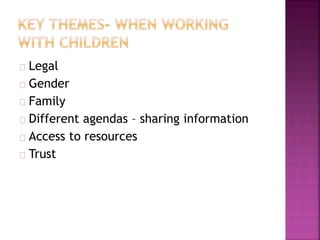
Legal 
Gender 
Family 
Different agendas – sharing information 
Access to resources 
Trust

3.3.4 ms edwina scerri

  • 1.
    Presented by EdwinaScerri and Debbie Seldon Bankstown Women Health Centre
  • 2.
    Services at thecentre include: Counselling Child-CSA Health promotion Case management A variety of groups Medical Naturopathy and massage Vietnamese counsellor Psychologists
  • 3.
    CSA clients comewith a diverse range of trauma. Often multiple trauma’s which has shaped the client in many ways and often impacts the course of therapy. This includes: Lack of affect regulation- Client finds it difficulty to stay on topic or is completely withdrawn and struggles to maintain contact.
  • 4.
    Clients irregular attendance-When there is irregular attendance there is difficulty in maintaining a flow of the therapy. Client readiness- Client may only want some sort of assistance in the area of court or written letter. Client may minimise the CSA and not think it is currently impacting them.
  • 5.
    Disability- Clients withan intellectual delay often struggle to process their emotions around the sexual abuse and the therapy often needs to be quite concrete and pragmatic. Domestic violence- The client may still be living in DV so it may be difficult to allow the client to unravel in the room when they are not going home to a safe place.
  • 6.
    Co-morbidity- Often thereare number of co-occuring mental health issues and client identifies with label and feels they have no capacity to change. Cultural and religious beliefs - That can be reinforced in a way that is quite silencing and harmful to the client.
  • 7.
    As therapist someof our goals is to: Build rapport. Build safety in the room. Take as long as needed and go at clients pace. Work relationally- attachment and counter transference. Mindfulness what we may represent to the client and really thinking into how we do things with the client.
  • 8.
    Using supervision andpeer support to get support with: Time boundaries Dealing with non-attendance Assessing clients readiness Counter transference Vicarious trauma and self-care
  • 9.
    Legal Gender Family Different agendas – sharing information Access to resources Trust