Women’s Evaluation of Abuse & 
Violence Care in General Practice: 
6 and 12 month outcomes 
Kelsey Hegarty, Lorna O’Doherty, 
Angela Taft, Patty Chondros, 
Stephanie Brown, Jodie Valpied, 
Jill Astbury, Ann Taket, Lisa Gold, 
Gene Feder, Jane Gunn 
Primary Care Research Unit, 
The University of Melbourne
Overview 
• What is the problem? 
• Why this particular intervention? 
• How did we do the trial? 
• What did we find? 
• Strengths and limitations 
• What does it all mean?
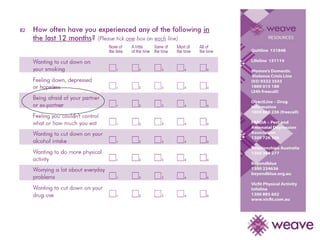
Problem Campbell (2008) 
• Intimate partner violence is common - 1 in 10 
women attending general practice Hegarty (2006) 
• Leading cause of morbidity and mortality for 
women of child-bearing age Vos (2005) 
• Not identified in primary care due to barriers for 
women and GPs, although GPs often first formal 
support that women disclose to Hegarty (2006) 
• Inadequate training in undergraduate medical 
programs Voice study (2012)
Intervention evidence 
• Systematic review suggests limited evidence around 
whether screening works or not Feder (2009) 
• Two screening trials have assessed women’s health 
outcomes – very minimal effect on QOL or mental health 
MacMillan (2009) Klevens (2012) 
• Advocacy & support groups reduce abuse in women who 
actively sought help from refuges and psychological 
interventions improve depression Feder (2009) 
• GP training interventions increase referrals from a very 
low baseline (.02%) to a low level (0.3%) Feder (2011)
Context of Intervention Nelson (2012) 
• Only one primary care screening trial - no effect of a 
US nurse management protocol compared with the 
use of a wallet-sized referral card on reducing IPV 
McFarlane (2006) 
• Two antenatal care trials, a safety planning/ 
empowerment intervention by Hong Kong nurses 
and a social worker for African American women 
found reduction in minor physical violence Tiwari 
(2005) , Kielly (2010)
What do women expect from health 
care providers? Feder, (2006) 
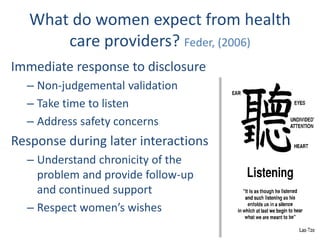
Immediate response to disclosure 
– Non-judgemental validation 
– Take time to listen 
– Address safety concerns 
Response during later interactions 
– Understand chronicity of the 
problem and provide follow-up 
and continued support 
– Respect women’s wishes
Aim Hegarty, Lancet (2013) 
To determine if an intervention consisting of 
i. screening women for IPV and notification to GP; 
ii. training GPs to respond to women; 
iii. inviting women for brief counselling with the GP 
increases 
• quality of life (primary) 
• mental health 
• safety planning and behaviours 
• GPs’ inquiry about safety of women and children 
reduces 
• depression and anxiety 
and is cost-effective
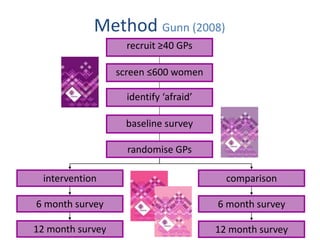
Method Gunn (2008) 
recruit ≥40 GPs 
randomise GPs 
intervention 
6 month survey 
12 month survey 
comparison 
screen ≤600 women 
identify ‘afraid’ 
6 month survey 
12 month survey 
baseline survey
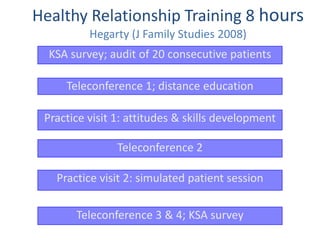
Healthy Relationship Training 8 hours 
Hegarty (J Family Studies 2008) 
KSA survey; audit of 20 consecutive patients 
Teleconference 1; distance education 
Practice visit 1: attitudes & skills development 
Teleconference 2 
Practice visit 2: simulated patient session 
Teleconference 3 & 4; KSA survey
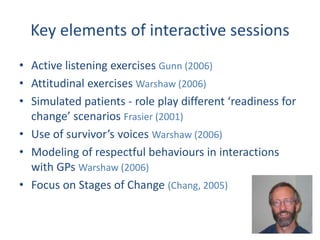
Key elements of interactive sessions 
• Active listening exercises Gunn (2006) 
• Attitudinal exercises Warshaw (2006) 
• Simulated patients - role play different ‘readiness for 
change’ scenarios Frasier (2001) 
• Use of survivor’s voices Warshaw (2006) 
• Modeling of respectful behaviours in interactions 
with GPs Warshaw (2006) 
• Focus on Stages of Change (Chang, 2005)
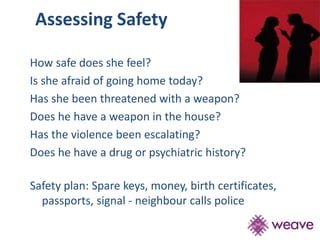
Assessing Safety 
How safe does she feel? 
Is she afraid of going home today? 
Has she been threatened with a weapon? 
Does he have a weapon in the house? 
Has the violence been escalating? 
Does he have a drug or psychiatric history? 
Safety plan: Spare keys, money, birth certificates, 
passports, signal - neighbour calls police
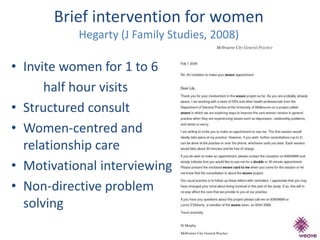
Brief intervention for women 
Hegarty (J Family Studies, 2008) 
• Invite women for 1 to 6 
half hour visits 
• Structured consult 
• Women-centred and 
relationship care 
• Motivational interviewing 
• Non-directive problem 
solving
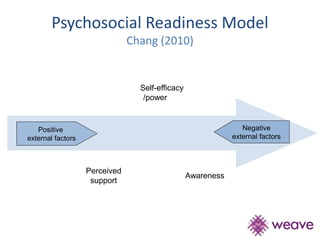
Psychosocial Readiness Model 
Positive 
external factors 
Chang (2010) 
Perceived 
support 
Self-efficacy 
/power 
Awareness 
Negative 
external factors
Overview 
• What is the problem? 
• Why this particular intervention? 
• How did we do the trial? 
• What did we find? 
• Strengths and limitations 
• What does it all mean? 
• Illustrate with stories……..
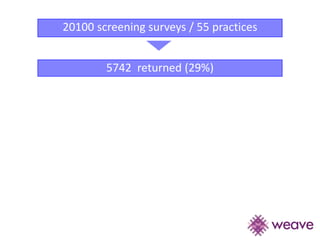
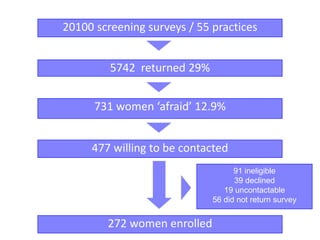
20100 screening surveys / 55 practices 
5742 returned (29%)
20100 screening surveys / 55 practices 
5742 returned 29% 
731 women ‘afraid’ 12.9% 
91 ineligible 
39 declined 
477 willing to be contacted 
19 uncontactable 
56 did not return survey 
272 women enrolled
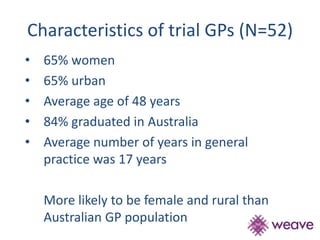
Characteristics of trial GPs (N=52) 
• 65% women 
• 65% urban 
• Average age of 48 years 
• 84% graduated in Australia 
• Average number of years in general 
practice was 17 years 
More likely to be female and rural than 
Australian GP population
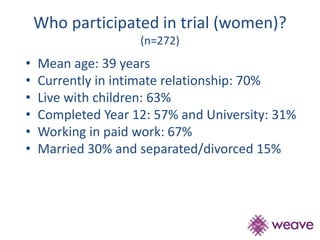
Who participated in trial (women)? 
(n=272) 
• Mean age: 39 years 
• Currently in intimate relationship: 70% 
• Live with children: 63% 
• Completed Year 12: 57% and University: 31% 
• Working in paid work: 67% 
• Married 30% and separated/divorced 15%
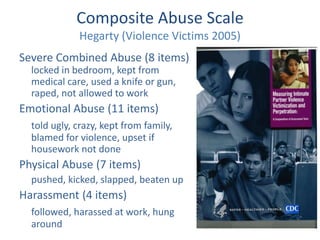
Composite Abuse Scale 
Hegarty (Violence Victims 2005) 
Severe Combined Abuse (8 items) 
locked in bedroom, kept from 
medical care, used a knife or gun, 
raped, not allowed to work 
Emotional Abuse (11 items) 
told ugly, crazy, kept from family, 
blamed for violence, upset if 
housework not done 
Physical Abuse (7 items) 
pushed, kicked, slapped, beaten up 
Harassment (4 items) 
followed, harassed at work, hung 
around
100 
90 
80 
70 
60 
50 
40 
30 
20 
10 
0 
Abuse types at baseline (n=272) 
% 
Severe 
Combined 
Abuse 
Physical & 
Emotional/ 
Harassment 
Physical 
Abuse 
Only 
Emotional/ 
Harassment 
Only 
None (below 
CAS cut-off)
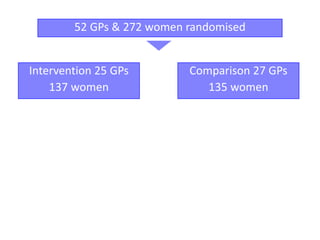
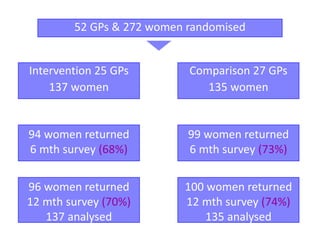
52 GPs & 272 women randomised 
Intervention 25 GPs 
137 women 
Comparison 27 GPs 
135 women
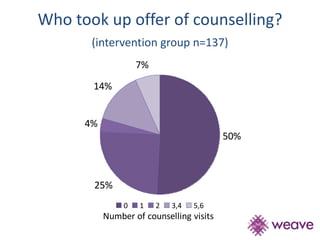
Who took up offer of counselling? 
(intervention group n=137) 
14% 
Number of counselling visits 
50% 
4% 
25% 
7% 
0 1 2 3,4 5,6
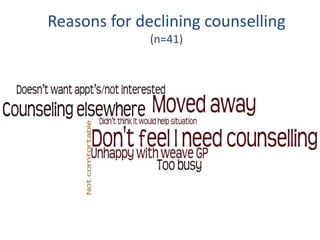
Reasons for declining counselling 
(n=41)
52 GPs & 272 women randomised 
Intervention 25 GPs 
137 women 
Comparison 27 GPs 
135 women 
94 women returned 
6 mth survey (68%) 
99 women returned 
6 mth survey (73%) 
96 women returned 
12 mth survey (70%) 
137 analysed 
100 women returned 
12 mth survey (74%) 
135 analysed
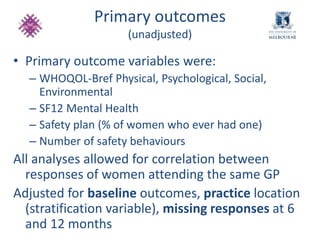
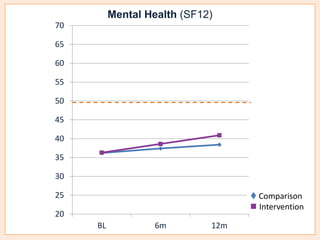
Primary outcomes 
(unadjusted) 
• Primary outcome variables were: 
– WHOQOL-Bref Physical, Psychological, Social, 
Environmental 
– SF12 Mental Health 
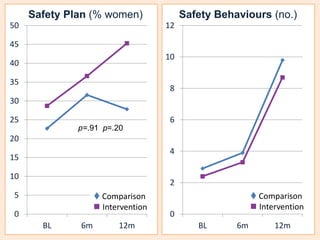
– Safety plan (% of women who ever had one) 
– Number of safety behaviours 
All analyses allowed for correlation between 
responses of women attending the same GP 
Adjusted for baseline outcomes, practice location 
(stratification variable), missing responses at 6 
and 12 months
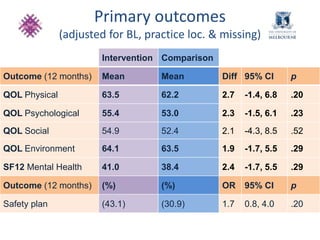
Primary outcomes 
(adjusted for BL, practice loc. & missing) 
Intervention Comparison 
Outcome (12 months) Mean Mean Diff 95% CI p 
QOL Physical 63.5 62.2 2.7 -1.4, 6.8 .20 
QOL Psychological 55.4 53.0 2.3 -1.5, 6.1 .23 
QOL Social 54.9 52.4 2.1 -4.3, 8.5 .52 
QOL Environment 64.1 63.5 1.9 -1.7, 5.5 .29 
SF12 Mental Health 41.0 38.4 2.4 -1.7, 5.5 .29 
Outcome (12 months) (%) (%) OR 95% CI p 
Safety plan (43.1) (30.9) 1.7 0.8, 4.0 .20
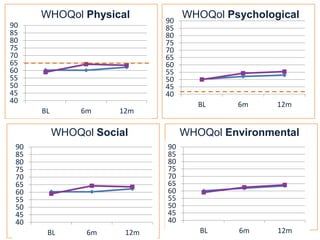
WHOQol Physical WHOQol Psychological 
90 
85 
80 
75 
70 
65 
60 
55 
50 
45 
40 
90 
85 
80 
75 
70 
65 
60 
55 
50 
45 
40 BL 6m 12m 
BL 6m 12m 
90 
85 
80 
75 
70 
65 
60 
55 
50 
45 
40 
WHOQol Social WHOQol Environmental 
BL 6m 12m 
90 
85 
80 
75 
70 
65 
60 
55 
50 
45 
40 
BL 6m 12m
70 
65 
60 
55 
50 
45 
40 
35 
30 
25 
20 
Mental Health (SF12) 
BL 6m 12m 
 Comparison 
 Intervention
12 
10 
8 
6 
4 
2 
0 
BL 6m 12m 
50 
45 
40 
35 
30 
25 
20 
15 
10 
5 
0 
Safety Plan (% women) 
BL 6m 12m 
 Comparison 
 Intervention 
 Comparison 
 Intervention 
Safety Behaviours (no.) 
p=.91 p=.20
Secondary outcomes 
(unadjusted) 
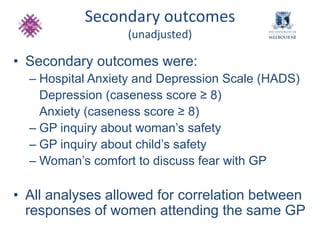
• Secondary outcomes were: 
– Hospital Anxiety and Depression Scale (HADS) 
Depression (caseness score ≥ 8) 
Anxiety (caseness score ≥ 8) 
– GP inquiry about woman’s safety 
– GP inquiry about child’s safety 
– Woman’s comfort to discuss fear with GP 
• All analyses allowed for correlation between 
responses of women attending the same GP
Secondary outcomes 
(adjusted for BL, practice loc. & missing) 
Intervention Comparison 
Outcome (12 months) (%) (%) OR 95% CI p 
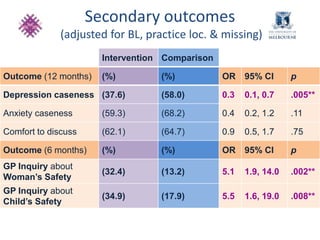
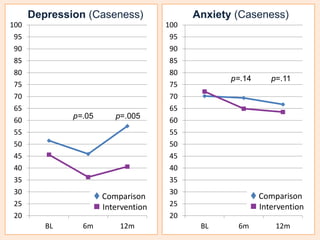
Depression caseness (37.6) (58.0) 0.3 0.1, 0.7 .005** 
Anxiety caseness (59.3) (68.2) 0.4 0.2, 1.2 .11 
Comfort to discuss (62.1) (64.7) 0.9 0.5, 1.7 .75 
Outcome (6 months) (%) (%) OR 95% CI p 
GP Inquiry about 
Woman’s Safety 
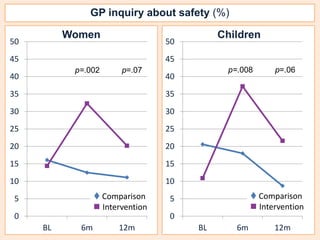
(32.4) (13.2) 5.1 1.9, 14.0 .002** 
GP Inquiry about 
Child’s Safety 
(34.9) (17.9) 5.5 1.6, 19.0 .008**
Depression (Caseness) Anxiety (Caseness) 
100 
95 
90 
85 
80 
75 
70 
65 
60 
55 
50 
45 
40 
35 
30 
25 
20 
BL 6m 12m 
100 
95 
90 
85 
80 
75 
70 
65 
60 
55 
50 
45 
40 
35 
30 
25 
20 
p=.05 p=.005 
BL 6m 12m 
 Comparison 
 Intervention 
 Comparison 
 Intervention 
p=.14 p=.11
GP inquiry about safety (%) 
50 
45 
40 
35 
30 
25 
20 
15 
10 
5 
0 
BL 6m 12m 
50 
45 
40 
35 
30 
25 
20 
15 
10 
5 
0 
Women 
BL 6m 12m 
 Comparison 
 Intervention 
 Comparison 
 Intervention 
Children 
p=.002 p=.07 p=.008 p=.06
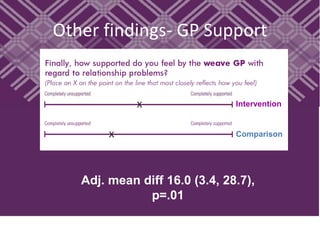
Other findings- GP Support 
X 
X Intervention 
Adj. mean diff 16.0 (3.4, 28.7), 
p=.01 
Comparison
30 
28 
26 
24 
22 
20 
18 
16 
14 
12 
10 
8 
6 
4 
2 
0 
BL 6m 12m 
 Comparison 
 Intervention 
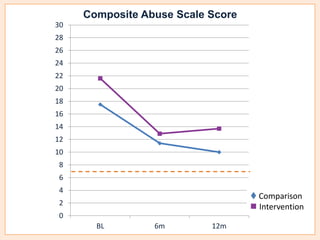
Composite Abuse Scale Score
Limitations 
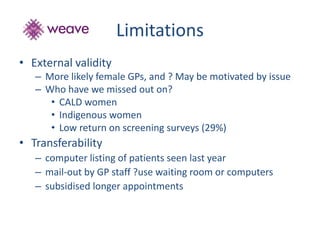
• External validity 
– More likely female GPs, and ? May be motivated by issue 
– Who have we missed out on? 
• CALD women 
• Indigenous women 
• Low return on screening surveys (29%) 
• Transferability 
– computer listing of patients seen last year 
– mail-out by GP staff ?use waiting room or computers 
– subsidised longer appointments
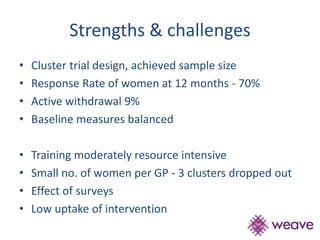
Strengths & challenges 
• Cluster trial design, achieved sample size 
• Response Rate of women at 12 months - 70% 
• Active withdrawal 9% 
• Baseline measures balanced 
• Training moderately resource intensive 
• Small no. of women per GP - 3 clusters dropped out 
• Effect of surveys 
• Low uptake of intervention
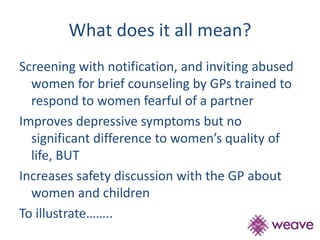
What does it all mean? 
Screening with notification, and inviting abused 
women for brief counseling by GPs trained to 
respond to women fearful of a partner 
Improves depressive symptoms but no 
significant difference to women’s quality of 
life, BUT 
Increases safety discussion with the GP about 
women and children 
To illustrate……..
To conclude..... 
I probably would have just kept plodding along with 
the way life was if I hadn’t got the weave invite. 
I still find the weave GP's probably my anchor, my 
centre point for going for things. 
She regularly keeps track of me. 
She has been my main focal point, the rest are just 
people that I see to help assist with getting through 
the journey.
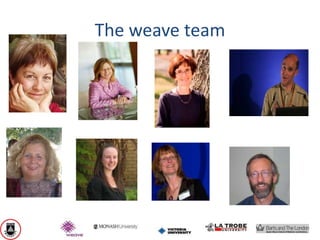
The weave team
Kelsey Hegarty 
k.hegarty@unimelb.edu.au 
Primary Care Research Unit, 
Department of General 
Practice

2.1.2 a prof kelsey hegarty

  • 1.
    Women’s Evaluation ofAbuse & Violence Care in General Practice: 6 and 12 month outcomes Kelsey Hegarty, Lorna O’Doherty, Angela Taft, Patty Chondros, Stephanie Brown, Jodie Valpied, Jill Astbury, Ann Taket, Lisa Gold, Gene Feder, Jane Gunn Primary Care Research Unit, The University of Melbourne
  • 2.
    Overview • Whatis the problem? • Why this particular intervention? • How did we do the trial? • What did we find? • Strengths and limitations • What does it all mean?
  • 3.
    Problem Campbell (2008) • Intimate partner violence is common - 1 in 10 women attending general practice Hegarty (2006) • Leading cause of morbidity and mortality for women of child-bearing age Vos (2005) • Not identified in primary care due to barriers for women and GPs, although GPs often first formal support that women disclose to Hegarty (2006) • Inadequate training in undergraduate medical programs Voice study (2012)
  • 4.
    Intervention evidence •Systematic review suggests limited evidence around whether screening works or not Feder (2009) • Two screening trials have assessed women’s health outcomes – very minimal effect on QOL or mental health MacMillan (2009) Klevens (2012) • Advocacy & support groups reduce abuse in women who actively sought help from refuges and psychological interventions improve depression Feder (2009) • GP training interventions increase referrals from a very low baseline (.02%) to a low level (0.3%) Feder (2011)
  • 5.
    Context of InterventionNelson (2012) • Only one primary care screening trial - no effect of a US nurse management protocol compared with the use of a wallet-sized referral card on reducing IPV McFarlane (2006) • Two antenatal care trials, a safety planning/ empowerment intervention by Hong Kong nurses and a social worker for African American women found reduction in minor physical violence Tiwari (2005) , Kielly (2010)
  • 6.
    What do womenexpect from health care providers? Feder, (2006) Immediate response to disclosure – Non-judgemental validation – Take time to listen – Address safety concerns Response during later interactions – Understand chronicity of the problem and provide follow-up and continued support – Respect women’s wishes
  • 7.
    Aim Hegarty, Lancet(2013) To determine if an intervention consisting of i. screening women for IPV and notification to GP; ii. training GPs to respond to women; iii. inviting women for brief counselling with the GP increases • quality of life (primary) • mental health • safety planning and behaviours • GPs’ inquiry about safety of women and children reduces • depression and anxiety and is cost-effective
  • 8.
    Method Gunn (2008) recruit ≥40 GPs randomise GPs intervention 6 month survey 12 month survey comparison screen ≤600 women identify ‘afraid’ 6 month survey 12 month survey baseline survey
  • 10.
    Healthy Relationship Training8 hours Hegarty (J Family Studies 2008) KSA survey; audit of 20 consecutive patients Teleconference 1; distance education Practice visit 1: attitudes & skills development Teleconference 2 Practice visit 2: simulated patient session Teleconference 3 & 4; KSA survey
  • 11.
    Key elements ofinteractive sessions • Active listening exercises Gunn (2006) • Attitudinal exercises Warshaw (2006) • Simulated patients - role play different ‘readiness for change’ scenarios Frasier (2001) • Use of survivor’s voices Warshaw (2006) • Modeling of respectful behaviours in interactions with GPs Warshaw (2006) • Focus on Stages of Change (Chang, 2005)
  • 12.
    Assessing Safety Howsafe does she feel? Is she afraid of going home today? Has she been threatened with a weapon? Does he have a weapon in the house? Has the violence been escalating? Does he have a drug or psychiatric history? Safety plan: Spare keys, money, birth certificates, passports, signal - neighbour calls police
  • 13.
    Brief intervention forwomen Hegarty (J Family Studies, 2008) • Invite women for 1 to 6 half hour visits • Structured consult • Women-centred and relationship care • Motivational interviewing • Non-directive problem solving
  • 14.
    Psychosocial Readiness Model Positive external factors Chang (2010) Perceived support Self-efficacy /power Awareness Negative external factors
  • 15.
    Overview • Whatis the problem? • Why this particular intervention? • How did we do the trial? • What did we find? • Strengths and limitations • What does it all mean? • Illustrate with stories……..
  • 16.
    20100 screening surveys/ 55 practices 5742 returned (29%)
  • 17.
    20100 screening surveys/ 55 practices 5742 returned 29% 731 women ‘afraid’ 12.9% 91 ineligible 39 declined 477 willing to be contacted 19 uncontactable 56 did not return survey 272 women enrolled
  • 18.
    Characteristics of trialGPs (N=52) • 65% women • 65% urban • Average age of 48 years • 84% graduated in Australia • Average number of years in general practice was 17 years More likely to be female and rural than Australian GP population
  • 19.
    Who participated intrial (women)? (n=272) • Mean age: 39 years • Currently in intimate relationship: 70% • Live with children: 63% • Completed Year 12: 57% and University: 31% • Working in paid work: 67% • Married 30% and separated/divorced 15%
  • 20.
    Composite Abuse Scale Hegarty (Violence Victims 2005) Severe Combined Abuse (8 items) locked in bedroom, kept from medical care, used a knife or gun, raped, not allowed to work Emotional Abuse (11 items) told ugly, crazy, kept from family, blamed for violence, upset if housework not done Physical Abuse (7 items) pushed, kicked, slapped, beaten up Harassment (4 items) followed, harassed at work, hung around
  • 21.
    100 90 80 70 60 50 40 30 20 10 0 Abuse types at baseline (n=272) % Severe Combined Abuse Physical & Emotional/ Harassment Physical Abuse Only Emotional/ Harassment Only None (below CAS cut-off)
  • 22.
    52 GPs &272 women randomised Intervention 25 GPs 137 women Comparison 27 GPs 135 women
  • 23.
    Who took upoffer of counselling? (intervention group n=137) 14% Number of counselling visits 50% 4% 25% 7% 0 1 2 3,4 5,6
  • 24.
    Reasons for decliningcounselling (n=41)
  • 26.
    52 GPs &272 women randomised Intervention 25 GPs 137 women Comparison 27 GPs 135 women 94 women returned 6 mth survey (68%) 99 women returned 6 mth survey (73%) 96 women returned 12 mth survey (70%) 137 analysed 100 women returned 12 mth survey (74%) 135 analysed
  • 27.
    Primary outcomes (unadjusted) • Primary outcome variables were: – WHOQOL-Bref Physical, Psychological, Social, Environmental – SF12 Mental Health – Safety plan (% of women who ever had one) – Number of safety behaviours All analyses allowed for correlation between responses of women attending the same GP Adjusted for baseline outcomes, practice location (stratification variable), missing responses at 6 and 12 months
  • 28.
    Primary outcomes (adjustedfor BL, practice loc. & missing) Intervention Comparison Outcome (12 months) Mean Mean Diff 95% CI p QOL Physical 63.5 62.2 2.7 -1.4, 6.8 .20 QOL Psychological 55.4 53.0 2.3 -1.5, 6.1 .23 QOL Social 54.9 52.4 2.1 -4.3, 8.5 .52 QOL Environment 64.1 63.5 1.9 -1.7, 5.5 .29 SF12 Mental Health 41.0 38.4 2.4 -1.7, 5.5 .29 Outcome (12 months) (%) (%) OR 95% CI p Safety plan (43.1) (30.9) 1.7 0.8, 4.0 .20
  • 29.
    WHOQol Physical WHOQolPsychological 90 85 80 75 70 65 60 55 50 45 40 90 85 80 75 70 65 60 55 50 45 40 BL 6m 12m BL 6m 12m 90 85 80 75 70 65 60 55 50 45 40 WHOQol Social WHOQol Environmental BL 6m 12m 90 85 80 75 70 65 60 55 50 45 40 BL 6m 12m
  • 30.
    70 65 60 55 50 45 40 35 30 25 20 Mental Health (SF12) BL 6m 12m  Comparison  Intervention
  • 31.
    12 10 8 6 4 2 0 BL 6m 12m 50 45 40 35 30 25 20 15 10 5 0 Safety Plan (% women) BL 6m 12m  Comparison  Intervention  Comparison  Intervention Safety Behaviours (no.) p=.91 p=.20
  • 32.
    Secondary outcomes (unadjusted) • Secondary outcomes were: – Hospital Anxiety and Depression Scale (HADS) Depression (caseness score ≥ 8) Anxiety (caseness score ≥ 8) – GP inquiry about woman’s safety – GP inquiry about child’s safety – Woman’s comfort to discuss fear with GP • All analyses allowed for correlation between responses of women attending the same GP
  • 33.
    Secondary outcomes (adjustedfor BL, practice loc. & missing) Intervention Comparison Outcome (12 months) (%) (%) OR 95% CI p Depression caseness (37.6) (58.0) 0.3 0.1, 0.7 .005** Anxiety caseness (59.3) (68.2) 0.4 0.2, 1.2 .11 Comfort to discuss (62.1) (64.7) 0.9 0.5, 1.7 .75 Outcome (6 months) (%) (%) OR 95% CI p GP Inquiry about Woman’s Safety (32.4) (13.2) 5.1 1.9, 14.0 .002** GP Inquiry about Child’s Safety (34.9) (17.9) 5.5 1.6, 19.0 .008**
  • 34.
    Depression (Caseness) Anxiety(Caseness) 100 95 90 85 80 75 70 65 60 55 50 45 40 35 30 25 20 BL 6m 12m 100 95 90 85 80 75 70 65 60 55 50 45 40 35 30 25 20 p=.05 p=.005 BL 6m 12m  Comparison  Intervention  Comparison  Intervention p=.14 p=.11
  • 35.
    GP inquiry aboutsafety (%) 50 45 40 35 30 25 20 15 10 5 0 BL 6m 12m 50 45 40 35 30 25 20 15 10 5 0 Women BL 6m 12m  Comparison  Intervention  Comparison  Intervention Children p=.002 p=.07 p=.008 p=.06
  • 36.
    Other findings- GPSupport X X Intervention Adj. mean diff 16.0 (3.4, 28.7), p=.01 Comparison
  • 37.
    30 28 26 24 22 20 18 16 14 12 10 8 6 4 2 0 BL 6m 12m  Comparison  Intervention Composite Abuse Scale Score
  • 38.
    Limitations • Externalvalidity – More likely female GPs, and ? May be motivated by issue – Who have we missed out on? • CALD women • Indigenous women • Low return on screening surveys (29%) • Transferability – computer listing of patients seen last year – mail-out by GP staff ?use waiting room or computers – subsidised longer appointments
  • 39.
    Strengths & challenges • Cluster trial design, achieved sample size • Response Rate of women at 12 months - 70% • Active withdrawal 9% • Baseline measures balanced • Training moderately resource intensive • Small no. of women per GP - 3 clusters dropped out • Effect of surveys • Low uptake of intervention
  • 40.
    What does itall mean? Screening with notification, and inviting abused women for brief counseling by GPs trained to respond to women fearful of a partner Improves depressive symptoms but no significant difference to women’s quality of life, BUT Increases safety discussion with the GP about women and children To illustrate……..
  • 41.
    To conclude..... Iprobably would have just kept plodding along with the way life was if I hadn’t got the weave invite. I still find the weave GP's probably my anchor, my centre point for going for things. She regularly keeps track of me. She has been my main focal point, the rest are just people that I see to help assist with getting through the journey.
  • 42.
  • 43.
    Kelsey Hegarty k.hegarty@unimelb.edu.au Primary Care Research Unit, Department of General Practice