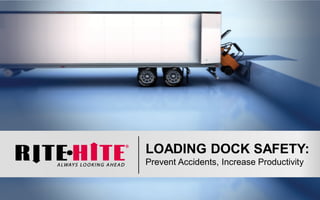
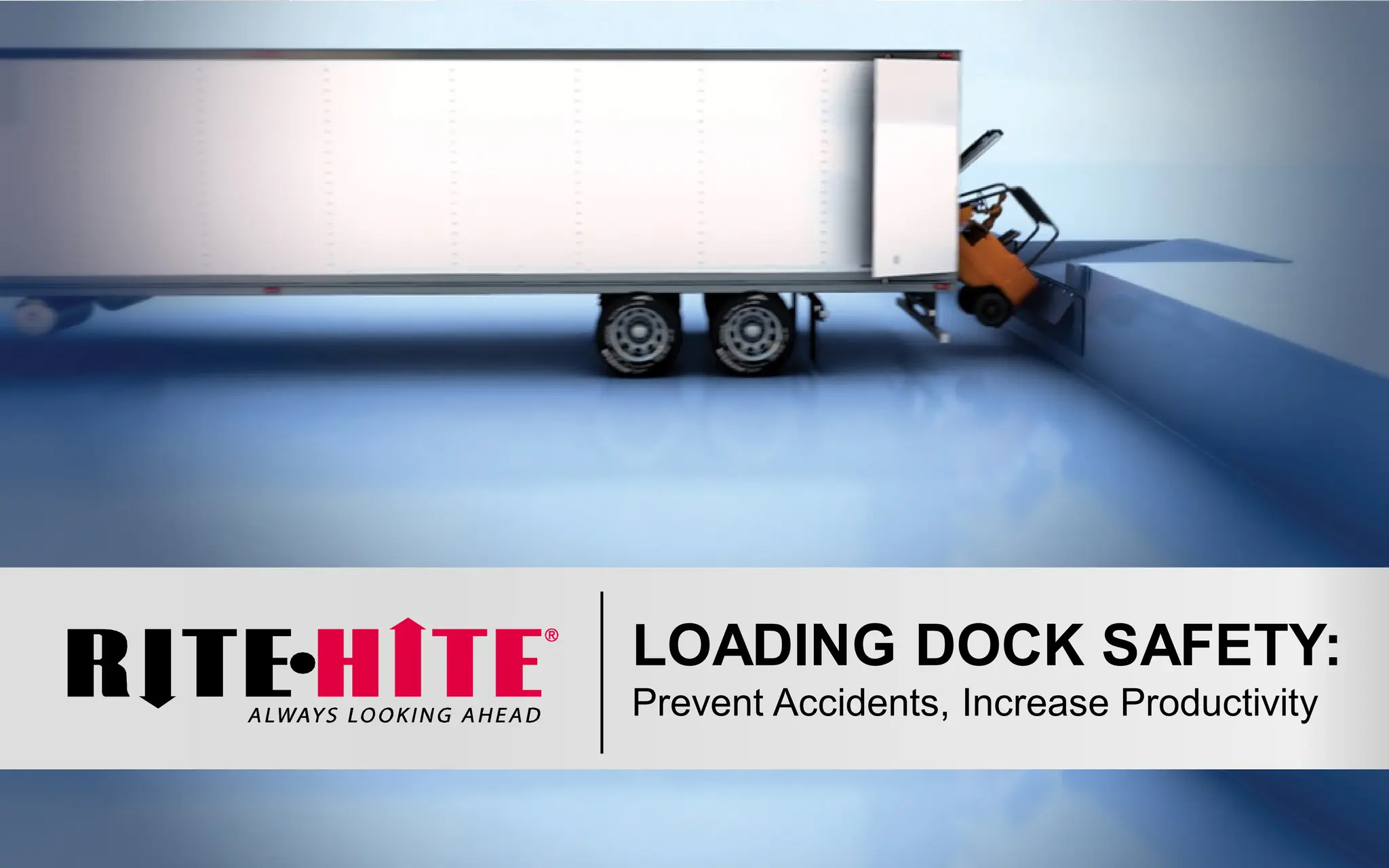
LOADING DOCK SAFETY:
Prevent Accidents, Increase Productivity
Who is Rite-Hite?
• A world leader in the manufacture, sale, and service of loading dock equipment,
industrial doors, safety barriers, HVLS fans, industrial curtain walls, and more – all
designed to improve safety, security, productivity, energy savings, and environmental
control.
• Sell through a global distribution network who represent Rite-Hite on an exclusive
basis throughout the world
• Customer base includes:
– End users
– Contractors
– 3rd party logistic services
– Any one that loads and/or unloads trucks and trailers
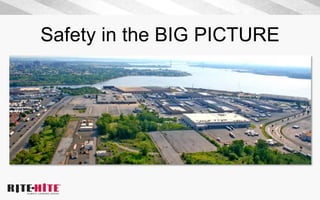
Safety in the BIG PICTURE
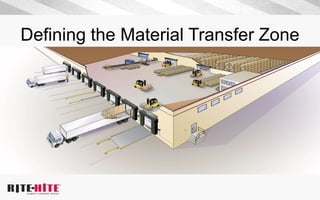
Defining the Material Transfer Zone
Risk Recognition within the M.T.Z.
• Trailer Hazards: Identifying damage during inspections
• Problem: Catastrophic trailer separation accidents
• Problem: Trailer drop
• Problem: Insufficient visual communication
• Problem: Landing gears fail
• Problem: Falls from dock platforms and vacant loading docks
• Problem: “Dock Shock”
• Best Practices for dock leveler maintenance
• Problem: Hot trailer marker lights can cause fires
• Problem: Is water creating a safety concern at your loading dock
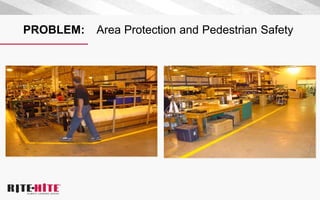
• Problem: Area protection and pedestrian safety
High % of accidents take place at
the Material Transfer Zone
• Every 3 days someone is killed in a forklift related accident
• An additional 94,750 forklift related injuries are reported each year.
• $135,000,000 in immediate costs are incurred due to forklift accidents
• 7% of forklift accidents occur when a lift truck is driven off a loading dock
• 70% of all reported accidents could have been avoided with proper safety precautions
*nist.gov, “Performance Metrics for Intelligence Systems Workshop” 2009
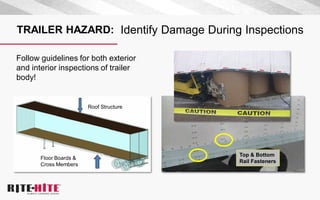
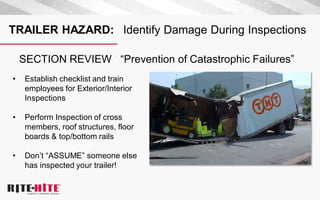
TRAILER HAZARD: Identify Damage During Inspections
Follow guidelines for both exterior
and interior inspections of trailer
body!
Roof Structure
Floor Boards &
Cross Members
Top & Bottom
Rail Fasteners
TRAILER HAZARD: Identify Damage During Inspections
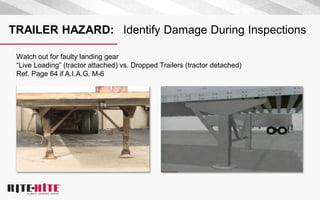
Watch out for faulty landing gear
“Live Loading” (tractor attached) vs. Dropped Trailers (tractor detached)
Ref. Page 64 if A.I.A.G. M-6
TRAILER HAZARD: Identify Damage During Inspections
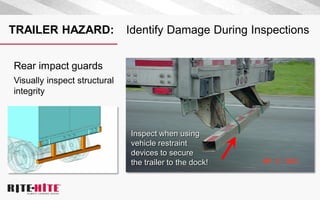
Inspect when using
vehicle restraint
devices to secure
the trailer to the dock!
Rear impact guards
Visually inspect structural
integrity
TRAILER HAZARD: Identify Damage During Inspections
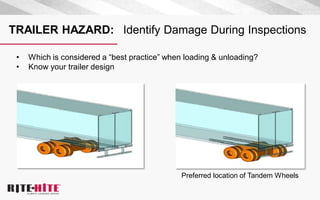
• Which is considered a “best practice” when loading & unloading?
• Know your trailer design
Preferred location of Tandem Wheels
TRAILER HAZARD: Identify Damage During Inspections
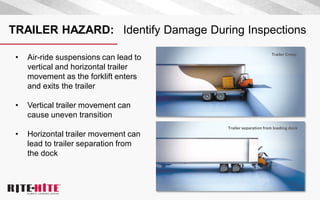
• Air-ride suspensions can lead to
vertical and horizontal trailer
movement as the forklift enters
and exits the trailer
• Vertical trailer movement can
cause uneven transition
• Horizontal trailer movement can
lead to trailer separation from
the dock
Trailer Creep
Trailer separation from loading dock
TRAILER HAZARD: Identify Damage During Inspections
• Establish checklist and train
employees for Exterior/Interior
Inspections
• Perform Inspection of cross
members, roof structures, floor
boards & top/bottom rails
• Don’t “ASSUME” someone else
has inspected your trailer!
SECTION REVIEW “Prevention of Catastrophic Failures”
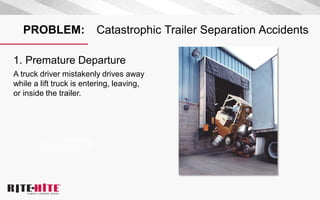
PROBLEM: Catastrophic Trailer Separation Accidents
1. Premature Departure
A truck driver mistakenly drives away
while a lift truck is entering, leaving,
or inside the trailer.
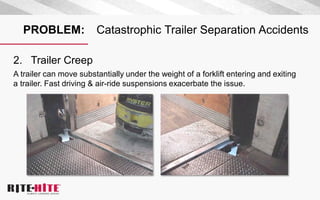
PROBLEM: Catastrophic Trailer Separation Accidents
2. Trailer Creep
A trailer can move substantially under the weight of a forklift entering and exiting
a trailer. Fast driving & air-ride suspensions exacerbate the issue.
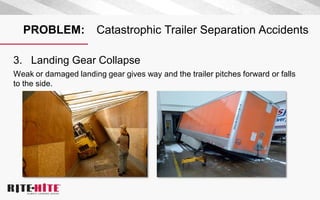
PROBLEM: Catastrophic Trailer Separation Accidents
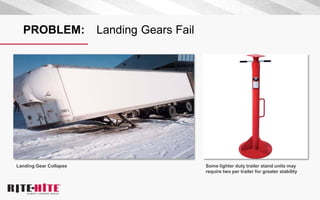
3. Landing Gear Collapse
Weak or damaged landing gear gives way and the trailer pitches forward or falls
to the side.
PROBLEM: Catastrophic Trailer Separation Accidents
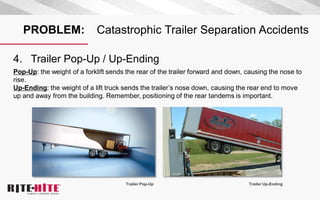
4. Trailer Pop-Up / Up-Ending
Pop-Up: the weight of a forklift sends the rear of the trailer forward and down, causing the nose to
rise.
Up-Ending: the weight of a lift truck sends the trailer’s nose down, causing the rear end to move
up and away from the building. Remember, positioning of the rear tandems is important.
Trailer Pop-Up Trailer Up-Ending
PROBLEM: Catastrophic Trailer Separation Accidents
1910.178 OSHA guide
(7) Brakes shall be set and wheel blocks shall be in place
to prevent movement of trucks, trailers, or railroad cars
while loading or unloading.
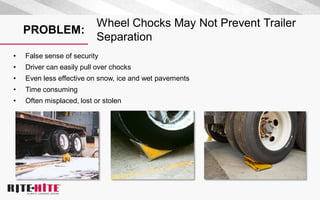
PROBLEM:
Wheel Chocks May Not Prevent Trailer
Separation
• False sense of security
• Driver can easily pull over chocks
• Even less effective on snow, ice and wet pavements
• Time consuming
• Often misplaced, lost or stolen
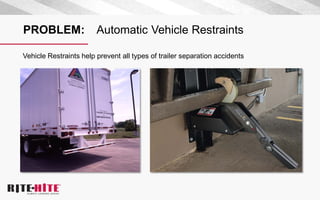
PROBLEM: Automatic Vehicle Restraints
Vehicle Restraints help prevent all types of trailer separation accidents
PROBLEM: Automatic Vehicle Restraints
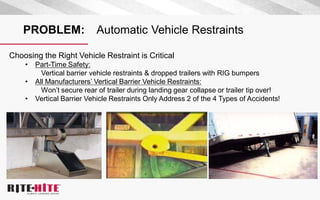
Choosing the Right Vehicle Restraint is Critical
• Part-Time Safety:
Vertical barrier vehicle restraints & dropped trailers with RIG bumpers
• All Manufacturers’ Vertical Barrier Vehicle Restraints:
Won’t secure rear of trailer during landing gear collapse or trailer tip over!
• Vertical Barrier Vehicle Restraints Only Address 2 of the 4 Types of Accidents!
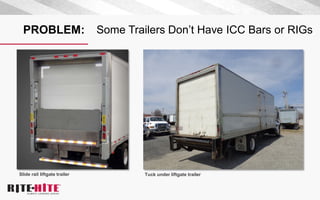
PROBLEM: Some Trailers Don’t Have ICC Bars or RIGs
Slide rail liftgate trailer Tuck under liftgate trailer
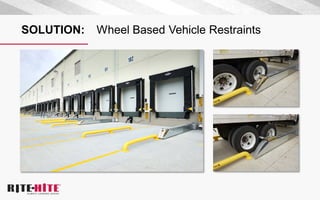
SOLUTION: Wheel Based Vehicle Restraints
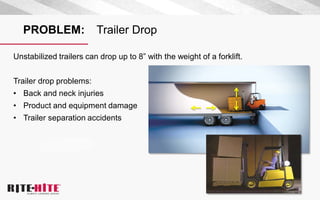
PROBLEM: Trailer Drop
Unstabilized trailers can drop up to 8” with the weight of a forklift.
Trailer drop problems:
• Back and neck injuries
• Product and equipment damage
• Trailer separation accidents
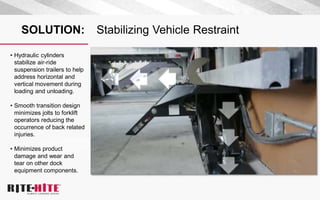
SOLUTION: Stabilizing Vehicle Restraint
• Hydraulic cylinders
stabilize air-ride
suspension trailers to help
address horizontal and
vertical movement during
loading and unloading.
• Smooth transition design
minimizes jolts to forklift
operators reducing the
occurrence of back related
injuries.
• Minimizes product
damage and wear and
tear on other dock
equipment components.
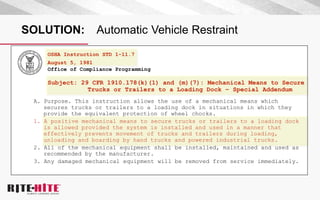
SOLUTION: Automatic Vehicle Restraint
OSHA Instruction STD 1-11.7
August 5, 1981
Office of Compliance Programming
Subject: 29 CFR 1910.178(k)(1) and (m)(7): Mechanical Means to Secure
Trucks or Trailers to a Loading Dock – Special Addendum
A. Purpose. This instruction allows the use of a mechanical means which
secures trucks or trailers to a loading dock in situations in which they
provide the equivalent protection of wheel chocks.
1. A positive mechanical means to secure trucks or trailers to a loading dock
is allowed provided the system is installed and used in a manner that
effectively prevents movement of trucks and trailers during loading,
unloading and boarding by hand trucks and powered industrial trucks.
2. All of the mechanical equipment shall be installed, maintained and used as
recommended by the manufacturer.
3. Any damaged mechanical equipment will be removed from service immediately.
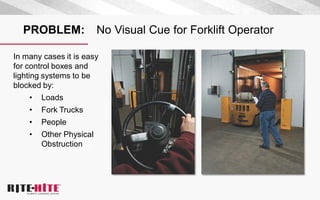
PROBLEM: No Visual Cue for Forklift Operator
In many cases it is easy
for control boxes and
lighting systems to be
blocked by:
• Loads
• Fork Trucks
• People
• Other Physical
Obstruction
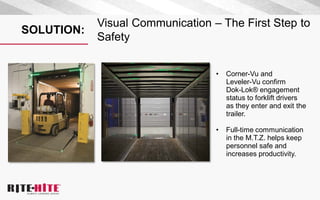
SOLUTION:
Visual Communication – The First Step to
Safety
• Corner-Vu and
Leveler-Vu confirm
Dok-Lok® engagement
status to forklift drivers
as they enter and exit the
trailer.
• Full-time communication
in the M.T.Z. helps keep
personnel safe and
increases productivity.
PROBLEM: Landing Gears Fail
Some lighter duty trailer stand units may
require two per trailer for greater stability
Landing Gear Collapse
PROBLEM: Landing Gears Fail
OSHA guide 1910.178 (k)(3)
Fixed jacks may be necessary to support a semi-trailer and
prevent upending during the loading or unloading when the
trailer is not coupled to a tractor.
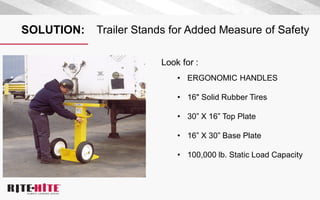
SOLUTION: Trailer Stands for Added Measure of Safety
Look for :
• ERGONOMIC HANDLES
• 16" Solid Rubber Tires
• 30” X 16” Top Plate
• 16” X 30” Base Plate
• 100,000 lb. Static Load Capacity
PROBLEM:
Falls From Dock Platforms & Vacant
Loading Docks
OSHA guide 1910.23 Guarding floor and wall openings and holes
• (a) Protection for floor openings. (1) Every stairway floor
opening shall be guarded by a standard railing...
• (10)(b) Protection for wall openings and holes.
(1) Every wall opening from which there is a drop of more than 4’
shall be guarded by one of the following
• (i) Rail, roller, picket fence, half door, or equivalent barrier...
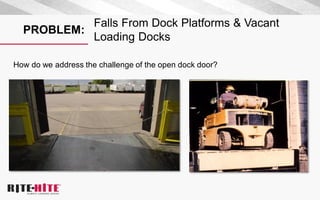
PROBLEM:
Falls From Dock Platforms & Vacant
Loading Docks
How do we address the challenge of the open dock door?
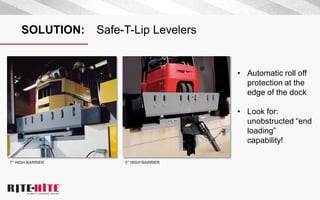
SOLUTION: Safe-T-Lip Levelers
• Automatic roll off
protection at the
edge of the dock
• Look for:
unobstructed “end
loading”
capability!
7" HIGH BARRIER 5" HIGH BARRIER
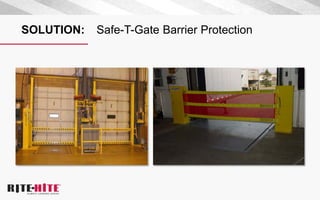
SOLUTION: Safe-T-Gate Barrier Protection
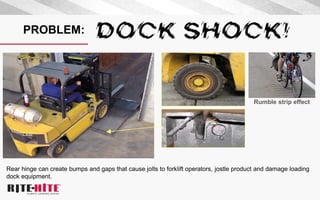
PROBLEM:
Rear hinge can create bumps and gaps that cause jolts to forklift operators, jostle product and damage loading
dock equipment.
Rumble strip effect
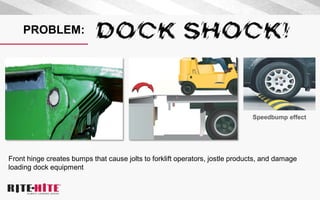
PROBLEM:
Front hinge creates bumps that cause jolts to forklift operators, jostle products, and damage
loading dock equipment
Speedbump effect
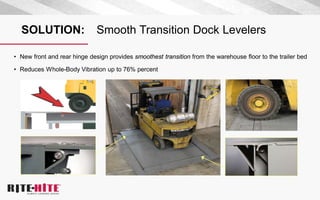
SOLUTION: Smooth Transition Dock Levelers
• New front and rear hinge design provides smoothest transition from the warehouse floor to the trailer bed
• Reduces Whole-Body Vibration up to 76% percent
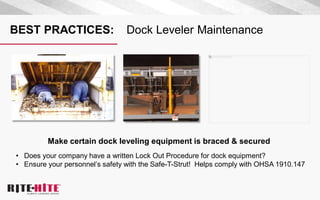
BEST PRACTICES: Dock Leveler Maintenance
Make certain dock leveling equipment is braced & secured
• Does your company have a written Lock Out Procedure for dock equipment?
• Ensure your personnel’s safety with the Safe-T-Strut! Helps comply with OHSA 1910.147
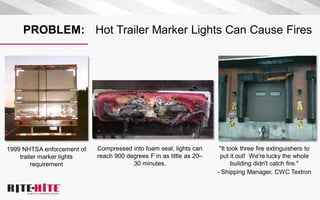
PROBLEM: Hot Trailer Marker Lights Can Cause Fires
"It took three fire extinguishers to
put it out! We're lucky the whole
building didn't catch fire."
- Shipping Manager, CWC Textron
1999 NHTSA enforcement of
trailer marker lights
requirement
Compressed into foam seal, lights can
reach 900 degrees F in as little as 20–
30 minutes.
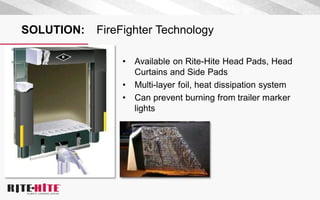
SOLUTION: FireFighter Technology
• Available on Rite-Hite Head Pads, Head
Curtains and Side Pads
• Multi-layer foil, heat dissipation system
• Can prevent burning from trailer marker
lights
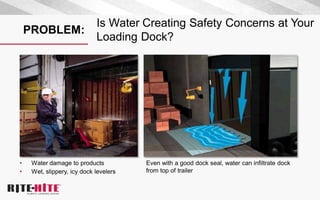
PROBLEM:
Is Water Creating Safety Concerns at Your
Loading Dock?
• Water damage to products
• Wet, slippery, icy dock levelers
Even with a good dock seal, water can infiltrate dock
from top of trailer
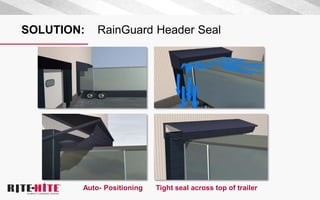
SOLUTION: RainGuard Header Seal
Tight seal across top of trailer
Auto- Positioning
PROBLEM: Area Protection and Pedestrian Safety
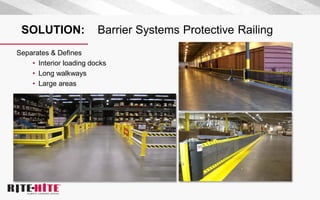
SOLUTION: Barrier Systems Protective Railing
Separates & Defines
• Interior loading docks
• Long walkways
• Large areas
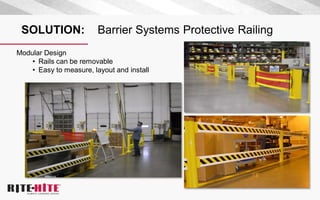
SOLUTION: Barrier Systems Protective Railing
Modular Design
• Rails can be removable
• Easy to measure, layout and install
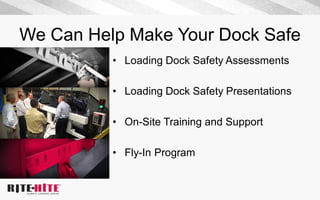
We Can Help Make Your Dock Safe
• Loading Dock Safety Assessments
• Loading Dock Safety Presentations
• On-Site Training and Support
• Fly-In Program
Thanks to…
• Supporting materials for this seminar were provided by the following groups:
– Pulp & Paper Safety Association
– Automotive Industry Action Group (refer to M-6)
www.ppsa.org/orderform.htm
Contact Us
• 30 plus years of Material Handling Industry experience. Available to speak
to Plants, Distribution Centers, Trade Associations or Conventions on any of
the topics listed above.
• Experience working as a liaison between Rite-Hite, our representative
enterprise and World Wide customer base of Fortune 1000 Companies.
Walt Swietlik
Director, Customer Relations and Sales Support
RITE HITE Corporation
8900 N. Arbon Drive
Milwaukee, WI 53223 USA
www.ritehite.com
wswietlik@ritehite.com
Office: 414-973-3631
Toll Free: 800-456-0600
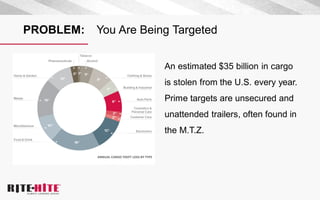
PROBLEM: You Are Being Targeted
ANNUAL CARGO THEFT LOSS BY TYPE
An estimated $35 billion in cargo
is stolen from the U.S. every year.
Prime targets are unsecured and
unattended trailers, often found in
the M.T.Z.
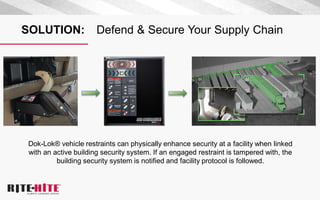
SOLUTION: Defend & Secure Your Supply Chain
Dok-Lok® vehicle restraints can physically enhance security at a facility when linked
with an active building security system. If an engaged restraint is tampered with, the
building security system is notified and facility protocol is followed.

Loading dock safety best practices document

  • 1.
    LOADING DOCK SAFETY: PreventAccidents, Increase Productivity
  • 2.
    Who is Rite-Hite? •A world leader in the manufacture, sale, and service of loading dock equipment, industrial doors, safety barriers, HVLS fans, industrial curtain walls, and more – all designed to improve safety, security, productivity, energy savings, and environmental control. • Sell through a global distribution network who represent Rite-Hite on an exclusive basis throughout the world • Customer base includes: – End users – Contractors – 3rd party logistic services – Any one that loads and/or unloads trucks and trailers
  • 3.
    Safety in theBIG PICTURE
  • 4.
    Defining the MaterialTransfer Zone
  • 5.
    Risk Recognition withinthe M.T.Z. • Trailer Hazards: Identifying damage during inspections • Problem: Catastrophic trailer separation accidents • Problem: Trailer drop • Problem: Insufficient visual communication • Problem: Landing gears fail • Problem: Falls from dock platforms and vacant loading docks • Problem: “Dock Shock” • Best Practices for dock leveler maintenance • Problem: Hot trailer marker lights can cause fires • Problem: Is water creating a safety concern at your loading dock • Problem: Area protection and pedestrian safety
  • 6.
    High % ofaccidents take place at the Material Transfer Zone • Every 3 days someone is killed in a forklift related accident • An additional 94,750 forklift related injuries are reported each year. • $135,000,000 in immediate costs are incurred due to forklift accidents • 7% of forklift accidents occur when a lift truck is driven off a loading dock • 70% of all reported accidents could have been avoided with proper safety precautions *nist.gov, “Performance Metrics for Intelligence Systems Workshop” 2009
  • 7.
    TRAILER HAZARD: IdentifyDamage During Inspections Follow guidelines for both exterior and interior inspections of trailer body! Roof Structure Floor Boards & Cross Members Top & Bottom Rail Fasteners
  • 8.
    TRAILER HAZARD: IdentifyDamage During Inspections Watch out for faulty landing gear “Live Loading” (tractor attached) vs. Dropped Trailers (tractor detached) Ref. Page 64 if A.I.A.G. M-6
  • 9.
    TRAILER HAZARD: IdentifyDamage During Inspections Inspect when using vehicle restraint devices to secure the trailer to the dock! Rear impact guards Visually inspect structural integrity
  • 10.
    TRAILER HAZARD: IdentifyDamage During Inspections • Which is considered a “best practice” when loading & unloading? • Know your trailer design Preferred location of Tandem Wheels
  • 11.
    TRAILER HAZARD: IdentifyDamage During Inspections • Air-ride suspensions can lead to vertical and horizontal trailer movement as the forklift enters and exits the trailer • Vertical trailer movement can cause uneven transition • Horizontal trailer movement can lead to trailer separation from the dock Trailer Creep Trailer separation from loading dock
  • 12.
    TRAILER HAZARD: IdentifyDamage During Inspections • Establish checklist and train employees for Exterior/Interior Inspections • Perform Inspection of cross members, roof structures, floor boards & top/bottom rails • Don’t “ASSUME” someone else has inspected your trailer! SECTION REVIEW “Prevention of Catastrophic Failures”
  • 13.
    PROBLEM: Catastrophic TrailerSeparation Accidents 1. Premature Departure A truck driver mistakenly drives away while a lift truck is entering, leaving, or inside the trailer.
  • 14.
    PROBLEM: Catastrophic TrailerSeparation Accidents 2. Trailer Creep A trailer can move substantially under the weight of a forklift entering and exiting a trailer. Fast driving & air-ride suspensions exacerbate the issue.
  • 15.
    PROBLEM: Catastrophic TrailerSeparation Accidents 3. Landing Gear Collapse Weak or damaged landing gear gives way and the trailer pitches forward or falls to the side.
  • 16.
    PROBLEM: Catastrophic TrailerSeparation Accidents 4. Trailer Pop-Up / Up-Ending Pop-Up: the weight of a forklift sends the rear of the trailer forward and down, causing the nose to rise. Up-Ending: the weight of a lift truck sends the trailer’s nose down, causing the rear end to move up and away from the building. Remember, positioning of the rear tandems is important. Trailer Pop-Up Trailer Up-Ending
  • 17.
    PROBLEM: Catastrophic TrailerSeparation Accidents 1910.178 OSHA guide (7) Brakes shall be set and wheel blocks shall be in place to prevent movement of trucks, trailers, or railroad cars while loading or unloading.
  • 18.
    PROBLEM: Wheel Chocks MayNot Prevent Trailer Separation • False sense of security • Driver can easily pull over chocks • Even less effective on snow, ice and wet pavements • Time consuming • Often misplaced, lost or stolen
  • 19.
    PROBLEM: Automatic VehicleRestraints Vehicle Restraints help prevent all types of trailer separation accidents
  • 20.
    PROBLEM: Automatic VehicleRestraints Choosing the Right Vehicle Restraint is Critical • Part-Time Safety: Vertical barrier vehicle restraints & dropped trailers with RIG bumpers • All Manufacturers’ Vertical Barrier Vehicle Restraints: Won’t secure rear of trailer during landing gear collapse or trailer tip over! • Vertical Barrier Vehicle Restraints Only Address 2 of the 4 Types of Accidents!
  • 21.
    PROBLEM: Some TrailersDon’t Have ICC Bars or RIGs Slide rail liftgate trailer Tuck under liftgate trailer
  • 22.
    SOLUTION: Wheel BasedVehicle Restraints
  • 23.
    PROBLEM: Trailer Drop Unstabilizedtrailers can drop up to 8” with the weight of a forklift. Trailer drop problems: • Back and neck injuries • Product and equipment damage • Trailer separation accidents
  • 24.
    SOLUTION: Stabilizing VehicleRestraint • Hydraulic cylinders stabilize air-ride suspension trailers to help address horizontal and vertical movement during loading and unloading. • Smooth transition design minimizes jolts to forklift operators reducing the occurrence of back related injuries. • Minimizes product damage and wear and tear on other dock equipment components.
  • 25.
    SOLUTION: Automatic VehicleRestraint OSHA Instruction STD 1-11.7 August 5, 1981 Office of Compliance Programming Subject: 29 CFR 1910.178(k)(1) and (m)(7): Mechanical Means to Secure Trucks or Trailers to a Loading Dock – Special Addendum A. Purpose. This instruction allows the use of a mechanical means which secures trucks or trailers to a loading dock in situations in which they provide the equivalent protection of wheel chocks. 1. A positive mechanical means to secure trucks or trailers to a loading dock is allowed provided the system is installed and used in a manner that effectively prevents movement of trucks and trailers during loading, unloading and boarding by hand trucks and powered industrial trucks. 2. All of the mechanical equipment shall be installed, maintained and used as recommended by the manufacturer. 3. Any damaged mechanical equipment will be removed from service immediately.
  • 26.
    PROBLEM: No VisualCue for Forklift Operator In many cases it is easy for control boxes and lighting systems to be blocked by: • Loads • Fork Trucks • People • Other Physical Obstruction
  • 27.
    SOLUTION: Visual Communication –The First Step to Safety • Corner-Vu and Leveler-Vu confirm Dok-Lok® engagement status to forklift drivers as they enter and exit the trailer. • Full-time communication in the M.T.Z. helps keep personnel safe and increases productivity.
  • 28.
    PROBLEM: Landing GearsFail Some lighter duty trailer stand units may require two per trailer for greater stability Landing Gear Collapse
  • 29.
    PROBLEM: Landing GearsFail OSHA guide 1910.178 (k)(3) Fixed jacks may be necessary to support a semi-trailer and prevent upending during the loading or unloading when the trailer is not coupled to a tractor.
  • 30.
    SOLUTION: Trailer Standsfor Added Measure of Safety Look for : • ERGONOMIC HANDLES • 16" Solid Rubber Tires • 30” X 16” Top Plate • 16” X 30” Base Plate • 100,000 lb. Static Load Capacity
  • 31.
    PROBLEM: Falls From DockPlatforms & Vacant Loading Docks OSHA guide 1910.23 Guarding floor and wall openings and holes • (a) Protection for floor openings. (1) Every stairway floor opening shall be guarded by a standard railing... • (10)(b) Protection for wall openings and holes. (1) Every wall opening from which there is a drop of more than 4’ shall be guarded by one of the following • (i) Rail, roller, picket fence, half door, or equivalent barrier...
  • 32.
    PROBLEM: Falls From DockPlatforms & Vacant Loading Docks How do we address the challenge of the open dock door?
  • 33.
    SOLUTION: Safe-T-Lip Levelers •Automatic roll off protection at the edge of the dock • Look for: unobstructed “end loading” capability! 7" HIGH BARRIER 5" HIGH BARRIER
  • 34.
  • 35.
    PROBLEM: Rear hinge cancreate bumps and gaps that cause jolts to forklift operators, jostle product and damage loading dock equipment. Rumble strip effect
  • 36.
    PROBLEM: Front hinge createsbumps that cause jolts to forklift operators, jostle products, and damage loading dock equipment Speedbump effect
  • 37.
    SOLUTION: Smooth TransitionDock Levelers • New front and rear hinge design provides smoothest transition from the warehouse floor to the trailer bed • Reduces Whole-Body Vibration up to 76% percent
  • 38.
    BEST PRACTICES: DockLeveler Maintenance Make certain dock leveling equipment is braced & secured • Does your company have a written Lock Out Procedure for dock equipment? • Ensure your personnel’s safety with the Safe-T-Strut! Helps comply with OHSA 1910.147
  • 39.
    PROBLEM: Hot TrailerMarker Lights Can Cause Fires "It took three fire extinguishers to put it out! We're lucky the whole building didn't catch fire." - Shipping Manager, CWC Textron 1999 NHTSA enforcement of trailer marker lights requirement Compressed into foam seal, lights can reach 900 degrees F in as little as 20– 30 minutes.
  • 40.
    SOLUTION: FireFighter Technology •Available on Rite-Hite Head Pads, Head Curtains and Side Pads • Multi-layer foil, heat dissipation system • Can prevent burning from trailer marker lights
  • 41.
    PROBLEM: Is Water CreatingSafety Concerns at Your Loading Dock? • Water damage to products • Wet, slippery, icy dock levelers Even with a good dock seal, water can infiltrate dock from top of trailer
  • 42.
    SOLUTION: RainGuard HeaderSeal Tight seal across top of trailer Auto- Positioning
  • 43.
    PROBLEM: Area Protectionand Pedestrian Safety
  • 44.
    SOLUTION: Barrier SystemsProtective Railing Separates & Defines • Interior loading docks • Long walkways • Large areas
  • 45.
    SOLUTION: Barrier SystemsProtective Railing Modular Design • Rails can be removable • Easy to measure, layout and install
  • 46.
    We Can HelpMake Your Dock Safe • Loading Dock Safety Assessments • Loading Dock Safety Presentations • On-Site Training and Support • Fly-In Program
  • 47.
    Thanks to… • Supportingmaterials for this seminar were provided by the following groups: – Pulp & Paper Safety Association – Automotive Industry Action Group (refer to M-6) www.ppsa.org/orderform.htm
  • 48.
    Contact Us • 30plus years of Material Handling Industry experience. Available to speak to Plants, Distribution Centers, Trade Associations or Conventions on any of the topics listed above. • Experience working as a liaison between Rite-Hite, our representative enterprise and World Wide customer base of Fortune 1000 Companies. Walt Swietlik Director, Customer Relations and Sales Support RITE HITE Corporation 8900 N. Arbon Drive Milwaukee, WI 53223 USA www.ritehite.com wswietlik@ritehite.com Office: 414-973-3631 Toll Free: 800-456-0600
  • 49.
    PROBLEM: You AreBeing Targeted ANNUAL CARGO THEFT LOSS BY TYPE An estimated $35 billion in cargo is stolen from the U.S. every year. Prime targets are unsecured and unattended trailers, often found in the M.T.Z.
  • 50.
    SOLUTION: Defend &Secure Your Supply Chain Dok-Lok® vehicle restraints can physically enhance security at a facility when linked with an active building security system. If an engaged restraint is tampered with, the building security system is notified and facility protocol is followed.