ADVENTURES
                         IN AGILITY
            How One Publisher Changed Its Approach
               to Online Development in 45 Days


Larry M. Belmont
Manager, Online Development
labelmo at aip dot org

Society for Scholarly Publishing
30th Annual Meeting, Boston, MA
May 30, 2008
About AIP
• Founded in 1931 as a service organization …
  – Charter: to diffuse and advance the knowledge of physics
    and its application to human welfare
  – Service mission: to supply economy-of-scale publishing
    services to Member Societies
  – Currently has 10 member societies, 23 affiliated societies,
    and several other organizations under its umbrella (most
    have a publishing program)
• A publisher in its own right …
  – 10 journals, conference proceedings, database products
• Scitation …
  – AIP’s online hosting platform; on the web since 1996
  – Aggregation of 180 publications for 25 publishing partners
About me
• 27 years in publishing, all at AIP …
  – 9 years in print journal production (most as a
    technical copy-editor)
  – 3 years in desktop publication production
  – 15 years in electronic/online products (8 as a
    manager)
• Currently an online product development
  manager in a business unit
• Not a programmer; more of a technical
  projects manager/product manager
Our goals
• Increase development speed in order to meet
  customer and customer constituency demands, as
  well as our own needs to evolve our services more
  regularly

• Position ourselves to innovate or deploy new
  features quickly in response to unpredictable
  “market conditions,” major paradigm shifts (like
  Web 2.0), or good ole competitive one-upsmanship
The enemy is us
• Project (micro)management
• “Perfect-plan-ism”
• Fear of failure (culture of “that won’t work”)
• Distributed decision-making
• Monolithic release mentality
• Design by committee
• Disconnect from users and customers at all
  but latest stages
• Compartmentalization, thick-walled bizunit-
  bizunit and bizunit-IT silos
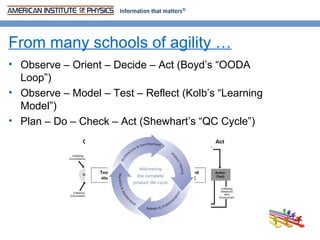
From many schools of agility …
• Observe – Orient – Decide – Act (Boyd’s “OODA
  Loop”)
• Observe – Model – Test – Reflect (Kolb’s “Learning
  Model”)
• Plan – Do – Check – Act (Shewhart’s “QC Cycle”)
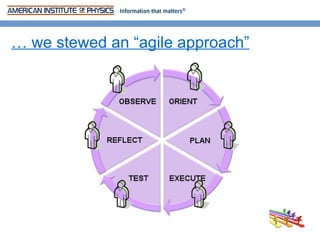
… we stewed an “agile approach”
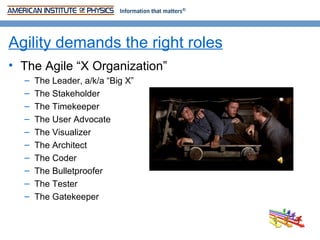
Agility demands the right roles
• The Agile “X Organization”
  –   The Leader, a/k/a “Big X”
  –   The Stakeholder
  –   The Timekeeper
  –   The User Advocate
  –   The Visualizer
  –   The Architect
  –   The Coder
  –   The Bulletproofer
  –   The Tester
  –   The Gatekeeper
What was our “Big X” like?
• Did not act like a certified project manager;
  more of an engager-resonator-cultivator-
  harmonizer

• Articulated clear intent/goal (co-signed “the
  contract of leadership” with the team)

• Asked the team to accomplish the goal, but
  did not tell them how to do it
Team attributes
•   Highly motivated, highly skilled
•   Zen-like, intuitive understanding (“feeling it”)
•   Mix of experienced hands, fresh POVs
•   Rank did not dictate leadership role(s)
•   Business-technology blend
•   Self-mobilizing at all levels
•   Cross-pollinating
•   Credibility, mutual respect, passion, trust
•   Subjugation of personal agendas
Team behaviors
• Highly verbal
• No blame, no fear
• No assumptions, projections, conceits
• Dialogue over monologue
• Sublimation of egos, but wide berth given to
  passionate POVs
• Devil’s advocacy tempers evangelism
• Belief in user input and test-driven
  development as primary design driver
A little inspiration
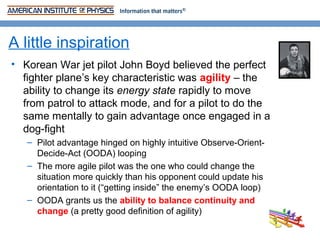
• Korean War jet pilot John Boyd believed the perfect
  fighter plane’s key characteristic was agility – the
  ability to change its energy state rapidly to move
  from patrol to attack mode, and for a pilot to do the
  same mentally to gain advantage once engaged in a
  dog-fight
   – Pilot advantage hinged on highly intuitive Observe-Orient-
     Decide-Act (OODA) looping
   – The more agile pilot was the one who could change the
     situation more quickly than his opponent could update his
     orientation to it (“getting inside” the enemy’s OODA loop)
   – OODA grants us the ability to balance continuity and
     change (a pretty good definition of agility)
What do aerial warfare and projects
have in common?
• Shared “adversaries”
  – Rapid, unanticipated changes that lead to
    disorientation
  – An uncertain environment
  – Constant threats to any initiative gained
  – Time itself
• OODA helps in dog-fights and projects
  – Allows us to control the environment (esp. change)
  – Can help identify threats faster
  – Is iterative by design
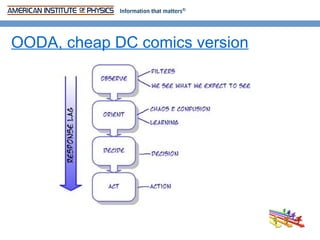
OODA, cheap DC comics version
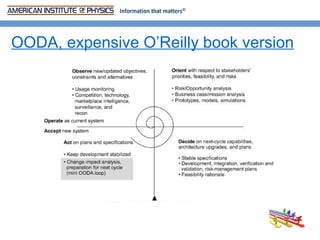
OODA, expensive O’Reilly book version
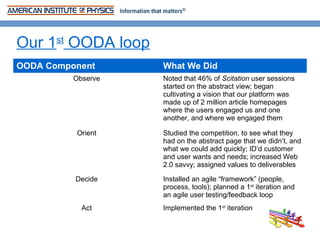
Our 1st OODA loop
OODA Component      What We Did
          Observe   Noted that 46% of Scitation user sessions
                    started on the abstract view; began
                    cultivating a vision that our platform was
                    made up of 2 million article homepages
                    where the users engaged us and one
                    another, and where we engaged them

          Orient    Studied the competition, to see what they
                    had on the abstract page that we didn’t, and
                    what we could add quickly; ID’d customer
                    and user wants and needs; increased Web
                    2.0 savvy; assigned values to deliverables

          Decide    Installed an agile “framework” (people,
                    process, tools); planned a 1st iteration and
                    an agile user testing/feedback loop
            Act     Implemented the 1st iteration
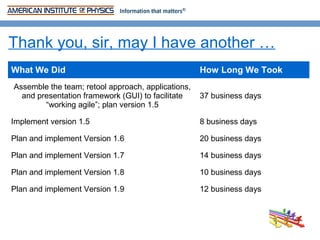
Thank you, sir, may I have another …
What We Did                                         How Long We Took
Assemble the team; retool approach, applications,
  and presentation framework (GUI) to facilitate    37 business days
        “working agile”; plan version 1.5

Implement version 1.5                               8 business days

Plan and implement Version 1.6                      20 business days

Plan and implement Version 1.7                      14 business days

Plan and implement Version 1.8                      10 business days

Plan and implement Version 1.9                      12 business days
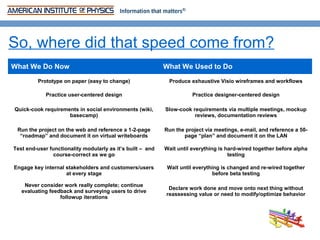
So, where did that speed come from?
What We Do Now                                              What We Used to Do
         Prototype on paper (easy to change)                 Produce exhaustive Visio wireframes and workflows

             Practice user-centered design                             Practice designer-centered design

Quick-cook requirements in social environments (wiki,       Slow-cook requirements via multiple meetings, mockup
                    basecamp)                                          reviews, documentation reviews

 Run the project on the web and reference a 1-2-page        Run the project via meetings, e-mail, and reference a 50-
  “roadmap” and document it on virtual writeboards                 page “plan” and document it on the LAN

Test end-user functionality modularly as it’s built – and   Wait until everything is hard-wired together before alpha
                course-correct as we go                                               testing

Engage key internal stakeholders and customers/users         Wait until everything is changed and re-wired together
                    at every stage                                              before beta testing

    Never consider work really complete; continue
                                                             Declare work done and move onto next thing without
   evaluating feedback and surveying users to drive
                                                            reassessing value or need to modify/optimize behavior
                  followup iterations
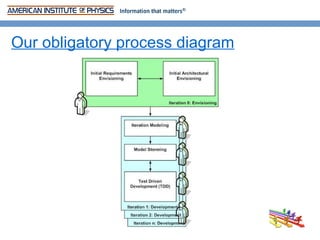
Our obligatory process diagram
Keys to speed: paper
• Went “retro” for planning, design, and
  visualization
  – Used index card bleachers to organize the high-level project
    components
  – User stories were literally story-boarded
  – Used presentation boards and Post-Its in multiple colors like
    Colorforms to arrange GUI elements – and wire-framed the
    results
  – Used dozens of 3x5 index cards and Post-Its to map the deeper
    logic underlying screen flows
  – Captured certain visualizations with a digital camera on the spot
    and posted them to the project Basecamp as a point of reference
    for the team
Keys to speed: new “environments”
• Ergonomics, creature comforts
   – Dual monitors
• Development framework
   –   AJAX
   –   Apache Tiles
   –   Spry
   –   XML
• Management framework (still playing with these)
   –   Basecamp, JIRA (web-based project collaboration)
   –   Jabber (IM-like messaging and conferencing)
   –   Pbwiki, Confluence, Drupal (online documentation)
   –   surveymonkey (online user feedback collector-analyzer)
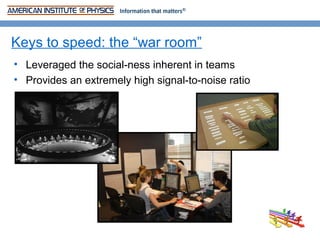
Keys to speed: the “war room”
• Leveraged the social-ness inherent in teams
• Provides an extremely high signal-to-noise ratio
Keys to speed: optimized meetings
• Daily meetings of the action team (team
  leaders, developers, designers)
   – 15 minutes or less
• Twice-weekly meetings of the entire team.
   – 30 minutes or less
• All other communication handled on the
  teamlet level, via short-burst online chat/IM or
  face-to-face
Keys to speed: “eating the elephant”
• To build is human; to iterate, divine
• Build first out of necessity, and then iterate
  aggressively to grant user flexibility, comfort,
  and – if desired – luxury:
   – Dirt track  single-lane cobblestone road  two-
     lane asphalt road  Autobahn
• Start with one “story,” and then …
   – Rewrite it
   – Rewrite it again (embrace “change”)
   – And (possibly) again
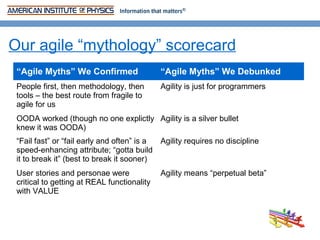
Our agile “mythology” scorecard
 “Agile Myths” We Confirmed                  “Agile Myths” We Debunked
 People first, then methodology, then        Agility is just for programmers
 tools – the best route from fragile to
 agile for us
 OODA worked (though no one explictly Agility is a silver bullet
 knew it was OODA)
 “Fail fast” or “fail early and often” is a Agility requires no discipline
 speed-enhancing attribute; “gotta build
 it to break it” (best to break it sooner)
 User stories and personae were              Agility means “perpetual beta”
 critical to getting at REAL functionality
 with VALUE
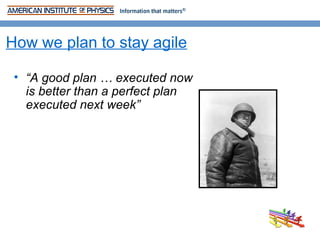
How we plan to stay agile

 • “A good plan … executed now
   is better than a perfect plan
   executed next week”
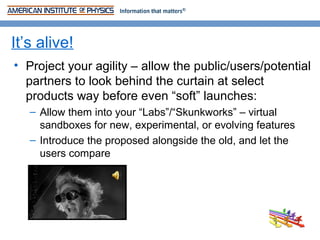
It’s alive!
• Project your agility – allow the public/users/potential
  partners to look behind the curtain at select
  products way before even “soft” launches:
   – Allow them into your “Labs”/“Skunkworks” – virtual
     sandboxes for new, experimental, or evolving features
   – Introduce the proposed alongside the old, and let the
     users compare
Thanks!


                                                     AIP
                        Agility in Practice
                                    Learn more at http://www.aip.org

                                  The director’s cut of this presentation is available
                                at http://www.slideshare.net/secret/1hFBfq9FGEZEAj


CREDIT WHERE IT’S DUE
Redrawn version of John Boyd's OODA Loop by Patrick E. Moran.
Agile Lifecycle and other diagrams, courtesy Scott W. Ambler, Javapolis.
A lifetime of project-management inspiration via http://www.lessons-from-history.com/
Other images and sound bytes from the Great Internet Hard Drive.

306 belmont ssp08agileit

  • 1.
    ADVENTURES IN AGILITY How One Publisher Changed Its Approach to Online Development in 45 Days Larry M. Belmont Manager, Online Development labelmo at aip dot org Society for Scholarly Publishing 30th Annual Meeting, Boston, MA May 30, 2008
  • 2.
    About AIP • Foundedin 1931 as a service organization … – Charter: to diffuse and advance the knowledge of physics and its application to human welfare – Service mission: to supply economy-of-scale publishing services to Member Societies – Currently has 10 member societies, 23 affiliated societies, and several other organizations under its umbrella (most have a publishing program) • A publisher in its own right … – 10 journals, conference proceedings, database products • Scitation … – AIP’s online hosting platform; on the web since 1996 – Aggregation of 180 publications for 25 publishing partners
  • 3.
    About me • 27years in publishing, all at AIP … – 9 years in print journal production (most as a technical copy-editor) – 3 years in desktop publication production – 15 years in electronic/online products (8 as a manager) • Currently an online product development manager in a business unit • Not a programmer; more of a technical projects manager/product manager
  • 4.
    Our goals • Increasedevelopment speed in order to meet customer and customer constituency demands, as well as our own needs to evolve our services more regularly • Position ourselves to innovate or deploy new features quickly in response to unpredictable “market conditions,” major paradigm shifts (like Web 2.0), or good ole competitive one-upsmanship
  • 5.
    The enemy isus • Project (micro)management • “Perfect-plan-ism” • Fear of failure (culture of “that won’t work”) • Distributed decision-making • Monolithic release mentality • Design by committee • Disconnect from users and customers at all but latest stages • Compartmentalization, thick-walled bizunit- bizunit and bizunit-IT silos
  • 6.
    From many schoolsof agility … • Observe – Orient – Decide – Act (Boyd’s “OODA Loop”) • Observe – Model – Test – Reflect (Kolb’s “Learning Model”) • Plan – Do – Check – Act (Shewhart’s “QC Cycle”)
  • 7.
    … we stewedan “agile approach”
  • 8.
    Agility demands theright roles • The Agile “X Organization” – The Leader, a/k/a “Big X” – The Stakeholder – The Timekeeper – The User Advocate – The Visualizer – The Architect – The Coder – The Bulletproofer – The Tester – The Gatekeeper
  • 9.
    What was our“Big X” like? • Did not act like a certified project manager; more of an engager-resonator-cultivator- harmonizer • Articulated clear intent/goal (co-signed “the contract of leadership” with the team) • Asked the team to accomplish the goal, but did not tell them how to do it
  • 10.
    Team attributes • Highly motivated, highly skilled • Zen-like, intuitive understanding (“feeling it”) • Mix of experienced hands, fresh POVs • Rank did not dictate leadership role(s) • Business-technology blend • Self-mobilizing at all levels • Cross-pollinating • Credibility, mutual respect, passion, trust • Subjugation of personal agendas
  • 11.
    Team behaviors • Highlyverbal • No blame, no fear • No assumptions, projections, conceits • Dialogue over monologue • Sublimation of egos, but wide berth given to passionate POVs • Devil’s advocacy tempers evangelism • Belief in user input and test-driven development as primary design driver
  • 12.
    A little inspiration •Korean War jet pilot John Boyd believed the perfect fighter plane’s key characteristic was agility – the ability to change its energy state rapidly to move from patrol to attack mode, and for a pilot to do the same mentally to gain advantage once engaged in a dog-fight – Pilot advantage hinged on highly intuitive Observe-Orient- Decide-Act (OODA) looping – The more agile pilot was the one who could change the situation more quickly than his opponent could update his orientation to it (“getting inside” the enemy’s OODA loop) – OODA grants us the ability to balance continuity and change (a pretty good definition of agility)
  • 13.
    What do aerialwarfare and projects have in common? • Shared “adversaries” – Rapid, unanticipated changes that lead to disorientation – An uncertain environment – Constant threats to any initiative gained – Time itself • OODA helps in dog-fights and projects – Allows us to control the environment (esp. change) – Can help identify threats faster – Is iterative by design
  • 14.
    OODA, cheap DCcomics version
  • 15.
  • 16.
    Our 1st OODAloop OODA Component What We Did Observe Noted that 46% of Scitation user sessions started on the abstract view; began cultivating a vision that our platform was made up of 2 million article homepages where the users engaged us and one another, and where we engaged them Orient Studied the competition, to see what they had on the abstract page that we didn’t, and what we could add quickly; ID’d customer and user wants and needs; increased Web 2.0 savvy; assigned values to deliverables Decide Installed an agile “framework” (people, process, tools); planned a 1st iteration and an agile user testing/feedback loop Act Implemented the 1st iteration
  • 17.
    Thank you, sir,may I have another … What We Did How Long We Took Assemble the team; retool approach, applications, and presentation framework (GUI) to facilitate 37 business days “working agile”; plan version 1.5 Implement version 1.5 8 business days Plan and implement Version 1.6 20 business days Plan and implement Version 1.7 14 business days Plan and implement Version 1.8 10 business days Plan and implement Version 1.9 12 business days
  • 18.
    So, where didthat speed come from? What We Do Now What We Used to Do Prototype on paper (easy to change) Produce exhaustive Visio wireframes and workflows Practice user-centered design Practice designer-centered design Quick-cook requirements in social environments (wiki, Slow-cook requirements via multiple meetings, mockup basecamp) reviews, documentation reviews Run the project on the web and reference a 1-2-page Run the project via meetings, e-mail, and reference a 50- “roadmap” and document it on virtual writeboards page “plan” and document it on the LAN Test end-user functionality modularly as it’s built – and Wait until everything is hard-wired together before alpha course-correct as we go testing Engage key internal stakeholders and customers/users Wait until everything is changed and re-wired together at every stage before beta testing Never consider work really complete; continue Declare work done and move onto next thing without evaluating feedback and surveying users to drive reassessing value or need to modify/optimize behavior followup iterations
  • 19.
  • 20.
    Keys to speed:paper • Went “retro” for planning, design, and visualization – Used index card bleachers to organize the high-level project components – User stories were literally story-boarded – Used presentation boards and Post-Its in multiple colors like Colorforms to arrange GUI elements – and wire-framed the results – Used dozens of 3x5 index cards and Post-Its to map the deeper logic underlying screen flows – Captured certain visualizations with a digital camera on the spot and posted them to the project Basecamp as a point of reference for the team
  • 21.
    Keys to speed:new “environments” • Ergonomics, creature comforts – Dual monitors • Development framework – AJAX – Apache Tiles – Spry – XML • Management framework (still playing with these) – Basecamp, JIRA (web-based project collaboration) – Jabber (IM-like messaging and conferencing) – Pbwiki, Confluence, Drupal (online documentation) – surveymonkey (online user feedback collector-analyzer)
  • 22.
    Keys to speed:the “war room” • Leveraged the social-ness inherent in teams • Provides an extremely high signal-to-noise ratio
  • 23.
    Keys to speed:optimized meetings • Daily meetings of the action team (team leaders, developers, designers) – 15 minutes or less • Twice-weekly meetings of the entire team. – 30 minutes or less • All other communication handled on the teamlet level, via short-burst online chat/IM or face-to-face
  • 24.
    Keys to speed:“eating the elephant” • To build is human; to iterate, divine • Build first out of necessity, and then iterate aggressively to grant user flexibility, comfort, and – if desired – luxury: – Dirt track  single-lane cobblestone road  two- lane asphalt road  Autobahn • Start with one “story,” and then … – Rewrite it – Rewrite it again (embrace “change”) – And (possibly) again
  • 25.
    Our agile “mythology”scorecard “Agile Myths” We Confirmed “Agile Myths” We Debunked People first, then methodology, then Agility is just for programmers tools – the best route from fragile to agile for us OODA worked (though no one explictly Agility is a silver bullet knew it was OODA) “Fail fast” or “fail early and often” is a Agility requires no discipline speed-enhancing attribute; “gotta build it to break it” (best to break it sooner) User stories and personae were Agility means “perpetual beta” critical to getting at REAL functionality with VALUE
  • 26.
    How we planto stay agile • “A good plan … executed now is better than a perfect plan executed next week”
  • 27.
    It’s alive! • Projectyour agility – allow the public/users/potential partners to look behind the curtain at select products way before even “soft” launches: – Allow them into your “Labs”/“Skunkworks” – virtual sandboxes for new, experimental, or evolving features – Introduce the proposed alongside the old, and let the users compare
  • 28.
    Thanks! AIP Agility in Practice Learn more at http://www.aip.org The director’s cut of this presentation is available at http://www.slideshare.net/secret/1hFBfq9FGEZEAj CREDIT WHERE IT’S DUE Redrawn version of John Boyd's OODA Loop by Patrick E. Moran. Agile Lifecycle and other diagrams, courtesy Scott W. Ambler, Javapolis. A lifetime of project-management inspiration via http://www.lessons-from-history.com/ Other images and sound bytes from the Great Internet Hard Drive.