International INTERNATIONAL Journal of Mechanical JOURNAL Engineering OF and MECHANICAL Technology (IJMET), ISSN ENGINEERING 
0976 – 6340(Print), 
ISSN 0976 – 6359(Online), Volume 5, Issue 7, July (2014), pp. 01-14 © IAEME 
AND TECHNOLOGY (IJMET) 
ISSN 0976 – 6340 (Print) 
ISSN 0976 – 6359 (Online) 
Volume 5, Issue 7, July (2014), pp. 01-14 
© IAEME: www.iaeme.com/IJMET.asp 
Journal Impact Factor (2014): 7.5377 (Calculated by GISI) 
www.jifactor.com 
1 


IJMET 
© I A E M E 
NUMERICAL INVESTIGATION OF AUTOMOTIVE RADIATOR 
LOUVERED FIN COMPACT HEAT EXCHANGER 
Manjunath S N1, S.S.Mahesh Reddy2, Saravana Kumar3 
1(M.Tech Student, Thermal Power Engineering, 
East Point College of Engineering and Technology Bangalore) 
2(Assistant Professor, East Point College of Engineering and Technology, Bangalore) 
3(Finite Flow Technology Solutions Pvt Ltd) 
ABSTRACT 
In compact heat exchangers, thermal resistance is generally dominant on the air-side and may 
account for 80% or more of the total thermal resistance. The air-side heat transfer surface area is 8 to 
10 times larger than the water-side. Any improvement in the heat transfer on air-side therefore 
improves the overall performance of the heat exchanger. Due to the high thermal resistance on the 
air-side, the optimization of such fins is essential to increase the performance of the heat exchangers 
which results in thermal systems enhancement. This helps to reduce CO2 emissions through a 
reduction of mass and fuel consumption. 
Optimization of louvered fin geometry in such heat exchangers is essential to increase the 
heat transfer performance and reduce weight, packaging, and cost requirements. In this study deals 
with Computational Fluid Dynamics (CFD) studies of the interactions between the air flow and 
louvered fins which equipped the automotive heat exchangers is carried out. 3D numerical 
simulation results is obtained by using the ANSYS Fluent 14.0 code and compared with 
experimental data. Finally the effect of louver angle and louver pitch geometrical parameters, on 
overall thermal hydraulic performances of louvered fins is studied. 
 
Keywords: CFD, Heat Transfer, Louver Fin, Radiator. 
I. INTRODUCTION 
A heat exchanger is a complex device that provides the transfer of thermal energy between 
two or more fluids, which are at different temperatures and are in thermal contact with each other.
International Journal of Mechanical Engineering and Technology (IJMET), ISSN 0976 – 6340(Print), 
ISSN 0976 – 6359(Online), Volume 5, Issue 7, July (2014), pp. 01-14 © IAEME 
Heat exchangers are used either individually or as components of a large thermal system, in a wide 
variety of commercial, industrial and household applications, e.g. power generation, refrigeration, 
ventilating and air-conditioning systems, process, manufacturing, aerospace industries, electronic 
chip cooling as well as in environmental engineering. The improvements in the performance of the 
heat exchangers have attracted many researchers for a long time as they are of great technical, 
economical, and not the least, ecological importance. Performance improvement becomes essential 
particularly in heat exchangers with gases because the thermal resistance of gases can be 10 to 50 
times as large as that of liquids, which requires large heat transfer surface area per unit volume on 
gas side. 
2 
 
The traditional methods of reducing the air-side thermal resistance are by increasing the 
surface area of the heat exchanger, or by reducing the thermal boundary layer thickness on the 
surface of the heat exchanger. Increasing the surface area is effective but it results in the increase in 
material cost and increase in mass of the heat exchanger. One of the methods to reduce boundary 
layer thickness is by the generation of passive vortices. In this technique the flow field is altered by 
an obstacle to generate a vortex oriented in the direction of the flow. The resulting change in the flow 
due to an obstacle alters the local thermal boundary layer. The net effect of this manipulation is an 
average increase in the heat transfer for the affected area. 
Fig.1: 1. Water filling hole, 2. Cold water to engine, 3. Recycling water to engine, 
4. Elliptical tube, 5. Fin, 6. Bottom header plate, 7. Bottom header, 8. Hot water from radiator, 
9. Drain cock, 10. Core bracket 
Borrajo-Pelaez et al. [1] carried out 3D numerical simulations to compare both an air side and 
air/water side model of a plain fin and tube heat exchanger. In their experiment, the influence of the 
Reynolds number, fin pitch, tube diameter, fin length and fin thickness were studied. Haci Mehmet 
Sahin et al. [2] studied the heat transfer and pressure drop characteristics of seven different fin angles
International Journal of Mechanical Engineering and Technology (IJMET), ISSN 0976 – 6340(Print), 
ISSN 0976 – 6359(Online), Volume 5, Issue 7, July (2014), pp. 01-14 © IAEME 
with plain fin and tube heat exchangers. This problem was analyzed using Fluent software, and it 
was found that a fin with 30º inclination is the optimum one, which gives the maximum heat transfer 
enhancement. 
3 
 
Mao-Yu Wen et al. [3] have investigated the heat transfer performance of a fin and tube heat 
exchanger with three different fin configurations such as plate fin, wavy fin and compounded fin. 
This experiment strongly suggested the use of the compound fin configuration for the heat 
exchanger. Wei-Mon Yan and Pay-Jen Sheen [4] have carried out an experiment to investigate the 
heat transfer and pressure drop characteristics of fin and tube heat exchangers with plate, wavy and 
louvered fin surfaces. From this experiment, it is found that at the same Reynolds number, louvered 
fin geometry shows larger values of f and j factors, compared with the plate fin surfaces. 
Igor Wolf et al. [5] studied the heat transfer performance of a wavy fin and tube heat 
exchanger by numerical and experimental methods. They presented some results of a three 
dimensional numerical analysis of heat transfer on the air side of a wavy fin and tube heat exchanger. 
The three dimensional local flow and thermal fields are well characterized by the numerical analysis. 
The developed and presented model demonstrated good heat transfer prediction. It could provide 
guidelines for the design optimization of a fin and tube heat exchanger. In this study, three rows of 
circular tubes in a staggered arrangement were taken as a domain. The air-side heat transfer and 
pressure drop characteristics were successfully modeled using the CFD software Fluent. The 
numerical results were validated with the experimental results and the deviation was within 8%. 
Tang et al. [6] carried out an experimental and numerical investigation on the air-side 
performance of fin and tube heat exchangers with various fin patterns, such as crimped spiral fin, 
plain fin, slit fin, fin with delta wing longitudinal vortex generator (VG), and mixed fin with front 
6-row vortex generator fin and rear 6-row slit fin. It was found that the heat exchanger with the 
crimped spiral fin has better performance than the other four configurations. Also it is found that the 
Slit fin offers the best heat transfer performance at a higher Reynolds number. Chi-Chuan Wang et 
al. [7] provided flow visualization and pressure drop results for plain fin and tube heat exchangers, 
with and without the presence of vortex generators. It was found that the pressure drop of the delta 
winglet is lower than that of the annular winglet. Fiebig et al. [8] investigated the local heat transfer 
and flow losses in plate fin and tube heat exchangers with vortex generators, to compare the 
performance of round and flat tubes. It was found that the heat exchanger with flat tubes and vortex 
generators gives nearly twice as much heat transfer with a penalty of 50% pressure loss, when 
compared to a heat exchanger with round tubes. Jin-Sheng Leu et al. [9] had performed a numerical 
and experimental analysis to study the thermo-hydraulic performance of an inclined block shape 
vortex generator embedded plate fin and tube heat exchangers. In this analysis, the effects of 
different span angles (30º, 45º and 60º) were investigated for Reynolds numbers ranging from 400 to 
3000. It was found that a 30º span angle provides the best heat transfer augmentation and also offers 
25% lesser fin surface area. 
Jin-Sheng Leu et al. [10] conducted a numerical simulation for louvered fin and tube heat 
exchangers having circular and oval tube configurations. The effects of the geometrical parameters 
such as louver angle, louver pitches and louver length were discussed. Joen et al. [11] worked on the 
interaction between the flow behavior (flow deflection and transition to unsteady flow) and the 
thermo-hydraulic performance of an inclined louvered fin design. In this experiment, the impact of 
fin pitch, fin angle and Reynolds number were discussed in detail. Zhang and Tafti [12] investigated 
the effect of the Reynolds number, fin pitch, louver thickness and louver angle on flow efficiency in 
multi-louvered fins and found that the flow efficiency (flow efficiency () = Mean flow angle 
(mean) / Louver angle ()) is strongly dependent on geometrical parameters, especially at a low 
Reynolds number. The Flow efficiency increases with the Reynolds number and louver angle, while 
decreasing with the fin pitch and thickness ratio. Wei Li and Xialing Wang [13] conducted an
International Journal of Mechanical Engineering and Technology (IJMET), ISSN 0976 – 6340(Print), 
ISSN 0976 – 6359(Online), Volume 5, Issue 7, July (2014), pp. 01-14 © IAEME 
experimental study on the air side heat transfer and pressure drop characteristics of brazed aluminum 
heat exchangers, with multi-region louver fins and flat tubes. They found that the heat transfer 
coefficients and pressure drop tend to decrease with increasing Reynolds numbers, and increase with 
the number of louvers. 
4 
 
Wang et al. [14] presented generalized heat transfer and friction correlations for louver fin 
geometry having a round tube configuration. They considered different geometrical parameters, such 
as louver pitch, louver height, longitudinal tube pitch, transverse tube pitch, tube diameter and fin 
pitch for the generation of correlations. Yu-Juei Chang and Chi-Chuan Wang [16] developed a 
similar generalized heat transfer correlation for louver fin geometry, using a large data bank. In this 
study, different geometrical parameters such as louver angle, tube width, louver length, louver pitch, 
fin length and fin pitch were used. For corrugated louver fin geometry, it is shown that 89.3% of the 
corrugated louver fin data are correlated within ±15% with a mean deviation of 7.55%. The inclusion 
of the plate and tube louver fin data in the heat transfer correlation results in a mean deviation of 
8.21%. 
It is found from the literature that most of the research works carried out in the field of 
compact heat exchangers are presenting j and f factors corresponding to the air side only. However, 
the heat transfer performance of the compact heat exchanger under varying conditions of the tube 
side fluid is not reported. In the present paper, in addition to the CFD studies carried out for the 
louvered fin and elliptical tube compact heat exchanger which is validated with the experimental 
results, the heat transferred to the air under different mass flow rate of the water is also reported, 
which provides lot of significance. 
II. MATHEMATICAL MODELS OF FLUENT 
All the fluids investigated in this research are Newtonian. This means that there exists a linear 
relationship between the shear stress, sij, and the rate of shear (the velocity gradient). In CFX, this is 
expressed as follows:
In FLUENT, these laws are expressed in the following form: 
Law of Conservation of Mass: Fluid mass is always conserved. 


Newton’s 2nd Law: The sum of the forces on a fluid particle is equal to the rate of change of 
momentum. 


 !  


  #    $ 
First Law of Thermodynamics: The rate of head added to a system plus the rate of work done on a 
fluid particle equals the total rate of change in energy.
International Journal of Mechanical Engineering and Technology (IJMET), ISSN 0976 – 6340(Print), 
ISSN 0976 – 6359(Online), Volume 5, Issue 7, July (2014), pp. 01-14 © IAEME 
5 


%  
 
 
%  


' 
( 


   ) 
The fluid behaviour can be characterised in terms of the fluid properties velocity vector u 
(with components u, v, and w in the x, y, and z directions), pressure p, density , viscosity μ, thermal 
conductivity , and temperature T. The changes in these fluid properties can occur over space and 
time. H is the total enthalpy, given in terms of the static (thermodynamic) enthalpy, h: 
III. GEOMETRIC MODEL 
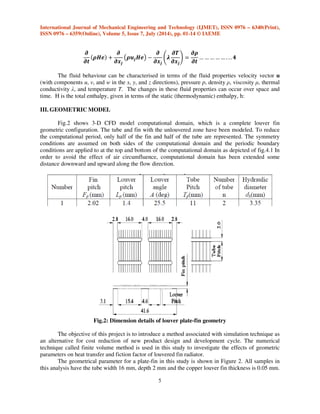
Fig.2 shows 3-D CFD model computational domain, which is a complete louver fin 
geometric configuration. The tube and fin with the unlouvered zone have been modeled. To reduce 
the computational period, only half of the fin and half of the tube are represented. The symmetry 
conditions are assumed on both sides of the computational domain and the periodic boundary 
conditions are applied to at the top and bottom of the computational domain as depicted of fig.4.1 In 
order to avoid the effect of air circumfluence, computational domain has been extended some 
distance downward and upward along the flow direction. 
Fig.2: Dimension details of louver plate-fin geometry 
The objective of this project is to introduce a method associated with simulation technique as 
an alternative for cost reduction of new product design and development cycle. The numerical 
technique called finite volume method is used in this study to investigate the effects of geometric 
parameters on heat transfer and fiction factor of louvered fin radiator. 
The geometrical parameter for a plate-fin in this study is shown in Figure 2. All samples in 
this analysis have the tube width 16 mm, depth 2 mm and the copper louver fin thickness is 0.05 mm.
International Journal of Mechanical Engineering and Technology (IJMET), ISSN 0976 – 6340(Print), 
ISSN 0976 – 6359(Online), Volume 5, Issue 7, July (2014), pp. 01-14 © IAEME 
The length of the fins in the airflow direction is 41.6 mm associating with double row tubes. 
Simulations are performed for different geometries with various fin pitch (Fp), louver pitch (Lp), 
tube pitch (Tp) and louver angle (). The values of these parameters are listed in Table 1. The scope 
of this paper is limited to 3 from 15 configurations of T.A. Cowell and A. Achaichia [15]. 
6 
 
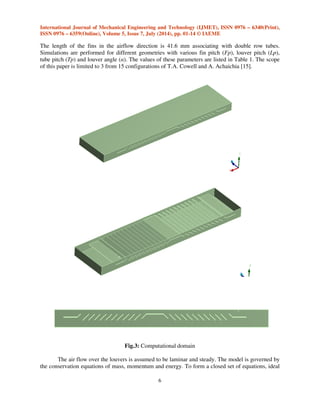
Fig.3: Computational domain 
The air flow over the louvers is assumed to be laminar and steady. The model is governed by 
the conservation equations of mass, momentum and energy. To form a closed set of equations, ideal
International Journal of Mechanical Engineering and Technology (IJMET), ISSN 0976 – 6340(Print), 
ISSN 0976 – 6359(Online), Volume 5, Issue 7, July (2014), pp. 01-14 © IAEME 
gas state equation can be used to relate pressure, density and temperature of air. The viscosity and 
thermal conductivity of the air are a function only of the temperature, the change of which is small in 
flow over the fin and can be assumed constant and evaluated at the mean air temperature of inlet and 
outlet. The viscosity is obtained from Sutherland’s law and the thermal conductivity can be fitted as 
linear form of mean temperature. 
7 
 
The boundary conditions for the velocity and thermal fields need to be specified on the 
interface of the fin surface and fluid due to take into account conjugate heat transfer. At the upstream 
boundary, the flow direction velocity and temperature are assumed to be constant, with the other two 
direction velocities being set to zero and flow direction velocity being set to the inlet air velocity and 
the temperature being set to the ambient atmospheric temperature. The downstream boundary is 
assumed to be pressure-outlet condition. The symmetry conditions are assumed on both sides of the 
computational domain and the periodic boundary condition are applied to at the top and bottom of 
the computational domain. All solid surfaces including the louver surface and the tube surface are 
assumed as no-slip boundary conditions and constant wall temperature are specified. 
IV. CFD MESHING 
In this model tetrahedral with prism boundary layer grid in the flow region. Especially 
complex shapes are difficult to model with a structured grid. Therefore an unstructured grid with 
triangular cells is used at the r outer region. 
Fig.4: CFD Meshing of Louver Fin 
The three-dimensional computational domain and boundary condition is shown in Figure 4. 
3. One-half of the tube pitch is considered with symmetry plane at one side and constant wall 
temperature at the other. The top and bottom surfaces of the domain are defined as periodic
International Journal of Mechanical Engineering and Technology (IJMET), ISSN 0976 – 6340(Print), 
ISSN 0976 – 6359(Online), Volume 5, Issue 7, July (2014), pp. 01-14 © IAEME 
boundaries. Previous literature suggests that the three-dimensional model is to be constructed with 
the smallest fluid cell size next to the wall being smaller than or equal to the fin’s thickness. For 
simplicity of the computational mesh and modeling reason of heat transfer between solid and fluid 
interface, however, its thickness next to fin is assigned to be equal to the fin height with symmetrical 
geometry at upper and lower surface of the fin. The numerical simulations are performed for 
different Reynolds number with range of 100 to 1000. From Experiment of T.A cowel and 
A.Achaichia the temperature variation of the tube is small, this can be assumed constant at 358K. 
The inlet air temperature of the louver fin is at 288K. 
8 
V. RESULTS AND DISCUSSIONS 
A. Smooth tube Results 
 
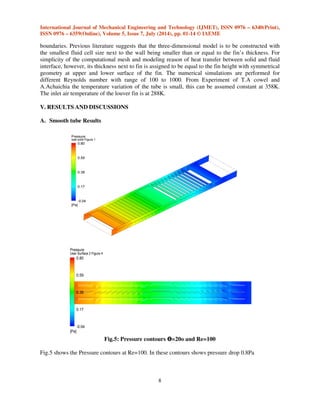
Fig.5: Pressure contours =20o and Re=100 
Fig.5 shows the Pressure contours at Re=100. In these contours shows pressure drop 0.8Pa
International Journal of Mechanical Engineering and Technology (IJMET), ISSN 0976 – 6340(Print), 
ISSN 0976 – 6359(Online), Volume 5, Issue 7, July (2014), pp. 01-14 © IAEME 
9 
 
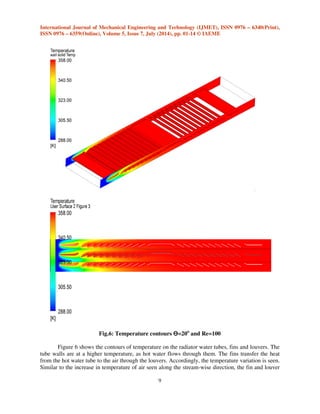
Fig.6: Temperature contours =20o and Re=100 
Figure 6 shows the contours of temperature on the radiator water tubes, fins and louvers. The 
tube walls are at a higher temperature, as hot water flows through them. The fins transfer the heat 
from the hot water tube to the air through the louvers. Accordingly, the temperature variation is seen. 
Similar to the increase in temperature of air seen along the stream-wise direction, the fin and louver
International Journal of Mechanical Engineering and Technology (IJMET), ISSN 0976 – 6340(Print), 
ISSN 0976 – 6359(Online), Volume 5, Issue 7, July (2014), pp. 01-14 © IAEME 
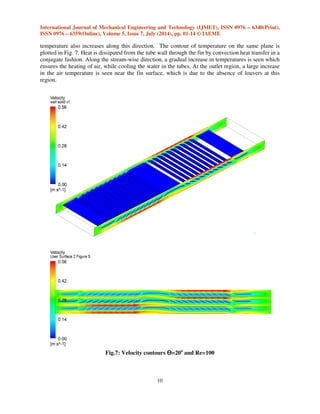
temperature also increases along this direction. The contour of temperature on the same plane is 
plotted in Fig. 7. Heat is dissipated from the tube wall through the fin by convection heat transfer in a 
conjugate fashion. Along the stream-wise direction, a gradual increase in temperatures is seen which 
ensures the heating of air, while cooling the water in the tubes. At the outlet region, a large increase 
in the air temperature is seen near the fin surface, which is due to the absence of louvers at this 
region. 
10 
 
Fig.7: Velocity contours =20o and Re=100
International Journal of Mechanical Engineering and Technology (IJMET), ISSN 0976 – 6340(Print), 
ISSN 0976 – 6359(Online), Volume 5, Issue 7, July (2014), pp. 01-14 © IAEME
11 


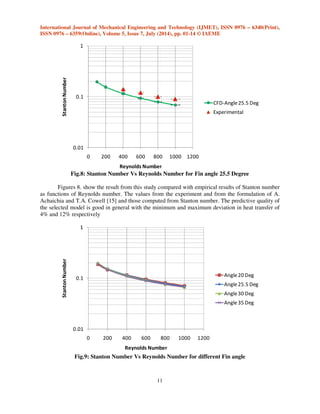
Fig.8: Stanton Number Vs Reynolds Number for Fin angle 25.5 Degree 
Figures 8. show the result from this study compared with empirical results of Stanton number 
as functions of Reynolds number. The values from the experiment and from the formulation of A. 
Achaichia and T.A. Cowell [15] and those computed from Stanton number. The predictive quality of 
the selected model is good in general with the minimum and maximum deviation in heat transfer of 
4% and 12% respectively 
 
 
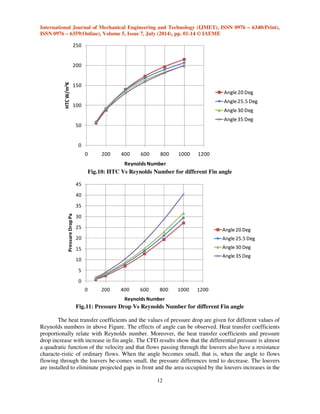
Fig.9: Stanton Number Vs Reynolds Number for different Fin angle

30120140507001

  • 1.
    International INTERNATIONAL Journalof Mechanical JOURNAL Engineering OF and MECHANICAL Technology (IJMET), ISSN ENGINEERING 0976 – 6340(Print), ISSN 0976 – 6359(Online), Volume 5, Issue 7, July (2014), pp. 01-14 © IAEME AND TECHNOLOGY (IJMET) ISSN 0976 – 6340 (Print) ISSN 0976 – 6359 (Online) Volume 5, Issue 7, July (2014), pp. 01-14 © IAEME: www.iaeme.com/IJMET.asp Journal Impact Factor (2014): 7.5377 (Calculated by GISI) www.jifactor.com 1 IJMET © I A E M E NUMERICAL INVESTIGATION OF AUTOMOTIVE RADIATOR LOUVERED FIN COMPACT HEAT EXCHANGER Manjunath S N1, S.S.Mahesh Reddy2, Saravana Kumar3 1(M.Tech Student, Thermal Power Engineering, East Point College of Engineering and Technology Bangalore) 2(Assistant Professor, East Point College of Engineering and Technology, Bangalore) 3(Finite Flow Technology Solutions Pvt Ltd) ABSTRACT In compact heat exchangers, thermal resistance is generally dominant on the air-side and may account for 80% or more of the total thermal resistance. The air-side heat transfer surface area is 8 to 10 times larger than the water-side. Any improvement in the heat transfer on air-side therefore improves the overall performance of the heat exchanger. Due to the high thermal resistance on the air-side, the optimization of such fins is essential to increase the performance of the heat exchangers which results in thermal systems enhancement. This helps to reduce CO2 emissions through a reduction of mass and fuel consumption. Optimization of louvered fin geometry in such heat exchangers is essential to increase the heat transfer performance and reduce weight, packaging, and cost requirements. In this study deals with Computational Fluid Dynamics (CFD) studies of the interactions between the air flow and louvered fins which equipped the automotive heat exchangers is carried out. 3D numerical simulation results is obtained by using the ANSYS Fluent 14.0 code and compared with experimental data. Finally the effect of louver angle and louver pitch geometrical parameters, on overall thermal hydraulic performances of louvered fins is studied. Keywords: CFD, Heat Transfer, Louver Fin, Radiator. I. INTRODUCTION A heat exchanger is a complex device that provides the transfer of thermal energy between two or more fluids, which are at different temperatures and are in thermal contact with each other.
  • 2.
    International Journal ofMechanical Engineering and Technology (IJMET), ISSN 0976 – 6340(Print), ISSN 0976 – 6359(Online), Volume 5, Issue 7, July (2014), pp. 01-14 © IAEME Heat exchangers are used either individually or as components of a large thermal system, in a wide variety of commercial, industrial and household applications, e.g. power generation, refrigeration, ventilating and air-conditioning systems, process, manufacturing, aerospace industries, electronic chip cooling as well as in environmental engineering. The improvements in the performance of the heat exchangers have attracted many researchers for a long time as they are of great technical, economical, and not the least, ecological importance. Performance improvement becomes essential particularly in heat exchangers with gases because the thermal resistance of gases can be 10 to 50 times as large as that of liquids, which requires large heat transfer surface area per unit volume on gas side. 2 The traditional methods of reducing the air-side thermal resistance are by increasing the surface area of the heat exchanger, or by reducing the thermal boundary layer thickness on the surface of the heat exchanger. Increasing the surface area is effective but it results in the increase in material cost and increase in mass of the heat exchanger. One of the methods to reduce boundary layer thickness is by the generation of passive vortices. In this technique the flow field is altered by an obstacle to generate a vortex oriented in the direction of the flow. The resulting change in the flow due to an obstacle alters the local thermal boundary layer. The net effect of this manipulation is an average increase in the heat transfer for the affected area. Fig.1: 1. Water filling hole, 2. Cold water to engine, 3. Recycling water to engine, 4. Elliptical tube, 5. Fin, 6. Bottom header plate, 7. Bottom header, 8. Hot water from radiator, 9. Drain cock, 10. Core bracket Borrajo-Pelaez et al. [1] carried out 3D numerical simulations to compare both an air side and air/water side model of a plain fin and tube heat exchanger. In their experiment, the influence of the Reynolds number, fin pitch, tube diameter, fin length and fin thickness were studied. Haci Mehmet Sahin et al. [2] studied the heat transfer and pressure drop characteristics of seven different fin angles
  • 3.
    International Journal ofMechanical Engineering and Technology (IJMET), ISSN 0976 – 6340(Print), ISSN 0976 – 6359(Online), Volume 5, Issue 7, July (2014), pp. 01-14 © IAEME with plain fin and tube heat exchangers. This problem was analyzed using Fluent software, and it was found that a fin with 30º inclination is the optimum one, which gives the maximum heat transfer enhancement. 3 Mao-Yu Wen et al. [3] have investigated the heat transfer performance of a fin and tube heat exchanger with three different fin configurations such as plate fin, wavy fin and compounded fin. This experiment strongly suggested the use of the compound fin configuration for the heat exchanger. Wei-Mon Yan and Pay-Jen Sheen [4] have carried out an experiment to investigate the heat transfer and pressure drop characteristics of fin and tube heat exchangers with plate, wavy and louvered fin surfaces. From this experiment, it is found that at the same Reynolds number, louvered fin geometry shows larger values of f and j factors, compared with the plate fin surfaces. Igor Wolf et al. [5] studied the heat transfer performance of a wavy fin and tube heat exchanger by numerical and experimental methods. They presented some results of a three dimensional numerical analysis of heat transfer on the air side of a wavy fin and tube heat exchanger. The three dimensional local flow and thermal fields are well characterized by the numerical analysis. The developed and presented model demonstrated good heat transfer prediction. It could provide guidelines for the design optimization of a fin and tube heat exchanger. In this study, three rows of circular tubes in a staggered arrangement were taken as a domain. The air-side heat transfer and pressure drop characteristics were successfully modeled using the CFD software Fluent. The numerical results were validated with the experimental results and the deviation was within 8%. Tang et al. [6] carried out an experimental and numerical investigation on the air-side performance of fin and tube heat exchangers with various fin patterns, such as crimped spiral fin, plain fin, slit fin, fin with delta wing longitudinal vortex generator (VG), and mixed fin with front 6-row vortex generator fin and rear 6-row slit fin. It was found that the heat exchanger with the crimped spiral fin has better performance than the other four configurations. Also it is found that the Slit fin offers the best heat transfer performance at a higher Reynolds number. Chi-Chuan Wang et al. [7] provided flow visualization and pressure drop results for plain fin and tube heat exchangers, with and without the presence of vortex generators. It was found that the pressure drop of the delta winglet is lower than that of the annular winglet. Fiebig et al. [8] investigated the local heat transfer and flow losses in plate fin and tube heat exchangers with vortex generators, to compare the performance of round and flat tubes. It was found that the heat exchanger with flat tubes and vortex generators gives nearly twice as much heat transfer with a penalty of 50% pressure loss, when compared to a heat exchanger with round tubes. Jin-Sheng Leu et al. [9] had performed a numerical and experimental analysis to study the thermo-hydraulic performance of an inclined block shape vortex generator embedded plate fin and tube heat exchangers. In this analysis, the effects of different span angles (30º, 45º and 60º) were investigated for Reynolds numbers ranging from 400 to 3000. It was found that a 30º span angle provides the best heat transfer augmentation and also offers 25% lesser fin surface area. Jin-Sheng Leu et al. [10] conducted a numerical simulation for louvered fin and tube heat exchangers having circular and oval tube configurations. The effects of the geometrical parameters such as louver angle, louver pitches and louver length were discussed. Joen et al. [11] worked on the interaction between the flow behavior (flow deflection and transition to unsteady flow) and the thermo-hydraulic performance of an inclined louvered fin design. In this experiment, the impact of fin pitch, fin angle and Reynolds number were discussed in detail. Zhang and Tafti [12] investigated the effect of the Reynolds number, fin pitch, louver thickness and louver angle on flow efficiency in multi-louvered fins and found that the flow efficiency (flow efficiency () = Mean flow angle (mean) / Louver angle ()) is strongly dependent on geometrical parameters, especially at a low Reynolds number. The Flow efficiency increases with the Reynolds number and louver angle, while decreasing with the fin pitch and thickness ratio. Wei Li and Xialing Wang [13] conducted an
  • 4.
    International Journal ofMechanical Engineering and Technology (IJMET), ISSN 0976 – 6340(Print), ISSN 0976 – 6359(Online), Volume 5, Issue 7, July (2014), pp. 01-14 © IAEME experimental study on the air side heat transfer and pressure drop characteristics of brazed aluminum heat exchangers, with multi-region louver fins and flat tubes. They found that the heat transfer coefficients and pressure drop tend to decrease with increasing Reynolds numbers, and increase with the number of louvers. 4 Wang et al. [14] presented generalized heat transfer and friction correlations for louver fin geometry having a round tube configuration. They considered different geometrical parameters, such as louver pitch, louver height, longitudinal tube pitch, transverse tube pitch, tube diameter and fin pitch for the generation of correlations. Yu-Juei Chang and Chi-Chuan Wang [16] developed a similar generalized heat transfer correlation for louver fin geometry, using a large data bank. In this study, different geometrical parameters such as louver angle, tube width, louver length, louver pitch, fin length and fin pitch were used. For corrugated louver fin geometry, it is shown that 89.3% of the corrugated louver fin data are correlated within ±15% with a mean deviation of 7.55%. The inclusion of the plate and tube louver fin data in the heat transfer correlation results in a mean deviation of 8.21%. It is found from the literature that most of the research works carried out in the field of compact heat exchangers are presenting j and f factors corresponding to the air side only. However, the heat transfer performance of the compact heat exchanger under varying conditions of the tube side fluid is not reported. In the present paper, in addition to the CFD studies carried out for the louvered fin and elliptical tube compact heat exchanger which is validated with the experimental results, the heat transferred to the air under different mass flow rate of the water is also reported, which provides lot of significance. II. MATHEMATICAL MODELS OF FLUENT All the fluids investigated in this research are Newtonian. This means that there exists a linear relationship between the shear stress, sij, and the rate of shear (the velocity gradient). In CFX, this is expressed as follows:
  • 5.
    In FLUENT, theselaws are expressed in the following form: Law of Conservation of Mass: Fluid mass is always conserved. Newton’s 2nd Law: The sum of the forces on a fluid particle is equal to the rate of change of momentum. ! # $ First Law of Thermodynamics: The rate of head added to a system plus the rate of work done on a fluid particle equals the total rate of change in energy.
  • 6.
    International Journal ofMechanical Engineering and Technology (IJMET), ISSN 0976 – 6340(Print), ISSN 0976 – 6359(Online), Volume 5, Issue 7, July (2014), pp. 01-14 © IAEME 5 % % ' ( ) The fluid behaviour can be characterised in terms of the fluid properties velocity vector u (with components u, v, and w in the x, y, and z directions), pressure p, density , viscosity μ, thermal conductivity , and temperature T. The changes in these fluid properties can occur over space and time. H is the total enthalpy, given in terms of the static (thermodynamic) enthalpy, h: III. GEOMETRIC MODEL Fig.2 shows 3-D CFD model computational domain, which is a complete louver fin geometric configuration. The tube and fin with the unlouvered zone have been modeled. To reduce the computational period, only half of the fin and half of the tube are represented. The symmetry conditions are assumed on both sides of the computational domain and the periodic boundary conditions are applied to at the top and bottom of the computational domain as depicted of fig.4.1 In order to avoid the effect of air circumfluence, computational domain has been extended some distance downward and upward along the flow direction. Fig.2: Dimension details of louver plate-fin geometry The objective of this project is to introduce a method associated with simulation technique as an alternative for cost reduction of new product design and development cycle. The numerical technique called finite volume method is used in this study to investigate the effects of geometric parameters on heat transfer and fiction factor of louvered fin radiator. The geometrical parameter for a plate-fin in this study is shown in Figure 2. All samples in this analysis have the tube width 16 mm, depth 2 mm and the copper louver fin thickness is 0.05 mm.
  • 7.
    International Journal ofMechanical Engineering and Technology (IJMET), ISSN 0976 – 6340(Print), ISSN 0976 – 6359(Online), Volume 5, Issue 7, July (2014), pp. 01-14 © IAEME The length of the fins in the airflow direction is 41.6 mm associating with double row tubes. Simulations are performed for different geometries with various fin pitch (Fp), louver pitch (Lp), tube pitch (Tp) and louver angle (). The values of these parameters are listed in Table 1. The scope of this paper is limited to 3 from 15 configurations of T.A. Cowell and A. Achaichia [15]. 6 Fig.3: Computational domain The air flow over the louvers is assumed to be laminar and steady. The model is governed by the conservation equations of mass, momentum and energy. To form a closed set of equations, ideal
  • 8.
    International Journal ofMechanical Engineering and Technology (IJMET), ISSN 0976 – 6340(Print), ISSN 0976 – 6359(Online), Volume 5, Issue 7, July (2014), pp. 01-14 © IAEME gas state equation can be used to relate pressure, density and temperature of air. The viscosity and thermal conductivity of the air are a function only of the temperature, the change of which is small in flow over the fin and can be assumed constant and evaluated at the mean air temperature of inlet and outlet. The viscosity is obtained from Sutherland’s law and the thermal conductivity can be fitted as linear form of mean temperature. 7 The boundary conditions for the velocity and thermal fields need to be specified on the interface of the fin surface and fluid due to take into account conjugate heat transfer. At the upstream boundary, the flow direction velocity and temperature are assumed to be constant, with the other two direction velocities being set to zero and flow direction velocity being set to the inlet air velocity and the temperature being set to the ambient atmospheric temperature. The downstream boundary is assumed to be pressure-outlet condition. The symmetry conditions are assumed on both sides of the computational domain and the periodic boundary condition are applied to at the top and bottom of the computational domain. All solid surfaces including the louver surface and the tube surface are assumed as no-slip boundary conditions and constant wall temperature are specified. IV. CFD MESHING In this model tetrahedral with prism boundary layer grid in the flow region. Especially complex shapes are difficult to model with a structured grid. Therefore an unstructured grid with triangular cells is used at the r outer region. Fig.4: CFD Meshing of Louver Fin The three-dimensional computational domain and boundary condition is shown in Figure 4. 3. One-half of the tube pitch is considered with symmetry plane at one side and constant wall temperature at the other. The top and bottom surfaces of the domain are defined as periodic
  • 9.
    International Journal ofMechanical Engineering and Technology (IJMET), ISSN 0976 – 6340(Print), ISSN 0976 – 6359(Online), Volume 5, Issue 7, July (2014), pp. 01-14 © IAEME boundaries. Previous literature suggests that the three-dimensional model is to be constructed with the smallest fluid cell size next to the wall being smaller than or equal to the fin’s thickness. For simplicity of the computational mesh and modeling reason of heat transfer between solid and fluid interface, however, its thickness next to fin is assigned to be equal to the fin height with symmetrical geometry at upper and lower surface of the fin. The numerical simulations are performed for different Reynolds number with range of 100 to 1000. From Experiment of T.A cowel and A.Achaichia the temperature variation of the tube is small, this can be assumed constant at 358K. The inlet air temperature of the louver fin is at 288K. 8 V. RESULTS AND DISCUSSIONS A. Smooth tube Results Fig.5: Pressure contours =20o and Re=100 Fig.5 shows the Pressure contours at Re=100. In these contours shows pressure drop 0.8Pa
  • 10.
    International Journal ofMechanical Engineering and Technology (IJMET), ISSN 0976 – 6340(Print), ISSN 0976 – 6359(Online), Volume 5, Issue 7, July (2014), pp. 01-14 © IAEME 9 Fig.6: Temperature contours =20o and Re=100 Figure 6 shows the contours of temperature on the radiator water tubes, fins and louvers. The tube walls are at a higher temperature, as hot water flows through them. The fins transfer the heat from the hot water tube to the air through the louvers. Accordingly, the temperature variation is seen. Similar to the increase in temperature of air seen along the stream-wise direction, the fin and louver
  • 11.
    International Journal ofMechanical Engineering and Technology (IJMET), ISSN 0976 – 6340(Print), ISSN 0976 – 6359(Online), Volume 5, Issue 7, July (2014), pp. 01-14 © IAEME temperature also increases along this direction. The contour of temperature on the same plane is plotted in Fig. 7. Heat is dissipated from the tube wall through the fin by convection heat transfer in a conjugate fashion. Along the stream-wise direction, a gradual increase in temperatures is seen which ensures the heating of air, while cooling the water in the tubes. At the outlet region, a large increase in the air temperature is seen near the fin surface, which is due to the absence of louvers at this region. 10 Fig.7: Velocity contours =20o and Re=100
  • 12.
    International Journal ofMechanical Engineering and Technology (IJMET), ISSN 0976 – 6340(Print), ISSN 0976 – 6359(Online), Volume 5, Issue 7, July (2014), pp. 01-14 © IAEME
  • 13.
    11 Fig.8: Stanton Number Vs Reynolds Number for Fin angle 25.5 Degree Figures 8. show the result from this study compared with empirical results of Stanton number as functions of Reynolds number. The values from the experiment and from the formulation of A. Achaichia and T.A. Cowell [15] and those computed from Stanton number. The predictive quality of the selected model is good in general with the minimum and maximum deviation in heat transfer of 4% and 12% respectively Fig.9: Stanton Number Vs Reynolds Number for different Fin angle