Andreas Martin - Page 1
Master of Science in Business Information Systems FHNW
Pre-Master Information Systems
3. Persistence Layer
Andreas Martin
3. Persistence Layer
http://www.flickr.com/photos/shandrew/3327258963
Andreas Martin - Page 2
Persistence Layer
 Object- Relational Mapping (ORM)
 Java Persistence API (JPA)
 Java Transaction API (JTA)
 Hands-on:
 Hands-on 1: JAVA PERSISTENCE
 Hands-on 2: MANAGING PERSISTENT OBJECTS
3. Persistence Layer
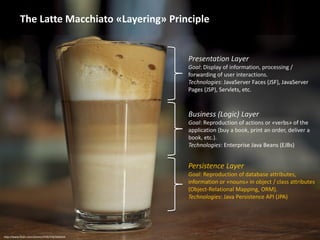
The Latte Macchiato «Layering» Principle
http://www.flickr.com/photos/tf28/4367660424
Presentation Layer
Goal: Display of information, processing /
forwarding of user interactions.
Technologies: JavaServer Faces (JSF), JavaServer
Pages (JSP), Servlets, etc.
Business (Logic) Layer
Goal: Reproduction of actions or «verbs» of the
application (buy a book, print an order, deliver a
book, etc.).
Technologies: Enterprise Java Beans (EJBs)
Persistence Layer
Goal: Reproduction of database attributes,
information or «nouns» in object / class attributes
(Object-Relational Mapping, ORM).
Technologies: Java Persistence API (JPA)
Object- Relational
Mapping (ORM)
http://www.flickr.com/photos/ellasdad/425813314
Andreas Martin - Page 5
JPA Specification at a Glance
 ORM: Mapping of java objects and database relations.
 Entity manager API: Database operations like: Create, Read,
Update, Delete (CRUD).
 Java Persistence Query Language (JPQL): Object oriented
query language.
 Java Transaction API (JTA): Transaction mechanism.
3. Persistence Layer
Source: Goncalves, 2010: Beginning Java™ EE 6 Platform with GlassFish™ 3 – Code (Apache-2.0 license): http://kenai.com/projects/beginningee6/
Andreas Martin - Page 6
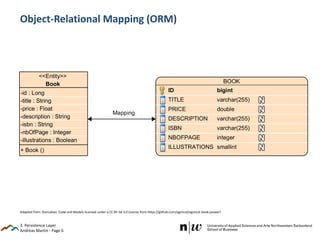
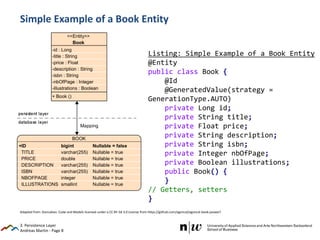
Object-Relational Mapping (ORM)
3. Persistence Layer
Adapted from: Goncalves: Code and Models licensed under a CC BY-SA 3.0 License from https://github.com/agoncal/agoncal-book-javaee7
Andreas Martin - Page 7
Object-Relational Mapping (ORM)
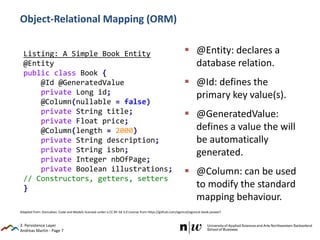
 @Entity: declares a
database relation.
 @Id: defines the
primary key value(s).
 @GeneratedValue:
defines a value the will
be automatically
generated.
 @Column: can be used
to modify the standard
mapping behaviour.
3. Persistence Layer
Listing: A Simple Book Entity
@Entity
public class Book {
@Id @GeneratedValue
private Long id;
@Column(nullable = false)
private String title;
private Float price;
@Column(length = 2000)
private String description;
private String isbn;
private Integer nbOfPage;
private Boolean illustrations;
// Constructors, getters, setters
}
Adapted from: Goncalves: Code and Models licensed under a CC BY-SA 3.0 License from https://github.com/agoncal/agoncal-book-javaee7
Andreas Martin - Page 8
Simple Example of a Book Entity
3. Persistence Layer
Listing: Simple Example of a Book Entity
@Entity
public class Book {
@Id
@GeneratedValue(strategy =
GenerationType.AUTO)
private Long id;
private String title;
private Float price;
private String description;
private String isbn;
private Integer nbOfPage;
private Boolean illustrations;
public Book() {
}
// Getters, setters
}
Adapted from: Goncalves: Code and Models licensed under a CC BY-SA 3.0 License from https://github.com/agoncal/agoncal-book-javaee7
Andreas Martin - Page 9
Simple Example of a Book Entity
3. Persistence Layer
Listing: Simple Example of a Book Entity
@Entity
public class Book {
@Id
@GeneratedValue(strategy =
GenerationType.AUTO)
private Long id;
private String title;
private Float price;
private String description;
private String isbn;
private Integer nbOfPage;
private Boolean illustrations;
public Book() {
}
// Getters, setters
}
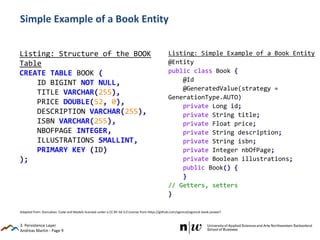
Listing: Structure of the BOOK
Table
CREATE TABLE BOOK (
ID BIGINT NOT NULL,
TITLE VARCHAR(255),
PRICE DOUBLE(52, 0),
DESCRIPTION VARCHAR(255),
ISBN VARCHAR(255),
NBOFPAGE INTEGER,
ILLUSTRATIONS SMALLINT,
PRIMARY KEY (ID)
);
Adapted from: Goncalves: Code and Models licensed under a CC BY-SA 3.0 License from https://github.com/agoncal/agoncal-book-javaee7
Andreas Martin - Page 10
Querying Entities using JPQL and EntityManager
3. Persistence Layer
EntityManagerFactory emf = Persistence.createEntityManagerFactory("primary");
EntityManager em = emf.createEntityManager();
em.persist(book);
 The methods
persist() and find()
will be transferred
by the
EntityManager into
JDBC calls (INSERT or
SELECT SQL
statements).
Adapted from: Goncalves: Code and Models licensed under a CC BY-SA 3.0 License from https://github.com/agoncal/agoncal-book-javaee7
Andreas Martin - Page 11
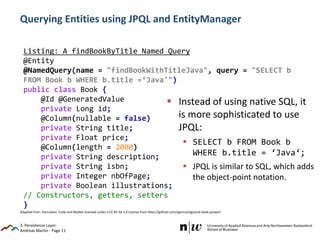
Listing: A findBookByTitle Named Query
@Entity
@NamedQuery(name = "findBookWithTitleJava", query = "SELECT b
FROM Book b WHERE b.title =‘Java'")
public class Book {
@Id @GeneratedValue
private Long id;
@Column(nullable = false)
private String title;
private Float price;
@Column(length = 2000)
private String description;
private String isbn;
private Integer nbOfPage;
private Boolean illustrations;
// Constructors, getters, setters
}
Querying Entities using JPQL and EntityManager
 Instead of using native SQL, it
is more sophisticated to use
JPQL:
 SELECT b FROM Book b
WHERE b.title = ‘Java‘;
 JPQL is similar to SQL, which adds
the object-point notation.
3. Persistence Layer
Adapted from: Goncalves: Code and Models licensed under a CC BY-SA 3.0 License from https://github.com/agoncal/agoncal-book-javaee7
Andreas Martin - Page 12
Hands-on-1
Java Persistence
3. Persistence Layer
Andreas Martin - Page 13
Predefined Projects - Hands-on Projects @ GitHub
…will be used for all the hands-on’s
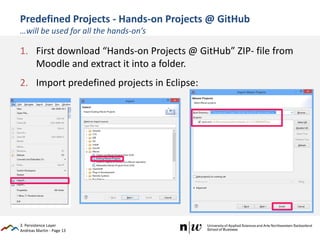
1. First download “Hands-on Projects @ GitHub” ZIP- file from
Moodle and extract it into a folder.
2. Import predefined projects in Eclipse:
3. Persistence Layer
Andreas Martin - Page 14
Database Connection
…will be used for the next two hands-on’s
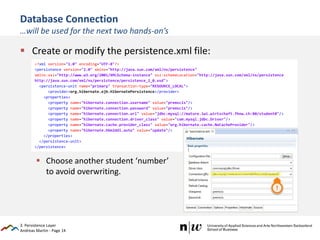
 Create or modify the persistence.xml file:
 Choose another student ‘number’
to avoid overwriting.
3. Persistence Layer
<?xml version="1.0" encoding="UTF-8"?>
<persistence version="2.0" xmlns="http://java.sun.com/xml/ns/persistence"
xmlns:xsi="http://www.w3.org/2001/XMLSchema-instance" xsi:schemaLocation="http://java.sun.com/xml/ns/persistence
http://java.sun.com/xml/ns/persistence/persistence_2_0.xsd">
<persistence-unit name="primary" transaction-type="RESOURCE_LOCAL">
<provider>org.hibernate.ejb.HibernatePersistence</provider>
<properties>
<property name="hibernate.connection.username" value="premscis"/>
<property name="hibernate.connection.password" value="premscis"/>
<property name="hibernate.connection.url" value="jdbc:mysql://mature.iwi.wirtschaft.fhnw.ch:80/student0"/>
<property name="hibernate.connection.driver_class" value="com.mysql.jdbc.Driver"/>
<property name="hibernate.cache.provider_class" value="org.hibernate.cache.NoCacheProvider"/>
<property name="hibernate.hbm2ddl.auto" value="update"/>
</properties>
</persistence-unit>
</persistence>
Andreas Martin - Page 15
Hands-on 1: Overview
 Now we know what an entity or the entity manager is.
 In this hands-on we are going to write a small application,
which stores an entity into a database.
 Create a Book entity and a Main class including a main
method, that stores a book entry into our MySQL database
(use the premscis scheme).
 Use the predefined maven project and watch out the pre-
configurations.
3. Persistence Layer
Andreas Martin - Page 16
Hands-on 1
1. Import (or create from blueprint) the hands-on-1 project. All
the source code will be placed into the
ch.fhnw.mscbis.premscis.handson1 package.
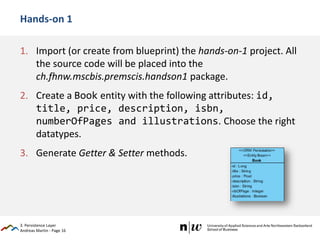
2. Create a Book entity with the following attributes: id,
title, price, description, isbn,
numberOfPages and illustrations. Choose the right
datatypes.
3. Generate Getter & Setter methods.
3. Persistence Layer
Andreas Martin - Page 17
Hands-on 1
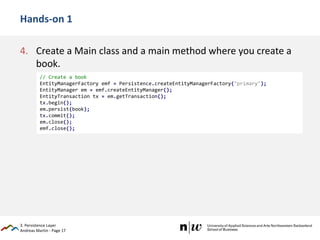
4. Create a Main class and a main method where you create a
book.
3. Persistence Layer
// Create a book
EntityManagerFactory emf = Persistence.createEntityManagerFactory("primary");
EntityManager em = emf.createEntityManager();
EntityTransaction tx = em.getTransaction();
tx.begin();
em.persist(book);
tx.commit();
em.close();
emf.close();
Object- Relational
Mapping (ORM)
http://www.flickr.com/photos/ellasdad/425813314
@Annotations
Andreas Martin - Page 19
@Table
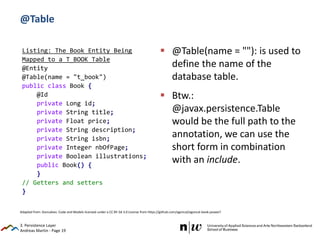
 @Table(name = ""): is used to
define the name of the
database table.
 Btw.:
@javax.persistence.Table
would be the full path to the
annotation, we can use the
short form in combination
with an include.
3. Persistence Layer
Listing: The Book Entity Being
Mapped to a T_BOOK Table
@Entity
@Table(name = "t_book")
public class Book {
@Id
private Long id;
private String title;
private Float price;
private String description;
private String isbn;
private Integer nbOfPage;
private Boolean illustrations;
public Book() {
}
// Getters and setters
}
Adapted from: Goncalves: Code and Models licensed under a CC BY-SA 3.0 License from https://github.com/agoncal/agoncal-book-javaee7
Andreas Martin - Page 20
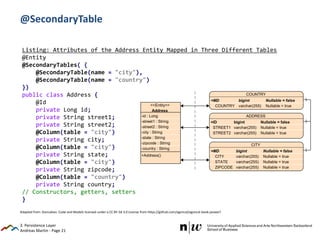
@SecondaryTable
3. Persistence Layer
Adapted from: Goncalves: Code and Models licensed under a CC BY-SA 3.0 License from https://github.com/agoncal/agoncal-book-javaee7
Andreas Martin - Page 21
@SecondaryTable
3. Persistence Layer
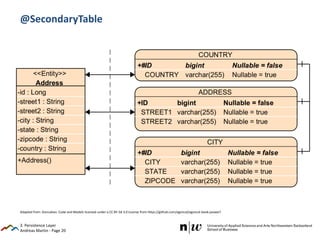
Listing: Attributes of the Address Entity Mapped in Three Different Tables
@Entity
@SecondaryTables( {
@SecondaryTable(name = "city"),
@SecondaryTable(name = "country")
})
public class Address {
@Id
private Long id;
private String street1;
private String street2;
@Column(table = "city")
private String city;
@Column(table = "city")
private String state;
@Column(table = "city")
private String zipcode;
@Column(table = "country")
private String country;
// Constructors, getters, setters
}
Adapted from: Goncalves: Code and Models licensed under a CC BY-SA 3.0 License from https://github.com/agoncal/agoncal-book-javaee7
Andreas Martin - Page 22
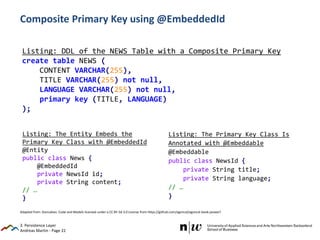
Composite Primary Key using @EmbeddedId
3. Persistence Layer
Listing: DDL of the NEWS Table with a Composite Primary Key
create table NEWS (
CONTENT VARCHAR(255),
TITLE VARCHAR(255) not null,
LANGUAGE VARCHAR(255) not null,
primary key (TITLE, LANGUAGE)
);
Listing: The Entity Embeds the
Primary Key Class with @EmbeddedId
@Entity
public class News {
@EmbeddedId
private NewsId id;
private String content;
// …
}
Listing: The Primary Key Class Is
Annotated with @Embeddable
@Embeddable
public class NewsId {
private String title;
private String language;
// …
}
Adapted from: Goncalves: Code and Models licensed under a CC BY-SA 3.0 License from https://github.com/agoncal/agoncal-book-javaee7
Andreas Martin - Page 23
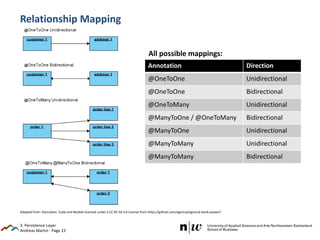
Relationship Mapping
3. Persistence Layer
Adapted from: Goncalves: Code and Models licensed under a CC BY-SA 3.0 License from https://github.com/agoncal/agoncal-book-javaee7
Annotation Direction
@OneToOne Unidirectional
@OneToOne Bidirectional
@OneToMany Unidirectional
@ManyToOne / @OneToMany Bidirectional
@ManyToOne Unidirectional
@ManyToMany Unidirectional
@ManyToMany Bidirectional
All possible mappings:
Andreas Martin - Page 24
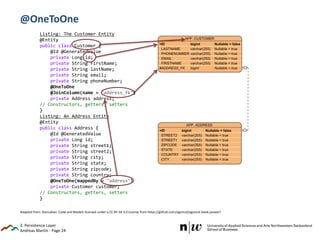
@OneToOne
3. Persistence Layer
Adapted from: Goncalves: Code and Models licensed under a CC BY-SA 3.0 License from https://github.com/agoncal/agoncal-book-javaee7
Listing: The Customer Entity
@Entity
public class Customer {
@Id @GeneratedValue
private Long id;
private String firstName;
private String lastName;
private String email;
private String phoneNumber;
@OneToOne
@JoinColumn(name = "address_fk")
private Address address;
// Constructors, getters, setters
}
Listing: An Address Entity
@Entity
public class Address {
@Id @GeneratedValue
private Long id;
private String street1;
private String street2;
private String city;
private String state;
private String zipcode;
private String country;
@OneToOne(mappedBy = "address")
private Customer customer;
// Constructors, getters, setters
}
Andreas Martin - Page 25
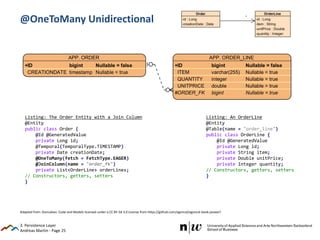
@OneToMany Unidirectional
3. Persistence Layer
Listing: The Order Entity with a Join Column
@Entity
public class Order {
@Id @GeneratedValue
private Long id;
@Temporal(TemporalType.TIMESTAMP)
private Date creationDate;
@OneToMany(fetch = FetchType.EAGER)
@JoinColumn(name = "order_fk")
private List<OrderLine> orderLines;
// Constructors, getters, setters
}
Listing: An OrderLine
@Entity
@Table(name = "order_line")
public class OrderLine {
@Id @GeneratedValue
private Long id;
private String item;
private Double unitPrice;
private Integer quantity;
// Constructors, getters, setters
}
Adapted from: Goncalves: Code and Models licensed under a CC BY-SA 3.0 License from https://github.com/agoncal/agoncal-book-javaee7
Andreas Martin - Page 26
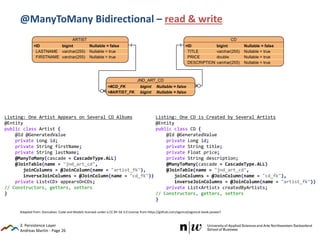
@ManyToMany Bidirectional – read & write
3. Persistence Layer
Listing: One Artist Appears on Several CD Albums
@Entity
public class Artist {
@Id @GeneratedValue
private Long id;
private String firstName;
private String lastName;
@ManyToMany(cascade = CascadeType.ALL)
@JoinTable(name = "jnd_art_cd",
joinColumns = @JoinColumn(name = "artist_fk"),
inverseJoinColumns = @JoinColumn(name = "cd_fk"))
private List<CD> appearsOnCDs;
// Constructors, getters, setters
}
Listing: One CD is Created by Several Artists
@Entity
public class CD {
@Id @GeneratedValue
private Long id;
private String title;
private Float price;
private String description;
@ManyToMany(cascade = CascadeType.ALL)
@JoinTable(name = "jnd_art_cd",
joinColumns = @JoinColumn(name = "cd_fk"),
inverseJoinColumns = @JoinColumn(name = "artist_fk"))
private List<Artist> createdByArtists;
// Constructors, getters, setters
}
Adapted from: Goncalves: Code and Models licensed under a CC BY-SA 3.0 License from https://github.com/agoncal/agoncal-book-javaee7
Andreas Martin - Page 27
Managing Persistent Objects
3. Persistence Layer
Andreas Martin - Page 28
Recap our Hands-on 1
3. Persistence Layer
Listing: A Main Class Persisting and Retrieving a Book Entity
public class Main {
public static void main(String[] args) {
// 1-Create an instance of the Book entity
Book book = new Book();
book.setId(1234L);
book.setTitle("The Hitchhiker's Guide to the Galaxy");
book.setPrice(12.5F);
book.setDescription("Science fiction created by Douglas Adams.");
book.setIsbn("1-84023-742-2");
book.setNbOfPage(354);
book.setIllustrations(false);
// 2-Get an entity manager and a transaction
EntityManagerFactory emf =
Persistence.createEntityManagerFactory(«primary");
EntityManager em = emf.createEntityManager();
EntityTransaction tx = em.getTransaction();
// 3-Persist the book to the database
tx.begin();
em.persist(book);
tx.commit();
// 4-Retrieve the book by its identifier
book = em.find(Book.class, 1234L);
System.out.println(book);
em.close();
emf.close();
}
}
Adapted from: Goncalves: Code and Models licensed under a CC BY-SA 3.0 License from https://github.com/agoncal/agoncal-book-javaee7
Andreas Martin - Page 29
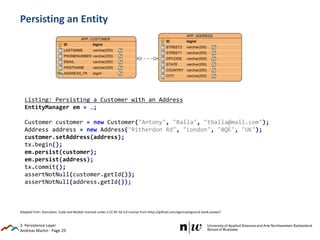
Persisting an Entity
3. Persistence Layer
Listing: Persisting a Customer with an Address
EntityManager em = …;
Customer customer = new Customer("Antony", "Balla", "tballa@mail.com");
Address address = new Address("Ritherdon Rd", "London", "8QE", "UK");
customer.setAddress(address);
tx.begin();
em.persist(customer);
em.persist(address);
tx.commit();
assertNotNull(customer.getId());
assertNotNull(address.getId());
Adapted from: Goncalves: Code and Models licensed under a CC BY-SA 3.0 License from https://github.com/agoncal/agoncal-book-javaee7
Andreas Martin - Page 30
JPQL
3. Persistence Layer
Andreas Martin - Page 31
UPDATE <entity name> [[AS] <identification variable>]
SET <update statement> {, <update statement>}*
[WHERE <conditional expression>]
DELETE FROM <entity name> [[AS] <identification var.>]
[WHERE <conditional expression>]
JPQL
SELECT- Syntax
DELETE- Syntax
UPDATE- Syntax
 The JPQL syntax is
comparable to the SQL
syntax is used in a MySQL or
Apache Derby environment.
 Extensions in JPQL e.g.:
3. Persistence Layer
Source: Goncalves, 2010: Beginning Java™ EE 6 Platform with GlassFish™ 3 – Code (Apache-2.0 license): http://kenai.com/projects/beginningee6/
SELECT <expression>
FROM <clause>
[WHERE <conditional expression>]
[ORDER BY <clause>]
[GROUP BY <clause>]
[HAVING <clause>]
SELECT CASE b.author WHEN 'Martin'
THEN b.price * 1.5
ELSE b.price * 0.8
END
FROM Book b
Andreas Martin - Page 32
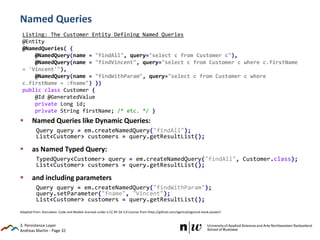
Named Queries
 Named Queries like Dynamic Queries:
Query query = em.createNamedQuery("findAll");
List<Customer> customers = query.getResultList();
 as Named Typed Query:
TypedQuery<Customer> query = em.createNamedQuery("findAll", Customer.class);
List<Customer> customers = query.getResultList();
 and including parameters
Query query = em.createNamedQuery("findWithParam");
query.setParameter("fname", "Vincent");
List<Customer> customers = query.getResultList();
3. Persistence Layer
Listing: The Customer Entity Defining Named Queries
@Entity
@NamedQueries( {
@NamedQuery(name = "findAll", query="select c from Customer c"),
@NamedQuery(name = "findVincent", query="select c from Customer c where c.firstName
= 'Vincent'"),
@NamedQuery(name = "findWithParam", query="select c from Customer c where
c.firstName = :fname") })
public class Customer {
@Id @GeneratedValue
private Long id;
private String firstName; /* etc. */ }
Adapted from: Goncalves: Code and Models licensed under a CC BY-SA 3.0 License from https://github.com/agoncal/agoncal-book-javaee7
Andreas Martin - Page 33
Hands-on 2
MANAGING PERSISTENT OBJECTS
3. Persistence Layer
Based on: Goncalves, 2010: Beginning Java™ EE 6 Platform with GlassFish™ 3
Andreas Martin - Page 34
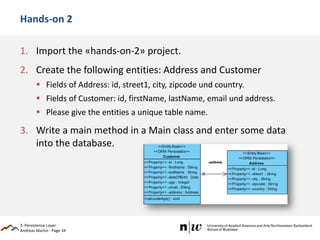
Hands-on 2
1. Import the «hands-on-2» project.
2. Create the following entities: Address and Customer
 Fields of Address: id, street1, city, zipcode und country.
 Fields of Customer: id, firstName, lastName, email und address.
 Please give the entities a unique table name.
3. Write a main method in a Main class and enter some data
into the database.
3. Persistence Layer

2014 Pre-MSc-IS-3 Persistence Layer

  • 1.
    Andreas Martin -Page 1 Master of Science in Business Information Systems FHNW Pre-Master Information Systems 3. Persistence Layer Andreas Martin 3. Persistence Layer http://www.flickr.com/photos/shandrew/3327258963
  • 2.
    Andreas Martin -Page 2 Persistence Layer  Object- Relational Mapping (ORM)  Java Persistence API (JPA)  Java Transaction API (JTA)  Hands-on:  Hands-on 1: JAVA PERSISTENCE  Hands-on 2: MANAGING PERSISTENT OBJECTS 3. Persistence Layer
  • 3.
    The Latte Macchiato«Layering» Principle http://www.flickr.com/photos/tf28/4367660424 Presentation Layer Goal: Display of information, processing / forwarding of user interactions. Technologies: JavaServer Faces (JSF), JavaServer Pages (JSP), Servlets, etc. Business (Logic) Layer Goal: Reproduction of actions or «verbs» of the application (buy a book, print an order, deliver a book, etc.). Technologies: Enterprise Java Beans (EJBs) Persistence Layer Goal: Reproduction of database attributes, information or «nouns» in object / class attributes (Object-Relational Mapping, ORM). Technologies: Java Persistence API (JPA)
  • 4.
  • 5.
    Andreas Martin -Page 5 JPA Specification at a Glance  ORM: Mapping of java objects and database relations.  Entity manager API: Database operations like: Create, Read, Update, Delete (CRUD).  Java Persistence Query Language (JPQL): Object oriented query language.  Java Transaction API (JTA): Transaction mechanism. 3. Persistence Layer Source: Goncalves, 2010: Beginning Java™ EE 6 Platform with GlassFish™ 3 – Code (Apache-2.0 license): http://kenai.com/projects/beginningee6/
  • 6.
    Andreas Martin -Page 6 Object-Relational Mapping (ORM) 3. Persistence Layer Adapted from: Goncalves: Code and Models licensed under a CC BY-SA 3.0 License from https://github.com/agoncal/agoncal-book-javaee7
  • 7.
    Andreas Martin -Page 7 Object-Relational Mapping (ORM)  @Entity: declares a database relation.  @Id: defines the primary key value(s).  @GeneratedValue: defines a value the will be automatically generated.  @Column: can be used to modify the standard mapping behaviour. 3. Persistence Layer Listing: A Simple Book Entity @Entity public class Book { @Id @GeneratedValue private Long id; @Column(nullable = false) private String title; private Float price; @Column(length = 2000) private String description; private String isbn; private Integer nbOfPage; private Boolean illustrations; // Constructors, getters, setters } Adapted from: Goncalves: Code and Models licensed under a CC BY-SA 3.0 License from https://github.com/agoncal/agoncal-book-javaee7
  • 8.
    Andreas Martin -Page 8 Simple Example of a Book Entity 3. Persistence Layer Listing: Simple Example of a Book Entity @Entity public class Book { @Id @GeneratedValue(strategy = GenerationType.AUTO) private Long id; private String title; private Float price; private String description; private String isbn; private Integer nbOfPage; private Boolean illustrations; public Book() { } // Getters, setters } Adapted from: Goncalves: Code and Models licensed under a CC BY-SA 3.0 License from https://github.com/agoncal/agoncal-book-javaee7
  • 9.
    Andreas Martin -Page 9 Simple Example of a Book Entity 3. Persistence Layer Listing: Simple Example of a Book Entity @Entity public class Book { @Id @GeneratedValue(strategy = GenerationType.AUTO) private Long id; private String title; private Float price; private String description; private String isbn; private Integer nbOfPage; private Boolean illustrations; public Book() { } // Getters, setters } Listing: Structure of the BOOK Table CREATE TABLE BOOK ( ID BIGINT NOT NULL, TITLE VARCHAR(255), PRICE DOUBLE(52, 0), DESCRIPTION VARCHAR(255), ISBN VARCHAR(255), NBOFPAGE INTEGER, ILLUSTRATIONS SMALLINT, PRIMARY KEY (ID) ); Adapted from: Goncalves: Code and Models licensed under a CC BY-SA 3.0 License from https://github.com/agoncal/agoncal-book-javaee7
  • 10.
    Andreas Martin -Page 10 Querying Entities using JPQL and EntityManager 3. Persistence Layer EntityManagerFactory emf = Persistence.createEntityManagerFactory("primary"); EntityManager em = emf.createEntityManager(); em.persist(book);  The methods persist() and find() will be transferred by the EntityManager into JDBC calls (INSERT or SELECT SQL statements). Adapted from: Goncalves: Code and Models licensed under a CC BY-SA 3.0 License from https://github.com/agoncal/agoncal-book-javaee7
  • 11.
    Andreas Martin -Page 11 Listing: A findBookByTitle Named Query @Entity @NamedQuery(name = "findBookWithTitleJava", query = "SELECT b FROM Book b WHERE b.title =‘Java'") public class Book { @Id @GeneratedValue private Long id; @Column(nullable = false) private String title; private Float price; @Column(length = 2000) private String description; private String isbn; private Integer nbOfPage; private Boolean illustrations; // Constructors, getters, setters } Querying Entities using JPQL and EntityManager  Instead of using native SQL, it is more sophisticated to use JPQL:  SELECT b FROM Book b WHERE b.title = ‘Java‘;  JPQL is similar to SQL, which adds the object-point notation. 3. Persistence Layer Adapted from: Goncalves: Code and Models licensed under a CC BY-SA 3.0 License from https://github.com/agoncal/agoncal-book-javaee7
  • 12.
    Andreas Martin -Page 12 Hands-on-1 Java Persistence 3. Persistence Layer
  • 13.
    Andreas Martin -Page 13 Predefined Projects - Hands-on Projects @ GitHub …will be used for all the hands-on’s 1. First download “Hands-on Projects @ GitHub” ZIP- file from Moodle and extract it into a folder. 2. Import predefined projects in Eclipse: 3. Persistence Layer
  • 14.
    Andreas Martin -Page 14 Database Connection …will be used for the next two hands-on’s  Create or modify the persistence.xml file:  Choose another student ‘number’ to avoid overwriting. 3. Persistence Layer <?xml version="1.0" encoding="UTF-8"?> <persistence version="2.0" xmlns="http://java.sun.com/xml/ns/persistence" xmlns:xsi="http://www.w3.org/2001/XMLSchema-instance" xsi:schemaLocation="http://java.sun.com/xml/ns/persistence http://java.sun.com/xml/ns/persistence/persistence_2_0.xsd"> <persistence-unit name="primary" transaction-type="RESOURCE_LOCAL"> <provider>org.hibernate.ejb.HibernatePersistence</provider> <properties> <property name="hibernate.connection.username" value="premscis"/> <property name="hibernate.connection.password" value="premscis"/> <property name="hibernate.connection.url" value="jdbc:mysql://mature.iwi.wirtschaft.fhnw.ch:80/student0"/> <property name="hibernate.connection.driver_class" value="com.mysql.jdbc.Driver"/> <property name="hibernate.cache.provider_class" value="org.hibernate.cache.NoCacheProvider"/> <property name="hibernate.hbm2ddl.auto" value="update"/> </properties> </persistence-unit> </persistence>
  • 15.
    Andreas Martin -Page 15 Hands-on 1: Overview  Now we know what an entity or the entity manager is.  In this hands-on we are going to write a small application, which stores an entity into a database.  Create a Book entity and a Main class including a main method, that stores a book entry into our MySQL database (use the premscis scheme).  Use the predefined maven project and watch out the pre- configurations. 3. Persistence Layer
  • 16.
    Andreas Martin -Page 16 Hands-on 1 1. Import (or create from blueprint) the hands-on-1 project. All the source code will be placed into the ch.fhnw.mscbis.premscis.handson1 package. 2. Create a Book entity with the following attributes: id, title, price, description, isbn, numberOfPages and illustrations. Choose the right datatypes. 3. Generate Getter & Setter methods. 3. Persistence Layer
  • 17.
    Andreas Martin -Page 17 Hands-on 1 4. Create a Main class and a main method where you create a book. 3. Persistence Layer // Create a book EntityManagerFactory emf = Persistence.createEntityManagerFactory("primary"); EntityManager em = emf.createEntityManager(); EntityTransaction tx = em.getTransaction(); tx.begin(); em.persist(book); tx.commit(); em.close(); emf.close();
  • 18.
  • 19.
    Andreas Martin -Page 19 @Table  @Table(name = ""): is used to define the name of the database table.  Btw.: @javax.persistence.Table would be the full path to the annotation, we can use the short form in combination with an include. 3. Persistence Layer Listing: The Book Entity Being Mapped to a T_BOOK Table @Entity @Table(name = "t_book") public class Book { @Id private Long id; private String title; private Float price; private String description; private String isbn; private Integer nbOfPage; private Boolean illustrations; public Book() { } // Getters and setters } Adapted from: Goncalves: Code and Models licensed under a CC BY-SA 3.0 License from https://github.com/agoncal/agoncal-book-javaee7
  • 20.
    Andreas Martin -Page 20 @SecondaryTable 3. Persistence Layer Adapted from: Goncalves: Code and Models licensed under a CC BY-SA 3.0 License from https://github.com/agoncal/agoncal-book-javaee7
  • 21.
    Andreas Martin -Page 21 @SecondaryTable 3. Persistence Layer Listing: Attributes of the Address Entity Mapped in Three Different Tables @Entity @SecondaryTables( { @SecondaryTable(name = "city"), @SecondaryTable(name = "country") }) public class Address { @Id private Long id; private String street1; private String street2; @Column(table = "city") private String city; @Column(table = "city") private String state; @Column(table = "city") private String zipcode; @Column(table = "country") private String country; // Constructors, getters, setters } Adapted from: Goncalves: Code and Models licensed under a CC BY-SA 3.0 License from https://github.com/agoncal/agoncal-book-javaee7
  • 22.
    Andreas Martin -Page 22 Composite Primary Key using @EmbeddedId 3. Persistence Layer Listing: DDL of the NEWS Table with a Composite Primary Key create table NEWS ( CONTENT VARCHAR(255), TITLE VARCHAR(255) not null, LANGUAGE VARCHAR(255) not null, primary key (TITLE, LANGUAGE) ); Listing: The Entity Embeds the Primary Key Class with @EmbeddedId @Entity public class News { @EmbeddedId private NewsId id; private String content; // … } Listing: The Primary Key Class Is Annotated with @Embeddable @Embeddable public class NewsId { private String title; private String language; // … } Adapted from: Goncalves: Code and Models licensed under a CC BY-SA 3.0 License from https://github.com/agoncal/agoncal-book-javaee7
  • 23.
    Andreas Martin -Page 23 Relationship Mapping 3. Persistence Layer Adapted from: Goncalves: Code and Models licensed under a CC BY-SA 3.0 License from https://github.com/agoncal/agoncal-book-javaee7 Annotation Direction @OneToOne Unidirectional @OneToOne Bidirectional @OneToMany Unidirectional @ManyToOne / @OneToMany Bidirectional @ManyToOne Unidirectional @ManyToMany Unidirectional @ManyToMany Bidirectional All possible mappings:
  • 24.
    Andreas Martin -Page 24 @OneToOne 3. Persistence Layer Adapted from: Goncalves: Code and Models licensed under a CC BY-SA 3.0 License from https://github.com/agoncal/agoncal-book-javaee7 Listing: The Customer Entity @Entity public class Customer { @Id @GeneratedValue private Long id; private String firstName; private String lastName; private String email; private String phoneNumber; @OneToOne @JoinColumn(name = "address_fk") private Address address; // Constructors, getters, setters } Listing: An Address Entity @Entity public class Address { @Id @GeneratedValue private Long id; private String street1; private String street2; private String city; private String state; private String zipcode; private String country; @OneToOne(mappedBy = "address") private Customer customer; // Constructors, getters, setters }
  • 25.
    Andreas Martin -Page 25 @OneToMany Unidirectional 3. Persistence Layer Listing: The Order Entity with a Join Column @Entity public class Order { @Id @GeneratedValue private Long id; @Temporal(TemporalType.TIMESTAMP) private Date creationDate; @OneToMany(fetch = FetchType.EAGER) @JoinColumn(name = "order_fk") private List<OrderLine> orderLines; // Constructors, getters, setters } Listing: An OrderLine @Entity @Table(name = "order_line") public class OrderLine { @Id @GeneratedValue private Long id; private String item; private Double unitPrice; private Integer quantity; // Constructors, getters, setters } Adapted from: Goncalves: Code and Models licensed under a CC BY-SA 3.0 License from https://github.com/agoncal/agoncal-book-javaee7
  • 26.
    Andreas Martin -Page 26 @ManyToMany Bidirectional – read & write 3. Persistence Layer Listing: One Artist Appears on Several CD Albums @Entity public class Artist { @Id @GeneratedValue private Long id; private String firstName; private String lastName; @ManyToMany(cascade = CascadeType.ALL) @JoinTable(name = "jnd_art_cd", joinColumns = @JoinColumn(name = "artist_fk"), inverseJoinColumns = @JoinColumn(name = "cd_fk")) private List<CD> appearsOnCDs; // Constructors, getters, setters } Listing: One CD is Created by Several Artists @Entity public class CD { @Id @GeneratedValue private Long id; private String title; private Float price; private String description; @ManyToMany(cascade = CascadeType.ALL) @JoinTable(name = "jnd_art_cd", joinColumns = @JoinColumn(name = "cd_fk"), inverseJoinColumns = @JoinColumn(name = "artist_fk")) private List<Artist> createdByArtists; // Constructors, getters, setters } Adapted from: Goncalves: Code and Models licensed under a CC BY-SA 3.0 License from https://github.com/agoncal/agoncal-book-javaee7
  • 27.
    Andreas Martin -Page 27 Managing Persistent Objects 3. Persistence Layer
  • 28.
    Andreas Martin -Page 28 Recap our Hands-on 1 3. Persistence Layer Listing: A Main Class Persisting and Retrieving a Book Entity public class Main { public static void main(String[] args) { // 1-Create an instance of the Book entity Book book = new Book(); book.setId(1234L); book.setTitle("The Hitchhiker's Guide to the Galaxy"); book.setPrice(12.5F); book.setDescription("Science fiction created by Douglas Adams."); book.setIsbn("1-84023-742-2"); book.setNbOfPage(354); book.setIllustrations(false); // 2-Get an entity manager and a transaction EntityManagerFactory emf = Persistence.createEntityManagerFactory(«primary"); EntityManager em = emf.createEntityManager(); EntityTransaction tx = em.getTransaction(); // 3-Persist the book to the database tx.begin(); em.persist(book); tx.commit(); // 4-Retrieve the book by its identifier book = em.find(Book.class, 1234L); System.out.println(book); em.close(); emf.close(); } } Adapted from: Goncalves: Code and Models licensed under a CC BY-SA 3.0 License from https://github.com/agoncal/agoncal-book-javaee7
  • 29.
    Andreas Martin -Page 29 Persisting an Entity 3. Persistence Layer Listing: Persisting a Customer with an Address EntityManager em = …; Customer customer = new Customer("Antony", "Balla", "tballa@mail.com"); Address address = new Address("Ritherdon Rd", "London", "8QE", "UK"); customer.setAddress(address); tx.begin(); em.persist(customer); em.persist(address); tx.commit(); assertNotNull(customer.getId()); assertNotNull(address.getId()); Adapted from: Goncalves: Code and Models licensed under a CC BY-SA 3.0 License from https://github.com/agoncal/agoncal-book-javaee7
  • 30.
    Andreas Martin -Page 30 JPQL 3. Persistence Layer
  • 31.
    Andreas Martin -Page 31 UPDATE <entity name> [[AS] <identification variable>] SET <update statement> {, <update statement>}* [WHERE <conditional expression>] DELETE FROM <entity name> [[AS] <identification var.>] [WHERE <conditional expression>] JPQL SELECT- Syntax DELETE- Syntax UPDATE- Syntax  The JPQL syntax is comparable to the SQL syntax is used in a MySQL or Apache Derby environment.  Extensions in JPQL e.g.: 3. Persistence Layer Source: Goncalves, 2010: Beginning Java™ EE 6 Platform with GlassFish™ 3 – Code (Apache-2.0 license): http://kenai.com/projects/beginningee6/ SELECT <expression> FROM <clause> [WHERE <conditional expression>] [ORDER BY <clause>] [GROUP BY <clause>] [HAVING <clause>] SELECT CASE b.author WHEN 'Martin' THEN b.price * 1.5 ELSE b.price * 0.8 END FROM Book b
  • 32.
    Andreas Martin -Page 32 Named Queries  Named Queries like Dynamic Queries: Query query = em.createNamedQuery("findAll"); List<Customer> customers = query.getResultList();  as Named Typed Query: TypedQuery<Customer> query = em.createNamedQuery("findAll", Customer.class); List<Customer> customers = query.getResultList();  and including parameters Query query = em.createNamedQuery("findWithParam"); query.setParameter("fname", "Vincent"); List<Customer> customers = query.getResultList(); 3. Persistence Layer Listing: The Customer Entity Defining Named Queries @Entity @NamedQueries( { @NamedQuery(name = "findAll", query="select c from Customer c"), @NamedQuery(name = "findVincent", query="select c from Customer c where c.firstName = 'Vincent'"), @NamedQuery(name = "findWithParam", query="select c from Customer c where c.firstName = :fname") }) public class Customer { @Id @GeneratedValue private Long id; private String firstName; /* etc. */ } Adapted from: Goncalves: Code and Models licensed under a CC BY-SA 3.0 License from https://github.com/agoncal/agoncal-book-javaee7
  • 33.
    Andreas Martin -Page 33 Hands-on 2 MANAGING PERSISTENT OBJECTS 3. Persistence Layer Based on: Goncalves, 2010: Beginning Java™ EE 6 Platform with GlassFish™ 3
  • 34.
    Andreas Martin -Page 34 Hands-on 2 1. Import the «hands-on-2» project. 2. Create the following entities: Address and Customer  Fields of Address: id, street1, city, zipcode und country.  Fields of Customer: id, firstName, lastName, email und address.  Please give the entities a unique table name. 3. Write a main method in a Main class and enter some data into the database. 3. Persistence Layer