Public Health England is responsible for the NHS Screening Programmes
Quality Assurance (London)
Newborn Screening Updates
30.10.15
Angela Dietrich, Senior QA Advisor
Newborn Blood Spot Sampling
2 Newborn Screening Update - 30.10.15
Guidelines currently being updated. Should be available end of Nov 2015.
They will: -
 include information on all of the nine conditions currently screened for
 provide clarity on the type of transfusions that affect bloodspot samples
 contain useful scenarios that can be used for training purposes
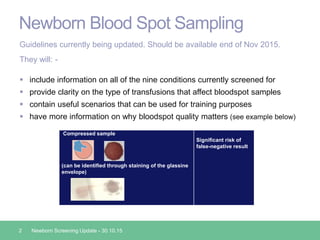
 have more information on why bloodspot quality matters (see example below)
Compressed sample
(can be identified through staining of the glassine
envelope)
Significant risk of
false-negative result
Newborn Blood Spot Sampling
• Residual blood spot consultation – November 2015 to January 2016
• Residual blood spots are currently used for:
• molecular genetic diagnosis
• prenatal diagnosis for at risk relatives
• diagnosis of congenital infection
• research
• Consultation is to review the retention, storage, use and release of residual
blood spots and related information
• Expanded NBS screening review – will be completed Jan 2016
• Review of NBS card - 2016
3 Newborn Screening Update - 30.10.15
NBSFS – Exception Reports
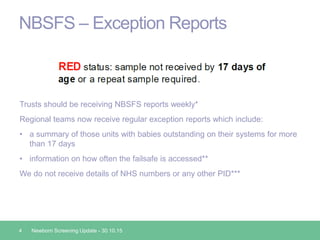
Trusts should be receiving NBSFS reports weekly*
Regional teams now receive regular exception reports which include:
• a summary of those units with babies outstanding on their systems for more
than 17 days
• information on how often the failsafe is accessed**
We do not receive details of NHS numbers or any other PID***
4 Newborn Screening Update - 30.10.15
Newborn & Infant Physical Examination
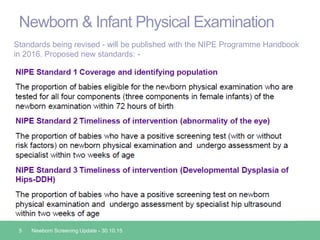
Standards being revised - will be published with the NIPE Programme Handbook
in 2016. Proposed new standards: -
5 Newborn Screening Update - 30.10.15
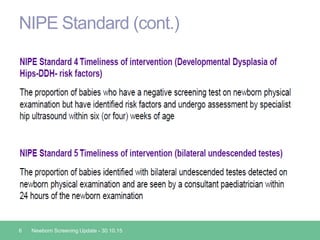
NIPE Standard (cont.)
6 Newborn Screening Update - 30.10.15
Newborn & Infant Physical Examination
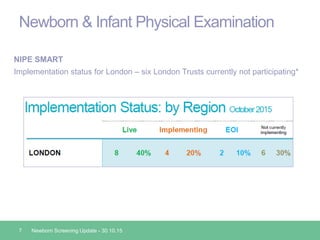
NIPE SMART
Implementation status for London – six London Trusts currently not participating*
7 Newborn Screening Update - 30.10.15
NIPE SMART IMPLEMENTATION
Some of the reasons given for not implementing NIPE SMART include: -
» screening team keen, neonatologist/NNU resistant
» not wanting to implement parallel systems which may require double (or
triple) entry
» already recording the data
It should be noted however that local systems will not meet the national service
specifications which require a robust national failsafe process.
8 Newborn Screening Update - 30.10.15
Pulse Oximetry
Pilots commenced February 2015
15 Trusts participating
Testing the impact of introducing Pulse
Oximetry – aim is to review the
feasible of its inclusion in the Newborn
& Infant Physical Examination
If rolled out nationally, pulse oximetry
fields will be added to NIPE SMART
9 Newborn Screening Update - 30.10.15
Newborn Hearing Screening Programme (NHSP)
 Programme standards under review
 Operational handbook being developed
Site / Border Changes
 Some Trusts are experiencing changes in how newborn hearing screening is
organised locally e.g. changes from community model to hospital model,
changes in service provider
 Largely influenced by funding / commissioning
 Presents a significant risk to this screening programme
Ensure concerns/issues related to these changes are discussed
formally at TSSGs and risks escalated appropriately
10 Newborn Screening Update - 30.10.15
Changes to local Hearing Screening Programmes
When changes are made/proposed QA and NHS England will
require assurance that: -
 local pathways have been reviewed and risk assessed
 where border changes have occurred, responsibility for screening is
clear
 planning includes the correct re- structuring of the NHSP IT system
(e-Screener Plus or eSP) so that babies are not missed or screening
delayed
 new hearing screening staff/providers of the service have
appropriate links with local internal governance structures
 local hearing screening guidelines are updated to reflect changes
11 Newborn Screening Update - 30.10.15

3 newborn updates – Michelle Onslow

  • 1.
    Public Health Englandis responsible for the NHS Screening Programmes Quality Assurance (London) Newborn Screening Updates 30.10.15 Angela Dietrich, Senior QA Advisor
  • 2.
    Newborn Blood SpotSampling 2 Newborn Screening Update - 30.10.15 Guidelines currently being updated. Should be available end of Nov 2015. They will: -  include information on all of the nine conditions currently screened for  provide clarity on the type of transfusions that affect bloodspot samples  contain useful scenarios that can be used for training purposes  have more information on why bloodspot quality matters (see example below) Compressed sample (can be identified through staining of the glassine envelope) Significant risk of false-negative result
  • 3.
    Newborn Blood SpotSampling • Residual blood spot consultation – November 2015 to January 2016 • Residual blood spots are currently used for: • molecular genetic diagnosis • prenatal diagnosis for at risk relatives • diagnosis of congenital infection • research • Consultation is to review the retention, storage, use and release of residual blood spots and related information • Expanded NBS screening review – will be completed Jan 2016 • Review of NBS card - 2016 3 Newborn Screening Update - 30.10.15
  • 4.
    NBSFS – ExceptionReports Trusts should be receiving NBSFS reports weekly* Regional teams now receive regular exception reports which include: • a summary of those units with babies outstanding on their systems for more than 17 days • information on how often the failsafe is accessed** We do not receive details of NHS numbers or any other PID*** 4 Newborn Screening Update - 30.10.15
  • 5.
    Newborn & InfantPhysical Examination Standards being revised - will be published with the NIPE Programme Handbook in 2016. Proposed new standards: - 5 Newborn Screening Update - 30.10.15
  • 6.
    NIPE Standard (cont.) 6Newborn Screening Update - 30.10.15
  • 7.
    Newborn & InfantPhysical Examination NIPE SMART Implementation status for London – six London Trusts currently not participating* 7 Newborn Screening Update - 30.10.15
  • 8.
    NIPE SMART IMPLEMENTATION Someof the reasons given for not implementing NIPE SMART include: - » screening team keen, neonatologist/NNU resistant » not wanting to implement parallel systems which may require double (or triple) entry » already recording the data It should be noted however that local systems will not meet the national service specifications which require a robust national failsafe process. 8 Newborn Screening Update - 30.10.15
  • 9.
    Pulse Oximetry Pilots commencedFebruary 2015 15 Trusts participating Testing the impact of introducing Pulse Oximetry – aim is to review the feasible of its inclusion in the Newborn & Infant Physical Examination If rolled out nationally, pulse oximetry fields will be added to NIPE SMART 9 Newborn Screening Update - 30.10.15
  • 10.
    Newborn Hearing ScreeningProgramme (NHSP)  Programme standards under review  Operational handbook being developed Site / Border Changes  Some Trusts are experiencing changes in how newborn hearing screening is organised locally e.g. changes from community model to hospital model, changes in service provider  Largely influenced by funding / commissioning  Presents a significant risk to this screening programme Ensure concerns/issues related to these changes are discussed formally at TSSGs and risks escalated appropriately 10 Newborn Screening Update - 30.10.15
  • 11.
    Changes to localHearing Screening Programmes When changes are made/proposed QA and NHS England will require assurance that: -  local pathways have been reviewed and risk assessed  where border changes have occurred, responsibility for screening is clear  planning includes the correct re- structuring of the NHSP IT system (e-Screener Plus or eSP) so that babies are not missed or screening delayed  new hearing screening staff/providers of the service have appropriate links with local internal governance structures  local hearing screening guidelines are updated to reflect changes 11 Newborn Screening Update - 30.10.15