Multiplication and Division of Fractions
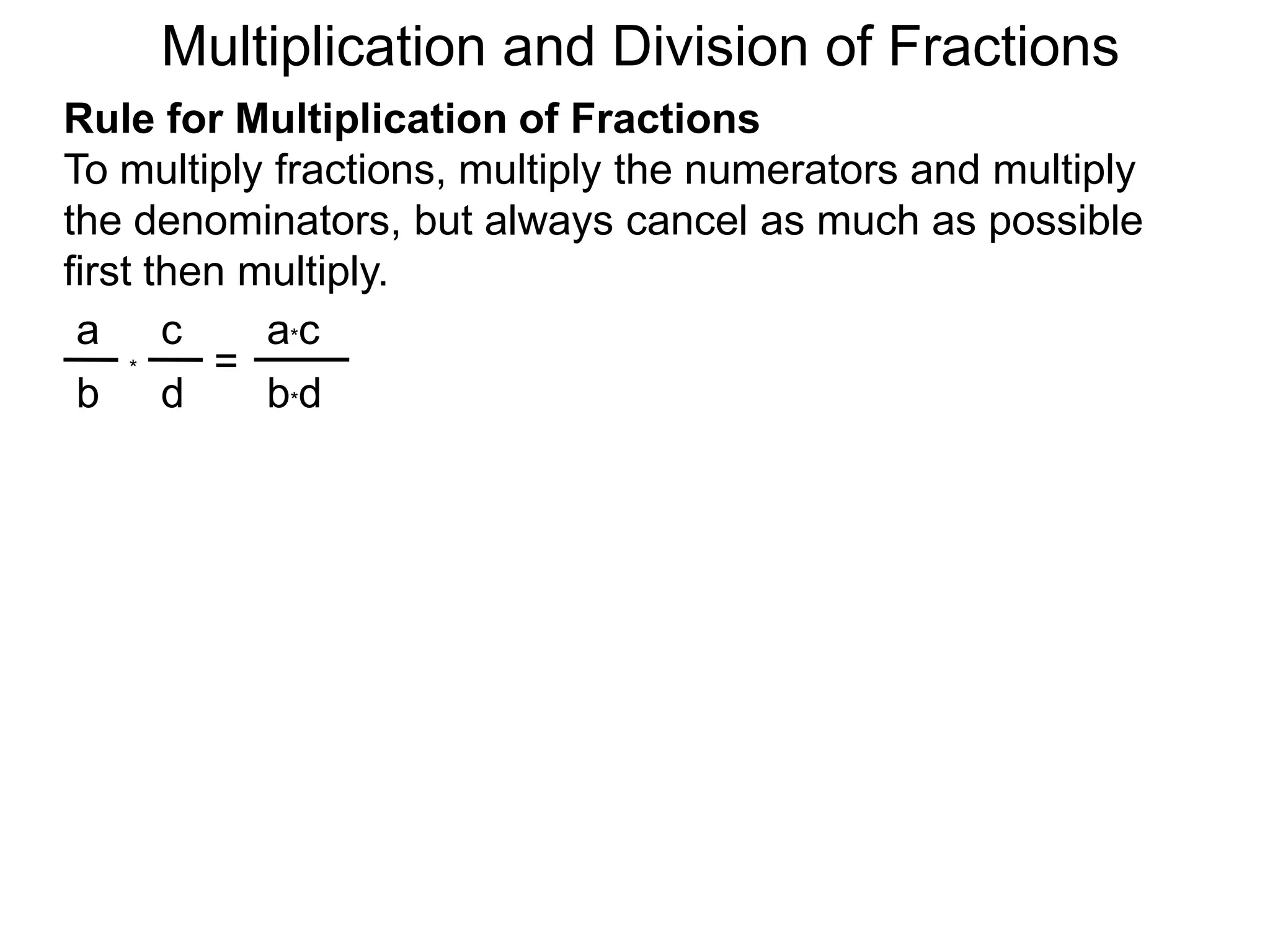
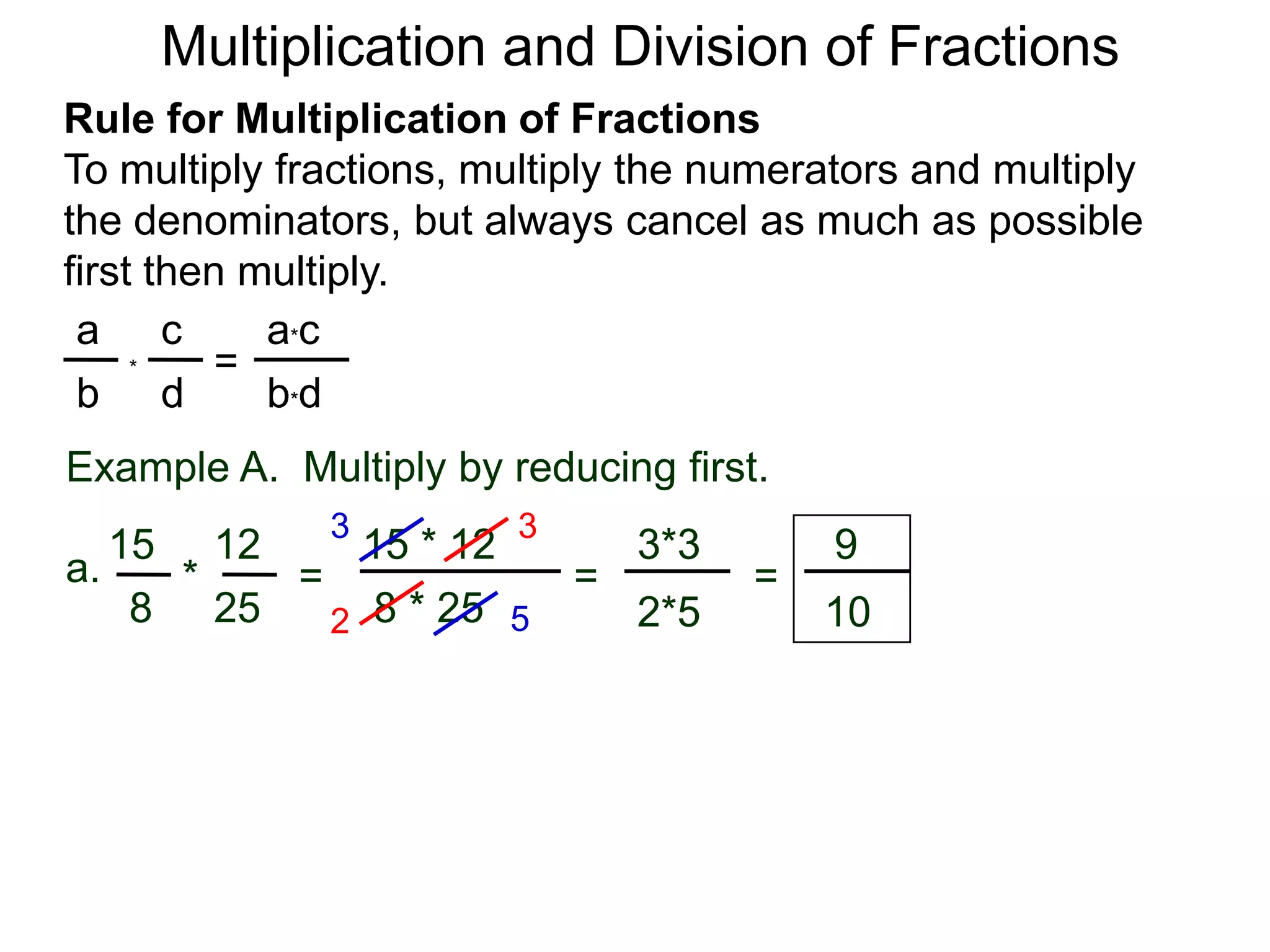
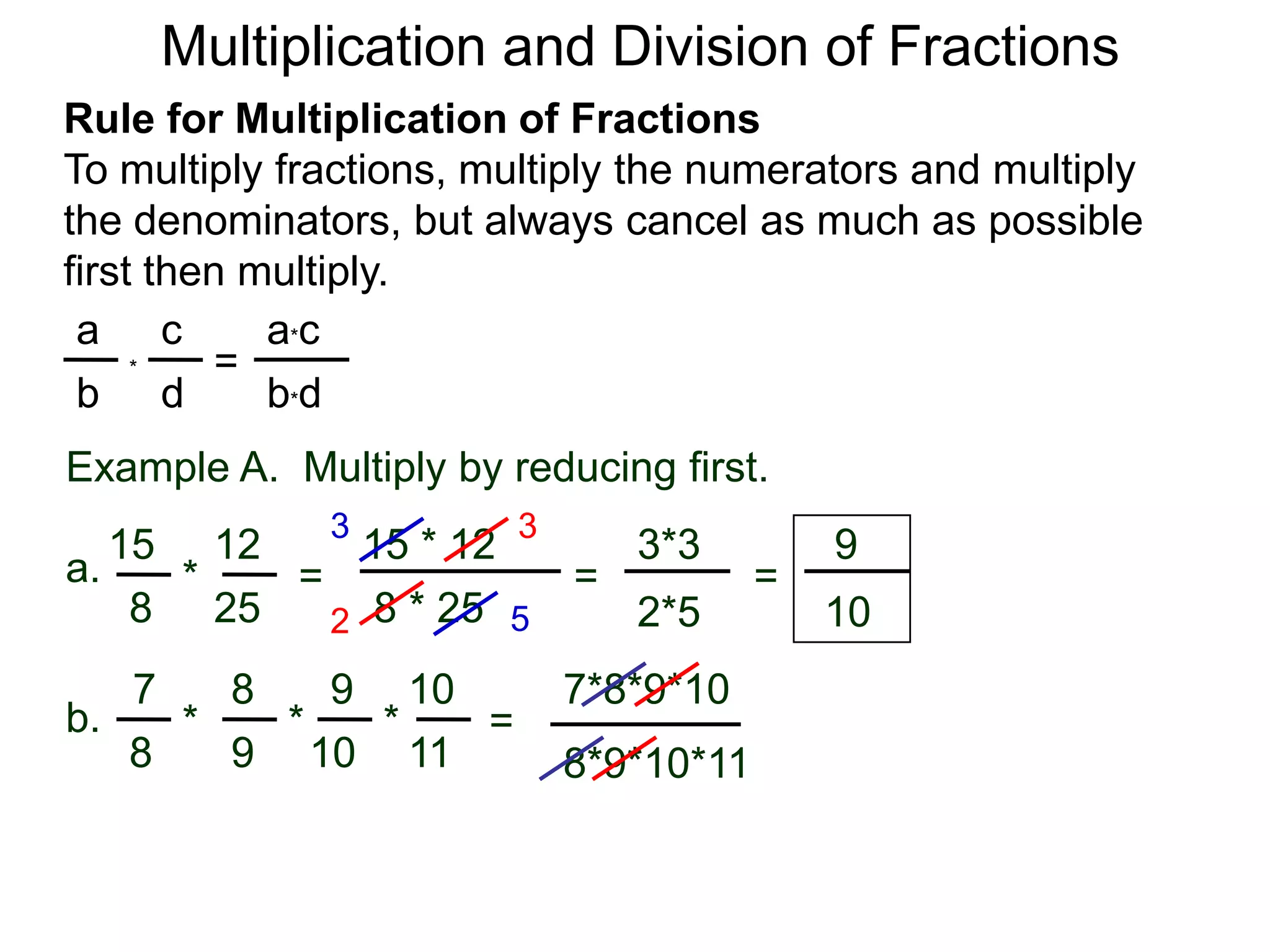
Multiplication and Division of FractionsRule for Multiplication of FractionsTo multiply fractions, multiply the numerators and multiply the denominators, but always cancel as much as possible first then multiply.
Multiplication and Division of FractionsRule for Multiplication of FractionsTo multiply fractions, multiply the numerators and multiply the denominators, but always cancel as much as possible first then multiply.ca*ca=*db*db
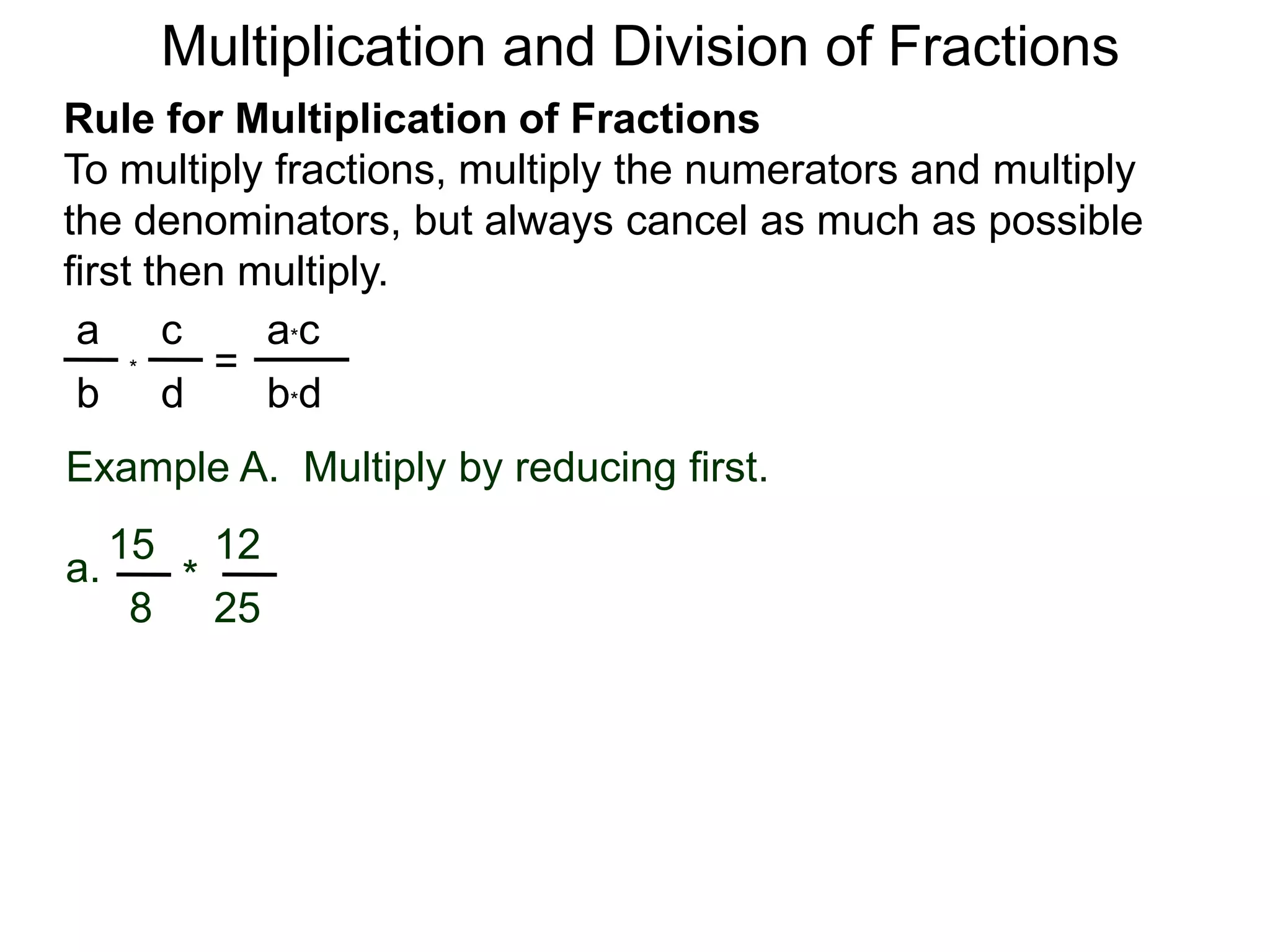
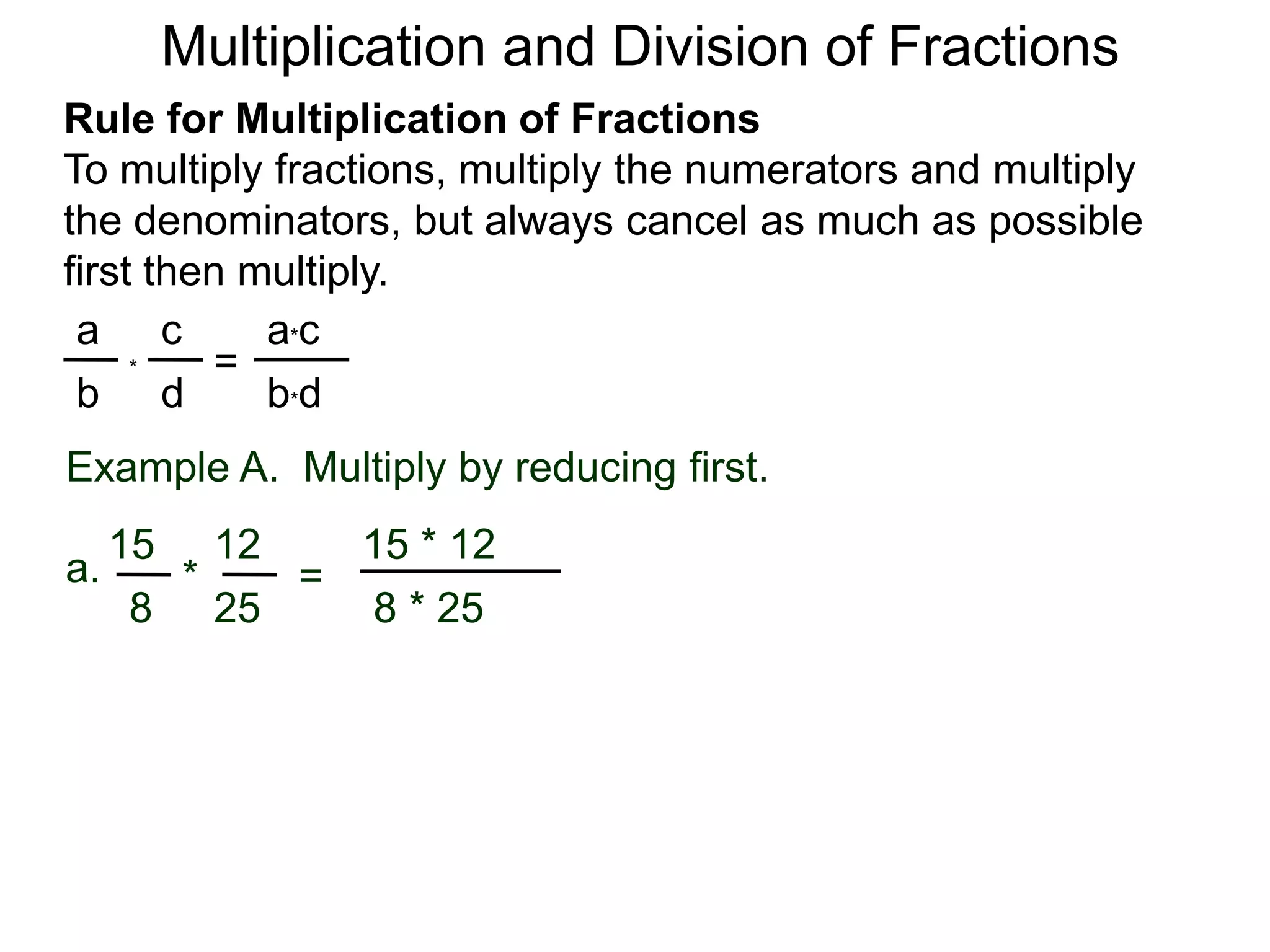
Multiplication and Division of FractionsRule for Multiplication of FractionsTo multiply fractions, multiply the numerators and multiply the denominators, but always cancel as much as possible first then multiply.ca*ca=*db*dbExample A.  Multiply by reducing first.1215a.*258
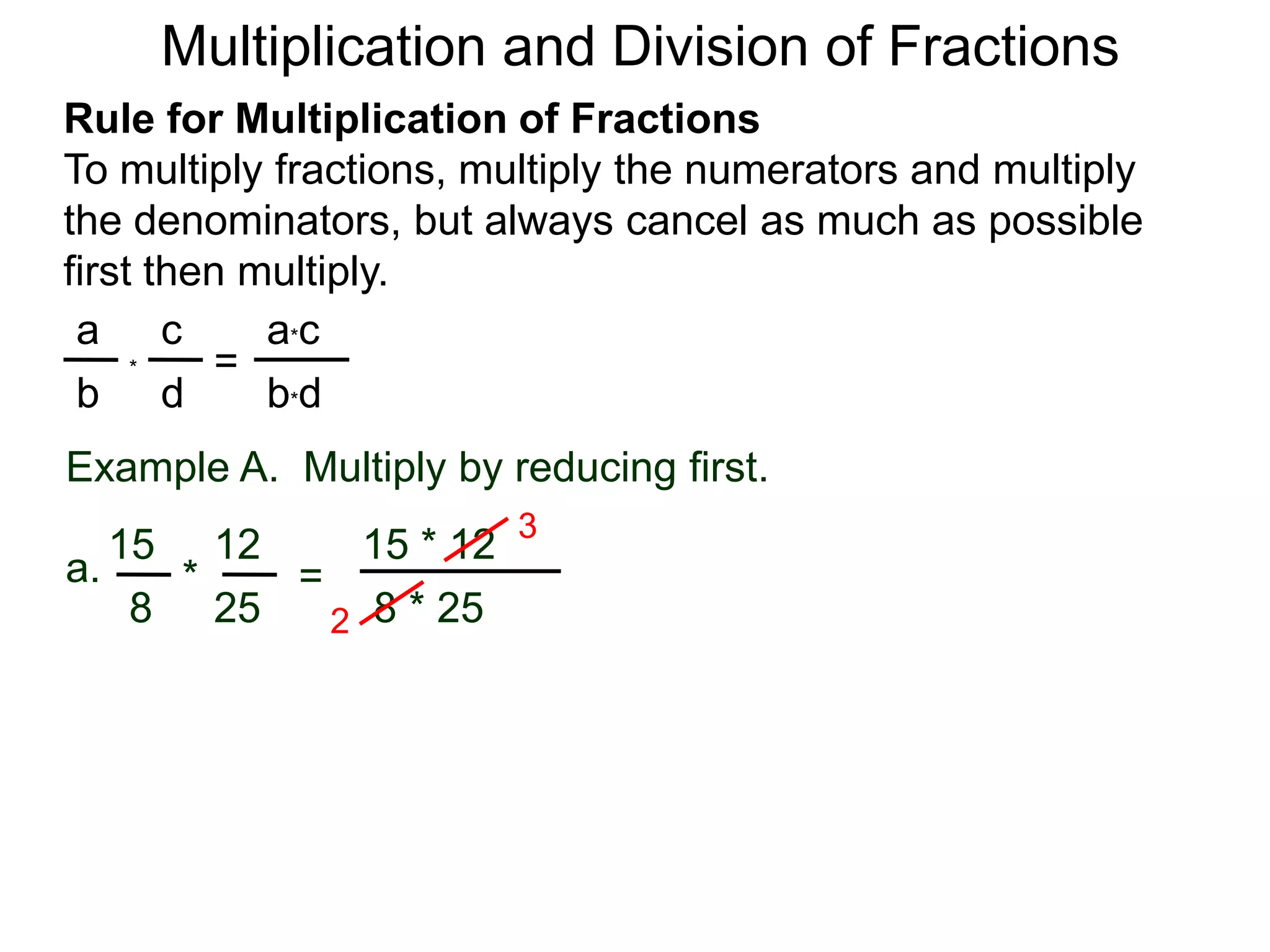
Multiplication and Division of FractionsRule for Multiplication of FractionsTo multiply fractions, multiply the numerators and multiply the denominators, but always cancel as much as possible first then multiply.ca*ca=*db*dbExample A.  Multiply by reducing first.15 * 121215a.=* 8 * 25258
Multiplication and Division of FractionsRule for Multiplication of FractionsTo multiply fractions, multiply the numerators and multiply the denominators, but always cancel as much as possible first then multiply.ca*ca=*db*dbExample A.  Multiply by reducing first.315 * 121215a.=* 8 * 252582
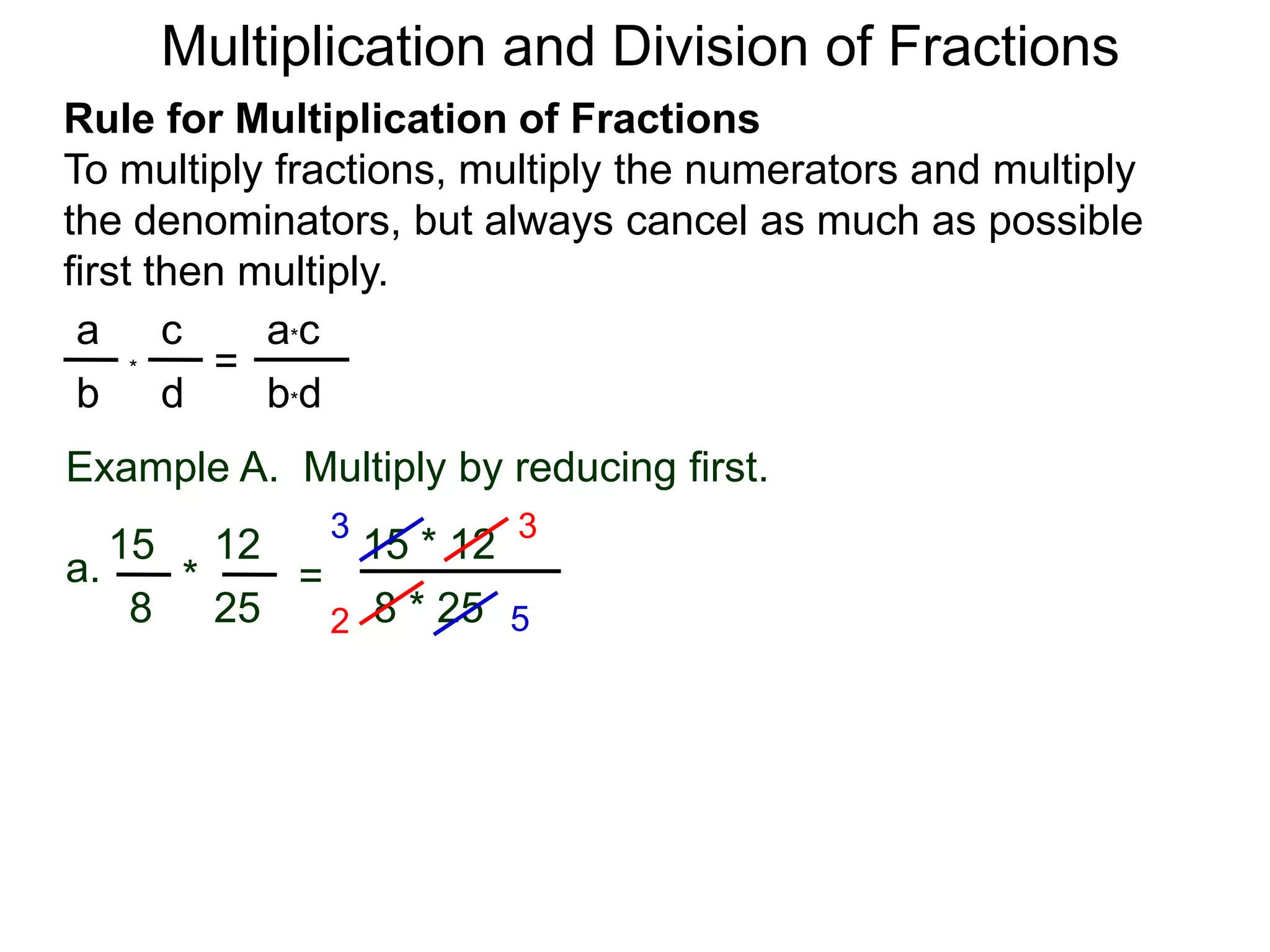
Multiplication and Division of FractionsRule for Multiplication of FractionsTo multiply fractions, multiply the numerators and multiply the denominators, but always cancel as much as possible first then multiply.ca*ca=*db*dbExample A.  Multiply by reducing first.3315 * 121215a.=* 8 * 2525852
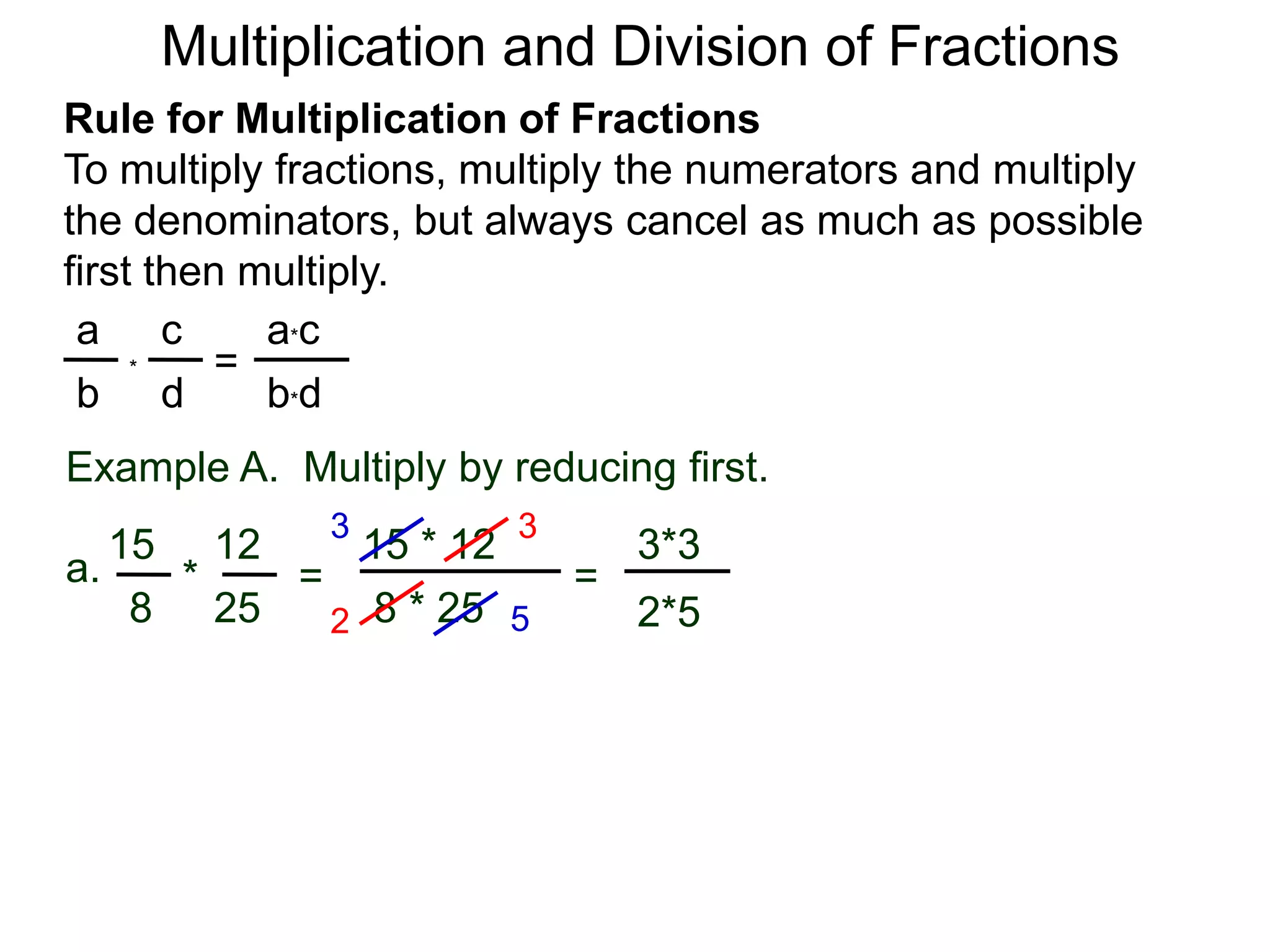
Multiplication and Division of FractionsRule for Multiplication of FractionsTo multiply fractions, multiply the numerators and multiply the denominators, but always cancel as much as possible first then multiply.ca*ca=*db*dbExample A.  Multiply by reducing first.3315 * 1212153*3a.=*= 8 * 252582*552
Multiplication and Division of FractionsRule for Multiplication of FractionsTo multiply fractions, multiply the numerators and multiply the denominators, but always cancel as much as possible first then multiply.ca*ca=*db*dbExample A.  Multiply by reducing first.3315 * 12121593*3a.=*== 8 * 25258102*552
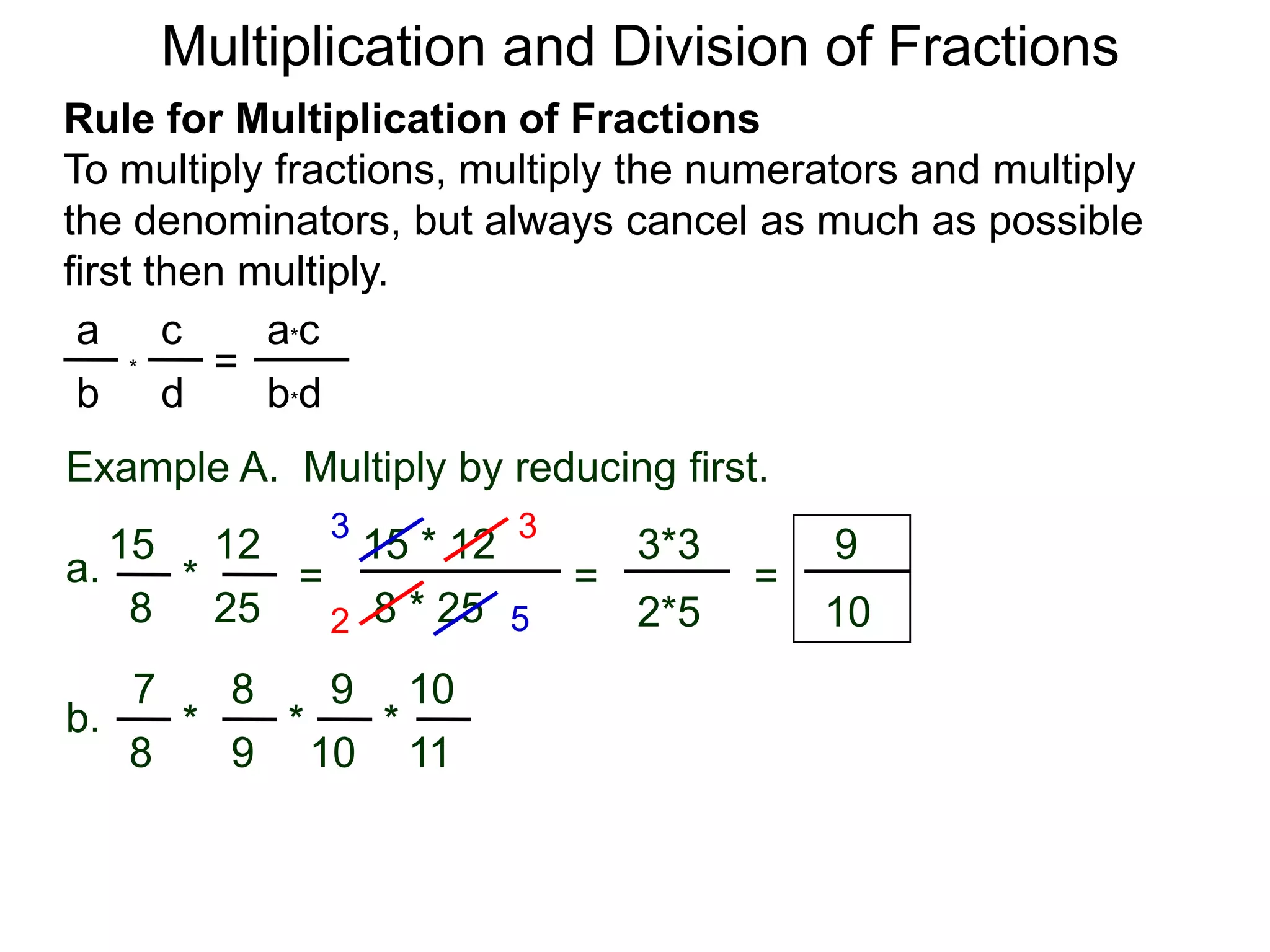
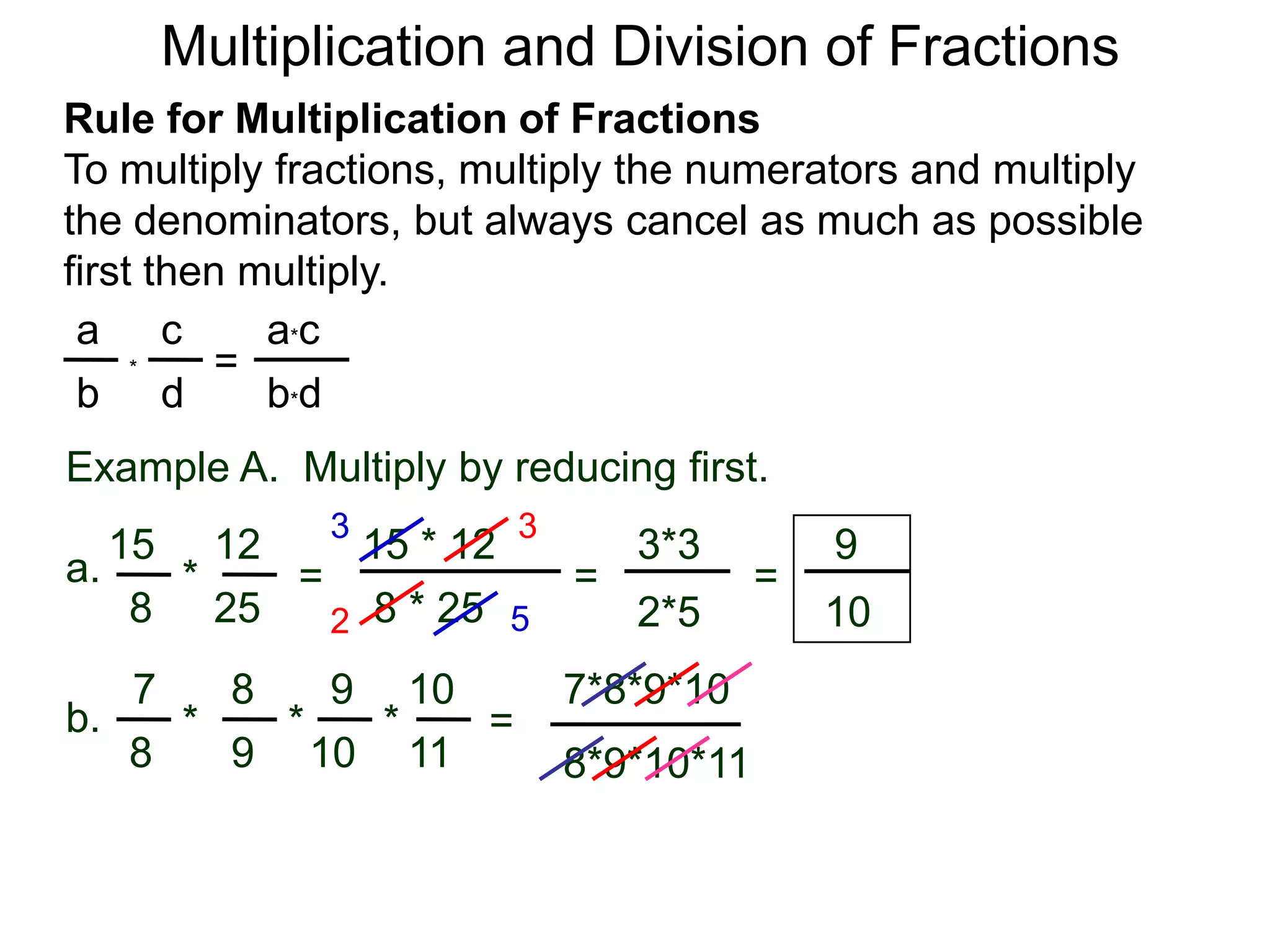
Multiplication and Division of FractionsRule for Multiplication of FractionsTo multiply fractions, multiply the numerators and multiply the denominators, but always cancel as much as possible first then multiply.ca*ca=*db*dbExample A.  Multiply by reducing first.3315 * 12121593*3a.=*== 8 * 25258102*55287109b.***981110
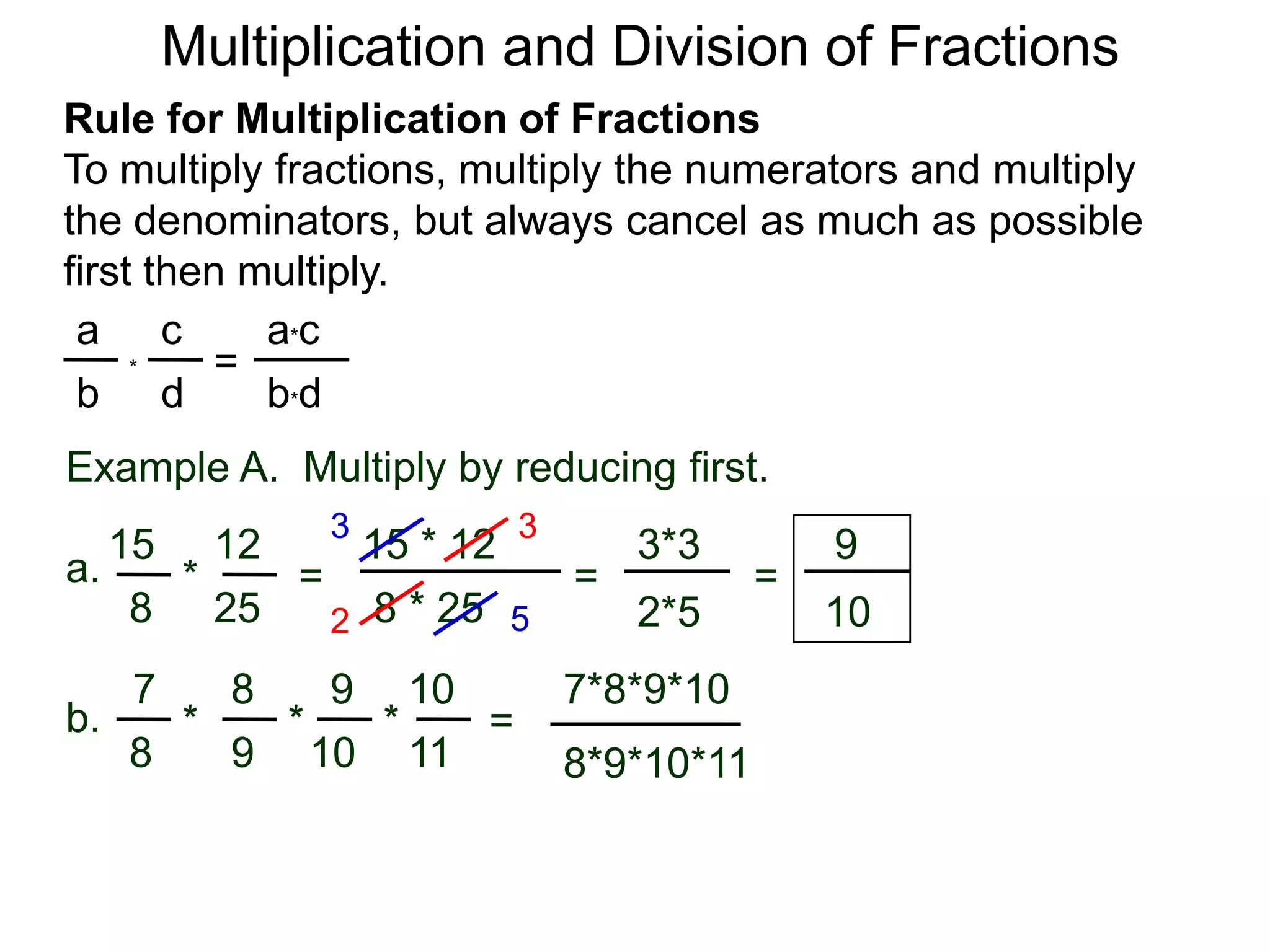
Multiplication and Division of FractionsRule for Multiplication of FractionsTo multiply fractions, multiply the numerators and multiply the denominators, but always cancel as much as possible first then multiply.ca*ca=*db*dbExample A.  Multiply by reducing first.3315 * 12121593*3a.=*== 8 * 25258102*5527*8*9*1087109b.***=9811108*9*10*11
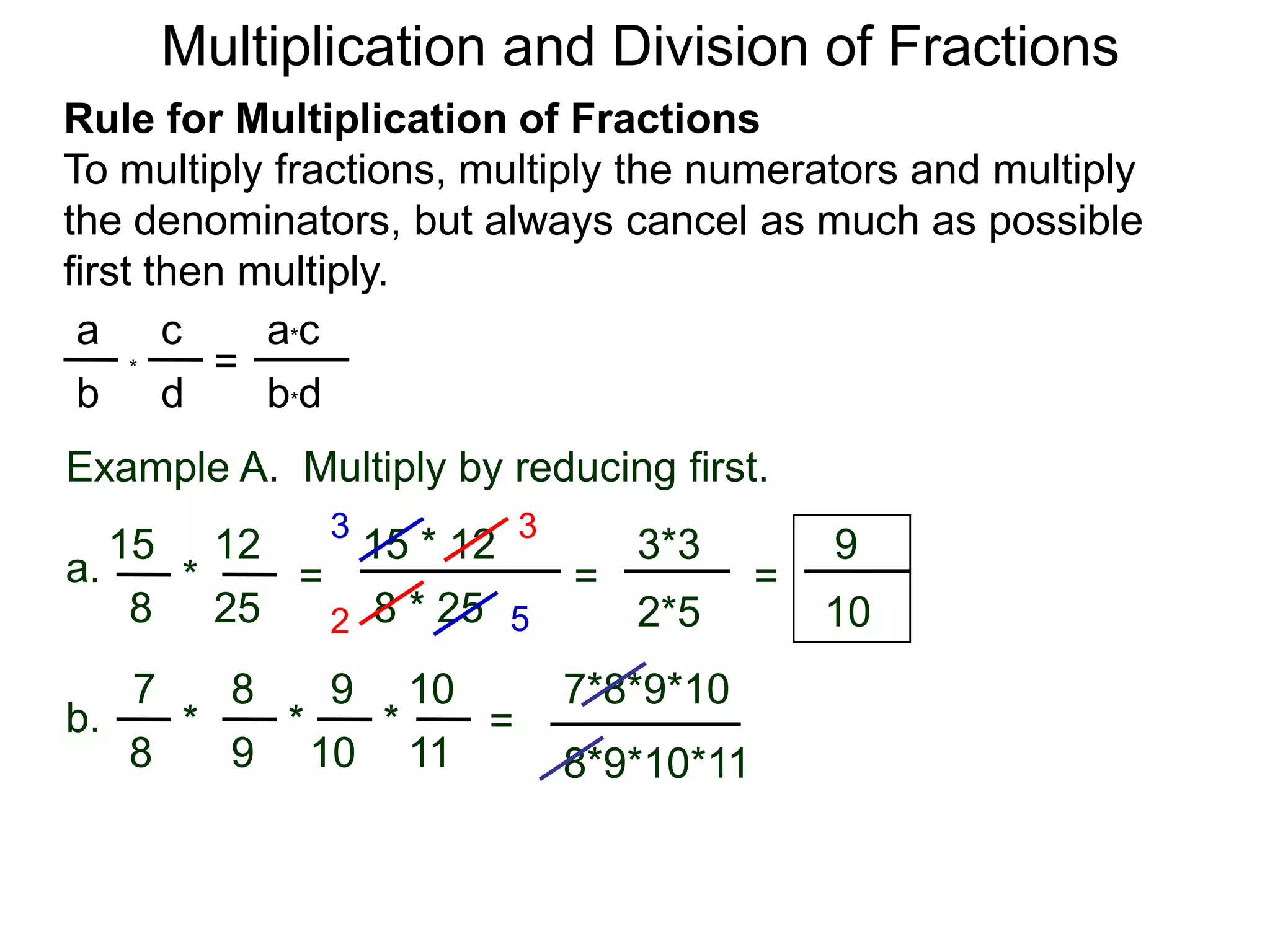
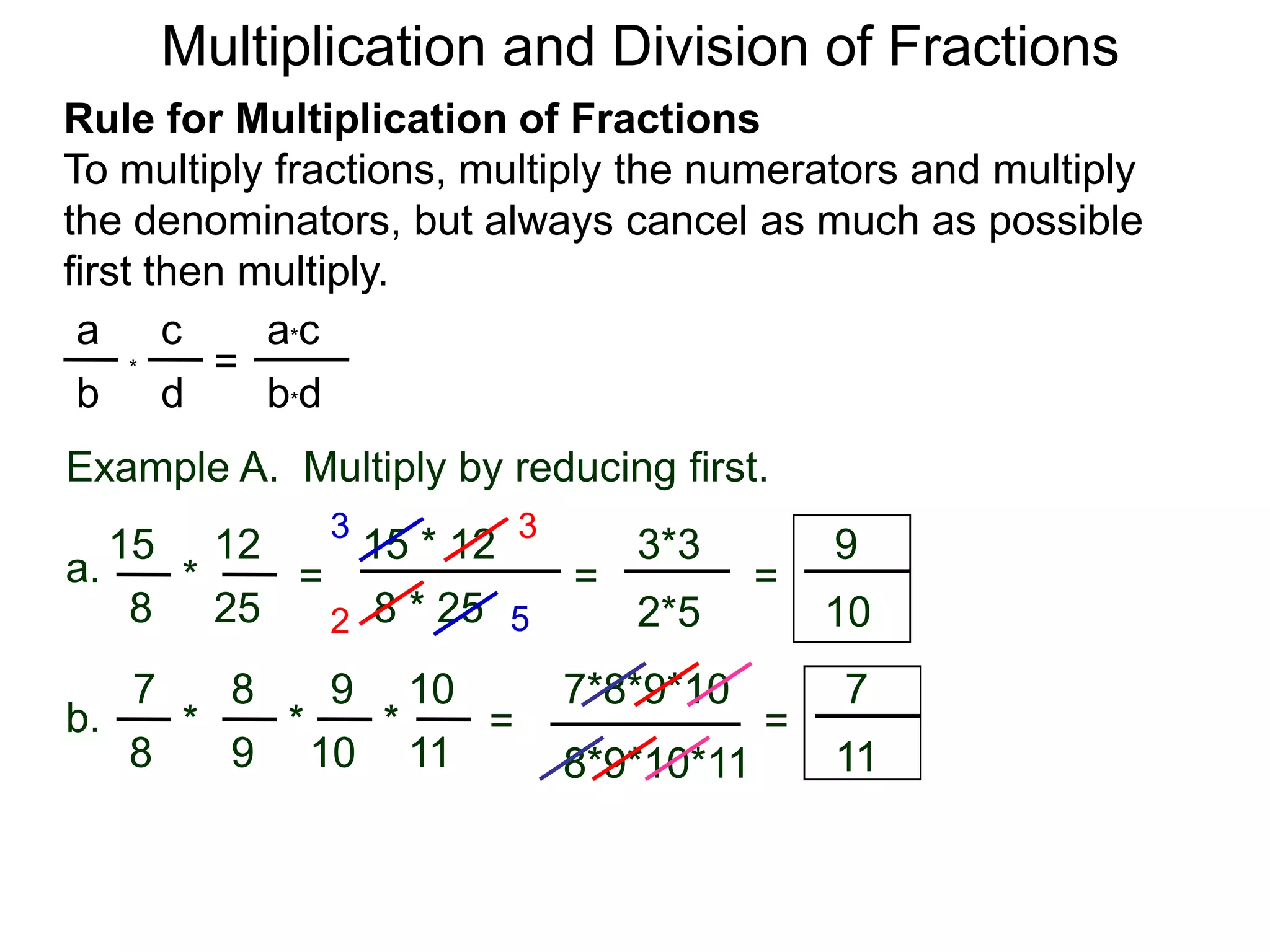
Multiplication and Division of FractionsRule for Multiplication of FractionsTo multiply fractions, multiply the numerators and multiply the denominators, but always cancel as much as possible first then multiply.ca*ca=*db*dbExample A.  Multiply by reducing first.3315 * 12121593*3a.=*== 8 * 25258102*5527*8*9*10871097b.***==981110118*9*10*11
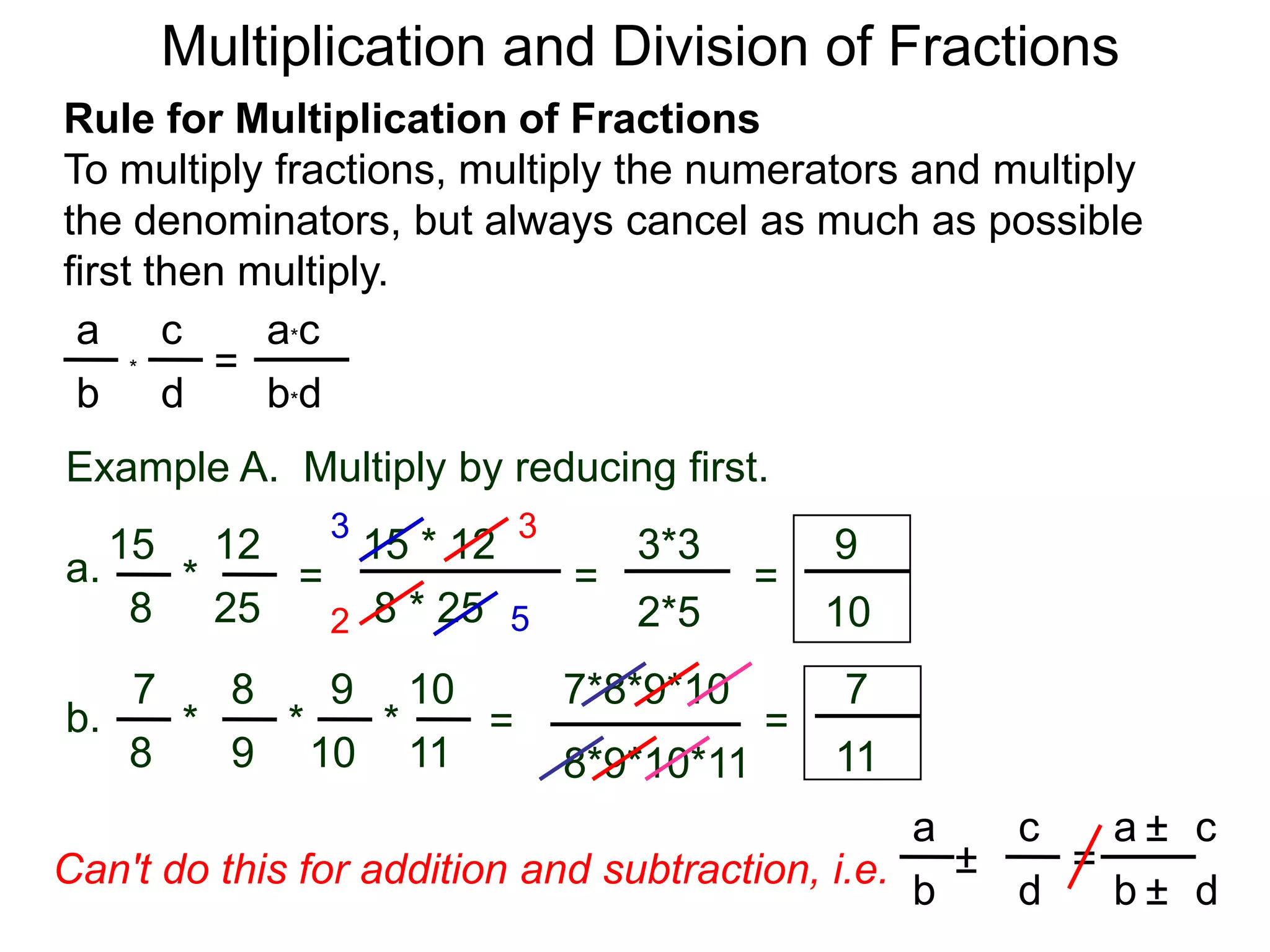
Multiplication and Division of FractionsRule for Multiplication of FractionsTo multiply fractions, multiply the numerators and multiply the denominators, but always cancel as much as possible first then multiply.ca*ca=*db*dbExample A.  Multiply by reducing first.3315 * 12121593*3a.=*== 8 * 25258102*5527*8*9*10871097b.***==981110118*9*10*11ca     ca± = ±Can't do this for addition and subtraction, i.e.db     db±
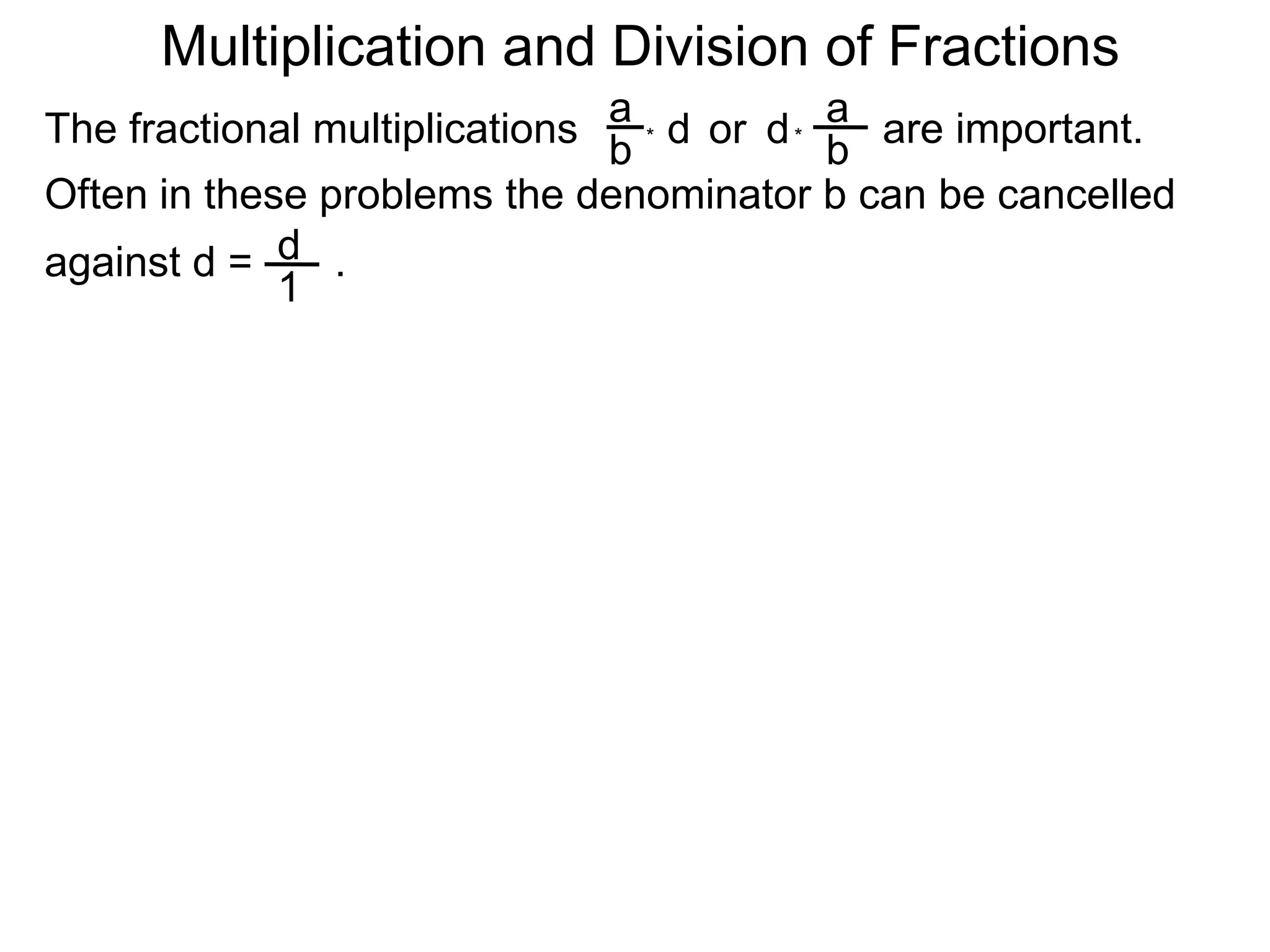
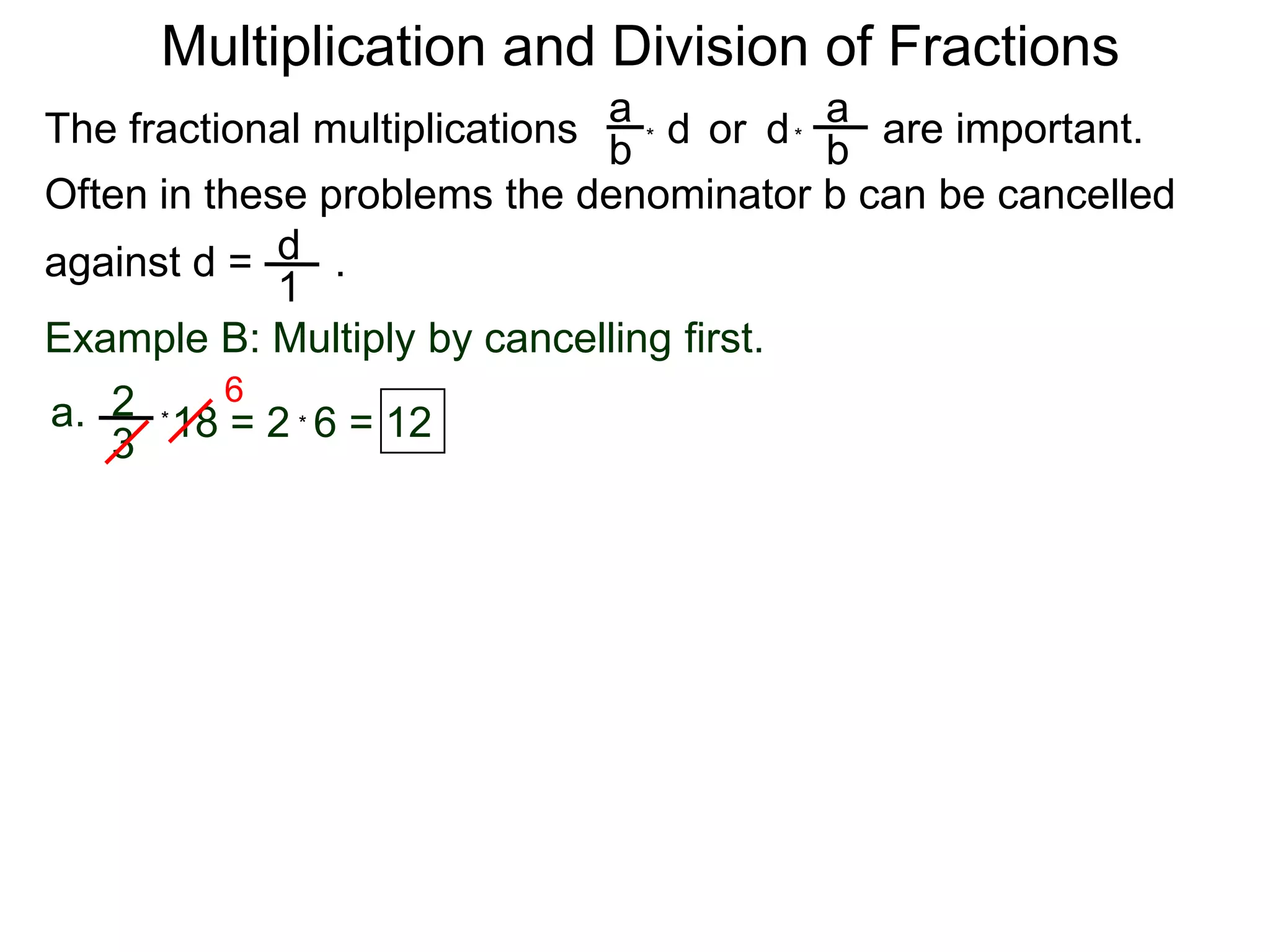
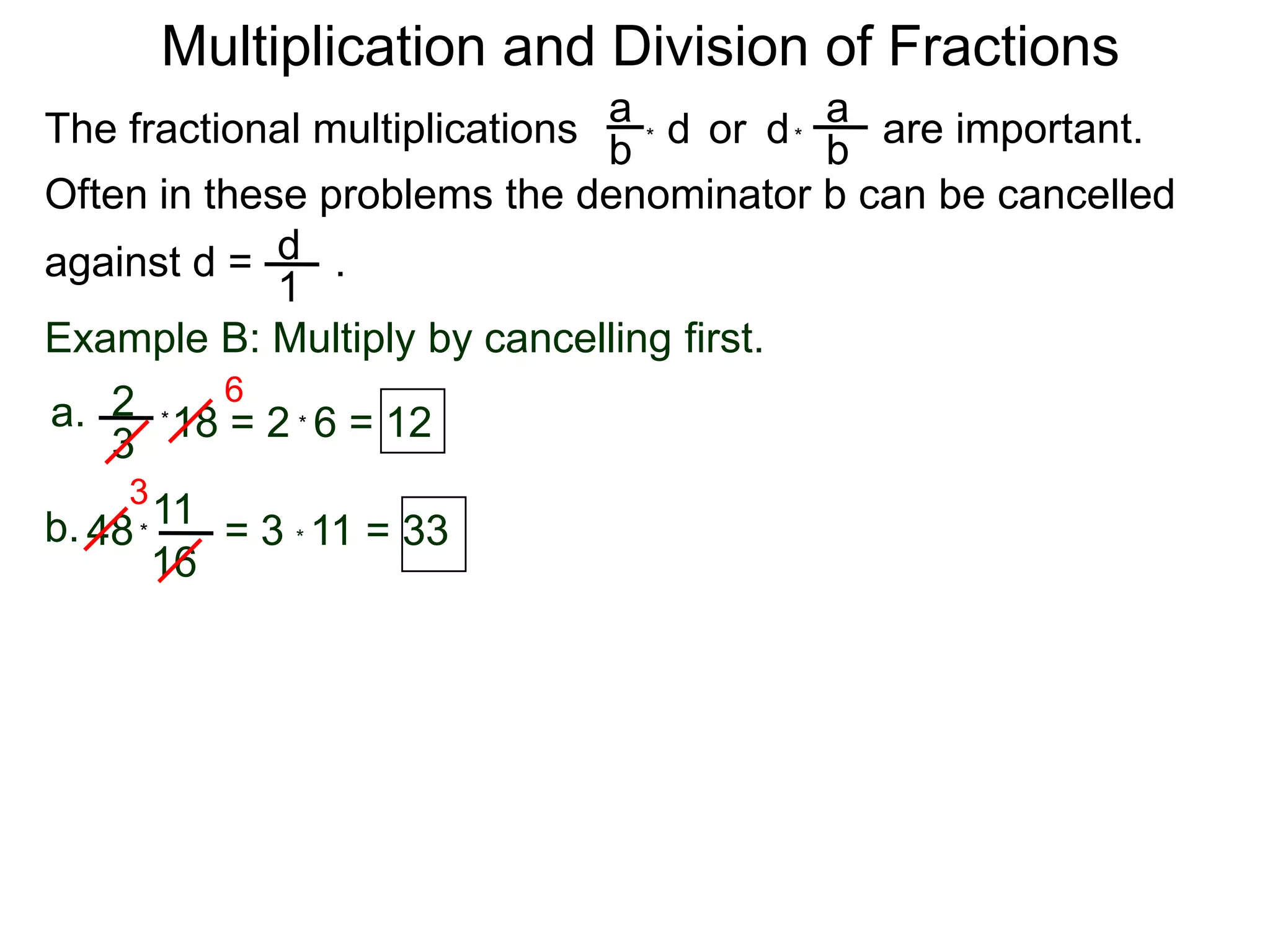
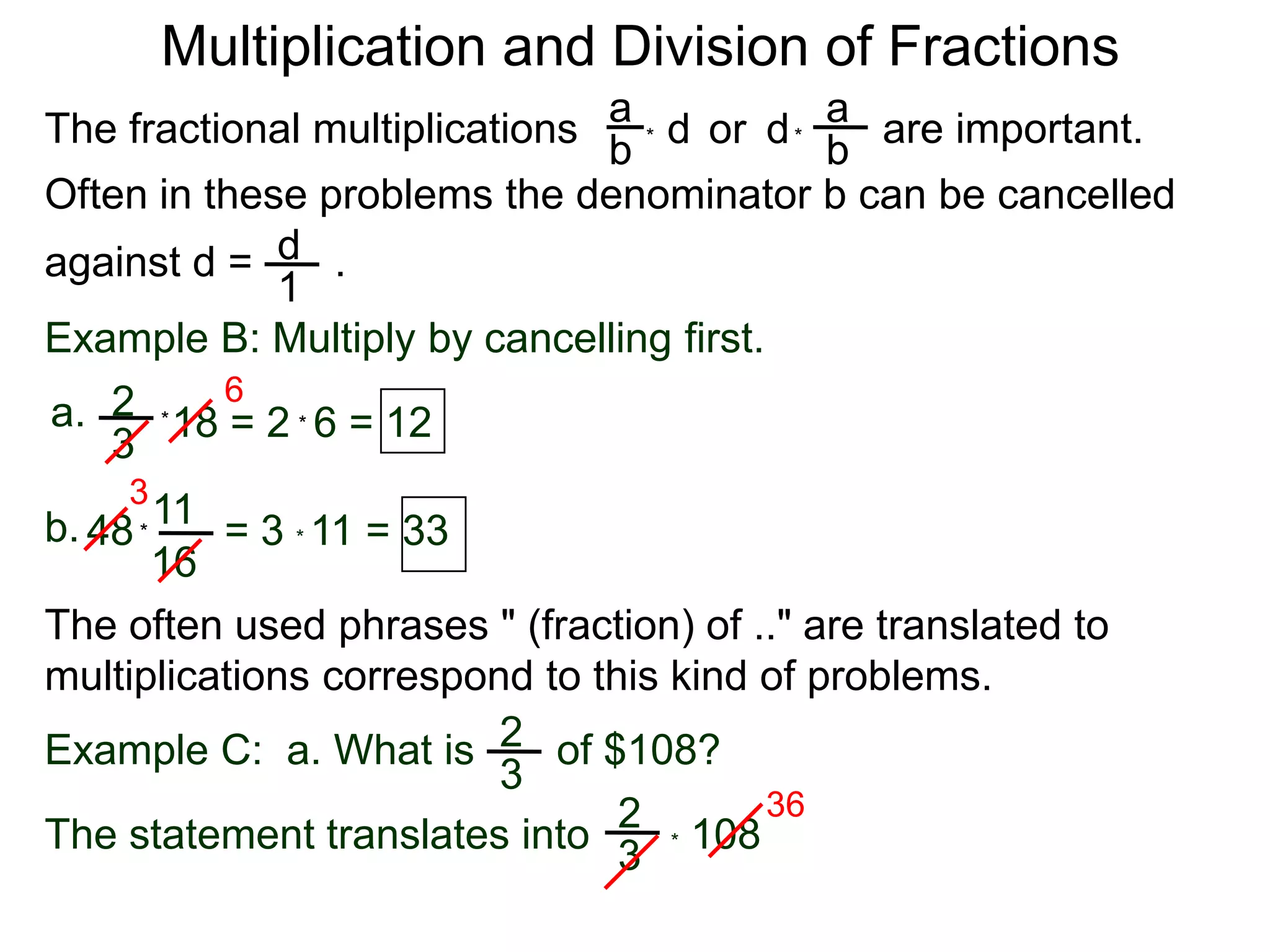
Multiplication and Division of FractionsaaThe fractional multiplications                          are important.ddor bb**Often in these problems the denominator b can be cancelledagainst d =       .    d1
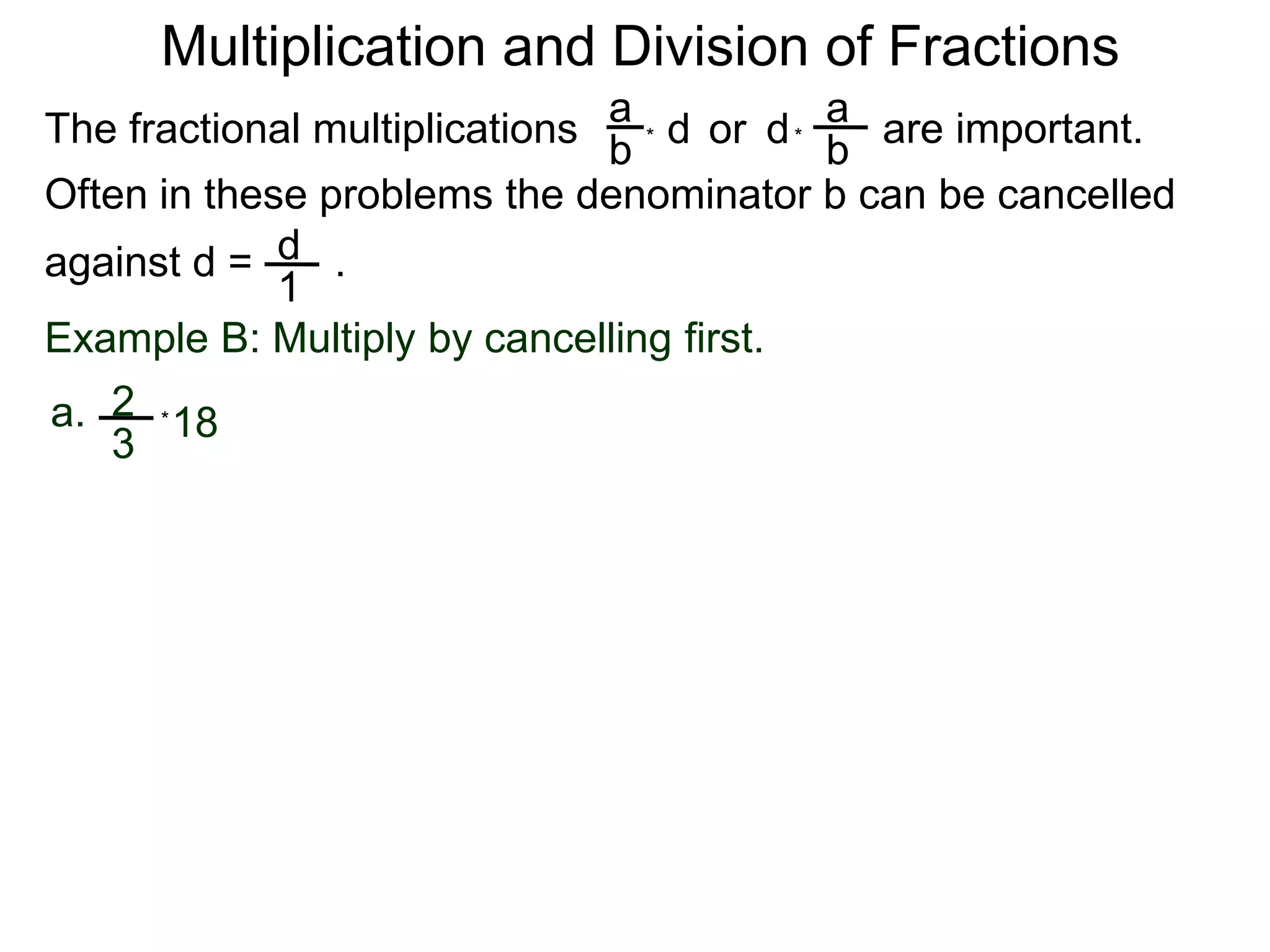
Multiplication and Division of FractionsaaThe fractional multiplications                          are important.ddor bb**Often in these problems the denominator b can be cancelledagainst d =       .    d1Example B: Multiply by cancelling first.2a.18 *3
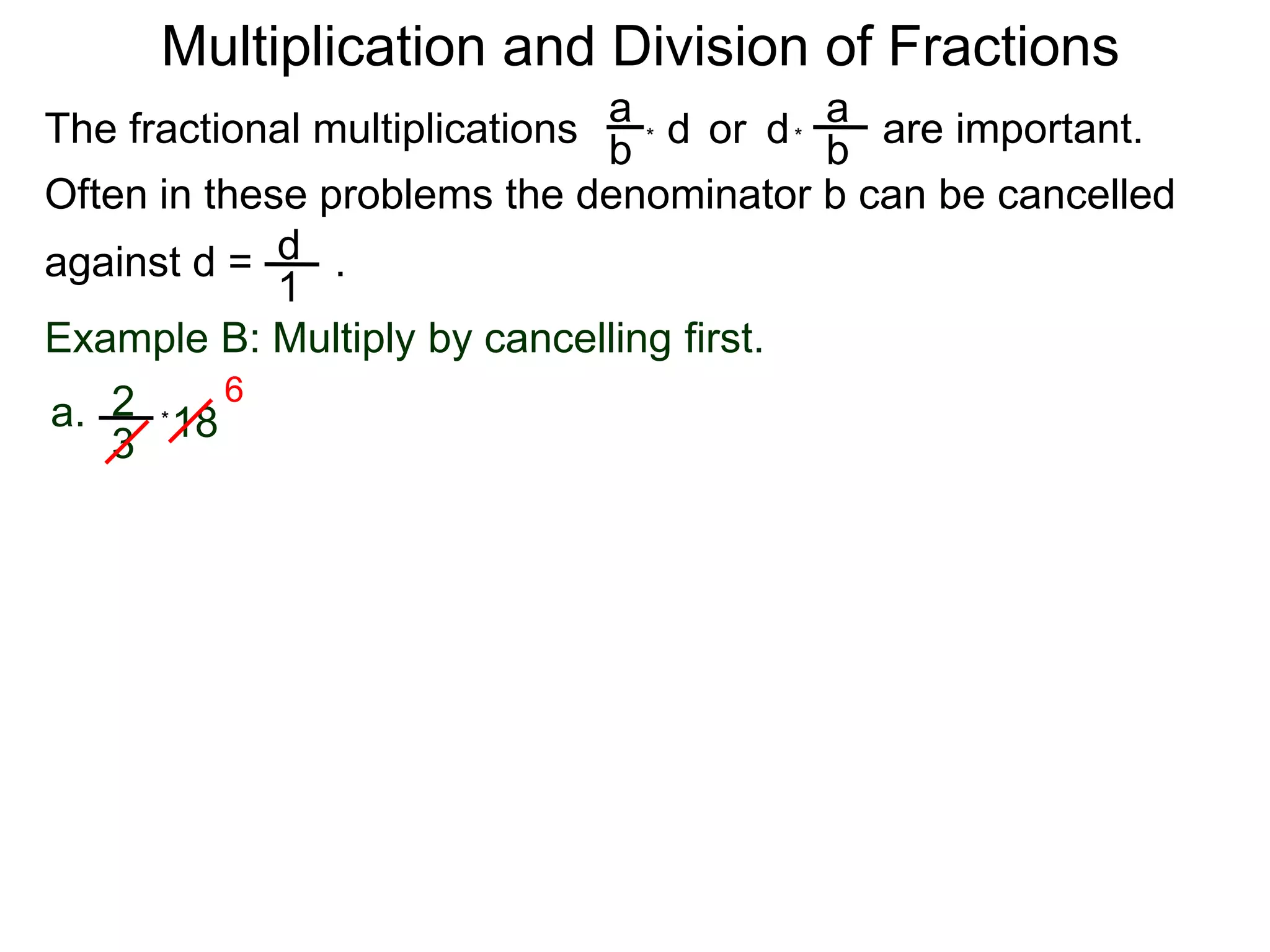
Multiplication and Division of FractionsaaThe fractional multiplications                          are important.ddor bb**Often in these problems the denominator b can be cancelledagainst d =       .    d1Example B: Multiply by cancelling first.62a.18 *3
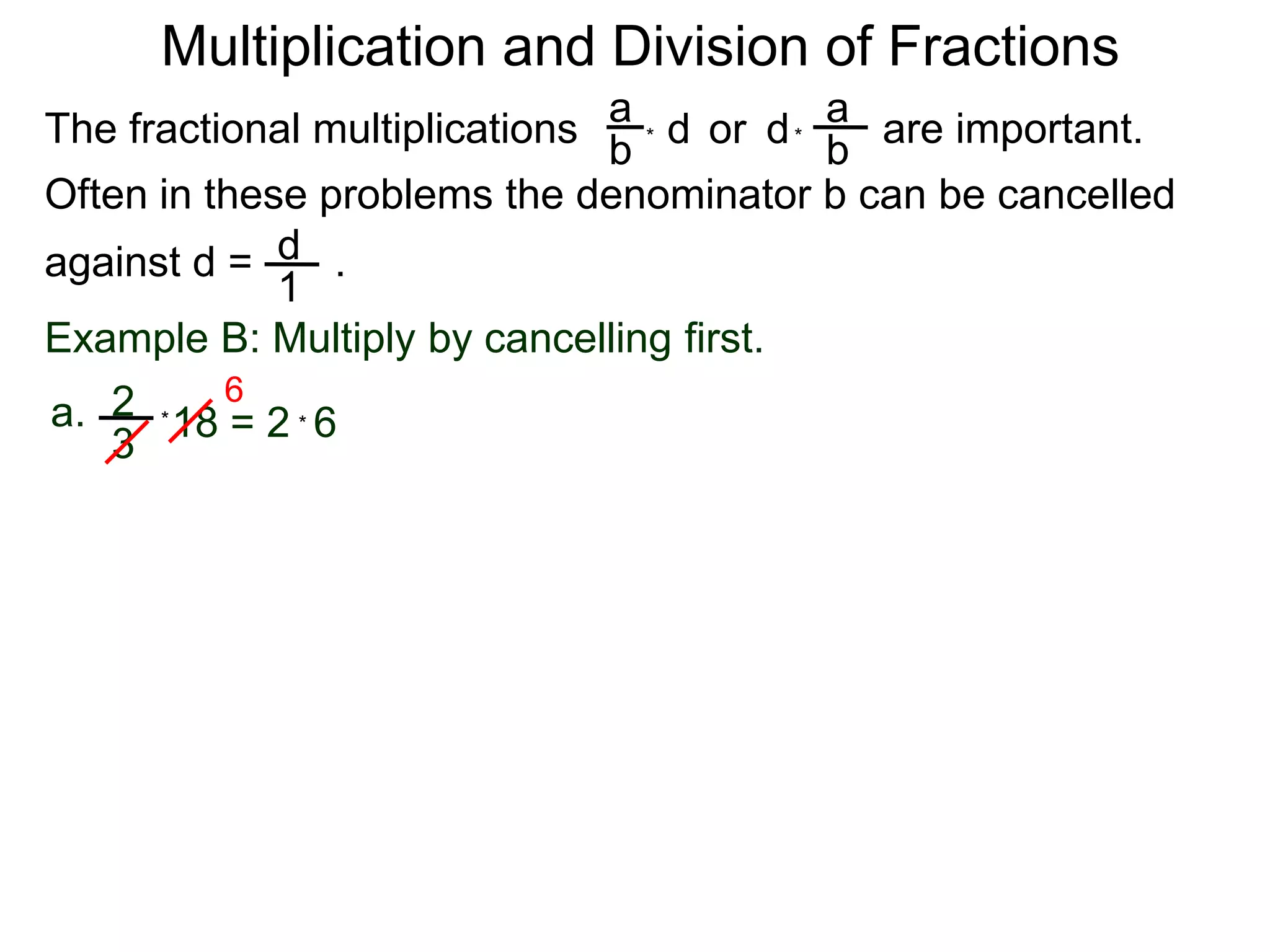
Multiplication and Division of FractionsaaThe fractional multiplications                          are important.ddor bb**Often in these problems the denominator b can be cancelledagainst d =       .    d1Example B: Multiply by cancelling first.62a.18 = 2  6 **3
Multiplication and Division of FractionsaaThe fractional multiplications                          are important.ddor bb**Often in these problems the denominator b can be cancelledagainst d =       .    d1Example B: Multiply by cancelling first.62a.18 = 2  6 = 12**3
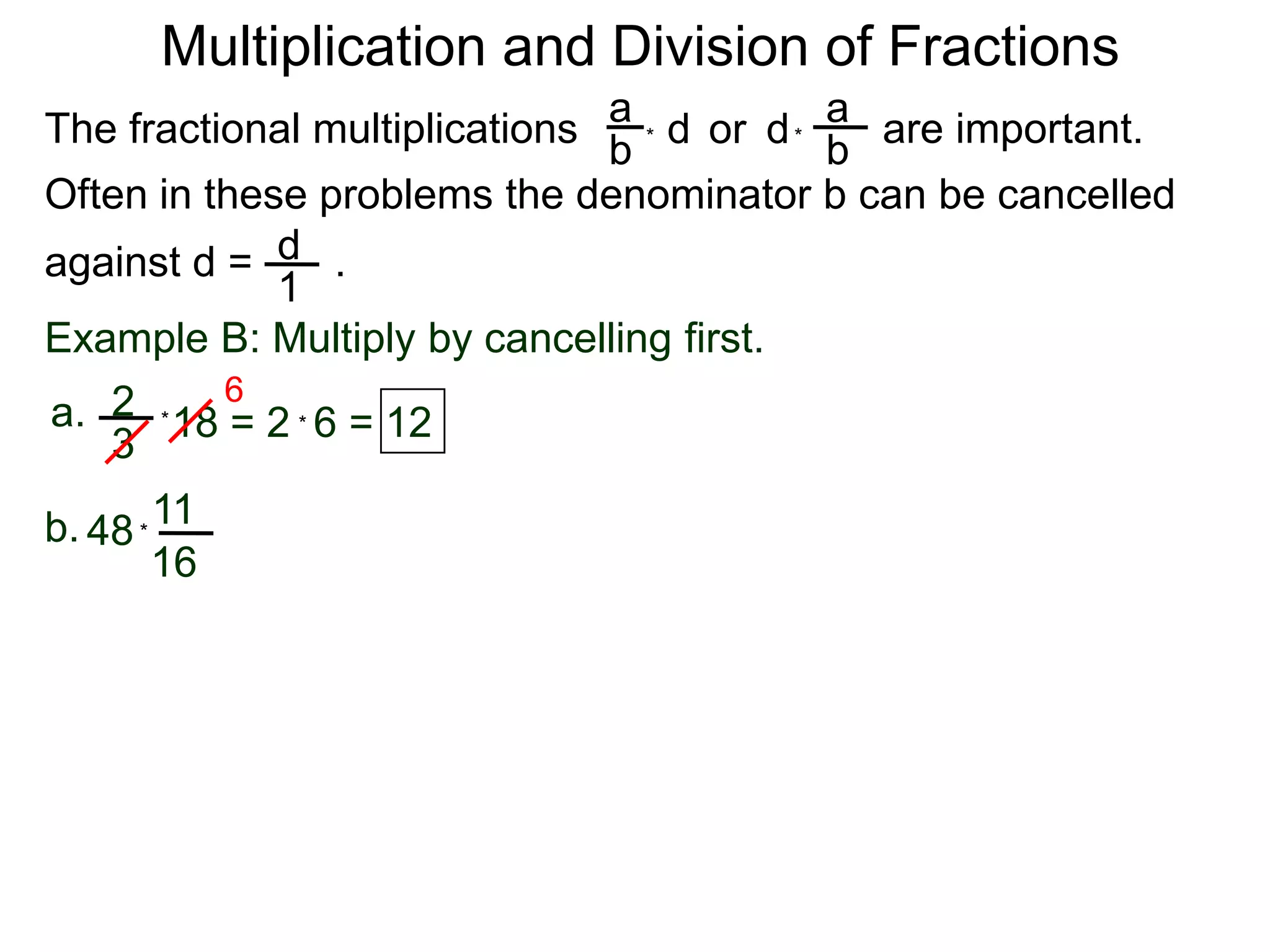
Multiplication and Division of FractionsaaThe fractional multiplications                          are important.ddor bb**Often in these problems the denominator b can be cancelledagainst d =       .    d1Example B: Multiply by cancelling first.62a.18 = 2  6 = 12**311b.48        *16
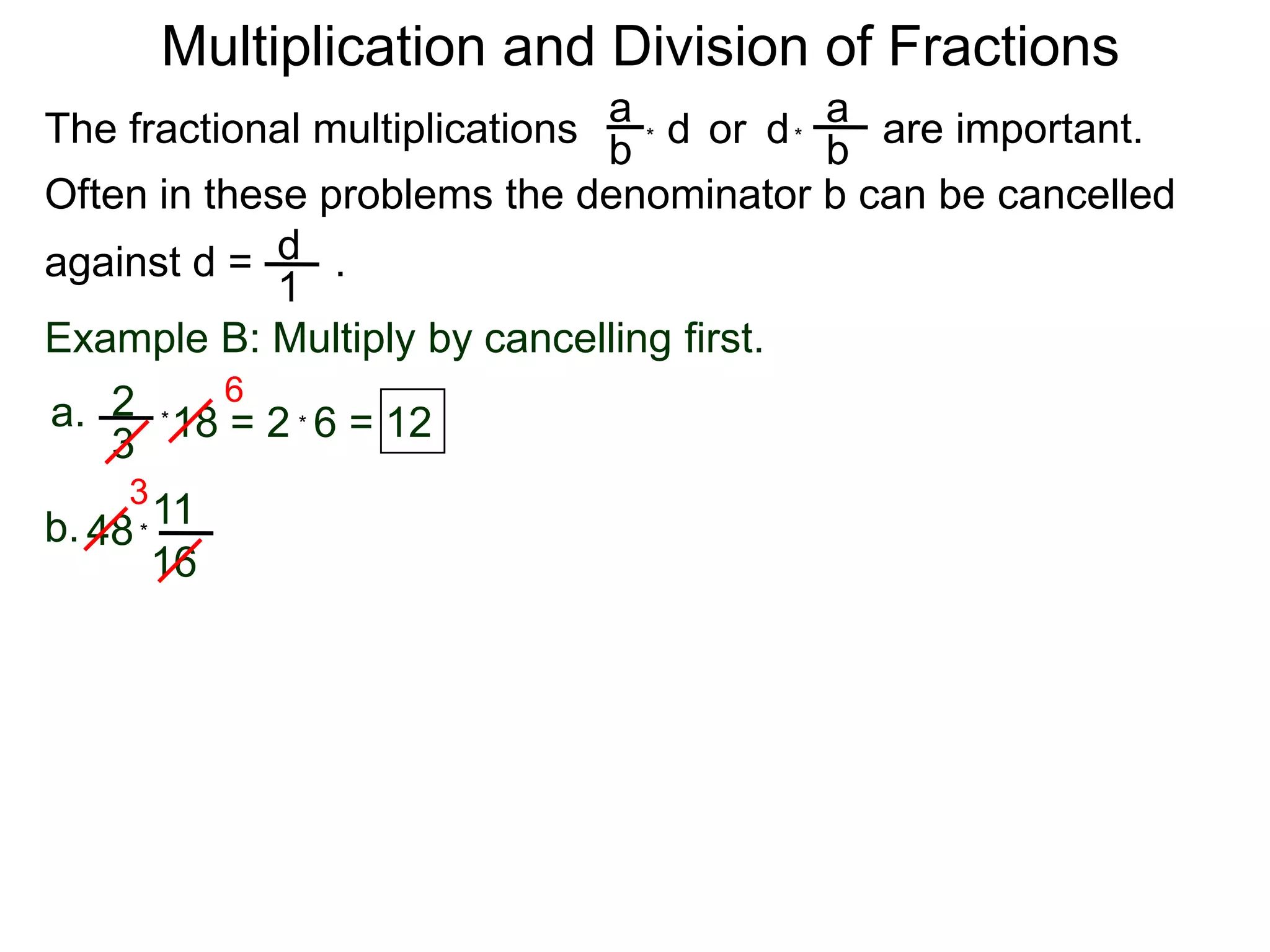
Multiplication and Division of FractionsaaThe fractional multiplications                          are important.ddor bb**Often in these problems the denominator b can be cancelledagainst d =       .    d1Example B: Multiply by cancelling first.62a.18 = 2  6 = 12**3311b.48        *16
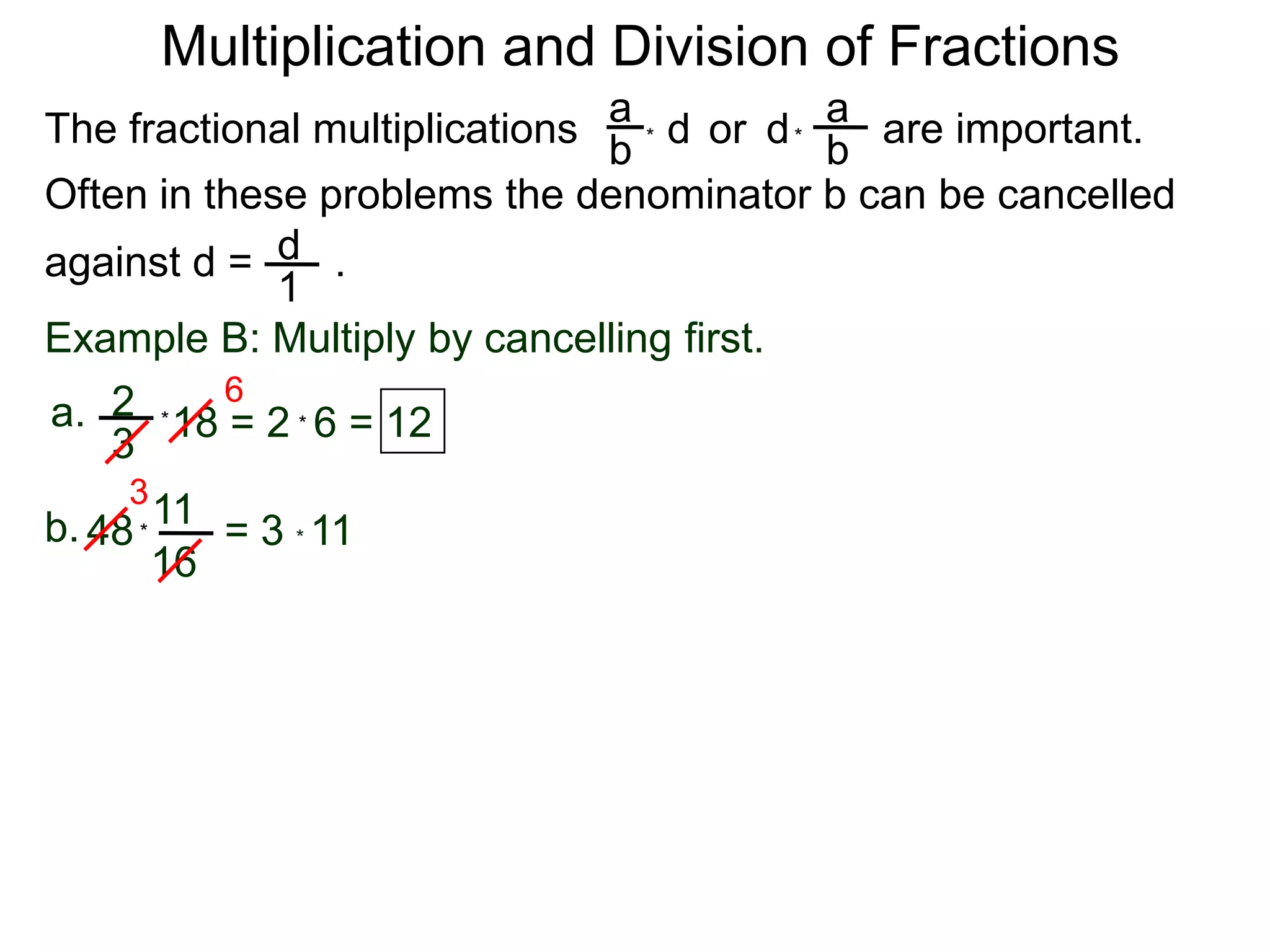
Multiplication and Division of FractionsaaThe fractional multiplications                          are important.ddor bb**Often in these problems the denominator b can be cancelledagainst d =       .    d1Example B: Multiply by cancelling first.62a.18 = 2  6 = 12**3311b.48        = 3 * 11 *16
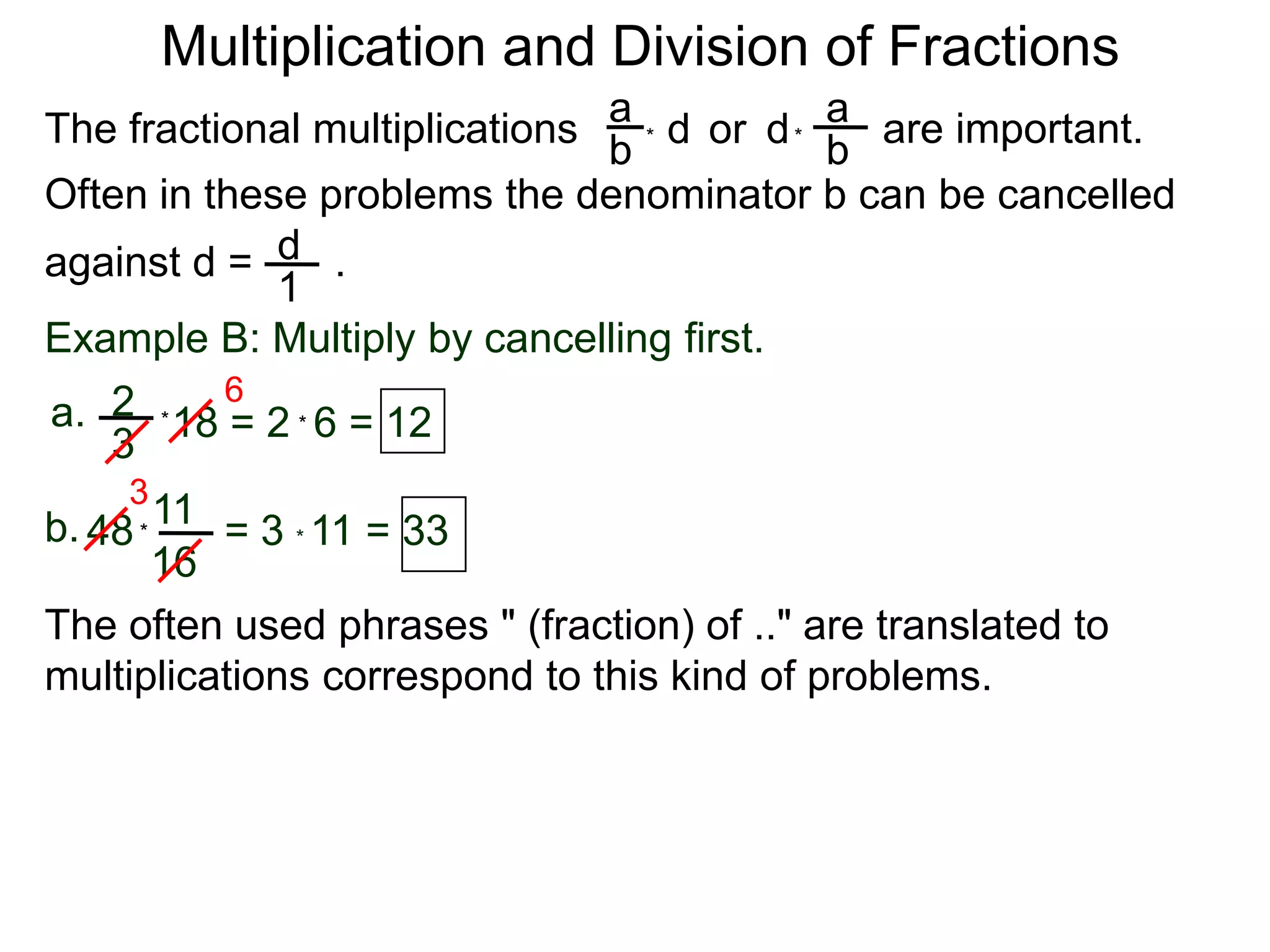
Multiplication and Division of FractionsaaThe fractional multiplications                          are important.ddor bb**Often in these problems the denominator b can be cancelledagainst d =       .    d1Example B: Multiply by cancelling first.62a.18 = 2  6 = 12**3311b.48        = 3 * 11 = 33*16
Multiplication and Division of FractionsaaThe fractional multiplications                          are important.ddor bb**Often in these problems the denominator b can be cancelledagainst d =       .    d1Example B: Multiply by cancelling first.62a.18 = 2  6 = 12**3311b.48        = 3 * 11 = 33*16The often used phrases " (fraction) of .." are translated to             multiplications correspond to this kind of problems.
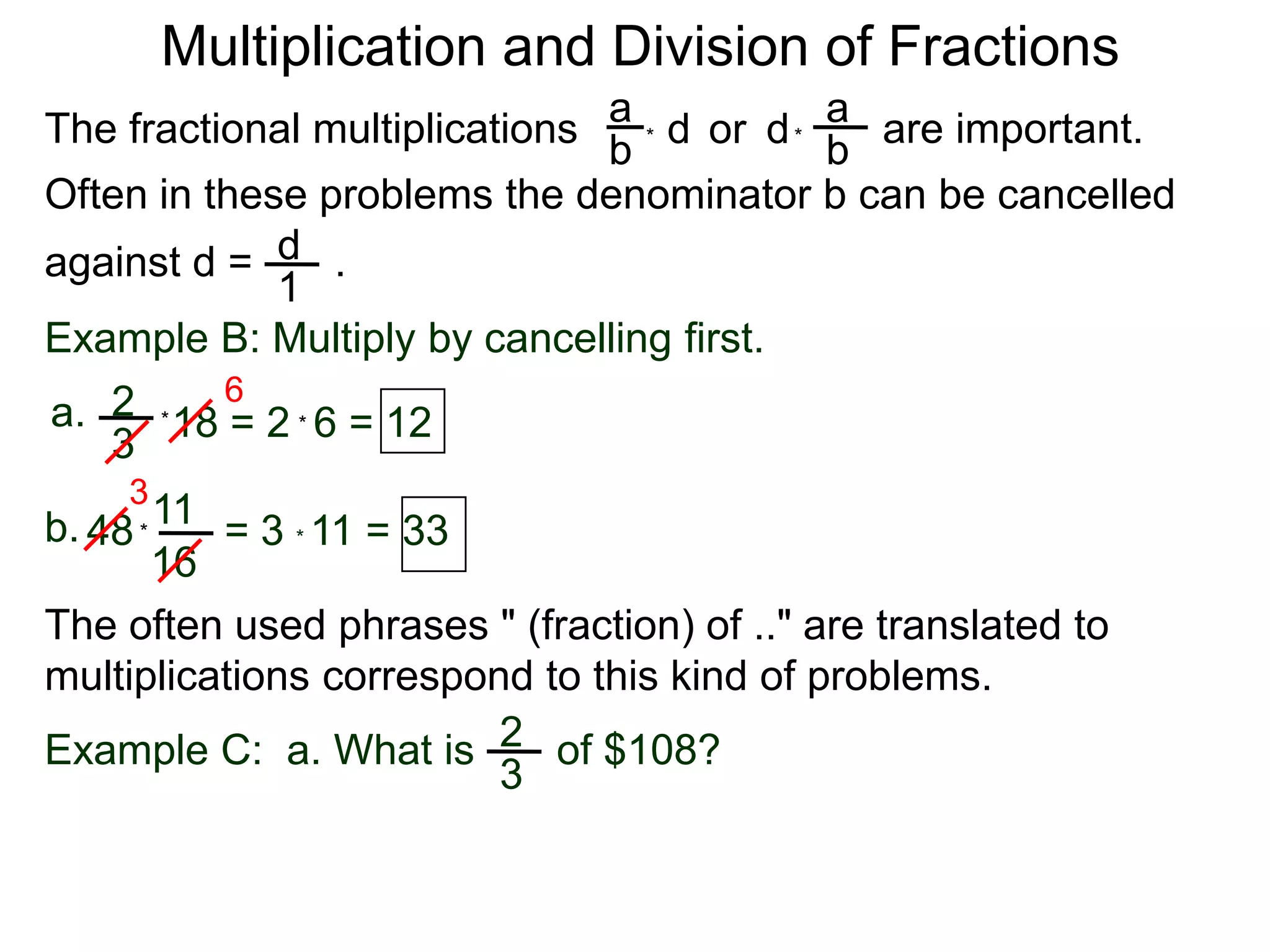
Multiplication and Division of FractionsaaThe fractional multiplications                          are important.ddor bb**Often in these problems the denominator b can be cancelledagainst d =       .    d1Example B: Multiply by cancelling first.62a.18 = 2  6 = 12**3311b.48        = 3 * 11 = 33*16The often used phrases " (fraction) of .." are translated to             multiplications correspond to this kind of problems.2Example C:  a. What is       of $108?3
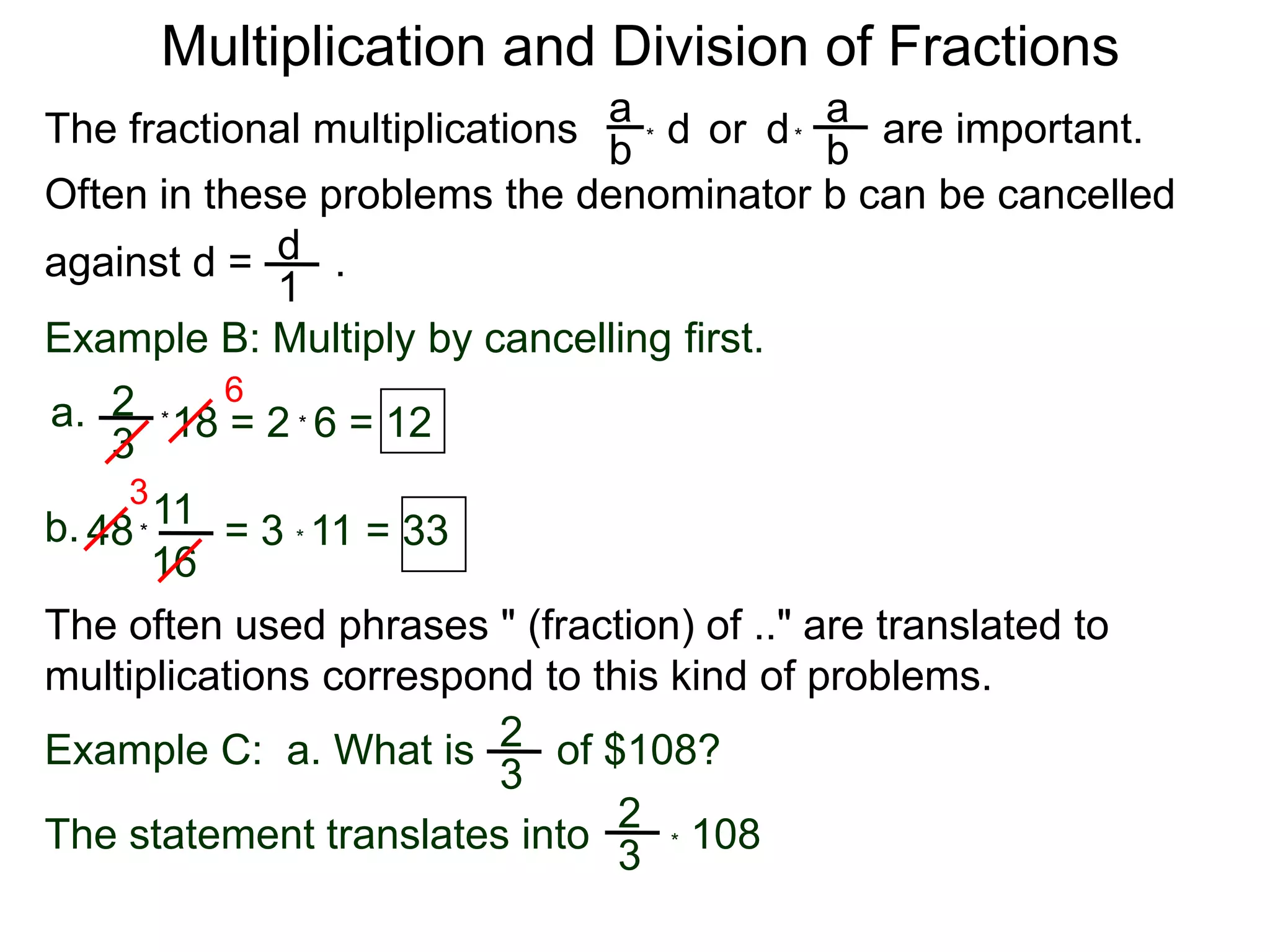
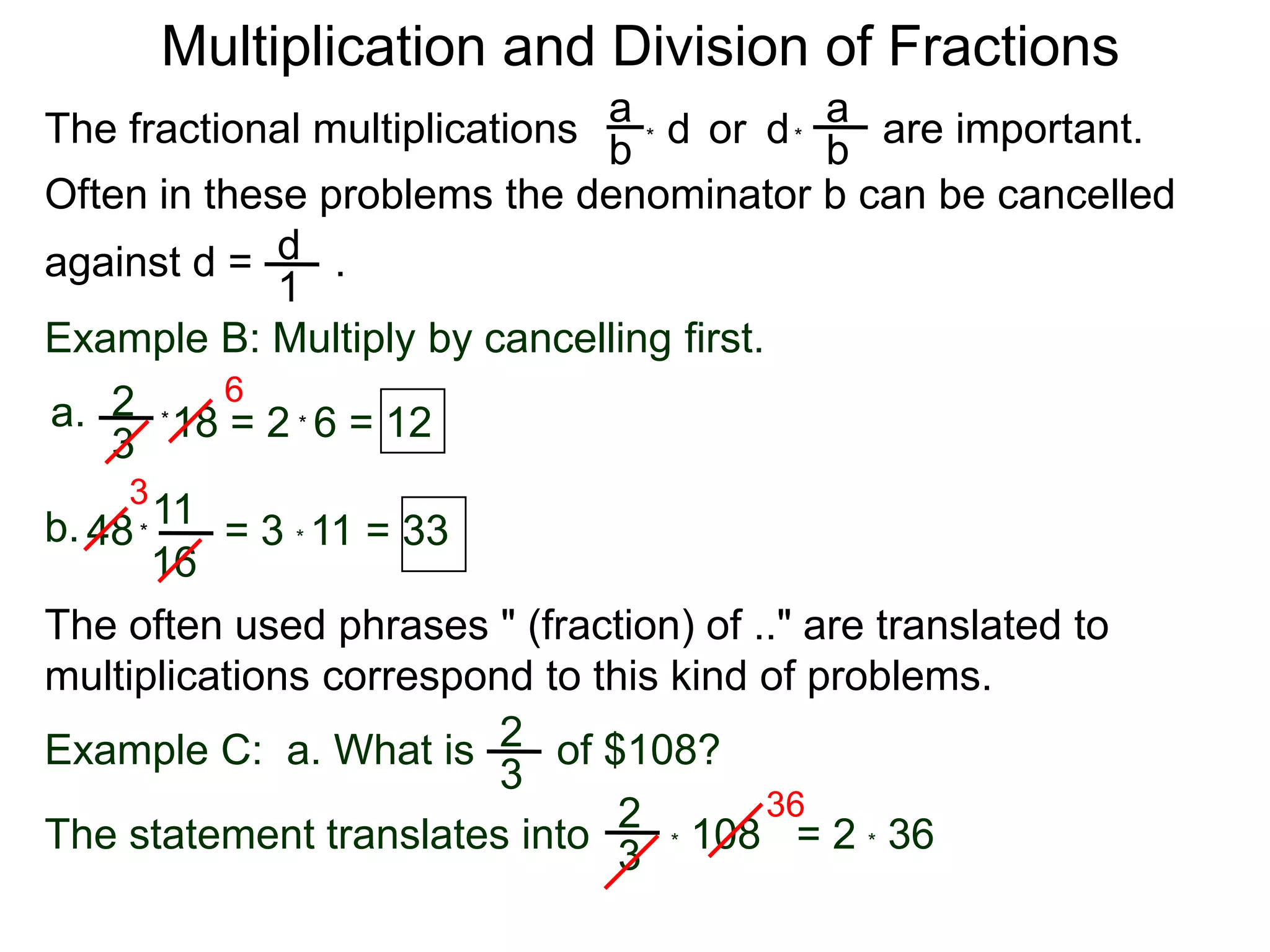
Multiplication and Division of FractionsaaThe fractional multiplications                          are important.ddor bb**Often in these problems the denominator b can be cancelledagainst d =       .    d1Example B: Multiply by cancelling first.62a.18 = 2  6 = 12**3311b.48        = 3 * 11 = 33*16The often used phrases " (fraction) of .." are translated to             multiplications correspond to this kind of problems.2Example C:  a. What is       of $108?32* 108  The statement translates into3
Multiplication and Division of FractionsaaThe fractional multiplications                          are important.ddor bb**Often in these problems the denominator b can be cancelledagainst d =       .    d1Example B: Multiply by cancelling first.62a.18 = 2  6 = 12**3311b.48        = 3 * 11 = 33*16The often used phrases " (fraction) of .." are translated to             multiplications correspond to this kind of problems.2Example C:  a. What is       of $108?3362* 108   The statement translates into3
Multiplication and Division of FractionsaaThe fractional multiplications                          are important.ddor bb**Often in these problems the denominator b can be cancelledagainst d =       .    d1Example B: Multiply by cancelling first.62a.18 = 2  6 = 12**3311b.48        = 3 * 11 = 33*16The often used phrases " (fraction) of .." are translated to             multiplications correspond to this kind of problems.2Example C:  a. What is       of $108?3362* 108   = 2 * 36 The statement translates into3
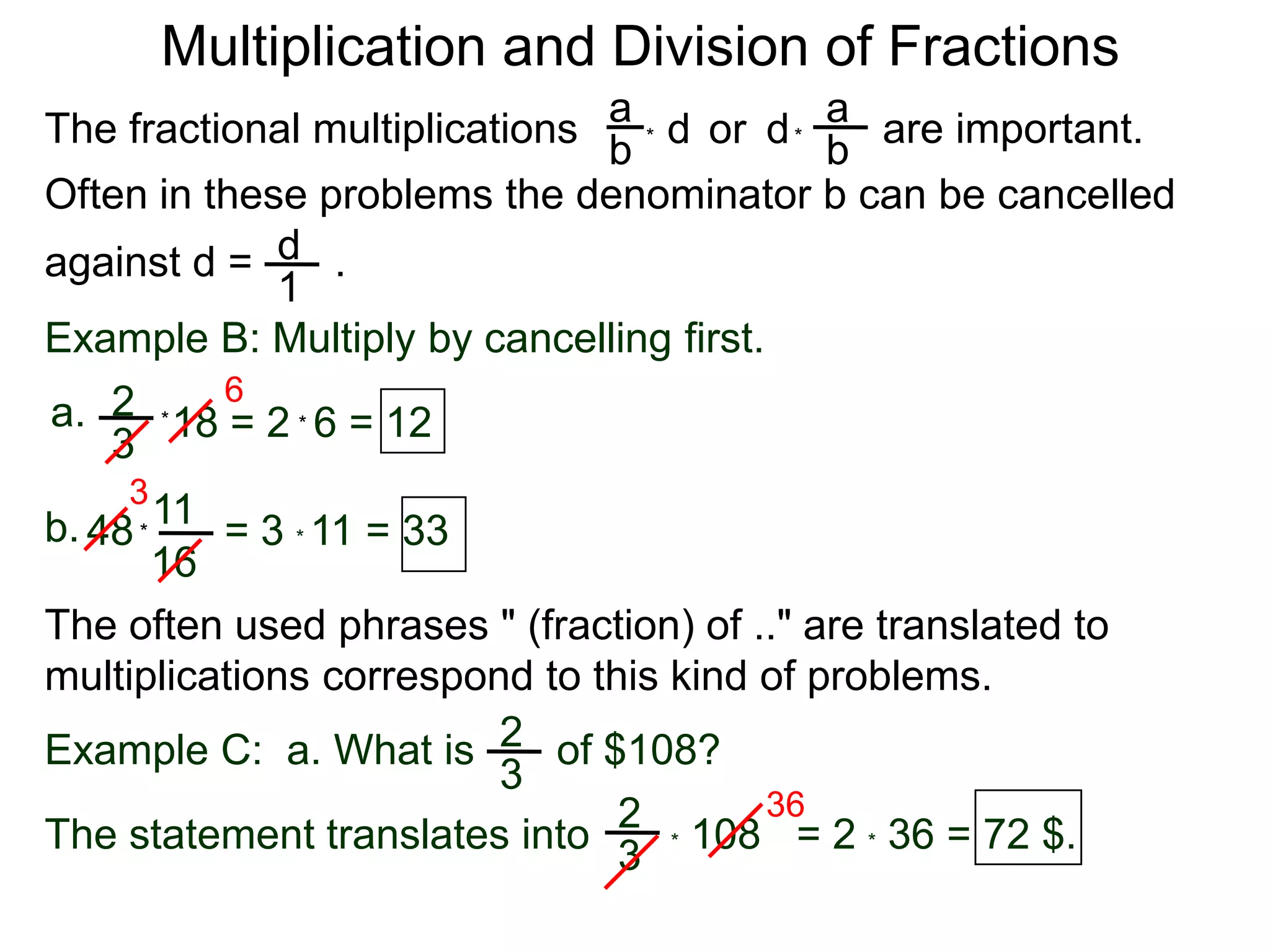
Multiplication and Division of FractionsaaThe fractional multiplications                          are important.ddor bb**Often in these problems the denominator b can be cancelledagainst d =       .    d1Example B: Multiply by cancelling first.62a.18 = 2  6 = 12**3311b.48        = 3 * 11 = 33*16The often used phrases " (fraction) of .." are translated to             multiplications correspond to this kind of problems.2Example C:  a. What is       of $108?3362* 108   = 2 * 36 = 72 $.The statement translates into3
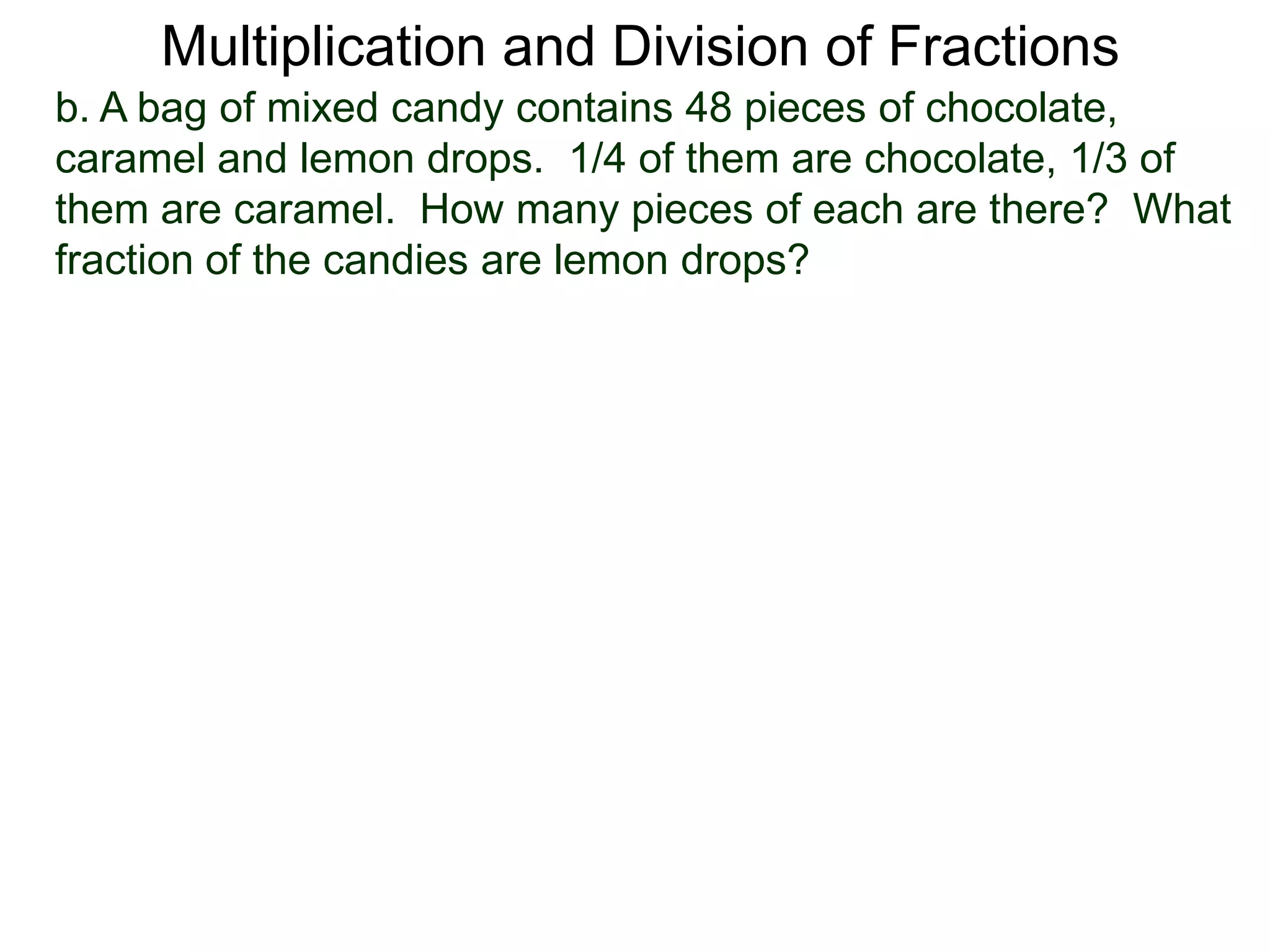
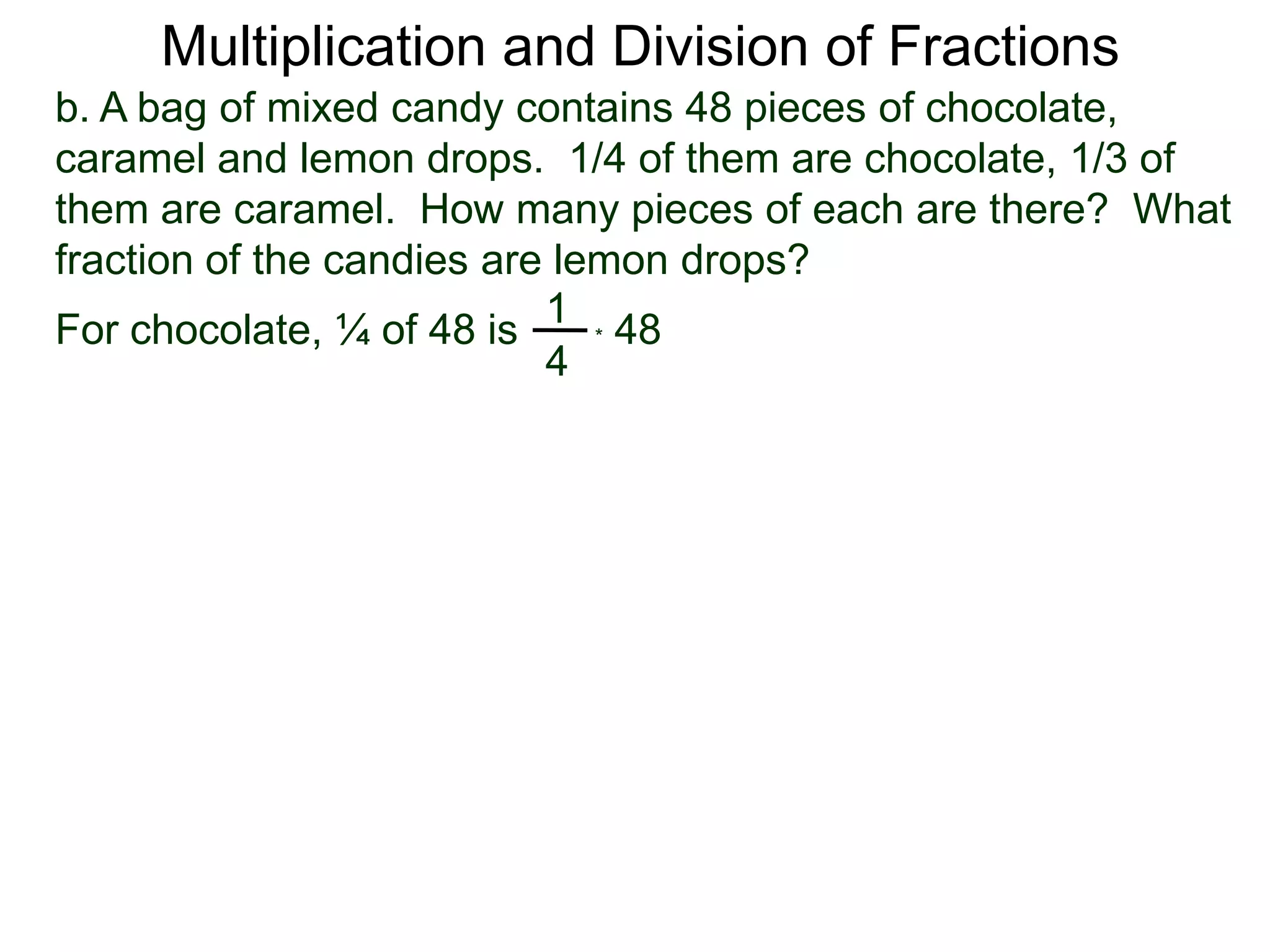
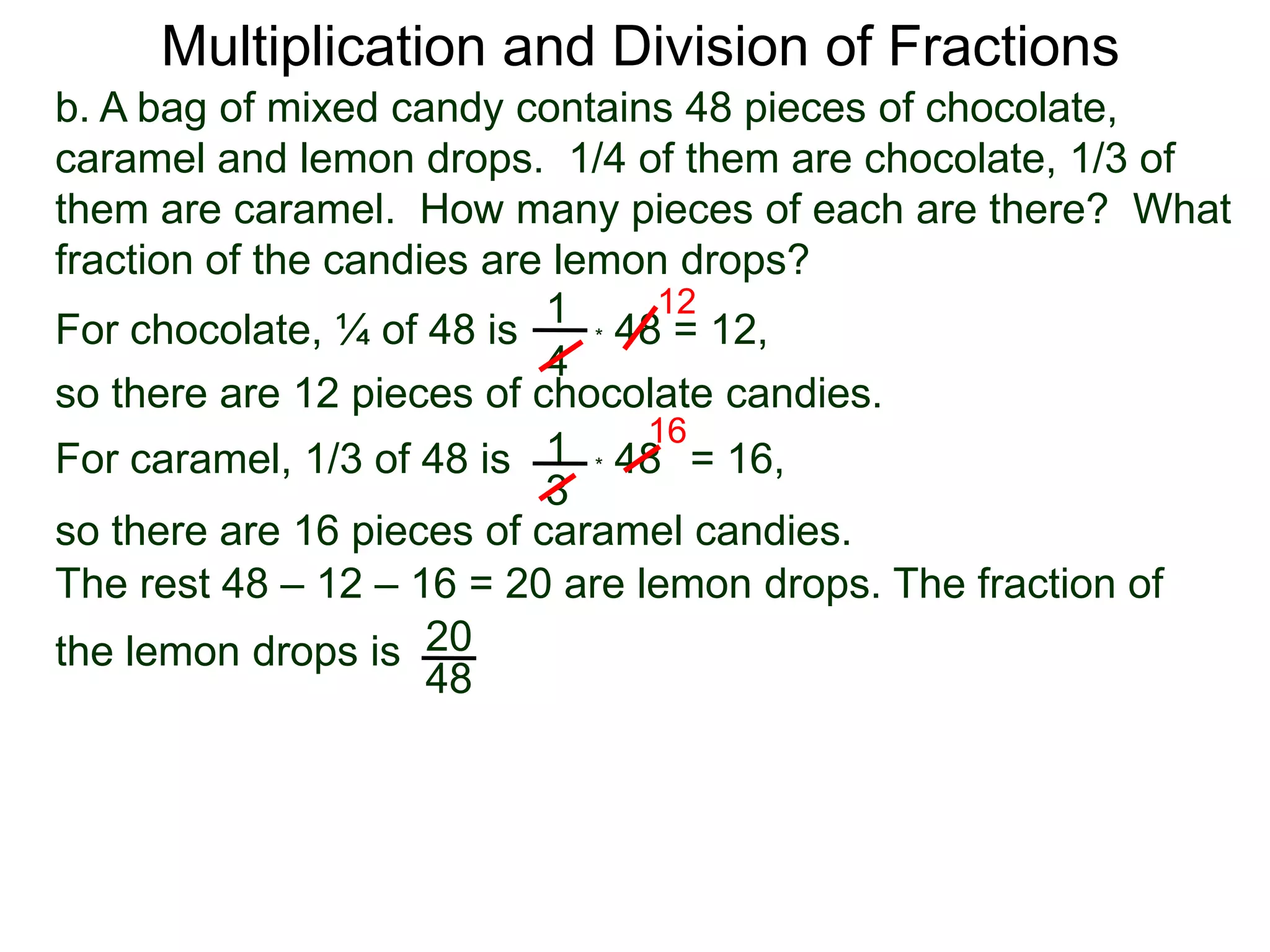
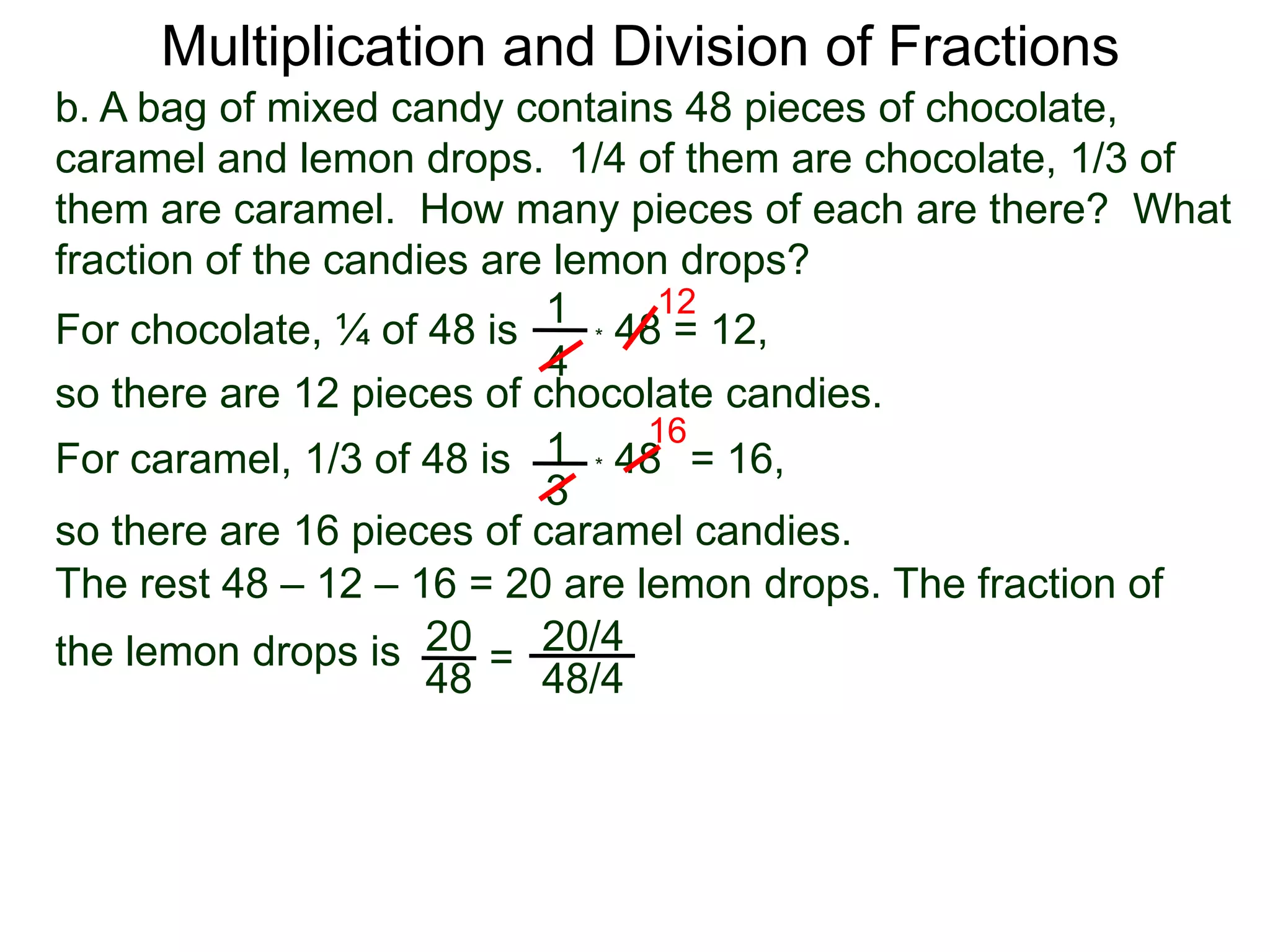
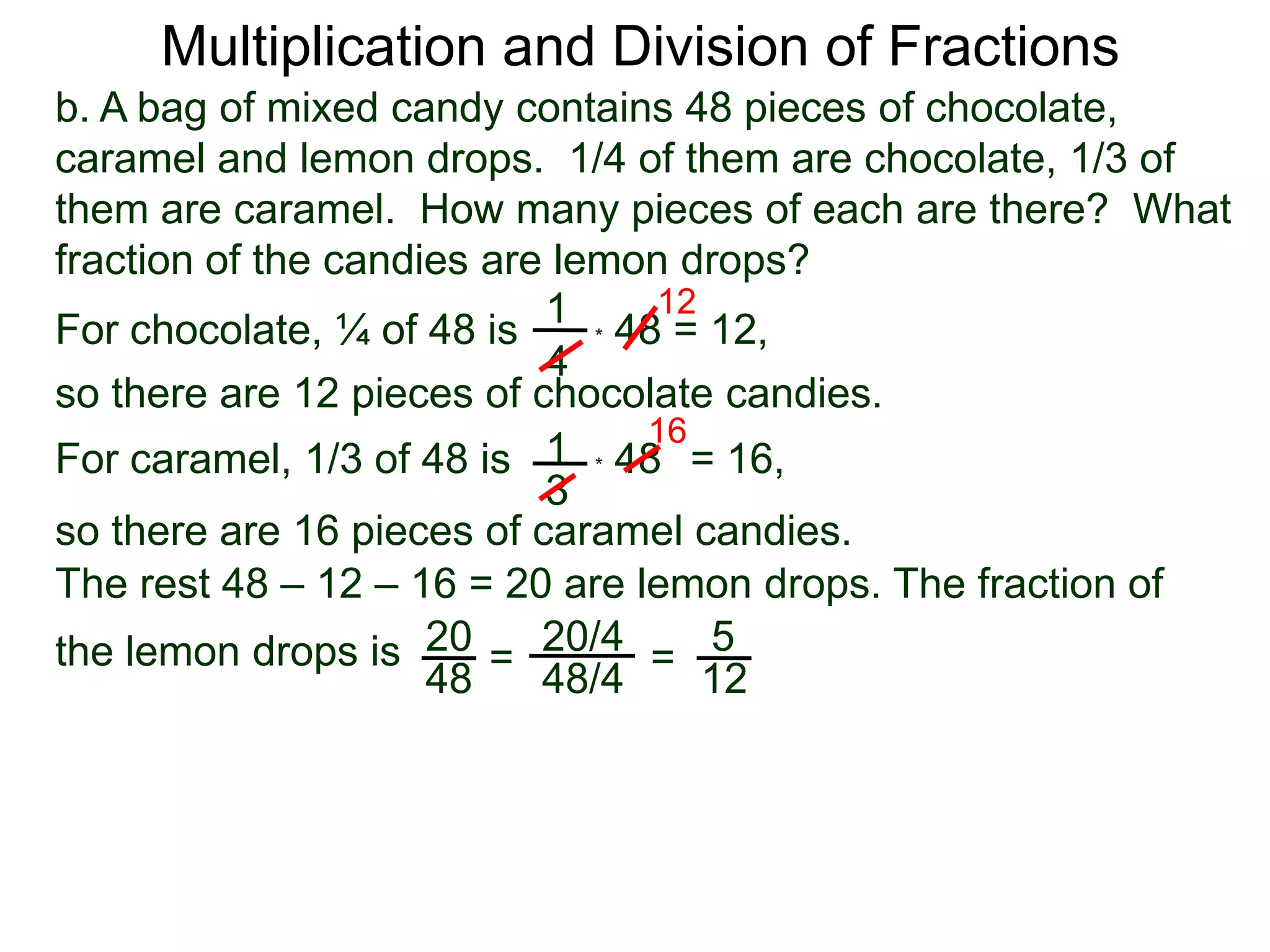
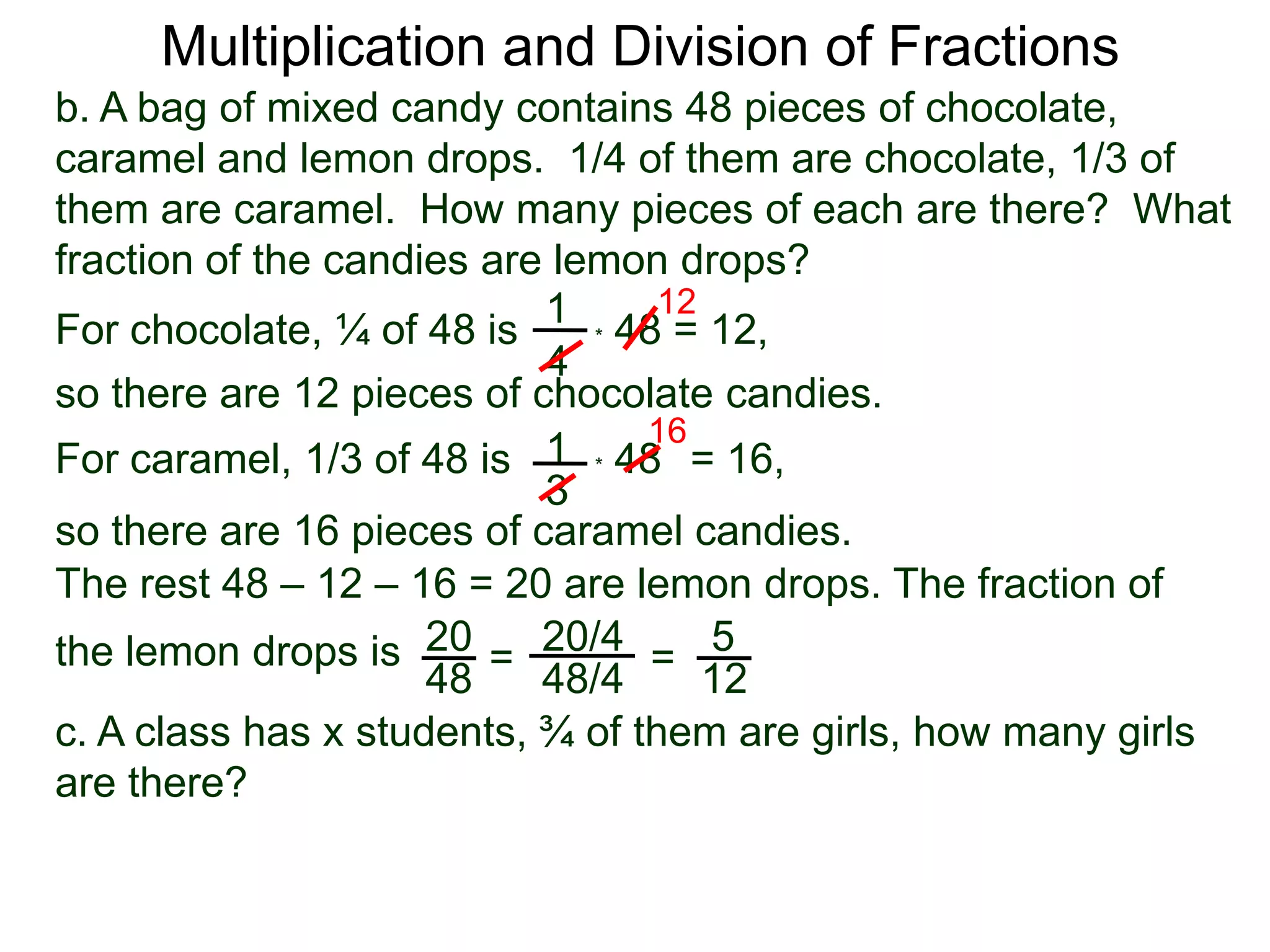
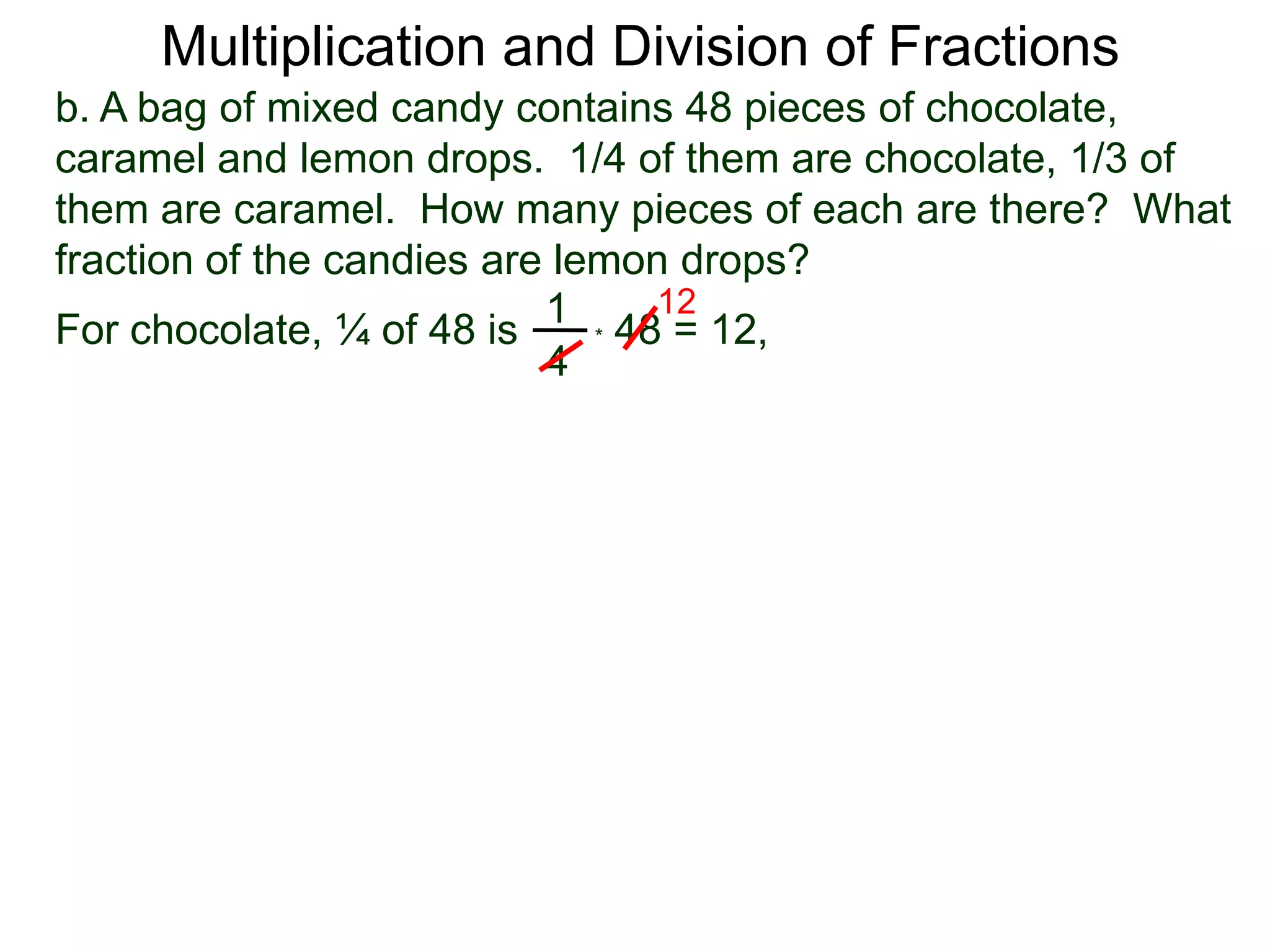
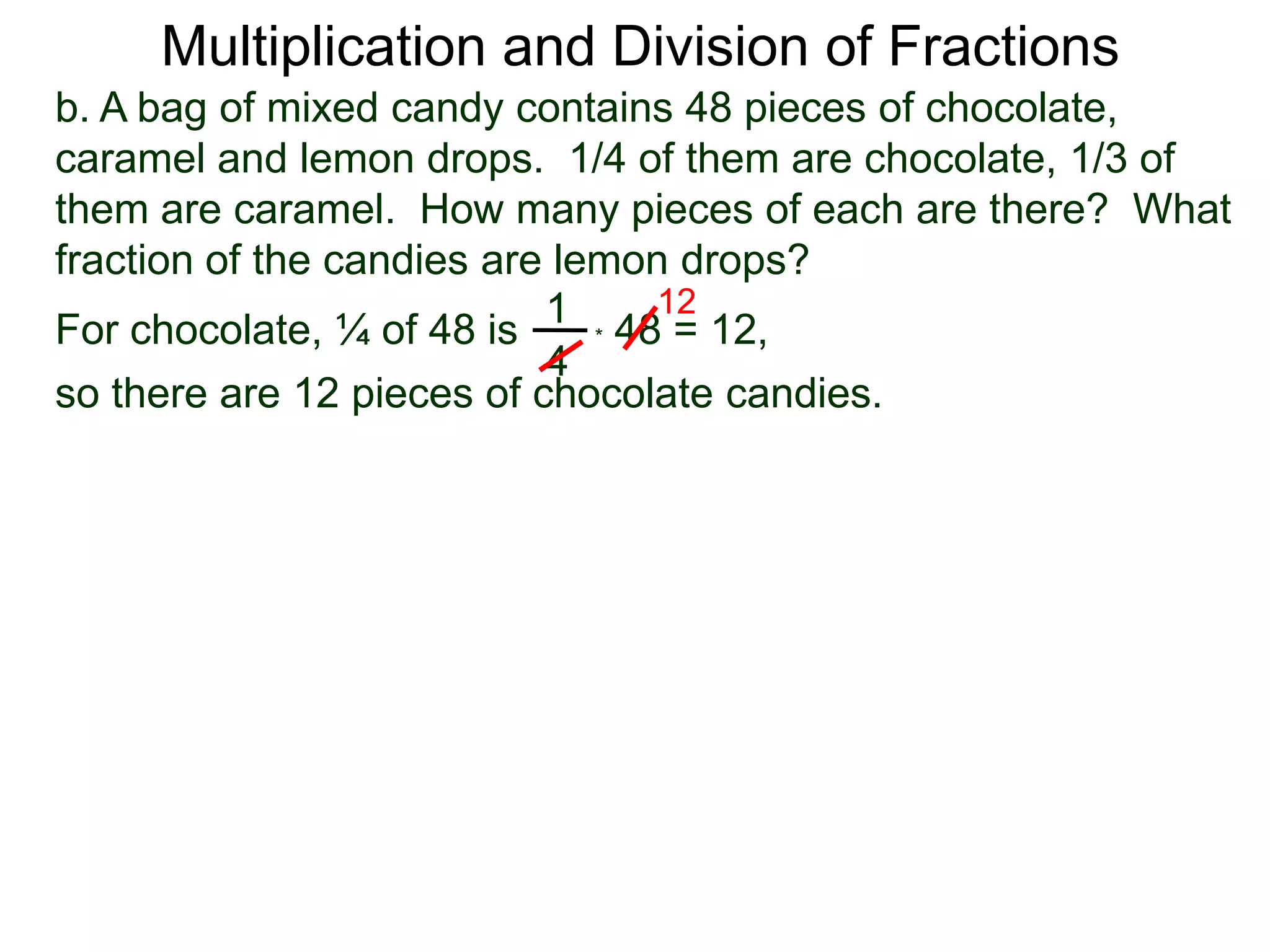
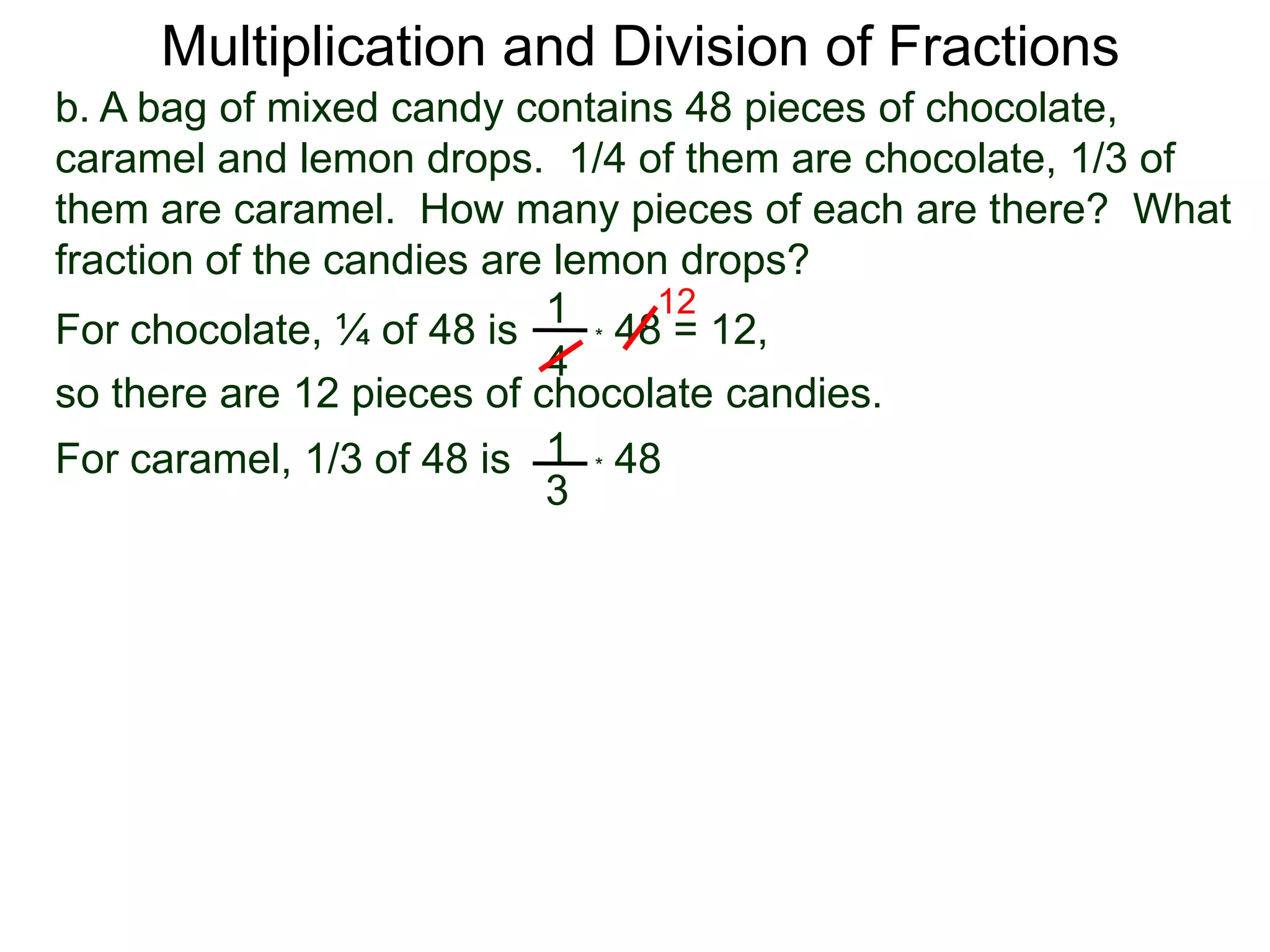
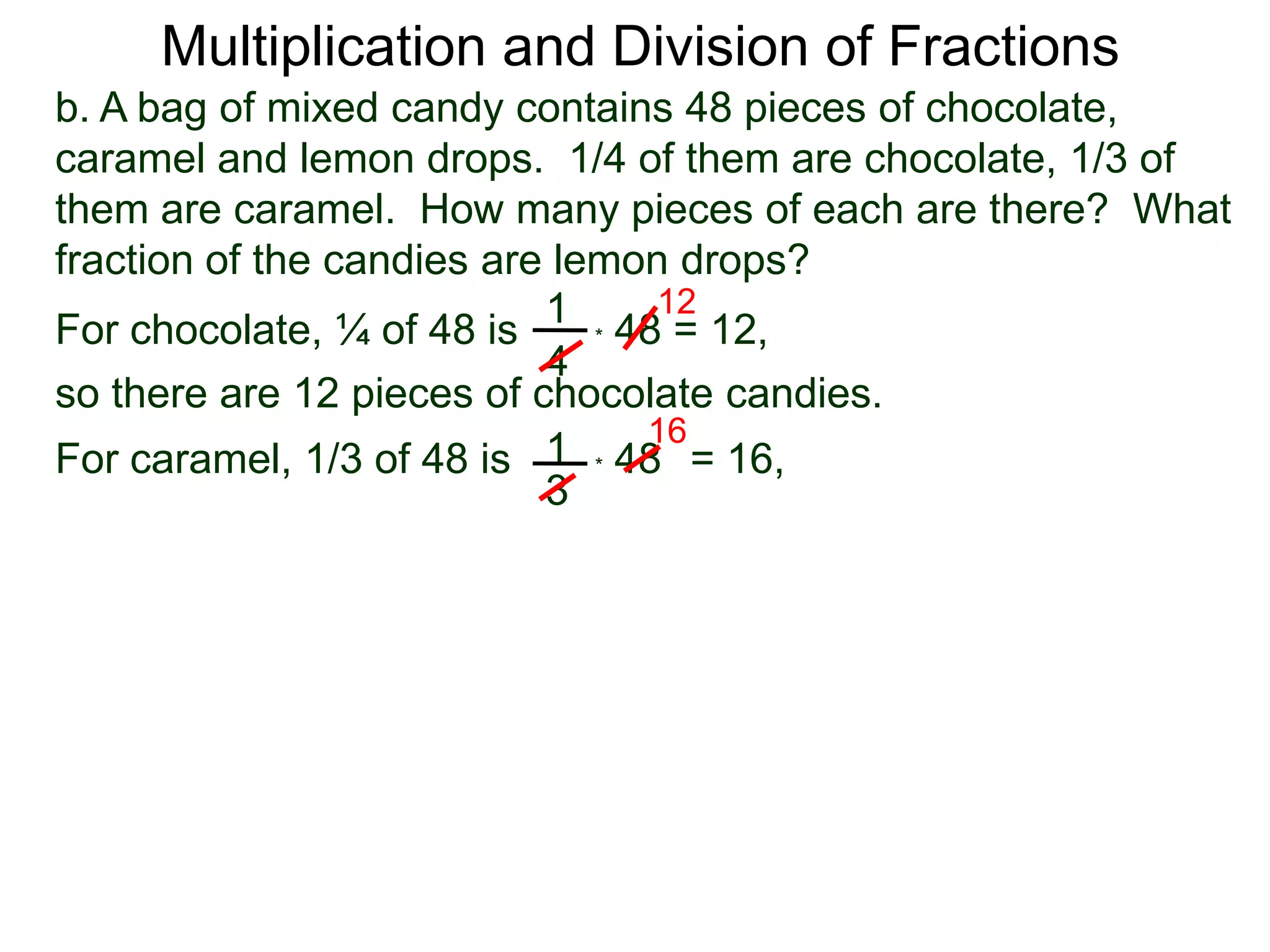
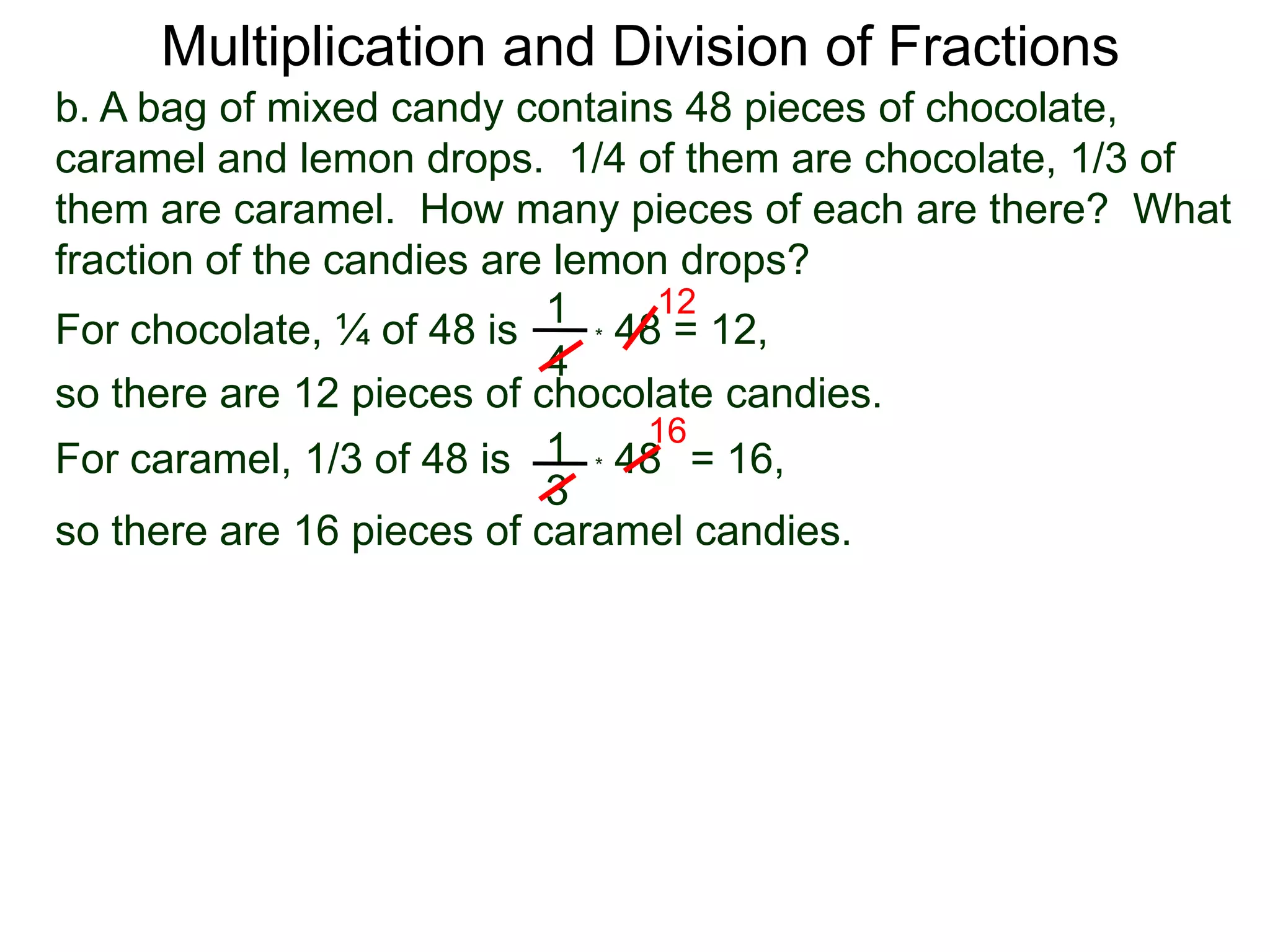
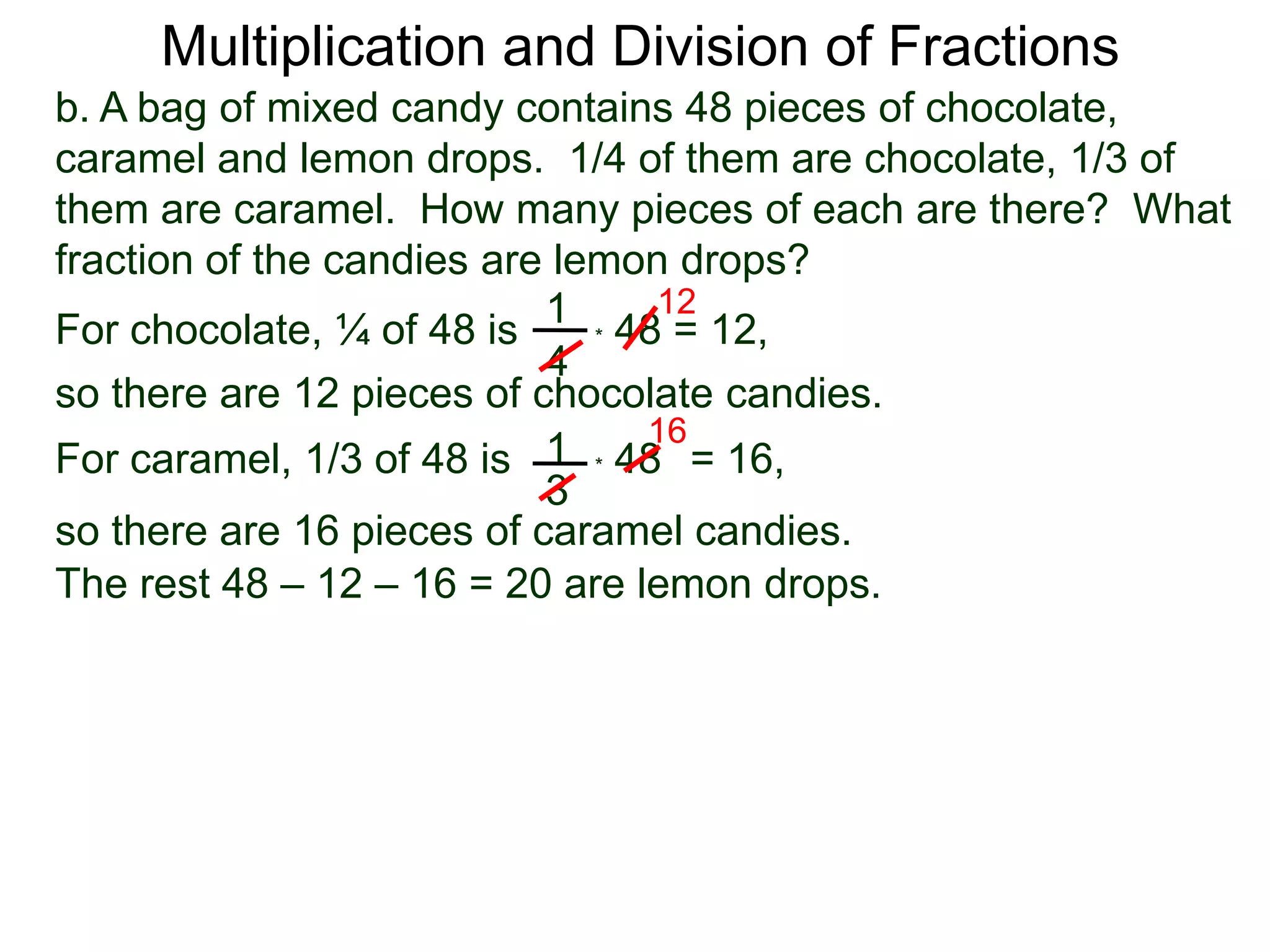
Multiplication and Division of Fractionsb. A bag of mixed candy contains 48 pieces of chocolate, caramel and lemon drops.  1/4 of them are chocolate, 1/3 of them are caramel.  How many pieces of each are there?  What fraction of the candies are lemon drops?
Multiplication and Division of Fractionsb. A bag of mixed candy contains 48 pieces of chocolate, caramel and lemon drops.  1/4 of them are chocolate, 1/3 of them are caramel.  How many pieces of each are there?  What fraction of the candies are lemon drops?1For chocolate, ¼ of 48 is* 48 4
Multiplication and Division of Fractionsb. A bag of mixed candy contains 48 pieces of chocolate, caramel and lemon drops.  1/4 of them are chocolate, 1/3 of them are caramel.  How many pieces of each are there?  What fraction of the candies are lemon drops?121For chocolate, ¼ of 48 is* 48 = 12,4
Multiplication and Division of Fractionsb. A bag of mixed candy contains 48 pieces of chocolate, caramel and lemon drops.  1/4 of them are chocolate, 1/3 of them are caramel.  How many pieces of each are there?  What fraction of the candies are lemon drops?121For chocolate, ¼ of 48 is* 48 = 12,4so there are 12 pieces of chocolate candies.
Multiplication and Division of Fractionsb. A bag of mixed candy contains 48 pieces of chocolate, caramel and lemon drops.  1/4 of them are chocolate, 1/3 of them are caramel.  How many pieces of each are there?  What fraction of the candies are lemon drops?121For chocolate, ¼ of 48 is* 48 = 12,4so there are 12 pieces of chocolate candies.1* 48   For caramel, 1/3 of 48 is3
Multiplication and Division of Fractionsb. A bag of mixed candy contains 48 pieces of chocolate, caramel and lemon drops.  1/4 of them are chocolate, 1/3 of them are caramel.  How many pieces of each are there?  What fraction of the candies are lemon drops?121For chocolate, ¼ of 48 is* 48 = 12,4so there are 12 pieces of chocolate candies.161* 48   For caramel, 1/3 of 48 is= 16, 3
Multiplication and Division of Fractionsb. A bag of mixed candy contains 48 pieces of chocolate, caramel and lemon drops.  1/4 of them are chocolate, 1/3 of them are caramel.  How many pieces of each are there?  What fraction of the candies are lemon drops?121For chocolate, ¼ of 48 is* 48 = 12,4so there are 12 pieces of chocolate candies.161* 48   For caramel, 1/3 of 48 is= 16, 3so there are 16 pieces of caramel candies.
Multiplication and Division of Fractionsb. A bag of mixed candy contains 48 pieces of chocolate, caramel and lemon drops.  1/4 of them are chocolate, 1/3 of them are caramel.  How many pieces of each are there?  What fraction of the candies are lemon drops?121For chocolate, ¼ of 48 is* 48 = 12,4so there are 12 pieces of chocolate candies.161* 48   For caramel, 1/3 of 48 is= 16, 3so there are 16 pieces of caramel candies.The rest 48 – 12 – 16 = 20 are lemon drops.
Multiplication and Division of Fractionsb. A bag of mixed candy contains 48 pieces of chocolate, caramel and lemon drops.  1/4 of them are chocolate, 1/3 of them are caramel.  How many pieces of each are there?  What fraction of the candies are lemon drops?121For chocolate, ¼ of 48 is* 48 = 12,4so there are 12 pieces of chocolate candies.161* 48   For caramel, 1/3 of 48 is= 16, 3so there are 16 pieces of caramel candies.The rest 48 – 12 – 16 = 20 are lemon drops. The fraction of the lemon drops is 2048
Multiplication and Division of Fractionsb. A bag of mixed candy contains 48 pieces of chocolate, caramel and lemon drops.  1/4 of them are chocolate, 1/3 of them are caramel.  How many pieces of each are there?  What fraction of the candies are lemon drops?121For chocolate, ¼ of 48 is* 48 = 12,4so there are 12 pieces of chocolate candies.161* 48   For caramel, 1/3 of 48 is= 16, 3so there are 16 pieces of caramel candies.The rest 48 – 12 – 16 = 20 are lemon drops. The fraction of the lemon drops is 2020/4=4848/4
Multiplication and Division of Fractionsb. A bag of mixed candy contains 48 pieces of chocolate, caramel and lemon drops.  1/4 of them are chocolate, 1/3 of them are caramel.  How many pieces of each are there?  What fraction of the candies are lemon drops?121For chocolate, ¼ of 48 is* 48 = 12,4so there are 12 pieces of chocolate candies.161* 48   For caramel, 1/3 of 48 is= 16, 3so there are 16 pieces of caramel candies.The rest 48 – 12 – 16 = 20 are lemon drops. The fraction of the lemon drops is 2020/45==4848/412
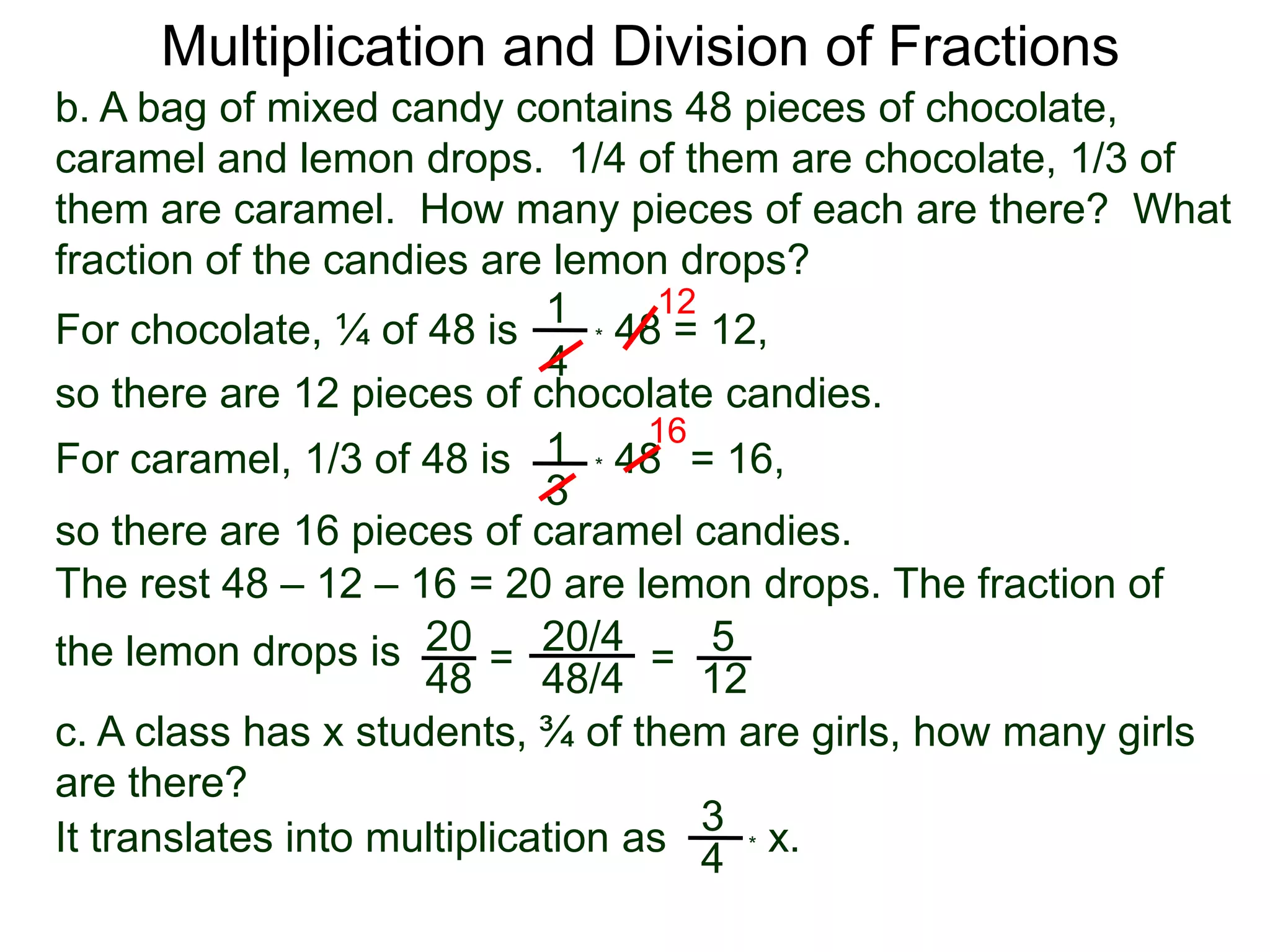
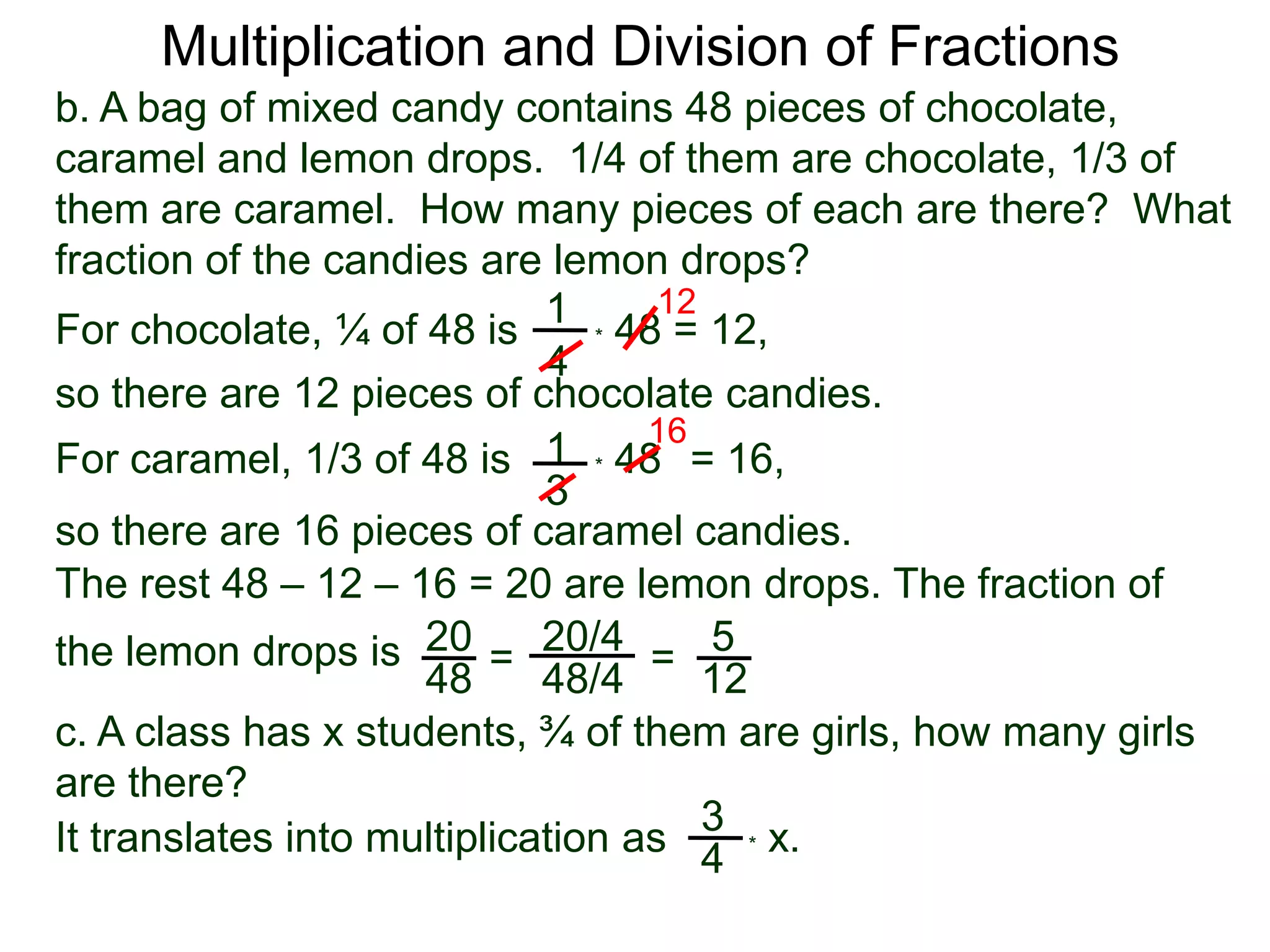
Multiplication and Division of Fractionsb. A bag of mixed candy contains 48 pieces of chocolate, caramel and lemon drops.  1/4 of them are chocolate, 1/3 of them are caramel.  How many pieces of each are there?  What fraction of the candies are lemon drops?121For chocolate, ¼ of 48 is* 48 = 12,4so there are 12 pieces of chocolate candies.161* 48   For caramel, 1/3 of 48 is= 16, 3so there are 16 pieces of caramel candies.The rest 48 – 12 – 16 = 20 are lemon drops. The fraction of the lemon drops is 2020/45==4848/412c. A class has x students, ¾ of them are girls, how many girls are there?
Multiplication and Division of Fractionsb. A bag of mixed candy contains 48 pieces of chocolate, caramel and lemon drops.  1/4 of them are chocolate, 1/3 of them are caramel.  How many pieces of each are there?  What fraction of the candies are lemon drops?121For chocolate, ¼ of 48 is* 48 = 12,4so there are 12 pieces of chocolate candies.161* 48   For caramel, 1/3 of 48 is= 16, 3so there are 16 pieces of caramel candies.The rest 48 – 12 – 16 = 20 are lemon drops. The fraction of the lemon drops is 2020/45==4848/412c. A class has x students, ¾ of them are girls, how many girls are there?3* x. It translates into multiplication as4
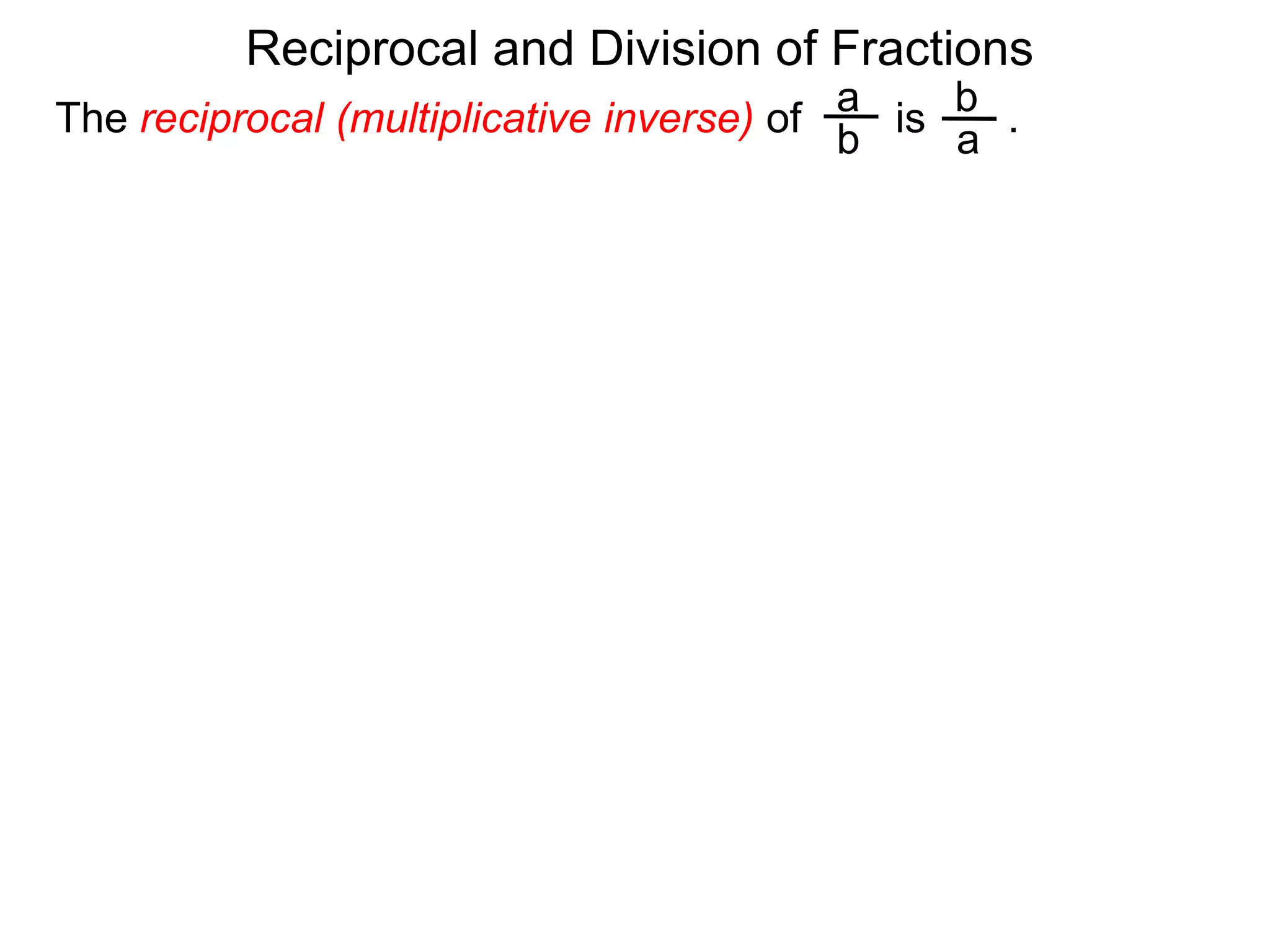
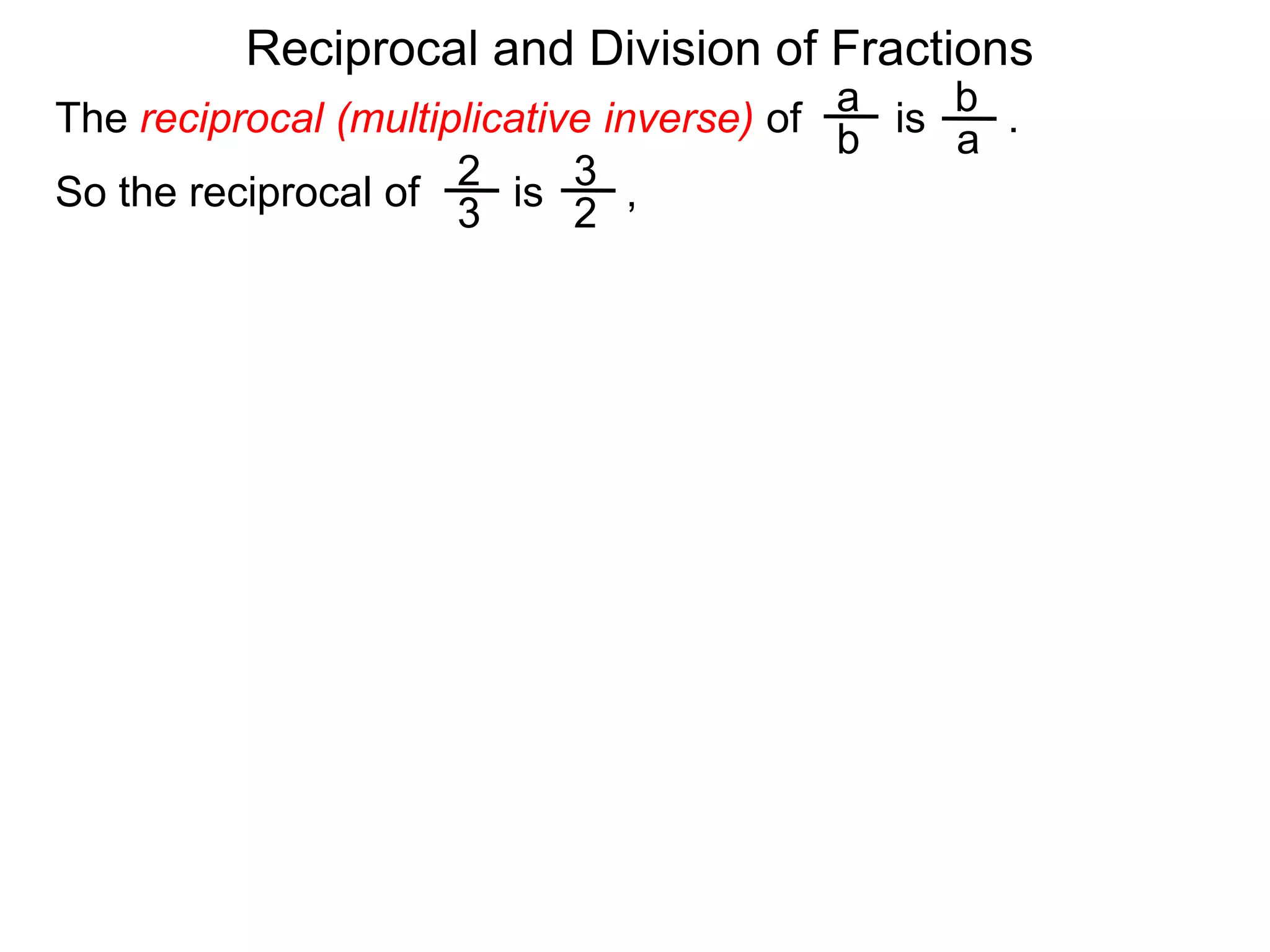
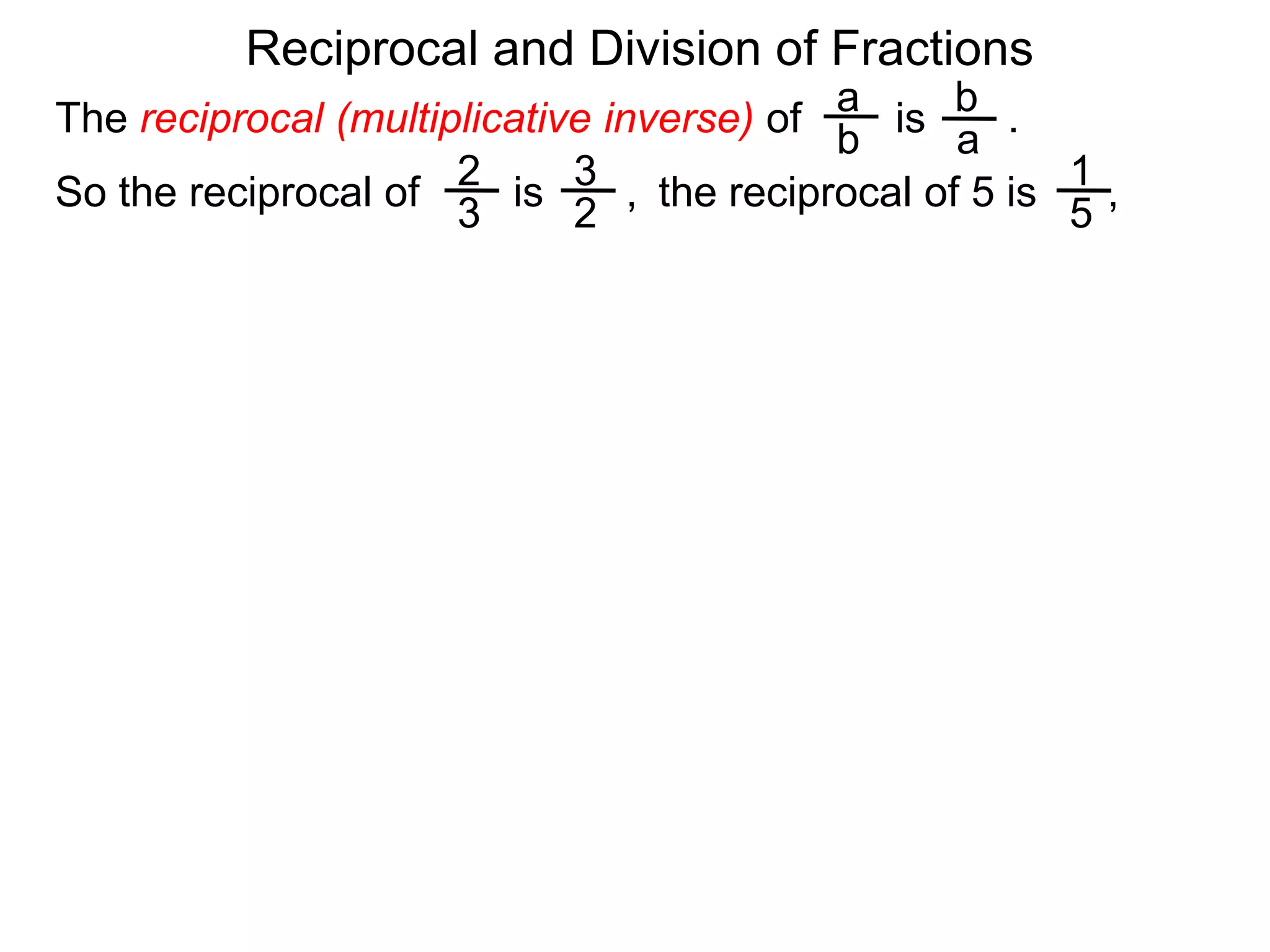
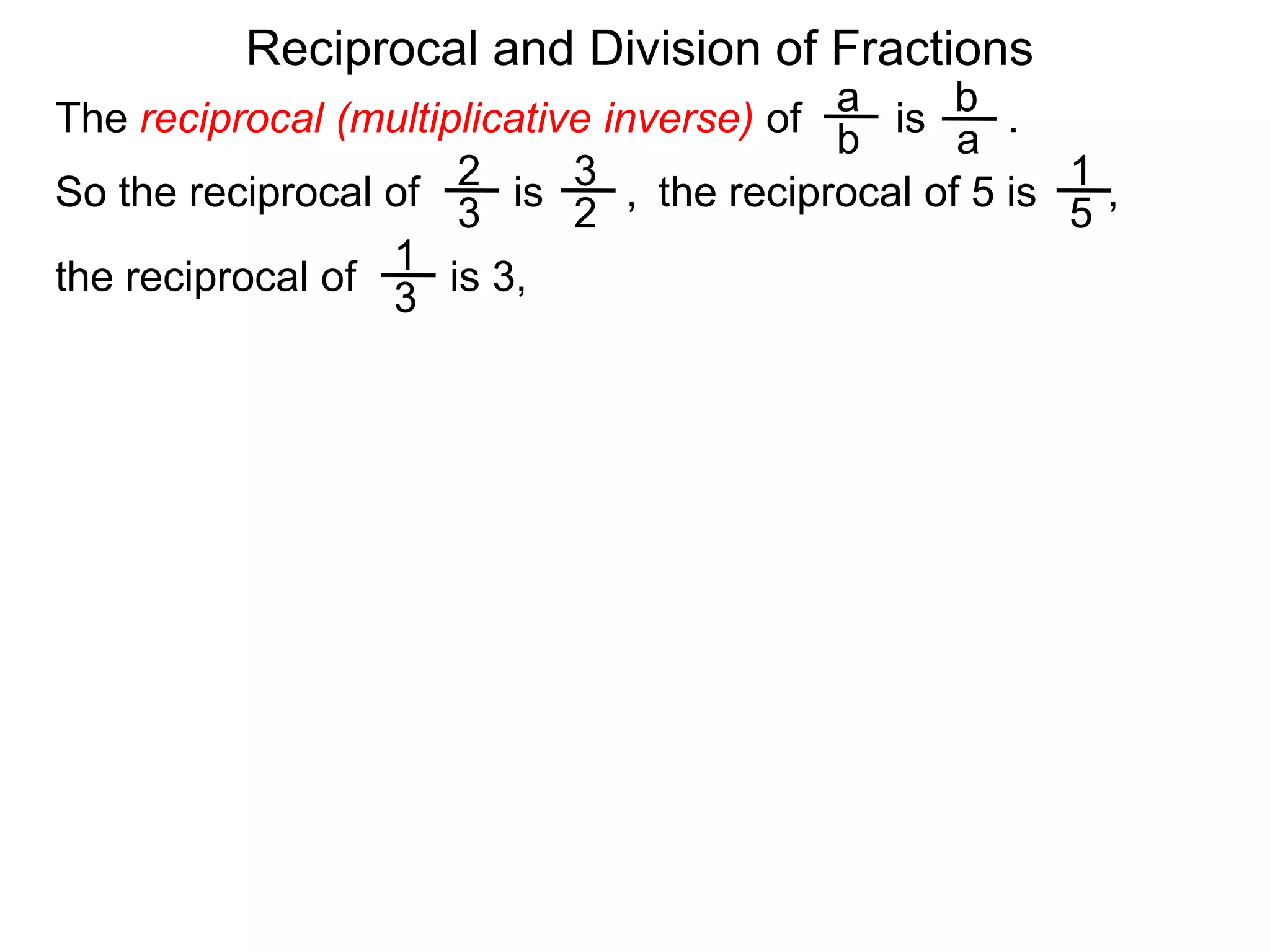
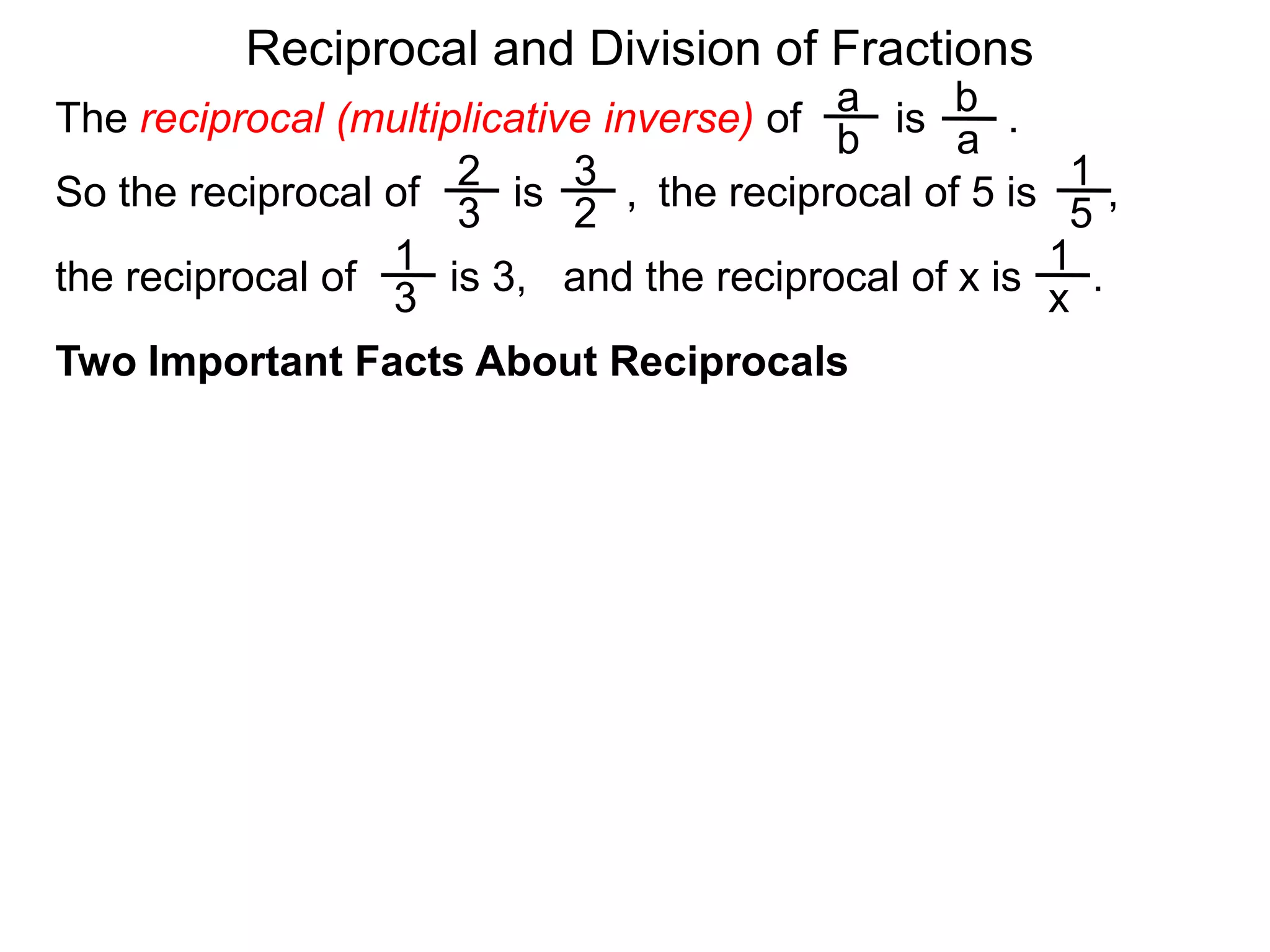
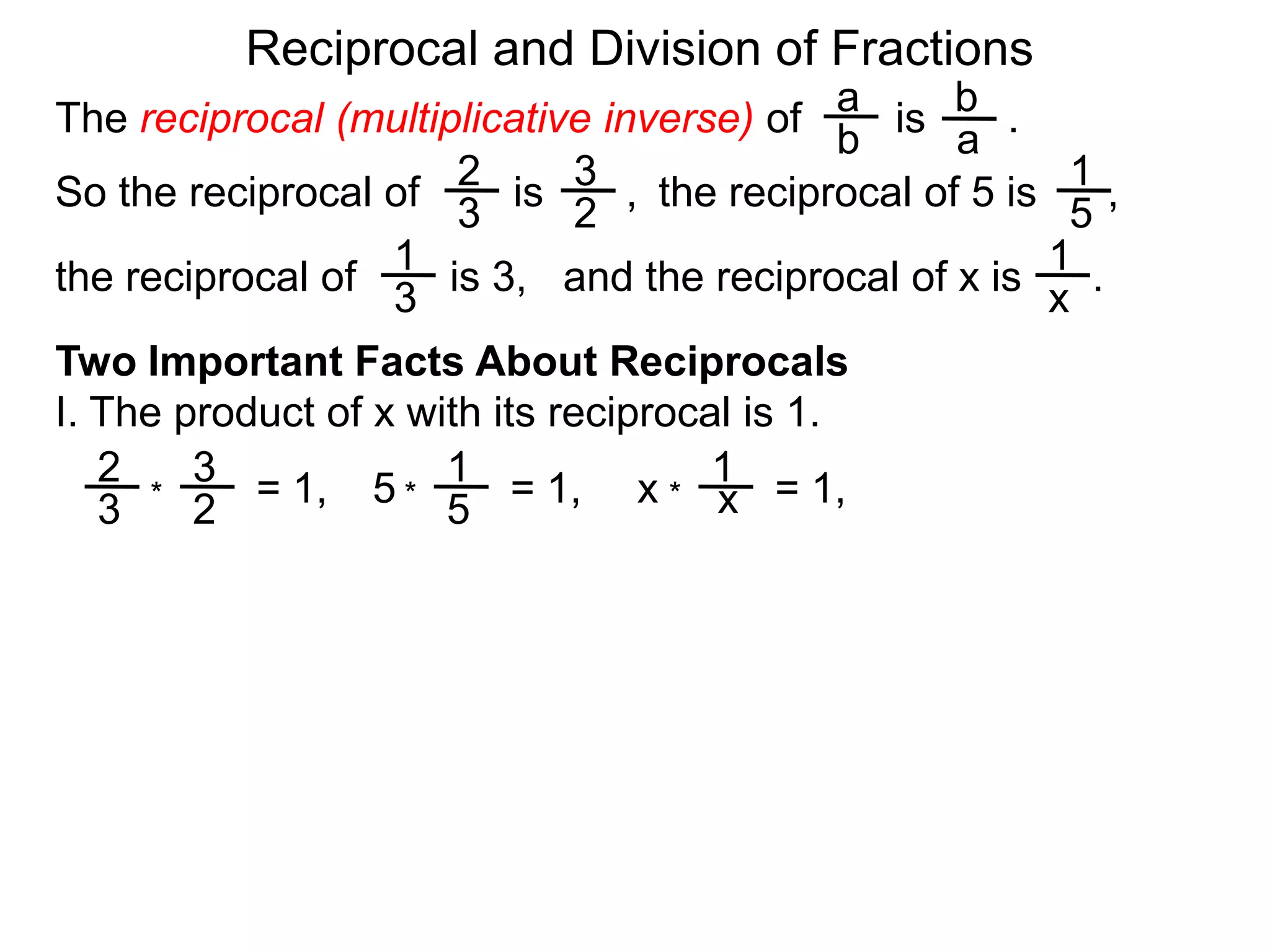
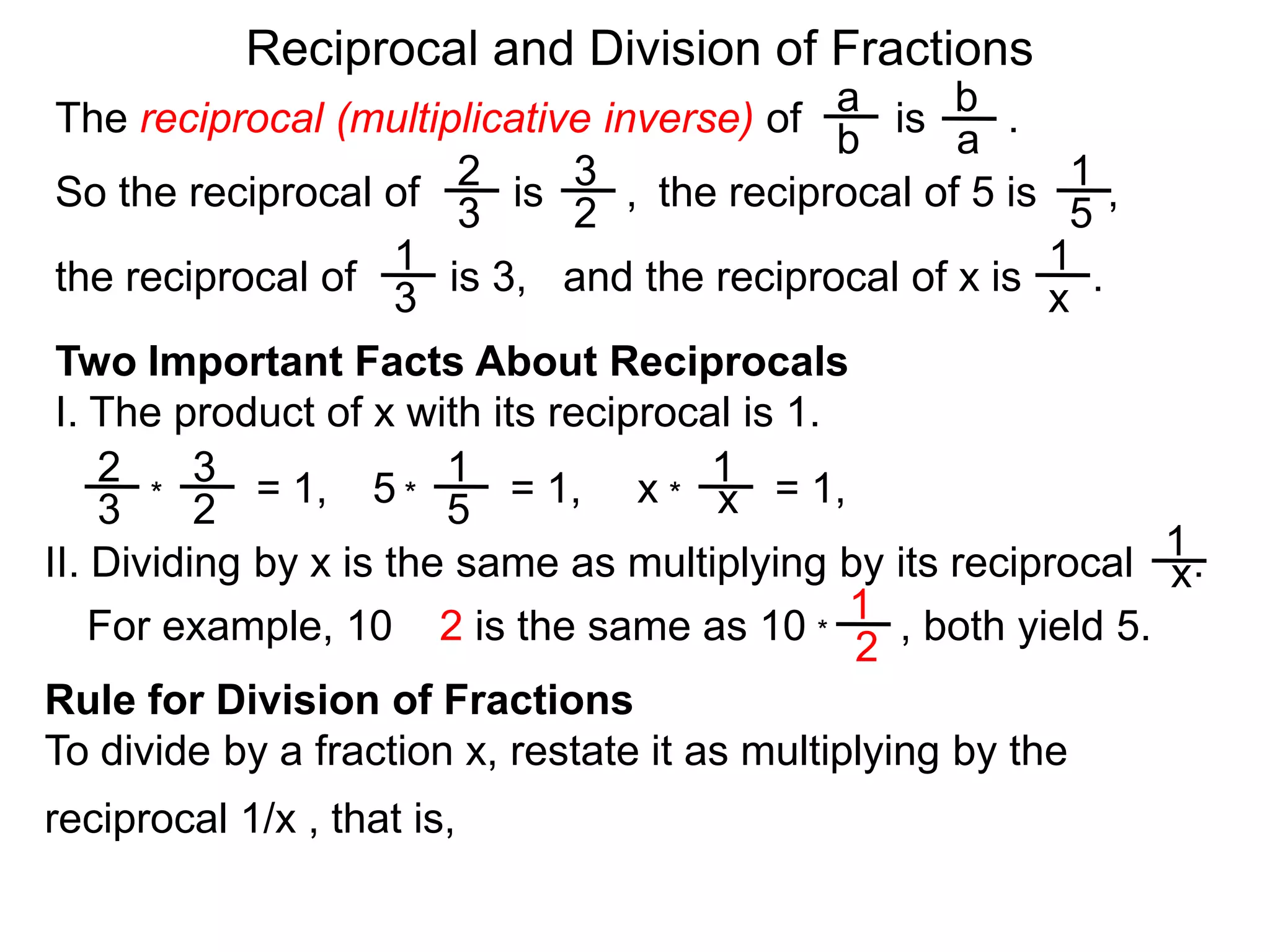
Reciprocal and Division of FractionsabThe reciprocal (multiplicative inverse) of        is       .  ba
Reciprocal and Division of FractionsabThe reciprocal (multiplicative inverse) of        is       .  ba23So the reciprocal of        is       ,  32
Reciprocal and Division of FractionsabThe reciprocal (multiplicative inverse) of        is       .  ba231So the reciprocal of        is       ,  the reciprocal of 5 is      ,  325
Reciprocal and Division of FractionsabThe reciprocal (multiplicative inverse) of        is       .  ba231So the reciprocal of        is       ,  the reciprocal of 5 is      ,  3251the reciprocal of        is 3,  3
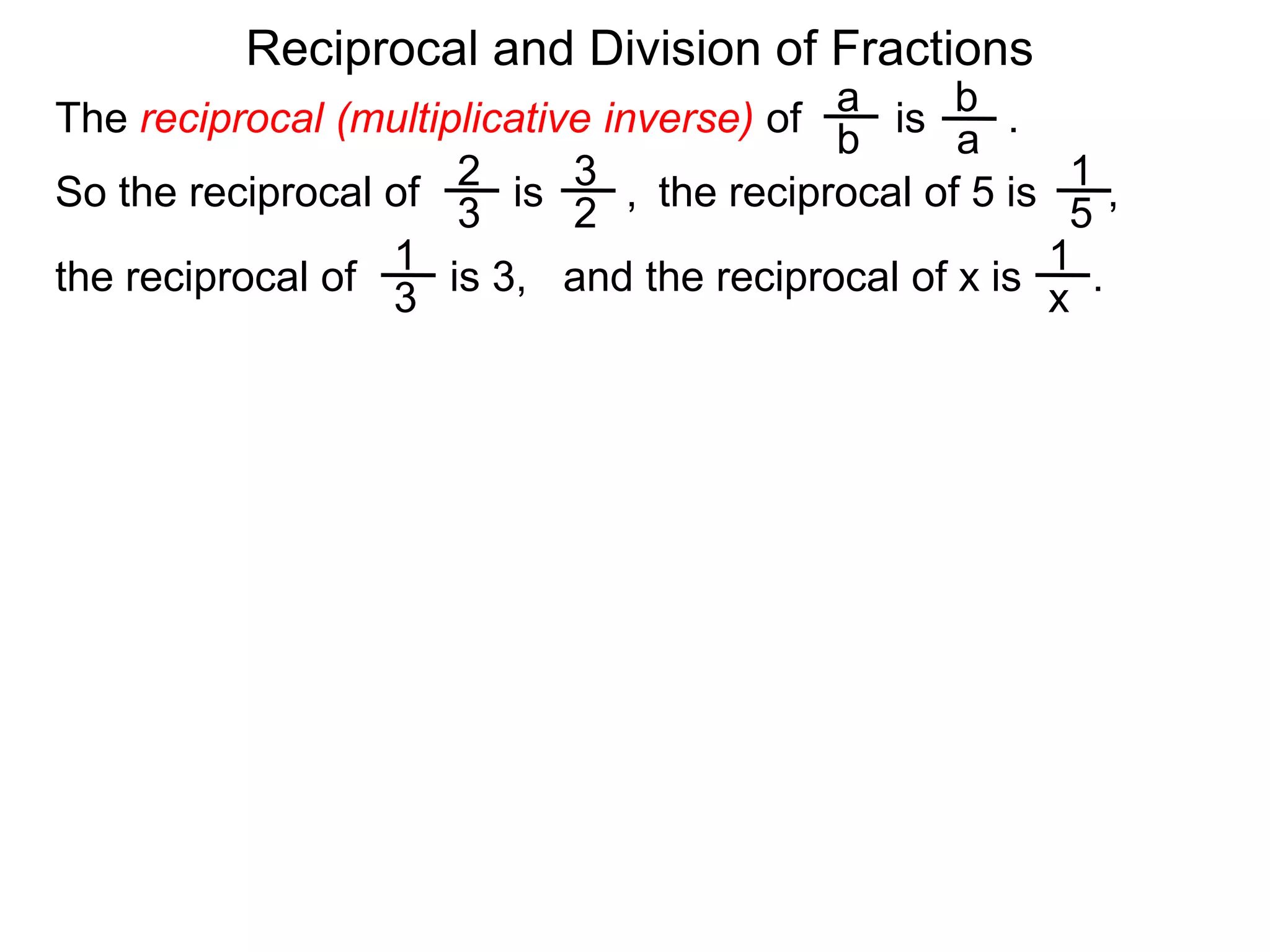
Reciprocal and Division of FractionsabThe reciprocal (multiplicative inverse) of        is       .  ba231So the reciprocal of        is       ,  the reciprocal of 5 is      ,  32511and the reciprocal of x is      .  the reciprocal of        is 3,  x3
Reciprocal and Division of FractionsabThe reciprocal (multiplicative inverse) of        is       .  ba231So the reciprocal of        is       ,  the reciprocal of 5 is      ,  32511and the reciprocal of x is      .  the reciprocal of        is 3,  x3Two Important Facts About Reciprocals
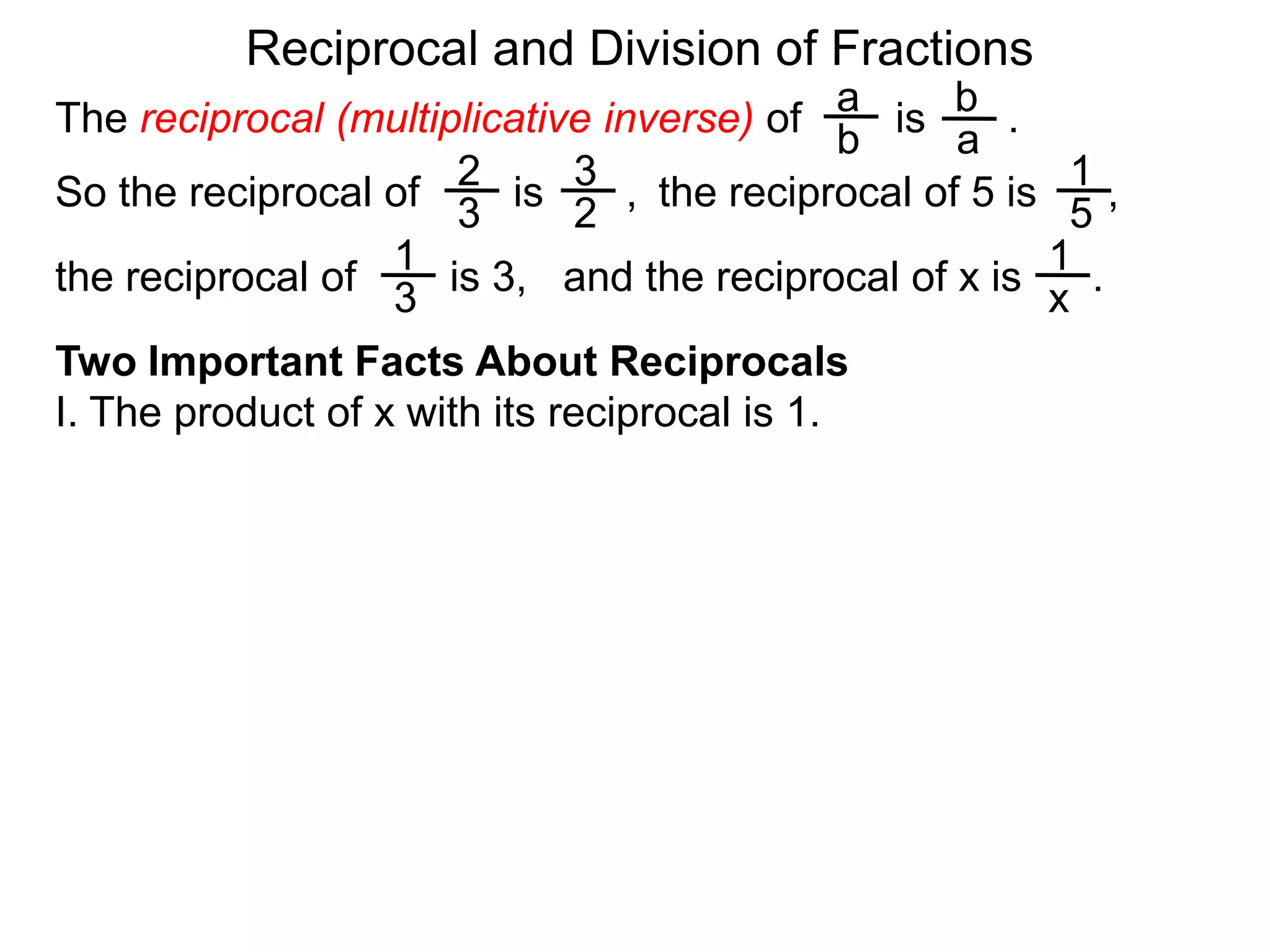
Reciprocal and Division of FractionsabThe reciprocal (multiplicative inverse) of        is       .  ba231So the reciprocal of        is       ,  the reciprocal of 5 is      ,  32511and the reciprocal of x is      .  the reciprocal of        is 3,  x3Two Important Facts About ReciprocalsI. The product of x with its reciprocal is 1.
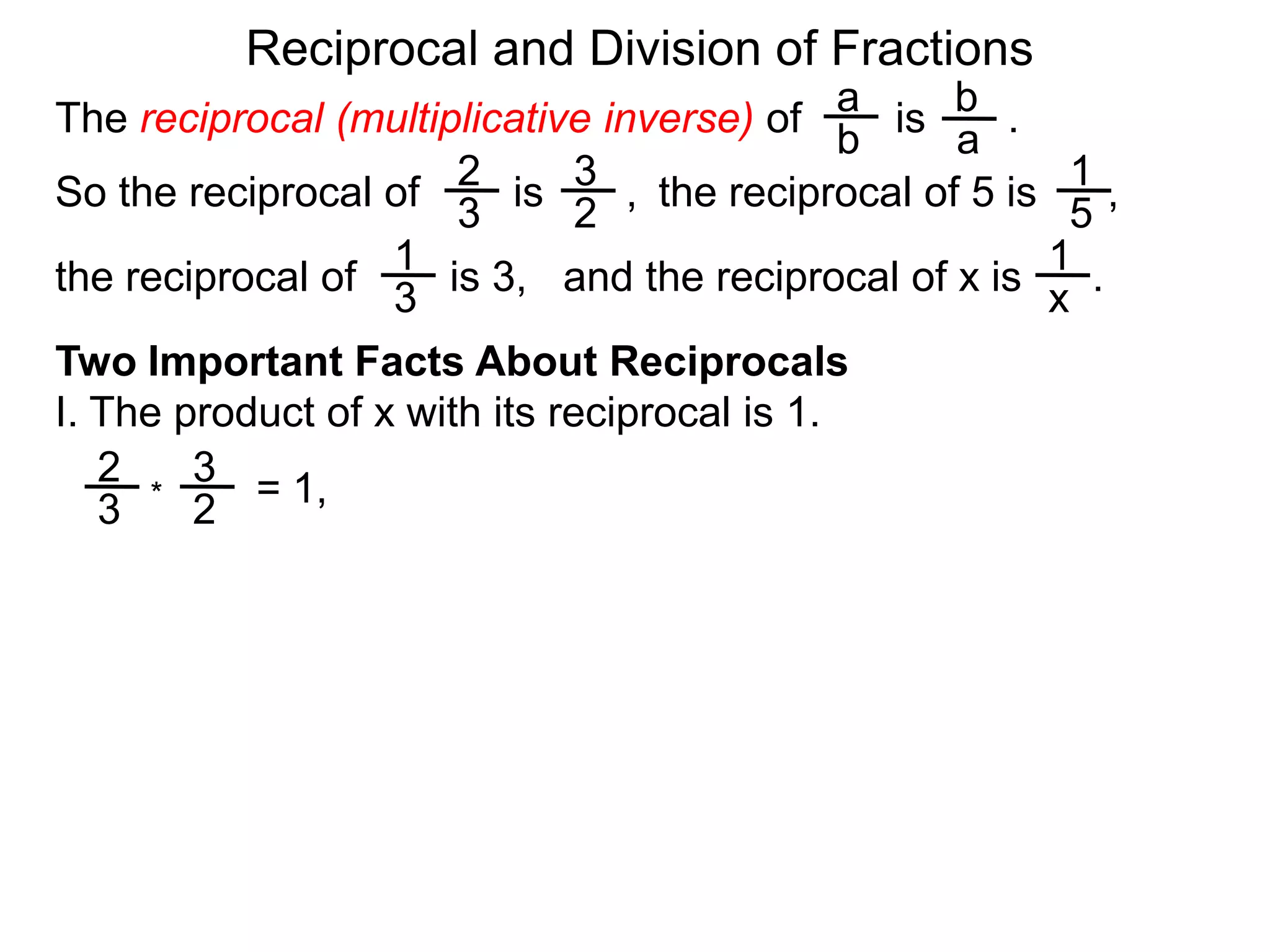
Reciprocal and Division of FractionsabThe reciprocal (multiplicative inverse) of        is       .  ba231So the reciprocal of        is       ,  the reciprocal of 5 is      ,  32511and the reciprocal of x is      .  the reciprocal of        is 3,  x3Two Important Facts About ReciprocalsI. The product of x with its reciprocal is 1.23= 1,*32
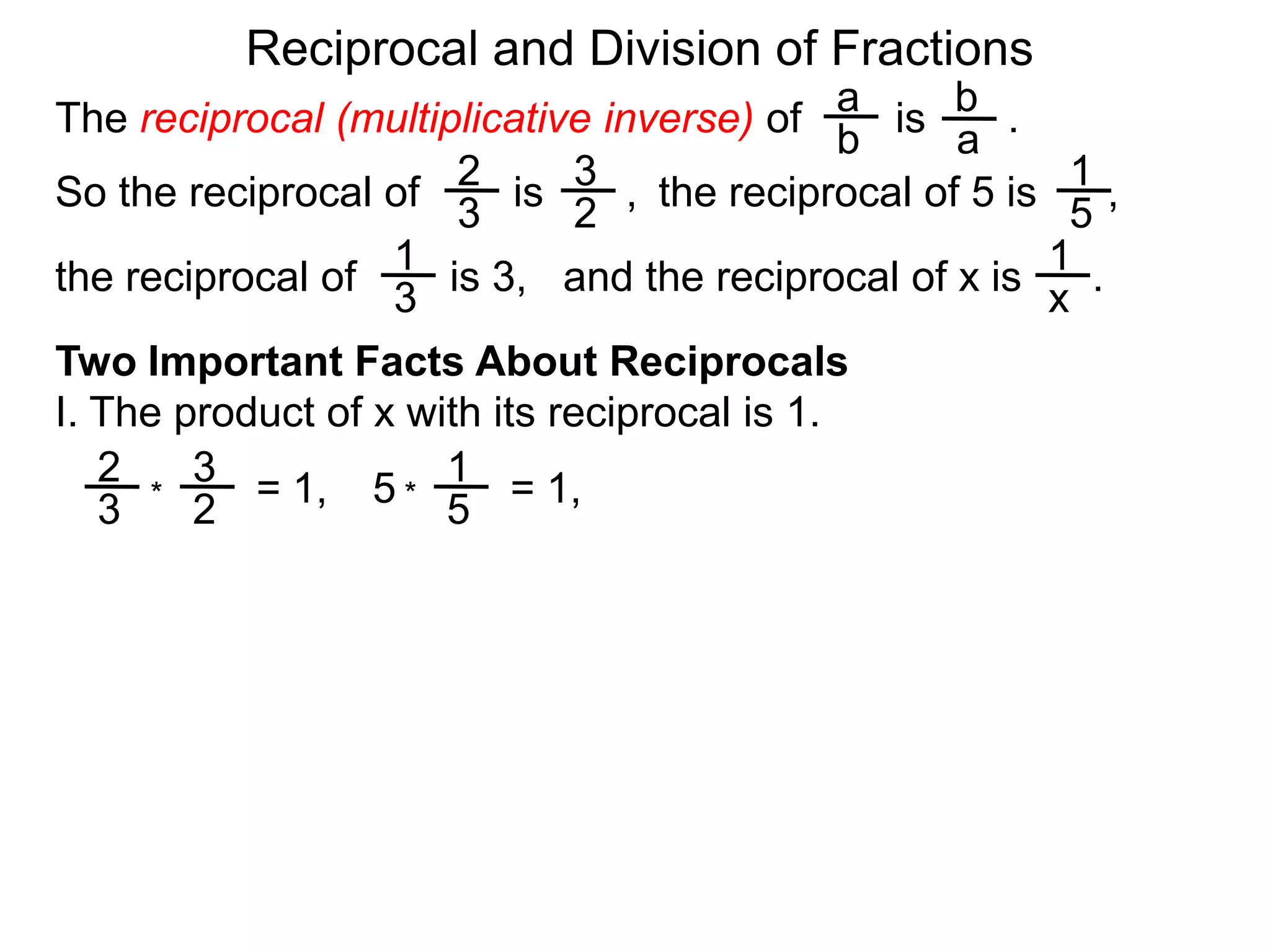
Reciprocal and Division of FractionsabThe reciprocal (multiplicative inverse) of        is       .  ba231So the reciprocal of        is       ,  the reciprocal of 5 is      ,  32511and the reciprocal of x is      .  the reciprocal of        is 3,  x3Two Important Facts About ReciprocalsI. The product of x with its reciprocal is 1.231= 1,5= 1,**325
Reciprocal and Division of FractionsabThe reciprocal (multiplicative inverse) of        is       .  ba231So the reciprocal of        is       ,  the reciprocal of 5 is      ,  32511and the reciprocal of x is      .  the reciprocal of        is 3,  x3Two Important Facts About ReciprocalsI. The product of x with its reciprocal is 1.2311= 1,5= 1,x= 1,x***325
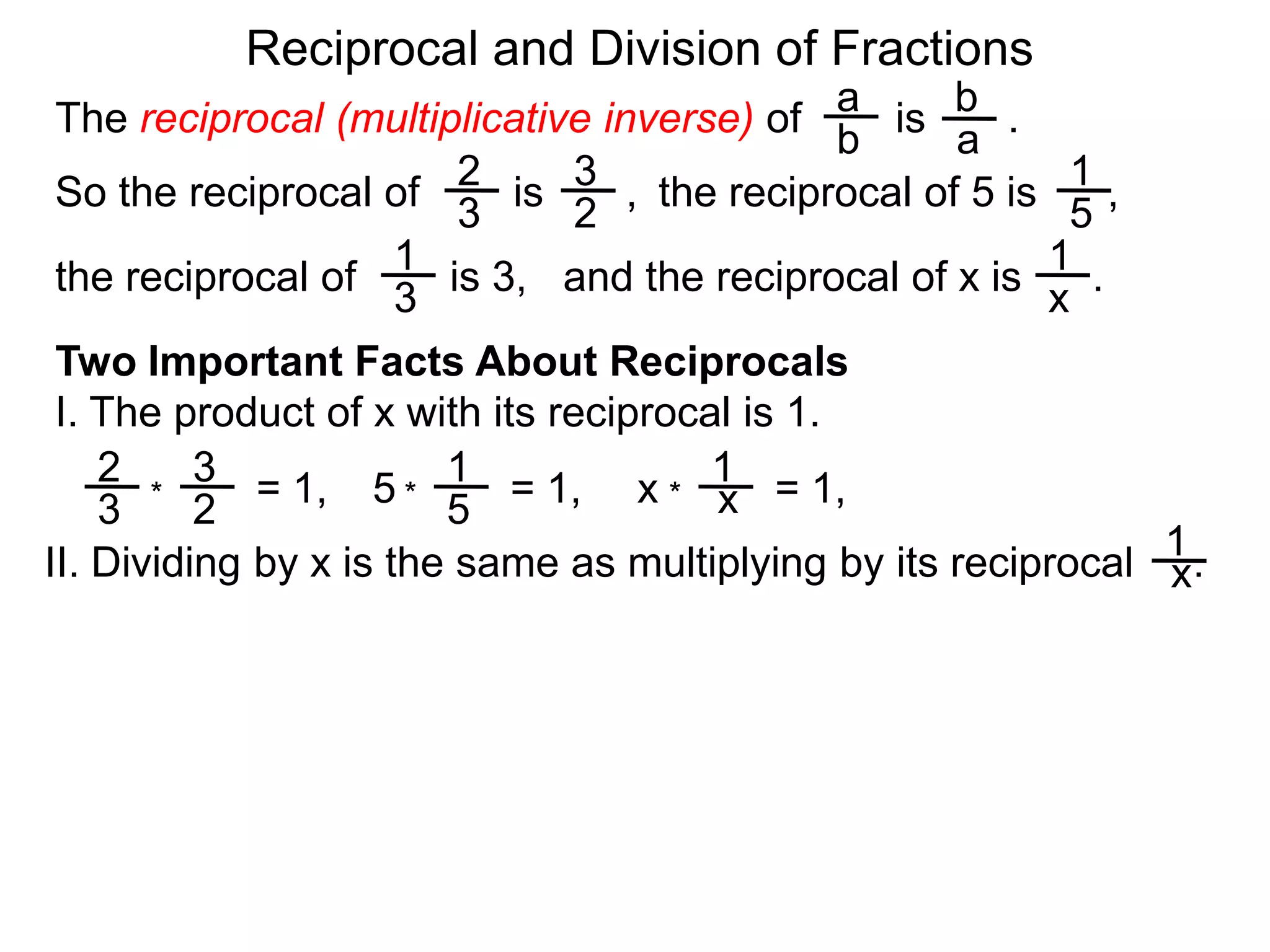
Reciprocal and Division of FractionsabThe reciprocal (multiplicative inverse) of        is       .  ba231So the reciprocal of        is       ,  the reciprocal of 5 is      ,  32511and the reciprocal of x is      .  the reciprocal of        is 3,  x3Two Important Facts About ReciprocalsI. The product of x with its reciprocal is 1.2311= 1,5= 1,x= 1,x***3251II. Dividing by x is the same as multiplying by its reciprocal     .x
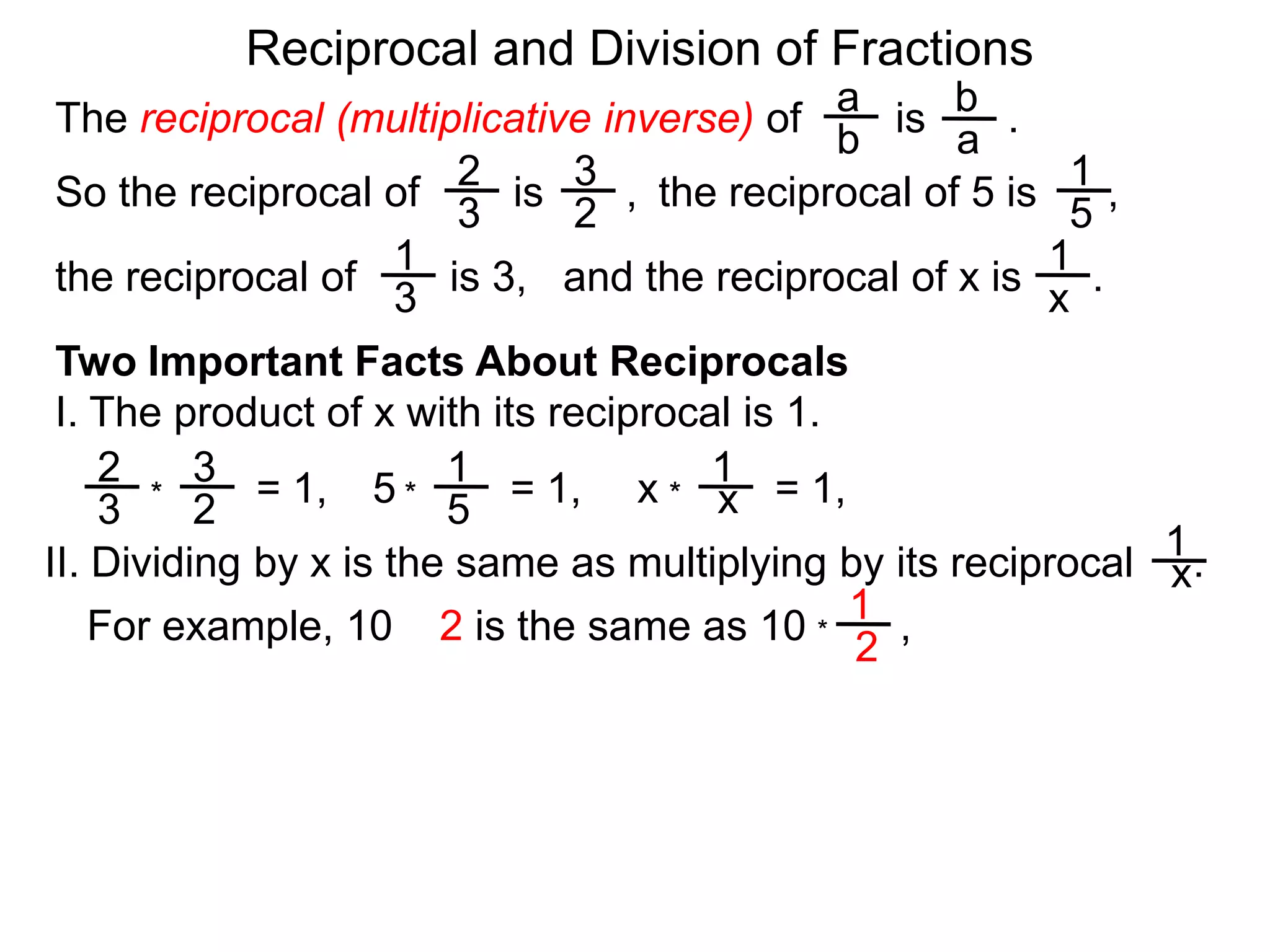
Reciprocal and Division of FractionsabThe reciprocal (multiplicative inverse) of        is       .  ba231So the reciprocal of        is       ,  the reciprocal of 5 is      ,  32511and the reciprocal of x is      .  the reciprocal of        is 3,  x3Two Important Facts About ReciprocalsI. The product of x with its reciprocal is 1.2311= 1,5= 1,x= 1,x***3251II. Dividing by x is the same as multiplying by its reciprocal     .x1For example, 10 ÷ 2 is the same as 10        , *2
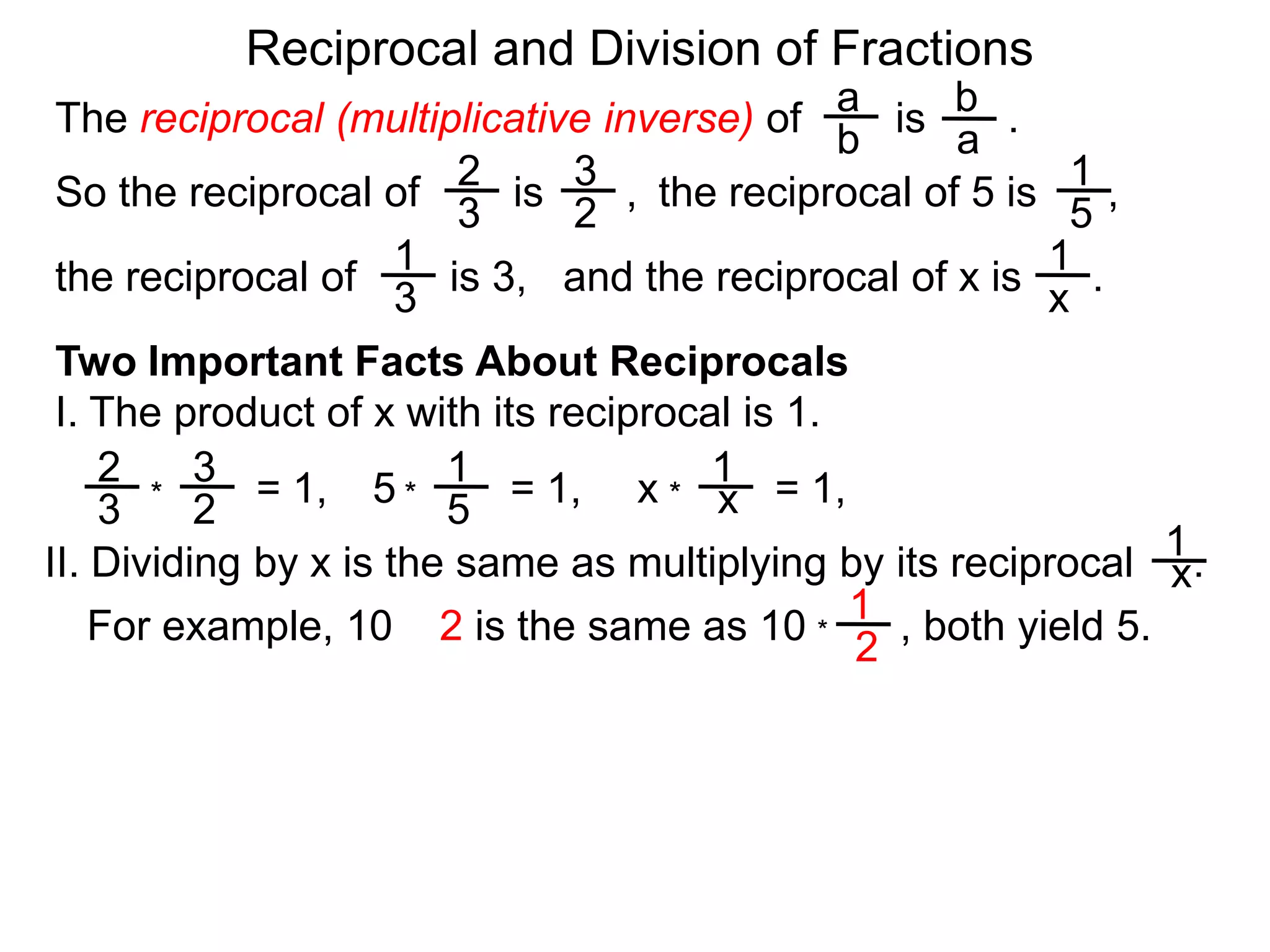
Reciprocal and Division of FractionsabThe reciprocal (multiplicative inverse) of        is       .  ba231So the reciprocal of        is       ,  the reciprocal of 5 is      ,  32511and the reciprocal of x is      .  the reciprocal of        is 3,  x3Two Important Facts About ReciprocalsI. The product of x with its reciprocal is 1.2311= 1,5= 1,x= 1,x***3251II. Dividing by x is the same as multiplying by its reciprocal     .x1For example, 10 ÷ 2 is the same as 10        , both yield 5. *2
Reciprocal and Division of FractionsabThe reciprocal (multiplicative inverse) of        is       .  ba231So the reciprocal of        is       ,  the reciprocal of 5 is      ,  32511and the reciprocal of x is      .  the reciprocal of        is 3,  x3Two Important Facts About ReciprocalsI. The product of x with its reciprocal is 1.2311= 1,5= 1,x= 1,x***3251II. Dividing by x is the same as multiplying by its reciprocal     .x1For example, 10 ÷ 2 is the same as 10        , both yield 5. *2Rule for Division of FractionsTo divide by a fraction x, restate it as multiplying by the reciprocal 1/x , that is,
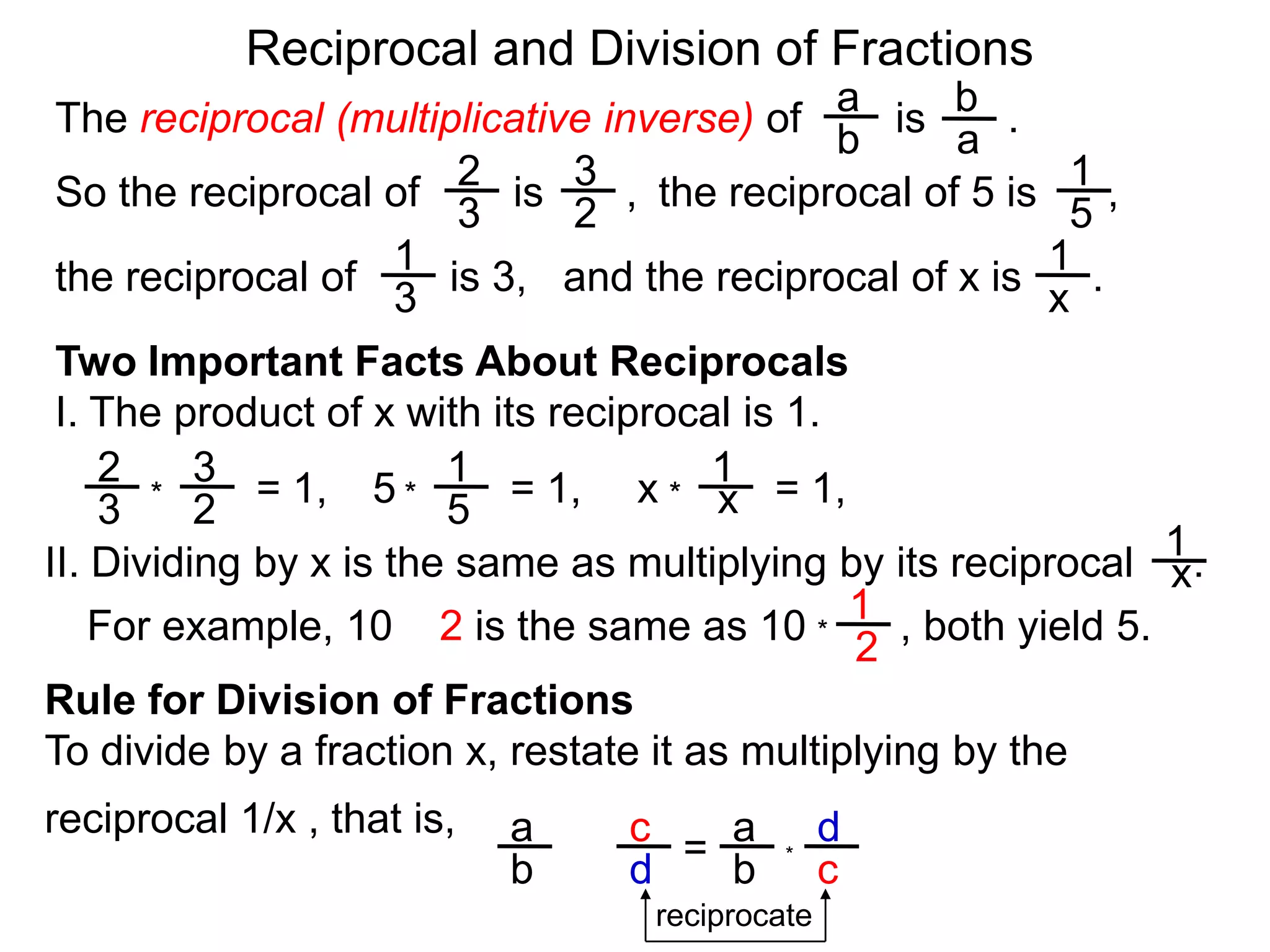
Reciprocal and Division of FractionsabThe reciprocal (multiplicative inverse) of        is       .  ba231So the reciprocal of        is       ,  the reciprocal of 5 is      ,  32511and the reciprocal of x is      .  the reciprocal of        is 3,  x3Two Important Facts About ReciprocalsI. The product of x with its reciprocal is 1.2311= 1,5= 1,x= 1,x***3251II. Dividing by x is the same as multiplying by its reciprocal     .x1For example, 10 ÷ 2 is the same as 10        , both yield 5. *2Rule for Division of FractionsTo divide by a fraction x, restate it as multiplying by the reciprocal 1/x , that is, daca = ÷*cbdbreciprocate
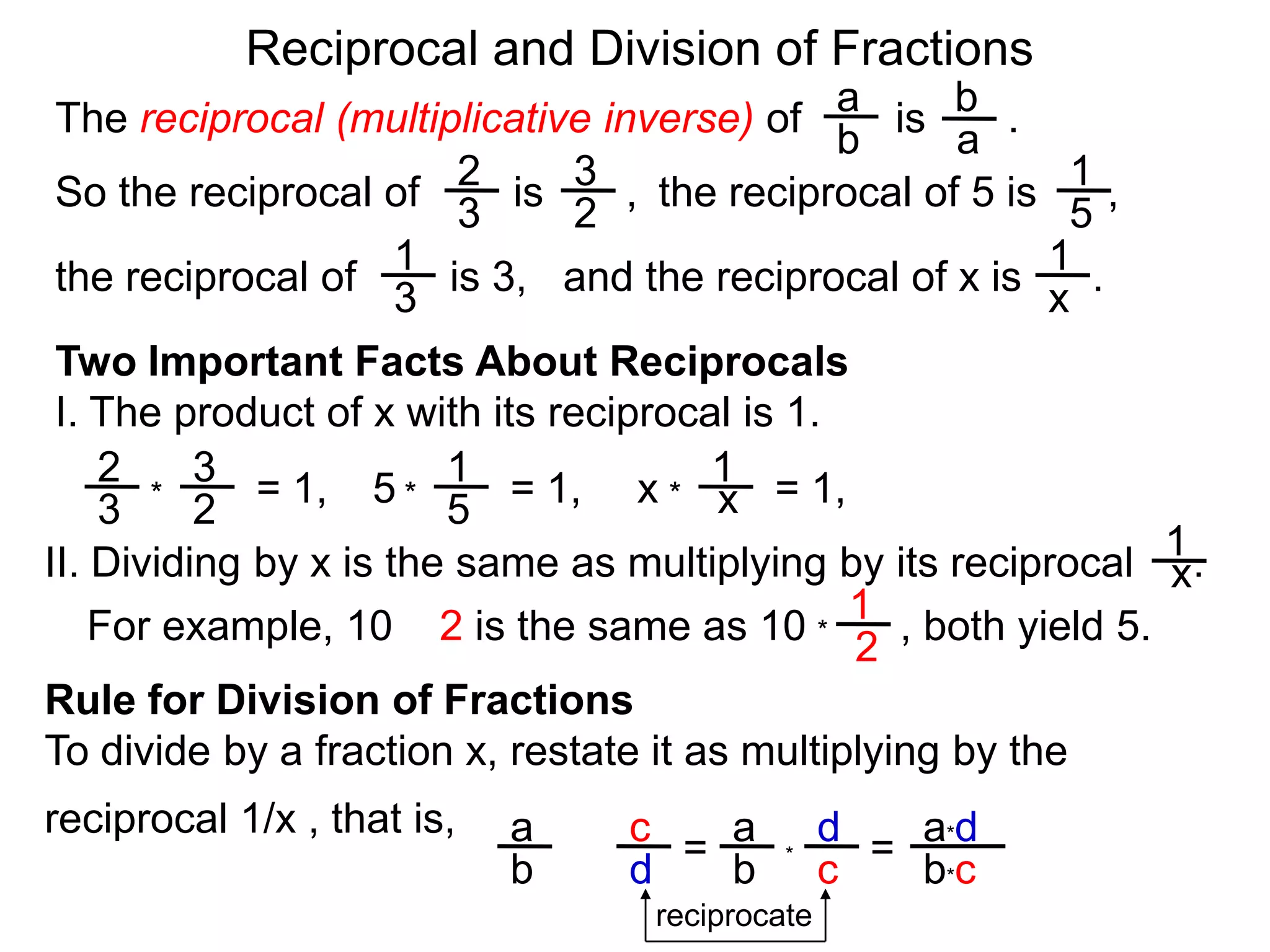
Reciprocal and Division of FractionsabThe reciprocal (multiplicative inverse) of        is       .  ba231So the reciprocal of        is       ,  the reciprocal of 5 is      ,  32511and the reciprocal of x is      .  the reciprocal of        is 3,  x3Two Important Facts About ReciprocalsI. The product of x with its reciprocal is 1.2311= 1,5= 1,x= 1,x***3251II. Dividing by x is the same as multiplying by its reciprocal     .x1For example, 10 ÷ 2 is the same as 10        , both yield 5. *2Rule for Division of FractionsTo divide by a fraction x, restate it as multiplying by the reciprocal 1/x , that is, da*daca= = ÷*cb*cbdbreciprocate
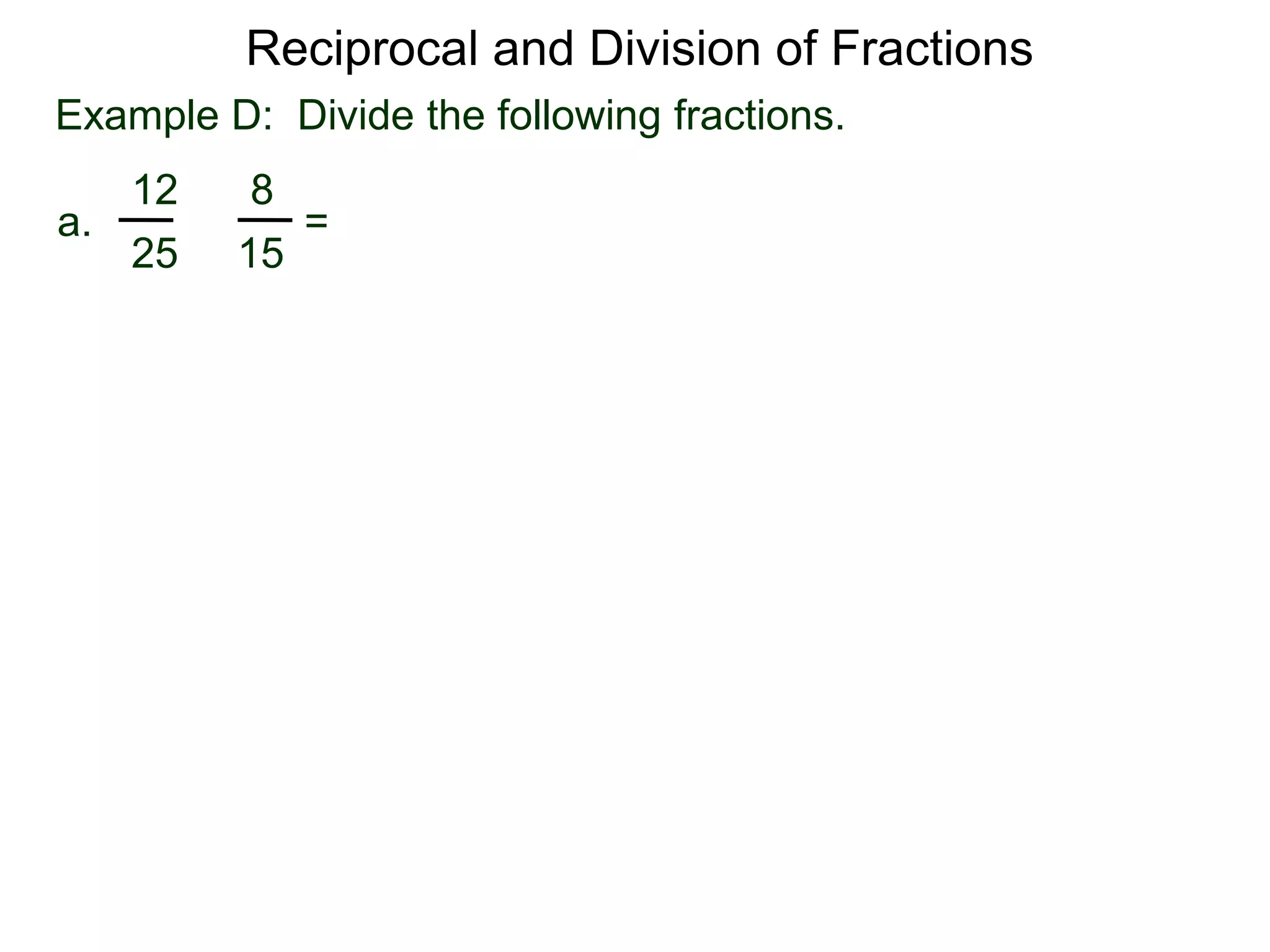
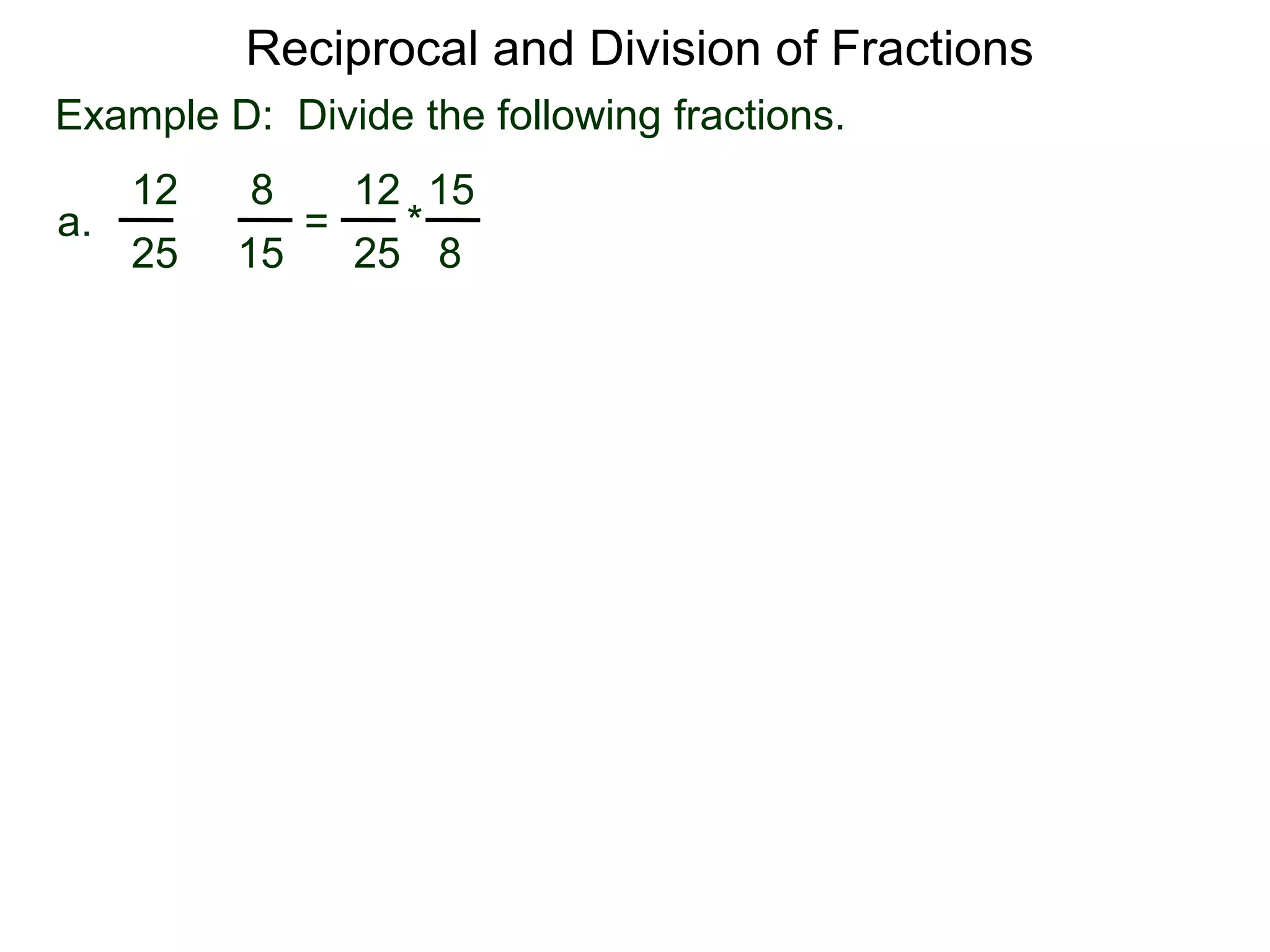
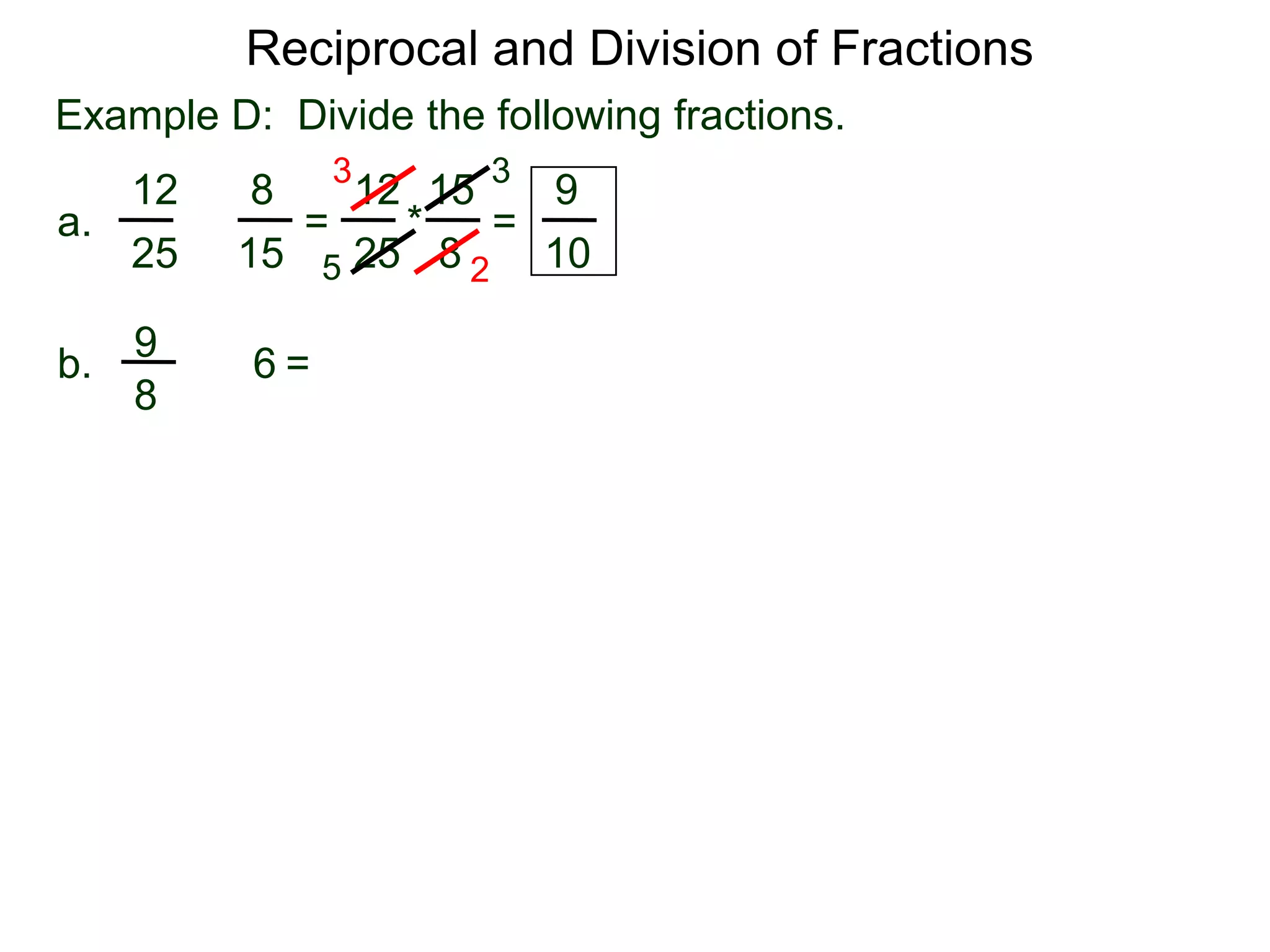
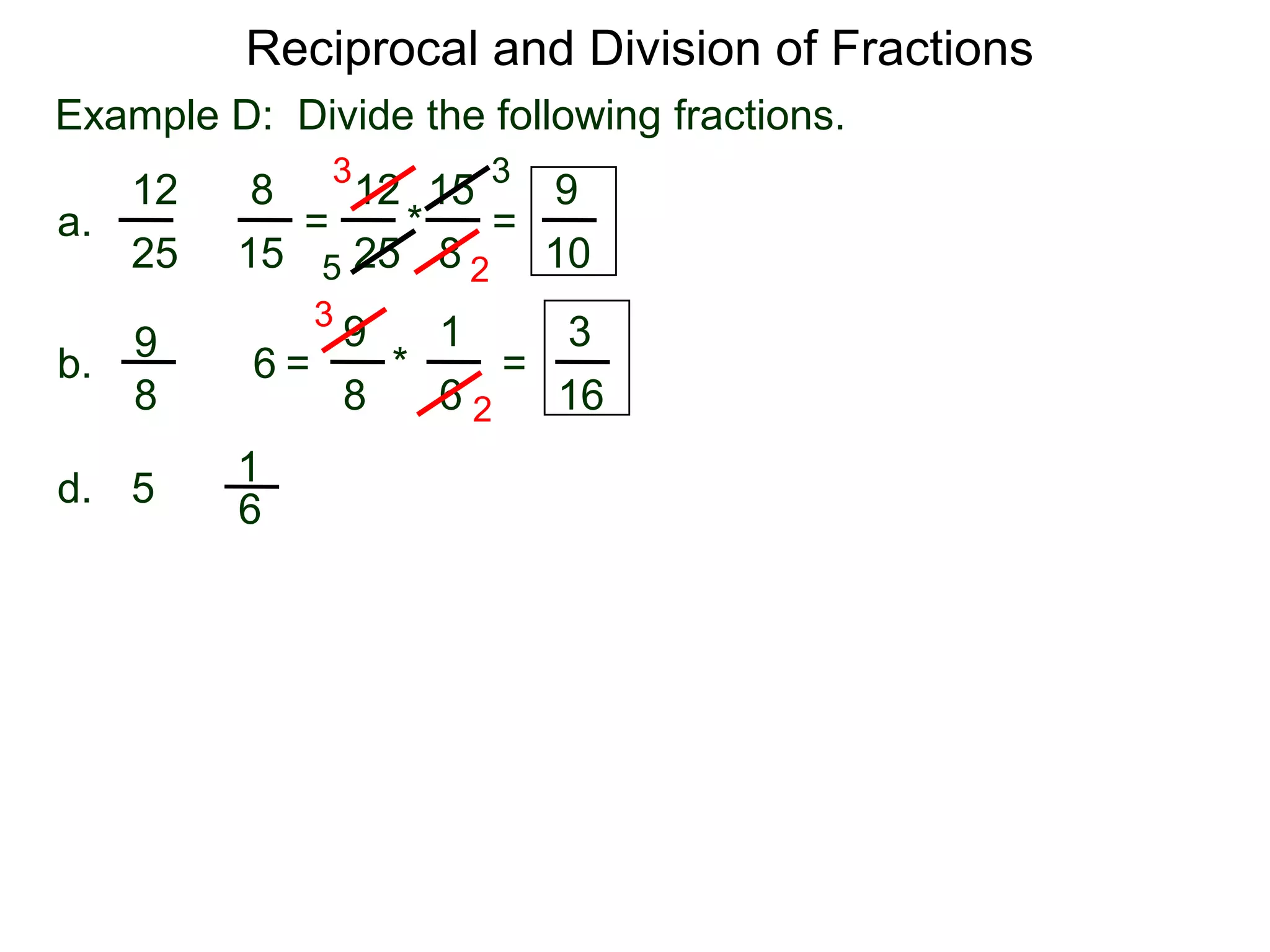
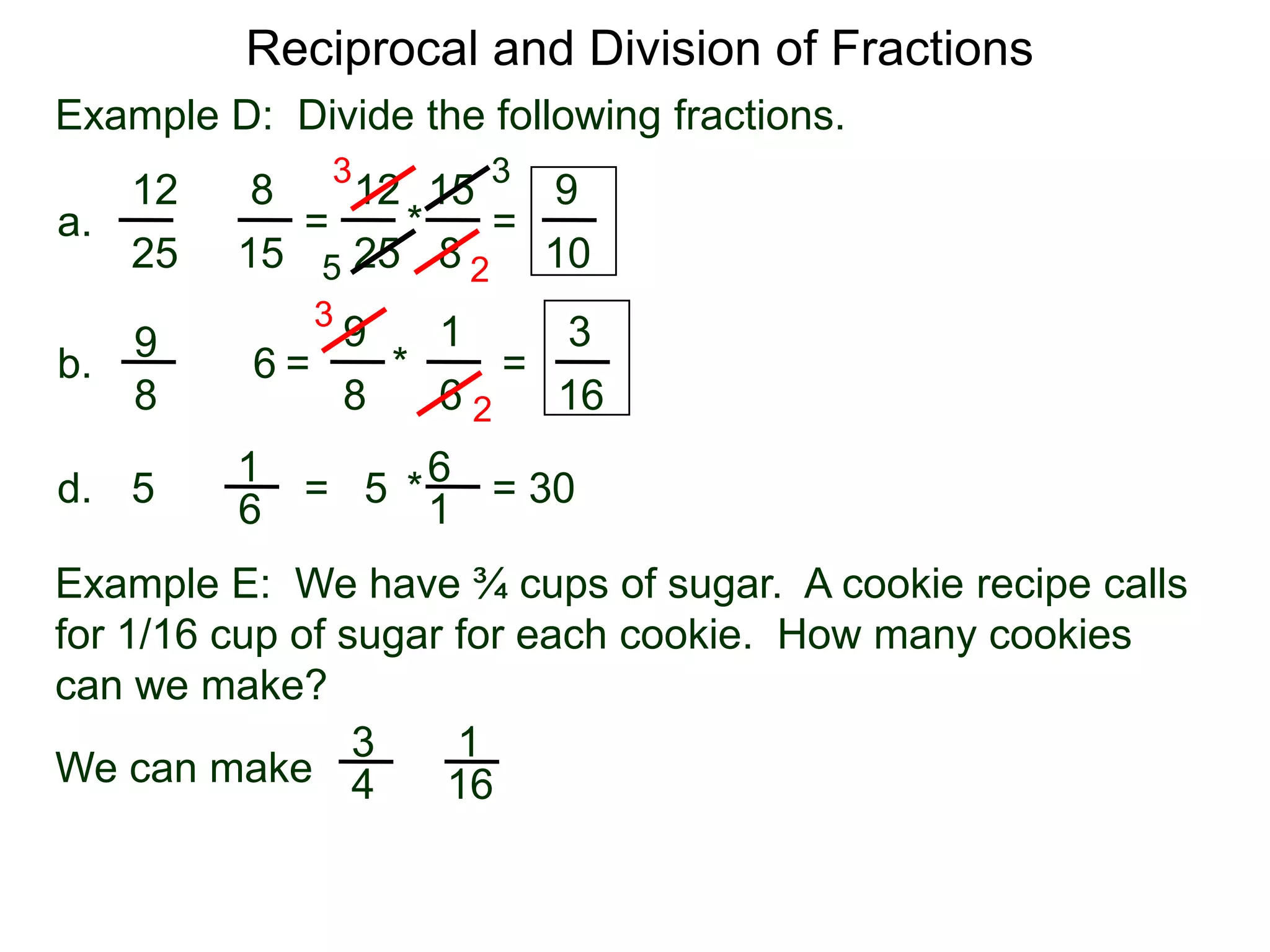
Reciprocal and Division of FractionsExample D:  Divide the following fractions. 812 = a.÷1525
Reciprocal and Division of FractionsExample D:  Divide the following fractions. 1512812* = a.÷8251525
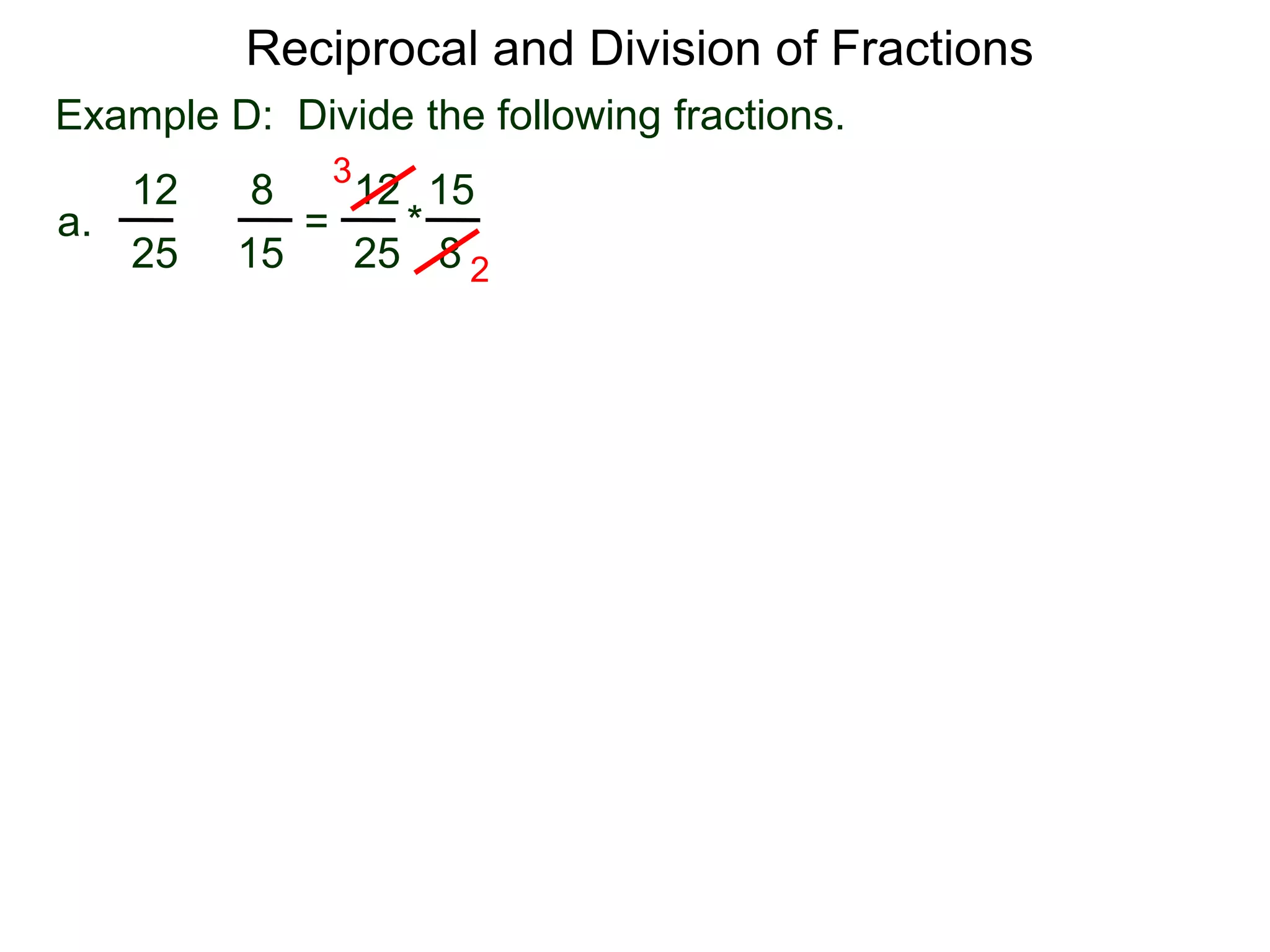
Reciprocal and Division of FractionsExample D:  Divide the following fractions. 31512812* = a.÷82515252
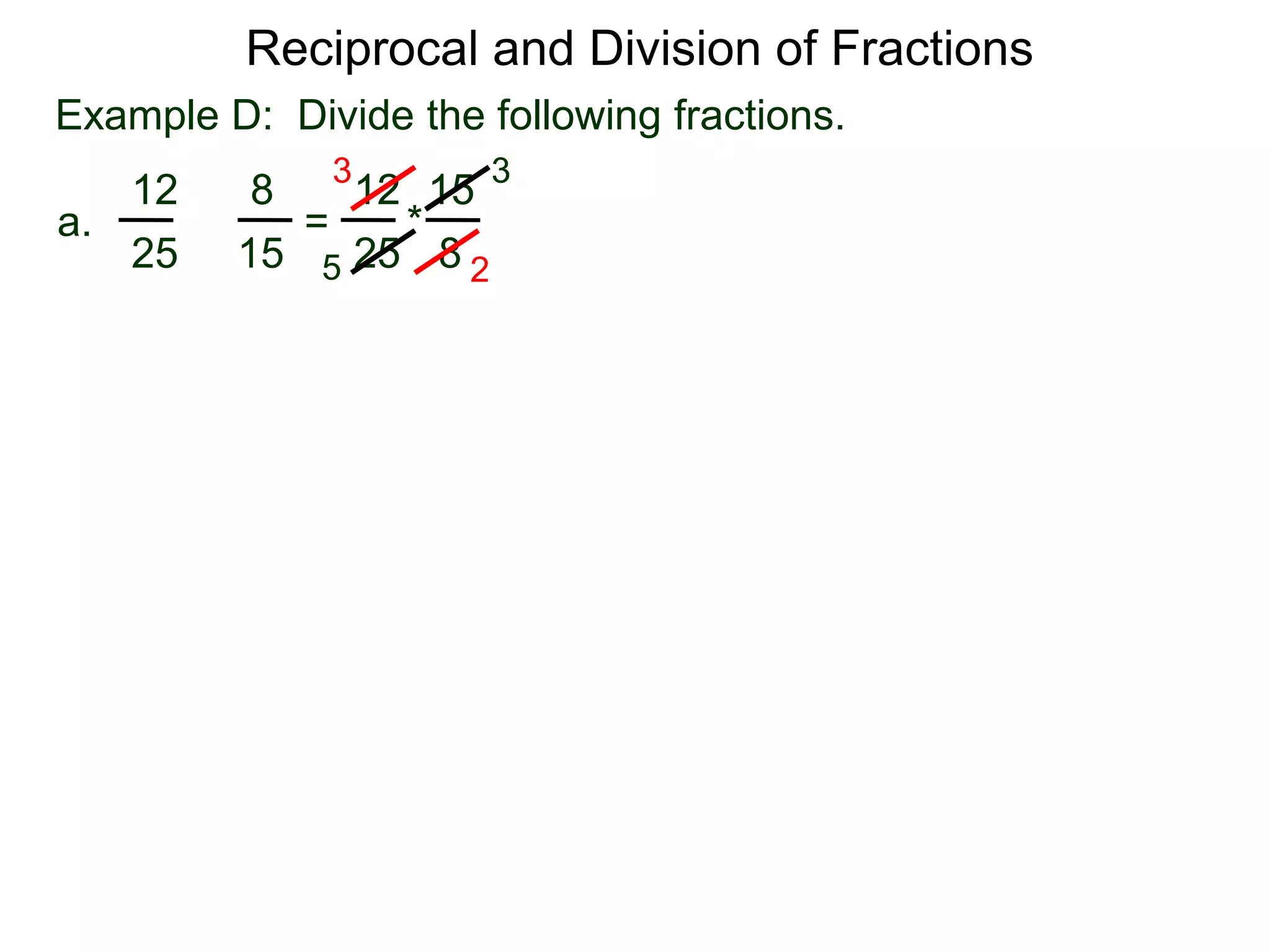
Reciprocal and Division of FractionsExample D:  Divide the following fractions. 331512812* = a.÷825152552
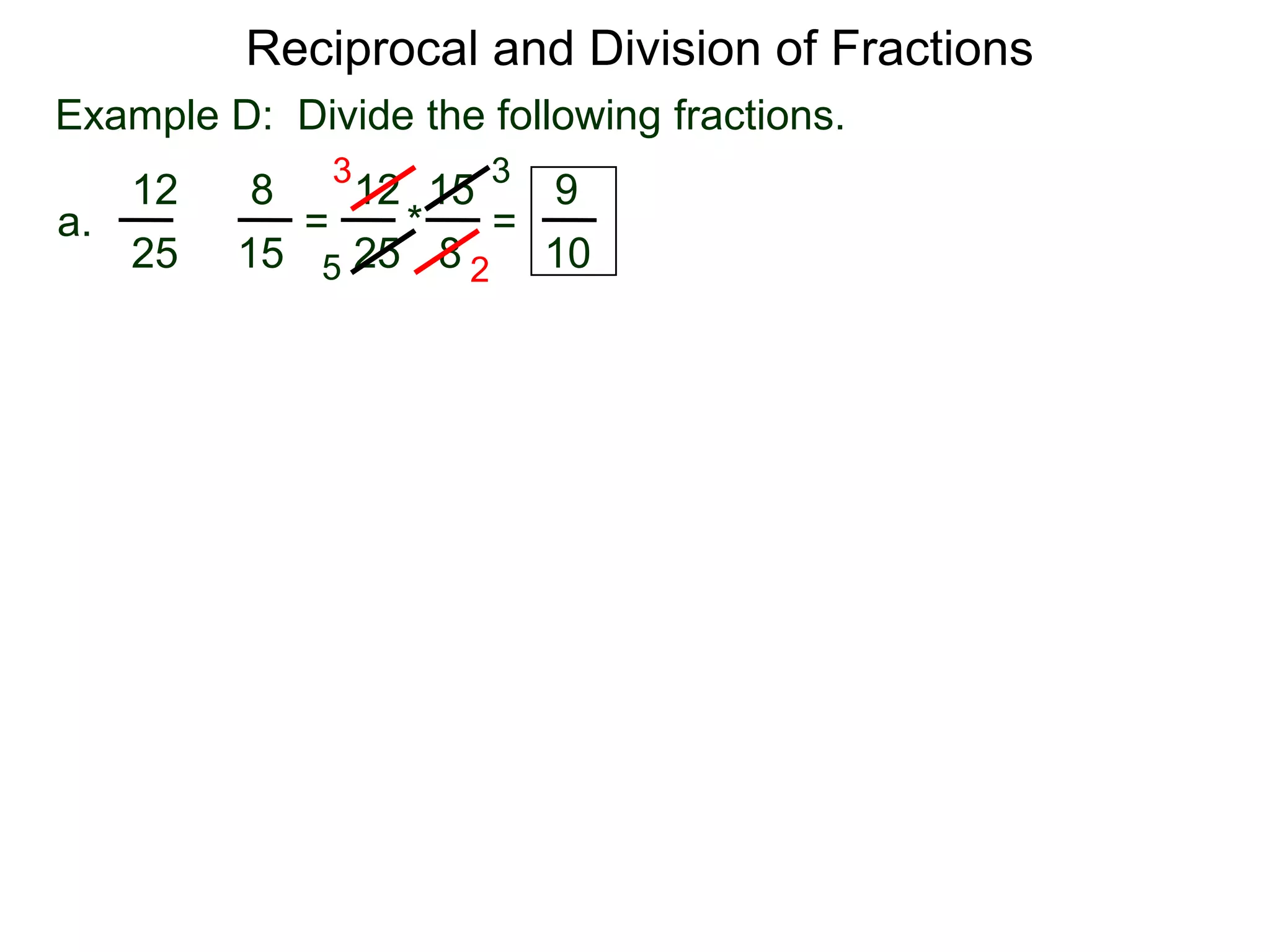
Reciprocal and Division of FractionsExample D:  Divide the following fractions. 3315128129 =  * = a.÷82515251052
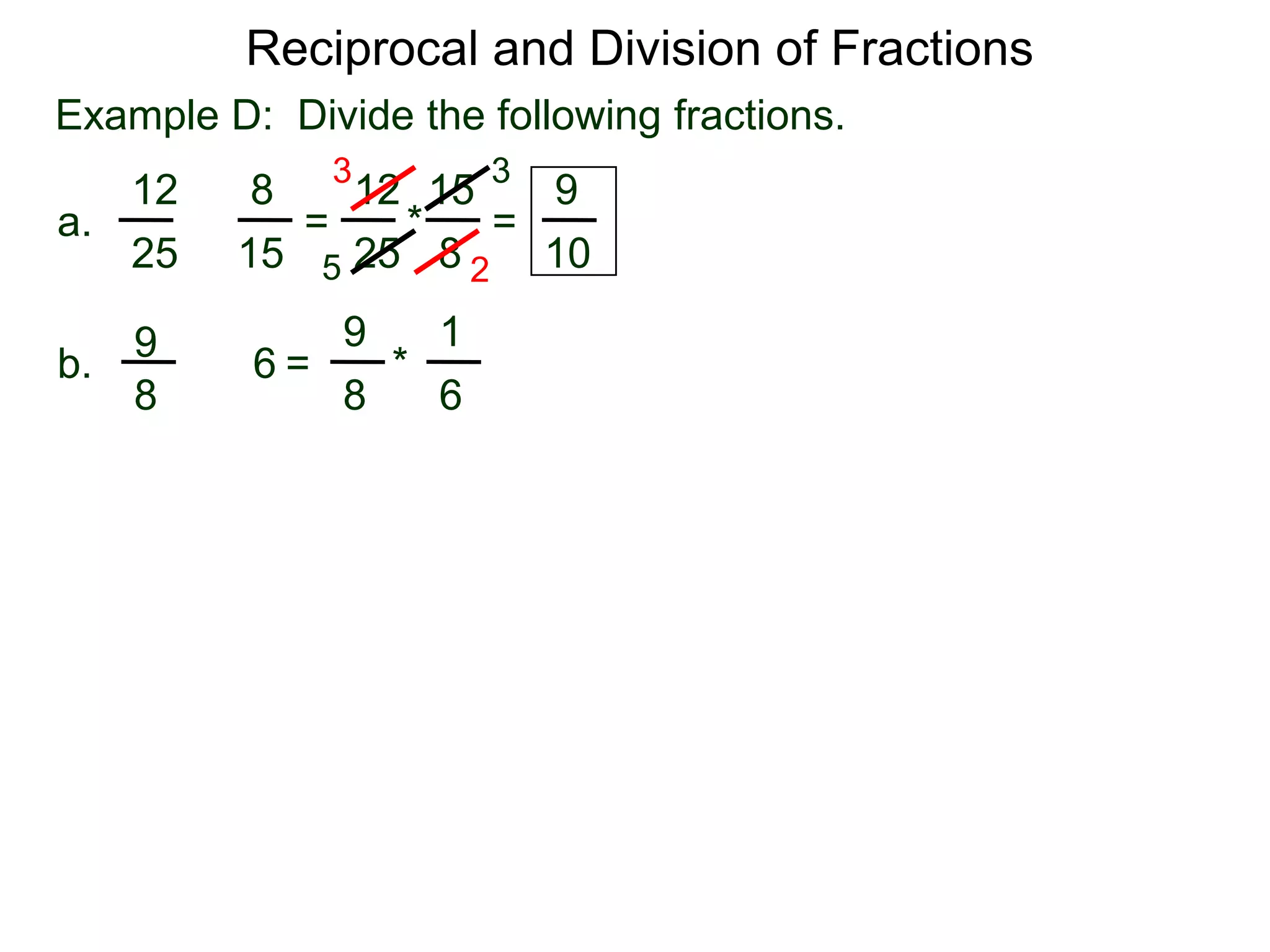
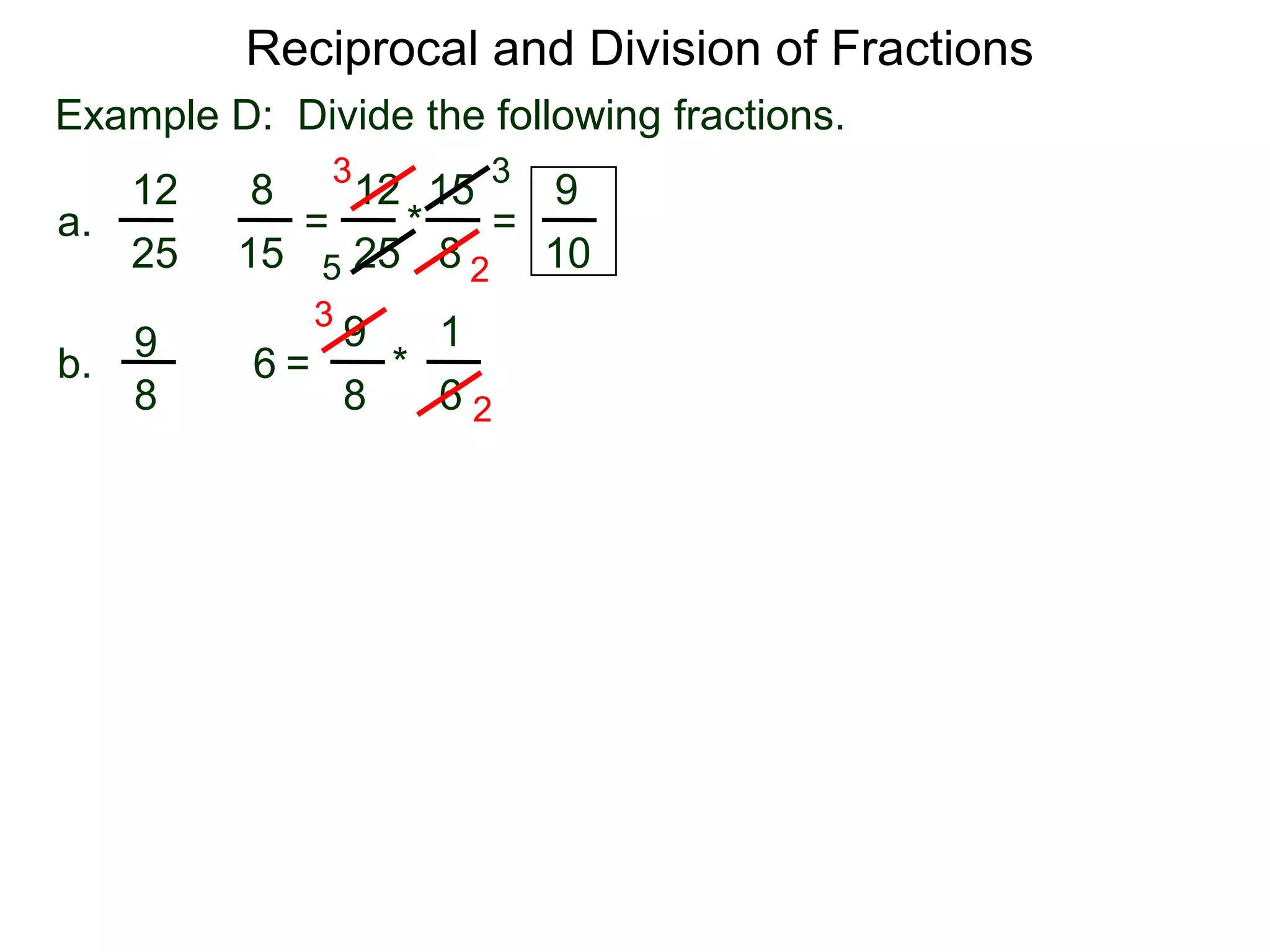
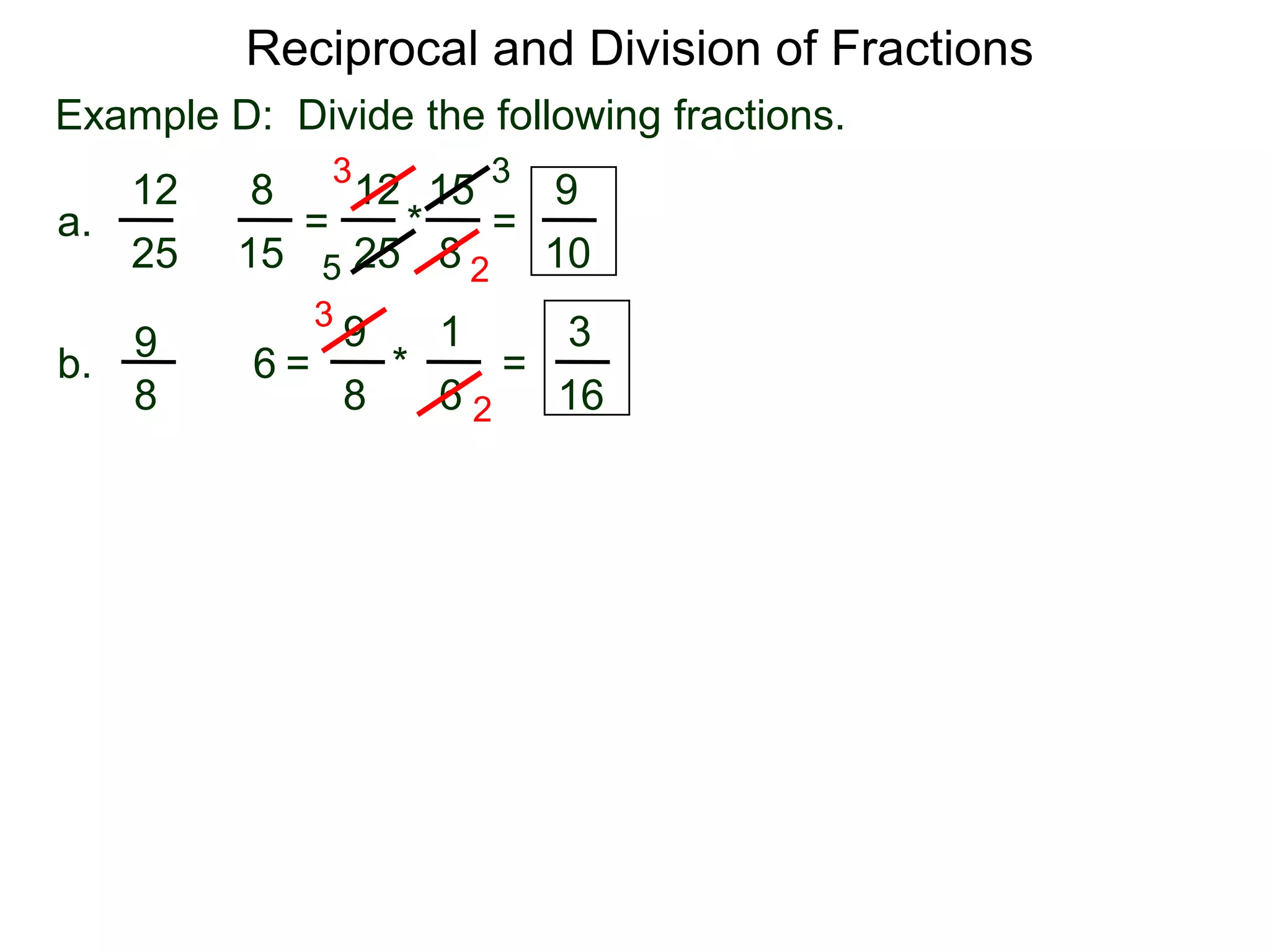
Reciprocal and Division of FractionsExample D:  Divide the following fractions. 3315128129 =  * = a.÷8251525105296÷ =b.8
Reciprocal and Division of FractionsExample D:  Divide the following fractions. 3315128129 =  * = a.÷825152510521996÷ =       *         b.886
Reciprocal and Division of FractionsExample D:  Divide the following fractions. 3315128129 =  * = a.÷8251525105231996÷ =       *        b.8862
Reciprocal and Division of FractionsExample D:  Divide the following fractions. 3315128129 =  * = a.÷82515251052319396÷ =       *        = b.886162
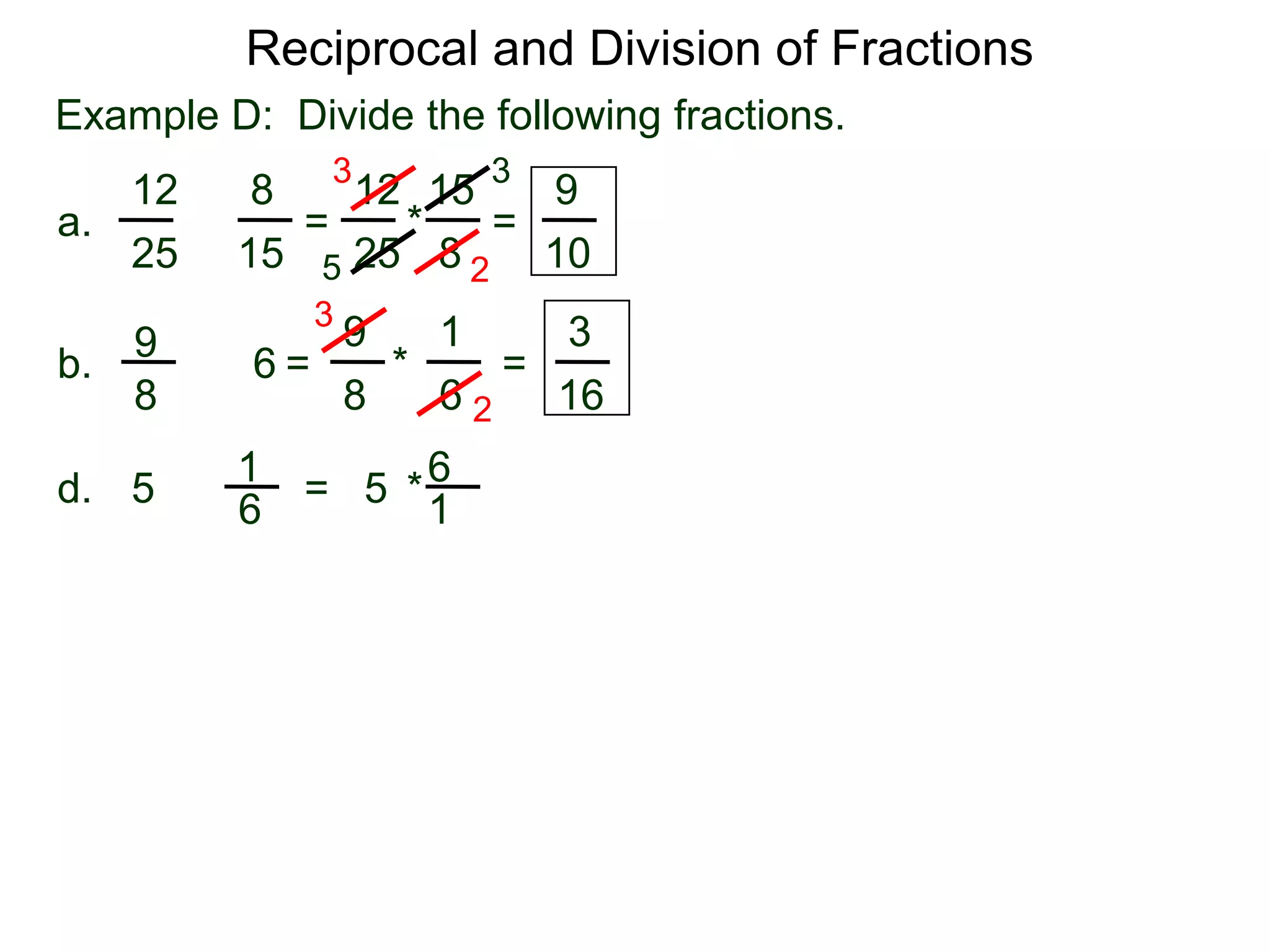
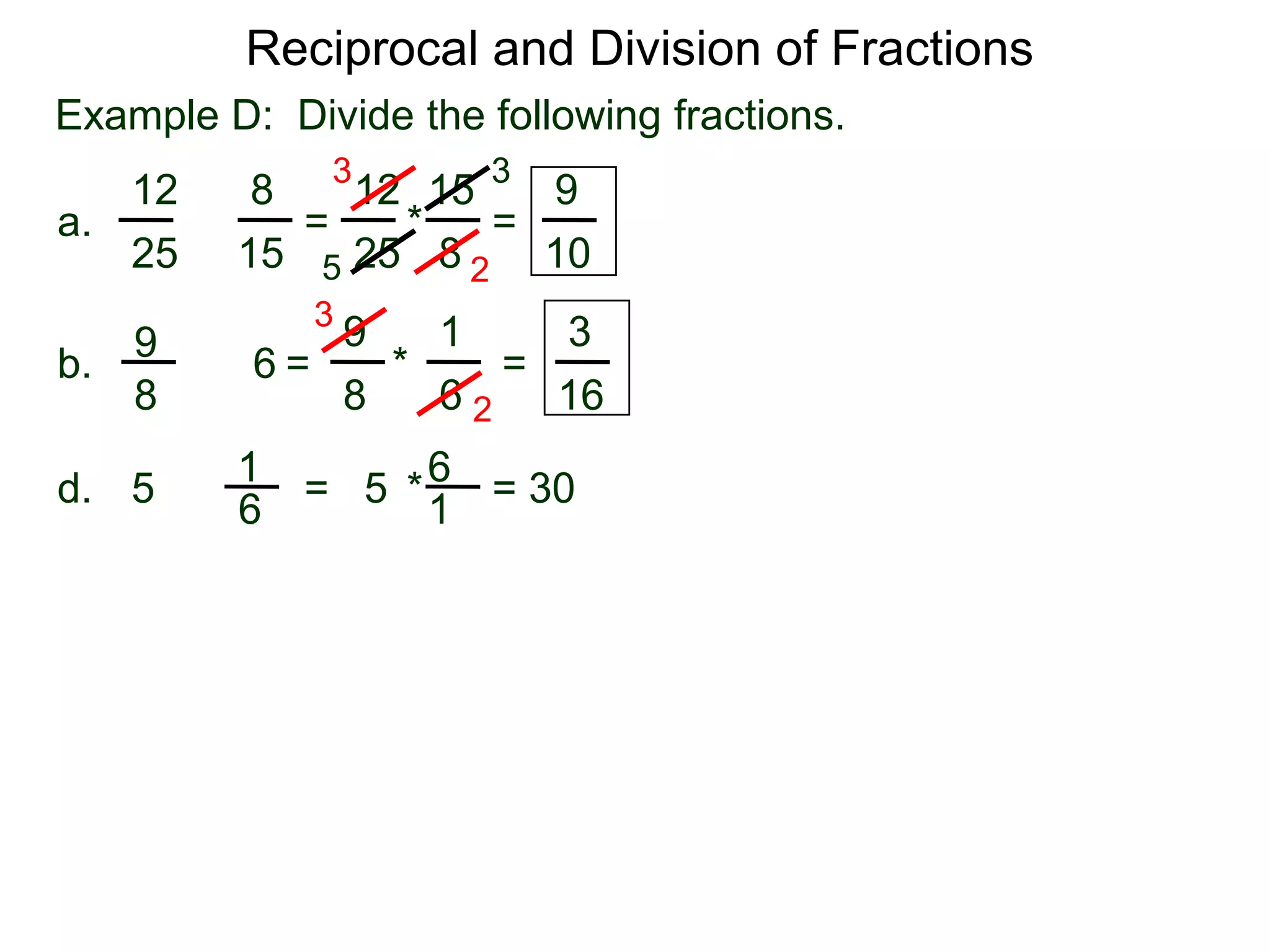
Reciprocal and Division of FractionsExample D:  Divide the following fractions. 3315128129 =  * = a.÷82515251052319396÷ =       *        = b.88616215d.÷6
Reciprocal and Division of FractionsExample D:  Divide the following fractions. 3315128129 =  * = a.÷82515251052319396÷ =       *        = b.88616261* = 5d.÷516
Reciprocal and Division of FractionsExample D:  Divide the following fractions. 3315128129 =  * = a.÷82515251052319396÷ =       *        = b.88616261 = 30  * = 5d.÷516
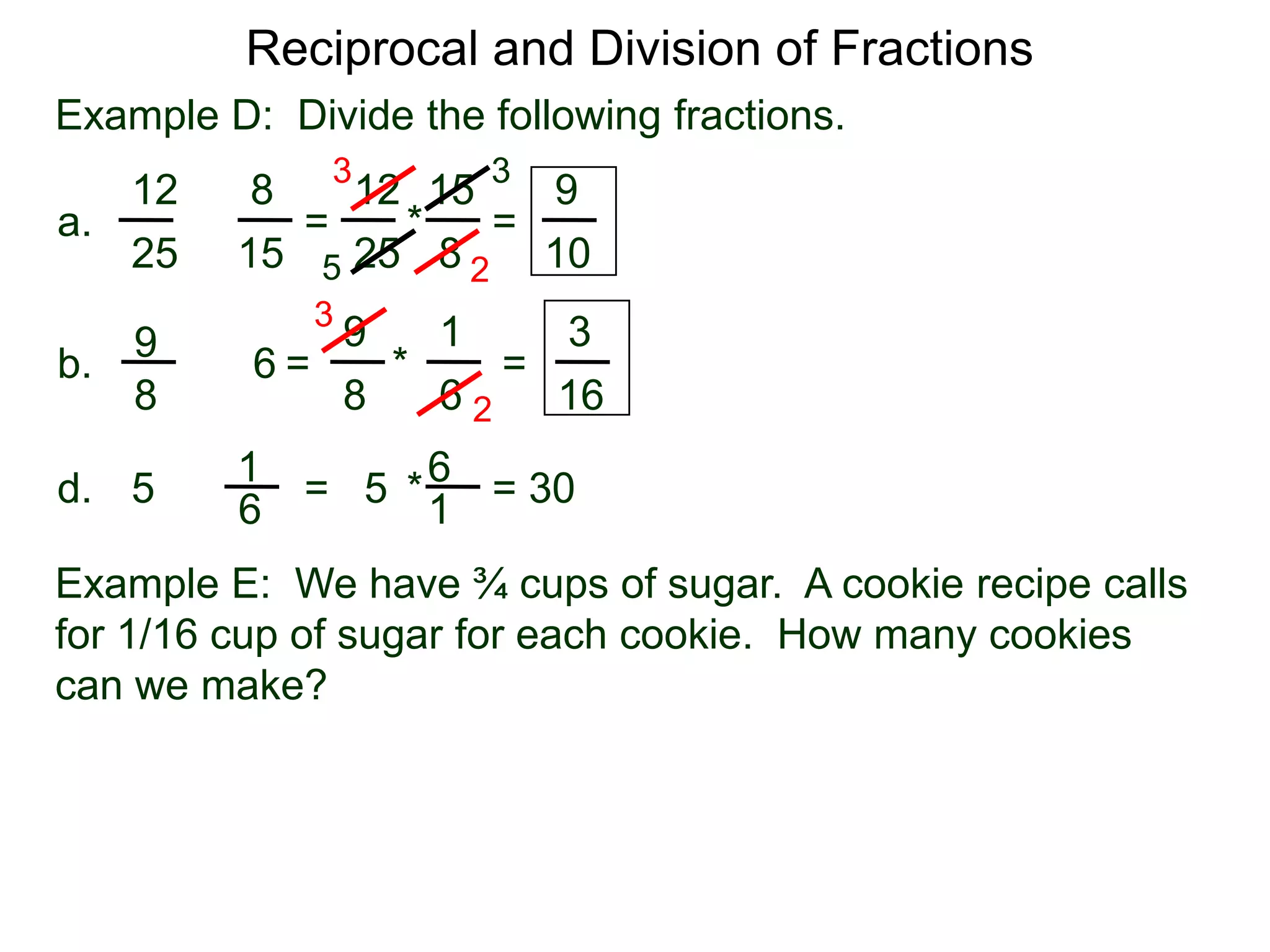
Reciprocal and Division of FractionsExample D:  Divide the following fractions. 3315128129 =  * = a.÷82515251052319396÷ =       *        = b.88616261 = 30  * = 5d.÷516Example E:  We have ¾ cups of sugar.  A cookie recipe calls for 1/16 cup of sugar for each cookie.  How many cookiescan we make?
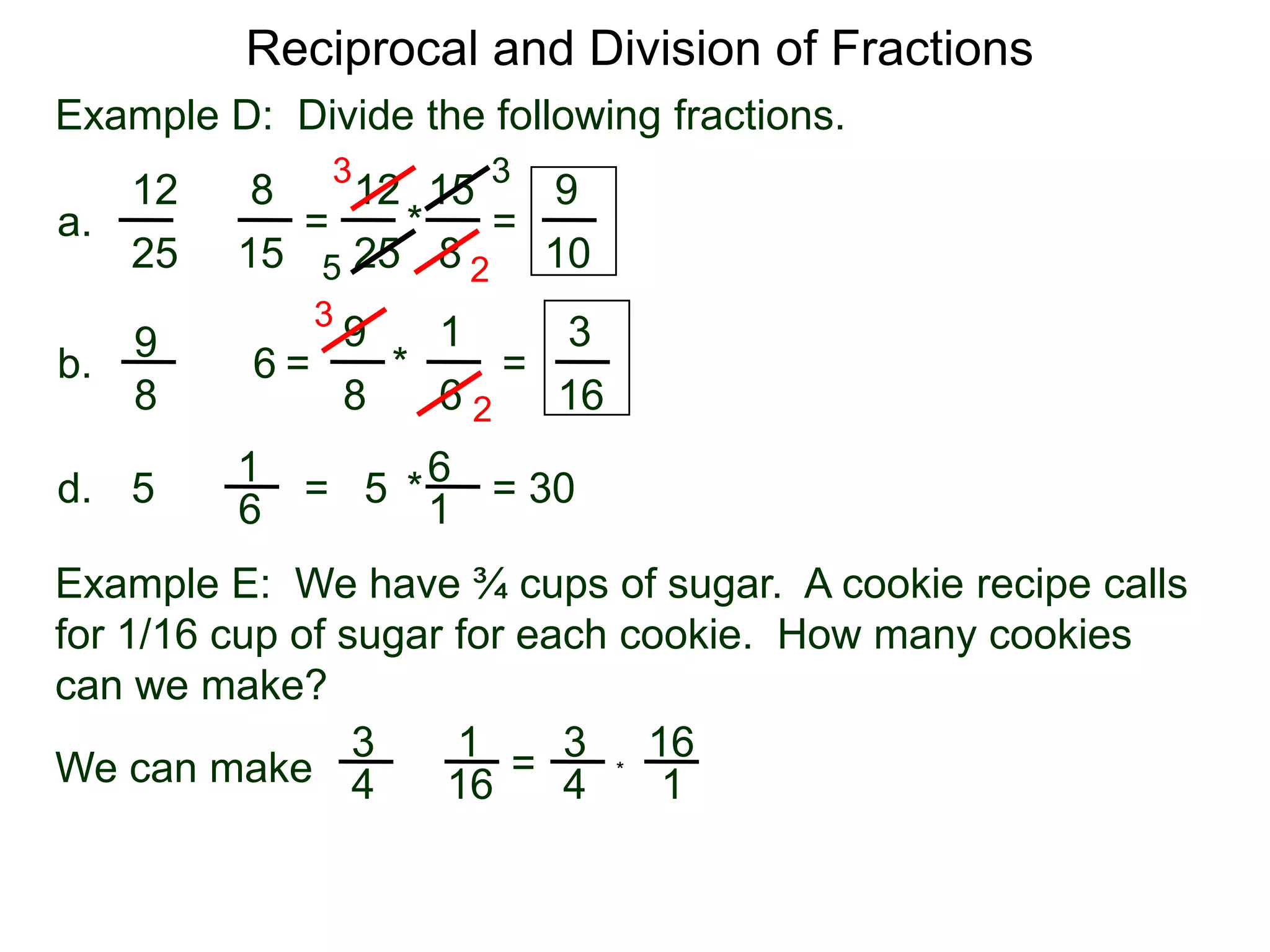
Reciprocal and Division of FractionsExample D:  Divide the following fractions. 3315128129 =  * = a.÷82515251052319396÷ =       *        = b.88616261 = 30  * = 5d.÷516Example E:  We have ¾ cups of sugar.  A cookie recipe calls for 1/16 cup of sugar for each cookie.  How many cookiescan we make?31÷We can make 416
Reciprocal and Division of FractionsExample D:  Divide the following fractions. 3315128129 =  * = a.÷82515251052319396÷ =       *        = b.88616261 = 30  * = 5d.÷516Example E:  We have ¾ cups of sugar.  A cookie recipe calls for 1/16 cup of sugar for each cookie.  How many cookiescan we make?31316÷ = We can make *41641
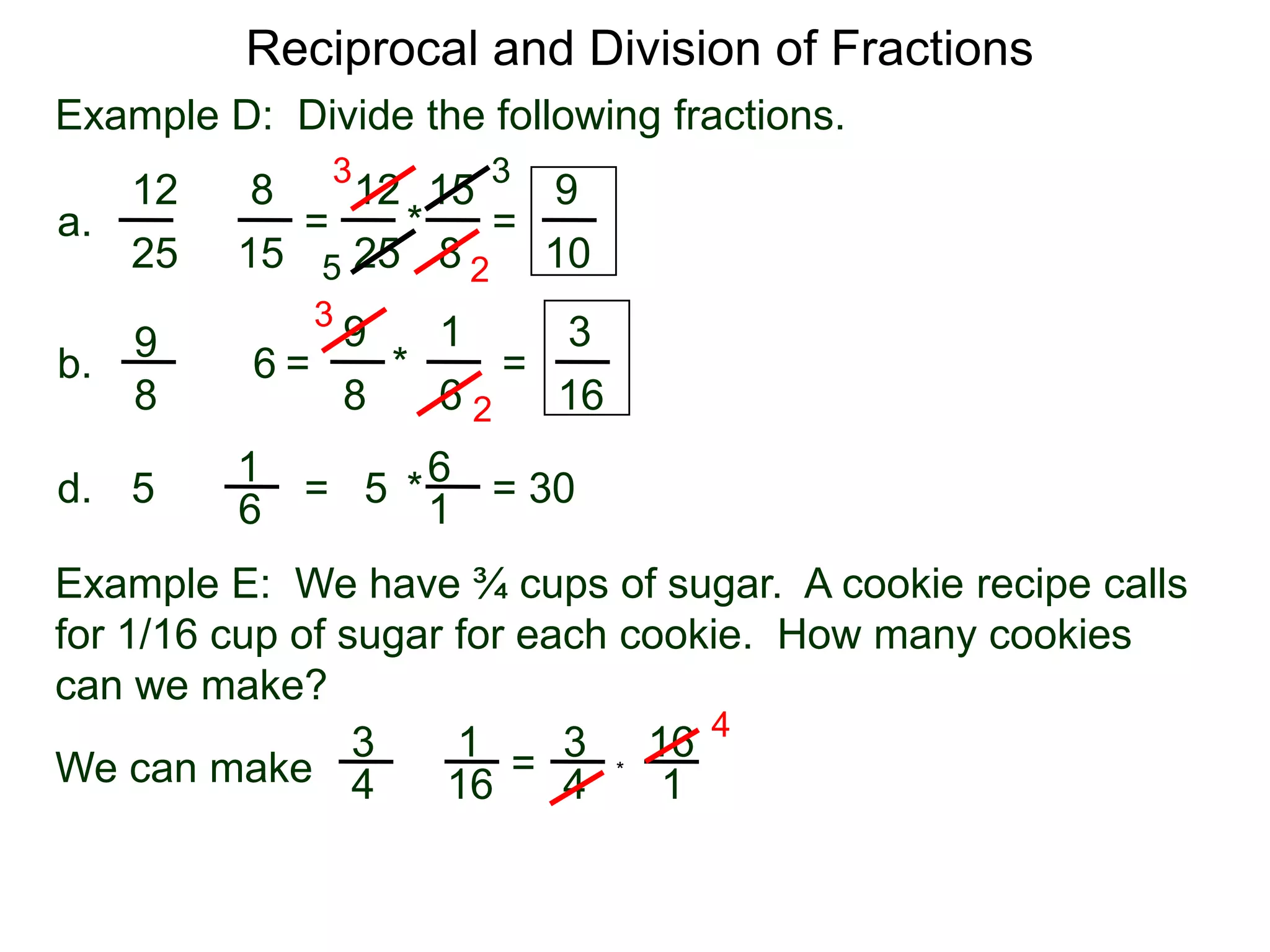
Reciprocal and Division of FractionsExample D:  Divide the following fractions. 3315128129 =  * = a.÷82515251052319396÷ =       *        = b.88616261 = 30  * = 5d.÷516Example E:  We have ¾ cups of sugar.  A cookie recipe calls for 1/16 cup of sugar for each cookie.  How many cookiescan we make?431316÷ = We can make *41641
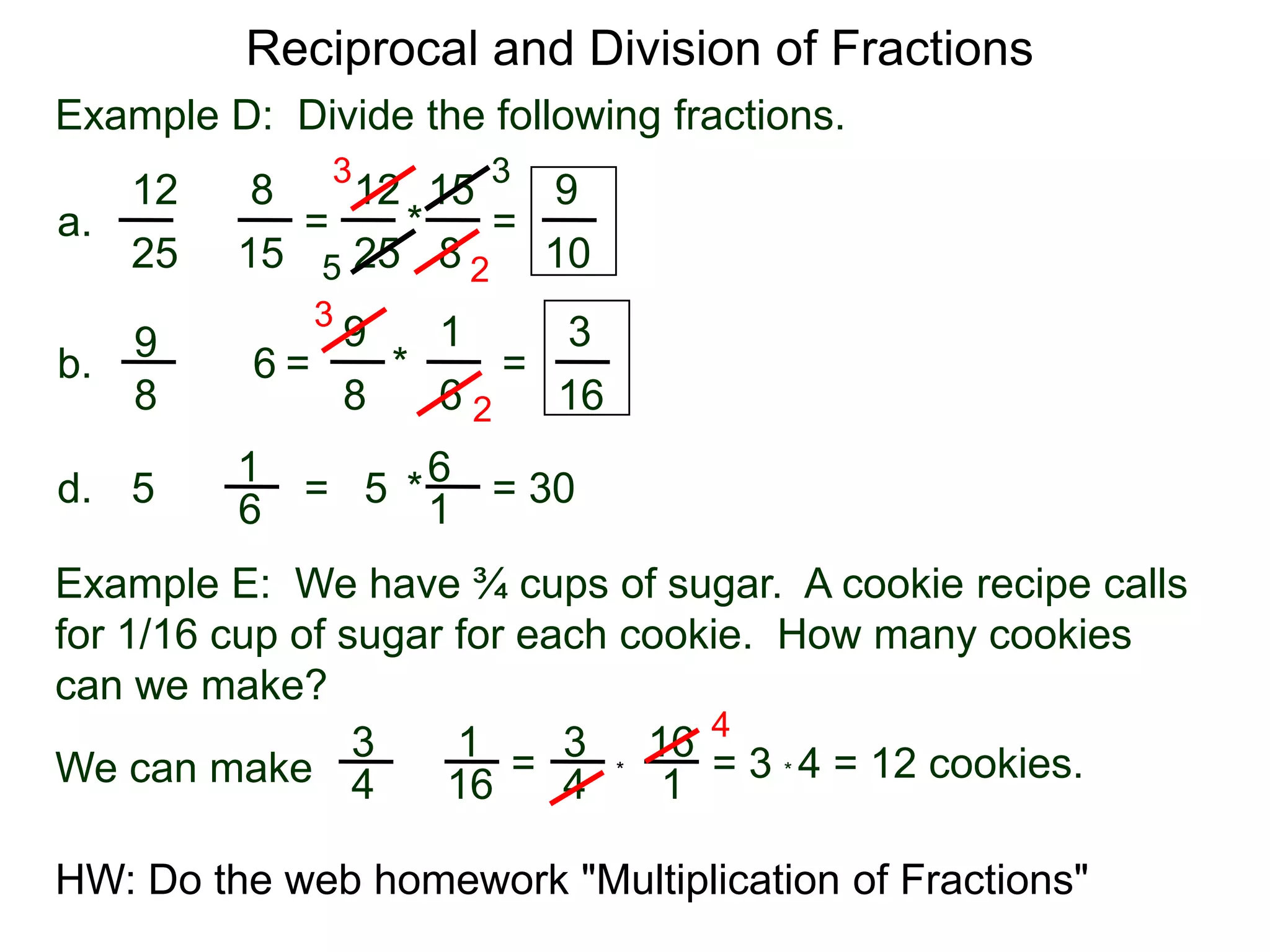
Reciprocal and Division of FractionsExample D:  Divide the following fractions. 3315128129 =  * = a.÷82515251052319396÷ =       *        = b.88616261 = 30  * = 5d.÷516Example E:  We have ¾ cups of sugar.  A cookie recipe calls for 1/16 cup of sugar for each cookie.  How many cookiescan we make?431316÷ =  = 3 * 4 = 12 cookies.We can make *41641HW: Do the web homework "Multiplication of Fractions"

123a-1-f3 multiplication and division of fractions

  • 1.
  • 2.
    Multiplication and Divisionof FractionsRule for Multiplication of FractionsTo multiply fractions, multiply the numerators and multiply the denominators, but always cancel as much as possible first then multiply.
  • 3.
    Multiplication and Divisionof FractionsRule for Multiplication of FractionsTo multiply fractions, multiply the numerators and multiply the denominators, but always cancel as much as possible first then multiply.ca*ca=*db*db
  • 4.
    Multiplication and Divisionof FractionsRule for Multiplication of FractionsTo multiply fractions, multiply the numerators and multiply the denominators, but always cancel as much as possible first then multiply.ca*ca=*db*dbExample A. Multiply by reducing first.1215a.*258
  • 5.
    Multiplication and Divisionof FractionsRule for Multiplication of FractionsTo multiply fractions, multiply the numerators and multiply the denominators, but always cancel as much as possible first then multiply.ca*ca=*db*dbExample A. Multiply by reducing first.15 * 121215a.=* 8 * 25258
  • 6.
    Multiplication and Divisionof FractionsRule for Multiplication of FractionsTo multiply fractions, multiply the numerators and multiply the denominators, but always cancel as much as possible first then multiply.ca*ca=*db*dbExample A. Multiply by reducing first.315 * 121215a.=* 8 * 252582
  • 7.
    Multiplication and Divisionof FractionsRule for Multiplication of FractionsTo multiply fractions, multiply the numerators and multiply the denominators, but always cancel as much as possible first then multiply.ca*ca=*db*dbExample A. Multiply by reducing first.3315 * 121215a.=* 8 * 2525852
  • 8.
    Multiplication and Divisionof FractionsRule for Multiplication of FractionsTo multiply fractions, multiply the numerators and multiply the denominators, but always cancel as much as possible first then multiply.ca*ca=*db*dbExample A. Multiply by reducing first.3315 * 1212153*3a.=*= 8 * 252582*552
  • 9.
    Multiplication and Divisionof FractionsRule for Multiplication of FractionsTo multiply fractions, multiply the numerators and multiply the denominators, but always cancel as much as possible first then multiply.ca*ca=*db*dbExample A. Multiply by reducing first.3315 * 12121593*3a.=*== 8 * 25258102*552
  • 10.
    Multiplication and Divisionof FractionsRule for Multiplication of FractionsTo multiply fractions, multiply the numerators and multiply the denominators, but always cancel as much as possible first then multiply.ca*ca=*db*dbExample A. Multiply by reducing first.3315 * 12121593*3a.=*== 8 * 25258102*55287109b.***981110
  • 11.
    Multiplication and Divisionof FractionsRule for Multiplication of FractionsTo multiply fractions, multiply the numerators and multiply the denominators, but always cancel as much as possible first then multiply.ca*ca=*db*dbExample A. Multiply by reducing first.3315 * 12121593*3a.=*== 8 * 25258102*5527*8*9*1087109b.***=9811108*9*10*11
  • 12.
    Multiplication and Divisionof FractionsRule for Multiplication of FractionsTo multiply fractions, multiply the numerators and multiply the denominators, but always cancel as much as possible first then multiply.ca*ca=*db*dbExample A. Multiply by reducing first.3315 * 12121593*3a.=*== 8 * 25258102*5527*8*9*1087109b.***=9811108*9*10*11
  • 13.
    Multiplication and Divisionof FractionsRule for Multiplication of FractionsTo multiply fractions, multiply the numerators and multiply the denominators, but always cancel as much as possible first then multiply.ca*ca=*db*dbExample A. Multiply by reducing first.3315 * 12121593*3a.=*== 8 * 25258102*5527*8*9*1087109b.***=9811108*9*10*11
  • 14.
    Multiplication and Divisionof FractionsRule for Multiplication of FractionsTo multiply fractions, multiply the numerators and multiply the denominators, but always cancel as much as possible first then multiply.ca*ca=*db*dbExample A. Multiply by reducing first.3315 * 12121593*3a.=*== 8 * 25258102*5527*8*9*1087109b.***=9811108*9*10*11
  • 15.
    Multiplication and Divisionof FractionsRule for Multiplication of FractionsTo multiply fractions, multiply the numerators and multiply the denominators, but always cancel as much as possible first then multiply.ca*ca=*db*dbExample A. Multiply by reducing first.3315 * 12121593*3a.=*== 8 * 25258102*5527*8*9*10871097b.***==981110118*9*10*11
  • 16.
    Multiplication and Divisionof FractionsRule for Multiplication of FractionsTo multiply fractions, multiply the numerators and multiply the denominators, but always cancel as much as possible first then multiply.ca*ca=*db*dbExample A. Multiply by reducing first.3315 * 12121593*3a.=*== 8 * 25258102*5527*8*9*10871097b.***==981110118*9*10*11ca ca± = ±Can't do this for addition and subtraction, i.e.db db±
  • 17.
    Multiplication and Divisionof FractionsaaThe fractional multiplications are important.ddor bb**Often in these problems the denominator b can be cancelledagainst d = . d1
  • 18.
    Multiplication and Divisionof FractionsaaThe fractional multiplications are important.ddor bb**Often in these problems the denominator b can be cancelledagainst d = . d1Example B: Multiply by cancelling first.2a.18 *3
  • 19.
    Multiplication and Divisionof FractionsaaThe fractional multiplications are important.ddor bb**Often in these problems the denominator b can be cancelledagainst d = . d1Example B: Multiply by cancelling first.62a.18 *3
  • 20.
    Multiplication and Divisionof FractionsaaThe fractional multiplications are important.ddor bb**Often in these problems the denominator b can be cancelledagainst d = . d1Example B: Multiply by cancelling first.62a.18 = 2 6 **3
  • 21.
    Multiplication and Divisionof FractionsaaThe fractional multiplications are important.ddor bb**Often in these problems the denominator b can be cancelledagainst d = . d1Example B: Multiply by cancelling first.62a.18 = 2 6 = 12**3
  • 22.
    Multiplication and Divisionof FractionsaaThe fractional multiplications are important.ddor bb**Often in these problems the denominator b can be cancelledagainst d = . d1Example B: Multiply by cancelling first.62a.18 = 2 6 = 12**311b.48 *16
  • 23.
    Multiplication and Divisionof FractionsaaThe fractional multiplications are important.ddor bb**Often in these problems the denominator b can be cancelledagainst d = . d1Example B: Multiply by cancelling first.62a.18 = 2 6 = 12**3311b.48 *16
  • 24.
    Multiplication and Divisionof FractionsaaThe fractional multiplications are important.ddor bb**Often in these problems the denominator b can be cancelledagainst d = . d1Example B: Multiply by cancelling first.62a.18 = 2 6 = 12**3311b.48 = 3 * 11 *16
  • 25.
    Multiplication and Divisionof FractionsaaThe fractional multiplications are important.ddor bb**Often in these problems the denominator b can be cancelledagainst d = . d1Example B: Multiply by cancelling first.62a.18 = 2 6 = 12**3311b.48 = 3 * 11 = 33*16
  • 26.
    Multiplication and Divisionof FractionsaaThe fractional multiplications are important.ddor bb**Often in these problems the denominator b can be cancelledagainst d = . d1Example B: Multiply by cancelling first.62a.18 = 2 6 = 12**3311b.48 = 3 * 11 = 33*16The often used phrases " (fraction) of .." are translated to multiplications correspond to this kind of problems.
  • 27.
    Multiplication and Divisionof FractionsaaThe fractional multiplications are important.ddor bb**Often in these problems the denominator b can be cancelledagainst d = . d1Example B: Multiply by cancelling first.62a.18 = 2 6 = 12**3311b.48 = 3 * 11 = 33*16The often used phrases " (fraction) of .." are translated to multiplications correspond to this kind of problems.2Example C: a. What is of $108?3
  • 28.
    Multiplication and Divisionof FractionsaaThe fractional multiplications are important.ddor bb**Often in these problems the denominator b can be cancelledagainst d = . d1Example B: Multiply by cancelling first.62a.18 = 2 6 = 12**3311b.48 = 3 * 11 = 33*16The often used phrases " (fraction) of .." are translated to multiplications correspond to this kind of problems.2Example C: a. What is of $108?32* 108 The statement translates into3
  • 29.
    Multiplication and Divisionof FractionsaaThe fractional multiplications are important.ddor bb**Often in these problems the denominator b can be cancelledagainst d = . d1Example B: Multiply by cancelling first.62a.18 = 2 6 = 12**3311b.48 = 3 * 11 = 33*16The often used phrases " (fraction) of .." are translated to multiplications correspond to this kind of problems.2Example C: a. What is of $108?3362* 108 The statement translates into3
  • 30.
    Multiplication and Divisionof FractionsaaThe fractional multiplications are important.ddor bb**Often in these problems the denominator b can be cancelledagainst d = . d1Example B: Multiply by cancelling first.62a.18 = 2 6 = 12**3311b.48 = 3 * 11 = 33*16The often used phrases " (fraction) of .." are translated to multiplications correspond to this kind of problems.2Example C: a. What is of $108?3362* 108 = 2 * 36 The statement translates into3
  • 31.
    Multiplication and Divisionof FractionsaaThe fractional multiplications are important.ddor bb**Often in these problems the denominator b can be cancelledagainst d = . d1Example B: Multiply by cancelling first.62a.18 = 2 6 = 12**3311b.48 = 3 * 11 = 33*16The often used phrases " (fraction) of .." are translated to multiplications correspond to this kind of problems.2Example C: a. What is of $108?3362* 108 = 2 * 36 = 72 $.The statement translates into3
  • 32.
    Multiplication and Divisionof Fractionsb. A bag of mixed candy contains 48 pieces of chocolate, caramel and lemon drops. 1/4 of them are chocolate, 1/3 of them are caramel. How many pieces of each are there? What fraction of the candies are lemon drops?
  • 33.
    Multiplication and Divisionof Fractionsb. A bag of mixed candy contains 48 pieces of chocolate, caramel and lemon drops. 1/4 of them are chocolate, 1/3 of them are caramel. How many pieces of each are there? What fraction of the candies are lemon drops?1For chocolate, ¼ of 48 is* 48 4
  • 34.
    Multiplication and Divisionof Fractionsb. A bag of mixed candy contains 48 pieces of chocolate, caramel and lemon drops. 1/4 of them are chocolate, 1/3 of them are caramel. How many pieces of each are there? What fraction of the candies are lemon drops?121For chocolate, ¼ of 48 is* 48 = 12,4
  • 35.
    Multiplication and Divisionof Fractionsb. A bag of mixed candy contains 48 pieces of chocolate, caramel and lemon drops. 1/4 of them are chocolate, 1/3 of them are caramel. How many pieces of each are there? What fraction of the candies are lemon drops?121For chocolate, ¼ of 48 is* 48 = 12,4so there are 12 pieces of chocolate candies.
  • 36.
    Multiplication and Divisionof Fractionsb. A bag of mixed candy contains 48 pieces of chocolate, caramel and lemon drops. 1/4 of them are chocolate, 1/3 of them are caramel. How many pieces of each are there? What fraction of the candies are lemon drops?121For chocolate, ¼ of 48 is* 48 = 12,4so there are 12 pieces of chocolate candies.1* 48 For caramel, 1/3 of 48 is3
  • 37.
    Multiplication and Divisionof Fractionsb. A bag of mixed candy contains 48 pieces of chocolate, caramel and lemon drops. 1/4 of them are chocolate, 1/3 of them are caramel. How many pieces of each are there? What fraction of the candies are lemon drops?121For chocolate, ¼ of 48 is* 48 = 12,4so there are 12 pieces of chocolate candies.161* 48 For caramel, 1/3 of 48 is= 16, 3
  • 38.
    Multiplication and Divisionof Fractionsb. A bag of mixed candy contains 48 pieces of chocolate, caramel and lemon drops. 1/4 of them are chocolate, 1/3 of them are caramel. How many pieces of each are there? What fraction of the candies are lemon drops?121For chocolate, ¼ of 48 is* 48 = 12,4so there are 12 pieces of chocolate candies.161* 48 For caramel, 1/3 of 48 is= 16, 3so there are 16 pieces of caramel candies.
  • 39.
    Multiplication and Divisionof Fractionsb. A bag of mixed candy contains 48 pieces of chocolate, caramel and lemon drops. 1/4 of them are chocolate, 1/3 of them are caramel. How many pieces of each are there? What fraction of the candies are lemon drops?121For chocolate, ¼ of 48 is* 48 = 12,4so there are 12 pieces of chocolate candies.161* 48 For caramel, 1/3 of 48 is= 16, 3so there are 16 pieces of caramel candies.The rest 48 – 12 – 16 = 20 are lemon drops.
  • 40.
    Multiplication and Divisionof Fractionsb. A bag of mixed candy contains 48 pieces of chocolate, caramel and lemon drops. 1/4 of them are chocolate, 1/3 of them are caramel. How many pieces of each are there? What fraction of the candies are lemon drops?121For chocolate, ¼ of 48 is* 48 = 12,4so there are 12 pieces of chocolate candies.161* 48 For caramel, 1/3 of 48 is= 16, 3so there are 16 pieces of caramel candies.The rest 48 – 12 – 16 = 20 are lemon drops. The fraction of the lemon drops is 2048
  • 41.
    Multiplication and Divisionof Fractionsb. A bag of mixed candy contains 48 pieces of chocolate, caramel and lemon drops. 1/4 of them are chocolate, 1/3 of them are caramel. How many pieces of each are there? What fraction of the candies are lemon drops?121For chocolate, ¼ of 48 is* 48 = 12,4so there are 12 pieces of chocolate candies.161* 48 For caramel, 1/3 of 48 is= 16, 3so there are 16 pieces of caramel candies.The rest 48 – 12 – 16 = 20 are lemon drops. The fraction of the lemon drops is 2020/4=4848/4
  • 42.
    Multiplication and Divisionof Fractionsb. A bag of mixed candy contains 48 pieces of chocolate, caramel and lemon drops. 1/4 of them are chocolate, 1/3 of them are caramel. How many pieces of each are there? What fraction of the candies are lemon drops?121For chocolate, ¼ of 48 is* 48 = 12,4so there are 12 pieces of chocolate candies.161* 48 For caramel, 1/3 of 48 is= 16, 3so there are 16 pieces of caramel candies.The rest 48 – 12 – 16 = 20 are lemon drops. The fraction of the lemon drops is 2020/45==4848/412
  • 43.
    Multiplication and Divisionof Fractionsb. A bag of mixed candy contains 48 pieces of chocolate, caramel and lemon drops. 1/4 of them are chocolate, 1/3 of them are caramel. How many pieces of each are there? What fraction of the candies are lemon drops?121For chocolate, ¼ of 48 is* 48 = 12,4so there are 12 pieces of chocolate candies.161* 48 For caramel, 1/3 of 48 is= 16, 3so there are 16 pieces of caramel candies.The rest 48 – 12 – 16 = 20 are lemon drops. The fraction of the lemon drops is 2020/45==4848/412c. A class has x students, ¾ of them are girls, how many girls are there?
  • 44.
    Multiplication and Divisionof Fractionsb. A bag of mixed candy contains 48 pieces of chocolate, caramel and lemon drops. 1/4 of them are chocolate, 1/3 of them are caramel. How many pieces of each are there? What fraction of the candies are lemon drops?121For chocolate, ¼ of 48 is* 48 = 12,4so there are 12 pieces of chocolate candies.161* 48 For caramel, 1/3 of 48 is= 16, 3so there are 16 pieces of caramel candies.The rest 48 – 12 – 16 = 20 are lemon drops. The fraction of the lemon drops is 2020/45==4848/412c. A class has x students, ¾ of them are girls, how many girls are there?3* x. It translates into multiplication as4
  • 45.
    Multiplication and Divisionof Fractionsb. A bag of mixed candy contains 48 pieces of chocolate, caramel and lemon drops. 1/4 of them are chocolate, 1/3 of them are caramel. How many pieces of each are there? What fraction of the candies are lemon drops?121For chocolate, ¼ of 48 is* 48 = 12,4so there are 12 pieces of chocolate candies.161* 48 For caramel, 1/3 of 48 is= 16, 3so there are 16 pieces of caramel candies.The rest 48 – 12 – 16 = 20 are lemon drops. The fraction of the lemon drops is 2020/45==4848/412c. A class has x students, ¾ of them are girls, how many girls are there?3* x. It translates into multiplication as4
  • 46.
    Reciprocal and Divisionof FractionsabThe reciprocal (multiplicative inverse) of is . ba
  • 47.
    Reciprocal and Divisionof FractionsabThe reciprocal (multiplicative inverse) of is . ba23So the reciprocal of is , 32
  • 48.
    Reciprocal and Divisionof FractionsabThe reciprocal (multiplicative inverse) of is . ba231So the reciprocal of is , the reciprocal of 5 is , 325
  • 49.
    Reciprocal and Divisionof FractionsabThe reciprocal (multiplicative inverse) of is . ba231So the reciprocal of is , the reciprocal of 5 is , 3251the reciprocal of is 3, 3
  • 50.
    Reciprocal and Divisionof FractionsabThe reciprocal (multiplicative inverse) of is . ba231So the reciprocal of is , the reciprocal of 5 is , 32511and the reciprocal of x is . the reciprocal of is 3, x3
  • 51.
    Reciprocal and Divisionof FractionsabThe reciprocal (multiplicative inverse) of is . ba231So the reciprocal of is , the reciprocal of 5 is , 32511and the reciprocal of x is . the reciprocal of is 3, x3Two Important Facts About Reciprocals
  • 52.
    Reciprocal and Divisionof FractionsabThe reciprocal (multiplicative inverse) of is . ba231So the reciprocal of is , the reciprocal of 5 is , 32511and the reciprocal of x is . the reciprocal of is 3, x3Two Important Facts About ReciprocalsI. The product of x with its reciprocal is 1.
  • 53.
    Reciprocal and Divisionof FractionsabThe reciprocal (multiplicative inverse) of is . ba231So the reciprocal of is , the reciprocal of 5 is , 32511and the reciprocal of x is . the reciprocal of is 3, x3Two Important Facts About ReciprocalsI. The product of x with its reciprocal is 1.23= 1,*32
  • 54.
    Reciprocal and Divisionof FractionsabThe reciprocal (multiplicative inverse) of is . ba231So the reciprocal of is , the reciprocal of 5 is , 32511and the reciprocal of x is . the reciprocal of is 3, x3Two Important Facts About ReciprocalsI. The product of x with its reciprocal is 1.231= 1,5= 1,**325
  • 55.
    Reciprocal and Divisionof FractionsabThe reciprocal (multiplicative inverse) of is . ba231So the reciprocal of is , the reciprocal of 5 is , 32511and the reciprocal of x is . the reciprocal of is 3, x3Two Important Facts About ReciprocalsI. The product of x with its reciprocal is 1.2311= 1,5= 1,x= 1,x***325
  • 56.
    Reciprocal and Divisionof FractionsabThe reciprocal (multiplicative inverse) of is . ba231So the reciprocal of is , the reciprocal of 5 is , 32511and the reciprocal of x is . the reciprocal of is 3, x3Two Important Facts About ReciprocalsI. The product of x with its reciprocal is 1.2311= 1,5= 1,x= 1,x***3251II. Dividing by x is the same as multiplying by its reciprocal .x
  • 57.
    Reciprocal and Divisionof FractionsabThe reciprocal (multiplicative inverse) of is . ba231So the reciprocal of is , the reciprocal of 5 is , 32511and the reciprocal of x is . the reciprocal of is 3, x3Two Important Facts About ReciprocalsI. The product of x with its reciprocal is 1.2311= 1,5= 1,x= 1,x***3251II. Dividing by x is the same as multiplying by its reciprocal .x1For example, 10 ÷ 2 is the same as 10 , *2
  • 58.
    Reciprocal and Divisionof FractionsabThe reciprocal (multiplicative inverse) of is . ba231So the reciprocal of is , the reciprocal of 5 is , 32511and the reciprocal of x is . the reciprocal of is 3, x3Two Important Facts About ReciprocalsI. The product of x with its reciprocal is 1.2311= 1,5= 1,x= 1,x***3251II. Dividing by x is the same as multiplying by its reciprocal .x1For example, 10 ÷ 2 is the same as 10 , both yield 5. *2
  • 59.
    Reciprocal and Divisionof FractionsabThe reciprocal (multiplicative inverse) of is . ba231So the reciprocal of is , the reciprocal of 5 is , 32511and the reciprocal of x is . the reciprocal of is 3, x3Two Important Facts About ReciprocalsI. The product of x with its reciprocal is 1.2311= 1,5= 1,x= 1,x***3251II. Dividing by x is the same as multiplying by its reciprocal .x1For example, 10 ÷ 2 is the same as 10 , both yield 5. *2Rule for Division of FractionsTo divide by a fraction x, restate it as multiplying by the reciprocal 1/x , that is,
  • 60.
    Reciprocal and Divisionof FractionsabThe reciprocal (multiplicative inverse) of is . ba231So the reciprocal of is , the reciprocal of 5 is , 32511and the reciprocal of x is . the reciprocal of is 3, x3Two Important Facts About ReciprocalsI. The product of x with its reciprocal is 1.2311= 1,5= 1,x= 1,x***3251II. Dividing by x is the same as multiplying by its reciprocal .x1For example, 10 ÷ 2 is the same as 10 , both yield 5. *2Rule for Division of FractionsTo divide by a fraction x, restate it as multiplying by the reciprocal 1/x , that is, daca = ÷*cbdbreciprocate
  • 61.
    Reciprocal and Divisionof FractionsabThe reciprocal (multiplicative inverse) of is . ba231So the reciprocal of is , the reciprocal of 5 is , 32511and the reciprocal of x is . the reciprocal of is 3, x3Two Important Facts About ReciprocalsI. The product of x with its reciprocal is 1.2311= 1,5= 1,x= 1,x***3251II. Dividing by x is the same as multiplying by its reciprocal .x1For example, 10 ÷ 2 is the same as 10 , both yield 5. *2Rule for Division of FractionsTo divide by a fraction x, restate it as multiplying by the reciprocal 1/x , that is, da*daca= = ÷*cb*cbdbreciprocate
  • 62.
    Reciprocal and Divisionof FractionsExample D: Divide the following fractions. 812 = a.÷1525
  • 63.
    Reciprocal and Divisionof FractionsExample D: Divide the following fractions. 1512812* = a.÷8251525
  • 64.
    Reciprocal and Divisionof FractionsExample D: Divide the following fractions. 31512812* = a.÷82515252
  • 65.
    Reciprocal and Divisionof FractionsExample D: Divide the following fractions. 331512812* = a.÷825152552
  • 66.
    Reciprocal and Divisionof FractionsExample D: Divide the following fractions. 3315128129 = * = a.÷82515251052
  • 67.
    Reciprocal and Divisionof FractionsExample D: Divide the following fractions. 3315128129 = * = a.÷8251525105296÷ =b.8
  • 68.
    Reciprocal and Divisionof FractionsExample D: Divide the following fractions. 3315128129 = * = a.÷825152510521996÷ = * b.886
  • 69.
    Reciprocal and Divisionof FractionsExample D: Divide the following fractions. 3315128129 = * = a.÷8251525105231996÷ = * b.8862
  • 70.
    Reciprocal and Divisionof FractionsExample D: Divide the following fractions. 3315128129 = * = a.÷82515251052319396÷ = * = b.886162
  • 71.
    Reciprocal and Divisionof FractionsExample D: Divide the following fractions. 3315128129 = * = a.÷82515251052319396÷ = * = b.88616215d.÷6
  • 72.
    Reciprocal and Divisionof FractionsExample D: Divide the following fractions. 3315128129 = * = a.÷82515251052319396÷ = * = b.88616261* = 5d.÷516
  • 73.
    Reciprocal and Divisionof FractionsExample D: Divide the following fractions. 3315128129 = * = a.÷82515251052319396÷ = * = b.88616261 = 30 * = 5d.÷516
  • 74.
    Reciprocal and Divisionof FractionsExample D: Divide the following fractions. 3315128129 = * = a.÷82515251052319396÷ = * = b.88616261 = 30 * = 5d.÷516Example E: We have ¾ cups of sugar. A cookie recipe calls for 1/16 cup of sugar for each cookie. How many cookiescan we make?
  • 75.
    Reciprocal and Divisionof FractionsExample D: Divide the following fractions. 3315128129 = * = a.÷82515251052319396÷ = * = b.88616261 = 30 * = 5d.÷516Example E: We have ¾ cups of sugar. A cookie recipe calls for 1/16 cup of sugar for each cookie. How many cookiescan we make?31÷We can make 416
  • 76.
    Reciprocal and Divisionof FractionsExample D: Divide the following fractions. 3315128129 = * = a.÷82515251052319396÷ = * = b.88616261 = 30 * = 5d.÷516Example E: We have ¾ cups of sugar. A cookie recipe calls for 1/16 cup of sugar for each cookie. How many cookiescan we make?31316÷ = We can make *41641
  • 77.
    Reciprocal and Divisionof FractionsExample D: Divide the following fractions. 3315128129 = * = a.÷82515251052319396÷ = * = b.88616261 = 30 * = 5d.÷516Example E: We have ¾ cups of sugar. A cookie recipe calls for 1/16 cup of sugar for each cookie. How many cookiescan we make?431316÷ = We can make *41641
  • 78.
    Reciprocal and Divisionof FractionsExample D: Divide the following fractions. 3315128129 = * = a.÷82515251052319396÷ = * = b.88616261 = 30 * = 5d.÷516Example E: We have ¾ cups of sugar. A cookie recipe calls for 1/16 cup of sugar for each cookie. How many cookiescan we make?431316÷ = = 3 * 4 = 12 cookies.We can make *41641HW: Do the web homework "Multiplication of Fractions"