NATIONAL AND KAPODISTRIAN UNIVERSITY OF ATHENS
FACULTY OF GEOLOGY & GEO-ENVIRONMENT
DEPARTMENT OF HISTORICAL GEOLOGY & PALEONTOLOGY


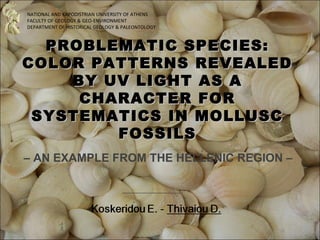
  PROBLEMATIC SPECIES:
COLOR PATTERNS REVEALED
    BY UV LIGHT AS A
     CHARACTER FOR
 SYSTEMATICS IN MOLLUSC
        FOSSILS
– AN EXAMPLE FROM THE HELLENIC REGION –
Study Area : Rhodes
Geological Setting:
Faliraki section, Rhodes
The Glycymeris genus
• Paralic environment
• Symmetrical valves
• Isomyarian
• Straight umbo
• Taxodont teeth
 Problems with identification and
characterization of species
Biometry

• Typological
  descriptions
• Shape descriptions

     length = f (width) for Glycymeris
          violascens (grey), regression
                coefficient: R2=0.876;
       length = f (width) for two fossil
       species of the Middle Lutetian,
   Glycymeris pulvinata (orange) and
  Glycymeris dispar (blue) (regression
 coefficients: R2(G. pulvinata)=0.949;
                   R2(G.dispar)=0.969)
Greek fossils of Glycymeris


Glycymeris cor
                 Glycymeris glycymeris
Mediterranean Glycymeris species


                                  Glycymeris glycymeris


  Glycymeris bimaculata   Glycymeris violascens
UV light : the method

• Color patterns have
been used for 200 years
• UV light method was
first described in 1967
• It has been
successfully used by
Caze (2010) on fossils
from the Paris Basin

                          Photo by Caze, 2010
UV light : the method
• First ever application to Greek fossils from Rhodes
  (good preservation of the specimens)
• The specimens have important morphological
  similarities
• Preliminary step: sodium hypochlorite (bleach)
  bath for the re-oxidation of the residual pigments
UV Light : Results
• Color patterns can differentiate and define similar
  species


 Photo of G. dispar under UV light   Photo of G. violascens under UV light
UV Light


Photo of G. violascens under UV light   Schematic shape of the color pattern
                                                  of G. violascens
CONCLUSIONS
• Fast retrieval of results
• Non-destructive method
• Characterization of the color pattern of the
  studied species
• Residual coloration can be used as a
  systematic character on fossil species
Thank you for your
    attention!

Problematic species: color patterns revealed by UV light as a character for systematics in mollusc fossils - an example from the Hellenic region. Koskeridou E., Thivaiou D.

  • 1.
    NATIONAL AND KAPODISTRIANUNIVERSITY OF ATHENS FACULTY OF GEOLOGY & GEO-ENVIRONMENT DEPARTMENT OF HISTORICAL GEOLOGY & PALEONTOLOGY PROBLEMATIC SPECIES: COLOR PATTERNS REVEALED BY UV LIGHT AS A CHARACTER FOR SYSTEMATICS IN MOLLUSC FOSSILS – AN EXAMPLE FROM THE HELLENIC REGION –
  • 2.
  • 3.
  • 4.
    The Glycymeris genus •Paralic environment • Symmetrical valves • Isomyarian • Straight umbo • Taxodont teeth  Problems with identification and characterization of species
  • 5.
    Biometry • Typological descriptions • Shape descriptions length = f (width) for Glycymeris violascens (grey), regression coefficient: R2=0.876; length = f (width) for two fossil species of the Middle Lutetian, Glycymeris pulvinata (orange) and Glycymeris dispar (blue) (regression coefficients: R2(G. pulvinata)=0.949; R2(G.dispar)=0.969)
  • 6.
    Greek fossils ofGlycymeris Glycymeris cor Glycymeris glycymeris
  • 7.
    Mediterranean Glycymeris species Glycymeris glycymeris Glycymeris bimaculata Glycymeris violascens
  • 8.
    UV light :the method • Color patterns have been used for 200 years • UV light method was first described in 1967 • It has been successfully used by Caze (2010) on fossils from the Paris Basin Photo by Caze, 2010
  • 9.
    UV light :the method • First ever application to Greek fossils from Rhodes (good preservation of the specimens) • The specimens have important morphological similarities • Preliminary step: sodium hypochlorite (bleach) bath for the re-oxidation of the residual pigments
  • 10.
    UV Light :Results • Color patterns can differentiate and define similar species Photo of G. dispar under UV light Photo of G. violascens under UV light
  • 11.
    UV Light Photo ofG. violascens under UV light Schematic shape of the color pattern of G. violascens
  • 12.
    CONCLUSIONS • Fast retrievalof results • Non-destructive method • Characterization of the color pattern of the studied species • Residual coloration can be used as a systematic character on fossil species
  • 13.
    Thank you foryour attention!

Editor's Notes

  • #4 Large Glycymeris bed + photo from the field
  • #5 Common fossil taxon Forms large fossil beds We found it in Rhodes We wanted to see if there was one or more species in the bed because the morphospace of G. violascens is not very well known, for that we used UV light. We also wanted to compare the results to another Glycymeris species in order to have a better idea as far as the validity of the method is concerned.
  • #6 The range of sizes for the three species is different, and in order to read the data more easily we present it in two different figures. The descriptor R 2 (varience) shows the differences between the global shapes of the shells, it is very similar for the two lutetian species, but different from g. violascens : illustration of the global difference of the shape of the shells. Τυπολογικές περιγραφές  διαστάσεις της θυρίδας. Η παράμετρος R 2 περιγράφει το κάθε είδος, και δείχνει τη διαφορά μεγέθους σε σχέση με το μέσο όρο μεγέθους στη διάρκεια της οντογένεσης. Είναι η διαφορά της κλίσης του άξονα y που μπορεί να δείξει κάποια διαφορά στα σχήματα ειδών του γένους αυτού. Σε αυτή τη περίπτωση όμως δεν βλέπουμε κάτι τέτοιο μιας και τα είδη έχουν πολλές ομοιότητες. Επομένως η βιομετρία δεν είναι μια μέθοδος που μπορεί να βγάλει σαφή και σημαντικά αποτελέσματα.
  • #8 Σημερινά είδη glycymeris από τη μεσόγειο, να φαίνονται οι χρωματικές διαφορές τους έντονα  θα δείξουμε πως ισχύει το ίδιο πράγμα και στα σημερινά
  • #11 Πως χρησιμοποιείται η μέθοδος
  • #12 Proposition of a model for characterazing the color patterns of this bivalve genus.
  • #13 The fact that this method is non-destructive allows not only to work on collected material but also on collections. Residual coloration on fossils used as it is used on recent species + it is useful to work on species that also have known fossils in order to make sure that the method works.