Conjunctions
(a form of sentence glue)
Devised by Jo Killmister, Skills
Enhancement Program,
Newcastle Business School
Conjunctions – definition & types
 Conjunctions are joining words.
 They join words to form phrases and join
phrases to form clauses.
 They also join clauses to each other to form
compound and complex sentences.
 Within sentences, there are three types of
conjunction: coordinating, subordinating and
correlative.
Devised by Jo Killmister, Skills
Enhancement Program,
Newcastle Business School
Coordinating conjunctions
There are seven coordinating conjunctions:
 and
 but
 for
 nor
 or
 so
 yet
A simple way to remember these is to rearrange their
order so that their first letters form a word in their
own right: For,and,nor,but,or,yet,so – Fanboys. (It
may be odd, but it’s memorable.)
Devised by Jo Killmister, Skills
Enhancement Program,
Newcastle Business School
The role of coordinating
conjunctions
Coordinating conjunctions help writers to
organise words into meaningful phrases
that can then be arranged to create larger
units of meaning such as clauses and
sentences
Devised by Jo Killmister, Skills
Enhancement Program,
Newcastle Business School
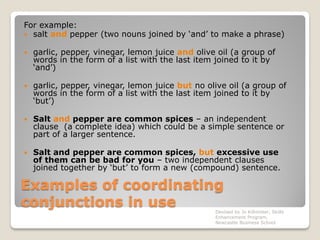
Examples of coordinating
conjunctions in use
For example:
 salt and pepper (two nouns joined by ‘and’ to make a phrase)
 garlic, pepper, vinegar, lemon juice and olive oil (a group of
words in the form of a list with the last item joined to it by
‘and’)
 garlic, pepper, vinegar, lemon juice but no olive oil (a group of
words in the form of a list with the last item joined to it by
‘but’)
 Salt and pepper are common spices – an independent
clause (a complete idea) which could be a simple sentence or
part of a larger sentence.
 Salt and pepper are common spices, but excessive use
of them can be bad for you – two independent clauses
joined together by ‘but’ to form a new (compound) sentence.
Devised by Jo Killmister, Skills
Enhancement Program,
Newcastle Business School
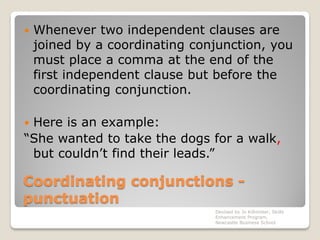
Coordinating conjunctions -
punctuation
 Whenever two independent clauses are
joined by a coordinating conjunction, you
must place a comma at the end of the
first independent clause but before the
coordinating conjunction.
 Here is an example:
“She wanted to take the dogs for a walk,
but couldn’t find their leads.”
Devised by Jo Killmister, Skills
Enhancement Program,
Newcastle Business School
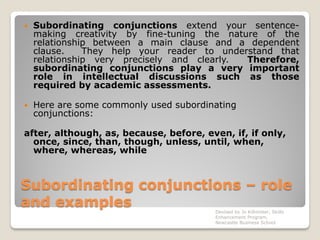
Subordinating conjunctions – role
and examples
 Subordinating conjunctions extend your sentence-
making creativity by fine-tuning the nature of the
relationship between a main clause and a dependent
clause. They help your reader to understand that
relationship very precisely and clearly. Therefore,
subordinating conjunctions play a very important
role in intellectual discussions such as those
required by academic assessments.
 Here are some commonly used subordinating
conjunctions:
after, although, as, because, before, even, if, if only,
once, since, than, though, unless, until, when,
where, whereas, while
Devised by Jo Killmister, Skills
Enhancement Program,
Newcastle Business School
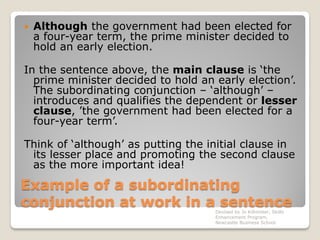
Example of a subordinating
conjunction at work in a sentence
 Although the government had been elected for
a four-year term, the prime minister decided to
hold an early election.
In the sentence above, the main clause is ‘the
prime minister decided to hold an early election’.
The subordinating conjunction – ‘although’ –
introduces and qualifies the dependent or lesser
clause, ’the government had been elected for a
four-year term’.
Think of ‘although’ as putting the initial clause in
its lesser place and promoting the second clause
as the more important idea!
Devised by Jo Killmister, Skills
Enhancement Program,
Newcastle Business School
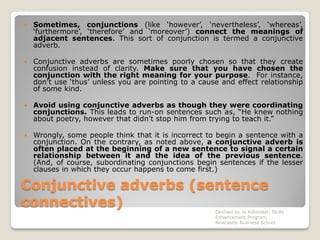
Conjunctive adverbs (sentence
connectives)
 Sometimes, conjunctions (like ‘however’, ‘nevertheless’, ‘whereas’,
‘furthermore’, ‘therefore’ and ‘moreover’) connect the meanings of
adjacent sentences. This sort of conjunction is termed a conjunctive
adverb.
 Conjunctive adverbs are sometimes poorly chosen so that they create
confusion instead of clarity. Make sure that you have chosen the
conjunction with the right meaning for your purpose. For instance,
don’t use ‘thus’ unless you are pointing to a cause and effect relationship
of some kind.
 Avoid using conjunctive adverbs as though they were coordinating
conjunctions. This leads to run-on sentences such as, “He knew nothing
about poetry, however that didn’t stop him from trying to teach it.”
 Wrongly, some people think that it is incorrect to begin a sentence with a
conjunction. On the contrary, as noted above, a conjunctive adverb is
often placed at the beginning of a new sentence to signal a certain
relationship between it and the idea of the previous sentence.
(And, of course, subordinating conjunctions begin sentences if the lesser
clauses in which they occur happens to come first.)
Devised by Jo Killmister, Skills
Enhancement Program,
Newcastle Business School
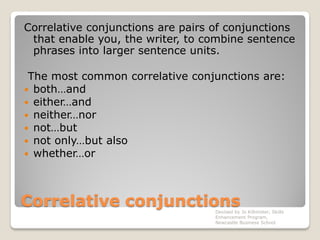
Correlative conjunctions
Correlative conjunctions are pairs of conjunctions
that enable you, the writer, to combine sentence
phrases into larger sentence units.
The most common correlative conjunctions are:
 both…and
 either…and
 neither…nor
 not…but
 not only…but also
 whether…or
Devised by Jo Killmister, Skills
Enhancement Program,
Newcastle Business School
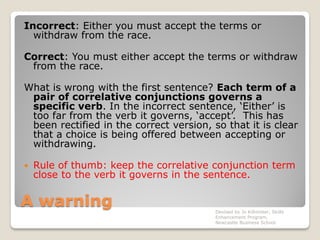
A warning
Incorrect: Either you must accept the terms or
withdraw from the race.
Correct: You must either accept the terms or withdraw
from the race.
What is wrong with the first sentence? Each term of a
pair of correlative conjunctions governs a
specific verb. In the incorrect sentence, ‘Either’ is
too far from the verb it governs, ‘accept’. This has
been rectified in the correct version, so that it is clear
that a choice is being offered between accepting or
withdrawing.
 Rule of thumb: keep the correlative conjunction term
close to the verb it governs in the sentence.
Devised by Jo Killmister, Skills
Enhancement Program,
Newcastle Business School
References
 Dutwin, P. (2010). English grammar demystified: a self-teaching guide. New York,
USA: McGraw-Hill.
 Dr Jim Jose, Associate Professor, School of Economics, Politics & Tourism, Faculty of
Business & Law, University of Newcastle, for his guidance through my frequent
reference to his Study Skills Online (2000).
 King, G. (2000). Good Grammar. Glasgow: HarperCollins.
 Lester, M. (2008). McGraw-Hill’s Essential ESL Grammar. New York, USA: McGraw-
Hill.
 Ramsay, M.A. (2004). The Complete Guide to English Usage for Australian Students.
Southbank, Victoria: Thomson Nelson.
 Sinclair, C. (2007). Grammar: A Friendly Approach. New York, USA: McGraw-Hill
 Wilson, P. & Glazier, T. (2003). Writing Essentials. Boston, USA: Heinle Cengage
Learning.
Recommended source of practice:
Murphy, R. (2004). English Grammar in Use (3rd ed.). Cambridge, UK: CUP.
Units 113-120.
Devised by Jo Killmister, Skills
Enhancement Program,
Newcastle Business School

3 conjunctions advervs

  • 1.
    Conjunctions (a form ofsentence glue) Devised by Jo Killmister, Skills Enhancement Program, Newcastle Business School
  • 2.
    Conjunctions – definition& types  Conjunctions are joining words.  They join words to form phrases and join phrases to form clauses.  They also join clauses to each other to form compound and complex sentences.  Within sentences, there are three types of conjunction: coordinating, subordinating and correlative. Devised by Jo Killmister, Skills Enhancement Program, Newcastle Business School
  • 3.
    Coordinating conjunctions There areseven coordinating conjunctions:  and  but  for  nor  or  so  yet A simple way to remember these is to rearrange their order so that their first letters form a word in their own right: For,and,nor,but,or,yet,so – Fanboys. (It may be odd, but it’s memorable.) Devised by Jo Killmister, Skills Enhancement Program, Newcastle Business School
  • 4.
    The role ofcoordinating conjunctions Coordinating conjunctions help writers to organise words into meaningful phrases that can then be arranged to create larger units of meaning such as clauses and sentences Devised by Jo Killmister, Skills Enhancement Program, Newcastle Business School
  • 5.
    Examples of coordinating conjunctionsin use For example:  salt and pepper (two nouns joined by ‘and’ to make a phrase)  garlic, pepper, vinegar, lemon juice and olive oil (a group of words in the form of a list with the last item joined to it by ‘and’)  garlic, pepper, vinegar, lemon juice but no olive oil (a group of words in the form of a list with the last item joined to it by ‘but’)  Salt and pepper are common spices – an independent clause (a complete idea) which could be a simple sentence or part of a larger sentence.  Salt and pepper are common spices, but excessive use of them can be bad for you – two independent clauses joined together by ‘but’ to form a new (compound) sentence. Devised by Jo Killmister, Skills Enhancement Program, Newcastle Business School
  • 6.
    Coordinating conjunctions - punctuation Whenever two independent clauses are joined by a coordinating conjunction, you must place a comma at the end of the first independent clause but before the coordinating conjunction.  Here is an example: “She wanted to take the dogs for a walk, but couldn’t find their leads.” Devised by Jo Killmister, Skills Enhancement Program, Newcastle Business School
  • 7.
    Subordinating conjunctions –role and examples  Subordinating conjunctions extend your sentence- making creativity by fine-tuning the nature of the relationship between a main clause and a dependent clause. They help your reader to understand that relationship very precisely and clearly. Therefore, subordinating conjunctions play a very important role in intellectual discussions such as those required by academic assessments.  Here are some commonly used subordinating conjunctions: after, although, as, because, before, even, if, if only, once, since, than, though, unless, until, when, where, whereas, while Devised by Jo Killmister, Skills Enhancement Program, Newcastle Business School
  • 8.
    Example of asubordinating conjunction at work in a sentence  Although the government had been elected for a four-year term, the prime minister decided to hold an early election. In the sentence above, the main clause is ‘the prime minister decided to hold an early election’. The subordinating conjunction – ‘although’ – introduces and qualifies the dependent or lesser clause, ’the government had been elected for a four-year term’. Think of ‘although’ as putting the initial clause in its lesser place and promoting the second clause as the more important idea! Devised by Jo Killmister, Skills Enhancement Program, Newcastle Business School
  • 9.
    Conjunctive adverbs (sentence connectives) Sometimes, conjunctions (like ‘however’, ‘nevertheless’, ‘whereas’, ‘furthermore’, ‘therefore’ and ‘moreover’) connect the meanings of adjacent sentences. This sort of conjunction is termed a conjunctive adverb.  Conjunctive adverbs are sometimes poorly chosen so that they create confusion instead of clarity. Make sure that you have chosen the conjunction with the right meaning for your purpose. For instance, don’t use ‘thus’ unless you are pointing to a cause and effect relationship of some kind.  Avoid using conjunctive adverbs as though they were coordinating conjunctions. This leads to run-on sentences such as, “He knew nothing about poetry, however that didn’t stop him from trying to teach it.”  Wrongly, some people think that it is incorrect to begin a sentence with a conjunction. On the contrary, as noted above, a conjunctive adverb is often placed at the beginning of a new sentence to signal a certain relationship between it and the idea of the previous sentence. (And, of course, subordinating conjunctions begin sentences if the lesser clauses in which they occur happens to come first.) Devised by Jo Killmister, Skills Enhancement Program, Newcastle Business School
  • 10.
    Correlative conjunctions Correlative conjunctionsare pairs of conjunctions that enable you, the writer, to combine sentence phrases into larger sentence units. The most common correlative conjunctions are:  both…and  either…and  neither…nor  not…but  not only…but also  whether…or Devised by Jo Killmister, Skills Enhancement Program, Newcastle Business School
  • 11.
    A warning Incorrect: Eitheryou must accept the terms or withdraw from the race. Correct: You must either accept the terms or withdraw from the race. What is wrong with the first sentence? Each term of a pair of correlative conjunctions governs a specific verb. In the incorrect sentence, ‘Either’ is too far from the verb it governs, ‘accept’. This has been rectified in the correct version, so that it is clear that a choice is being offered between accepting or withdrawing.  Rule of thumb: keep the correlative conjunction term close to the verb it governs in the sentence. Devised by Jo Killmister, Skills Enhancement Program, Newcastle Business School
  • 12.
    References  Dutwin, P.(2010). English grammar demystified: a self-teaching guide. New York, USA: McGraw-Hill.  Dr Jim Jose, Associate Professor, School of Economics, Politics & Tourism, Faculty of Business & Law, University of Newcastle, for his guidance through my frequent reference to his Study Skills Online (2000).  King, G. (2000). Good Grammar. Glasgow: HarperCollins.  Lester, M. (2008). McGraw-Hill’s Essential ESL Grammar. New York, USA: McGraw- Hill.  Ramsay, M.A. (2004). The Complete Guide to English Usage for Australian Students. Southbank, Victoria: Thomson Nelson.  Sinclair, C. (2007). Grammar: A Friendly Approach. New York, USA: McGraw-Hill  Wilson, P. & Glazier, T. (2003). Writing Essentials. Boston, USA: Heinle Cengage Learning. Recommended source of practice: Murphy, R. (2004). English Grammar in Use (3rd ed.). Cambridge, UK: CUP. Units 113-120. Devised by Jo Killmister, Skills Enhancement Program, Newcastle Business School