Miami-Dade Current Economic Conditions and 2011 OutlookMarch 2011Robert D. Cruz, PhDChief Economist, Miami-Dade CountyOffice of Economic Development and International Tradecruzr1@miamidade.govwww.miamidade.gov/economicdevelopmentOffice of Economic Development and International Trade1
SummaryLabor Market IndicatorsTaxable SalesInternational TradeTourismHousing Market/Foreclosure ActivityU.S. GDP growthContentsOffice of Economic Development International Trade2
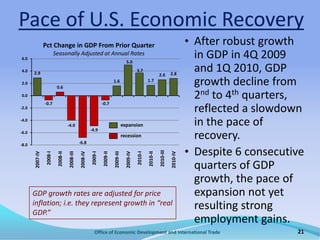
Office of Economic Development and International Trade3Summary of 2010Economic recovery continues in Miami-Dade, but like the national economy the pace of recovery has slowed in the 2nd half of this year.National economic recovery hit a “soft patch” in 2nd quarter 2010 (2Q10), but appears to have picked up in 2nd half of 2010.National economic recovery began in the 3Q09 and the robust growth in 4Q09 and 1Q10 was led by businesses rebuilding their stock of inventories.Economic recovery in last six months of 2010 was supported by gains in personal consumption spending and other components of final demand, but rising imports muted their effects in 2nd and 3rd quarters 2010.Keeping positive momentum in final sales is key to maintaining economic recovery, and eventually accelerating job growth, but uncertainty over federal spending policy clouds the outlook for the pace of recovery.
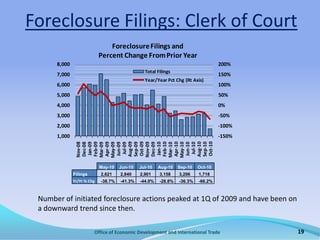
Office of Economic Development and International Trade4Summary of 2010 Payroll employment in Miami-Dade is on a slow upward trend, but job losses in the public sector are offsetting some of the gains in the private sector.Unemployment rates remain high (13.3% in Nov), but county residents holding jobs increased by 11,400 between Nov-09 and Nov-10. Labor force grew by 41,000 over the same period, driving unemployment rate higher.Business bankruptcies remain high (restraining hiring), and consumer bankruptcies still rising (an indicator to keep monitoring).Local taxable sales (in spite of personal bankruptcies) and international trade are bright spots in the local economy. Tourism is stronger than last year with occupancy and average room rates comparatively higher.Positive momentum in SF housing market has diminished since the summer, while bargain hunting in the condo market driving higher sales.Bank foreclosures ending year higher but initial filings have declined: drop in REO foreclosures expected to follow the decline in filings.December’s Congressional compromise on fiscal policy suggest prospects are better for a sustained and moderate acceleration in U.S. economic growth in 2011, which will support more robust local economic growth.
Office of Economic Development and International Trade5Pace of U.S. Recovery the Key Determinant of Local Economic Growth in 2011The business cycle in Miami-Dade during this recession and recovery has closely tracked the national economy.Miami-Dade economy is relatively less dependent on construction activity than other parts of Florida, and its drivers of tourism sector are different (more international/less domestic; more targeted towards adults and higher income/wealth).Relatively stable sectors like Professional and Business Services, Healthcare and Education represent relatively higher shares of the local economy.Probability U.S. GDP growth in 2011 in the 2.5-3% range is higher as a result of recent legislative action to keeping income tax rates from rising and 32% payroll tax cut for 2011.U.S. GDP growth at near 3% (or higher), combined with continuing economic strength in Latin American trading partners, should lead to an acceleration in local economic and employment growth.Infrastructure projects will help support construction jobs, but significant recovery in this sector not likely until 2012.
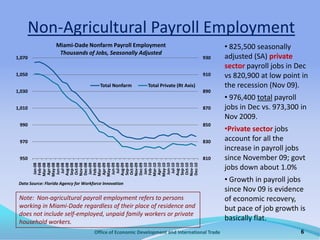
Non-Agricultural Payroll Employment 825,500 seasonally adjusted (SA) private sector payroll jobs in Dec vs 820,900 at low point in the recession (Nov 09).
 976,400 total payroll jobs in Dec vs. 973,300 in Nov 2009.
Private sector jobs account for all the increase in payroll jobs since November 09; govt jobs down about 1.0%
 Growth in payroll jobs since Nov 09 is evidence of economic recovery, but pace of job growth is basically flat.Note:  Non-agricultural payroll employment refers to persons working in Miami-Dade regardless of their place of residence and does not include self-employed, unpaid family workers or private household workers.Office of Economic Development and International Trade6
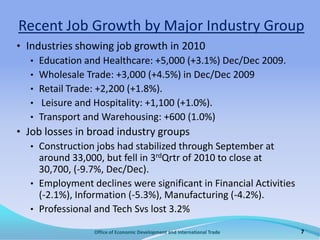
Office of Economic Development and International Trade7Recent Job Growth by Major Industry GroupIndustries showing job growth in 2010Education and Healthcare: +5,000 (+3.1%) Dec/Dec 2009. Wholesale Trade: +3,000 (+4.5%) in Dec/Dec 2009Retail Trade: +2,200 (+1.8%). Leisure and Hospitality: +1,100 (+1.0%).Transport and Warehousing: +600 (1.0%)Job losses in broad industry groupsConstruction jobs had stabilized through September at around 33,000, but fell in 3rdQrtr of 2010 to close at 30,700, (-9.7%, Dec/Dec).Employment declines were significant in Financial Activities      (-2.1%), Information (-5.3%), Manufacturing (-4.2%).Professional and Tech Svs lost 3.2%
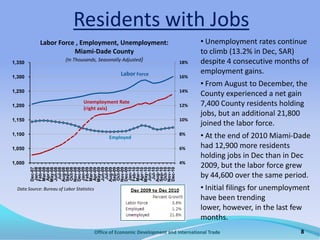
Residents with Jobs Unemployment rates continue to climb (13.2% in Dec, SAR) despite 4 consecutive months of employment gains.
 From August to December, the County experienced a net gain 7,400 County residents holding jobs, but an additional 21,800 joined the labor force.
 At the end of 2010 Miami-Dade had 12,900 more residents holding jobs in Dec than in Dec 2009, but the labor force grew by 44,600 over the same period.
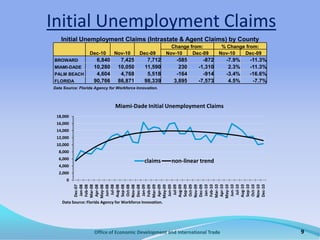
 Initial filings for unemployment have been trending lower, however, in the last few months.Office of Economic Development and International Trade8
Office of Economic Development and International Trade9Initial Unemployment Claims
Office of Economic Development and International Trade10After signs of stabilization in 2nd half of 2009, unemployment rates increase in 2010 in MDC
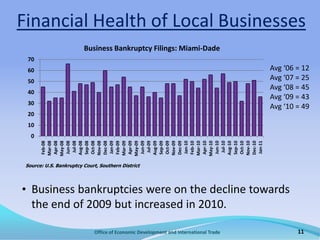
Office of Economic Development and International Trade11Financial Health of Local BusinessesAvg ‘06 = 12Avg ‘07 = 25Avg ‘08 = 45Avg ‘09 = 43Avg ‘10 = 49Business bankruptcies were on the decline towards the end of 2009 but increased in 2010.
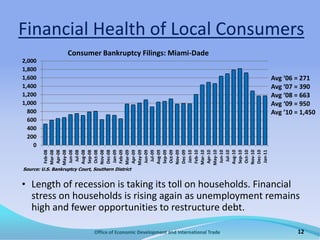
Office of Economic Development and International Trade12Avg ‘06 = 271Avg ‘07 = 390Avg ‘08 = 663Avg ‘09 = 950Avg ’10 = 1,450 Length of recession is taking its toll on households. Financial stress on households is rising again as unemployment remains high and fewer opportunities to restructure debt.Financial Health of Local Consumers
Office of Economic Development and International Trade13Taxable Sales, Seasonally AdjustedSeasonally adjusted taxable sales for the 2nd half 2010 increased at an annualized rate of 8% from 1st half of 2010.The strong gains in in the 2nd half were led byTourism & Recreation (+11%)Consumer Durables (+12%)Taxable sales of construction materials and business equipment have started to show a positive trend as well.Bldg materials/supplies (+10%)Business equipment (+5%)Approximately 45% of taxable sales are comprised of consumer durables (10%) and non-durables (35%).
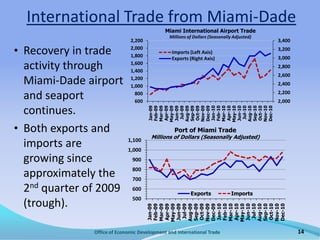
Office of Economic Development and International Trade14International Trade from Miami-DadeRecovery in trade activity through Miami-Dade airport and seaport continues.Both exports and imports are growing since approximately the 2nd quarter of 2009 (trough).
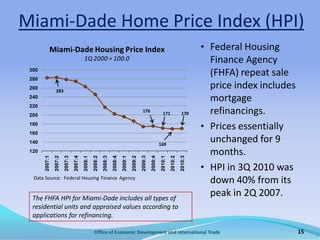
Office of Economic Development and International Trade15Miami-Dade Home Price Index (HPI)Federal Housing Finance Agency (FHFA) repeat sale price index includes mortgage refinancings.Prices essentially unchanged for 9 months.HPI in 3Q 2010 was down 40% from its peak in 2Q 2007.The FHFA HPI for Miami-Dade includes all types of residential units and appraised values according to applications for refinancing.
Office of Economic Development and International TradeSlight increase in permits issued but conditions for a significant increase in residential construction appear unlikely until late 2011 or early 2012.Residential Construction Activity16
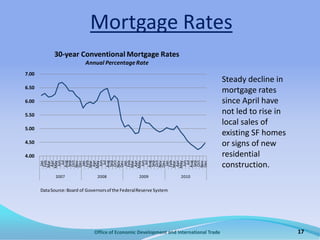
Office of Economic Development and International TradeMortgage Rates17Steady decline in mortgage rates since April have not led to rise in local sales of existing SF homes or signs of new residential construction.
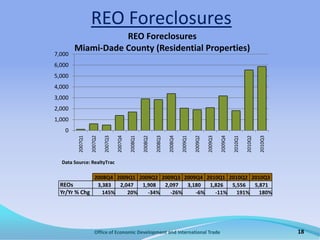
Office of Economic Development and International Trade18REO Foreclosures

3 4 2011 Mdc Econ Cond

  • 1.
    Miami-Dade Current EconomicConditions and 2011 OutlookMarch 2011Robert D. Cruz, PhDChief Economist, Miami-Dade CountyOffice of Economic Development and International Tradecruzr1@miamidade.govwww.miamidade.gov/economicdevelopmentOffice of Economic Development and International Trade1
  • 2.
    SummaryLabor Market IndicatorsTaxableSalesInternational TradeTourismHousing Market/Foreclosure ActivityU.S. GDP growthContentsOffice of Economic Development International Trade2
  • 3.
    Office of EconomicDevelopment and International Trade3Summary of 2010Economic recovery continues in Miami-Dade, but like the national economy the pace of recovery has slowed in the 2nd half of this year.National economic recovery hit a “soft patch” in 2nd quarter 2010 (2Q10), but appears to have picked up in 2nd half of 2010.National economic recovery began in the 3Q09 and the robust growth in 4Q09 and 1Q10 was led by businesses rebuilding their stock of inventories.Economic recovery in last six months of 2010 was supported by gains in personal consumption spending and other components of final demand, but rising imports muted their effects in 2nd and 3rd quarters 2010.Keeping positive momentum in final sales is key to maintaining economic recovery, and eventually accelerating job growth, but uncertainty over federal spending policy clouds the outlook for the pace of recovery.
  • 4.
    Office of EconomicDevelopment and International Trade4Summary of 2010 Payroll employment in Miami-Dade is on a slow upward trend, but job losses in the public sector are offsetting some of the gains in the private sector.Unemployment rates remain high (13.3% in Nov), but county residents holding jobs increased by 11,400 between Nov-09 and Nov-10. Labor force grew by 41,000 over the same period, driving unemployment rate higher.Business bankruptcies remain high (restraining hiring), and consumer bankruptcies still rising (an indicator to keep monitoring).Local taxable sales (in spite of personal bankruptcies) and international trade are bright spots in the local economy. Tourism is stronger than last year with occupancy and average room rates comparatively higher.Positive momentum in SF housing market has diminished since the summer, while bargain hunting in the condo market driving higher sales.Bank foreclosures ending year higher but initial filings have declined: drop in REO foreclosures expected to follow the decline in filings.December’s Congressional compromise on fiscal policy suggest prospects are better for a sustained and moderate acceleration in U.S. economic growth in 2011, which will support more robust local economic growth.
  • 5.
    Office of EconomicDevelopment and International Trade5Pace of U.S. Recovery the Key Determinant of Local Economic Growth in 2011The business cycle in Miami-Dade during this recession and recovery has closely tracked the national economy.Miami-Dade economy is relatively less dependent on construction activity than other parts of Florida, and its drivers of tourism sector are different (more international/less domestic; more targeted towards adults and higher income/wealth).Relatively stable sectors like Professional and Business Services, Healthcare and Education represent relatively higher shares of the local economy.Probability U.S. GDP growth in 2011 in the 2.5-3% range is higher as a result of recent legislative action to keeping income tax rates from rising and 32% payroll tax cut for 2011.U.S. GDP growth at near 3% (or higher), combined with continuing economic strength in Latin American trading partners, should lead to an acceleration in local economic and employment growth.Infrastructure projects will help support construction jobs, but significant recovery in this sector not likely until 2012.
  • 6.
    Non-Agricultural Payroll Employment825,500 seasonally adjusted (SA) private sector payroll jobs in Dec vs 820,900 at low point in the recession (Nov 09).
  • 7.
    976,400 totalpayroll jobs in Dec vs. 973,300 in Nov 2009.
  • 8.
    Private sector jobsaccount for all the increase in payroll jobs since November 09; govt jobs down about 1.0%
  • 9.
    Growth inpayroll jobs since Nov 09 is evidence of economic recovery, but pace of job growth is basically flat.Note: Non-agricultural payroll employment refers to persons working in Miami-Dade regardless of their place of residence and does not include self-employed, unpaid family workers or private household workers.Office of Economic Development and International Trade6
  • 10.
    Office of EconomicDevelopment and International Trade7Recent Job Growth by Major Industry GroupIndustries showing job growth in 2010Education and Healthcare: +5,000 (+3.1%) Dec/Dec 2009. Wholesale Trade: +3,000 (+4.5%) in Dec/Dec 2009Retail Trade: +2,200 (+1.8%). Leisure and Hospitality: +1,100 (+1.0%).Transport and Warehousing: +600 (1.0%)Job losses in broad industry groupsConstruction jobs had stabilized through September at around 33,000, but fell in 3rdQrtr of 2010 to close at 30,700, (-9.7%, Dec/Dec).Employment declines were significant in Financial Activities (-2.1%), Information (-5.3%), Manufacturing (-4.2%).Professional and Tech Svs lost 3.2%
  • 11.
    Residents with JobsUnemployment rates continue to climb (13.2% in Dec, SAR) despite 4 consecutive months of employment gains.
  • 12.
    From Augustto December, the County experienced a net gain 7,400 County residents holding jobs, but an additional 21,800 joined the labor force.
  • 13.
    At theend of 2010 Miami-Dade had 12,900 more residents holding jobs in Dec than in Dec 2009, but the labor force grew by 44,600 over the same period.
  • 14.
    Initial filingsfor unemployment have been trending lower, however, in the last few months.Office of Economic Development and International Trade8
  • 15.
    Office of EconomicDevelopment and International Trade9Initial Unemployment Claims
  • 16.
    Office of EconomicDevelopment and International Trade10After signs of stabilization in 2nd half of 2009, unemployment rates increase in 2010 in MDC
  • 17.
    Office of EconomicDevelopment and International Trade11Financial Health of Local BusinessesAvg ‘06 = 12Avg ‘07 = 25Avg ‘08 = 45Avg ‘09 = 43Avg ‘10 = 49Business bankruptcies were on the decline towards the end of 2009 but increased in 2010.
  • 18.
    Office of EconomicDevelopment and International Trade12Avg ‘06 = 271Avg ‘07 = 390Avg ‘08 = 663Avg ‘09 = 950Avg ’10 = 1,450 Length of recession is taking its toll on households. Financial stress on households is rising again as unemployment remains high and fewer opportunities to restructure debt.Financial Health of Local Consumers
  • 19.
    Office of EconomicDevelopment and International Trade13Taxable Sales, Seasonally AdjustedSeasonally adjusted taxable sales for the 2nd half 2010 increased at an annualized rate of 8% from 1st half of 2010.The strong gains in in the 2nd half were led byTourism & Recreation (+11%)Consumer Durables (+12%)Taxable sales of construction materials and business equipment have started to show a positive trend as well.Bldg materials/supplies (+10%)Business equipment (+5%)Approximately 45% of taxable sales are comprised of consumer durables (10%) and non-durables (35%).
  • 20.
    Office of EconomicDevelopment and International Trade14International Trade from Miami-DadeRecovery in trade activity through Miami-Dade airport and seaport continues.Both exports and imports are growing since approximately the 2nd quarter of 2009 (trough).
  • 21.
    Office of EconomicDevelopment and International Trade15Miami-Dade Home Price Index (HPI)Federal Housing Finance Agency (FHFA) repeat sale price index includes mortgage refinancings.Prices essentially unchanged for 9 months.HPI in 3Q 2010 was down 40% from its peak in 2Q 2007.The FHFA HPI for Miami-Dade includes all types of residential units and appraised values according to applications for refinancing.
  • 22.
    Office of EconomicDevelopment and International TradeSlight increase in permits issued but conditions for a significant increase in residential construction appear unlikely until late 2011 or early 2012.Residential Construction Activity16
  • 23.
    Office of EconomicDevelopment and International TradeMortgage Rates17Steady decline in mortgage rates since April have not led to rise in local sales of existing SF homes or signs of new residential construction.
  • 24.
    Office of EconomicDevelopment and International Trade18REO Foreclosures

Editor's Notes

  • #9 Gains from September to March