Economic Presentation  Presented by:  Morris  Segall, President  SPG Trend Advisors To:  Vistage     November 19 th , 2008
THE ECONOMY It’s a recession
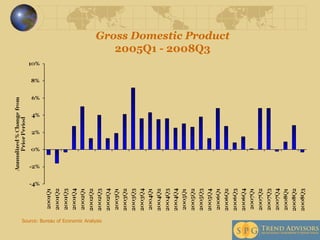
Gross Domestic Product 2005Q1 - 2008Q3 Source: Bureau of Economic Analysis
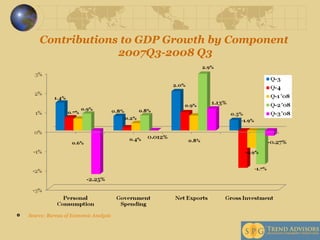
Contributions to GDP Growth by Component  2007Q3-2008 Q3 Source: Bureau of Economic Analysis
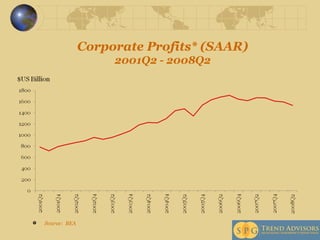
Corporate Profits* (SAAR) 2001Q2 - 2008Q2 Source:  BEA
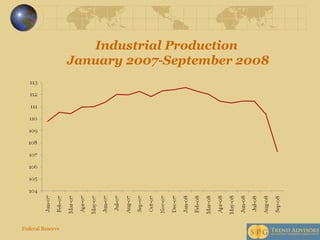
Industrial Production  January 2007-September 2008 Federal Reserve
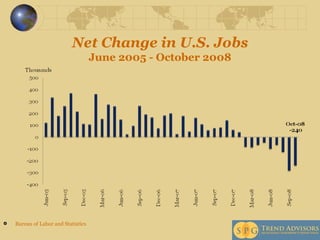
Net Change in U.S. Jobs June 2005 - October 2008 Bureau of Labor and Statistics
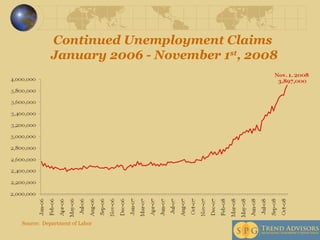
Continued Unemployment Claims  January 2006 - November 1 st , 2008 Source:  Department of Labor
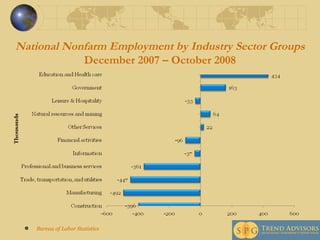
National Nonfarm Employment by Industry Sector Groups December 2007 – October 2008 Bureau of Labor Statistics
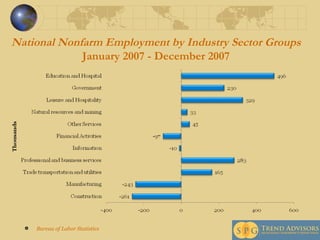
National Nonfarm Employment by Industry Sector Groups January 2007 - December 2007 Bureau of Labor Statistics
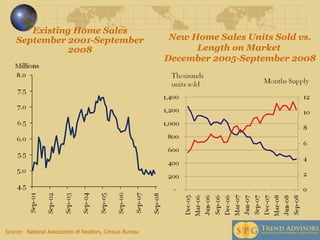
Existing Home Sales September 2001-September 2008 Source:  National Association of Realtors, Census Bureau  New Home Sales Units Sold vs. Length on Market  December 2005-September 2008
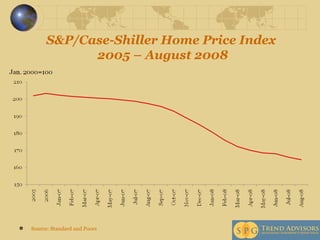
S&P/Case-Shiller Home Price Index  2005 – August 2008 Source: Standard and Poors
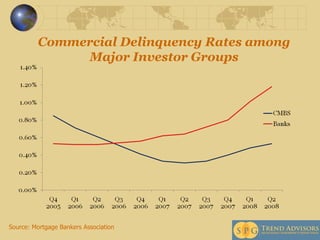
Commercial Delinquency Rates among Major Investor Groups Source: Mortgage Bankers Association
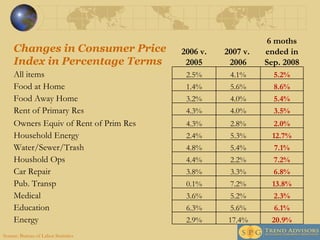
Source: Bureau of Labor Statistics Changes in Consumer Price Index in Percentage Terms 2006 v. 2005 2007 v.  2006 6 moths ended in Sep. 2008 All items 2.5% 4.1% 5.2% Food at Home 1.4% 5.6% 8.6% Food Away Home 3.2% 4.0% 5.4% Rent of Primary Res 4.3% 4.0% 3.5% Owners Equiv of Rent of Prim Res 4.3% 2.8% 2.0% Household Energy 2.4% 5.3% 12.7% Water/Sewer/Trash  4.8% 5.4% 7.1% Houshold Ops 4.4% 2.2% 7.2% Car Repair 3.8% 3.3% 6.8% Pub. Transp 0.1% 7.2% 13.8% Medical 3.6% 5.2% 2.3% Education 6.3% 5.6% 6.1% Energy 2.9% 17.4% 20.9%
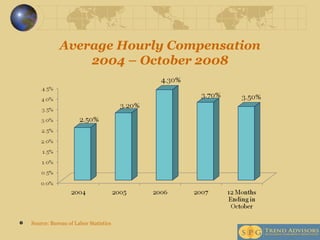
Average Hourly Compensation 2004 – October 2008 Source: Bureau of Labor Statistics
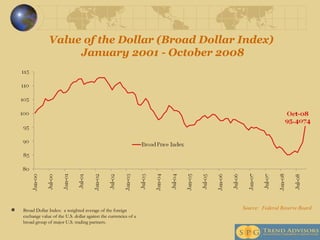
Value of the Dollar (Broad Dollar Index)  January 2001 - October 2008 Broad Dollar Index:  a weighted average of the foreign exchange value of the U.S. dollar against the currencies of a broad group of major U.S. trading partners. Source:  Federal Reserve Board
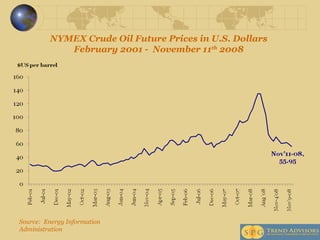
NYMEX Crude Oil Future Prices in U.S. Dollars February 2001 -  November 11 th  2008 Source:  Energy Information Administration
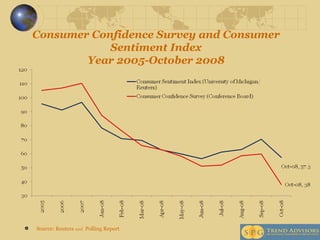
Consumer Confidence Survey and Consumer Sentiment Index Year 2005-October 2008 Source: Reuters  and   Polling Report
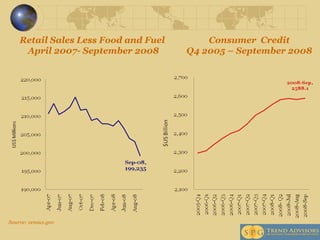
Source: census.gov Retail Sales Less Food and Fuel  April 2007- September 2008 Consumer  Credit Q4 2005 – September 2008
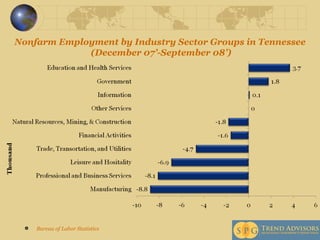
Nonfarm Employment by Industry Sector Groups in Tennessee  (December 07’-September 08’) Bureau of Labor Statistics
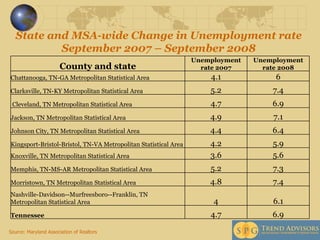
State and MSA-wide Change in Unemployment rate September 2007 – September 2008 Source: Maryland Association of Realtors County and state Unemployment rate 2007 Unemployment rate 2008 Chattanooga, TN-GA Metropolitan Statistical Area 4.1 6 Clarksville, TN-KY Metropolitan Statistical Area 5.2 7.4   Cleveland, TN Metropolitan Statistical Area 4.7 6.9 Jackson, TN Metropolitan Statistical Area 4.9 7.1 Johnson City, TN Metropolitan Statistical Area 4.4 6.4 Kingsport-Bristol-Bristol, TN-VA Metropolitan Statistical Area 4.2 5.9 Knoxville, TN Metropolitan Statistical Area 3.6 5.6 Memphis, TN-MS-AR Metropolitan Statistical Area 5.2 7.3 Morristown, TN Metropolitan Statistical Area 4.8 7.4 Nashville-Davidson--Murfreesboro--Franklin, TN Metropolitan Statistical Area 4 6.1 Tennessee 4.7 6.9
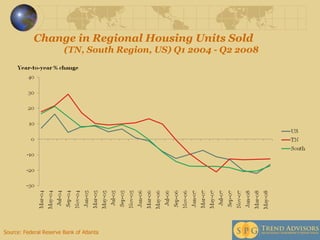
Change in Regional Housing Units Sold   (TN, South Region, US) Q1 2004 - Q2 2008 Source: Federal Reserve Bank of Atlanta
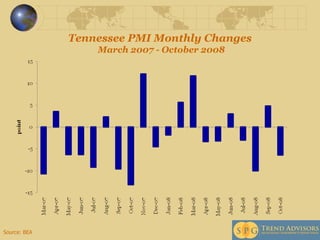
Tennessee PMI Monthly Changes  March 2007 - October 2008 Source: BEA
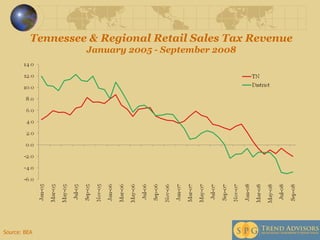
Tennessee & Regional Retail Sales Tax Revenue  January 2005 - September 2008 Source: BEA
How do I get through it? Manage business on cash flow basis Increase efficiency of asset turnover; increase liquidity  Intensify customer service initiatives Become innovative in controlling costs  Outsource where appropriate Join Co-ops to spread costs over larger group Look for new ways to leverage existing employees and infrastructure by investigating new sources of revenue from new products and markets Secure access to bank credit; firm up bank lines
How do I get through it? (cont.) Spend to increase productivity and market share Take advantage of accelerated equipment write offs as part of government’s economic stimulus package Take advantage of soft demand in economy to build for future by aggressive bargain purchasing If access to capital and liquidity are not detriments, look to acquire troubled companies and/or strategic assets of other companies Train employees to be more productive and increase their value by enabling them to do more tasks Increase networking and take advantage of trade associations for additional contacts and leads Partner with other firms
What’s on the other side?  2009 - Recession Bottoms with Housing and Unemployment Housing bottoms Bank loan losses abate Unemployment Peaks Lower Energy Prices alleviate pressure on consumer spending – but only gradual recovery as unemployment peaks As the economy firms, interest rates go up to finance increasing federal deficit Election –Democratic victory  Increased economic “bailout” and middle class spending programs along with higher taxes. Increased federal budget deficits.
What’s on the other side? (cont.) 2009 – Business Cost of goods declines from current levels as commodity prices decline – helps corporate profit margins; year over year profit comparisons become easier in second half that could lead to higher corporate profits As economy and consumer spending improve, bargains will disappear and prices will rise in the second half Inventories will rebuild as final sales increase Subdued consumer spending but pent-up demand building 2010 – Economy Makes Cyclical Recovery Increased employment = increased consumer spending Increased Corporate Sales = increased corporate profits = increased capital spending Increased exports to recovered overseas markets Increased interest rates and rising prices from higher demand and continuing federal budget deficits
Where are the opportunities? Healthcare – National Program Education Agriculture Energy Conservation Environmental Solutions  Electric Power Transportation – Increase Mass Transit Exports Water Conservation – New Supplies and Recycling U.S. Government Procurement and Outsourcing – Base Realignment Program (BRAC) Real Estate – Recycle and Rehab Existing Commercial and Residential Property
Conclusions Based on revised economic data, it appears we entered a recession in the fourth quarter of last year with economic weakness intensifying through 2008 into the first half of 2009.  Increased  near term economic and market pressures include:  stubbornly high inflation in food and basic services weakening corporate profits increased unemployment declining corporate capital and consumer spending
Conclusions continued Diminishing State and Local Government spending Reduced economic contribution from exports as overseas economic growth slows Continued credit pressures in residential housing and consumer lending spreading to commercial real estate markets
Conclusions continued However, a bottoming of the housing cycle and an abatement in bank credit losses in the second half of next year, could set the stage for cyclical capital markets and economic improvements in 2009 and 2010.  After an expected cyclical recovery in 2010-2012, we believe the longer term socio-economic issues facing this country will result in slower future economic growth for the United States.  The availability and cost of credit, particularly to consumers, will be more restricted and expensive in the future.
Thank You You can always reach me at  [email_address] Also, if you need us in a hurry, we are at 410.522.7243  Please contact us when you require economic and capital markets research & policy analysis. Further information available at www.spgtrend.com

Economic Presentation

  • 1.
    Economic Presentation Presented by: Morris Segall, President SPG Trend Advisors To: Vistage November 19 th , 2008
  • 2.
    THE ECONOMY It’sa recession
  • 3.
    Gross Domestic Product2005Q1 - 2008Q3 Source: Bureau of Economic Analysis
  • 4.
    Contributions to GDPGrowth by Component 2007Q3-2008 Q3 Source: Bureau of Economic Analysis
  • 5.
    Corporate Profits* (SAAR)2001Q2 - 2008Q2 Source: BEA
  • 6.
    Industrial Production January 2007-September 2008 Federal Reserve
  • 7.
    Net Change inU.S. Jobs June 2005 - October 2008 Bureau of Labor and Statistics
  • 8.
    Continued Unemployment Claims January 2006 - November 1 st , 2008 Source: Department of Labor
  • 9.
    National Nonfarm Employmentby Industry Sector Groups December 2007 – October 2008 Bureau of Labor Statistics
  • 10.
    National Nonfarm Employmentby Industry Sector Groups January 2007 - December 2007 Bureau of Labor Statistics
  • 11.
    Existing Home SalesSeptember 2001-September 2008 Source: National Association of Realtors, Census Bureau New Home Sales Units Sold vs. Length on Market December 2005-September 2008
  • 12.
    S&P/Case-Shiller Home PriceIndex 2005 – August 2008 Source: Standard and Poors
  • 13.
    Commercial Delinquency Ratesamong Major Investor Groups Source: Mortgage Bankers Association
  • 14.
    Source: Bureau ofLabor Statistics Changes in Consumer Price Index in Percentage Terms 2006 v. 2005 2007 v. 2006 6 moths ended in Sep. 2008 All items 2.5% 4.1% 5.2% Food at Home 1.4% 5.6% 8.6% Food Away Home 3.2% 4.0% 5.4% Rent of Primary Res 4.3% 4.0% 3.5% Owners Equiv of Rent of Prim Res 4.3% 2.8% 2.0% Household Energy 2.4% 5.3% 12.7% Water/Sewer/Trash 4.8% 5.4% 7.1% Houshold Ops 4.4% 2.2% 7.2% Car Repair 3.8% 3.3% 6.8% Pub. Transp 0.1% 7.2% 13.8% Medical 3.6% 5.2% 2.3% Education 6.3% 5.6% 6.1% Energy 2.9% 17.4% 20.9%
  • 15.
    Average Hourly Compensation2004 – October 2008 Source: Bureau of Labor Statistics
  • 16.
    Value of theDollar (Broad Dollar Index) January 2001 - October 2008 Broad Dollar Index: a weighted average of the foreign exchange value of the U.S. dollar against the currencies of a broad group of major U.S. trading partners. Source: Federal Reserve Board
  • 17.
    NYMEX Crude OilFuture Prices in U.S. Dollars February 2001 - November 11 th 2008 Source: Energy Information Administration
  • 18.
    Consumer Confidence Surveyand Consumer Sentiment Index Year 2005-October 2008 Source: Reuters and Polling Report
  • 19.
    Source: census.gov RetailSales Less Food and Fuel April 2007- September 2008 Consumer Credit Q4 2005 – September 2008
  • 20.
    Nonfarm Employment byIndustry Sector Groups in Tennessee (December 07’-September 08’) Bureau of Labor Statistics
  • 21.
    State and MSA-wideChange in Unemployment rate September 2007 – September 2008 Source: Maryland Association of Realtors County and state Unemployment rate 2007 Unemployment rate 2008 Chattanooga, TN-GA Metropolitan Statistical Area 4.1 6 Clarksville, TN-KY Metropolitan Statistical Area 5.2 7.4   Cleveland, TN Metropolitan Statistical Area 4.7 6.9 Jackson, TN Metropolitan Statistical Area 4.9 7.1 Johnson City, TN Metropolitan Statistical Area 4.4 6.4 Kingsport-Bristol-Bristol, TN-VA Metropolitan Statistical Area 4.2 5.9 Knoxville, TN Metropolitan Statistical Area 3.6 5.6 Memphis, TN-MS-AR Metropolitan Statistical Area 5.2 7.3 Morristown, TN Metropolitan Statistical Area 4.8 7.4 Nashville-Davidson--Murfreesboro--Franklin, TN Metropolitan Statistical Area 4 6.1 Tennessee 4.7 6.9
  • 22.
    Change in RegionalHousing Units Sold (TN, South Region, US) Q1 2004 - Q2 2008 Source: Federal Reserve Bank of Atlanta
  • 23.
    Tennessee PMI MonthlyChanges March 2007 - October 2008 Source: BEA
  • 24.
    Tennessee & RegionalRetail Sales Tax Revenue January 2005 - September 2008 Source: BEA
  • 25.
    How do Iget through it? Manage business on cash flow basis Increase efficiency of asset turnover; increase liquidity Intensify customer service initiatives Become innovative in controlling costs Outsource where appropriate Join Co-ops to spread costs over larger group Look for new ways to leverage existing employees and infrastructure by investigating new sources of revenue from new products and markets Secure access to bank credit; firm up bank lines
  • 26.
    How do Iget through it? (cont.) Spend to increase productivity and market share Take advantage of accelerated equipment write offs as part of government’s economic stimulus package Take advantage of soft demand in economy to build for future by aggressive bargain purchasing If access to capital and liquidity are not detriments, look to acquire troubled companies and/or strategic assets of other companies Train employees to be more productive and increase their value by enabling them to do more tasks Increase networking and take advantage of trade associations for additional contacts and leads Partner with other firms
  • 27.
    What’s on theother side? 2009 - Recession Bottoms with Housing and Unemployment Housing bottoms Bank loan losses abate Unemployment Peaks Lower Energy Prices alleviate pressure on consumer spending – but only gradual recovery as unemployment peaks As the economy firms, interest rates go up to finance increasing federal deficit Election –Democratic victory Increased economic “bailout” and middle class spending programs along with higher taxes. Increased federal budget deficits.
  • 28.
    What’s on theother side? (cont.) 2009 – Business Cost of goods declines from current levels as commodity prices decline – helps corporate profit margins; year over year profit comparisons become easier in second half that could lead to higher corporate profits As economy and consumer spending improve, bargains will disappear and prices will rise in the second half Inventories will rebuild as final sales increase Subdued consumer spending but pent-up demand building 2010 – Economy Makes Cyclical Recovery Increased employment = increased consumer spending Increased Corporate Sales = increased corporate profits = increased capital spending Increased exports to recovered overseas markets Increased interest rates and rising prices from higher demand and continuing federal budget deficits
  • 29.
    Where are theopportunities? Healthcare – National Program Education Agriculture Energy Conservation Environmental Solutions Electric Power Transportation – Increase Mass Transit Exports Water Conservation – New Supplies and Recycling U.S. Government Procurement and Outsourcing – Base Realignment Program (BRAC) Real Estate – Recycle and Rehab Existing Commercial and Residential Property
  • 30.
    Conclusions Based onrevised economic data, it appears we entered a recession in the fourth quarter of last year with economic weakness intensifying through 2008 into the first half of 2009. Increased near term economic and market pressures include: stubbornly high inflation in food and basic services weakening corporate profits increased unemployment declining corporate capital and consumer spending
  • 31.
    Conclusions continued DiminishingState and Local Government spending Reduced economic contribution from exports as overseas economic growth slows Continued credit pressures in residential housing and consumer lending spreading to commercial real estate markets
  • 32.
    Conclusions continued However,a bottoming of the housing cycle and an abatement in bank credit losses in the second half of next year, could set the stage for cyclical capital markets and economic improvements in 2009 and 2010. After an expected cyclical recovery in 2010-2012, we believe the longer term socio-economic issues facing this country will result in slower future economic growth for the United States. The availability and cost of credit, particularly to consumers, will be more restricted and expensive in the future.
  • 33.
    Thank You Youcan always reach me at [email_address] Also, if you need us in a hurry, we are at 410.522.7243 Please contact us when you require economic and capital markets research & policy analysis. Further information available at www.spgtrend.com