MDG Acceleration Framework (MAF)
in the Philippines: Reducing Maternal Mortality
                  21 June 2012


                                        0
                                   © United Nations Development Programme
                                                                  |
OVERVIEW

The global context for the MAF


What is the MAF? Where it has been applied?


The case of the Philippines on Maternal Mortality


Following through: value addition and
implementation

                                                    | 1
THE MAF: GLOBAL CONTEXT
▪   The 2010 MDG Summit
    – Provides the evidence from the ground on what works and what
      doesn’t: countries know what needs to be done to achieve the
      MDGs, but progress in implementation is lacking or has slowed in
      many
    – Outcome document calls for an acceleration agenda for the MDGs
▪   MAF formally endorsed in 2010 by UNDG
    – UN Secretary-General Ban Ki-moon and UNDG Chair Helen Clark
      introduce it at the 2010 Summit
    – UNDP corporate priority
    – UNDG guidance to UNCTs

▪   MAF developed and tested over 2009-2010
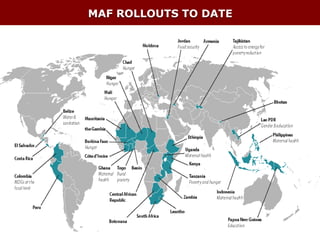
    – 14 countries and six MDGs
    – In 2011-2012: MAF being rolled-out in 20 countries

▪   Unlocking Progress: MDG Acceleration on the road to 2015
    – Summarize and synthesize main lessons learned from the pilot
      phase
    – Growing body of country reports and experiences

                                                                                | 2
                                                © United Nations Development Programme
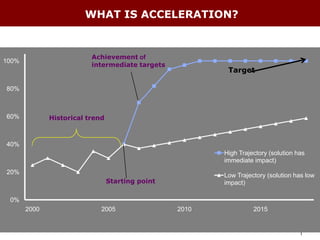
WHAT IS ACCELERATION?


                          Achievement of
100%
                          intermediate targets
                                                          Target

80%


60%           Historical trend


40%
                                                         High Trajectory (solution has
                                                         immediate impact)
20%
                                                         Low Trajectory (solution has low
                                 Starting point          impact)

 0%
       2000                  2005                 2010             2015

                                                                                    3
                                                                                    |
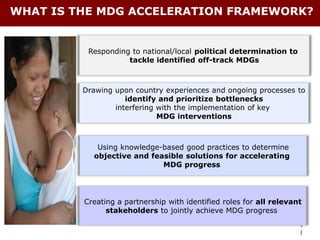
WHAT IS THE MDG ACCELERATION FRAMEWORK?


          Responding to national/local political determination to
                    tackle identified off-track MDGs


         Drawing upon country experiences and ongoing processes to
                    identify and prioritize bottlenecks
                 interfering with the implementation of key
                             MDG interventions


            Using knowledge-based good practices to determine
           objective and feasible solutions for accelerating
                            MDG progress


         Creating a partnership with identified roles for all relevant
               stakeholders to jointly achieve MDG progress

                                                                     4
                                                                     |
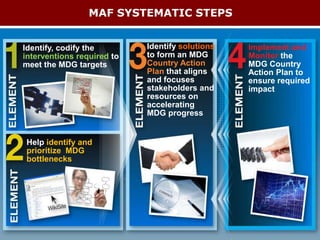
MAF SYSTEMATIC STEPS


Identify, codify the        Identify solutions   Implement and
interventions required to   to form an MDG       Monitor the
meet the MDG targets        Country Action       MDG Country
                            Plan that aligns     Action Plan to
                            and focuses          ensure required
                            stakeholders and     impact
                            resources on
                            accelerating
                            MDG progress


Help identify and
prioritize MDG
bottlenecks


                                                             |
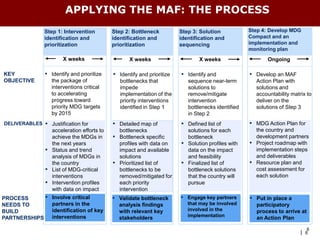
APPLYING THE MAF: THE PROCESS
               Step 1: Intervention          Step 2: Bottleneck           Step 3: Solution             Step 4: Develop MDG
               identification and            identification and           identification and           Compact and an
               prioritization                prioritization               sequencing                   implementation and
                                                                                                       monitoring plan
                        X weeks                      X weeks                      X weeks                      Ongoing

KEY            ▪ Identify and prioritize     ▪ Identify and prioritize    ▪ Identify and               ▪ Develop an MAF
OBJECTIVE          the package of                bottlenecks that             sequence near-term           Action Plan with
                   interventions critical        impede                       solutions to                 solutions and
                   to accelerating               implementation of the        remove/mitigate              accountability matrix to
                   progress toward               priority interventions       intervention                 deliver on the
                   priority MDG targets          identified in Step 1         bottlenecks identified       solutions of Step 3
                   by 2015                                                    in Step 2
DELIVERABLES   ▪ Justification for           ▪ Detailed map of            ▪ Defined list of            ▪ MDG Action Plan for
                   acceleration efforts to       bottlenecks                  solutions for each           the country and
                   achieve the MDGs in       ▪   Bottleneck specific          bottleneck                   development partners
                   the next years                profiles with data on    ▪   Solution profiles with   ▪   Project roadmap with
               ▪   Status and trend              impact and available         data on the impact           implementation steps
                   analysis of MDGs in           solutions                    and feasibility              and deliverables
                   the country               ▪   Prioritized list of      ▪   Finalized list of        ▪   Resource plan and
               ▪   List of MDG-critical          bottlenecks to be            bottleneck solutions         cost assessment for
                   interventions                 removed/mitigated for        that the country will        each solution
               ▪   Intervention profiles         each priority                pursue
                   with data on impact           intervention
PROCESS      ▪     Involve critical          ▪ Validate bottleneck        ▪   Engage key partners      ▪ Put in place a
NEEDS TO           partners in the               analysis findings            that may be involved         participatory
BUILD              identification of key         with relevant key            involved in the              process to arrive at
                   interventions                                              implementation
PARTNERSHIPS                                     stakeholders                                              an Action Plan

                                                                                                                                  6
                                                                                                                              | 6
MAF ROLLOUTS TO DATE


                       |
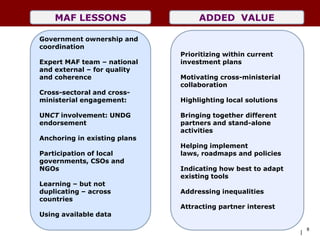
MAF LESSONS                    ADDED VALUE

Government ownership and
coordination
                              Prioritizing within current
Expert MAF team – national    investment plans
and external – for quality
and coherence                 Motivating cross-ministerial
                              collaboration
Cross-sectoral and cross-
ministerial engagement:       Highlighting local solutions

UNCT involvement: UNDG        Bringing together different
endorsement                   partners and stand-alone
                              activities
Anchoring in existing plans
                              Helping implement
Participation of local        laws, roadmaps and policies
governments, CSOs and
NGOs                          Indicating how best to adapt
                              existing tools
Learning – but not
duplicating – across          Addressing inequalities
countries
                              Attracting partner interest
Using available data

                                                                 8
                                                             |
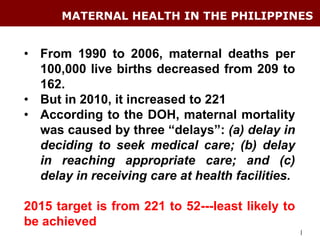
MATERNAL HEALTH IN THE PHILIPPINES


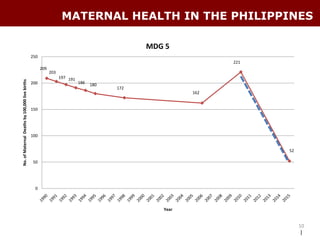
• From 1990 to 2006, maternal deaths per
  100,000 live births decreased from 209 to
  162.
• But in 2010, it increased to 221
• According to the DOH, maternal mortality
  was caused by three “delays”: (a) delay in
  deciding to seek medical care; (b) delay
  in reaching appropriate care; and (c)
  delay in receiving care at health facilities.

2015 target is from 221 to 52---least likely to
be achieved
                                                  |
MATERNAL HEALTH IN THE PHILIPPINES

                                                                                              MDG 5
                                                250
                                                                                                              221
                                                      209
                                                            203
                                                                  197 191
No. of Maternal Deaths by 100,000 live births


                                                200                         186   180
                                                                                        172
                                                                                                        162


                                                150


                                                100


                                                                                                                    52

                                                 50


                                                  0


                                                                                                 Year


                                                                                                                         10
                                                                                                                          |
MATERNAL HEALTH IN THE PHILIPPINES
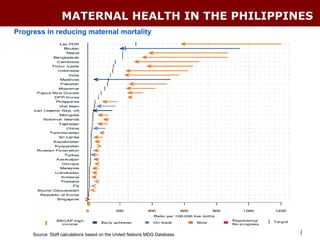
Progress in reducing maternal mortality


     Source: Staff calculations based on the United Nations MDG Database.   |
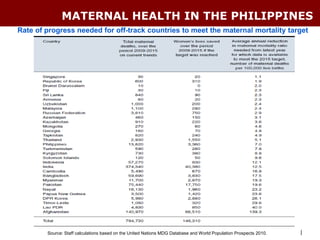
MATERNAL HEALTH IN THE PHILIPPINES
Rate of progress needed for off-track countries to meet the maternal mortality target


        Source: Staff calculations based on the United Nations MDG Database and World Population Prospects 2010.   |
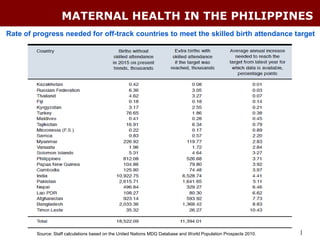
MATERNAL HEALTH IN THE PHILIPPINES
Rate of progress needed for off-track countries to meet the skilled birth attendance target


         Source: Staff calculations based on the United Nations MDG Database and World Population Prospects 2010.   |
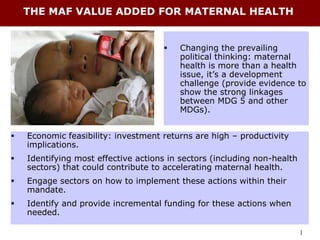
THE MAF VALUE ADDED FOR MATERNAL HEALTH


                                        Changing the prevailing
                                         political thinking: maternal
                                         health is more than a health
                                         issue, it’s a development
                                         challenge (provide evidence to
                                         show the strong linkages
                                         between MDG 5 and other
                                         MDGs).


   Economic feasibility: investment returns are high – productivity
    implications.
   Identifying most effective actions in sectors (including non-health
    sectors) that could contribute to accelerating maternal health.
   Engage sectors on how to implement these actions within their
    mandate.
   Identify and provide incremental funding for these actions when
    needed.

                                                                          |
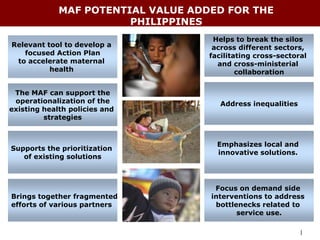
MAF POTENTIAL VALUE ADDED FOR THE
                        PHILIPPINES
                                     Helps to break the silos
Relevant tool to develop a           across different sectors,
   focused Action Plan              facilitating cross-sectoral
 to accelerate maternal               and cross-ministerial
          health                            collaboration


 The MAF can support the
 operationalization of the             Address inequalities
existing health policies and
         strategies


                                      Emphasizes local and
Supports the prioritization
                                      innovative solutions.
   of existing solutions


                                     Focus on demand side
Brings together fragmented          interventions to address
efforts of various partners          bottlenecks related to
                                           service use.

                                                              |
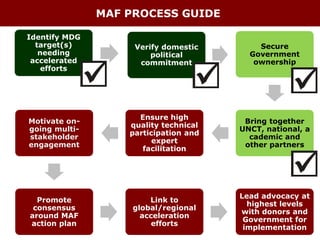
MAF PROCESS GUIDE

Identify MDG
  target(s)         Verify domestic        Secure
   needing              political        Government
 accelerated         commitment           ownership
    efforts


                     Ensure high
Motivate on-                            Bring together
                   quality technical
going multi-                           UNCT, national, a
                   participation and
stakeholder                              cademic and
                         expert
engagement                              other partners
                      facilitation


                                       Lead advocacy at
  Promote               Link to
                                         highest levels
 consensus          global/regional
                                       with donors and
around MAF            acceleration
                                        Government for
action plan              efforts
                                        implementation16
                                                      |
Thank You

            17
              © United Nations Development Programme

ANNEX B_UNDP Presentation on MAF PHL introduction

  • 1.
    MDG Acceleration Framework(MAF) in the Philippines: Reducing Maternal Mortality 21 June 2012 0 © United Nations Development Programme |
  • 2.
    OVERVIEW The global contextfor the MAF What is the MAF? Where it has been applied? The case of the Philippines on Maternal Mortality Following through: value addition and implementation | 1
  • 3.
    THE MAF: GLOBALCONTEXT ▪ The 2010 MDG Summit – Provides the evidence from the ground on what works and what doesn’t: countries know what needs to be done to achieve the MDGs, but progress in implementation is lacking or has slowed in many – Outcome document calls for an acceleration agenda for the MDGs ▪ MAF formally endorsed in 2010 by UNDG – UN Secretary-General Ban Ki-moon and UNDG Chair Helen Clark introduce it at the 2010 Summit – UNDP corporate priority – UNDG guidance to UNCTs ▪ MAF developed and tested over 2009-2010 – 14 countries and six MDGs – In 2011-2012: MAF being rolled-out in 20 countries ▪ Unlocking Progress: MDG Acceleration on the road to 2015 – Summarize and synthesize main lessons learned from the pilot phase – Growing body of country reports and experiences | 2 © United Nations Development Programme
  • 4.
    WHAT IS ACCELERATION? Achievement of 100% intermediate targets Target 80% 60% Historical trend 40% High Trajectory (solution has immediate impact) 20% Low Trajectory (solution has low Starting point impact) 0% 2000 2005 2010 2015 3 |
  • 5.
    WHAT IS THEMDG ACCELERATION FRAMEWORK? Responding to national/local political determination to tackle identified off-track MDGs Drawing upon country experiences and ongoing processes to identify and prioritize bottlenecks interfering with the implementation of key MDG interventions Using knowledge-based good practices to determine objective and feasible solutions for accelerating MDG progress Creating a partnership with identified roles for all relevant stakeholders to jointly achieve MDG progress 4 |
  • 6.
    MAF SYSTEMATIC STEPS Identify,codify the Identify solutions Implement and interventions required to to form an MDG Monitor the meet the MDG targets Country Action MDG Country Plan that aligns Action Plan to and focuses ensure required stakeholders and impact resources on accelerating MDG progress Help identify and prioritize MDG bottlenecks |
  • 7.
    APPLYING THE MAF:THE PROCESS Step 1: Intervention Step 2: Bottleneck Step 3: Solution Step 4: Develop MDG identification and identification and identification and Compact and an prioritization prioritization sequencing implementation and monitoring plan X weeks X weeks X weeks Ongoing KEY ▪ Identify and prioritize ▪ Identify and prioritize ▪ Identify and ▪ Develop an MAF OBJECTIVE the package of bottlenecks that sequence near-term Action Plan with interventions critical impede solutions to solutions and to accelerating implementation of the remove/mitigate accountability matrix to progress toward priority interventions intervention deliver on the priority MDG targets identified in Step 1 bottlenecks identified solutions of Step 3 by 2015 in Step 2 DELIVERABLES ▪ Justification for ▪ Detailed map of ▪ Defined list of ▪ MDG Action Plan for acceleration efforts to bottlenecks solutions for each the country and achieve the MDGs in ▪ Bottleneck specific bottleneck development partners the next years profiles with data on ▪ Solution profiles with ▪ Project roadmap with ▪ Status and trend impact and available data on the impact implementation steps analysis of MDGs in solutions and feasibility and deliverables the country ▪ Prioritized list of ▪ Finalized list of ▪ Resource plan and ▪ List of MDG-critical bottlenecks to be bottleneck solutions cost assessment for interventions removed/mitigated for that the country will each solution ▪ Intervention profiles each priority pursue with data on impact intervention PROCESS ▪ Involve critical ▪ Validate bottleneck ▪ Engage key partners ▪ Put in place a NEEDS TO partners in the analysis findings that may be involved participatory BUILD identification of key with relevant key involved in the process to arrive at interventions implementation PARTNERSHIPS stakeholders an Action Plan 6 | 6
  • 8.
  • 9.
    MAF LESSONS ADDED VALUE Government ownership and coordination Prioritizing within current Expert MAF team – national investment plans and external – for quality and coherence Motivating cross-ministerial collaboration Cross-sectoral and cross- ministerial engagement: Highlighting local solutions UNCT involvement: UNDG Bringing together different endorsement partners and stand-alone activities Anchoring in existing plans Helping implement Participation of local laws, roadmaps and policies governments, CSOs and NGOs Indicating how best to adapt existing tools Learning – but not duplicating – across Addressing inequalities countries Attracting partner interest Using available data 8 |
  • 10.
    MATERNAL HEALTH INTHE PHILIPPINES • From 1990 to 2006, maternal deaths per 100,000 live births decreased from 209 to 162. • But in 2010, it increased to 221 • According to the DOH, maternal mortality was caused by three “delays”: (a) delay in deciding to seek medical care; (b) delay in reaching appropriate care; and (c) delay in receiving care at health facilities. 2015 target is from 221 to 52---least likely to be achieved |
  • 11.
    MATERNAL HEALTH INTHE PHILIPPINES MDG 5 250 221 209 203 197 191 No. of Maternal Deaths by 100,000 live births 200 186 180 172 162 150 100 52 50 0 Year 10 |
  • 12.
    MATERNAL HEALTH INTHE PHILIPPINES Progress in reducing maternal mortality Source: Staff calculations based on the United Nations MDG Database. |
  • 13.
    MATERNAL HEALTH INTHE PHILIPPINES Rate of progress needed for off-track countries to meet the maternal mortality target Source: Staff calculations based on the United Nations MDG Database and World Population Prospects 2010. |
  • 14.
    MATERNAL HEALTH INTHE PHILIPPINES Rate of progress needed for off-track countries to meet the skilled birth attendance target Source: Staff calculations based on the United Nations MDG Database and World Population Prospects 2010. |
  • 15.
    THE MAF VALUEADDED FOR MATERNAL HEALTH  Changing the prevailing political thinking: maternal health is more than a health issue, it’s a development challenge (provide evidence to show the strong linkages between MDG 5 and other MDGs).  Economic feasibility: investment returns are high – productivity implications.  Identifying most effective actions in sectors (including non-health sectors) that could contribute to accelerating maternal health.  Engage sectors on how to implement these actions within their mandate.  Identify and provide incremental funding for these actions when needed. |
  • 16.
    MAF POTENTIAL VALUEADDED FOR THE PHILIPPINES Helps to break the silos Relevant tool to develop a across different sectors, focused Action Plan facilitating cross-sectoral to accelerate maternal and cross-ministerial health collaboration The MAF can support the operationalization of the Address inequalities existing health policies and strategies Emphasizes local and Supports the prioritization innovative solutions. of existing solutions Focus on demand side Brings together fragmented interventions to address efforts of various partners bottlenecks related to service use. |
  • 17.
    MAF PROCESS GUIDE IdentifyMDG target(s) Verify domestic Secure needing political Government accelerated commitment ownership efforts Ensure high Motivate on- Bring together quality technical going multi- UNCT, national, a participation and stakeholder cademic and expert engagement other partners facilitation Lead advocacy at Promote Link to highest levels consensus global/regional with donors and around MAF acceleration Government for action plan efforts implementation16 |
  • 18.
    Thank You 17 © United Nations Development Programme