Awareness and Guidance on
Investigational New Drug (IND)
and ANDA applications
Mr.B.Brahmaiah
Assistant Professor
Department of Pharmaceutical
Regulatory Affairs &
Pharmaceutics
Shri Vishnu College of Pharmacy,
Bhimavaram
• Investigational New Drug is defined
under 21 CFR 312.3(b) as ‘ a new
drug or biological drug that is used in
clinical investigation’.
• After pre-clinical investigations when
the new molecule has been screened
for pharmacological activity and acute
toxicity potential in animals the
sponsor requires permission from
FDA for its clinical trials in humans.
INVESTIGATIONAL NEW DRUG
(IND)
• The sponsor submits the application for conduct of
human clinical trials called Investigational New
Drug (IND) application to FDA or DCGI .
• Once IND application is submitted , the sponsor
must wait for 30 days before initiating any clinical
trial.
• Clinical trials in humans can begin only after IND
is reviewed by the FDA and a local institutional
review board (IRB).
• IRBs approve clinical trial protocol, informed
consent of all participants and appropriate steps to
prevent subjects from harm.
• If the FDA accepts the IND request within 30 days
of submission, clinical testing of the new molecule
on human may begin by the investigator.
• At this point, the molecule under the legal status
of FDA becomes a new drug subject to specific
requirements of drug regulatory system.
• If at any time during clinical testing, the data
furnished to FDA indicate the IP to be toxic under
the criterion of FDA’s Benefit/Risk ratio, FDA can
terminate clinical trial and its actions are not
subject to any judicial review.
The IND application must contain information in 3
broad areas:
i. Animal Pharmacology and toxicology studies-
Preclinical data to assess if the product is
reasonably safe for initial testing in humans. Also
, included are any previous with drug in humans.
ii. Manufacturing information- Information
pertaining to composition, manufacturer, stability
and controls used for manufacturing drug product
to ensure that the company can adequately
produce and supply consistent batches of the
drug.
iii. Clinical Protocol and Investigator
information
 Detailed protocols for proposed clinical
 studies to make sure subjects are not
 exposed to undue risks. Also,
information on
 the qualifications of the investigators
(chiefly
 physicians) if they fulfill their clinical
duties.
 Finally, commitments to obtain informed
 consent from all research subjects, to
obtain
 review of the study by an IRB and to
adhere
 to the investigational new drug
1. Cover sheet ( Form FDA 1571).
2. A table of contents.
3. Introductory statement and General Investigational
Plan.
4. Investigator’s Brochure.
5. Protocols.
6. Chemistry, Manufacturing and Control information.
7. Pharmacology and Toxicology Information.
8. Previous human experience with IP.
9. Additional Information.
Format and content of IND
CHART
 At any time a sponsor can withdraw an effective IND . In such a case,
FDA and IRB shall be so notified with reasons for withdrawal, all clinical
studies ended, all current investigators and subjects notified, all stocks
of drug returned to the sponsor or otherwise disposed off on request of
sponsor in accordance with 312.59.
WITHDRAWAL OF an IND
 IND has been defined under Rule 122-DA (3) of
Drugs and Cosmetics Rules 1945 as a chemical
entity having therapeutic indication but which have
never been earlier tested on humans.
 No clinical trial for new drug for any purpose be
conducted without permission , in writing, of the
Licensing Authority (DCGI).
 Application for conducting clinical trials in India
require submission by the sponsor on Form 44
along with requisite fee (Rs 50k) and documents
as provided under Schedule Y to Drugs and
Cosmetics Act 1940.
IND PROCESS IN INDIA
Data to be submitted along with the
application on Form44 to conduct
clinical trials (2 hard copies and 2 soft
copies i.e., CDs in PDF format)
1. Application on Form 44
2. Introduction of the drug
3. Fee Rs 50K through challan form
4. Chemical and Pharmaceutical
information as per Appendix I of
Schedule Y
5. Animal Pharmacology as per
Appendix IV
6. Animal Toxicology as per Appendix III
7. Human/Clinical Pharmacology data
as per Appendix I
8. Regulatory status in other countries
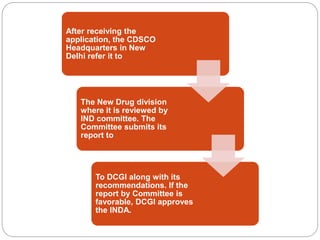
After receiving the
application, the CDSCO
Headquarters in New
Delhi refer it to
The New Drug division
where it is reviewed by
IND committee. The
Committee submits its
report to
To DCGI along with its
recommendations. If the
report by Committee is
favorable, DCGI approves
the INDA.
 It takes 4-6 months for the approval but it is not
documented. The Ethical Committee also requires
1-3 months time. Thus , it almost takes 7-9 months
for approval of INDA from DCGI.
 For international applicants, import license to
import IP samples and permission from Director
General Foreign Trade to export blood samples is
also needed.
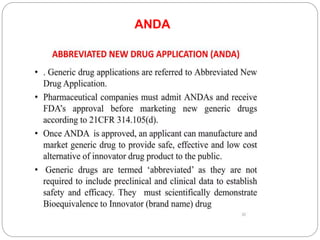
ANDA
“A drug product that is comparable to a brand/reference listed drug product in
dosage form, strength, route of administration, quality and performance
characteristics, and intended use”
It termed "abbreviated" because they generally not required to include
preclinical (animal) and clinical (human) data to establish safety and
effectiveness.
Basic Generic Drug Requirements are:--
 Same active ingredient(s)
 Same route of administration
 Same dosage form
 Same strength
 Same conditions of use
 Inactive ingredients already approved in a similar NDA
19
ANDA
 To reduce the price of the drug.
 To reduce the time development.
 Increase the bioavailability of the drug in
comparison to references list drug.
20
Goal of ANDA
22
ANDA Review process
NDA vs. ANDA Review
Process
NDA Requirement ANDA Requirement
23
A generic drug is considered to be
bioequivalent to the brand name drug if:
 The rate and extent of absorption do not
show a significant difference from listed
drug, or
 The extent of absorption does not show a
significant difference and any difference in
rate is intentional or not medically
significant
24
What is Bioequivalence?
NDA ANDA
Applicable for new
drug
Applicable for generic
drug
Take longer time ( 12-
15 years)
Compare to NAD less
time taken(1-2 years)
More expenditure of
money
Comparatively less
Cost of drugs are more Cost of drugs are less
Nonclinical studies and
clinical investigations
are essential
Nonclinical studies and
clinical investigations
are nonessential
except bioavailability
and bioequivalence
29
CONCLUSION
Thank You
30

2.IND AND ANDA.pptx

  • 1.
    Awareness and Guidanceon Investigational New Drug (IND) and ANDA applications Mr.B.Brahmaiah Assistant Professor Department of Pharmaceutical Regulatory Affairs & Pharmaceutics Shri Vishnu College of Pharmacy, Bhimavaram
  • 4.
    • Investigational NewDrug is defined under 21 CFR 312.3(b) as ‘ a new drug or biological drug that is used in clinical investigation’. • After pre-clinical investigations when the new molecule has been screened for pharmacological activity and acute toxicity potential in animals the sponsor requires permission from FDA for its clinical trials in humans. INVESTIGATIONAL NEW DRUG (IND)
  • 5.
    • The sponsorsubmits the application for conduct of human clinical trials called Investigational New Drug (IND) application to FDA or DCGI . • Once IND application is submitted , the sponsor must wait for 30 days before initiating any clinical trial. • Clinical trials in humans can begin only after IND is reviewed by the FDA and a local institutional review board (IRB). • IRBs approve clinical trial protocol, informed consent of all participants and appropriate steps to prevent subjects from harm.
  • 6.
    • If theFDA accepts the IND request within 30 days of submission, clinical testing of the new molecule on human may begin by the investigator. • At this point, the molecule under the legal status of FDA becomes a new drug subject to specific requirements of drug regulatory system. • If at any time during clinical testing, the data furnished to FDA indicate the IP to be toxic under the criterion of FDA’s Benefit/Risk ratio, FDA can terminate clinical trial and its actions are not subject to any judicial review.
  • 8.
    The IND applicationmust contain information in 3 broad areas: i. Animal Pharmacology and toxicology studies- Preclinical data to assess if the product is reasonably safe for initial testing in humans. Also , included are any previous with drug in humans. ii. Manufacturing information- Information pertaining to composition, manufacturer, stability and controls used for manufacturing drug product to ensure that the company can adequately produce and supply consistent batches of the drug.
  • 9.
    iii. Clinical Protocoland Investigator information  Detailed protocols for proposed clinical  studies to make sure subjects are not  exposed to undue risks. Also, information on  the qualifications of the investigators (chiefly  physicians) if they fulfill their clinical duties.  Finally, commitments to obtain informed  consent from all research subjects, to obtain  review of the study by an IRB and to adhere  to the investigational new drug
  • 10.
    1. Cover sheet( Form FDA 1571). 2. A table of contents. 3. Introductory statement and General Investigational Plan. 4. Investigator’s Brochure. 5. Protocols. 6. Chemistry, Manufacturing and Control information. 7. Pharmacology and Toxicology Information. 8. Previous human experience with IP. 9. Additional Information. Format and content of IND
  • 12.
  • 13.
     At anytime a sponsor can withdraw an effective IND . In such a case, FDA and IRB shall be so notified with reasons for withdrawal, all clinical studies ended, all current investigators and subjects notified, all stocks of drug returned to the sponsor or otherwise disposed off on request of sponsor in accordance with 312.59. WITHDRAWAL OF an IND
  • 14.
     IND hasbeen defined under Rule 122-DA (3) of Drugs and Cosmetics Rules 1945 as a chemical entity having therapeutic indication but which have never been earlier tested on humans.  No clinical trial for new drug for any purpose be conducted without permission , in writing, of the Licensing Authority (DCGI).  Application for conducting clinical trials in India require submission by the sponsor on Form 44 along with requisite fee (Rs 50k) and documents as provided under Schedule Y to Drugs and Cosmetics Act 1940. IND PROCESS IN INDIA
  • 15.
    Data to besubmitted along with the application on Form44 to conduct clinical trials (2 hard copies and 2 soft copies i.e., CDs in PDF format) 1. Application on Form 44 2. Introduction of the drug 3. Fee Rs 50K through challan form 4. Chemical and Pharmaceutical information as per Appendix I of Schedule Y 5. Animal Pharmacology as per Appendix IV 6. Animal Toxicology as per Appendix III 7. Human/Clinical Pharmacology data as per Appendix I 8. Regulatory status in other countries
  • 16.
    After receiving the application,the CDSCO Headquarters in New Delhi refer it to The New Drug division where it is reviewed by IND committee. The Committee submits its report to To DCGI along with its recommendations. If the report by Committee is favorable, DCGI approves the INDA.
  • 17.
     It takes4-6 months for the approval but it is not documented. The Ethical Committee also requires 1-3 months time. Thus , it almost takes 7-9 months for approval of INDA from DCGI.  For international applicants, import license to import IP samples and permission from Director General Foreign Trade to export blood samples is also needed.
  • 18.
  • 19.
    “A drug productthat is comparable to a brand/reference listed drug product in dosage form, strength, route of administration, quality and performance characteristics, and intended use” It termed "abbreviated" because they generally not required to include preclinical (animal) and clinical (human) data to establish safety and effectiveness. Basic Generic Drug Requirements are:--  Same active ingredient(s)  Same route of administration  Same dosage form  Same strength  Same conditions of use  Inactive ingredients already approved in a similar NDA 19 ANDA
  • 20.
     To reducethe price of the drug.  To reduce the time development.  Increase the bioavailability of the drug in comparison to references list drug. 20 Goal of ANDA
  • 22.
  • 23.
    NDA vs. ANDAReview Process NDA Requirement ANDA Requirement 23
  • 24.
    A generic drugis considered to be bioequivalent to the brand name drug if:  The rate and extent of absorption do not show a significant difference from listed drug, or  The extent of absorption does not show a significant difference and any difference in rate is intentional or not medically significant 24 What is Bioequivalence?
  • 29.
    NDA ANDA Applicable fornew drug Applicable for generic drug Take longer time ( 12- 15 years) Compare to NAD less time taken(1-2 years) More expenditure of money Comparatively less Cost of drugs are more Cost of drugs are less Nonclinical studies and clinical investigations are essential Nonclinical studies and clinical investigations are nonessential except bioavailability and bioequivalence 29 CONCLUSION
  • 30.