Equipment operation of size reduction
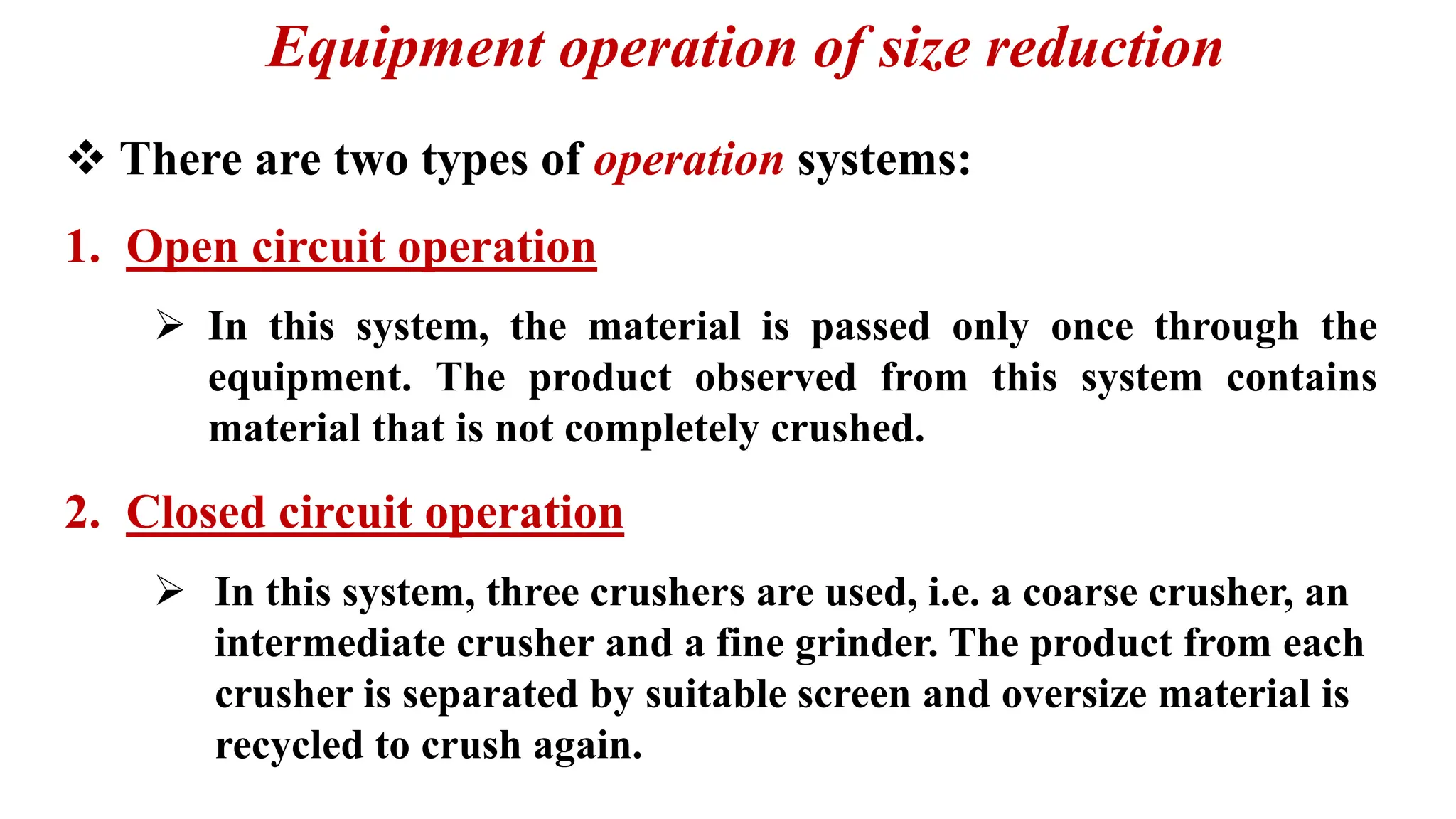
❖ There are two types of operation systems:
1. Open circuit operation
➢ In this system, the material is passed only once through the
equipment. The product observed from this system contains
material that is not completely crushed.
2. Closed circuit operation
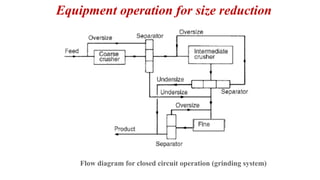
➢ In this system, three crushers are used, i.e. a coarse crusher, an
intermediate crusher and a fine grinder. The product from each
crusher is separated by suitable screen and oversize material is
recycled to crush again.
Equipment operation for size reduction
Flow diagram for closed circuit operation (grinding system)
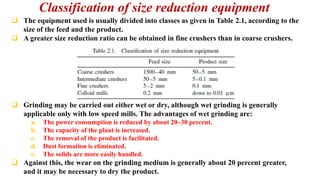
Classification of size reduction equipment
❑ The equipment used is usually divided into classes as given in Table 2.1, according to the
size of the feed and the product.
❑ A greater size reduction ratio can be obtained in fine crushers than in coarse crushers.
❑ Grinding may be carried out either wet or dry, although wet grinding is generally
applicable only with low speed mills. The advantages of wet grinding are:
a. The power consumption is reduced by about 20–30 percent.
b. The capacity of the plant is increased.
c. The removal of the product is facilitated.
d. Dust formation is eliminated.
e. The solids are more easily handled.
❑ Against this, the wear on the grinding medium is generally about 20 percent greater,
and it may be necessary to dry the product.
Factors affecting size reduction
1) Hardness
▪ It is a surface property of the material.
▪ The hardness of the material affects the power consumption and the wear on the
machine.
▪ It is necessary to use a low-speed machine with hard and abrasive materials.
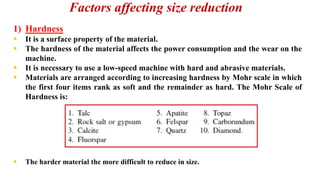
▪ Materials are arranged according to increasing hardness by Mohr scale in which
the first four items rank as soft and the remainder as hard. The Mohr Scale of
Hardness is:
▪ The harder material the more difficult to reduce in size.
Factors affecting size reduction
2) Structure:
➢ Normal granular materials such as coal, ores and rocks can be effectively crushed
employing the normal forces of compression, impact, and so on. With fibrous
materials a tearing action is required.
3) Moisture content:
➢ It is found that materials do not flow well if they contain between about 5 and 50
percent of moisture. Under these conditions the material tends to cake together in the
form of balls. In general, grinding can be carried out satisfactorily outside these limits.
4) Crushing strength:
➢ The power required for crushing is almost directly proportional to the crushing
strength of the material.
5) Softening temperature:
➢ During size reduction process sometimes heat is generated which may cause some
substances to soften, and the temperature at which this occurs can be important.
Waxy substances, such as stearic acid, or drugs containing oils or fats are examples
that may be affected.
➢ Some methods can be used to overcome this like cooling the mill, either by a water
jacket or by passing a stream of air through the equipment.
Factors affecting size reduction
6) Friability
➢ The friability of the material is its tendency to fracture during normal handling. In
general, a crystalline material will break along well-defined planes and the power
required for crushing will increase as the particle size is reduced.
7) Stickiness
➢ A sticky material will tend to clog the grinding equipment and it should therefore be
ground in a place that can be cleaned easily.
8) Soapiness
➢ In general, this is a measure of the coefficient of friction of the surface of the material.
If the coefficient of friction is low, the crushing may be more difficult.
9) Explosive materials
➢ Such materials must be ground wet or in the presence of an inert atmosphere.
10) Materials yielding dusts
➢ Such materials are harmful to the health and must be ground under conditions where
the dust is not allowed to escape.
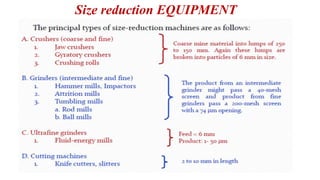
Size reduction EQUIPMENT
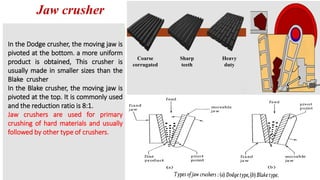
Jaw crusher
In the Dodge crusher, the moving jaw is
pivoted at the bottom. a more uniform
product is obtained, This crusher is
usually made in smaller sizes than the
Blake crusher
In the Blake crusher, the moving jaw is
pivoted at the top. It is commonly used
and the reduction ratio is 8:1.
Jaw crushers are used for primary
crushing of hard materials and usually
followed by other type of crushers.
Coarse
corrugated
Sharp
teeth
Heavy
duty
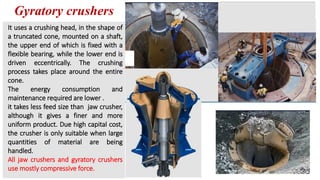
Gyratory crushers
It uses a crushing head, in the shape of
a truncated cone, mounted on a shaft,
the upper end of which is fixed with a
flexible bearing, while the lower end is
driven eccentrically. The crushing
process takes place around the entire
cone.
The energy consumption and
maintenance required are lower .
it takes less feed size than jaw crusher,
although it gives a finer and more
uniform product. Due high capital cost,
the crusher is only suitable when large
quantities of material are being
handled.
All jaw crushers and gyratory crushers
use mostly compressive force.
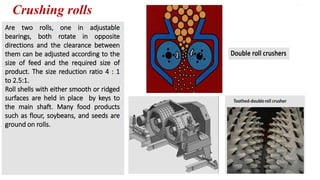
Crushing rolls
Are two rolls, one in adjustable
bearings, both rotate in opposite
directions and the clearance between
them can be adjusted according to the
size of feed and the required size of
product. The size reduction ratio 4 : 1
to 2.5:1.
Roll shells with either smooth or ridged
surfaces are held in place by keys to
the main shaft. Many food products
such as flour, soybeans, and seeds are
ground on rolls.
Crushing rolls
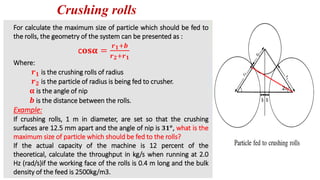
For calculate the maximum size of particle which should be fed to
the rolls, the geometry of the system can be presented as :
Where:
𝒓𝟏 is the crushing rolls of radius
𝒓𝟐 is the particle of radius is being fed to crusher.
𝛂 is the angle of nip
𝒃 is the distance between the rolls.
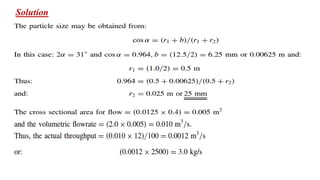
Example:
If crushing rolls, 1 m in diameter, are set so that the crushing
surfaces are 12.5 mm apart and the angle of nip is 𝟑𝟏𝒐
, what is the
maximum size of particle which should be fed to the rolls?
If the actual capacity of the machine is 12 percent of the
theoretical, calculate the throughput in kg/s when running at 2.0
Hz (rad/s)if the working face of the rolls is 0.4 m long and the bulk
density of the feed is 2500kg/m3.
c𝐨𝐬𝛂 =
𝒓𝟏+𝒃
𝒓𝟐+𝒓𝟏
2
Solution
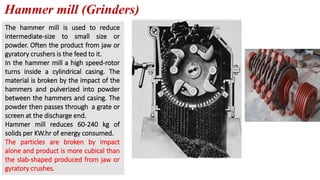
Hammer mill (Grinders)
The hammer mill is used to reduce
intermediate-size to small size or
powder. Often the product from jaw or
gyratory crushers is the feed to it.
In the hammer mill a high speed-rotor
turns inside a cylindrical casing. The
material is broken by the impact of the
hammers and pulverized into powder
between the hammers and casing. The
powder then passes through a grate or
screen at the discharge end.
Hammer mill reduces 60-240 kg of
solids per KW.hr of energy consumed.
The particles are broken by impact
alone and product is more cubical than
the slab-shaped produced from jaw or
gyratory crushes.
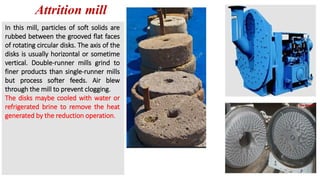
Attrition mill
In this mill, particles of soft solids are
rubbed between the grooved flat faces
of rotating circular disks. The axis of the
disks is usually horizontal or sometime
vertical. Double-runner mills grind to
finer products than single-runner mills
but process softer feeds. Air blew
through the mill to prevent clogging.
The disks maybe cooled with water or
refrigerated brine to remove the heat
generated by the reduction operation.
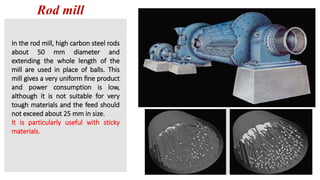
Rod mill
In the rod mill, high carbon steel rods
about 50 mm diameter and
extending the whole length of the
mill are used in place of balls. This
mill gives a very uniform fine product
and power consumption is low,
although it is not suitable for very
tough materials and the feed should
not exceed about 25 mm in size.
It is particularly useful with sticky
materials.
Ball mill (tumbling mill)
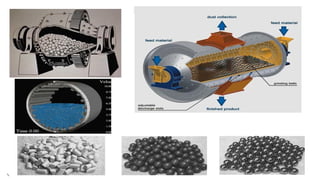
❑ The ball mill consists of a rotating hollow cylinder, partially filled with balls, with its axis
either horizontal or at a small angle to the horizontal.
❑ The outlet is normally covered with a coarse screen to prevent the escape of the balls.
❑ The inner surface of the cylinder is usually lined with an abrasion-resistant material
such as manganese steel, stoneware or rubber.
❑ The ball mill is used for the grinding of a wide range of materials, including coal,
pigments, and felspar for pottery, and it copes with feed up to about 50 mm in size.
❑ The balls are usually made of flint or steel and occupy between 30 and 50 % of the
volume of the mill.
❑ The diameter of ball used will vary between 12 mm and 125 mm whereas the shell in a
large ball mill might be 3 m in diameter and 4.25 m long.
❑ The optimum diameter is proportional to the square root of the size of the feed, with the
proportionality constant being a function of the nature of the material.
❑ During grinding, the balls wear and are constantly replaced by new ones so that the mill
contains balls of various ages, and hence of various sizes.
Ball mill
❑ The maximum rate of wear of steel balls, using very abrasive materials, is about 0.3
kg/ton of material for dry grinding, and 1–1.5 kg/ton for wet grinding. The normal
charge of balls is about 5 ton/m3.
❑ In small mills where very fine grinding is required, pebbles are often used in place of
balls.
❑ For economical consideration, the cylinder is divided into a number of compartments
by vertical perforated plates; the material flows axially along the mill and can pass
from one compartment to the next only when its size has been reduced to less than
that of the perforations in the plate.
❑ Each compartment is supplied with balls of a different size; the large balls are at the
entry end and thus operate on the feed material, whilst the small balls come into
contact with the material immediately before it is discharged.
❑ This arrangement gives a uniform product with short residence time distribution for
the material.
Ball mill
Optimum speed of rotation:
In general, little crushing action is obtained at low speeds of rotation since the balls
simply roll over one another. However, higher speeds are unfavorable also since the
balls round in contact with the sides of the mill and little grinding takes place again.
The minimum speed at which the balls round in this manner is called critical speed
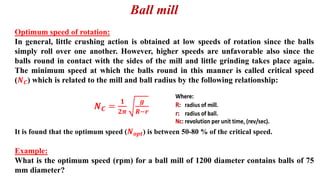
(𝑵𝑪) which is related to the mill and ball radius by the following relationship:
𝑵𝑪 =
𝟏
𝟐𝝅
𝒈
𝑹−𝒓
It is found that the optimum speed (𝑵𝒐𝒑𝒕) is between 50-80 % of the critical speed.
Example:
What is the optimum speed (rpm) for a ball mill of 1200 diameter contains balls of 75
mm diameter?
Factors influencing the size of the product
▪ The rate of feed
✓ High rates of feed results in less size reduction.
▪ The properties of the feed material.
✓ A smaller size reduction is obtained with a hard material.
▪ Weight of balls.
✓ A heavy charge of balls produces a fine product.
▪ The diameter of the balls.
✓ Small balls facilitate the production of fine material.
▪ The slope of the mill.
✓ An increase in the slope of the mill increases the capacity of the plant because the retention
time is reduced, although a coarser product is obtained.
▪ Discharge freedom.
✓ Increasing the freedom of discharge of the product has the same effect as increasing the slope.
▪ The speed of rotation of the mill.
✓ At low speeds of rotation, the balls simply roll over one another and little crushing action is
obtained.
▪ The level of material in the mill.
✓ Power consumption is reduced by maintaining a low level of material in the mill, and this can
be controlled most satisfactorily by fitting a suitable discharge opening for the product.
Advantages of the ball mill
▪ The mill may be used wet or dry although wet grinding facilitates the
removal of the product.
▪ The costs of installation and power are low.
▪ The ball mill may be used with an inert atmosphere and therefore can be
used for the grinding of explosive materials.
▪ The grinding medium is cheap.
▪ The mill is suitable for materials of all degrees of hardness.
▪ It may be used for batch or continuous operation.
▪ It may be used for open or closed circuit grinding.
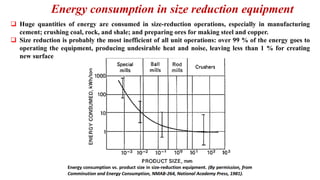
Energy consumption in size reduction equipment
❑ Huge quantities of energy are consumed in size-reduction operations, especially in manufacturing
cement; crushing coal, rock, and shale; and preparing ores for making steel and copper.
❑ Size reduction is probably the most inefficient of all unit operations: over 99 % of the energy goes to
operating the equipment, producing undesirable heat and noise, leaving less than 1 % for creating
new surface
Problem 3
A ball-mill 1.2 m in diameter is run at 0.8 Hz and it is found that the mill is not
working satisfactorily. Should any modification in the condition of operation be
suggested?

Lect 9-Seperation Process 1 Dr. ALI AL-SHATRI .pdf

  • 1.
    Equipment operation ofsize reduction ❖ There are two types of operation systems: 1. Open circuit operation ➢ In this system, the material is passed only once through the equipment. The product observed from this system contains material that is not completely crushed. 2. Closed circuit operation ➢ In this system, three crushers are used, i.e. a coarse crusher, an intermediate crusher and a fine grinder. The product from each crusher is separated by suitable screen and oversize material is recycled to crush again.
  • 2.
    Equipment operation forsize reduction Flow diagram for closed circuit operation (grinding system)
  • 3.
    Classification of sizereduction equipment ❑ The equipment used is usually divided into classes as given in Table 2.1, according to the size of the feed and the product. ❑ A greater size reduction ratio can be obtained in fine crushers than in coarse crushers. ❑ Grinding may be carried out either wet or dry, although wet grinding is generally applicable only with low speed mills. The advantages of wet grinding are: a. The power consumption is reduced by about 20–30 percent. b. The capacity of the plant is increased. c. The removal of the product is facilitated. d. Dust formation is eliminated. e. The solids are more easily handled. ❑ Against this, the wear on the grinding medium is generally about 20 percent greater, and it may be necessary to dry the product.
  • 4.
    Factors affecting sizereduction 1) Hardness ▪ It is a surface property of the material. ▪ The hardness of the material affects the power consumption and the wear on the machine. ▪ It is necessary to use a low-speed machine with hard and abrasive materials. ▪ Materials are arranged according to increasing hardness by Mohr scale in which the first four items rank as soft and the remainder as hard. The Mohr Scale of Hardness is: ▪ The harder material the more difficult to reduce in size.
  • 5.
    Factors affecting sizereduction 2) Structure: ➢ Normal granular materials such as coal, ores and rocks can be effectively crushed employing the normal forces of compression, impact, and so on. With fibrous materials a tearing action is required. 3) Moisture content: ➢ It is found that materials do not flow well if they contain between about 5 and 50 percent of moisture. Under these conditions the material tends to cake together in the form of balls. In general, grinding can be carried out satisfactorily outside these limits. 4) Crushing strength: ➢ The power required for crushing is almost directly proportional to the crushing strength of the material. 5) Softening temperature: ➢ During size reduction process sometimes heat is generated which may cause some substances to soften, and the temperature at which this occurs can be important. Waxy substances, such as stearic acid, or drugs containing oils or fats are examples that may be affected. ➢ Some methods can be used to overcome this like cooling the mill, either by a water jacket or by passing a stream of air through the equipment.
  • 6.
    Factors affecting sizereduction 6) Friability ➢ The friability of the material is its tendency to fracture during normal handling. In general, a crystalline material will break along well-defined planes and the power required for crushing will increase as the particle size is reduced. 7) Stickiness ➢ A sticky material will tend to clog the grinding equipment and it should therefore be ground in a place that can be cleaned easily. 8) Soapiness ➢ In general, this is a measure of the coefficient of friction of the surface of the material. If the coefficient of friction is low, the crushing may be more difficult. 9) Explosive materials ➢ Such materials must be ground wet or in the presence of an inert atmosphere. 10) Materials yielding dusts ➢ Such materials are harmful to the health and must be ground under conditions where the dust is not allowed to escape.
  • 7.
  • 8.
    Jaw crusher In theDodge crusher, the moving jaw is pivoted at the bottom. a more uniform product is obtained, This crusher is usually made in smaller sizes than the Blake crusher In the Blake crusher, the moving jaw is pivoted at the top. It is commonly used and the reduction ratio is 8:1. Jaw crushers are used for primary crushing of hard materials and usually followed by other type of crushers. Coarse corrugated Sharp teeth Heavy duty
  • 9.
    Gyratory crushers It usesa crushing head, in the shape of a truncated cone, mounted on a shaft, the upper end of which is fixed with a flexible bearing, while the lower end is driven eccentrically. The crushing process takes place around the entire cone. The energy consumption and maintenance required are lower . it takes less feed size than jaw crusher, although it gives a finer and more uniform product. Due high capital cost, the crusher is only suitable when large quantities of material are being handled. All jaw crushers and gyratory crushers use mostly compressive force.
  • 10.
    Crushing rolls Are tworolls, one in adjustable bearings, both rotate in opposite directions and the clearance between them can be adjusted according to the size of feed and the required size of product. The size reduction ratio 4 : 1 to 2.5:1. Roll shells with either smooth or ridged surfaces are held in place by keys to the main shaft. Many food products such as flour, soybeans, and seeds are ground on rolls.
  • 11.
    Crushing rolls For calculatethe maximum size of particle which should be fed to the rolls, the geometry of the system can be presented as : Where: 𝒓𝟏 is the crushing rolls of radius 𝒓𝟐 is the particle of radius is being fed to crusher. 𝛂 is the angle of nip 𝒃 is the distance between the rolls. Example: If crushing rolls, 1 m in diameter, are set so that the crushing surfaces are 12.5 mm apart and the angle of nip is 𝟑𝟏𝒐 , what is the maximum size of particle which should be fed to the rolls? If the actual capacity of the machine is 12 percent of the theoretical, calculate the throughput in kg/s when running at 2.0 Hz (rad/s)if the working face of the rolls is 0.4 m long and the bulk density of the feed is 2500kg/m3. c𝐨𝐬𝛂 = 𝒓𝟏+𝒃 𝒓𝟐+𝒓𝟏 2
  • 12.
  • 13.
    Hammer mill (Grinders) Thehammer mill is used to reduce intermediate-size to small size or powder. Often the product from jaw or gyratory crushers is the feed to it. In the hammer mill a high speed-rotor turns inside a cylindrical casing. The material is broken by the impact of the hammers and pulverized into powder between the hammers and casing. The powder then passes through a grate or screen at the discharge end. Hammer mill reduces 60-240 kg of solids per KW.hr of energy consumed. The particles are broken by impact alone and product is more cubical than the slab-shaped produced from jaw or gyratory crushes.
  • 14.
    Attrition mill In thismill, particles of soft solids are rubbed between the grooved flat faces of rotating circular disks. The axis of the disks is usually horizontal or sometime vertical. Double-runner mills grind to finer products than single-runner mills but process softer feeds. Air blew through the mill to prevent clogging. The disks maybe cooled with water or refrigerated brine to remove the heat generated by the reduction operation.
  • 15.
    Rod mill In therod mill, high carbon steel rods about 50 mm diameter and extending the whole length of the mill are used in place of balls. This mill gives a very uniform fine product and power consumption is low, although it is not suitable for very tough materials and the feed should not exceed about 25 mm in size. It is particularly useful with sticky materials.
  • 16.
    Ball mill (tumblingmill) ❑ The ball mill consists of a rotating hollow cylinder, partially filled with balls, with its axis either horizontal or at a small angle to the horizontal. ❑ The outlet is normally covered with a coarse screen to prevent the escape of the balls. ❑ The inner surface of the cylinder is usually lined with an abrasion-resistant material such as manganese steel, stoneware or rubber. ❑ The ball mill is used for the grinding of a wide range of materials, including coal, pigments, and felspar for pottery, and it copes with feed up to about 50 mm in size. ❑ The balls are usually made of flint or steel and occupy between 30 and 50 % of the volume of the mill. ❑ The diameter of ball used will vary between 12 mm and 125 mm whereas the shell in a large ball mill might be 3 m in diameter and 4.25 m long. ❑ The optimum diameter is proportional to the square root of the size of the feed, with the proportionality constant being a function of the nature of the material. ❑ During grinding, the balls wear and are constantly replaced by new ones so that the mill contains balls of various ages, and hence of various sizes.
  • 17.
    Ball mill ❑ Themaximum rate of wear of steel balls, using very abrasive materials, is about 0.3 kg/ton of material for dry grinding, and 1–1.5 kg/ton for wet grinding. The normal charge of balls is about 5 ton/m3. ❑ In small mills where very fine grinding is required, pebbles are often used in place of balls. ❑ For economical consideration, the cylinder is divided into a number of compartments by vertical perforated plates; the material flows axially along the mill and can pass from one compartment to the next only when its size has been reduced to less than that of the perforations in the plate. ❑ Each compartment is supplied with balls of a different size; the large balls are at the entry end and thus operate on the feed material, whilst the small balls come into contact with the material immediately before it is discharged. ❑ This arrangement gives a uniform product with short residence time distribution for the material.
  • 19.
    Ball mill Optimum speedof rotation: In general, little crushing action is obtained at low speeds of rotation since the balls simply roll over one another. However, higher speeds are unfavorable also since the balls round in contact with the sides of the mill and little grinding takes place again. The minimum speed at which the balls round in this manner is called critical speed (𝑵𝑪) which is related to the mill and ball radius by the following relationship: 𝑵𝑪 = 𝟏 𝟐𝝅 𝒈 𝑹−𝒓 It is found that the optimum speed (𝑵𝒐𝒑𝒕) is between 50-80 % of the critical speed. Example: What is the optimum speed (rpm) for a ball mill of 1200 diameter contains balls of 75 mm diameter?
  • 20.
    Factors influencing thesize of the product ▪ The rate of feed ✓ High rates of feed results in less size reduction. ▪ The properties of the feed material. ✓ A smaller size reduction is obtained with a hard material. ▪ Weight of balls. ✓ A heavy charge of balls produces a fine product. ▪ The diameter of the balls. ✓ Small balls facilitate the production of fine material. ▪ The slope of the mill. ✓ An increase in the slope of the mill increases the capacity of the plant because the retention time is reduced, although a coarser product is obtained. ▪ Discharge freedom. ✓ Increasing the freedom of discharge of the product has the same effect as increasing the slope. ▪ The speed of rotation of the mill. ✓ At low speeds of rotation, the balls simply roll over one another and little crushing action is obtained. ▪ The level of material in the mill. ✓ Power consumption is reduced by maintaining a low level of material in the mill, and this can be controlled most satisfactorily by fitting a suitable discharge opening for the product.
  • 21.
    Advantages of theball mill ▪ The mill may be used wet or dry although wet grinding facilitates the removal of the product. ▪ The costs of installation and power are low. ▪ The ball mill may be used with an inert atmosphere and therefore can be used for the grinding of explosive materials. ▪ The grinding medium is cheap. ▪ The mill is suitable for materials of all degrees of hardness. ▪ It may be used for batch or continuous operation. ▪ It may be used for open or closed circuit grinding.
  • 22.
    Energy consumption insize reduction equipment ❑ Huge quantities of energy are consumed in size-reduction operations, especially in manufacturing cement; crushing coal, rock, and shale; and preparing ores for making steel and copper. ❑ Size reduction is probably the most inefficient of all unit operations: over 99 % of the energy goes to operating the equipment, producing undesirable heat and noise, leaving less than 1 % for creating new surface
  • 23.
    Problem 3 A ball-mill1.2 m in diameter is run at 0.8 Hz and it is found that the mill is not working satisfactorily. Should any modification in the condition of operation be suggested?