Shifting Gears Options for Transitional Housing Kay Moshier McDivitt Lancaster County Coalition to End Homelessness 150 North Queen Street, Suite 610 Lancaster, PA  17603 717-735-8485 [email_address] 1
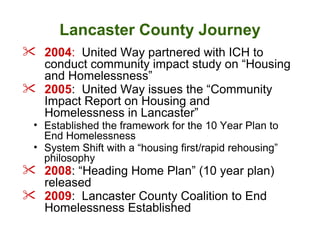
Lancaster County Journey 2004 :  United Way partnered with ICH to conduct community impact study on “Housing and Homelessness” 2005 :  United Way issues the “Community Impact Report on Housing and Homelessness in Lancaster” Established the framework for the 10 Year Plan to End Homelessness System Shift with a “housing first/rapid rehousing” philosophy 2008 :  “Heading Home Plan” (10 year plan) released 2009 :  Lancaster County Coalition to End Homelessness Established
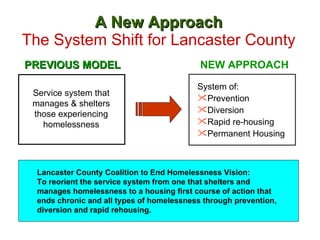
A New Approach The System Shift for Lancaster County PREVIOUS MODEL Service system that manages & shelters those experiencing homelessness NEW APPROACH System of: Prevention Diversion Rapid re-housing Permanent Housing Lancaster County Coalition to End Homelessness Vision:  To reorient the service system from one that shelters and manages homelessness to a housing first course of action that ends chronic and all types of homelessness through prevention, diversion and rapid rehousing.
Shifting Gears – Options for Transitional Housing   Lancaster Co. PA’s Journey Defining the Emergency and Transitional Shelter System:   “ Through coordinated and integrated services with standard measures of success and best practices for all providers of transitional housing, Lancaster County  will reduce the length of stay the individuals and families spend in transitional housing and increase the number of individuals and families rapidly moved to permanent housing .” 4
Shifting Gears – Options for Transitional Housing   Lancaster Co. PA’s Journey System Wide Benchmark Established 2009 to reduce the length of stay 70% of all households in Transitional Housing will move to a permanent housing placement in less than 6 months TH providers involved in establishing the benchmark 5
Lancaster County Experience (where our journey took us) Shortened Length of Stay to Permanent Housing 2005 54 Room Long Term Transitional Housing Program with mandated minimum of 6 months intensive program services Length of stay up to 2 years with 35% “graduation” rate Current Transitioned to a “rapid exit” model  Average length of stay from 12+ months to 105 days Length of stay not program or participation driven Determined by individual housing plan to find permanent housing, not by program “requirements”  Developed service partnerships to provide the supportive services and housing stabilization services Less dependence on the program 6
Strategic Planning Process (but don’t take too long) Identifies possible options Model type, target populations, staffing configurations, partnerships, merging  Identifies issues to be considered barriers and solutions, staff, board and funding concerns, population served, new outcome measurements Identifies questions you want answered Feasibility, community buy-in, where we get the housing Identifies a final recommendation and an implementation plan How to “roll out” the conversion 7
Shifting Gears   Strategic Planning Process The vision drives the process Set clear steps and goals Evaluate your current program Analyze your research and data Final Goal:  Identify the model/blueprint for your rapid exit approach 8
Evaluate the program: What we found “ Program” requirements created barriers  Many households exited for non participation with mandatory services Trying to be “all” to “all issues” Creating a “cycle of dependency” Folks asking to come back even after program completion to access services 9
Create the Vision The result we want is: Successful move to a permanent solution in the shortest amount of time with households connected to resources and services that can support them outside the facility 10
Shifting Gears “Rethinking and Redefining” Switch from a “housing readiness” approach to “rapid exit” approach Shift from “what you need to do to stay here successfully” to “what you need to leave here quickly and successfully” Role of staff shifts to focus on immediate housing plan to engage participants in finding housing and wrap around services for permanent housing Redefining of “who we are” and “how we do business”-a paradigm shift 11
Shifting Gears   Create the conversion model Incorporate the “Rapid Exit Approach” into your mission statement Proposed organizational structure Develop a program flow chart Identify staffing and training needs Identify the community partnerships, collaborations and resources needed Proposed budget/funding adjustments Develop a clear communication plan  12
Rethinking Your Program  Implementation And Evaluation Plan Identify clear targets for implementation  Plan and schedule necessary training Meet with identified service providers  MOU’s identify role and responsibility of each providers Develop a plan to shift organizational culture Develop clear communication plan  Set outcome targets with quarterly reviews, adjust program accordingly (# housed, shorten length of stay, # retaining housing) 13
Shifting Gears Staff Preparation Reframe “change” as a move to “new opportunities”  Focus on “moving folks to housing more quickly” Have a small “forum” for staff Bring peers in from other organizations that have transitioned to a Rapid Exit approach Allow opportunities for open dialogue Map out the Rapid Exit strategy and how it will work in your program (process mapping) Deliver the message that this is the direction your organization going 14
Shifting Gears Consumer shift Key Concepts Give a sense of urgency when clients walk in the door  Focus on moving out instead of moving in Offer training/groups that directly correlate to obtaining and maintaining housing Set firm boundaries and make them clear up front Give them realistic housing options 15
Shifting Gears   Partnerships-Key Elements Identify the housing stabilization services to leverage types of services currently provided in the program (budgeting, parenting, mental health, d&a, employment skills, life skills,) that can be “wrapped around” Where will we get the housing Who has experience in housing procurement Landlord engagement Faith community Collaborate with other “rapid exit” proponents in the community Less dependence on the program 16
Lancaster Experience It Works!   Redefined length of stay, immediate focus on permanent housing plan Service provision is through external sources rather than internal staff Redefined staff role to housing locators, supportive service coordinators, housing stabilizers Outcomes and indicators focus on moving to permanent affordable housing Established community partnerships Development of landlord partnerships 17
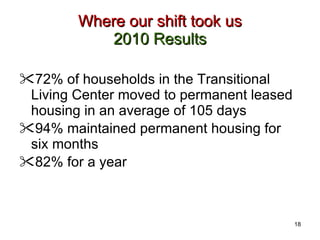
Where our shift took us 2010 Results 72% of households in the Transitional Living Center moved to permanent leased housing in an average of 105 days 94% maintained permanent housing for six months 82% for a year  18
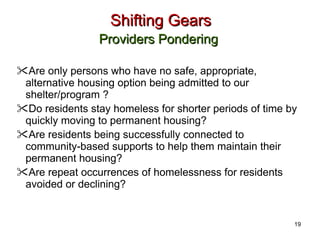
Shifting Gears Providers Pondering   Are only persons who have no safe, appropriate, alternative housing option being admitted to our shelter/program ? Do residents stay homeless for shorter periods of time by quickly moving to permanent housing? Are residents being successfully connected to community-based supports to help them maintain their permanent housing? Are repeat occurrences of homelessness for residents avoided or declining?  19
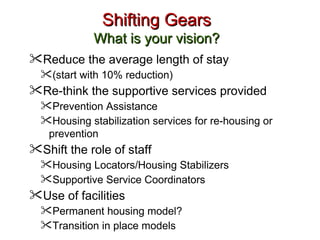
Shifting Gears What is your vision? Reduce the average length of stay  (start with 10% reduction) Re-think the supportive services provided Prevention Assistance Housing stabilization services for re-housing or prevention Shift the role of staff Housing Locators/Housing Stabilizers  Supportive Service Coordinators  Use of facilities Permanent housing model? Transition in place models
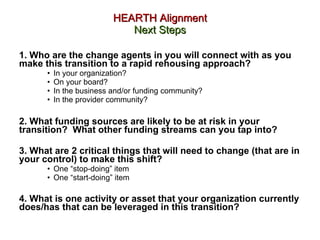
HEARTH Alignment Next Steps 1. Who are the change agents in you will connect with as you make this transition to a rapid rehousing approach?  In your organization?  On your board?  In the business and/or funding community?  In the provider community?  2. What funding sources are likely to be at risk in your transition?  What other funding streams can you tap into? 3. What are 2 critical things that will need to change (that are in your control) to make this shift?  One “stop-doing” item One “start-doing” item 4. What is one activity or asset that your organization currently does/has that can be leveraged in this transition?
Final Thoughts  Re-defining the role of your transitional housing program requires a culture that embraces change No housing plan is the same Clear vision and goals are imperative Community involvement is key to success Prepare a communication plan Evaluate and adjust Be prepared for challenges:  Change can be slow Build on successes: celebrate small victories Remember, “its not the letting go that hurts, it’s the holding on”. 22
Thank You 23

2.5 Kay Moshier McDivitt

  • 1.
    Shifting Gears Optionsfor Transitional Housing Kay Moshier McDivitt Lancaster County Coalition to End Homelessness 150 North Queen Street, Suite 610 Lancaster, PA 17603 717-735-8485 [email_address] 1
  • 2.
    Lancaster County Journey2004 : United Way partnered with ICH to conduct community impact study on “Housing and Homelessness” 2005 : United Way issues the “Community Impact Report on Housing and Homelessness in Lancaster” Established the framework for the 10 Year Plan to End Homelessness System Shift with a “housing first/rapid rehousing” philosophy 2008 : “Heading Home Plan” (10 year plan) released 2009 : Lancaster County Coalition to End Homelessness Established
  • 3.
    A New ApproachThe System Shift for Lancaster County PREVIOUS MODEL Service system that manages & shelters those experiencing homelessness NEW APPROACH System of: Prevention Diversion Rapid re-housing Permanent Housing Lancaster County Coalition to End Homelessness Vision: To reorient the service system from one that shelters and manages homelessness to a housing first course of action that ends chronic and all types of homelessness through prevention, diversion and rapid rehousing.
  • 4.
    Shifting Gears –Options for Transitional Housing Lancaster Co. PA’s Journey Defining the Emergency and Transitional Shelter System: “ Through coordinated and integrated services with standard measures of success and best practices for all providers of transitional housing, Lancaster County will reduce the length of stay the individuals and families spend in transitional housing and increase the number of individuals and families rapidly moved to permanent housing .” 4
  • 5.
    Shifting Gears –Options for Transitional Housing Lancaster Co. PA’s Journey System Wide Benchmark Established 2009 to reduce the length of stay 70% of all households in Transitional Housing will move to a permanent housing placement in less than 6 months TH providers involved in establishing the benchmark 5
  • 6.
    Lancaster County Experience(where our journey took us) Shortened Length of Stay to Permanent Housing 2005 54 Room Long Term Transitional Housing Program with mandated minimum of 6 months intensive program services Length of stay up to 2 years with 35% “graduation” rate Current Transitioned to a “rapid exit” model Average length of stay from 12+ months to 105 days Length of stay not program or participation driven Determined by individual housing plan to find permanent housing, not by program “requirements” Developed service partnerships to provide the supportive services and housing stabilization services Less dependence on the program 6
  • 7.
    Strategic Planning Process(but don’t take too long) Identifies possible options Model type, target populations, staffing configurations, partnerships, merging Identifies issues to be considered barriers and solutions, staff, board and funding concerns, population served, new outcome measurements Identifies questions you want answered Feasibility, community buy-in, where we get the housing Identifies a final recommendation and an implementation plan How to “roll out” the conversion 7
  • 8.
    Shifting Gears Strategic Planning Process The vision drives the process Set clear steps and goals Evaluate your current program Analyze your research and data Final Goal: Identify the model/blueprint for your rapid exit approach 8
  • 9.
    Evaluate the program:What we found “ Program” requirements created barriers Many households exited for non participation with mandatory services Trying to be “all” to “all issues” Creating a “cycle of dependency” Folks asking to come back even after program completion to access services 9
  • 10.
    Create the VisionThe result we want is: Successful move to a permanent solution in the shortest amount of time with households connected to resources and services that can support them outside the facility 10
  • 11.
    Shifting Gears “Rethinkingand Redefining” Switch from a “housing readiness” approach to “rapid exit” approach Shift from “what you need to do to stay here successfully” to “what you need to leave here quickly and successfully” Role of staff shifts to focus on immediate housing plan to engage participants in finding housing and wrap around services for permanent housing Redefining of “who we are” and “how we do business”-a paradigm shift 11
  • 12.
    Shifting Gears Create the conversion model Incorporate the “Rapid Exit Approach” into your mission statement Proposed organizational structure Develop a program flow chart Identify staffing and training needs Identify the community partnerships, collaborations and resources needed Proposed budget/funding adjustments Develop a clear communication plan 12
  • 13.
    Rethinking Your Program Implementation And Evaluation Plan Identify clear targets for implementation Plan and schedule necessary training Meet with identified service providers MOU’s identify role and responsibility of each providers Develop a plan to shift organizational culture Develop clear communication plan Set outcome targets with quarterly reviews, adjust program accordingly (# housed, shorten length of stay, # retaining housing) 13
  • 14.
    Shifting Gears StaffPreparation Reframe “change” as a move to “new opportunities” Focus on “moving folks to housing more quickly” Have a small “forum” for staff Bring peers in from other organizations that have transitioned to a Rapid Exit approach Allow opportunities for open dialogue Map out the Rapid Exit strategy and how it will work in your program (process mapping) Deliver the message that this is the direction your organization going 14
  • 15.
    Shifting Gears Consumershift Key Concepts Give a sense of urgency when clients walk in the door Focus on moving out instead of moving in Offer training/groups that directly correlate to obtaining and maintaining housing Set firm boundaries and make them clear up front Give them realistic housing options 15
  • 16.
    Shifting Gears Partnerships-Key Elements Identify the housing stabilization services to leverage types of services currently provided in the program (budgeting, parenting, mental health, d&a, employment skills, life skills,) that can be “wrapped around” Where will we get the housing Who has experience in housing procurement Landlord engagement Faith community Collaborate with other “rapid exit” proponents in the community Less dependence on the program 16
  • 17.
    Lancaster Experience ItWorks! Redefined length of stay, immediate focus on permanent housing plan Service provision is through external sources rather than internal staff Redefined staff role to housing locators, supportive service coordinators, housing stabilizers Outcomes and indicators focus on moving to permanent affordable housing Established community partnerships Development of landlord partnerships 17
  • 18.
    Where our shifttook us 2010 Results 72% of households in the Transitional Living Center moved to permanent leased housing in an average of 105 days 94% maintained permanent housing for six months 82% for a year 18
  • 19.
    Shifting Gears ProvidersPondering Are only persons who have no safe, appropriate, alternative housing option being admitted to our shelter/program ? Do residents stay homeless for shorter periods of time by quickly moving to permanent housing? Are residents being successfully connected to community-based supports to help them maintain their permanent housing? Are repeat occurrences of homelessness for residents avoided or declining? 19
  • 20.
    Shifting Gears Whatis your vision? Reduce the average length of stay (start with 10% reduction) Re-think the supportive services provided Prevention Assistance Housing stabilization services for re-housing or prevention Shift the role of staff Housing Locators/Housing Stabilizers Supportive Service Coordinators Use of facilities Permanent housing model? Transition in place models
  • 21.
    HEARTH Alignment NextSteps 1. Who are the change agents in you will connect with as you make this transition to a rapid rehousing approach? In your organization? On your board? In the business and/or funding community? In the provider community? 2. What funding sources are likely to be at risk in your transition?  What other funding streams can you tap into? 3. What are 2 critical things that will need to change (that are in your control) to make this shift? One “stop-doing” item One “start-doing” item 4. What is one activity or asset that your organization currently does/has that can be leveraged in this transition?
  • 22.
    Final Thoughts Re-defining the role of your transitional housing program requires a culture that embraces change No housing plan is the same Clear vision and goals are imperative Community involvement is key to success Prepare a communication plan Evaluate and adjust Be prepared for challenges: Change can be slow Build on successes: celebrate small victories Remember, “its not the letting go that hurts, it’s the holding on”. 22
  • 23.