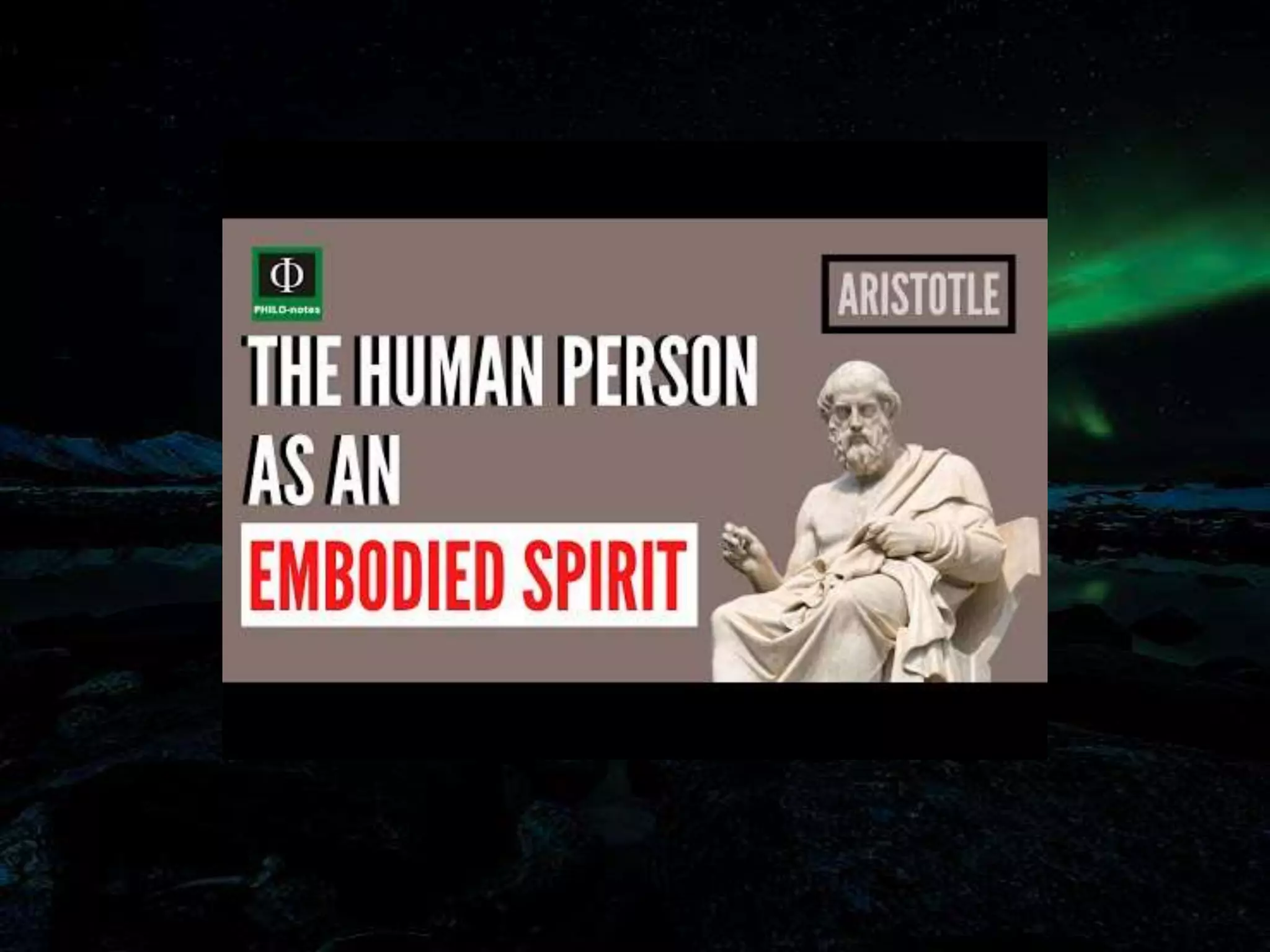
The Human Person as a
Embodied Spirit
Lesson 3
INQUIRE AND DISCOVER
The human person is an important
subject in Philosophy and an
understand of the nature and condition
of the person is one of the foremost
goals of the discipline.
Philosophers have long pondered
human nature, what it means to be
human, and what sets us apart from
other beings and things in existence.
We often ask ourselves, “What
makes us special?” Pondering our
human nature allow as to determine the
special traits us humans unique as a
species. Further reflection on our
nature as human will also help us figure
out what makes us special as
individuals and how this uniqueness is
shared with our fellow human beings.
TERMS RELATED
Man is the general term commonly
used to refer to the entire human race.
Other related terms include humanity,
mankind and humankind.
Human refers to man as a species —
Homo sapiens or modern human
beings.
The term human being is also used to
distinguish man from other animals.
Person is a much more complex term
which generally refers to a human
being granted recognition of certain
rights, protection, responsibilities and
dignity, above all.
Personhood refers to the state of being
a person.
Human nature refers to the
characteristics that distinguish humans
from all other creatures. These traits
are assumed to arise independent of
the influence of culture and society.
Examples of this characteristics include
thinking, feeling and acting. This traits
are considered to form the essence of
humanity, and without them, an
individual may not be considered a
human person.
WHAT IS THE HUMAN
PERSON?
The most basic definition of a
human being relates to the nature of
humans as animals. Philosophers,
however, believe that the human being
is not just a mere animal. There is
something in the human individual that
sets him or her apart from other beings.
These special traits make a human a
distinct individual person.
ASK YOURSELF THE
FOLLOWING QUESTIONS:
• Am I a dog?
• Am I rock?
• Am I a lamp?
Here are several obvious
reason why you replied NO
to each of these questions:
• Based on a purely physical
comparison, we can confidently state
that we share no physical similarities
with a rock as they are non-living
things composed of inorganic
materials.
• Looking at the dog, however, you may
see a number of shared traits or
features. Humans and animals both have
eyes, ears, a nose, a mouth, a body —
though these are shaped in different
ways. Being a living, breathing,
functioning organism is a characteristic
that we share with other organisms that
occupy this planet. Though living is an
essential feature of being human, it
cannot be the defining feature that sets
as apart and makes us human person.
Let as say that we make this dog you
pet. Think back on how you treat you
pets. Oftentimes we treat our pets as if
they are similar to us.
• You put clothes on pets.
• You give your toys to play with.
• You make it live in house.
• You teach it behave properly around
other people.
By doing these things, do
you make your pet a human
person?
Of course, No. Despite the
actions and intentions of people,
animals are fundamentally
different from us humans.
Though we share a number of
similarities with other members of
animal kingdom, there are certain
things that we posses — traits and
capabilities — that are not found in
other organisms.
The first trait that defines a person
is self-awareness. It refers to the
person having a clear perception of
oneself, including his or her thoughts,
emotions, identity and actions.
A human person knows that he or
she is leaving an experience and is an
active participant in this experience. We
do not experience life as an audience
watching a movie on a screen; we are
stars in our own movies, acting and
starring in a story of our own making.
This awareness gives rise to the
notion of the “self”, which philosophers
describe as the person who is actively
aware that he or she is perceiving and
experiencing reality.
This awareness of the self also
enables us person to experience an
“inner world” that is defined by our
personal thoughts and ideas. The fact
that we can daydream, get lost in our
thoughts, imagine, fantasize and
reflects shows that we are able to reach
within ourselves and experience
interiority, which is the quality of being
focused on one’s inner life and identity.
The self also enables us to reach
out and interact with things outside
ourselves. This means that we are not
only aware of our surroundings and
everything around us — but we are
also aware of other human beings.
Another trait that defines a person
is self determination. This refers to
capability of person to make choices
and decisions based on their own
preferences, monitor and regulate their
actions, be goal-oriented and self-
directed. We are person because we
act and we are aware of our actions.
Our free will enables us to do
actions whenever we want to makes
self-determination possible. Free will is
the capacity to choose a course of
action from various alternatives. The
existence of free will enables a person
to act willfully control his or her actions
and recognize himself or herself as the
source of action.
The discussion on self-
determination and free will eventually
leads to a discussion of consequence.
The consequence is the result or effect
of an action or condition. As persons,
we are aware that each action that we
perform as a consequence.
Another element of human action is
morality or the goodness or badness of
an act.
Human action is such an important
aspect of the person that many
philosophers consider human action as
a way to reveal a person’s true nature.
Human acts complete the person, as it
is through his or her actions that his or
her inner self is revealed to other, and it
is through action that a person is able
to explore his or her potential.
Another important trait that defines
a human person is externality or the
capability to reach out and interact with
others in the world.
The final trait that distinguishes the
human person is dignity or innate right
to be valued and respected.
Philosophers consider all human as
having an inherent worth or value.
Philosophers, however, do not equate
value or worth with any quantifiable
measure such as a price.
Each person is worth the same as
another person in the sense that every
person is priceless, unique,
unrepeatable and irreplaceable. We do
not value another person in the same
way that we assign values to thing such
as cars and houses.
Human dignity is rooted in the
nature of the human being. This means
a human person has dignity simply
because of the fact that he or she is a
human. Dignity is not defined by
outside forces or characteristics such
as intelligence, ability, skills or
attractiveness.
Human dignity also drives us to
seek what is good. Doing good actions,
therefore, upholds and promotes the
dignity of the human person. The
recognition of the dignity of the human
person is the basis for the recognition
of human rights.
WHAT IS AN OUR HUMAN NATURE THAT
ENABLES US TO BECOME PERSONS?
Our body is not the only thing that defines.
Philosophers believe that a person cannot be simply
reduced to his or her physical body.
Being hopeful, happy or friendly are
characteristics that are very much part of us, but are
not seen in any physical trait we posses and are only
made evident through our actions.
Philosophers point to another unseen aspect
of the human person which, along with the body,
defines us as a persons. This intangible element is
the spirit which enables us to exercise thought,
possess awareness, interiority and the capacity to
reach out to the outside world and other person.
WHAT IS AN OUR HUMAN
NATURE THAT ENABLES US
TO BECOME PERSONS?
Our body is not the only thing that
defines. Philosophers believe that a
person cannot be simply reduced to his
or her physical body.
Being hopeful, happy or friendly are
characteristics that are very much part
of us, but are not seen in any physical
trait we posses and are only made
evident through our actions.
Philosophers point to another
unseen aspect of the human person
which, along with the body, defines us
as a persons. This intangible element is
the spirit which enables us to exercise
thought, possess awareness, interiority
and the capacity to reach out to the
outside world and other person.
HOW ARE THE BODY AND
THE SPIRIT RELATED ?
Philosophers consider the human
person as define by the union of the
body and spirit. The human person is
an embodied spirit. Not only are the
body and spirit united, but they are also
integrated with each other. This means
that we cannot separate the two and
they go hand-in-hand in making us who
we are.
Philosophers , on the other hand,
argue that reducing a profound
experience such as love to biological
function or activities of certain body
parts is absurd. Embodied, therefore, is
the one thing that enables us to feel
love and love others.
Our experience is also a product of
embodiment. The human mind process
as information through the senses,
which are experienced through the
body.
The human body also stands as
the mediator between the material
world and the spiritual world. Being an
embodied spirit, the person also
encounter the world of objects in a
manner that transcends the physical.
This explain why people who are in
love with each other seem to
communicate effortlessly without words.
The mere act of “holding hands”
conveys a powerful message between
lovers, as it is through this act that they
can express their affection towards each
other. A smile from a stranger will not
elicit a reaction from you but a smile
from your crush will immediately cause
an intense emotional reaction in you.
HOW DOES MY HUMAN
NATURE ENABLE ME TO
EXPLORE MY LIMITS?
Though the nature of the person as
an embodied spirit provides numerous
opportunities to explore everything
around us and even without us, our
human nature still imposes limitation. It
is true that the human person enjoys a
number of advantage compared to
other beings, but there are still a
number of things that human naturally
cannot do.
It can be said that a person is a
very biologically deficient being. This
means that we are not equipped with
the best physical attributes among all
the beings in the world.
The ability to surpass limits is
called transcendence, and it is also on
important trait that distinguishes the
human person from other being
existence.
Our mind is an important tool that
allows us to go beyond many of our
physical limits. As persons, we are able
to exercise our imagination and
reflection to go beyond our own
thoughts and experiences. Being
physically limited in our abilities does
not prevents us from hoping for or
aspiring greater things.
It must also be understand that as
human persons, we have natural
tendencies or inclinations. Some of these
felt bodily functions and they are
experienced as a person goes through
life. Transcendence also means
overcoming oneself or being in control
even if the body reminds us to certain
tendencies. Although these tendencies
are felt, the person can govern them and
ensure that they are exercised within the
Philosophy gives as useful tools to
explore our limitations and possibilities for
transcendence. The essence of
transcendence is to acknowledge our
limitation, identify possibilities for
development, and change ourselves for
the better. Another aspect of
transcendence is opening yourself to new
experiences and ideas. Our capacity for
transcendence give us the opportunity to
work toward becoming better version of

The-Human-Person-as-a-Embodied-Spirit-pptx.pptx

  • 1.
    The Human Personas a Embodied Spirit Lesson 3
  • 4.
    INQUIRE AND DISCOVER Thehuman person is an important subject in Philosophy and an understand of the nature and condition of the person is one of the foremost goals of the discipline. Philosophers have long pondered human nature, what it means to be human, and what sets us apart from other beings and things in existence.
  • 5.
    We often askourselves, “What makes us special?” Pondering our human nature allow as to determine the special traits us humans unique as a species. Further reflection on our nature as human will also help us figure out what makes us special as individuals and how this uniqueness is shared with our fellow human beings.
  • 6.
    TERMS RELATED Man isthe general term commonly used to refer to the entire human race. Other related terms include humanity, mankind and humankind. Human refers to man as a species — Homo sapiens or modern human beings.
  • 7.
    The term humanbeing is also used to distinguish man from other animals. Person is a much more complex term which generally refers to a human being granted recognition of certain rights, protection, responsibilities and dignity, above all. Personhood refers to the state of being a person.
  • 8.
    Human nature refersto the characteristics that distinguish humans from all other creatures. These traits are assumed to arise independent of the influence of culture and society. Examples of this characteristics include thinking, feeling and acting. This traits are considered to form the essence of humanity, and without them, an individual may not be considered a human person.
  • 9.
    WHAT IS THEHUMAN PERSON? The most basic definition of a human being relates to the nature of humans as animals. Philosophers, however, believe that the human being is not just a mere animal. There is something in the human individual that sets him or her apart from other beings. These special traits make a human a distinct individual person.
  • 10.
    ASK YOURSELF THE FOLLOWINGQUESTIONS: • Am I a dog? • Am I rock? • Am I a lamp?
  • 11.
    Here are severalobvious reason why you replied NO to each of these questions: • Based on a purely physical comparison, we can confidently state that we share no physical similarities with a rock as they are non-living things composed of inorganic materials.
  • 12.
    • Looking atthe dog, however, you may see a number of shared traits or features. Humans and animals both have eyes, ears, a nose, a mouth, a body — though these are shaped in different ways. Being a living, breathing, functioning organism is a characteristic that we share with other organisms that occupy this planet. Though living is an essential feature of being human, it cannot be the defining feature that sets as apart and makes us human person.
  • 13.
    Let as saythat we make this dog you pet. Think back on how you treat you pets. Oftentimes we treat our pets as if they are similar to us. • You put clothes on pets. • You give your toys to play with. • You make it live in house. • You teach it behave properly around other people.
  • 14.
    By doing thesethings, do you make your pet a human person? Of course, No. Despite the actions and intentions of people, animals are fundamentally different from us humans.
  • 15.
    Though we sharea number of similarities with other members of animal kingdom, there are certain things that we posses — traits and capabilities — that are not found in other organisms. The first trait that defines a person is self-awareness. It refers to the person having a clear perception of oneself, including his or her thoughts, emotions, identity and actions.
  • 16.
    A human personknows that he or she is leaving an experience and is an active participant in this experience. We do not experience life as an audience watching a movie on a screen; we are stars in our own movies, acting and starring in a story of our own making.
  • 17.
    This awareness givesrise to the notion of the “self”, which philosophers describe as the person who is actively aware that he or she is perceiving and experiencing reality.
  • 18.
    This awareness ofthe self also enables us person to experience an “inner world” that is defined by our personal thoughts and ideas. The fact that we can daydream, get lost in our thoughts, imagine, fantasize and reflects shows that we are able to reach within ourselves and experience interiority, which is the quality of being focused on one’s inner life and identity.
  • 19.
    The self alsoenables us to reach out and interact with things outside ourselves. This means that we are not only aware of our surroundings and everything around us — but we are also aware of other human beings.
  • 20.
    Another trait thatdefines a person is self determination. This refers to capability of person to make choices and decisions based on their own preferences, monitor and regulate their actions, be goal-oriented and self- directed. We are person because we act and we are aware of our actions.
  • 21.
    Our free willenables us to do actions whenever we want to makes self-determination possible. Free will is the capacity to choose a course of action from various alternatives. The existence of free will enables a person to act willfully control his or her actions and recognize himself or herself as the source of action.
  • 22.
    The discussion onself- determination and free will eventually leads to a discussion of consequence. The consequence is the result or effect of an action or condition. As persons, we are aware that each action that we perform as a consequence. Another element of human action is morality or the goodness or badness of an act.
  • 23.
    Human action issuch an important aspect of the person that many philosophers consider human action as a way to reveal a person’s true nature. Human acts complete the person, as it is through his or her actions that his or her inner self is revealed to other, and it is through action that a person is able to explore his or her potential.
  • 24.
    Another important traitthat defines a human person is externality or the capability to reach out and interact with others in the world.
  • 25.
    The final traitthat distinguishes the human person is dignity or innate right to be valued and respected. Philosophers consider all human as having an inherent worth or value. Philosophers, however, do not equate value or worth with any quantifiable measure such as a price.
  • 26.
    Each person isworth the same as another person in the sense that every person is priceless, unique, unrepeatable and irreplaceable. We do not value another person in the same way that we assign values to thing such as cars and houses.
  • 27.
    Human dignity isrooted in the nature of the human being. This means a human person has dignity simply because of the fact that he or she is a human. Dignity is not defined by outside forces or characteristics such as intelligence, ability, skills or attractiveness.
  • 28.
    Human dignity alsodrives us to seek what is good. Doing good actions, therefore, upholds and promotes the dignity of the human person. The recognition of the dignity of the human person is the basis for the recognition of human rights.
  • 29.
    WHAT IS ANOUR HUMAN NATURE THAT ENABLES US TO BECOME PERSONS? Our body is not the only thing that defines. Philosophers believe that a person cannot be simply reduced to his or her physical body. Being hopeful, happy or friendly are characteristics that are very much part of us, but are not seen in any physical trait we posses and are only made evident through our actions. Philosophers point to another unseen aspect of the human person which, along with the body, defines us as a persons. This intangible element is the spirit which enables us to exercise thought, possess awareness, interiority and the capacity to reach out to the outside world and other person.
  • 30.
    WHAT IS ANOUR HUMAN NATURE THAT ENABLES US TO BECOME PERSONS? Our body is not the only thing that defines. Philosophers believe that a person cannot be simply reduced to his or her physical body.
  • 31.
    Being hopeful, happyor friendly are characteristics that are very much part of us, but are not seen in any physical trait we posses and are only made evident through our actions.
  • 32.
    Philosophers point toanother unseen aspect of the human person which, along with the body, defines us as a persons. This intangible element is the spirit which enables us to exercise thought, possess awareness, interiority and the capacity to reach out to the outside world and other person.
  • 33.
    HOW ARE THEBODY AND THE SPIRIT RELATED ?
  • 34.
    Philosophers consider thehuman person as define by the union of the body and spirit. The human person is an embodied spirit. Not only are the body and spirit united, but they are also integrated with each other. This means that we cannot separate the two and they go hand-in-hand in making us who we are.
  • 35.
    Philosophers , onthe other hand, argue that reducing a profound experience such as love to biological function or activities of certain body parts is absurd. Embodied, therefore, is the one thing that enables us to feel love and love others.
  • 36.
    Our experience isalso a product of embodiment. The human mind process as information through the senses, which are experienced through the body.
  • 37.
    The human bodyalso stands as the mediator between the material world and the spiritual world. Being an embodied spirit, the person also encounter the world of objects in a manner that transcends the physical.
  • 38.
    This explain whypeople who are in love with each other seem to communicate effortlessly without words. The mere act of “holding hands” conveys a powerful message between lovers, as it is through this act that they can express their affection towards each other. A smile from a stranger will not elicit a reaction from you but a smile from your crush will immediately cause an intense emotional reaction in you.
  • 39.
    HOW DOES MYHUMAN NATURE ENABLE ME TO EXPLORE MY LIMITS?
  • 40.
    Though the natureof the person as an embodied spirit provides numerous opportunities to explore everything around us and even without us, our human nature still imposes limitation. It is true that the human person enjoys a number of advantage compared to other beings, but there are still a number of things that human naturally cannot do.
  • 41.
    It can besaid that a person is a very biologically deficient being. This means that we are not equipped with the best physical attributes among all the beings in the world.
  • 42.
    The ability tosurpass limits is called transcendence, and it is also on important trait that distinguishes the human person from other being existence.
  • 43.
    Our mind isan important tool that allows us to go beyond many of our physical limits. As persons, we are able to exercise our imagination and reflection to go beyond our own thoughts and experiences. Being physically limited in our abilities does not prevents us from hoping for or aspiring greater things.
  • 44.
    It must alsobe understand that as human persons, we have natural tendencies or inclinations. Some of these felt bodily functions and they are experienced as a person goes through life. Transcendence also means overcoming oneself or being in control even if the body reminds us to certain tendencies. Although these tendencies are felt, the person can govern them and ensure that they are exercised within the
  • 45.
    Philosophy gives asuseful tools to explore our limitations and possibilities for transcendence. The essence of transcendence is to acknowledge our limitation, identify possibilities for development, and change ourselves for the better. Another aspect of transcendence is opening yourself to new experiences and ideas. Our capacity for transcendence give us the opportunity to work toward becoming better version of