SPEED Bracket Placement
Guide
3rd edition
2012
©Sylvain Chamberland
http://www.slideshare.net/sylvainchamberland
©Dr Sylvain Chamberland
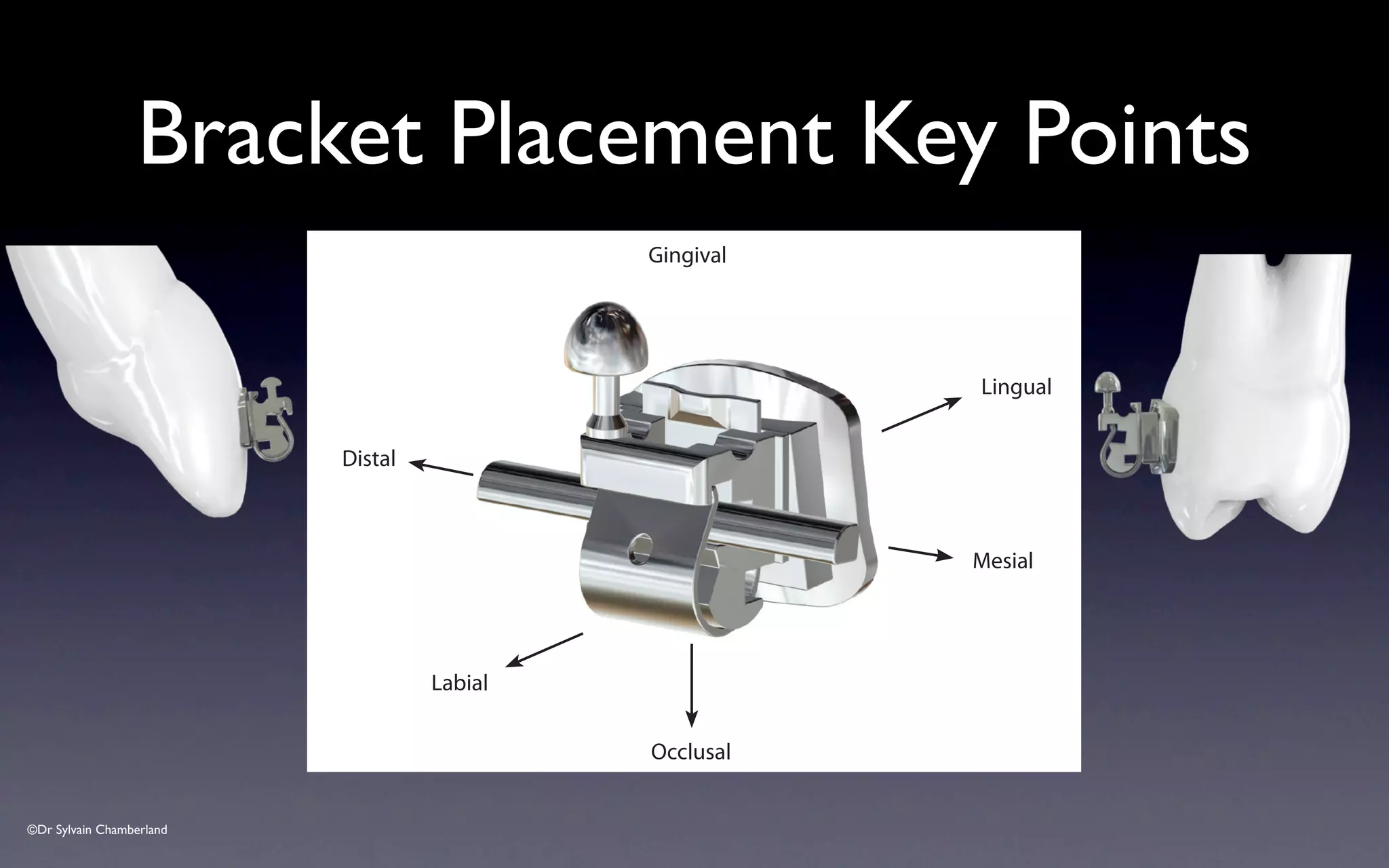
-BCJBM
-JOHVBM
(JOHJWBM
0DDMVTBM
%JTUBM
.FTJBM
Bracket Placement Key Points
©Dr Sylvain Chamberland
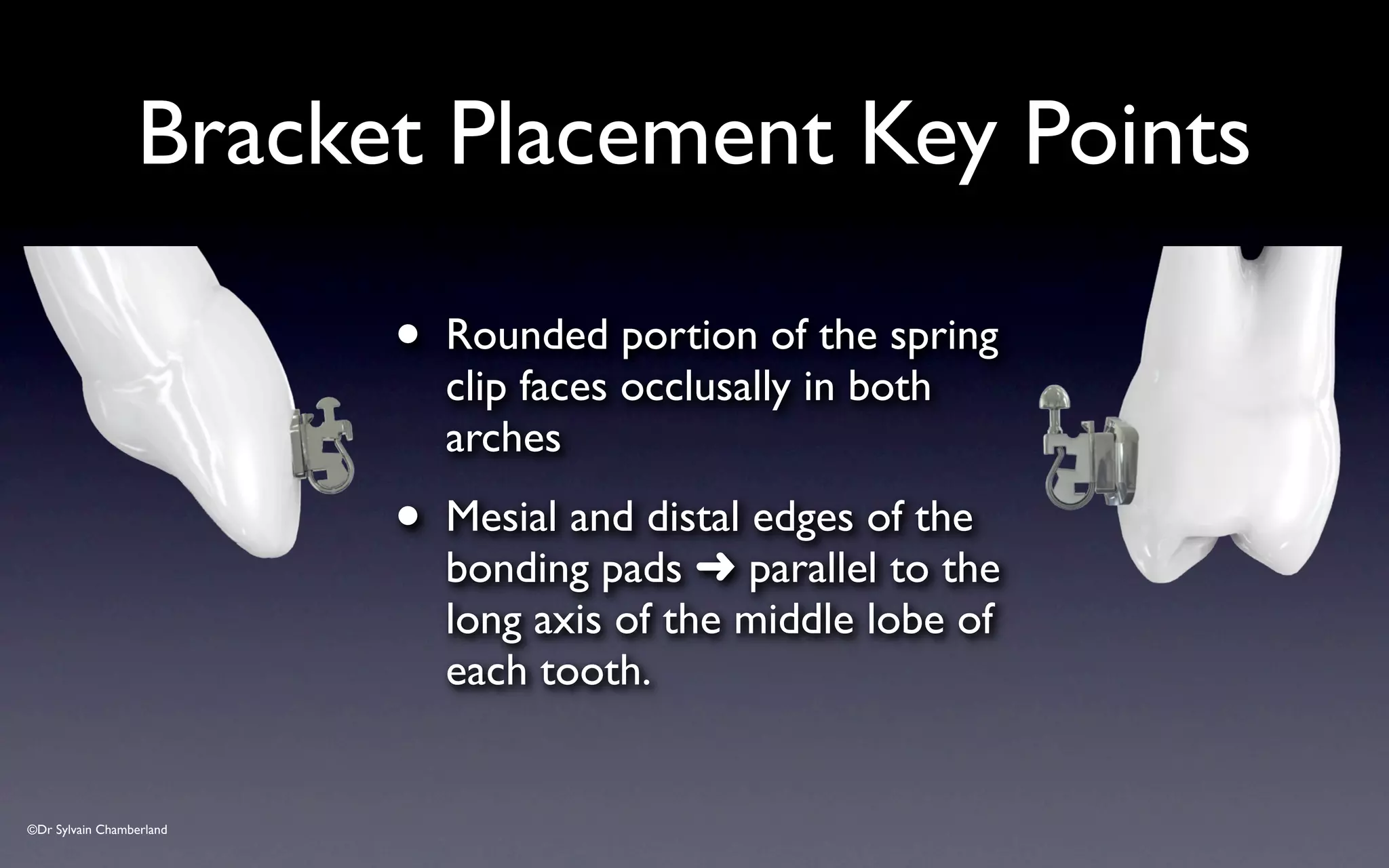
• Rounded portion of the spring
clip faces occlusally in both
arches
• Mesial and distal edges of the
bonding pads ➜ parallel to the
long axis of the middle lobe of
each tooth.
Bracket Placement Key Points
©Dr Sylvain Chamberland
Bracket Placement Key Points
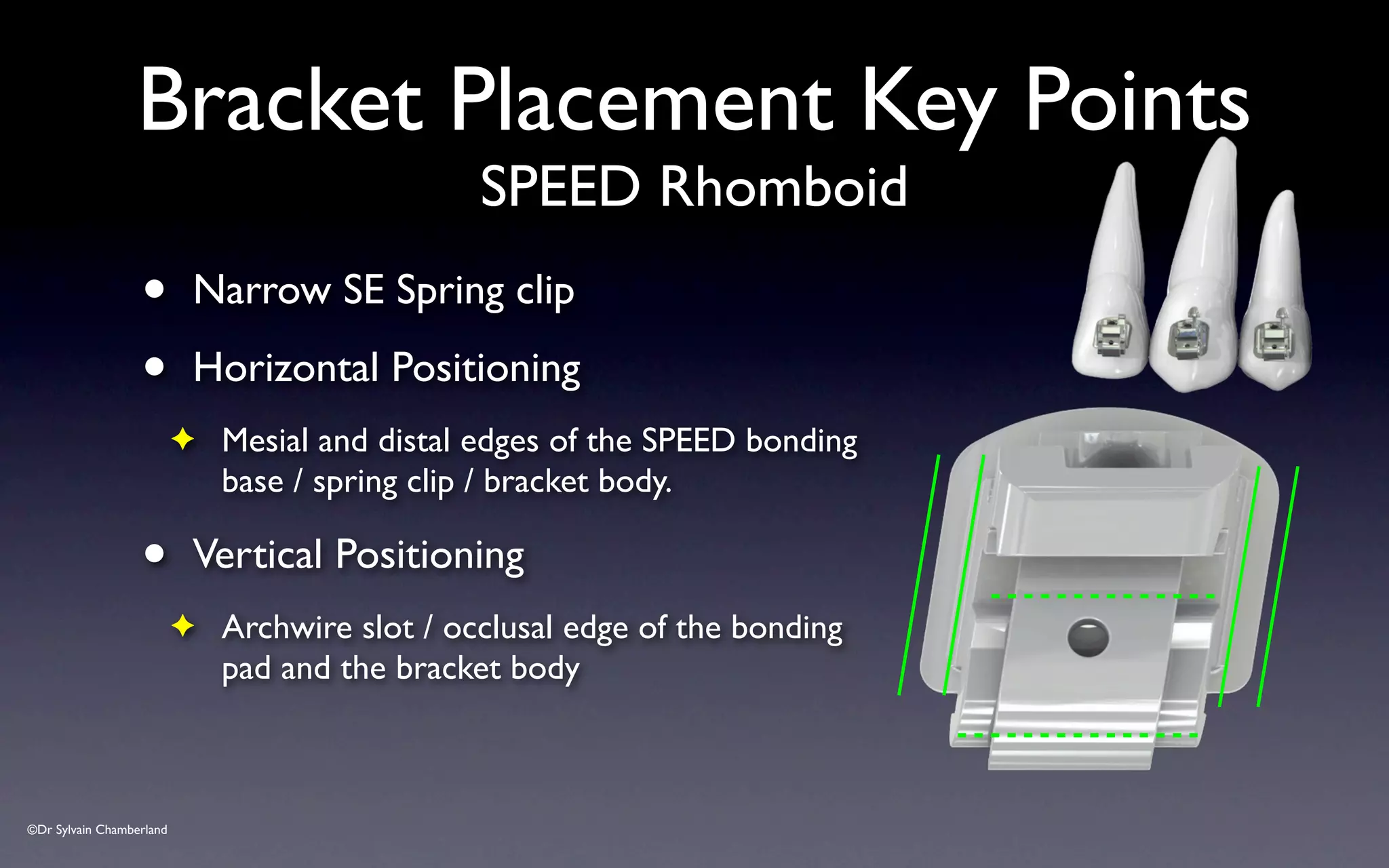
SPEED Rhomboid
• Narrow SE Spring clip
• Horizontal Positioning
✦ Mesial and distal edges of the SPEED bonding
base / spring clip / bracket body.
• Vertical Positioning
✦ Archwire slot / occlusal edge of the bonding
pad and the bracket body
©Dr Sylvain Chamberland
Bracket Placement Key Points
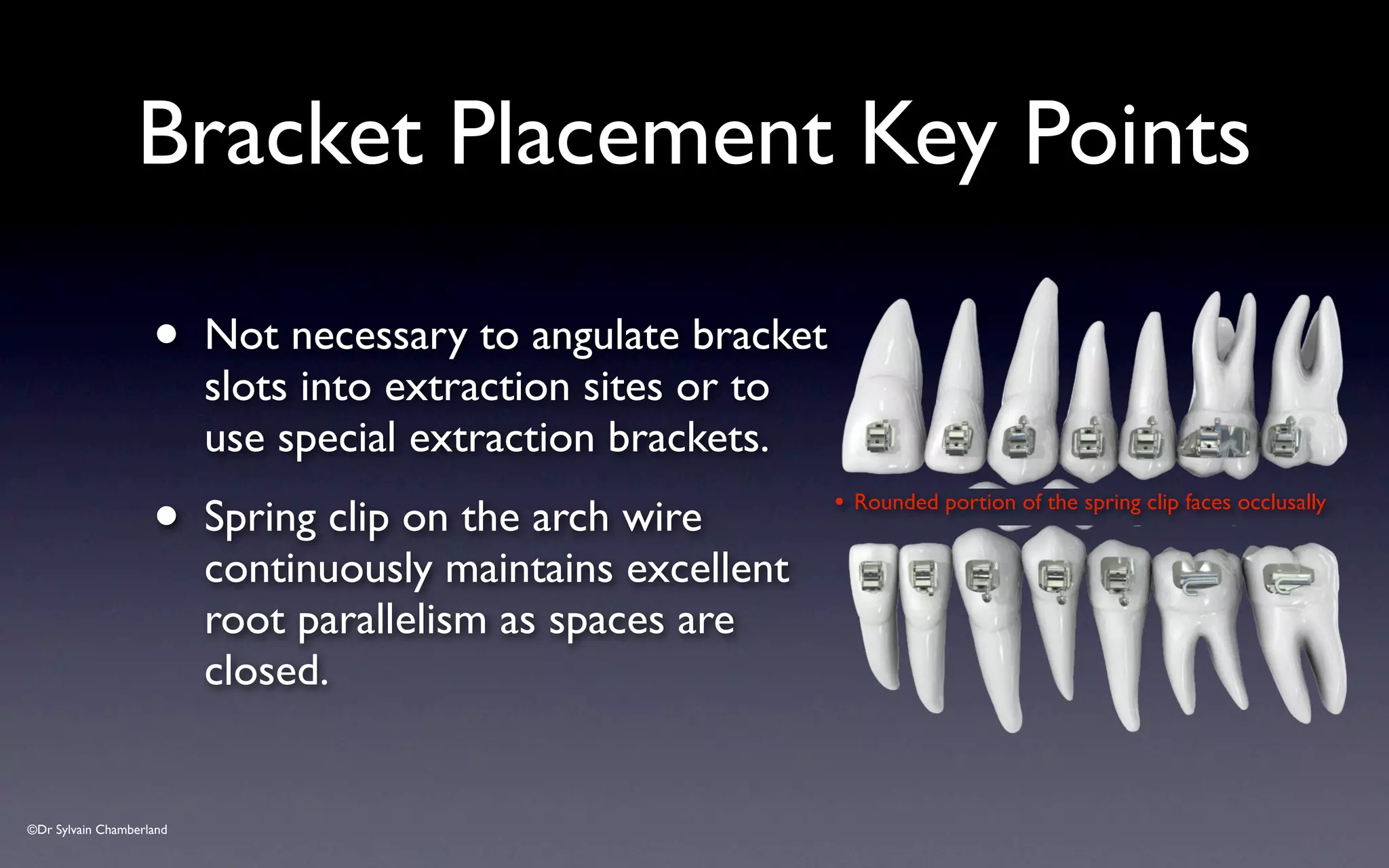
• Not necessary to angulate bracket
slots into extraction sites or to
use special extraction brackets.
• Spring clip on the arch wire
continuously maintains excellent
root parallelism as spaces are
closed.
• Rounded portion of the spring clip faces occlusally
©Dr Sylvain Chamberland
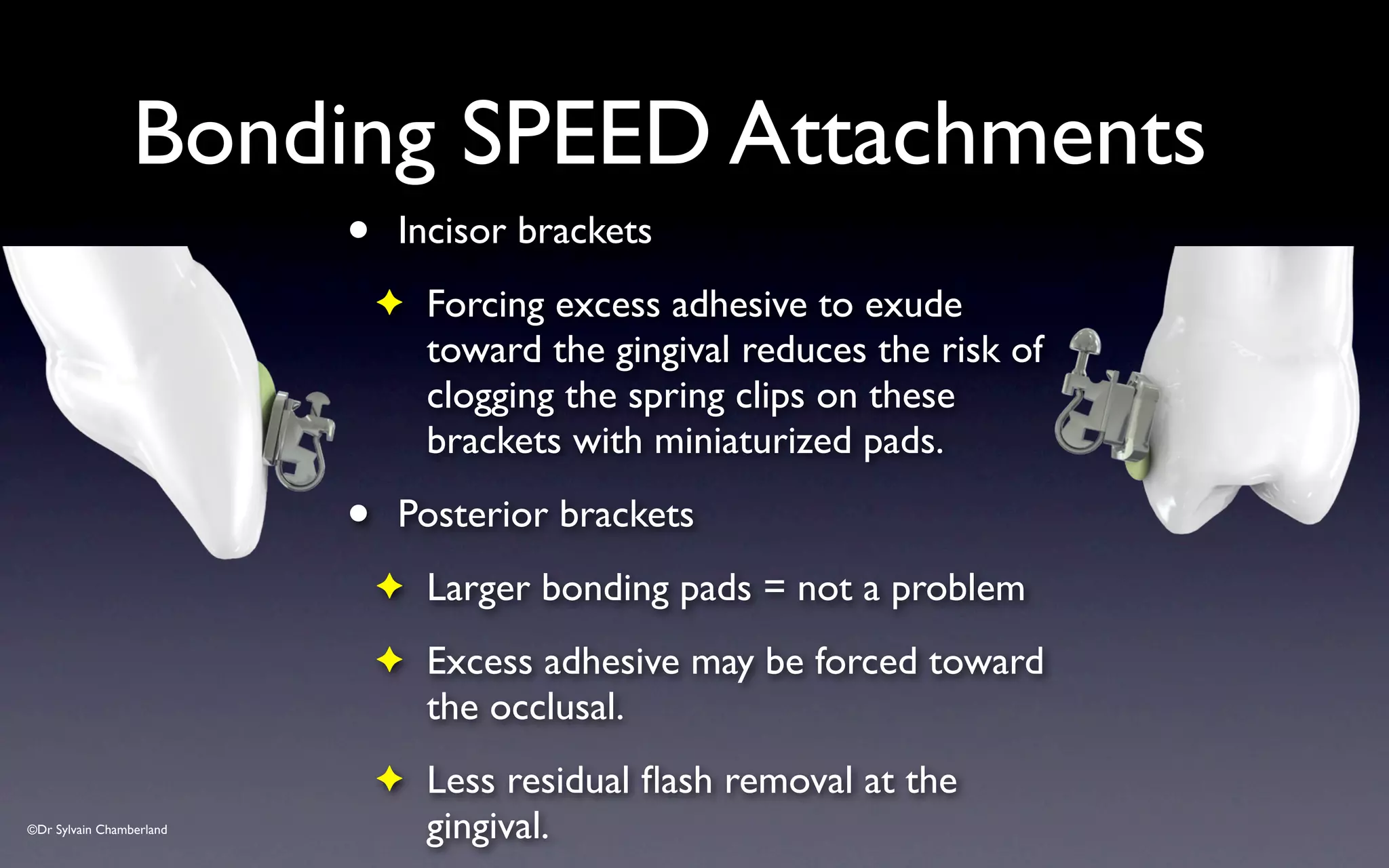
Bonding SPEED Attachments
• Incisor brackets
✦ Forcing excess adhesive to exude
toward the gingival reduces the risk of
clogging the spring clips on these
brackets with miniaturized pads.
• Posterior brackets
✦ Larger bonding pads = not a problem
✦ Excess adhesive may be forced toward
the occlusal.
✦ Less residual flash removal at the
gingival.
©Dr Sylvain Chamberland
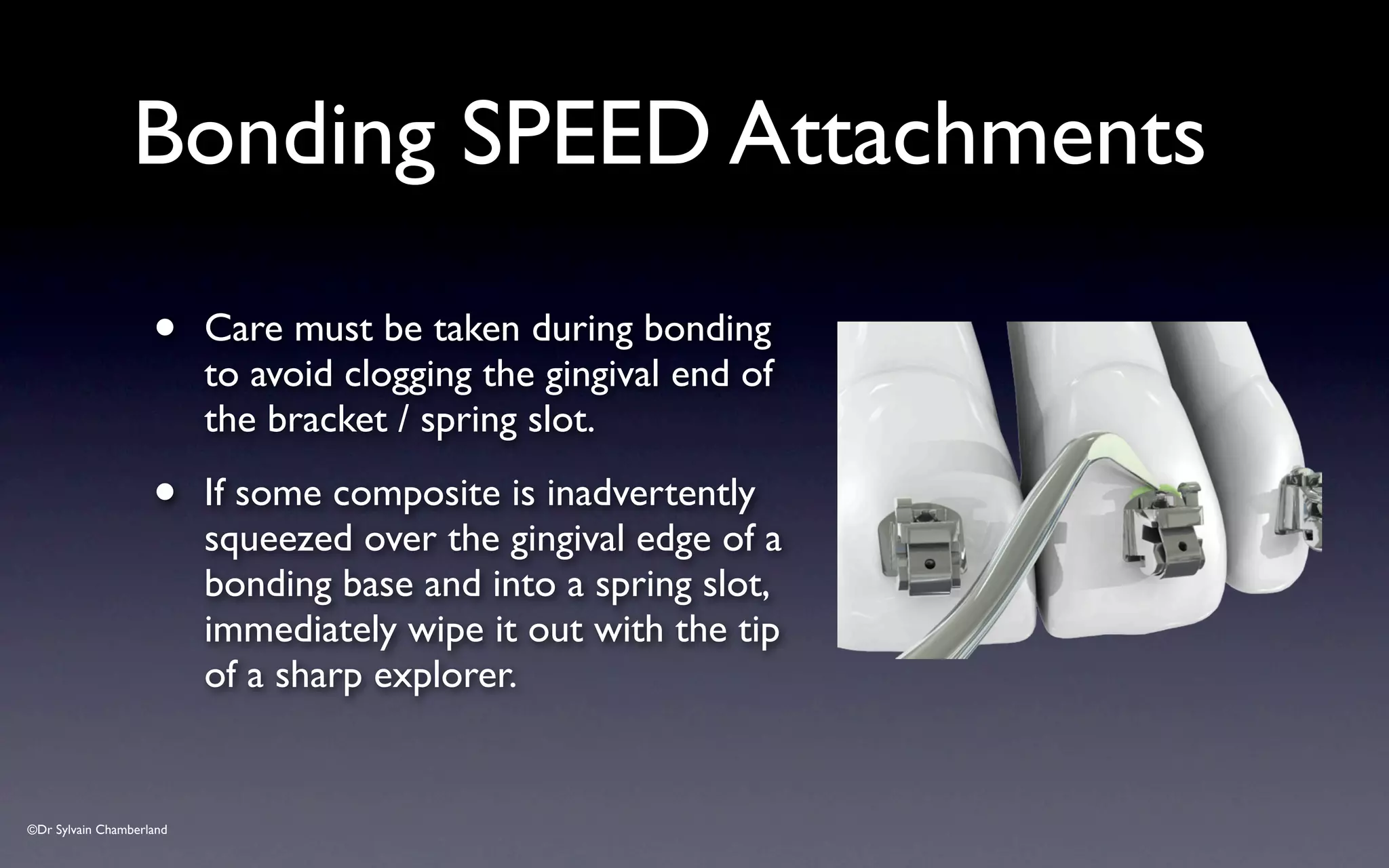
Bonding SPEED Attachments
• Care must be taken during bonding
to avoid clogging the gingival end of
the bracket / spring slot.
• If some composite is inadvertently
squeezed over the gingival edge of a
bonding base and into a spring slot,
immediately wipe it out with the tip
of a sharp explorer.
©Dr Sylvain Chamberland
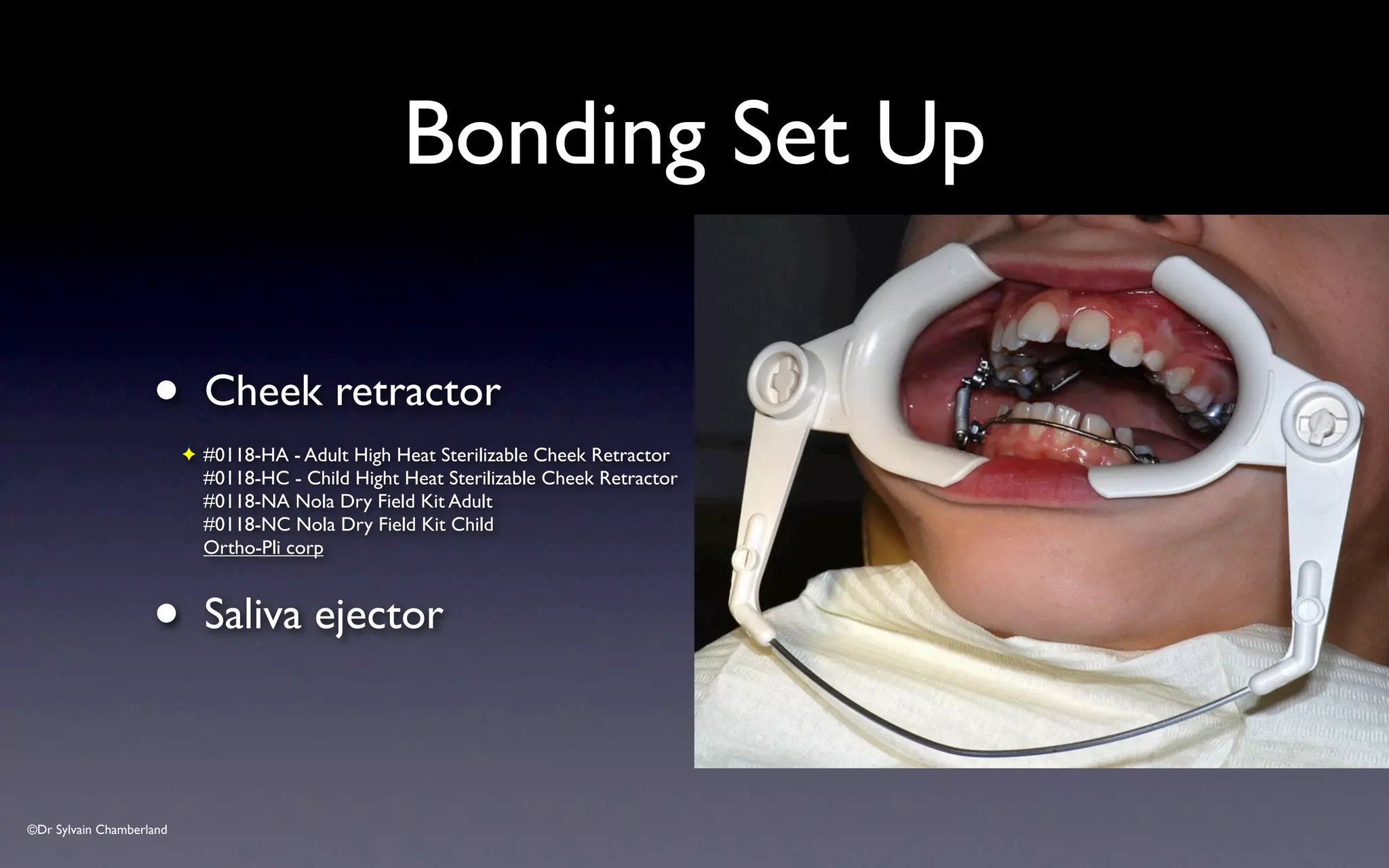
Bonding Set Up
• Cheek retractor
✦ #0118-HA - Adult High Heat Sterilizable Cheek Retractor
#0118-HC - Child Hight Heat Sterilizable Cheek Retractor
#0118-NA Nola Dry Field Kit Adult
#0118-NC Nola Dry Field Kit Child
Ortho-Pli corp
• Saliva ejector
©Dr Sylvain Chamberland
Bonding Set Up
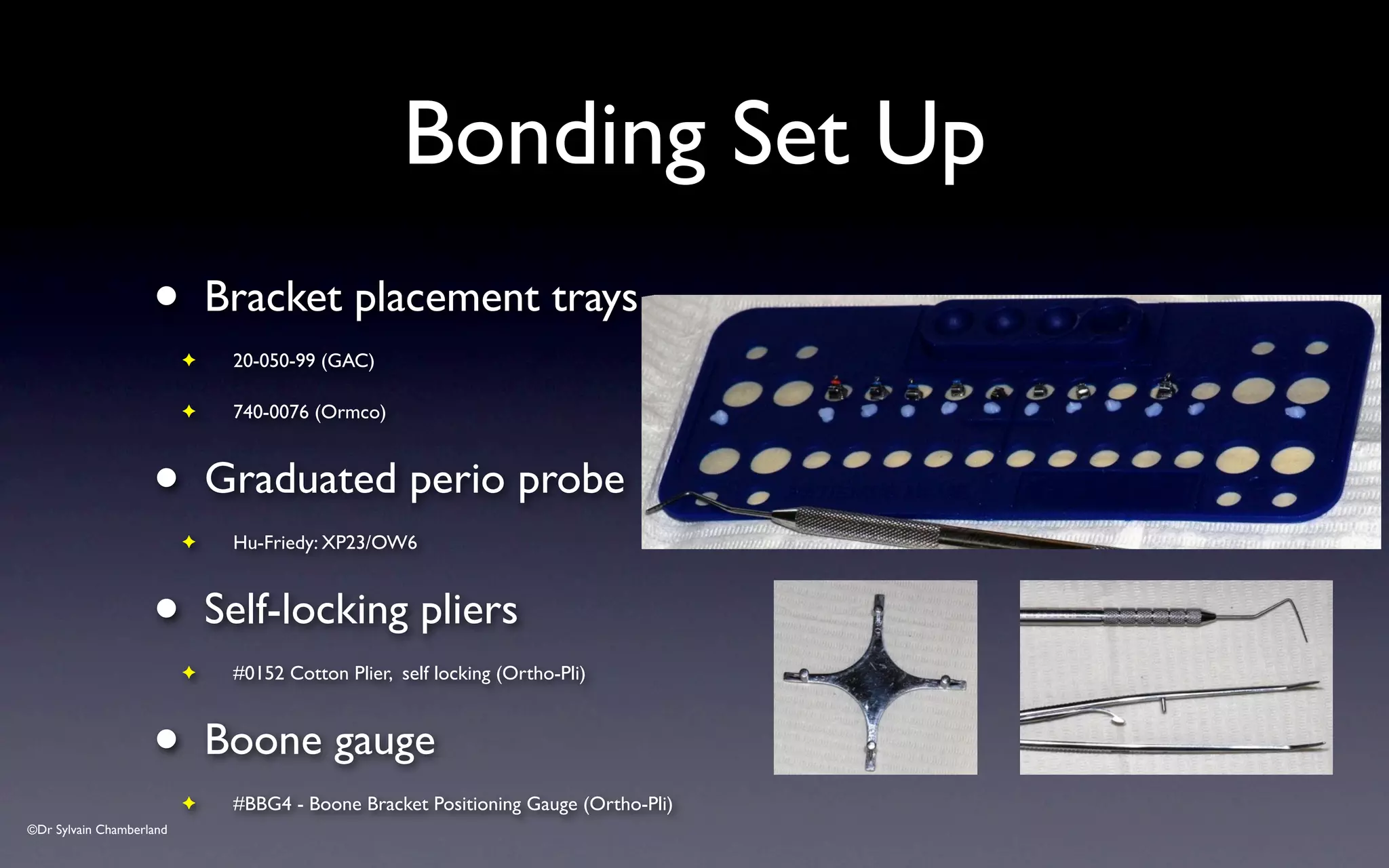
• Bracket placement trays
✦ 20-050-99 (GAC)
✦ 740-0076 (Ormco)
• Graduated perio probe
✦ Hu-Friedy: XP23/OW6
• Self-locking pliers
✦ #0152 Cotton Plier, self locking (Ortho-Pli)
• Boone gauge
✦ #BBG4 - Boone Bracket Positioning Gauge (Ortho-Pli)
©Dr Sylvain Chamberland
Bonding Technique Key Points
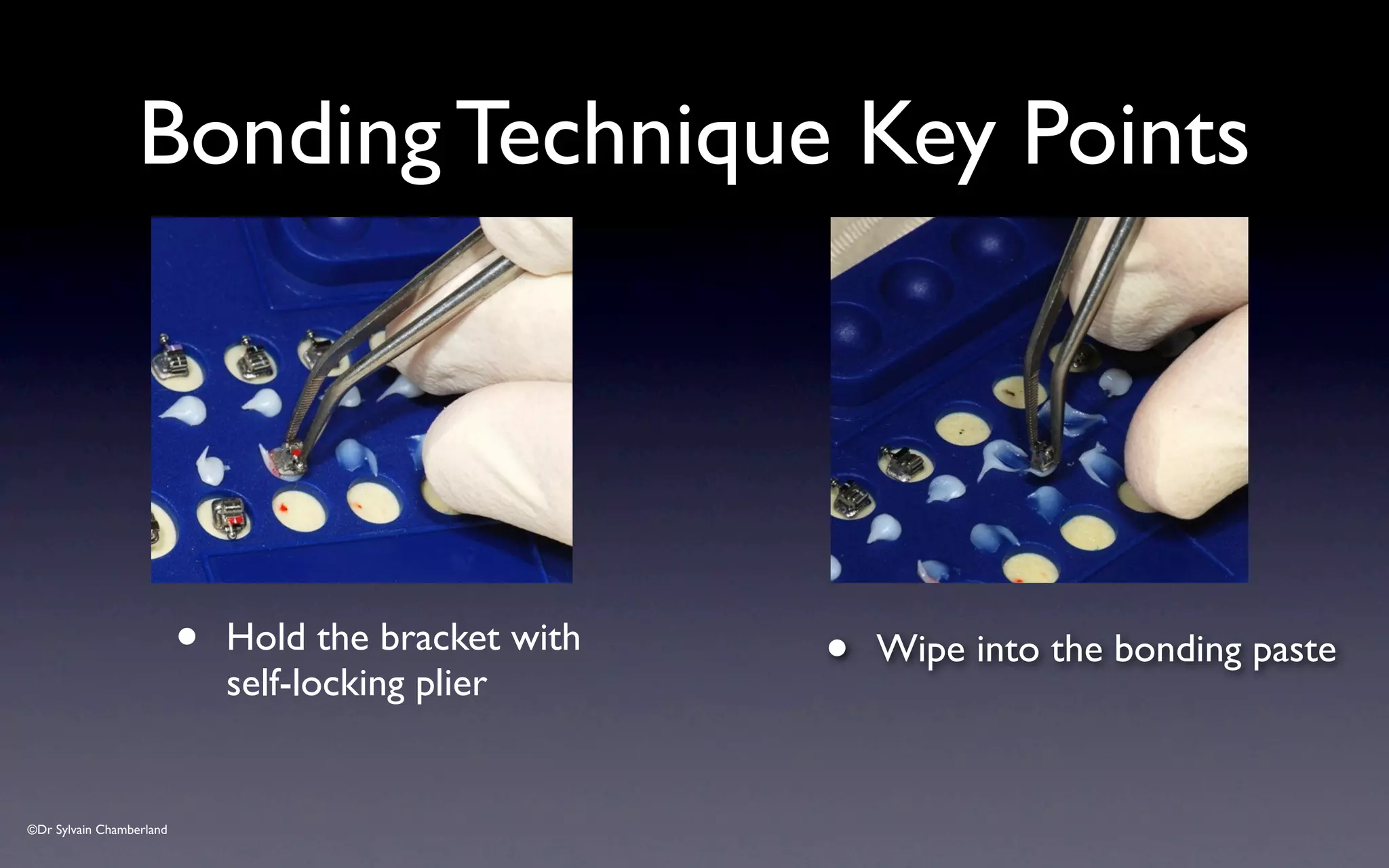
• Wipe into the bonding paste
• Hold the bracket with
self-locking plier
©Dr Sylvain Chamberland
Bonding Technique Key Points
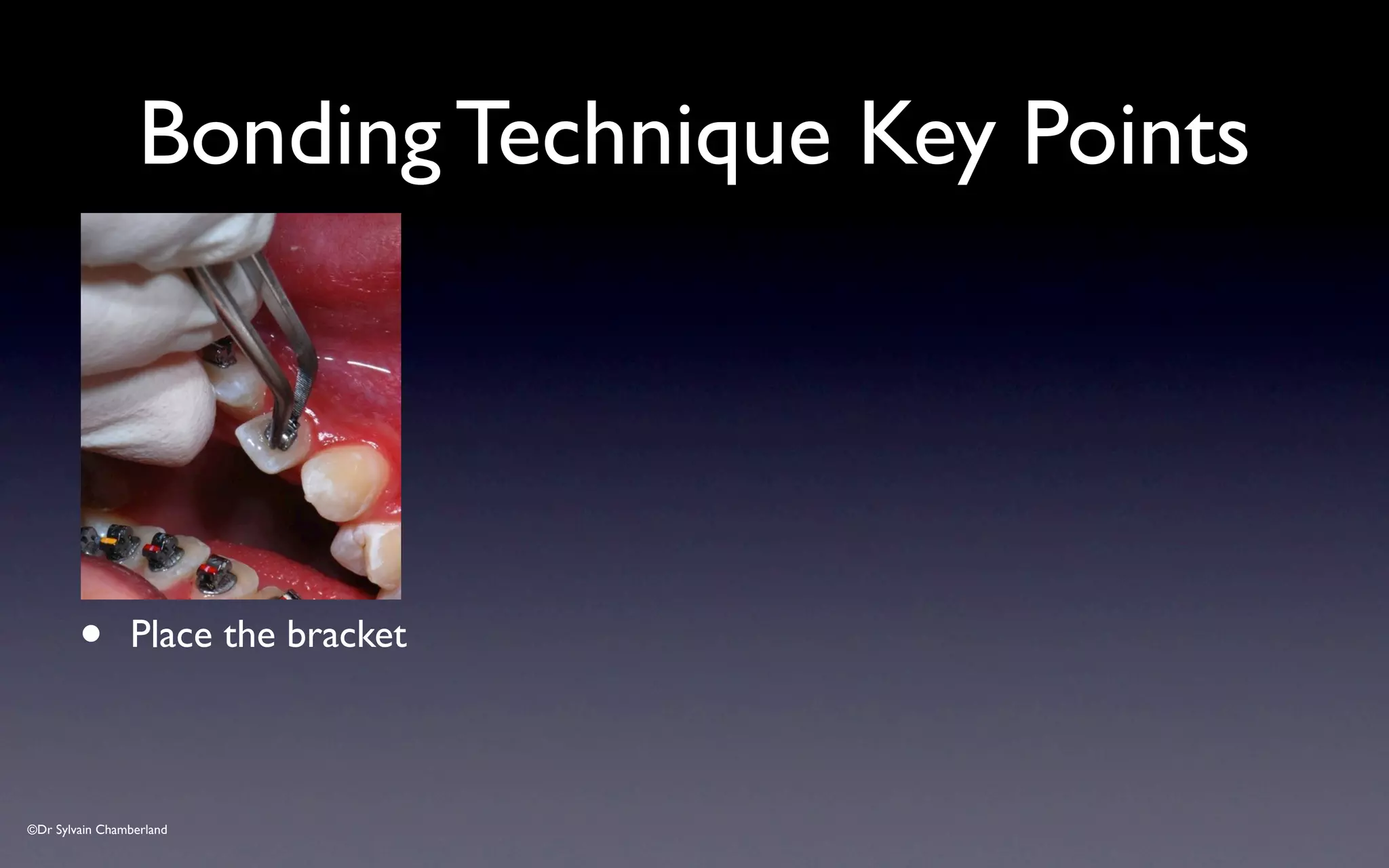
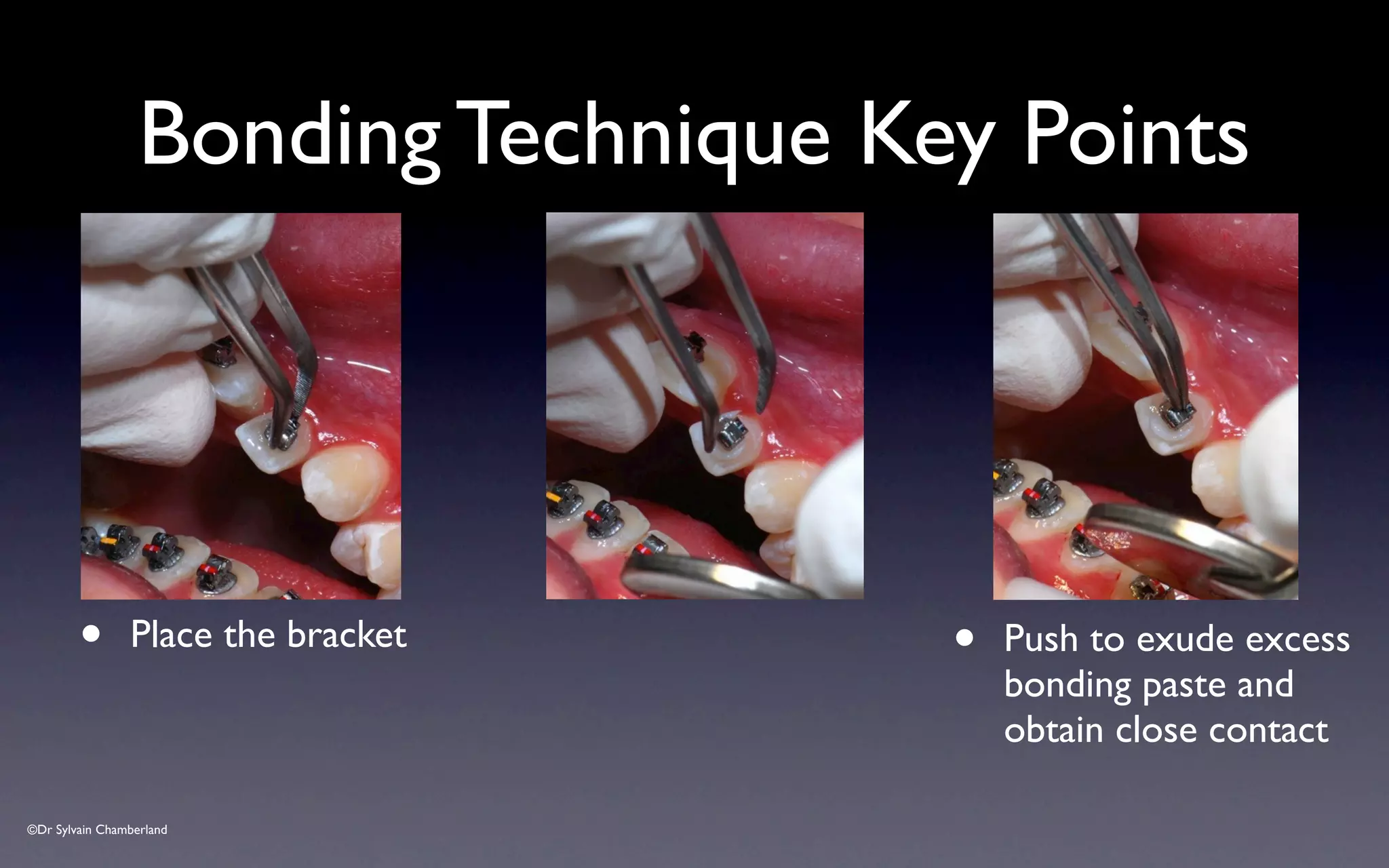
• Place the bracket
©Dr Sylvain Chamberland
Bonding Technique Key Points
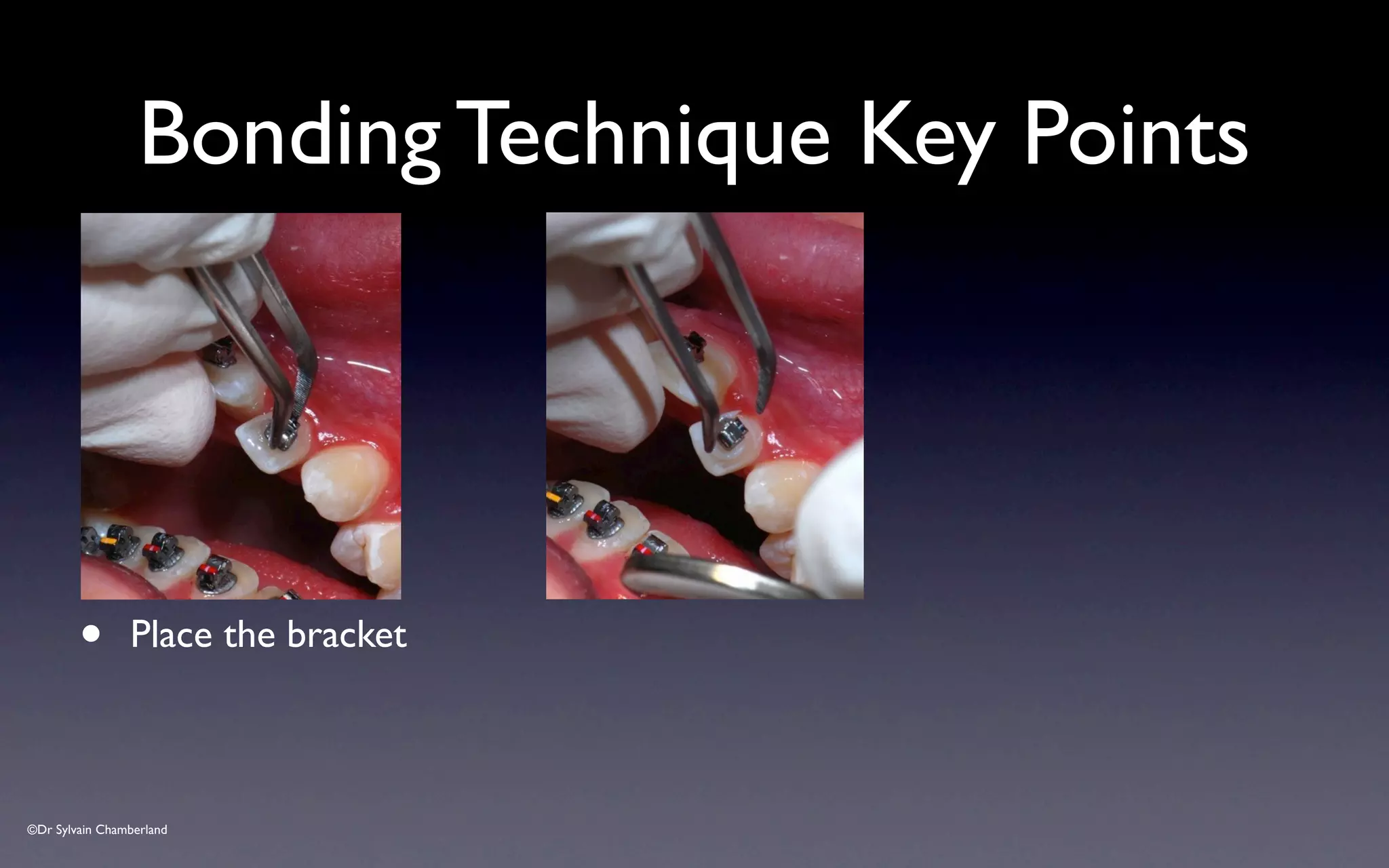
• Place the bracket
©Dr Sylvain Chamberland
Bonding Technique Key Points
• Place the bracket • Push to exude excess
bonding paste and
obtain close contact
©Dr Sylvain Chamberland
Bonding Technique Key Points
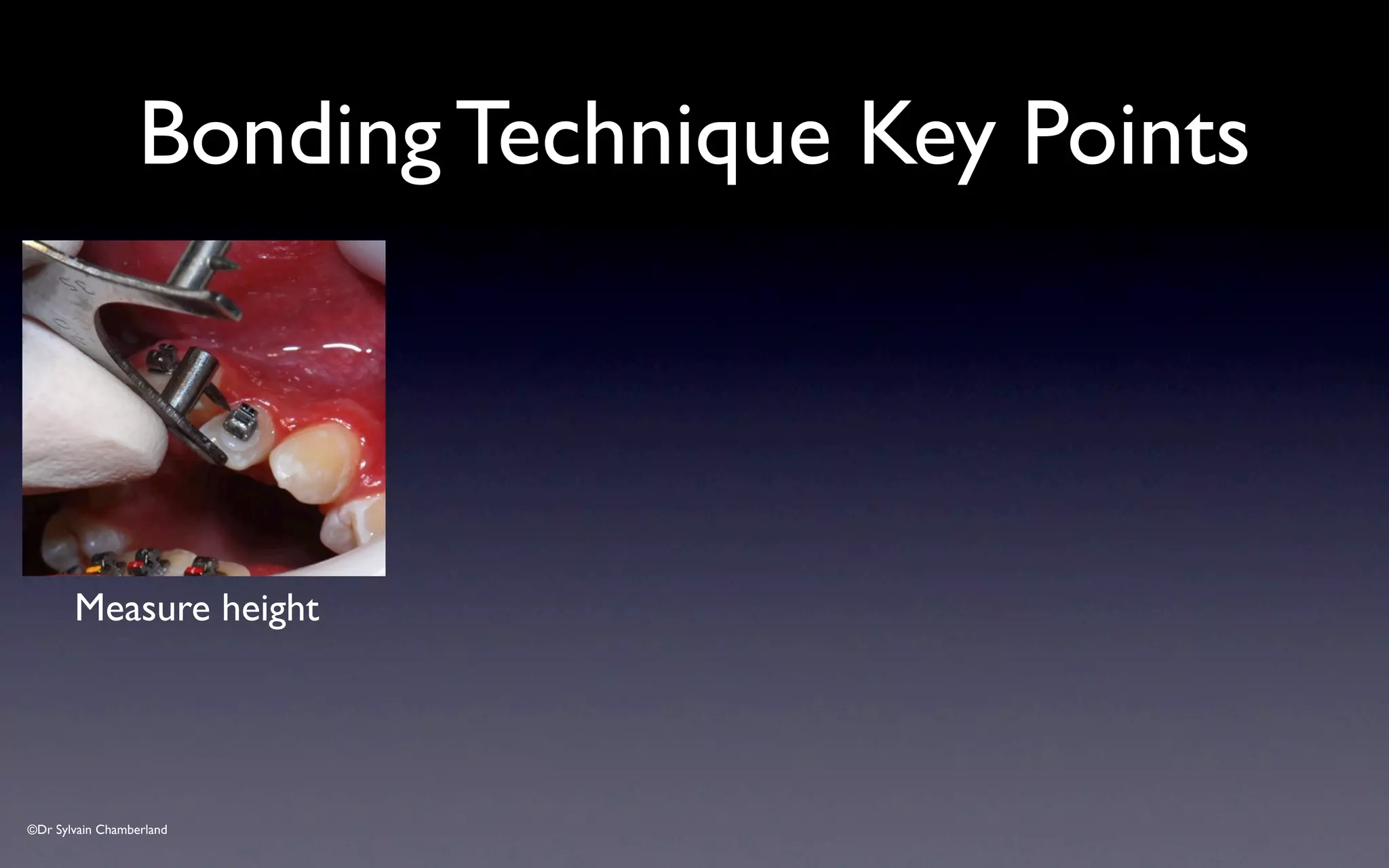
Measure height
©Dr Sylvain Chamberland
Bonding Technique Key Points
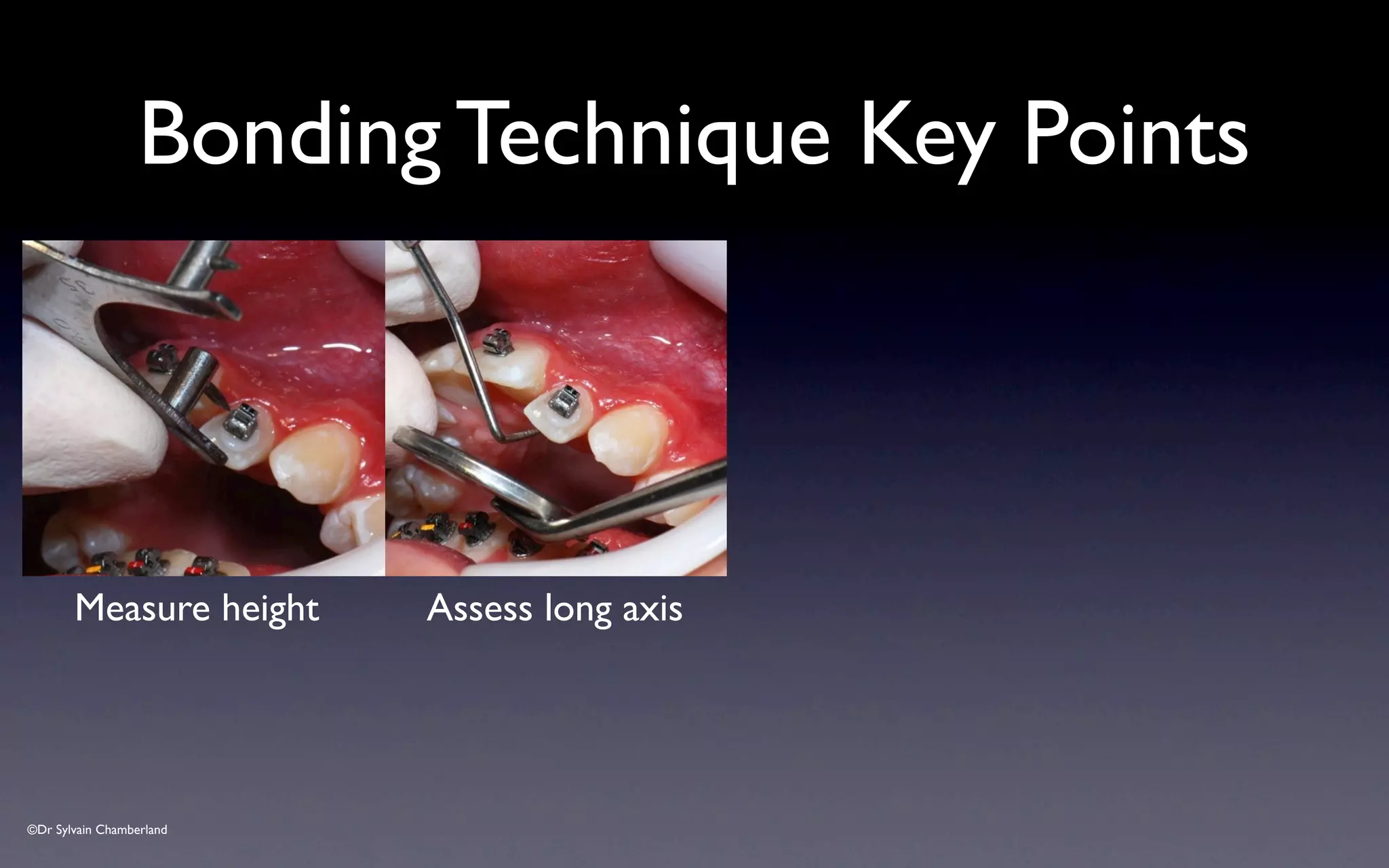
Measure height Assess long axis
©Dr Sylvain Chamberland
Bonding Technique Key Points
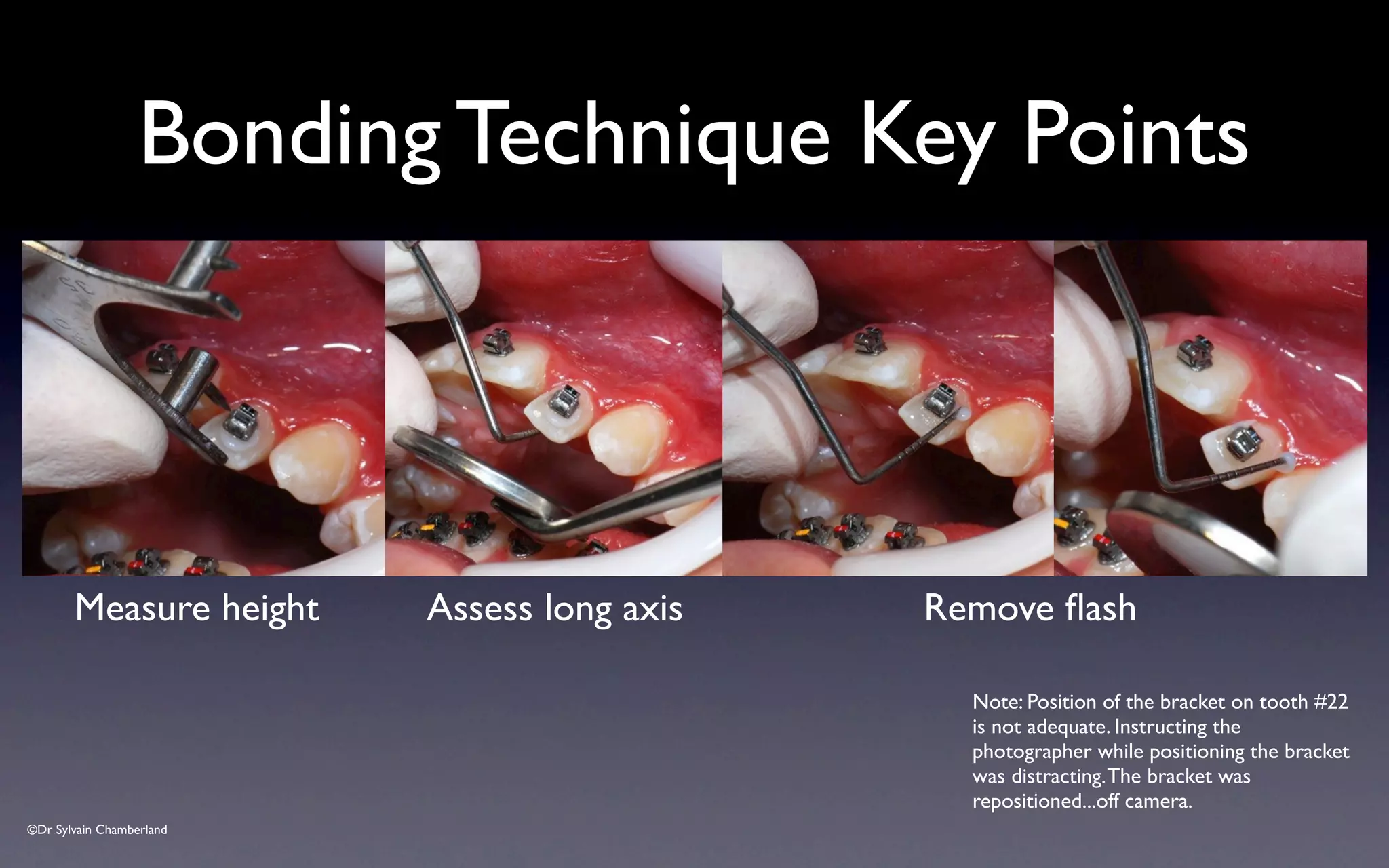
Measure height Assess long axis Remove flash
Note: Position of the bracket on tooth #22
is not adequate. Instructing the
photographer while positioning the bracket
was distracting.The bracket was
repositioned...off camera.
©Dr Sylvain Chamberland
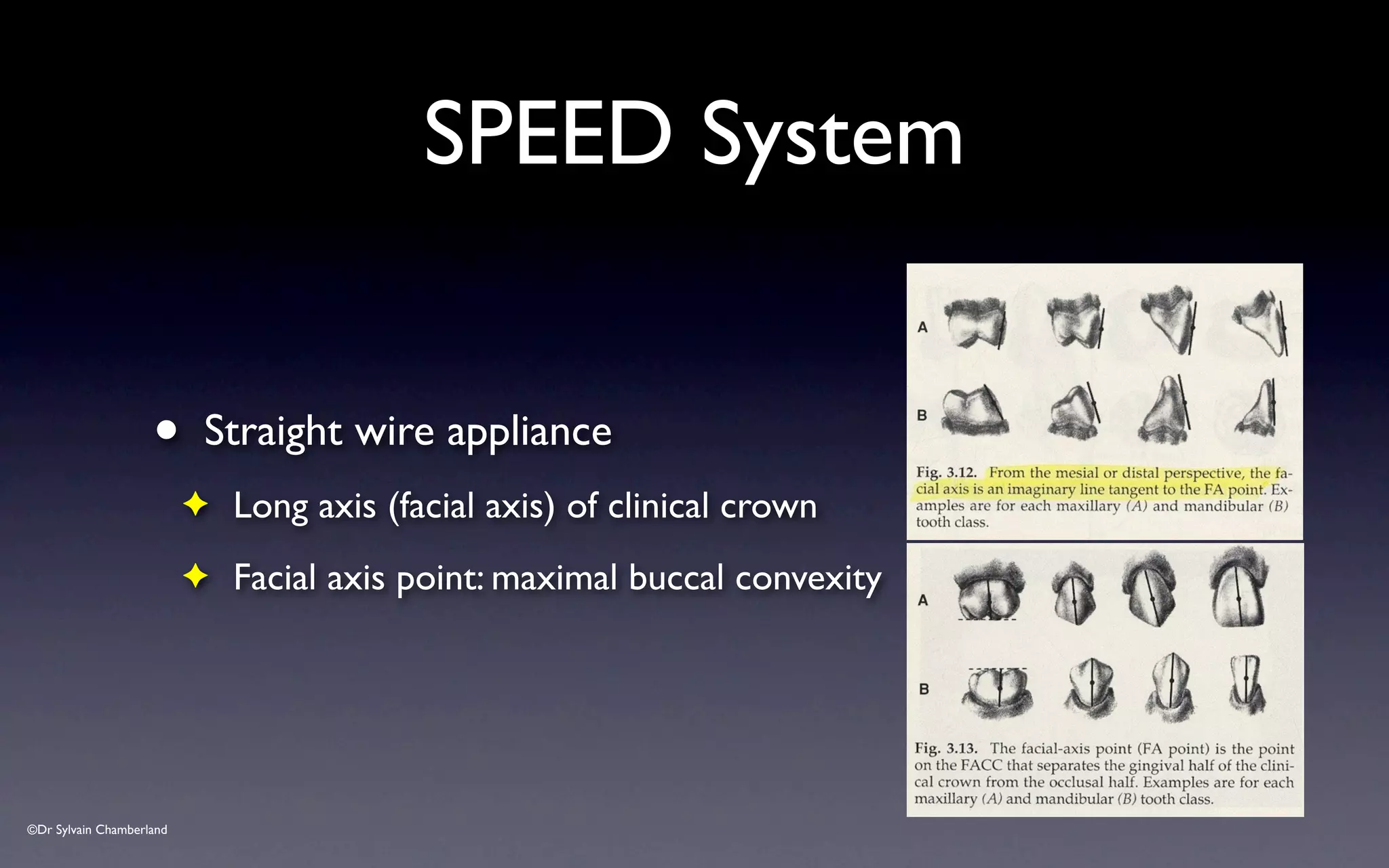
SPEED System
• Straight wire appliance
✦ Long axis (facial axis) of clinical crown
✦ Facial axis point: maximal buccal convexity
©Dr Sylvain Chamberland
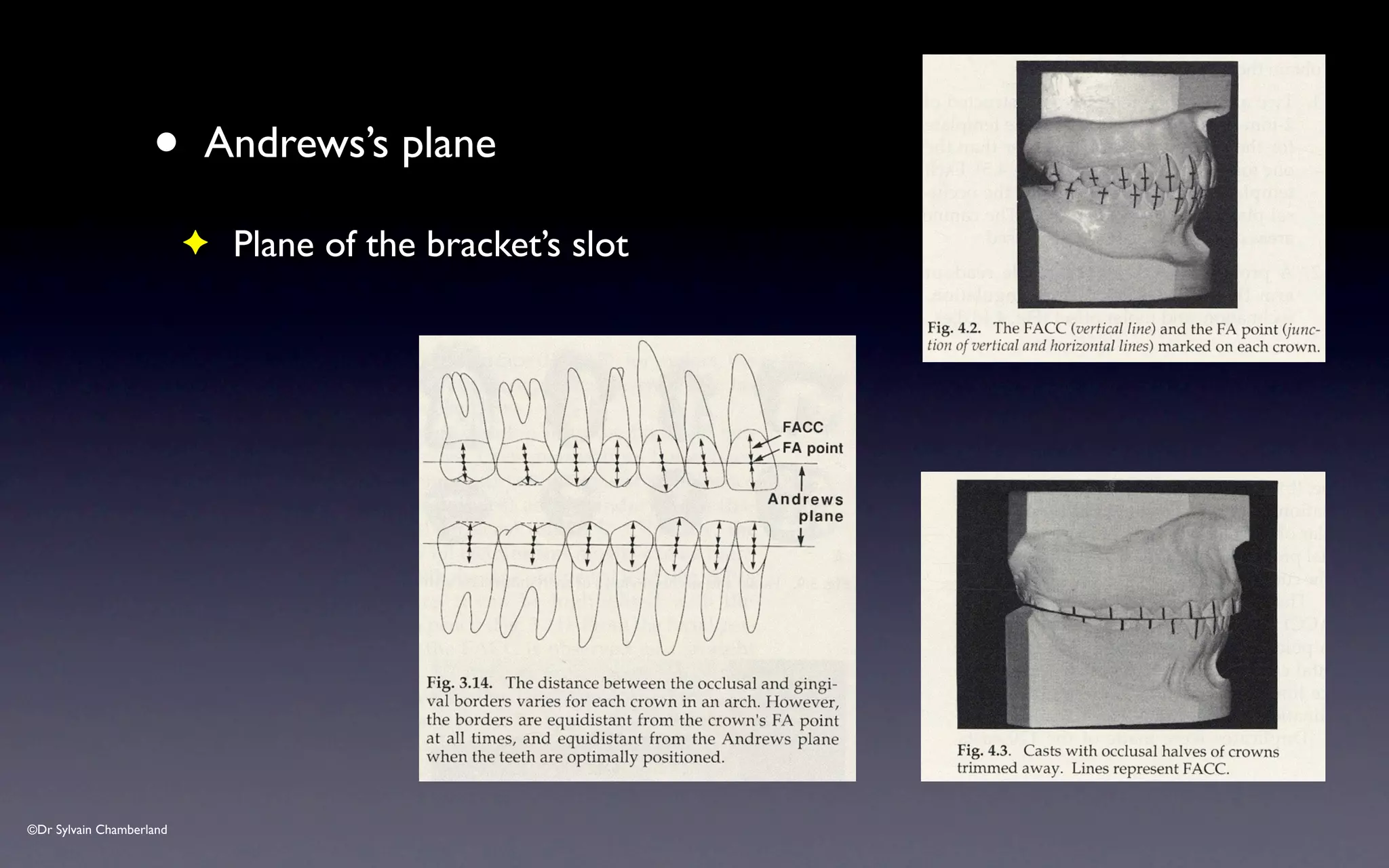
• Andrews’s plane
✦ Plane of the bracket’s slot
©Dr Sylvain Chamberland
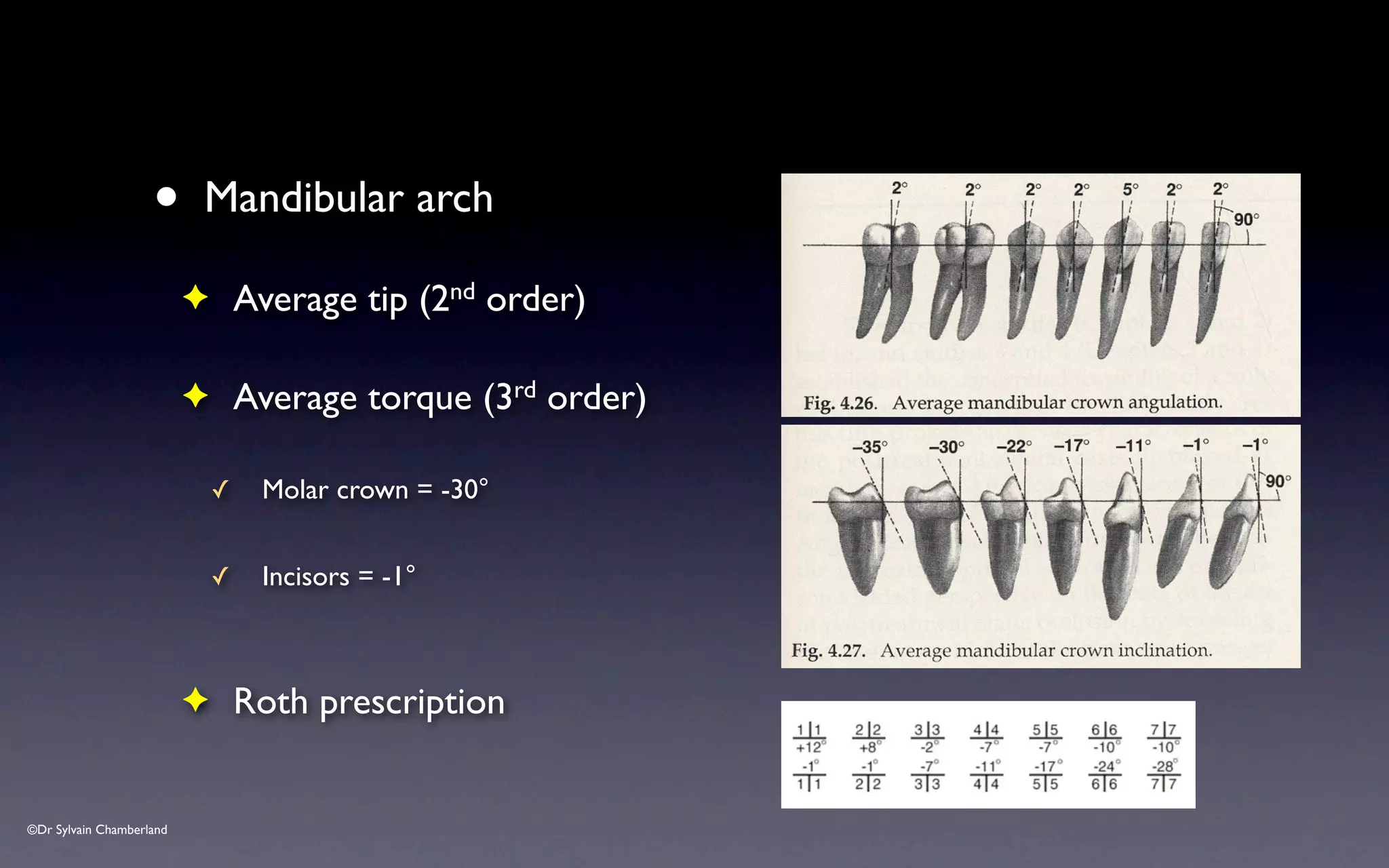
• Mandibular arch
✦ Average tip (2nd order)
✦ Average torque (3rd order)
✓ Molar crown = -30°
✓ Incisors = -1°
✦ Roth prescription
©Dr Sylvain Chamberland
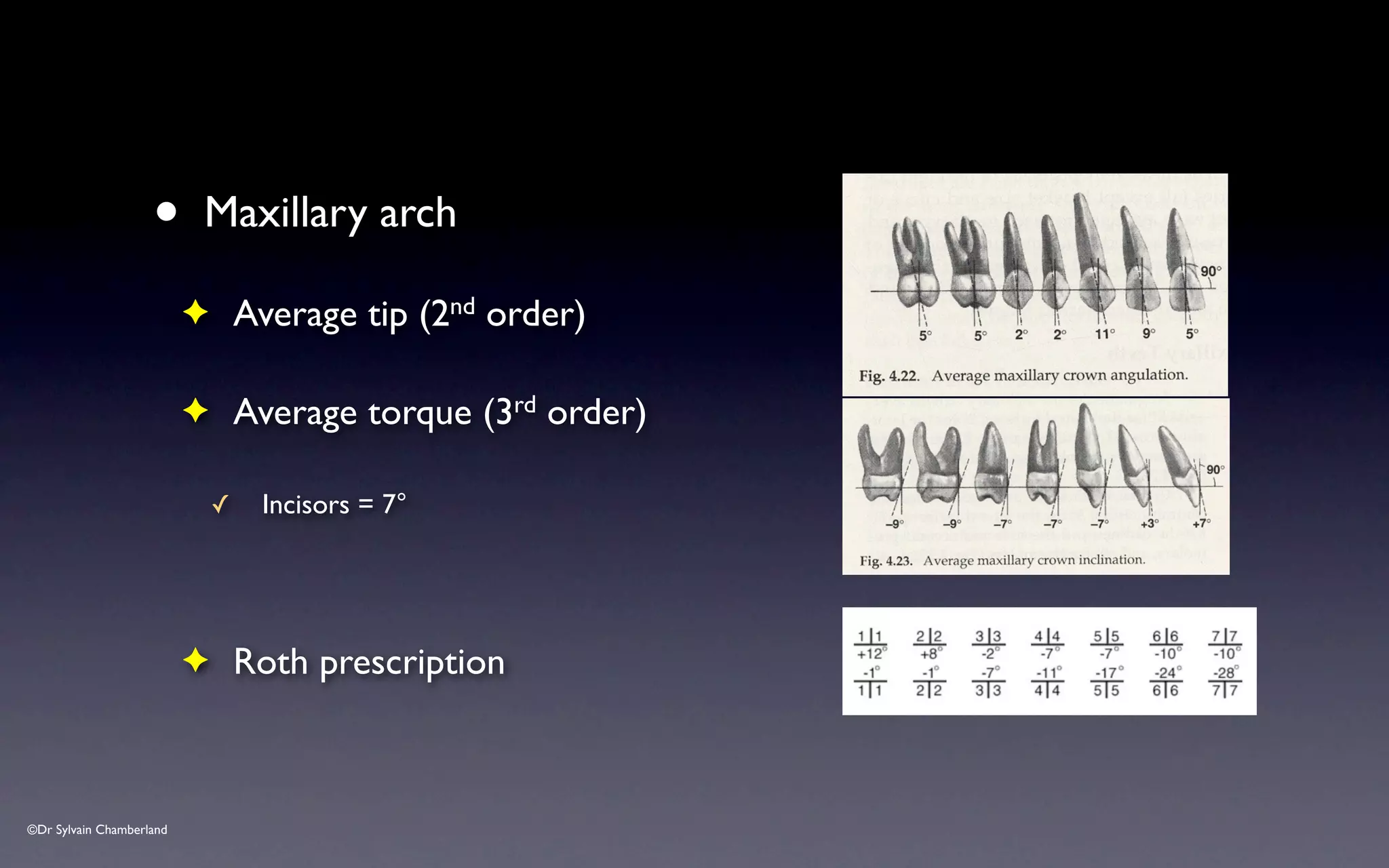
• Maxillary arch
✦ Average tip (2nd order)
✦ Average torque (3rd order)
✓ Incisors = 7°
✦ Roth prescription
©Dr Sylvain Chamberland
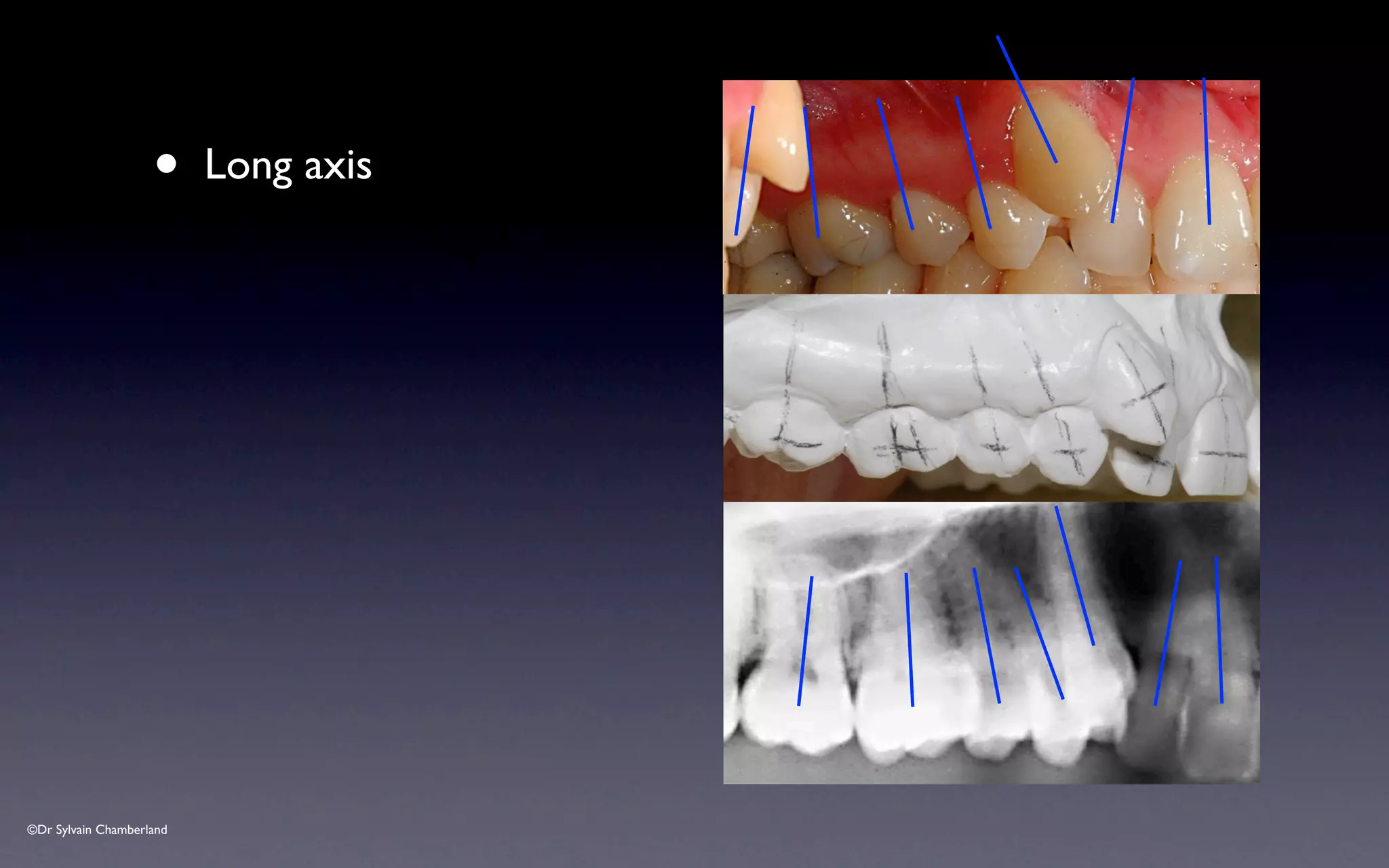
• Long axis
©Dr Sylvain Chamberland
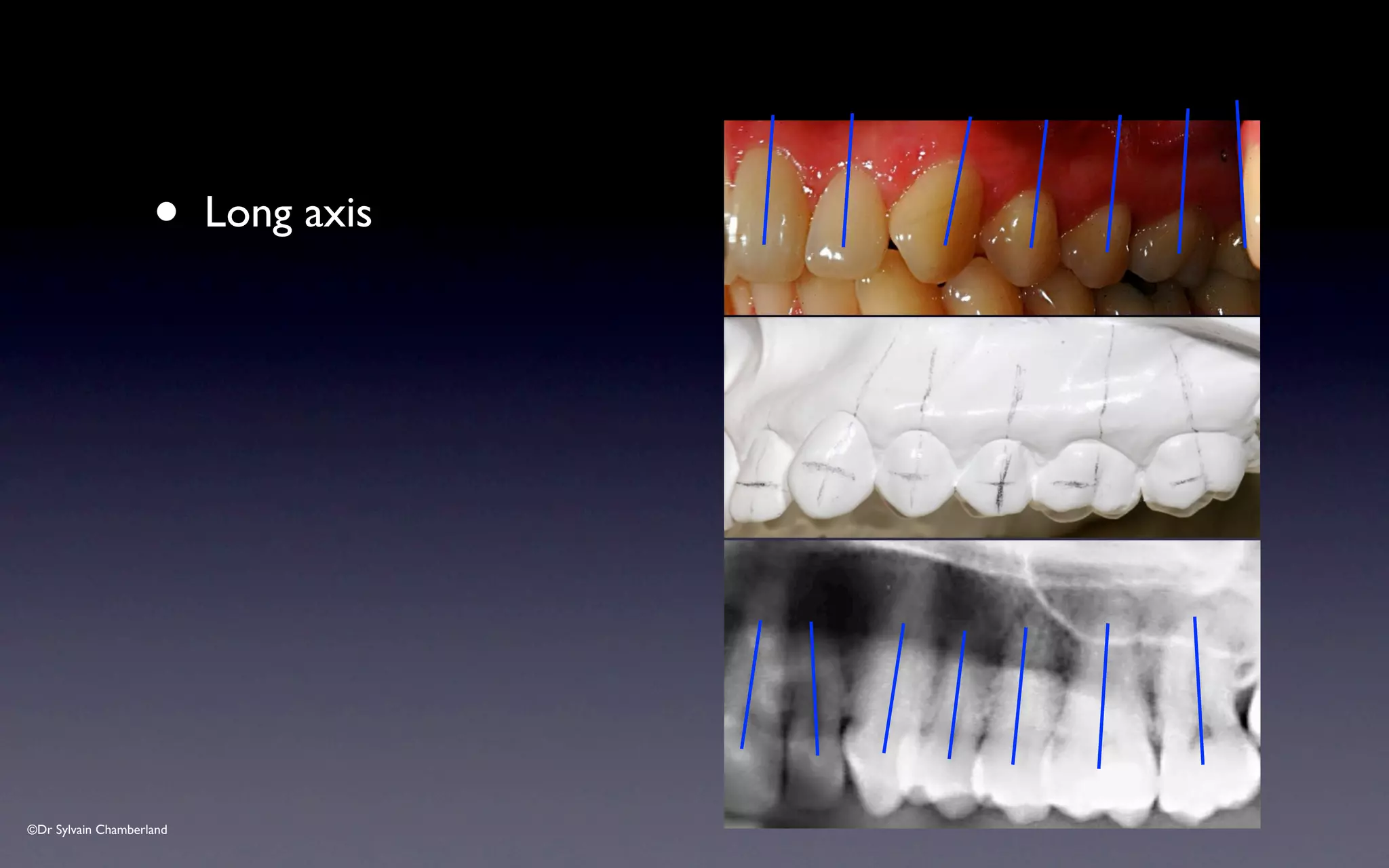
• Long axis
©Dr Sylvain Chamberland
• C
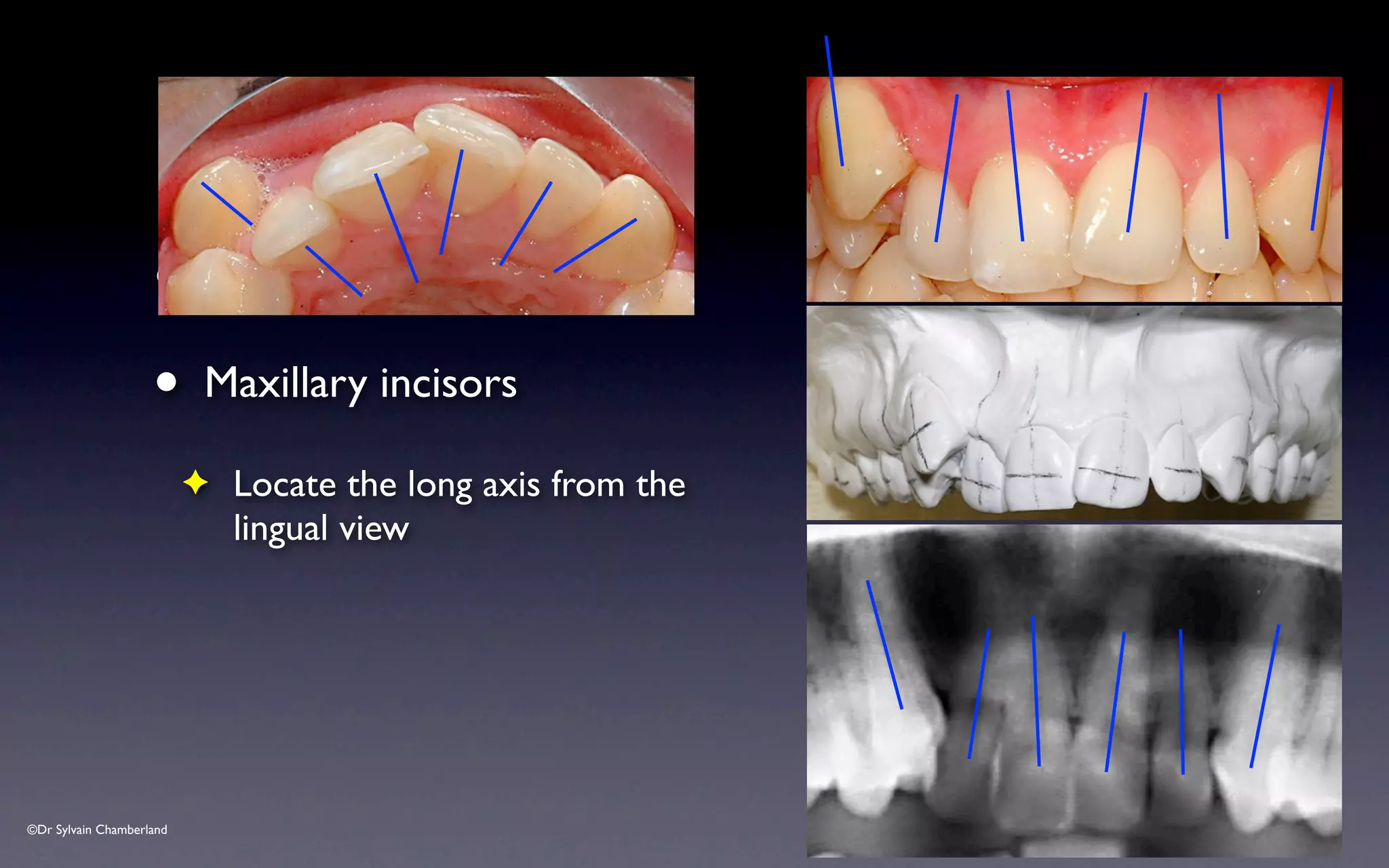
• Maxillary incisors
✦ Locate the long axis from the
lingual view
©Dr Sylvain Chamberland
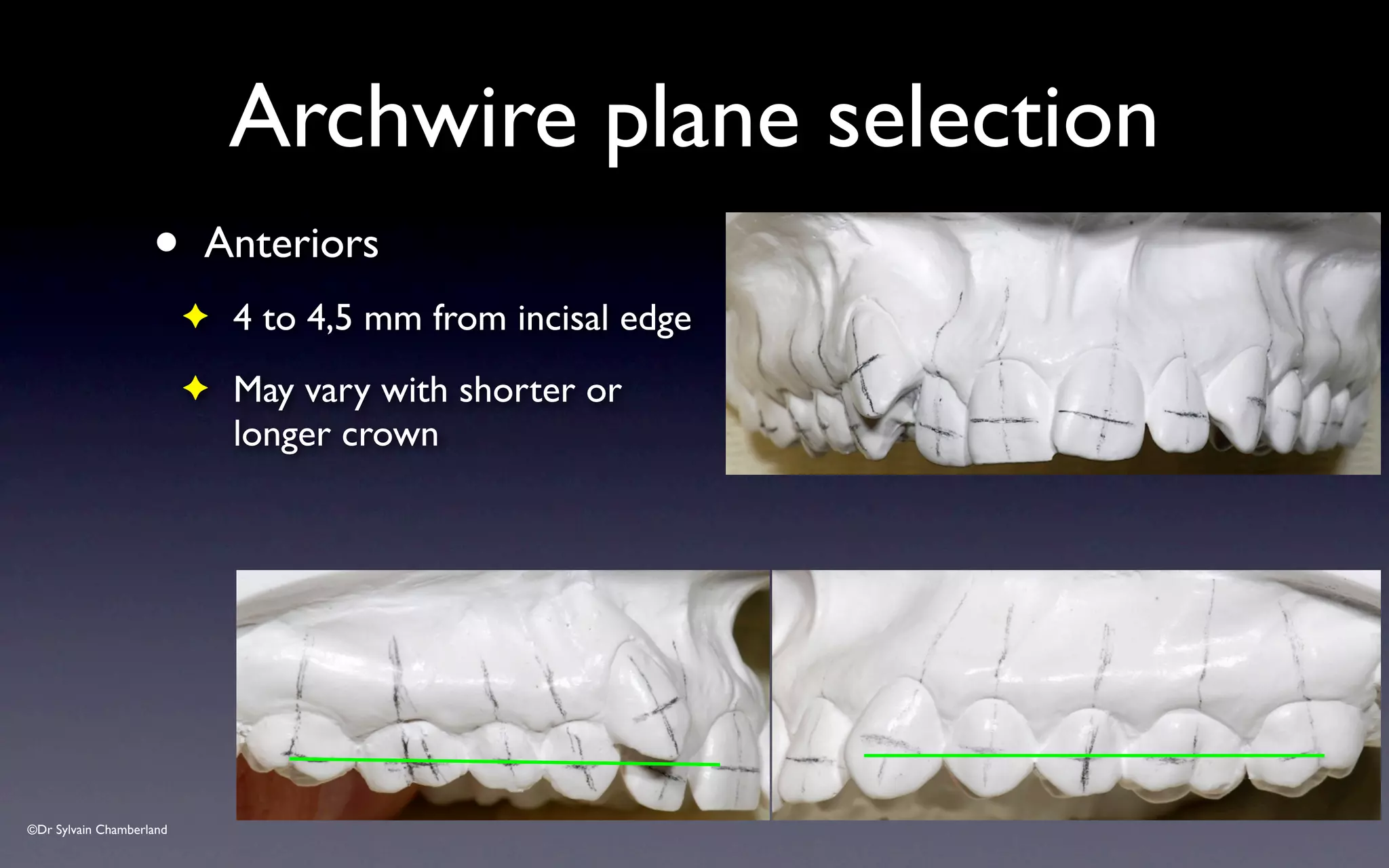
• Anteriors
✦ 4 to 4,5 mm from incisal edge
✦ May vary with shorter or
longer crown
Archwire plane selection
©Dr Sylvain Chamberland
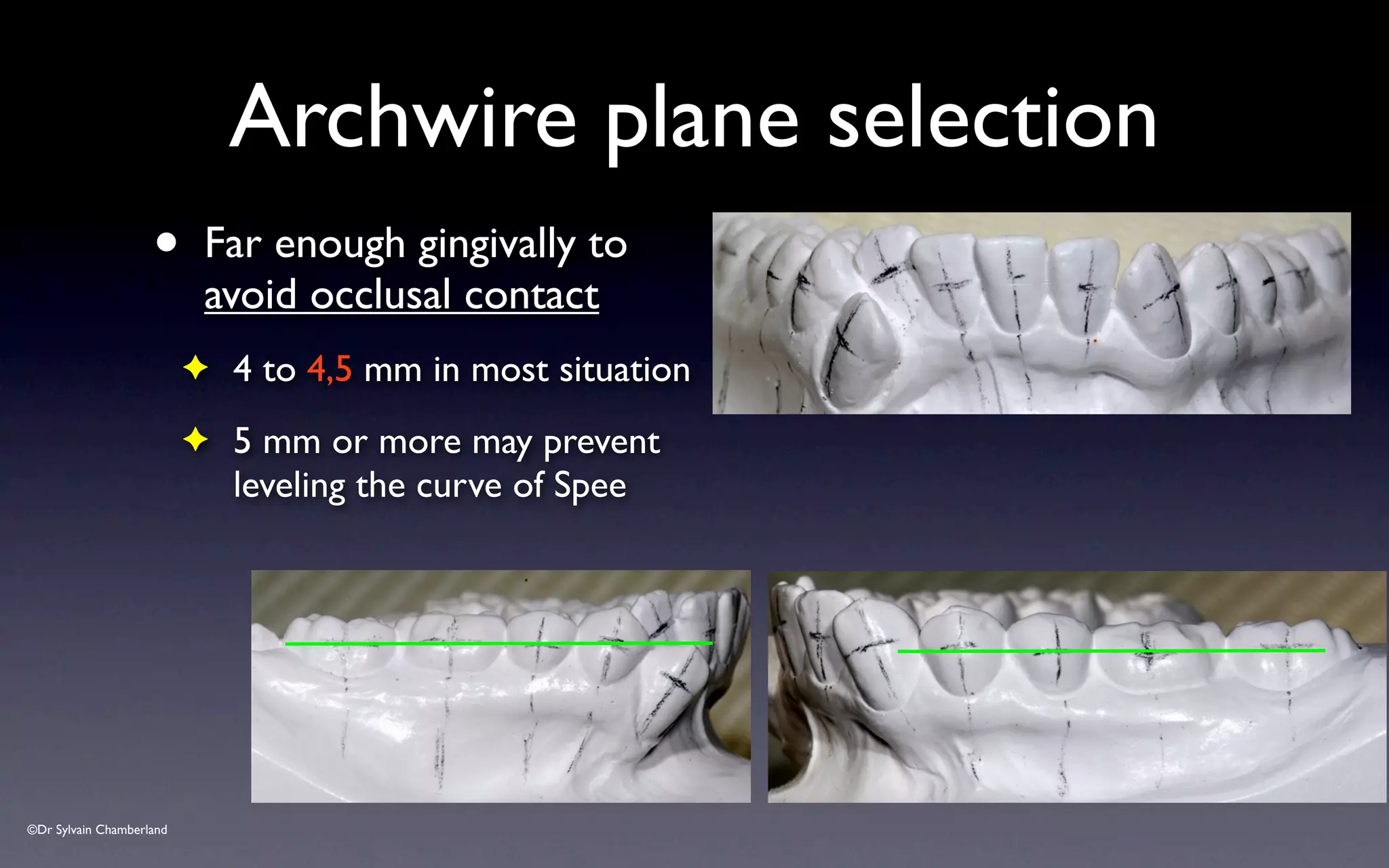
• Far enough gingivally to
avoid occlusal contact
✦ 4 to 4,5 mm in most situation
✦ 5 mm or more may prevent
leveling the curve of Spee
Archwire plane selection
©Dr Sylvain Chamberland
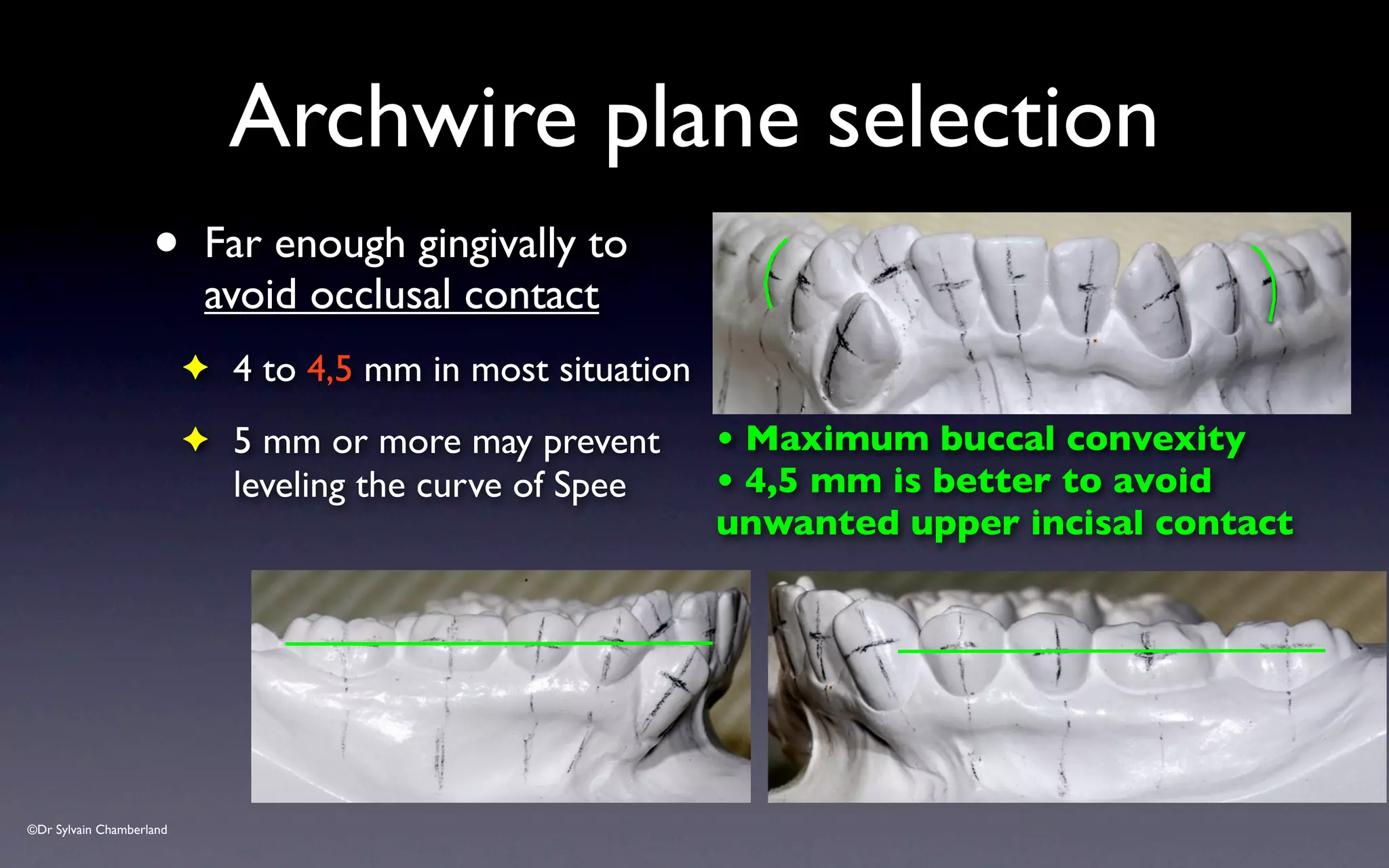
• Far enough gingivally to
avoid occlusal contact
✦ 4 to 4,5 mm in most situation
✦ 5 mm or more may prevent
leveling the curve of Spee
Archwire plane selection
• Maximum buccal convexity
• 4,5 mm is better to avoid
unwanted upper incisal contact
©Dr Sylvain Chamberland
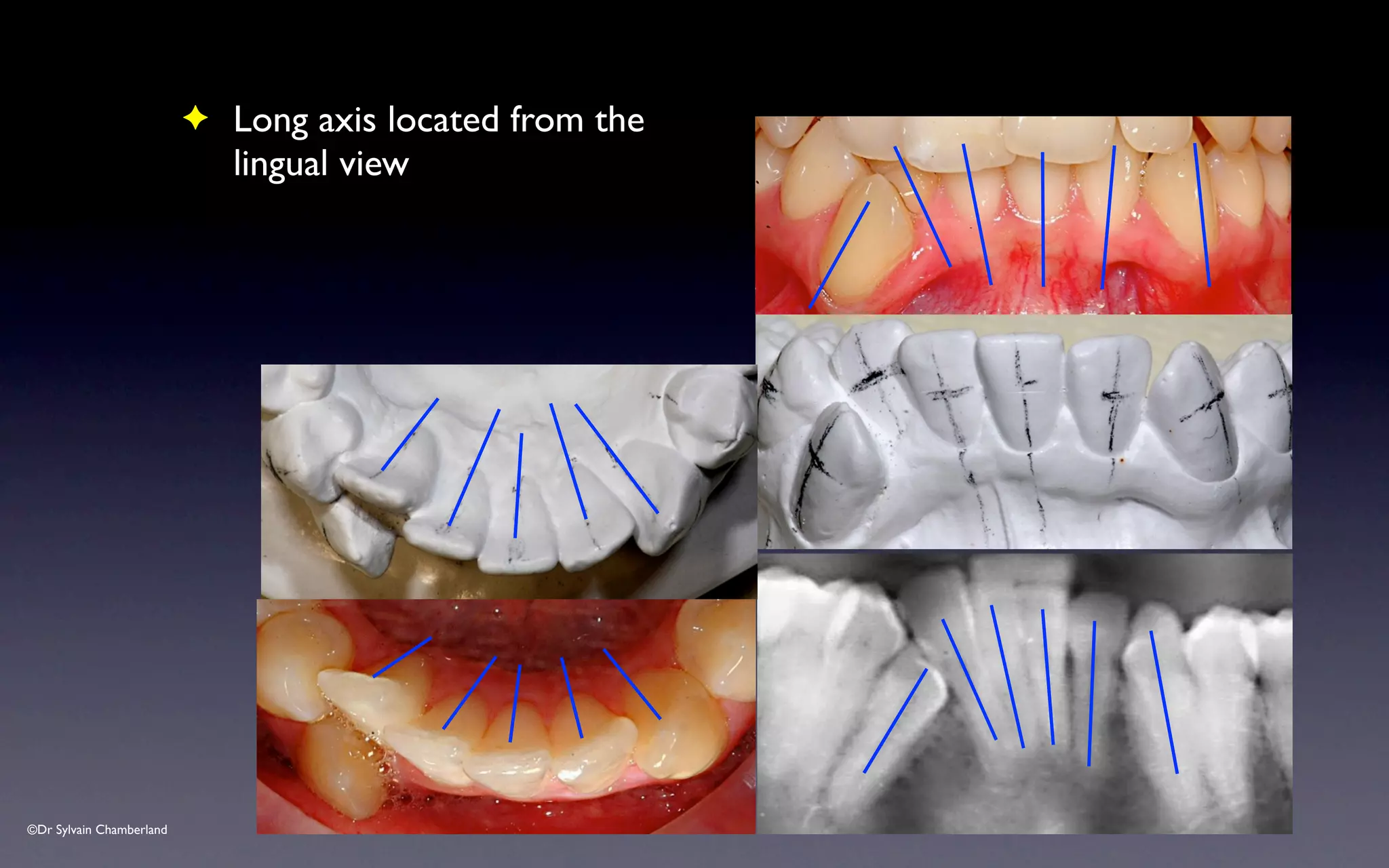
✦ Long axis located from the
lingual view
©Dr Sylvain Chamberland
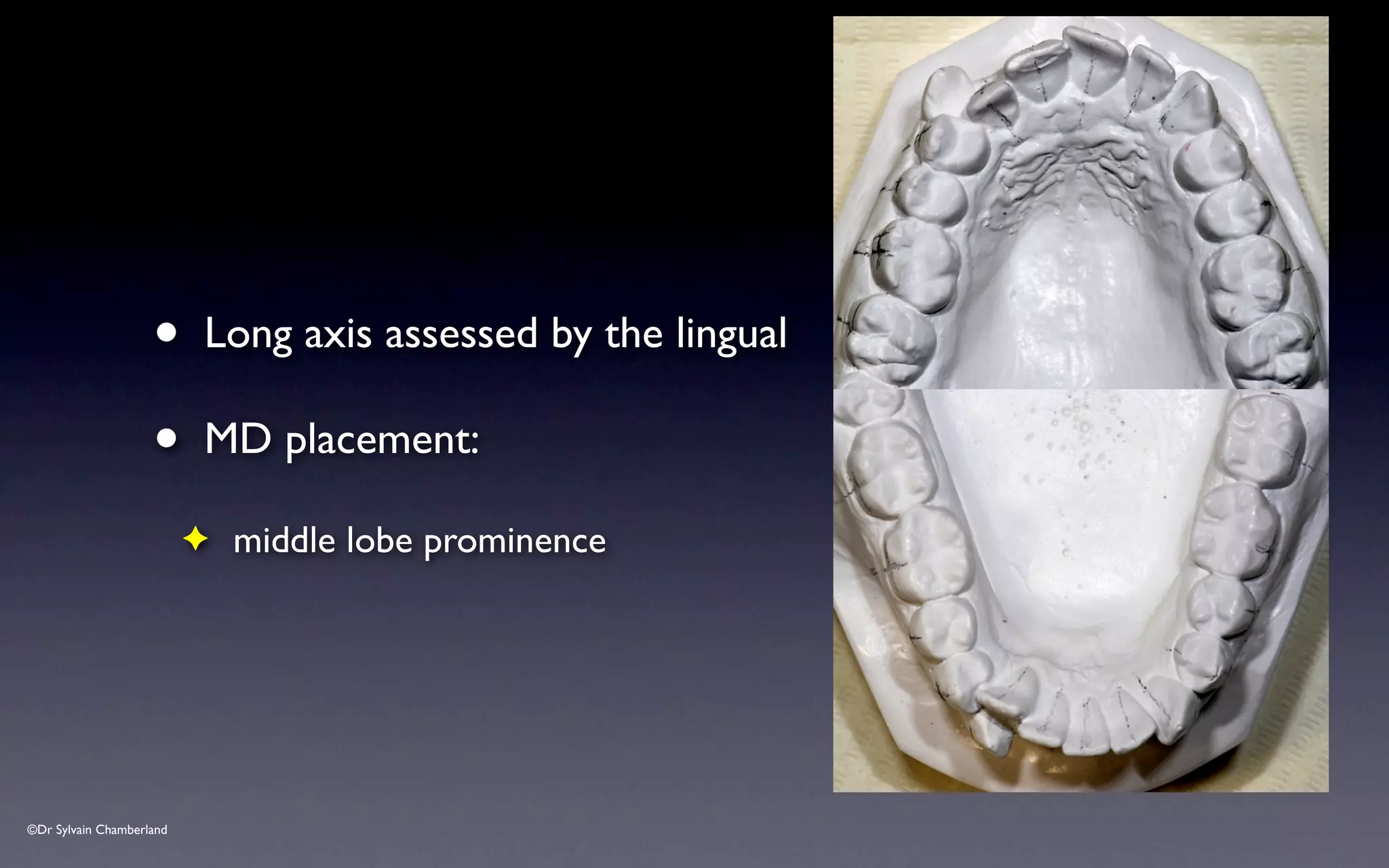
• Long axis assessed by the lingual
• MD placement:
✦ middle lobe prominence
©Dr Sylvain Chamberland
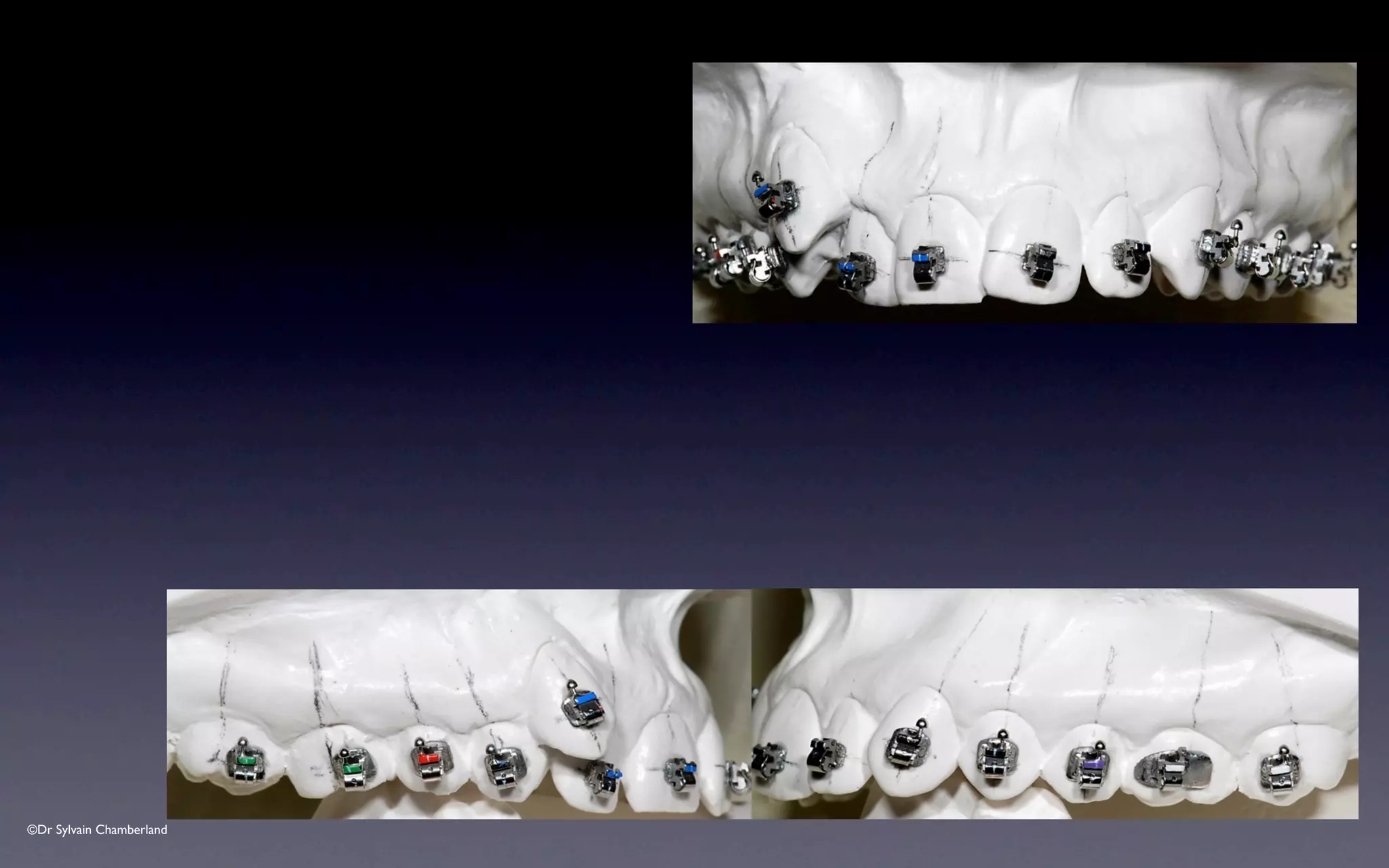
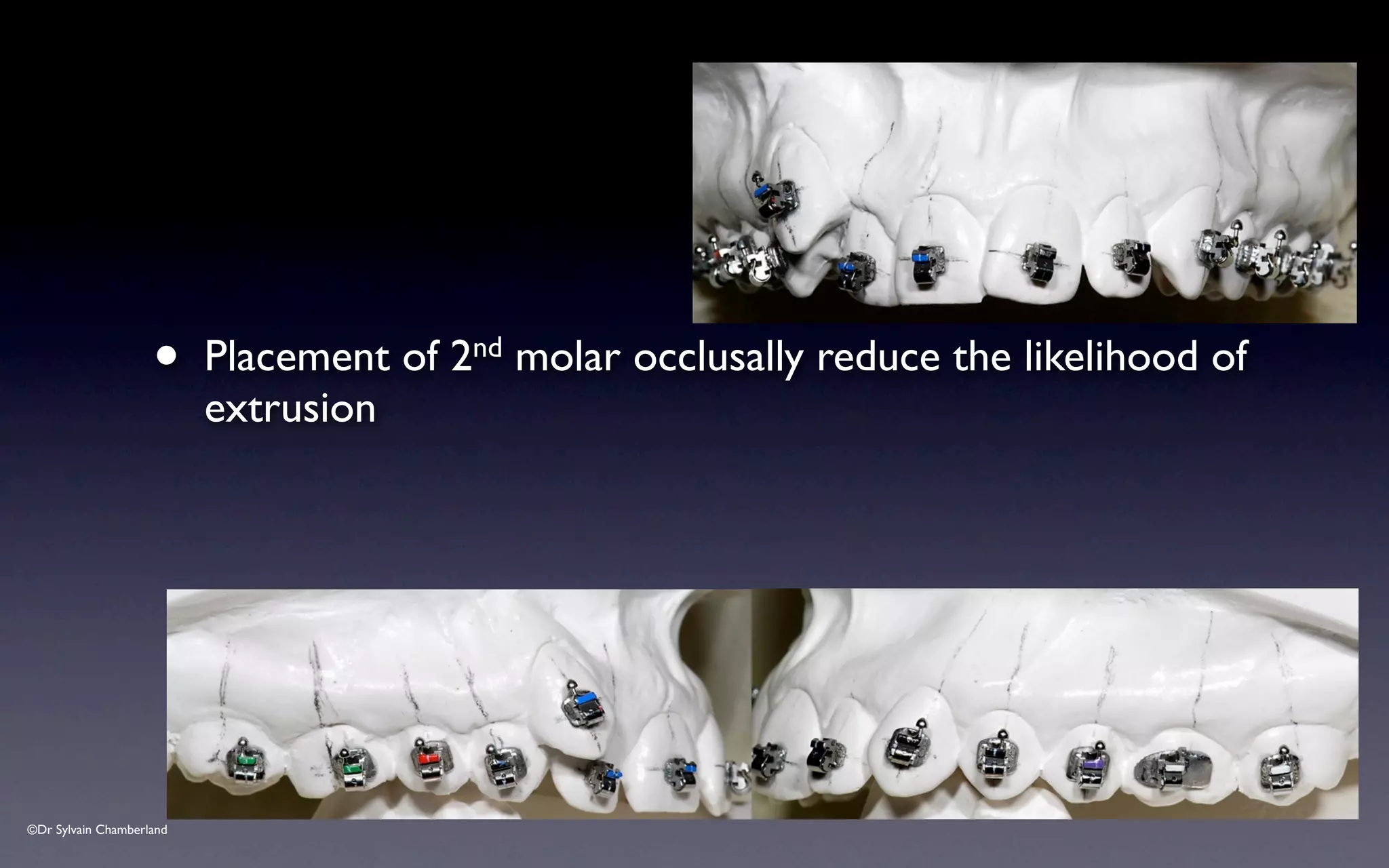
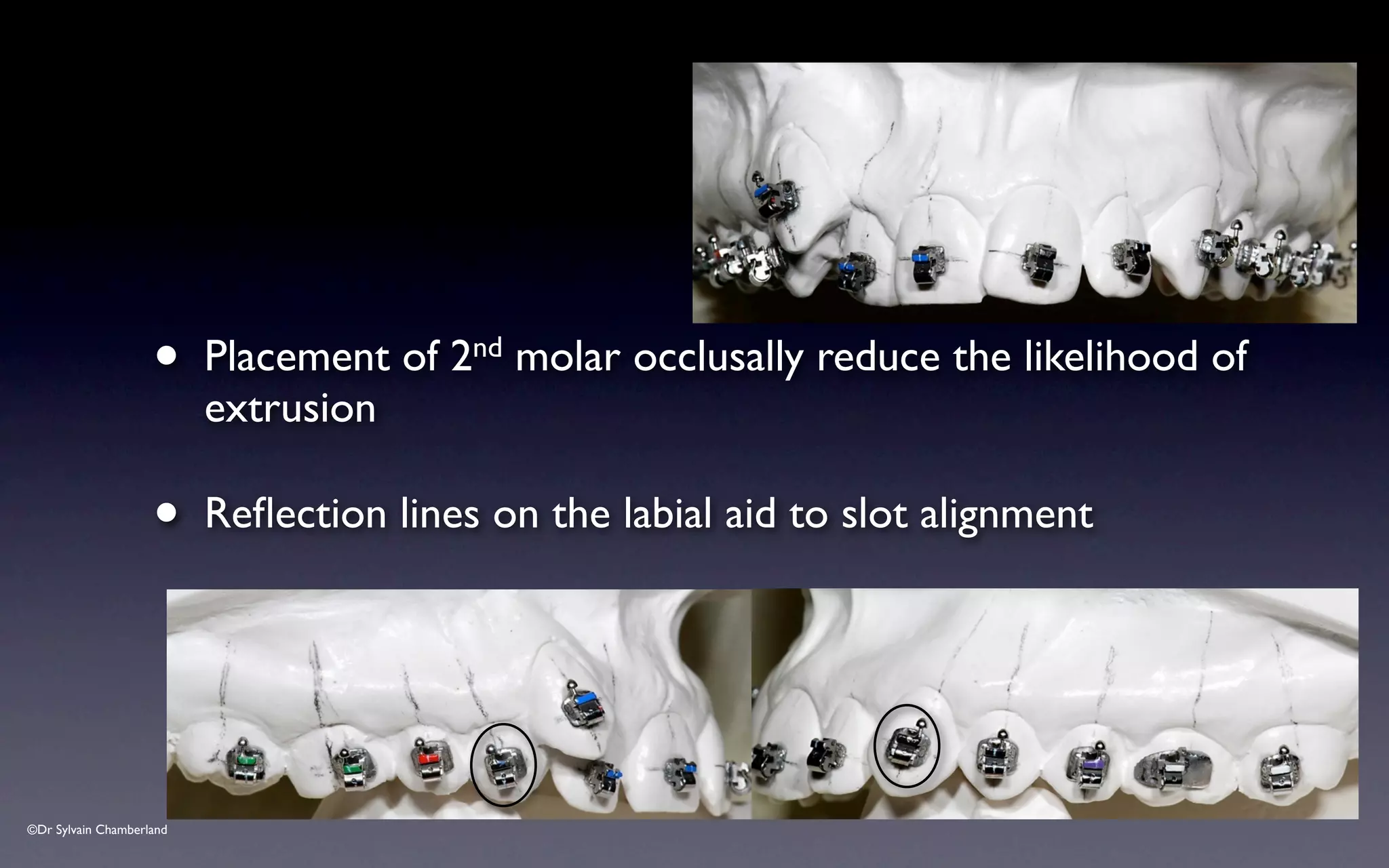
• Placement of 2nd molar occlusally reduce the likelihood of
extrusion
©Dr Sylvain Chamberland
• Placement of 2nd molar occlusally reduce the likelihood of
extrusion
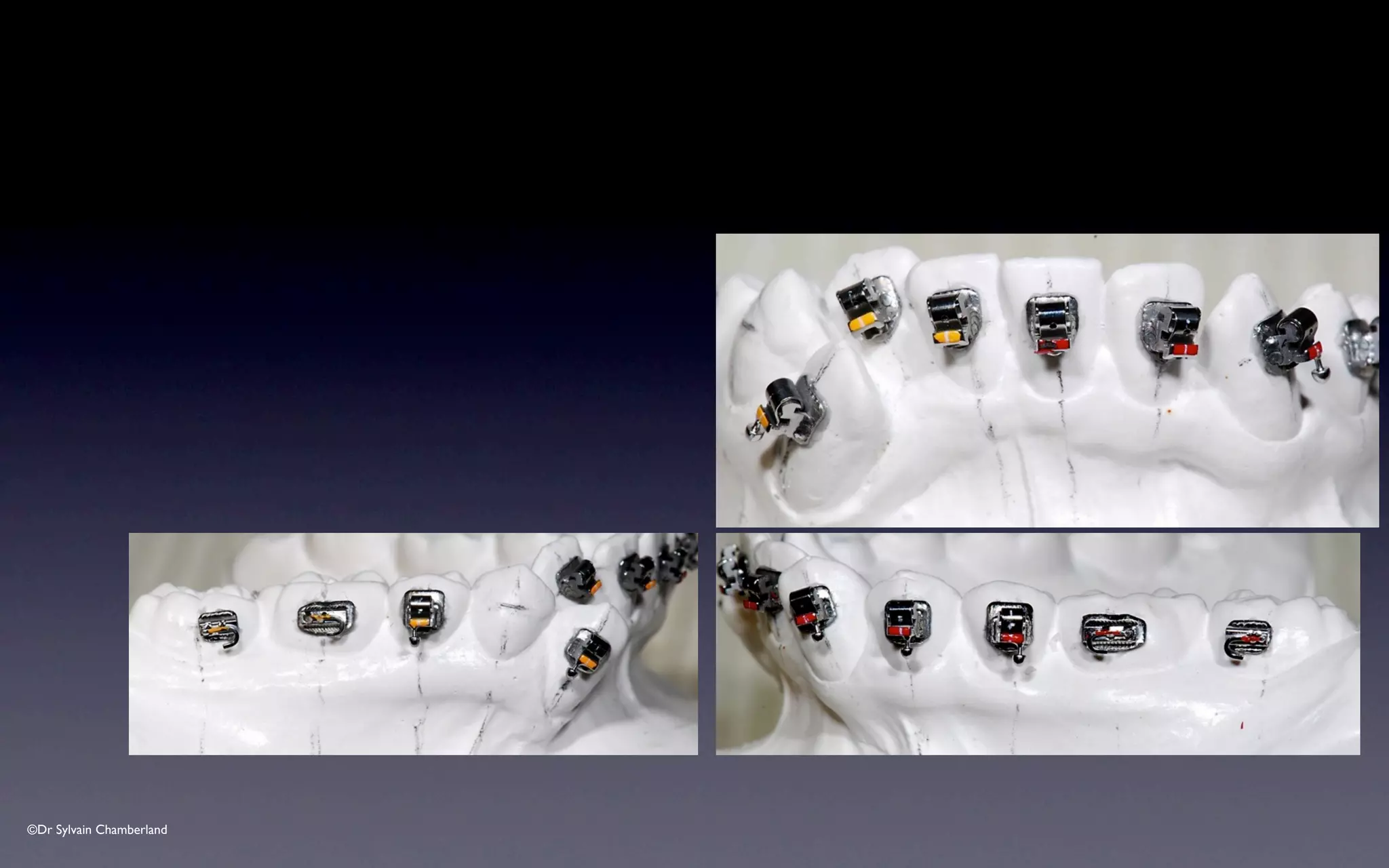
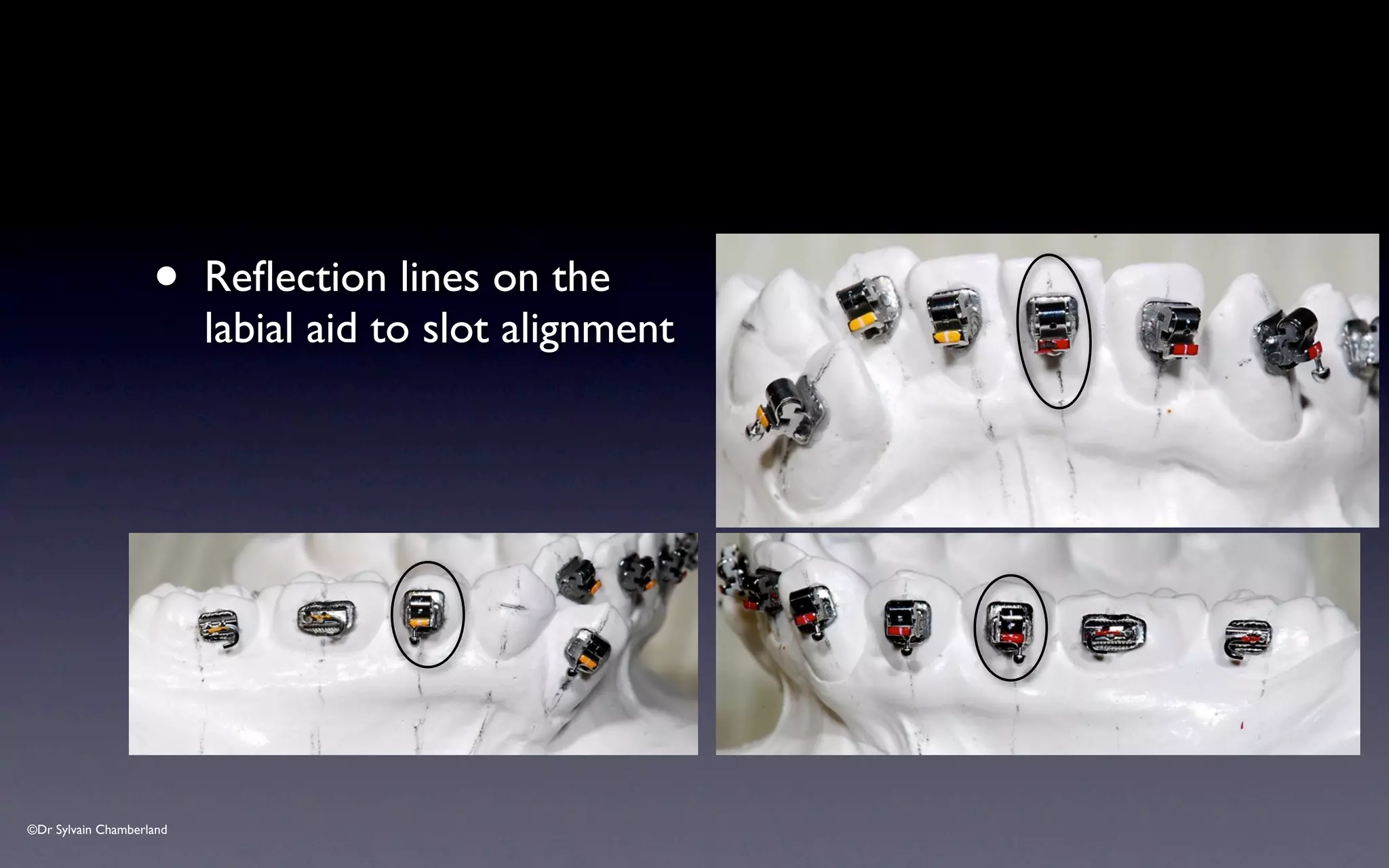
• Reflection lines on the labial aid to slot alignment
©Dr Sylvain Chamberland
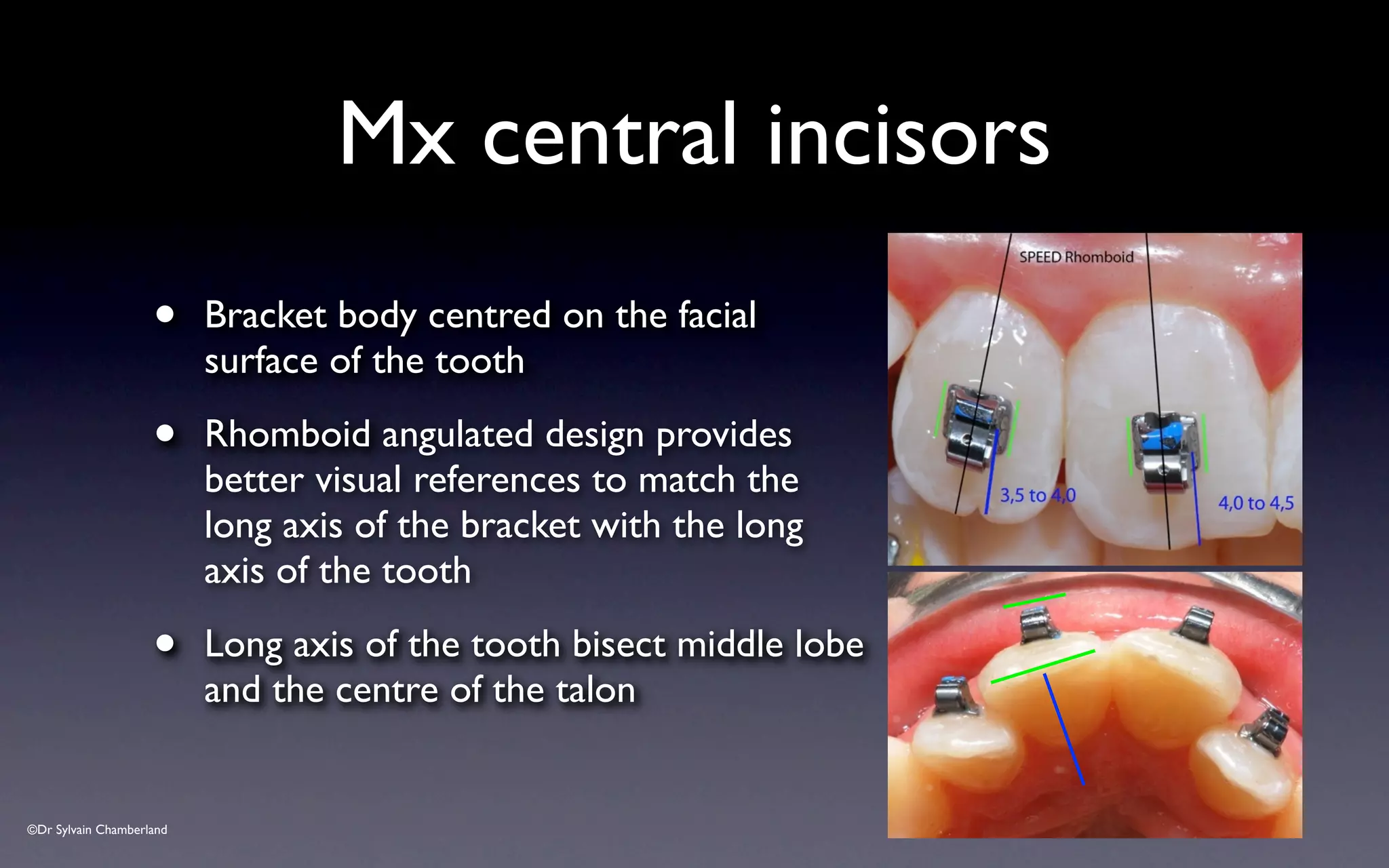
• Bracket body centred on the facial
surface of the tooth
• Rhomboid angulated design provides
better visual references to match the
long axis of the bracket with the long
axis of the tooth
• Long axis of the tooth bisect middle lobe
and the centre of the talon
Mx central incisors
4 to 4,5
©Dr Sylvain Chamberland
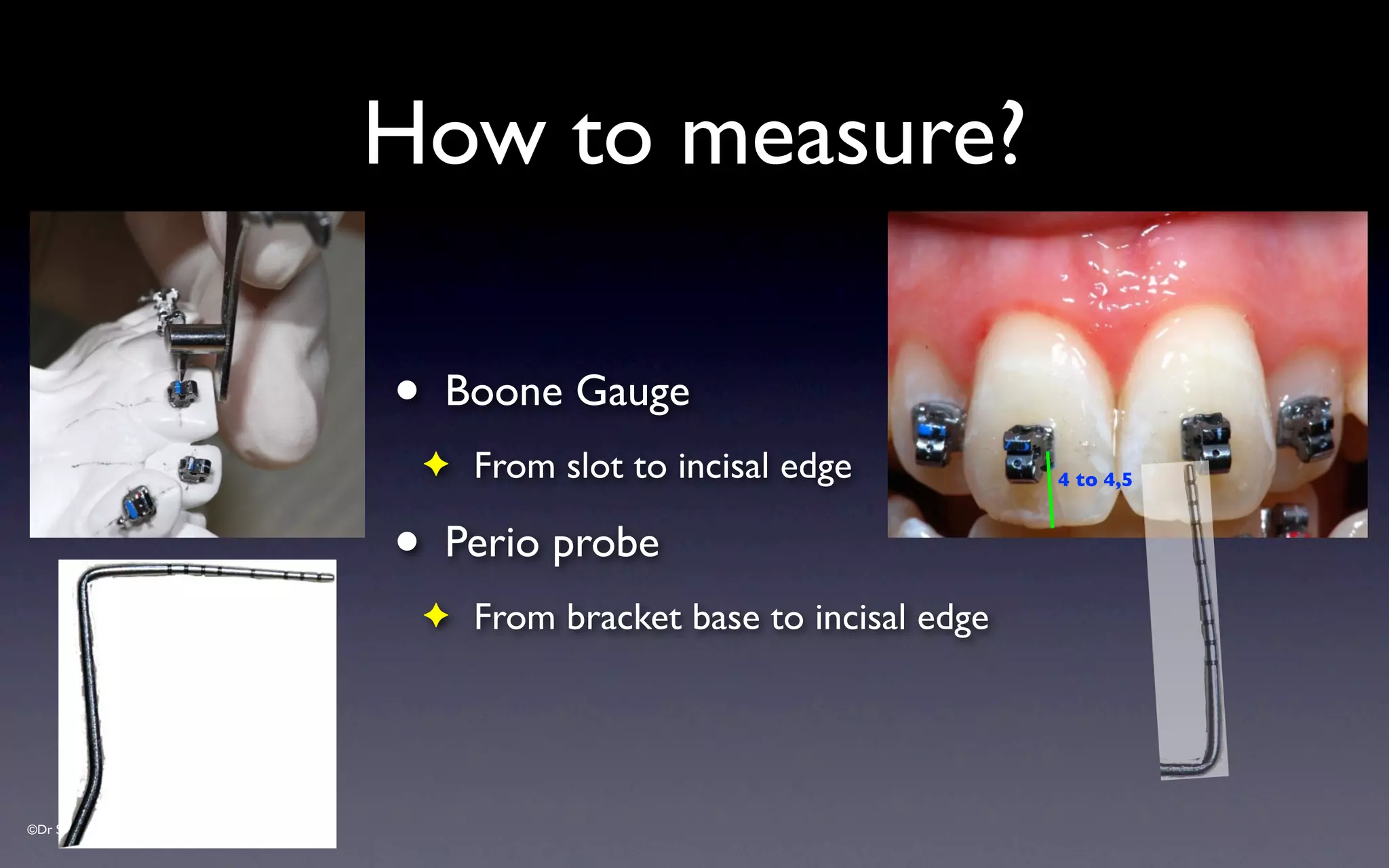
How to measure?
• Boone Gauge
✦ From slot to incisal edge
• Perio probe
✦ From bracket base to incisal edge
4 to 4,5
©Dr Sylvain Chamberland
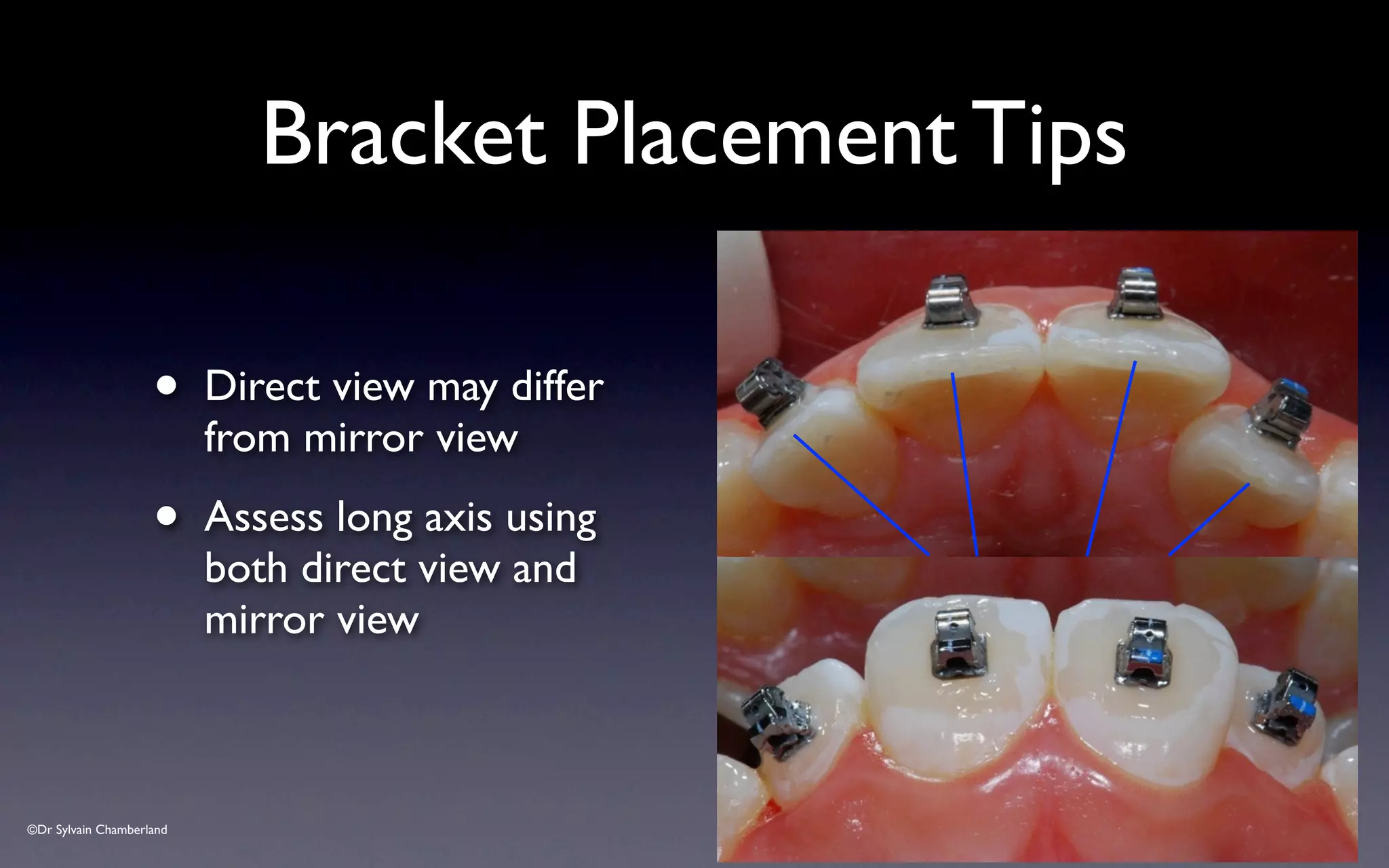
Bracket Placement Tips
• Direct view may differ
from mirror view
• Assess long axis using
both direct view and
mirror view
©Dr Sylvain Chamberland
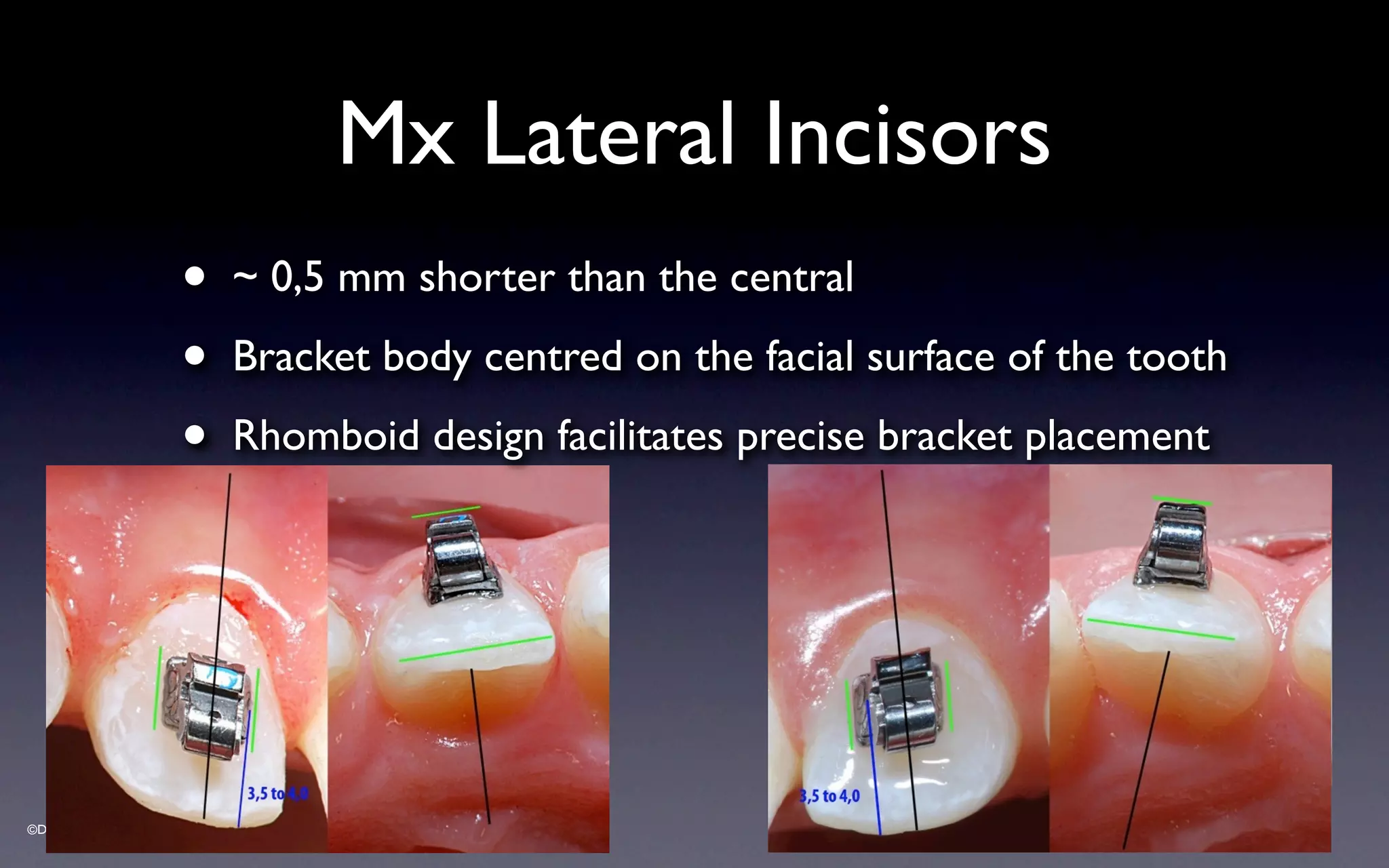
Mx Lateral Incisors
• ~ 0,5 mm shorter than the central
• Bracket body centred on the facial surface of the tooth
• Rhomboid design facilitates precise bracket placement
©Dr Sylvain Chamberland
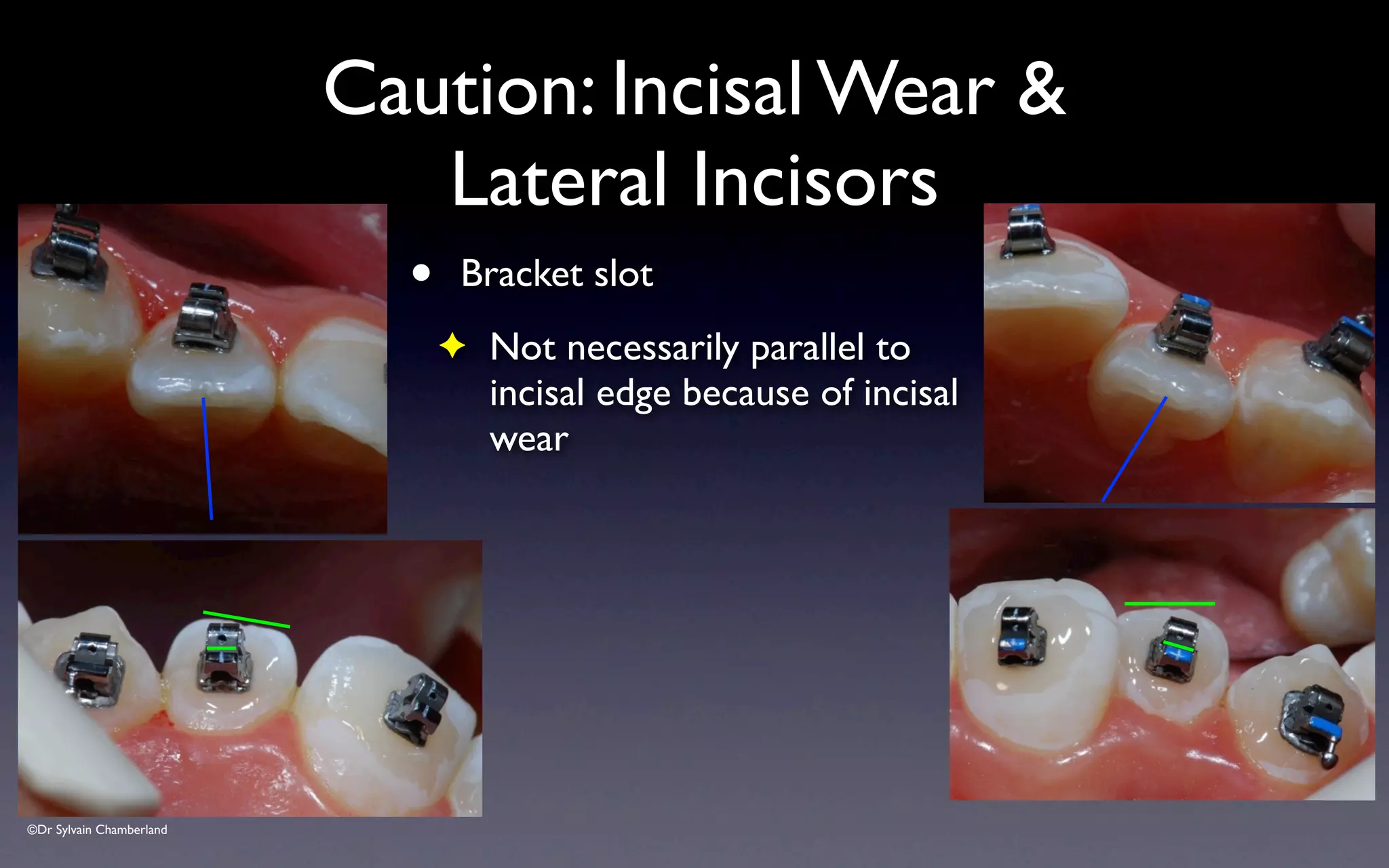
• Bracket slot
✦ Not necessarily parallel to
incisal edge because of incisal
wear
Caution: Incisal Wear &
Lateral Incisors
©Dr Sylvain Chamberland
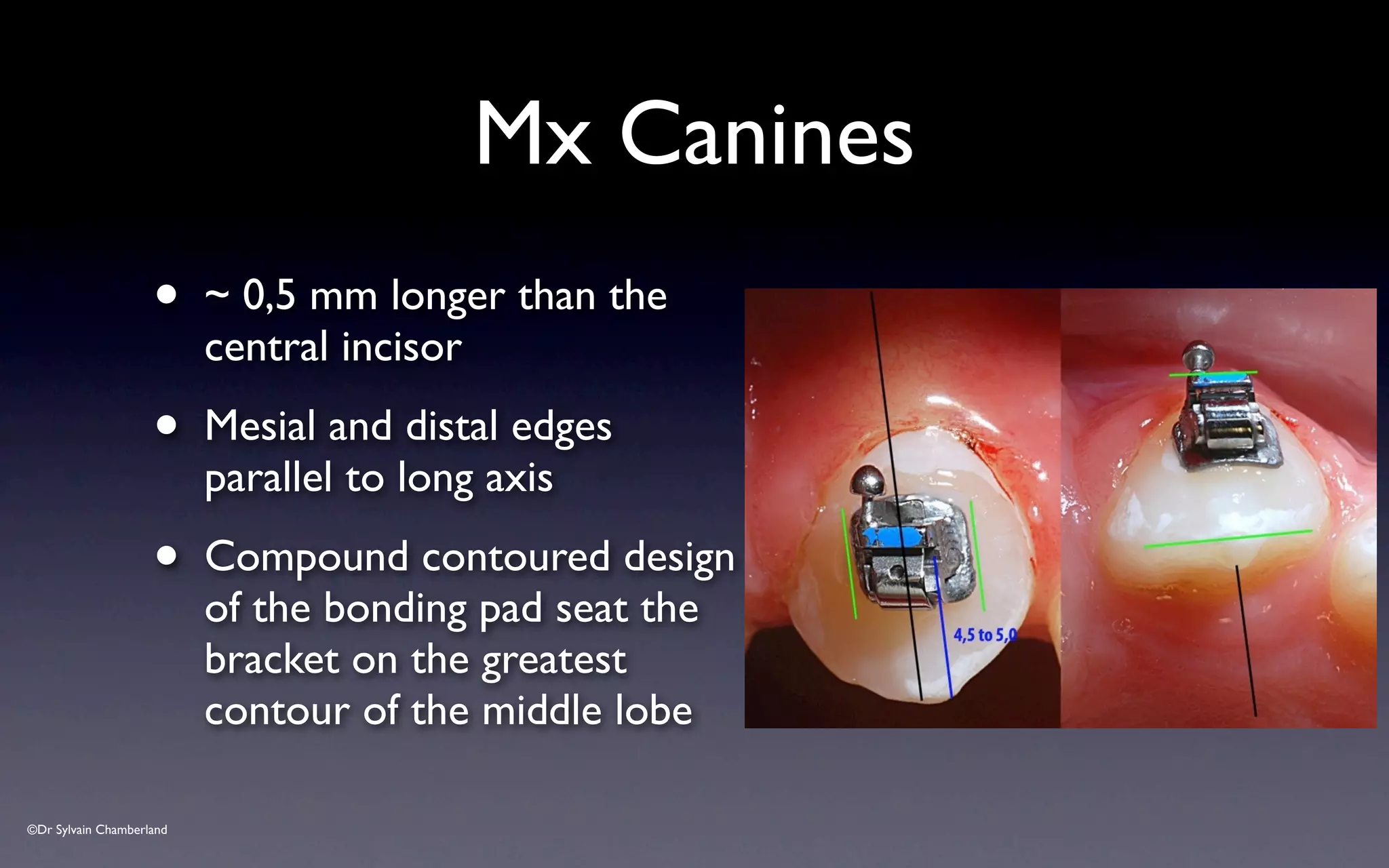
Mx Canines
• ~ 0,5 mm longer than the
central incisor
• Mesial and distal edges
parallel to long axis
• Compound contoured design
of the bonding pad seat the
bracket on the greatest
contour of the middle lobe
©Dr Sylvain Chamberland
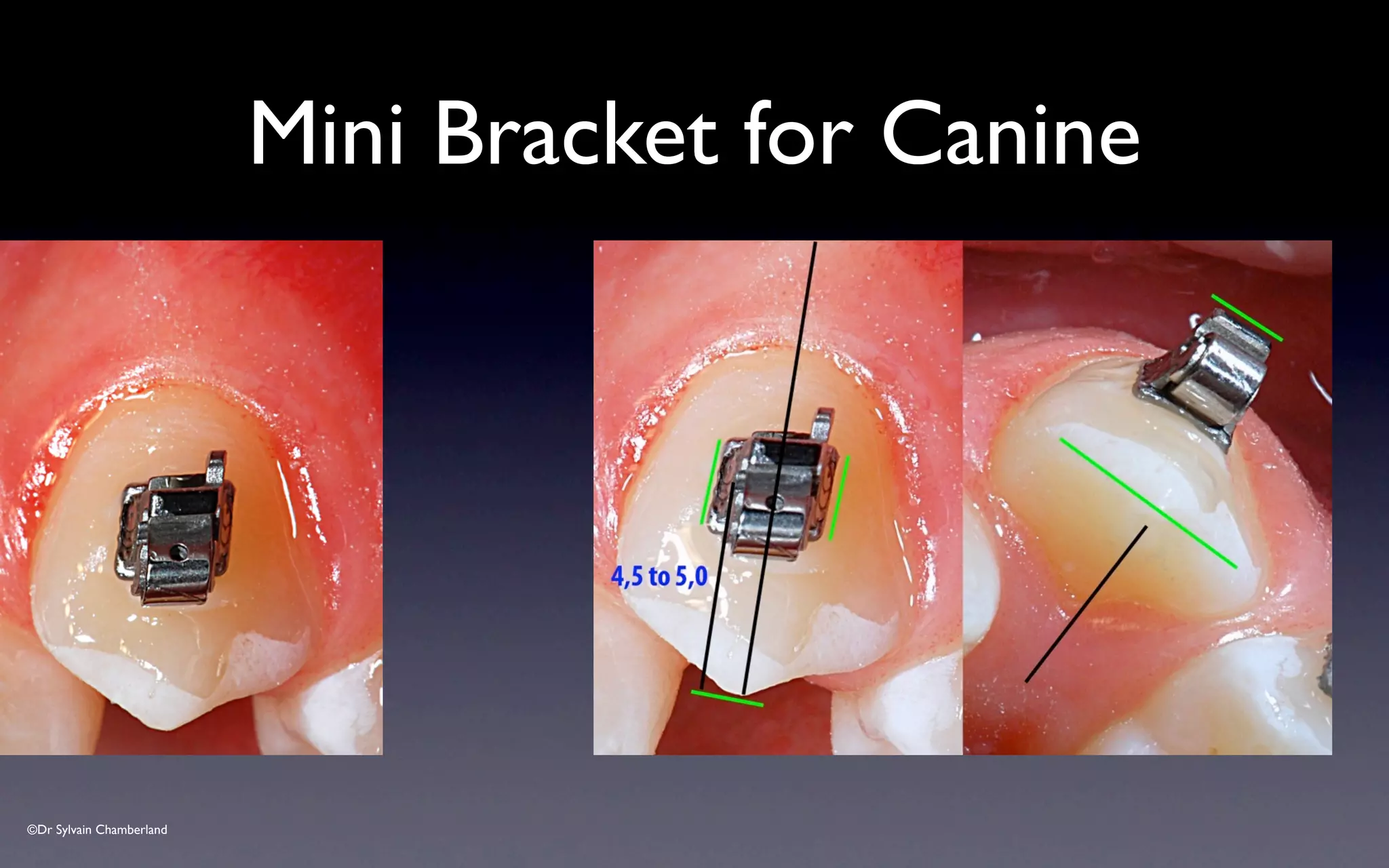
Mini Bracket for Canine
©Dr Sylvain Chamberland
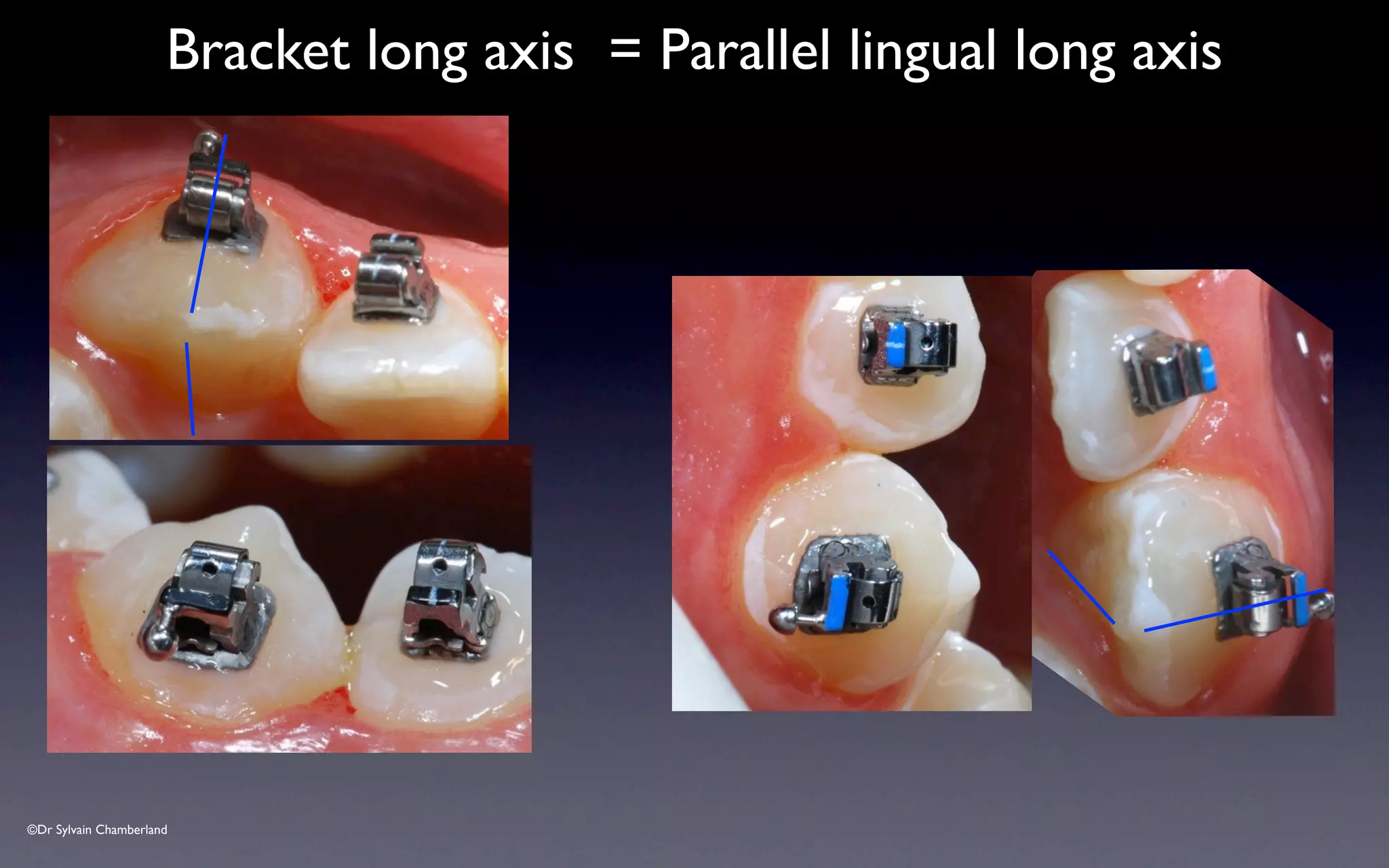
Bracket long axis = Parallel lingual long axis
©Dr Sylvain Chamberland
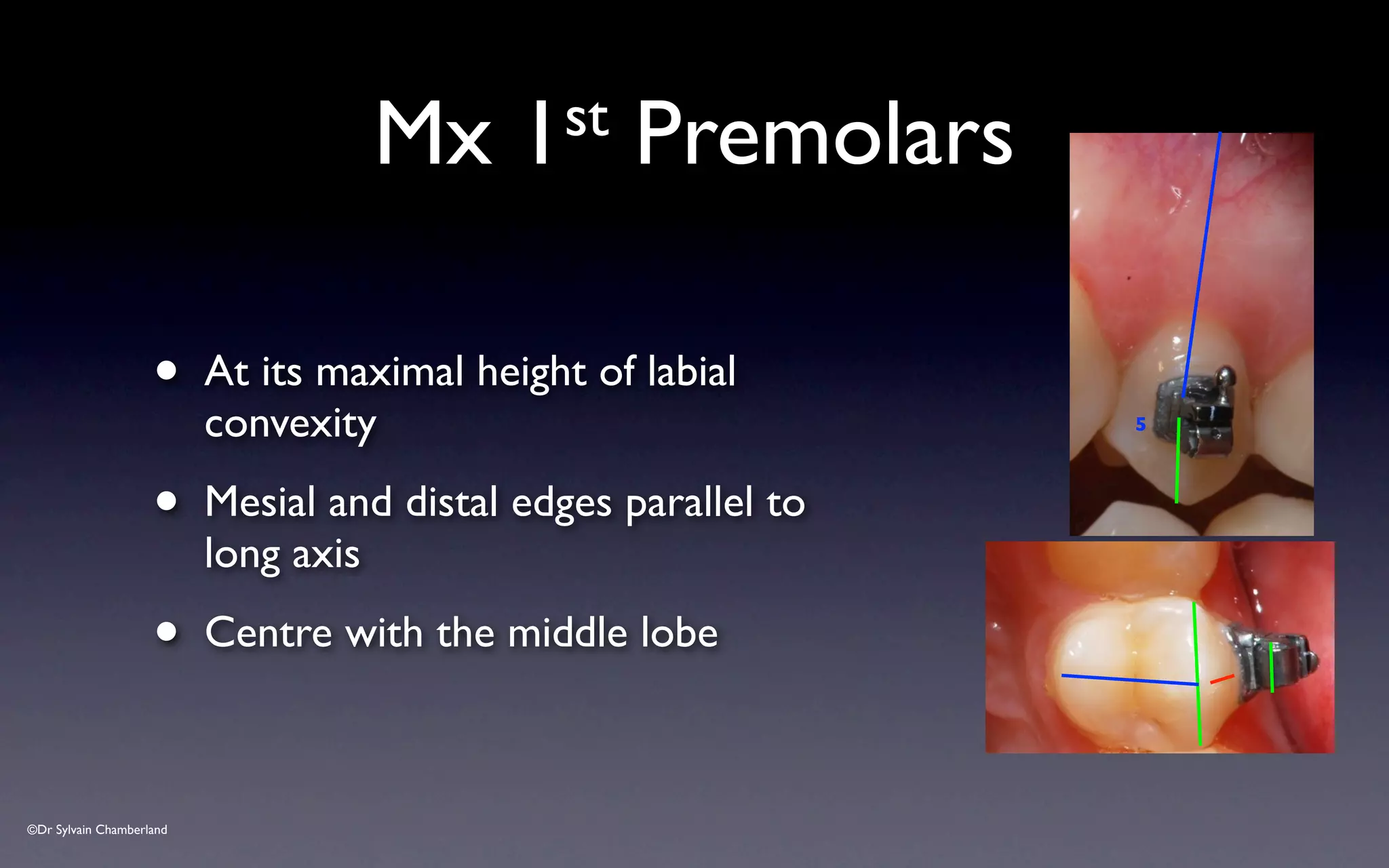
Mx 1st Premolars
• At its maximal height of labial
convexity
• Mesial and distal edges parallel to
long axis
• Centre with the middle lobe
5
©Dr Sylvain Chamberland
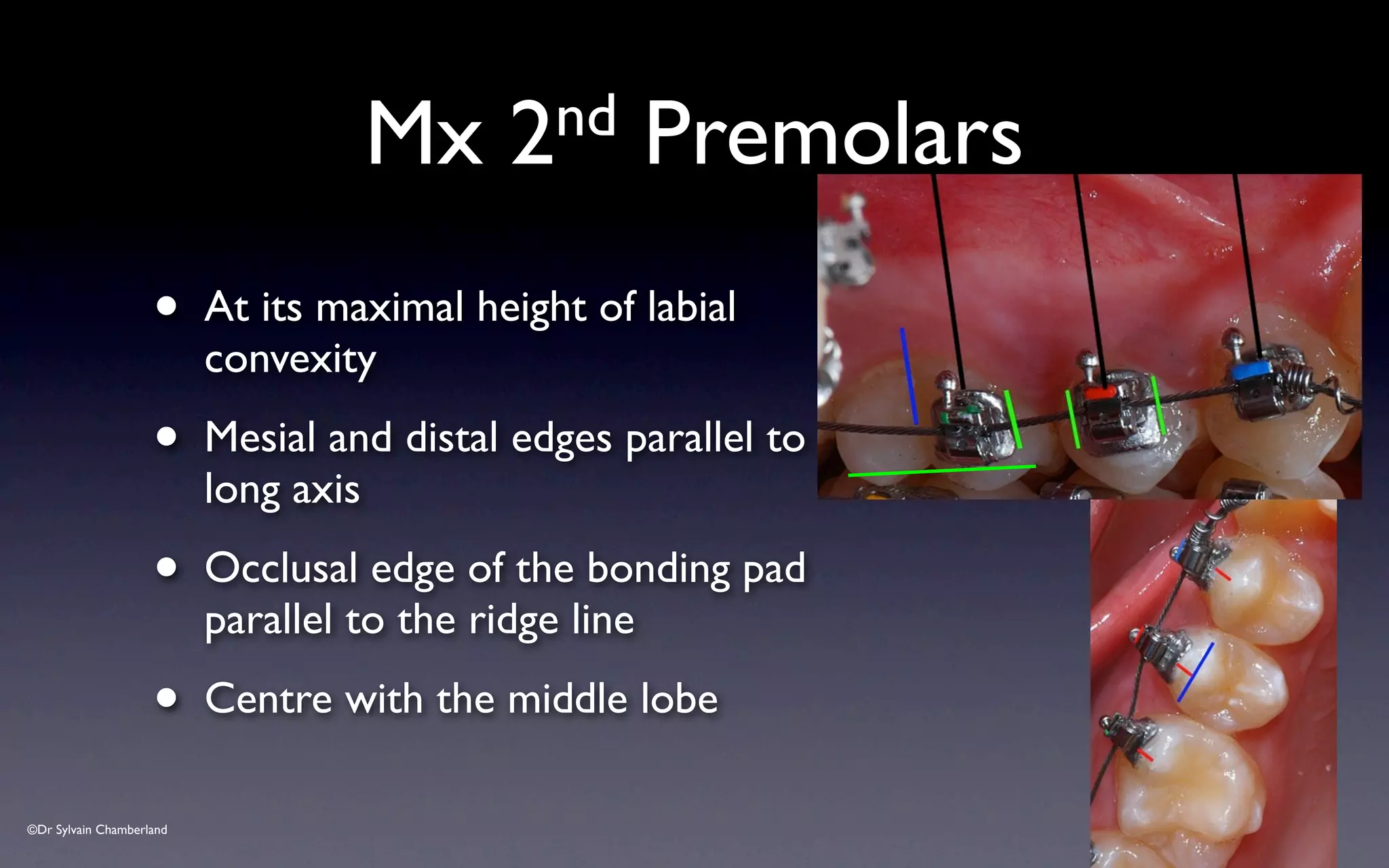
Mx 2nd Premolars
• At its maximal height of labial
convexity
• Mesial and distal edges parallel to
long axis
• Occlusal edge of the bonding pad
parallel to the ridge line
• Centre with the middle lobe
©Dr Sylvain Chamberland
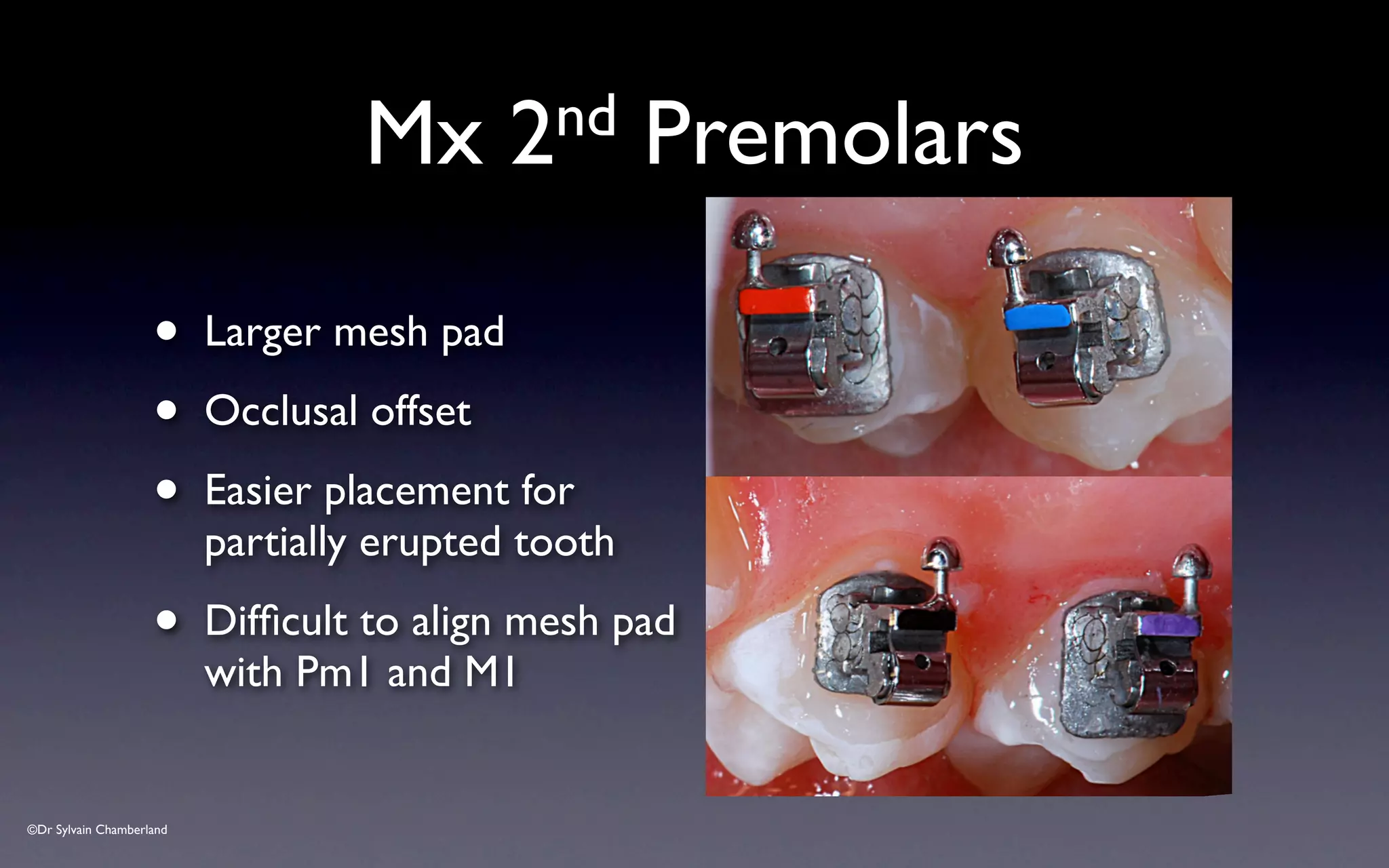
Mx 2nd Premolars
• Larger mesh pad
• Occlusal offset
• Easier placement for
partially erupted tooth
• Difficult to align mesh pad
with Pm1 and M1
©Dr Sylvain Chamberland
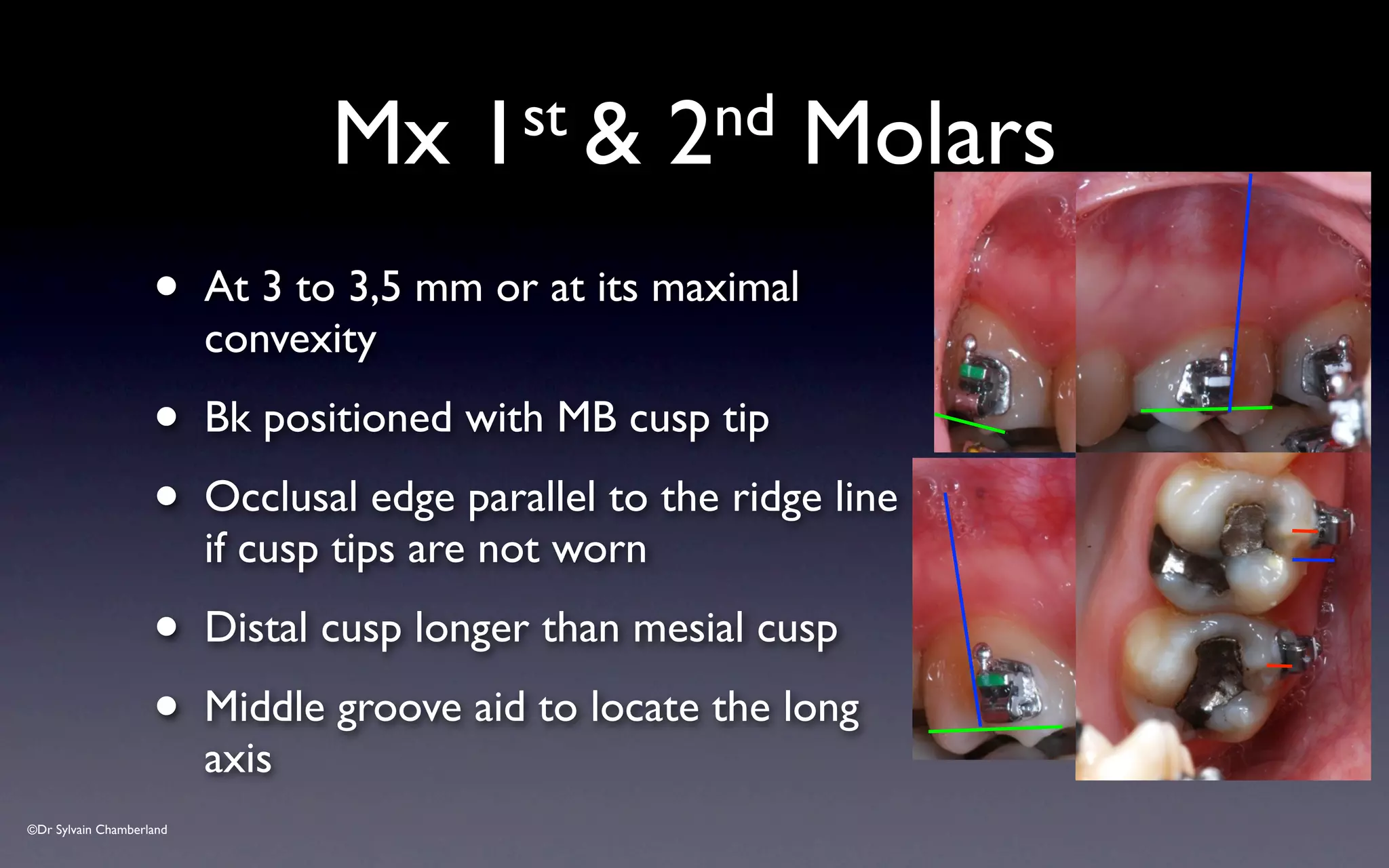
Mx 1st & 2nd Molars
• At 3 to 3,5 mm or at its maximal
convexity
• Bk positioned with MB cusp tip
• Occlusal edge parallel to the ridge line
if cusp tips are not worn
• Distal cusp longer than mesial cusp
• Middle groove aid to locate the long
axis
©Dr Sylvain Chamberland
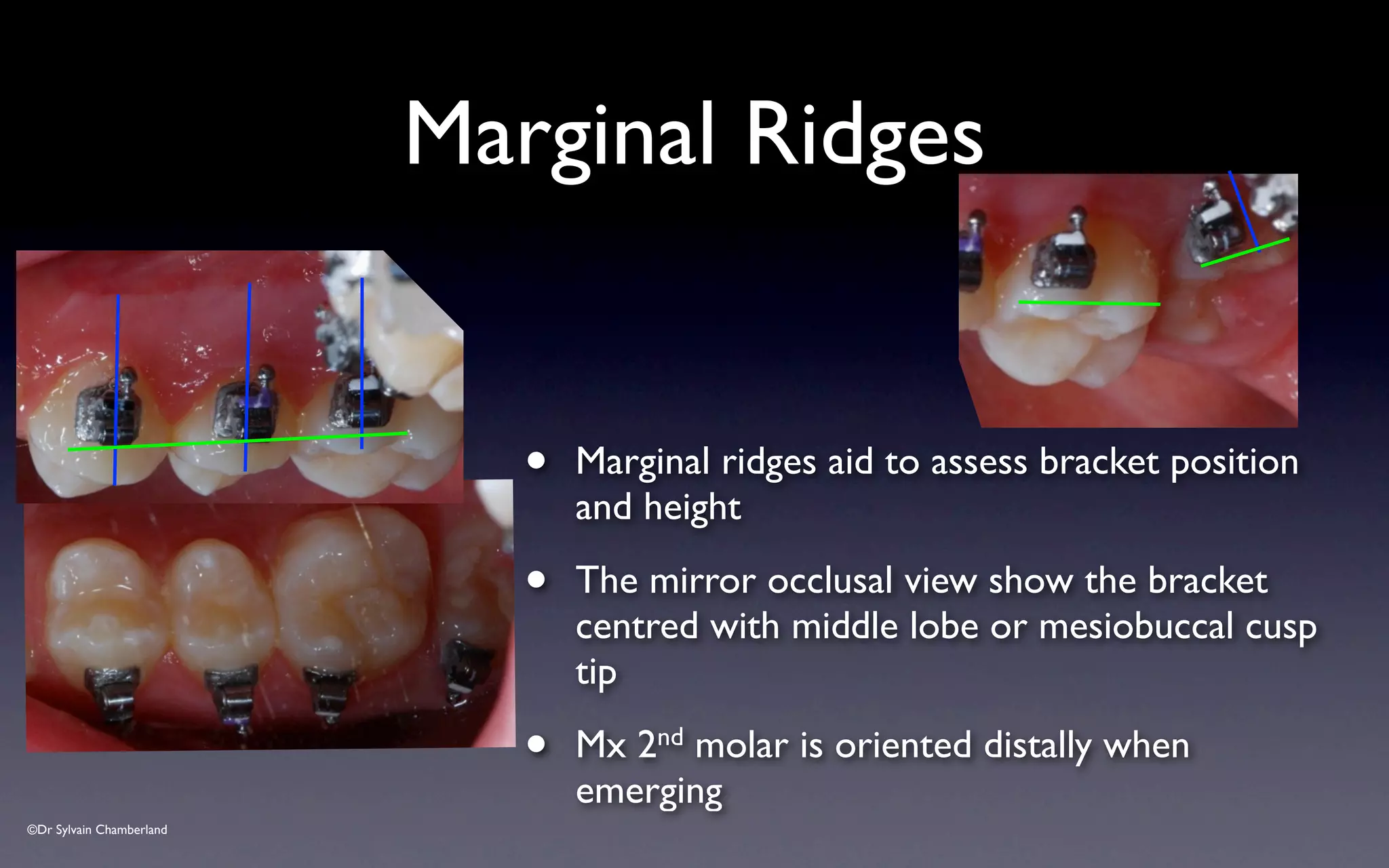
• Marginal ridges aid to assess bracket position
and height
• The mirror occlusal view show the bracket
centred with middle lobe or mesiobuccal cusp
tip
• Mx 2nd molar is oriented distally when
emerging
Marginal Ridges
©Dr Sylvain Chamberland
Marginal Ridges
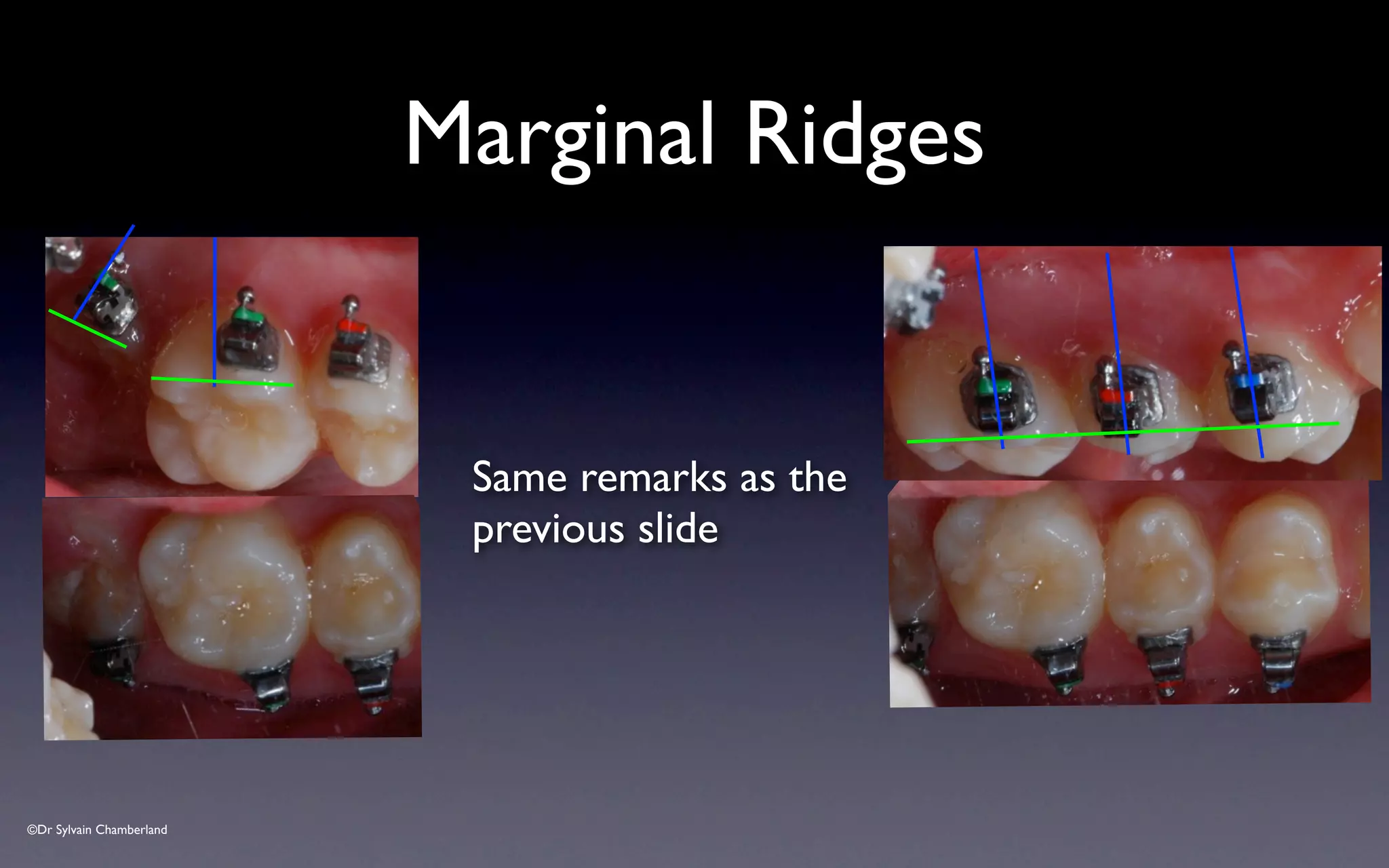
Same remarks as the
previous slide
©Dr Sylvain Chamberland
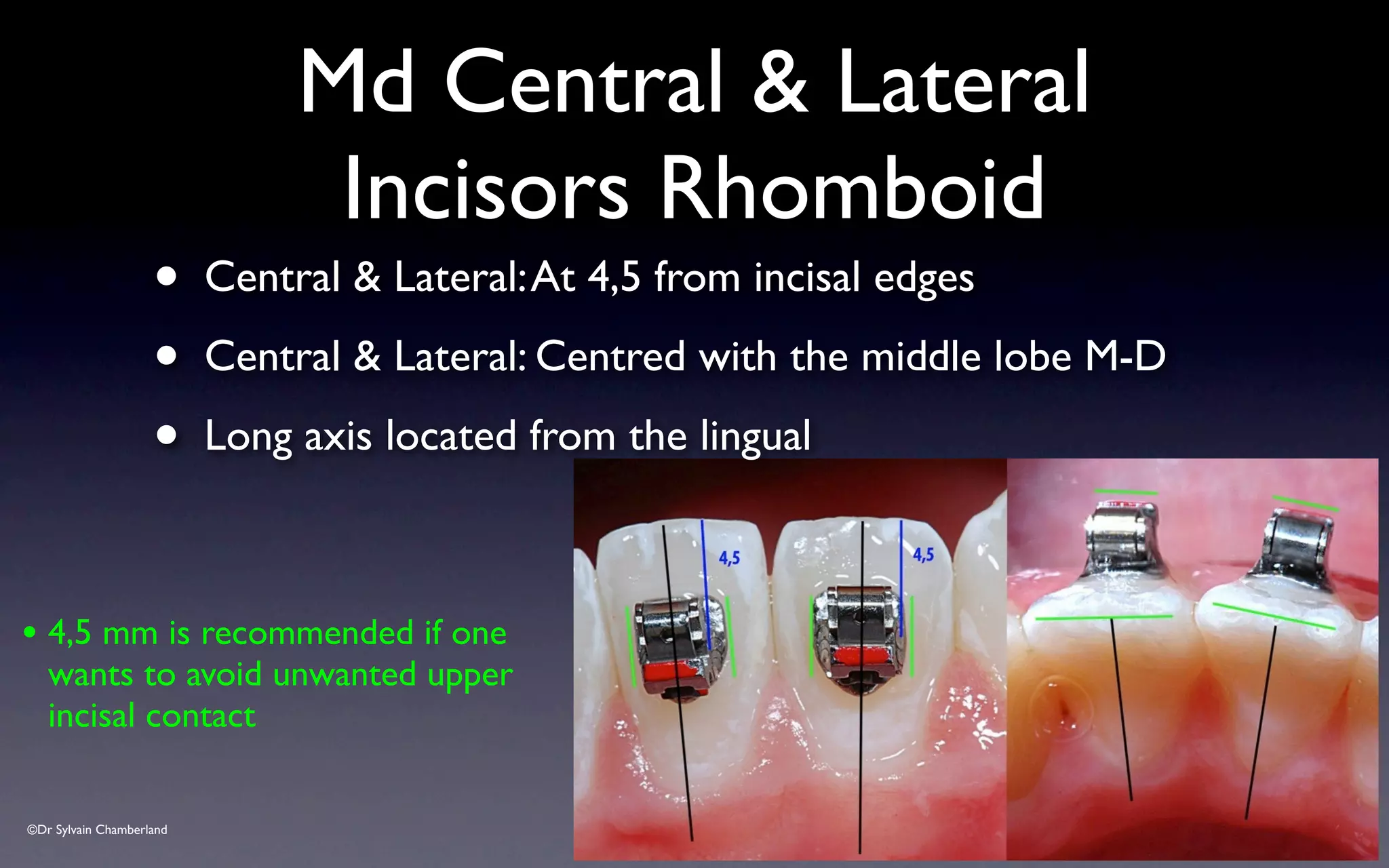
Md Central & Lateral
Incisors Rhomboid
• 4,5 mm is recommended if one
wants to avoid unwanted upper
incisal contact
• Central & Lateral:At 4,5 from incisal edges
• Central & Lateral: Centred with the middle lobe M-D
• Long axis located from the lingual
©Dr Sylvain Chamberland
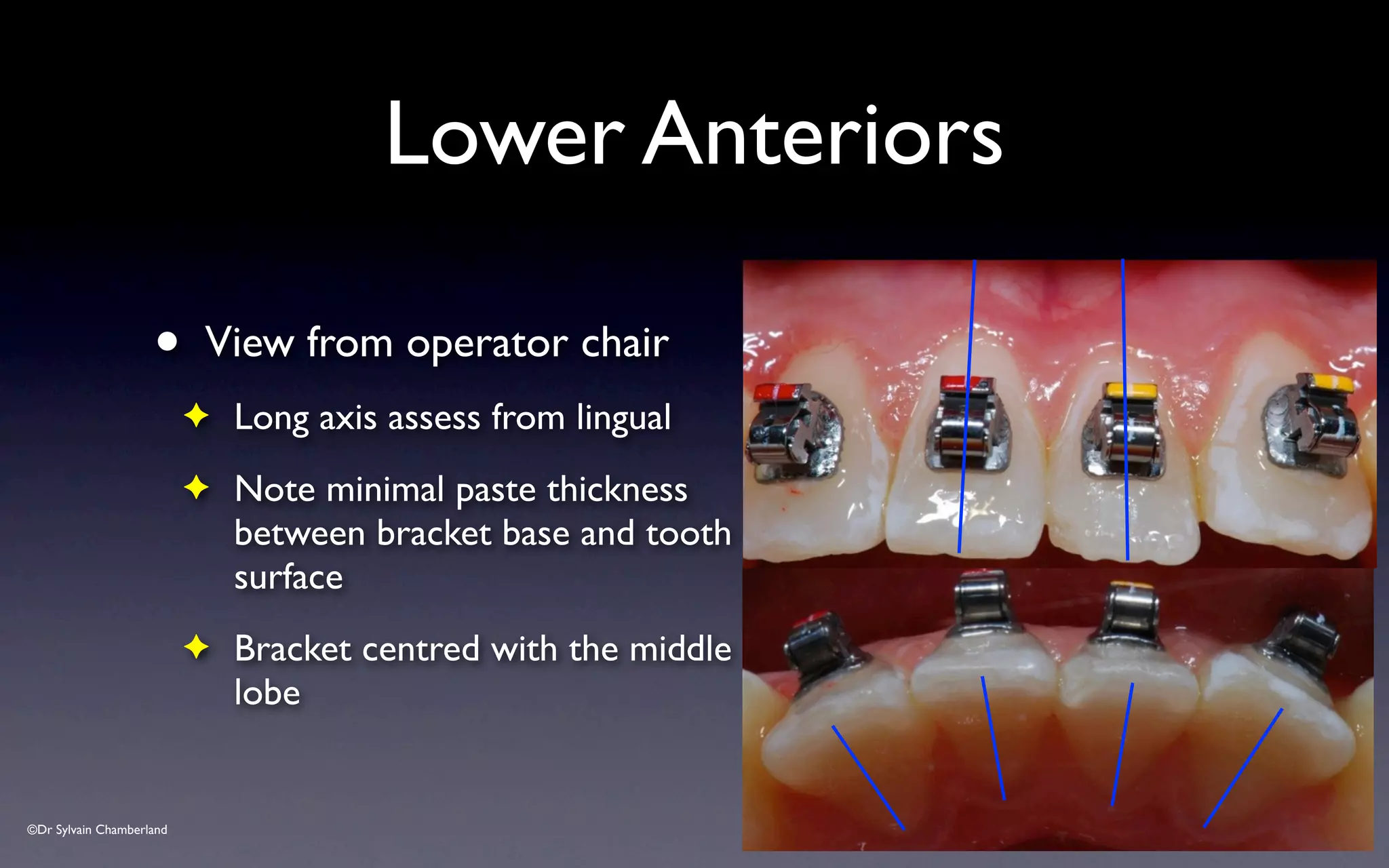
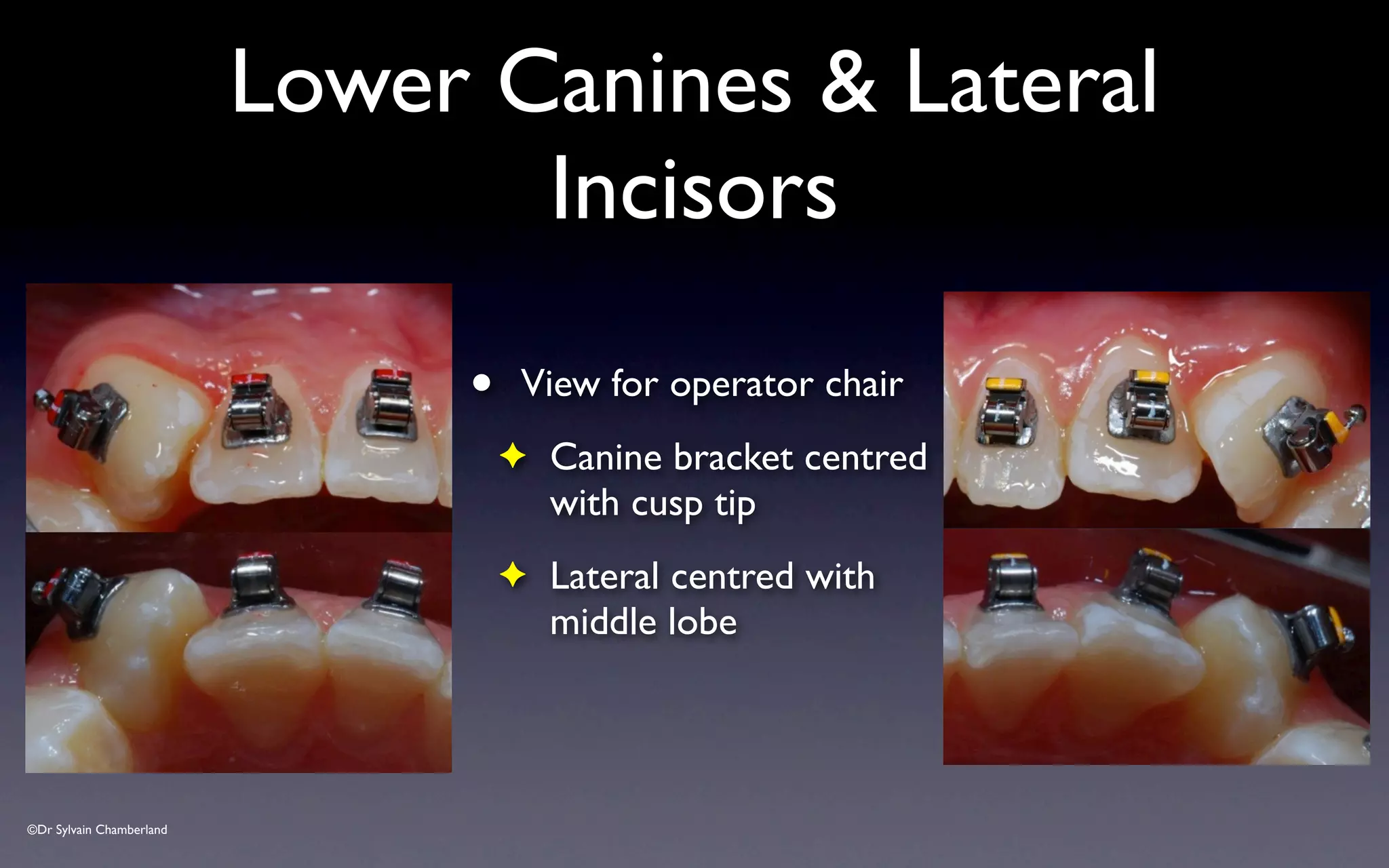
Lower Anteriors
• View from operator chair
✦ Long axis assess from lingual
✦ Note minimal paste thickness
between bracket base and tooth
surface
✦ Bracket centred with the middle
lobe
©Dr Sylvain Chamberland
Lower Canines & Lateral
Incisors
• View for operator chair
✦ Canine bracket centred
with cusp tip
✦ Lateral centred with
middle lobe
©Dr Sylvain Chamberland
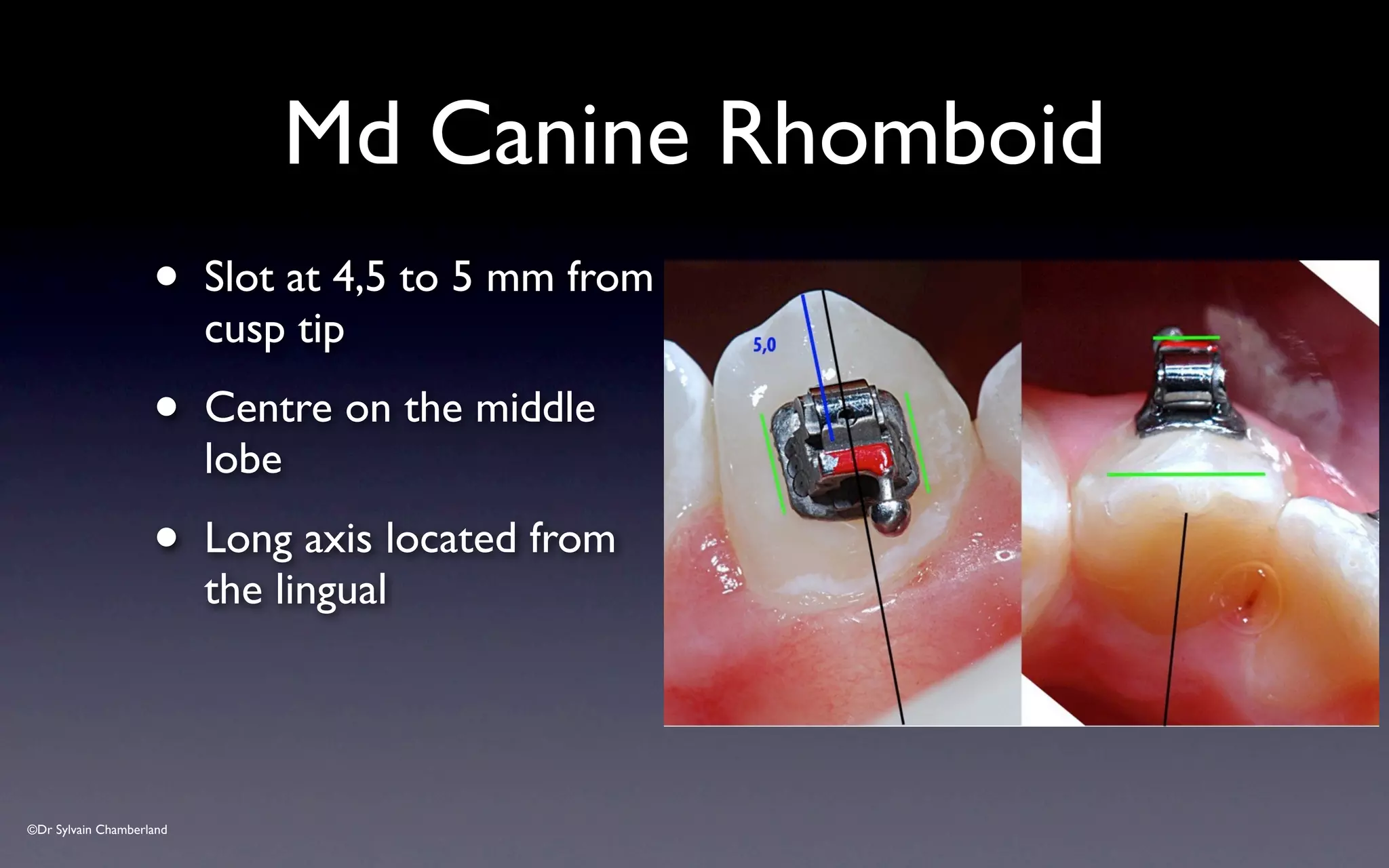
Md Canine Rhomboid
• Slot at 4,5 to 5 mm from
cusp tip
• Centre on the middle
lobe
• Long axis located from
the lingual
©Dr Sylvain Chamberland
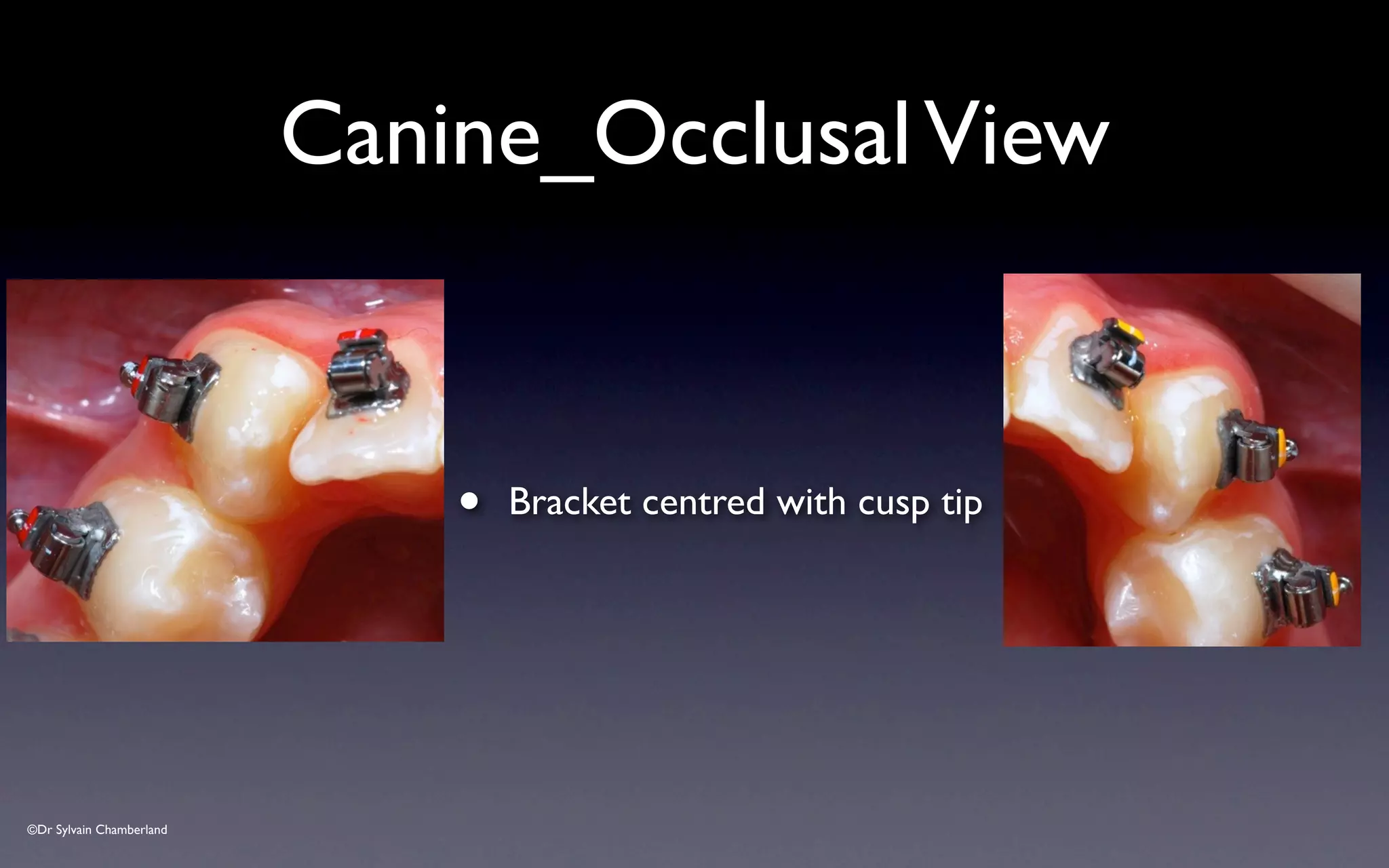
Canine_OcclusalView
• Bracket centred with cusp tip
©Dr Sylvain Chamberland
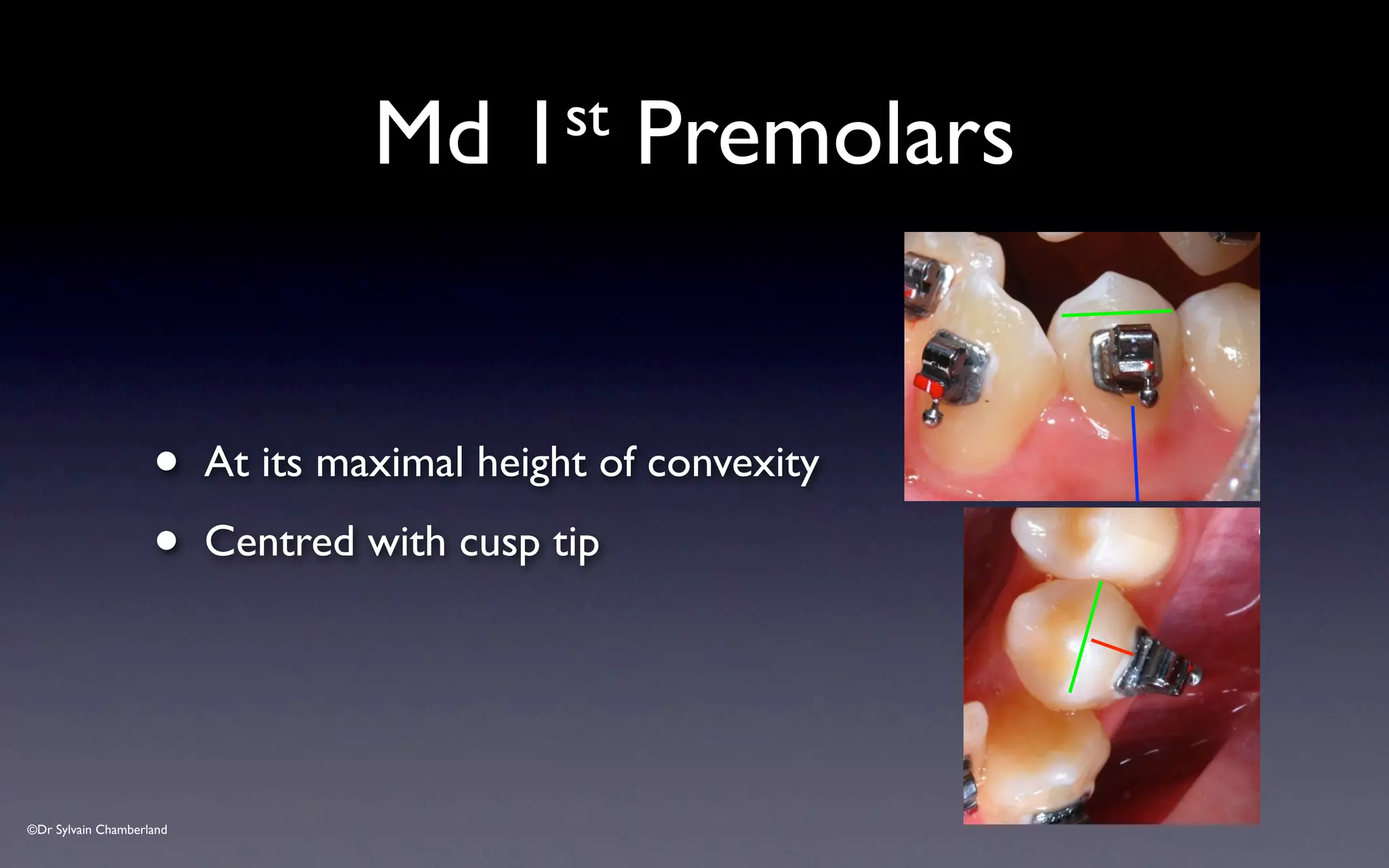
Md 1st Premolars
• At its maximal height of convexity
• Centred with cusp tip
©Dr Sylvain Chamberland
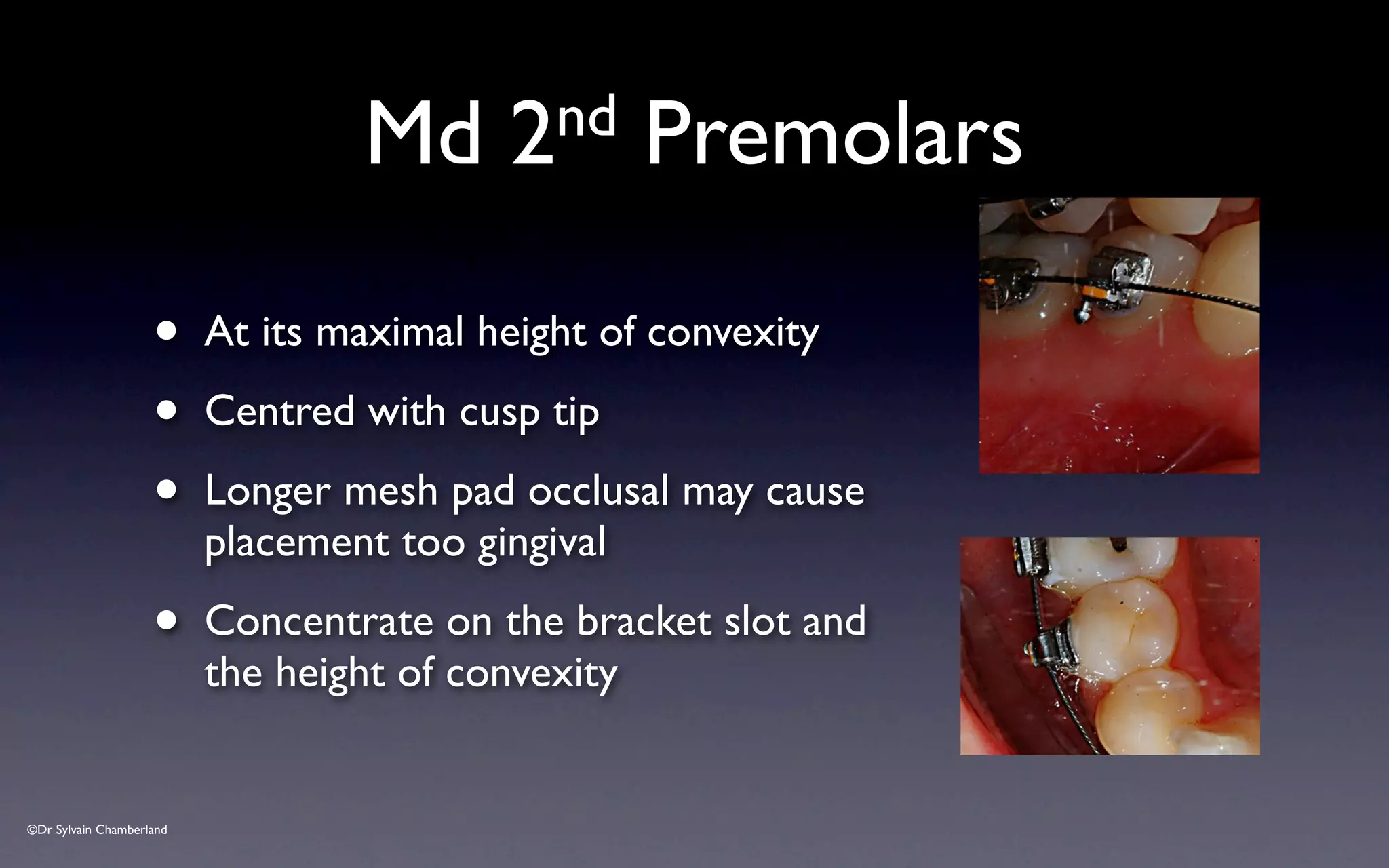
Md 2nd Premolars
• At its maximal height of convexity
• Centred with cusp tip
• Longer mesh pad occlusal may cause
placement too gingival
• Concentrate on the bracket slot and
the height of convexity
©Dr Sylvain Chamberland
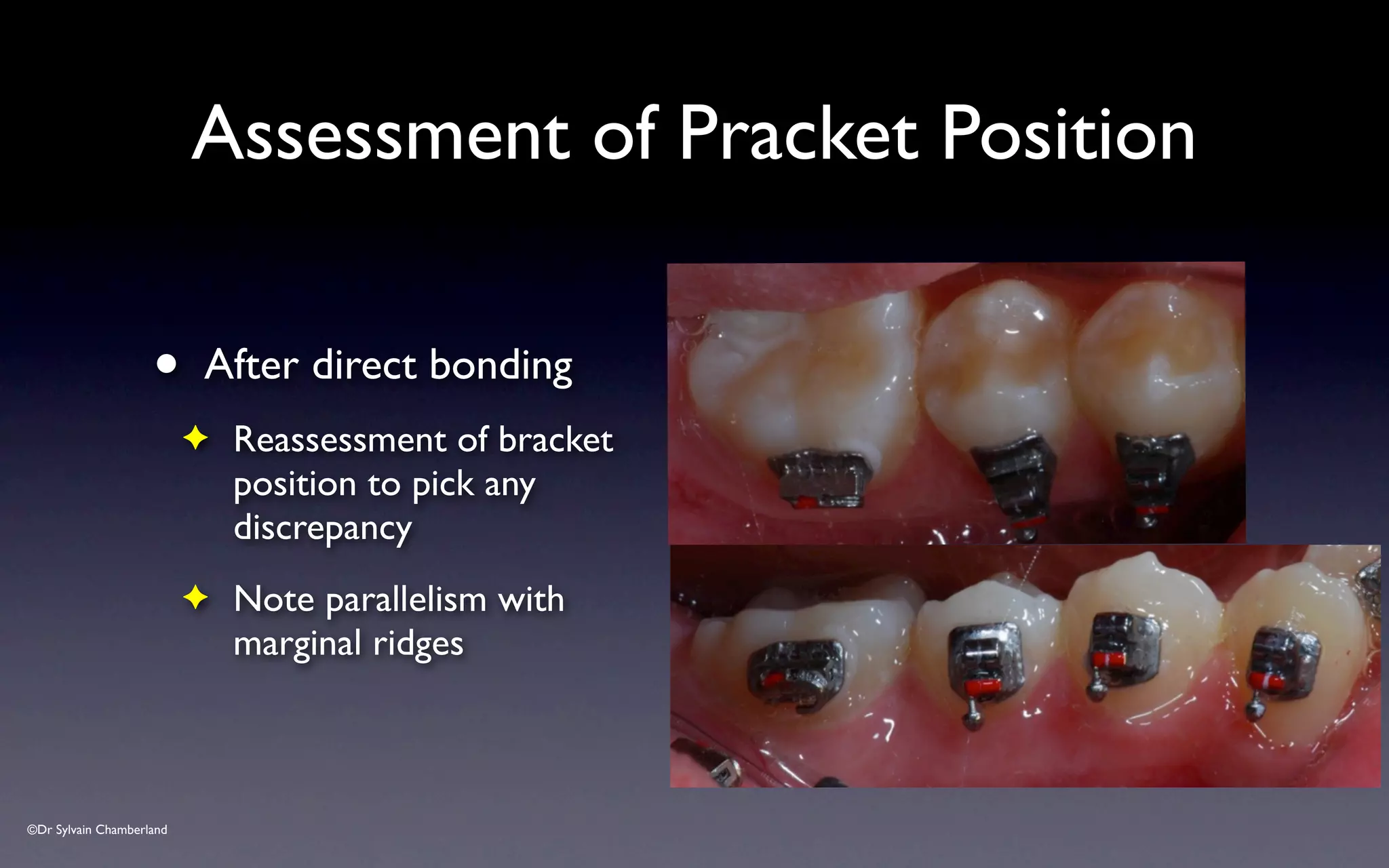
Assessment of Pracket Position
• After direct bonding
✦ Reassessment of bracket
position to pick any
discrepancy
✦ Note parallelism with
marginal ridges
©Dr Sylvain Chamberland
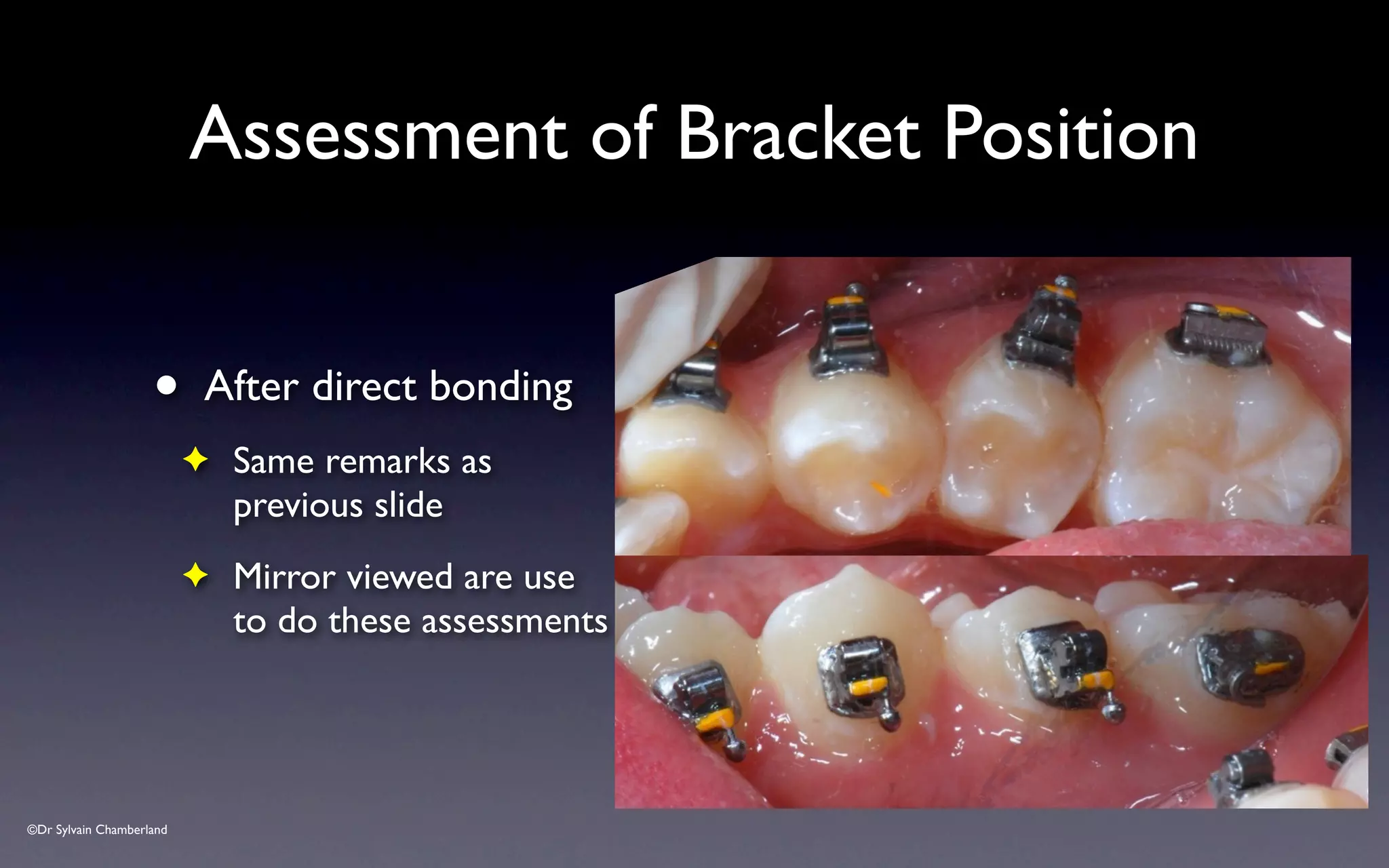
Assessment of Bracket Position
• After direct bonding
✦ Same remarks as
previous slide
✦ Mirror viewed are use
to do these assessments
©Dr Sylvain Chamberland
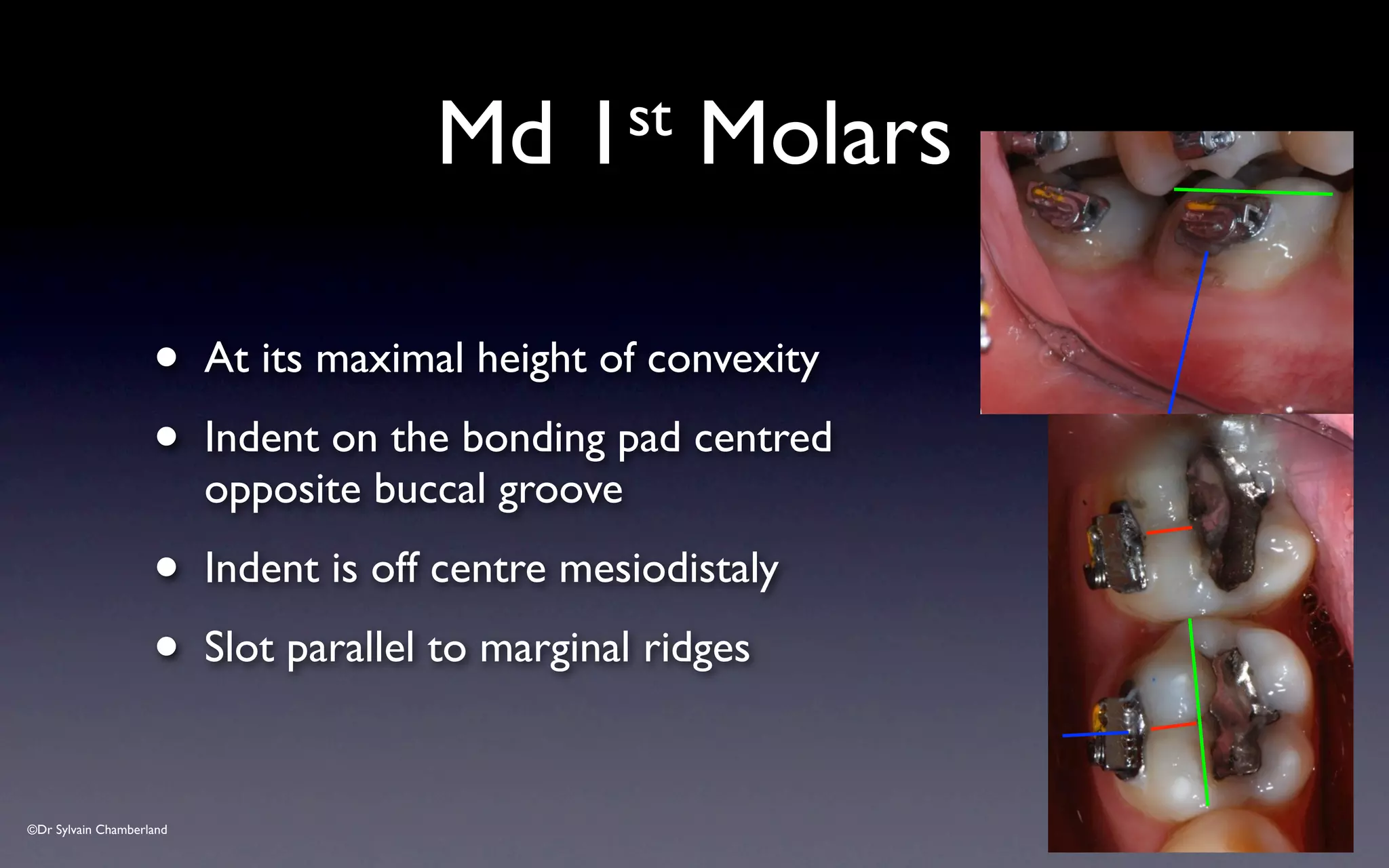
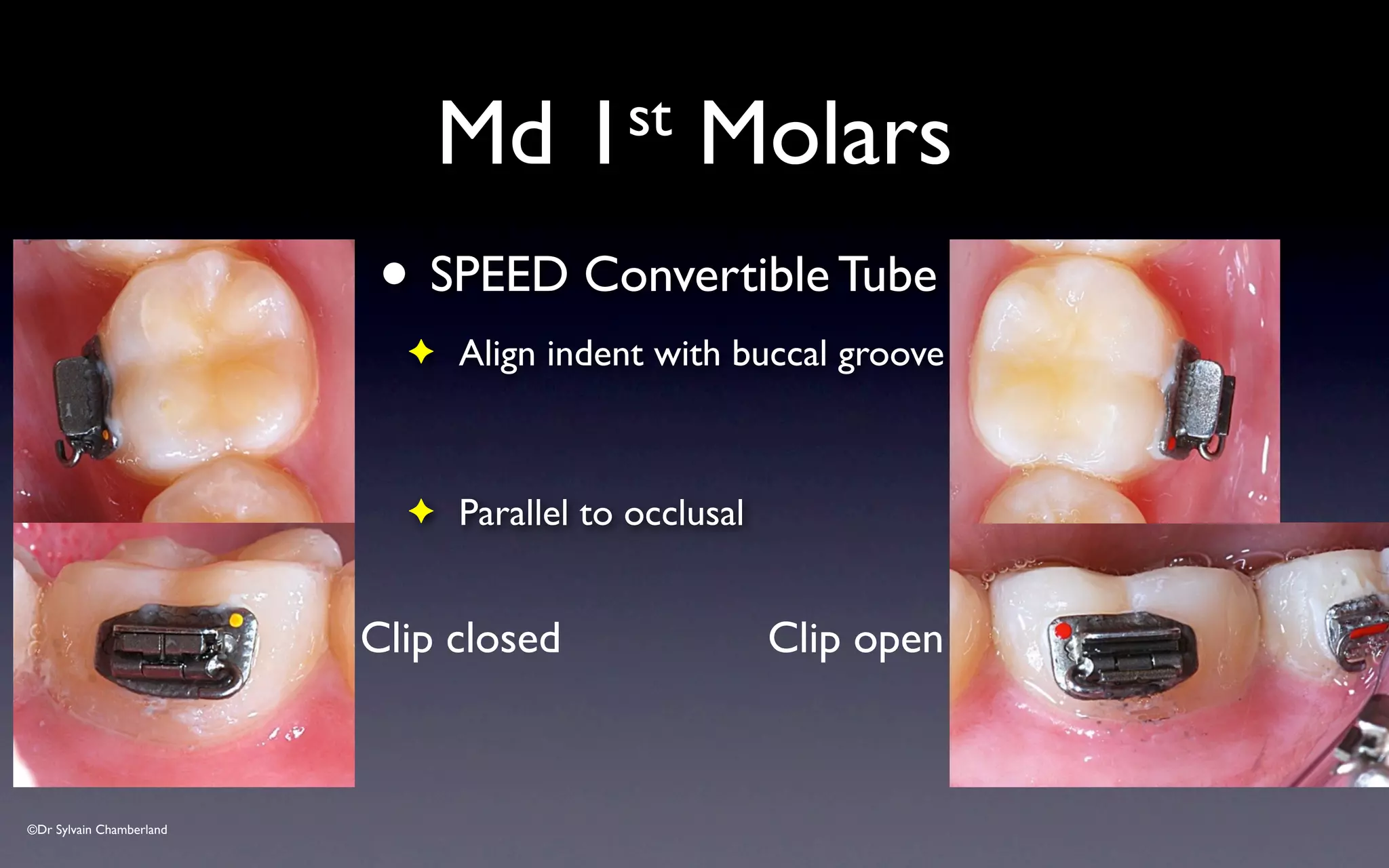
Md 1st Molars
• At its maximal height of convexity
• Indent on the bonding pad centred
opposite buccal groove
• Indent is off centre mesiodistaly
• Slot parallel to marginal ridges
©Dr Sylvain Chamberland
Md 1st Molars
• SPEED Convertible Tube
✦ Align indent with buccal groove
✦ Parallel to occlusal
Clip closed Clip open
©Dr Sylvain Chamberland
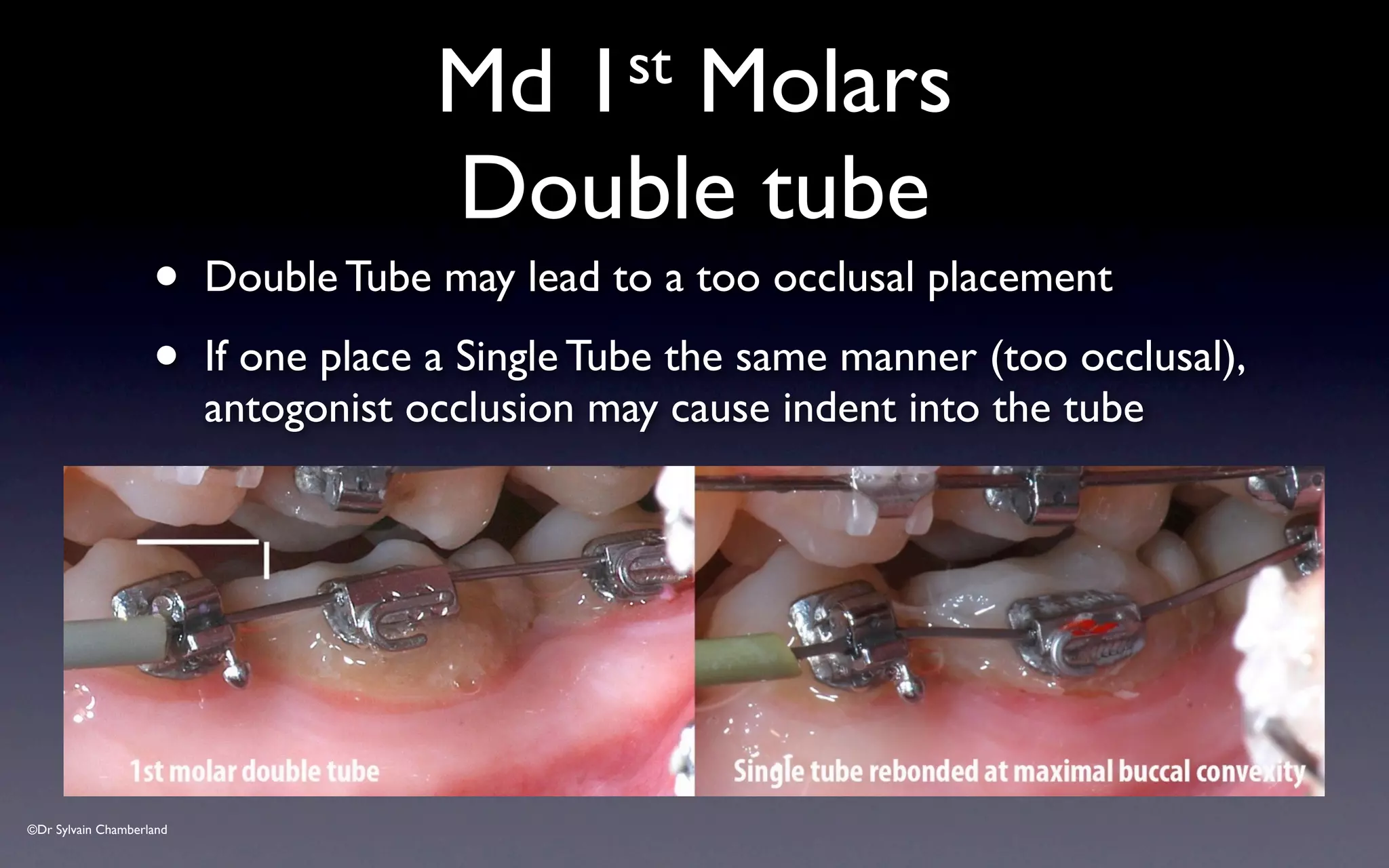
Md 1st Molars
Double tube
• Double Tube may lead to a too occlusal placement
• If one place a Single Tube the same manner (too occlusal),
antogonist occlusion may cause indent into the tube
©Dr Sylvain Chamberland
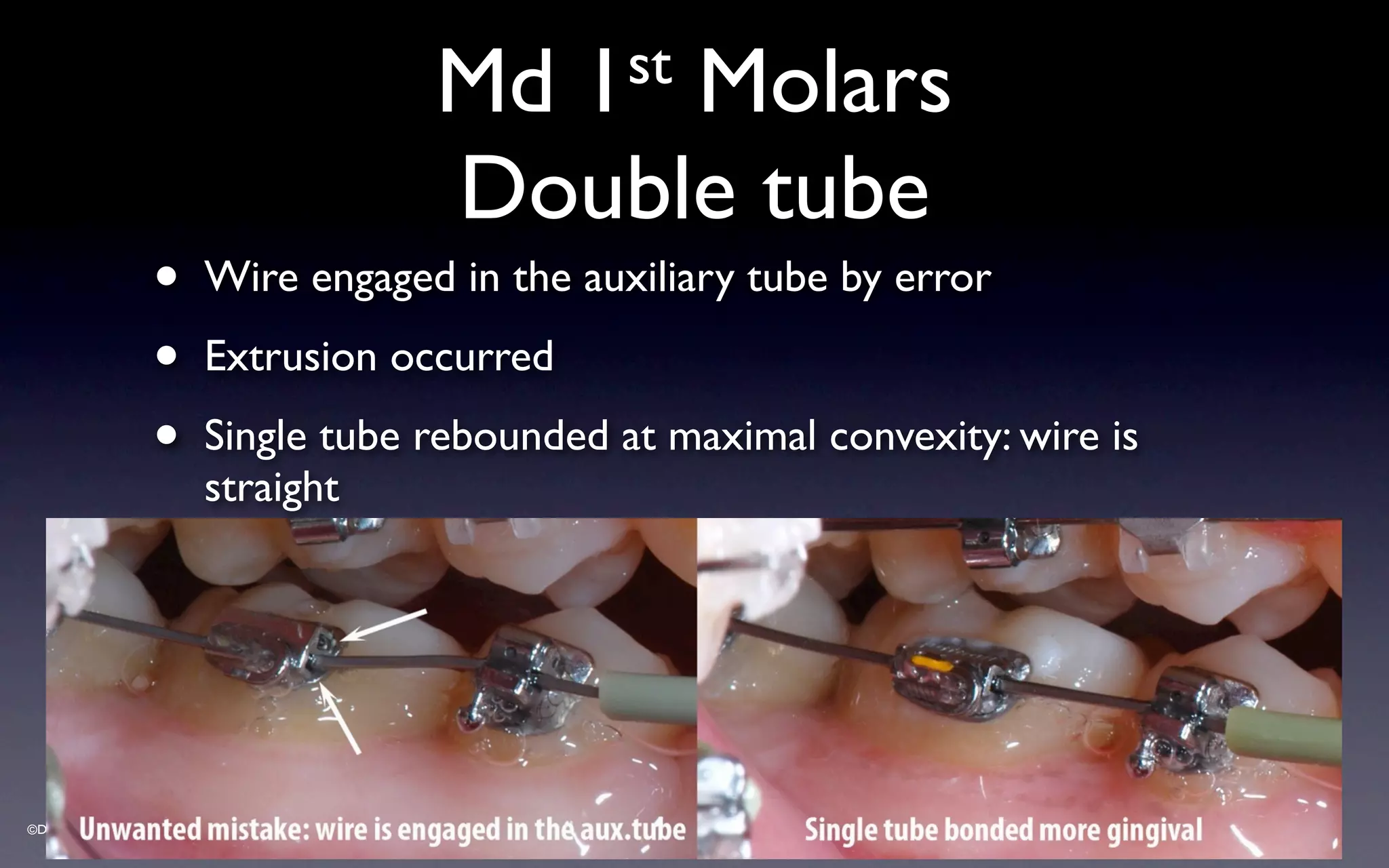
Md 1st Molars
Double tube
• Wire engaged in the auxiliary tube by error
• Extrusion occurred
• Single tube rebounded at maximal convexity: wire is
straight
©Dr Sylvain Chamberland
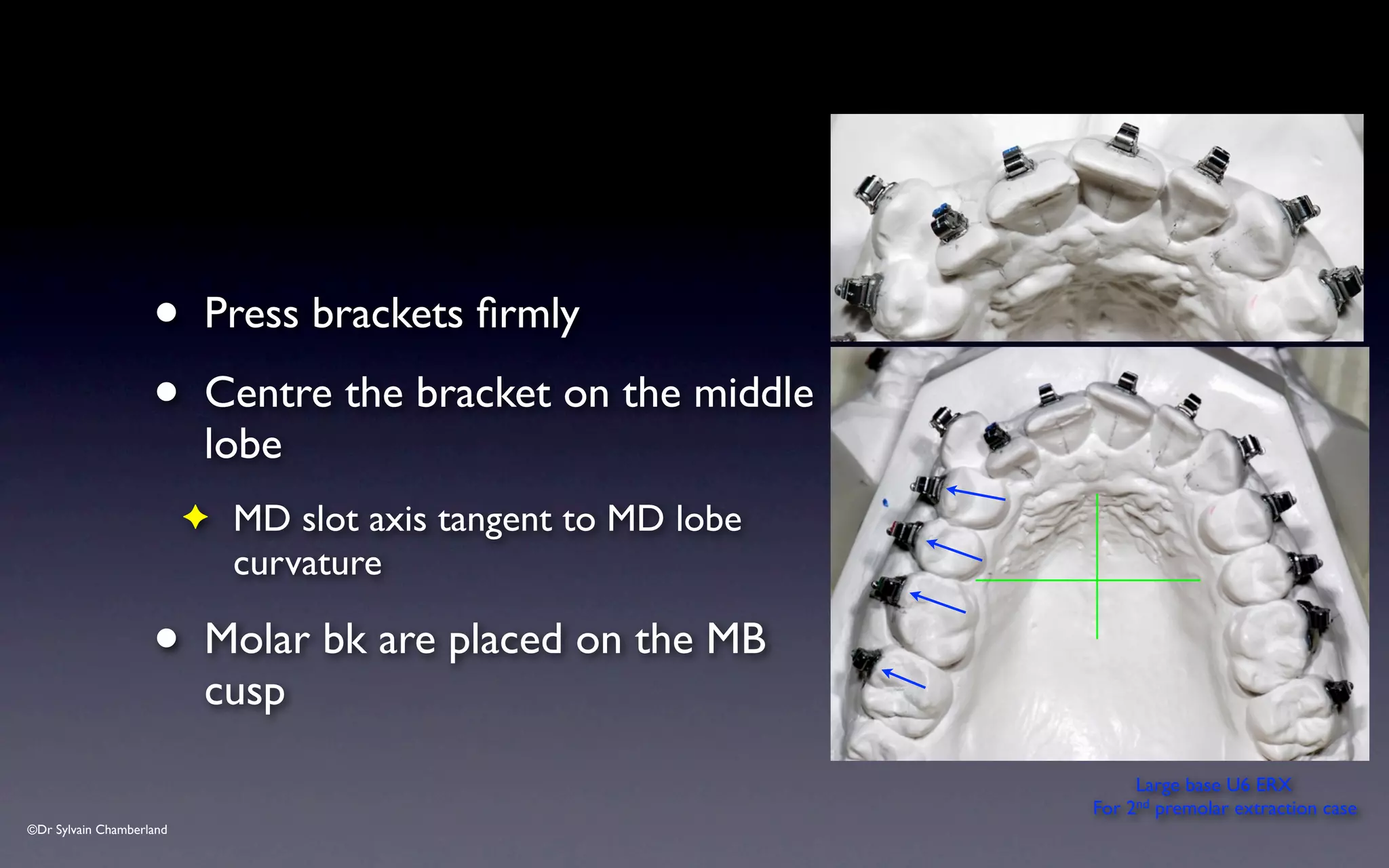
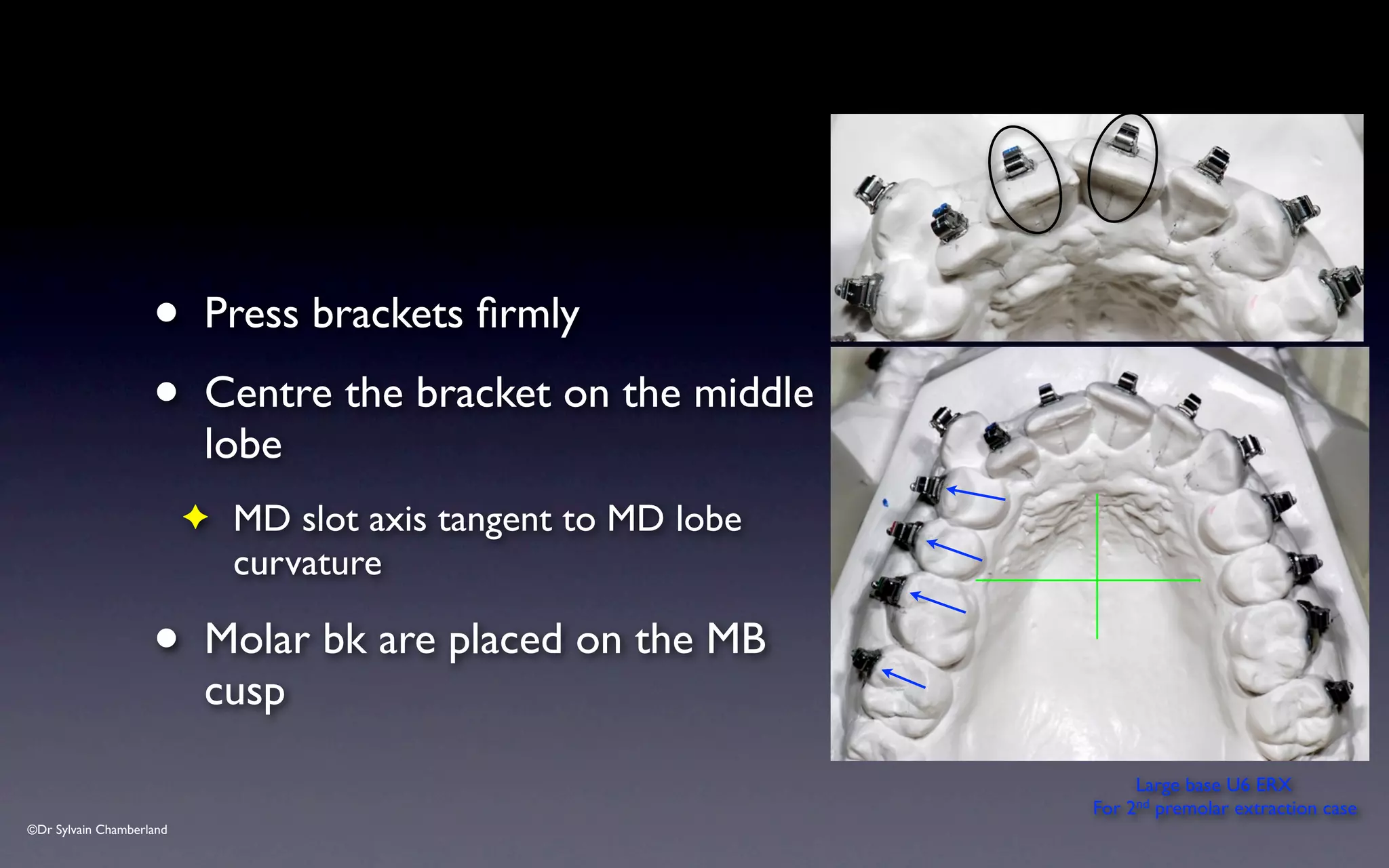
• Press brackets firmly
• Centre the bracket on the middle
lobe
✦ MD slot axis tangent to MD lobe
curvature
• Molar bk are placed on the MB
cusp
Large base U6 ERX
For 2nd premolar extraction case
©Dr Sylvain Chamberland
• Press brackets firmly
• Centre the bracket on the middle
lobe
✦ MD slot axis tangent to MD lobe
curvature
• Molar bk are placed on the MB
cusp
Large base U6 ERX
For 2nd premolar extraction case
©Dr Sylvain Chamberland An.No. 12-08
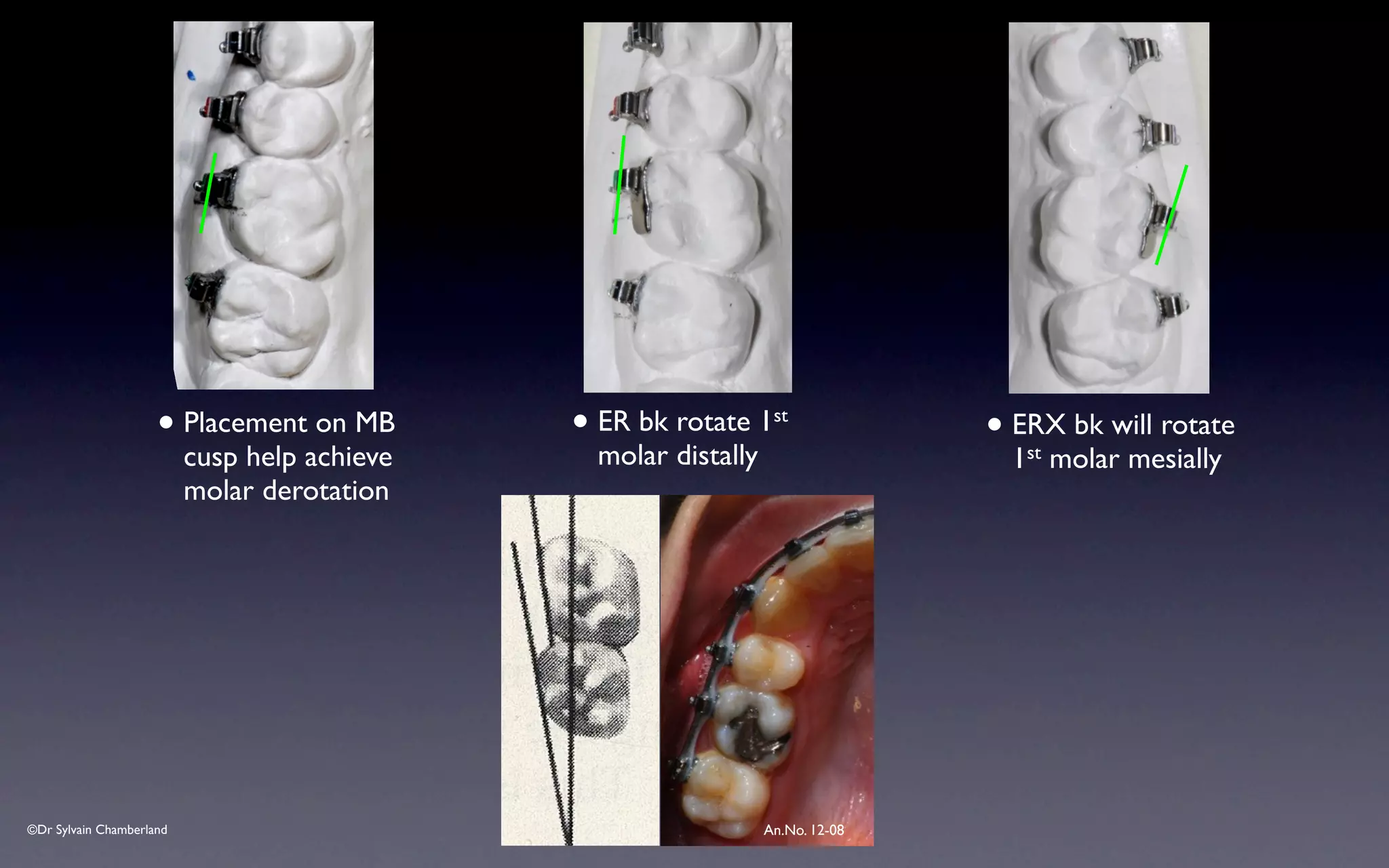
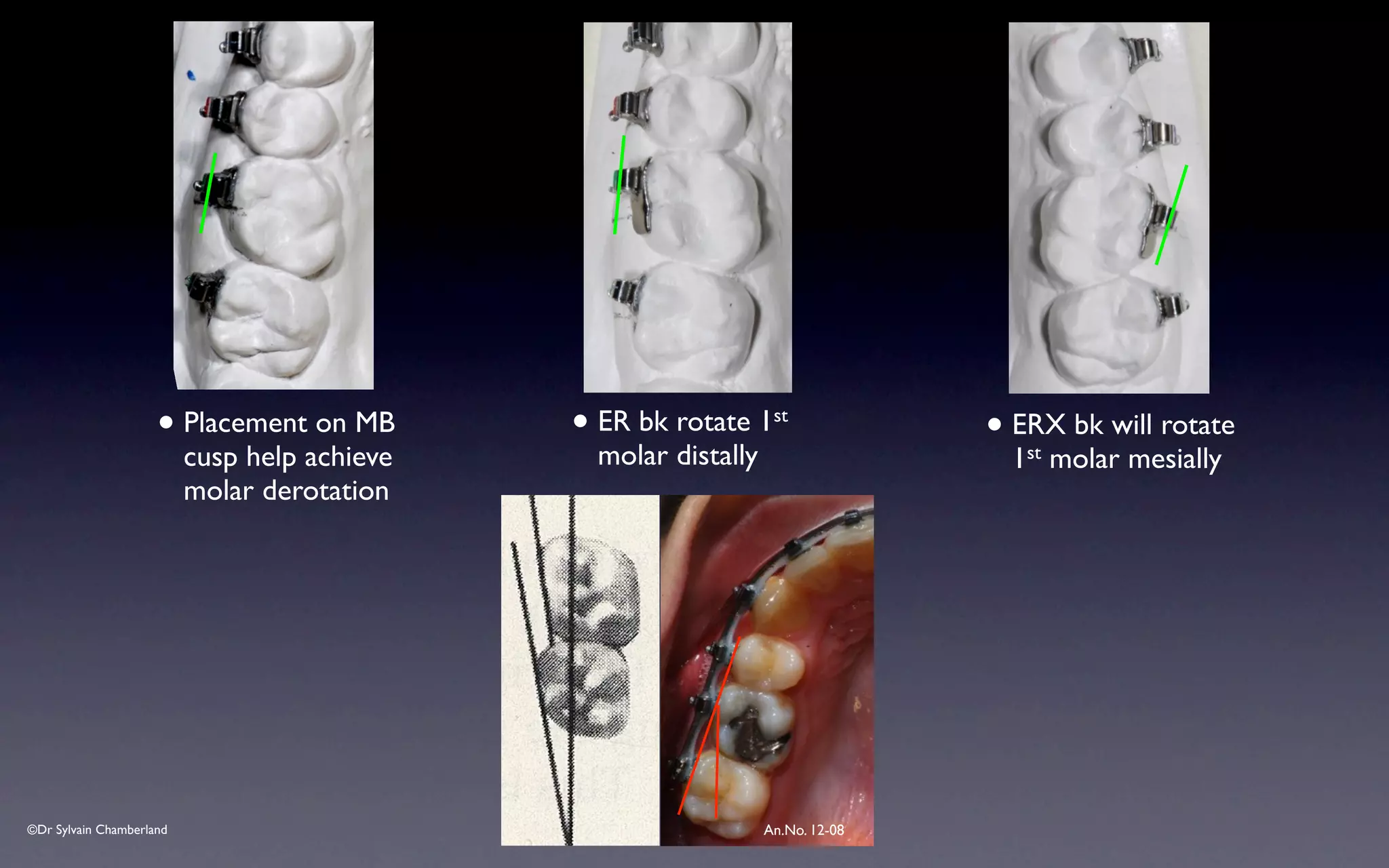
• ERX bk will rotate
1st molar mesially
• Placement on MB
cusp help achieve
molar derotation
• ER bk rotate 1st
molar distally
©Dr Sylvain Chamberland An.No. 12-08
• ERX bk will rotate
1st molar mesially
• Placement on MB
cusp help achieve
molar derotation
• ER bk rotate 1st
molar distally
©Dr Sylvain Chamberland
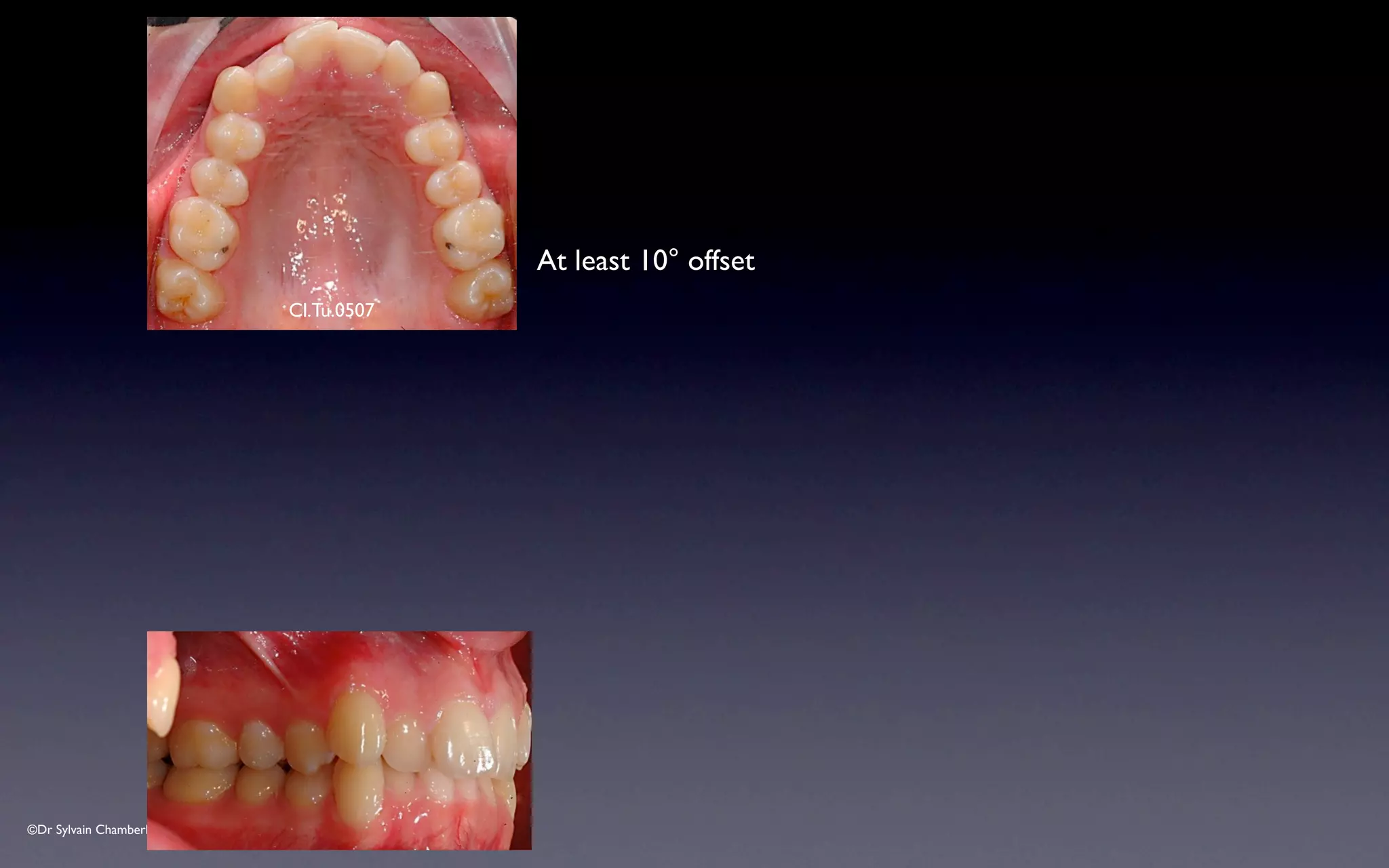
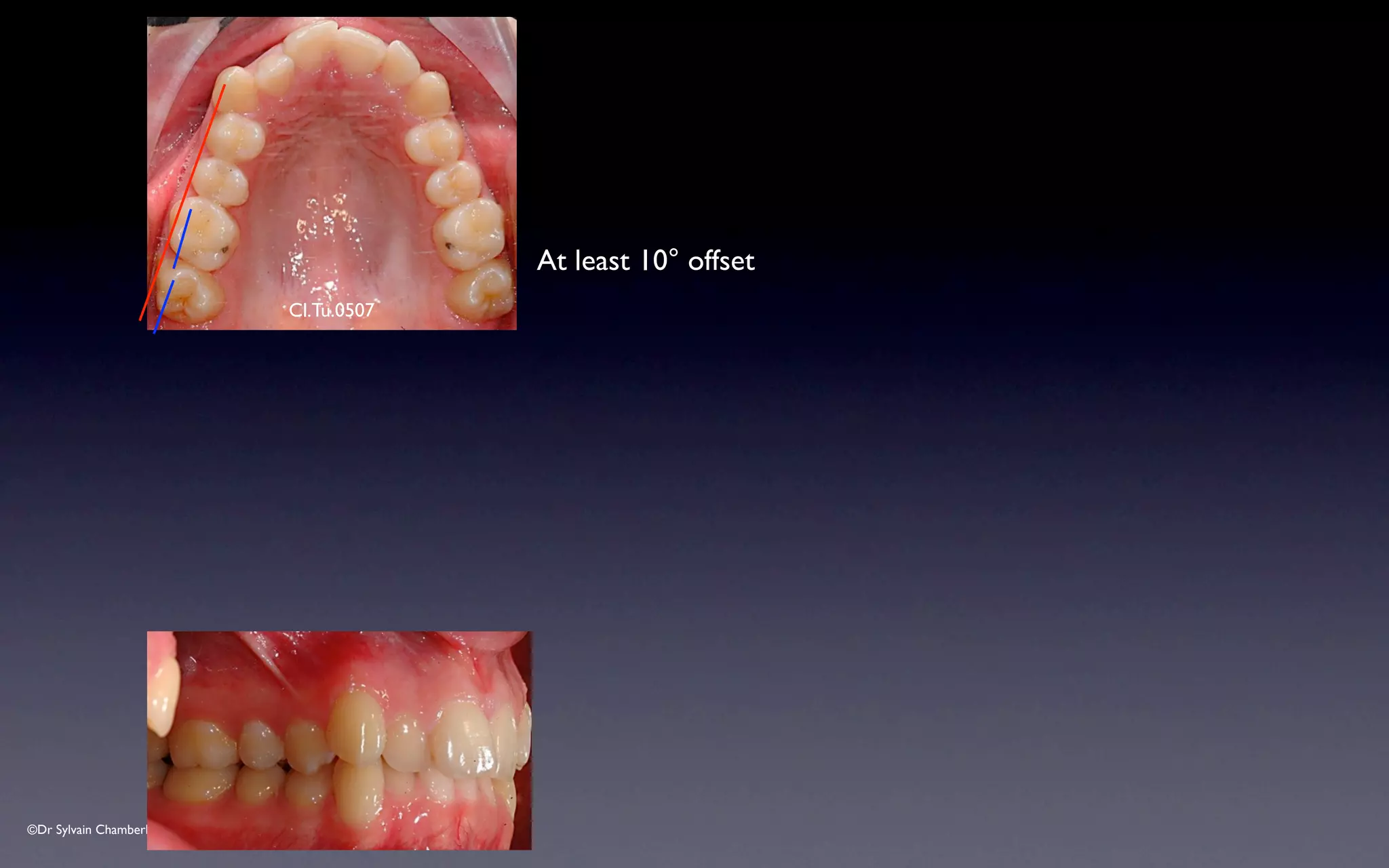
Cl.Tu.0507
At least 10° offset
©Dr Sylvain Chamberland
Cl.Tu.0507
At least 10° offset
©Dr Sylvain Chamberland
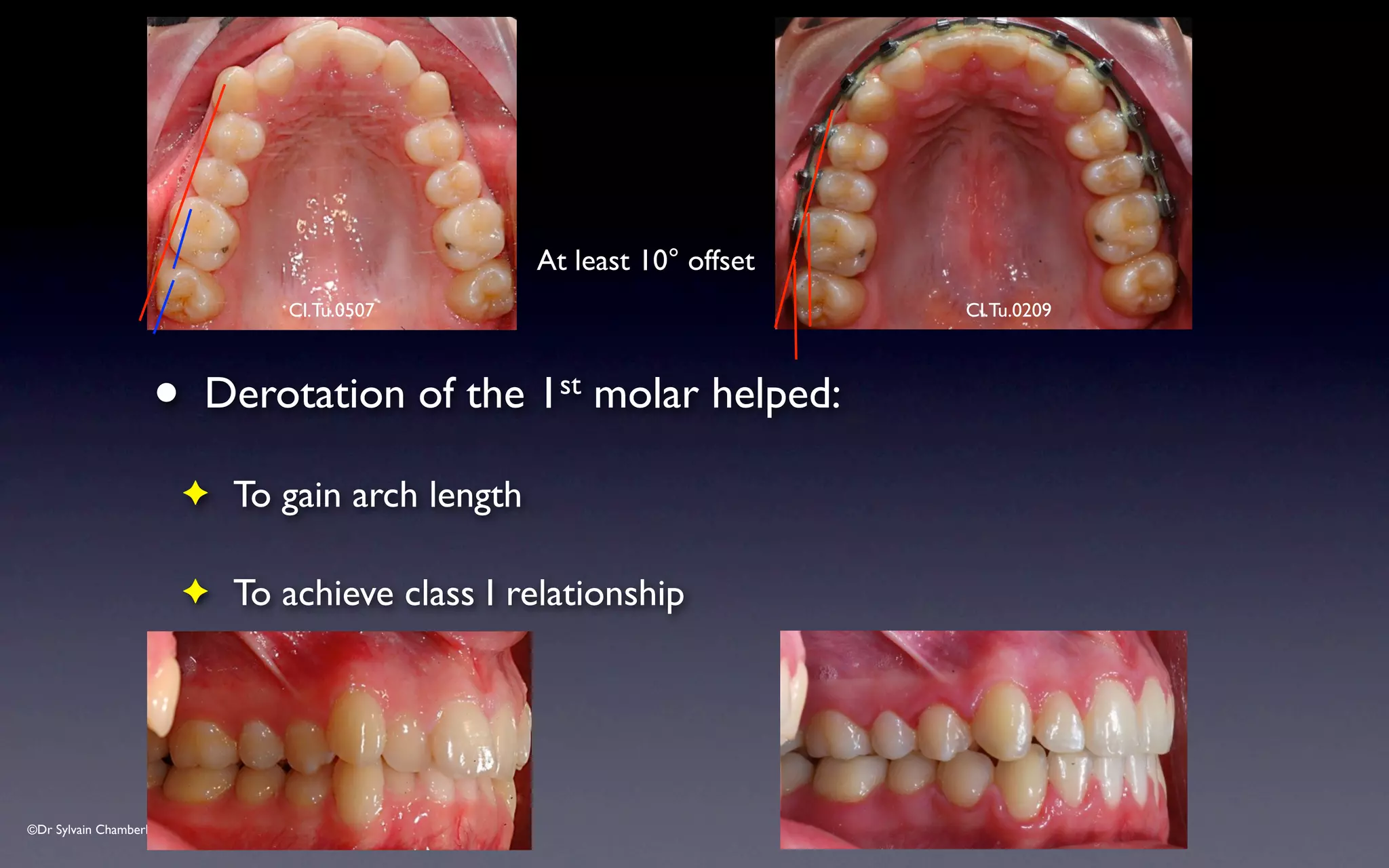
• Derotation of the 1st molar helped:
✦ To gain arch length
✦ To achieve class I relationship
Cl.Tu.0507 Cl.Tu.0209
At least 10° offset
©Dr Sylvain Chamberland
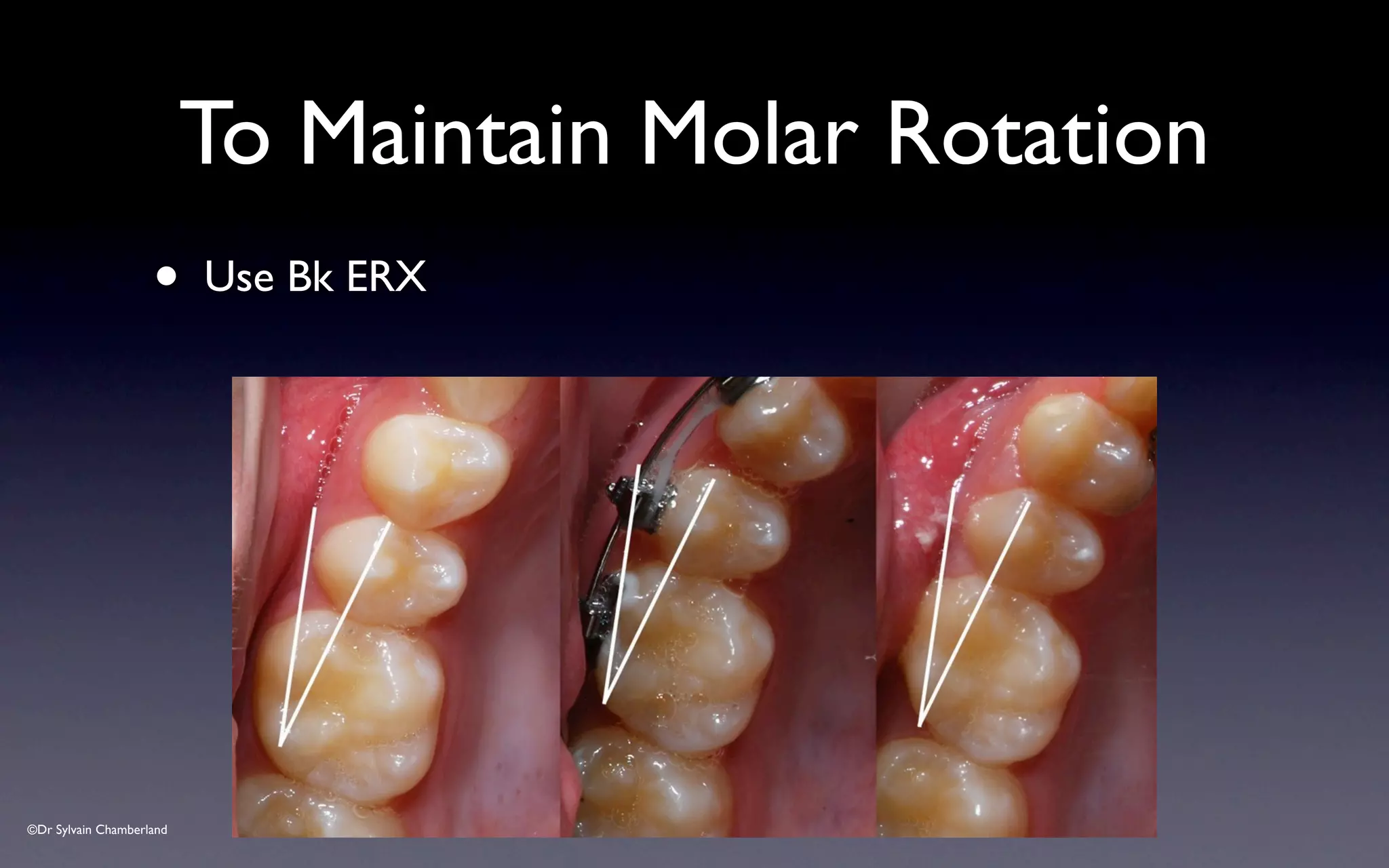
• Use Bk ERX
To Maintain Molar Rotation
©Dr Sylvain Chamberland
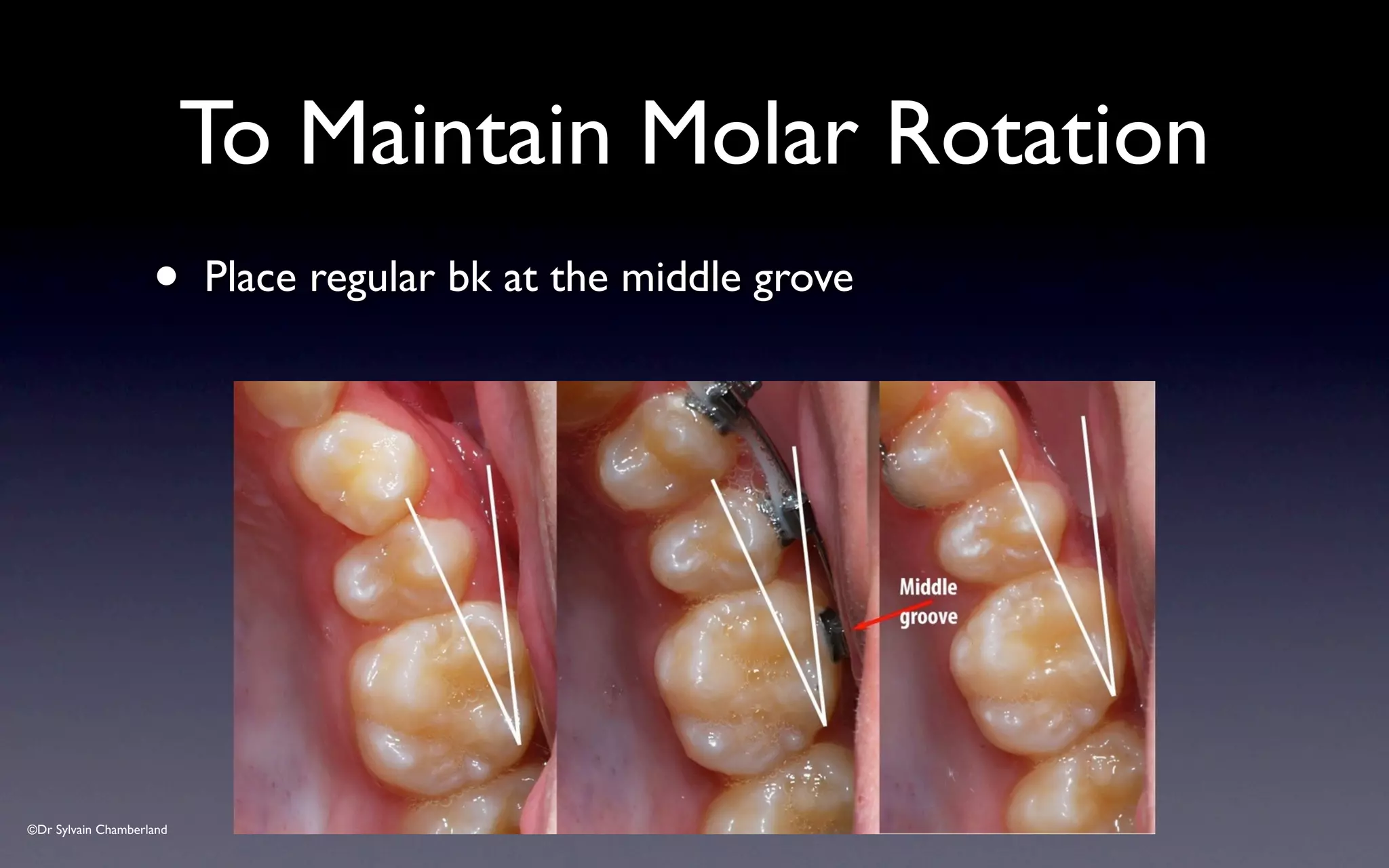
• Place regular bk at the middle grove
To Maintain Molar Rotation
©Dr Sylvain Chamberland
• Reflection lines on the
labial aid to slot alignment
©Dr Sylvain Chamberland
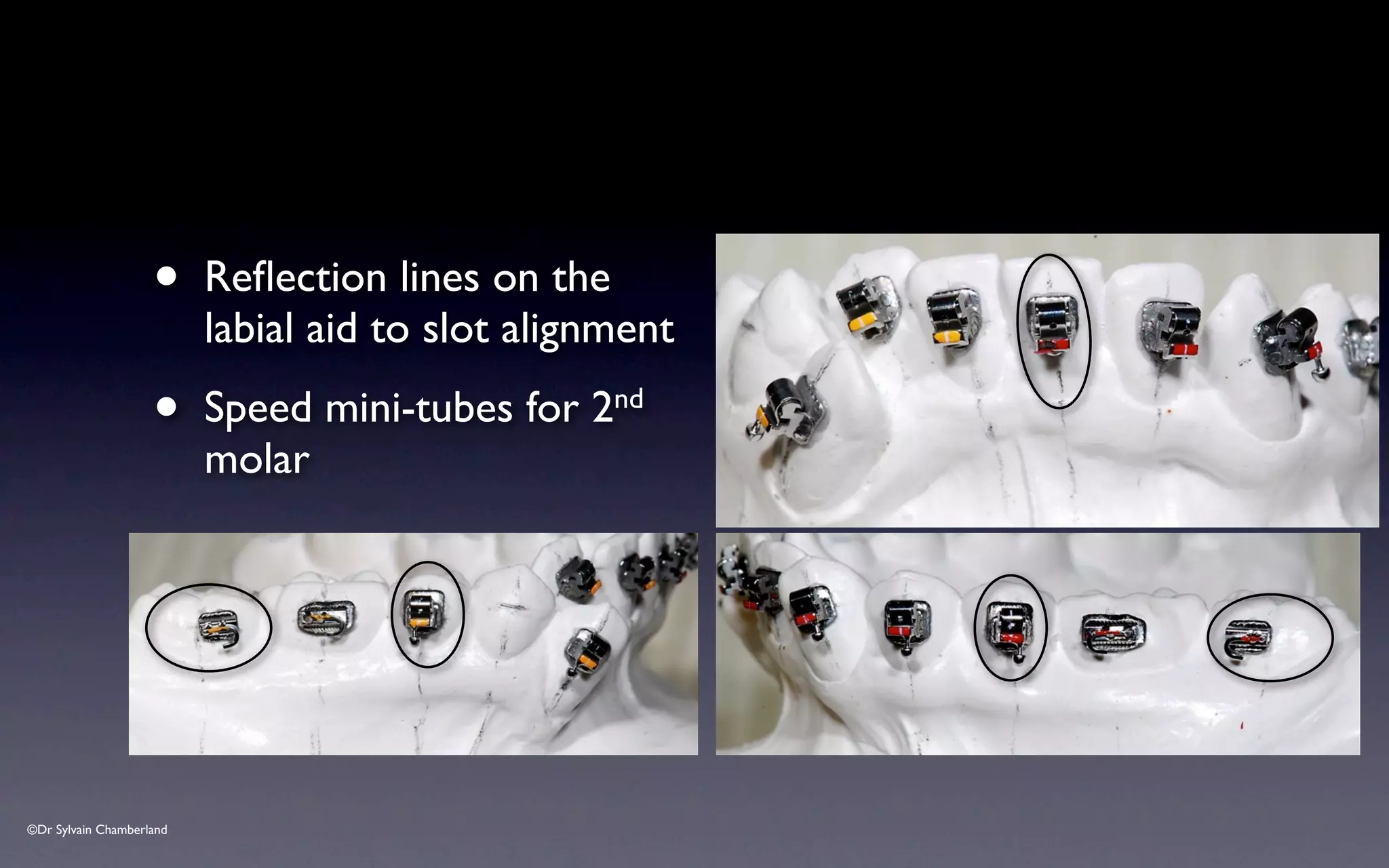
• Reflection lines on the
labial aid to slot alignment
• Speed mini-tubes for 2nd
molar
©Dr Sylvain Chamberland
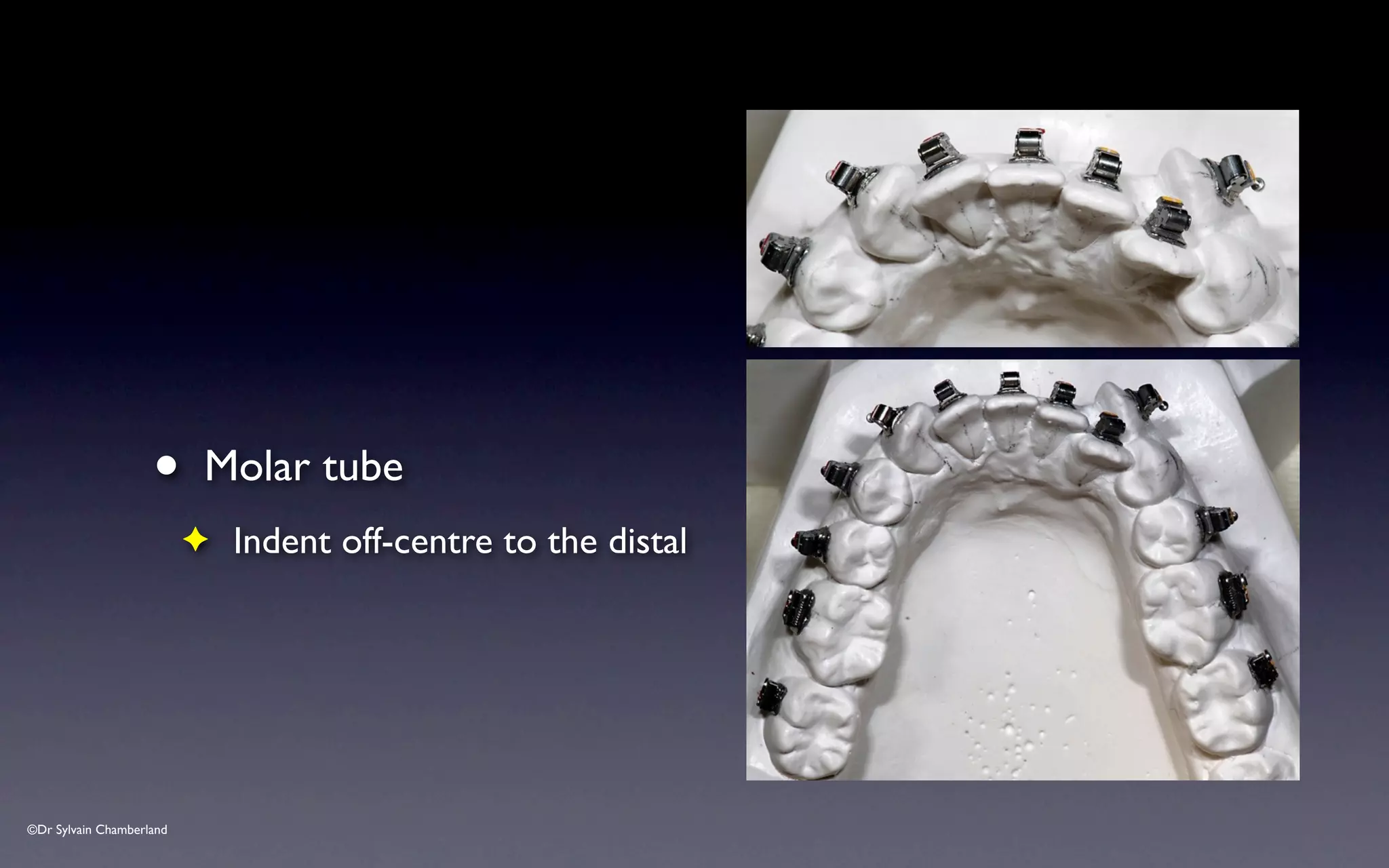
• Molar tube
✦ Indent off-centre to the distal
©Dr Sylvain Chamberland
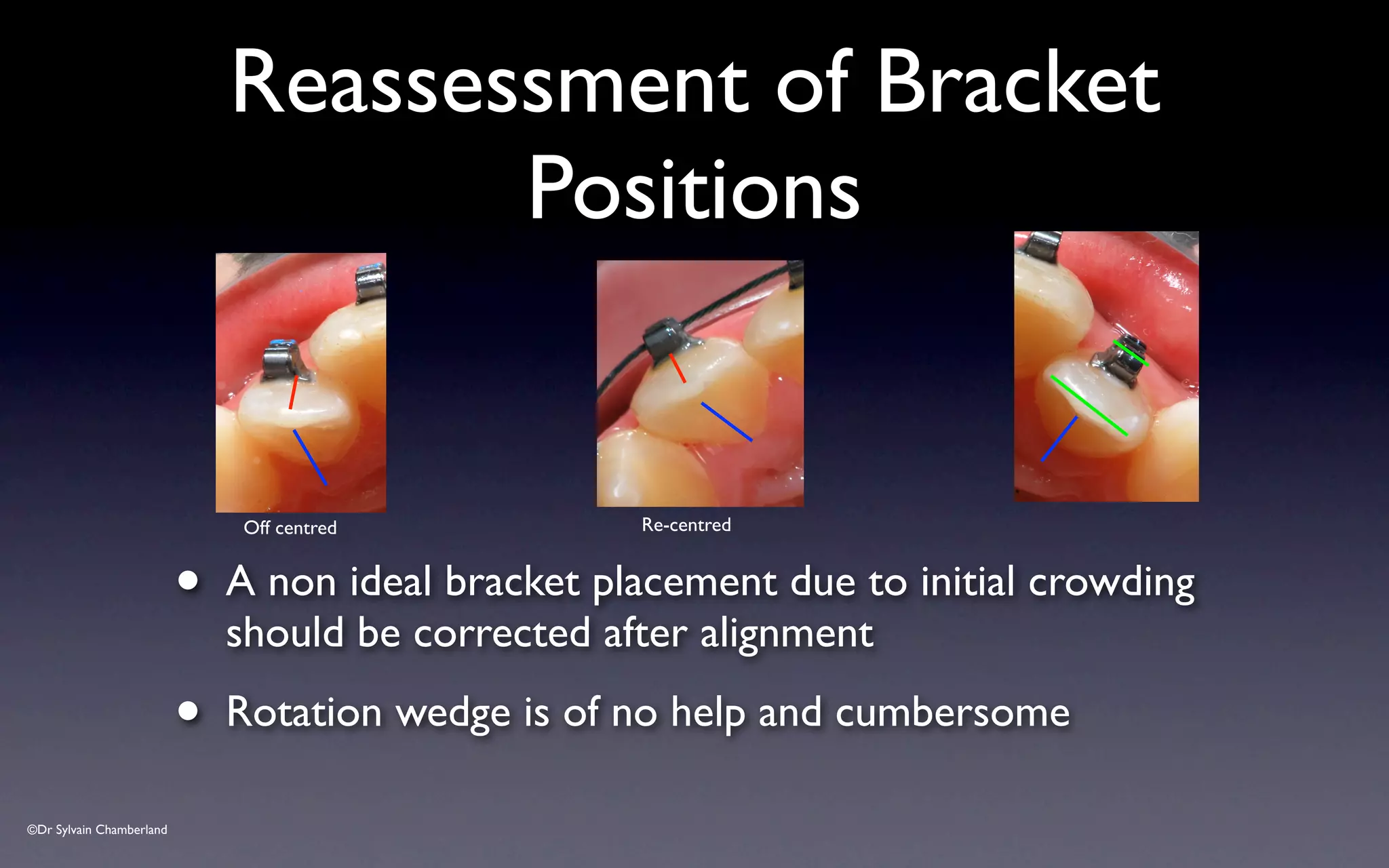
Reassessment of Bracket
Positions
• A non ideal bracket placement due to initial crowding
should be corrected after alignment
• Rotation wedge is of no help and cumbersome
Off centred Re-centred
©Dr Sylvain Chamberland
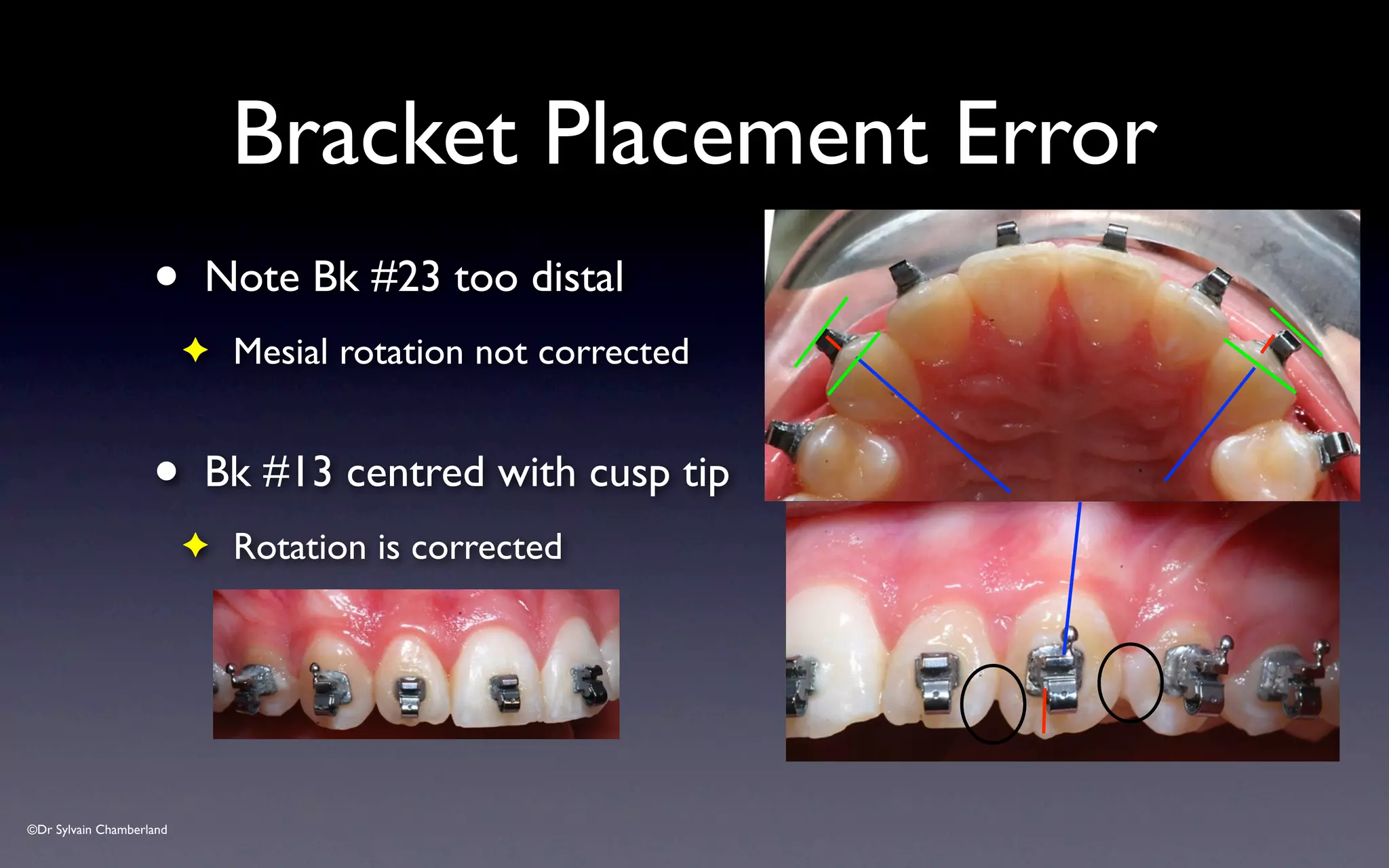
Bracket Placement Error
• Note Bk #23 too distal
✦ Mesial rotation not corrected
• Bk #13 centred with cusp tip
✦ Rotation is corrected
©Dr Sylvain Chamberland
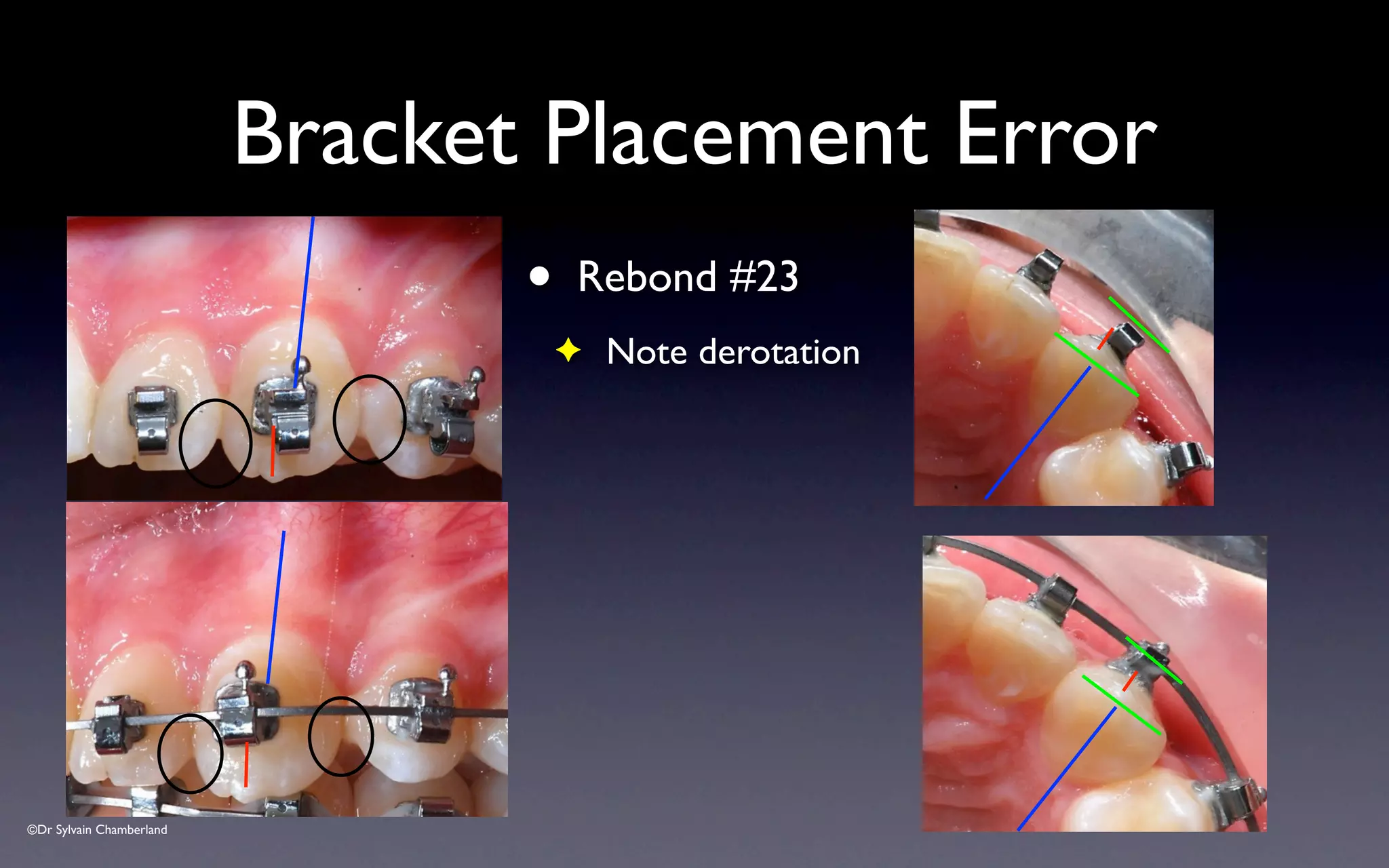
• Rebond #23
✦ Note derotation
Bracket Placement Error
©Dr Sylvain Chamberland
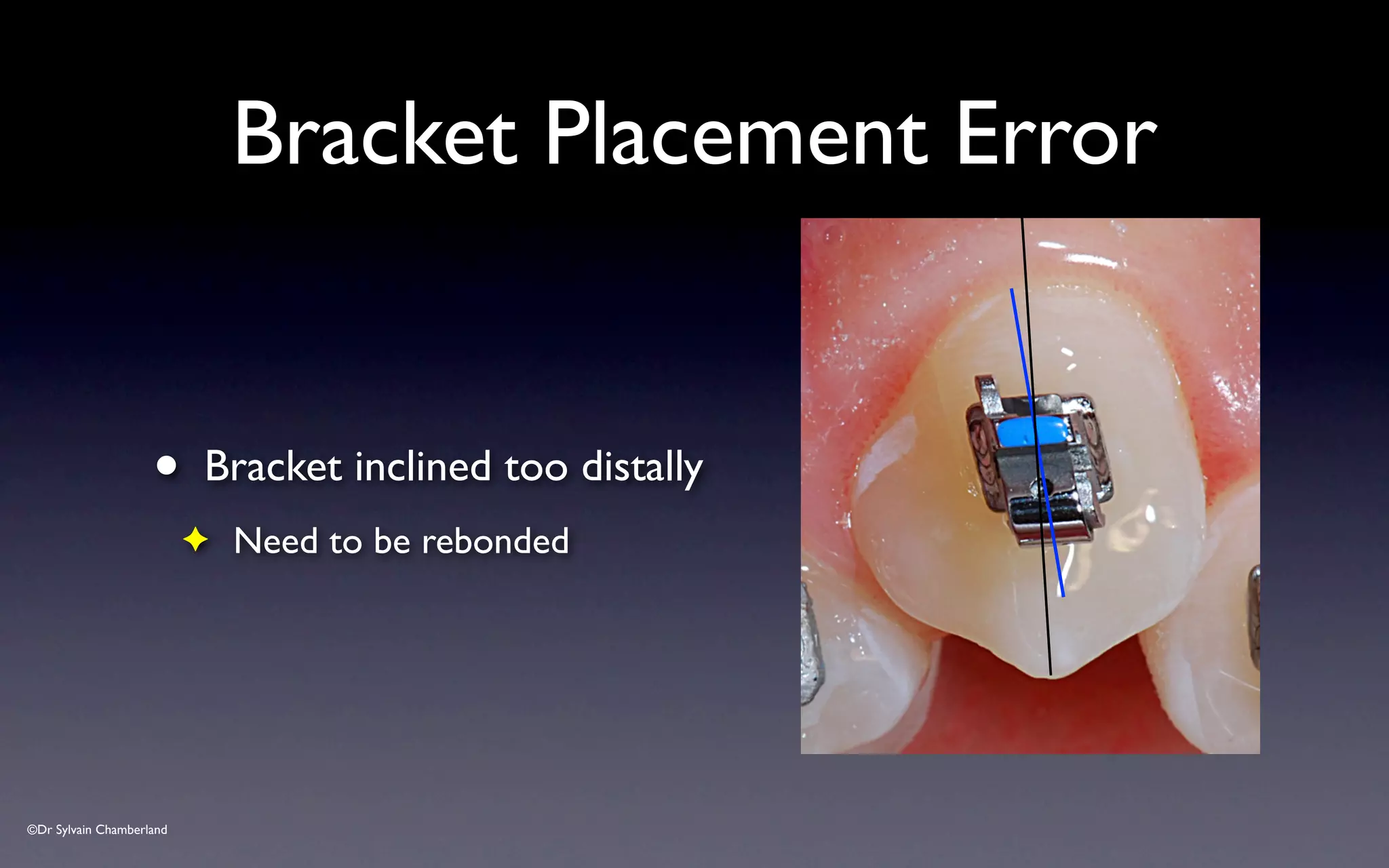
Bracket Placement Error
• Bracket inclined too distally
✦ Need to be rebonded
©Dr Sylvain Chamberland
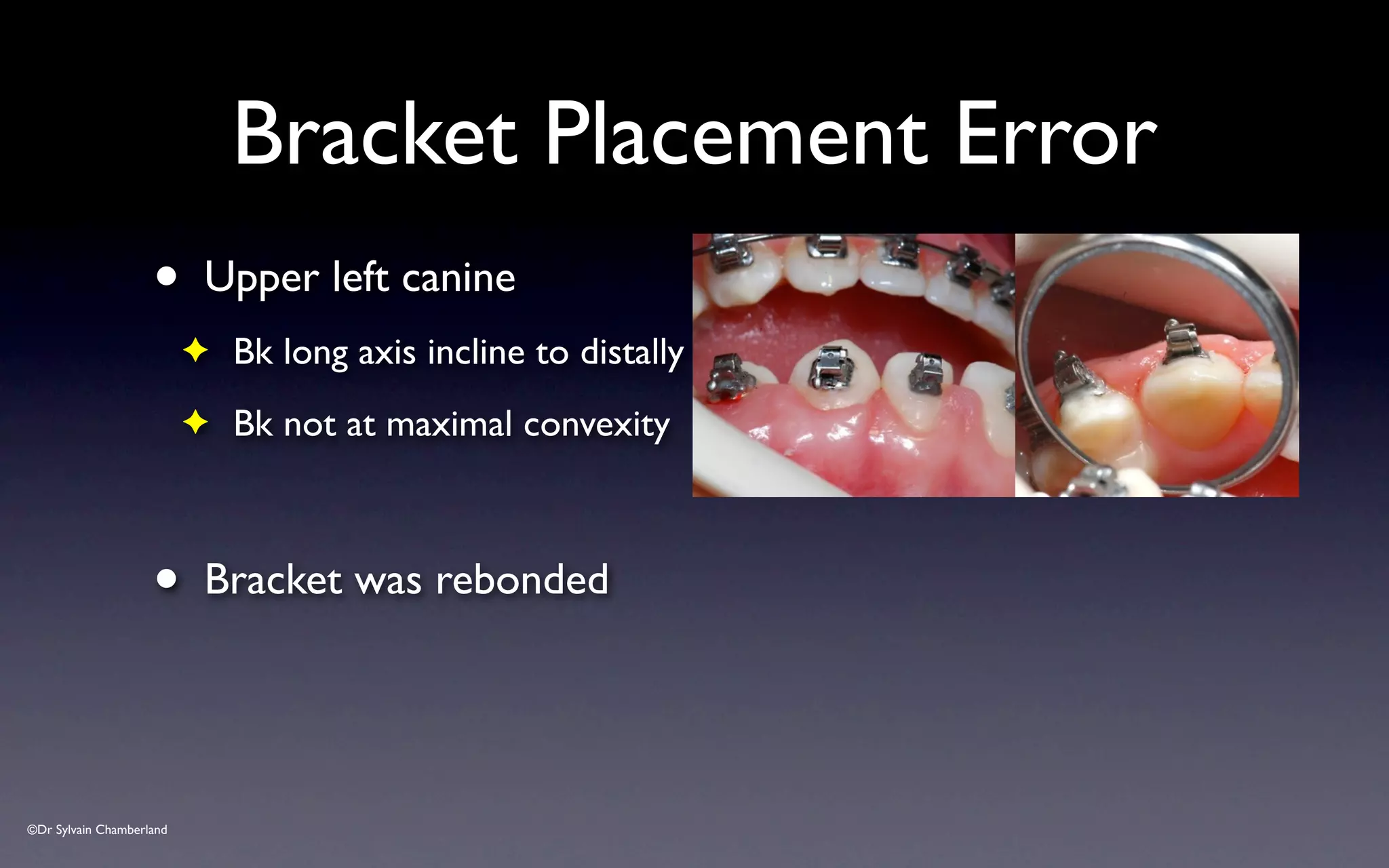
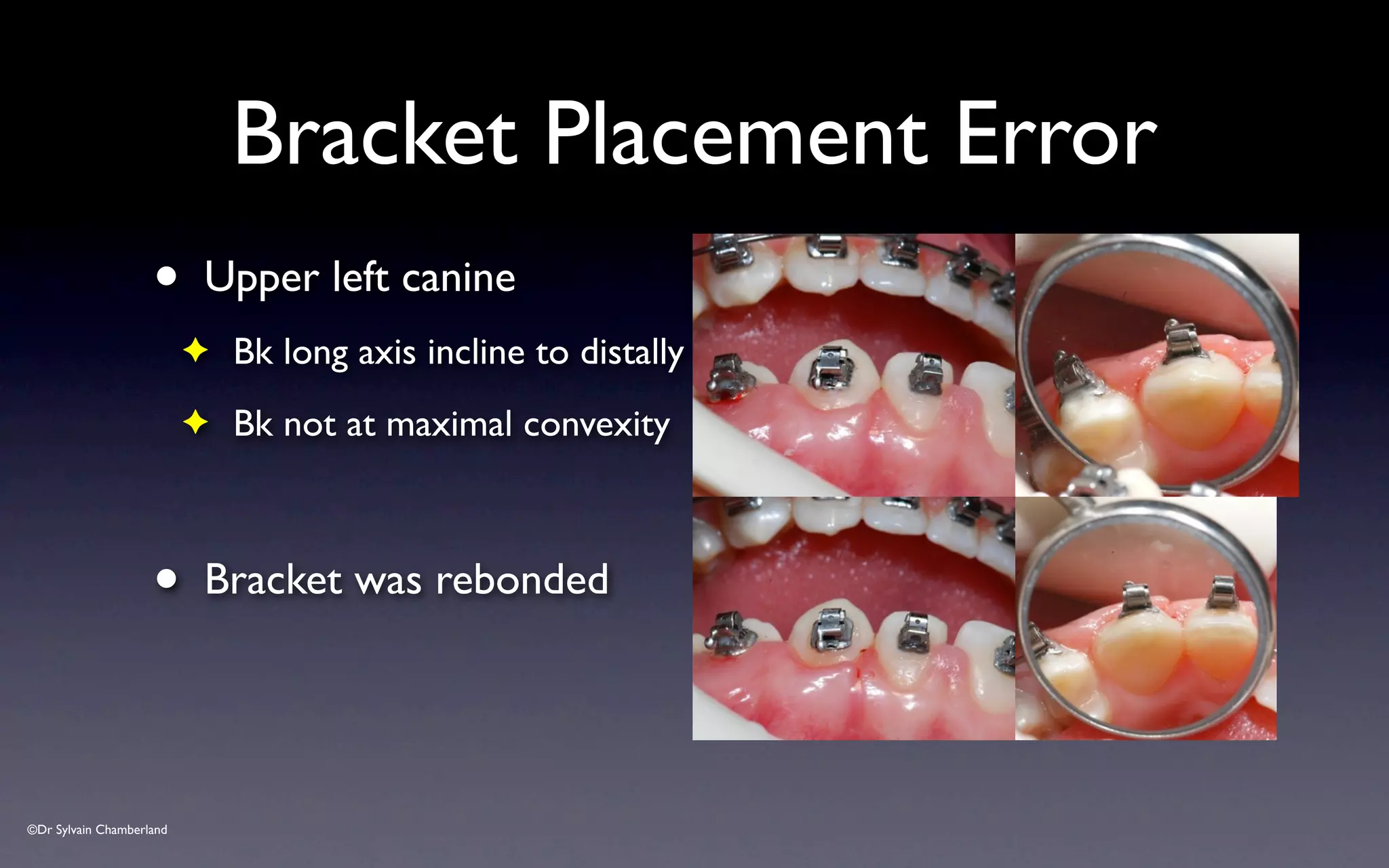
Bracket Placement Error
• Upper left canine
✦ Bk long axis incline to distally
✦ Bk not at maximal convexity
• Bracket was rebonded
©Dr Sylvain Chamberland
Bracket Placement Error
• Upper left canine
✦ Bk long axis incline to distally
✦ Bk not at maximal convexity
• Bracket was rebonded
©Dr Sylvain Chamberland
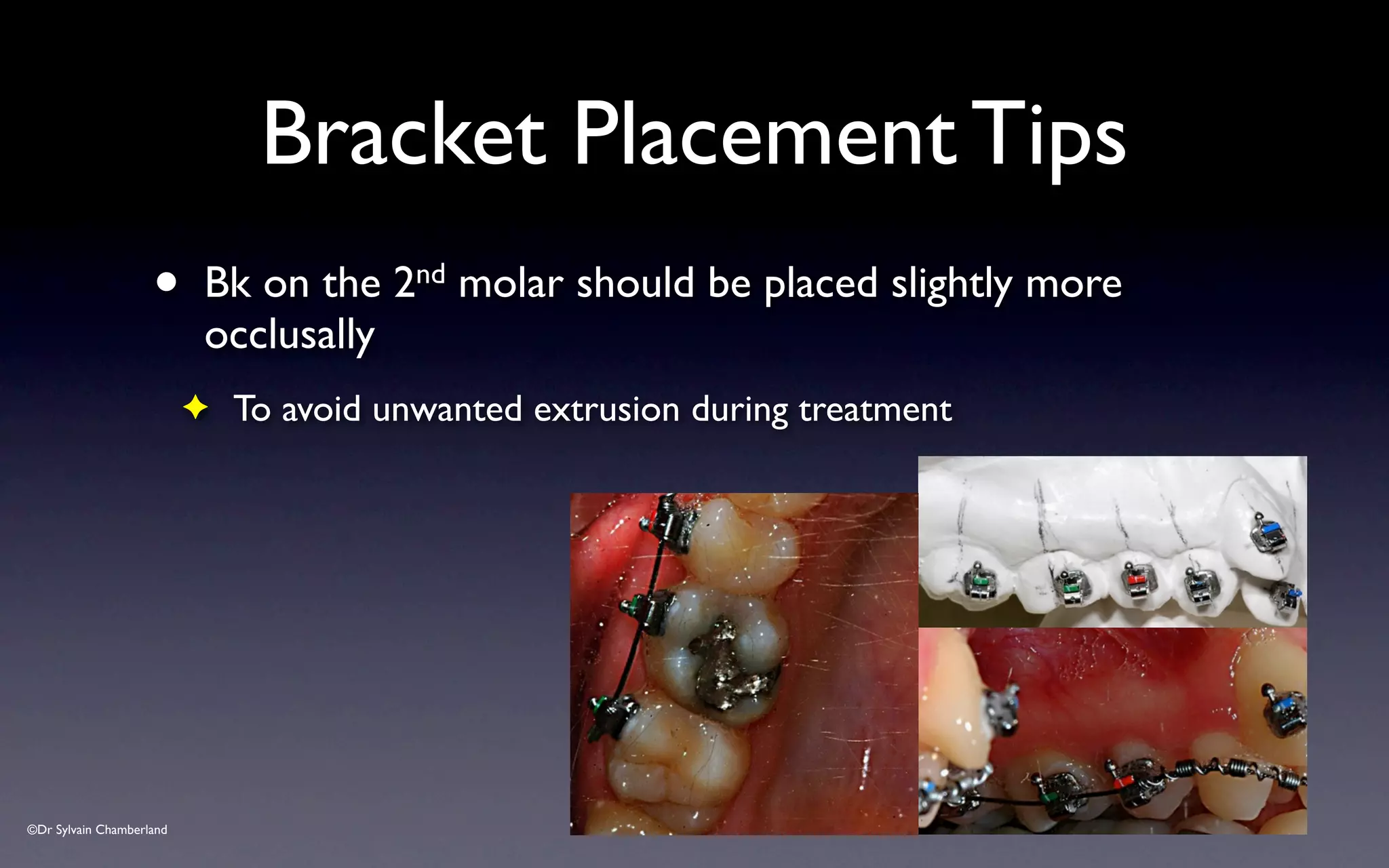
• Bk on the 2nd molar should be placed slightly more
occlusally
✦ To avoid unwanted extrusion during treatment
Bracket Placement Tips
©Dr Sylvain Chamberland
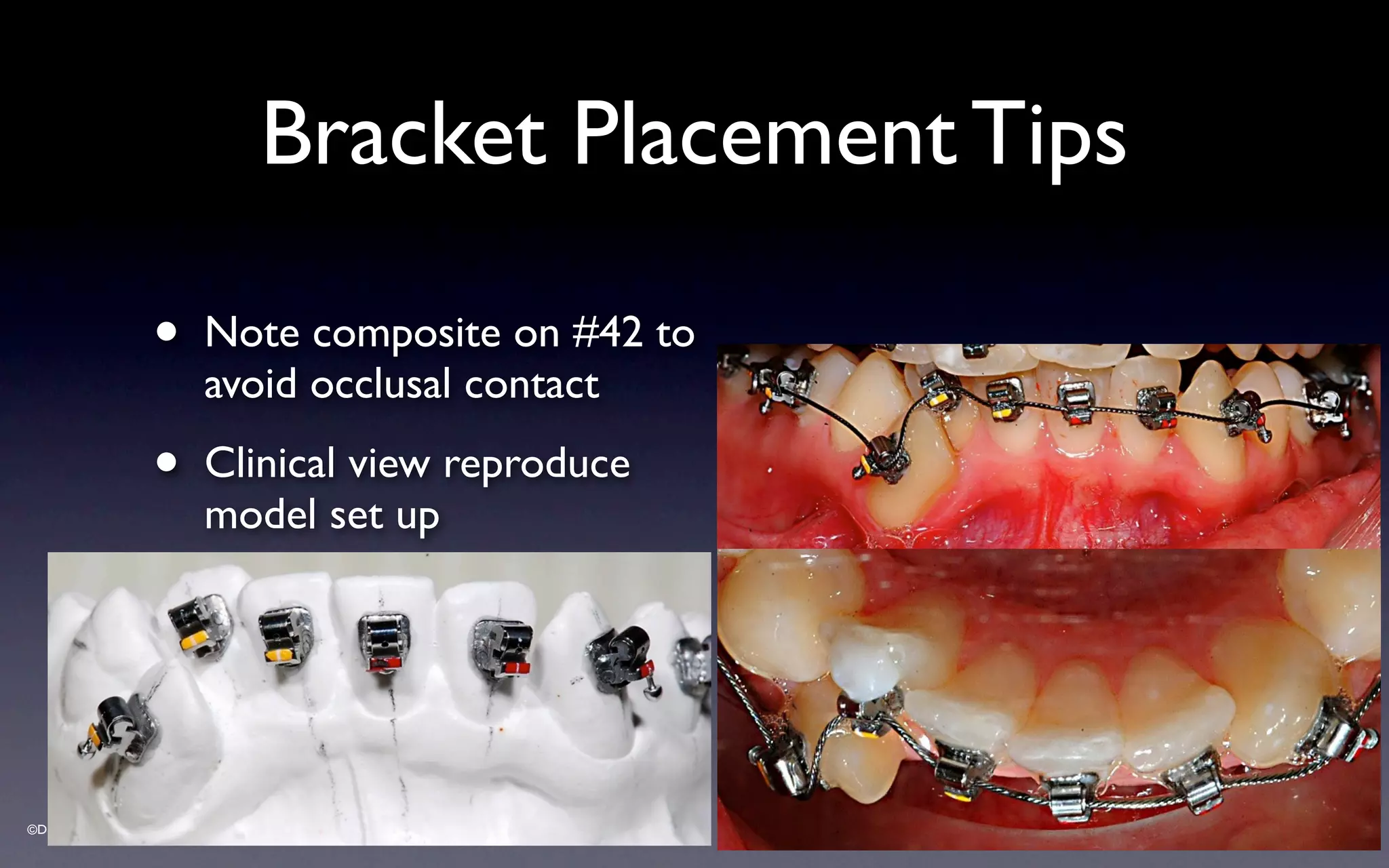
• Note composite on #42 to
avoid occlusal contact
• Clinical view reproduce
model set up
Bracket Placement Tips
©Dr Sylvain Chamberland
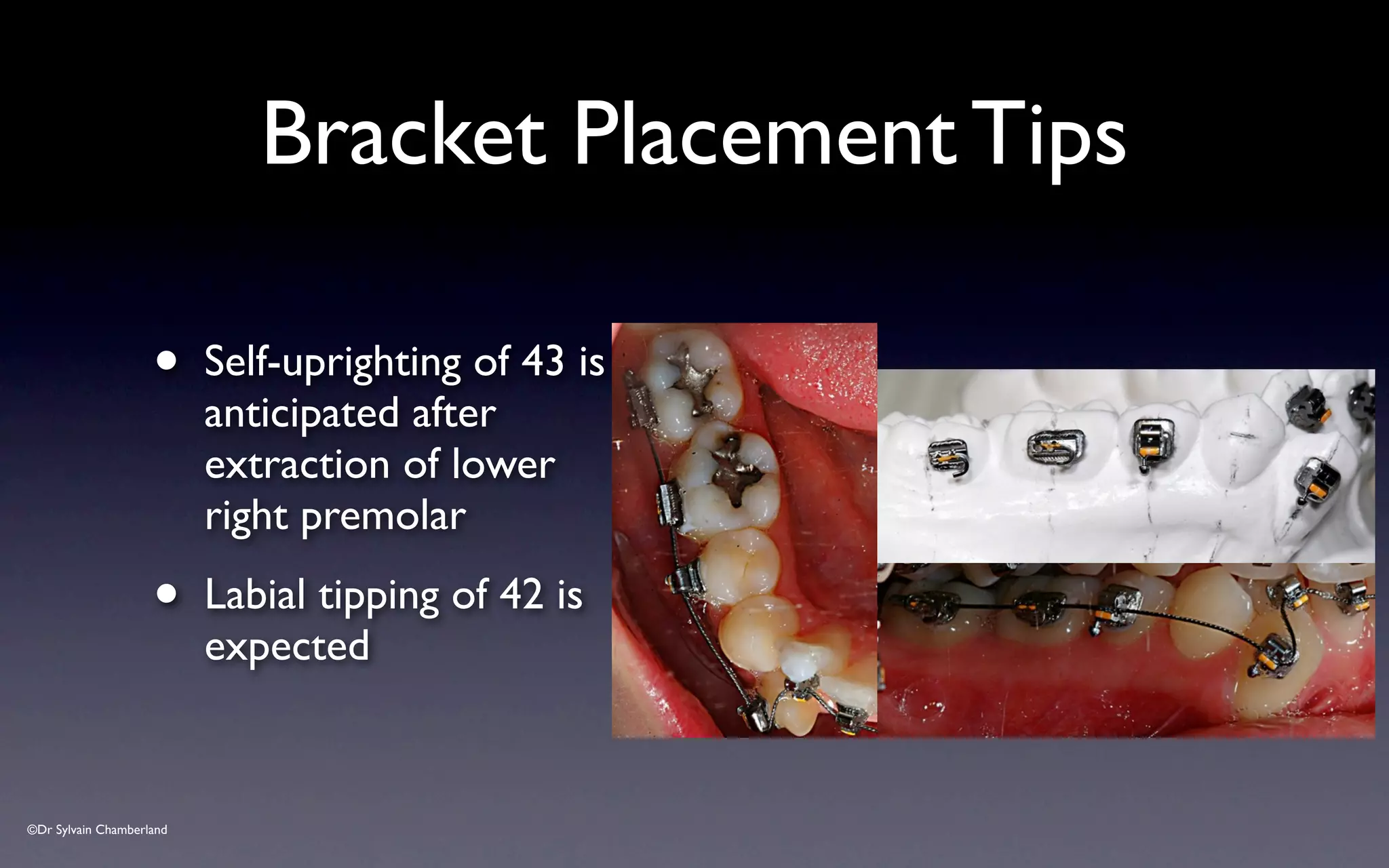
• Self-uprighting of 43 is
anticipated after
extraction of lower
right premolar
• Labial tipping of 42 is
expected
Bracket Placement Tips
©Dr Sylvain Chamberland
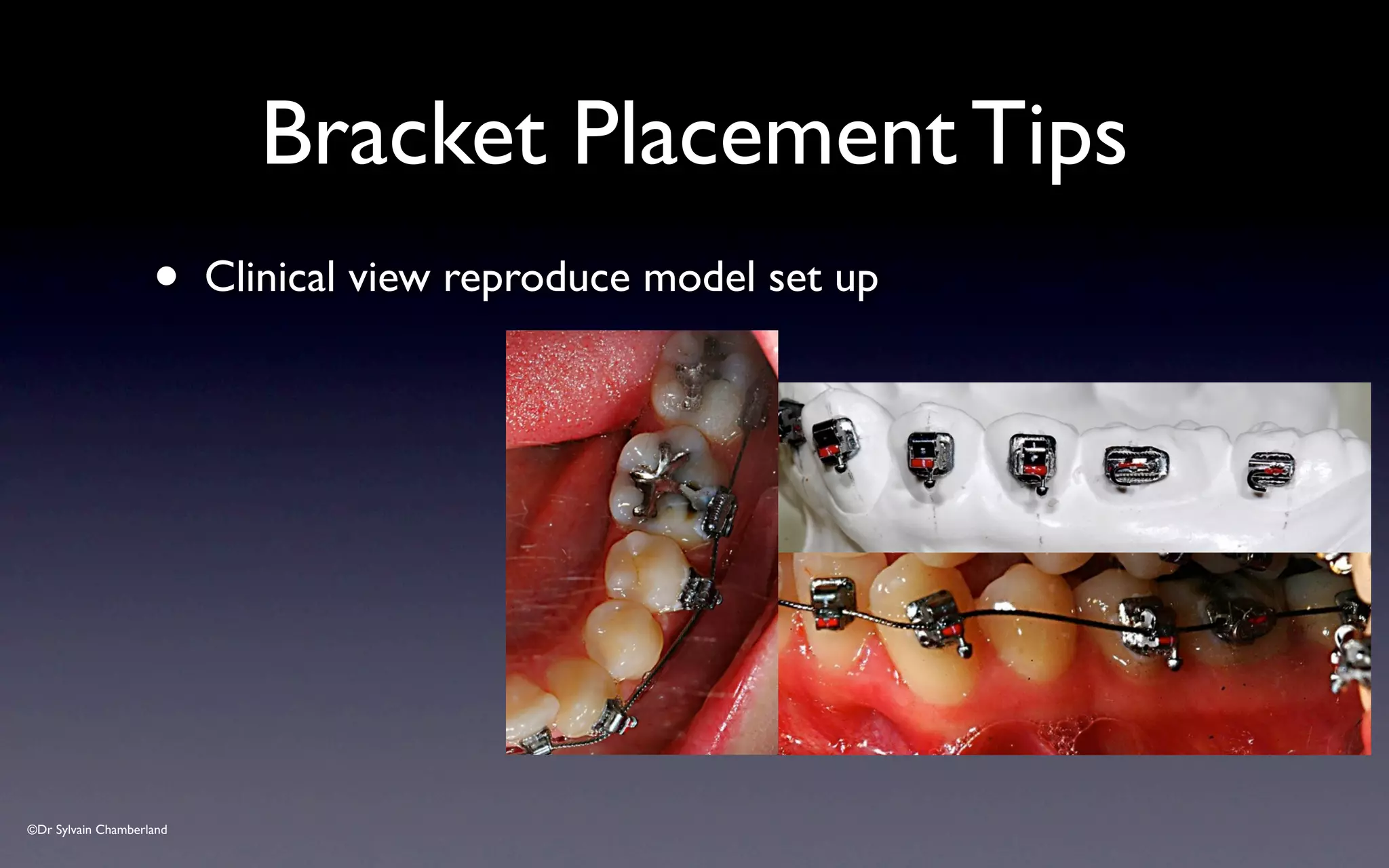
• Clinical view reproduce model set up
Bracket Placement Tips
©Dr Sylvain Chamberland
Bracket Placement Error
El.Jo.100309
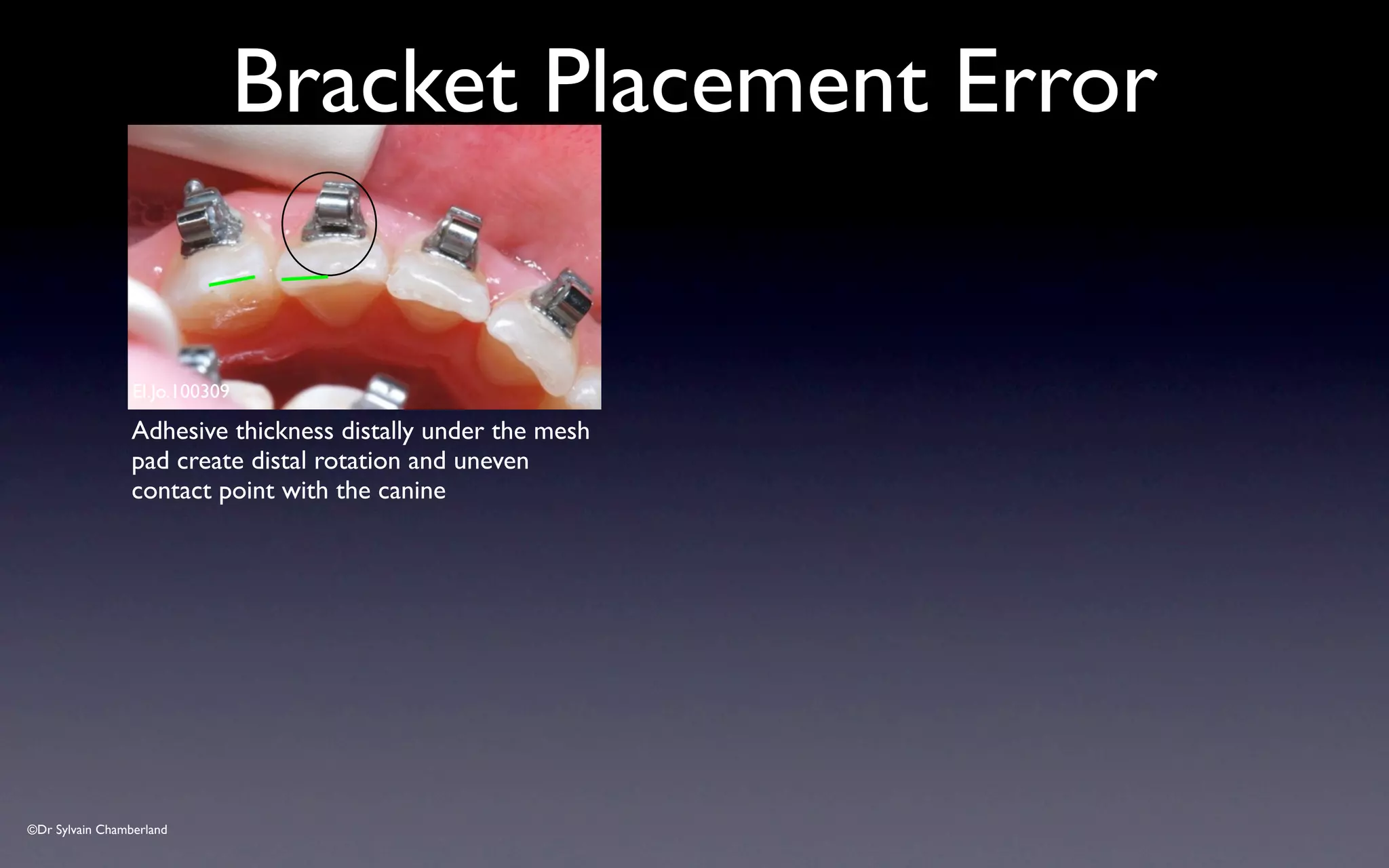
Adhesive thickness distally under the mesh
pad create distal rotation and uneven
contact point with the canine
©Dr Sylvain Chamberland
Bracket Placement Error
El.Jo.100309
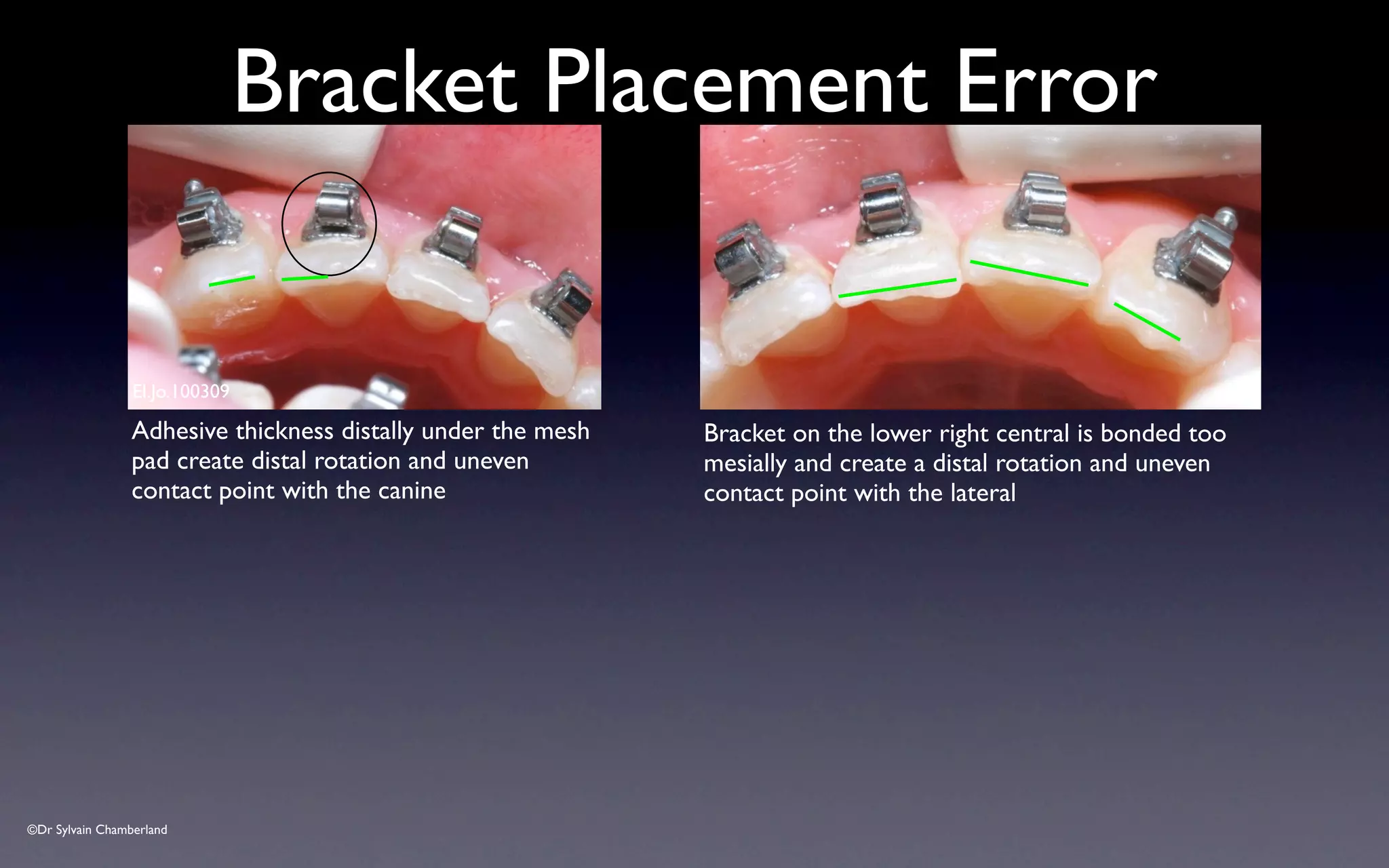
Adhesive thickness distally under the mesh
pad create distal rotation and uneven
contact point with the canine
Bracket on the lower right central is bonded too
mesially and create a distal rotation and uneven
contact point with the lateral
©Dr Sylvain Chamberland
Bracket Placement Error
El.Jo.100309
Adhesive thickness distally under the mesh
pad create distal rotation and uneven
contact point with the canine
Bracket on the lower right central is bonded too
mesially and create a distal rotation and uneven
contact point with the lateral
El.Jo.240409
Rebonded bracket help to achieve better
alignment of the contact points
©Dr Sylvain Chamberland
Bracket Placement Error
El.Jo.100309
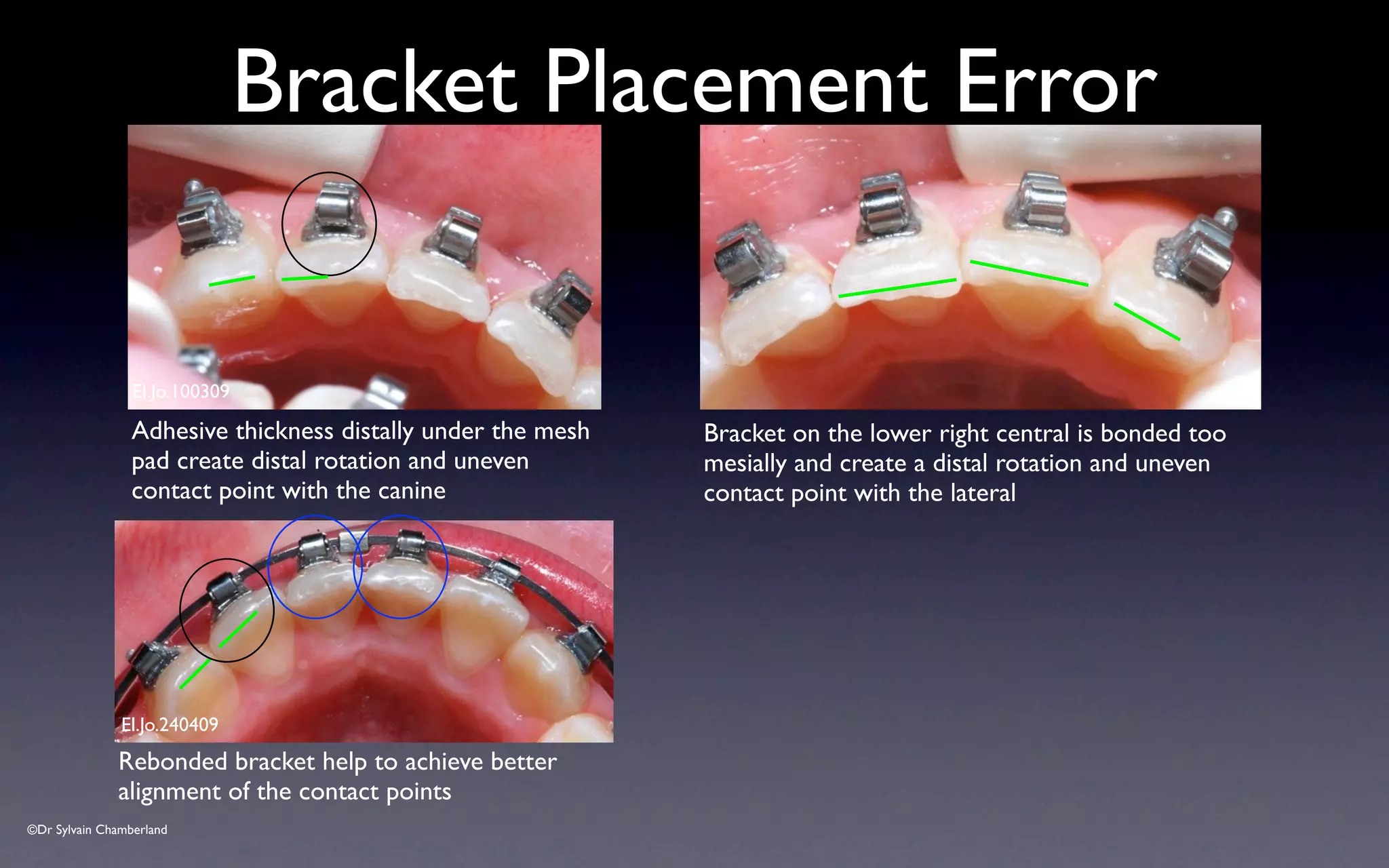
Adhesive thickness distally under the mesh
pad create distal rotation and uneven
contact point with the canine
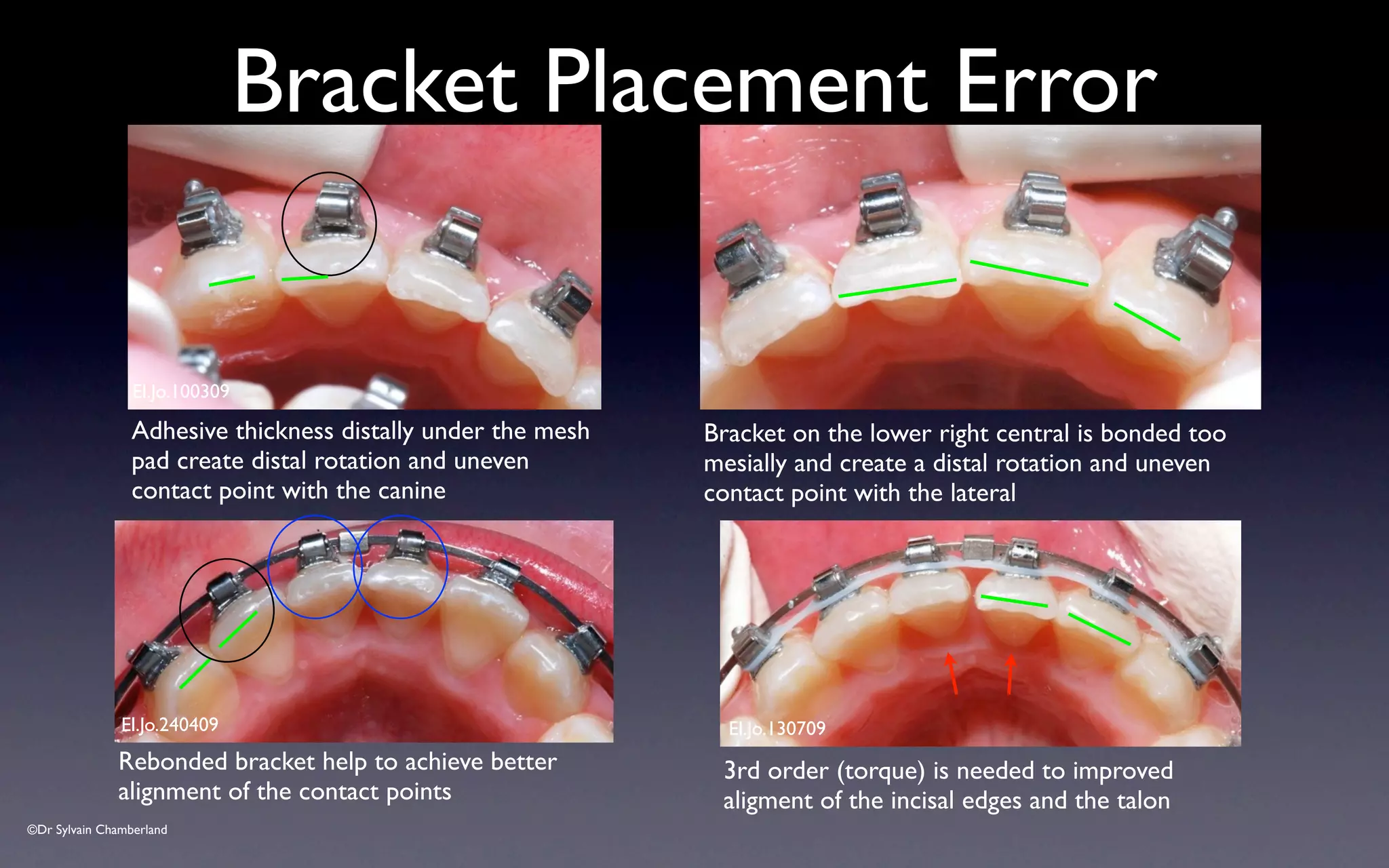
Bracket on the lower right central is bonded too
mesially and create a distal rotation and uneven
contact point with the lateral
El.Jo.240409
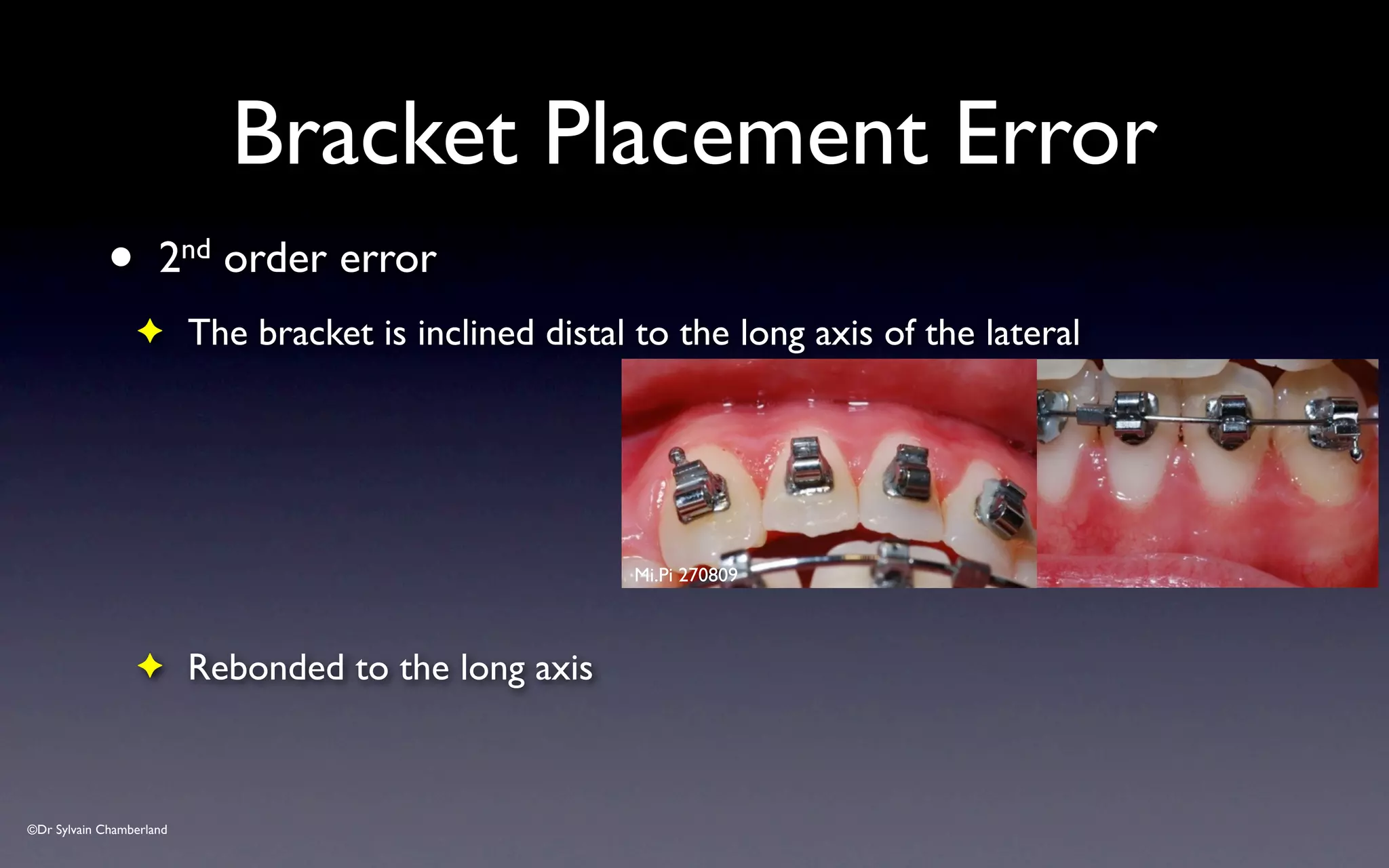
Rebonded bracket help to achieve better
alignment of the contact points
El.Jo.130709
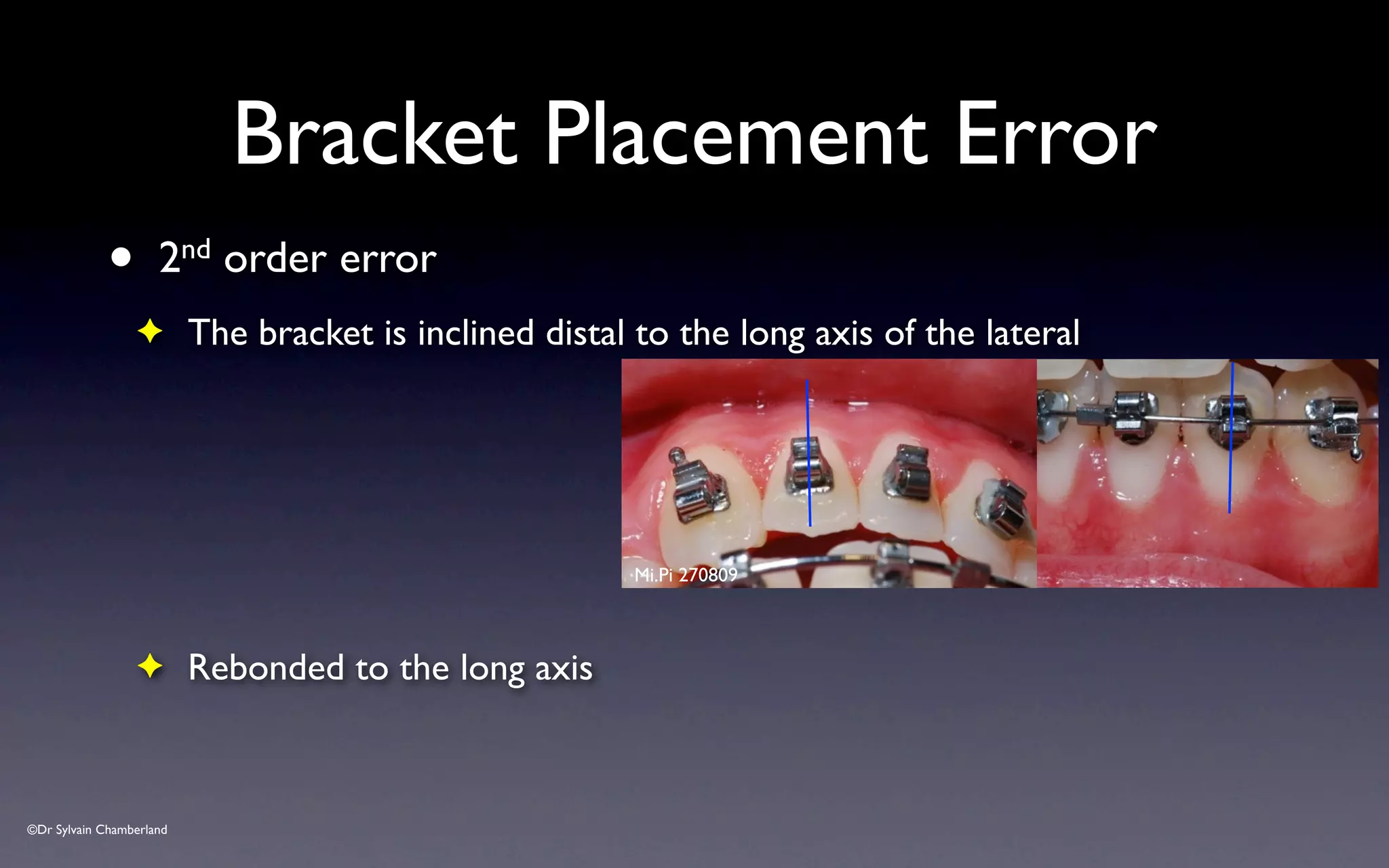
3rd order (torque) is needed to improved
aligment of the incisal edges and the talon
©Dr Sylvain Chamberland
Bracket Placement Error
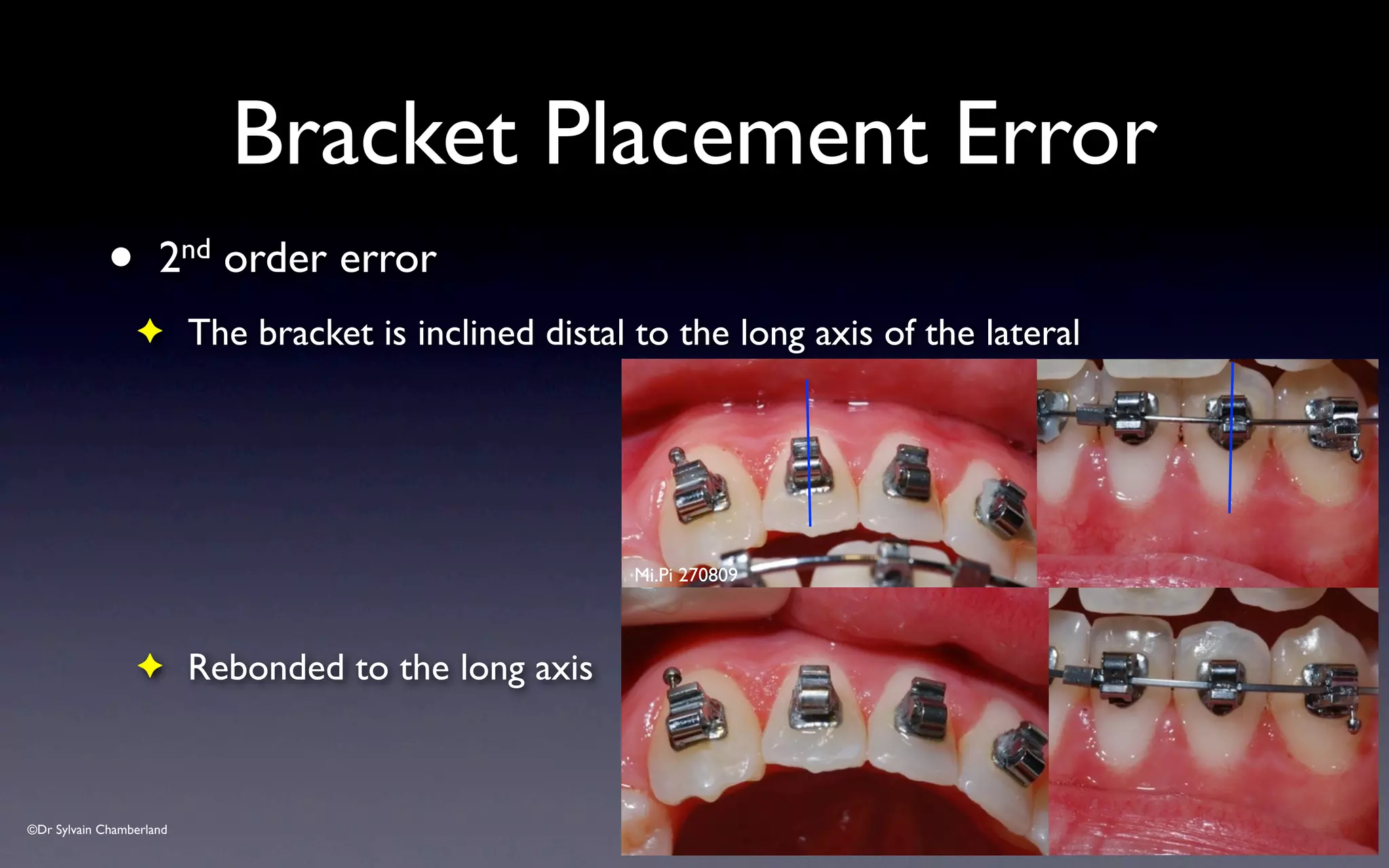
• 2nd order error
✦ The bracket is inclined distal to the long axis of the lateral
✦ Rebonded to the long axis
Mi.Pi 270809
©Dr Sylvain Chamberland
Bracket Placement Error
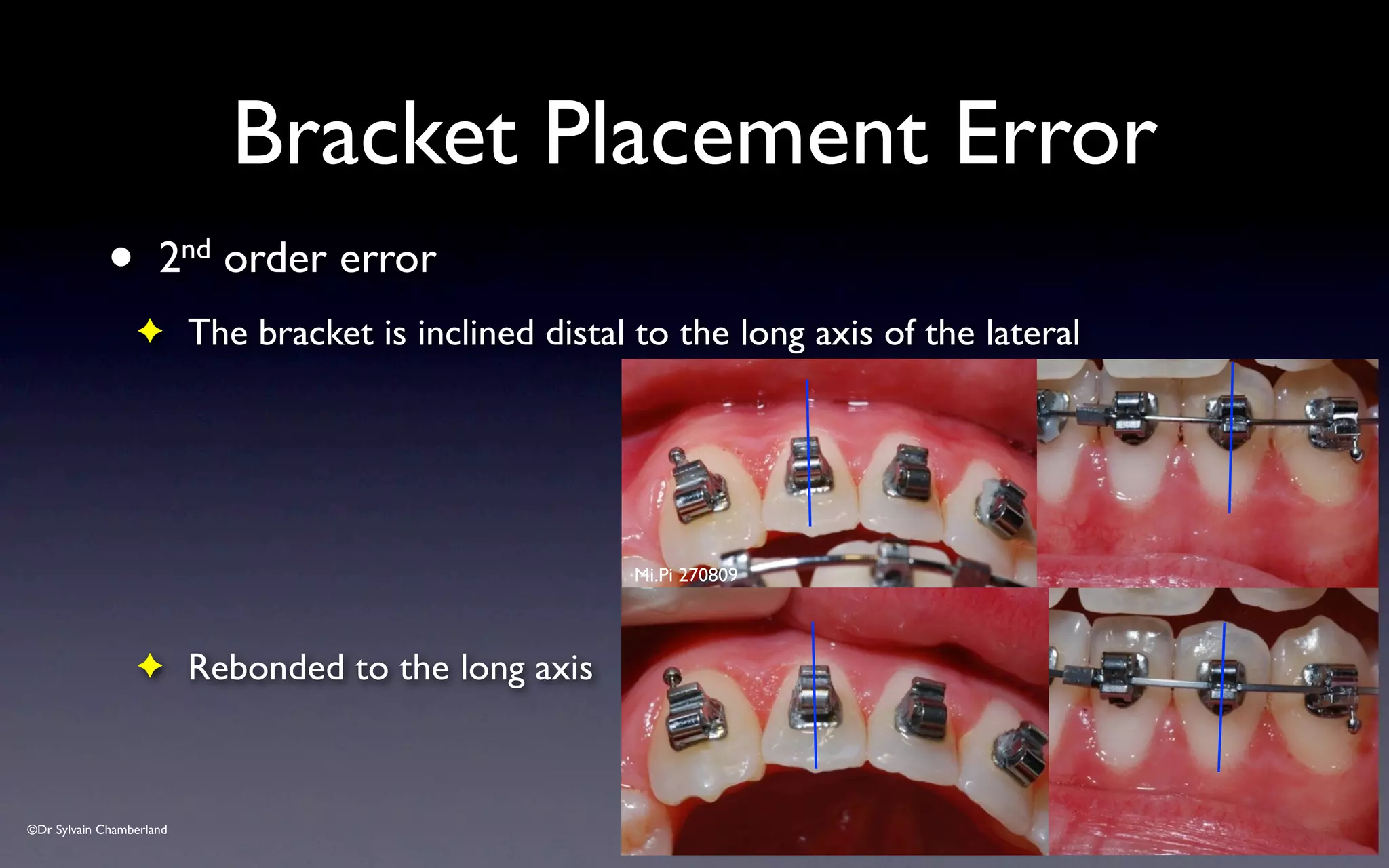
• 2nd order error
✦ The bracket is inclined distal to the long axis of the lateral
✦ Rebonded to the long axis
Mi.Pi 270809
©Dr Sylvain Chamberland
Bracket Placement Error
• 2nd order error
✦ The bracket is inclined distal to the long axis of the lateral
✦ Rebonded to the long axis
Mi.Pi 270809
©Dr Sylvain Chamberland
Bracket Placement Error
• 2nd order error
✦ The bracket is inclined distal to the long axis of the lateral
✦ Rebonded to the long axis
Mi.Pi 270809
©Dr Sylvain Chamberland
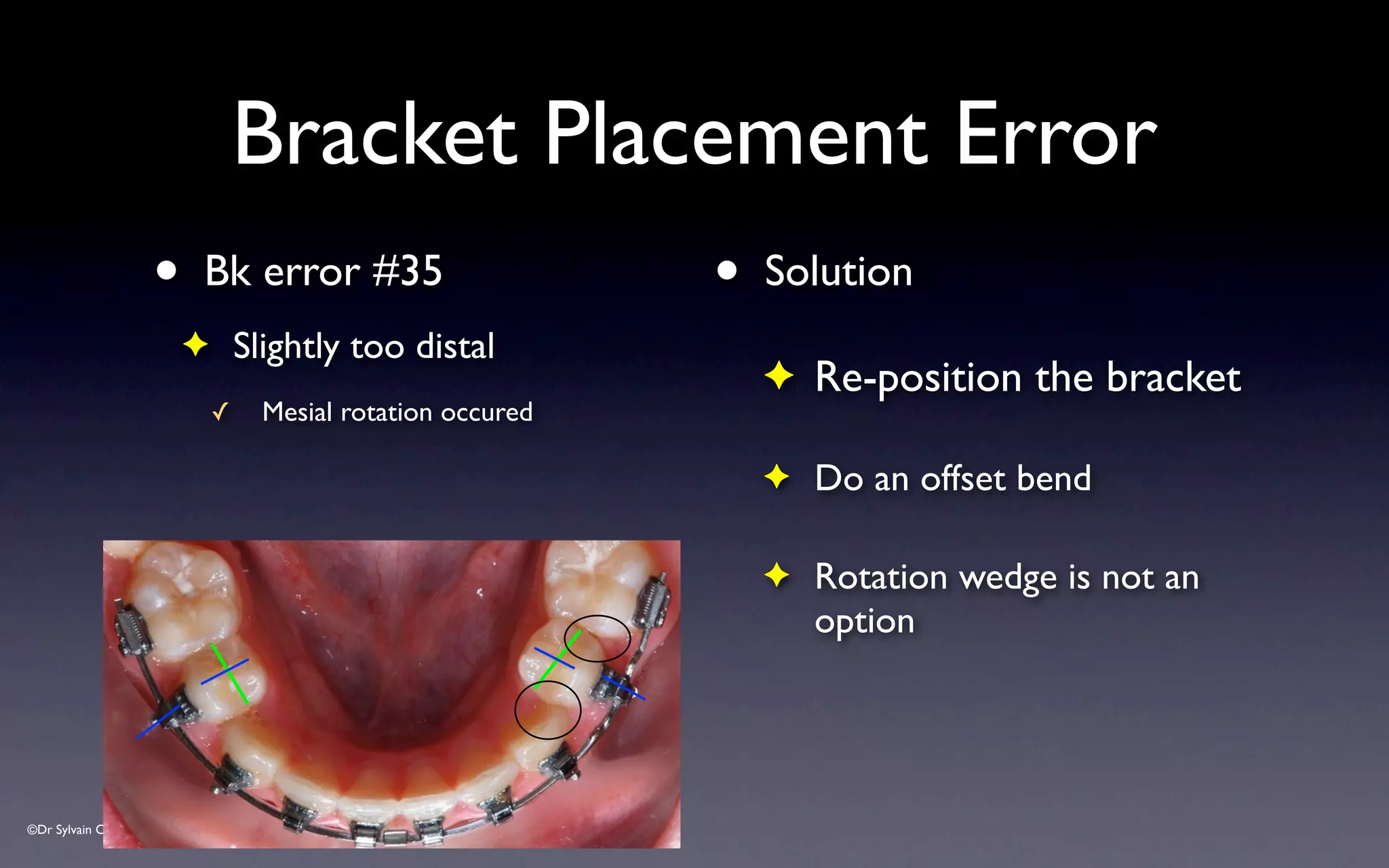
• Bk error #35
✦ Slightly too distal
✓ Mesial rotation occured
• Solution
✦ Re-position the bracket
✦ Do an offset bend
✦ Rotation wedge is not an
option
Bracket Placement Error
©Dr Sylvain Chamberland
Precise Bracket Position
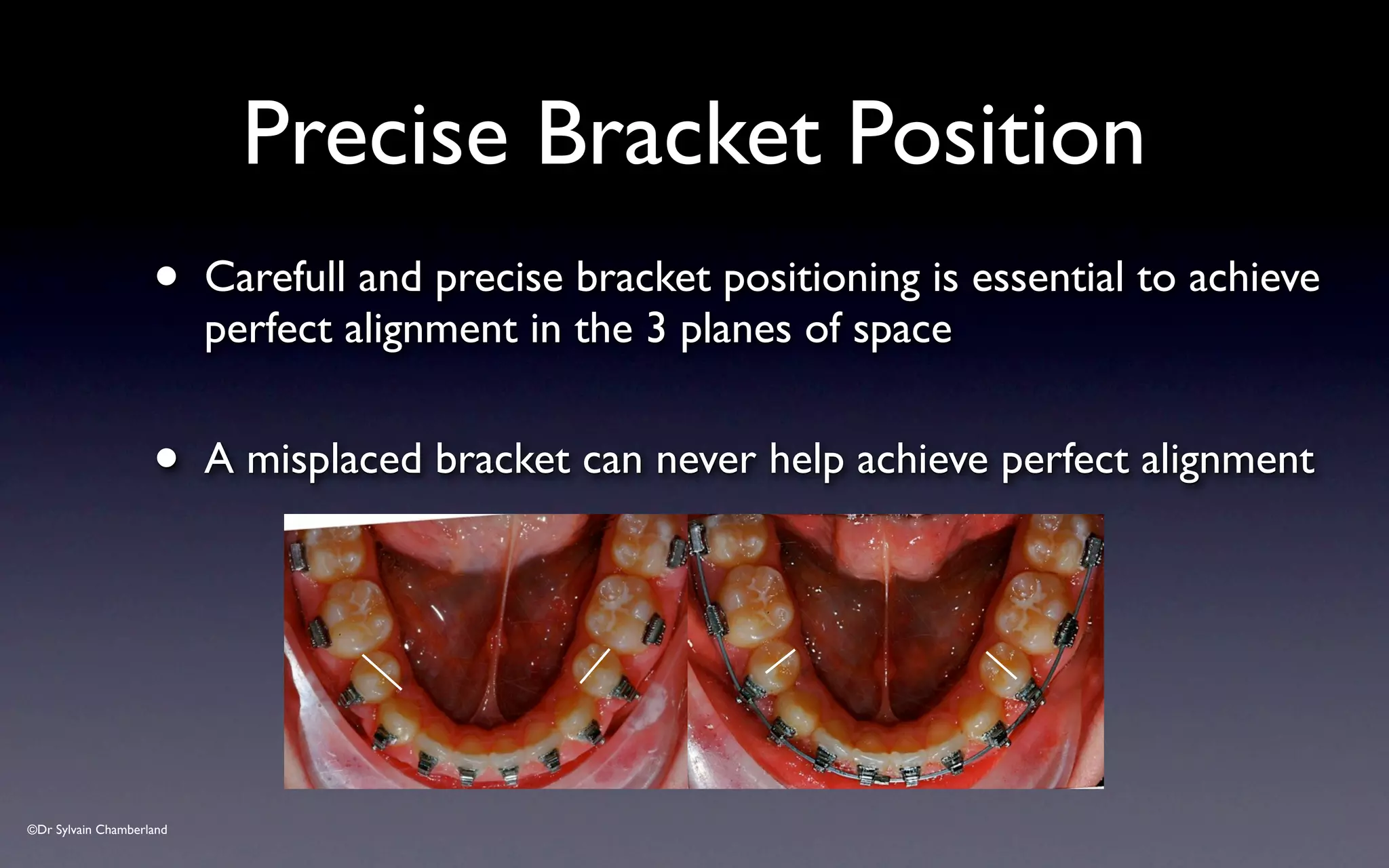
• Carefull and precise bracket positioning is essential to achieve
perfect alignment in the 3 planes of space
• A misplaced bracket can never help achieve perfect alignment

2-0bracketplacementguideforspeed2ndedition-110403201913-phpapp01.pdf

  • 1.
    SPEED Bracket Placement Guide 3rdedition 2012 ©Sylvain Chamberland http://www.slideshare.net/sylvainchamberland
  • 2.
  • 3.
    ©Dr Sylvain Chamberland •Rounded portion of the spring clip faces occlusally in both arches • Mesial and distal edges of the bonding pads ➜ parallel to the long axis of the middle lobe of each tooth. Bracket Placement Key Points
  • 4.
    ©Dr Sylvain Chamberland BracketPlacement Key Points SPEED Rhomboid • Narrow SE Spring clip • Horizontal Positioning ✦ Mesial and distal edges of the SPEED bonding base / spring clip / bracket body. • Vertical Positioning ✦ Archwire slot / occlusal edge of the bonding pad and the bracket body
  • 5.
    ©Dr Sylvain Chamberland BracketPlacement Key Points • Not necessary to angulate bracket slots into extraction sites or to use special extraction brackets. • Spring clip on the arch wire continuously maintains excellent root parallelism as spaces are closed. • Rounded portion of the spring clip faces occlusally
  • 6.
    ©Dr Sylvain Chamberland BondingSPEED Attachments • Incisor brackets ✦ Forcing excess adhesive to exude toward the gingival reduces the risk of clogging the spring clips on these brackets with miniaturized pads. • Posterior brackets ✦ Larger bonding pads = not a problem ✦ Excess adhesive may be forced toward the occlusal. ✦ Less residual flash removal at the gingival.
  • 7.
    ©Dr Sylvain Chamberland BondingSPEED Attachments • Care must be taken during bonding to avoid clogging the gingival end of the bracket / spring slot. • If some composite is inadvertently squeezed over the gingival edge of a bonding base and into a spring slot, immediately wipe it out with the tip of a sharp explorer.
  • 8.
    ©Dr Sylvain Chamberland BondingSet Up • Cheek retractor ✦ #0118-HA - Adult High Heat Sterilizable Cheek Retractor #0118-HC - Child Hight Heat Sterilizable Cheek Retractor #0118-NA Nola Dry Field Kit Adult #0118-NC Nola Dry Field Kit Child Ortho-Pli corp • Saliva ejector
  • 9.
    ©Dr Sylvain Chamberland BondingSet Up • Bracket placement trays ✦ 20-050-99 (GAC) ✦ 740-0076 (Ormco) • Graduated perio probe ✦ Hu-Friedy: XP23/OW6 • Self-locking pliers ✦ #0152 Cotton Plier, self locking (Ortho-Pli) • Boone gauge ✦ #BBG4 - Boone Bracket Positioning Gauge (Ortho-Pli)
  • 10.
    ©Dr Sylvain Chamberland BondingTechnique Key Points • Wipe into the bonding paste • Hold the bracket with self-locking plier
  • 11.
    ©Dr Sylvain Chamberland BondingTechnique Key Points • Place the bracket
  • 12.
    ©Dr Sylvain Chamberland BondingTechnique Key Points • Place the bracket
  • 13.
    ©Dr Sylvain Chamberland BondingTechnique Key Points • Place the bracket • Push to exude excess bonding paste and obtain close contact
  • 14.
    ©Dr Sylvain Chamberland BondingTechnique Key Points Measure height
  • 15.
    ©Dr Sylvain Chamberland BondingTechnique Key Points Measure height Assess long axis
  • 16.
    ©Dr Sylvain Chamberland BondingTechnique Key Points Measure height Assess long axis Remove flash Note: Position of the bracket on tooth #22 is not adequate. Instructing the photographer while positioning the bracket was distracting.The bracket was repositioned...off camera.
  • 17.
    ©Dr Sylvain Chamberland SPEEDSystem • Straight wire appliance ✦ Long axis (facial axis) of clinical crown ✦ Facial axis point: maximal buccal convexity
  • 18.
    ©Dr Sylvain Chamberland •Andrews’s plane ✦ Plane of the bracket’s slot
  • 19.
    ©Dr Sylvain Chamberland •Mandibular arch ✦ Average tip (2nd order) ✦ Average torque (3rd order) ✓ Molar crown = -30° ✓ Incisors = -1° ✦ Roth prescription
  • 20.
    ©Dr Sylvain Chamberland •Maxillary arch ✦ Average tip (2nd order) ✦ Average torque (3rd order) ✓ Incisors = 7° ✦ Roth prescription
  • 21.
  • 22.
  • 23.
    ©Dr Sylvain Chamberland •C • Maxillary incisors ✦ Locate the long axis from the lingual view
  • 24.
    ©Dr Sylvain Chamberland •Anteriors ✦ 4 to 4,5 mm from incisal edge ✦ May vary with shorter or longer crown Archwire plane selection
  • 25.
    ©Dr Sylvain Chamberland •Far enough gingivally to avoid occlusal contact ✦ 4 to 4,5 mm in most situation ✦ 5 mm or more may prevent leveling the curve of Spee Archwire plane selection
  • 26.
    ©Dr Sylvain Chamberland •Far enough gingivally to avoid occlusal contact ✦ 4 to 4,5 mm in most situation ✦ 5 mm or more may prevent leveling the curve of Spee Archwire plane selection • Maximum buccal convexity • 4,5 mm is better to avoid unwanted upper incisal contact
  • 27.
    ©Dr Sylvain Chamberland ✦Long axis located from the lingual view
  • 28.
    ©Dr Sylvain Chamberland •Long axis assessed by the lingual • MD placement: ✦ middle lobe prominence
  • 29.
  • 30.
    ©Dr Sylvain Chamberland •Placement of 2nd molar occlusally reduce the likelihood of extrusion
  • 31.
    ©Dr Sylvain Chamberland •Placement of 2nd molar occlusally reduce the likelihood of extrusion • Reflection lines on the labial aid to slot alignment
  • 32.
    ©Dr Sylvain Chamberland •Bracket body centred on the facial surface of the tooth • Rhomboid angulated design provides better visual references to match the long axis of the bracket with the long axis of the tooth • Long axis of the tooth bisect middle lobe and the centre of the talon Mx central incisors 4 to 4,5
  • 33.
    ©Dr Sylvain Chamberland Howto measure? • Boone Gauge ✦ From slot to incisal edge • Perio probe ✦ From bracket base to incisal edge 4 to 4,5
  • 34.
    ©Dr Sylvain Chamberland BracketPlacement Tips • Direct view may differ from mirror view • Assess long axis using both direct view and mirror view
  • 35.
    ©Dr Sylvain Chamberland MxLateral Incisors • ~ 0,5 mm shorter than the central • Bracket body centred on the facial surface of the tooth • Rhomboid design facilitates precise bracket placement
  • 36.
    ©Dr Sylvain Chamberland •Bracket slot ✦ Not necessarily parallel to incisal edge because of incisal wear Caution: Incisal Wear & Lateral Incisors
  • 37.
    ©Dr Sylvain Chamberland MxCanines • ~ 0,5 mm longer than the central incisor • Mesial and distal edges parallel to long axis • Compound contoured design of the bonding pad seat the bracket on the greatest contour of the middle lobe
  • 38.
  • 39.
    ©Dr Sylvain Chamberland Bracketlong axis = Parallel lingual long axis
  • 40.
    ©Dr Sylvain Chamberland Mx1st Premolars • At its maximal height of labial convexity • Mesial and distal edges parallel to long axis • Centre with the middle lobe 5
  • 41.
    ©Dr Sylvain Chamberland Mx2nd Premolars • At its maximal height of labial convexity • Mesial and distal edges parallel to long axis • Occlusal edge of the bonding pad parallel to the ridge line • Centre with the middle lobe
  • 42.
    ©Dr Sylvain Chamberland Mx2nd Premolars • Larger mesh pad • Occlusal offset • Easier placement for partially erupted tooth • Difficult to align mesh pad with Pm1 and M1
  • 43.
    ©Dr Sylvain Chamberland Mx1st & 2nd Molars • At 3 to 3,5 mm or at its maximal convexity • Bk positioned with MB cusp tip • Occlusal edge parallel to the ridge line if cusp tips are not worn • Distal cusp longer than mesial cusp • Middle groove aid to locate the long axis
  • 44.
    ©Dr Sylvain Chamberland •Marginal ridges aid to assess bracket position and height • The mirror occlusal view show the bracket centred with middle lobe or mesiobuccal cusp tip • Mx 2nd molar is oriented distally when emerging Marginal Ridges
  • 45.
    ©Dr Sylvain Chamberland MarginalRidges Same remarks as the previous slide
  • 46.
    ©Dr Sylvain Chamberland MdCentral & Lateral Incisors Rhomboid • 4,5 mm is recommended if one wants to avoid unwanted upper incisal contact • Central & Lateral:At 4,5 from incisal edges • Central & Lateral: Centred with the middle lobe M-D • Long axis located from the lingual
  • 47.
    ©Dr Sylvain Chamberland LowerAnteriors • View from operator chair ✦ Long axis assess from lingual ✦ Note minimal paste thickness between bracket base and tooth surface ✦ Bracket centred with the middle lobe
  • 48.
    ©Dr Sylvain Chamberland LowerCanines & Lateral Incisors • View for operator chair ✦ Canine bracket centred with cusp tip ✦ Lateral centred with middle lobe
  • 49.
    ©Dr Sylvain Chamberland MdCanine Rhomboid • Slot at 4,5 to 5 mm from cusp tip • Centre on the middle lobe • Long axis located from the lingual
  • 50.
  • 51.
    ©Dr Sylvain Chamberland Md1st Premolars • At its maximal height of convexity • Centred with cusp tip
  • 52.
    ©Dr Sylvain Chamberland Md2nd Premolars • At its maximal height of convexity • Centred with cusp tip • Longer mesh pad occlusal may cause placement too gingival • Concentrate on the bracket slot and the height of convexity
  • 53.
    ©Dr Sylvain Chamberland Assessmentof Pracket Position • After direct bonding ✦ Reassessment of bracket position to pick any discrepancy ✦ Note parallelism with marginal ridges
  • 54.
    ©Dr Sylvain Chamberland Assessmentof Bracket Position • After direct bonding ✦ Same remarks as previous slide ✦ Mirror viewed are use to do these assessments
  • 55.
    ©Dr Sylvain Chamberland Md1st Molars • At its maximal height of convexity • Indent on the bonding pad centred opposite buccal groove • Indent is off centre mesiodistaly • Slot parallel to marginal ridges
  • 56.
    ©Dr Sylvain Chamberland Md1st Molars • SPEED Convertible Tube ✦ Align indent with buccal groove ✦ Parallel to occlusal Clip closed Clip open
  • 57.
    ©Dr Sylvain Chamberland Md1st Molars Double tube • Double Tube may lead to a too occlusal placement • If one place a Single Tube the same manner (too occlusal), antogonist occlusion may cause indent into the tube
  • 58.
    ©Dr Sylvain Chamberland Md1st Molars Double tube • Wire engaged in the auxiliary tube by error • Extrusion occurred • Single tube rebounded at maximal convexity: wire is straight
  • 59.
    ©Dr Sylvain Chamberland •Press brackets firmly • Centre the bracket on the middle lobe ✦ MD slot axis tangent to MD lobe curvature • Molar bk are placed on the MB cusp Large base U6 ERX For 2nd premolar extraction case
  • 60.
    ©Dr Sylvain Chamberland •Press brackets firmly • Centre the bracket on the middle lobe ✦ MD slot axis tangent to MD lobe curvature • Molar bk are placed on the MB cusp Large base U6 ERX For 2nd premolar extraction case
  • 61.
    ©Dr Sylvain ChamberlandAn.No. 12-08 • ERX bk will rotate 1st molar mesially • Placement on MB cusp help achieve molar derotation • ER bk rotate 1st molar distally
  • 62.
    ©Dr Sylvain ChamberlandAn.No. 12-08 • ERX bk will rotate 1st molar mesially • Placement on MB cusp help achieve molar derotation • ER bk rotate 1st molar distally
  • 63.
  • 64.
  • 65.
    ©Dr Sylvain Chamberland •Derotation of the 1st molar helped: ✦ To gain arch length ✦ To achieve class I relationship Cl.Tu.0507 Cl.Tu.0209 At least 10° offset
  • 66.
    ©Dr Sylvain Chamberland •Use Bk ERX To Maintain Molar Rotation
  • 67.
    ©Dr Sylvain Chamberland •Place regular bk at the middle grove To Maintain Molar Rotation
  • 68.
  • 69.
    ©Dr Sylvain Chamberland •Reflection lines on the labial aid to slot alignment
  • 70.
    ©Dr Sylvain Chamberland •Reflection lines on the labial aid to slot alignment • Speed mini-tubes for 2nd molar
  • 71.
    ©Dr Sylvain Chamberland •Molar tube ✦ Indent off-centre to the distal
  • 72.
    ©Dr Sylvain Chamberland Reassessmentof Bracket Positions • A non ideal bracket placement due to initial crowding should be corrected after alignment • Rotation wedge is of no help and cumbersome Off centred Re-centred
  • 73.
    ©Dr Sylvain Chamberland BracketPlacement Error • Note Bk #23 too distal ✦ Mesial rotation not corrected • Bk #13 centred with cusp tip ✦ Rotation is corrected
  • 74.
    ©Dr Sylvain Chamberland •Rebond #23 ✦ Note derotation Bracket Placement Error
  • 75.
    ©Dr Sylvain Chamberland BracketPlacement Error • Bracket inclined too distally ✦ Need to be rebonded
  • 76.
    ©Dr Sylvain Chamberland BracketPlacement Error • Upper left canine ✦ Bk long axis incline to distally ✦ Bk not at maximal convexity • Bracket was rebonded
  • 77.
    ©Dr Sylvain Chamberland BracketPlacement Error • Upper left canine ✦ Bk long axis incline to distally ✦ Bk not at maximal convexity • Bracket was rebonded
  • 78.
    ©Dr Sylvain Chamberland •Bk on the 2nd molar should be placed slightly more occlusally ✦ To avoid unwanted extrusion during treatment Bracket Placement Tips
  • 79.
    ©Dr Sylvain Chamberland •Note composite on #42 to avoid occlusal contact • Clinical view reproduce model set up Bracket Placement Tips
  • 80.
    ©Dr Sylvain Chamberland •Self-uprighting of 43 is anticipated after extraction of lower right premolar • Labial tipping of 42 is expected Bracket Placement Tips
  • 81.
    ©Dr Sylvain Chamberland •Clinical view reproduce model set up Bracket Placement Tips
  • 82.
    ©Dr Sylvain Chamberland BracketPlacement Error El.Jo.100309 Adhesive thickness distally under the mesh pad create distal rotation and uneven contact point with the canine
  • 83.
    ©Dr Sylvain Chamberland BracketPlacement Error El.Jo.100309 Adhesive thickness distally under the mesh pad create distal rotation and uneven contact point with the canine Bracket on the lower right central is bonded too mesially and create a distal rotation and uneven contact point with the lateral
  • 84.
    ©Dr Sylvain Chamberland BracketPlacement Error El.Jo.100309 Adhesive thickness distally under the mesh pad create distal rotation and uneven contact point with the canine Bracket on the lower right central is bonded too mesially and create a distal rotation and uneven contact point with the lateral El.Jo.240409 Rebonded bracket help to achieve better alignment of the contact points
  • 85.
    ©Dr Sylvain Chamberland BracketPlacement Error El.Jo.100309 Adhesive thickness distally under the mesh pad create distal rotation and uneven contact point with the canine Bracket on the lower right central is bonded too mesially and create a distal rotation and uneven contact point with the lateral El.Jo.240409 Rebonded bracket help to achieve better alignment of the contact points El.Jo.130709 3rd order (torque) is needed to improved aligment of the incisal edges and the talon
  • 86.
    ©Dr Sylvain Chamberland BracketPlacement Error • 2nd order error ✦ The bracket is inclined distal to the long axis of the lateral ✦ Rebonded to the long axis Mi.Pi 270809
  • 87.
    ©Dr Sylvain Chamberland BracketPlacement Error • 2nd order error ✦ The bracket is inclined distal to the long axis of the lateral ✦ Rebonded to the long axis Mi.Pi 270809
  • 88.
    ©Dr Sylvain Chamberland BracketPlacement Error • 2nd order error ✦ The bracket is inclined distal to the long axis of the lateral ✦ Rebonded to the long axis Mi.Pi 270809
  • 89.
    ©Dr Sylvain Chamberland BracketPlacement Error • 2nd order error ✦ The bracket is inclined distal to the long axis of the lateral ✦ Rebonded to the long axis Mi.Pi 270809
  • 90.
    ©Dr Sylvain Chamberland •Bk error #35 ✦ Slightly too distal ✓ Mesial rotation occured • Solution ✦ Re-position the bracket ✦ Do an offset bend ✦ Rotation wedge is not an option Bracket Placement Error
  • 91.
    ©Dr Sylvain Chamberland PreciseBracket Position • Carefull and precise bracket positioning is essential to achieve perfect alignment in the 3 planes of space • A misplaced bracket can never help achieve perfect alignment