15-1
Lecture PowerPoint
Chemistry
The Molecular Nature of
Matter and Change
Seventh Edition
Martin S. Silberberg and
Patricia G. Amateis
Copyright  McGraw-Hill Education. All rights reserved. No reproduction or distribution without the prior written consent of McGraw-Hill Education.
15-2
Chapter 15
Organic Compounds and the
Atomic Properties of Carbon
15-3
Organic Compounds and the Atomic Properties of Carbon
15.1 The Special Nature of Carbon and the Characteristics of
Organic Molecules
15.2 The Structures and Classes of Hydrocarbons
15.3 Some Important Classes of Organic Reactions
15.4 Properties and Reactivities of Common Functional Groups
15-4
Bonding Properties of Carbon
• Carbon forms covalent bonds in all its elemental forms
and compounds.
– The ground state electron configuration of C is [He] 2s2
2p2
; the
formation of carbon ions is therefore energetically unfavorable.
– C has an electronegativity of 2.5, which is midway between that of
most metals and nonmetals. C prefers to share electrons.
• Carbon exhibits catenation, the ability to bond to itself
and form stable chain, ring, and branched compounds.
– The small size of the C atom allows it to form short, strong bonds.
– The short C-C bond allows the ready formation of  bonds,
increasing the variety of compounds that can be formed.
15-5
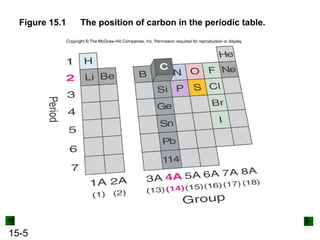
Figure 15.1 The position of carbon in the periodic table.
15-6
Comparison of Carbon and Silicon
• As atomic size increases down the group, bonds
between identical atoms become longer and weaker.
– A C–C bond is much stronger than a Si–Si bond.
• The bond energies of a C–C bond, a C–O bond, and a
C–Cl bond are very similar.
– C compounds can undergo a variety of reactions and remain
stable, while Si compounds cannot.
• Si has low energy d orbitals available for reaction,
allowing Si compounds to be more reactive than C
compounds.
15-7
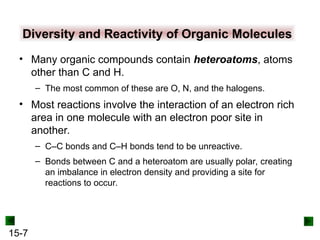
Diversity and Reactivity of Organic Molecules
• Many organic compounds contain heteroatoms, atoms
other than C and H.
– The most common of these are O, N, and the halogens.
• Most reactions involve the interaction of an electron rich
area in one molecule with an electron poor site in
another.
– C–C bonds and C–H bonds tend to be unreactive.
– Bonds between C and a heteroatom are usually polar, creating
an imbalance in electron density and providing a site for
reactions to occur.
15-8
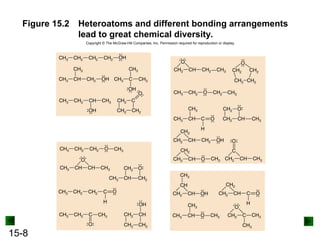
Figure 15.2 Heteroatoms and different bonding arrangements
lead to great chemical diversity.
Copyright © The McGraw-Hill Companies, Inc. Permission required for reproduction or display.
15-9
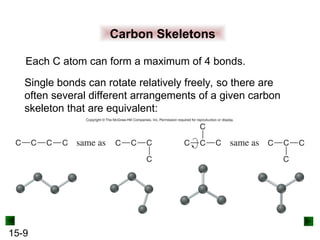
Carbon Skeletons
Each C atom can form a maximum of 4 bonds.
Single bonds can rotate relatively freely, so there are
often several different arrangements of a given carbon
skeleton that are equivalent:
15-10
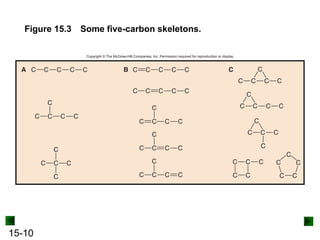
Figure 15.3 Some five-carbon skeletons.
15-11
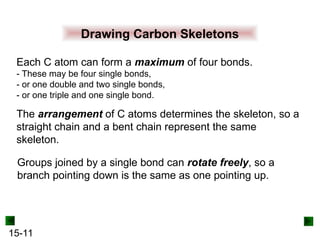
Drawing Carbon Skeletons
Each C atom can form a maximum of four bonds.
- These may be four single bonds,
- or one double and two single bonds,
- or one triple and one single bond.
The arrangement of C atoms determines the skeleton, so a
straight chain and a bent chain represent the same
skeleton.
Groups joined by a single bond can rotate freely, so a
branch pointing down is the same as one pointing up.
15-12
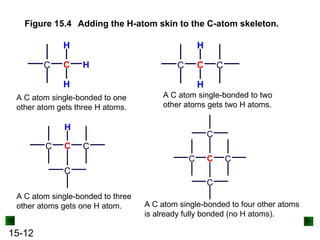
Figure 15.4 Adding the H-atom skin to the C-atom skeleton.
A C atom single-bonded to one
other atom gets three H atoms.
C C
H
H
H
A C atom single-bonded to two
other atoms gets two H atoms.
C C
H
C
H
A C atom single-bonded to three
other atoms gets one H atom.
C C
H
C
C
A C atom single-bonded to four other atoms
is already fully bonded (no H atoms).
C C C
C
C
15-13
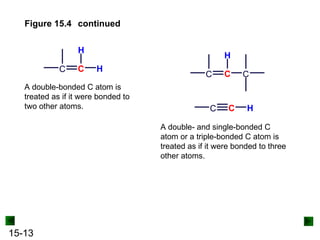
Figure 15.4 continued
A double-bonded C atom is
treated as if it were bonded to
two other atoms.
C C H
H
A double- and single-bonded C
atom or a triple-bonded C atom is
treated as if it were bonded to three
other atoms.
C C
H
C
C C H
15-14
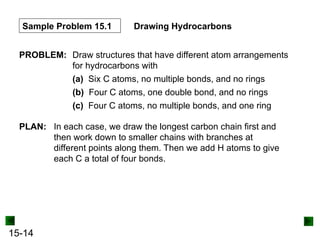
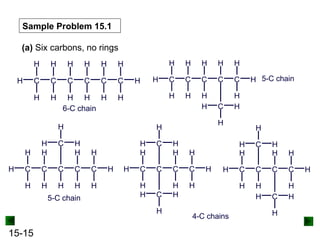
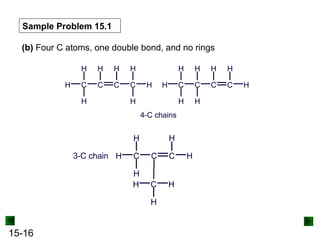
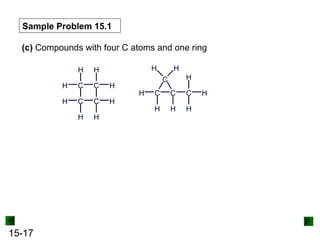
Sample Problem 15.1 Drawing Hydrocarbons
PLAN: In each case, we draw the longest carbon chain first and
then work down to smaller chains with branches at
different points along them. Then we add H atoms to give
each C a total of four bonds.
PROBLEM: Draw structures that have different atom arrangements
for hydrocarbons with
(a) Six C atoms, no multiple bonds, and no rings
(b) Four C atoms, one double bond, and no rings
(c) Four C atoms, no multiple bonds, and one ring
15-15
Sample Problem 15.1
(a) Six carbons, no rings
H C C C C C C
H
H
H
H
H
H
H
H
H
H
H
H
H
6-C chain
H C C C C C H
H
H
H
C
H
H
H
H
H H
H
H
H
5-C chain
H C C C C H
H
H
H
C
C
H
H H
H
H
H
H H
H
C C C C H
H
H
H
C
C
H
H H
H
H
H
H
H H
H
4-C chains
H C C C C C H
H
H
H
C
H
H
H
H
H
H
H H
H
5-C chain
15-16
Sample Problem 15.1
(b) Four C atoms, one double bond, and no rings
H C
H
H
C C
H
H
C
H H
H
3-C chain
H C C C C
H
H
H H H
H
H
C C
H
H
H
H
H
C C H
H
H
4-C chains
15-17
Sample Problem 15.1
(c) Compounds with four C atoms and one ring
C C
C
C
H
H
H
H
H
H
H
H
C C
C
H H
C
H
H
H
H
H
H
15-18
Alkanes
Hydrocarbons contain only C and H.
Alkanes are hydrocarbons that contain only single bonds
and are referred to as saturated hydrocarbons.
The general formula for an alkane is CnH2n+2, where n is
any positive integer.
Alkanes comprise a homologous series, a group of
compounds in which each member differs from the next by
a –CH2– group.
15-19
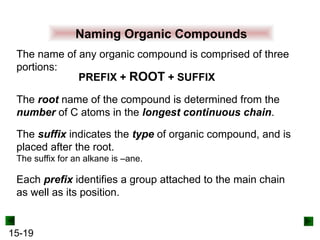
Naming Organic Compounds
The root name of the compound is determined from the
number of C atoms in the longest continuous chain.
The name of any organic compound is comprised of three
portions:
PREFIX + ROOT + SUFFIX
Each prefix identifies a group attached to the main chain
as well as its position.
The suffix indicates the type of organic compound, and is
placed after the root.
The suffix for an alkane is –ane.
15-20
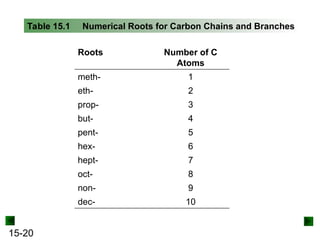
Table 15.1 Numerical Roots for Carbon Chains and Branches
Roots Number of C
Atoms
meth- 1
eth- 2
prop- 3
but- 4
pent- 5
hex- 6
hept- 7
oct- 8
non- 9
dec- 10
15-21
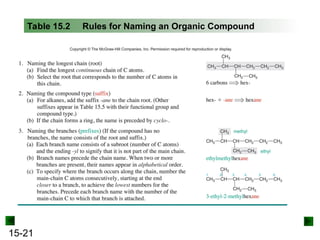
Table 15.2 Rules for Naming an Organic Compound
15-22
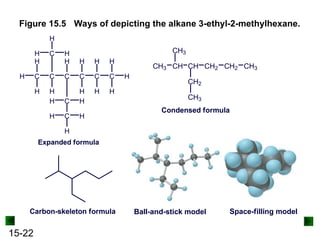
Figure 15.5 Ways of depicting the alkane 3-ethyl-2-methylhexane.
C C C C C
H
H
H
C
C
H
H H
C
H
H
H
H H
H
H H
H
C
H
H
H
H
H
Expanded formula
CH3 CH
CH3
CH
CH2
CH3
CH2 CH2 CH3
Condensed formula
Carbon-skeleton formula Ball-and-stick model Space-filling model
15-23
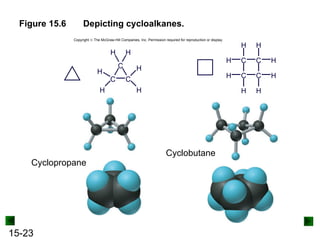
Figure 15.6 Depicting cycloalkanes.
Cyclopropane
C
C C
H H
H
H
H
H
Cyclobutane
C
C C
C
H
H H
H
H
H
H
H
Copyright  The McGraw-Hill Companies, Inc. Permission required for reproduction or display.
15-24
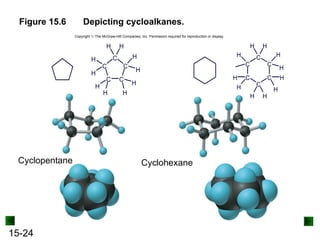
Cyclopentane
C
C C
C
C
H H
H
H
H
H
H
H
H
H
Cyclohexane
C
C
C
C
C
C
H H
H H
H
H
H
H
H
H
H
Figure 15.6 Depicting cycloalkanes.
Copyright  The McGraw-Hill Companies, Inc. Permission required for reproduction or display.
15-25
Constitutional Isomers
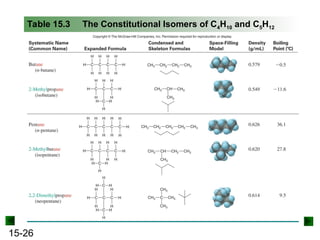
Constitutional or structural isomers have the same
molecular formula but a different arrangement of the
bonded atoms.
A straight-chain alkane may have many branched
structural isomers.
Structural isomers are different compounds and have
different properties.
If the isomers contain the same functional groups, their properties
will still be similar.
15-26
Table 15.3 The Constitutional Isomers of C4H10 and C5H12
15-27
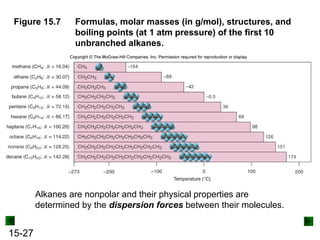
Figure 15.7 Formulas, molar masses (in g/mol), structures, and
boiling points (at 1 atm pressure) of the first 10
unbranched alkanes.
Alkanes are nonpolar and their physical properties are
determined by the dispersion forces between their molecules.
15-28
Chiral Molecules
Stereoisomers are molecules with the same arrangement
of atoms but different orientations of groups in space.
Optical isomers are mirror images of each other that
cannot be superimposed.
A molecule must be asymmetric in order to exist as a pair
of optical isomers. An asymmetric molecule is termed
chiral.
Typically, a carbon atom is a chiral center if it is bonded to four different
groups.
15-29
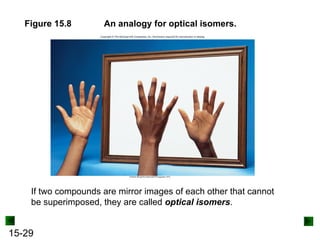
Figure 15.8 An analogy for optical isomers.
If two compounds are mirror images of each other that cannot
be superimposed, they are called optical isomers.
15-30
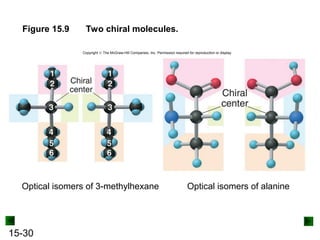
Figure 15.9 Two chiral molecules.
Optical isomers of 3-methylhexane Optical isomers of alanine
Copyright  The McGraw-Hill Companies, Inc. Permission required for reproduction or display.
15-31
Optical Activity
Optical isomers have identical physical properties, except
that they rotate the plane of polarized light in opposite
directions.
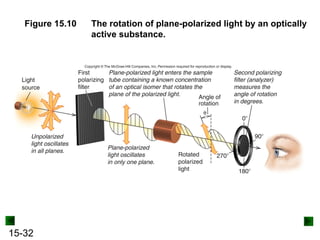
A chiral compound is optically active; i.e., it rotates the
plane of polarized light.
A compound that rotates the plane of light clockwise is
called dextrorotatory, while a compound that rotates the
plane of light counterclockwise is called levorotatory.
In their chemical properties, optical isomers differ only in
a chiral (asymmetric) environment.
15-32
Figure 15.10 The rotation of plane-polarized light by an optically
active substance.
15-33
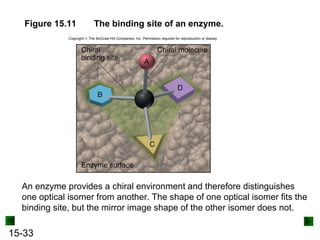
Figure 15.11 The binding site of an enzyme.
An enzyme provides a chiral environment and therefore distinguishes
one optical isomer from another. The shape of one optical isomer fits the
binding site, but the mirror image shape of the other isomer does not.
Copyright  The McGraw-Hill Companies, Inc. Permission required for reproduction or display.
15-34
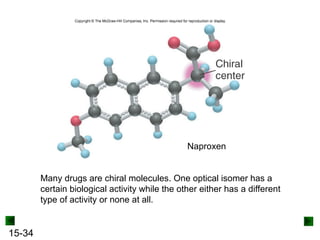
Naproxen
Many drugs are chiral molecules. One optical isomer has a
certain biological activity while the other either has a different
type of activity or none at all.
15-35
Alkenes
A hydrocarbon that contains at least one C=C bond is
called an alkene.
Alkenes are unsaturated and have the general formula
CnH2n.
To name an alkene, the root name is determined by the
number of C atoms in the longest chain that also
contains the double bond.
The C chain is numbered from the end closest to the double bond.
The suffix for alkenes is –ene.
15-36
Geometric Isomers
The double bond of an alkene restricts rotation, so that
the relative positions of the atoms attached to the double
bond are fixed.
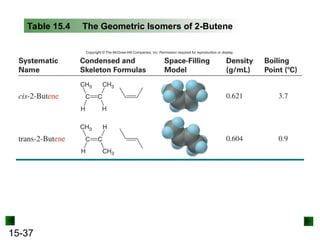
Alkenes may exist as geometric or cis-trans isomers,
which differ in the orientation of the groups attached to
the double bond.
Geometric isomers have different physical properties.
15-37
Table 15.4 The Geometric Isomers of 2-Butene
15-38
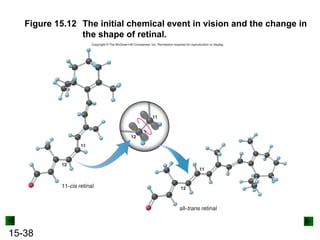
Figure 15.12 The initial chemical event in vision and the change in
the shape of retinal.
15-39
Alkynes
An alkyne is a hydrocarbon that contains at least one
CΞC triple bond.
Alkynes have the general formula CnH2n-2 and they are
also considered unsaturated carbons.
Alkynes are named in the same way as alkenes, using
the suffix –yne.
15-40
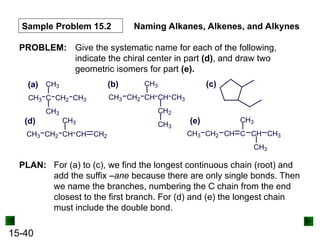
Sample Problem 15.2 Naming Alkanes, Alkenes, and Alkynes
PROBLEM: Give the systematic name for each of the following,
indicate the chiral center in part (d), and draw two
geometric isomers for part (e).
CH3 C
CH3
CH3
CH2 CH3
(a) (b)
CH3 CH2 CH
CH3
CH
CH2
CH3
CH3
(c)
(d)
CH3 CH2 CH
CH3
CH CH2
(e)
CH3 CH2 CH C
CH3
CH CH3
CH3
PLAN: For (a) to (c), we find the longest continuous chain (root) and
add the suffix –ane because there are only single bonds. Then
we name the branches, numbering the C chain from the end
closest to the first branch. For (d) and (e) the longest chain
must include the double bond.
15-41
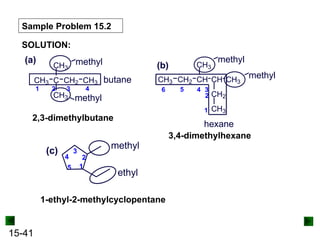
Sample Problem 15.2
SOLUTION:
2,3-dimethylbutane
(b)
CH3 CH2 CH
CH3
CH
CH2
CH3
CH3
methyl
1
2
3
4
5
6
hexane
methyl
3,4-dimethylhexane
methyl
1
2
3
4
5
(c)
ethyl
1-ethyl-2-methylcyclopentane
CH3 C
CH3
CH3
CH2 CH3
(a)
butane
methyl
methyl
1 2 3 4
15-42
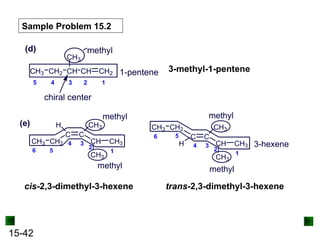
Sample Problem 15.2
3-methyl-1-pentene
(d)
CH3 CH2 CH
CH3
CH CH2
methyl
1
2
3
4
5
chiral center
1-pentene
(e)
1
2
3
4
5
6
C C
CH3
CH
H
CH2
CH3
CH3
CH3
1
2
3
4
5
6 C C
CH3
CH
CH2
H
CH3
CH3
CH3
methyl
methyl
methyl
methyl
3-hexene
cis-2,3-dimethyl-3-hexene trans-2,3-dimethyl-3-hexene
15-43
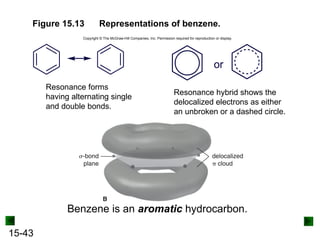
Figure 15.13 Representations of benzene.
Resonance forms
having alternating single
and double bonds.
or
Resonance hybrid shows the
delocalized electrons as either
an unbroken or a dashed circle.
Benzene is an aromatic hydrocarbon.
Copyright © The McGraw-Hill Companies, Inc. Permission required for reproduction or display.
15-44
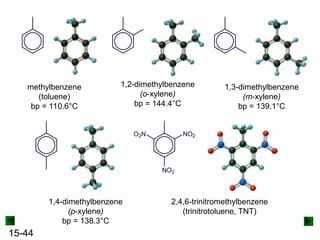
methylbenzene
(toluene)
bp = 110.6°C
1,2-dimethylbenzene
(o-xylene)
bp = 144.4°C
1,3-dimethylbenzene
(m-xylene)
bp = 139.1°C
1,4-dimethylbenzene
(p-xylene)
bp = 138.3°C
O2N NO2
NO2
2,4,6-trinitromethylbenzene
(trinitrotoluene, TNT)
15-45
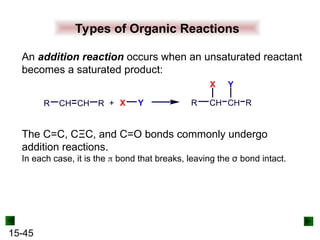
Types of Organic Reactions
An addition reaction occurs when an unsaturated reactant
becomes a saturated product:
R CH CH R + X Y R CH CH R
X Y
The C=C, CΞC, and C=O bonds commonly undergo
addition reactions.
In each case, it is the  bond that breaks, leaving the σ bond intact.
15-46
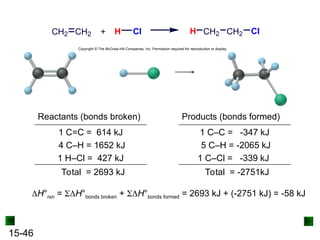
CH2 CH2 + H Cl H CH2 CH2 Cl
Reactants (bonds broken)
1 C=C = 614 kJ
4 C–H = 1652 kJ
1 H–Cl = 427 kJ
Total = 2693 kJ
Products (bonds formed)
1 C–C = -347 kJ
5 C–H = -2065 kJ
1 C–Cl = -339 kJ
Total = -2751kJ
H°rxn = H°bonds broken + H°bonds formed = 2693 kJ + (-2751 kJ) = -58 kJ
Copyright © The McGraw-Hill Companies, Inc. Permission required for reproduction or display.
15-47
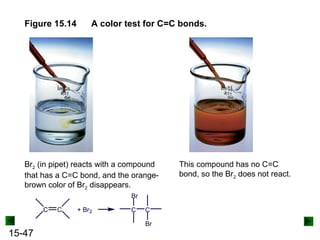
Figure 15.14 A color test for C=C bonds.
This compound has no C=C
bond, so the Br2 does not react.
C C + Br2 C C
Br
Br
Br2 (in pipet) reacts with a compound
that has a C=C bond, and the orange-
brown color of Br2 disappears.
15-48
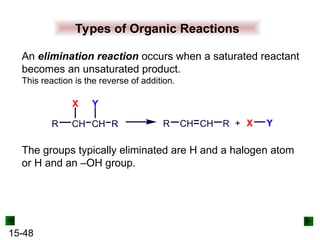
Types of Organic Reactions
An elimination reaction occurs when a saturated reactant
becomes an unsaturated product.
This reaction is the reverse of addition.
The groups typically eliminated are H and a halogen atom
or H and an –OH group.
R CH CH R + X Y
R CH CH R
X Y
15-49
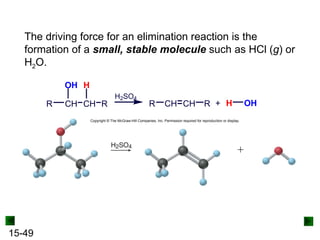
The driving force for an elimination reaction is the
formation of a small, stable molecule such as HCl (g) or
H2O.
R CH CH R + H OH
R CH CH R
OH H
H2SO4
Copyright © The McGraw-Hill Companies, Inc. Permission required for reproduction or display.
15-50
Types of Organic Reactions
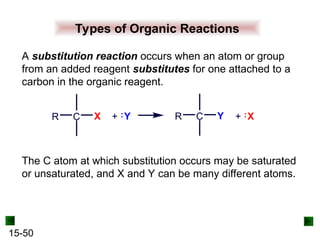
A substitution reaction occurs when an atom or group
from an added reagent substitutes for one attached to a
carbon in the organic reagent.
The C atom at which substitution occurs may be saturated
or unsaturated, and X and Y can be many different atoms.
R C X + Y R C Y + X
15-51
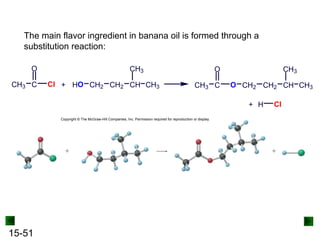
CH3 C
O
Cl + HO CH2 CH2 CH
CH3
CH3 CH3 C
O
O CH2 CH2 CH
CH3
CH3
+ H Cl
The main flavor ingredient in banana oil is formed through a
substitution reaction:
Copyright © The McGraw-Hill Companies, Inc. Permission required for reproduction or display.
15-52
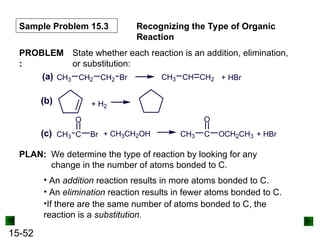
Sample Problem 15.3 Recognizing the Type of Organic
Reaction
PLAN: We determine the type of reaction by looking for any
change in the number of atoms bonded to C.
• An addition reaction results in more atoms bonded to C.
• An elimination reaction results in fewer atoms bonded to C.
•If there are the same number of atoms bonded to C, the
reaction is a substitution.
PROBLEM
:
State whether each reaction is an addition, elimination,
or substitution:
CH3 CH2 CH2 Br CH3 CH CH2 + HBr
(a)
(c) CH3 C
O
Br + CH3CH2OH CH3 C
O
OCH2CH3 + HBr
(b) + H2
15-53
Sample Problem 15.3
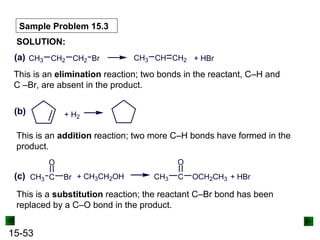
SOLUTION:
CH3 CH2 CH2 Br CH3 CH CH2 + HBr
(a)
This is an elimination reaction; two bonds in the reactant, C–H and
C –Br, are absent in the product.
(b) + H2
This is an addition reaction; two more C–H bonds have formed in the
product.
(c) CH3 C
O
Br + CH3CH2OH CH3 C
O
OCH2CH3 + HBr
This is a substitution reaction; the reactant C–Br bond has been
replaced by a C–O bond in the product.
15-54
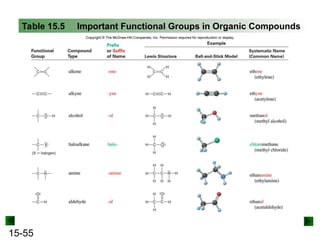
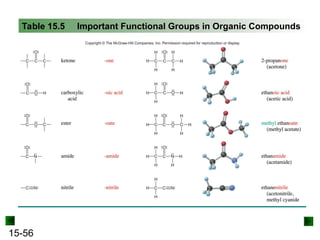
Functional Groups
Organic compounds are classified according to their
functional groups, a group of atoms bonded in a
particular way.
The functional groups in a compound determine both its
physical properties and its chemical reactivity.
Functional groups affect the polarity of a compound, and therefore
determine the intermolecular forces it exhibits.
Functional groups define the regions of high and low electron density in
a compound, thus determining its reactivity.
15-55
Table 15.5 Important Functional Groups in Organic Compounds
15-56
Table 15.5 Important Functional Groups in Organic Compounds
15-57
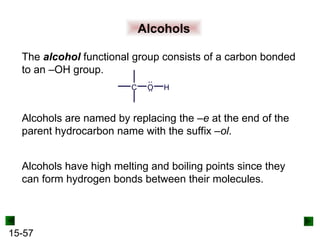
Alcohols
The alcohol functional group consists of a carbon bonded
to an –OH group.
C O H
Alcohols are named by replacing the –e at the end of the
parent hydrocarbon name with the suffix –ol.
Alcohols have high melting and boiling points since they
can form hydrogen bonds between their molecules.
15-58
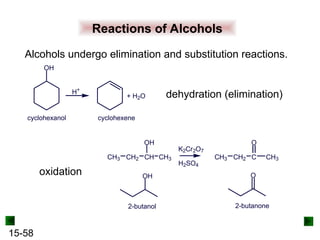
Reactions of Alcohols
Alcohols undergo elimination and substitution reactions.
OH
H+
cyclohexanol cyclohexene
+ H2O dehydration (elimination)
CH3 CH2 CH
OH
CH3
K2Cr2O7
H2SO4
CH3 CH2 C
O
CH3
OH O
2-butanol 2-butanone
oxidation
15-59
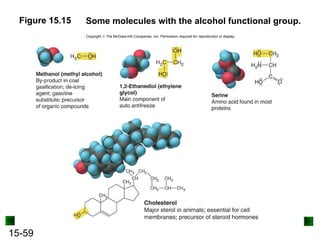
Figure 15.15 Some molecules with the alcohol functional group.
Copyright  The McGraw-Hill Companies, Inc. Permission required for reproduction or display.
15-60
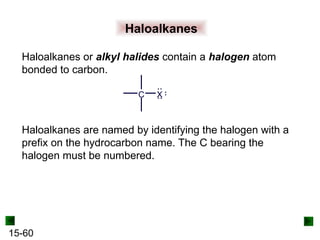
Haloalkanes
Haloalkanes or alkyl halides contain a halogen atom
bonded to carbon.
Haloalkanes are named by identifying the halogen with a
prefix on the hydrocarbon name. The C bearing the
halogen must be numbered.
C X
15-61
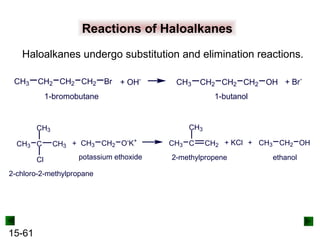
Reactions of Haloalkanes
Haloalkanes undergo substitution and elimination reactions.
CH3 CH2 CH2 CH2 Br + OH-
CH3 CH2 CH2 CH2 OH + Br-
1-bromobutane 1-butanol
CH3 C
CH3
Cl
CH3 CH3 CH2 O-
K+
+ CH3 C
CH3
CH2 + KCl + CH3 CH2 OH
2-chloro-2-methylpropane
potassium ethoxide 2-methylpropene ethanol
15-62
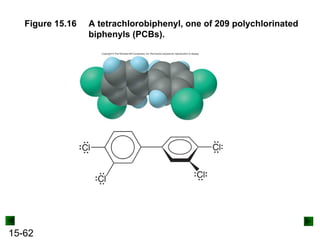
Figure 15.16 A tetrachlorobiphenyl, one of 209 polychlorinated
biphenyls (PCBs).
15-63
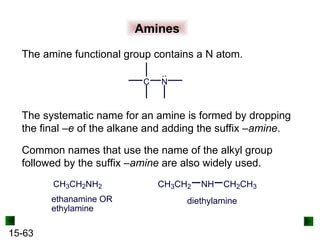
Amines
The amine functional group contains a N atom.
The systematic name for an amine is formed by dropping
the final –e of the alkane and adding the suffix –amine.
C N
Common names that use the name of the alkyl group
followed by the suffix –amine are also widely used.
CH3CH2NH2
ethanamine OR
ethylamine
CH3CH2 NH CH2CH3
diethylamine
15-64
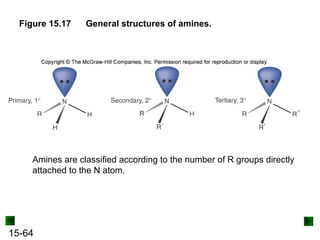
Figure 15.17 General structures of amines.
Amines are classified according to the number of R groups directly
attached to the N atom.
15-65
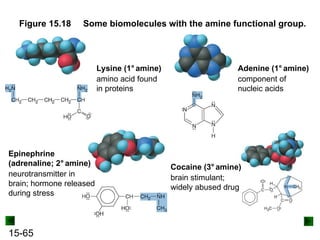
Figure 15.18 Some biomolecules with the amine functional group.
Lysine (1° amine)
amino acid found
in proteins
Adenine (1° amine)
component of
nucleic acids
Epinephrine
(adrenaline; 2° amine)
neurotransmitter in
brain; hormone released
during stress
Cocaine (3° amine)
brain stimulant;
widely abused drug
15-66
Properties and Reactions of Amines
Primary and secondary amines can form H bonds; they
therefore have higher melting and boiling points than
hydrocarbons or alkyl halides of similar mass.
Amines of low molar mass are fishy smelling, water
soluble, and weakly basic.
Tertiary amines cannot form H bonds between their
molecules because they lack a polar N–H bond.
Amines undergo a variety of reactions, including
substitution reactions.
15-67
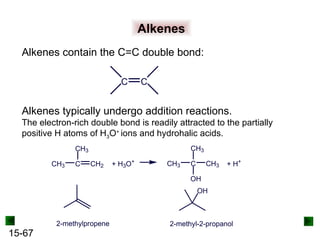
Alkenes
Alkenes contain the C=C double bond:
Alkenes typically undergo addition reactions.
The electron-rich double bond is readily attracted to the partially
positive H atoms of H3O+
ions and hydrohalic acids.
C C
CH3
C CH2
CH3 + H3O+
CH3
C CH3
CH3
OH
OH
+ H+
2-methylpropene 2-methyl-2-propanol
15-68
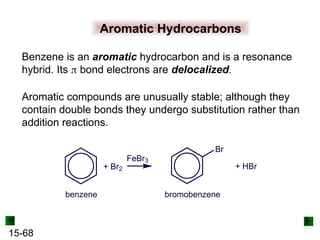
Aromatic Hydrocarbons
Benzene is an aromatic hydrocarbon and is a resonance
hybrid. Its  bond electrons are delocalized.
Aromatic compounds are unusually stable; although they
contain double bonds they undergo substitution rather than
addition reactions.
+ Br2
FeBr3
Br
+ HBr
benzene bromobenzene
15-69
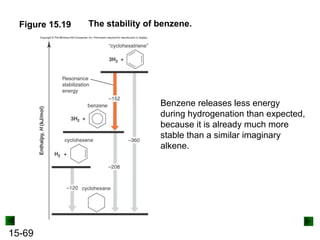
Figure 15.19 The stability of benzene.
Benzene releases less energy
during hydrogenation than expected,
because it is already much more
stable than a similar imaginary
alkene.
15-70
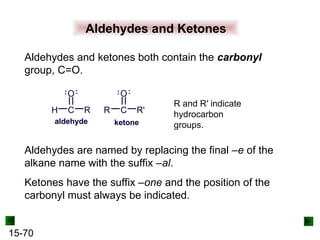
Aldehydes and Ketones
Aldehydes and ketones both contain the carbonyl
group, C=O.
Aldehydes are named by replacing the final –e of the
alkane name with the suffix –al.
Ketones have the suffix –one and the position of the
carbonyl must always be indicated.
R and R′ indicate
hydrocarbon
groups.
H C
O
R
aldehyde
R C
O
R'
ketone
15-71
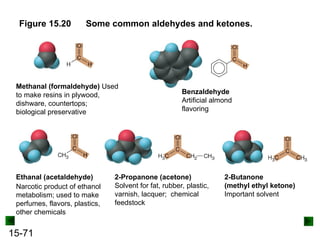
Figure 15.20 Some common aldehydes and ketones.
Methanal (formaldehyde) Used
to make resins in plywood,
dishware, countertops;
biological preservative
Ethanal (acetaldehyde)
Narcotic product of ethanol
metabolism; used to make
perfumes, flavors, plastics,
other chemicals
2-Propanone (acetone)
Solvent for fat, rubber, plastic,
varnish, lacquer; chemical
feedstock
2-Butanone
(methyl ethyl ketone)
Important solvent
Benzaldehyde
Artificial almond
flavoring
15-72
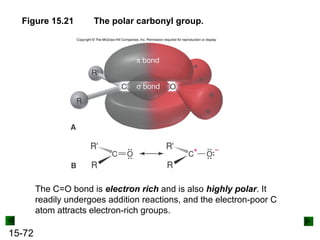
Figure 15.21 The polar carbonyl group.
The C=O bond is electron rich and is also highly polar. It
readily undergoes addition reactions, and the electron-poor C
atom attracts electron-rich groups.
15-73
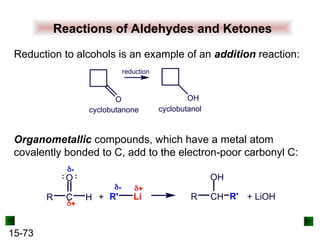
Reactions of Aldehydes and Ketones
Reduction to alcohols is an example of an addition reaction:
O
reduction
OH
cyclobutanone cyclobutanol
Organometallic compounds, which have a metal atom
covalently bonded to C, add to the electron-poor carbonyl C:
R C
O
H + R' Li
+
-
+
-
R CH
OH
R' + LiOH
15-74
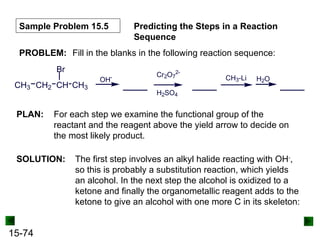
Sample Problem 15.5 Predicting the Steps in a Reaction
Sequence
PLAN: For each step we examine the functional group of the
reactant and the reagent above the yield arrow to decide on
the most likely product.
PROBLEM: Fill in the blanks in the following reaction sequence:
CH3 CH2 CH
Br
CH3
OH- Cr2O7
2-
H2SO4
CH3-Li H2O
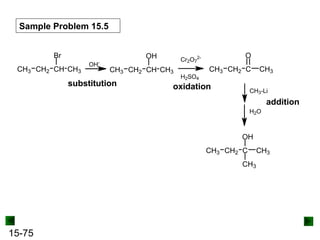
SOLUTION: The first step involves an alkyl halide reacting with OH-
,
so this is probably a substitution reaction, which yields
an alcohol. In the next step the alcohol is oxidized to a
ketone and finally the organometallic reagent adds to the
ketone to give an alcohol with one more C in its skeleton:
15-75
Sample Problem 15.5
CH3 CH2 CH
Br
CH3
OH-
Cr2O7
2-
H2SO4
CH3-Li
H2O
CH3 CH2 CH
OH
CH3
substitution
CH3 CH2 C
O
CH3
addition
CH3 CH2 C
OH
CH3
CH3
oxidation
15-76
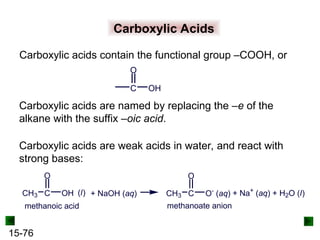
Carboxylic Acids
Carboxylic acids are named by replacing the –e of the
alkane with the suffix –oic acid.
Carboxylic acids contain the functional group –COOH, or
Carboxylic acids are weak acids in water, and react with
strong bases:
C
O
OH
CH3 C
O
OH (l) + NaOH (aq) CH3 C
O
O-
(aq) + Na+
(aq) + H2O (l)
methanoic acid methanoate anion
15-77
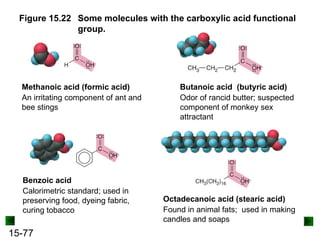
Figure 15.22 Some molecules with the carboxylic acid functional
group.
Methanoic acid (formic acid)
An irritating component of ant and
bee stings
Butanoic acid (butyric acid)
Odor of rancid butter; suspected
component of monkey sex
attractant
Octadecanoic acid (stearic acid)
Found in animal fats; used in making
candles and soaps
Benzoic acid
Calorimetric standard; used in
preserving food, dyeing fabric,
curing tobacco
15-78
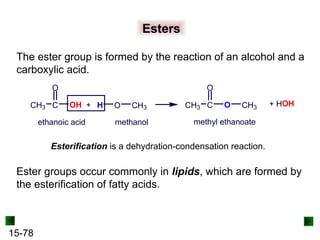
Esters
The ester group is formed by the reaction of an alcohol and a
carboxylic acid.
Ester groups occur commonly in lipids, which are formed by
the esterification of fatty acids.
CH3 C
O
OH O CH3
H
+ CH3 C
O
O CH3 + HOH
ethanoic acid methanol methyl ethanoate
Esterification is a dehydration-condensation reaction.
15-79
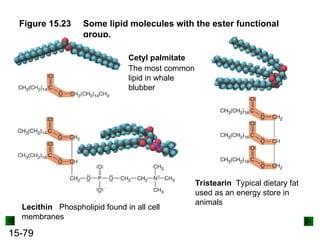
Figure 15.23 Some lipid molecules with the ester functional
group.
Cetyl palmitate
The most common
lipid in whale
blubber
Lecithin Phospholipid found in all cell
membranes
Tristearin Typical dietary fat
used as an energy store in
animals
15-80
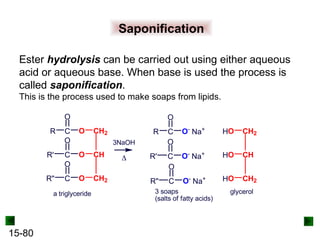
Saponification
Ester hydrolysis can be carried out using either aqueous
acid or aqueous base. When base is used the process is
called saponification.
This is the process used to make soaps from lipids.
R C
O
O CH2
CH
CH2
O
O
C
O
R"
C
O
R'
a triglyceride
3NaOH

HO CH2
CH
CH2
HO
HO
R C
O
O-
Na+
R' C
O
O-
Na+
R" C
O
O-
Na+
3 soaps
(salts of fatty acids)
glycerol
15-81
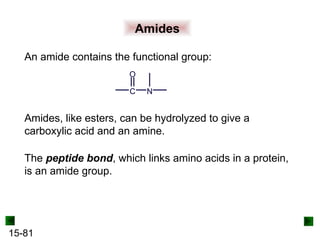
Amides
An amide contains the functional group:
C
O
N
Amides, like esters, can be hydrolyzed to give a
carboxylic acid and an amine.
The peptide bond, which links amino acids in a protein,
is an amide group.
15-82
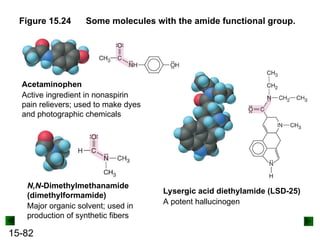
Lysergic acid diethylamide (LSD-25)
A potent hallucinogen
Figure 15.24 Some molecules with the amide functional group.
N,N-Dimethylmethanamide
(dimethylformamide)
Major organic solvent; used in
production of synthetic fibers
Acetaminophen
Active ingredient in nonaspirin
pain relievers; used to make dyes
and photographic chemicals
15-83
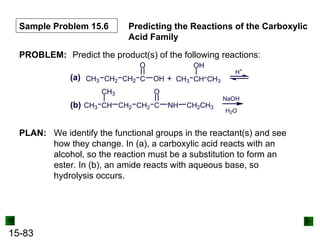
Sample Problem 15.6 Predicting the Reactions of the Carboxylic
Acid Family
PROBLEM: Predict the product(s) of the following reactions:
(a) CH3 CH2 CH2 C
O
OH CH3 CH
OH
CH3
+
H+
(b) CH CH2 CH2 C
O
NH
CH3
CH3 CH2CH3
NaOH
H2O
PLAN: We identify the functional groups in the reactant(s) and see
how they change. In (a), a carboxylic acid reacts with an
alcohol, so the reaction must be a substitution to form an
ester. In (b), an amide reacts with aqueous base, so
hydrolysis occurs.
15-84
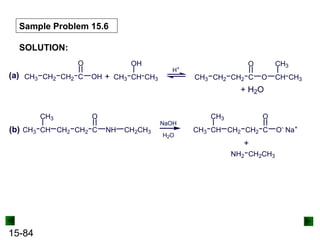
Sample Problem 15.6
SOLUTION:
(a) CH3 CH2 CH2 C
O
OH CH3 CH
OH
CH3
+
H+
CH3 CH2 CH2 C
O
O CH
CH3
CH3
+ H2O
(b) CH CH2 CH2 C
O
NH
CH3
CH3 CH2CH3
NaOH
H2O
CH CH2 CH2 C
O
CH3
CH3 O-
Na+
CH2CH3
+
NH2
15-85
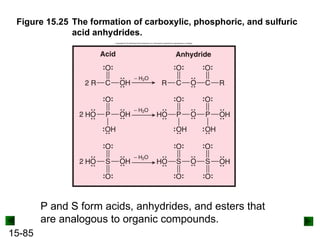
Figure 15.25 The formation of carboxylic, phosphoric, and sulfuric
acid anhydrides.
P and S form acids, anhydrides, and esters that
are analogous to organic compounds.
15-86
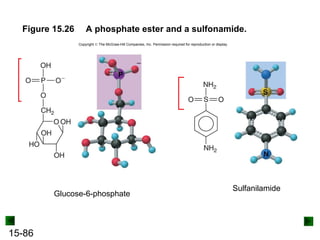
Figure 15.26 A phosphate ester and a sulfonamide.
Glucose-6-phosphate
Sulfanilamide
Copyright  The McGraw-Hill Companies, Inc. Permission required for reproduction or display.
15-87
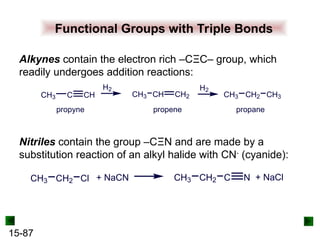
Functional Groups with Triple Bonds
Alkynes contain the electron rich –CΞC– group, which
readily undergoes addition reactions:
C CH
CH3
H2
propyne
CH CH2
CH3
propene
H2
CH2 CH3
CH3
propane
Nitriles contain the group –CΞN and are made by a
substitution reaction of an alkyl halide with CN-
(cyanide):
CH2 Cl
CH3 + NaCN CH2 C
CH3 N + NaCl
15-88
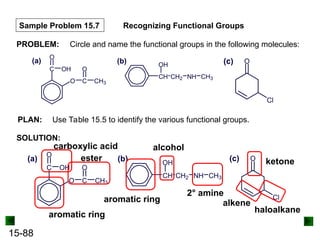
Sample Problem 15.7
SOLUTION:
Recognizing Functional Groups
PLAN: Use Table 15.5 to identify the various functional groups.
PROBLEM: Circle and name the functional groups in the following molecules:
(a)
C
O
OH
O C
O
CH3
(b)
CH
OH
CH2 NH CH3
(c) O
Cl
(a)
C
O
OH
O C
O
CH3
(b)
CH
OH
CH2 NH CH3
(c) O
Cl
carboxylic acid
ester
aromatic ring
aromatic ring
alcohol
2° amine
ketone
alkene
haloalkane
15-89
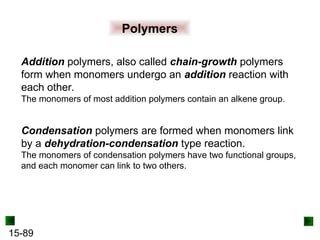
Polymers
Addition polymers, also called chain-growth polymers
form when monomers undergo an addition reaction with
each other.
The monomers of most addition polymers contain an alkene group.
Condensation polymers are formed when monomers link
by a dehydration-condensation type reaction.
The monomers of condensation polymers have two functional groups,
and each monomer can link to two others.
15-90
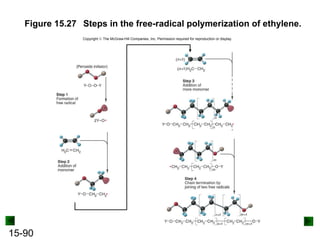
Figure 15.27 Steps in the free-radical polymerization of ethylene.
Copyright  The McGraw-Hill Companies, Inc. Permission required for reproduction or display.
15-91
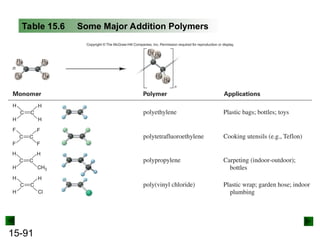
Table 15.6 Some Major Addition Polymers
15-92
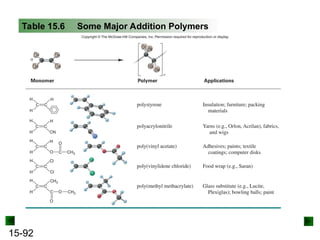
Table 15.6 Some Major Addition Polymers

ch15_organic-compounds-stem-grade 12-ppt

  • 1.
    15-1 Lecture PowerPoint Chemistry The MolecularNature of Matter and Change Seventh Edition Martin S. Silberberg and Patricia G. Amateis Copyright  McGraw-Hill Education. All rights reserved. No reproduction or distribution without the prior written consent of McGraw-Hill Education.
  • 2.
    15-2 Chapter 15 Organic Compoundsand the Atomic Properties of Carbon
  • 3.
    15-3 Organic Compounds andthe Atomic Properties of Carbon 15.1 The Special Nature of Carbon and the Characteristics of Organic Molecules 15.2 The Structures and Classes of Hydrocarbons 15.3 Some Important Classes of Organic Reactions 15.4 Properties and Reactivities of Common Functional Groups
  • 4.
    15-4 Bonding Properties ofCarbon • Carbon forms covalent bonds in all its elemental forms and compounds. – The ground state electron configuration of C is [He] 2s2 2p2 ; the formation of carbon ions is therefore energetically unfavorable. – C has an electronegativity of 2.5, which is midway between that of most metals and nonmetals. C prefers to share electrons. • Carbon exhibits catenation, the ability to bond to itself and form stable chain, ring, and branched compounds. – The small size of the C atom allows it to form short, strong bonds. – The short C-C bond allows the ready formation of  bonds, increasing the variety of compounds that can be formed.
  • 5.
    15-5 Figure 15.1 Theposition of carbon in the periodic table.
  • 6.
    15-6 Comparison of Carbonand Silicon • As atomic size increases down the group, bonds between identical atoms become longer and weaker. – A C–C bond is much stronger than a Si–Si bond. • The bond energies of a C–C bond, a C–O bond, and a C–Cl bond are very similar. – C compounds can undergo a variety of reactions and remain stable, while Si compounds cannot. • Si has low energy d orbitals available for reaction, allowing Si compounds to be more reactive than C compounds.
  • 7.
    15-7 Diversity and Reactivityof Organic Molecules • Many organic compounds contain heteroatoms, atoms other than C and H. – The most common of these are O, N, and the halogens. • Most reactions involve the interaction of an electron rich area in one molecule with an electron poor site in another. – C–C bonds and C–H bonds tend to be unreactive. – Bonds between C and a heteroatom are usually polar, creating an imbalance in electron density and providing a site for reactions to occur.
  • 8.
    15-8 Figure 15.2 Heteroatomsand different bonding arrangements lead to great chemical diversity. Copyright © The McGraw-Hill Companies, Inc. Permission required for reproduction or display.
  • 9.
    15-9 Carbon Skeletons Each Catom can form a maximum of 4 bonds. Single bonds can rotate relatively freely, so there are often several different arrangements of a given carbon skeleton that are equivalent:
  • 10.
    15-10 Figure 15.3 Somefive-carbon skeletons.
  • 11.
    15-11 Drawing Carbon Skeletons EachC atom can form a maximum of four bonds. - These may be four single bonds, - or one double and two single bonds, - or one triple and one single bond. The arrangement of C atoms determines the skeleton, so a straight chain and a bent chain represent the same skeleton. Groups joined by a single bond can rotate freely, so a branch pointing down is the same as one pointing up.
  • 12.
    15-12 Figure 15.4 Addingthe H-atom skin to the C-atom skeleton. A C atom single-bonded to one other atom gets three H atoms. C C H H H A C atom single-bonded to two other atoms gets two H atoms. C C H C H A C atom single-bonded to three other atoms gets one H atom. C C H C C A C atom single-bonded to four other atoms is already fully bonded (no H atoms). C C C C C
  • 13.
    15-13 Figure 15.4 continued Adouble-bonded C atom is treated as if it were bonded to two other atoms. C C H H A double- and single-bonded C atom or a triple-bonded C atom is treated as if it were bonded to three other atoms. C C H C C C H
  • 14.
    15-14 Sample Problem 15.1Drawing Hydrocarbons PLAN: In each case, we draw the longest carbon chain first and then work down to smaller chains with branches at different points along them. Then we add H atoms to give each C a total of four bonds. PROBLEM: Draw structures that have different atom arrangements for hydrocarbons with (a) Six C atoms, no multiple bonds, and no rings (b) Four C atoms, one double bond, and no rings (c) Four C atoms, no multiple bonds, and one ring
  • 15.
    15-15 Sample Problem 15.1 (a)Six carbons, no rings H C C C C C C H H H H H H H H H H H H H 6-C chain H C C C C C H H H H C H H H H H H H H H 5-C chain H C C C C H H H H C C H H H H H H H H H C C C C H H H H C C H H H H H H H H H H 4-C chains H C C C C C H H H H C H H H H H H H H H 5-C chain
  • 16.
    15-16 Sample Problem 15.1 (b)Four C atoms, one double bond, and no rings H C H H C C H H C H H H 3-C chain H C C C C H H H H H H H C C H H H H H C C H H H 4-C chains
  • 17.
    15-17 Sample Problem 15.1 (c)Compounds with four C atoms and one ring C C C C H H H H H H H H C C C H H C H H H H H H
  • 18.
    15-18 Alkanes Hydrocarbons contain onlyC and H. Alkanes are hydrocarbons that contain only single bonds and are referred to as saturated hydrocarbons. The general formula for an alkane is CnH2n+2, where n is any positive integer. Alkanes comprise a homologous series, a group of compounds in which each member differs from the next by a –CH2– group.
  • 19.
    15-19 Naming Organic Compounds Theroot name of the compound is determined from the number of C atoms in the longest continuous chain. The name of any organic compound is comprised of three portions: PREFIX + ROOT + SUFFIX Each prefix identifies a group attached to the main chain as well as its position. The suffix indicates the type of organic compound, and is placed after the root. The suffix for an alkane is –ane.
  • 20.
    15-20 Table 15.1 NumericalRoots for Carbon Chains and Branches Roots Number of C Atoms meth- 1 eth- 2 prop- 3 but- 4 pent- 5 hex- 6 hept- 7 oct- 8 non- 9 dec- 10
  • 21.
    15-21 Table 15.2 Rulesfor Naming an Organic Compound
  • 22.
    15-22 Figure 15.5 Waysof depicting the alkane 3-ethyl-2-methylhexane. C C C C C H H H C C H H H C H H H H H H H H H C H H H H H Expanded formula CH3 CH CH3 CH CH2 CH3 CH2 CH2 CH3 Condensed formula Carbon-skeleton formula Ball-and-stick model Space-filling model
  • 23.
    15-23 Figure 15.6 Depictingcycloalkanes. Cyclopropane C C C H H H H H H Cyclobutane C C C C H H H H H H H H Copyright  The McGraw-Hill Companies, Inc. Permission required for reproduction or display.
  • 24.
    15-24 Cyclopentane C C C C C H H H H H H H H H H Cyclohexane C C C C C C HH H H H H H H H H H Figure 15.6 Depicting cycloalkanes. Copyright  The McGraw-Hill Companies, Inc. Permission required for reproduction or display.
  • 25.
    15-25 Constitutional Isomers Constitutional orstructural isomers have the same molecular formula but a different arrangement of the bonded atoms. A straight-chain alkane may have many branched structural isomers. Structural isomers are different compounds and have different properties. If the isomers contain the same functional groups, their properties will still be similar.
  • 26.
    15-26 Table 15.3 TheConstitutional Isomers of C4H10 and C5H12
  • 27.
    15-27 Figure 15.7 Formulas,molar masses (in g/mol), structures, and boiling points (at 1 atm pressure) of the first 10 unbranched alkanes. Alkanes are nonpolar and their physical properties are determined by the dispersion forces between their molecules.
  • 28.
    15-28 Chiral Molecules Stereoisomers aremolecules with the same arrangement of atoms but different orientations of groups in space. Optical isomers are mirror images of each other that cannot be superimposed. A molecule must be asymmetric in order to exist as a pair of optical isomers. An asymmetric molecule is termed chiral. Typically, a carbon atom is a chiral center if it is bonded to four different groups.
  • 29.
    15-29 Figure 15.8 Ananalogy for optical isomers. If two compounds are mirror images of each other that cannot be superimposed, they are called optical isomers.
  • 30.
    15-30 Figure 15.9 Twochiral molecules. Optical isomers of 3-methylhexane Optical isomers of alanine Copyright  The McGraw-Hill Companies, Inc. Permission required for reproduction or display.
  • 31.
    15-31 Optical Activity Optical isomershave identical physical properties, except that they rotate the plane of polarized light in opposite directions. A chiral compound is optically active; i.e., it rotates the plane of polarized light. A compound that rotates the plane of light clockwise is called dextrorotatory, while a compound that rotates the plane of light counterclockwise is called levorotatory. In their chemical properties, optical isomers differ only in a chiral (asymmetric) environment.
  • 32.
    15-32 Figure 15.10 Therotation of plane-polarized light by an optically active substance.
  • 33.
    15-33 Figure 15.11 Thebinding site of an enzyme. An enzyme provides a chiral environment and therefore distinguishes one optical isomer from another. The shape of one optical isomer fits the binding site, but the mirror image shape of the other isomer does not. Copyright  The McGraw-Hill Companies, Inc. Permission required for reproduction or display.
  • 34.
    15-34 Naproxen Many drugs arechiral molecules. One optical isomer has a certain biological activity while the other either has a different type of activity or none at all.
  • 35.
    15-35 Alkenes A hydrocarbon thatcontains at least one C=C bond is called an alkene. Alkenes are unsaturated and have the general formula CnH2n. To name an alkene, the root name is determined by the number of C atoms in the longest chain that also contains the double bond. The C chain is numbered from the end closest to the double bond. The suffix for alkenes is –ene.
  • 36.
    15-36 Geometric Isomers The doublebond of an alkene restricts rotation, so that the relative positions of the atoms attached to the double bond are fixed. Alkenes may exist as geometric or cis-trans isomers, which differ in the orientation of the groups attached to the double bond. Geometric isomers have different physical properties.
  • 37.
    15-37 Table 15.4 TheGeometric Isomers of 2-Butene
  • 38.
    15-38 Figure 15.12 Theinitial chemical event in vision and the change in the shape of retinal.
  • 39.
    15-39 Alkynes An alkyne isa hydrocarbon that contains at least one CΞC triple bond. Alkynes have the general formula CnH2n-2 and they are also considered unsaturated carbons. Alkynes are named in the same way as alkenes, using the suffix –yne.
  • 40.
    15-40 Sample Problem 15.2Naming Alkanes, Alkenes, and Alkynes PROBLEM: Give the systematic name for each of the following, indicate the chiral center in part (d), and draw two geometric isomers for part (e). CH3 C CH3 CH3 CH2 CH3 (a) (b) CH3 CH2 CH CH3 CH CH2 CH3 CH3 (c) (d) CH3 CH2 CH CH3 CH CH2 (e) CH3 CH2 CH C CH3 CH CH3 CH3 PLAN: For (a) to (c), we find the longest continuous chain (root) and add the suffix –ane because there are only single bonds. Then we name the branches, numbering the C chain from the end closest to the first branch. For (d) and (e) the longest chain must include the double bond.
  • 41.
    15-41 Sample Problem 15.2 SOLUTION: 2,3-dimethylbutane (b) CH3CH2 CH CH3 CH CH2 CH3 CH3 methyl 1 2 3 4 5 6 hexane methyl 3,4-dimethylhexane methyl 1 2 3 4 5 (c) ethyl 1-ethyl-2-methylcyclopentane CH3 C CH3 CH3 CH2 CH3 (a) butane methyl methyl 1 2 3 4
  • 42.
    15-42 Sample Problem 15.2 3-methyl-1-pentene (d) CH3CH2 CH CH3 CH CH2 methyl 1 2 3 4 5 chiral center 1-pentene (e) 1 2 3 4 5 6 C C CH3 CH H CH2 CH3 CH3 CH3 1 2 3 4 5 6 C C CH3 CH CH2 H CH3 CH3 CH3 methyl methyl methyl methyl 3-hexene cis-2,3-dimethyl-3-hexene trans-2,3-dimethyl-3-hexene
  • 43.
    15-43 Figure 15.13 Representationsof benzene. Resonance forms having alternating single and double bonds. or Resonance hybrid shows the delocalized electrons as either an unbroken or a dashed circle. Benzene is an aromatic hydrocarbon. Copyright © The McGraw-Hill Companies, Inc. Permission required for reproduction or display.
  • 44.
    15-44 methylbenzene (toluene) bp = 110.6°C 1,2-dimethylbenzene (o-xylene) bp= 144.4°C 1,3-dimethylbenzene (m-xylene) bp = 139.1°C 1,4-dimethylbenzene (p-xylene) bp = 138.3°C O2N NO2 NO2 2,4,6-trinitromethylbenzene (trinitrotoluene, TNT)
  • 45.
    15-45 Types of OrganicReactions An addition reaction occurs when an unsaturated reactant becomes a saturated product: R CH CH R + X Y R CH CH R X Y The C=C, CΞC, and C=O bonds commonly undergo addition reactions. In each case, it is the  bond that breaks, leaving the σ bond intact.
  • 46.
    15-46 CH2 CH2 +H Cl H CH2 CH2 Cl Reactants (bonds broken) 1 C=C = 614 kJ 4 C–H = 1652 kJ 1 H–Cl = 427 kJ Total = 2693 kJ Products (bonds formed) 1 C–C = -347 kJ 5 C–H = -2065 kJ 1 C–Cl = -339 kJ Total = -2751kJ H°rxn = H°bonds broken + H°bonds formed = 2693 kJ + (-2751 kJ) = -58 kJ Copyright © The McGraw-Hill Companies, Inc. Permission required for reproduction or display.
  • 47.
    15-47 Figure 15.14 Acolor test for C=C bonds. This compound has no C=C bond, so the Br2 does not react. C C + Br2 C C Br Br Br2 (in pipet) reacts with a compound that has a C=C bond, and the orange- brown color of Br2 disappears.
  • 48.
    15-48 Types of OrganicReactions An elimination reaction occurs when a saturated reactant becomes an unsaturated product. This reaction is the reverse of addition. The groups typically eliminated are H and a halogen atom or H and an –OH group. R CH CH R + X Y R CH CH R X Y
  • 49.
    15-49 The driving forcefor an elimination reaction is the formation of a small, stable molecule such as HCl (g) or H2O. R CH CH R + H OH R CH CH R OH H H2SO4 Copyright © The McGraw-Hill Companies, Inc. Permission required for reproduction or display.
  • 50.
    15-50 Types of OrganicReactions A substitution reaction occurs when an atom or group from an added reagent substitutes for one attached to a carbon in the organic reagent. The C atom at which substitution occurs may be saturated or unsaturated, and X and Y can be many different atoms. R C X + Y R C Y + X
  • 51.
    15-51 CH3 C O Cl +HO CH2 CH2 CH CH3 CH3 CH3 C O O CH2 CH2 CH CH3 CH3 + H Cl The main flavor ingredient in banana oil is formed through a substitution reaction: Copyright © The McGraw-Hill Companies, Inc. Permission required for reproduction or display.
  • 52.
    15-52 Sample Problem 15.3Recognizing the Type of Organic Reaction PLAN: We determine the type of reaction by looking for any change in the number of atoms bonded to C. • An addition reaction results in more atoms bonded to C. • An elimination reaction results in fewer atoms bonded to C. •If there are the same number of atoms bonded to C, the reaction is a substitution. PROBLEM : State whether each reaction is an addition, elimination, or substitution: CH3 CH2 CH2 Br CH3 CH CH2 + HBr (a) (c) CH3 C O Br + CH3CH2OH CH3 C O OCH2CH3 + HBr (b) + H2
  • 53.
    15-53 Sample Problem 15.3 SOLUTION: CH3CH2 CH2 Br CH3 CH CH2 + HBr (a) This is an elimination reaction; two bonds in the reactant, C–H and C –Br, are absent in the product. (b) + H2 This is an addition reaction; two more C–H bonds have formed in the product. (c) CH3 C O Br + CH3CH2OH CH3 C O OCH2CH3 + HBr This is a substitution reaction; the reactant C–Br bond has been replaced by a C–O bond in the product.
  • 54.
    15-54 Functional Groups Organic compoundsare classified according to their functional groups, a group of atoms bonded in a particular way. The functional groups in a compound determine both its physical properties and its chemical reactivity. Functional groups affect the polarity of a compound, and therefore determine the intermolecular forces it exhibits. Functional groups define the regions of high and low electron density in a compound, thus determining its reactivity.
  • 55.
    15-55 Table 15.5 ImportantFunctional Groups in Organic Compounds
  • 56.
    15-56 Table 15.5 ImportantFunctional Groups in Organic Compounds
  • 57.
    15-57 Alcohols The alcohol functionalgroup consists of a carbon bonded to an –OH group. C O H Alcohols are named by replacing the –e at the end of the parent hydrocarbon name with the suffix –ol. Alcohols have high melting and boiling points since they can form hydrogen bonds between their molecules.
  • 58.
    15-58 Reactions of Alcohols Alcoholsundergo elimination and substitution reactions. OH H+ cyclohexanol cyclohexene + H2O dehydration (elimination) CH3 CH2 CH OH CH3 K2Cr2O7 H2SO4 CH3 CH2 C O CH3 OH O 2-butanol 2-butanone oxidation
  • 59.
    15-59 Figure 15.15 Somemolecules with the alcohol functional group. Copyright  The McGraw-Hill Companies, Inc. Permission required for reproduction or display.
  • 60.
    15-60 Haloalkanes Haloalkanes or alkylhalides contain a halogen atom bonded to carbon. Haloalkanes are named by identifying the halogen with a prefix on the hydrocarbon name. The C bearing the halogen must be numbered. C X
  • 61.
    15-61 Reactions of Haloalkanes Haloalkanesundergo substitution and elimination reactions. CH3 CH2 CH2 CH2 Br + OH- CH3 CH2 CH2 CH2 OH + Br- 1-bromobutane 1-butanol CH3 C CH3 Cl CH3 CH3 CH2 O- K+ + CH3 C CH3 CH2 + KCl + CH3 CH2 OH 2-chloro-2-methylpropane potassium ethoxide 2-methylpropene ethanol
  • 62.
    15-62 Figure 15.16 Atetrachlorobiphenyl, one of 209 polychlorinated biphenyls (PCBs).
  • 63.
    15-63 Amines The amine functionalgroup contains a N atom. The systematic name for an amine is formed by dropping the final –e of the alkane and adding the suffix –amine. C N Common names that use the name of the alkyl group followed by the suffix –amine are also widely used. CH3CH2NH2 ethanamine OR ethylamine CH3CH2 NH CH2CH3 diethylamine
  • 64.
    15-64 Figure 15.17 Generalstructures of amines. Amines are classified according to the number of R groups directly attached to the N atom.
  • 65.
    15-65 Figure 15.18 Somebiomolecules with the amine functional group. Lysine (1° amine) amino acid found in proteins Adenine (1° amine) component of nucleic acids Epinephrine (adrenaline; 2° amine) neurotransmitter in brain; hormone released during stress Cocaine (3° amine) brain stimulant; widely abused drug
  • 66.
    15-66 Properties and Reactionsof Amines Primary and secondary amines can form H bonds; they therefore have higher melting and boiling points than hydrocarbons or alkyl halides of similar mass. Amines of low molar mass are fishy smelling, water soluble, and weakly basic. Tertiary amines cannot form H bonds between their molecules because they lack a polar N–H bond. Amines undergo a variety of reactions, including substitution reactions.
  • 67.
    15-67 Alkenes Alkenes contain theC=C double bond: Alkenes typically undergo addition reactions. The electron-rich double bond is readily attracted to the partially positive H atoms of H3O+ ions and hydrohalic acids. C C CH3 C CH2 CH3 + H3O+ CH3 C CH3 CH3 OH OH + H+ 2-methylpropene 2-methyl-2-propanol
  • 68.
    15-68 Aromatic Hydrocarbons Benzene isan aromatic hydrocarbon and is a resonance hybrid. Its  bond electrons are delocalized. Aromatic compounds are unusually stable; although they contain double bonds they undergo substitution rather than addition reactions. + Br2 FeBr3 Br + HBr benzene bromobenzene
  • 69.
    15-69 Figure 15.19 Thestability of benzene. Benzene releases less energy during hydrogenation than expected, because it is already much more stable than a similar imaginary alkene.
  • 70.
    15-70 Aldehydes and Ketones Aldehydesand ketones both contain the carbonyl group, C=O. Aldehydes are named by replacing the final –e of the alkane name with the suffix –al. Ketones have the suffix –one and the position of the carbonyl must always be indicated. R and R′ indicate hydrocarbon groups. H C O R aldehyde R C O R' ketone
  • 71.
    15-71 Figure 15.20 Somecommon aldehydes and ketones. Methanal (formaldehyde) Used to make resins in plywood, dishware, countertops; biological preservative Ethanal (acetaldehyde) Narcotic product of ethanol metabolism; used to make perfumes, flavors, plastics, other chemicals 2-Propanone (acetone) Solvent for fat, rubber, plastic, varnish, lacquer; chemical feedstock 2-Butanone (methyl ethyl ketone) Important solvent Benzaldehyde Artificial almond flavoring
  • 72.
    15-72 Figure 15.21 Thepolar carbonyl group. The C=O bond is electron rich and is also highly polar. It readily undergoes addition reactions, and the electron-poor C atom attracts electron-rich groups.
  • 73.
    15-73 Reactions of Aldehydesand Ketones Reduction to alcohols is an example of an addition reaction: O reduction OH cyclobutanone cyclobutanol Organometallic compounds, which have a metal atom covalently bonded to C, add to the electron-poor carbonyl C: R C O H + R' Li + - + - R CH OH R' + LiOH
  • 74.
    15-74 Sample Problem 15.5Predicting the Steps in a Reaction Sequence PLAN: For each step we examine the functional group of the reactant and the reagent above the yield arrow to decide on the most likely product. PROBLEM: Fill in the blanks in the following reaction sequence: CH3 CH2 CH Br CH3 OH- Cr2O7 2- H2SO4 CH3-Li H2O SOLUTION: The first step involves an alkyl halide reacting with OH- , so this is probably a substitution reaction, which yields an alcohol. In the next step the alcohol is oxidized to a ketone and finally the organometallic reagent adds to the ketone to give an alcohol with one more C in its skeleton:
  • 75.
    15-75 Sample Problem 15.5 CH3CH2 CH Br CH3 OH- Cr2O7 2- H2SO4 CH3-Li H2O CH3 CH2 CH OH CH3 substitution CH3 CH2 C O CH3 addition CH3 CH2 C OH CH3 CH3 oxidation
  • 76.
    15-76 Carboxylic Acids Carboxylic acidsare named by replacing the –e of the alkane with the suffix –oic acid. Carboxylic acids contain the functional group –COOH, or Carboxylic acids are weak acids in water, and react with strong bases: C O OH CH3 C O OH (l) + NaOH (aq) CH3 C O O- (aq) + Na+ (aq) + H2O (l) methanoic acid methanoate anion
  • 77.
    15-77 Figure 15.22 Somemolecules with the carboxylic acid functional group. Methanoic acid (formic acid) An irritating component of ant and bee stings Butanoic acid (butyric acid) Odor of rancid butter; suspected component of monkey sex attractant Octadecanoic acid (stearic acid) Found in animal fats; used in making candles and soaps Benzoic acid Calorimetric standard; used in preserving food, dyeing fabric, curing tobacco
  • 78.
    15-78 Esters The ester groupis formed by the reaction of an alcohol and a carboxylic acid. Ester groups occur commonly in lipids, which are formed by the esterification of fatty acids. CH3 C O OH O CH3 H + CH3 C O O CH3 + HOH ethanoic acid methanol methyl ethanoate Esterification is a dehydration-condensation reaction.
  • 79.
    15-79 Figure 15.23 Somelipid molecules with the ester functional group. Cetyl palmitate The most common lipid in whale blubber Lecithin Phospholipid found in all cell membranes Tristearin Typical dietary fat used as an energy store in animals
  • 80.
    15-80 Saponification Ester hydrolysis canbe carried out using either aqueous acid or aqueous base. When base is used the process is called saponification. This is the process used to make soaps from lipids. R C O O CH2 CH CH2 O O C O R" C O R' a triglyceride 3NaOH  HO CH2 CH CH2 HO HO R C O O- Na+ R' C O O- Na+ R" C O O- Na+ 3 soaps (salts of fatty acids) glycerol
  • 81.
    15-81 Amides An amide containsthe functional group: C O N Amides, like esters, can be hydrolyzed to give a carboxylic acid and an amine. The peptide bond, which links amino acids in a protein, is an amide group.
  • 82.
    15-82 Lysergic acid diethylamide(LSD-25) A potent hallucinogen Figure 15.24 Some molecules with the amide functional group. N,N-Dimethylmethanamide (dimethylformamide) Major organic solvent; used in production of synthetic fibers Acetaminophen Active ingredient in nonaspirin pain relievers; used to make dyes and photographic chemicals
  • 83.
    15-83 Sample Problem 15.6Predicting the Reactions of the Carboxylic Acid Family PROBLEM: Predict the product(s) of the following reactions: (a) CH3 CH2 CH2 C O OH CH3 CH OH CH3 + H+ (b) CH CH2 CH2 C O NH CH3 CH3 CH2CH3 NaOH H2O PLAN: We identify the functional groups in the reactant(s) and see how they change. In (a), a carboxylic acid reacts with an alcohol, so the reaction must be a substitution to form an ester. In (b), an amide reacts with aqueous base, so hydrolysis occurs.
  • 84.
    15-84 Sample Problem 15.6 SOLUTION: (a)CH3 CH2 CH2 C O OH CH3 CH OH CH3 + H+ CH3 CH2 CH2 C O O CH CH3 CH3 + H2O (b) CH CH2 CH2 C O NH CH3 CH3 CH2CH3 NaOH H2O CH CH2 CH2 C O CH3 CH3 O- Na+ CH2CH3 + NH2
  • 85.
    15-85 Figure 15.25 Theformation of carboxylic, phosphoric, and sulfuric acid anhydrides. P and S form acids, anhydrides, and esters that are analogous to organic compounds.
  • 86.
    15-86 Figure 15.26 Aphosphate ester and a sulfonamide. Glucose-6-phosphate Sulfanilamide Copyright  The McGraw-Hill Companies, Inc. Permission required for reproduction or display.
  • 87.
    15-87 Functional Groups withTriple Bonds Alkynes contain the electron rich –CΞC– group, which readily undergoes addition reactions: C CH CH3 H2 propyne CH CH2 CH3 propene H2 CH2 CH3 CH3 propane Nitriles contain the group –CΞN and are made by a substitution reaction of an alkyl halide with CN- (cyanide): CH2 Cl CH3 + NaCN CH2 C CH3 N + NaCl
  • 88.
    15-88 Sample Problem 15.7 SOLUTION: RecognizingFunctional Groups PLAN: Use Table 15.5 to identify the various functional groups. PROBLEM: Circle and name the functional groups in the following molecules: (a) C O OH O C O CH3 (b) CH OH CH2 NH CH3 (c) O Cl (a) C O OH O C O CH3 (b) CH OH CH2 NH CH3 (c) O Cl carboxylic acid ester aromatic ring aromatic ring alcohol 2° amine ketone alkene haloalkane
  • 89.
    15-89 Polymers Addition polymers, alsocalled chain-growth polymers form when monomers undergo an addition reaction with each other. The monomers of most addition polymers contain an alkene group. Condensation polymers are formed when monomers link by a dehydration-condensation type reaction. The monomers of condensation polymers have two functional groups, and each monomer can link to two others.
  • 90.
    15-90 Figure 15.27 Stepsin the free-radical polymerization of ethylene. Copyright  The McGraw-Hill Companies, Inc. Permission required for reproduction or display.
  • 91.
    15-91 Table 15.6 SomeMajor Addition Polymers
  • 92.
    15-92 Table 15.6 SomeMajor Addition Polymers