Deregulation & Higher
Education in a Developing
        Country
 The Challenge of Funding &
Managing Private Universities in
           Nigeria
                     By
            Mojisola Ladipo, mni
Outline
• Historical Background to University
  Education in Nigeria
• The Country Nigeria : Profile
• Deregulation:    Pathway      to the
  Emergence of Private Universities in
  Nigeria
• The Challenges
• The Future
Background to University
       Education
The aspirations of Nigerians
for higher education for the
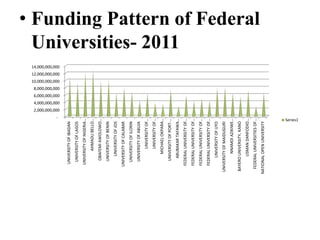
production and development
of human resources is older
than the history of tertiary
education in Nigeria.
Its origin is rooted in the
aspirations of Nigerians to be
active    players    in    the
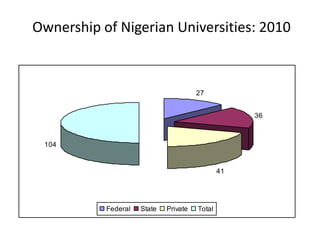
development of commerce,
health services, engineering
and administration, long
before the Nigerian nation
was born.
•   From the 1860’s “local
    merchants, and mainly
    Sierra            Leonean
    immigrants in Lagos sent
    their children overseas,
    especially England to train
    as professionals.
The intention was to fulfill the
practical need for qualified
personnel in various fields of
endeavour and to grant the
merchants a competitive edge
in commerce and social
prestige for such families and
the individuals.
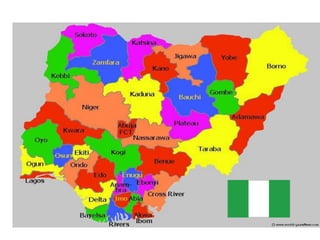
PROFILE OF NIGERIA
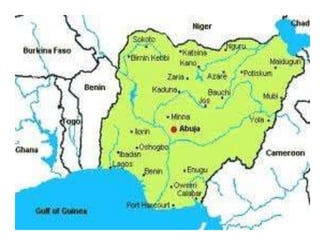
• Located in West Africa, bordering
  the Gulf of Guinea, Benin,
  Cameroon, Chad and Niger.
• Total Land Area – 923,768sq km
• Oil-Rich, with 37.2billion cu.m
  proven reserves
• Population – over 150million
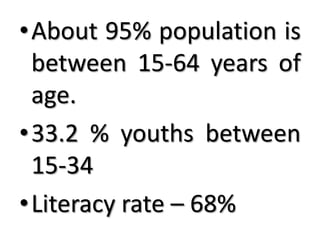
•About 95% population is
 between 15-64 years of
 age.
•33.2 % youths between
 15-34
•Literacy rate – 68%
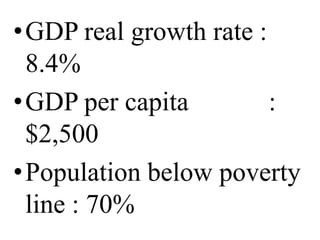
•GDP real growth rate :
 8.4%
•GDP per capita         :
 $2,500
•Population below poverty
 line : 70%
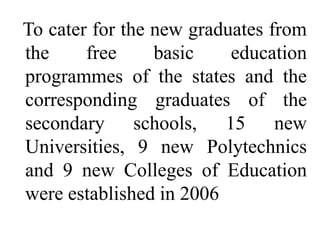
To cater for the new graduates from
the     free     basic    education
programmes of the states and the
corresponding graduates of the
secondary schools, 15 new
Universities, 9 new Polytechnics
and 9 new Colleges of Education
were established in 2006
In 2007, 1.37 million
students were enrolled
in     the    nation’s
Universities,
Polytechnics       and
Colleges of Education.
It is estimated that about 1.8
million new entrants from the
nation’s educational institutions
enter the labour market each
year,        resulting         in
unemployment                  and
underemployment.
In spite of the high
unemployment rate now
besieging University graduates
in Nigeria, there is an
unrelenting private or social
demand      for      University
education.
            - NISER (2004)
University Growth: 1930-2012
• 1930– Yaba        Medical School
  established to grant Diplomas and
  certificates.
• 1934—Yaba        Higher    College
  established
• 1949---The University College,
  Ibadan established
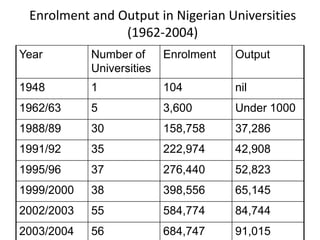
Enrolment and Output in Nigerian Universities
                (1962-2004)
Year        Number of      Enrolment   Output
            Universities
1948        1              104         nil
1962/63     5              3,600       Under 1000
1988/89     30             158,758     37,286
1991/92     35             222,974     42,908
1995/96     37             276,440     52,823
1999/2000   38             398,556     65,145
2002/2003   55             584,774     84,744
2003/2004   56             684,747     91,015
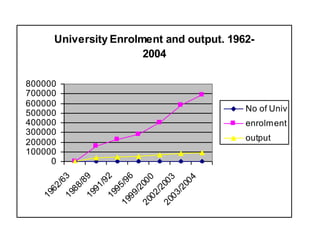
University Enrolment and output. 1962-
                      2004

800000
700000
600000
500000                                   No of Univ
400000                                   enrolment
300000
                                         output
200000
100000
     0
         3

                9

                       2

                             99 6

                             02 0

                             03 3

                                     4
      /6

             /8

                    /9

                                   /9

                           20 00

                           20 00

                                  00
     62

            88

                   91

                          95

                               /2

                               /2

                               /2
   19

          19

                 19

                        19
                           19
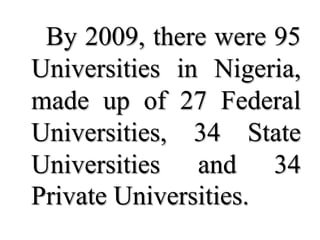
By 2009, there were 95
Universities in Nigeria,
made up of 27 Federal
Universities, 34 State
Universities and 34
Private Universities.
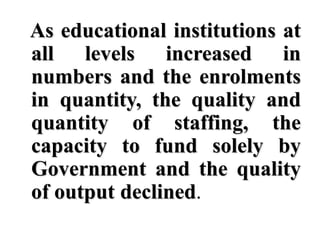
As educational institutions at
all levels increased in
numbers and the enrolments
in quantity, the quality and
quantity of staffing, the
capacity to fund solely by
Government and the quality
of output declined.
-
                                                                                                  10,000,000,000
                                                                                                                   12,000,000,000
                                                                                                                                    14,000,000,000


                                  2,000,000,000
                                                  4,000,000,000
                                                                  6,000,000,000
                                                                                  8,000,000,000
    UNIVERSITY OF IBADAN
     UNIVERSITY OF LAGOS
    UNIVERSITY OF NIGERIA…
          AHMADU BELLO…
      OBAFEMI AWOLOWO…
     UNIVERSITY OF BENIN
        UNIVERSITY OF JOS
   UNIVERSITY OF CALABAR
     UNIVERSITY OF ILORIN
     UNIVERSITY OF ABUJA
           UNIVERSITY OF…
           UNIVERSITY OF…
         MICHAEL OKPARA…
     UNIVERSITY OF PORT-…
                                                                                                                                                       Universities- 2011


       ABUBAKAR TAFAWA…
   FEDERAL UNIVERSITY OF…
   FEDERAL UNIVERSITY OF…
   FEDERAL UNIVERSITY OF…
   FEDERAL UNIVERSITY OF…
       UNIVERSITY OF UYO
UNIVERSITY OF MAIDUGURI
         NNAMDI AZIKIWE…
 BAYERO UNIVERSITY, KANO
        USMAN DANFODIO…
  FEDERAL UNIVERSITIES OF…
                                                                                                                                                     • Funding Pattern of Federal


NATIONAL OPEN UNIVERSITY
                        Series1
• The proliferation of Federal
  and State owned universities
  between 1975 and 1999 to meet
  increasing demand from the
  teeming youth population led to
  great increase in enrolment
  figures of students, which in
  turn led to diminished resource
  allocation.
Path to Deregulation
•   Irregular University calendar
•   Militant unionism
•    Decaying infrastructure
•    Brain drain
•    Declining quality of education in the
    universities      called for new
    initiatives.
In     1993,     the    Federal
Government         passed    a
legislation    (the    National
Minimum       Standards    and
Establishments of Institutions
Amendment Decree) allowing
Private Institutions of higher
learning.
Deregulation
• Removal of ‘bridging’ subsidy
  from sale and supply
• Allowance of ‘market forces’ to
  determine price
• Absence of price fixing, control of
  supply and uniform pricing
• Cessation     or    stoppage     of
  Government monopoly
The ‘deregulation’ of the Higher
education sector in Nigeria in
real terms is a liberalisation of the
market by removing the rules that
constrain private participation but
retaining overall regulation of
standards and quality through the
National                Universities
Commission.
ADVANTAGES OF DEREGULATION
• Infusion of private capital
  and initiative
• Competition          among
  players.
• Increase in public access to
  services
Ownership of Nigerian Universities: 2010


                                       27


                                                    36


 104


                                               41


           Federal   State   Private   Total
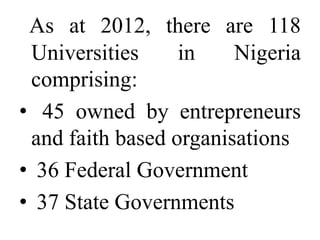
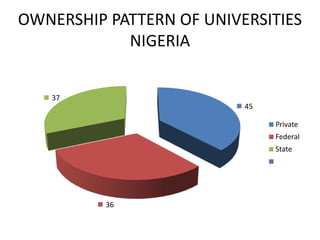
As at 2012, there are 118
 Universities     in    Nigeria
 comprising:
• 45 owned by entrepreneurs
 and faith based organisations
• 36 Federal Government
• 37 State Governments
OWNERSHIP PATTERN OF UNIVERSITIES
            NIGERIA


   37
                          45

                               Private
                               Federal
                               State


          36
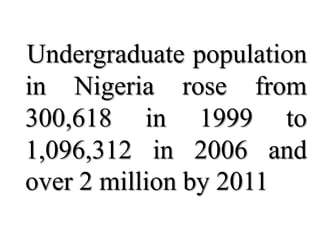
Undergraduate population
in Nigeria rose from
300,618 in 1999 to
1,096,312 in 2006 and
over 2 million by 2011
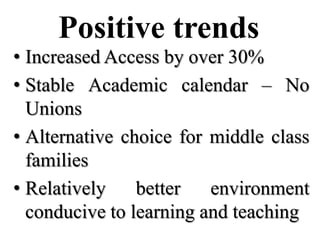
Positive trends
• Increased Access by over 30%
• Stable Academic calendar – No
  Unions
• Alternative choice for middle class
  families
• Relatively    better   environment
  conducive to learning and teaching
• Small population, hence more
  focussed on rich learning and
  teaching experience
• Higher moral tone in the faith
  based Institutions due to emphasis
  on     spirituality   and   moral
  counselling
• Healthy competition in the higher
  education sector
Challenges
•Management
•Quality
•Funding
MANAGEMENT CHALLENGES
• Infancy Stage, hence no established
  tradition of Governance, Management and
  Administration
• Micro management by the proprietor (s)
• Lack of respect for Governance structure
• Conflict between Management and
  Proprietors
• Lack of Appellate body for conflict
  resolution
Challenges of quality : Students
• Poor quality applicants
• Challenges of academic performance
• Pressure on maintenance of high
  enrolment and low drop out rate for
  financial reasons
• Challenge of discipline vis-a-vis
  personal freedom
Coping strategy
• Strong remedial teaching
• Smaller classes / higher contact rate
  through tutorials, make-up classes
  for slow students
• Emphasis on proactive measures
  against institutional cultures that
  alienate students or are detrimental
  to student performance
Challenge of Quality : Staff
• Low standard of available
  faculty
• High rate of adjunct and Part
  time Faculty
• Low     research     capability/
  output
• Lack of job security
Coping strategy
• Reliance on adjunct, visiting and
  part time staff from neighbouring
  institutions
• Strong linkage with overseas
  partners/ faith institutions
• Development of ‘own’ core staff
  through retaining and training fresh
  graduates
• ‘Poaching’ with incentives
• Strong Quality Assurance
  and Peer review
  Directorates
• Mentoring and Coaching
  by Senior Academics
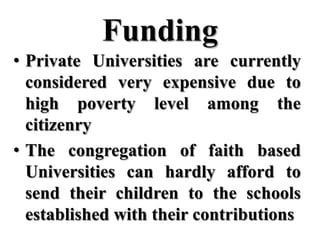
Funding
• Private Universities are currently
  considered very expensive due to
  high poverty level among the
  citizenry
• The congregation of faith based
  Universities can hardly afford to
  send their children to the schools
  established with their contributions
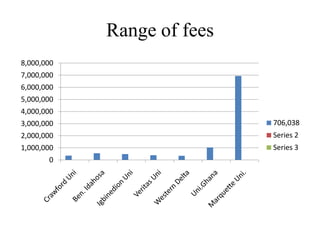
Range of fees
8,000,000
7,000,000
6,000,000
5,000,000
4,000,000
3,000,000                   706,038
2,000,000                   Series 2
1,000,000                   Series 3
       0
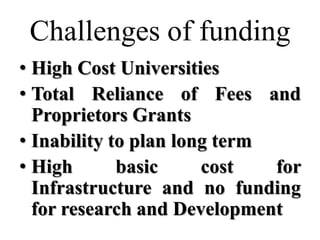
Challenges of funding
• High Cost Universities
• Total Reliance of Fees and
  Proprietors Grants
• Inability to plan long term
• High       basic     cost   for
  Infrastructure and no funding
  for research and Development
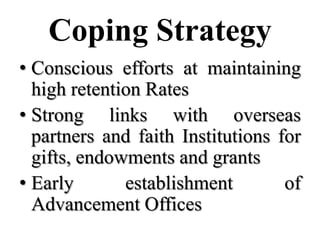
Coping Strategy
• Conscious efforts at maintaining
  high retention Rates
• Strong links with overseas
  partners and faith Institutions for
  gifts, endowments and grants
• Early       establishment        of
  Advancement Offices
•Focussed and     dedicated
 cultivation of    potential
 donors
•Business         strategies
 applied to       academic
 decisions
• Long Term Investment in
  Ventures
• Business partnering/ Stand alone
  to provide continuous flow of
  funds. E.g. Printing Press, Feeder
  Schools,                     Petrol
  Stations,             Agricultural
  Ventures, Hotels and Resorts.
The Future
• The advent of private incursion has
  changed the Higher Education
  landscape
• Some Casualties definitely expected
  like all business ventures
• Over time, greater collaboration
  between      Public    and  private
  Institutions envisaged.

209 - Deregulation HE in a Developing Country

  • 1.
    Deregulation & Higher Educationin a Developing Country The Challenge of Funding & Managing Private Universities in Nigeria By Mojisola Ladipo, mni
  • 2.
    Outline • Historical Backgroundto University Education in Nigeria • The Country Nigeria : Profile • Deregulation: Pathway to the Emergence of Private Universities in Nigeria • The Challenges • The Future
  • 3.
    Background to University Education The aspirations of Nigerians for higher education for the production and development of human resources is older than the history of tertiary education in Nigeria.
  • 4.
    Its origin isrooted in the aspirations of Nigerians to be active players in the development of commerce, health services, engineering and administration, long before the Nigerian nation was born.
  • 5.
    From the 1860’s “local merchants, and mainly Sierra Leonean immigrants in Lagos sent their children overseas, especially England to train as professionals.
  • 6.
    The intention wasto fulfill the practical need for qualified personnel in various fields of endeavour and to grant the merchants a competitive edge in commerce and social prestige for such families and the individuals.
  • 8.
    PROFILE OF NIGERIA •Located in West Africa, bordering the Gulf of Guinea, Benin, Cameroon, Chad and Niger. • Total Land Area – 923,768sq km • Oil-Rich, with 37.2billion cu.m proven reserves • Population – over 150million
  • 10.
    •About 95% populationis between 15-64 years of age. •33.2 % youths between 15-34 •Literacy rate – 68%
  • 11.
    •GDP real growthrate : 8.4% •GDP per capita : $2,500 •Population below poverty line : 70%
  • 12.
    To cater forthe new graduates from the free basic education programmes of the states and the corresponding graduates of the secondary schools, 15 new Universities, 9 new Polytechnics and 9 new Colleges of Education were established in 2006
  • 13.
    In 2007, 1.37million students were enrolled in the nation’s Universities, Polytechnics and Colleges of Education.
  • 14.
    It is estimatedthat about 1.8 million new entrants from the nation’s educational institutions enter the labour market each year, resulting in unemployment and underemployment.
  • 15.
    In spite ofthe high unemployment rate now besieging University graduates in Nigeria, there is an unrelenting private or social demand for University education. - NISER (2004)
  • 16.
    University Growth: 1930-2012 •1930– Yaba Medical School established to grant Diplomas and certificates. • 1934—Yaba Higher College established • 1949---The University College, Ibadan established
  • 17.
    Enrolment and Outputin Nigerian Universities (1962-2004) Year Number of Enrolment Output Universities 1948 1 104 nil 1962/63 5 3,600 Under 1000 1988/89 30 158,758 37,286 1991/92 35 222,974 42,908 1995/96 37 276,440 52,823 1999/2000 38 398,556 65,145 2002/2003 55 584,774 84,744 2003/2004 56 684,747 91,015
  • 18.
    University Enrolment andoutput. 1962- 2004 800000 700000 600000 500000 No of Univ 400000 enrolment 300000 output 200000 100000 0 3 9 2 99 6 02 0 03 3 4 /6 /8 /9 /9 20 00 20 00 00 62 88 91 95 /2 /2 /2 19 19 19 19 19
  • 19.
    By 2009, therewere 95 Universities in Nigeria, made up of 27 Federal Universities, 34 State Universities and 34 Private Universities.
  • 20.
    As educational institutionsat all levels increased in numbers and the enrolments in quantity, the quality and quantity of staffing, the capacity to fund solely by Government and the quality of output declined.
  • 21.
    - 10,000,000,000 12,000,000,000 14,000,000,000 2,000,000,000 4,000,000,000 6,000,000,000 8,000,000,000 UNIVERSITY OF IBADAN UNIVERSITY OF LAGOS UNIVERSITY OF NIGERIA… AHMADU BELLO… OBAFEMI AWOLOWO… UNIVERSITY OF BENIN UNIVERSITY OF JOS UNIVERSITY OF CALABAR UNIVERSITY OF ILORIN UNIVERSITY OF ABUJA UNIVERSITY OF… UNIVERSITY OF… MICHAEL OKPARA… UNIVERSITY OF PORT-… Universities- 2011 ABUBAKAR TAFAWA… FEDERAL UNIVERSITY OF… FEDERAL UNIVERSITY OF… FEDERAL UNIVERSITY OF… FEDERAL UNIVERSITY OF… UNIVERSITY OF UYO UNIVERSITY OF MAIDUGURI NNAMDI AZIKIWE… BAYERO UNIVERSITY, KANO USMAN DANFODIO… FEDERAL UNIVERSITIES OF… • Funding Pattern of Federal NATIONAL OPEN UNIVERSITY Series1
  • 22.
    • The proliferationof Federal and State owned universities between 1975 and 1999 to meet increasing demand from the teeming youth population led to great increase in enrolment figures of students, which in turn led to diminished resource allocation.
  • 23.
    Path to Deregulation • Irregular University calendar • Militant unionism • Decaying infrastructure • Brain drain • Declining quality of education in the universities called for new initiatives.
  • 24.
    In 1993, the Federal Government passed a legislation (the National Minimum Standards and Establishments of Institutions Amendment Decree) allowing Private Institutions of higher learning.
  • 25.
    Deregulation • Removal of‘bridging’ subsidy from sale and supply • Allowance of ‘market forces’ to determine price • Absence of price fixing, control of supply and uniform pricing • Cessation or stoppage of Government monopoly
  • 26.
    The ‘deregulation’ ofthe Higher education sector in Nigeria in real terms is a liberalisation of the market by removing the rules that constrain private participation but retaining overall regulation of standards and quality through the National Universities Commission.
  • 27.
    ADVANTAGES OF DEREGULATION •Infusion of private capital and initiative • Competition among players. • Increase in public access to services
  • 28.
    Ownership of NigerianUniversities: 2010 27 36 104 41 Federal State Private Total
  • 29.
    As at 2012,there are 118 Universities in Nigeria comprising: • 45 owned by entrepreneurs and faith based organisations • 36 Federal Government • 37 State Governments
  • 30.
    OWNERSHIP PATTERN OFUNIVERSITIES NIGERIA 37 45 Private Federal State 36
  • 31.
    Undergraduate population in Nigeriarose from 300,618 in 1999 to 1,096,312 in 2006 and over 2 million by 2011
  • 32.
    Positive trends • IncreasedAccess by over 30% • Stable Academic calendar – No Unions • Alternative choice for middle class families • Relatively better environment conducive to learning and teaching
  • 33.
    • Small population,hence more focussed on rich learning and teaching experience • Higher moral tone in the faith based Institutions due to emphasis on spirituality and moral counselling • Healthy competition in the higher education sector
  • 34.
  • 35.
    MANAGEMENT CHALLENGES • InfancyStage, hence no established tradition of Governance, Management and Administration • Micro management by the proprietor (s) • Lack of respect for Governance structure • Conflict between Management and Proprietors • Lack of Appellate body for conflict resolution
  • 36.
    Challenges of quality: Students • Poor quality applicants • Challenges of academic performance • Pressure on maintenance of high enrolment and low drop out rate for financial reasons • Challenge of discipline vis-a-vis personal freedom
  • 37.
    Coping strategy • Strongremedial teaching • Smaller classes / higher contact rate through tutorials, make-up classes for slow students • Emphasis on proactive measures against institutional cultures that alienate students or are detrimental to student performance
  • 38.
    Challenge of Quality: Staff • Low standard of available faculty • High rate of adjunct and Part time Faculty • Low research capability/ output • Lack of job security
  • 39.
    Coping strategy • Relianceon adjunct, visiting and part time staff from neighbouring institutions • Strong linkage with overseas partners/ faith institutions • Development of ‘own’ core staff through retaining and training fresh graduates
  • 40.
    • ‘Poaching’ withincentives • Strong Quality Assurance and Peer review Directorates • Mentoring and Coaching by Senior Academics
  • 41.
    Funding • Private Universitiesare currently considered very expensive due to high poverty level among the citizenry • The congregation of faith based Universities can hardly afford to send their children to the schools established with their contributions
  • 42.
    Range of fees 8,000,000 7,000,000 6,000,000 5,000,000 4,000,000 3,000,000 706,038 2,000,000 Series 2 1,000,000 Series 3 0
  • 43.
    Challenges of funding •High Cost Universities • Total Reliance of Fees and Proprietors Grants • Inability to plan long term • High basic cost for Infrastructure and no funding for research and Development
  • 44.
    Coping Strategy • Consciousefforts at maintaining high retention Rates • Strong links with overseas partners and faith Institutions for gifts, endowments and grants • Early establishment of Advancement Offices
  • 45.
    •Focussed and dedicated cultivation of potential donors •Business strategies applied to academic decisions
  • 46.
    • Long TermInvestment in Ventures • Business partnering/ Stand alone to provide continuous flow of funds. E.g. Printing Press, Feeder Schools, Petrol Stations, Agricultural Ventures, Hotels and Resorts.
  • 47.
    The Future • Theadvent of private incursion has changed the Higher Education landscape • Some Casualties definitely expected like all business ventures • Over time, greater collaboration between Public and private Institutions envisaged.