BY
AHMAD ALIYU PALLADAN
EDUCATION INDUSTRY IN
NIGERIA: ISSUES AND
CHALLENGES
NIGERIA: A GENERAL
OVERVIEW
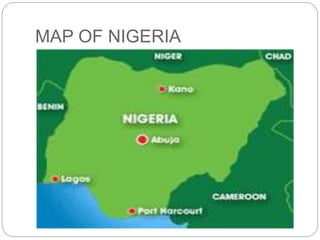
 GEOGRAPHY: Nigeria is located in the West
African region and lies between longitudes 3
degrees and 14 degrees and latitudes 4 degrees
and 14 degrees. It has a land mass of 923,768
sq.km. It is bordered to the north by the Republics
of Niger and Chad; it shares borders to the west
with the Republic of Benin, while the Republic of
Cameroun shares the eastern borders right down
to the shores of the Atlantic Ocean which forms
the southern limits of Nigerian Territory. The
coastline border is 800 Km long.
 POPULATION: Nigerian population is estimated to
be at 174 Million as at January, 2015. Nigeria is the
most populous country in Africa and equally 7th most
populous on earth. Nigeria has one of the largest
population of youths in the world (CIA factbook,
2013).
 Nigeria is the most populous black nation on earth.
 The country’s major tribes are Hausa, Yoruba and
Ibo . English is the official language in Nigeria.
Arabic is another popular language spoken is,
especially in the northern part of the country.
 Nigeria is a multi-religious country. 50% of the
population practices Islam while the remaining
practices Christianity and other traditional religious
(Mapsofworld, 2015).
 Nigeria has 36 states plus a Federal Capital
Territory (FCT). Nigeria has 772 local government
areas.
 The most populous state is Lagos, seconded by
Kano, and Kaduna being the third (National Census,
2006).
 POLITICAL: Nigeria got it independence from
Britain on 1st October 1960.
 Nigeria is multi- party democratic state.
 The dominant political parties in the country are
All People Congress (APC) and the People
Democratic Party (PDP)
 The current president of Nigeria is Muhammad
Buhari who was elected on the platform of the
APC on 28 March, 2015.
 ECONOMY: In 2014, opined Aljazeera (2014) and
Bloomberg (2014), Nigeria's economy (GDP)
became the largest in Africa, with more than $500
billion. This overtook that of South Africa, hence
become the 21st largest economy in the world
(Aljazeera; Blomberg, 2014). This majorily
attributed to its vast reserve of oil and gas.
 NOTE: Gross Domestic Product is different from
Per capita income. Nigerian per capita is not
commensurable with its GDP.
MAP OF NIGERIA
NIGERIAN EDUCATIONAL
INDUSTRY
 WESTERN EDUCATION IN NIGERIA DURING
COLONIALISM: Western Education was
introduced into Nigeria in the 1840s. It began in
Lagos, Calabar and other coastal areas. In a few
decades schooling in English language gradually
took roots in Nigeria. During the Colonial years,
Great Britain did not promote education. The
British colonial government only funded a few
schools.
 Schools were set up and operated by Christian
Missionaries. The policy of the colonial
government then was to give grant to mission
schools rather than expand the system.
EDUCATION IN CONTEMPORARY NIGERIA:
• The literacy rate for 15-24 year olds is 72.1%, just
11 % higher to the adult rate, which is 61.3%. The
total enrolment ratio at secondary schools level is
just 44% or 21% points below the global average,
but four higher than the African Sub-Saharan
average, while the lower secondary ratio is just 47
percent versus a global average of 82 percent
(Wenr, 2013).
• CATEGORY OF SCHOOLS IN NIGERIAN
EDUCATIONAL SYSTEM: The education system is
divided into three categories:
i. Primary education
ii. Secondary education
iii. Tertiary education
TERTIARY EDUCATION IN
NIGERIA
• Nigeria operates binary system of tertiary education.
• The government has majority control of university
education. Nigeria has a total number of 129
universities registered by the NUC among which
federal and state government own 40 and 39
respectively while 50 universities are privately owned
(NUC, 2015).
REQUIREMENT FOR ENTRY INTO NIGERIA
UNIVERSITIES:
• First year entry requirements into most universities in
Nigeria include: Minimum of SSCE/GCE Ordinary
Level Credits at maximum of two sittings; Minimum
cut-off marks in Joint Admission and Matriculation
Board Entrance Examination (JAMB) of 180 and
above out of a maximum of 400 marks are required
(JAMB,2015).
 Candidates with minimum of Merit Pass in
National Certificate of Education (NCE), National
Diploma (ND) and other Advanced Level
Certificates minimum qualifications with minimum
of 5 O/L Credits are given direct entry admission
into the appropriate undergraduate degree
programs. (The five credits most include English
and Mathematics).
 Students normally enter university from age of 18
onwards, and study for an academic degree.
 Just of recent there is issue of another exams
that universities compel prospective students to
take and pass before they could be admitted. Its
regarded as Post UTME exams. Each university
organize its own, and its mostly in electronic
format.
OTHER TERTIARY
INSTITUTIONS:
 Polytechnics : There are 126 polytechnics in
Nigeria. 41 belongs to federal government, 21
owned by state government and 61 owned by
private individuals and organizations
(NBTE,2015).
 Colleges of education: The mandates of these
institutions is to train teachers that will teach in
primary and lower secondary schools. There are
total of 83 colleges of education in Nigeria both
federal, state and private (NCCE, 2015).
 The last category at this juncture are the
monotechnics. They are numbered at 248 both
federal, state owned and private as at January,
2015. (NBTE, 2015).
MAIN CHALLENGES BEDEVILLING
HEIs IN NIGERIA
 Accessibility: The word “access” implies making it
possible for every child of school age to receive
school education.
 Dada (2004) and Tonwe (2005) described access as
the right to get or receive formal education as distinct
from informal or outside school education, while the
United Nations Educational, Scientific and Cultural
Organization. (UNESCO, 2003) put “access in tertiary
education” to mean “ensuring equitable access to
tertiary education based on merit, capacity, effort and
perseverance”. In this connection, equity in education
implies ensuring that every segment of the civil
society receives its fair share of access to whatever
educational opportunities that are
provided (Ene, 2005).
 Steep competitions exist in the Nigerian
universities. Every year many candidates writes
the UTME exams but quite number of them are
not admitted (Patricia et al, 2012). The average
pass rate for UTME exams in the country is 60%.
 The failure of Nigeria’s education system to meet
increasing demand, along with the rapid increase
in the number of families that can afford to send
their children overseas are the main drivers of
academic mobility out of Nigeria (UNESCO,
2012).
NB: Accessibility is one of the most
disturbing challenge in Nigerian tertiary
education system presently.
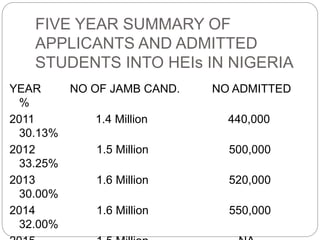
FIVE YEAR SUMMARY OF
APPLICANTS AND ADMITTED
STUDENTS INTO HEIs IN NIGERIA
YEAR NO OF JAMB CAND. NO ADMITTED
%
2011 1.4 Million 440,000
30.13%
2012 1.5 Million 500,000
33.25%
2013 1.6 Million 520,000
30.00%
2014 1.6 Million 550,000
32.00%
BUT WHY???!!!
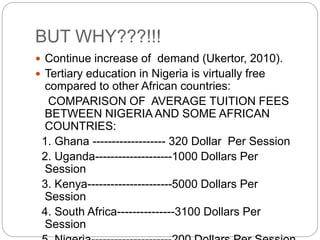
 Continue increase of demand (Ukertor, 2010).
 Tertiary education in Nigeria is virtually free
compared to other African countries:
COMPARISON OF AVERAGE TUITION FEES
BETWEEN NIGERIA AND SOME AFRICAN
COUNTRIES:
1. Ghana ------------------- 320 Dollar Per Session
2. Uganda--------------------1000 Dollars Per
Session
3. Kenya----------------------5000 Dollars Per
Session
4. South Africa---------------3100 Dollars Per
Session
 Much of the students prefer public universities to
private due high tuition fees charged by the
private universities. Public universities admits
more 90% of the studnets every year.
 Insufficient funding. Nigerian budget on
education ranges from 15 to 17% only which is
less than 27% as recommended by the United
Nation.
 Carrying capacity has not been consistent with
demand.
SOME STEPS TAKING TO REMEDY
THE PROBLEM
 Licensing of private universities
 Establishment of new universities
 Expansion of the exiting universities through
massive recruitment and training of academic
staff both within and outside the country
 Affiliating non degree awarding institutions with
degree awarding institutions.
 Increase of middle class that has been on the
surge within the past 10 years or so also leads to
sending of many children overseas
• Creation of TETFUND
STUDYING OUTSIDE THE COUNTRY:
 The number of Nigerian students at overseas
institutions of education grew to 71% between 2007
and 2010 alone (UNESCO, 2012).
 The UK has been a favourite destination for Nigerian
students overseas, with numbers surging in recent
years from 11,785 in 2008 to 17,620 in 2012,
according to recent data from Britain’s Higher
Education Statistics Agency (HESA, 2013).
 On the other hand, the US is the second popular
destination, with enrolment of Nigerian students of
3,820 in year 2000/01 and over 7,000 in 2011/12
 Other countries includes: Ghana, South Africa,
Ukraine, Malaysia etc.
ALHAMDULILLAH
THANK YOU ALL

Strategic Magement Practices (Education Industry in Nigeria)

  • 1.
    BY AHMAD ALIYU PALLADAN EDUCATIONINDUSTRY IN NIGERIA: ISSUES AND CHALLENGES
  • 2.
    NIGERIA: A GENERAL OVERVIEW GEOGRAPHY: Nigeria is located in the West African region and lies between longitudes 3 degrees and 14 degrees and latitudes 4 degrees and 14 degrees. It has a land mass of 923,768 sq.km. It is bordered to the north by the Republics of Niger and Chad; it shares borders to the west with the Republic of Benin, while the Republic of Cameroun shares the eastern borders right down to the shores of the Atlantic Ocean which forms the southern limits of Nigerian Territory. The coastline border is 800 Km long.
  • 3.
     POPULATION: Nigerianpopulation is estimated to be at 174 Million as at January, 2015. Nigeria is the most populous country in Africa and equally 7th most populous on earth. Nigeria has one of the largest population of youths in the world (CIA factbook, 2013).  Nigeria is the most populous black nation on earth.  The country’s major tribes are Hausa, Yoruba and Ibo . English is the official language in Nigeria. Arabic is another popular language spoken is, especially in the northern part of the country.  Nigeria is a multi-religious country. 50% of the population practices Islam while the remaining practices Christianity and other traditional religious (Mapsofworld, 2015).  Nigeria has 36 states plus a Federal Capital Territory (FCT). Nigeria has 772 local government areas.  The most populous state is Lagos, seconded by Kano, and Kaduna being the third (National Census, 2006).
  • 4.
     POLITICAL: Nigeriagot it independence from Britain on 1st October 1960.  Nigeria is multi- party democratic state.  The dominant political parties in the country are All People Congress (APC) and the People Democratic Party (PDP)  The current president of Nigeria is Muhammad Buhari who was elected on the platform of the APC on 28 March, 2015.  ECONOMY: In 2014, opined Aljazeera (2014) and Bloomberg (2014), Nigeria's economy (GDP) became the largest in Africa, with more than $500 billion. This overtook that of South Africa, hence become the 21st largest economy in the world (Aljazeera; Blomberg, 2014). This majorily attributed to its vast reserve of oil and gas.
  • 5.
     NOTE: GrossDomestic Product is different from Per capita income. Nigerian per capita is not commensurable with its GDP.
  • 6.
  • 7.
    NIGERIAN EDUCATIONAL INDUSTRY  WESTERNEDUCATION IN NIGERIA DURING COLONIALISM: Western Education was introduced into Nigeria in the 1840s. It began in Lagos, Calabar and other coastal areas. In a few decades schooling in English language gradually took roots in Nigeria. During the Colonial years, Great Britain did not promote education. The British colonial government only funded a few schools.  Schools were set up and operated by Christian Missionaries. The policy of the colonial government then was to give grant to mission schools rather than expand the system.
  • 8.
    EDUCATION IN CONTEMPORARYNIGERIA: • The literacy rate for 15-24 year olds is 72.1%, just 11 % higher to the adult rate, which is 61.3%. The total enrolment ratio at secondary schools level is just 44% or 21% points below the global average, but four higher than the African Sub-Saharan average, while the lower secondary ratio is just 47 percent versus a global average of 82 percent (Wenr, 2013). • CATEGORY OF SCHOOLS IN NIGERIAN EDUCATIONAL SYSTEM: The education system is divided into three categories: i. Primary education ii. Secondary education iii. Tertiary education
  • 9.
    TERTIARY EDUCATION IN NIGERIA •Nigeria operates binary system of tertiary education. • The government has majority control of university education. Nigeria has a total number of 129 universities registered by the NUC among which federal and state government own 40 and 39 respectively while 50 universities are privately owned (NUC, 2015). REQUIREMENT FOR ENTRY INTO NIGERIA UNIVERSITIES: • First year entry requirements into most universities in Nigeria include: Minimum of SSCE/GCE Ordinary Level Credits at maximum of two sittings; Minimum cut-off marks in Joint Admission and Matriculation Board Entrance Examination (JAMB) of 180 and above out of a maximum of 400 marks are required (JAMB,2015).
  • 10.
     Candidates withminimum of Merit Pass in National Certificate of Education (NCE), National Diploma (ND) and other Advanced Level Certificates minimum qualifications with minimum of 5 O/L Credits are given direct entry admission into the appropriate undergraduate degree programs. (The five credits most include English and Mathematics).  Students normally enter university from age of 18 onwards, and study for an academic degree.  Just of recent there is issue of another exams that universities compel prospective students to take and pass before they could be admitted. Its regarded as Post UTME exams. Each university organize its own, and its mostly in electronic format.
  • 11.
    OTHER TERTIARY INSTITUTIONS:  Polytechnics: There are 126 polytechnics in Nigeria. 41 belongs to federal government, 21 owned by state government and 61 owned by private individuals and organizations (NBTE,2015).  Colleges of education: The mandates of these institutions is to train teachers that will teach in primary and lower secondary schools. There are total of 83 colleges of education in Nigeria both federal, state and private (NCCE, 2015).  The last category at this juncture are the monotechnics. They are numbered at 248 both federal, state owned and private as at January, 2015. (NBTE, 2015).
  • 12.
    MAIN CHALLENGES BEDEVILLING HEIsIN NIGERIA  Accessibility: The word “access” implies making it possible for every child of school age to receive school education.  Dada (2004) and Tonwe (2005) described access as the right to get or receive formal education as distinct from informal or outside school education, while the United Nations Educational, Scientific and Cultural Organization. (UNESCO, 2003) put “access in tertiary education” to mean “ensuring equitable access to tertiary education based on merit, capacity, effort and perseverance”. In this connection, equity in education implies ensuring that every segment of the civil society receives its fair share of access to whatever educational opportunities that are provided (Ene, 2005).
  • 13.
     Steep competitionsexist in the Nigerian universities. Every year many candidates writes the UTME exams but quite number of them are not admitted (Patricia et al, 2012). The average pass rate for UTME exams in the country is 60%.  The failure of Nigeria’s education system to meet increasing demand, along with the rapid increase in the number of families that can afford to send their children overseas are the main drivers of academic mobility out of Nigeria (UNESCO, 2012). NB: Accessibility is one of the most disturbing challenge in Nigerian tertiary education system presently.
  • 14.
    FIVE YEAR SUMMARYOF APPLICANTS AND ADMITTED STUDENTS INTO HEIs IN NIGERIA YEAR NO OF JAMB CAND. NO ADMITTED % 2011 1.4 Million 440,000 30.13% 2012 1.5 Million 500,000 33.25% 2013 1.6 Million 520,000 30.00% 2014 1.6 Million 550,000 32.00%
  • 15.
    BUT WHY???!!!  Continueincrease of demand (Ukertor, 2010).  Tertiary education in Nigeria is virtually free compared to other African countries: COMPARISON OF AVERAGE TUITION FEES BETWEEN NIGERIA AND SOME AFRICAN COUNTRIES: 1. Ghana ------------------- 320 Dollar Per Session 2. Uganda--------------------1000 Dollars Per Session 3. Kenya----------------------5000 Dollars Per Session 4. South Africa---------------3100 Dollars Per Session
  • 16.
     Much ofthe students prefer public universities to private due high tuition fees charged by the private universities. Public universities admits more 90% of the studnets every year.  Insufficient funding. Nigerian budget on education ranges from 15 to 17% only which is less than 27% as recommended by the United Nation.  Carrying capacity has not been consistent with demand.
  • 17.
    SOME STEPS TAKINGTO REMEDY THE PROBLEM  Licensing of private universities  Establishment of new universities  Expansion of the exiting universities through massive recruitment and training of academic staff both within and outside the country  Affiliating non degree awarding institutions with degree awarding institutions.  Increase of middle class that has been on the surge within the past 10 years or so also leads to sending of many children overseas • Creation of TETFUND
  • 18.
    STUDYING OUTSIDE THECOUNTRY:  The number of Nigerian students at overseas institutions of education grew to 71% between 2007 and 2010 alone (UNESCO, 2012).  The UK has been a favourite destination for Nigerian students overseas, with numbers surging in recent years from 11,785 in 2008 to 17,620 in 2012, according to recent data from Britain’s Higher Education Statistics Agency (HESA, 2013).  On the other hand, the US is the second popular destination, with enrolment of Nigerian students of 3,820 in year 2000/01 and over 7,000 in 2011/12  Other countries includes: Ghana, South Africa, Ukraine, Malaysia etc.
  • 19.