Index Terms— Leakage current, voltage drop, bipolar junction transistor, capacitor
discharge.
1. INTRODUCTION:
1.1 Semiconductor leaking problem:
Studies of aging behavior of transistors are never free from many of the confounding effects,
which tend to degrade measurement repeatability. The data from recent experiments indicate
that, generally, junction leakage current tends to decrease during early stages of aging. As
aging continues, or as aging stresses are increased, leakage current increases. For some
transistors, junction leakage currents are observed to increase from the beginning. It appears
that for these transistors, early increases in leakage current are a manifestation of a continuous
process during which leakage current continues to increase, leading eventually to device
"failure."
The fractional changes in leakage current of interest are relatively small, and therefore all
sources of variability in the measurement process are of concern. The inherent behavior of the
device itself is one such source, and in some instances is the major source of variability. The
measurement of transistor parameter values is not only dependent upon bias conditions and
ambient temperature, but upon the time duration of the measurement and upon the bias and
Paper Code is 208-EEI-49
A NEW TROPOLOGY FOR DETECTION OF THE LEAKAGE
CURRENT OF A BIPOLAR JUCTION TRANSISTOR
Anunita Biswas, Biswajit Khan, Promit Mukherjee
Ideal Institute of Engineering, Kalyani
Electronics Engineering Department 2nd
year
Abstract— Semiconductor leaking is a very known and serious problem for electronics
devices. A transistor conducts a small amount of current even when it is turned off.
This current is called leakage current of the bipolar junction transistor. In high
frequency circuit this type of leakage increases power consumption and if sufficiently
large can cause complete circuit failure. In order to avoid such consequences, here in
this paper a simple testing arrangement has been proposed, which is capable of
detecting the leakage current of a Bipolar Junction transistor.
temperature histories resulting from prior measurement and aging stresses. Transistor aging
studies in which every reasonable effort is being applied towards minimization of un- wanted
variability in the aging data through careful instrumentation, selection of test methods and
procedures, and design of experiments.
1.2 BJT leakage problem:
The whole of emitter current does not reach the collector. It is because a small percentage of
it, because of electron-hole combinations occurring in base area, gives rise to base current.
Moreover, as the collector-base junction is reversed biased, therefore, some leakage current
flows due to minority carriers. It follows therefore; the total collector current consists of
i)The part of emitter current which reaches the collector terminal i.e. E
ii) The leakage current I (leakage) .This current is due to the movement of minority carriers
across base-collector junction because of it being reverse biased. This is generally much
smaller than .(5)
So, total collector current IC = IE + ICBO
It is clear that, if IE = 0, ( i.e. emitter circuit is open ),a small leakage current still flows in
the collector circuit .
This ILEAKAGE is abbreviated as ICBO meaning collector-base current with emitter open.
IC = IE + ICBO ……………..(i)
Now, IE = IB + IC
SO, IC = (IB + IC) + ICBO
Or IC(1 – ) = IB + ICBO
Or IC = / (1 – ) IB + ICBO / (1 – ) ……… (ii)
IC = βIB + ICBO (1+β)
This is the leakage collector current and is denoted by ICBO .(2)
2. EXPLANATION
2.1. Measurement of leakage current
Ic = IB + ( Ico
Ic = Collector current.
IB = Base current.
Ico = Leakage current
= Transistor current gain.
2.2 Transistor leakage current testing prototype:
The leakage current of the transistor has the relation with its blocking loss. That means when a
transistor is off, the voltage across the collector-emitter of the transistor multiplied by the
collector current gives the blocking power loss of the transistor. Therefore the leakage current
of the transistor is also an important criterion for the selection of any particular transistor.
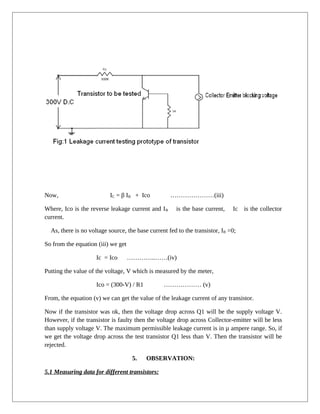
In the below fig. the prototype of the leakage current testing transistor is shown. The supply
to the prototype is kept 300 V as the input of the high frequency oscillator is near about 300V
d.c. therefore, the transistors have to withstand a voltage around 300 volt d.c. continuously.
The leakage current of transistors are generally in μ Amps range. The 1kΩ resistance is
connected to the base of the transistors to provide a path of reverse leakage current to flow.
Now, IC = β IB + Ico …………………(iii)
Where, Ico is the reverse leakage current and IB is the base current, Ic is the collector
current.
As, there is no voltage source, the base current fed to the transistor, IB =0;
So from the equation (iii) we get
Ic = Ico …………..……(iv)
Putting the value of the voltage, V which is measured by the meter,
Ico = (300-V) / R1 ……………… (v)
From, the equation (v) we can get the value of the leakage current of any transistor.
Now if the transistor was ok, then the voltage drop across Q1 will be the supply voltage V.
However, if the transistor is faulty then the voltage drop across Collector-emitter will be less
than supply voltage V. The maximum permissible leakage current is in µ ampere range. So, if
we get the voltage drop across the test transistor Q1 less than V. Then the transistor will be
rejected.
5. OBSERVATION:
5.1 Measuring data for different transistors:
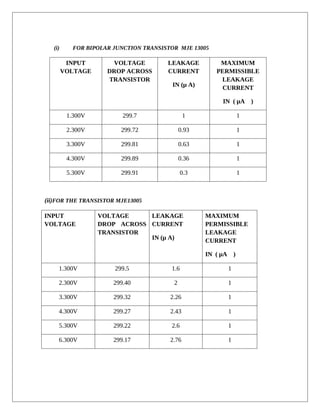
(i) FOR BIPOLAR JUNCTION TRANSISTOR MJE 13005
INPUT
VOLTAGE
VOLTAGE
DROP ACROSS
TRANSISTOR
LEAKAGE
CURRENT
IN (μ A)
MAXIMUM
PERMISSIBLE
LEAKAGE
CURRENT
IN ( μA )
1.300V 299.7 1 1
2.300V 299.72 0.93 1
3.300V 299.81 0.63 1
4.300V 299.89 0.36 1
5.300V 299.91 0.3 1
(ii)FOR THE TRANSISTOR MJE13005
INPUT
VOLTAGE
VOLTAGE
DROP ACROSS
TRANSISTOR
LEAKAGE
CURRENT
IN (μ A)
MAXIMUM
PERMISSIBLE
LEAKAGE
CURRENT
IN ( μA )
1.300V 299.5 1.6 1
2.300V 299.40 2 1
3.300V 299.32 2.26 1
4.300V 299.27 2.43 1
5.300V 299.22 2.6 1
6.300V 299.17 2.76 1
6. CONCLUSION:
From table (i) we can see that, power transistor which we have used in our experiment are
active, because there are very minor difference between the applied voltage and the transistor
voltage drop. But from table (ii) we can see that the difference between supply voltage and the
transistor voltage drop is more than previous data. From the measuring data(ii), we observed
that the output leakage current Ico is more than the permissible leakage current.(3) So these
are the faulty transistors which are not applicable in high frequency circuit , because due to
this leakage current, the transistor switching circuit could not be run perfectly, causing
switching loss and leading to circuit failure. So from the mathematical equation is as
following we can measured the leakage current from any amplifier. From, Ohms law we know
that V=IR, so as per follow this law we can write
[Supply voltage (V) -x] / R = leakage current
[Where x = the transistor voltage drop]
Therefore, from that calculation we can easily measure the leakage current.
REFERENCES:
(1) JOURNAL OF REASERCH of National Standered Bureau of Standered C.-
Engineering & Instrumentation Vol-69C No-4
(2) PRICIPLES OF ELECTRONICS –BY V K MAHTA.-From-‘BJT Amplifier’.
(3) ELECTRONIC CIRCUITS-BY –DONALD A NYMEN-FROM-‘Transistor
Amplifier’.
(4) D. SHIN, J. KIM, and S. LEE, “Low-energy intra-task voltage scheduling using
static timing analysis,”.
(5) www.wekipedia.org.-‘Bipolar Junction Transistor’

208-EEI-49

  • 1.
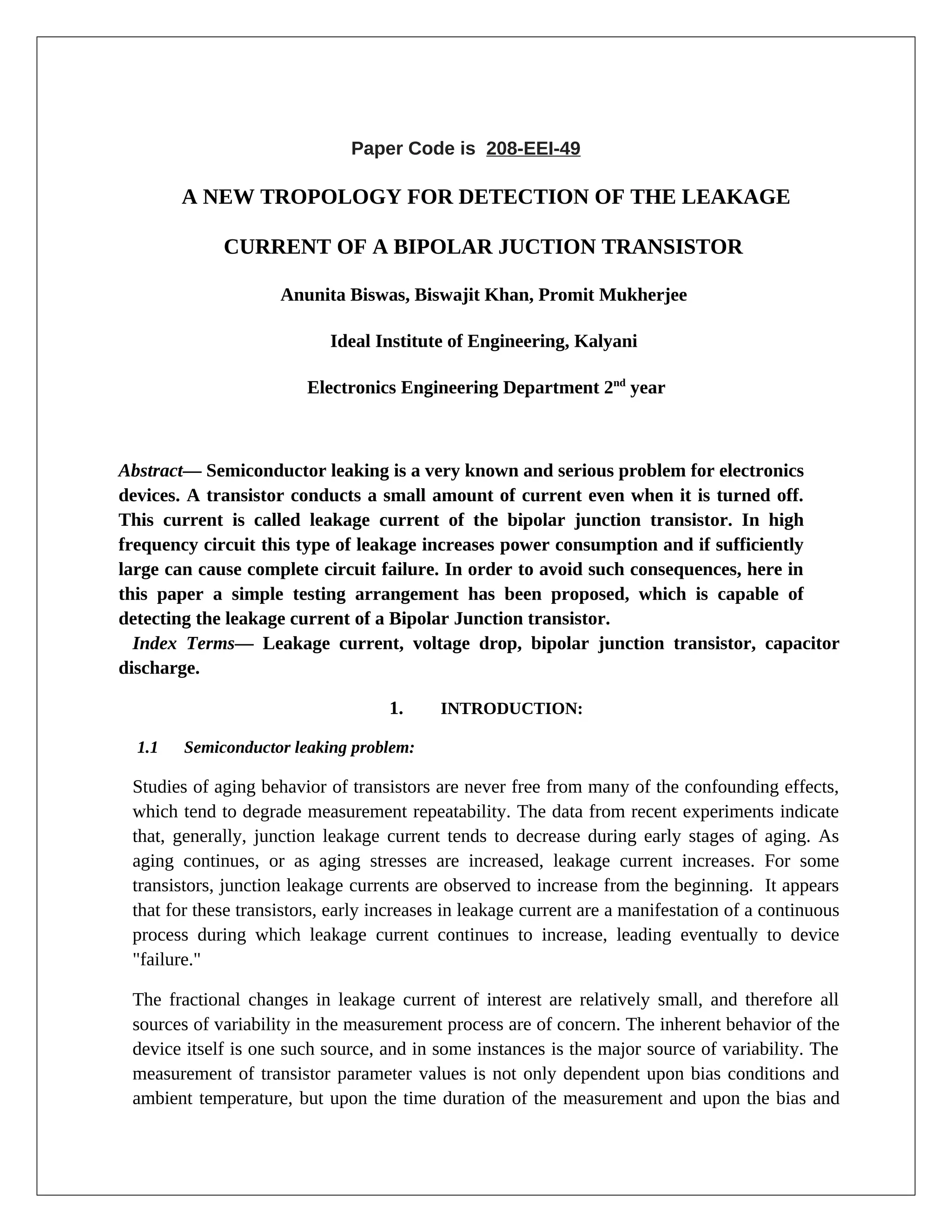
    Index Terms— Leakagecurrent, voltage drop, bipolar junction transistor, capacitor discharge. 1. INTRODUCTION: 1.1 Semiconductor leaking problem: Studies of aging behavior of transistors are never free from many of the confounding effects, which tend to degrade measurement repeatability. The data from recent experiments indicate that, generally, junction leakage current tends to decrease during early stages of aging. As aging continues, or as aging stresses are increased, leakage current increases. For some transistors, junction leakage currents are observed to increase from the beginning. It appears that for these transistors, early increases in leakage current are a manifestation of a continuous process during which leakage current continues to increase, leading eventually to device "failure." The fractional changes in leakage current of interest are relatively small, and therefore all sources of variability in the measurement process are of concern. The inherent behavior of the device itself is one such source, and in some instances is the major source of variability. The measurement of transistor parameter values is not only dependent upon bias conditions and ambient temperature, but upon the time duration of the measurement and upon the bias and Paper Code is 208-EEI-49 A NEW TROPOLOGY FOR DETECTION OF THE LEAKAGE CURRENT OF A BIPOLAR JUCTION TRANSISTOR Anunita Biswas, Biswajit Khan, Promit Mukherjee Ideal Institute of Engineering, Kalyani Electronics Engineering Department 2nd year Abstract— Semiconductor leaking is a very known and serious problem for electronics devices. A transistor conducts a small amount of current even when it is turned off. This current is called leakage current of the bipolar junction transistor. In high frequency circuit this type of leakage increases power consumption and if sufficiently large can cause complete circuit failure. In order to avoid such consequences, here in this paper a simple testing arrangement has been proposed, which is capable of detecting the leakage current of a Bipolar Junction transistor.
  • 2.
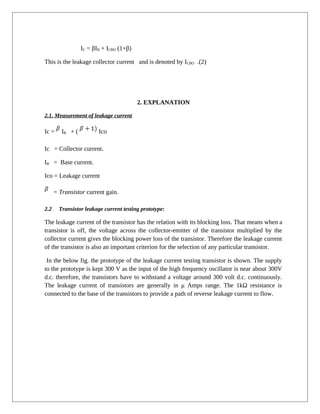
    temperature histories resultingfrom prior measurement and aging stresses. Transistor aging studies in which every reasonable effort is being applied towards minimization of un- wanted variability in the aging data through careful instrumentation, selection of test methods and procedures, and design of experiments. 1.2 BJT leakage problem: The whole of emitter current does not reach the collector. It is because a small percentage of it, because of electron-hole combinations occurring in base area, gives rise to base current. Moreover, as the collector-base junction is reversed biased, therefore, some leakage current flows due to minority carriers. It follows therefore; the total collector current consists of i)The part of emitter current which reaches the collector terminal i.e. E ii) The leakage current I (leakage) .This current is due to the movement of minority carriers across base-collector junction because of it being reverse biased. This is generally much smaller than .(5) So, total collector current IC = IE + ICBO It is clear that, if IE = 0, ( i.e. emitter circuit is open ),a small leakage current still flows in the collector circuit . This ILEAKAGE is abbreviated as ICBO meaning collector-base current with emitter open. IC = IE + ICBO ……………..(i) Now, IE = IB + IC SO, IC = (IB + IC) + ICBO Or IC(1 – ) = IB + ICBO Or IC = / (1 – ) IB + ICBO / (1 – ) ……… (ii)
  • 3.
    IC = βIB+ ICBO (1+β) This is the leakage collector current and is denoted by ICBO .(2) 2. EXPLANATION 2.1. Measurement of leakage current Ic = IB + ( Ico Ic = Collector current. IB = Base current. Ico = Leakage current = Transistor current gain. 2.2 Transistor leakage current testing prototype: The leakage current of the transistor has the relation with its blocking loss. That means when a transistor is off, the voltage across the collector-emitter of the transistor multiplied by the collector current gives the blocking power loss of the transistor. Therefore the leakage current of the transistor is also an important criterion for the selection of any particular transistor. In the below fig. the prototype of the leakage current testing transistor is shown. The supply to the prototype is kept 300 V as the input of the high frequency oscillator is near about 300V d.c. therefore, the transistors have to withstand a voltage around 300 volt d.c. continuously. The leakage current of transistors are generally in μ Amps range. The 1kΩ resistance is connected to the base of the transistors to provide a path of reverse leakage current to flow.
  • 4.
    Now, IC =β IB + Ico …………………(iii) Where, Ico is the reverse leakage current and IB is the base current, Ic is the collector current. As, there is no voltage source, the base current fed to the transistor, IB =0; So from the equation (iii) we get Ic = Ico …………..……(iv) Putting the value of the voltage, V which is measured by the meter, Ico = (300-V) / R1 ……………… (v) From, the equation (v) we can get the value of the leakage current of any transistor. Now if the transistor was ok, then the voltage drop across Q1 will be the supply voltage V. However, if the transistor is faulty then the voltage drop across Collector-emitter will be less than supply voltage V. The maximum permissible leakage current is in µ ampere range. So, if we get the voltage drop across the test transistor Q1 less than V. Then the transistor will be rejected. 5. OBSERVATION: 5.1 Measuring data for different transistors:
  • 5.
    (i) FOR BIPOLARJUNCTION TRANSISTOR MJE 13005 INPUT VOLTAGE VOLTAGE DROP ACROSS TRANSISTOR LEAKAGE CURRENT IN (μ A) MAXIMUM PERMISSIBLE LEAKAGE CURRENT IN ( μA ) 1.300V 299.7 1 1 2.300V 299.72 0.93 1 3.300V 299.81 0.63 1 4.300V 299.89 0.36 1 5.300V 299.91 0.3 1 (ii)FOR THE TRANSISTOR MJE13005 INPUT VOLTAGE VOLTAGE DROP ACROSS TRANSISTOR LEAKAGE CURRENT IN (μ A) MAXIMUM PERMISSIBLE LEAKAGE CURRENT IN ( μA ) 1.300V 299.5 1.6 1 2.300V 299.40 2 1 3.300V 299.32 2.26 1 4.300V 299.27 2.43 1 5.300V 299.22 2.6 1 6.300V 299.17 2.76 1
  • 6.
    6. CONCLUSION: From table(i) we can see that, power transistor which we have used in our experiment are active, because there are very minor difference between the applied voltage and the transistor voltage drop. But from table (ii) we can see that the difference between supply voltage and the transistor voltage drop is more than previous data. From the measuring data(ii), we observed that the output leakage current Ico is more than the permissible leakage current.(3) So these are the faulty transistors which are not applicable in high frequency circuit , because due to this leakage current, the transistor switching circuit could not be run perfectly, causing switching loss and leading to circuit failure. So from the mathematical equation is as following we can measured the leakage current from any amplifier. From, Ohms law we know that V=IR, so as per follow this law we can write [Supply voltage (V) -x] / R = leakage current [Where x = the transistor voltage drop] Therefore, from that calculation we can easily measure the leakage current. REFERENCES: (1) JOURNAL OF REASERCH of National Standered Bureau of Standered C.- Engineering & Instrumentation Vol-69C No-4 (2) PRICIPLES OF ELECTRONICS –BY V K MAHTA.-From-‘BJT Amplifier’. (3) ELECTRONIC CIRCUITS-BY –DONALD A NYMEN-FROM-‘Transistor Amplifier’. (4) D. SHIN, J. KIM, and S. LEE, “Low-energy intra-task voltage scheduling using static timing analysis,”. (5) www.wekipedia.org.-‘Bipolar Junction Transistor’