ADAPTED PHYSICAL 
EDUCATION 
April Wood 
ITEC 7530 
Georgia Southern University
What is Adapted Physical Education? 
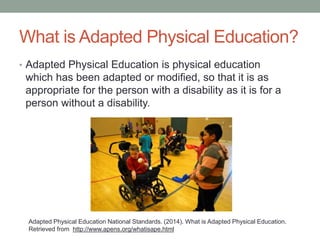
• Adapted Physical Education is physical education 
which has been adapted or modified, so that it is as 
appropriate for the person with a disability as it is for a 
person without a disability. 
Adapted Physical Education National Standards. (2014). What is Adapted Physical Education. 
Retrieved from http://www.apens.org/whatisape.html
Physical Education Development 
Federal law mandates that physical education be provided 
to students with disabilities and defines Physical Education 
as the development of: 
• Physical and motor skills 
• Fundamental motor skills and patterns (throwing, 
catching, walking, running, etc.) 
• Skills in aquatics, dance, and individual and group games 
and sports (including intramural and lifetime sports) 
Adapted Physical Education National Standards. (2014). What is Adapted Physical Education. 
Retrieved from http://www.apens.org/whatisape.html
Students with Learning Disabilities 
• These students will demand more of your time and 
patience 
• Require specialized instructional strategies in a structured 
environment that enhances their learning potential 
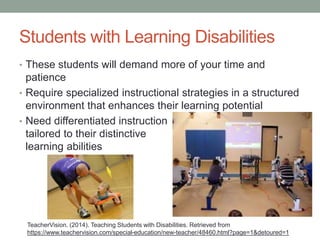
• Need differentiated instruction 
tailored to their distinctive 
learning abilities 
TeacherVision. (2014). Teaching Students with Disabilities. Retrieved from 
https://www.teachervision.com/special-education/new-teacher/48460.html?page=1&detoured=1
Physical Education for Learning Disabled 
• Provide oral instructions for tests and other reading 
materials for students with reading disabilities 
• Give immediate feedback for students to see the 
relationship between what was taught and what was 
learned 
• Make activities short and concise 
• Provide video and technology for instructions and 
demonstrations 
• Provide students with items they can touch, hear, smell, 
etc. 
TeacherVision. (2014). Teaching Students with Disabilities. Retrieved from 
https://www.teachervision.com/special-education/new-teacher/48460.html?page=1&detoured=1
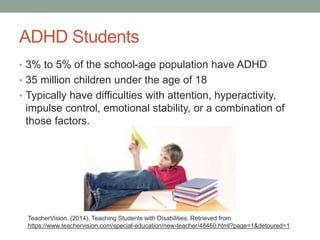
ADHD Students 
• 3% to 5% of the school-age population have ADHD 
• 35 million children under the age of 18 
• Typically have difficulties with attention, hyperactivity, 
impulse control, emotional stability, or a combination of 
those factors. 
TeacherVision. (2014). Teaching Students with Disabilities. Retrieved from 
https://www.teachervision.com/special-education/new-teacher/48460.html?page=1&detoured=1
ADHD Physical Education 
• Make your instructions brief and teach one step at a time 
• Carefully monitor work from one activity to another 
• Adjust work time so it matches attention spans 
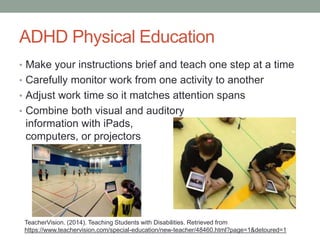
• Combine both visual and auditory 
information with iPads, 
computers, or projectors 
TeacherVision. (2014). Teaching Students with Disabilities. Retrieved from 
https://www.teachervision.com/special-education/new-teacher/48460.html?page=1&detoured=1
Students with Hearing Impairments 
• Hearing impairment may range from mildly impaired to 
total deafness. 
• Provide written, pictorial, and/or audiovisual directions 
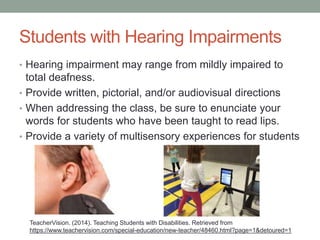
• When addressing the class, be sure to enunciate your 
words for students who have been taught to read lips. 
• Provide a variety of multisensory experiences for students 
TeacherVision. (2014). Teaching Students with Disabilities. Retrieved from 
https://www.teachervision.com/special-education/new-teacher/48460.html?page=1&detoured=1
Physical Education Resources 
• Adapt-Talk (http://www.lyris.sportime.com/adapt-talk-index. 
html) 
• Adapted Physical Education National Standards 
(www.apens.org) 
• Human Kinetics (http://www.humankinetics.com/) 
• National Consortium on Physical Education and Recreation 
for Individuals with Disabilities (http://www.ncpeid.org/) 
• PE Central (www.pecentral.org) 
• Special Olympics (http://www.specialolympics.org/)
Physical Education Resources 
• TeacherVision (www.teachervision.com) 
• Therapeutic Recreation 
(http://www.recreationtherapy.com/) 
• Thera-Talk (http://www.lyris.sportime.com/thera-talk-index. 
html)

Assistive Technology Presentation

  • 1.
    ADAPTED PHYSICAL EDUCATION April Wood ITEC 7530 Georgia Southern University
  • 2.
    What is AdaptedPhysical Education? • Adapted Physical Education is physical education which has been adapted or modified, so that it is as appropriate for the person with a disability as it is for a person without a disability. Adapted Physical Education National Standards. (2014). What is Adapted Physical Education. Retrieved from http://www.apens.org/whatisape.html
  • 3.
    Physical Education Development Federal law mandates that physical education be provided to students with disabilities and defines Physical Education as the development of: • Physical and motor skills • Fundamental motor skills and patterns (throwing, catching, walking, running, etc.) • Skills in aquatics, dance, and individual and group games and sports (including intramural and lifetime sports) Adapted Physical Education National Standards. (2014). What is Adapted Physical Education. Retrieved from http://www.apens.org/whatisape.html
  • 4.
    Students with LearningDisabilities • These students will demand more of your time and patience • Require specialized instructional strategies in a structured environment that enhances their learning potential • Need differentiated instruction tailored to their distinctive learning abilities TeacherVision. (2014). Teaching Students with Disabilities. Retrieved from https://www.teachervision.com/special-education/new-teacher/48460.html?page=1&detoured=1
  • 5.
    Physical Education forLearning Disabled • Provide oral instructions for tests and other reading materials for students with reading disabilities • Give immediate feedback for students to see the relationship between what was taught and what was learned • Make activities short and concise • Provide video and technology for instructions and demonstrations • Provide students with items they can touch, hear, smell, etc. TeacherVision. (2014). Teaching Students with Disabilities. Retrieved from https://www.teachervision.com/special-education/new-teacher/48460.html?page=1&detoured=1
  • 6.
    ADHD Students •3% to 5% of the school-age population have ADHD • 35 million children under the age of 18 • Typically have difficulties with attention, hyperactivity, impulse control, emotional stability, or a combination of those factors. TeacherVision. (2014). Teaching Students with Disabilities. Retrieved from https://www.teachervision.com/special-education/new-teacher/48460.html?page=1&detoured=1
  • 7.
    ADHD Physical Education • Make your instructions brief and teach one step at a time • Carefully monitor work from one activity to another • Adjust work time so it matches attention spans • Combine both visual and auditory information with iPads, computers, or projectors TeacherVision. (2014). Teaching Students with Disabilities. Retrieved from https://www.teachervision.com/special-education/new-teacher/48460.html?page=1&detoured=1
  • 8.
    Students with HearingImpairments • Hearing impairment may range from mildly impaired to total deafness. • Provide written, pictorial, and/or audiovisual directions • When addressing the class, be sure to enunciate your words for students who have been taught to read lips. • Provide a variety of multisensory experiences for students TeacherVision. (2014). Teaching Students with Disabilities. Retrieved from https://www.teachervision.com/special-education/new-teacher/48460.html?page=1&detoured=1
  • 9.
    Physical Education Resources • Adapt-Talk (http://www.lyris.sportime.com/adapt-talk-index. html) • Adapted Physical Education National Standards (www.apens.org) • Human Kinetics (http://www.humankinetics.com/) • National Consortium on Physical Education and Recreation for Individuals with Disabilities (http://www.ncpeid.org/) • PE Central (www.pecentral.org) • Special Olympics (http://www.specialolympics.org/)
  • 10.
    Physical Education Resources • TeacherVision (www.teachervision.com) • Therapeutic Recreation (http://www.recreationtherapy.com/) • Thera-Talk (http://www.lyris.sportime.com/thera-talk-index. html)

Editor's Notes

  • #3 References Adapted Physical Education National Standards. (2014). What is Adapted Physical Education. Retrieved from http://www.apens.org/whatisape.html
  • #4 References Adapted Physical Education National Standards. (2014). What is Adapted Physical Education. Retrieved from http://www.apens.org/whatisape.html
  • #5 References TeacherVision. (2014). Teaching Students with Disabilities. Retrieved from https://www.teachervision.com/special-education/new-teacher/48460.html?page=1&detoured=1
  • #6 References TeacherVision. (2014). Teaching Students with Disabilities. Retrieved from https://www.teachervision.com/special-education/new-teacher/48460.html?page=1&detoured=1
  • #7 References TeacherVision. (2014). Teaching Students with Disabilities. Retrieved from https://www.teachervision.com/special-education/new-teacher/48460.html?page=1&detoured=1
  • #8 References TeacherVision. (2014). Teaching Students with Disabilities. Retrieved from https://www.teachervision.com/special-education/new-teacher/48460.html?page=1&detoured=1
  • #9 References TeacherVision. (2014). Teaching Students with Disabilities. Retrieved from https://www.teachervision.com/special-education/new-teacher/48460.html?page=1&detoured=1
  • #11 References Adapted Physical Education National Standards. (2014). What is Adapted Physical Education. Retrieved from http://www.apens.org/whatisape.html PE Central. (2014). Differentiation Instruction for Students with Disabilities. Retrieved from http://www.pecentral.org/adapted/adaptedactivities.html TeacherVision. (2014). Teaching Students with Disabilities. Retrieved from https://www.teachervision.com/special-education/new-teacher/48460.html?page=1&detoured=1