COME321: Computer Organization
(Fall 2019)
Dr. Eng. Ghada Abozaid
Ghada.abozaid@aswu.edu.eg
Electrical Engineering Dept.
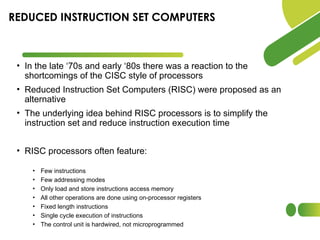
• In the late ‘70s and early ‘80s there was a reaction to the
shortcomings of the CISC style of processors
• Reduced Instruction Set Computers (RISC) were proposed as an
alternative
• The underlying idea behind RISC processors is to simplify the
instruction set and reduce instruction execution time
• RISC processors often feature:
• Few instructions
• Few addressing modes
• Only load and store instructions access memory
• All other operations are done using on-processor registers
• Fixed length instructions
• Single cycle execution of instructions
• The control unit is hardwired, not microprogrammed
REDUCED INSTRUCTION SET COMPUTERS
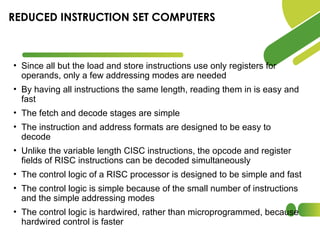
• Since all but the load and store instructions use only registers for
operands, only a few addressing modes are needed
• By having all instructions the same length, reading them in is easy and
fast
• The fetch and decode stages are simple
• The instruction and address formats are designed to be easy to
decode
• Unlike the variable length CISC instructions, the opcode and register
fields of RISC instructions can be decoded simultaneously
• The control logic of a RISC processor is designed to be simple and fast
• The control logic is simple because of the small number of instructions
and the simple addressing modes
• The control logic is hardwired, rather than microprogrammed, because
hardwired control is faster
REDUCED INSTRUCTION SET COMPUTERS
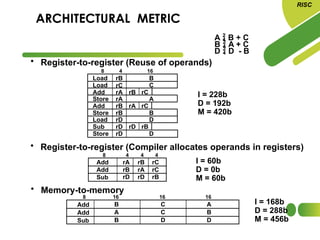
ARCHITECTURAL METRIC
A  B + C
B  A + C
D  D - B
RISC
• Register-to-register (Reuse of operands)
• Register-to-register (Compiler allocates operands in registers)
• Memory-to-memory
I = 228b
D = 192b
M = 420b
I = 60b
D = 0b
M = 60b
I = 168b
D = 288b
M = 456b
Load rB B
Load rC C
Add rA
Store rA A
rB rC
8 4 16
Add rB rA rC
Store rB B
Load rD D
Sub rD rD rB
Store rD D
Add rA rB rC
Add rB rA rC
Sub rD rD rB
8 4 4 4
Add B C A
8 16 16 16
Add A C B
Sub B D D
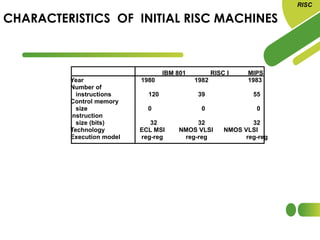
CHARACTERISTICS OF INITIAL RISC MACHINES
RISC
IBM 801 RISC I MIPS
Year 1980 1982 1983
Number of
instructions 120 39 55
Control memory
size 0 0 0
Instruction
size (bits) 32 32 32
Technology ECL MSI NMOS VLSI NMOS VLSI
Execution model reg-reg reg-reg reg-reg
ADD rA rB
register
operand
rC
OP DEST SOUR1 SOUR2
ADD rA rA
immediate
operand
1
SUB rD rD
register
operand
rB
32b memory port
ADD
(3 operands)
register
operand
B register
operand
C register
operand
A
INC
(1 operands)
register
operand
A
SUB
(2 operands)
register
operand
B
register
operand
D
3 operands
in memory
B C ...
... C A
A
D
D
A
D
D
1 operand
in memory
A
I
N
C
I
N
C
2 operands
in memory D ...
B
... D SUB
RISC 1
VAX
432
RISC
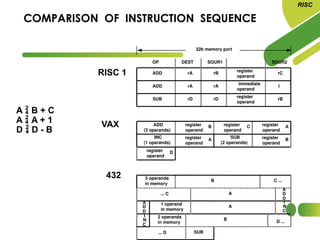
COMPARISON OF INSTRUCTION SEQUENCE
A  B + C
A  A + 1
D  D - B
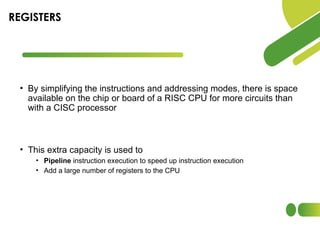
• By simplifying the instructions and addressing modes, there is space
available on the chip or board of a RISC CPU for more circuits than
with a CISC processor
• This extra capacity is used to
• Pipeline instruction execution to speed up instruction execution
• Add a large number of registers to the CPU
REGISTERS
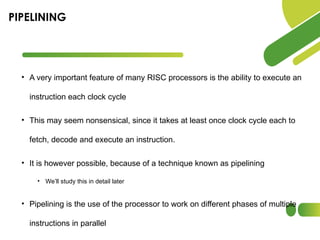
• A very important feature of many RISC processors is the ability to execute an
instruction each clock cycle
• This may seem nonsensical, since it takes at least once clock cycle each to
fetch, decode and execute an instruction.
• It is however possible, because of a technique known as pipelining
• We’ll study this in detail later
• Pipelining is the use of the processor to work on different phases of multiple
instructions in parallel
PIPELINING
• For instance, at one time, a pipelined processor may be
• Executing instruction it
• Decoding instruction it+1
• Fetching instruction it+2 from memory
• So, if we’re running three instructions at once, and it takes an
average instruction three cycles to run, the CPU is executing an
average of an instruction a clock cycle
• As we’ll see when we cover it in depth, there are complications
• For example, what happens to the pipeline when the processor branches
• However, pipelined execution is an integral part of all modern
processors, and plays an important role
PIPELINING
• By having a large number of general purpose registers, a processor
can minimize the number of times it needs to access memory to load
or store a value
• This results in a significant speed up, since memory accesses are
much slower than register accesses
• Register accesses are fast, since they just use the bus on the CPU
itself, and any transfer can be done in one clock cycle
• To go off-processor to memory requires using the much slower
memory (or system) bus
REGISTERS
• It may take many clock cycles to read or write to memory
across the memory bus
• The memory bus hardware is usually slower than the processor
• There may even be competition for access to the memory bus by other
devices in the computer (e.g. disk drives)
• So, for this reason alone, a RISC processor may have an
advantage over a comparable CISC processor, since it
only needs to access memory
• for its instructions, and
• occasionally to load or store a memory value
REGISTERS
• Observations
- Weighted Dynamic Frequency of HLL Operations
 Procedure call/return is the most time consuming operations
- Locality of Procedure Nesting
 The depth of procedure activation fluctuates within a relatively narrow
range
- A typical procedure employs only a few passed parameters and local variables
• Solution
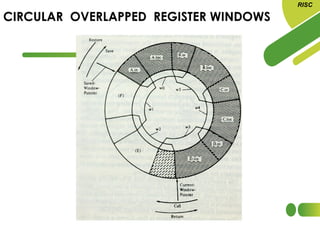
- Use multiple small sets of registers (windows), each assigned to a different procedure
- A procedure call automatically switches the CPU to use a different
window of registers, rather than saving registers in memory
- Windows for adjacent procedures are overlapped to allow parameter passing
REGISTER WINDOW APPROACH
CIRCULAR OVERLAPPED REGISTER WINDOWS
RISC
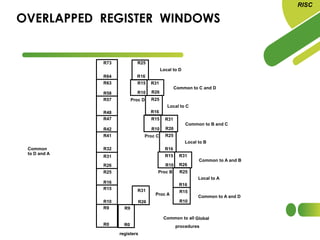
OVERLAPPED REGISTER WINDOWS
RISC
R15
R10
R15
R10
R25
R16
Common
to D and A
Local to D
Common to C and D
Local to C
Common to B and C
Local to B
Common to A and B
Local to A
Common to A and D
Proc D
Proc C
Proc B
Proc A
R9
R0
Common to all
procedures
Global
registers
R31
R26
R9
R0
R15
R10
R25
R16
R31
R26
R41
R32
R47
R42
R57
R48
R63
R58
R73
R64
R25
R16
R31
R26
R15
R10
R25
R16
R31
R26
R15
R10
R25
R16
R31
R26
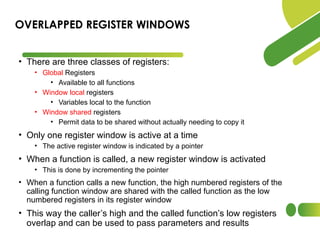
• There are three classes of registers:
• Global Registers
• Available to all functions
• Window local registers
• Variables local to the function
• Window shared registers
• Permit data to be shared without actually needing to copy it
• Only one register window is active at a time
• The active register window is indicated by a pointer
• When a function is called, a new register window is activated
• This is done by incrementing the pointer
• When a function calls a new function, the high numbered registers of the
calling function window are shared with the called function as the low
numbered registers in its register window
• This way the caller’s high and the called function’s low registers
overlap and can be used to pass parameters and results
OVERLAPPED REGISTER WINDOWS
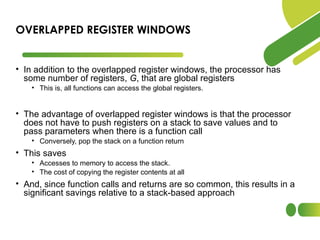
• In addition to the overlapped register windows, the processor has
some number of registers, G, that are global registers
• This is, all functions can access the global registers.
• The advantage of overlapped register windows is that the processor
does not have to push registers on a stack to save values and to
pass parameters when there is a function call
• Conversely, pop the stack on a function return
• This saves
• Accesses to memory to access the stack.
• The cost of copying the register contents at all
• And, since function calls and returns are so common, this results in a
significant savings relative to a stack-based approach
OVERLAPPED REGISTER WINDOWS
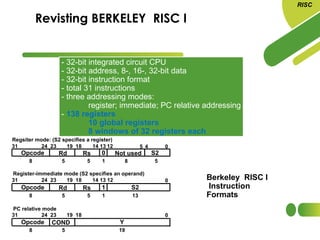
Revisting BERKELEY RISC I
- 32-bit integrated circuit CPU
- 32-bit address, 8-, 16-, 32-bit data
- 32-bit instruction format
- total 31 instructions
- three addressing modes:
register; immediate; PC relative addressing
- 138 registers
10 global registers
8 windows of 32 registers each
Berkeley RISC I
Instruction
Formats
RISC
Opcode Rs
Rd 0 Not used S2
31 24 23 19 18 14 13 12 5 4 0
8 5 5 1 8 5
Opcode Rs
Rd 1 S2
31 24 23 19 18 14 13 12 0
8 5 5 1 13
Opcode COND Y
31 24 23 19 18 0
8 5 19
Regsiter mode: (S2 specifies a register)
Register-immediate mode (S2 specifies an operand)
PC relative mode
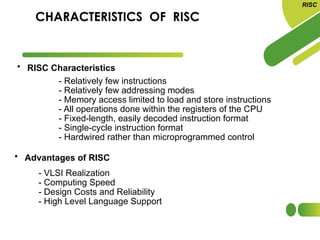
CHARACTERISTICS OF RISC
• RISC Characteristics
• Advantages of RISC
- VLSI Realization
- Computing Speed
- Design Costs and Reliability
- High Level Language Support
RISC
- Relatively few instructions
- Relatively few addressing modes
- Memory access limited to load and store instructions
- All operations done within the registers of the CPU
- Fixed-length, easily decoded instruction format
- Single-cycle instruction format
- Hardwired rather than microprogrammed control
ADVANTAGES OF RISC
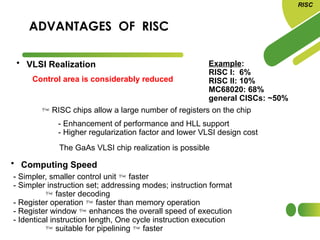
• Computing Speed
- Simpler, smaller control unit  faster
- Simpler instruction set; addressing modes; instruction format
 faster decoding
- Register operation  faster than memory operation
- Register window  enhances the overall speed of execution
- Identical instruction length, One cycle instruction execution
 suitable for pipelining  faster
RISC
• VLSI Realization
Control area is considerably reduced
Example:
RISC I: 6%
RISC II: 10%
MC68020: 68%
general CISCs: ~50%
 RISC chips allow a large number of registers on the chip
- Enhancement of performance and HLL support
- Higher regularization factor and lower VLSI design cost
The GaAs VLSI chip realization is possible
ADVANTAGES OF RISC
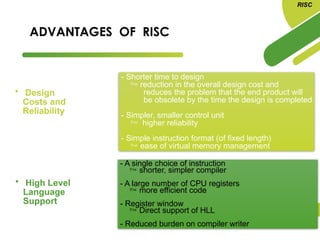
• Design
Costs and
Reliability
- Shorter time to design
 reduction in the overall design cost and
reduces the problem that the end product will
be obsolete by the time the design is completed
- Simpler, smaller control unit
 higher reliability
- Simple instruction format (of fixed length)
 ease of virtual memory management
• High Level
Language
Support
- A single choice of instruction
 shorter, simpler compiler
- A large number of CPU registers
 more efficient code
- Register window
 Direct support of HLL
- Reduced burden on compiler writer
RISC
11/23/2024 21
11/23/2024 22

2024_lecture13_come321.pptx.........................

  • 1.
    COME321: Computer Organization (Fall2019) Dr. Eng. Ghada Abozaid Ghada.abozaid@aswu.edu.eg Electrical Engineering Dept.
  • 2.
    • In thelate ‘70s and early ‘80s there was a reaction to the shortcomings of the CISC style of processors • Reduced Instruction Set Computers (RISC) were proposed as an alternative • The underlying idea behind RISC processors is to simplify the instruction set and reduce instruction execution time • RISC processors often feature: • Few instructions • Few addressing modes • Only load and store instructions access memory • All other operations are done using on-processor registers • Fixed length instructions • Single cycle execution of instructions • The control unit is hardwired, not microprogrammed REDUCED INSTRUCTION SET COMPUTERS
  • 3.
    • Since allbut the load and store instructions use only registers for operands, only a few addressing modes are needed • By having all instructions the same length, reading them in is easy and fast • The fetch and decode stages are simple • The instruction and address formats are designed to be easy to decode • Unlike the variable length CISC instructions, the opcode and register fields of RISC instructions can be decoded simultaneously • The control logic of a RISC processor is designed to be simple and fast • The control logic is simple because of the small number of instructions and the simple addressing modes • The control logic is hardwired, rather than microprogrammed, because hardwired control is faster REDUCED INSTRUCTION SET COMPUTERS
  • 4.
    ARCHITECTURAL METRIC A B + C B  A + C D  D - B RISC • Register-to-register (Reuse of operands) • Register-to-register (Compiler allocates operands in registers) • Memory-to-memory I = 228b D = 192b M = 420b I = 60b D = 0b M = 60b I = 168b D = 288b M = 456b Load rB B Load rC C Add rA Store rA A rB rC 8 4 16 Add rB rA rC Store rB B Load rD D Sub rD rD rB Store rD D Add rA rB rC Add rB rA rC Sub rD rD rB 8 4 4 4 Add B C A 8 16 16 16 Add A C B Sub B D D
  • 5.
    CHARACTERISTICS OF INITIALRISC MACHINES RISC IBM 801 RISC I MIPS Year 1980 1982 1983 Number of instructions 120 39 55 Control memory size 0 0 0 Instruction size (bits) 32 32 32 Technology ECL MSI NMOS VLSI NMOS VLSI Execution model reg-reg reg-reg reg-reg
  • 6.
    ADD rA rB register operand rC OPDEST SOUR1 SOUR2 ADD rA rA immediate operand 1 SUB rD rD register operand rB 32b memory port ADD (3 operands) register operand B register operand C register operand A INC (1 operands) register operand A SUB (2 operands) register operand B register operand D 3 operands in memory B C ... ... C A A D D A D D 1 operand in memory A I N C I N C 2 operands in memory D ... B ... D SUB RISC 1 VAX 432 RISC COMPARISON OF INSTRUCTION SEQUENCE A  B + C A  A + 1 D  D - B
  • 7.
    • By simplifyingthe instructions and addressing modes, there is space available on the chip or board of a RISC CPU for more circuits than with a CISC processor • This extra capacity is used to • Pipeline instruction execution to speed up instruction execution • Add a large number of registers to the CPU REGISTERS
  • 8.
    • A veryimportant feature of many RISC processors is the ability to execute an instruction each clock cycle • This may seem nonsensical, since it takes at least once clock cycle each to fetch, decode and execute an instruction. • It is however possible, because of a technique known as pipelining • We’ll study this in detail later • Pipelining is the use of the processor to work on different phases of multiple instructions in parallel PIPELINING
  • 9.
    • For instance,at one time, a pipelined processor may be • Executing instruction it • Decoding instruction it+1 • Fetching instruction it+2 from memory • So, if we’re running three instructions at once, and it takes an average instruction three cycles to run, the CPU is executing an average of an instruction a clock cycle • As we’ll see when we cover it in depth, there are complications • For example, what happens to the pipeline when the processor branches • However, pipelined execution is an integral part of all modern processors, and plays an important role PIPELINING
  • 10.
    • By havinga large number of general purpose registers, a processor can minimize the number of times it needs to access memory to load or store a value • This results in a significant speed up, since memory accesses are much slower than register accesses • Register accesses are fast, since they just use the bus on the CPU itself, and any transfer can be done in one clock cycle • To go off-processor to memory requires using the much slower memory (or system) bus REGISTERS
  • 11.
    • It maytake many clock cycles to read or write to memory across the memory bus • The memory bus hardware is usually slower than the processor • There may even be competition for access to the memory bus by other devices in the computer (e.g. disk drives) • So, for this reason alone, a RISC processor may have an advantage over a comparable CISC processor, since it only needs to access memory • for its instructions, and • occasionally to load or store a memory value REGISTERS
  • 12.
    • Observations - WeightedDynamic Frequency of HLL Operations  Procedure call/return is the most time consuming operations - Locality of Procedure Nesting  The depth of procedure activation fluctuates within a relatively narrow range - A typical procedure employs only a few passed parameters and local variables • Solution - Use multiple small sets of registers (windows), each assigned to a different procedure - A procedure call automatically switches the CPU to use a different window of registers, rather than saving registers in memory - Windows for adjacent procedures are overlapped to allow parameter passing REGISTER WINDOW APPROACH
  • 13.
  • 14.
    OVERLAPPED REGISTER WINDOWS RISC R15 R10 R15 R10 R25 R16 Common toD and A Local to D Common to C and D Local to C Common to B and C Local to B Common to A and B Local to A Common to A and D Proc D Proc C Proc B Proc A R9 R0 Common to all procedures Global registers R31 R26 R9 R0 R15 R10 R25 R16 R31 R26 R41 R32 R47 R42 R57 R48 R63 R58 R73 R64 R25 R16 R31 R26 R15 R10 R25 R16 R31 R26 R15 R10 R25 R16 R31 R26
  • 15.
    • There arethree classes of registers: • Global Registers • Available to all functions • Window local registers • Variables local to the function • Window shared registers • Permit data to be shared without actually needing to copy it • Only one register window is active at a time • The active register window is indicated by a pointer • When a function is called, a new register window is activated • This is done by incrementing the pointer • When a function calls a new function, the high numbered registers of the calling function window are shared with the called function as the low numbered registers in its register window • This way the caller’s high and the called function’s low registers overlap and can be used to pass parameters and results OVERLAPPED REGISTER WINDOWS
  • 16.
    • In additionto the overlapped register windows, the processor has some number of registers, G, that are global registers • This is, all functions can access the global registers. • The advantage of overlapped register windows is that the processor does not have to push registers on a stack to save values and to pass parameters when there is a function call • Conversely, pop the stack on a function return • This saves • Accesses to memory to access the stack. • The cost of copying the register contents at all • And, since function calls and returns are so common, this results in a significant savings relative to a stack-based approach OVERLAPPED REGISTER WINDOWS
  • 17.
    Revisting BERKELEY RISCI - 32-bit integrated circuit CPU - 32-bit address, 8-, 16-, 32-bit data - 32-bit instruction format - total 31 instructions - three addressing modes: register; immediate; PC relative addressing - 138 registers 10 global registers 8 windows of 32 registers each Berkeley RISC I Instruction Formats RISC Opcode Rs Rd 0 Not used S2 31 24 23 19 18 14 13 12 5 4 0 8 5 5 1 8 5 Opcode Rs Rd 1 S2 31 24 23 19 18 14 13 12 0 8 5 5 1 13 Opcode COND Y 31 24 23 19 18 0 8 5 19 Regsiter mode: (S2 specifies a register) Register-immediate mode (S2 specifies an operand) PC relative mode
  • 18.
    CHARACTERISTICS OF RISC •RISC Characteristics • Advantages of RISC - VLSI Realization - Computing Speed - Design Costs and Reliability - High Level Language Support RISC - Relatively few instructions - Relatively few addressing modes - Memory access limited to load and store instructions - All operations done within the registers of the CPU - Fixed-length, easily decoded instruction format - Single-cycle instruction format - Hardwired rather than microprogrammed control
  • 19.
    ADVANTAGES OF RISC •Computing Speed - Simpler, smaller control unit  faster - Simpler instruction set; addressing modes; instruction format  faster decoding - Register operation  faster than memory operation - Register window  enhances the overall speed of execution - Identical instruction length, One cycle instruction execution  suitable for pipelining  faster RISC • VLSI Realization Control area is considerably reduced Example: RISC I: 6% RISC II: 10% MC68020: 68% general CISCs: ~50%  RISC chips allow a large number of registers on the chip - Enhancement of performance and HLL support - Higher regularization factor and lower VLSI design cost The GaAs VLSI chip realization is possible
  • 20.
    ADVANTAGES OF RISC •Design Costs and Reliability - Shorter time to design  reduction in the overall design cost and reduces the problem that the end product will be obsolete by the time the design is completed - Simpler, smaller control unit  higher reliability - Simple instruction format (of fixed length)  ease of virtual memory management • High Level Language Support - A single choice of instruction  shorter, simpler compiler - A large number of CPU registers  more efficient code - Register window  Direct support of HLL - Reduced burden on compiler writer RISC
  • 21.
  • 22.