Stretch Building Code
         Green Communities Act


Jennifer Henriquez • Deborah Silva • Joe Szafarowicz
Green Communities Act


• Ambitious energy legislation passed
  in 2008
• First state in the US to pass
  something like this
• Creates the Green Communities
  Program
Green Communities Program


• There is $10 million per year in
  funding to towns & cities
• Consists of 5 Criteria
  –All these requirements aim to reduce
   energy consumption
  –At a commercial, residential, and
   municipal level
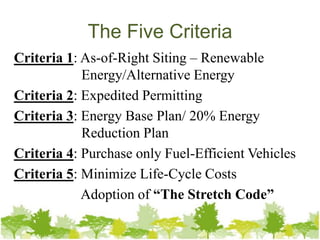
The Five Criteria
Criteria 1: As-of-Right Siting – Renewable
            Energy/Alternative Energy
Criteria 2: Expedited Permitting
Criteria 3: Energy Base Plan/ 20% Energy
            Reduction Plan
Criteria 4: Purchase only Fuel-Efficient Vehicles
Criteria 5: Minimize Life-Cycle Costs
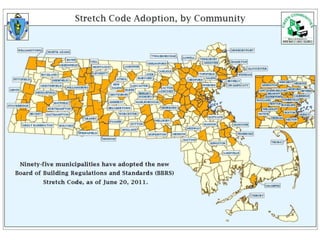
            Adoption of “The Stretch Code”
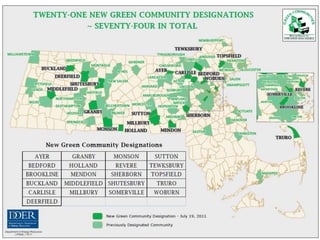
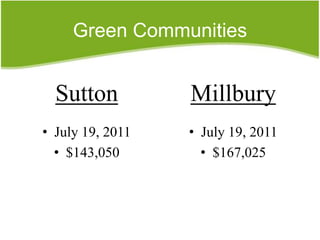
Green Communities


  Sutton          Millbury
• July 19, 2011   • July 19, 2011
  • $143,050        • $167,025
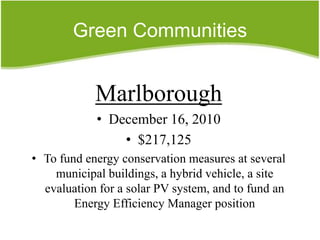
Green Communities


            Marlborough
            • December 16, 2010
                • $217,125
• To fund energy conservation measures at several
    municipal buildings, a hybrid vehicle, a site
  evaluation for a solar PV system, and to fund an
        Energy Efficiency Manager position
Green Communities


                   Palmer
                 • May 25, 2010
                   • $169,103
• To fund energy conservation measures at Town Hall;
           a boiler and chiller replacements
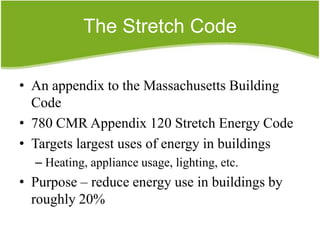
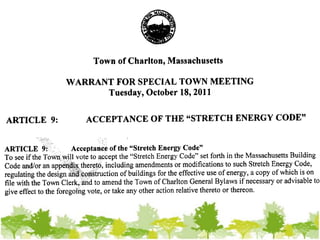
The Stretch Code

• An appendix to the Massachusetts Building
  Code
• 780 CMR Appendix 120 Stretch Energy Code
• Targets largest uses of energy in buildings
  – Heating, appliance usage, lighting, etc.
• Purpose – reduce energy use in buildings by
  roughly 20%
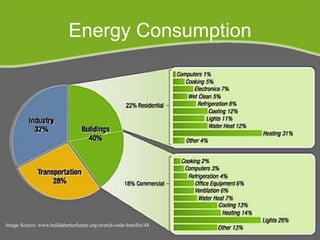
Energy Consumption


Image Source: www.buildabetterfuture.org/stretch-code-benifits/48
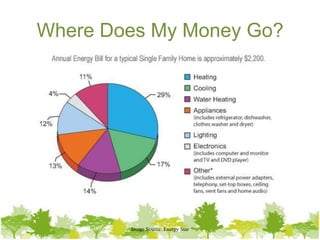
Where Does My Money Go?


        Image Source: Energy Star
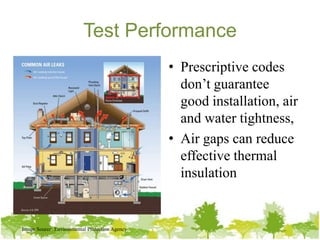
Test Performance
                                                • Prescriptive codes
                                                  don‟t guarantee
                                                  good installation, air
                                                  and water tightness,
                                                • Air gaps can reduce
                                                  effective thermal
                                                  insulation


Image Source: Environmental Protection Agency
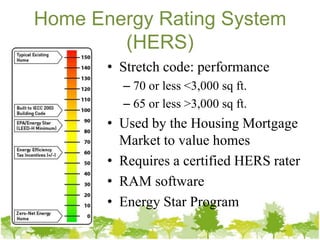
Home Energy Rating System
        (HERS)
       • Stretch code: performance
         – 70 or less <3,000 sq ft.
         – 65 or less >3,000 sq ft.
       • Used by the Housing Mortgage
         Market to value homes
       • Requires a certified HERS rater
       • RAM software
       • Energy Star Program
Residential New Construction

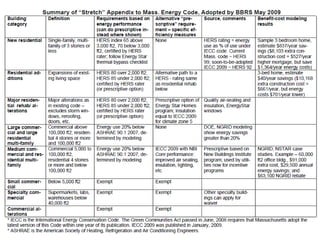
• Performance only „stretch‟ option
        – Uses Home Energy Rating System (HERS)
        – 70 or less < 3,000 sq ft.
        – 65 or less > 3,000 sq ft.
• Requires a certified HERS rater
        – Review building plans
        – Check insulation installation
        – Blower-door and duct testing
        – Thermal bypass Checklist
Residential Additions

• 2 options – Performance or Prescriptive
        – HERS index on just addition (often not possible)
        or whole house
        – Treated as new construction
        – 70 or less < 3,000 sq ft.
        – 65 or less > 3,000 sq ft.
• Most Additions will use Prescriptive Path
        – Energy Star Builders Option Package (BOP)
        – Includes Thermal Bypass Checklist
Commercial ‘Stretch’ Appendix

• Only for New Construction over 5,000 sq ft
• Performance option for all Buildings
• Utility program & incentives to help
• Prescriptive option includes 3 choices
        – Heating and cooling equipment improvements,
        – Improved Lighting efficiency (LPD)
        – 3% + of electric needs from on-site renewable
Town Benefits
• Stretch Code is an optional appendix to IECC 2009 code
   – Once IECC is updated, stretch code will be integrated

• Promotes Energy Efficiency & Collaboration
   – Gives flexibility to both builders and homeowners
   – 20-35% energy reduction provides savings in utility bills
   – Promotes awareness of sustainability
Town Benefits
• Opportunity to apply for grants
   – Can use grant to install energy-efficient appliances and/or
     systems
   – Grants will be competitive in the future

• Publicity
   – Society is turning more green
   – “Green Communities” status a noticeable factor for
     Charlton
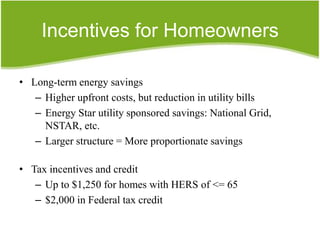
Incentives for Homeowners

• Long-term energy savings
   – Higher upfront costs, but reduction in utility bills
   – Energy Star utility sponsored savings: National Grid,
     NSTAR, etc.
   – Larger structure = More proportionate savings

• Tax incentives and credit
   – Up to $1,250 for homes with HERS of <= 65
   – $2,000 in Federal tax credit
Questions? Comments?
                     Thank You!
All information and data provided by the Mass Department
                  of Energy Resources.

        For more information please email us at:
                  jenniferh@wpi.edu
               deborahcsilva@wpi.edu
                jszafarowicz@wpi.edu


      Jennifer Henriquez • Deborah Silva • Joe Szafarowicz

Stretch Building Code

  • 1.
    Stretch Building Code Green Communities Act Jennifer Henriquez • Deborah Silva • Joe Szafarowicz
  • 2.
    Green Communities Act •Ambitious energy legislation passed in 2008 • First state in the US to pass something like this • Creates the Green Communities Program
  • 3.
    Green Communities Program •There is $10 million per year in funding to towns & cities • Consists of 5 Criteria –All these requirements aim to reduce energy consumption –At a commercial, residential, and municipal level
  • 4.
    The Five Criteria Criteria1: As-of-Right Siting – Renewable Energy/Alternative Energy Criteria 2: Expedited Permitting Criteria 3: Energy Base Plan/ 20% Energy Reduction Plan Criteria 4: Purchase only Fuel-Efficient Vehicles Criteria 5: Minimize Life-Cycle Costs Adoption of “The Stretch Code”
  • 6.
    Green Communities Sutton Millbury • July 19, 2011 • July 19, 2011 • $143,050 • $167,025
  • 7.
    Green Communities Marlborough • December 16, 2010 • $217,125 • To fund energy conservation measures at several municipal buildings, a hybrid vehicle, a site evaluation for a solar PV system, and to fund an Energy Efficiency Manager position
  • 8.
    Green Communities Palmer • May 25, 2010 • $169,103 • To fund energy conservation measures at Town Hall; a boiler and chiller replacements
  • 9.
    The Stretch Code •An appendix to the Massachusetts Building Code • 780 CMR Appendix 120 Stretch Energy Code • Targets largest uses of energy in buildings – Heating, appliance usage, lighting, etc. • Purpose – reduce energy use in buildings by roughly 20%
  • 11.
    Energy Consumption Image Source:www.buildabetterfuture.org/stretch-code-benifits/48
  • 12.
    Where Does MyMoney Go? Image Source: Energy Star
  • 13.
    Test Performance • Prescriptive codes don‟t guarantee good installation, air and water tightness, • Air gaps can reduce effective thermal insulation Image Source: Environmental Protection Agency
  • 14.
    Home Energy RatingSystem (HERS) • Stretch code: performance – 70 or less <3,000 sq ft. – 65 or less >3,000 sq ft. • Used by the Housing Mortgage Market to value homes • Requires a certified HERS rater • RAM software • Energy Star Program
  • 15.
    Residential New Construction •Performance only „stretch‟ option – Uses Home Energy Rating System (HERS) – 70 or less < 3,000 sq ft. – 65 or less > 3,000 sq ft. • Requires a certified HERS rater – Review building plans – Check insulation installation – Blower-door and duct testing – Thermal bypass Checklist
  • 16.
    Residential Additions • 2options – Performance or Prescriptive – HERS index on just addition (often not possible) or whole house – Treated as new construction – 70 or less < 3,000 sq ft. – 65 or less > 3,000 sq ft. • Most Additions will use Prescriptive Path – Energy Star Builders Option Package (BOP) – Includes Thermal Bypass Checklist
  • 17.
    Commercial ‘Stretch’ Appendix •Only for New Construction over 5,000 sq ft • Performance option for all Buildings • Utility program & incentives to help • Prescriptive option includes 3 choices – Heating and cooling equipment improvements, – Improved Lighting efficiency (LPD) – 3% + of electric needs from on-site renewable
  • 18.
    Town Benefits • StretchCode is an optional appendix to IECC 2009 code – Once IECC is updated, stretch code will be integrated • Promotes Energy Efficiency & Collaboration – Gives flexibility to both builders and homeowners – 20-35% energy reduction provides savings in utility bills – Promotes awareness of sustainability
  • 19.
    Town Benefits • Opportunityto apply for grants – Can use grant to install energy-efficient appliances and/or systems – Grants will be competitive in the future • Publicity – Society is turning more green – “Green Communities” status a noticeable factor for Charlton
  • 20.
    Incentives for Homeowners •Long-term energy savings – Higher upfront costs, but reduction in utility bills – Energy Star utility sponsored savings: National Grid, NSTAR, etc. – Larger structure = More proportionate savings • Tax incentives and credit – Up to $1,250 for homes with HERS of <= 65 – $2,000 in Federal tax credit
  • 23.
    Questions? Comments? Thank You! All information and data provided by the Mass Department of Energy Resources. For more information please email us at: jenniferh@wpi.edu deborahcsilva@wpi.edu jszafarowicz@wpi.edu Jennifer Henriquez • Deborah Silva • Joe Szafarowicz

Editor's Notes

  • #2 Submit to Professor/ Kelly by Tuesday evening
  • #13 Most of the Life Cycle Cost is put into Heating and Cooling. In New England this is an important factor because of the freezing temperature in winter and oscillating hot summers.
  • #14 Prescriptive- Specified brand names for materials and methods for execution well defined.Performance-Define performance of end result and identify testing methods
  • #15 The current IECC 2009 Building Code performance requires a HERS rating of 100 or lower. Energy Star Program provides builder incentives and rebates like $1250 per home for HERS 65 index, and on appliances, fluorescent light etc.
  • #24 Submit to Professor/ Kelly by Tuesday evening