先行研究:視線計測と読解研究④
文章理解研究への視線計測の応用可能性
Hyönä etal. (2003)
“eye tracking has been successfully adopted to the study of basic reading
processes and to that of syntactic parsing, but there are surprisingly few
studies where eye tracking is employed to examine global text
processing” (p. 313)
“discuss the potential usefulness of existing eye movement measures
and to suggest new measures capable of reflecting different aspects
of global text processing” (p. 330)
Rayner et al. (2006)
“the time is ripe for more comprehension studies to use eye movement
data to understand discourse processing.” (p. 252)
9.
先行研究:読解における文の読み戻り①
L1文章理解研究の事例
Hyönä etal. (2002)
説明文の読解において,各文の注視時間や文間の読み戻りの頻度によって読
解パターンの個人差を特定 文間の読み戻り頻度における個人差を指摘
Kaakinen et al. (2002)
説明文の読解において,読みの目的によって文章中の特定の文への注視や読
み戻りが変化するかを検証
Rayner et al. (2006)
(1) 文章の難易度,(2) 照応詞と先行詞の一致・不一致という2つの談話要因が
注視時間や回数,文間の読み戻り (2のみ) に与える影響を検証
Rinck et al. (2003), van der Schoot et al. (2012)
物語文の読解において,矛盾する内容を含む2つの文間の読み戻りなどを検証
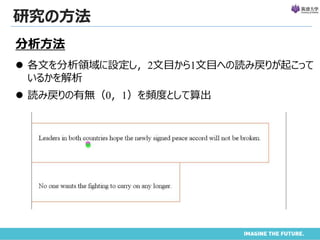
研究の方法
英文 FKGL RDL2
準2級
Frank’scomputer broke last week, but he does not have
much money right now. He wishes that he were rich, so he
could buy a new one.
3.36 32.85
2級
When Frank became the sales manager, his boss told him
that he would have to answer for any mistakes that his team
made. Frank agreed to take on this new responsibility.
6.82 21.66
準1級
Frank hated the idea of selling his guitar. However, he
needed the money, so he eventually overcame his reluctance
and put an advertisement in the newspaper.
10.35 13.44
表2. 実験材料の例
注. FKGL = Flesch-Kincaid Grade Level; RDL2 = The Coh-Metrix L2 Readability.
引用文献
Conklin, K., Pellicer-Sánchez,A., & Carrol, G. (2018). Eye-tracking: A guide for applied linguistics research. Cambridge
University Press.
Crossley, S. A., Kyle, K., & Dascalu, M. (2019). The tool for the automatic analysis of cohesion 2.0: Integrating semantic
similarity and text overlap. Behavioral Research Methods, 50, 1030–1046.
Hyönä, J., Lorch, R. F. Jr., & Kaakinen, J. K. (2002). Individual differences in reading to summarize expository text: Evidence
from eye fixation patterns. Journal of Educational Psychology, 94, 44–55.
Hyönä, J., Lorch, R. F., Jr., & Rinck, M. (2003). Eye movement measures to study global text processing. In J. Hyönä, R. Radach,
& H. Deubel (Eds.), The mind’s eye: Cognitive and applied aspects of eye movement research (pp. 313–334). Amsterdam,
Netherlands: Elsevier Science.
Kaakinen, J. K., Hyönä, J., & Keenan, J. M. (2002). Perspective effects on on-line text processing. Discourse Processes, 33,
159–173. doi:10.1207/S15326950DP3302_03
Kyle, K., Crossley, S., & Berger, C. (2018). The tool for the automatic analysis of lexical sophistication (TAALES): version
2.0. Behavior Research Methods, 50, 1030–1046.
Nahatame, S. (2015). Revision of predictive inferences and Japanese EFL learners’ text comprehension processes: A study of eye
movements during reading. ARELE, 26, 45–60.
Rayner, K. (1998). Eye movements in reading and information processing: 20 years of research. Psychological Bulletin, 124,
372–422. doi:10.1037/0033-2909.124.3.372
Rayner, K., Chace, K., Slattery, T. J., & Ashby, J. (2006). Eye movements as reflections of comprehension processes in
reading. Scientific Studies of Reading, 10, 241–255. doi: 10.1207/s1532799xssr1003_3
Rinck, M., Gamez, E., Diaz, J. M., & de Vega, M. (2003). Processing of temporal information: Evidence from eye
movements. Memory & Cognition, 31, 77–86. doi: 10.3758/BF03196084
Roberts, L., & Siyanova-Chanturia, A. (2013). Using eye-tracking to investigate topics in L2 acquisition and L2
processing. Studies in Second Language Acquisition, 35, 213–235. doi: 10.1017/S0272263112000861
Ushiro, Y., Ogiso, T.,Hosoda, M., Nahatame, S., Kamimura, K., Sasaki, Y., Kessoku, M., & Sekine, T. (2019). How EFL
readers understand the protagonist, causal, and intentional links of narratives: An eye-tracking study. ARELE, 30, 161–176.
van der Schoot, M., Reijntjes, A., & van Lieshout, E. C. D. M. (2012). How do children deal with inconsistencies in text? An eye
fixation and self-paced reading study in good and poor reading comprehenders. Reading and Writing, 25, 1665–1690. doi:
10.1007/s11145-011-9337-4
#10 Rayner et al. (2006)
that longer regressions largely reflect comprehension failures. The relative rarity of long-distance regressions suggests that readers avoid looking very far back in the text unless it is absolutely necessary. When readers do make long regressions, they are fairly accurate in finding that portion of the text where their understanding went astray (see Frazier & Rayner, 1982; Meseguer, Carreiras, & Clifton, 2002)
#11 Kaakinen et al. (2003)
説明文の読解において,読みの目的によって文章中の特定の情報への注視パターンが変化するかを検証
Kaakinen, J. K., Hyönä, J., & Keenan, J. M. (2002). Perspective effects on on-line text processing. Discourse Processes, 33, 159–173.