IAEA-KINS Workshop on Radiation Safety and
Emergency Response in the Medical or Industrial
Use of Radiation
June 12, 2019
Radiological Emergency Response Management
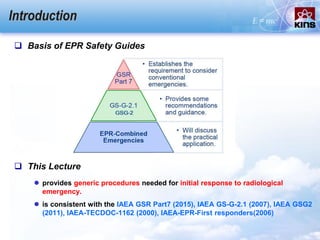
Introduction
 Basis of EPR Safety Guides
 This Lecture
 provides generic procedures needed for initial response to radiological
emergency.
 is consistent with the IAEA GSR Part7 (2015), IAEA GS-G-2.1 (2007), IAEA GSG2
(2011), IAEA-TECDOC-1162 (2000), IAEA-EPR-First responders(2006)
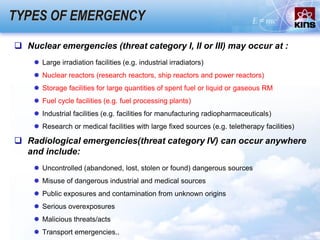
TYPES OF EMERGENCY
 Nuclear emergencies (threat category I, II or III) may occur at :
 Large irradiation facilities (e.g. industrial irradiators)
 Nuclear reactors (research reactors, ship reactors and power reactors)
 Storage facilities for large quantities of spent fuel or liquid or gaseous RM
 Fuel cycle facilities (e.g. fuel processing plants)
 Industrial facilities (e.g. facilities for manufacturing radiopharmaceuticals)
 Research or medical facilities with large fixed sources (e.g. teletherapy facilities)
 Radiological emergencies(threat category IV) can occur anywhere
and include:
 Uncontrolled (abandoned, lost, stolen or found) dangerous sources
 Misuse of dangerous industrial and medical sources
 Public exposures and contamination from unknown origins
 Serious overexposures
 Malicious threats/acts
 Transport emergencies..
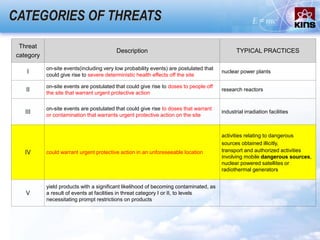
CATEGORIES OF THREATS
Threat
category
Description TYPICAL PRACTICES
I
on-site events(including very low probability events) are postulated that
could give rise to severe deterministic health effects off the site
nuclear power plants
II
on-site events are postulated that could give rise to doses to people off
the site that warrant urgent protective action
research reactors
III
on-site events are postulated that could give rise to doses that warrant
or contamination that warrants urgent protective action on the site
industrial irradiation facilities
IV could warrant urgent protective action in an unforeseeable location
activities relating to dangerous
sources obtained illicitly,
transport and authorized activities
involving mobile dangerous sources,
nuclear powered satellites or
radiothermal generators
V
yield products with a significant likelihood of becoming contaminated, as
a result of events at facilities in threat category I or II, to levels
necessitating prompt restrictions on products
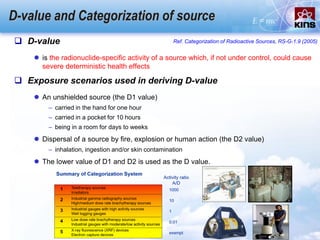
D-value and Categorization of source
 D-value
 is the radionuclide-specific activity of a source which, if not under control, could cause
severe deterministic health effects
 Exposure scenarios used in deriving D-value
 An unshielded source (the D1 value)
– carried in the hand for one hour
– carried in a pocket for 10 hours
– being in a room for days to weeks
 Dispersal of a source by fire, explosion or human action (the D2 value)
– inhalation, ingestion and/or skin contamination
 The lower value of D1 and D2 is used as the D value.
Ref. Categorization of Radioactive Sources, RS-G-1.9 (2005)
CATEGORIES OF THREATS
 Types of event associated with radiological emergency
 Detection of medical symptoms of radiation exposure due to unknown sources
 Lost, Theft, Found, Recovery of (uncontrolled) dangerous source
 Radiography: disconnected or damaged source, source in a fire
 Damage to a fixed dangerous sealed source (e.g. as used in gauges)
 Public contamination and/or exposure (including that caused intentionally)
 Re-entry of a satellite containing radioactive material
 Transport emergencies
 Emergency in radiology or nuclear medicine and in radiotherapy
 A serious overexposure
 Credible or confirmed and Non-credible terrorist threats
 An explosive radiological dispersal device
 Intentional contamination of water supply, food and /or other products
 Detection of elevated radiation levels (in air, water, food or other products)
 Notification of a transnational emergency by the IAEA or any State
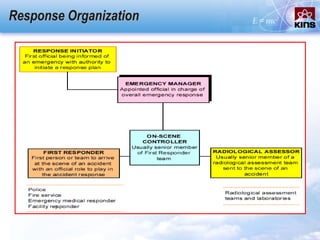
Response Organization
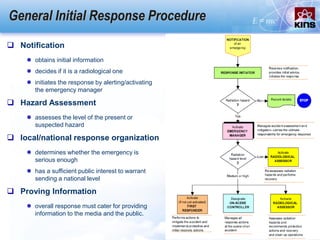
General Initial Response Procedure
 Notification
 obtains initial information
 decides if it is a radiological one
 initiates the response by alerting/activating
the emergency manager
 Hazard Assessment
 assesses the level of the present or
suspected hazard
 local/national response organization
 determines whether the emergency is
serious enough
 has a sufficient public interest to warrant
sending a national level
 Proving Information
 overall response must cater for providing
information to the media and the public.
Hazard Assessment
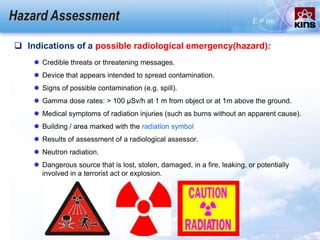
 Indications of a possible radiological emergency(hazard):
 Credible threats or threatening messages.
 Device that appears intended to spread contamination.
 Signs of possible contamination (e.g. spill).
 Gamma dose rates: > 100 μSv/h at 1 m from object or at 1m above the ground.
 Medical symptoms of radiation injuries (such as burns without an apparent cause).
 Building / area marked with the radiation symbol
 Results of assessment of a radiological assessor.
 Neutron radiation.
 Dangerous source that is lost, stolen, damaged, in a fire, leaking, or potentially
involved in a terrorist act or explosion.
Hazard Assessment
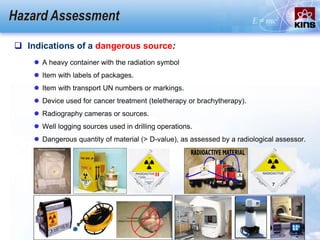
 Indications of a dangerous source:
 A heavy container with the radiation symbol
 Item with labels of packages.
 Item with transport UN numbers or markings.
 Device used for cancer treatment (teletherapy or brachytherapy).
 Radiography cameras or sources.
 Well logging sources used in drilling operations.
 Dangerous quantity of material (> D-value), as assessed by a radiological assessor.
Hazard Assessment
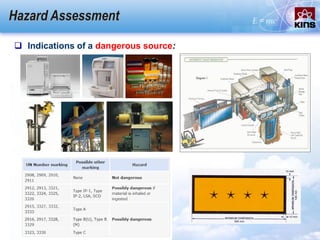
 Indications of a dangerous source:
Establishment of Cordoned Area etc.
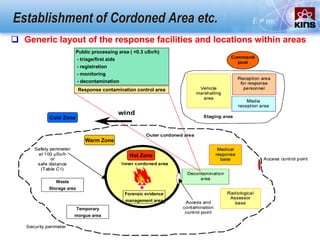
Forensic evidence
management area
Temporary
morgue area
Waste
Storage area
Public processing area ( <0.3 uSv/h)
- triage/first aids
- registration
- monitoring
- decontamination
Response contamination control area
 Generic layout of the response facilities and locations within areas
Hot Zone
Warm Zone
Cold Zone
Establishment of Cordoned Area etc.
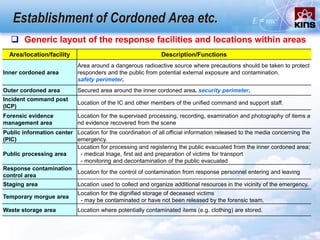
 Generic layout of the response facilities and locations within areas
Area/location/facility Description/Functions
Inner cordoned area
Area around a dangerous radioactive source where precautions should be taken to protect
responders and the public from potential external exposure and contamination.
safety perimeter.
Outer cordoned area Secured area around the inner cordoned area. security perimeter.
Incident command post
(ICP)
Location of the IC and other members of the unified command and support staff.
Forensic evidence
management area
Location for the supervised processing, recording, examination and photography of items a
nd evidence recovered from the scene
Public information center
(PIC)
Location for the coordination of all official information released to the media concerning the
emergency.
Public processing area
Location for processing and registering the public evacuated from the inner cordoned area;
- medical triage, first aid and preparation of victims for transport
- monitoring and decontamination of the public evacuated
Response contamination
control area
Location for the control of contamination from response personnel entering and leaving
Staging area Location used to collect and organize additional resources in the vicinity of the emergency.
Temporary morgue area
Location for the dignified storage of deceased victims
- may be contaminated or have not been released by the forensic team.
Waste storage area Location where potentially contaminated items (e.g. clothing) are stored.
Establishment of Cordoned Area etc.
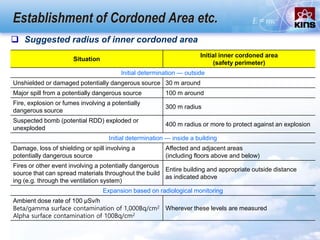
 Suggested radius of inner cordoned area
Situation
Initial inner cordoned area
(safety perimeter)
Initial determination — outside
Unshielded or damaged potentially dangerous source 30 m around
Major spill from a potentially dangerous source 100 m around
Fire, explosion or fumes involving a potentially
dangerous source
300 m radius
Suspected bomb (potential RDD) exploded or
unexploded
400 m radius or more to protect against an explosion
Initial determination — inside a building
Damage, loss of shielding or spill involving a
potentially dangerous source
Affected and adjacent areas
(including floors above and below)
Fires or other event involving a potentially dangerous
source that can spread materials throughout the build
ing (e.g. through the ventilation system)
Entire building and appropriate outside distance
as indicated above
Expansion based on radiological monitoring
Ambient dose rate of 100 µSv/h
Beta/gamma surface contamination of 1,000Bq/cm2
Alpha surface contamination of 100Bq/cm2
Wherever these levels are measured
Personnel Protection Guidelines
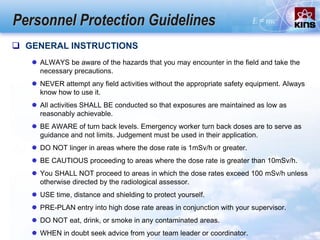
 GENERAL INSTRUCTIONS
 ALWAYS be aware of the hazards that you may encounter in the field and take the
necessary precautions.
 NEVER attempt any field activities without the appropriate safety equipment. Always
know how to use it.
 All activities SHALL BE conducted so that exposures are maintained as low as
reasonably achievable.
 BE AWARE of turn back levels. Emergency worker turn back doses are to serve as
guidance and not limits. Judgement must be used in their application.
 DO NOT linger in areas where the dose rate is 1mSv/h or greater.
 BE CAUTIOUS proceeding to areas where the dose rate is greater than 10mSv/h.
 You SHALL NOT proceed to areas in which the dose rates exceed 100 mSv/h unless
otherwise directed by the radiological assessor.
 USE time, distance and shielding to protect yourself.
 PRE-PLAN entry into high dose rate areas in conjunction with your supervisor.
 DO NOT eat, drink, or smoke in any contaminated areas.
 WHEN in doubt seek advice from your team leader or coordinator.
Personnel Protection Guidelines
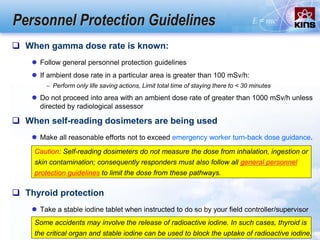
 When gamma dose rate is known:
 Follow general personnel protection guidelines
 If ambient dose rate in a particular area is greater than 100 mSv/h:
– Perform only life saving actions, Limit total time of staying there to < 30 minutes
 Do not proceed into area with an ambient dose rate of greater than 1000 mSv/h unless
directed by radiological assessor
 When self-reading dosimeters are being used
 Make all reasonable efforts not to exceed emergency worker turn-back dose guidance.
Caution: Self-reading dosimeters do not measure the dose from inhalation, ingestion or
skin contamination; consequently responders must also follow all general personnel
protection guidelines to limit the dose from these pathways.
 Thyroid protection
 Take a stable iodine tablet when instructed to do so by your field controller/supervisor
Some accidents may involve the release of radioactive iodine. In such cases, thyroid is
the critical organ and stable iodine can be used to block the uptake of radioactive iodine.
Personnel Protection Guidelines
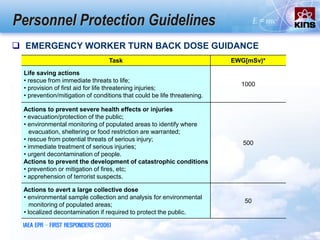
 EMERGENCY WORKER TURN BACK DOSE GUIDANCE
Task EWG[mSv)*
Life saving actions
• rescue from immediate threats to life;
• provision of first aid for life threatening injuries;
• prevention/mitigation of conditions that could be life threatening.
1000
Actions to prevent severe health effects or injuries
• evacuation/protection of the public;
• environmental monitoring of populated areas to identify where
evacuation, sheltering or food restriction are warranted;
• rescue from potential threats of serious injury;
• immediate treatment of serious injuries;
• urgent decontamination of people.
Actions to prevent the development of catastrophic conditions
• prevention or mitigation of fires, etc;
• apprehension of terrorist suspects.
500
Actions to avert a large collective dose
• environmental sample collection and analysis for environmental
monitoring of populated areas;
• localized decontamination if required to protect the public.
50
IAEA EPR – FIRST RESPONDERS (2006)
Personnel Protection Guidelines
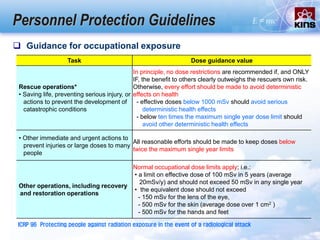
 Guidance for occupational exposure
Task Dose guidance value
Rescue operations*
• Saving life, preventing serious injury, or
actions to prevent the development of
catastrophic conditions
In principle, no dose restrictions are recommended if, and ONLY
IF, the benefit to others clearly outweighs the rescuers own risk.
Otherwise, every effort should be made to avoid deterministic
effects on health
- effective doses below 1000 mSv should avoid serious
deterministic health effects
- below ten times the maximum single year dose limit should
avoid other deterministic health effects
• Other immediate and urgent actions to
prevent injuries or large doses to many
people
All reasonable efforts should be made to keep doses below
twice the maximum single year limits
Other operations, including recovery
and restoration operations
Normal occupational dose limits apply; i.e.:
• a limit on effective dose of 100 mSv in 5 years (average
20mSv/y) and should not exceed 50 mSv in any single year
• the equivalent dose should not exceed
- 150 mSv for the lens of the eye,
- 500 mSv for the skin (average dose over 1 cm2 )
- 500 mSv for the hands and feet
ICRP 96 Protecting people against radiation exposure in the event of a radiological attack
Public Protection Guidelines
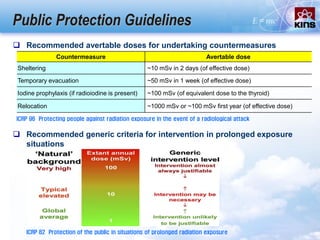
 Recommended avertable doses for undertaking countermeasures
Countermeasure Avertable dose
Sheltering ~10 mSv in 2 days (of effective dose)
Temporary evacuation ~50 mSv in 1 week (of effective dose)
Iodine prophylaxis (if radioiodine is present) ~100 mSv (of equivalent dose to the thyroid)
Relocation ~1000 mSv or ~100 mSv first year (of effective dose)
ICRP 96 Protecting people against radiation exposure in the event of a radiological attack
 Recommended generic criteria for intervention in prolonged exposure
situations
ICRP 82 Protection of the public in situations of prolonged radiation exposure
Recovery/Removal of Radioactive Material
 GENERAL INSTRUCTIONS
 Before recovery, confirm that that all necessary protective actions have been
implemented and the location has been stabilized and secured
 Review all available information on the identity, quantity, and physical properties of the
radioactive materials
 Identify an approved location or repository to which the source material is to be sent
 determine what type of equipment and other resources are required (e.g. shovels,
bucket loader, dump truck, barrels etc.)
 Develop a step-by-step procedure and proper protocol for handling RM
 Ensure that radiological monitoring capability is in place
 Ensure that all packages containing radioactive materials are properly labelled and
identified
 Once removing RM, conduct another survey of the area to ensure that no portions of
the site continue to exhibit readings above the prescribed clearance levels.
Recovery/Removal of Radioactive Material
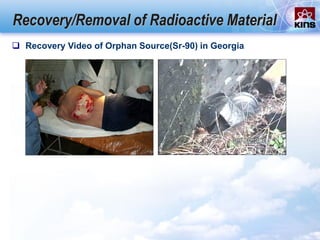
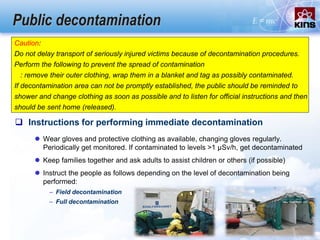
 Recovery Video of Orphan Source(Sr-90) in Georgia
Public decontamination
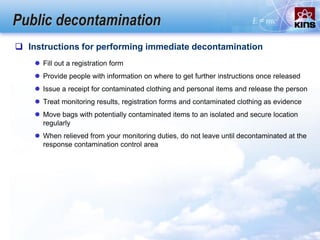
 Instructions for performing immediate decontamination
 Wear gloves and protective clothing as available, changing gloves regularly.
Periodically get monitored. If contaminated to levels >1 µSv/h, get decontaminated
 Keep families together and ask adults to assist children or others (if possible)
 Instruct the people as follows depending on the level of decontamination being
performed:
– Field decontamination
– Full decontamination
Caution:
Do not delay transport of seriously injured victims because of decontamination procedures.
Perform the following to prevent the spread of contamination
: remove their outer clothing, wrap them in a blanket and tag as possibly contaminated.
If decontamination area can not be promptly established, the public should be reminded to
shower and change clothing as soon as possible and to listen for official instructions and then
should be sent home (released).
Public decontamination
 Instructions for performing immediate decontamination
 Fill out a registration form
 Provide people with information on where to get further instructions once released
 Issue a receipt for contaminated clothing and personal items and release the person
 Treat monitoring results, registration forms and contaminated clothing as evidence
 Move bags with potentially contaminated items to an isolated and secure location
regularly
 When relieved from your monitoring duties, do not leave until decontaminated at the
response contamination control area
Response contamination control
 When entering the inner cordoned area:
 Cover instruments with plastic bags
 Log in (keep account of those in area)
 Limit taking additional tools going into the area if possible (use tools already in the area)
 When leaving the inner cordoned area:
 Remove plastic cover from the instruments
 Leave instruments and equipment used inside of the inner cordoned area for further
use
 Receive monitoring using instructions for monitoring of the public and responders
 Receive field decontamination, Before leaving the scene get a full decontamination
 Log out
 Establish a response contamination control area at the boundary of
the inner cordoned area.
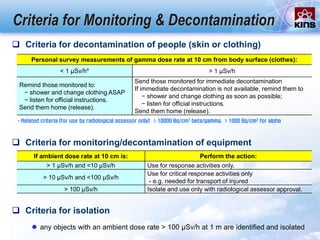
Criteria for Monitoring & Decontamination
 Criteria for decontamination of people (skin or clothing)
Personal survey measurements of gamma dose rate at 10 cm from body surface (clothes):
< 1 μSv/h* > 1 μSv/h
Remind those monitored to:
− shower and change clothing ASAP
− listen for official instructions.
Send them home (release).
Send those monitored for immediate decontamination
If immediate decontamination is not available, remind them to
− shower and change clothing as soon as possible;
− listen for official instructions.
Send them home (release).
* Related criteria (for use by radiological assessor only): > 10000 Bq/cm2 beta/gamma, > 1000 Bq/cm2 for alpha
 Criteria for monitoring/decontamination of equipment
 Criteria for isolation
 any objects with an ambient dose rate > 100 μSv/h at 1 m are identified and isolated
If ambient dose rate at 10 cm is: Perform the action:
> 1 μSv/h and <10 μSv/h Use for response activities only.
> 10 μSv/h and <100 μSv/h
Use for critical response activities only
- e.g. needed for transport of injured
> 100 μSv/h Isolate and use only with radiological assessor approval.
Prevention, Detection,
Prepardness, and Response
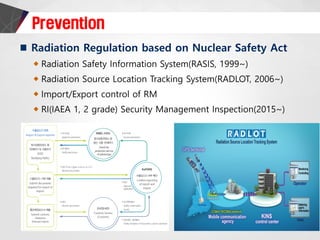
Prevention
Radiation Safety Information System(RASIS, 1999~)
Radiation Source Location Tracking System(RADLOT, 2006~)
Import/Export control of RM
RI(IAEA 1, 2 grade) Security Management Inspection(2015~)
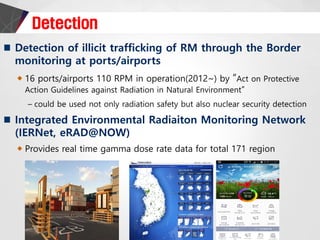
Detection
16 ports/airports 110 RPM in operation(2012~) by “Act on Protective
Action Guidelines against Radiation in Natural Environment“
– could be used not only radiation safety but also nuclear security detection
Provides real time gamma dose rate data for total 171 region
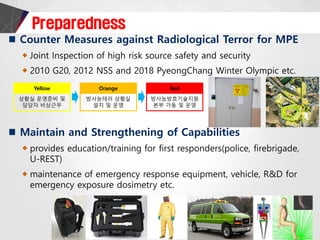
Preparedness
Joint Inspection of high risk source safety and security
2010 G20, 2012 NSS and 2018 PyeongChang Winter Olympic etc.
provides education/training for first responders(police, firebrigade,
U-REST)
maintenance of emergency response equipment, vehicle, R&D for
emergency exposure dosimetry etc.
상황실 운영준비 및
담당자 비상근무
Yellow
방사능테러 상황실
설치 및 운영
Orange
방사능방호기술지원
본부 가동 및 운영
Red
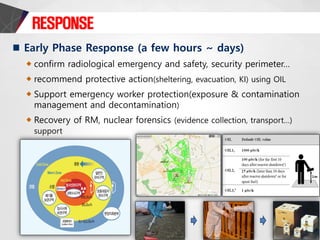
RESPONSE
confirm radiological emergency and safety, security perimeter…
recommend protective action(sheltering, evacuation, KI) using OIL
Support emergency worker protection(exposure & contamination
management and decontamination)
Recovery of RM, nuclear forensics (evidence collection, transport…)
support
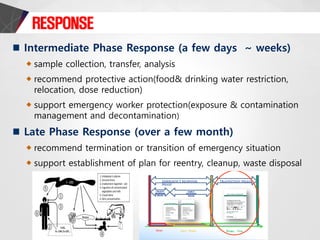
RESPONSE
sample collection, transfer, analysis
recommend protective action(food& drinking water restriction,
relocation, dose reduction)
support emergency worker protection(exposure & contamination
management and decontamination)
recommend termination or transition of emergency situation
support establishment of plan for reentry, cleanup, waste disposal
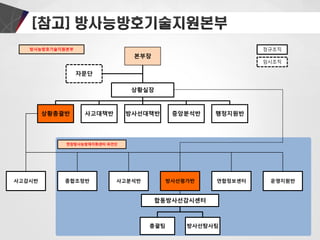
본부장
상황실장
상황총괄반 사고대책반 방사선대책반 중앙분석반 행정지원반
자문단
사고감시반 종합조정반 사고분석반 방사선평가반 연합정보센터 운영지원반
합동방사선감시센터
총괄팀 방사선탐사팀
현장방사능방재지휘센터 파견단
방사능방호기술지원본부 정규조직
임시조직
Retrieval (SouRe]
Inspection (TBD)
Monitoring (IMD]
Search (SIREN/MDF)
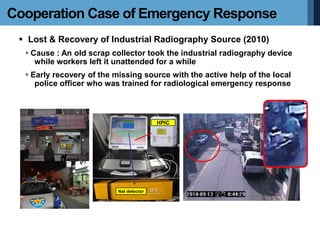
 Lost & Recovery of Industrial Radiography Source (2010)
◦ Cause : An old scrap collector took the industrial radiography device
while workers left it unattended for a while
◦ Early recovery of the missing source with the active help of the local
police officer who was trained for radiological emergency response
Cooperation Case of Emergency Response
가압이온챔버
NaI 섬광검출기
HPIC
NaI detector
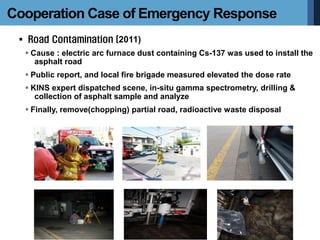
 Road Contamination (2011)
◦ Cause : electric arc furnace dust containing Cs-137 was used to install the
asphalt road
◦ Public report, and local fire brigade measured elevated the dose rate
◦ KINS expert dispatched scene, in-situ gamma spectrometry, drilling &
collection of asphalt sample and analyze
◦ Finally, remove(chopping) partial road, radioactive waste disposal
Cooperation Case of Emergency Response
International Cooperation & Assistance
 IAEA’s CoC and Supplementary Guidance
◦ ROK has supported for the implementation of CoC and Supplementary
Guidance on April 2004 and on September 2012 respectively
 Cooperation with IAEA and Convention
◦ Korea has joined IAEA’s program related to nuclear security such as
ITDB, INES etc. and has fulfilled the activities actively
◦ NSSC shall notify IAEA and related countries of the details under
Convention on Early Notification of a Nuclear Accident, Convention on
Assistance in the Case of a Nuclear Accident or Radiological Emergency
 Collaboration with the GICNT, ITWG, WINS and US(MI, PCG, HLBC)
◦ ROK also has collaborated with the international organizations about
nuclear security, nuclear forensics, and detection & analysis technique
for illicit trafficking of nuclear or radioactive material
20190612_04_AC Emergency response management (KWON).pdf

20190612_04_AC Emergency response management (KWON).pdf

  • 1.
    IAEA-KINS Workshop onRadiation Safety and Emergency Response in the Medical or Industrial Use of Radiation June 12, 2019 Radiological Emergency Response Management
  • 2.
    Introduction  Basis ofEPR Safety Guides  This Lecture  provides generic procedures needed for initial response to radiological emergency.  is consistent with the IAEA GSR Part7 (2015), IAEA GS-G-2.1 (2007), IAEA GSG2 (2011), IAEA-TECDOC-1162 (2000), IAEA-EPR-First responders(2006)
  • 3.
    TYPES OF EMERGENCY Nuclear emergencies (threat category I, II or III) may occur at :  Large irradiation facilities (e.g. industrial irradiators)  Nuclear reactors (research reactors, ship reactors and power reactors)  Storage facilities for large quantities of spent fuel or liquid or gaseous RM  Fuel cycle facilities (e.g. fuel processing plants)  Industrial facilities (e.g. facilities for manufacturing radiopharmaceuticals)  Research or medical facilities with large fixed sources (e.g. teletherapy facilities)  Radiological emergencies(threat category IV) can occur anywhere and include:  Uncontrolled (abandoned, lost, stolen or found) dangerous sources  Misuse of dangerous industrial and medical sources  Public exposures and contamination from unknown origins  Serious overexposures  Malicious threats/acts  Transport emergencies..
  • 4.
    CATEGORIES OF THREATS Threat category DescriptionTYPICAL PRACTICES I on-site events(including very low probability events) are postulated that could give rise to severe deterministic health effects off the site nuclear power plants II on-site events are postulated that could give rise to doses to people off the site that warrant urgent protective action research reactors III on-site events are postulated that could give rise to doses that warrant or contamination that warrants urgent protective action on the site industrial irradiation facilities IV could warrant urgent protective action in an unforeseeable location activities relating to dangerous sources obtained illicitly, transport and authorized activities involving mobile dangerous sources, nuclear powered satellites or radiothermal generators V yield products with a significant likelihood of becoming contaminated, as a result of events at facilities in threat category I or II, to levels necessitating prompt restrictions on products
  • 5.
    D-value and Categorizationof source  D-value  is the radionuclide-specific activity of a source which, if not under control, could cause severe deterministic health effects  Exposure scenarios used in deriving D-value  An unshielded source (the D1 value) – carried in the hand for one hour – carried in a pocket for 10 hours – being in a room for days to weeks  Dispersal of a source by fire, explosion or human action (the D2 value) – inhalation, ingestion and/or skin contamination  The lower value of D1 and D2 is used as the D value. Ref. Categorization of Radioactive Sources, RS-G-1.9 (2005)
  • 6.
    CATEGORIES OF THREATS Types of event associated with radiological emergency  Detection of medical symptoms of radiation exposure due to unknown sources  Lost, Theft, Found, Recovery of (uncontrolled) dangerous source  Radiography: disconnected or damaged source, source in a fire  Damage to a fixed dangerous sealed source (e.g. as used in gauges)  Public contamination and/or exposure (including that caused intentionally)  Re-entry of a satellite containing radioactive material  Transport emergencies  Emergency in radiology or nuclear medicine and in radiotherapy  A serious overexposure  Credible or confirmed and Non-credible terrorist threats  An explosive radiological dispersal device  Intentional contamination of water supply, food and /or other products  Detection of elevated radiation levels (in air, water, food or other products)  Notification of a transnational emergency by the IAEA or any State
  • 7.
  • 8.
    General Initial ResponseProcedure  Notification  obtains initial information  decides if it is a radiological one  initiates the response by alerting/activating the emergency manager  Hazard Assessment  assesses the level of the present or suspected hazard  local/national response organization  determines whether the emergency is serious enough  has a sufficient public interest to warrant sending a national level  Proving Information  overall response must cater for providing information to the media and the public.
  • 9.
    Hazard Assessment  Indicationsof a possible radiological emergency(hazard):  Credible threats or threatening messages.  Device that appears intended to spread contamination.  Signs of possible contamination (e.g. spill).  Gamma dose rates: > 100 μSv/h at 1 m from object or at 1m above the ground.  Medical symptoms of radiation injuries (such as burns without an apparent cause).  Building / area marked with the radiation symbol  Results of assessment of a radiological assessor.  Neutron radiation.  Dangerous source that is lost, stolen, damaged, in a fire, leaking, or potentially involved in a terrorist act or explosion.
  • 10.
    Hazard Assessment  Indicationsof a dangerous source:  A heavy container with the radiation symbol  Item with labels of packages.  Item with transport UN numbers or markings.  Device used for cancer treatment (teletherapy or brachytherapy).  Radiography cameras or sources.  Well logging sources used in drilling operations.  Dangerous quantity of material (> D-value), as assessed by a radiological assessor.
  • 11.
    Hazard Assessment  Indicationsof a dangerous source:
  • 12.
    Establishment of CordonedArea etc. Forensic evidence management area Temporary morgue area Waste Storage area Public processing area ( <0.3 uSv/h) - triage/first aids - registration - monitoring - decontamination Response contamination control area  Generic layout of the response facilities and locations within areas Hot Zone Warm Zone Cold Zone
  • 13.
    Establishment of CordonedArea etc.  Generic layout of the response facilities and locations within areas Area/location/facility Description/Functions Inner cordoned area Area around a dangerous radioactive source where precautions should be taken to protect responders and the public from potential external exposure and contamination. safety perimeter. Outer cordoned area Secured area around the inner cordoned area. security perimeter. Incident command post (ICP) Location of the IC and other members of the unified command and support staff. Forensic evidence management area Location for the supervised processing, recording, examination and photography of items a nd evidence recovered from the scene Public information center (PIC) Location for the coordination of all official information released to the media concerning the emergency. Public processing area Location for processing and registering the public evacuated from the inner cordoned area; - medical triage, first aid and preparation of victims for transport - monitoring and decontamination of the public evacuated Response contamination control area Location for the control of contamination from response personnel entering and leaving Staging area Location used to collect and organize additional resources in the vicinity of the emergency. Temporary morgue area Location for the dignified storage of deceased victims - may be contaminated or have not been released by the forensic team. Waste storage area Location where potentially contaminated items (e.g. clothing) are stored.
  • 14.
    Establishment of CordonedArea etc.  Suggested radius of inner cordoned area Situation Initial inner cordoned area (safety perimeter) Initial determination — outside Unshielded or damaged potentially dangerous source 30 m around Major spill from a potentially dangerous source 100 m around Fire, explosion or fumes involving a potentially dangerous source 300 m radius Suspected bomb (potential RDD) exploded or unexploded 400 m radius or more to protect against an explosion Initial determination — inside a building Damage, loss of shielding or spill involving a potentially dangerous source Affected and adjacent areas (including floors above and below) Fires or other event involving a potentially dangerous source that can spread materials throughout the build ing (e.g. through the ventilation system) Entire building and appropriate outside distance as indicated above Expansion based on radiological monitoring Ambient dose rate of 100 µSv/h Beta/gamma surface contamination of 1,000Bq/cm2 Alpha surface contamination of 100Bq/cm2 Wherever these levels are measured
  • 15.
    Personnel Protection Guidelines GENERAL INSTRUCTIONS  ALWAYS be aware of the hazards that you may encounter in the field and take the necessary precautions.  NEVER attempt any field activities without the appropriate safety equipment. Always know how to use it.  All activities SHALL BE conducted so that exposures are maintained as low as reasonably achievable.  BE AWARE of turn back levels. Emergency worker turn back doses are to serve as guidance and not limits. Judgement must be used in their application.  DO NOT linger in areas where the dose rate is 1mSv/h or greater.  BE CAUTIOUS proceeding to areas where the dose rate is greater than 10mSv/h.  You SHALL NOT proceed to areas in which the dose rates exceed 100 mSv/h unless otherwise directed by the radiological assessor.  USE time, distance and shielding to protect yourself.  PRE-PLAN entry into high dose rate areas in conjunction with your supervisor.  DO NOT eat, drink, or smoke in any contaminated areas.  WHEN in doubt seek advice from your team leader or coordinator.
  • 16.
    Personnel Protection Guidelines When gamma dose rate is known:  Follow general personnel protection guidelines  If ambient dose rate in a particular area is greater than 100 mSv/h: – Perform only life saving actions, Limit total time of staying there to < 30 minutes  Do not proceed into area with an ambient dose rate of greater than 1000 mSv/h unless directed by radiological assessor  When self-reading dosimeters are being used  Make all reasonable efforts not to exceed emergency worker turn-back dose guidance. Caution: Self-reading dosimeters do not measure the dose from inhalation, ingestion or skin contamination; consequently responders must also follow all general personnel protection guidelines to limit the dose from these pathways.  Thyroid protection  Take a stable iodine tablet when instructed to do so by your field controller/supervisor Some accidents may involve the release of radioactive iodine. In such cases, thyroid is the critical organ and stable iodine can be used to block the uptake of radioactive iodine.
  • 17.
    Personnel Protection Guidelines EMERGENCY WORKER TURN BACK DOSE GUIDANCE Task EWG[mSv)* Life saving actions • rescue from immediate threats to life; • provision of first aid for life threatening injuries; • prevention/mitigation of conditions that could be life threatening. 1000 Actions to prevent severe health effects or injuries • evacuation/protection of the public; • environmental monitoring of populated areas to identify where evacuation, sheltering or food restriction are warranted; • rescue from potential threats of serious injury; • immediate treatment of serious injuries; • urgent decontamination of people. Actions to prevent the development of catastrophic conditions • prevention or mitigation of fires, etc; • apprehension of terrorist suspects. 500 Actions to avert a large collective dose • environmental sample collection and analysis for environmental monitoring of populated areas; • localized decontamination if required to protect the public. 50 IAEA EPR – FIRST RESPONDERS (2006)
  • 18.
    Personnel Protection Guidelines Guidance for occupational exposure Task Dose guidance value Rescue operations* • Saving life, preventing serious injury, or actions to prevent the development of catastrophic conditions In principle, no dose restrictions are recommended if, and ONLY IF, the benefit to others clearly outweighs the rescuers own risk. Otherwise, every effort should be made to avoid deterministic effects on health - effective doses below 1000 mSv should avoid serious deterministic health effects - below ten times the maximum single year dose limit should avoid other deterministic health effects • Other immediate and urgent actions to prevent injuries or large doses to many people All reasonable efforts should be made to keep doses below twice the maximum single year limits Other operations, including recovery and restoration operations Normal occupational dose limits apply; i.e.: • a limit on effective dose of 100 mSv in 5 years (average 20mSv/y) and should not exceed 50 mSv in any single year • the equivalent dose should not exceed - 150 mSv for the lens of the eye, - 500 mSv for the skin (average dose over 1 cm2 ) - 500 mSv for the hands and feet ICRP 96 Protecting people against radiation exposure in the event of a radiological attack
  • 19.
    Public Protection Guidelines Recommended avertable doses for undertaking countermeasures Countermeasure Avertable dose Sheltering ~10 mSv in 2 days (of effective dose) Temporary evacuation ~50 mSv in 1 week (of effective dose) Iodine prophylaxis (if radioiodine is present) ~100 mSv (of equivalent dose to the thyroid) Relocation ~1000 mSv or ~100 mSv first year (of effective dose) ICRP 96 Protecting people against radiation exposure in the event of a radiological attack  Recommended generic criteria for intervention in prolonged exposure situations ICRP 82 Protection of the public in situations of prolonged radiation exposure
  • 20.
    Recovery/Removal of RadioactiveMaterial  GENERAL INSTRUCTIONS  Before recovery, confirm that that all necessary protective actions have been implemented and the location has been stabilized and secured  Review all available information on the identity, quantity, and physical properties of the radioactive materials  Identify an approved location or repository to which the source material is to be sent  determine what type of equipment and other resources are required (e.g. shovels, bucket loader, dump truck, barrels etc.)  Develop a step-by-step procedure and proper protocol for handling RM  Ensure that radiological monitoring capability is in place  Ensure that all packages containing radioactive materials are properly labelled and identified  Once removing RM, conduct another survey of the area to ensure that no portions of the site continue to exhibit readings above the prescribed clearance levels.
  • 21.
    Recovery/Removal of RadioactiveMaterial  Recovery Video of Orphan Source(Sr-90) in Georgia
  • 22.
    Public decontamination  Instructionsfor performing immediate decontamination  Wear gloves and protective clothing as available, changing gloves regularly. Periodically get monitored. If contaminated to levels >1 µSv/h, get decontaminated  Keep families together and ask adults to assist children or others (if possible)  Instruct the people as follows depending on the level of decontamination being performed: – Field decontamination – Full decontamination Caution: Do not delay transport of seriously injured victims because of decontamination procedures. Perform the following to prevent the spread of contamination : remove their outer clothing, wrap them in a blanket and tag as possibly contaminated. If decontamination area can not be promptly established, the public should be reminded to shower and change clothing as soon as possible and to listen for official instructions and then should be sent home (released).
  • 23.
    Public decontamination  Instructionsfor performing immediate decontamination  Fill out a registration form  Provide people with information on where to get further instructions once released  Issue a receipt for contaminated clothing and personal items and release the person  Treat monitoring results, registration forms and contaminated clothing as evidence  Move bags with potentially contaminated items to an isolated and secure location regularly  When relieved from your monitoring duties, do not leave until decontaminated at the response contamination control area
  • 24.
    Response contamination control When entering the inner cordoned area:  Cover instruments with plastic bags  Log in (keep account of those in area)  Limit taking additional tools going into the area if possible (use tools already in the area)  When leaving the inner cordoned area:  Remove plastic cover from the instruments  Leave instruments and equipment used inside of the inner cordoned area for further use  Receive monitoring using instructions for monitoring of the public and responders  Receive field decontamination, Before leaving the scene get a full decontamination  Log out  Establish a response contamination control area at the boundary of the inner cordoned area.
  • 25.
    Criteria for Monitoring& Decontamination  Criteria for decontamination of people (skin or clothing) Personal survey measurements of gamma dose rate at 10 cm from body surface (clothes): < 1 μSv/h* > 1 μSv/h Remind those monitored to: − shower and change clothing ASAP − listen for official instructions. Send them home (release). Send those monitored for immediate decontamination If immediate decontamination is not available, remind them to − shower and change clothing as soon as possible; − listen for official instructions. Send them home (release). * Related criteria (for use by radiological assessor only): > 10000 Bq/cm2 beta/gamma, > 1000 Bq/cm2 for alpha  Criteria for monitoring/decontamination of equipment  Criteria for isolation  any objects with an ambient dose rate > 100 μSv/h at 1 m are identified and isolated If ambient dose rate at 10 cm is: Perform the action: > 1 μSv/h and <10 μSv/h Use for response activities only. > 10 μSv/h and <100 μSv/h Use for critical response activities only - e.g. needed for transport of injured > 100 μSv/h Isolate and use only with radiological assessor approval.
  • 26.
  • 27.
    Prevention Radiation Safety InformationSystem(RASIS, 1999~) Radiation Source Location Tracking System(RADLOT, 2006~) Import/Export control of RM RI(IAEA 1, 2 grade) Security Management Inspection(2015~)
  • 28.
    Detection 16 ports/airports 110RPM in operation(2012~) by “Act on Protective Action Guidelines against Radiation in Natural Environment“ – could be used not only radiation safety but also nuclear security detection Provides real time gamma dose rate data for total 171 region
  • 29.
    Preparedness Joint Inspection ofhigh risk source safety and security 2010 G20, 2012 NSS and 2018 PyeongChang Winter Olympic etc. provides education/training for first responders(police, firebrigade, U-REST) maintenance of emergency response equipment, vehicle, R&D for emergency exposure dosimetry etc. 상황실 운영준비 및 담당자 비상근무 Yellow 방사능테러 상황실 설치 및 운영 Orange 방사능방호기술지원 본부 가동 및 운영 Red
  • 30.
    RESPONSE confirm radiological emergencyand safety, security perimeter… recommend protective action(sheltering, evacuation, KI) using OIL Support emergency worker protection(exposure & contamination management and decontamination) Recovery of RM, nuclear forensics (evidence collection, transport…) support
  • 31.
    RESPONSE sample collection, transfer,analysis recommend protective action(food& drinking water restriction, relocation, dose reduction) support emergency worker protection(exposure & contamination management and decontamination) recommend termination or transition of emergency situation support establishment of plan for reentry, cleanup, waste disposal
  • 32.
    본부장 상황실장 상황총괄반 사고대책반 방사선대책반중앙분석반 행정지원반 자문단 사고감시반 종합조정반 사고분석반 방사선평가반 연합정보센터 운영지원반 합동방사선감시센터 총괄팀 방사선탐사팀 현장방사능방재지휘센터 파견단 방사능방호기술지원본부 정규조직 임시조직
  • 33.
  • 34.
     Lost &Recovery of Industrial Radiography Source (2010) ◦ Cause : An old scrap collector took the industrial radiography device while workers left it unattended for a while ◦ Early recovery of the missing source with the active help of the local police officer who was trained for radiological emergency response Cooperation Case of Emergency Response 가압이온챔버 NaI 섬광검출기 HPIC NaI detector
  • 35.
     Road Contamination(2011) ◦ Cause : electric arc furnace dust containing Cs-137 was used to install the asphalt road ◦ Public report, and local fire brigade measured elevated the dose rate ◦ KINS expert dispatched scene, in-situ gamma spectrometry, drilling & collection of asphalt sample and analyze ◦ Finally, remove(chopping) partial road, radioactive waste disposal Cooperation Case of Emergency Response
  • 36.
    International Cooperation &Assistance  IAEA’s CoC and Supplementary Guidance ◦ ROK has supported for the implementation of CoC and Supplementary Guidance on April 2004 and on September 2012 respectively  Cooperation with IAEA and Convention ◦ Korea has joined IAEA’s program related to nuclear security such as ITDB, INES etc. and has fulfilled the activities actively ◦ NSSC shall notify IAEA and related countries of the details under Convention on Early Notification of a Nuclear Accident, Convention on Assistance in the Case of a Nuclear Accident or Radiological Emergency  Collaboration with the GICNT, ITWG, WINS and US(MI, PCG, HLBC) ◦ ROK also has collaborated with the international organizations about nuclear security, nuclear forensics, and detection & analysis technique for illicit trafficking of nuclear or radioactive material