2019 Research Synopsis on Lycorma delicatula in northern
Berks County and very southern Schuylkill County, PA
November 2019
Richard Gardner
rtgardner3@yahoo.com
Photos and other parts of this presentation may be used
providing they are referenced with the title and “Richard
Gardner, November 2019”.
This past field season I focused on Lycorma delicatula, the
Spotted Lanternfly (SLF), since we live in northern Berks
County, PA, on the northern edge of its spread. For me this was
an ideal or nightmare situation in that it is cutting edge
research on a highly invasive newly introduced non-native
insect which is literally in my backyard.
The most diabolical part of being an ecologist, especially an
invasive species ecologist studying an organism like the SLF is
that the research is everywhere I am whenever I am outside,
including my backyard. For the last 16 months my camera was
seldom far from my hand when hiking.
I did most of my research in the following locations:
1.) my backyard just south of Shartlesville, Berks County, PA
2.) a stand of Ailanthus altissima trees in Shartlesville
3.) Blue Marsh Lake on the uphill end of Landis and Highland Roads
to Sterner Hill Road
4.) the Appalachian Trail (AT) on the border of Berks and Schuylkill
counties just “south” of where it crosses Rt. 183
5.) Blue Marsh Lake, ½ mile on each side of mile 19 of the loop trail.
Other research areas were around mile 4.5 in Blue Marsh Lake
which is where I saw the first nymphs emerging, SGL110 in two
locations near Shartlesville, Peacock Road in Blue Marsh Lake
and random locations I happened to be at.
During this field season I talked with two wineries, and
purchased their wines, two farm markets selling tree fruit and
numerous other people. The wine helped.
The fascinating part of having research sites in different locations
with varying ecological conditions such as amount of sunlight on
egg masses and 1000 feet difference in altitude is watching the
eggs hatch and nymphs mature at different times. There were
about two weeks between the first eggs hatching at Blue Marsh
Lake and the first of three egg sets hatching on top of Blue
Mountain along the AT south of Rt. 183.
I was fortunate to see gypsy moth larvae (Lymantria dispar)
emerging from eggs close to SLF egg masses near the AT south of
Rt. 183 south. This gave me a comparison between a known
organism and an unknown one. Gypsy moths are an interesting
contrast to SLF in that they are a real threat to forests from
urban areas to wild areas, not an ephemeral one.
I feel that at least $200,000,000 will be wasted on SLF research
and quarantines. My expectation is that Penn State University
will waste at least $100,000,000 on this organism. After this
issue solves itself Penn State will proudly take credit for
something which they had no part in resolving.
Beyond the money wasted, the fear SLF engendered, with
Penn State’s help, will further poison the landscape with
needless insecticides and herbicides. I recently heard concerns
that the honey of local bees may be contaminated with
insecticides due SLF panic. If so, this will be a huge blow to
local agriculture.
The spread of SLF from my observations is unstoppable. The
most likely scenario is that after local population explosions
the SLF will become indigenous with a low-level background
presence throughout North America like many other invasive
non-native organisms.
What I see in Berks County is similar to dropping a stone into a
puddle – large immediate ripples moving outward followed by
smaller ripples. Periodicity is the one question I still have. It is a
long-term issue which cannot be determined in one or several
years.
I do not even remotely see a need for biocontrols. If the pattern
of exponential growth and decline which we are seeing in Berks
County is consistent throughout SLF expansion, an introduced
biocontrol will do little if any good. The possibilities and
probabilities for environmental harm are too great at this time
to at any logical level consider introducing another organism
which will have unpredictable short- and long-term effects on
the ecosystems SLF spreads to. There are simply too many
variables to introduce yet another non-native organism into
ecosystems already flooded with non-native organisms.
I see the Brown Marmorated Stink Bug (BMSB) as a model for SLF in
many ways, although there are significant differences in their
ecology.
The four major similarities are that
1.) both are not woodland organisms, preferring open areas in
urban, suburban and rural landscapes,
2.) both were introduced within 35 miles of my home and 30 miles
of each other
3.) the spread of both is unstoppable and
4.) both had a major population explosion followed by a steep
decline where they were first introduced. This is basic ecological
theory (introduction/lag/log/peak/decline/stability).
The major differences are that
SLF
1.) is a hopper,
2.) has no close native relatives,
3.) prefers to feed on woody plants such as Ailanthus altissima,
grape vines and some tree species, especially domestic trees,
4.) lays eggs in the fall which overwinter and
5.) the adult dies in early winter.
BMSB
1.) is a flyer,
2.) has many native relatives,
3.) prefers to feed on soft foods such as my tomatoes and beans,
4.) adults overwinter to lay eggs in the spring
5.) subsequent generations lay eggs throughout the summer and
in the following spring after overwintering as adults.
I saw numerous Brown Marmorated Stink Bugs at different
instars in my garden and home. However, BMSB this year was
possibly at the lowest level in our garden since it was planted
several years ago. We lost perhaps 10% of our beans this year
versus 90% the last two years.
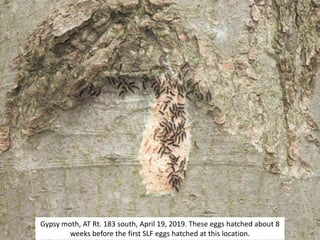
Gypsy moth, AT Rt. 183 south, April 19, 2019. These eggs hatched about 8
weeks before the first SLF eggs hatched at this location.
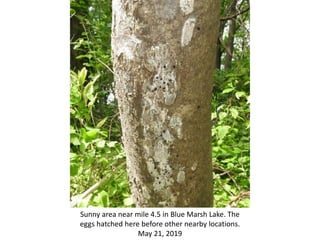
Sunny area near mile 4.5 in Blue Marsh Lake. The
eggs hatched here before other nearby locations.
May 21, 2019
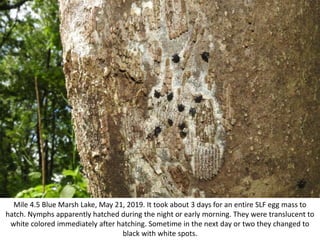
Mile 4.5 Blue Marsh Lake, May 21, 2019. It took about 3 days for an entire SLF egg mass to
hatch. Nymphs apparently hatched during the night or early morning. They were translucent to
white colored immediately after hatching. Sometime in the next day or two they changed to
black with white spots.
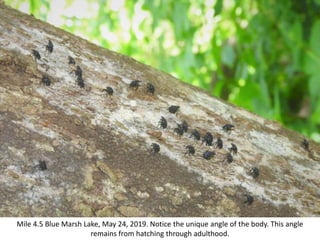
Mile 4.5 Blue Marsh Lake, May 24, 2019. Notice the unique angle of the body. This angle
remains from hatching through adulthood.
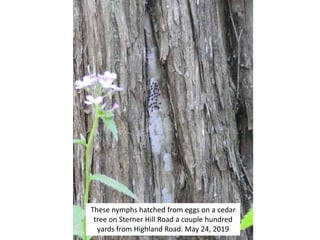
These nymphs hatched from eggs on a cedar
tree on Sterner Hill Road a couple hundred
yards from Highland Road. May 24, 2019
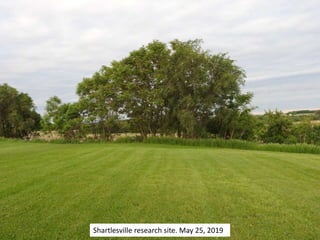
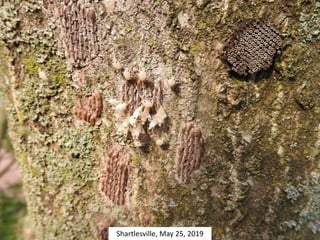
Shartlesville research site. May 25, 2019
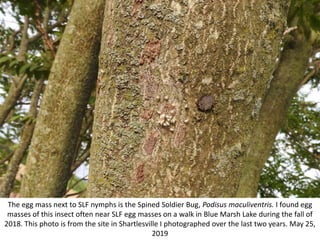
The egg mass next to SLF nymphs is the Spined Soldier Bug, Podisus maculiventris. I found egg
masses of this insect often near SLF egg masses on a walk in Blue Marsh Lake during the fall of
2018. This photo is from the site in Shartlesville I photographed over the last two years. May 25,
2019
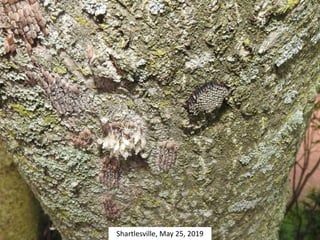
Shartlesville, May 25, 2019
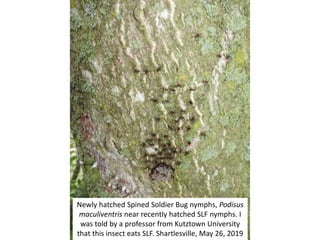
Newly hatched Spined Soldier Bug nymphs, Podisus
maculiventris near recently hatched SLF nymphs. I
was told by a professor from Kutztown University
that this insect eats SLF. Shartlesville, May 26, 2019
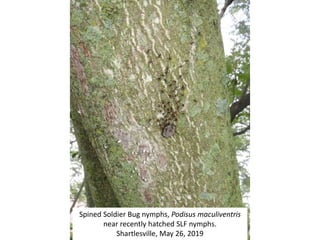
Spined Soldier Bug nymphs, Podisus maculiventris
near recently hatched SLF nymphs.
Shartlesville, May 26, 2019
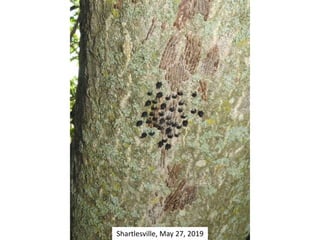
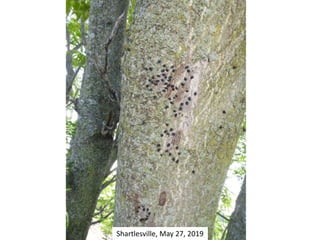
Shartlesville, May 27, 2019
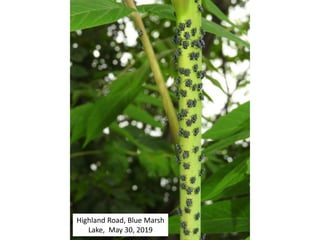
Highland Road, Blue Marsh
Lake, May 30, 2019
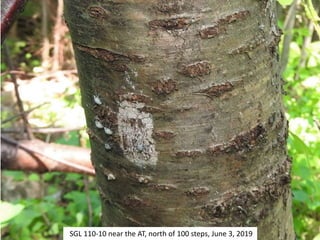
SGL 110-10 near the AT, north of 100 steps, June 3, 2019
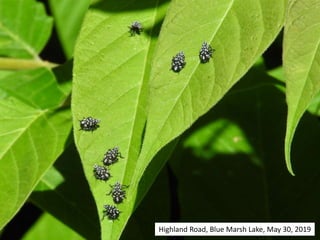
Highland Road, Blue Marsh Lake, May 30, 2019
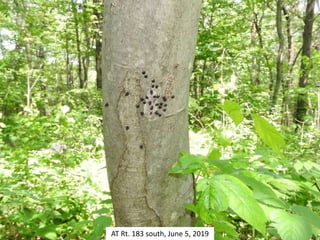
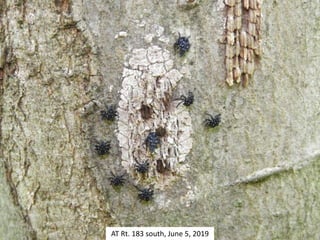
AT Rt. 183 south, June 5, 2019
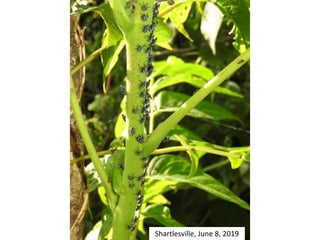
Shartlesville, June 8, 2019
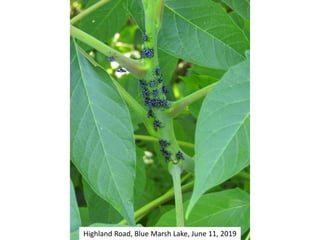
Highland Road, Blue Marsh Lake, June 11, 2019
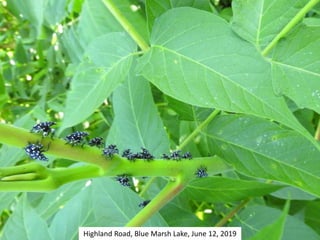
Highland Road, Blue Marsh Lake, June 12, 2019
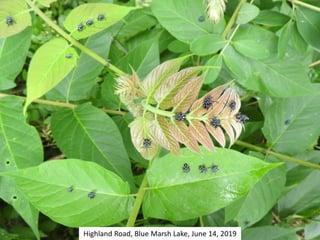
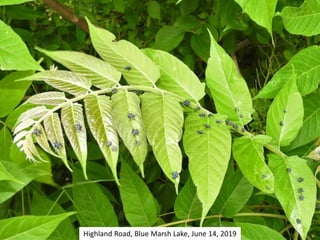
Highland Road, Blue Marsh Lake, June 14, 2019
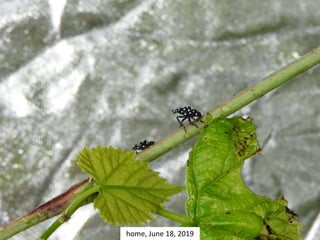
home, June 18, 2019
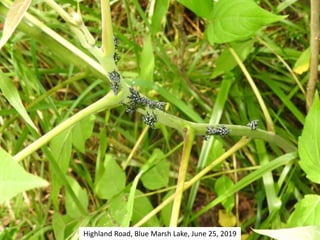
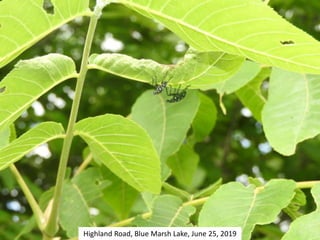
Highland Road, Blue Marsh Lake, June 25, 2019
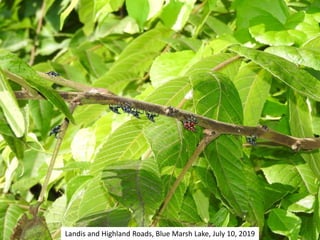
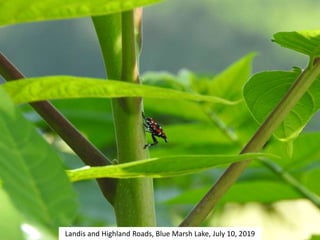
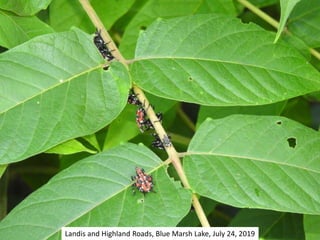
Landis and Highland Roads, Blue Marsh Lake, July 10, 2019
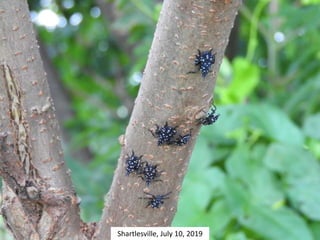
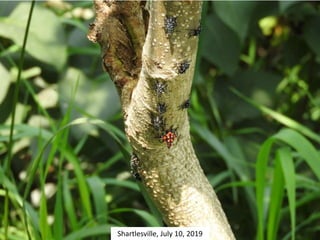
Shartlesville, July 10, 2019
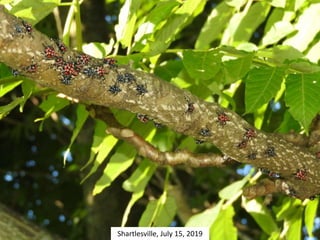
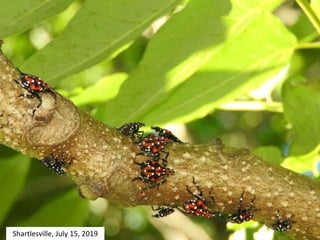
Shartlesville, July 15, 2019
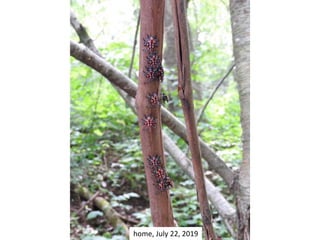
home, July 22, 2019
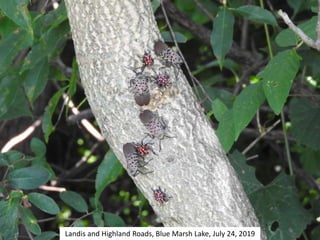
Landis and Highland Roads, Blue Marsh Lake, July 24, 2019
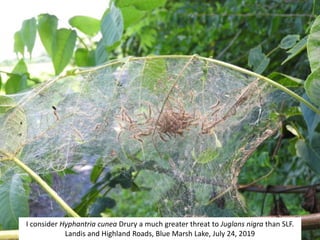
I consider Hyphantria cunea Drury a much greater threat to Juglans nigra than SLF.
Landis and Highland Roads, Blue Marsh Lake, July 24, 2019
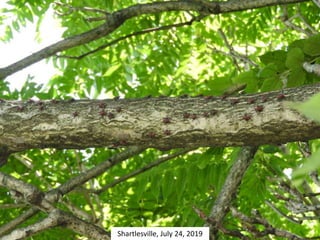
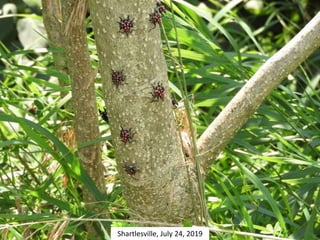
Shartlesville, July 24, 2019
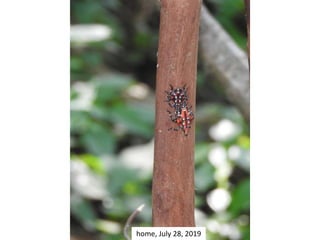
home, July 28, 2019
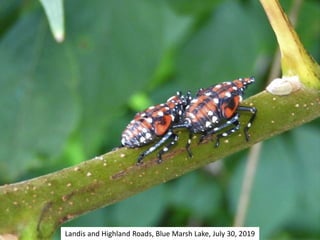
Landis and Highland Roads, Blue Marsh Lake, July 30, 2019
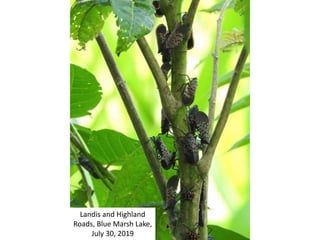
Landis and Highland
Roads, Blue Marsh Lake,
July 30, 2019
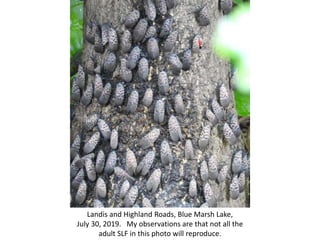
Landis and Highland Roads, Blue Marsh Lake,
July 30, 2019. My observations are that not all the
adult SLF in this photo will reproduce.
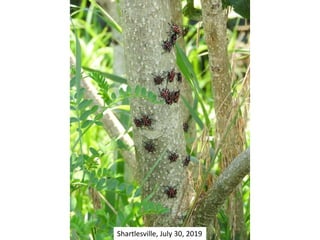
Shartlesville, July 30, 2019
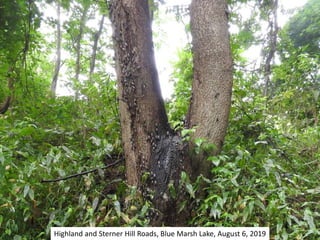
Highland and Sterner Hill Roads, Blue Marsh Lake, August 6, 2019
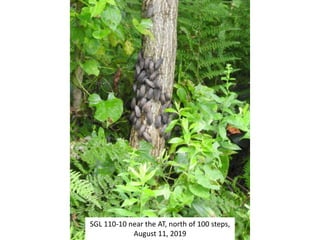
SGL 110-10 near the AT, north of 100 steps,
August 11, 2019
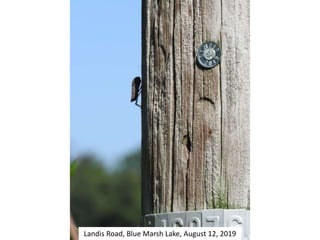
Landis Road, Blue Marsh Lake, August 12, 2019
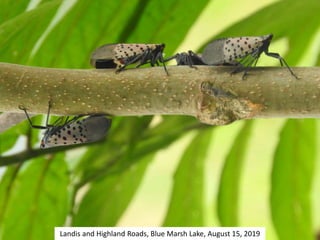
Landis and Highland Roads, Blue Marsh Lake, August 15, 2019
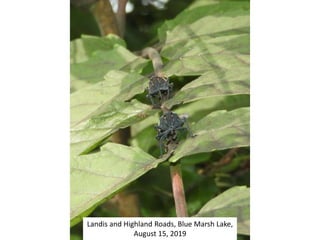
Landis and Highland Roads, Blue Marsh Lake,
August 15, 2019
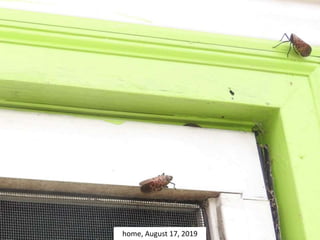
home, August 17, 2019
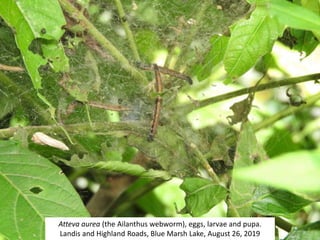
Atteva aurea (the Ailanthus webworm), eggs, larvae and pupa.
Landis and Highland Roads, Blue Marsh Lake, August 26, 2019
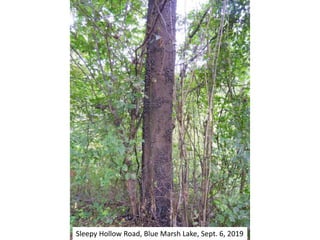
Sleepy Hollow Road, Blue Marsh Lake, Sept. 6, 2019
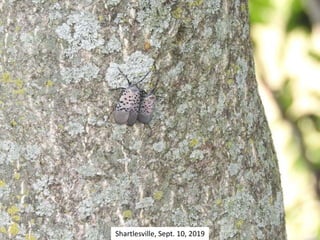
Shartlesville, Sept. 10, 2019
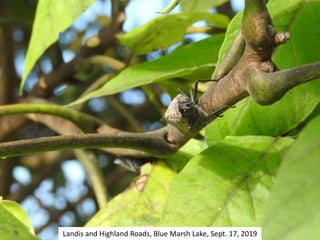
Landis and Highland Roads, Blue Marsh Lake, Sept. 17, 2019
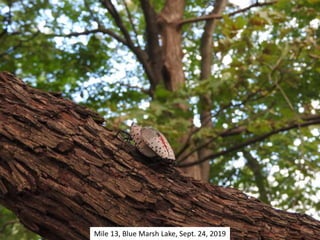
Mile 13, Blue Marsh Lake, Sept. 24, 2019
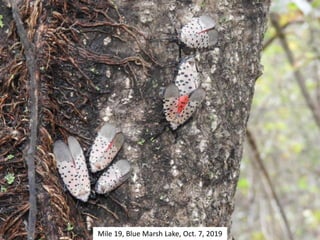
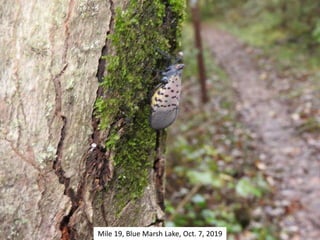
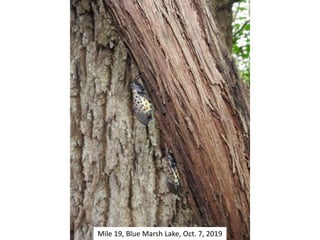
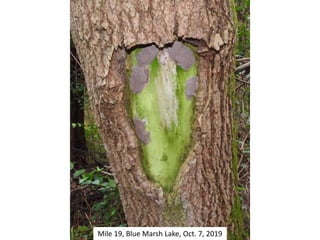
Mile 19, Blue Marsh Lake, Oct. 7, 2019
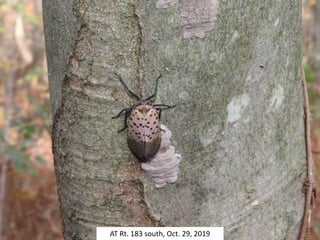
AT Rt. 183 south, Oct. 29, 2019
One serious issue we are going to have to deal with in Pennsylvania is Gun Bullying by
the Pennsylvania Game Commission and by hunters. It appears to be especially aimed
at women hikers since from our experience they are the largest number of hikers and
men are easily the largest number of hunters. My wife and other women have
experienced gun bullying by hunters and I had shotgun pellets hitting trees over my
head recently when walking with a woman who is a close friend. It will be curtailing
research and outdoor recreation because there is literally no public land owned by the
state in Pennsylvania which is not open to hunting including state parks and state
forests, and the land owned by the Army Corps of Engineers. The legislature has
decreed the request by Pennsylvania Game Commission that rifle deer season will start
the first Saturday after Thanksgiving, which was a prime day for outdoor recreation
which does not involve slaughtering animals with high powered rifles, and three
random Sundays will also be open to hunting, which no one is sure when they will be
until they hear gunshots.
There is literally no place safe for hikers, mountain bikers and families in Pennsylvania
to enjoy outdoor recreation from mid-September through early January and during the
month of May. Instead of “Go Outdoors Pennsylvania”, it is “Go Outdoors anywhere
but Pennsylvania”.
My feelings are that this will destroy outdoor recreation in Pennsylvania, which seems
to be a goal of the Pennsylvania Game Commission. I suggest that people planning
their vacations in Pennsylvania find other states to go to until this resolves itself in a
positive way for hikers, bicyclists and families. We will be doing so.

2019 Spotted Lanternfly research synopsis

  • 1.
    2019 Research Synopsison Lycorma delicatula in northern Berks County and very southern Schuylkill County, PA November 2019 Richard Gardner rtgardner3@yahoo.com
  • 2.
    Photos and otherparts of this presentation may be used providing they are referenced with the title and “Richard Gardner, November 2019”.
  • 3.
    This past fieldseason I focused on Lycorma delicatula, the Spotted Lanternfly (SLF), since we live in northern Berks County, PA, on the northern edge of its spread. For me this was an ideal or nightmare situation in that it is cutting edge research on a highly invasive newly introduced non-native insect which is literally in my backyard.
  • 4.
    The most diabolicalpart of being an ecologist, especially an invasive species ecologist studying an organism like the SLF is that the research is everywhere I am whenever I am outside, including my backyard. For the last 16 months my camera was seldom far from my hand when hiking.
  • 5.
    I did mostof my research in the following locations: 1.) my backyard just south of Shartlesville, Berks County, PA 2.) a stand of Ailanthus altissima trees in Shartlesville 3.) Blue Marsh Lake on the uphill end of Landis and Highland Roads to Sterner Hill Road 4.) the Appalachian Trail (AT) on the border of Berks and Schuylkill counties just “south” of where it crosses Rt. 183 5.) Blue Marsh Lake, ½ mile on each side of mile 19 of the loop trail.
  • 6.
    Other research areaswere around mile 4.5 in Blue Marsh Lake which is where I saw the first nymphs emerging, SGL110 in two locations near Shartlesville, Peacock Road in Blue Marsh Lake and random locations I happened to be at. During this field season I talked with two wineries, and purchased their wines, two farm markets selling tree fruit and numerous other people. The wine helped.
  • 7.
    The fascinating partof having research sites in different locations with varying ecological conditions such as amount of sunlight on egg masses and 1000 feet difference in altitude is watching the eggs hatch and nymphs mature at different times. There were about two weeks between the first eggs hatching at Blue Marsh Lake and the first of three egg sets hatching on top of Blue Mountain along the AT south of Rt. 183. I was fortunate to see gypsy moth larvae (Lymantria dispar) emerging from eggs close to SLF egg masses near the AT south of Rt. 183 south. This gave me a comparison between a known organism and an unknown one. Gypsy moths are an interesting contrast to SLF in that they are a real threat to forests from urban areas to wild areas, not an ephemeral one.
  • 8.
    I feel thatat least $200,000,000 will be wasted on SLF research and quarantines. My expectation is that Penn State University will waste at least $100,000,000 on this organism. After this issue solves itself Penn State will proudly take credit for something which they had no part in resolving. Beyond the money wasted, the fear SLF engendered, with Penn State’s help, will further poison the landscape with needless insecticides and herbicides. I recently heard concerns that the honey of local bees may be contaminated with insecticides due SLF panic. If so, this will be a huge blow to local agriculture.
  • 9.
    The spread ofSLF from my observations is unstoppable. The most likely scenario is that after local population explosions the SLF will become indigenous with a low-level background presence throughout North America like many other invasive non-native organisms. What I see in Berks County is similar to dropping a stone into a puddle – large immediate ripples moving outward followed by smaller ripples. Periodicity is the one question I still have. It is a long-term issue which cannot be determined in one or several years.
  • 10.
    I do noteven remotely see a need for biocontrols. If the pattern of exponential growth and decline which we are seeing in Berks County is consistent throughout SLF expansion, an introduced biocontrol will do little if any good. The possibilities and probabilities for environmental harm are too great at this time to at any logical level consider introducing another organism which will have unpredictable short- and long-term effects on the ecosystems SLF spreads to. There are simply too many variables to introduce yet another non-native organism into ecosystems already flooded with non-native organisms.
  • 11.
    I see theBrown Marmorated Stink Bug (BMSB) as a model for SLF in many ways, although there are significant differences in their ecology. The four major similarities are that 1.) both are not woodland organisms, preferring open areas in urban, suburban and rural landscapes, 2.) both were introduced within 35 miles of my home and 30 miles of each other 3.) the spread of both is unstoppable and 4.) both had a major population explosion followed by a steep decline where they were first introduced. This is basic ecological theory (introduction/lag/log/peak/decline/stability).
  • 12.
    The major differencesare that SLF 1.) is a hopper, 2.) has no close native relatives, 3.) prefers to feed on woody plants such as Ailanthus altissima, grape vines and some tree species, especially domestic trees, 4.) lays eggs in the fall which overwinter and 5.) the adult dies in early winter. BMSB 1.) is a flyer, 2.) has many native relatives, 3.) prefers to feed on soft foods such as my tomatoes and beans, 4.) adults overwinter to lay eggs in the spring 5.) subsequent generations lay eggs throughout the summer and in the following spring after overwintering as adults.
  • 13.
    I saw numerousBrown Marmorated Stink Bugs at different instars in my garden and home. However, BMSB this year was possibly at the lowest level in our garden since it was planted several years ago. We lost perhaps 10% of our beans this year versus 90% the last two years.
  • 14.
    Gypsy moth, ATRt. 183 south, April 19, 2019. These eggs hatched about 8 weeks before the first SLF eggs hatched at this location.
  • 15.
    Sunny area nearmile 4.5 in Blue Marsh Lake. The eggs hatched here before other nearby locations. May 21, 2019
  • 16.
    Mile 4.5 BlueMarsh Lake, May 21, 2019. It took about 3 days for an entire SLF egg mass to hatch. Nymphs apparently hatched during the night or early morning. They were translucent to white colored immediately after hatching. Sometime in the next day or two they changed to black with white spots.
  • 17.
    Mile 4.5 BlueMarsh Lake, May 24, 2019. Notice the unique angle of the body. This angle remains from hatching through adulthood.
  • 18.
    These nymphs hatchedfrom eggs on a cedar tree on Sterner Hill Road a couple hundred yards from Highland Road. May 24, 2019
  • 19.
  • 20.
    The egg massnext to SLF nymphs is the Spined Soldier Bug, Podisus maculiventris. I found egg masses of this insect often near SLF egg masses on a walk in Blue Marsh Lake during the fall of 2018. This photo is from the site in Shartlesville I photographed over the last two years. May 25, 2019
  • 21.
  • 22.
  • 23.
    Newly hatched SpinedSoldier Bug nymphs, Podisus maculiventris near recently hatched SLF nymphs. I was told by a professor from Kutztown University that this insect eats SLF. Shartlesville, May 26, 2019
  • 24.
    Spined Soldier Bugnymphs, Podisus maculiventris near recently hatched SLF nymphs. Shartlesville, May 26, 2019
  • 25.
  • 26.
  • 27.
    Highland Road, BlueMarsh Lake, May 30, 2019
  • 28.
    SGL 110-10 nearthe AT, north of 100 steps, June 3, 2019
  • 29.
    Highland Road, BlueMarsh Lake, May 30, 2019
  • 30.
    AT Rt. 183south, June 5, 2019
  • 31.
    AT Rt. 183south, June 5, 2019
  • 32.
  • 33.
    Highland Road, BlueMarsh Lake, June 11, 2019
  • 34.
    Highland Road, BlueMarsh Lake, June 12, 2019
  • 35.
    Highland Road, BlueMarsh Lake, June 14, 2019
  • 36.
    Highland Road, BlueMarsh Lake, June 14, 2019
  • 37.
  • 38.
    Highland Road, BlueMarsh Lake, June 25, 2019
  • 39.
    Highland Road, BlueMarsh Lake, June 25, 2019
  • 40.
    Landis and HighlandRoads, Blue Marsh Lake, July 10, 2019
  • 41.
    Landis and HighlandRoads, Blue Marsh Lake, July 10, 2019
  • 42.
  • 43.
  • 44.
  • 45.
  • 46.
  • 47.
    Landis and HighlandRoads, Blue Marsh Lake, July 24, 2019
  • 48.
    Landis and HighlandRoads, Blue Marsh Lake, July 24, 2019
  • 49.
    I consider Hyphantriacunea Drury a much greater threat to Juglans nigra than SLF. Landis and Highland Roads, Blue Marsh Lake, July 24, 2019
  • 50.
  • 51.
  • 52.
  • 53.
    Landis and HighlandRoads, Blue Marsh Lake, July 30, 2019
  • 54.
    Landis and Highland Roads,Blue Marsh Lake, July 30, 2019
  • 55.
    Landis and HighlandRoads, Blue Marsh Lake, July 30, 2019. My observations are that not all the adult SLF in this photo will reproduce.
  • 56.
  • 57.
    Highland and SternerHill Roads, Blue Marsh Lake, August 6, 2019
  • 58.
    SGL 110-10 nearthe AT, north of 100 steps, August 11, 2019
  • 59.
    Landis Road, BlueMarsh Lake, August 12, 2019
  • 60.
    Landis and HighlandRoads, Blue Marsh Lake, August 15, 2019
  • 61.
    Landis and HighlandRoads, Blue Marsh Lake, August 15, 2019
  • 62.
  • 63.
    Atteva aurea (theAilanthus webworm), eggs, larvae and pupa. Landis and Highland Roads, Blue Marsh Lake, August 26, 2019
  • 64.
    Sleepy Hollow Road,Blue Marsh Lake, Sept. 6, 2019
  • 65.
  • 66.
    Landis and HighlandRoads, Blue Marsh Lake, Sept. 17, 2019
  • 67.
    Mile 13, BlueMarsh Lake, Sept. 24, 2019
  • 68.
    Mile 19, BlueMarsh Lake, Oct. 7, 2019
  • 69.
    Mile 19, BlueMarsh Lake, Oct. 7, 2019
  • 70.
    Mile 19, BlueMarsh Lake, Oct. 7, 2019
  • 71.
    Mile 19, BlueMarsh Lake, Oct. 7, 2019
  • 72.
    AT Rt. 183south, Oct. 29, 2019
  • 73.
    One serious issuewe are going to have to deal with in Pennsylvania is Gun Bullying by the Pennsylvania Game Commission and by hunters. It appears to be especially aimed at women hikers since from our experience they are the largest number of hikers and men are easily the largest number of hunters. My wife and other women have experienced gun bullying by hunters and I had shotgun pellets hitting trees over my head recently when walking with a woman who is a close friend. It will be curtailing research and outdoor recreation because there is literally no public land owned by the state in Pennsylvania which is not open to hunting including state parks and state forests, and the land owned by the Army Corps of Engineers. The legislature has decreed the request by Pennsylvania Game Commission that rifle deer season will start the first Saturday after Thanksgiving, which was a prime day for outdoor recreation which does not involve slaughtering animals with high powered rifles, and three random Sundays will also be open to hunting, which no one is sure when they will be until they hear gunshots. There is literally no place safe for hikers, mountain bikers and families in Pennsylvania to enjoy outdoor recreation from mid-September through early January and during the month of May. Instead of “Go Outdoors Pennsylvania”, it is “Go Outdoors anywhere but Pennsylvania”. My feelings are that this will destroy outdoor recreation in Pennsylvania, which seems to be a goal of the Pennsylvania Game Commission. I suggest that people planning their vacations in Pennsylvania find other states to go to until this resolves itself in a positive way for hikers, bicyclists and families. We will be doing so.