








1 
WELCOME 
First Detector Seminar 
Trees and Drought 
Reno, Nevada 26 September 2014
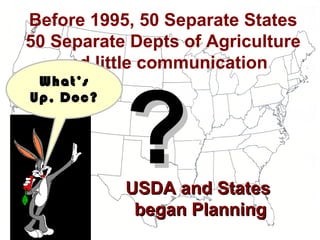
Before 1995, 50 Separate States 
50 Separate Depts of Agriculture 
2 
and little communication 
?? 
What’s 
Up, Doc? 
UUSSDDAA aanndd SSttaatteess 
bbeeggaann PPllaannnniinngg
3 
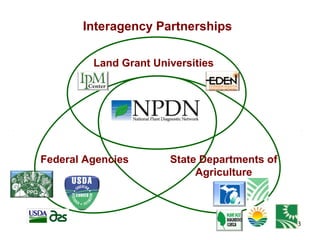
Interagency Partnerships 
Land Grant Universities 
Federal Agencies State Departments of 
Agriculture
What is the National PPllaanntt DDiiaaggnnoossttiicc 
4 
NNeettwwoorrkk?? 
Founded in 2002 to protect food and 
agriculture in the United States 
Brings together staff and scientists in 
Federal, State, and University plant 
diagnostic labs 
Provides money for education, training, 
workshops, salaries, and labs 
Forms “the network” for First Detectors 
through websites and email pest alerts
NPDN Responsibilities 
• Outbreak detection and identification 
• Secure communications system 
• Information storage and management 
• Data analysis 
• Reporting and alerts 
• Training and Education
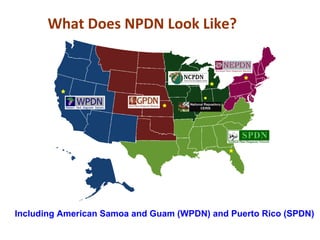
What Does NPDN Look Like? 
Including American Samoa and Guam (WPDN) and Puerto Rico (SPDN)
7 
WWhhoo aarree FFiirrsstt DDeetteeccttoorrss?? 
Anyone involved in: 
Agriculture 
Food Processing 
Horticulture 
Forestry 
Ecology
8 
NPDN First 
Detector 
Registration 
Please print 
clearly & 
complete all the 
information 
Confidential!
9 
Certificate of First Detector Training Completion 
is hereby granted 
Tom Jefferson 
for completion of core “First Detector” training modules. 
September 26, 2014 Reno, NV 
This certificate has been approved by 
Marty Draper, PhD, NPDN Chair and 
Rachel McCarthy, MS., Chair of NPDN Training and Education 
Training Session Coordinator
10 
IInnvvaassiivveess’’ WWeebbssiitteess 
http://www.cal-ipc.org/ 
http://www.nappo.org/ 
http://weblogs.nal.usda.gov/invasivespecies/
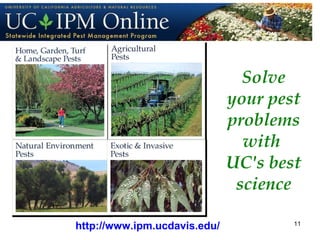
Solve 
your pest 
problems 
with 
UC's best 
science 
http://www.ipm.ucdavis.edu/ 11
The Western IPM Center 
promotes the adoption of 
integrated pest management 
practices and funds new 
research to solve pest problems 
in agriculture, communities and 
natural lands throughout the 
West. 
http://www.wrpmc.ucdavis.edu/index.html 12
13 
http://www.unce.unr.edu/
14 
Chemistry Laboratory 
Entomology 
Environmental Services 
Export Certification 
Good Agricultural Practices Program (GAP) 
Noxious Weeds 
Nursery Program 
Organic Program 
Pest Control 
Plant Pathology 
Producer Certification 
Seed Certification 
Specialty Crop Block Grant Program 
Nevada state entomologist 
(insects) 
Jeff Knight 
jknight@agri.nv.gov 
775-353-3767 
Plant Diseases: 
Nevada state pathologist (plant 
diseases) 
Dr. Shouhua Wang 
shwang@agri.nv.gov 
775-353-3765 
Noxious Weeds 
State Noxious Weed Coordinator 
Robert Little 
rlittle@agri.nv.gov 
775-353-3751 
Nevada Pest Alerts 
Nevada Pest Alerts 
http://agri.nv.gov/Plant-Industry/
15 
Vancouver 
Seattle 
Oakland-SF 
LA-Longbeach 
San Diego 
Portland 
West Coast Commerce 
Nogales
16 
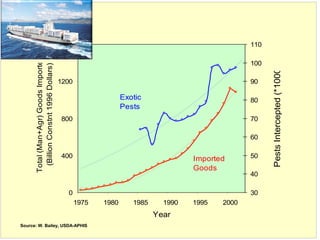
1600 
110 
Total (Man+Agr) Goods Imported 
(Billion Constnt 1996 Dollars) 30 
1200 
800 
400 
0 
1975 1980 1985 1990 1995 2000 
Year 
100 
90 
80 
70 
60 
50 
40 
Pests Intercepted (*1000) 
Imported 
Goods 
Exotic 
Pests 
Source: W. Bailey, USDA-APHIS
Migration aanndd tthhee mmoovveemmeenntt ooff 
hhuummaannss,, ppllaannttss,, aanndd aanniimmaallss 
17 
Image courtesy of Marius Christensen
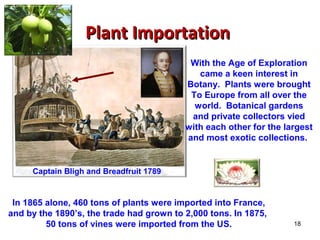
PPllaanntt IImmppoorrttaattiioonn 
With the Age of Exploration 
came a keen interest in 
Botany. Plants were brought 
To Europe from all over the 
world. Botanical gardens 
and private collectors vied 
with each other for the largest 
and most exotic collections. 
18 
Captain Bligh and Breadfruit 1789 
In 1865 alone, 460 tons of plants were imported into France, 
and by the 1890’s, the trade had grown to 2,000 tons. In 1875, 
50 tons of vines were imported from the US.
19 
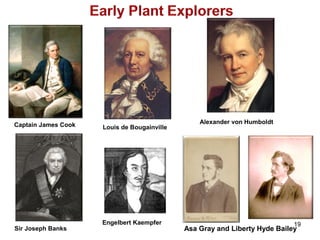
Alexander von Humboldt 
Captain James Cook Louis de Bougainville 
Sir Joseph Banks 
Engelbert Kaempfer 
Asa Gray and Liberty Hyde Bailey
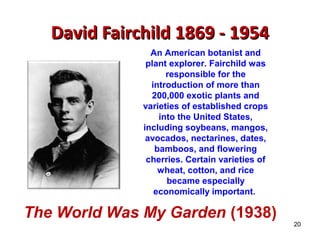
DDaavviidd FFaaiirrcchhiilldd 11886699 -- 11995544 
20 
An American botanist and 
plant explorer. Fairchild was 
responsible for the 
introduction of more than 
200,000 exotic plants and 
varieties of established crops 
into the United States, 
including soybeans, mangos, 
avocados, nectarines, dates, 
bamboos, and flowering 
cherries. Certain varieties of 
wheat, cotton, and rice 
became especially 
economically important. 
The World Was My Garden (1938)
GGiinnggkkoo bbiilloobbaa 
21 
Meteor 2017 Wikipedia 
Kurt Stueber Wikipedia 
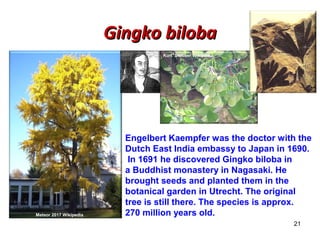
Engelbert Kaempfer was the doctor with the 
Dutch East India embassy to Japan in 1690. 
In 1691 he discovered Gingko biloba in 
a Buddhist monastery in Nagasaki. He 
brought seeds and planted them in the 
botanical garden in Utrecht. The original 
tree is still there. The species is approx. 
270 million years old.
DDaawwnn RReeddwwoooodd 
MMeettaasseeqquuooiiaa ggllyyppttoossttrroobbooiiddeess 
22 
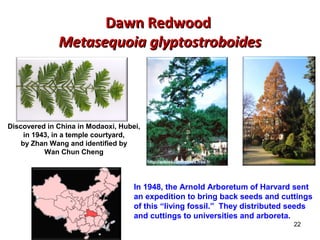
Discovered in China in Modaoxi, Hubei, 
in 1943, in a temple courtyard, 
by Zhan Wang and identified by 
Wan Chun Cheng 
http://arbresvenerables.free.fr 
In 1948, the Arnold Arboretum of Harvard sent 
an expedition to bring back seeds and cuttings 
of this “living fossil.” They distributed seeds 
and cuttings to universities and arboreta.
23 
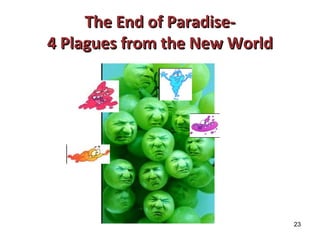
TThhee EEnndd ooff PPaarraaddiissee-- 
44 PPllaagguueess ffrroomm tthhee NNeeww WWoorrlldd 
Cartoons courtesy of Annemiek Schilder
24 
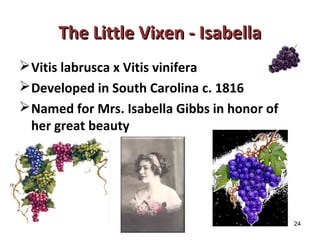
TThhee LLiittttllee VViixxeenn -- IIssaabbeellllaa 
Vitis labrusca x Vitis vinifera 
Developed in South Carolina c. 1816 
Named for Mrs. Isabella Gibbs in honor of 
her great beauty
25 
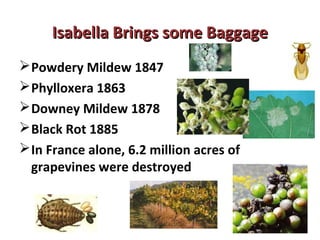
Isabella BBrriinnggss ssoommee BBaaggggaaggee 
Powdery Mildew 1847 
Phylloxera 1863 
Downey Mildew 1878 
Black Rot 1885 
In France alone, 6.2 million acres of 
grapevines were destroyed
26 
SSuummmmaarryy ooff NNPPDDNN MMiissssiioonn 
Communicate 
Coordinate 
Cooperate 
Eradication of the Pest
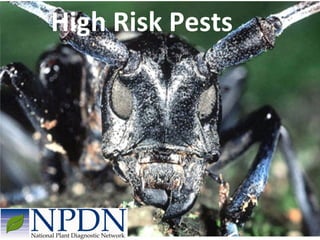
High Risk Pests 
High Risk Pests 
27 
The European Grapevine Moth
28 
Commodore Matthew Perry Pays a Visit: 
Tokyo 1853
29 
Pathogen && PPeesstt IInnttrroodduuccttiioonnss 
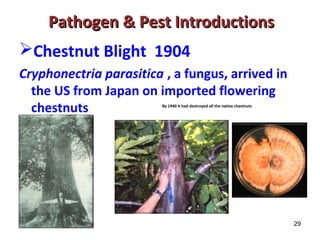
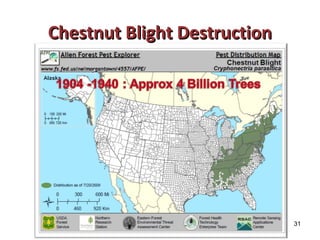
Chestnut Blight 1904 
Cryphonectria parasitica , a fungus, arrived in 
the US from Japan on imported flowering 
chestnuts By 1940 it had destroyed all the native chestnuts
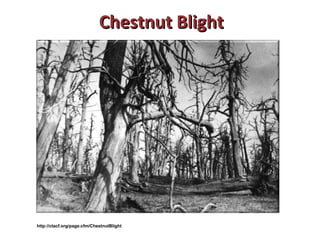
CChheessttnnuutt BBlliigghhtt 
http://ctacf.org/page.cfm/ChestnutBlight
CChheessttnnuutt BBlliigghhtt DDeessttrruuccttiioonn 
31
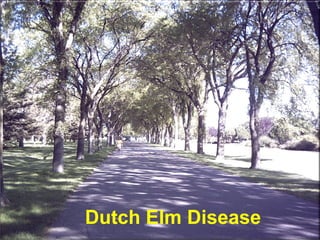
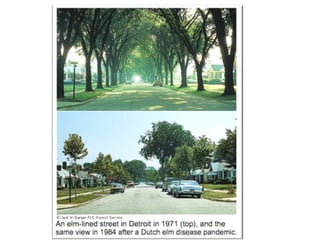
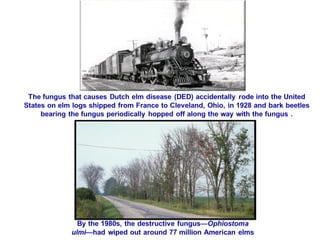
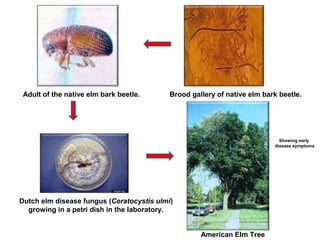
Dutch Elm Disease
Adult of the native elm bark beetle. Brood gallery of native elm bark beetle. 
American Elm Tree 
Dutch elm disease fungus (Ceratocystis ulmi) 
growing in a petri dish in the laboratory. 
Showing early 
disease symptoms
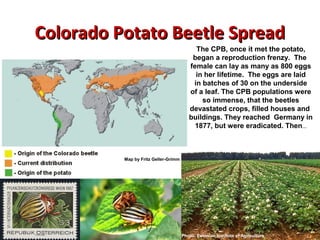
CCoolloorraaddoo PPoottaattoo BBeeeettllee SSpprreeaadd 
Map by Fritz Geller-Grimm 
The CPB, once it met the potato, 
began a reproduction frenzy. The 
female can lay as many as 800 eggs 
in her lifetime. The eggs are laid 
in batches of 30 on the underside 
of a leaf. The CPB populations were 
so immense, that the beetles 
devastated crops, filled houses and 
buildings. They reached Germany in 
1877, but were eradicated. Then… 
Photo: Estonian Institute of Agriculture
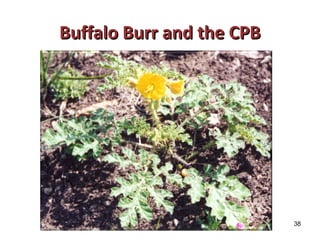
BBuuffffaalloo BBuurrrr aanndd tthhee CCPPBB 
38
RRoocckkyy MMoouunnttaaiinn LLooccuusstt 
MMeellaannoopplluuss sspprreettuuss WWaallsshh 11886666 
11887733 ttoo 11887777 -- nnooww eexxttiinncctt 
Photo by Jim Conrad 
Photo courtesy of University Cambridge 
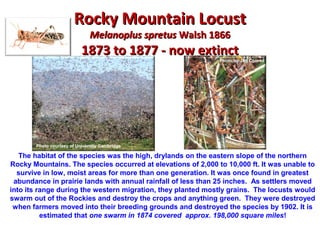
The habitat of the species was the high, drylands on the eastern slope of the northern 
Rocky Mountains. The species occurred at elevations of 2,000 to 10,000 ft. It was unable to 
survive in low, moist areas for more than one generation. It was once found in greatest 
abundance in prairie lands with annual rainfall of less than 25 inches. As settlers moved 
into its range during the western migration, they planted mostly grains. The locusts would 
swarm out of the Rockies and destroy the crops and anything green. They were destroyed 
when farmers moved into their breeding grounds and destroyed the species by 1902. It is 
estimated that one swarm in 1874 covered approx. 198,000 square miles!
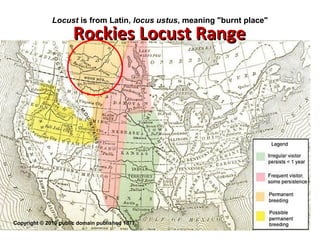
Locust is from Latin, locus ustus, meaning "burnt place" 
RRoocckkiieess LLooccuusstt RRaannggee 
Copyright © 2010 public domain published 1877
What fresh Hell is this? 
41 
Dorothy Parker
42 
Drought Effects - 
Death Comes Gradually to Trees 
Drought Symptoms 
•Loss of rigidity in needles and leaves 
•Drooping, wilting, yellowing of foliage 
•Premature leaf or needle drop 
•Excessive squirrel damage (especially on oaks) 
•Bark cracks 
•Twig and branch dieback 
•Leaf margin scorch and interveinal necrosis on 
deciduous trees 
•Browning of needle tips on evergreens 
•General canopy thinning 
•Poor growth and stunting
43 
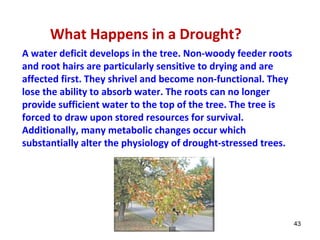
What Happens in a Drought? 
A water deficit develops in the tree. Non-woody feeder roots 
and root hairs are particularly sensitive to drying and are 
affected first. They shrivel and become non-functional. They 
lose the ability to absorb water. The roots can no longer 
provide sufficient water to the top of the tree. The tree is 
forced to draw upon stored resources for survival. 
Additionally, many metabolic changes occur which 
substantially alter the physiology of drought-stressed trees.
44 
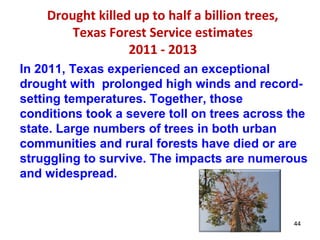
Drought killed up to half a billion trees, 
Texas Forest Service estimates 
2011 - 2013 
In 2011, Texas experienced an exceptional 
drought with prolonged high winds and record-setting 
temperatures. Together, those 
conditions took a severe toll on trees across the 
state. Large numbers of trees in both urban 
communities and rural forests have died or are 
struggling to survive. The impacts are numerous 
and widespread.
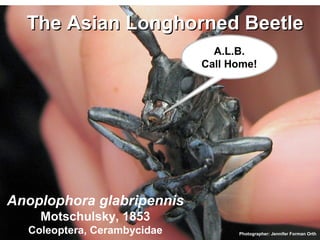
TThhee AAssiiaann LLoonngghhoorrnneedd BBeeeettllee 
45 
Anoplophora glabripennis 
Motschulsky, 1853 
Coleoptera, Cerambycidae 
A.L.B. 
Call Home! 
Photographer: Jennifer Forman Orth
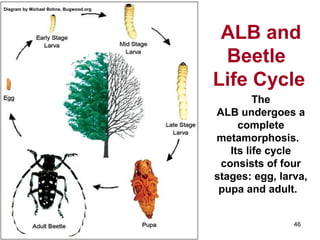
ALB and 
Beetle 
Life Cycle 
46 
Diagram by Michael Bohne, Bugwood.org 
The 
ALB undergoes a 
complete 
metamorphosis. 
Its life cycle 
consists of four 
stages: egg, larva, 
pupa and adult.
47 
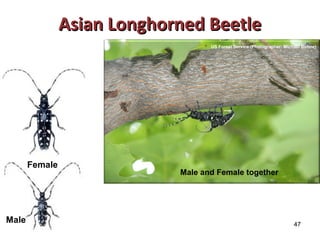
AAssiiaann LLoonngghhoorrnneedd BBeeeettllee 
Female 
Male and Female together 
Male 
US Forest Service (Photographer: Michael Bohne)
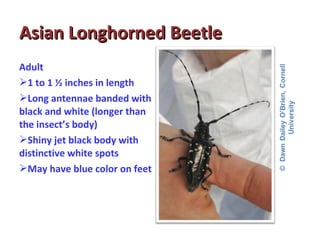
AAssiiaann LLoonngghhoorrnneedd BBeeeettllee 
Adult 
1 to 1 ½ inches in length 
Long antennae banded with 
black and white (longer than 
the insect’s body) 
Shiny jet black body with 
distinctive white spots 
May have blue color on feet
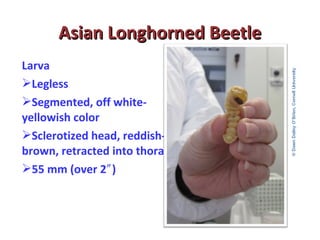
AAssiiaann LLoonngghhoorrnneedd BBeeeettllee 
Larva 
Legless 
Segmented, off white-yellowish 
color 
Sclerotized head, reddish-brown, 
retracted into thorax 
55 mm (over 2″)
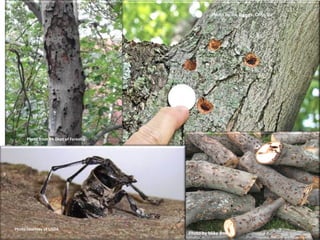
50 
Photo courtesy of USDA 
Photo by Joe Boggs, Ohio SU 
Photo by Mike Boehne 
Photo from PA Dept of Forestry
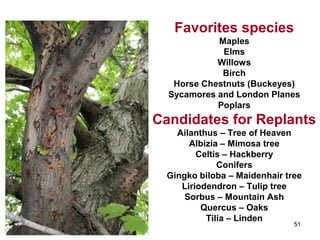
Favorites species 
51 
Maples 
Elms 
Willows 
Birch 
Horse Chestnuts (Buckeyes) 
Sycamores and London Planes 
Poplars 
Candidates for Replants 
Ailanthus – Tree of Heaven 
Albizia – Mimosa tree 
Celtis – Hackberry 
Conifers 
Gingko biloba – Maidenhair tree 
Liriodendron – Tulip tree 
Sorbus – Mountain Ash 
Quercus – Oaks 
Tilia – Linden
52 
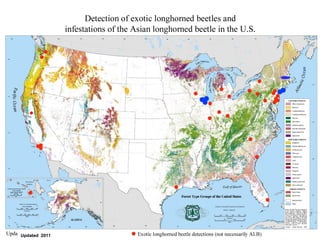
Updated 2011
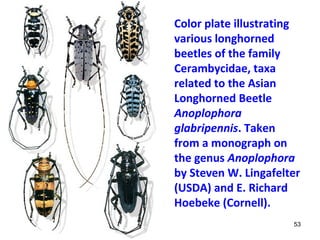
Color plate illustrating 
various longhorned 
beetles of the family 
Cerambycidae, taxa 
related to the Asian 
Longhorned Beetle 
Anoplophora 
glabripennis. Taken 
from a monograph on 
the genus Anoplophora 
by Steven W. Lingafelter 
(USDA) and E. Richard 
Hoebeke (Cornell). 
53
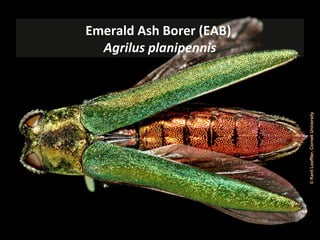
© Kent Loeffler, Cornell University 
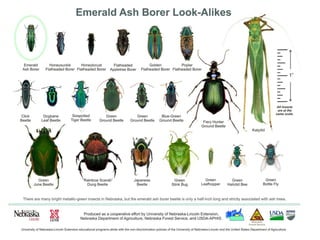
Emerald Ash Borer (EAB) 
Agrilus planipennis
EEmmeerraalldd AAsshh 
BBoorreerr 
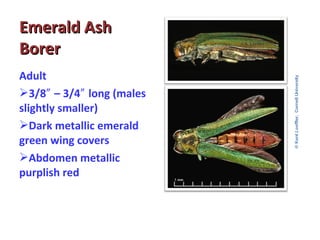
Adult 
3/8″ – 3/4″ long (males 
slightly smaller) 
Dark metallic emerald 
green wing covers 
Abdomen metallic 
purplish red
EEmmeerraalldd AAsshh BBoorreerr mmeeeettss tthhee AAsshh 
photo from Bugguide 
Fraxinus spp. - Ash 
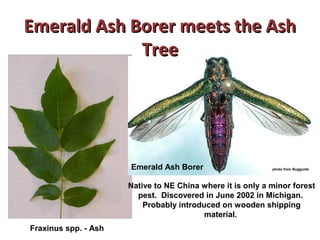
Emerald Ash Borer 
Native to NE China where it is only a minor forest 
pest. Discovered in June 2002 in Michigan. 
Probably introduced on wooden shipping 
material. 
TTrreeee
57 
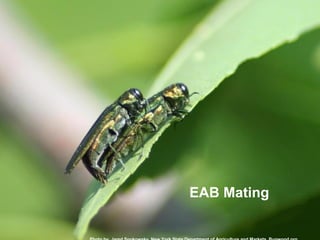
EAB Mating 
Photo by Jared Spokowsky, New York State Department of Agriculture and Markets, Bugwood.org
Emerald AAsshh BBoorreerr LLiiffee CCyyccllee 
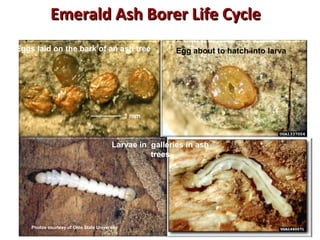
Eggs laid on the bark of an ash tree Egg about to hatch into larva 
larva 
Larvae in galleries in ash 
trees 
Photos courtesy of Ohio State University
59
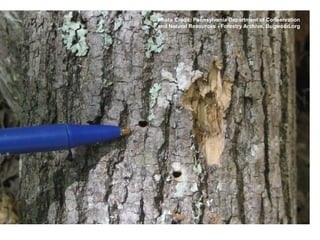
Photo Credit: Pennsylvania Department of Conservation 
and Natural Resources - Forestry Archive, Bugwood.org
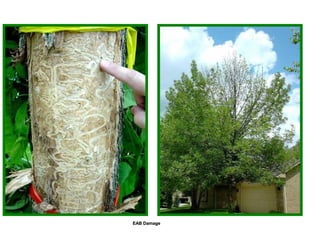
EEAABB DDaammaaggee
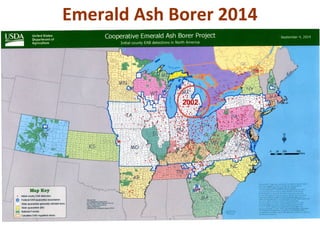
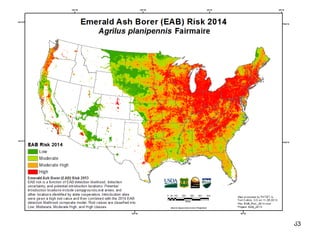
Emerald Ash Borer 2014 
2002
63
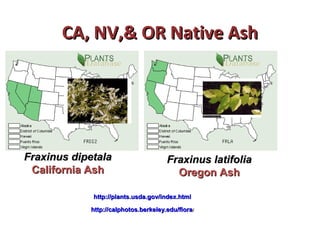
CCAA,, NNVV,,&& OORR NNaattiivvee AAsshh 
FFrraaxxiinnuuss ddiippeettaallaa 
CCaalliiffoorrnniiaa AAsshh 
FFrraaxxiinnuuss llaattiiffoolliiaa 
OOrreeggoonn AAsshh 
hhttttpp::////ppllaannttss..uussddaa..ggoovv//iinnddeexx..hhttmmll 
hhttttpp::////ccaallpphhoottooss..bbeerrkkeelleeyy..eedduu//fflloorraa//
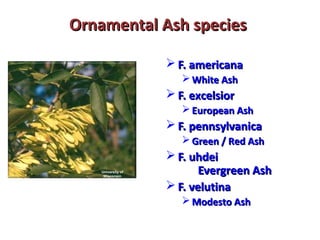
Ornamental AAsshh ssppeecciieess 
University of 
Wisconsin 
FF.. aammeerriiccaannaa 
WWhhiittee AAsshh 
FF.. eexxcceellssiioorr 
EEuurrooppeeaann AAsshh 
FF.. ppeennnnssyyllvvaanniiccaa 
GGrreeeenn // RReedd AAsshh 
FF.. uuhhddeeii 
EEvveerrggrreeeenn AAsshh 
FF.. vveelluuttiinnaa 
MMooddeessttoo AAsshh
66 
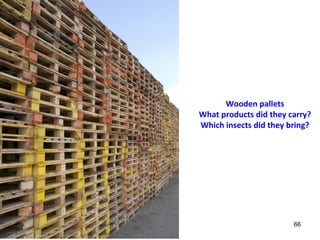
Wooden pallets 
What products did they carry? 
Which insects did they bring?
67 
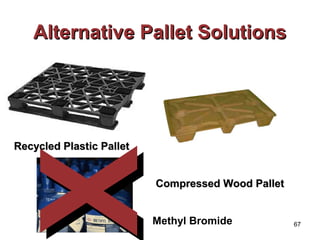
AAlltteerrnnaattiivvee PPaalllleett SSoolluuttiioonnss 
RReeccyycclleedd PPllaassttiicc PPaalllleett 
CCoommpprreesssseedd WWoooodd PPaalllleett XXMethyl Bromide
WWoooodd PPaacckkiinngg RReegguullaattiioonnss 
International Standards For Phytosanitary Measures, ISPM 15, requires that 
all international ocean freight shipments using any species of raw wood 
packaging must be fumigated or heat treated, prior the international 
shipping, to kill insects or fungus. All wood-packing materials used in 
international shipping must be stamped with the approved by IPPC stamp, 
prior the international shipping. International ocean freight shipments that 
contain wood-packing materials will be checked in respect of compliance 
with the ISPM 15 regulations before to be allowed to enter to or crossing 
through a participating to IPPC country. 
68
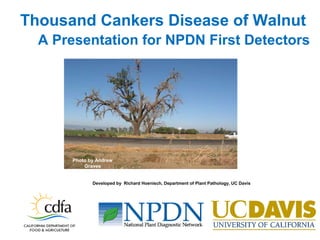
Thousand Cankers Disease of Walnut 
A Presentation for NPDN First Detectors 
69 
Photo by Andrew 
Graves 
Developed by Richard Hoenisch, Department of Plant Pathology, UC Davis
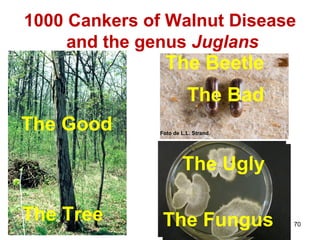
1000 Cankers of Walnut Disease 
70 
and the genus Juglans 
The Beetle 
The Bad 
Foto de L.L. Strand. 
The Good 
The Ugly 
The Ugly 
The Fungus 
The Tree The Fungus
71 
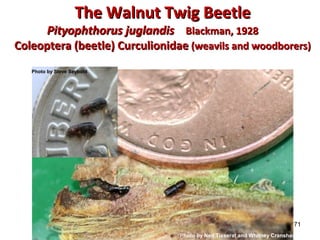
TThhee WWaallnnuutt TTwwiigg BBeeeettllee 
PPiittyyoopphhtthhoorruuss jjuuggllaannddiiss BBllaacckkmmaann,, 1992288 
CCoolleeoopptteerraa ((bbeeeettllee)) CCuurrccuulliioonniiddaaee ((wweeaavviillss aanndd wwooooddbboorreerrss)) 
Photo by Ned Tisserat and Whitney Cranshaw 
Photo by Steve Seybold
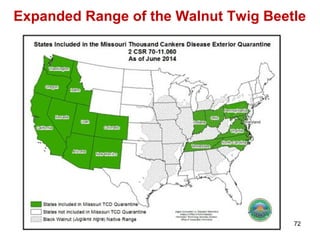
Expanded Range of the Walnut Twig Beetle 
72
73 
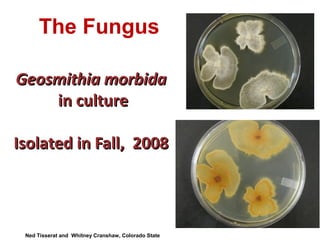
The Fungus 
GGeeoossmmiitthhiiaa mmoorrbbiiddaa 
iinn ccuullttuurree 
IIssoollaatteedd iinn FFaallll,, 220088 
Ned Tisserat and Whitney Cranshaw, Colorado State
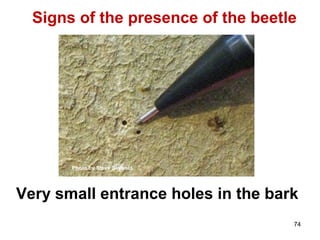
Signs of the presence of the beetle 
Very small entrance holes in the bark 
74 
Photo by Steve Seybold
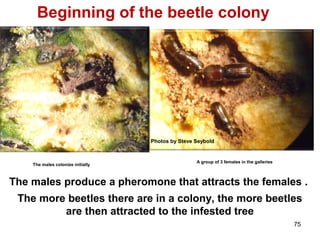
Beginning of the beetle colony 
The males colonize initially A group of 3 females in the galleries 
The males produce a pheromone that attracts the females . 
The more beetles there are in a colony, the more beetles 
are then attracted to the infested tree 
75 
Photos by Steve Seybold
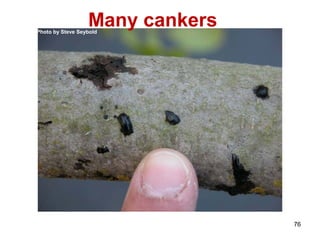
Many cankers 
76 
Photo by Steve Seybold
77 
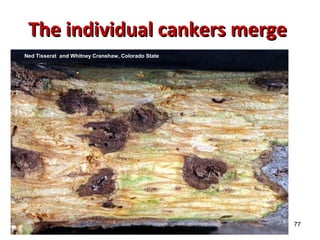
TThhee iinnddiivviidduuaall ccaannkkeerrss mmeerrggee 
Ned Tisserat and Whitney Cranshaw, Colorado State
78 
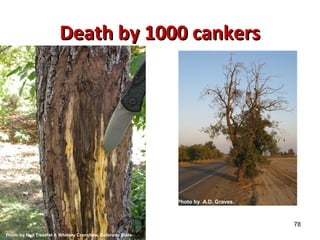
DDeeaatthh bbyy 1000 ccaannkkeerrss 
Photo by A.D. Graves. 
Photo by Ned Tisserat & Whitney Cranshaw, Colorado State
79 
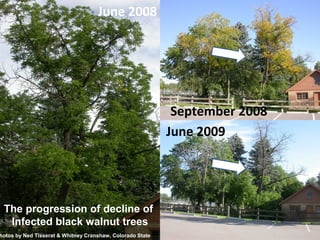
June 2008 
September 2008 
June 2009 
The progression of decline of 
Infected black walnut trees 
photos by Ned Tisserat & Whitney Cranshaw, Colorado State
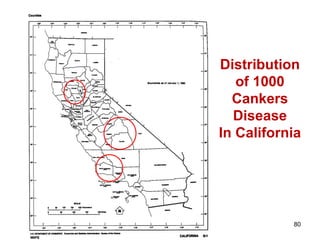
Distribution 
of 1000 
Cankers 
Disease 
In California 
80
81 
Susceptible Juglans species 
The beetle can colonize: 
J. ailantifolia 
J. australis 
J. californica* 
J. hindsii* 
J. major 
J. mandshurica 
J. mollis 
j. nigra (rootstock) 
The fungus can colonize: 
J. hindsii x regia (rootstock) 
J. californica* 
J. hindsii* 
J. microcarpa 
J. regia ( English Walnut)
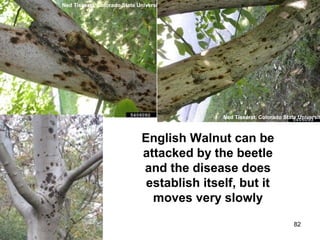
Ned Tisserat, Colorado State University 
English Walnut can be 
attacked by the beetle 
and the disease does 
establish itself, but it 
moves very slowly 
82
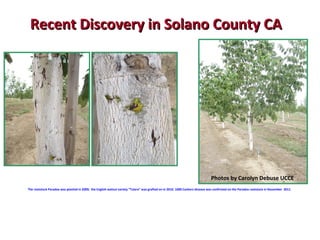
Recent Discovery iinn SSoollaannoo CCoouunnttyy CCAA 
Photos by Carolyn Debuse UCCE 
The rootstock Paradox was planted in 2009; the English walnut variety “Tulare” was grafted on in 2010. 1000 Cankers disease was confirmed on the Paradox rootstock in November 2011.
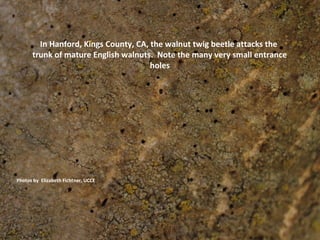
In Hanford, Kings County, CA, the walnut twig beetle attacks the 
trunk of mature English walnuts. Note the many very small entrance 
holes 
Photos by Elizabeth Fichtner, UCCE
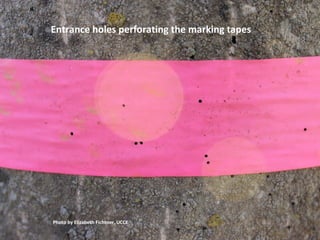
Entrance holes perforating the marking tapes 
Photo by Elizabeth Fichtner, UCCE
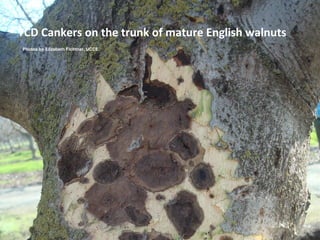
TCD Cankers on the trunk of mature English walnuts 
Photos by Elizabeth Fichtner, UCCE
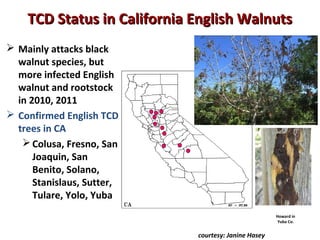
TCD Status iinn CCaalliiffoorrnniiaa EEnngglliisshh WWaallnnuuttss 
 Mainly attacks black 
walnut species, but 
more infected English 
walnut and rootstock 
in 2010, 2011 
 Confirmed English TCD 
trees in CA 
Colusa, Fresno, San 
Joaquin, San 
Benito, Solano, 
Stanislaus, Sutter, 
Tulare, Yolo, Yuba 
Howard in 
Yuba Co. 
courtesy: Janine Hasey
88 
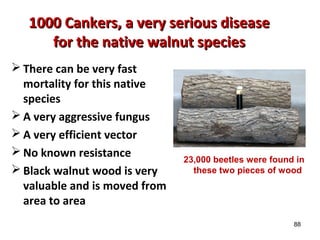
1000 Cankers, aa vveerryy sseerriioouuss ddiisseeaassee 
ffoorr tthhee nnaattiivvee wwaallnnuutt ssppeecciieess 
There can be very fast 
mortality for this native 
species 
A very aggressive fungus 
A very efficient vector 
No known resistance 
Black walnut wood is very 
valuable and is moved from 
area to area 
23,000 beetles were found in 
these two pieces of wood
89 
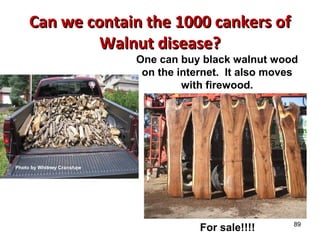
Can we contain tthhee 11000000 ccaannkkeerrss ooff 
WWaallnnuutt ddiisseeaassee?? 
One can buy black walnut wood 
on the internet. It also moves 
with firewood. 
For sale!!!! 
Photo by Whitney Cranshaw
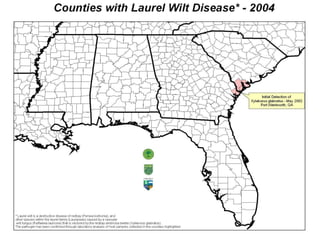
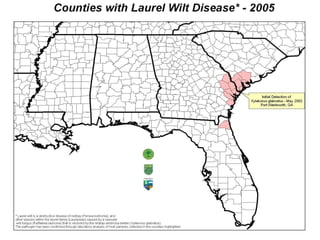
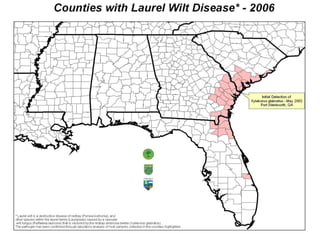
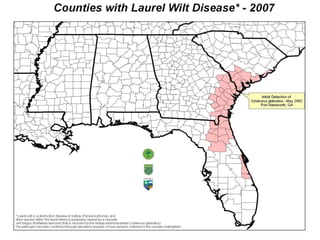
Laurel Wilt Disease 
Akif Eskalen, Ph.D. 
Asst. Cooperative Extension Specialist / Plant Pathologist 
Department of Plant Pathology and Microbiology 
University of California, Riverside 
www.eskalenlab.ucr.edu 
Laurel Wilt module courtesy of Akif Eskalen, UC Riverside
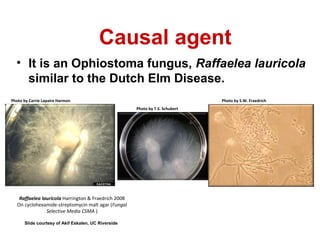
Causal agent 
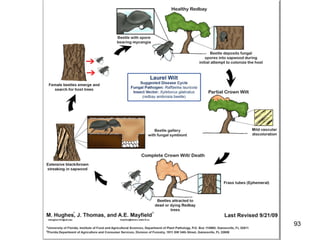
• It is an Ophiostoma fungus, Raffaelea lauricola 
similar to the Dutch Elm Disease. 
Photo by S.W. Fraedrich 
Photo by Carrie Lapaire Harmon 
Raffaelea lauricola Harrington & Fraedrich 2008 
On cyclohexamide-streptomycin malt agar (Fungal 
Selective Media CSMA ) 
Slide courtesy of Akif Eskalen, UC Riverside 
Photo by T.S. Schubert
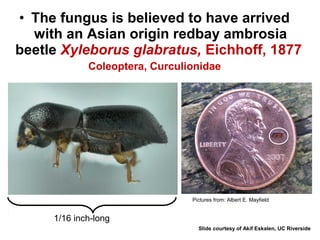
• The fungus is believed to have arrived 
with an Asian origin redbay ambrosia 
beetle Xyleborus glabratus, Eichhoff, 1877 
Coleoptera, Curculionidae 
1/16 inch-long 
Pictures from: Albert E. Mayfield 
Slide courtesy of Akif Eskalen, UC Riverside
93
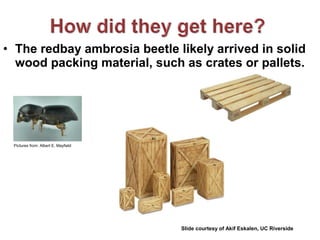
• The redbay ambrosia beetle likely arrived in solid 
wood packing material, such as crates or pallets. 
Pictures from: Albert E. Mayfield 
Slide courtesy of Akif Eskalen, UC Riverside
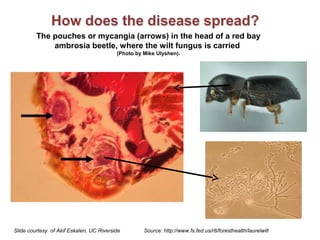
The pouches or mycangia (arrows) in the head of a red bay 
ambrosia beetle, where the wilt fungus is carried 
(Photo by Mike Ulyshen). 
Slide courtesy of Akif Eskalen, UC Riverside Source: http://www.fs.fed.us/r8/foresthealth/laurelwilt
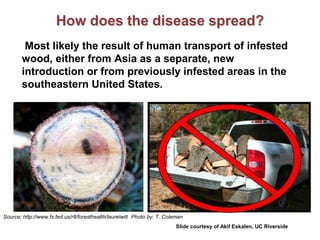
Most likely the result of human transport of infested 
wood, either from Asia as a separate, new 
introduction or from previously infested areas in the 
southeastern United States. 
Source: http://www.fs.fed.us/r8/foresthealth/laurelwilt 
Photo by: T. Coleman 
Slide courtesy of Akif Eskalen, UC Riverside
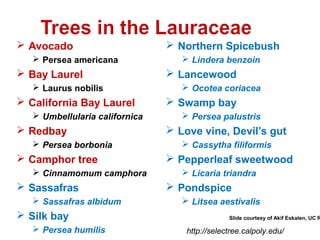
 Avocado 
 Persea americana 
 Bay Laurel 
 Laurus nobilis 
 California Bay Laurel 
 Umbellularia californica 
 Redbay 
 Persea borbonia 
 Camphor tree 
 Cinnamomum camphora 
 Sassafras 
 Sassafras albidum 
 Silk bay 
 Persea humilis 
 Northern Spicebush 
 Lindera benzoin 
 Lancewood 
 Ocotea coriacea 
 Swamp bay 
 Persea palustris 
 Love vine, Devil’s gut 
 Cassytha filiformis 
 Pepperleaf sweetwood 
 Licaria triandra 
 Pondspice 
 Litsea aestivalis 
Slide courtesy of Akif Eskalen, UC Riverside 
http://selectree.calpoly.edu/
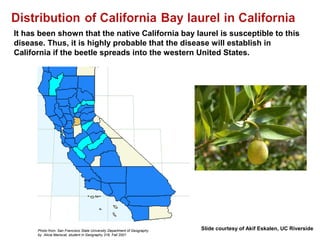
It has been shown that the native California bay laurel is susceptible to this 
disease. Thus, it is highly probable that the disease will establish in 
California if the beetle spreads into the western United States. 
Photo from: San Francisco State University Department of Geography 
by Alicia Mariscal, student in Geography 316, Fall 2001 
Slide courtesy of Akif Eskalen, UC Riverside
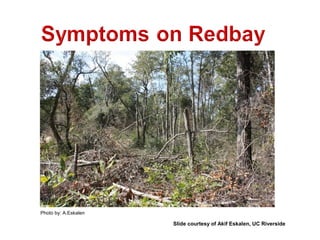
Photo by: A.Eskalen 
Slide courtesy of Akif Eskalen, UC Riverside
Picture from: Fraedrich et al. 2008 Slide courtesy of Akif Eskalen, UC Riverside 
http://www.fs.fed.us/r8/foresthealth/laurelwilt
Photo by: A.Eskalen 
Slide courtesy of Akif Eskalen, UC Riverside
Dead Row of Sassafras 
Photos by: A.Eskalen 
Slide courtesy of Akif Eskalen, UC Riverside
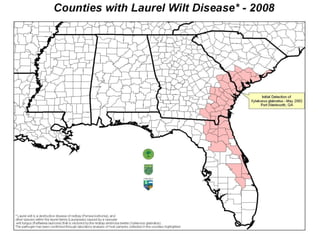
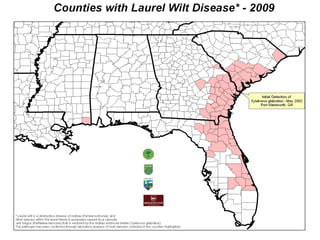
http://www.fs.fed.us/r8/foresthealth/laurelwilt/dist_map.shtml 
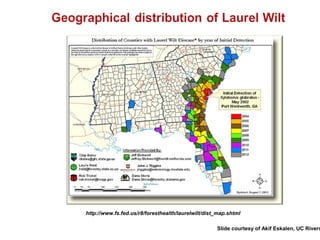
Slide courtesy of Akif Eskalen, UC Riverside
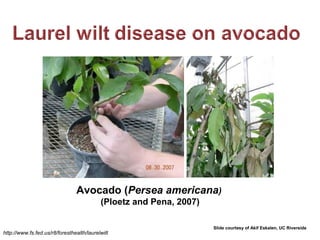
Avocado (Persea americana) 
(Ploetz and Pena, 2007) 
http://www.fs.fed.us/r8/foresthealth/laurelwilt 
Slide courtesy of Akif Eskalen, UC Riverside
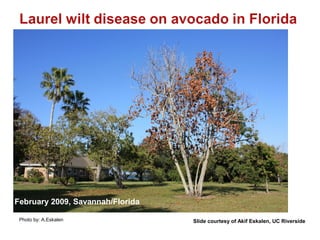
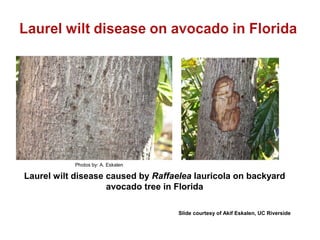
Laurel wilt disease caused by Raffaelea sp. on backyard avocado trees in Florida 
February 2009, Savannah/Florida 
Photo by: A.Eskalen Slide courtesy of Akif Eskalen, UC Riverside
Photos by: A. Eskalen 
Laurel wilt disease caused by Raffaelea lauricola on backyard 
avocado tree in Florida 
Slide courtesy of Akif Eskalen, UC Riverside
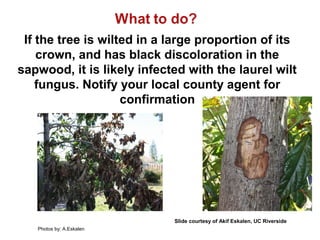
If the tree is wilted in a large proportion of its 
crown, and has black discoloration in the 
sapwood, it is likely infected with the laurel wilt 
fungus. Notify your local county agent for 
confirmation 
Photos by: A.Eskalen 
Slide courtesy of Akif Eskalen, UC Riverside
California Avocado Commission & Avocado growers 
Virginia McDonald 
Shannon C. Lynch 
Ben Faber 
Gary Bender 
Mary Bianchi 
From University of Florida 
Randy Ploetz 
Jonathan Crane 
Jorge Pena 
Slide courtesy of Akif Eskalen, UC Riverside
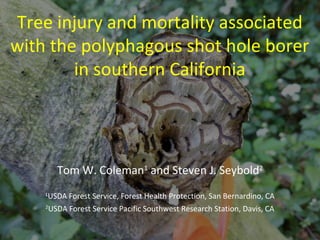
Tree injury and mortality associated 
with the polyphagous shot hole borer 
in southern California 
Tom W. Coleman1 and Steven J. Seybold2 
1USDA Forest Service, Forest Health Protection, San Bernardino, CA 
2USDA Forest Service Pacific Southwest Research Station, Davis, CA
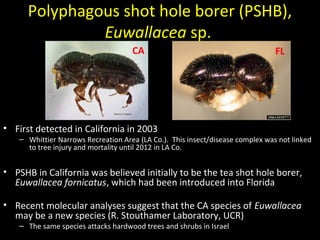
Polyphagous shot hole borer (PSHB), 
Euwallacea sp. 
CA FL 
• First detected in California in 2003 
– Whittier Narrows Recreation Area (LA Co.). This insect/disease complex was not linked 
to tree injury and mortality until 2012 in LA Co. 
• PSHB in California was believed initially to be the tea shot hole borer, 
Euwallacea fornicatus, which had been introduced into Florida 
• Recent molecular analyses suggest that the CA species of Euwallacea 
may be a new species (R. Stouthamer Laboratory, UCR) 
– The same species attacks hardwood trees and shrubs in Israel
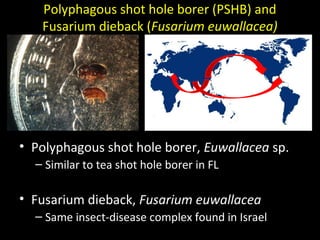
Polyphagous shot hole borer (PSHB) and 
Fusarium dieback (Fusarium euwallacea) 
• Polyphagous shot hole borer, Euwallacea sp. 
– Similar to tea shot hole borer in FL 
• Fusarium dieback, Fusarium euwallacea 
– Same insect-disease complex found in Israel
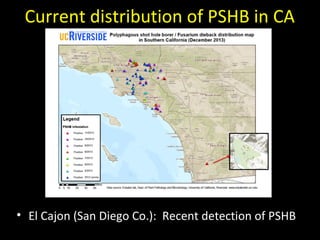
Current distribution of PSHB in CA 
• El Cajon (San Diego Co.): Recent detection of PSHB
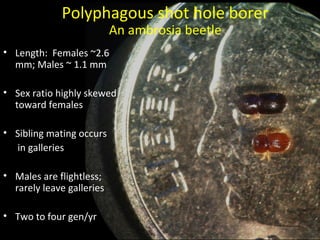
Polyphagous shot hole borer 
An ambrosia beetle 
• Length: Females ~2.6 
mm; Males ~ 1.1 mm 
• Sex ratio highly skewed 
toward females 
• Sibling mating occurs 
in galleries 
• Males are flightless; 
rarely leave galleries 
• Two to four gen/yr
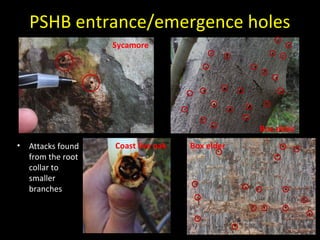
PSHB entrance/emergence holes 
• Attacks found 
from the root 
collar to 
smaller 
branches 
Sycamore 
Box elder 
Coast live oak Box elder
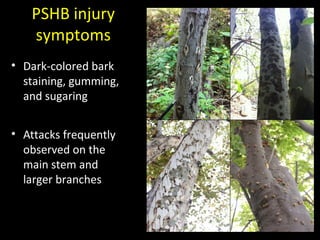
PSHB injury 
symptoms 
• Dark-colored bark 
staining, gumming, 
and sugaring 
• Attacks frequently 
observed on the 
main stem and 
larger branches
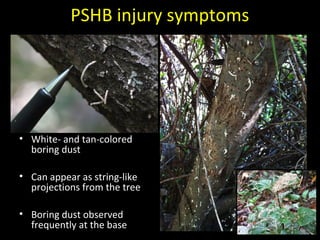
PSHB injury symptoms 
• White- and tan-colored 
boring dust 
• Can appear as string-like 
projections from the tree 
• Boring dust observed 
frequently at the base
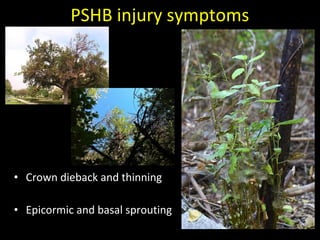
PSHB injury symptoms 
• Crown dieback and thinning 
• Epicormic and basal sprouting
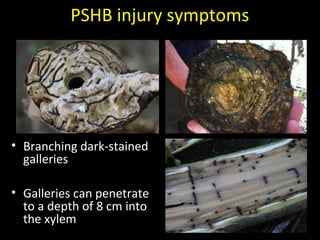
PSHB injury symptoms 
• Branching dark-stained 
galleries 
• Galleries can penetrate 
to a depth of 8 cm into 
the xylem
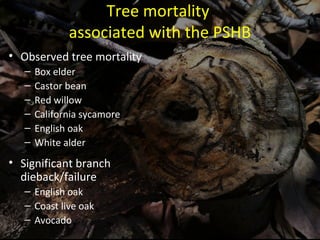
Tree mortality 
associated with the PSHB 
• Observed tree mortality 
– Box elder 
– Castor bean 
– Red willow 
– California sycamore 
– English oak 
– White alder 
• Significant branch 
dieback/failure 
– English oak 
– Coast live oak 
– Avocado
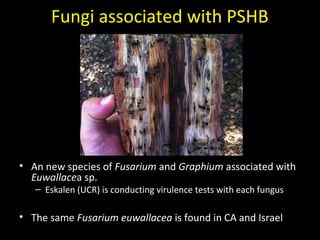
Fungi associated with PSHB 
• An new species of Fusarium and Graphium associated with 
Euwallacea sp. 
– Eskalen (UCR) is conducting virulence tests with each fungus 
• The same Fusarium euwallacea is found in CA and Israel
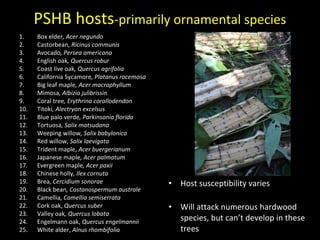
PSHB hosts-primarily ornamental species 
1. Box elder, Acer negundo 
2. Castorbean, Ricinus communis 
3. Avocado, Persea americana 
4. English oak, Quercus robur 
5. Coast live oak, Quercus agrifolia 
6. California Sycamore, Platanus racemosa 
7. Big leaf maple, Acer macrophyllum 
8. Mimosa, Albizia julibrissin 
9. Coral tree, Erythrina corallodendon 
10. Titoki, Alectryon excelsus 
11. Blue palo verde, Parkinsonia florida 
12. Tortuosa, Salix matsudana 
13. Weeping willow, Salix babylonica 
14. Red willow, Salix laevigata 
15. Trident maple, Acer buergerianum 
16. Japanese maple, Acer palmatum 
17. Evergreen maple, Acer paxii 
18. Chinese holly, Ilex cornuta 
19. Brea, Cercidium sonorae 
20. Black bean, Castanospermum australe 
21. Camellia, Camellia semiserrata 
22. Cork oak, Quercus suber 
23. Valley oak, Quercus lobata 
24. Engelmann oak, Quercus engelmannii 
25. White alder, Alnus rhombifolia 
• Host susceptibility varies 
• Will attack numerous hardwood 
species, but can’t develop in these 
trees
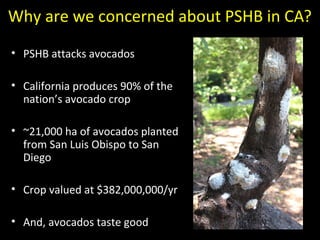
Why are we concerned about PSHB in CA? 
• PSHB attacks avocados 
• California produces 90% of the 
nation’s avocado crop 
• ~21,000 ha of avocados planted 
from San Luis Obispo to San 
Diego 
• Crop valued at $382,000,000/yr 
• And, avocados taste good
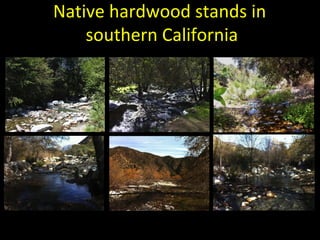
Native hardwood stands in 
southern California
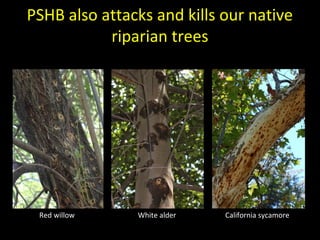
PSHB also attacks and kills our native 
riparian trees 
Red willow White alder California sycamore
Summary 
• PSHB is already impacting the native hardwood 
stands of southern California and the urban 
areas 
– Loss of hardwood stands can impact wildlife and 
threatened and endangered species 
– Willow flycatcher, bell vireo, Arroyo toad, yellow-legged 
frogs, western yellow-billed cuckoo, gray 
vireo, 3 bat species, and 6 snake species 
• Its impact may be more prevalent in lower 
elevation hardwood stands on California 
sycamore, castorbean, and willow spp. 
– All size classes appear to be susceptible
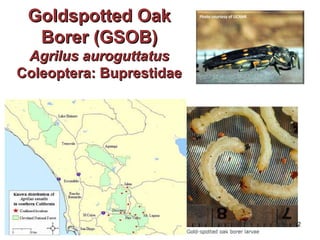
GGoollddssppootttteedd OOaakk 
BBoorreerr ((GGSSOOBB)) 
AAggrriilluuss aauurroogguuttttaattuuss 
CCoolleeoopptteerraa:: BBuupprreessttiiddaaee 
132 
Photo courtesy of UCANR
GGSSOOBB FFiirrsstt NNoottiicceedd iinn 22000044 
133 
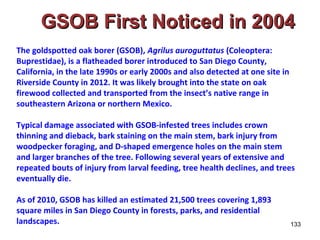
The goldspotted oak borer (GSOB), Agrilus auroguttatus (Coleoptera: 
Buprestidae), is a flatheaded borer introduced to San Diego County, 
California, in the late 1990s or early 2000s and also detected at one site in 
Riverside County in 2012. It was likely brought into the state on oak 
firewood collected and transported from the insect’s native range in 
southeastern Arizona or northern Mexico. 
Typical damage associated with GSOB-infested trees includes crown 
thinning and dieback, bark staining on the main stem, bark injury from 
woodpecker foraging, and D-shaped emergence holes on the main stem 
and larger branches of the tree. Following several years of extensive and 
repeated bouts of injury from larval feeding, tree health declines, and trees 
eventually die. 
As of 2010, GSOB has killed an estimated 21,500 trees covering 1,893 
square miles in San Diego County in forests, parks, and residential 
landscapes.
134 
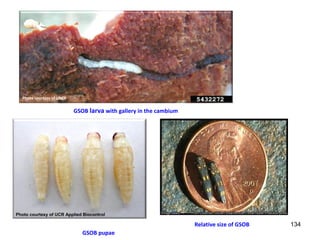
Photo courtesy of UNCE 
GSOB larva with gallery in the cambium 
Photo courtesy of UCR Applied Biocontrol 
GSOB pupae 
Relative size of GSOB
135 
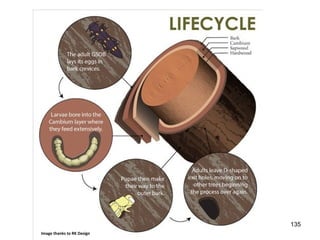
Image thanks to RK Design
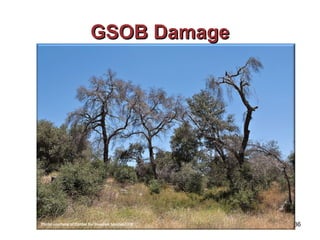
GGSSOOBB DDaammaaggee 
Photo courtesy of Center for Invasive Species UCR 136
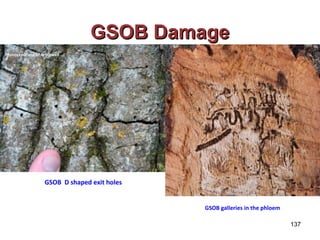
GGSSOOBB DDaammaaggee 
137 
Photos courtesy of Arborwell 
Photo by Tom Coleman USDAFS 
GSOB D shaped exit holes 
GSOB galleries in the phloem
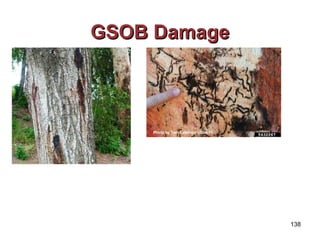
GGSSOOBB DDaammaaggee 
138 
Photo by Tom Coleman USDA FS
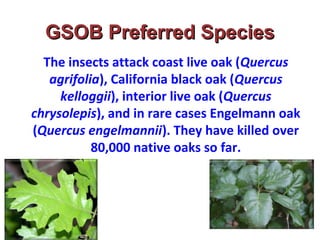
GGSSOOBB PPrreeffeerrrreedd SSppeecciieess 
139 
The insects attack coast live oak (Quercus 
agrifolia), California black oak (Quercus 
kelloggii), interior live oak (Quercus 
chrysolepis), and in rare cases Engelmann oak 
(Quercus engelmannii). They have killed over 
80,000 native oaks so far.
GGSSOOBB CCoonnttrrooll SSttrraatteeggiieess 
140 
Don’t move fire wood from infested 
area 
Grinding infest wood destroys the 
larvae 
Biocontrol with 2 species of 
hymenoptera 
Woodpeckers 
Systemic insecticides
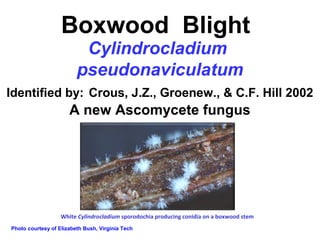
Boxwood Blight 
Cylindrocladium 
pseudonaviculatum 
Identified by: Crous, J.Z., Groenew., & C.F. Hill 2002 
A new Ascomycete fungus 
White Cylindrocladium sporodochia producing conidia on a boxwood stem 
Photo courtesy of Elizabeth Bush, Virginia Tech
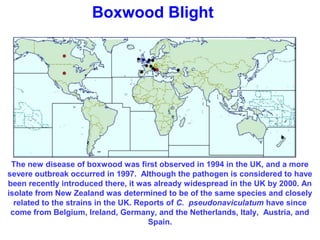
Boxwood Blight 
The new disease of boxwood was first observed in 1994 in the UK, and a more 
severe outbreak occurred in 1997. Although the pathogen is considered to have 
been recently introduced there, it was already widespread in the UK by 2000. An 
isolate from New Zealand was determined to be of the same species and closely 
related to the strains in the UK. Reports of C. pseudonaviculatum have since 
come from Belgium, Ireland, Germany, and the Netherlands, Italy, Austria, and 
Spain.
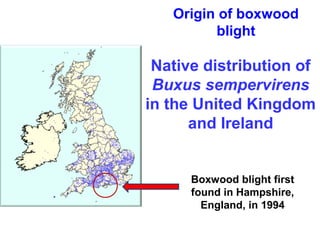
Map courtesy of Online Atlas of the British and Irish Flora 
Origin of boxwood 
blight 
Native distribution of 
Buxus sempervirens 
in the United Kingdom 
and Ireland 
Boxwood blight first 
found in Hampshire, 
England, in 1994
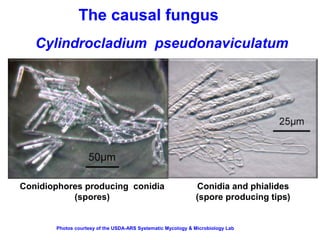
The causal fungus 
Cylindrocladium pseudonaviculatum 
Conidia and phialides 
(spore producing tips) 
Conidiophores producing conidia 
(spores) 
Photos courtesy of the USDA-ARS Systematic Mycology & Microbiology Lab
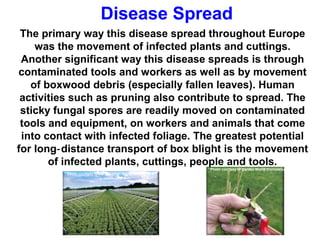
Disease Spread 
The primary way this disease spread throughout Europe 
was the movement of infected plants and cuttings. 
Another significant way this disease spreads is through 
contaminated tools and workers as well as by movement 
of boxwood debris (especially fallen leaves). Human 
activities such as pruning also contribute to spread. The 
sticky fungal spores are readily moved on contaminated 
tools and equipment, on workers and animals that come 
into contact with infected foliage. The greatest potential 
for long distance transport of box blight ‐ is the movement 
of infected plants, cuttings, people and tools. 
Photo courtesy of Garden World Discussion 
Photo courtesy of the Canadian Nursery Certification 
Institute
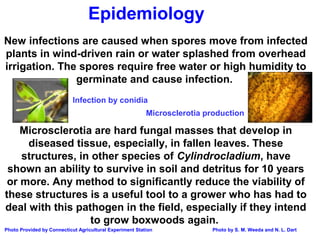
New infections are caused when spores move from infected 
plants in wind-driven rain or water splashed from overhead 
irrigation. The spores require free water or high humidity to 
germinate and cause infection. 
Microsclerotia are hard fungal masses that develop in 
diseased tissue, especially, in fallen leaves. These 
structures, in other species of Cylindrocladium, have 
shown an ability to survive in soil and detritus for 10 years 
or more. Any method to significantly reduce the viability of 
these structures is a useful tool to a grower who has had to 
deal with this pathogen in the field, especially if they intend 
to grow boxwoods again. 
Photo by S. M. Weeda and N. L. Dart 
Epidemiology 
Infection by conidia 
Microsclerotia production 
Photo Provided by Connecticut Agricultural Experiment Station
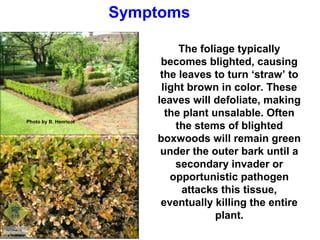
Photo by B. Henricot 
The foliage typically 
becomes blighted, causing 
the leaves to turn ‘straw’ to 
light brown in color. These 
leaves will defoliate, making 
the plant unsalable. Often 
the stems of blighted 
boxwoods will remain green 
under the outer bark until a 
secondary invader or 
opportunistic pathogen 
attacks this tissue, 
eventually killing the entire 
plant. 
Symptoms
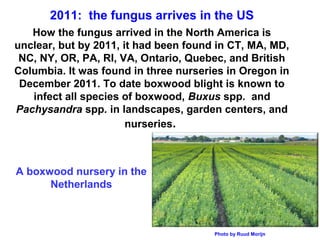
2011: the fungus arrives in the US 
How the fungus arrived in the North America is 
unclear, but by 2011, it had been found in CT, MA, MD, 
NC, NY, OR, PA, RI, VA, Ontario, Quebec, and British 
Columbia. It was found in three nurseries in Oregon in 
December 2011. To date boxwood blight is known to 
infect all species of boxwood, Buxus spp. and 
Pachysandra spp. in landscapes, garden centers, and 
Photo by Ruud Morijn 
nurseries. 
A boxwood nursery in the 
Netherlands
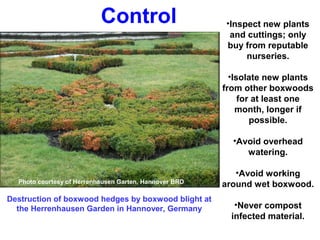
Control •Inspect new plants 
Photo courtesy of Herrenhausen Garten, Hannover BRD 
and cuttings; only 
buy from reputable 
nurseries. 
•Isolate new plants 
from other boxwoods 
for at least one 
month, longer if 
possible. 
•Avoid overhead 
watering. 
•Avoid working 
around wet boxwood. 
•Never compost 
infected material. 
Destruction of boxwood hedges by boxwood blight at 
the Herrenhausen Garden in Hannover, Germany
150 
A Consortium of Regional Networks 
www.npdn.org 
www.wpdn.org 
SSaammppllee SSuubbmmiissssiioonn:: 
QQuuaalliittyy aanndd SSeeccuurriittyy
151 
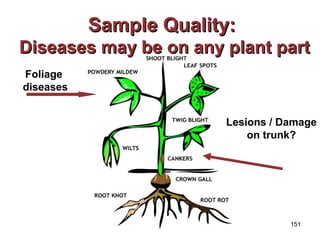
Foliage 
diseases 
SSaammppllee QQuuaalliittyy:: 
DDiisseeaasseess mmaayy bbee oonn aannyy ppllaanntt ppaarrtt 
Lesions / Damage 
on trunk?
DDiiggiittaall DDiiaaggnnoossiiss 
Take at least 5 photos – close up 
152 
and at a distance
SSaammppllee QQuuaalliittyy 
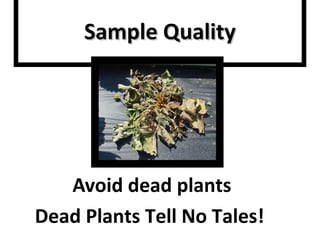
Avoid dead plants 
Dead Plants Tell No Tales!
154 
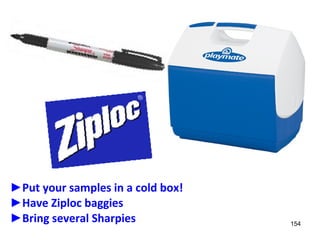
►Put your samples in a cold box! 
►Have Ziploc baggies 
►Bring several Sharpies
155 
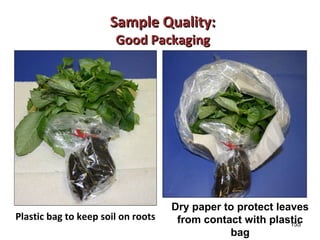
SSaammppllee QQuuaalliittyy:: 
GGoooodd PPaacckkaaggiinngg 
Dry paper to protect leaves 
from contact with plastic 
bag 
Plastic bag to keep soil on roots
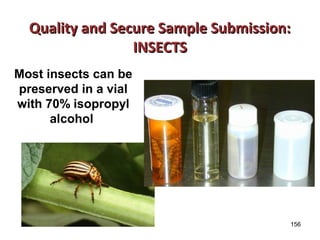
Quality aanndd SSeeccuurree SSaammppllee SSuubbmmiissssiioonn:: 
156 
IINNSSEECCTTSS 
Most insects can be 
preserved in a vial 
with 70% isopropyl 
alcohol
157 
SSeeccuurree SSaammppllee SSuubbmmiissssiioonn 
Furnish all relevant information to the Ag 
Commissioner’s office: 
►your contact information 
►location, name of grower/owner, date found 
►extent of damage, incidence and severity data 
►more information means faster, better 
diagnosis
158 
Rick Bostock 
WPDN Regional Director 
UCD 530-752-4269 
rmbostock@ucdavis.edu 
Carla Thomas 
WPDN Deputy Director 
UCD 530-304-0689 
cthomas@ucdavis.edu 
Marty Draper 
NPDN Project Leader 
mdraper@nifa.usda.gov 
Richard Hoenisch 
NPDN Education Coordinator 
UCD 530-754-2255 
rwhoenisch@ucdavis.edu
Photo by e_monk

Tree pests to watch for in a changing climate

  • 1.
    1 WELCOME FirstDetector Seminar Trees and Drought Reno, Nevada 26 September 2014
  • 2.
    Before 1995, 50Separate States 50 Separate Depts of Agriculture 2 and little communication ?? What’s Up, Doc? UUSSDDAA aanndd SSttaatteess bbeeggaann PPllaannnniinngg
  • 3.
    3 Interagency Partnerships Land Grant Universities Federal Agencies State Departments of Agriculture
  • 4.
    What is theNational PPllaanntt DDiiaaggnnoossttiicc 4 NNeettwwoorrkk?? Founded in 2002 to protect food and agriculture in the United States Brings together staff and scientists in Federal, State, and University plant diagnostic labs Provides money for education, training, workshops, salaries, and labs Forms “the network” for First Detectors through websites and email pest alerts
  • 5.
    NPDN Responsibilities •Outbreak detection and identification • Secure communications system • Information storage and management • Data analysis • Reporting and alerts • Training and Education
  • 6.
    What Does NPDNLook Like? Including American Samoa and Guam (WPDN) and Puerto Rico (SPDN)
  • 7.
    7 WWhhoo aarreeFFiirrsstt DDeetteeccttoorrss?? Anyone involved in: Agriculture Food Processing Horticulture Forestry Ecology
  • 8.
    8 NPDN First Detector Registration Please print clearly & complete all the information Confidential!
  • 9.
    9 Certificate ofFirst Detector Training Completion is hereby granted Tom Jefferson for completion of core “First Detector” training modules. September 26, 2014 Reno, NV This certificate has been approved by Marty Draper, PhD, NPDN Chair and Rachel McCarthy, MS., Chair of NPDN Training and Education Training Session Coordinator
  • 10.
    10 IInnvvaassiivveess’’ WWeebbssiitteess http://www.cal-ipc.org/ http://www.nappo.org/ http://weblogs.nal.usda.gov/invasivespecies/
  • 11.
    Solve your pest problems with UC's best science http://www.ipm.ucdavis.edu/ 11
  • 12.
    The Western IPMCenter promotes the adoption of integrated pest management practices and funds new research to solve pest problems in agriculture, communities and natural lands throughout the West. http://www.wrpmc.ucdavis.edu/index.html 12
  • 13.
  • 14.
    14 Chemistry Laboratory Entomology Environmental Services Export Certification Good Agricultural Practices Program (GAP) Noxious Weeds Nursery Program Organic Program Pest Control Plant Pathology Producer Certification Seed Certification Specialty Crop Block Grant Program Nevada state entomologist (insects) Jeff Knight jknight@agri.nv.gov 775-353-3767 Plant Diseases: Nevada state pathologist (plant diseases) Dr. Shouhua Wang shwang@agri.nv.gov 775-353-3765 Noxious Weeds State Noxious Weed Coordinator Robert Little rlittle@agri.nv.gov 775-353-3751 Nevada Pest Alerts Nevada Pest Alerts http://agri.nv.gov/Plant-Industry/
  • 15.
    15 Vancouver Seattle Oakland-SF LA-Longbeach San Diego Portland West Coast Commerce Nogales
  • 16.
    16 1600 110 Total (Man+Agr) Goods Imported (Billion Constnt 1996 Dollars) 30 1200 800 400 0 1975 1980 1985 1990 1995 2000 Year 100 90 80 70 60 50 40 Pests Intercepted (*1000) Imported Goods Exotic Pests Source: W. Bailey, USDA-APHIS
  • 17.
    Migration aanndd tthheemmoovveemmeenntt ooff hhuummaannss,, ppllaannttss,, aanndd aanniimmaallss 17 Image courtesy of Marius Christensen
  • 18.
    PPllaanntt IImmppoorrttaattiioonn Withthe Age of Exploration came a keen interest in Botany. Plants were brought To Europe from all over the world. Botanical gardens and private collectors vied with each other for the largest and most exotic collections. 18 Captain Bligh and Breadfruit 1789 In 1865 alone, 460 tons of plants were imported into France, and by the 1890’s, the trade had grown to 2,000 tons. In 1875, 50 tons of vines were imported from the US.
  • 19.
    19 Alexander vonHumboldt Captain James Cook Louis de Bougainville Sir Joseph Banks Engelbert Kaempfer Asa Gray and Liberty Hyde Bailey
  • 20.
    DDaavviidd FFaaiirrcchhiilldd 11886699-- 11995544 20 An American botanist and plant explorer. Fairchild was responsible for the introduction of more than 200,000 exotic plants and varieties of established crops into the United States, including soybeans, mangos, avocados, nectarines, dates, bamboos, and flowering cherries. Certain varieties of wheat, cotton, and rice became especially economically important. The World Was My Garden (1938)
  • 21.
    GGiinnggkkoo bbiilloobbaa 21 Meteor 2017 Wikipedia Kurt Stueber Wikipedia Engelbert Kaempfer was the doctor with the Dutch East India embassy to Japan in 1690. In 1691 he discovered Gingko biloba in a Buddhist monastery in Nagasaki. He brought seeds and planted them in the botanical garden in Utrecht. The original tree is still there. The species is approx. 270 million years old.
  • 22.
    DDaawwnn RReeddwwoooodd MMeettaasseeqquuooiiaaggllyyppttoossttrroobbooiiddeess 22 Discovered in China in Modaoxi, Hubei, in 1943, in a temple courtyard, by Zhan Wang and identified by Wan Chun Cheng http://arbresvenerables.free.fr In 1948, the Arnold Arboretum of Harvard sent an expedition to bring back seeds and cuttings of this “living fossil.” They distributed seeds and cuttings to universities and arboreta.
  • 23.
    23 TThhee EEnnddooff PPaarraaddiissee-- 44 PPllaagguueess ffrroomm tthhee NNeeww WWoorrlldd Cartoons courtesy of Annemiek Schilder
  • 24.
    24 TThhee LLiittttlleeVViixxeenn -- IIssaabbeellllaa Vitis labrusca x Vitis vinifera Developed in South Carolina c. 1816 Named for Mrs. Isabella Gibbs in honor of her great beauty
  • 25.
    25 Isabella BBrriinnggssssoommee BBaaggggaaggee Powdery Mildew 1847 Phylloxera 1863 Downey Mildew 1878 Black Rot 1885 In France alone, 6.2 million acres of grapevines were destroyed
  • 26.
    26 SSuummmmaarryy ooffNNPPDDNN MMiissssiioonn Communicate Coordinate Cooperate Eradication of the Pest
  • 27.
    High Risk Pests High Risk Pests 27 The European Grapevine Moth
  • 28.
    28 Commodore MatthewPerry Pays a Visit: Tokyo 1853
  • 29.
    29 Pathogen &&PPeesstt IInnttrroodduuccttiioonnss Chestnut Blight 1904 Cryphonectria parasitica , a fungus, arrived in the US from Japan on imported flowering chestnuts By 1940 it had destroyed all the native chestnuts
  • 30.
  • 31.
  • 32.
  • 35.
    Adult of thenative elm bark beetle. Brood gallery of native elm bark beetle. American Elm Tree Dutch elm disease fungus (Ceratocystis ulmi) growing in a petri dish in the laboratory. Showing early disease symptoms
  • 37.
    CCoolloorraaddoo PPoottaattoo BBeeeettlleeSSpprreeaadd Map by Fritz Geller-Grimm The CPB, once it met the potato, began a reproduction frenzy. The female can lay as many as 800 eggs in her lifetime. The eggs are laid in batches of 30 on the underside of a leaf. The CPB populations were so immense, that the beetles devastated crops, filled houses and buildings. They reached Germany in 1877, but were eradicated. Then… Photo: Estonian Institute of Agriculture
  • 38.
  • 39.
    RRoocckkyy MMoouunnttaaiinn LLooccuusstt MMeellaannoopplluuss sspprreettuuss WWaallsshh 11886666 11887733 ttoo 11887777 -- nnooww eexxttiinncctt Photo by Jim Conrad Photo courtesy of University Cambridge The habitat of the species was the high, drylands on the eastern slope of the northern Rocky Mountains. The species occurred at elevations of 2,000 to 10,000 ft. It was unable to survive in low, moist areas for more than one generation. It was once found in greatest abundance in prairie lands with annual rainfall of less than 25 inches. As settlers moved into its range during the western migration, they planted mostly grains. The locusts would swarm out of the Rockies and destroy the crops and anything green. They were destroyed when farmers moved into their breeding grounds and destroyed the species by 1902. It is estimated that one swarm in 1874 covered approx. 198,000 square miles!
  • 40.
    Locust is fromLatin, locus ustus, meaning "burnt place" RRoocckkiieess LLooccuusstt RRaannggee Copyright © 2010 public domain published 1877
  • 41.
    What fresh Hellis this? 41 Dorothy Parker
  • 42.
    42 Drought Effects- Death Comes Gradually to Trees Drought Symptoms •Loss of rigidity in needles and leaves •Drooping, wilting, yellowing of foliage •Premature leaf or needle drop •Excessive squirrel damage (especially on oaks) •Bark cracks •Twig and branch dieback •Leaf margin scorch and interveinal necrosis on deciduous trees •Browning of needle tips on evergreens •General canopy thinning •Poor growth and stunting
  • 43.
    43 What Happensin a Drought? A water deficit develops in the tree. Non-woody feeder roots and root hairs are particularly sensitive to drying and are affected first. They shrivel and become non-functional. They lose the ability to absorb water. The roots can no longer provide sufficient water to the top of the tree. The tree is forced to draw upon stored resources for survival. Additionally, many metabolic changes occur which substantially alter the physiology of drought-stressed trees.
  • 44.
    44 Drought killedup to half a billion trees, Texas Forest Service estimates 2011 - 2013 In 2011, Texas experienced an exceptional drought with prolonged high winds and record-setting temperatures. Together, those conditions took a severe toll on trees across the state. Large numbers of trees in both urban communities and rural forests have died or are struggling to survive. The impacts are numerous and widespread.
  • 45.
    TThhee AAssiiaann LLoonngghhoorrnneeddBBeeeettllee 45 Anoplophora glabripennis Motschulsky, 1853 Coleoptera, Cerambycidae A.L.B. Call Home! Photographer: Jennifer Forman Orth
  • 46.
    ALB and Beetle Life Cycle 46 Diagram by Michael Bohne, Bugwood.org The ALB undergoes a complete metamorphosis. Its life cycle consists of four stages: egg, larva, pupa and adult.
  • 47.
    47 AAssiiaann LLoonngghhoorrnneeddBBeeeettllee Female Male and Female together Male US Forest Service (Photographer: Michael Bohne)
  • 48.
    AAssiiaann LLoonngghhoorrnneedd BBeeeettllee Adult 1 to 1 ½ inches in length Long antennae banded with black and white (longer than the insect’s body) Shiny jet black body with distinctive white spots May have blue color on feet
  • 49.
    AAssiiaann LLoonngghhoorrnneedd BBeeeettllee Larva Legless Segmented, off white-yellowish color Sclerotized head, reddish-brown, retracted into thorax 55 mm (over 2″)
  • 50.
    50 Photo courtesyof USDA Photo by Joe Boggs, Ohio SU Photo by Mike Boehne Photo from PA Dept of Forestry
  • 51.
    Favorites species 51 Maples Elms Willows Birch Horse Chestnuts (Buckeyes) Sycamores and London Planes Poplars Candidates for Replants Ailanthus – Tree of Heaven Albizia – Mimosa tree Celtis – Hackberry Conifers Gingko biloba – Maidenhair tree Liriodendron – Tulip tree Sorbus – Mountain Ash Quercus – Oaks Tilia – Linden
  • 52.
  • 53.
    Color plate illustrating various longhorned beetles of the family Cerambycidae, taxa related to the Asian Longhorned Beetle Anoplophora glabripennis. Taken from a monograph on the genus Anoplophora by Steven W. Lingafelter (USDA) and E. Richard Hoebeke (Cornell). 53
  • 54.
    © Kent Loeffler,Cornell University Emerald Ash Borer (EAB) Agrilus planipennis
  • 55.
    EEmmeerraalldd AAsshh BBoorreerr Adult 3/8″ – 3/4″ long (males slightly smaller) Dark metallic emerald green wing covers Abdomen metallic purplish red
  • 56.
    EEmmeerraalldd AAsshh BBoorreerrmmeeeettss tthhee AAsshh photo from Bugguide Fraxinus spp. - Ash Emerald Ash Borer Native to NE China where it is only a minor forest pest. Discovered in June 2002 in Michigan. Probably introduced on wooden shipping material. TTrreeee
  • 57.
    57 EAB Mating Photo by Jared Spokowsky, New York State Department of Agriculture and Markets, Bugwood.org
  • 58.
    Emerald AAsshh BBoorreerrLLiiffee CCyyccllee Eggs laid on the bark of an ash tree Egg about to hatch into larva larva Larvae in galleries in ash trees Photos courtesy of Ohio State University
  • 59.
  • 60.
    Photo Credit: PennsylvaniaDepartment of Conservation and Natural Resources - Forestry Archive, Bugwood.org
  • 61.
  • 62.
  • 63.
  • 64.
    CCAA,, NNVV,,&& OORRNNaattiivvee AAsshh FFrraaxxiinnuuss ddiippeettaallaa CCaalliiffoorrnniiaa AAsshh FFrraaxxiinnuuss llaattiiffoolliiaa OOrreeggoonn AAsshh hhttttpp::////ppllaannttss..uussddaa..ggoovv//iinnddeexx..hhttmmll hhttttpp::////ccaallpphhoottooss..bbeerrkkeelleeyy..eedduu//fflloorraa//
  • 65.
    Ornamental AAsshh ssppeecciieess University of Wisconsin FF.. aammeerriiccaannaa WWhhiittee AAsshh FF.. eexxcceellssiioorr EEuurrooppeeaann AAsshh FF.. ppeennnnssyyllvvaanniiccaa GGrreeeenn // RReedd AAsshh FF.. uuhhddeeii EEvveerrggrreeeenn AAsshh FF.. vveelluuttiinnaa MMooddeessttoo AAsshh
  • 66.
    66 Wooden pallets What products did they carry? Which insects did they bring?
  • 67.
    67 AAlltteerrnnaattiivvee PPaalllleettSSoolluuttiioonnss RReeccyycclleedd PPllaassttiicc PPaalllleett CCoommpprreesssseedd WWoooodd PPaalllleett XXMethyl Bromide
  • 68.
    WWoooodd PPaacckkiinngg RReegguullaattiioonnss International Standards For Phytosanitary Measures, ISPM 15, requires that all international ocean freight shipments using any species of raw wood packaging must be fumigated or heat treated, prior the international shipping, to kill insects or fungus. All wood-packing materials used in international shipping must be stamped with the approved by IPPC stamp, prior the international shipping. International ocean freight shipments that contain wood-packing materials will be checked in respect of compliance with the ISPM 15 regulations before to be allowed to enter to or crossing through a participating to IPPC country. 68
  • 69.
    Thousand Cankers Diseaseof Walnut A Presentation for NPDN First Detectors 69 Photo by Andrew Graves Developed by Richard Hoenisch, Department of Plant Pathology, UC Davis
  • 70.
    1000 Cankers ofWalnut Disease 70 and the genus Juglans The Beetle The Bad Foto de L.L. Strand. The Good The Ugly The Ugly The Fungus The Tree The Fungus
  • 71.
    71 TThhee WWaallnnuuttTTwwiigg BBeeeettllee PPiittyyoopphhtthhoorruuss jjuuggllaannddiiss BBllaacckkmmaann,, 1992288 CCoolleeoopptteerraa ((bbeeeettllee)) CCuurrccuulliioonniiddaaee ((wweeaavviillss aanndd wwooooddbboorreerrss)) Photo by Ned Tisserat and Whitney Cranshaw Photo by Steve Seybold
  • 72.
    Expanded Range ofthe Walnut Twig Beetle 72
  • 73.
    73 The Fungus GGeeoossmmiitthhiiaa mmoorrbbiiddaa iinn ccuullttuurree IIssoollaatteedd iinn FFaallll,, 220088 Ned Tisserat and Whitney Cranshaw, Colorado State
  • 74.
    Signs of thepresence of the beetle Very small entrance holes in the bark 74 Photo by Steve Seybold
  • 75.
    Beginning of thebeetle colony The males colonize initially A group of 3 females in the galleries The males produce a pheromone that attracts the females . The more beetles there are in a colony, the more beetles are then attracted to the infested tree 75 Photos by Steve Seybold
  • 76.
    Many cankers 76 Photo by Steve Seybold
  • 77.
    77 TThhee iinnddiivviidduuaallccaannkkeerrss mmeerrggee Ned Tisserat and Whitney Cranshaw, Colorado State
  • 78.
    78 DDeeaatthh bbyy1000 ccaannkkeerrss Photo by A.D. Graves. Photo by Ned Tisserat & Whitney Cranshaw, Colorado State
  • 79.
    79 June 2008 September 2008 June 2009 The progression of decline of Infected black walnut trees photos by Ned Tisserat & Whitney Cranshaw, Colorado State
  • 80.
    Distribution of 1000 Cankers Disease In California 80
  • 81.
    81 Susceptible Juglansspecies The beetle can colonize: J. ailantifolia J. australis J. californica* J. hindsii* J. major J. mandshurica J. mollis j. nigra (rootstock) The fungus can colonize: J. hindsii x regia (rootstock) J. californica* J. hindsii* J. microcarpa J. regia ( English Walnut)
  • 82.
    Ned Tisserat, ColoradoState University Ned Tisserat, Colorado State University English Walnut can be attacked by the beetle and the disease does establish itself, but it moves very slowly 82
  • 83.
    Recent Discovery iinnSSoollaannoo CCoouunnttyy CCAA Photos by Carolyn Debuse UCCE The rootstock Paradox was planted in 2009; the English walnut variety “Tulare” was grafted on in 2010. 1000 Cankers disease was confirmed on the Paradox rootstock in November 2011.
  • 84.
    In Hanford, KingsCounty, CA, the walnut twig beetle attacks the trunk of mature English walnuts. Note the many very small entrance holes Photos by Elizabeth Fichtner, UCCE
  • 85.
    Entrance holes perforatingthe marking tapes Photo by Elizabeth Fichtner, UCCE
  • 86.
    TCD Cankers onthe trunk of mature English walnuts Photos by Elizabeth Fichtner, UCCE
  • 87.
    TCD Status iinnCCaalliiffoorrnniiaa EEnngglliisshh WWaallnnuuttss  Mainly attacks black walnut species, but more infected English walnut and rootstock in 2010, 2011  Confirmed English TCD trees in CA Colusa, Fresno, San Joaquin, San Benito, Solano, Stanislaus, Sutter, Tulare, Yolo, Yuba Howard in Yuba Co. courtesy: Janine Hasey
  • 88.
    88 1000 Cankers,aa vveerryy sseerriioouuss ddiisseeaassee ffoorr tthhee nnaattiivvee wwaallnnuutt ssppeecciieess There can be very fast mortality for this native species A very aggressive fungus A very efficient vector No known resistance Black walnut wood is very valuable and is moved from area to area 23,000 beetles were found in these two pieces of wood
  • 89.
    89 Can wecontain tthhee 11000000 ccaannkkeerrss ooff WWaallnnuutt ddiisseeaassee?? One can buy black walnut wood on the internet. It also moves with firewood. For sale!!!! Photo by Whitney Cranshaw
  • 90.
    Laurel Wilt Disease Akif Eskalen, Ph.D. Asst. Cooperative Extension Specialist / Plant Pathologist Department of Plant Pathology and Microbiology University of California, Riverside www.eskalenlab.ucr.edu Laurel Wilt module courtesy of Akif Eskalen, UC Riverside
  • 91.
    Causal agent •It is an Ophiostoma fungus, Raffaelea lauricola similar to the Dutch Elm Disease. Photo by S.W. Fraedrich Photo by Carrie Lapaire Harmon Raffaelea lauricola Harrington & Fraedrich 2008 On cyclohexamide-streptomycin malt agar (Fungal Selective Media CSMA ) Slide courtesy of Akif Eskalen, UC Riverside Photo by T.S. Schubert
  • 92.
    • The fungusis believed to have arrived with an Asian origin redbay ambrosia beetle Xyleborus glabratus, Eichhoff, 1877 Coleoptera, Curculionidae 1/16 inch-long Pictures from: Albert E. Mayfield Slide courtesy of Akif Eskalen, UC Riverside
  • 93.
  • 94.
    • The redbayambrosia beetle likely arrived in solid wood packing material, such as crates or pallets. Pictures from: Albert E. Mayfield Slide courtesy of Akif Eskalen, UC Riverside
  • 95.
    The pouches ormycangia (arrows) in the head of a red bay ambrosia beetle, where the wilt fungus is carried (Photo by Mike Ulyshen). Slide courtesy of Akif Eskalen, UC Riverside Source: http://www.fs.fed.us/r8/foresthealth/laurelwilt
  • 96.
    Most likely theresult of human transport of infested wood, either from Asia as a separate, new introduction or from previously infested areas in the southeastern United States. Source: http://www.fs.fed.us/r8/foresthealth/laurelwilt Photo by: T. Coleman Slide courtesy of Akif Eskalen, UC Riverside
  • 97.
     Avocado Persea americana  Bay Laurel  Laurus nobilis  California Bay Laurel  Umbellularia californica  Redbay  Persea borbonia  Camphor tree  Cinnamomum camphora  Sassafras  Sassafras albidum  Silk bay  Persea humilis  Northern Spicebush  Lindera benzoin  Lancewood  Ocotea coriacea  Swamp bay  Persea palustris  Love vine, Devil’s gut  Cassytha filiformis  Pepperleaf sweetwood  Licaria triandra  Pondspice  Litsea aestivalis Slide courtesy of Akif Eskalen, UC Riverside http://selectree.calpoly.edu/
  • 98.
    It has beenshown that the native California bay laurel is susceptible to this disease. Thus, it is highly probable that the disease will establish in California if the beetle spreads into the western United States. Photo from: San Francisco State University Department of Geography by Alicia Mariscal, student in Geography 316, Fall 2001 Slide courtesy of Akif Eskalen, UC Riverside
  • 99.
    Photo by: A.Eskalen Slide courtesy of Akif Eskalen, UC Riverside
  • 100.
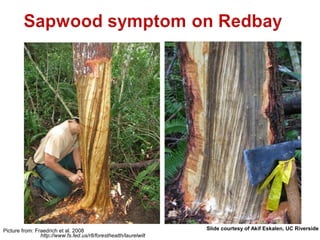
    Picture from: Fraedrichet al. 2008 Slide courtesy of Akif Eskalen, UC Riverside http://www.fs.fed.us/r8/foresthealth/laurelwilt
  • 101.
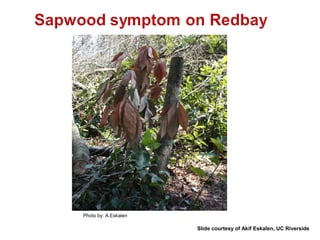
    Photo by: A.Eskalen Slide courtesy of Akif Eskalen, UC Riverside
  • 102.
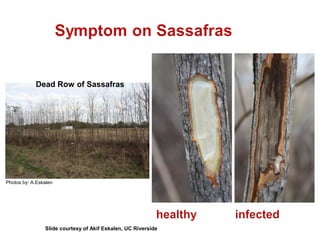
    Dead Row ofSassafras Photos by: A.Eskalen Slide courtesy of Akif Eskalen, UC Riverside
  • 103.
  • 110.
    Avocado (Persea americana) (Ploetz and Pena, 2007) http://www.fs.fed.us/r8/foresthealth/laurelwilt Slide courtesy of Akif Eskalen, UC Riverside
  • 111.
    Laurel wilt diseasecaused by Raffaelea sp. on backyard avocado trees in Florida February 2009, Savannah/Florida Photo by: A.Eskalen Slide courtesy of Akif Eskalen, UC Riverside
  • 112.
    Photos by: A.Eskalen Laurel wilt disease caused by Raffaelea lauricola on backyard avocado tree in Florida Slide courtesy of Akif Eskalen, UC Riverside
  • 113.
    If the treeis wilted in a large proportion of its crown, and has black discoloration in the sapwood, it is likely infected with the laurel wilt fungus. Notify your local county agent for confirmation Photos by: A.Eskalen Slide courtesy of Akif Eskalen, UC Riverside
  • 114.
    California Avocado Commission& Avocado growers Virginia McDonald Shannon C. Lynch Ben Faber Gary Bender Mary Bianchi From University of Florida Randy Ploetz Jonathan Crane Jorge Pena Slide courtesy of Akif Eskalen, UC Riverside
  • 115.
    Tree injury andmortality associated with the polyphagous shot hole borer in southern California Tom W. Coleman1 and Steven J. Seybold2 1USDA Forest Service, Forest Health Protection, San Bernardino, CA 2USDA Forest Service Pacific Southwest Research Station, Davis, CA
  • 116.
    Polyphagous shot holeborer (PSHB), Euwallacea sp. CA FL • First detected in California in 2003 – Whittier Narrows Recreation Area (LA Co.). This insect/disease complex was not linked to tree injury and mortality until 2012 in LA Co. • PSHB in California was believed initially to be the tea shot hole borer, Euwallacea fornicatus, which had been introduced into Florida • Recent molecular analyses suggest that the CA species of Euwallacea may be a new species (R. Stouthamer Laboratory, UCR) – The same species attacks hardwood trees and shrubs in Israel
  • 117.
    Polyphagous shot holeborer (PSHB) and Fusarium dieback (Fusarium euwallacea) • Polyphagous shot hole borer, Euwallacea sp. – Similar to tea shot hole borer in FL • Fusarium dieback, Fusarium euwallacea – Same insect-disease complex found in Israel
  • 118.
    Current distribution ofPSHB in CA • El Cajon (San Diego Co.): Recent detection of PSHB
  • 119.
    Polyphagous shot holeborer An ambrosia beetle • Length: Females ~2.6 mm; Males ~ 1.1 mm • Sex ratio highly skewed toward females • Sibling mating occurs in galleries • Males are flightless; rarely leave galleries • Two to four gen/yr
  • 120.
    PSHB entrance/emergence holes • Attacks found from the root collar to smaller branches Sycamore Box elder Coast live oak Box elder
  • 121.
    PSHB injury symptoms • Dark-colored bark staining, gumming, and sugaring • Attacks frequently observed on the main stem and larger branches
  • 122.
    PSHB injury symptoms • White- and tan-colored boring dust • Can appear as string-like projections from the tree • Boring dust observed frequently at the base
  • 123.
    PSHB injury symptoms • Crown dieback and thinning • Epicormic and basal sprouting
  • 124.
    PSHB injury symptoms • Branching dark-stained galleries • Galleries can penetrate to a depth of 8 cm into the xylem
  • 125.
    Tree mortality associatedwith the PSHB • Observed tree mortality – Box elder – Castor bean – Red willow – California sycamore – English oak – White alder • Significant branch dieback/failure – English oak – Coast live oak – Avocado
  • 126.
    Fungi associated withPSHB • An new species of Fusarium and Graphium associated with Euwallacea sp. – Eskalen (UCR) is conducting virulence tests with each fungus • The same Fusarium euwallacea is found in CA and Israel
  • 127.
    PSHB hosts-primarily ornamentalspecies 1. Box elder, Acer negundo 2. Castorbean, Ricinus communis 3. Avocado, Persea americana 4. English oak, Quercus robur 5. Coast live oak, Quercus agrifolia 6. California Sycamore, Platanus racemosa 7. Big leaf maple, Acer macrophyllum 8. Mimosa, Albizia julibrissin 9. Coral tree, Erythrina corallodendon 10. Titoki, Alectryon excelsus 11. Blue palo verde, Parkinsonia florida 12. Tortuosa, Salix matsudana 13. Weeping willow, Salix babylonica 14. Red willow, Salix laevigata 15. Trident maple, Acer buergerianum 16. Japanese maple, Acer palmatum 17. Evergreen maple, Acer paxii 18. Chinese holly, Ilex cornuta 19. Brea, Cercidium sonorae 20. Black bean, Castanospermum australe 21. Camellia, Camellia semiserrata 22. Cork oak, Quercus suber 23. Valley oak, Quercus lobata 24. Engelmann oak, Quercus engelmannii 25. White alder, Alnus rhombifolia • Host susceptibility varies • Will attack numerous hardwood species, but can’t develop in these trees
  • 128.
    Why are weconcerned about PSHB in CA? • PSHB attacks avocados • California produces 90% of the nation’s avocado crop • ~21,000 ha of avocados planted from San Luis Obispo to San Diego • Crop valued at $382,000,000/yr • And, avocados taste good
  • 129.
    Native hardwood standsin southern California
  • 130.
    PSHB also attacksand kills our native riparian trees Red willow White alder California sycamore
  • 131.
    Summary • PSHBis already impacting the native hardwood stands of southern California and the urban areas – Loss of hardwood stands can impact wildlife and threatened and endangered species – Willow flycatcher, bell vireo, Arroyo toad, yellow-legged frogs, western yellow-billed cuckoo, gray vireo, 3 bat species, and 6 snake species • Its impact may be more prevalent in lower elevation hardwood stands on California sycamore, castorbean, and willow spp. – All size classes appear to be susceptible
  • 132.
    GGoollddssppootttteedd OOaakk BBoorreerr((GGSSOOBB)) AAggrriilluuss aauurroogguuttttaattuuss CCoolleeoopptteerraa:: BBuupprreessttiiddaaee 132 Photo courtesy of UCANR
  • 133.
    GGSSOOBB FFiirrsstt NNoottiicceeddiinn 22000044 133 The goldspotted oak borer (GSOB), Agrilus auroguttatus (Coleoptera: Buprestidae), is a flatheaded borer introduced to San Diego County, California, in the late 1990s or early 2000s and also detected at one site in Riverside County in 2012. It was likely brought into the state on oak firewood collected and transported from the insect’s native range in southeastern Arizona or northern Mexico. Typical damage associated with GSOB-infested trees includes crown thinning and dieback, bark staining on the main stem, bark injury from woodpecker foraging, and D-shaped emergence holes on the main stem and larger branches of the tree. Following several years of extensive and repeated bouts of injury from larval feeding, tree health declines, and trees eventually die. As of 2010, GSOB has killed an estimated 21,500 trees covering 1,893 square miles in San Diego County in forests, parks, and residential landscapes.
  • 134.
    134 Photo courtesyof UNCE GSOB larva with gallery in the cambium Photo courtesy of UCR Applied Biocontrol GSOB pupae Relative size of GSOB
  • 135.
    135 Image thanksto RK Design
  • 136.
    GGSSOOBB DDaammaaggee Photocourtesy of Center for Invasive Species UCR 136
  • 137.
    GGSSOOBB DDaammaaggee 137 Photos courtesy of Arborwell Photo by Tom Coleman USDAFS GSOB D shaped exit holes GSOB galleries in the phloem
  • 138.
    GGSSOOBB DDaammaaggee 138 Photo by Tom Coleman USDA FS
  • 139.
    GGSSOOBB PPrreeffeerrrreedd SSppeecciieess 139 The insects attack coast live oak (Quercus agrifolia), California black oak (Quercus kelloggii), interior live oak (Quercus chrysolepis), and in rare cases Engelmann oak (Quercus engelmannii). They have killed over 80,000 native oaks so far.
  • 140.
    GGSSOOBB CCoonnttrrooll SSttrraatteeggiieess 140 Don’t move fire wood from infested area Grinding infest wood destroys the larvae Biocontrol with 2 species of hymenoptera Woodpeckers Systemic insecticides
  • 141.
    Boxwood Blight Cylindrocladium pseudonaviculatum Identified by: Crous, J.Z., Groenew., & C.F. Hill 2002 A new Ascomycete fungus White Cylindrocladium sporodochia producing conidia on a boxwood stem Photo courtesy of Elizabeth Bush, Virginia Tech
  • 142.
    Boxwood Blight Thenew disease of boxwood was first observed in 1994 in the UK, and a more severe outbreak occurred in 1997. Although the pathogen is considered to have been recently introduced there, it was already widespread in the UK by 2000. An isolate from New Zealand was determined to be of the same species and closely related to the strains in the UK. Reports of C. pseudonaviculatum have since come from Belgium, Ireland, Germany, and the Netherlands, Italy, Austria, and Spain.
  • 143.
    Map courtesy ofOnline Atlas of the British and Irish Flora Origin of boxwood blight Native distribution of Buxus sempervirens in the United Kingdom and Ireland Boxwood blight first found in Hampshire, England, in 1994
  • 144.
    The causal fungus Cylindrocladium pseudonaviculatum Conidia and phialides (spore producing tips) Conidiophores producing conidia (spores) Photos courtesy of the USDA-ARS Systematic Mycology & Microbiology Lab
  • 145.
    Disease Spread Theprimary way this disease spread throughout Europe was the movement of infected plants and cuttings. Another significant way this disease spreads is through contaminated tools and workers as well as by movement of boxwood debris (especially fallen leaves). Human activities such as pruning also contribute to spread. The sticky fungal spores are readily moved on contaminated tools and equipment, on workers and animals that come into contact with infected foliage. The greatest potential for long distance transport of box blight ‐ is the movement of infected plants, cuttings, people and tools. Photo courtesy of Garden World Discussion Photo courtesy of the Canadian Nursery Certification Institute
  • 146.
    New infections arecaused when spores move from infected plants in wind-driven rain or water splashed from overhead irrigation. The spores require free water or high humidity to germinate and cause infection. Microsclerotia are hard fungal masses that develop in diseased tissue, especially, in fallen leaves. These structures, in other species of Cylindrocladium, have shown an ability to survive in soil and detritus for 10 years or more. Any method to significantly reduce the viability of these structures is a useful tool to a grower who has had to deal with this pathogen in the field, especially if they intend to grow boxwoods again. Photo by S. M. Weeda and N. L. Dart Epidemiology Infection by conidia Microsclerotia production Photo Provided by Connecticut Agricultural Experiment Station
  • 147.
    Photo by B.Henricot The foliage typically becomes blighted, causing the leaves to turn ‘straw’ to light brown in color. These leaves will defoliate, making the plant unsalable. Often the stems of blighted boxwoods will remain green under the outer bark until a secondary invader or opportunistic pathogen attacks this tissue, eventually killing the entire plant. Symptoms
  • 148.
    2011: the fungusarrives in the US How the fungus arrived in the North America is unclear, but by 2011, it had been found in CT, MA, MD, NC, NY, OR, PA, RI, VA, Ontario, Quebec, and British Columbia. It was found in three nurseries in Oregon in December 2011. To date boxwood blight is known to infect all species of boxwood, Buxus spp. and Pachysandra spp. in landscapes, garden centers, and Photo by Ruud Morijn nurseries. A boxwood nursery in the Netherlands
  • 149.
    Control •Inspect newplants Photo courtesy of Herrenhausen Garten, Hannover BRD and cuttings; only buy from reputable nurseries. •Isolate new plants from other boxwoods for at least one month, longer if possible. •Avoid overhead watering. •Avoid working around wet boxwood. •Never compost infected material. Destruction of boxwood hedges by boxwood blight at the Herrenhausen Garden in Hannover, Germany
  • 150.
    150 A Consortiumof Regional Networks www.npdn.org www.wpdn.org SSaammppllee SSuubbmmiissssiioonn:: QQuuaalliittyy aanndd SSeeccuurriittyy
  • 151.
    151 Foliage diseases SSaammppllee QQuuaalliittyy:: DDiisseeaasseess mmaayy bbee oonn aannyy ppllaanntt ppaarrtt Lesions / Damage on trunk?
  • 152.
    DDiiggiittaall DDiiaaggnnoossiiss Takeat least 5 photos – close up 152 and at a distance
  • 153.
    SSaammppllee QQuuaalliittyy Avoiddead plants Dead Plants Tell No Tales!
  • 154.
    154 ►Put yoursamples in a cold box! ►Have Ziploc baggies ►Bring several Sharpies
  • 155.
    155 SSaammppllee QQuuaalliittyy:: GGoooodd PPaacckkaaggiinngg Dry paper to protect leaves from contact with plastic bag Plastic bag to keep soil on roots
  • 156.
    Quality aanndd SSeeccuurreeSSaammppllee SSuubbmmiissssiioonn:: 156 IINNSSEECCTTSS Most insects can be preserved in a vial with 70% isopropyl alcohol
  • 157.
    157 SSeeccuurree SSaammpplleeSSuubbmmiissssiioonn Furnish all relevant information to the Ag Commissioner’s office: ►your contact information ►location, name of grower/owner, date found ►extent of damage, incidence and severity data ►more information means faster, better diagnosis
  • 158.
    158 Rick Bostock WPDN Regional Director UCD 530-752-4269 rmbostock@ucdavis.edu Carla Thomas WPDN Deputy Director UCD 530-304-0689 cthomas@ucdavis.edu Marty Draper NPDN Project Leader mdraper@nifa.usda.gov Richard Hoenisch NPDN Education Coordinator UCD 530-754-2255 rwhoenisch@ucdavis.edu
  • 159.

Editor's Notes

  • #6 The responsibilities of the NPDN include: Providing secure communications during outbreaks This involves keeping information confidential and communicating all pertinent information to the appropriate people. Creating information storage and management Information is stored in a repository through the Center of Environmental and Regulatory Information Systems (CERIS) at Purdue University Analysis of data collected at a national repository The data collected in the repository must be analyzed for improving the NPDN’s impact, efficacy, and efficiency Providing first detectors and others with up to date alerts and reporting NPDN Newsletters are published on a monthly basis. Sign up to receive the newsletters at http://www.npdn.org/newsletter Providing training to first detectors and diagnosticians These responsibilities in combination support the overall mission of the NPDN by minimizing impact. References: National Plant Diagnostic Network. Five-Year Review. Report of the Review Panel. June12, 2007. http://www.npdn.org/webfm_send/3 Accessed: August 25, 2012. National Plant Diagnostic Network. CSREES NPDN Review. A Record of Accomplishment. January 2007. http://www.npdn.org/webfm_send/2 Accessed: August 26, 2012 Impacts of the National Plant Diagnostic Network. http://www.npdn.org/webfm_send/1707 Accessed: August 26, 2012
  • #8 First Detectors are made up of all types of people in agriculture, horticulture, and regulatory people. They are agricultural professionals
  • #10 A First Detector Certificate will be sent to you. It is a reminder of your training today and participation in this growing network.
  • #20 http://en.wikipedia.org/wiki/James_Cook
  • #22 http://en.wikipedia.org/wiki/Engelbert_Kaempfer
  • #23 http://www.arboretum.harvard.edu/plants/plants.html http://en.wikipedia.org/wiki/Metasequoia
  • #27 So in summary, NPDN detects, diagnoses, communicates and coordinates and analyzes data. Response to detections is conducted by state departments of agriculture and APHIS with assistance from the university specialists, extension and NPDN.
  • #47 The ALB undergoes a complete metamorphosis.  Mating Asian long-horned beetles begin mating once they have emerged from the pupa stage and become adult beetles. After mating, the male Asian long-horned beetle guards the female against other male beetles in order to ensure that his sperm will fertilize the female's egg. Eggs Female Asian long-horned beetles chew small holes or grooves into the bark of trees. They then lays eggs one at a time into grooves or holes. The eggs are off-white in color, oblong in shape and approximately 1/4 inch in length. The eggs are also concave at either end. After the female beetle has laid her eggs, she covers the hole with digested wood called "frass." Larvae Approximately 11 days after the female beetle lays her eggs, the larvae emerge from the eggs. Asian long-horned beetle larvae measure about 2 inches long. The Asian longhorned beetle larvae feed on the cambium of trees. The larvae molt two times. As they grow, they burrow further into the tree as they eat. The larvae then make a chamber within the tree in order to pupate. Pupae The Asian longhorned beetle pupae are off-white in color. The pupa stage lasts for about 20 days. The pupae are approximately 1 1/4 inches long and 1/2 inch wide. The pupae have a protruding abdominal structure on the eighth body segment. Adults Adult Asian longhorned beetles are shiny black in color with white or yellow spots. They have two long antennae, each with 11 segments. The male beetle's antennae have white bands on them and are almost two times as long as its body. Adult beetles measure about 1/4 to 1/2 inch wide and 3/4 to 1 1/4 inches long. Asian longhorned beetles only live to be about 42 days old. Read more: Asian Longhorned Beetle Life Cycle | eHow.com http://www.ehow.com/about_6619829_asian-longhorned-beetle-life-cycle.html#ixzz0w93LYPwK
  • #49 Adults are easy to identify: 1 to 1 ½ inches in length Long antennae banded with black and white (longer than the insect’s body) Shiny jet black body with distinctive white spots Six legs May have blue color on feet
  • #52 http://www.aphis.usda.gov/plant_health/plant_pest_info/asian_lhb/downloads/hostlist.pdf
  • #56 Adult beetles average 3/8 inch to 3/4 inch (10 mm to 20 mm) long and 1/6 inch (4 mm) wide (males are slightly smaller than females). EAB have dark metallic emerald green wing covers with bronze, golden, or reddish-green bodies. The dorsal side of the abdomen, which can be seen when the wings are spread, is a metallic purplish red. EAB generally have a 1-year life cycle, emerging from beneath the bark of ash trees from late-May through early-June with peak activity between mid-June and early-July, tapering off by the middle of August. Adult beetles are most active during the day and favor sunny, warm weather, sheltering in bark crevices or under foliage when it is rainy, windy or cooler. The life span of adult EAB is about 3 weeks.
  • #70 Walnuts (genus Juglans) are plants in the family Juglandaceae. They are deciduous trees, 10–40 meters tall (about 30–130 ft), with pinnate leaves 200–900 millimetres long (7–35 in), with 5–25 leaflets; the shoots have chambered pith, a character shared with the wingnuts (Pterocarya), but not the hickories (Carya) in the same family. The 21 species in the genus range across the north temperate Old World from southeast Europe east to Japan, and more widely in the New World from southeast Canada west to California and south to Argentina. The Latin name, Juglans, derives from Jupiter glans, "Jupiter's acorn": figuratively, a nut fit for a god. The word walnut derives from Old English wealhhnutu, literally "foreign nut", wealh meaning "foreign" (wealh is akin to the terms Welsh and Vlach;] The walnut was so called because it was introduced from Gaul and Italy. The Latin name for the walnut was nux Gallica, "Gallic nut".[1]
  • #72 Historically, this very small beetle was not considered a parasite of the walnut trees. The walnut twig borer, Pityophthorus juglandis, is native to California, the the southern borders of Arizona and New Mexico, and the corresponding border areas of northern Mexico, where their original hosts were black western walnut trees. The extensive ornamental plantations of the black walnut of the east and the English walnut in the western USA have provided the new hosts. This assumption si that “thousand cankers of walnut ” only happen in the walnut species, Juglans.
  • #73 http://entomology.ucdavis.edu/news/walnuttwigbeetle.html
  • #75 What to look for: At a distance, the initial symptoms of thousand cankers can include dying branches (b). At closer examination, the surface of the bark on the branches of the tree reveals tiny pin-sized entrance holes of the beetle and the sap exuding from them and a staining , that is frequently near the cankers in underlying cambium (C, D). The WTB populations make numerous feeding and the reproductive galleries, around which the cankers’ form, then are united, and surrounded the branches and the twigs die.
  • #80 Epidemiology-Dutch Elm Disease vs. Thousand Cankers Disease Involvement of the pathogen DED. Ophiostoma novo-ulmi develops within the vascular system of the plant and can move quickly throughout a tree, including into roots. TCD. Geosmithia morbida is restricted to the phloem and outer tree bark (and later the cambium) producing localized cankers. Role of Root Grafts DED. Root graft transmission can be a very important means of DED-spread. TCD. Root graft transmission does not occur. Association of the Pathogen with the Beetle Vector DED. Ophiostoma novo-ulmi is only incidentally associated with the Scolytus spp. vectors, via attachment of spores when beetles develop within a DED-infected wood. The bark beetles will develop in damaged limbs and dying trees or recently felled logs, regardless of whether DED is present. In areas where DED is well managed, essentially no beetles carry the O. nova-ulmi pathogen. TCD. Geosmithia morbida is consistently associated with the walnut twig beetle. It is a very common and perhaps invariable fungal associate of walnut twig beetles. It is possible that the two organisms have a mutualistic association, as occurs with some bark beetles. Speed of Symptom Development DED. Infections resulting from twig-feeding by infective bark beetles initially produce a limited area of crown flagging. As the fungus moves within the plant symptoms progress and trees will usually die within 1-2 years following initial infection. Infection via root grafts may result in more rapid tree death. TCD. Symptoms develop from the cumulative effects of multiple canker production, resulting from very large numbers of individual inoculations by G. morbida-carrying walnut twig beetles. External symptoms of infection, e.g., flagging, will not occur until sufficient numbers of cankers have been present to produce girdling.
  • #88 Eastern black most susceptible. English weakened, but not always, even young vigorous trees. Just confirmed in SJ Nov 2011
  • #89 Applied sprays (e.g., permethrin, bifenthrin) or soil drench systemic insecticides (e.g., imidacloprid) to kill the walnut twig beetle (Pityophthorus juglandis). The walnut twig beetle is the vector of Geosmithia morbida, the fungal associate that produces bark cankers that most define the course of TCD infections. These beetle-targeted insecticide applications have apparently had only limited effectiveness and, at best, have been able only to slow the TCD progress. Sanitation has also been considered for TCD management. The effectiveness of sanitation for managing some shade tree diseases is well illustrated with Dutch elm disease (DED), a devastating disease of American elm (Ulmus americana) that similarly involves a pathogenic fungus (Ophiostoma novo-ulmi) and a bark beetle vector (Scolytus multistriatus; probably Scolytus schevyrewii). Indeed, the adoption of sanitation and other management practices for DED was a key event in the development modern urban forestry. However, the epidemiology of thousand cankers disease differs in many respects from that of Dutch Elm Disease. It is important to recognize these differences to understand how management, including sanitation, may differ for these two urban tree problems.
  • #90 Because of the very high value of black walnut logs, salvage often will be attempted. If logs cut from TCD-infective trees are recovered, they should be handled in a manner that prevents beetle dispersal until the wood no long supports further walnut twig beetle development. Until sufficiently dried (2, perhaps 3 years under normal conditions) they should be isolated. Isolation can be achieved largely by stockpiling wood in a site that is distant from healthy walnuts, particularly walnuts located down wind. Storage of logs in buildings can achieve beetle containment. Tarping logs with clear plastic also may contain beetles within logs. Tarping to achieve solarization also would likely be a means to kill developing beetles. http://www.coloradotrees.org/News/Thousand%20Cankers%20Disease%209-09.pdf
  • #95 Like many other non-native wood-boring beetles SWPM is routinely used to ship goods internationally, but these materials can harbor unwanted wood-inhabiting pests if they are not properly treated before export.
  • #96 they feed on the fungi growing on the wood.
  • #104 http://www.mfc.state.ms.us/fh_laurel_wilt.htm
  • #111 Insect live in woody tissues and distribute the disease. Recently a new avocado wilting disease was reported in Florida which is also known as laurel wilt disease caused by a Raffaelea laurelensis. Laurel wilt is a vascular disease of redbay (Persea borbonia (L.) Spreng.) and other plants in the family Lauraceae. The fungus is vectored by a non-native insect of Asian origin, the redbay ambrosia beetle (Xyleborus glabratus Eichhoff). (Mayfield et al. 2008; Fraedrich et al. 2008; Kubono and Ito, 2002).
  • #117 The two species are morphological indistinguishable TSB was introduced into Australia, Madagascar, Panama, several islands of the Indian and Pacific oceans, Hawaii, and Florida TSB has not been associated with any significant tree mortality in Florida
  • #129 Doesn’t seem to prefer avocado trees –production loss, little mortality
  • #132 Spread quickly
  • #133 This beetle is different than typical wood-boring bugs because it doesn't feed on dead, dying or recently killed trees. It attacks healthy, mature oaks on main stems and large branches.  Larvae feed on the underside of the bark, causing strips or patches of the tree to die - eventually killing the entire tree after repeated attacks. Infestations have been identified in Julian, Alpine, Pine Valley, Descanso and the Morena Village area on private land as well as land owned by the County, state and federal governments.  The damage is seen in several types of oaks, including the coast live oak, canyon live oak and California black oak. Experts think the gold-spotted oak borer may have spread to San Diego County under the bark of firewood, and the public is urged not to transport firewood in and out of the county until more is known about the pest. Residents who find the insects should contact the County of San Diego Department of Agriculture, Weights and Measures.  The department would like samples sent or delivered to one of their offices.
  • #137 there is another beetle, the western oak bark beetle and its associated fungus, that has been shown to be an even bigger player in the death of multiple species of oaks across ALL of southern Calif. This beetle attacks the upper half of the trees in great numbers. Initial egg chambers have a pre-deposited fungus that begins digestion of surrounding tissue. This fungus sends its hypae into the xyleme where water transport is disrupted. Simultaniously, the eggs hatch and cambium feeding begins by the grubs. usually by this time the tree has turned brown and is at its highest level of beetle and brood population. failure to act on early symptoms can lead to a population bloom and a "Domino Effect" in your forest!!!
  • #142 A leaf and twig blight disease of Buxus spp. was found to be associated with a new species of Cylindrocladium. The novel species status was confirmed using morphological characters, sequencing of the ribosomal 5.8S RNA gene and the flanking internal transcribed spacers (ITS), the β-tubulin gene, and the high mobility group (HMG) of the MAT2 mating type gene. Cylindrocladium buxicola is proposed as a new name. Fifteen isolates from the UK and one isolate from New Zealand were paired in all combinations but no fertile perithecia were obtained suggesting that C. buxicola is heterothallic and all isolates belonged to one mating type. AFLP analysis showed that the isolates collected in the UK and New Zealand are genetically homogenous. Phylogenetic analyses indicated that this species falls within a new lineage.
  • #145 C. buxicola is an anamorphic species in a genus of common ascomycete plant pathogens. It was identified relatively recently in the UK, as an introduced species causing a devastating shoot blight of boxwood [Buxus spp.] plants that are commonly used in gardens and landscaping. The full extent of its host range is not known, but Buxus species from different continents were found to be susceptible (Henricot et al., 2008). It was placed on the EPPO Alert list in 2004, as it appeared to be spreading to the mainland (EPPO, 2009a), and removed from the list in 2008. This pathogen has been reported from additional European countries in recent years, and may have been transported in asymptomatic infected plants or propagating materials. It survives well in plant debris and probably also in soil. © CAB International 2013 http://www.cabi.org/isc/?compid=5&dsid=17414&loadmodule=datasheet&page=481&site=144
  • #148 In late 1994, a new blight disease of boxwood was discovered in a nursery in Hampshire (UK). No additional new cases were reported until 1997 when a sudden outbreak of the disease was noticed (Henricot et al 2000⇓). The symptoms of the disease are dark brown spots on the leaves, black streaks on the stems and severe defoliation. http://www.mycologia.org/content/94/6/980.full
  • #152 Check the entire plant for symptoms and damage.
  • #154 Avoid dry or dead plants, select plants that show various stages of symptom development. If the plant is dried up, it is very hard to tell the symptoms. And, if the plant is dried up, so also the insect or pathogen. A cool box is important to keep the samples fresh and protected. Even in cool weather the heat inside a car or truck can dry out the sample
  • #156 This is an example of how to wrap the soil and roots separately from the upper plant then wrap the whole plant in another set of bags. Note paper towel around leaves and inside bag.
  • #157 Also, most adult (hard-bodied) insects can be effectively preserved by freezing. However, Lepidopteran caterpillars require boiling in water. Bring the water to a boil and them put the caterpillar in for one minute.
  • #159 Key contacts for the Western Region Plant Diagnostic Network.