Posture and Eye Contact
International Marketing Presentation Skills
Michelle Li
2017
The Physical Message
 Close your book and write down definitions or
key words associated with each of the
following term:
 Posture
 Eye Contact
 Gestures
 Voice Inflection
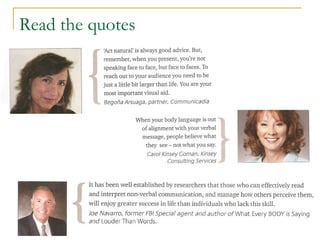
Read the quotes
Why is the Physical Message important?
 A good Physical Message sends a confident,
positive, energetic and enthusiastic message to the
audience.
 Physical Message is indeed a means of
communicating information, sometimes as quickly
and as efficiently as the verbal message.
 You can use the Physical Message to fall back on if
your language skills fail.
Physical message pairwork
Posture and Eye Contact
 used to indicate our readiness to do
something
Negative Messages
 We all have little nervous habits that we
should be aware of and that we should
control to become better public speakers.
 Could be read as
 distracting the audience
 uncertainty
 Lack of knowledge
 plain fear
 will damage the credibility of the speaker’s
message
Posture and Eye contact checklist
 Set your feet
 Set your hands
 Eye contact
 Presentation voice
 Good morning, my name is _____________.
DVD
 In Episode 1, Lisa will give an informative
speech on her favorite city.
 Close your book and answer the following
questions after the first viewing of the
Episode 1:
 What is the topic of her informative speech?
 How many points does she have?
DVD
 Please complete the evaluation form after the
second viewing of the Episode 1.
Informative Speech
 The speech type
 Give an informative speech is like teaching.
 Your job is to teach something to the
audience.
 The success of your speech depends on
whether the audience learns what you
wanted to teach.
 So you have to be specific.
Informative Speech
 The speech skill
 In an informative speech, eye contacts are
important.
 By watching the audience’s faces, you get to
know whether they understand what you’re
saying.
 Good when the audience nod in agreement
 Bad when the audience look puzzled,
meaning you need to try to explain more.
Informative Speech
 The speech preparation
 Use a quadrant to help you prepare a
presentation on the city you recommend
visiting.
Speech Preparation
 The Four Ps
 Plan
 Prepare
 Practice
 Perform
Your First Try - Plan
 Get a blank paper.
 Draw four quadrants.
 Write our names and the cities you recommend
seeing at the top.
 Look at the example of Lisa. Brainstorm and list at
least 5 items to see in your hometown or city of your
choice.
 Circling two items you recommend seeing.
 Repeat these steps for the other three quadrants.
Your First Try – Prepare
 Prepare your poster or slides
 You could use 4 A4 papers to form your 4
quadrants and make your own poster.
 Or use PowerPoint to prepare your speech
visuals.
Your First Try - Practice
 Do practice the “checklist” from p.12 of your
book.
 When using visuals, please emulate Lisa.
She is a good model.
 She stands parallel to the visual and face the
audience.
 She points to information and then looks at the
audience.
 Please time your speeches. ( 3 minutes for
this speech)
Your First Try - Perform
 Student As are the presenters and use your
visuals to perform your speeches. At the
timer’s signal, you rotate.
 Student Bs are listeners and complete the
evaluation form for each speech (You do not
rotate.)

2018/4/17 unit 1 posture and eye contact

  • 1.
    Posture and EyeContact International Marketing Presentation Skills Michelle Li 2017
  • 2.
    The Physical Message Close your book and write down definitions or key words associated with each of the following term:  Posture  Eye Contact  Gestures  Voice Inflection
  • 3.
  • 4.
    Why is thePhysical Message important?  A good Physical Message sends a confident, positive, energetic and enthusiastic message to the audience.  Physical Message is indeed a means of communicating information, sometimes as quickly and as efficiently as the verbal message.  You can use the Physical Message to fall back on if your language skills fail.
  • 5.
  • 6.
    Posture and EyeContact  used to indicate our readiness to do something
  • 7.
    Negative Messages  Weall have little nervous habits that we should be aware of and that we should control to become better public speakers.  Could be read as  distracting the audience  uncertainty  Lack of knowledge  plain fear  will damage the credibility of the speaker’s message
  • 8.
    Posture and Eyecontact checklist  Set your feet  Set your hands  Eye contact  Presentation voice
  • 9.
     Good morning,my name is _____________.
  • 10.
    DVD  In Episode1, Lisa will give an informative speech on her favorite city.  Close your book and answer the following questions after the first viewing of the Episode 1:  What is the topic of her informative speech?  How many points does she have?
  • 11.
    DVD  Please completethe evaluation form after the second viewing of the Episode 1.
  • 12.
    Informative Speech  Thespeech type  Give an informative speech is like teaching.  Your job is to teach something to the audience.  The success of your speech depends on whether the audience learns what you wanted to teach.  So you have to be specific.
  • 13.
    Informative Speech  Thespeech skill  In an informative speech, eye contacts are important.  By watching the audience’s faces, you get to know whether they understand what you’re saying.  Good when the audience nod in agreement  Bad when the audience look puzzled, meaning you need to try to explain more.
  • 14.
    Informative Speech  Thespeech preparation  Use a quadrant to help you prepare a presentation on the city you recommend visiting.
  • 15.
    Speech Preparation  TheFour Ps  Plan  Prepare  Practice  Perform
  • 16.
    Your First Try- Plan  Get a blank paper.  Draw four quadrants.  Write our names and the cities you recommend seeing at the top.  Look at the example of Lisa. Brainstorm and list at least 5 items to see in your hometown or city of your choice.  Circling two items you recommend seeing.  Repeat these steps for the other three quadrants.
  • 17.
    Your First Try– Prepare  Prepare your poster or slides  You could use 4 A4 papers to form your 4 quadrants and make your own poster.  Or use PowerPoint to prepare your speech visuals.
  • 18.
    Your First Try- Practice  Do practice the “checklist” from p.12 of your book.  When using visuals, please emulate Lisa. She is a good model.  She stands parallel to the visual and face the audience.  She points to information and then looks at the audience.  Please time your speeches. ( 3 minutes for this speech)
  • 19.
    Your First Try- Perform  Student As are the presenters and use your visuals to perform your speeches. At the timer’s signal, you rotate.  Student Bs are listeners and complete the evaluation form for each speech (You do not rotate.)